Virus-Derived Gene Expression and RNA Interference Vector for
Grapevine
Elizabeth G. Kurth,aValera V. Peremyslov,aAlexey I. Prokhnevsky,a* Kristin D. Kasschau,aMarilyn Miller,aJames C. Carrington,a,b* and Valerian V. Doljaa,b
Department of Botany and Plant Pathology, Oregon State University, Corvallis, Oregon, USA,a
andCenter for Genome Research and Biocomputing, Oregon State University, Corvallis, Oregon, USAb
The improvement of the agricultural and wine-making qualities of the grapevine (Vitis vinifera) is hampered by adherence to traditional varieties, the recalcitrance of this plant to genetic modifications, and public resistance to genetically modified organ-ism (GMO) technologies. To address these challenges, we developed an RNA virus-based vector for the introduction of desired traits into grapevine without heritable modifications to the genome. This vector expresses recombinant proteins in the phloem tissue that is involved in sugar transport throughout the plant, from leaves to roots to berries. Furthermore, the vector provides a powerful RNA interference (RNAi) capability of regulating the expression of endogenous genes via virus-induced gene-silenc-ing (VIGS) technology. Additional advantages of this vector include superb genetic capacity and stability, as well as the swiftness of technology implementation. The most significant applications of the viral vector include functional genomics of the grapevine and disease control via RNAi-enabled vaccination against pathogens or invertebrate pests.
G
rapevine (Vitis vinifera) is a plant celebrated for its nutri-tional, cultural, and romantic value, as well as for its multi-billion-dollar economic output (39). Grapevine production and wine consumption are bound to grow along with global economic development (7). The rapid expansion of the grape industry into the New World and China, as well as climate change, pose sub-stantial challenges to traditional viticultural practices. These chal-lenges are exacerbated by the growing spread of pathogens, an early example being the so-called phylloxera plague that came from North America in the late 19th century and devastated wine grapes in Europe (25). More recent epidemics include bacterial Pierce’s disease and viral leafroll disease, which menace grape growers in California and beyond (44,54). Even controlling fa-miliar scourges like powdery mildew becomes more problematic due to the development of fungicide resistance and the undesir-ability of fungicides (18). In addition to avoiding costs associated with the diseases, there is a desire to improve grape varieties for their health benefits and traits, such as antioxidants (including resveratrol) and flavors (4,58).There are two major approaches to improving grapevine, tra-ditional breeding and biotechnology. These approaches are not mutually exclusive, and both will benefit from the availability of grapevine genomic sequences (28,57). However, breeding takes decades and is hardly an option for wine grapes with their cher-ished traditional varieties. Despite substantial progress with grapevine transformation (9), it is still cumbersome (58), whereas wine makers and consumers alike are wary of genetically modified organism (GMO) technology (12,53).
Here, we advance a technology that is reminiscent of plant vaccination in that it uses a live virus to attain desirable traits via either expressing a protein of interest or knocking down gene expression via RNA interference (RNAi). Specifically, we have generated a virus-derived gene expression and regulation vector based on Grapevine leafroll-associated virus-2 (GLRaV-2). This relatively benign, positive-strand RNA virus of the family Clos-teroviridae (13, 33) is spread throughout grape-growing areas worldwide. We have applied a decade’s worth of molecular
re-search to tailor GLRaV-2 to the needs of functional genomics and pathogen control. Because the vector is based on RNA, and be-cause no inheritable modifications are made to the grapevine, a vector-based approach provides a powerful alternative to GMO technology.
MATERIALS AND METHODS
Generation of the virus vector using vine-derived GLRaV-2.The RNA
was isolated from GLRaV-2-infected leaves of a Pinot noir plant from an Oregonian vineyard. Virus-specific oligonucleotides were designed ac-cording to the published GLRaV-2 isolate sequence (33) and used for the reverse transcription-PCR (RT-PCR) amplification of the overlapping cDNAs encompassing the complete genome. The PCR products were se-quenced to obtain a consensus sequence of the natural GLRaV-2 isolate. Unique restriction sites common for the published and natural isolates were used to reassemble a vine-derived GLRaV-2 genome cDNA. For each fragment, clones that conformed to the consensus sequence were used for the full-length cDNA assembly. The gene expression cassette harboring the reporter endoplasmic reticulum (ER)-targeted green fluorescent pro-tein (GFP) open reading frame (ORF) was described earlier (33). The resulting cDNA was designated vLR2-GFP, and the corresponding binary plasmid was mobilized toAgrobacterium tumefaciensEHA105 by electro-poration.
Micropropagation and agroinfiltration.The grapevine plantlets were
cultivated using sterile three-quarter-strength MS medium containing 0.4 mg/liter thiamine, 25 mg/liter inositol, 1 mg/liter indole-3-acetic acid
Received21 February 2012 Accepted12 March 2012
Published ahead of print21 March 2012
Address correspondence to Valerian V. Dolja, [email protected].
* Present address: A. I. Prokhnevsky, Fraunhofer-CMB, Newark, Delaware, USA; J. C. Carrington, Donald Danforth Plant Science Center, St. Louis, Missouri, USA.
E. G. Kurth and V. V. Peremyslov contributed equally to the work.
Supplemental material for this article may be found athttp://jvi.asm.org/.
Copyright © 2012, American Society for Microbiology. All Rights Reserved.
doi:10.1128/JVI.00436-12
The authors have paid a fee to allow immediate free access to this article.
on November 7, 2019 by guest
http://jvi.asm.org/
(IAA), 1.25% sucrose, and it was solidified with 0.175% agar and 0.12% gelzan at pH 5.3. The growth conditions were a 16/8-h light/dark cycle at 23°C. Two- to 4-month-old rooted plants were trimmed and wounded with a 31-guage needle and used for infiltration withAgrobacterium. The bacterial cells were harvested and resuspended in 400 ml (optical density at 600 nm [OD600] of 2.0 for the vector-containing bacterium and 0.4 for
the supplemental bacterium containing GLRaV-2 RNAi suppressor p24) in induction buffer (10 mM morpholineethanesulfonic acid, pH 5.85, 10 mM MgCl2, 150 mM acetosyringone). Plantlets were submerged in
bac-terial suspension and vacuum infiltrated in a nucerite desiccator (Nalgen/ Sybron Corp.) for 10 min, followed by a quick pressure release. Mock-inoculated plants were infiltrated withAgrobacteriumcontaining the p24 expression plasmid only. Infiltrated plants were potted, covered, and al-lowed to recover in a growth chamber for 3 weeks before being moved to a greenhouse. The greenhouse conditions were a 12/12-h light/dark cycle (24/21°C day/night) with a light intensity of⬃400mol m⫺2s⫺1 photo-synthetic photon flux.
Infectivity assays.Plants were screened starting at 1 month
postinoc-ulation (mpi) for GFP expression using epifluorescent (33) or confocal laser-scanning microscopy (42). Imaging was done using detached leaves or bark samples. The RT-PCR analyses were done using primer sets A, B, and C (set A, 5=-GGAAGATTACGAAGAAAAATCC and 5=-CTCTTCAC CGCTTCTCTCACTCCC; set B, 5=-GCTTAATTAACAATGAAGACT AATC and 5=-AGGAGCCCCTTTCTGCACCAA; set C, 5=-AAGGAATA CTTAGGCGCCGAC and 5=-AGGAGCCCCTTTCTGCACCAA). Set A was designed to amplify a 3=-terminal region of virus genome downstream
from the expression cassette, set B was designed to amplify a region en-compassing most of the GFP and minor capsid protein (CPm) ORFs (Fig. 1A), and set C corresponded to virus genome sequences flanking the en-tire cassette. The expected sizes of the PCR products for vLR2-GFP were 851, 1,230, and 1,458 nucleotides (nt), respectively. For GLRaV-2, these sizes were 851 and 357 nt for sets A and C, respectively, whereas no prod-uct was expected for set B because one primer corresponded to a cassette sequence. The immunoblotting was done using GLRaV-2-specific poly-clonal rabbit antiserum at a 1:5,000 dilution (33).
The green-to-green grafting was done by the manual cleft graft method using 1- to 3-year-old, virus-free stock and⬃1-year-old vector-infected scions. The union was wrapped with parafilm, and the plants were bagged for 2 weeks for high humidity. Dormant-to-green grafts were obtained by chip-bud grafting. Dormant canes were collected from 1-year-old infected plants, and chip buds were cut and screened for GFP expression before we joined GFP-positive chip buds with virus-free stock plants and then wrapped them with grafting tape.
Engineering of the VIGS (virus-induced gene silencing) vectors and
RNAi assays.A 477-bp-long fragment of an ORF encodingV. vinifera
(Syrah) phytoene desaturase (PDS; locus XM_002264231) in the sense orientation, or a 523-bp-long fragment of this ORF in the antisense ori-entation, was PCR amplified and cloned into the vLR2-GFP cDNA-con-taining plasmid using PacI and FseI sites to replace the GFP ORF. Primers used for the RT-PCR amplification of the cDNA fragments of PDS and ChlI mRNAs isolated from grapevine variety Syrah were 5=-CAGGCCTA CATATATTCTTTGG and 5=-CAGGATGGCCCATATCCCATTT for
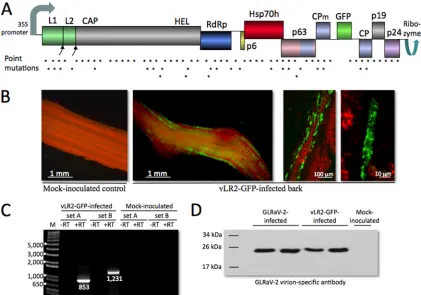
FIG 1Infectivity of the GLRaV-2-derived vector engineered to express GFP (designated vLR2-GFP). (A) Gene map of vLR2-GFP. L1 and L2, papain-like leader proteases; CAP, capping enzyme; HEL, RNA helicase; RdRp, RNA-dependent RNA polymerase; p6, 6-kDa movement protein; Hsp70h, heat shock protein (70-kDa), homolog; p63, 63-kDa virion protein; CPm, minor capsid protein; CP, major capsid protein; p19, 19-kDa protein; p24, 24-kDa RNAi suppressor. Asterisks show the locations of the 75 point mutations present in theN. benthamiana-adapted GLRaV-2. (B) Imaging of the ER-targeted GFP in the inner bark ofV. vinifera(Syrah) plants. The right-most panel shows a single, virus-infected, phloem cell. (C) RT-PCR analysis of the leaf RNA. M, DNA size markers with lengths in base pairs;⫺RT, no-reverse-transcriptase control; sets A and B, primer sets designed to amplify the 3=-terminal region of GLRaV-2 RNA (851 nt) and vLR2-GFP gene expression cassette (1,230 nt), respectively. (D) Immunoblot analysis of the petiole samples from 4 infected and 1 noninfected plant using GLRaV-2-specific antiserum.
on November 7, 2019 by guest
http://jvi.asm.org/
[image:2.585.81.502.66.361.2]PDS and 5=-CTCTCCCTCTTTGTACATGGC and 5=-CAGCGGCAAGC TTTTGGGCCTTT for ChlI. The same fragments were also cloned using the FseI site downstream from the GFP ORF to obtain variants expressing both the GFP and PDS ORF fragments (seeFig. 3A). The same strategy was used to clone the 998-bp sense or antisense fragment of the Chl1 subunit of the magnesium-protoporphyrin IX chelatase (Chl1; locus XM_002276226).
To determine the PDS and ChlI mRNA levels, real-time RT-PCR was done using leaf RNA (8), with modifications. After the first isopropanol extraction, RNA was resuspended in 300l of 0.1⫻Tris-EDTA (TE) buffer and extracted with 1 ml TRIzol and 250l chloroform, followed by two chloroform extractions and then precipitation with isopropanol. Pel-lets were resuspended in 300l 0.1⫻TE, and the protocol was continued through the phenol-chloroform extractions. The RNA was precipitated with 3 M ammonium acetate (NH4OAc) and 2.5 volumes of ethanol.
First-strand cDNA was made using 2g of leaf RNA, Moloney murine leukemia virus (M-MLV) RT, and Invitrogen random hexamer primers (Invitrogen). The real-time PCR was done using a Power SYBR green PCR master mix (Applied Biosystems) and ABI Prism 7500 Fast sequence de-tection system. Primers used for the PCR of PDS and ChlI are listed above; the primers for the amplification of a control ubiquitin cDNA were 5=-CAFCA AACAAGATGCAGGCATC and 5=-GGTGTCTCCGATGGTCCCTTG. The 7500 FAST system software (v.1.4.0) was used for threshold cycle (⌬⌬CT) data analysis;n⫽6 for each experimental or control variant. The
chlorophyll concentration was determined as the OD660. The statistical
analysis was done using an unpaired two-samplettest (two-tailed).
Nucleotide sequence accession number.The newly determined
se-quence in the study was submitted to GenBank under accession number JQ771955.
RESULTS
Host adaptation as a key to generating an efficient virus vector.
Unlike other leafroll viruses that can be propagated only on grape-vine, GLRaV-2 was transmitted to the herbaceous hostNicotiana benthamiana(23), a model plant that is susceptible to a broad range of viruses (21). Using this host, we generated a full-length cDNA clone and engineered the GLRaV-2 gene expression vector designated LR-GFP. This vector infectedN. benthamianaupon agroinoculation and expressed GFP (33). However, LR-GFP was not capable of systemic infection in grapevine, where GLRaV-2 is normally localized to the phloem. As we have demonstrated, the coexpression of the viral RNAi suppressors during agroinocula-tion results in an⬃1,000-fold increase in virus invasiveness (10). Even though GLRaV-2 p24 was among the strongest RNAi sup-pressors, its inclusion did not result in systemic infection.
We reasoned that the inability of a grapevine virus to infect its natural host may be due to a rapid adaptive evolution in a new host, which is typical of RNA viruses (15,31,46). The comparison of the nucleotide sequence of the viral vector to that of the original GLRaV-2 isolate present in a Pinot noir vine revealed 75 point mutations distributed throughout the genome (Fig. 1A). It is plausible that at least a subset of these mutations was responsible for the vector’s loss of infectivity on grapevine following propaga-tion inN. benthamiana. Because mapping the effects of each of these mutations was impractical, we reassembled the entire vector using viral cDNA derived from the infected vine. It is well estab-lished that the populations of RNA viruses represent so-called clouds of viral genomes with one or more mutations compared to the most represented variant (31,46). To ensure that the modified vector corresponded to such a predominant “back-to-the-vine” variant, the cDNA clones with a consensus sequence were used for
reassembling a vector dubbed vLR2-GFP, and the new sequence was submitted to GenBank.
Most of the grapevine viruses are transmitted by arthropods or nematodes or by grafting; none of these pathways is conducive for launching engineered virus vectors from cDNA clones. Agroinfec-tion, whereby virus is launched by Agrobacterium tumefaciens (55), has become a method of choice in plant virus biotechnology (36). Because grapevine leaves are unsuitable for the manual agroinoculation that is used for herbaceous plants, we developed an alternative technique of vacuum infiltration of whole, young, micropropagatedV. viniferaSyrah plants.
At⬃4 weeks postagroinoculation (wpi) with vLR2-GFP, GFP fluorescence was readily detectable in the stem phloem, thus at-testing to the onset of systemic infection (Fig. 1B). The accumu-lation of viral RNA harboring a reporter ORF was validated using RT-PCR (Fig. 1C). Immunoblot analysis showed capsid protein expression levels similar to those in the naturally GLRaV-2-in-fected vines (Fig. 1D). These experiments confirmed the biological activity and utility of the GLRaV-2-based gene expression vector for grapevine.
To determine if the agroinfected plants retained the plasmid containing viral cDNA and if there was the integration of the viral cDNA into grapevine chromosomes, we used PCR analysis. The DNA was isolated from mock- or agroinoculated plants at 1 or 4 months postinoculation (n⫽48), and three distinct primer sets were used for PCR. The PCR product of the expected size was obtained for all 48 samples using primers designed to amplify a fragment of the endogenous grapevine geneSUC2, thus validating the PCR sensitivity (see Fig. S1 in the supplemental material). In contrast, no PCR products were detected in any of the samples when the primer sets specific for vLR2-GFP were used (see Fig. S1). These results demonstrated that no plasmid DNA used to launch viral infection was present in plants at 1 month postagroin-filtration. Moreover, no integration of viral cDNA into the host genome occurred during the 4-month-long infection period. Therefore, we established that the virus-based gene expression occurred exclusively at the RNA level and did not involve the lasting presence of the viral cDNA in either extrachromosomal or genome-integrated form.
Vector transmission to a range of grape varieties.To evaluate the range of grapevine susceptibility to vLR2-GFP, we agroinocu-lated 15 distinct grape varieties (a complete list will be provided on request). In addition to Syrah, Cabernet franc has consistently exhibited a relatively high infection rate. In 15 independent exper-iments involving⬃200 plants of these varieties, this rate averaged
⬃30%. In addition, Zinfandel showed occasional infections, whereas none of the remaining varieties was agroinfected success-fully.
Because the only known mechanism of GLRaV-2 transmission is grafting, we used grafting for launching vLR2-GFP into varieties that were recalcitrant to agroinfection. Strikingly, all six of these wine grape varieties, Cabernet sauvignon, Chardonnay, Gren-ache, Pinot blanc, Sauvignon blanc, and Tempranillo, as well as Freedom, a root stock variety, were successfully infected using wedge or chip bud grafting. Furthermore, the twoVitis labrusca table grape varieties, red Concord and white Himrod, were also susceptible to vLR2-GFP upon graft inoculation. Thus, many wine and table grape varieties, both white and red, support sys-temic infection by the viral vector via agroinoculation, graft inoc-Kurth et al.
on November 7, 2019 by guest
http://jvi.asm.org/
ulation, or both, facilitating the broad commercial application of the vector technology.
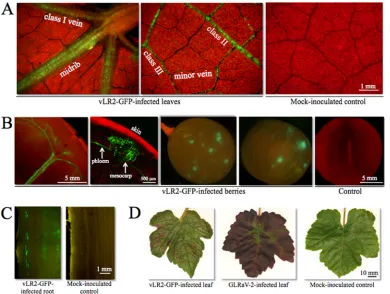
Illuminating the pathway of virus transport in vines. Al-though it is generally accepted that the leafroll viruses are phloem limited, investigating the virus dynamics in the vines has been difficult due to variability in virus accumulation during the grow-ing season. The GFP tagggrow-ing allowed us to visualize virus spread in the vines for the first time. As shown inFig. 1B, vLR2-GFP is detectable initially in the stem phloem, where it replicates in patches of cells distributed along the vascular bundles. Four weeks later, virus enters the petioles and invades leaves via major and then minor veins (Fig. 2A). When berries are formed, vLR2-GFP spreads into some of them through the vascular bundles (Fig. 2B). Surprisingly, in the berries, the virus is not strictly phloem limited; groups of the large mesocarp cells adjacent to phloem also support viral replication (Fig. 2B).
During the first few months postinoculation, the virus stayed in the aerial organs and did not spread to roots. At 6 mpi, the virus was detected in the roots (Fig. 2C) both in plants that went through dormancy period and in those that did not. Therefore, both stems and roots form a reservoir in which the virus can over-winter.
The previous attempts to generate a virus vector for grapevine did not succeed in the consistent systemic expression of a reporter gene, likely due to the aberrant infection (38). By illuminating the entire pathway of virus reproduction and transport, vLR2-GFP provided an invaluable tool for the investigation of the viral colo-nization of the vines during the seasons and in response to
envi-ronmental cues. In turn, the knowledge of virus distribution dy-namics will inform the use of viral vectors for pathogen control.
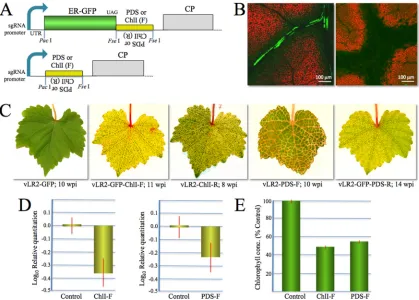
Virus-induced RNAi as a tool of functional genomics. Virus-induced RNAi, or VIGS (virus-Virus-induced gene silencing), is an in-dispensable tool for plant biology (2,5,59). To determine if vLR2-GFP can be used for VIGS, we modified the vector for the simultaneous expression of GFP and an adjacent RNA fragment targeting the endogenous grapevine genes involved in chlorophyll biogenesis. The fragments of the ORFs encoding V. vinifera (Syrah) phytoene desaturase (PDS;⬃500 nt) or subunit I of mag-nesium-protoporphyrin IX chelatase (ChlI;⬃1,000 nt) were in-serted downstream from the GFP ORF (Fig. 3A). Because the in-activation of these genes results in leaf bleaching due to the loss of chlorophyll,PDSandChlIare used as RNAi reporters in diverse plants (20,49). ThePDSandChlIRNAi-triggering sequences were cloned both in sense, or forward (F), and antisense, or reverse (R), orientations. In addition, each of these four inserts was cloned to replace the GFP ORF (Fig. 3A).
Strikingly, each of the 8 generated VIGS vectors elicited leaf bleaching starting at 6 wpi and peaking after 8 wpi (Fig. 3C). This result demonstrated that both sense and antisense RNAi con-structs induced effective VIGS. The dual-purpose vectors express-ing both GFP and RNAi triggers were used to monitor the spread of the virus and RNAi within leaves. Initially, chloroplast bleach-ing was detected in the leaf cells surroundbleach-ing the virus-infected, GFP-expressing cells (Fig. 3B, left; dark areas against normal red chloroplast autofluorescence). Subsequently, the chlorophyll-less areas expanded along the vascular system into the areas that did
FIG 2Distribution pattern and symptoms of vLR2-GFP infection inV. vinifera. (A) Epifluorescence microscopic detection of the green, vLR2-GFP-infected phloem cells in the leaves. (B) Invasion of vLR2-GFP to berries. (C) Spread of vLR2-GFP into root; the inner surface of the root bark was used for epifluorescence microscopy. (D) Symptoms of the interveinal reddening in the infected leaves.
on November 7, 2019 by guest
http://jvi.asm.org/
[image:4.585.99.489.66.360.2]not harbor virus (Fig. 3B, right). This VIGS pattern in grapevine was fully consistent with the cell-to-cell and systemic transport of RNAi signal described forArabidopsis(16,37).
To validate the downregulation of mRNA expression, the levels of ChlI and PDS mRNAs were measured using quantitative PCR. In both cases, a statistically significant, ⬃2-fold reduction in mRNA levels was observed in grapes infected with VIGS vectors compared to control plants (P⫽0.031 and 0.015 for ChlI and PDS mRNAs, respectively) (Fig. 3D). The measurements of chloro-phyll concentration in the leaf extracts were in full accord with mRNA data (P⫽0.00055 and 0.00095 for ChlI-F and vLR2-PDS-F, respectively) (Fig. 3E). We concluded that the virus vector provided a VIGS capability for downregulating the endogenous genes, making it a powerful tool for functional genomics in grape-vine.
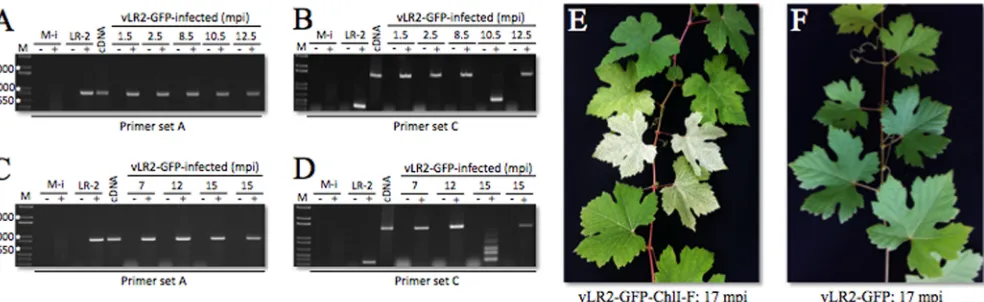
Genetic stability of the viral vector.Due to their high recom-bination rates, virus vectors are notoriously unstable, often losing a gene expression cassette in a matter of days (14,19,43). Such a short time frame is not conducive to using the vector in woody plants. To test the genetic stability of vLR2-GFP, we investigated expression cassette retention over time in Cabernet franc and Syrah using RT-PCR and primer set C flanking the cassette. Primer set A, designed to amplify the genome region outside the cassette, was used as a control. As expected, RT-PCR using set A yielded an identical PCR product in all samples (Fig. 4A and C).
Analysis of the Cabernet franc plants showed the retention of the intact cassette of up to 12.5 months (Fig. 4B). However, in a plant sampled at 10.5 mpi, the intact cassette was present only in a fraction of vector genomes. A similar pattern was observed in vLR2-GFP-infected Syrah plants. Whereas the majority of plants retained the cassette for the entire observation period of 15 months, some of them showed cassette degradation at this latest time point (Fig. 4D).
Our screening of the VIGS-affected plants showed striking bleaching throughout the observation periods of up to 17 months. These phenotypes were observed even after dormancy and ap-peared as periodic patches of bleached leaves, suggesting the de-velopmental regulation of VIGS during the vegetation period (Fig. 4E). Thus, the GLRaV-2 gene expression and VIGS vector dem-onstrated a remarkable durability, with most of the plants show-ing reporter accumulation or VIGS symptoms for more than a year. This durability provides an ample time frame for utilizing the vector to modify grapevine traits or confer resistance to patho-gens during a growing season.
DISCUSSION
The GLRaV-2-derived gene expression and VIGS vector described here has the potential to revolutionize grapevine biotechnology along three avenues of research and application. The first avenue is the investigation of virus-host interactions empowered by the
FIG 3Virus vector-induced VIGS inV. vinifera. (A) Expression cassettes that harbor RNAi-triggering inserts corresponding toV. vinifera PDSorChlI. Inserts were either in forward (F) or reverse (R) orientation and either downstream from the GFP ORF (top) or in place of that ORF (bottom). (B) Imaging of the chlorophyll degradation in response to RNAi targetingPDS. (C) Bleaching symptoms caused by VIGS ofPDSorChlItriggered by F or R vector variants expressing RNAi inserts, with or without the GFP ORF. wpi, weeks postinoculation. (D) Quantification of the ChlI and PDS mRNA levels in the leaves infected with vLR2-ChlI-F and vLR2-PDS-F, respectively, using real-time PCR (n⫽6). (E) Quantification of the chlorophyll levels in the leaves infected with vLR2-ChlI-F and vLR2-PDS-F, respectively (same leaves as in panel D).
Kurth et al.
on November 7, 2019 by guest
http://jvi.asm.org/
[image:5.585.83.502.66.366.2]ability to track virus infection. Our first glance at a pathway of virus transport already yielded surprises, including the virus inva-sion of the roots and berries and exit from the phloem to the mesocarp (Fig. 2). Because GLRaV-2 is strictly limited to phloem in other plant organs, this observation suggests the distinct nature of the plasmodesmata that interconnect berry phloem and meso-carp cells and are involved in pumping sugars. Therefore, the virus follows the entire pathway of sugar transport from leaves to roots to fruit, providing a tool for investigating this pathway via recom-binant protein expression or RNAi.
The ability to follow virus transmission will shed new light on the regulation of virus-host interactions in a woody plant and facilitate the identification of the virus genes involved in these interactions. Our recent work already revealed novel roles for pro-teases that affect GLRaV-2 invasiveness in grapevine (33) and sug-gested such roles for the AlkB RNA repair enzyme encoded by many viruses of woody plants, includingGrapevine leafroll-associ-ated virus-3(56).
The second biotechnology avenue opened up by viral vectors is the functional genomics of grapevine using VIGS. The last decade has witnessed an explosion in the use of VIGS (2,5,59). This facile technology is particularly important for plants with long life cy-cles, such as trees and vines. However, VIGS in woody plants is in its infancy and is trying to find its path through the thicket of technical problems, including the scarcity of known tree-infecting viruses and the vagaries of reintroducing vectors to these well-protected hosts. The VIGS demonstrated here for grapevine (Fig. 3) opens immense opportunities for the functional mapping of the grapevine genome (28,57). Some of the important research areas include (i) the investigation of the sugar transport (30); (ii) metabolomics aimed at improving nutritional, medicinal, and wine-making qualities (50); and (iii) mapping disease resistance and susceptibility genes to control pathogens (18,26,29).
A third avenue of vector utilization is disease protection. The RNAi-susceptible pathogens, such as viruses, fungi, and inverte-brate pests, are potential targets for VIGS. Previously,
transgene-triggered RNAi was used to control plant-parasitic insects (3,35), nematodes (27), and viruses (24). These approaches, although promising, involve labor-intensive GMO technology that is often faced with vocal opposition. In contrast, we have shown here that the RNA virus vector does not integrate into the grape genome, which is in full accord with the absence of any RNA virus se-quences in the grapevine chromosomes despite the prolonged ex-posure of this plant to virus infections (6).
Perhaps the closest analogy to RNA vector technology applied to disease resistance is provided by vaccination against human diseases such as poliomyelitis (32). In both cases the genetically modified, live, attenuated RNA viruses are used to protect the host. Indeed, the insertion of an expression cassette into GLRaV-2 resulted in attenuated symptoms (Fig. 2D) of the already mild disease present and often tolerated throughout grapevine-grow-ing areas. On the other hand, the poliovirus vaccine can protect only against poliomyelitis, whereas VIGS vectors can be used against a broad range of plant pathogens and pests.
The GLRaV-2 vector has several important advantages over other plant virus vectors. Whereas most of these vectors tolerate relatively small inserts (19), our vector can accommodate inserts at least⬃2 kb in size (Fig. 3A). This genetic capacity enables the simultaneous targeting of several pathogens by engineering VIGS cassettes harboring multiple RNAi triggers. The GLRaV-2 vector is also durable for more than a year versus days or weeks, which is typical of other vectors. The only vector comparable to GLRaV-2 in this respect is theCitrus tristezavirus vector that is derived from a related closterovirus (11,17). However, this promising vector could raise biosafety concerns due to potential escape via aphid transmission. In contrast, GLRaV-2 is transmissible only by graft-ing, thus minimizing the risks of inadvertent escape.
Why closterovirus-derived vectors exhibit a remarkably higher genetic stability compared to their competition from other lin-eages of plant RNA viruses is an intriguing evolutionary question. GLRaV-2 replication is prone to point mutations or deletions (this work), whereas the recombination-mediated occurrence of
FIG 4Genetic stability of the viral vector during propagation in theV. viniferaplants. (A and B) Reverse transcription-PCR amplification of the GLRaV-2 or vLR2-GFP genome regions using RNA isolated from the infected Cabernet franc plants. Primer set A (same as that shown inFig. 1C) was used to amplify the 3=-terminal region of GLRaV-2 genome (851 nt long) downstream from the expression cassette insertion site, whereas primers of set C flanked this site. Correspondingly, the resulting amplification products for set C were 357 nt long for the LR2 lacking the cassette and 1,458 nt for vLR2-GFP containing the intact cassette. M-i, mock-inoculated plants; LR2, GLRaV-2-infected plants; cDNA, amplification of vLR2-GFP cDNA clone as a positive control;⫺and⫹,⫺RT or ⫹RT samples; mpi, months postinoculation. White asterisks show 500-, 1,000-, and 2,000-nt-long size markers (from bottom to top). (C and D) Reverse transcription-PCR amplification of the GLRaV-2 or vLR2-GFP genome region using RNA isolated from the infected Syrah plants. Designations are the same as those for panels A and B. (E and F) Images of the vLR2-GFP-ChlI-F-infected or vLR2-GFP-infected Cabernet franc plants, respectively. Note an extensive leaf bleaching phenotype at 17 mpi in panel E but not in panel F.
on November 7, 2019 by guest
http://jvi.asm.org/
[image:6.585.48.540.67.218.2]defective RNAs and chimeric isolates is well documented in di-verse closteroviruses (47, 48). It is possible, however, that (yet uncharacterized) mutation or recombination rates in closterovi-ruses are lower than in other RNA viclosterovi-ruses. This notion is sup-ported by evidence for the proofreading ability of RNA poly-merases in coronaviruses, a family of animal viruses whose large RNA genome evolution shows some analogies to closteroviruses (13,22). A second distinct possibility is that the Hsp70 chaperone-aided assembly of the filamentous closteroviruses (1,41,51,52) alleviates selection for shorter genomes that is typical for spherical or rod-shaped viruses. Finally, as proposed earlier (13), the acqui-sition of strong RNAi suppressors (34,45) and leader proteases (33,40) that counteract distinct host defense mechanisms precon-ditioned closteroviruses for evolving larger genomes and in-creased their tolerance to accommodating larger genetic loads.
In conclusion, the GLRaV-2 vector provides a platform for multiple applications in grapevine functional genomics, biotech-nology, and pathogen control. It also paves the way for generating analogous vectors for other woody plants used in agriculture, for-estry, or the biofuel industry.
ACKNOWLEDGMENTS
This work was supported by contract 2010-744 from Vinoculate, Inc., Soledad, CA, a subcontract from USDA-NIFA (award no. 2009-04401), and BARD award no. IS-4314-10C to V.V.D. The work in J.C.C. lab is supported by NSF award MCB-1231726 and NIH award AI43288.
We are grateful to Robert R. Martin (USDA-ARS) for his advice and for providing plant materials.
REFERENCES
1.Alzhanova DV, Prokhnevsky AI, Peremyslov VV, Dolja VV. 2007. Virion tails of Beet yellows virus: coordinated assembly by three structural proteins. Virology359:220 –226.
2.Baulcombe D.1999. Fast forward genetics based on virus-induced gene silencing. Curr. Opin. Plant Biol.2:109 –113.
3.Baum JA, et al.2007. Control of coleopteran insect pests through RNA interference. Nat. Biotechnol.25:1322–1326.
4.Baur JA, et al.2006. Resveratrol improves health and survival of mice on a high-calorie diet. Nature444:337–342.
5.Becker A, Lange M.2010. VIGS– genomics goes functional. Trends Plant Sci.15:1– 4.
6.Bertsch C, et al.2009. Retention of the virus-derived sequences in the nuclear genome of grapevine as a potential pathway to virus resistance. Biol. Direct4:21.
7.Bisson LF, Waterhouse AL, Ebeler SE, Walker MA, Lapsley JT.2002. The present and future of the international wine industry. Nature418: 696 – 699.
8.Carra A, Gambino G, Schubert A.2007. A cetyltrimethylammonium bromide-based method to extract low-molecular-weight RNA from poly-saccharide-rich plant tissues. Anal. Biochem.360:318 –320.
9.Chaib J, et al.2010. The grape microvine–a model system for rapid forward and reverse genetics of grapevines. Plant J.62:1083–1092. 10. Chiba M, et al.2006. Diverse suppressors of RNA silencing enhance
agroinfection by a viral replicon. Virology346:7–14.
11. Dawson WO.25 October 2011. A personal history of virus-based vector construction. Curr. Top. Microbiol. Immunol. [Epub ahead of print]. 12. DeFrancesco L.2008. Vintage genetic engineering. Nature26:261–263. 13. Dolja VV, Kreuze JF, Valkonen JP.2006. Comparative and functional
genomics of closteroviruses. Virus Res.117:38 –51.
14. Dolja VV, McBride HJ, Carrington JC.1992. Tagging of plant potyvirus replication and movement by insertion of beta-glucuronidase into the viral polyprotein. Proc. Natl. Acad. Sci. U. S. A.89:10208 –10212. 15. Duffy S, Shakelton LA, Holmes EC.2008. Rates of evolutionary change
in viruses: patterns and determinants. Nat. Rev. Genet.9:267–276. 16. Dunoyer P, et al.2010. Small RNA duplexes function as mobile silencing
signals between plant cells. Science328:912–916.
17. Folimonov AS, Folimonova SY, Bar-Joseph M, Dawson WO.2007. A stable RNA virus-based vector for citrus trees. Virology368:205–216. 18. Gadoury DM, et al.2012. Grapevine powdery mildew (Erysiphe necator):
a fascinating system for the study of the biology, ecology and epidemiology of an obligate biotroph. Mol. Plant Pathol.13:1–16.
19. Gleba Y, Klimyuk V, Marillonnet S.2007. Viral vectors for the expression of proteins in plants. Curr. Opin. Biotechnol.18:134 –141.
20. Golenberg EM, et al.2009. Development of a gene silencing DNA vector derived from a broad host range geminivirus. Plant Methods5:9. 21. Goodin MM, Zaitlin D, Naidu RA, Lommel SA.2008. Nicotiana
ben-thamiana: its history and future as a model for plant-pathogen interac-tions. Mol. Plant Microbe Interact.21:1015–1026.
22. Gorbalenya AE, Enjuanes L, Ziebuhr J, Snijder EJ.2006. Nidovirales: evolving the largest RNA virus genome. Virus Res.117:17–37.
23. Goszczynski DE, Kasdorf GGF, Pietersen G, van Tonder H. 1996. Detection of two strains of grapevine leafroll-associated virus 2. Vitis35: 133–135.
24. Gottula J, Fuchs M.2009. Toward a quarter century of pathogen-derived resistance and practical approaches to plant virus disease control. Adv. Virus Res.75:161–183.
25. Granett J, Walker MA, Kocsis L, Omer AD.2001. Biology and manage-ment of grape phylloxera. Annu. Rev. Entomol.46:387– 412.
26. Gust AA, Brunner F, Nurnberger T.2010. Biotechnological concepts for improving plant innate immunity. Curr. Opin. Biotechnol.21:204 –210. 27. Huang G, Allen R, Davis EL, Baum TJ, Hussey RS.2006. Engineering
broad root-knot resistance in transgenic plants by RNAi silencing of a conserved and essential root-knot nematode parasitism gene. Proc. Natl. Acad. Sci. U. S. A.103:14302–14306.
28. Jaillon O, et al.2007. The grapevine genome sequence suggests ancestral hexaploidization in major angiosperm phyla. Nature449:463– 468. 29. Jones JD, Dangl JL.2006. The plant immune system. Nature444:323–
329.
30. Kuhn C, Grof CP.2010. Sucrose transporters of higher plants. Curr. Opin. Plant Biol.13:288 –298.
31. Lauring AS, Andino R.2010. Quasispecies theory and the behavior of RNA viruses. PLoS Pathog.6:e1001005.
32. Lauring AS, Jones JO, Andino R.2010. Rationalizing the development of life attenuated virus vaccines. Nat. Biotechnol.28:573–579.
33. Liu Y-P, Peremyslov VV, Medina V, Dolja VV.2009. Tandem leader proteases of grapevine leafroll-associated virus-2: host-specific functions in the infection cycle. Virology383:291–299.
34. Lu R, et al.2004. Three distinct suppressors of RNA silencing encoded by a 20-kb viral RNA genome. Proc. Natl. Acad. Sci. U. S. A.101:15742– 15747.
35. Mao YB, et al.2007. Silencing a cotton bollworm P450 monooxygenase gene by plant-mediated RNAi impairs larval tolerance of gossypol. Nat. Biotechnol.25:1307–1313.
36. Marillonnet S, Thoeringer C, Kandzia R, Klimyuk V, Gleba Y.2005. Systemic Agrobacterium tumefaciens-mediated transfection of viral rep-licons for efficient transient expression in plants. Nat. Biotechnol.23:718 – 723.
37. Molnar A, et al.2010. Small silencing RNAs in plants are mobile and direct epigenetic modification in recipient cells. Science328:872– 875. 38. Muruganantham M, et al.2009. Grapevine virus A-mediated gene
silenc-ing in Nicotiana benthamiana and Vitis vinifera. J. Virol. Methods155: 167–174.
39. Myles S, et al.2011. Genetic structure and domestication history of the grape. Proc. Natl. Acad. Sci. U. S. A.108:3530 –3535.
40. Peng CW, Peremyslov VV, Mushegian AR, Dawson WO, Dolja VV.
2001. Functional specialization and evolution of leader proteinases in the family closteroviridae. J. Virol.75:12153–12160.
41. Peremyslov VV, et al.2004. Complex molecular architecture of beet yellows virus particles. Proc. Natl. Acad. Sci. U. S. A.101:5030 –5035. 42. Peremyslov VV, Prokhnevsky AI, Dolja VV.2010. Class XI myosins are
required for development, cell expansion, and F-actin organization in Arabidopsis. Plant Cell22:1883–1897.
43. Pogue GP, Lindbo JA, Garder SJ, Fitzmaurice WP.2002. Making an ally from an enemy: plant virology and the new agriculture. Annu. Rev. Phy-topathol.40:45–74.
44. Redak RA, et al.2004. The biology of xylem fluid-feeding insect vectors of Xylella fastidiosa and their relation to disease epidemiology. Annu. Rev. Entomol.49:243–270.
Kurth et al.
on November 7, 2019 by guest
http://jvi.asm.org/
45. Reed JC, et al.2003. Suppressor of RNA silencing encoded by beet yellows virus. Virology306:203–209.
46. Roossinck MJ, Schneider WL.2006. Mutant clouds and occupation of space in plant RNA viruses. Curr. Top. Microbiol. Immunol.299:337–348. 47. Rubio L, et al.2001. Genetic variation of Citrus tristeza virus isolates from
California and Spain: evidence for mixed infections and recombination. J. Virol.75:8054 – 8062.
48. Rubio L, Yeh H-H, Tian T, Falk BW.2000. A heterogeneous population of defective RNAs is associated with lettuce infectious yellows virus. Vi-rology271:205–212.
49. Ruiz MT, Voinnet O, Baulcombe DC.1998. Initiation and maintenance of virus-induced gene silencing. Plant Cell10:937–946.
50. Saito K, Matsuda F.2010. Metabolomics for functional genomics, sys-tems biology, and biotechnology. Annu. Rev. Plant Biol.61:463– 489. 51. Satyanarayana T, Gowda S, Ayllon MA, Dawson WO.2004.
Clostero-virus bipolar virion: evidence for initiation of assembly by minor coat protein and its restriction to the genomic RNA 5=region. Proc. Natl. Acad. Sci. U. S. A.101:799 – 804.
52. Satyanarayana T, et al.2000. Closterovirus encoded HSP70 homolog and p61 in addition to both coat proteins function in efficient virion assembly. Virology278:253–265.
53. Travis J.2008. Uncorking the grape genome. Science320:475– 477. 54. Tsai CW, et al.2008. Transmission of grapevine leafroll-associated virus
3 by the vine mealybug (Planococcus ficus). Phytopathology98:1093– 1098.
55. Tzfira T, Citovsky V.2006. Agrobacterium-mediated genetic transfor-mation of plants: biology and biotechnology. Curr. Opin. Biotechnol.17: 147–154.
56. van den Born E, et al.2008. Viral AlkB proteins repair RNA damage by oxidative demethylation. Nucleic Acids Res.36:5451–5461.
57. Velasco R, et al.2007. A high quality draft consensus sequence of the genome of a heterozygous grapevine variety. PLoS One2:e1326. 58. Vivier MA, Pretorius IS.2002. Genetically tailored grapevines for the
wine industry. Trends Biotechnol.20:472– 478.
59. Waterhouse PM, Helliwell CA.2003. Exploring plant genomes by RNA-induced gene silencing. Nat. Rev. Genet.4:29 –38.