Identifying & profiling potential FIFO workers
Perspectives from Far North Queensland
Summary Report
Identifying & profiling potential FIFO workers
Perspectives from Far North Queensland Summary Report
A research report prepared by:
Josephine Pryce‡ • Riccardo Welters† • Paul Lynch‡ • Laurie Murphy†† • Anna Blackman‡
†
Discipline of Economics, ‡ Discipline of Marketing and Management, †† Discipline of Tourism
© January 2013
ISBN 978-0-9873109-4-1
Acknowledgements
The Cairns Fly In Fly Out (FIFO) Coordinator Project is a two-year pilot project funded by the Commonwealth Government through the Department of Industry, Innovation, Science, Research and Tertiary Education, and this report has been produced with the assistance of that funding provided by the Commonwealth Government.
SkillsDMC, with its project partner Advance Cairns, commissioned The Cairns Institute at James Cook University to undertake two components of research to better understand the strengths and capability of the existing and the potential FIFO workforce based in the Cairns region. JCU would like to acknowledge the support of these organisations, and a group of devoted JCU students who assisted in data collection. Without their support and expertise this project would not have eventuated.
Disclaimer
Executive summary
This report presents the findings from an online survey which sought to determine the demographic characteristics, qualifications, experience and current employment status of workers in the Far North Queensland region who are interested in Fly-In, Fly-Out (FIFO) work. In addition, it aimed to ascertain the level of interest these potential workers had in FIFO work and possible barriers faced in becoming part of the FIFO community. It was anticipated that this information would be able to provide a good indication of the capacity of the potential FIFO workforce and to determine how to facilitate entry for these workers into FIFO work.
Information sessions were held by SkillsDMC so as to create awareness among people in the Cairns region who may be interested in FIFO work about this research and the online survey. These sessions were held in November 2012 in Innisfail (12th, 53 attendees), Malanda (13th, 30 attendees), Mareeba (15th, 45 attendees), and Cairns (20th, 208 attendees). Following the awareness campaigns, the online survey was made available for the months of November and December 2012, during which time 213 respondents participated. The online survey was designed and administered by JCU researchers in consultation with SkillsDMC.
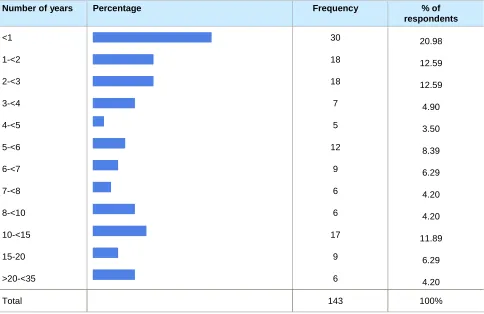
The demographic profile showed that respondents were predominantly employed (76.5%) with almost one third (31.48%) having worked in their current job for between three and ten years in key industries such as mining (16%), construction (16%) and government (16%). The largest proportion of the potential FIFO workers (32.4%) noted their occupations as technicians and trade workers with 18.9% indicating they are professionals, 15.5% managers and 14.2% machinery operators and drivers.
The interest in FIFO work was overwhelming with 95.4% indicating that they were ‘Interested’ or ‘Very interested’ with the majority showing a ranked preference to work in Far North Queensland (91.2%), Northwest Queensland (79.6%), Central Queensland (70.7%), and Northern Territory (70.7%). The main reason advanced for the interest in FIFO work is primarily related to the pay and conditions, followed by rosters and time off, then by opportunities to up skill and retrain.
To date, approaches utilised by potential FIFO workers in seeking FIFO work have mainly included checking of online career pages (26.5%) and subscription to automatic notification of jobs from online career or company sites (21.5%). Job opportunities for potential FIFO workers seem favourable with one third of respondents (32.5%) having previously worked in a FIFO role with 24 respondents reporting having spent more than three years in a FIFO role; and, with 65.7% of respondents having previously worked in remote communities. Factors impacting on willingness to be deployed were majorly related to ‘travel time’ (64.7%) and ‘conditions’ (64.7%), with other factors being ‘site’ (50.0%), ‘period of employment’ (50.0%) and ‘roster’ (47.1%).
Demographically, respondents principally lived in Cairns (62.9%) with 98.2% or respondents living within two hours driving distance from the Cairns Airport. The potential FIFO workers included 24.8% females and 75.2% males, with the majority (81.7%) of respondents aged between 30 and 59 years. Further to this, 64.8% were in a relationship and 63.6% did not have children.
CONTENTS
Acknowledgements ... i
Executive summary ... ii
Tables ... iv
Figures ... iv
1. Introduction ...1
2. Methodology ...2
Part 1: Demographics of potential FIFO workers ...3
Gender ...3
Age ...3
Citizenship & Indigenous representation ...4
Marital status & children ...5
Location of potential FIFO workers ...6
Part 2: Current employment status of potential FIFO workers ...8
Current industry of work ... 10
Current occupation ... 11
Current tenure ... 11
Been looking for work ... 12
Number of applications lodged ... 12
Part 3: Interest in FIFO work ... 13
Interested in FIFO work ... 13
Willingness to be deployed anywhere in Australia ... 13
Reasons for interest in FIFO work ... 14
Ways of seeking FIFO work ... 15
Preferred geographical regions for FIFO work ... 15
Part 4: Qualifications & experience of potential FIFO workers ... 17
Education & qualifications ... 17
Tickets & licences ... 18
Work experience of potential FIFO workers ... 19
Previous work in FIFO role ... 19
Tables
Table 1: Gender of potential FIFO workers ... 3
Table 2: Ages of potential FIFO workers ... 4
Table 3: Citizenship of potential FIFO workers ... 4
Table 4: Aboriginal or Torres Strait Islander potential FIFO workers ... 5
Table 5: Marital status of potential FIFO workers... 5
Table 6: Dependent children of potential FIFO workers ... 6
Table 7: Driving distance to Cairns Airport ... 7
Table 8: Current employment status of respondents ... 8
Table 9: Paid work previously... 8
Table 10: Length of employment in current job ... 9
Table 11: Current industry of work ... 10
Table 12: Current occupation ... 11
Table 13: Current tenure ... 11
Table 14: Been looking for work ... 12
Table 15: Interest in FIFO work ... 13
Table 16: Deployed anywhere in Australia ... 13
Table 17: Factors impacting on willingness to be deployed ... 14
Table 18: Ways of actively seeking FIFO work ... 15
Table 19: Preferred region for work ... 15
Table 20: Highest level of education ... 17
Table 22: Tickets or Licences held by potential FIFO workers ... 18
Table 23: Other tickets or licences ... 18
Table 24: Work experience of potential FIFO workers ... 19
Table 25: Worked in FIFO role before ... 19
Table 26: Worked in remote communities ... 20
Figures
Figure 1: Map of Cairns Region... 2Figure 2: Location of potential FIFO workers ... 6
Figure 3: Number of applications lodged ... 12
1. Introduction
In September 2009, the Australian Government announced the establishment of the National Resources Sector Employment Taskforce (NRSET) to develop a comprehensive plan to meet the skills needs (at that time) of more than 75 major resources projects expected to commence in Australia over the following five years. The Cairns Fly In Fly Out (FIFO) Coordinator initiative arose from Recommendation 5.4 from the NRSET report and forms part of the National Resource Sector Workforce Strategy launched in March 2011 by the Commonwealth Government. The Cairns FIFO Coordinator Project is being funded by the Commonwealth Government over two years as a pilot project, to develop links between resources projects in remote locations and skilled workers, including local unemployed job-seekers. SkillsDMC launched the Cairns FIFO Coordinator Project in November 2011.
A core objective of the project is to identify the potential FIFO workforce in the Cairns region and to establish a pathway to link this workforce to mining, construction and infrastructure jobs required by existing and emerging resources projects in northern and western Australia. SkillsDMC commissioned The Cairns Institute at James Cook University to undertake research which would help the Project partners, the Commonwealth Government and the region better understand the existing FIFO workforce in the Cairns region, and to identify the skills and experience of job-seekers who have potential to join the FIFO workforce.
To date, there is scant research examining the level of interest amongst workers in local regional communities (such as Cairns) in becoming FIFO workers; there has been little that identifies profiles of potential FIFO workers and their capacity to become FIFO workers; and, limited data that reveals barriers to entry for workers interested in FIFO. Insights into each of these aspects of FIFO work are useful in the development of regional hubs to service the mines with competent, capable and experienced workers. Much of the research focuses on areas outside of Far North Queensland. Hence, gaining data particular to the region and which identifies the specific needs of the region is critical if servicing of the mines by a local workforce is to be achieved.
This report presents key findings from a study of potential FIFO workers in a sample of individuals from Far North Queensland. This report seeks to provide insights into how best to manage the emerging working life of a FIFO worker. It aims to inform individuals, organisations, communities, and governments in the development of policies and practices which will provide sustainable partnerships for all stakeholders.
2. Methodology
This study focused on potential workers in Far North Queensland living in the Cairns region, extending to Innisfail in the south, Mareeba in the west, and Cairns itself as the most northern point (see Figure 1). In reviewing options on how to proceed with this study, it was decided that an online survey would work best to capture a more extensive area around the Cairns region of Far North Queensland, hosted on the website
www.fifocairns.com.au.
Awareness of the online survey was achieved by way of information sessions conducted by SkillsDMC and Advance Cairns during November of 2012. These sessions targeted people who may be interested in FIFO work and were held in Cairns, Mareeba, Innisfail and Malanda (see Figure 1). The survey was open for November and December of 2012, allowing for maximum opportunity for interested FIFO workers to partake. A steady response rate to the online survey persisted throughout this period but peaks in responses corresponded with the information sessions. In all 213 surveys were attempted with participants responding to all questions as relevant to them. For example, some questions such as Q7 (How long have you been out of paid work?) referred only to respondents who answered ‘No’ to Q6.
[image:7.612.223.390.347.635.2]Part 1: Demographics of potential FIFO workers
Gender
The sample of respondents was predominantly male (75.3%), with only one quarter (24.8%) being female (see Table 1). These statistics are consistent with studies which show women working in the mining industry are a minority. Pirotta (2009) explored the experiences of women working in a FIFO capacity and reported that there were positive attractions for women (e.g. financial security, career advancement, sense of adventure, work satisfaction, sense of belonging, and enduring friendships). Conversely, she found that amongst the challenges there were aspects which related to working in an environment which was male-dominated including: coping with male mine site behaviour, being the focus of attention, coping with discrimination and harassment, lack of female contact, lack of privacy, and having to prove themselves. These findings inform recommendations for companies recruiting FIFO workers in ensuring the well-being of all workers, with particular attention to attitudes towards females.
Table 1: Gender of potential FIFO workers
Gender Response %
Female 41 24.8%
Male 124 75.2%
Total 165 100.0%
Age
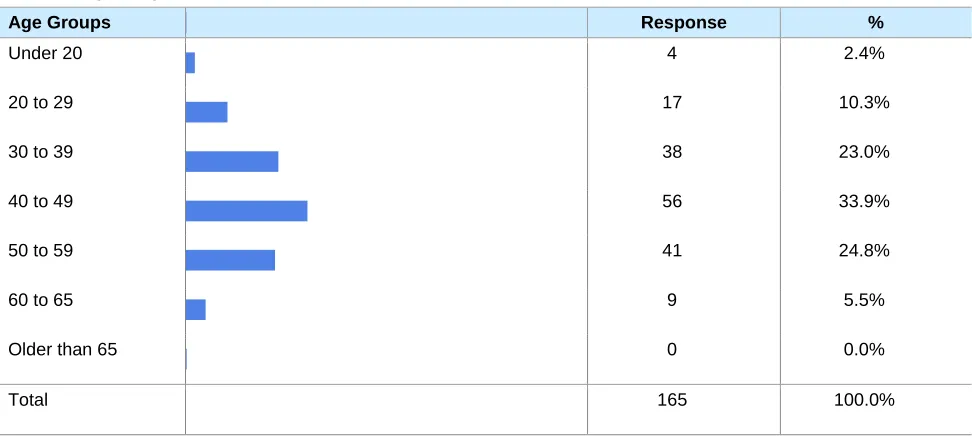
In relation to age, Table 2 shows that the majority of respondents (81.7%) were between 30 and 59 years old with a marginal 10.3% aged between 20 and 29, and minority aged under 20 (2.4%) and ’60 to 65’ (5.5%). With a government focus on ‘Earn and Learn’ the underrepresentation of respondents aged under 20 years of age is not surprising. Equally, despite the ageing workforce, it is reasonable that there is also an underrepresentation of the over 60s because of the demands of FIFO work.
Table 2: Ages of potential FIFO workers
Age Groups Response %
Under 20
4 2.4%
20 to 29 17 10.3%
30 to 39 38 23.0%
40 to 49 56 33.9%
50 to 59 41 24.8%
60 to 65
9 5.5%
Older than 65
0 0.0%
Total 165 100.0%
Citi zenship & Indigenous rep resen tation
[image:9.612.64.550.78.297.2]Further results, showed that respondents were overwhelmingly Australian citizens (98.8%) with 10.9% representation of Aboriginal and Torres Strait Islander people (Tables 3 & 4). In general, the Indigenous labour force is considerably smaller than the non-Indigenous workforce. Hence, the results appear to be indicative of the survey participation. In recent times, Australian mining companies have made a concerted effort to employ Aboriginal and Torres Strait Islander people (Brereton & Parmenter, 2008; Taylor & Scambary). The provision of employment opportunities for indigenous people has been variable but research indicates that the potential for positive outcomes is high. Hence, it is positive to see participation in this survey by indigenous people and their interest should be pursued.
Table 3: Citizenship of potential FIFO workers
Australian Citizen Response %
Yes 163 98.8%
No
2 1.2%
Table 4: Aboriginal or Torres Strait Islander potential FIFO workers Aboriginal or
Torres Strait Islander
Response %
Yes 18 10.9%
No 147 89.1%
Total 165 100.0%
Mari tal status & ch ildren
Relationship issues are often targeted as areas of major concern for FIFO workers, with information indicating that FIFO has a negative effect on relationships (Gent, 2004; Voysey, 2012). The literature identifies various factors which impact on relationships: rosters, stress and support received (Beach, Brereton, & Cliff, 2003). More recently, research is revealing that relationship satisfaction is similar between FIFO workers and/or partners and the general population (Voysey, 2012). However, studies are showing that “the presence of children in the home of FIFO workers and partners increases the risk of relationship stress” (Voysey, 2012, p. 13). It seems that FIFO couples with children under five years of age experience the greatest stress (Gent, 2004; Kaczmarek & Sibbel, 2008; Voysey, 2012).
In this study, the majority of respondents (64.8%) were in a relationship, with the largest proportion of these potential FIFO workers (40.0%) being married (Table 5). The number of respondents without children (63.6%) was much higher than those with children (36.4%) (Table 6). It can be argued that perhaps perceptions of prospective FIFO workers are influenced by stories emerging from trends noted in research such as that described above. In this case, the data here is not surprising and potential FIFO workers in relationships are willing to engage with FIFO work but those with children are more reluctant to do so. However, further research would be needed to explore this possibility more fully.
Table 5: Marital status of potential FIFO workers
Marital Status Response %
Single 58 35.2%
Married 66 40.0%
In a relationship 41 24.8%
[image:10.612.63.550.463.541.2]Table 6: Dependent children of potential FIFO workers
Dependent Children Response %
No 105 63.6%
Yes. How many? 60 36.4%
Total 165 100.0%
Yes. How many? Frequency
1 22
2 24
3 14
Locati on of potenti al FI FO work ers
Figure 2 shows that the majority of respondents were from the Cairns region (62.9%), with just under a quarter (23.3%) from the South of Cairns area. There was one respondent from the Gold Coast and another from Victoria but neither of these are included in the results below (Figure 2).
Figure 2: Location of potential FIFO workers
62.89% 7.55%
23.27% 5.03%
1.26%
0% 10% 20% 30% 40% 50% 60% 70%
Cairns Area Atherton Area South of Cairns Mareeba Area North of Cairns
[image:11.612.114.497.307.529.2]These results are consistent with responses to the question: ‘What is your driving distance to Cairns Airport? Most of the respondents (70.3%) indicated that they are within one hour’s drive from the Cairns Airport, with 98.2% being within two hours’ drive (Table 7).
Table 7: Driving distance to Cairns Airport
Driving distance to Cairns Airport
Response %
Less than 1 hour 116 70.3%
1 to 2 hours 46 27.9%
2 to 3 hours
0 0.0%
More than 3 hours
3 1.8%
Part 2: Current employment status of potential FIFO workers
[image:13.612.63.550.142.236.2]Survey participants were asked whether they were currently employed. Out of 200 respondents, 76.5% (153) indicated that they were currently employed (Table 8).
Table 8: Current employment status of respondents
Answer Response %
Yes 153 76.5%
No 47 23.5%
Total 200 100.0%
Of the respondents who stated that they were currently unemployed, 84.8% said that they had been in paid work (Table 9) and 15.2% had never been in paid work. The majority of those respondents who had previously been in paid work (33 respondents, 86.8%) indicated that they had been out of work for six months or less, two other had been out of work for just under one year, and the rest had been out of paid work for two years, three years and six years, respectively.
Table 9: Paid work previously Paid work
previously
Response %
Yes 39 84.8%
No 7 15.2%
Total 46 100.0%
[image:13.612.64.551.334.444.2]Table 10: Length of employment in current job
Number of years Percentage Frequency % of respondents
<1 30 20.98
1-<2 18 12.59
2-<3 18 12.59
3-<4 7 4.90
4-<5 5 3.50
5-<6 12 8.39
6-<7 9 6.29
7-<8 6 4.20
8-<10 6 4.20
10-<15 17 11.89
15-20 9 6.29
>20-<35 6 4.20
Current industry of work
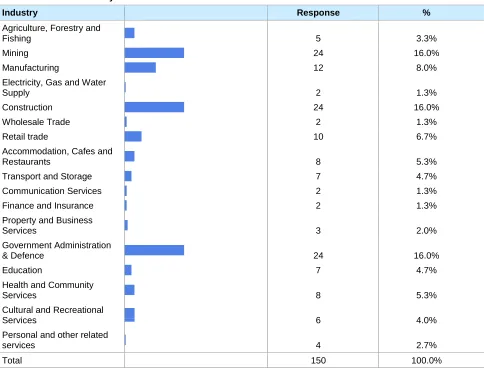
[image:15.612.66.550.156.528.2]Respondents were asked: What industry are you working in? Results indicated that they work in all sorts of industries, providing potential to fill a wide range of positions in the mining industry (Table 11). Equal proportions (16% per each industry) worked in mining, construction and ‘government, administration, defence’. The next largest industry representations were manufacturing (8.0%) and retail (6.7%).
Table 11: Current industry of work
Industry Response %
Agriculture, Forestry and
Fishing 5 3.3%
Mining 24 16.0%
Manufacturing 12 8.0%
Electricity, Gas and Water
Supply 2 1.3%
Construction 24 16.0%
Wholesale Trade 2 1.3%
Retail trade 10 6.7%
Accommodation, Cafes and
Restaurants 8 5.3%
Transport and Storage 7 4.7%
Communication Services 2 1.3%
Finance and Insurance 2 1.3%
Property and Business
Services 3 2.0%
Government Administration
& Defence 24 16.0%
Education 7 4.7%
Health and Community
Services 8 5.3%
Cultural and Recreational
Services 6 4.0%
Personal and other related
services 4 2.7%
Current occup ati on
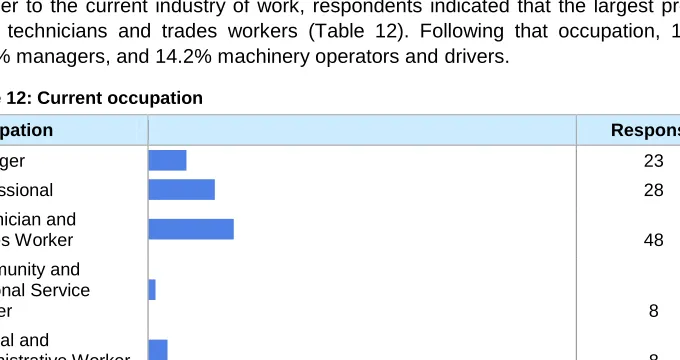
[image:16.612.91.431.91.271.2]Further to the current industry of work, respondents indicated that the largest proportion of them (32.4%) were technicians and trades workers (Table 12). Following that occupation, 18.9% were professional, 15.5% managers, and 14.2% machinery operators and drivers.
Table 12: Current occupation
Occupation Response %
Manager 23 15.5%
Professional 28 18.9%
Technician and
Trades Worker 48 32.4%
Community and Personal Service Worker
8 5.4%
Clerical and
Administrative Worker 8 5.4%
Sales Worker 7 4.7%
Machinery Operator
and Driver 21 14.2%
Labourer 5 3.4%
Total 151 100.0%
Current tenu re
Almost three quarters of respondents were employed in ongoing, full-time employment (Table 13). Less than one percent of the respondents were unemployed and seeking work. Almost twenty percent (19.1%) were employed as either casual or ongoing, part-time.
Table 13: Current tenure
Current tenure Response %
Employed on ongoing basis - working full-time
107 70.4%
Employed on ongoing basis - working part-time
10 6.6%
Been looking for work
[image:17.612.63.558.147.260.2]In order to gauge the pool of potential FIFO workers, respondents were asked to indicate if they had been seeking work in the previous four weeks. Interestingly, almost three quarters (70.8%) replied in the affirmative (Table 14).
Table 14: Been looking for work Been looking for
work in previous four weeks
Response %
Yes 136 70.8%
No 56 29.2%
Total 192 100.0%
Nu mb er of applicati ons lod ged
One way to gauge the seriousness of respondents in seeking FIFO employment was to determine the number of applications lodged by respondents in the past three months for FIFO positions. Figure 3 presents the results for ‘Number of applications lodged’ (vertical axis) against ‘Number of respondents’ (horizontal axis). The results show that 21 respondents had lodged at least one application in the past three months, with 76 respondents lodging up to six applications. Further to this, the results for interest in FIFO work were of interest and these are reported in the next section.
[image:17.612.126.488.381.648.2]Part 3: Interest in FIFO work
Interes ted in FI FO work
The majority of respondents (95.4%) indicated that they were ‘Interested’ or ‘Very interested’ in working in the mining or oil and gas sectors on a Fly-In, Fly-Out basis (Table 15).
Table 15: Interest in FIFO work Interested in FIFO
work
Response %
Very interested 162 83.1%
Interested 24 12.3%
Vaguely interested
3 1.5%
Not interested
6 3.1%
Total 195 100.0%
Willingn ess to b e d eployed anywh ere in Australia
Further to this, three quarters of respondents (74.9%) indicated that if they were to be successful in applying for a FIFO job, they would be willing to be deployed anywhere in Australia (Table 16). Some respondents (19.9%) indicated that they may be interested and this depended on several reasons.
Table 16: Deployed anywhere in Australia Deployed anywhere
in Australia
Response %
Yes 143 74.9%
Maybe 38 19.9%
No
10 5.2%
Table 17: Factors impacting on willingness to be deployed Deployment
depends on
Response %
Travel time 22 64.7%
Roster 16 47.1%
Conditions 22 64.7%
Site 17 50.0%
Period of employment 17 50.0%
Other
1 2.9%
[image:19.612.69.527.417.682.2]Reasons for interes t in FI FO work
Figure 4 presents rankings for interest in FIFO work with 1st, 2nd, and 3rd preferences noted. From Figure 4 it can be seen that when asked to rank reasons for their interest in FIFO, most respondents indicated that their main reason was “The pay and conditions are attractive” (138 main rankings), followed by the appeal of “The rosters, with time off” (90 main rankings), then “I'm hoping it will provide an opportunity for me to up-skill or retrain” (78 main rankings), “There’s not a lot of work at home currently” (66 main ranking), and “It means my family can live where we want to live with access to things that suit our lifestyle” (61 rankings). Factors other than those listed in Figure 4 which potential FIFO workers listed included: “general interest in geological settings”, “have tertiary qualifications and 5+ years’ experience in mining”, “future investment towards my superannuation”, and “stable long term employment”.
Ways of s eeking FI FO work
[image:20.612.66.547.189.399.2]In order to ascertain how potential FIFO workers were seeking employment in the mining industry, respondents were asked to tick an option from Table 18 which best described them. The largest proportion of respondents (26.5%) stated that they “Regularly check positions vacant in online career pages”; an almost similar portion of respondents (21.5%) indicated that they “subscribe to automatic notifications of jobs from online careers pages and/or company sites”. These findings provide a good indication of the best possible approaches for mining companies to use when advertising to recruit employees.
Table 18: Ways of actively seeking FIFO work
Actively seeking FIFO work Response %
Occasionally look at positions vacant in the
newspaper 22 12.2%
Regularly check positions vacant in the
newspaper 19 10.5%
Occasionally look at positions vacant in online
careers pages (e.g. CareerOne, Seek) 28 15.5%
Regularly check positions vacant in online careers
pages (e.g. CareerOne, Seek) 48 26.5%
Occasionally look at positions vacant on resource
company websites 15 8.3%
Regularly check positions vacant on resource
company websites 10 5.5%
I subscribe to automatic notifications of jobs from
online careers pages and/or company sites 39 21.5%
Total 181 100.0%
Preferred geograph ical regions for FIFO work
In a further effort to ascertain how best to attract FIFO workers, respondents were asked to indicate the geographical regions they would consider going to as a FIFO worker. Table 19 shows that by far the most preferred region for FIFO work was Far North Queensland (91.2%). Following this, preferred regions were Northwest Queensland (79.6%), Central Queensland (70.7%), Northern Territory (70.7%), and Northwest Western Australia (55.2%). Eight respondents stated that they would go ‘anywhere’, three noted ‘PNG’, and two said ‘Australia’.
[image:20.612.65.557.536.674.2]Part 4: Qualifications & experience of potential FIFO workers
Education & qu alifi cations
[image:22.612.68.551.166.354.2]In terms of education, the largest proportion of potential FIFO workers (36.2%) had a Trade Certificate IV, with 15.8% having completed at least Year 10, 7.3% Year 12 and 7.3% a Bachelor degree (Table 20).
Table 20: Highest level of education
# Highest level of Education Response %
1 Year 10 28 15.8%
2 Year 12 13 7.3%
3 General Certificate II or III
(non-trade), specify 25 14.1%
4 Trade Certificate IV, specify 64 36.2%
5 Advanced Diploma or
Diploma, specify 21 11.9%
6 Graduate Diploma or Graduate
Certificate, specify 6 3.4%
7 Bachelor Degree, specify 13 7.3%
8 Postgraduate degree, specify 7 4.0%
[image:22.612.63.554.167.354.2]Total 177 100.0%
Table 21 shows that nearly half of the respondents (43.7%) had substantial experience in a particular trade area but had never received formal or recognised qualifications. Of these 24 respondents had experience in “Heavy Fabrication or Boilermaker or Pipefitter or Welder”, 19 “mechanical fitter”, and 18 in “carpentry or formwork”. This indicates potential for approximately half of those surveyed to be employed through mature-age programs such as the National Apprenticeships Program, which facilitates employment of people using their substantive competencies, and by putting them through a process to recognise prior learning and gain formal qualifications in an expedited manner.
Table 21: Area of substantial experience without formal recognised qualifications Area of experience (without
qualification) Completed 2+ years as apprentice but never finished trade Worked as trades assistant for 4+ years
[image:22.612.64.553.488.678.2]Tick ets & li cen ces
[image:23.612.63.552.147.299.2]Also, some respondents indicated that they hold mobile plant operator tickets or licences (Table 22). Of these, the largest proportion (37.9%) had forklift licences, with an almost similar percentage holding heavy rigid licences (32.5%), and medium rigid licences (27.2%).
Table 21: Tickets or Licences held by potential FIFO workers
# Ticket or Licence Yes No
1 Backhoe 6.5% 93.5%
2 Crane 5.9% 94.1%
3 Dozer 6.5% 93.5%
4 Forklift 37.9% 62.1%
5 Grader 5.3% 94.7%
6 Medium Rigid 27.2% 72.8%
7 Heavy Rigid 32.5% 67.5%
8 Other 34.9% 65.1%
TOTAL 169 respondents
In relation to other tickets, a ‘confined space’ qualification was common with 45 respondents indicating they had one such ticket (Table 23). Similarly, other common qualifications included ‘elevated work platform’ (37 respondents), ‘general induction metalliferous surface’ (39 respondents) and ‘fire-fighting’ (37 respondents).
Table 22: Other tickets or licences
# Other tickets or licences Have Ticket or Licence
1 General Induction Metalliferous Surface 39
2 General Induction Underground Coal 7
3 Confined Space 45
4 Elevated Work Platform 37
5 Fire-fighting 27
6 Rigging 8
7 Scaffolding 4
[image:23.612.59.546.393.534.2]Work experi en ce of potenti al FIFO workers
[image:24.612.67.554.172.295.2]The level of work experience is another useful characteristic to include in profiling the skills and capabilities of potential FIFO workers. Table 24 shows that there is a wealth of work experience amongst these workers with more than half of the respondents (53.0%) holding 21 years or more of work experience and 16.3% with 16 to 20 years. That means that nearly three quarters of the potential FIFO workers surveyed (69.3%) have substantial work experience.
Table 23: Work experience of potential FIFO workers
Work Experience Response %
Less than 1 year 11 6.6%
Between 1 and 5 years 15 9.0%
6 to 10 years 12 7.2%
11 to 15 years 13 7.8%
16 to 20 years 27 16.3%
21 years or more 88 53.0%
Total 166 100.0%
Previ ous work in FI FO rol e
In addition, about one third of respondents (32.5%) have previously worked in a FIFO role (Table 25) and some of these indicating substantial years of working in a FIFO role (Figure 5). Twenty-four respondents reported more than three years spent working in a FIFO role, with thirteen of these spending more than eight years in a FIFO role.
Table 24: Worked in FIFO role before # Worked in FIFO
role before
Response %
1 No 112 67.5%
2
Yes, specify length of time in years and months
54 32.5%
[image:24.612.61.552.403.507.2]Figure 5: Years worked in FIFO role
Previ ous work in remote communi ti es
A further factor in the profiling of potential FIFO workers is consideration of whether they have previously worked in remote communities as it would be reasonable to contend that this would make such workers more amenable to FIFO work. Table 26 shows 65.7% of respondents had previously worked in remote communities; hence, providing a ready pool of workers who have experience and understanding of the challenges faced by FIFO work.
Table 25: Worked in remote communities Worked in remote
communities
Response %
No 57 34.3%
Yes, specify length of time in years and months
109 65.7%
Total 166 100.0%
13
13 11
9
4
<1
1 to 3
>3 to 7
8 to 13
3. Conclusion
This study sought to (1) identify and profile potential FIFO workers by determining their demographic characteristics, qualifications, experience and current employment status; (2) ascertain the level of interest these workers have in FIFO work; and, (3) determine possible barriers faced by individuals in becoming part of the FIFO community. In so doing, it found that there is good capacity within the Cairns region to build a strong and capable workforce to accommodate the needs of the mining and oil and gas sectors. The results show that relevant skills and experience are available in the region. Most interesting is the fact that nearly half of the respondents have substantial experience in a particular trade area but have never received formal or recognised qualifications. This finding is most informative as it means that by engagement with existing initiatives targeting mature-age individuals, such as The National Apprenticeships Program which assists in transition of individuals into the workforce, the current level of skills and expertise in the region can be readily enhanced and so, position individuals and the region formidably in the labour marketplace.
4. References
Beach, R., Brereton, D., & Cliff, D. (2003). Workforce turnover in FIFO mining operations in Australia: An exploratory study. Brisbane: Centre for Social Responsibility in Mining. Retrieved from
http://www.csrm.uq.edu.au/docs/TURN_FINAL.pdf
Brereton, D., & Parmenter, J. (2008). Indigenous employment in the Australian mining industry. Journal of Energy and Natural Resources Law, 26, 66-90.
Carter, T., & Kaczmarek, E. (2009). An exploration of generation Y’s experiences of offshore fly-in/fly-out employment. The Australian Community Psychologist, 21(2), 52-66.
Gent, V. M. (2004). The impact of fly-in/fly-out work on well-being and work-life satisfaction. Perth: Murdoch University.
Kaczmarek, E. A., & Sibbel, A. M. (2008). The psychosocial well-being of children from Australian military and fly-in/fly-out (FIFO) mining families. Community, Work & Family, 11(3), 297-312. doi:
10.1080/13668800801890129
Pirotta, J. (2009). An exploration of the experiences of women who FIFO. The Australian Community Psychologist, 21(2), 37-51.
Taylor, J., & Scambary, B. (2005). Indigenous people and the Pilbara mining boom. Canberra: Centre for Aboriginal Economic Policy Research, The Australian National University.
Voysey, W. (2012). Satisfaction with a fly-in/fly-out (FIFO) lifestyle: Is it related to rosters, children and support resources utilised by Australian employees and partners and does it impact on relationship quality and stress? (Honours thesis). Murdoch University, Perth, Australia. Retrieved from
5. Appendix: Questionnaire Survey
FIFO Job-Seekers Online Survey Cairns
Information about this research
You are invited to take part in a research project about Fly-In, Fly-Out (FIFO) employment in the Tropical North. This research project seeks to determine the current status of FIFO in the Tropical North and so inform practices and policies to assist organisations, community agencies and government departments. The project is a collaboration between SkillsDMC (who have employed a Cairns FIFO Coordinator), Advance Cairns (as the peak regional economic development agency, and James Cook University (who are providing the professional research capabilities). It is important that this study captures the experiences and suggestions of a range of FIFO workers. Your opinion matters!
This survey is part of this project and it seeks to secure more FIFO jobs for people living in the region. We are interested in ascertaining who is out there looking for jobs in the resources sector, determining the decision-making process for taking on a FIFO role, and understanding the career implications of FIFO and/or resources sector work.
Taking part in this study is completely voluntary and your responses and details will be strictly confidential. Individuals will not be required to provide their personal information, and data will be non identifiable. The data from the study will be used in research publications and reports to Advance Cairns. You will not be identified in any way in these publications. A copy of the final report relating to this research will be available online through SkillsDMC at the completion of the project.
The survey should take approximately ten (10) minutes of your time. If you agree to be involved, completion of the survey will be recognised as informed consent. You may withdraw at anytime from completing the online survey.
If you have any questions about the study, please contact: Dr Riccardo Welters (Principal Investigator) or Dr Josephine Pryce (Co-Investigator).
Principal- Investigator: Dr Riccardo Welters, Head of Discipline (Economics), Senior Lecturer, School of Business, James Cook University, Phone: (07) 4781 4325, Email: [email protected]
Co- Investigator: Dr Josephine Pryce, Senior Lecturer, School of Business, Fellow In-Residence, The Cairns Institute, James Cook University, Phone: (07) 4042 1426, Email: [email protected]
Theme 1: Current employment status
Q1. Are you currently employed (either full-time or part-time)?
Yes (1)
No (2)
If No Is Selected, Then Skip To Q6. Have you ever been in paid work?
Q2. How long have you worked in your current job?
Years (1) Months (2)
Please indicate: (1)
Q3. What industry are you working in?
Agriculture, Forestry and Fishing (1)
Mining (2)
Manufacturing (3)
Electricity, Gas and Water Supply (4)
Construction (5)
Wholesale Trade (6)
Retail trade (7)
Accommodation, Cafes and Restaurants (8)
Transport and Storage (9)
Communication Services (10)
Finance and Insurance (11)
Property and Business Services (12)
Government Administration and Defence (13)
Education (14)
Health and Community Services (15)
Cultural and Recreational Services (16)
Personal and other related services (17)
Q4. What is your occupation?
Manager (1)
Professional (2)
Technician and Trades Worker (3)
Community and Personal Service Worker (4)
Clerical and Administrative Worker (5)
Sales Worker (6)
Machinery Operator and Driver (7)
Labourer (8)
Other (9) ____________________
Q5. Which of the following best describes your current job?
Employed on ongoing basis - working full-time (1)
Employed on ongoing basis - working part-time (2)
Employed on fixed term contract (3)
Employed on casual basis (4)
Answer If Are you currently employed (either full-time or part-time)? No Is Selected
Q6. Have you ever been in paid work?
Yes (1)
No (2)
If No Is Selected, Then Skip To Q8. At any time during the last 4 wee...
Answer If Have you ever been in paid work? Yes Is Selected
Q7. How long have you been out of paid work?
Years (1) Months (2)
Please indicate: (1)
Q8. At any time during the last 4 weeks, have you looked for paid work?
Yes (1)
Theme 2: Interest in FIFO work
Q9. Are you interested in working in the mining or oil and gas sectors on a Fly In, Fly Out basis?
Very interested (1)
Interested (2)
Vaguely interested (3)
Not interested (4)
If Not interested Is Selected, Then Skip To End of Survey
Q10a. If you were to apply for a FIFO job, are you willing to be deployed anywhere in Australia?
Yes (1)
Maybe (2)
No (3)
Answer If If you were to apply for a FIFO job, are you willing to b... Maybe Is Selected
Q10b. If 'Maybe', it depends on (more than one response possible):
Travel time (1)
Roster (2)
Conditions (3)
Site (4)
Period of employment (5)
Other (6) ____________________
Q11. Why are you interested in working in a FIFO role in the resources sector? Rank top 3 preferences, 1 being the main reason:
Q12. How active have you been in looking for a FIFO role in the resources sector? Tick the option which best describes you at present:
Occasionally look at positions vacant in the newspaper (1)
Regularly check positions vacant in the newspaper (2)
Occasionally look at positions vacant in online careers pages (e.g. CareerOne, Seek) (3)
Regularly check positions vacant in online careers pages (e.g. CareerOne, Seek) (4)
Occasionally look at positions vacant on resource company websites (5)
Regularly check positions vacant on resource company websites (6)
I subscribe to automatic notifications of jobs from online careers pages and/or company sites (7)
Q13. How many job applications for FIFO positions have you submitted in the past 3 months?
Number of applications: (1)
Q14. What geographical regions would you consider going to as a FIFO worker (more than one response applicable)?
Far North Queensland (1)
Northwest Queensland (2)
Central Queensland (3)
Northern Territory (4)
Northwest Western Australian (Pilbara/Kimberley) (5)
Theme 3: Qualifications & experience
Q15. Please indicate your highest level of education, and specify where applicable your main qualification:
Year 10 (1)
Year 12 (2)
General Certificate II or III (non-trade), specify (3) ____________________
Trade Certificate IV, specify (4) ____________________
Advanced Diploma or Diploma, specify (5) ____________________
Graduate Diploma or Graduate Certificate, specify (6) ____________________
Bachelor Degree, specify (7) ____________________
Postgraduate degree, specify (8) ____________________
Q16. You may have substantial experience in a particular trade area but never received formal or recognized qualifications. If this describes your situation, for the trade areas identified below, what type of experience is it that you have? Please click in the appropriate field(s).
Completed 2+ years as apprentice but never finished trade (1) Worked as trades assistant for
4+ years (2)
Completed trade qualifications overseas (3) Have trade aligned to one listed (4) Ex-Defence with aligned qualifications (5) Not applicable (6) Electrical Fitter
Mechanic (1)
Diesel Fitter (2)
Carpentry/Formwork
(3)
Heavy Fabrication or Boilermaker or
Q17a. Which of the following mobile plant operator tickets or licences do you have?
Have Ticket or Licence
Yes No
Backhoe (1)
Crane (2)
Dozer (3)
Forklift (4)
Grader (5)
Medium Rigid (6)
Heavy Rigid (7)
Other (8)
Q17b. If you answered 'Yes' to any of the above, please specify your experience with size or type:
Please specify your experience, indicating size or type of machinery you have experience with Backhoe (1)
Crane (2)
Dozer (3)
Forklift (4)
Grader (5)
Medium Rigid (6)
Q17c. What other tickets or licences do you have? Please indicate:
Have Ticket or Licence (1) Not applicable (2)
General Induction Metalliferous
Surface (1)
General Induction Underground
Coal (2)
Confined Space (3)
Elevated Work Platform (4)
Fire-fighting (5)
Rigging (6)
Scaffolding (7)
Q17d. Any other tickets or licences? Please specify:
Q18. How many years of work experience do you have?
Less than 1 year
Between 1 and 5 years
6 to 10 years
11 to 15 years
16 to 20 years
21 years or more
Q19. Have you ever worked in a FIFO role before? If so, for how long?
No
Yes, specify length of time in years and months ____________________
Q20. Have you ever worked in remote communities before? If so, for how long?
No
Theme 4: Demographics
Q21. Please indicate your gender:
Female
Male
Q22. Please indicate your age
Under 20
20 to 29
30 to 39
40 to 49
50 to 59
60 to 65
Older than 65
Q23. Are you a citizen or permanent resident of Australia?
Yes
No
Q24. Do you identify as Aboriginal or Torres Strait Islander?
Yes
Q25. Are you:
Single
Married
In a relationship
Q26. Do you have dependent children?
No
Yes. How many? ____________________
Q27. What is the postcode and suburb of your home address?
Postcode (1) Suburb (2)
Please indicate:
Q28. What is your driving distance to Cairns Airport?
Less than 1 hour
1 to 2 hours
2 to 3 hours
More than 3 hours