White Rose Research Online URL for this paper: http://eprints.whiterose.ac.uk/120794/
Version: Accepted Version
Article:
Hanczakowski, M., Zawadzka, K. and Higham, P.A. (2014) The dud-alternative effect in memory for associations: Putting confidence into local context. Psychonomic Bulletin & Review, 21 (2). pp. 543-548. ISSN 1069-9384
https://doi.org/10.3758/s13423-013-0497-x
[email protected] https://eprints.whiterose.ac.uk/
Reuse
Unless indicated otherwise, fulltext items are protected by copyright with all rights reserved. The copyright exception in section 29 of the Copyright, Designs and Patents Act 1988 allows the making of a single copy solely for the purpose of non-commercial research or private study within the limits of fair dealing. The publisher or other rights-holder may allow further reproduction and re-use of this version - refer to the White Rose Research Online record for this item. Where records identify the publisher as the copyright holder, users can verify any specific terms of use on the publisher’s website.
Takedown
If you consider content in White Rose Research Online to be in breach of UK law, please notify us by
The Dud-Alternative Effect in Memory for Associations: Putting Confidence into Local
Context
Maciej Hanczakowski¹, Katarzyna Zawadzka², and Philip A. Higham²
¹Cardiff University, UK
²University of Southampton, UK
Author Notes
Maciej Hanczakowski, School of Psychology, Cardiff University; Katarzyna
Zawadzka, Psychology, University of Southampton; Philip A. Higham, Psychology,
University of Southampton.
The authors would like to thank Dylan Jones for helpful comments while developing
this project.
Correspondence concerning this article should be directed to Maciej Hanczakowski,
School of Psychology, Cardiff University 64 Park Place, Cardiff, CF10 3AT, United
Kingdom, email: [email protected], ph: +44 (0)299 2087 5030.
Article published in Psychonomic Bulletin & Review.
Abstract
When participants are asked to provide confidence judgments for each provided alternative in
a multiple-choice memory task, such judgments are inflated if assessed alternatives are
accompanied by an implausible (dud) alternative. This finding, termed the dud-alternative
effect, has been recently documented in a memory setting with a line-up procedure
(Charman, Wells, & Joy, 2011). In the present study we develop a novel paradigm to
investigate the dud-alternative effect in memory. The paradigm utilizes a multiple-choice
associative recognition task in which dud alternatives can be rejected on the basis of their
unfamiliarity. In two experiments we demonstrate a reliable dud-alternative effect with our
novel procedure. The results demonstrate that the dud-alternative effect in episodic memory
is not limited to tasks based on perceptual factors but is a general phenomenon concerning
confidence judgments.
The Dud-Alternative Effect in Memory for Associations: Putting Confidence into Local
Context.
When faced with a task of remembering, people often consider evidence supporting
multiple alternatives. How sure is a person that she parked her car today at the entrance and
not closer to the parking gate? How sure is she that she saw the person number five robbing
the old lady and not the person number four? It seems logical that when assessing confidence
for multiple alternatives, confidence is reduced if there is strong evidence supporting each
alternative (Clark, 1997). But what happens with confidence when there is very little
evidence in support of one (or more) of the alternatives? The most intuitive prediction would
be that nothing much happens Ð the implausible alternative is simply eliminated and
confidence depends on evidence supporting the remaining alternatives. However, some
recent evidence indicates that this intuition is incorrect and such alternatives do have an
important effect on confidence, an effect that is examined in the present study.
Windschitl and Chambers (2004) introduced the dud-alternative effect whereby the
inclusion of implausible (dud) alternatives in a multiple-choice question inflates the judged
likelihood of other, plausible alternatives relative to a case in which duds are absent. For
example, in the dud-absent condition of their Experiment 1, participants were asked which of
the following alternatives was selected in a recent survey of American 7-10 year-olds to be
their favorite food for dinner: Pizza or Hamburger. In the dud-present condition, the question
included two additional dud alternatives: Eggplant Parmesan and Grilled Fish. Windschitl
and Chambers found that likelihood judgments for the plausible alternatives (Pizza and
Hamburger) were higher in the dud condition compared to the no-dud condition. The effect
generalized across a number of different tasks and conditions. For example, the judged
likelihood of winning a raffle was increased if some players (duds) were added that had very
attention to a particular alternative (e.g., ÒHow likely do you think it is that pizza was the
most frequently selected option?Ó) or if ratings were required for all alternatives. The finding
is non-normative because adding more alternatives should either reduce (if they are plausible)
or leave unchanged (if they are completely implausible) the judged likelihood of the original,
plausible alternatives, but they should never increase it.
Windschitl and Chambers (2004) accounted for their finding with a contrast
hypothesis. According to it, participants judge the likelihood of a given alternative by
comparing it (explicitly or implicitly) against the likelihood of the other alternatives. By this
hypothesis, the inclusion of duds increases the number of comparisons that strongly favor the
focal alternative currently being judged, which, in turn, increases its judged likelihood.
Although not the focus of Windschitl and Chambers (2004) research, the authors
nevertheless predicted that a similar effect would occur with episodic memory judgments.
Recently, Charman, Wells, and Joy (2011) confirmed this prediction using a line-up
identification procedure. They found that including duds in the line-ups (i.e., foils that were
highly perceptually dissimilar to the actual perpetrator) increased confidence that the
remaining, non-dud foils matched the perpetrator. Thus, consistent with Windschitl and
ChambersÕ predictions, the study by Charman et al. indicated that dud alternatives can
increase confidence for non-dud alternatives in episodic memory tasks as well as other
likelihood judgment tasks.
However, Charman et al. (2011) suggested that the dud-alternative effect in line-ups
might stem from a different mechanism than the analogous effect with non-episodic
likelihood judgments. Specifically, they argued against the contrast hypothesis and in favor
of a perceptual similarity account. This account postulates that inclusion of duds in line-ups
causes the non-dud alternatives to be perceived as more perceptually similar to the memory
Although Charman et al. (2011) did not delineate the exact psychological mechanism
of how duds affect perceived similarity between non-dud line-up member and the memory
representation of a perpetrator, work by Tversky (1977) may be helpful in this regard.
Tversky argued that changing the local context in which similarity judgments are made by
including a novel alternative could broaden the set of features that are considered diagnostic
of category membership, a phenomenon referred to as the extension effect. Applying this
logic to CharmanÕs et al. recognition results, if all non-dud members of a line up share a
particular feature (e.g., blonde hair) with the memory representation of the perpetrator, that
feature is nondiagnostic for recognition: All non-dud members are perceived to be equally
similar to the memory representation with respect to hair color and so the feature cannot be
used to differentiate amongst the candidates and may not even be considered at all. However,
when the line-up also includes a dark-haired suspect (dud), hair color acquires diagnostic
value, boosting the perceived similarity between non-duds and the memory representation.
That is, in this new context, non-duds share the feature Òblonde hairÓ with the perpetrator
whereas the dud does not, and so the presence of the dud facilitates the perceived similarity
(and judged likelihood) between non-dud line-up members and the memory representation.
However, despite this potential role of feature diagnosticity on perceived similarity, in
our view, the perceptual similarity hypothesis proposed by Charman et al. (2011) is overly
narrow. When several alternatives of what happened in the past are considered, it is rare that
the question boils down to which alternative is most perceptually similar to what is in
memory. Consequently, the main empirical objective of the present study is to demonstrate
that the dud-alternative effect occurs in episodic memory tasks for which perceptual
similarity plays a minimal role.
For this demonstration, we developed a novel paradigm. Our procedure is based on
Kelley & Wixted, 2001; Verde, 2004). Participants in our paradigm decided which of the
provided alternatives was paired with a given cue in the study phase. A condition in which
two non-dud alternatives were provided, one being a target paired with this cue and the other
being a target paired with other cues, was pitted against a condition in which the third, dud
alternative was also included. The dud alternative was novel, not paired previously with any
cue, and thus easily rejected because of low familiarity. Given that the paradigm is based on
memory for perceptually impoverished but semantically rich materials, namely pairs of
words, we assume that in our task, perceptual similarity of presented alternatives to the
correct answer plays a negligible role. Thus, if the dud-alternative effect in memory is
restricted to situations in which duds affect perceptual similarity of non-dud alternatives to
targets, then we would predict no dud-alternative effect in our paradigm. If, however, the
dud-alternative effect extends beyond such limited circumstances and obtains more broadly
in confidence judgments provided in an episodic memory setting, we can expect this effect to
occur in our paradigm.
Experiment 1
Method
Participants. Forty undergraduates from Cardiff University participated for course
credit or small monetary compensation (age: M = 19.13; 4 males).
Materials and Design. The experiment consisted of two study-test blocks, with one
block corresponding to the dud-present condition and the other to the dud-absent condition.
The order of the two block types was counterbalanced across participants.
To generate the materials for the two blocks, 64 4-8 letter nouns with average ratings
on various dimensions (e.g., lexical frequency, concreteness, imageability) were chosen from
the MRC database. Thirty-two words were used as study materials and the remaining 32
words were randomly divided into two lists of 16 words, with separate lists to be used in each
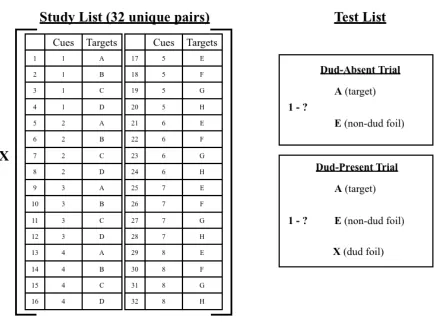
block (Figure 1). For each list of 16 words, eight words were randomly chosen to act as cues
and eight to act as targets. Each of four cues (1-4) within each list was randomly paired with
four different targets (A-D) to make 16 pairs (4 X 4), whereas each of the remaining four
cues (5-8) was paired with each of the remaining four targets (E-H) to make another 16 pairs.
Each resultant list of 32 pairs was presented three times within the study phase of each block
for a total of 96 study trials per block. List repetition did not occur until the previous list
presentation was complete and a different random order of pairs was used within each list
presentation. Thus, in the study phase of each block, every cue and target word was seen for
a total of 12 times each (four times within each list X three presentations of the list).
Assignment of lists to blocks was counterbalanced across participants. (see Verde, 2004, for a
similar arrangement of materials, referred to as interference sets). The aim of using
interference sets was to allow for multiple presentations of individual cues and targets (to
increase their familiarity) without producing ceiling effects in performance.
At each test trial, a single cue was presented with two or three alternatives
corresponding to the dud-absent and dud-present conditions (blocks), respectively. In the
dud-absent condition, the alternatives included the target for the presented cue plus one of the
four targets not paired with the cue (non-dud foil). The same two alternatives were presented
in the dud-present condition along with a new word not shown at study (dud foil). The order
of the two or three alternatives on the screen was random. For both test conditions/blocks,
every cue was presented four times corresponding to the four pairs for which the cue was
presented at study. Similarly, every target was presented eight times in each block, four
times as a correct alternative and four times as a non-dud foil. Every dud in the dud-present
Procedure. Participants were first instructed that they should memorize the pairs and
that all pairs will be repeated several times. At study each pair was presented for two
seconds with a 0.5 second interval. During study, there was no indication that the study list
was complete and was about to be repeated either the first or second time.
At test, participants were informed that they would be presented with individual cues
from the study phase together with some alternatives out of which one and only one was a
target previously paired with a given cue. Participants were asked to rate each alternative for
their confidence that it was paired with a given cue on a scale from 1 (very low confidence)
to 6 (very high confidence). Responding in the test was self-paced. After the test for the first
block was finished, the second study phase ensued and the test for this list followed.
Results and Discussion
Table 1 presents mean confidence ratings for this experiment. Duds received very low
confidence ratings (M = 1.15; SD = 0.27), indicating that participants were highly confident
that duds were not paired with cues. Following Windschitl and Chambers (2004), we did not
actually require participants to choose a target from amongst the alternatives. Instead,
participants only rated confidence in each alternative. However, by using confidence ratings,
it is possible to determine target selection rate by examining the proportion of trials on which
a target alternative was given the highest confidence rating from among presented
alternatives. When a target and one of the remaining alternatives received the same highest
confidence judgment, the trial was excluded from the analysis.2 A t-test comparing the
proportion of included trials with targets receiving the highest confidence ratings failed to
reveal a significant difference between the dud-present (M = .67; SD = .15) and dud-absent
(M = .69; SD = .17) conditions, t < 1. This null result suggests that including duds does not
The confidence ratings given to non-dud alternatives were initially analyzed with an
ANOVA that included the order of conditions as a factor. However, this factor failed to
produce any significant effects, so we collapsed the data from the two counterbalancing
conditions. A resulting 2 (alternative status) x 2 (test condition/block) repeated-measures
ANOVA yielded a significant main effect of alternative status, F(1, 39) = 68.87, MSE = 0.89,
p < .001, ηp2 = .64, which indicates that participants gave higher judgments for targets than
for non-dud foils. This main effect reflects a certain level of memory for associations. More
interestingly, the ANOVA also yielded a significant main effect of test condition, F(1, 39) =
6.68, MSE = 0.29, p = .014, ηp2 = .15, with higher confidence ratings when duds were
included in the test than if they were not. The interaction was not significant, F(1, 39) = 1.63,
MSE = 0.35, p > .20, indicating that duds affected confidence for both targets and non-dud
foils. These results indicate that the dud-alternative effect is present in our paradigm,
extending this effect to a memory task in which the role of perceptual features of the assessed
alternatives is negligible.²
The present results document the dud-alternative effect in associative recognition.
Inclusion of dud alternatives in test trials led to higher confidence ratings for both targets and
non-dud foils. Thus, at test, providing local context in the form of a highly implausible
alternative elevates confidence for the remaining alternatives, even if the memory task is
clearly not dependent on assessing perceptual similarity of alternatives to information stored
in memory. This result demonstrates that the dud-alternative effect is a general phenomenon
of episodic memory when people assess confidence for multiple alternatives concerning past
events. It is not limited to perceptually-driven tasks like the line-up procedure.
However, Experiment 1 suffers from one important caveat. Although we have argued
trial, one could argue that our implementation of duds in Experiment 1 has more to do with
global than local context. Because the presence of duds was manipulated between blocks, all
test trials in the dud-present block included duds. It is thus possible that duds do not exert
their influence on confidence at the level of individual trials but rather at the level of the
whole test. To tease apart these two possibilities, Experiment 2 manipulated the presence of
duds within a single test. If duds serve as local context and elevate confidence only in trials in
which they are included, we should replicate the dud-alternative effect in Experiment 2. If, in
contrast, duds exert their influence at the general level of the whole test, we should obtain no
dud-alternative effect in Experiment 2.
Experiment 2
Method
Participants. Twenty-four undergraduates from Cardiff University participated for
course credit (age: M = 19.17; all females).
Materials, Procedure, and Design. One of the lists of cue-target pairs developed for
the previous experiment was used together with half of the words that served as duds in the
final test. The study phase was the same as either study phase in Experiment 1. In the test
phase, half of the trials were presented with only two alternatives (target and non-dud foil)
whereas the remaining half included an additional dud. Presentation order of the two trial
types was random. The assignment of items to the two test conditions was counterbalanced
across participants.
Results and Discussion
Table 1 presents mean confidence for this experiment. Confidence ratings for duds
the proportion of trials in which targets received the highest confidence rating.3 A t-test
showed no significant difference between the dud-present (M = .73; SD = .16) and dud-absent
(M = .70; SD = .16) conditions, replicating Experiment 1 and showing that inclusion of duds
does not affect participantsÕ ability to identify targets. A 2 (alternative status) x 2 (test
condition) repeated measures ANOVA performed on the confidence ratings for the non-dud
alternatives yielded a significant main effect of status, F(1, 23) = 50.50, MSE = 1.01, p <
.001, ηp2 = .69, which again indicates that participants gave higher judgments for targets
than for non-dud foils. More importantly, the main effect of the test condition was also
significant, F(1, 23) = 9.51, MSE = 0.08, p = .005, ηp2 = .29. These results are consistent
with the results of Experiment 1 and indicate that the presence of duds inflated confidence
judgments. The interaction was not significant, F < 1.
Thus, Experiment 2 again documented that duds inflate confidence for non-dud
alternatives, this time with the presence of duds manipulated within a single test. This result
suggests that duds serve as local context affecting confidence at the level of individual test
trials. The theoretical underpinnings of these results are discussed next.
General Discussion
In the present study we developed a novel paradigm for investigating the
dud-alternative effect in memory. Using a variant of the associative recognition task, we created
conditions under which an unfamiliar and therefore easily rejected dud alternative was
included in the test, affecting confidence for the remaining, non-dud alternatives. In two
experiments, using a design in which the presence of duds was manipulated between blocks
(Experiment 1), and a design in which the presence of duds was manipulated within a single
alternatives, whether they are targets or non-dud foils. These results speak to the robustness
of the dud-alternative effect for confidence judgments concerning past events.
Regarding the mechanism of the dud-alternative effect, it is first important to note that
this effect occurs robustly across different tasks. To date, it has been documented in the
non-episodic likelihood judgments tasks (Windschitl & Chambers, 2004), as well as non-episodic
memory tasks such as line-up identification (Charman et al., 2011), and associative
recognition (the present study). The mechanism of this effect should thus be general enough
to account for its various manifestations. The present study is clearly inconsistent with the
perceptual-similarity hypothesis developed by Charman et al. for their line-up study. Our
results and those of Windschitl and Chambers indicate that the dud-alternative effect in
episodic memory requires a broader theoretical framework.
In our view, the results of the investigations of the dud-alternative effect conducted to
date remain consistent with the contrast hypothesis developed by Windschitl and Chambers
(2004). Duds create a local context to which evidence supporting the assessed alternative is
compared. Because duds differ greatly from the focal alternatives on the assessed dimension,
when comparison against a dud is made, the perceived value on the assessed dimension for
the focal alternative is greater, leading to higher confidence judgments. Charman et al. (2011)
claimed that the contrast hypothesis was inconsistent with their results from the line-up
procedure. They argued against this hypothesis, because duds in their line-ups increased
confidence not only for the endorsed non-dud foil (they used only target-absent line-ups) but
also for the other, unendorsed non-dud foil. Moreover, duds affected confidence for
participants who were precluded from choosing in a line-up. Charman et al. reasoned that the
contrast hypothesis predicts the dud-alternative effect only for the explicitly chosen
However, in our view, Charman et al. (2011) might have unnecessarily restricted the
meaning of Ôfocal alternativeÕ in their analysis of the contrast hypothesis. Our reading of
Windschitl and ChamberÕs (2004) use of the term suggests that a Ôfocal alternativeÕ is any
alternative for which confidence is currently being assessed. Consequently, confidence for
an assessed alternative could be affected by the presence of duds via the contrast mechanism
even if it is not ultimately endorsed. We consider the contrast hypothesis a possible
overarching account of the dud-alternative effect that is able to provide a framework for
understanding various manifestations of this effect.
A somewhat more detailed implementation of the contrast hypothesis may be offered
by the aforementioned analysis of Tversky (1977). Tversky proposed that a local context may
determine which features of the stimuli are considered diagnostic for a similarity judgment.
In the case of perceptual similarity, providing a dud alternative may highlight and thus render
diagnostic perceptual features of assessed line-up members that would otherwise be ignored.
But this logic may be extended to other cases of similarity as well. In the case of the
associative recognition task, the fact that two alternatives were both studied may not be
deemed diagnostic when all words provided in the test trial were studied. However, when
duds are included and non-duds alternatives are contrasted with duds, the fact that non-dud
alternatives were studied becomes salient and thus diagnostic to the decision of which
alternative was associated with the cue, inflating confidence judgments. The idea of
diagnosticity of features developed by Tversky can be thus seen as a detailed specification of
the contrast hypothesis proposed by Windschitl and Chambers (2004).
We need to acknowledge, however, that an alternative account of the dud-alternative
effect is also possible. Both Windschitl and Chambers (2004) and Charman et al. (2011)
discussed a hypothesis that could be referred to as a recalibration hypothesis. According to
alternatives but instead change the scale on which confidence judgments are made. When
duds are absent, confidence assigned to non-dud foils may create an anchor at the low end of
the scale (e.g., Tversky & Kahneman, 1974). However, when a dud alternative is included,
the complete lack of confidence associated with this alternative may cause the confidence
scale to be recalibrated. Recalibration sets a new, lower anchor for the confidence scale,
pushing the assigned confidence values for the remaining alternatives upward despite no
actual change in the underlying subjective confidence. Under this scenario, the
dud-alternative effect is more about how people define the low end of a response scale given a
certain set of alternatives than it is about true changes in subjective confidence.
Our results have some consequences for the recalibration hypothesis. Specifically, the
fact that we observed the dud-alternative effect in Experiment 2, when the presence of duds
was manipulated within a single test, suggests that if duds induce recalibration, then
recalibration occurs not at the level of an entire test but at the level of individual trials. In
other words, if the recalibration hypothesis is correct, our results would suggest that the way
subjective confidence is translated into values on confidence scale is highly malleable and
may be adjusted on the trial-by-trial basis. At present, the status of this novel, continuous
recalibration hypothesis is unclear and further tests with dependent measures other than
confidence judgments may be necessary to investigate it. We believe that our novel paradigm
for investigating the dud-alternative effect can be used in further studies on this issue.
References
Charman, S. D., Wells, G. L., & Joy, S. W. (2011). The dud effect: Adding highly dissimilar
fillers increases confidence in lineup identifications. Law & Human Behavior, 35,
479-500. doi: http://dx.doi.org/10.1007/s10979-010-9261-1
Clark, S. E. (1997). A familiarity-based account of confidence-accuracy inversions in
recognition memory. Journal of Experimental Psychology: Learning, Memory, and
Cognition, 23,232-238. doi: http://dx.doi.org/10.1037/0278-7393.23.1.232
Tversky, A. & Kahneman, D. (1974). Judgment under uncertainty: Heuristics and biases.
Science, 185, 1124Ð1130. doi: http://dx.doi.org/10.1126/science.185.4157.1124
Kelley, R., & Wixted, J.T. (2001). On the nature of associative information in recognition
memory. Journal of Experimental Psychology: Learning, Memory, and Cognition, 27,
701-722. doi: http://dx.doi.org/10.1037//0278-7393.27.3.701
Tulving, E. (1981). Similarity relations in recognition. Journal of Verbal Learning and
Verbal Behavior, 20, 479-496. doi: http://dx.doi.org/10.1016/S0022-5371(81)90129-8
Tversky, A. (1977). Features of similarity. Psychological Review, 84, 327-352. doi:
http://dx.doi.org/10.1037//0033-295X.84.4.327
Verde, M. F. (2004). Associative interference in recognition memory: A dual-process
account. Memory & Cognition, 32, 1273-1283. doi:
http://dx.doi.org/10.3758/BF03206318
Windschitl, P. D., & Chambers, J. R. (2004). The dud-alternative effect in likelihood
judgment. Journal of Experimental Psychology: Learning, Memory, and Cognition, 30,
Footnotes
1.
Tulving (1981) distinguished between perceptual and ecphoric similarity in
memory tasks, where perceptual similarity refers to similarity between items
physically presented in a test and ecphoric similarity refers to similarity between
items presented in a test and information stored in memory. In these terms, the
hypothesis considered by Charman et al. (2011) states that perceptual dissimilarity
between the assessed alternative and a dud leads to increased ecphoric similarity
between the assessed alternative and stored memory for perpetrator. Here,
however, we will refer to perceptual similarity as referring to perceived similarity
between assessed alternative and memory for perpetrator.
2.
There were 5.15 trials (16% of all trials) excluded from the dud-present list and
4.15 trials (13% of all trials) excluded from the dud-absent list. Importantly, the
number of excluded trials did not differ between the lists, t(39) = 1.33, SE = .75, p
= .19.
3.
We once again excluded from the analysis trials for which a target and one of the
remaining alternatives received the same highest confidence judgment. There
were 2.33 trials (15% of all trials) excluded from the dud-present condition and
1.92 trials (12% of all trials) excluded from the dud-absent condition. The number
Table 1. MeanConfidence Judgments In Experiments 1 and 2 as a Function of Test
Condition (Dud-Present vs. Dud Absent) and Alternative Status (Target, Non-Dud Foil, Dud
Alternative). Standard Deviations Are Given in Parentheses.
Experimental Condition
Item Dud-present Dud-absent
Experiment 1
Target 4.50 (0.58) 4.40 (0.66)
Non-dud foil 3.38 (0.94) 3.04 (0.79)
Dud alternative 1.15 (0.27) -
Experiment 2
Target 4.62 (0.61) 4.46 (0.66)
Non-dud foil 3.17 (1.00) 2.98 (0.85)
Figure 1. Schematic depiction of the design used in Experiment 1. In the study list, numbers
designate eight different word cues and letters designate eight different word targets. For
each of the two study-test blocks, 32 unique cue-target pairs were generated by pairing each
cue with four targets as shown above. In each block, the 32 pairs were presented in a random
order for study, and then the same pairs were presented again a second time in a different
random order, and then a third time in third random order. This meant that each cue and
target was viewed 12 times in total by the end of the 96 study trials for a given block, making
them very familiar. At test, participants were required to rate confidence in each alternative
on each trial. The alternatives were a target and a non-dud (familiar) foil in the dud-absent
condition/block. These same two words plus a new dud word not presented at study were the