This content has been downloaded from IOPscience. Please scroll down to see the full text.
Download details:
IP Address: 129.11.23.117
This content was downloaded on 17/10/2016 at 09:14
Please note that terms and conditions apply.
You may also be interested in:
The role of the Pauli–Lubaski vector for the Dirac, Weyl, Proca, Maxwell and Fierz–Pauli equations Sergey I Kryuchkov, Nathan A Lanfear and Sergei K Suslov
Weyl field strength symmetries for arbitrary helicity and gauge invariant Fierz-Pauli and Rarita-Schwinger wave equations
N A Doughty and D L Wiltshire
Mixed-symmetry massive fields in AdS(5) R R Metsaev
One-loop partition function from normal modes for N=1 supergravity in AdS_3 Hongbao Zhang and Xiangdong Zhang
Arbitrary spin field equations and anomalies in the Riemann-Cartan space-time Yu N Obukhov
An explicit QWEI for Dirac fields in curved spacetimes S P Dawson and C J Fewster
Field theory on an evolving fuzzy 2-sphere Naoki Sasakura
A generalized bag-like boundary condition for fields with arbitrary spin
View the table of contents for this issue, or go to the journal homepage for more 2015 New J. Phys. 17 073012
(http://iopscience.iop.org/1367-2630/17/7/073012)
PAPER
A generalized bag-like boundary condition for
fi
elds with
arbitrary spin
Adam Stokes1
and Robert Bennett
Department of Physics & Astronomy, University of Leeds, LS2 9JT, UK 1 Author to whom any correspondence should be addressed.
E-mail:[email protected]
Keywords:Casimir effect, spinorfields, bag model
Abstract
Boundary conditions (BCs) for the Maxwell and Dirac
fi
elds at material surfaces are widely-used and
physically well-motivated, but do not appear to have been generalized to deal with higher spin
fi
elds.
As a result there is no clear prescription as to which BCs should be selected in order to obtain
physically-relevant results pertaining to con
fi
ned higher spin
fi
elds. This lack of understanding is
signi
fi
cant given that boundary-dependent phenomena are ubiquitous across physics, a prominent
example being the Casimir effect. Here, we use the two-spinor calculus formalism to present a uni
fi
ed
treatment of BCs routinely employed in the treatment of spin-
1 2
and spin-1
fi
elds. We then use this
uni
fi
cation to obtain a BC that can be applied to massless
fi
elds of any spin, including the spin-2
graviton, and its supersymmetric partner the spin-
3 2
gravitino.
The coupling of a quantizedfield to matter causes the spectrum of its vacuumfluctuations to change. The range of resulting phenomena includes what are variously known as Casimir forces, energies and pressures. The simple case of two perfectly reflecting, infinite, parallel plates, that impose boundary conditions (BCs) on the Maxwell
field was investigated by Casimir in [1]. Casimir’s seminal paper has since resulted in a wide range of extensions, generalizations and experimental confirmations over the last half-century or so [2–7]. This has led, for example, to new constraints on hypothetical Yukawa corrections to Newtonian gravity [8]. Casimir’s relatively simple and
intuitive calculation has provided an enormously fruitful link between real-world experiments and the abstract discipline of quantumfield theory. In fact, boundary-dependent effects are often cited in standard quantumfield theory textbooks as the primary justification for the reality of vacuumfluctuations. Such interpretations
however, are not without controversy [9]. Boundary-dependent vacuum forces are not specific to
electromagnetism, and are in fact a general feature of quantizedfields. Here we provide a unified and physically well-motivated treatment of the effects that perfectly reflecting material boundaries have onanyquantumfield.
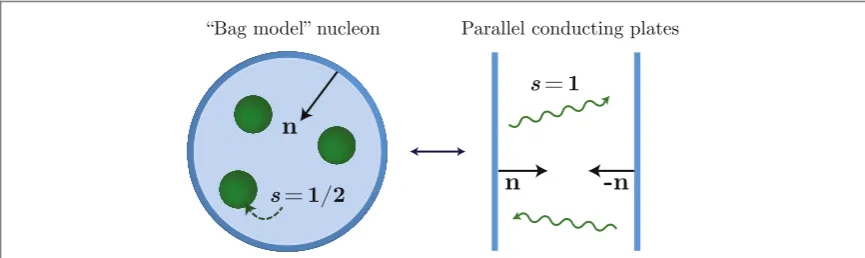
A striking example of non-electromagnetic Casimir effects can be found in nuclear physics, wherein early attempts to model the nucleon without considering BCs at its surface ran into a variety of problems [10]. Many of these problems were solved by the introduction of the‘bag model’[11], which describes a nucleon as a collection of free massless quarks2confined to a region of space (the‘bag’), with a postulated BC that governs their behavior at the surface (seefigure1). This model, subject to sensible choices of a small number of free parameters, correctly predicts much of the physics of the nucleon [10]. The boundary-dependent vacuum contribution to the energy (the Casimir energy) has important consequences for the stability of the bag [12–14]. This further emphasizes the importance of using physically-motivated BCs. Another example of the need to impose physical BCs on fermionicfields is provided by graphene and carbon nanotubes, both of which are the subject of intense contemporary interest. These structures support a two-dimensional gas of massless fermions [15] and the resultant fermionic Casimir force has been found to have even a differentsigndepending on the precise choice of BCs, namely periodic or anti-periodic [16]. Single carbon nanotubes have been proposed as nanomechanical switches [17] whose failure modes may include stiction caused by Casimir forces [18]. OPEN ACCESS
RECEIVED 21 April 2015
ACCEPTED FOR PUBLICATION 4 June 2015
PUBLISHED 9 July 2015
Content from this work may be used under the terms of theCreative Commons Attribution 3.0 licence.
Any further distribution of this work must maintain attribution to the author(s) and the title of the work, journal citation and DOI.
2
This is justified because the energy scale associated with the nucleon radius is much larger than that associated with the mass of the quark.
Given that Casimir effects associated with the Maxwell (spin-1)field and the Dirac (spin-1 2)field are of experimental and theoretical interest, one is naturally led to the question as to whether the Casimir effect for thesefields can be calculated in a unified way. Since Casimir physics is essentially the study of BCs, can we construct BCs that include those used for the spin-1 2and spin-1fields as special cases? Furthermore, can we generalize this unified BC to one that applies to higher-spinfields? Answering these questions would significantly advance our understanding of the physics of confined higher-spinfields. For example, in [19] arbitrary BCs (periodic) are applied to the spin-3 2field—no physical justification is attempted. Here we unify the BCs usually employed in the treatment of spin-1 2and spin-1fields near perfect reflectors, and then develop this unification in order to model the confinement offields possessing arbitrary spin.
We will begin our treatment by outlining the BCs assumed within the bag model, i.e., those usually employed in the treatment of massless spin-1 2particles. In this model, one envisages a fermionicfield confined to some region of space that is surrounded by an impenetrable barrier. Thus, a physically reasonable constraint to impose (which can also be motivated by an appropriate choice of Lagrangian [10,20]) is that there be no particle current across the surface;
(
n jμ μ)
=0 jμ =ϕγ ψμ , (1)
wherenμis a spacelike unit four-vector normal to the surface defining the bag, and where we have employed the summation convention for repeated upper and lower indices. Rather than using the usual notationψ¯to denote the Dirac adjointψ γ† 0ofψ, we have usedϕ ≡ψ γ† 0in order to avoid confusion later on. The constraint (1) is obeyed ifψ( )x ≡ψsatisfies
n x
i μγ ψμ =ψ ∈. (2)
This can be shown by multiplying equation (2) byϕfrom the left, and the Dirac adjoint of equation (2) byψ from the right. Adding these two quantities, onefinds2inμϕγ ψμ =2in jμ μ =0. This shows that the BC (2)
impliesn jμ μ=0, which is the constraint imposed in the bag model.
What about higher spins? It is well-known that the description offields with arbitrary spin can be constructed using elementary two-spinors via the so-called two-spinor calculus formalism [21–24]. This means that, for example, the Maxwellfield can be described on the same footing as the massless Diracfield. As a result, we should be able tofind a spin-1 analog of the constraint (1). Initially this might seem hopeless, because no local particle-current exists forfields with spin greater than1 2[25]. However, we shall see that there is a natural adaptation of the
Dirac-field BC to the Maxwellfield, which moreover coincides with the BC usually employed in the calculation of the electromagnetic Casimir force. This allows us to generalize the BC (2) tofields with arbitrary spin.
The two-spinor calculus allows one to build irreducible representations of the universal covering group of the homogeneous Lorentz group using two-dimensional complex symplectic vector spacesSandS¯, where a bar is used to denote the complex conjugate space. The spaceSis the pair( ,V ω), whereVis a two-dimensional complex vector space andωis a complex symplectic (non-degenerate) form. Choosing a basis{ }fa ⊂Vwe can write arbitrary elements (spinors) ofSandS¯as
f S ¯ f S¯, (3)
a
a a¯a¯
ψ=ψ ∈ ψ=ψ ∈
where we use bars rather than the more commonly used dots to distinguish between a spinor index and a conjugate-spinor index. Furthermore we rely entirely on the different indices in order to distinguish between the components ofψandψ¯. With these index conventions matrix operations become particularly simple. If a matrix
[image:3.595.119.552.62.191.2]vhas elementsvabthen we have the following representations
Figure 1.Schematic representation of the main idea of our work. We exploit a correspondence between the bag model of the nucleon and the electromagnetic Casimir force between parallel conducting plates. This enables us to unify them and subsequently generalize them in order to treat arbitrary spinorfields.
2
v ↔vab, v¯↔vab¯ ¯, v⊤↔vba, v†↔vba¯¯, (4)
where⊤and†denote matrix transposition and Hermitian conjugation respectively. The symplectic formωis
used to raise and lower spinor indices. We adopt the convention thatωab= −ωbacan only be used to lower an
index when the repeated index is in thefirst slot. Similarlyωabonly raises the index when the repeated index is in the second slot. The same rules apply for barred indices, so altogether
, , , . (5)
ab a b ab b a ab¯ ¯ a¯ b¯ ab¯ ¯ b¯ a¯
ω ψ =ψ ω ψ =ψ ω ψ =ψ ω ψ =ψ
We note that these identities imply the following identity for the contraction of a rank-nspin tensor with its dual
( 1) . (6)
a a ...an a a ...a n a a ...a a a ...a n
n n
1 2 1 2
1 2 1 2
ϕ ϕ = − ϕ ϕ
This means that for oddn(fermionicfields) the quantity a a a a a a ... n ...
n
1 2 1 2
ϕ ϕ is identically zero.
The above ingredients allow one to write a spacetime tensor of rank (i,j) in terms of Hermitian matrices as
T ... ... a a¯ ... a a¯ ˜ b b ... ˜ b bTa a a ab b b b, (7) ¯ ¯ ¯ ... ¯
¯ ... ¯ j
i
i i i
i
i i i i
i i
1 1
1 1 1
1
1 1 1 1
1 1
σ σ σ σ
=
ν ν
μ μ μ μ
ν ν
where
( , i), ˜ ( , i) (8)
σμ= σ σμ= −σ
withσitheith Pauli matrix. We have now laid out a formalism that we can use to describefields of arbitrary spin.
This will eventually enable us to determine a unified physical BC applicable to any massless spinorfield. We begin this process by rewriting the right-helicity component of the Dirac current in (1) as
jμ =σμaa¯ jaa¯, jaa¯ ≡ψ ψa¯ a. (9)
In terms of the two-spinor calculus formalism, the BC (2) for the right-helicity component becomes
nμσμaa¯ ψa=ψa¯ x∈. (10)
We can demonstrate that equation (10) impliesn jμ μ =0by multiplying both sides byψa¯and using the identity
(6), which gives
nμσμaa¯ ψ ψa¯ a=ψ ψa¯ a¯≡0 x∈. (11)
This shows that equation (10) is indeed the two-spinor calculus version of the bag BC (2) for a right-helicity spinor. A similar calculation holds for the left-helicity spinor.
The next-lowest spinfield after the Diracfield (s=1 2) is of course the Maxwellfield (s= 1). Just as in our discussion of the Diracfield, we will begin by casting the usual statements of the BCs (in this case given by restrictions on the electric and magneticfieldsEandB) in the language of two-spinor calculus. The electromagnetic BC for a perfect conductor requires thatn ×Eandn B· vanish at the surface. This in turn implies thatn S· also vanishes, whereS=E ×Bis the Poynting vector. Using the Riemann–Silberstein (RS) vectorF≡E+ iB, the electromagnetic BCs can be written
n F n F x
Re [ × ]=0, Im [ · ]=0 ∈. (12)
We can assume without loss of generality thatnμ= (0, ˆ)z so that the RS vector obeying the BCs (12) is
(
B B E)
F= i x, i y, z . (13)
Following [26], we now introduce the spin tensorϕabsuch that
Fx i ,Fy F¯x i ¯ ,Fy (14)
00
0¯0¯
ϕ = − + ϕ = −
Fz , F¯z , (15)
01 10
0¯1¯ 1¯0¯
ϕ = =ϕ ϕ = − =ϕ
Fx i ,Fy F¯x i ¯ ,Fy (16)
11
1¯1¯
ϕ = + ϕ = − −
in terms of which (13) can be written as
, . (17)
00
0¯0¯ 01 0¯1¯
ϕ =ϕ ϕ = −ϕ
Using equation (7) we can write a symmetric tensorTμν as
Tμν=σμaa¯ σνbb¯Taabb¯ ¯, (18)
whereTaabb¯ ¯ is a symmetric spin-tensor. If we defineTaabb¯ ¯ =ϕ ϕab ab¯ ¯ , thenTμν
in equation (18) is the familiar electromagnetic energy–momentum tensor, with components
In terms ofTμνthe constraintn S· becomes
n Ti 0i=0 x∈, (20)
which fornμ =(0, ˆ)z can be written
n T 0=0 x∈ . (21)
μ μ
Comparing this with (1), we see thatTμ0plays the role of the Dirac currentjμfor the Maxwellfield. The physical constraint, analogous to (1), that we impose on the Maxwellfield is therefore
n Tμ μ0=nμσμaa¯ σ0 ¯bbϕ ϕab ab¯ ¯ =0 x∈, (22)
which will necessarily hold if
n nμ νσμaa¯ σνbb¯ ϕab=ϕab¯ ¯ x ∈. (23)
We can easily demonstrate that the BC (23) implies the constraint (22) by again takingnμ=(0, ˆ)z, so that the
BC becomes
x . (24)
aa bb ab ab 3
¯ 3 ¯ ¯ ¯
σ σ ϕ =ϕ ∈
Using the explicit form of the Pauli matrices, equation (24) immediately yields equation (17), which themselves followed from having written the BCs (10) and (23) in terms of the RS vector.
The fact that the above procedure is exactly analogous to that for the Diracfield is remarkable and
unexpected. As already mentioned, no local particle-current exists for masslessfields with spin greater than1 2. However, one of the few local observables associated with photons is their energy current, which is precisely the quantity that naturally appears in the spin-1 constraint (22).
The generalization of the BC to arbitrary spinorfields is now clear. For spin-m2we write our generalized bag-like BC
n n1 2...n m a a¯1 1 a a¯ ... a a¯m m a a ...am a a¯ ¯ ... ¯am, (25)
1
2 2
2 2 1 2
1 2
σ σ σ ϕ =ϕ
μ μ μ μ μ μ
forx∈. This implies[nμμ( )]m ∣ = 0where
m
( ) a a¯ 0a a¯ ... 0a a¯m m a a ...a a a¯ ¯ ... ¯a (26)
m m
1 1 2 2
1 2 1 2
σ σ σ ϕ ϕ
=
μ μ
is the local current for the spinorfield concerned—the Diracfield hasμ(1)=jμ, the Maxwellfield has
T (2)= 0
μ μ
and so on. In terms of the spin-tensorϕ, the current is defined by
. (27)
a a a a1 1 2 2¯ ¯ ...a am m¯ ≡ϕa a1 2...amϕa a¯ ¯ ... ¯1 2 am
The BC (25) ensures that
n ( )m 0. (28)
⎡⎣ μμ ⎤⎦ =
We can prove this by using the rules (5), which allow (25) to be written as
... . (29)
a a
a a a a a a a a a a ¯ ¯ 3
¯ ¯ ¯m m 3¯m m ... ¯ ... ¯
m m
1 1 1 1
1 1
ω ′σ ′ ω ′σ ′ ψ =ψ
Substituting this intonμμand using the explicit forms of the Pauli matrices along with the matrix representationω=iσ2, wefind
n ( )m ( 1) ...
( 1) ... . (30)
m
a a a a a a aa a
m
a a a a aa a a a a
1 1 ... ...
1 1 ... ...
m m m
m
m m m
m
2 2 1 1
2
2 2 1
2 1 2
σ σ ψ ψ
σ σ ψ ψ
= −
= − −
μ μ ′ ′ ′ ′ ′
′ ′ ′ ′ ′ ′
Usingσ1=( )σ1⊤and relabelling the indicesa a
i↔ i′fori= 2,…,m, the last line of equation (30) is equal to
n ( )m ( 1)m ... , (31)
a a a a a a aa a
1 1 ... ...
m m m
m
2 2 1 1
2
σ σ ψ ψ
= −
μμ ′ ′ ′ ′ ′
which is the negative of thefirst line in equation (30). This proves that the BC (25) impliesnμμ( )m =0for an
arbitrary spin-m 2field, meaning that it is indeed a generalized bag-like BC. This is the main result of our work. As we have already noted, the identification of a physical current for higher spinfields seems atfirst problematic, due to the non-existence of a local particle current for spin>1 2. We have in fact already tackled this problem by adapting the spin-1 2BCs to the spin-1 case. This enables us to inductively determine the appropriate for higher spinfields.
Particularly noteworthy is identification of for the spin-2field that describes linearized quantum gravity. Thisfield is most commonly described using a symmetric traceless tensorfieldhμνthat results from thefirst-order expansiongμν( )u =gμν +uhμν +...of the general metric tensor of curved spacetime. In thisfirst-order
approximation, Einstein’s vacuum equations in terms ofhμνare equivalent to the correct relativistic wave equation
4
for a massless spin-2 particle (the so-called graviton). The right and left-helicities of the graviton are described by symmetric spin-tensorsψabcdandψabcd¯ ¯¯ ¯respectively. These can be used to define the Bel–Robinson tensor, which is a strong candidate for the gravitational version of a symmetric energy–momentum tensor [23]. While it is well-known that the gravitationalfield does not possess a unique local energy–momentum tensor, the Bel–Robinson tensorTμνρσpossesses many of the properties usually associated with such objects, namely, total-symmetry, tracelessness and certain positivity properties [23]. It is also the natural spin-2 analog of the symmetric energy–
momentum tensorTμνof electrodynamics. The generalized BC in equation (25) therefore implies the vanishing of the local currentTμ000. Analogously to the currents encountered in the spin-1 2and spin-1 cases,Tμ000could be
viewed as a natural quantity in terms of which the physical BC should be specified for the spin-2field.
A possible impact of our unified BC is the ability to transfer well-known techniques from electromagnetism tofields with different spin. This could prove especially fruitful in extending our work to consideration of imperfectly reflecting boundaries, as was done very recently in [27] for the particular case of the spin-2 graviton.
To conclude, we have reported thefirst unified treatment of physical (bag-like) BCs at perfect reflectors for
fields with arbitrary spin. This was achieved by writing well-known BCs for the Maxwell and massless Dirac
fields in a unified language, and then carrying out a natural generalization. The very existence of a unified BC for the Maxwell and Diracfields is a remarkable result on its own because of the fundamental differences between the conserved currents for the twofields. However, we have shown that such a BC does exist—the unification of two apparently disparate approaches within one self-consistent model is a satisfying result, but moreover the unification proceeds in such a way that it can be naturally extended tofind completely new bag-like BCs forfields with any spin, meaning that our work opens up a whole landscape of study in confinement of higher-spinfields.
Acknowledgments
It is a pleasure to thank Almut Beige and Jiannis Pachos for helpful comments. Financial support from the UK Engineering and Physical Sciences Research Council (EPSRC) is greatly appreciated.
References
[1] Casimir H B G 1948 On the attraction between two perfectly conducting platesProc. K. Ned. Akad. Wet.51150
[2] Landau L D, Lifšic E M, Sykes J B, Bell J S, Kearsley M J and Pitaevskii L P 1960Electrodynamics of Continuous Mediavol 364 (Oxford: Pergamon)
[3] Boyer T October 1968 Quantum electromagnetic zero-point energy of a conducting spherical shell and the Casimir model for a charged particlePhys. Rev.1741764–76
[4] Schwinger J, DeRaad L L Jr and Milton K A 1978 Casimir effect in dielectricsAnn. Phys., NY1151–23
[5] Lamoreaux S K 1997 Demonstration of the Casimir force in the 0.6 to 6μmrangePhys. Rev. Lett.785–8
[6] Mohideen U and Roy A 1998 Precision measurement of the Casimir force from 0.1 to0.9 mμ Phys. Rev. Lett.814549–52
[7] Rahi S J, Emig T, Graham N, Jaffe R L and Kardar M 2009 Scattering theory approach to electrodynamic Casimir forcesPhys. Rev.D80
085021
[8] Decca R S, López D, Fischbach E, Klimchitskaya G L, Krause D E and Mostepanenko V M 2007 Tests of new physics from precise measurements of the Casimir pressure between two gold-coated platesPhys. Rev.D75077101
[9] Jaffe R 2005 Casimir effect and the quantum vacuumPhys. Rev.D72021301
[10] Thomas A W and Weise W 2010The Structure of the Nucleon(New York: Wiley)
[11] Chodos A, Jaffe R, Johnson K, Thorn C and Weisskopf V 1974 New extended model of hadronsPhys. Rev.D93471–95
[12] Milton K A 1983 Fermionic Casimir stress on a spherical bagAnn. Phys., NY150432–8
[13] Milton K A 1983 Towardfinite zero-point energies in the bag modelPhys. Rev.D27439–43
[14] Oxman L, Svaiter N and Amaral R 2005 Attractive Casimir effect in an infrared modified gluon bag modelPhys. Rev.D72125007
[15] Novoselov K S, Geim A K, Morozov S V, Jiang D, Katsnelson M I, Grigorieva I V, Dubonos S V and Firsov A A 2005 Two-dimensional gas of massless Dirac fermions in grapheneNature438197–200
[16] Bellucci S and Saharian A 2009 Fermionic Casimir effect for parallel plates in the presence of compact dimensions with applications to nanotubesPhys. Rev.D80105003
[17] Sapmaz S, Blanter Y A, Gurevich L and van der Zant H 2003 Carbon nanotubes as nanoelectromechanical systemsPhys. Rev.B67235414
[18] Andrews D L and Bradshaw D S 2014 The role of virtual photons in nanoscale photonicsAnn. Phys., Lpz.526173–86
[19] Wen-Biao L, Kui X and Hong-Bao Z 2008 Casimir effect for a massless spin-3/2field in Minkowski spacetimeCommun. Theor. Phys.48
457–60
[20] Johnson K 1978 Afield theory Lagrangian for the MIT bag modelPhys. Lett.B78259–62
[21] van der Waerden B L 1928 SpinoranalyseNachr. von Ges. Wiss. zu Göttingen Math.-Phys. Kl.1929100–9 [22] Bade W and Jehle H 1953 An Introduction to SpinorsRev. Mod. Phys.25714–28
[23] Penrose R and Rindler W 1987Spinors and Space-Time:Two-Spinor Calculus and Relativistic Fields (Cambridge Monographs on Mathematical Physics)vol 1 (Cambridge: Cambridge University Press)
[24] Schwinger J 1965 On angular momentumQuantum Theory of Angular Momentumed L C Biedenharn and H van Dam (New York: Academic)
Schwinger J 2000A Quantum Legacy: Seminal Papers of Julian Schwingered K A Milton (Singapore: World Scientific) p 173 [25] Penrose R 1965 Zero rest-massfields including gravitation: asymptotic behaviourProc. R. Soc.A 284 159–203
[26] Bialynicki-Birula I 1996 Photon wave functionProg. Opt.36245–94