This is a repository copy of
Coronal global EIT waves as tools for multiple diagnostics
.
White Rose Research Online URL for this paper:
http://eprints.whiterose.ac.uk/10578/
Proceedings Paper:
Ballai, I. and Douglas, M. (2007) Coronal global EIT waves as tools for multiple
diagnostics. In: Erdelyi, R. and Mendoza-Briceno, C.A., (eds.) Waves & Oscillations in the
Solar Atmosphere: Heating and Magneto-Seismology. IAU Symposium 247, September
17-22, 2007, Porlamar, Isla de Margarita, Venezuela. Proceedings of the International
Astronomical Union, 3 (s247). Cambridge University Press , Cambridge , pp. 243-250.
ISBN 978-0-52187-4694
https://doi.org/10.1017/S1743921308014932
[email protected] https://eprints.whiterose.ac.uk/
Reuse
Unless indicated otherwise, fulltext items are protected by copyright with all rights reserved. The copyright exception in section 29 of the Copyright, Designs and Patents Act 1988 allows the making of a single copy solely for the purpose of non-commercial research or private study within the limits of fair dealing. The publisher or other rights-holder may allow further reproduction and re-use of this version - refer to the White Rose Research Online record for this item. Where records identify the publisher as the copyright holder, users can verify any specific terms of use on the publisher’s website.
Takedown
If you consider content in White Rose Research Online to be in breach of UK law, please notify us by
Heating and Magneto-Seismology
Proceedings IAU Symposium No. 247, 2007 R. Erd´elyi & C. A. Mendoza-Bricen˜o, eds.
c
2008 International Astronomical Union doi:10.1017/S1743921308014932
Coronal global EIT waves as tools for
multiple diagnostics
I. Ballai and M. Douglas
SP2RC, Department of Applied Mathematics, University of Sheffield, Sheffield S3 7RH, UK
email:i.ballai;[email protected]
Abstract.Observations in EUV lines of the solar corona revealed large scale propagating waves generated by eruptive events able to travel across the solar disk for large distances. In the low corona, CMEs are known to generate, e.g. EIT waves which can be used to sample the coronal local and global magnetic field. This contribution presents theoretical models for finding values of magnetic field in the quiet Sun and coronal loops based on the interaction of global waves and local coronal loops as well as results on the generation and propagation of EIT waves. The physical connection between local and global solar coronal events (e.g. flares, EIT waves and coronal loop oscillations) will also be explored.
Keywords.Sun: corona, Sun: magnetic fields, Sun: coronal mass ejections (CMEs) waves
1. Introduction
Solar magneto-seismology is one of the newest branches of solar physics that emerged after the direct observational detection of magnetic oscillations in the solar corona (As-chwandenet al.1999; Nakariakovet al.1999). In particular, when applying this technique to the solar corona (as suggested originally by Robertset al. (1984) coronal seismology, using observable properties of waves, can determine plasma and field parameters in the corona. In addition to other field diagnostic methods in the corona (e.g. gyroresonance, Faraday rotation in the higher regions of the atmosphere) coronal seismology can pro-vide initial estimates for the strength of magnetic field, the key parameter which controls the dynamics, structure and evolution of the corona of the Sun. Unlike other methods, coronal seismology can also diagnose the magnetic field in the quiet Sun. A natural way to test coronal seismology would be to make it suitable to sample the substructure of the magnetic field. Since the theory is already established, such target would be achieved as soon as the observational resolution will be accurate enough. In addition, with the aid of coronal seismology information was obtained for parameters such as, heating functions, density structures, temperature profiles, etc. (see, e.g. Erd´elyi and Verth 2007; Verth et al. 2007). A recent review of this topic is given by Banerjeeet al.(2007).
Traditionally, the terminology of coronal seismology was used mainly to describe the techniques involving magnetohydrodynamic (MHD) waves propagating in coronal loops. Since then, this method has acquired a much broader significance and the technique is generalised to obtain information about the magnetic solar atmosphere (De Pontieu, Erd´elyi and James, 2004; De Pontieu and Erd´elyi 2006; Erd´elyi 2006). In all the above given examples magneto-seismology uses waves which are localized to a particular mag-netic structure, therefore it would be appropriate to label all these previous seismic stud-ies as local coronal seismology. After the discovery of large-scale wave-like disturbances, such as EIT waves, X-ray waves,etc., it became necessary to introduce a new term,global coronal seismology(Ballai et al. 2005; Ballai 2007), where the diagnostic information is provided by global waves propagating over very large distances, sometimes comparable
244 I. Ballai & M. Douglas
to the solar radius. Although this may seem a separate subject, in reality these two as-pects of coronal seismology are very much linked. A global wave generated by sudden energy releases (flares, CMEs) can interact with active region loops or prominences and localized loop or prominence waves and oscillations are emerging so, there must be a link between the generating source and flare-induced waves in coronal loops.
Unambiguous evidence for large-scale coronal impulsively driven disturbances initiated during the early stage of a flare and/or CME has been first observed by the Extreme-ultraviolet Imaging Telescope (EIT) observations onboard SOHO and by TRACE/EUV. EIT waves propagate in the quiet Sun with speeds of 250-400 km s−1 at an almost constant altitude. EIT waves have two stages: first there is an early (driven) stage where the wave correlates to radio type II bursts due to the creation of an energized population of charged particles which serves as the source of radio emission. The second stage consists of a freely propagating wavefront which is observed to interact with coronal loops, see, e.g. Will-Davey & Thompson (1999) and Harra & Sterling (2003). Using TRACE/EUV 195 ˚A observations, Ballai, Erd´elyi & Pint´er (2005) have shown that EIT waves (seen in this wavelength) are waves with average periods of the order of 400 s. Since at this height the magnetic field can be considered vertical, EIT waves were interpreted as fast MHD waves (FMW).
Unfortunately there is no unified agreement about what EIT waves really are. Several models have been proposed to explain the nature, generation and propagation of these coronal disturbances. It has been suggested that EIT waves are not even real waves, instead, they are rearrangement of the magnetic structures during eruption of a CME and this produces currents and pressure enhancements observed as brightenings (e.g. Delan´ee (2000), Chenet al.(2002)). Attrillet al.(2007a,b) proposed that the diffuse EIT coronal bright fronts are due to driven magnetic reconnections between the skirt of the expanding CME magnetic field and the favorably orientated quiet Sun magnetic field. According to this latter model the propagation process of the front consists of a sequence of reconnection events. The interpretation of EIT waves as fast magnetoacoustic waves (FMW) propagating in the quiet Sun perpendicular to the background magnetic field has been put forward by e.g. Wang (2000), Warmuth et al.(2004), Ballai, Erd´elyi & Pint´er (2005). In reality it is very likely that both models (magnetic and wave) may coexist and they are just manifestations of the same physical processes at different moments in their evolution.
In the present contribution we will study the propagation of EIT waves considered as FMW propagating at a density interface in the quiet Sun. In addition, we review a few applications of EIT waves in diagnosing a range of magnetic features in the solar corona, including the usage of EIT waves for multiple diagnostics.
2. EIT waves as guided fast magnetoacoustic waves
The propagation characteristics of EIT waves are little known, however since they appear to propagate along the solar surface (and localized to the surface), we have the impetus to treat them, in a first approximation, as most probably FWM at a spheri-cal density interface with the background magnetic field radial (perpendicular) to the interface.
field is not affecting the equilibrium, e.g. the radial force-balance is ensured by the grav-itational force and the pressure-force only. The gravgrav-itational acceleration is described by a term of the formM⊙G/r2 whereM⊙ is the mass of the Sun, andGis the gravitational constant.
In the standard MHD equations written in spherical geometry we split the compression term ∆ =∇ ·vinto a sum of the radial part ∆r and a horizontal part ∆h, where
∆r = 1
r2
∂ ∂r
r2∂ vr
∂r
, (2.1)
and
∆h= 1
rsinθ ∂ ∂θ
sinθ∂ vθ ∂θ
+ 1
rsinθ ∂ vφ
∂φ, (2.2)
where v = (vr, vθ, vφ) is the velocity perturbation. All perturbations are separable and expressed as
f(r, θ, φ, t) = ˆf(r)Ylm(θ, φ) exp(iωt), (2.3) where Ym
l (θ, φ) is the real part of the spherical harmonic and l is the spherical degree. The linearised MHD equations are thus
iωρ+rho0
r ∂ ∂r(r
2v
r) +ρ0∆h+vrdρ0
dr = 0, (2.4)
iωbr=−B0∆h, ρ0iωvr =−dp dr −
ρGM
r2 , (2.5)
ρ0iω∆h =
l(l+ 1)
r2 p+
B0
µ
l(l+ 1)
r2 br−
B0
µr2 d2 dr2(r
2b
r), (2.6)
iωp+vr
dp0
dr + γp0
r2
d dr(r
2v
r) +γp0∆h = 0, (2.7)
where we used the property that
∇2hYlm(θ, φ) =−l(l+ 1)
r2 Y m
l (θ, φ), (2.8)
with
∇2h = 1
r2sin2θ
∂ ∂θ
sinθ ∂
∂θ
+ 1
r2sin2θ
∂2
∂φ2. (2.9)
In order to make the problem tractable from an analytical point of view, let us further assume that the medium is isothermal where the density and pressure are given by
ρ0(r) =ρ0(R⊙) exp[Λ(1/r−1/R⊙)], p0(r) =p0(R⊙) exp[Λ(1/r−1/R⊙)].
In this equation the quantity Λ =GMµm˜ p/(kBT0) defines a length-scale (different from the density/pressure scale height), ˜µis the mean molecular weight,mpis the proton mass,
kB is the Boltzmann constant andT0 is the isothermal temperature of the medium. For this choice of the atmosphere the sound speed,cs= (γp0/ρ0)1/2, is height-independent, while the Alfv´en speed has a variation with respect torof the form
vA(r) =vA(R⊙)
exp[Λ/2(1/R⊙−1/r)]
r2 ,
where vA(R⊙) is the Alfv´en speed at the base of our model, i.e. atr=R⊙.
Analytical progress can be achieved in the limit when x=r/Λ≪1, i.e. in the limit
246 I. Ballai & M. Douglas
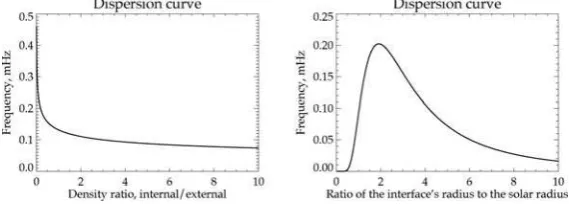
Figure 1. The variation of the frequency of EIT waves (modelled as waves at a spherical interface) for different values of the density contrast between the interior and exterior regions (left panel) and with respect to the position fop the interface relative to the solar surface (left panel).
be analytically found (for details see, e.g. Lou (1996)). In order to derive a dispersion relation for waves propagating at a density interface the condition of continuity of the radial displacement and total pressure must be satisfied at all times.
With these ingredients EIT waves are in fact modelled as magnetoacoustic gravity waves. The dispersion relation is derived and the variation of the frequency of waves with respect to the density contrast at the interface (left panel) and with respect to the position of the interface relative to the solar surface are shown in Figure 1. It should be noted that for a density contrast larger that 2, the frequency of the waves saturates and noticeable changes occur for small density contrast. On the right panel, apart from the region where the ratio between the interface’s radius and the solar radius is smaller than 2 (where the frequency of EIT waves is increasing with the distance), the general tendency is that the frequency of the waves, modelling the propagation of EIT waves, is decreasing with the distance of the interface from the solar surface.
3. EIT waves as a tool for plasma and field diagnostics
EIT waves, just like any other waves carry information about the medium in which they propagate. EIT waves are observed to cover very large distances across the solar disk in the quiet Sun, therefore they can be used to sample the global magnetic field in this region of the solar corona.
The event, which occurred on 13 June 1998 and studied by Will-Davey & Thomp-son (1999) and Ballai, Erd´elyi & Pint´er (2005), shows an EIT wave propagating north-ward and interacting with large coronal loops. This interaction resulted in visible linear transversal loop oscillations identified as fast kink oscillations which can be used to es-timate the magnetic field in the coronal loop (Nakariakov et al. (1999)) or the energy of the EIT wave generating the oscillation. Ballai, Erd´elyi & Pint´er (2005) were able to estimate that the minimum energy of the EIT wave of the event occurred on 13 June 1998 was 3.8×10¹⁸ J, a value derived from the formula
E= πL(ρiR 2+ρ
e/λ2e) 2
x
m ax−x1
tm ax−t1 2
, (3.1)
where L is the length of the loop, R the radius, ρi and ρe are the densities inside and outside the loop,xm ax is the maximum deflection of the tube (which occurs attm ax) and
Date(yyyymmdd) L(Mm) R(Mm) n(×108 cm−3) E(J)
1998 Jul 14 168 7.2 5.7 2.2×101 7
1998 Jul 14 204 7.9 6.2 9.7×101 8
1998 Nov 23 190 16.8 3 1.3×101 9
1999 Jul 04 258 7 6.3 3.9×101 6
1999 Oct 25 166 6.3 7.2 1.6×101 8
2000 Mar 23 198 8.8 17 5.2×101 6
2000 Apr 12 78 6.8 6.9 2.5×101 6
2001 Mar 21 406 9.2 6.2 7.4×101 6
2001 Mar 22 260 6.2 3.2 1.9×101 6
2001 Apr 12 226 7 4.4 1.4×101 8
2001 Apr 15 256 8.5 5.1 1.4×101 6
2001 May 13 182 11.4 4 2.2×101 8
2001 May 15 192 6.9 2.7 1.6×101 9
[image:6.493.118.374.49.221.2]2001 Jun 15 146 15.8 3.2 1.1×101 7
Table 1.The minimum energy of EIT waves which could produce the loop oscillations studied
by Aschwandenet al.(2002).
derive the Alfv´en speed in the loop (i.e. determine the magnetic field viaλe), density ratio, geometrical sizes of the loop, i.e. global waves can be used for local coronal seismology as well.
Another important point to note is the energy of EIT waves: using a few loop oscillation events presented by Aschwanden et al. (2002), and the minimum energy of EIT waves necessary to produce the observed oscillations shown in Table 1 we can conclude that the obtained energies are in the range of 1016−1019 J with no particular correlation with the length and radius of the loop, however, there is a good correlation between the energy and 1/n. In evaluating these energies we used the the geometrical size of loops and the number densities given by Aschwandenet al.(2002).
Similar to this approach we can estimate the minimum energy of an EIT wave required to produce a displacement of one pixel in TRACE/EUV 195 ˚A images using the relation
E = 1.66×10⁶LρiR2+ρe/λ2e, (J). The energy range was found to be in the interval
3×10¹⁷−3×10¹⁸ J for loop lengths and radii varying in the intervals 60 – 500 Mm and
1 – 10 Mm. A similar result was obtained recently by Terradas et al. (2007) by a much more sophisticated analytical and numerical approach.
Observations show that EIT waves propagate in every direction almost isotropically on the solar disk, therefore we can reasonably suppose that they are fast magnetoacoustic waves (FMWs) propagating in the quiet Sun perpendicular to the vertical equilibrium magnetic field. The representative intermediate line formation temperature corresponding to the 195 ˚A wavelength is 1.4×10⁶K. The sound speed corresponding to this temperature
is 179 km s−1. Since the FMWs propagate perpendicular to the field, their phase speed is approximated by (c2
S +vA2)1/2.
248 I. Ballai & M. Douglas
r/R⊙ T n cS vA(a) B
(a) v(b)
A B
(b)
1.00 1.30 3.60 1.72 1.81 1.57 3.61 3.13
1.02 1.41 3.30 1.80 1.73 1.44 3.57 2.97
1.04 1.50 3.10 1.85 1.67 1.34 3.54 2.85
1.06 1.58 2.95 1.90 1.61 1.27 3.51 2.76
1.08 1.64 2.83 1.94 1.57 1.21 3.49 2.69
[image:7.493.156.339.48.132.2]1.10 1.70 2.73 1.97 1.52 1.15 3.47 2.63
Table 2.The variation of the temperature (MK), density (108 cm−3), Alfv´en and sound speeds
(107 cm s−1) and magnetic field (G) with height above the photosphere for an EIT wave
prop-agating with a speed of (a) 250 km s−1, and (b) 400 km s−1, respectively.
We recall a simple atmospheric model developed by Sturrocket al.(1996). The tem-perature profile above a region of the quiet Sun, where the magnetic field is radial, is given by
T(x) =
T07/2+ 7R⊙F0
2a
1−1
d
2/7
. (3.2)
Here F0 is the inward heat flux (1.8×10⁵ erg cm−2 s−1), d is the normalized height coordinate defined by d=r/R⊙, T0 is the temperature at the base of the model (con-sidered to be 1.3×10⁶ K) andais the coefficient of thermal conductivity. The quantity
a is weakly dependent on pressure and atmospheric composition; for the solar corona a value of 10−6 (in cgs units) is appropriate (Nowak and Ulmschneider, 1977). Assuming a model atmosphere in hydrostatic equilibrium we obtain that the number density, based on the temperature profile supposed in Eq. (3.2), is
n(x) = n0T0
T(x)exp[−δ(T(x)
5/2−T5/2
0 )], δ=
2˜µGM⊙mpa 5kBR⊙2F0
, (3.3)
with n0 = 3.6×108 cm−3 the density at the base of corona. Having the variation of density with height and the value of Alfv´en speed deduced from the phase speed of EIT waves, we can calculate the magnetic field using B = vA(4πmpn)1/2. Evaluating the relations above, the variation of temperature, density, Alfv´en speed and magnetic field with height are shown in Table 2.
Two particular cases are derived for EIT waves propagating strictly perpendicular to the radial magnetic field with a speed of (a) 250 km s−1 and, (b) 400 km s−1, respectively. The values of the physical quantities show some change for a given propagation speed but will have little effect on the final results.
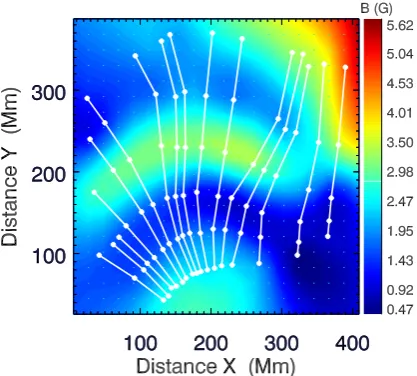
For an average value of EIT wave speed of 300 km s−1 propagating at 0.05R
Figure 2.Magnetic map of the quite Sun obtained using an EIT wave observed by
TRACE/EUV in 195 ˚A .
has been obtained assuming a single value for density. In reality both magnetic field and density can vary along the propagation direction as well. The method we employed to find this magnetic map (magnetic field derived via the Alfv´en speed) means that density and magnetic field cannot be determined at the same time. Further EUV density sensitive line ratio measurements are required to establish a density map of the quiet Sun which will provide an accurate determination of the local magnetic field.
Acknowledgements
I. B. acknowledges the financial support by The Royal Society, The National University Research Council Romania (CNCSIS-PN-II/531/2007) and the NFS Hungary (OTKA, K67746). M.D. acknowledges the support from STFC.
References
Aschwanden, M.J., Fletcher, L., Schrijver, C.J. & Alexander, D. 1999,Astrophys. J, 520, 880
Attrill, G.D.R., Harra, L.K., van Driel-Gesztelyi, L., D´emoulin, P. & W¨usler, J.-P. 2007a,Astron.
Nachrt., 328, 760
Attrill, G.D.R., Harra, L.K., van Driel-Gesztelyi, L.& D´emoulin, P. 2007b,Astrophys. J., 656,
L101
Ballai, I, Erd´elyi, R. & Pint´er, B 2005,Astrophys. J., 633, L145
Ballai, I. 2007,Sol. Phys., 246, 177
Banerjee, D., Erd´elyi, R., Oliver, R. & O’Shea, E. 2007,Sol. Phys, 246, 3
Chaplin, W.J., Dumbhill, A.H., Elsworth, Y., Isaak, G.R., McLeod, C.P.et al.2003,Mon. Not.
Roy. Astron. Soc., 343, 813
Chen, P.F., Wu, S.T., Shibata, K. & Fang, C. 2002,Astrophys. J, 572, L99
Delan´ee, C. 2000,Astrophys. J, 545, 512
De Pontieu, B., Erd´elyi, R., James, S. 2004,Nature, 430, 536
De Pontieu, B. & Erd´elyi, R. 2006,Phil. Trans. Roy. Soc. London Ser. A, 364, 383
250 I. Ballai & M. Douglas
Erd´elyi, R. 2006,Phil. Trans. Roy. Soc. London Ser. A, 364, 351
Erd´elyi, R. & Verth, G. 2007,Astron. Astrophys., 462, 743
Nakariakov, V.M., Ofman, L., DeLuca, E.E., Roberts, B. & Davila, J.M. 1999,Science, 285, 862
Nowak, T., Ulmschneider, P. 1977,Astron. Astrophys., 60, 413
Lou, Y.Q. 1996,Mon. Not. Roy. Astron. Soc., 281, 750
Roberts, B, Edwin, P.M. & Benz, A.O. 1984,Astrophys. J., 279, 857
Sturrock, P., Wheatland, M.S., Acton, L. 1996,Astrophys. J., 461, L115
Terradas, J., Andries, J. & Goossens, M. 2007,Astron. Astrophys., 469, 1135
Verth, G., van Doorsseleare, T., Erd´elyi, R. & Goossens, M. 2007,Astron. Astrophys., 475, 341
Wang, Y.M. 2000,Astrophys. J., 543,L89
Warmuth, A., Vr˘snak, B., Magdalenic, J., Hanslmeier, A. & Otruba, W. 2004,Astron.
Astro-phys., 418, 1117