R.G. MENZIES LIBRARY BUILDING NO:2 FACSIMILE: +61 2 6125 4063
THE AUSTRALIAN NATIONAL UNIVERSITY EMAIL: [email protected]
CANBERRA ACT 0200 AUSTRALIA
USE OF THESES
This copy is supplied for purposes
of private study and research only.
Passages from the thesis may not be
copied or closely paraphrased without the
Fijian Women and 'the Decrease of the Race'
A thesis submitted for the degree of Doctor of Philosophy
of the Australian National University
December, 1997
me the scholarship which made this doctorate possible and provided a wonderful research environment; and the National Archives of Fiji furnished the inspiring material.
There are many people I would like to thank. Deryck Scarr gave generous assistance and encouragement during the early stages when he was my principal supervisor. His writings in Fijian history are an invaluable resource. My subsequent supervisors, Donald Denoon and Margaret Jolly are both gifted, practical and stimulating mentors. To Margaret's teeming ideas and Donald's gentle sagacity my debts are great. In crucial ways, their own work has informed my efforts. I can never adequately express my gratitude for their acumen and kindness.
Thanks also to Brij Lal, Dorothy Shineberg, Mark Elvin, Niel Gunson and Hank Nelson- and no acknowledgements would be complete without effusive appreciation of the Division's wonderful administrative cadre- Dorothy Macintosh, Jude Shanahan, Julie ('Imelda') Gordon, Oanh Collins and Marion Weekes. The list of other ANU staff, students and visitors who enriched my research would be long, but I would like to thank Brigitte d'Ozouville and Nicholas Thomas.
In Fiji, my greatest debt is to the National Archives and to the late Setareki Tuinaceva, his successor Margaret Patel and their splendid staff. They preside over a truly remarkable collection and make the archives a most pleasurable and rewarding place to work. A special thanks to Feroz Hussein who searched out and suggested sources with infectious enthusiasm.
To Rigieta Nadakuitavuki, her former deputy Vika Tikinitabua and Naomi Raiqiso in the Department of Nursing; to Lola Tuiloma, head of the Fiji School of Nursing; and to Jane Erasito, former president of the Fiji Nurses Association, many thanks for your help! I hope that one or two chapters in this thesis will make some modest return. Special thanks to Setaita Lutumailagi, formerly of the Nausori Health Centre and her colleagues; to Sereana Bera for hospitality in Bua and Ba; and to Alisi Vudiniabola, whose own thesis on the Fijian nursing profession is its pioneer history. To all the nurses who gave me their time and patience, my thanks!
I am also grateful to Mere Erasito; Nina and Apisai Matairavulo in Ovea; Ulamila Tokaduadua and family in Namata; Sereana Baya at Davuilevu; Mareta Tovata; Lenore Qereqeretabua; Losalina Ratugolea; Eta Norton; Eci Nabalarua; Jone Cagi; Firipo Nakaora; Lusiana Daucakacaka; Adi Kelera Rokotuinaceva; Pio Manoa; Susan
Parkinson; Jimaima Bale Schultz, Asasela Ravuvu, Paul Geraghty and Vanessa Griffen. For your help and the help of all of those whose kindness I cannot individually
acknowledge,vinaka vakalevu! And thanks too, to the Fiji Museum and Roman Catholic Archives in Suva.
The completion of this thesis has had many delays, some of them beneficial. Students of 'Disease and Colonialism' at Victoria University, Wellington, made me think differently about many aspects of the topic, and Tom's arrival gave me personal insights into what had previously been a merely academic acquaintance with maternity!
I thank my family- especially Kirsten, Bob, Ingi and Val for their encouragement when it was sorely needed- and thank Alastair for his marvellous support and
Abstract Abbreviations Fijian Orthography Note on Fijian terms Glossary Chapter 1 Chapter 2 Chapter 3 Chapter 4 Chapter 5 Chapter 6 Chapter 7 Chapter 8 Chapter 9 Chapter 10 Chapter 11 Conclusion Bibliography Map 1 Map2 Map3 Graph 1 Graph 2 Graph 3 Introduction ANew Age
A Strange Discourse
'Polygamy'
Polygamy's 'Abolition'
Was 'Polygamy's Abolition' a Cause of Decrease?
New Mothers by Edict New Mothers by Education New Mothers by Training
The Rise of the Indian Mother Fijian Mothers, Again
From Maternity to Paternity
Maps
Early Nineteenth Century Fiji Eastern Viti Levu and Ovalau Colonial Fiji
Graphs
Fijian population, 1881- 1936 Indian population, 1916- 1936
Fijians, Indians and Others, 1881-1946
Table 1 Fijian sex ratios (males per 100 females), 1880-1891 22
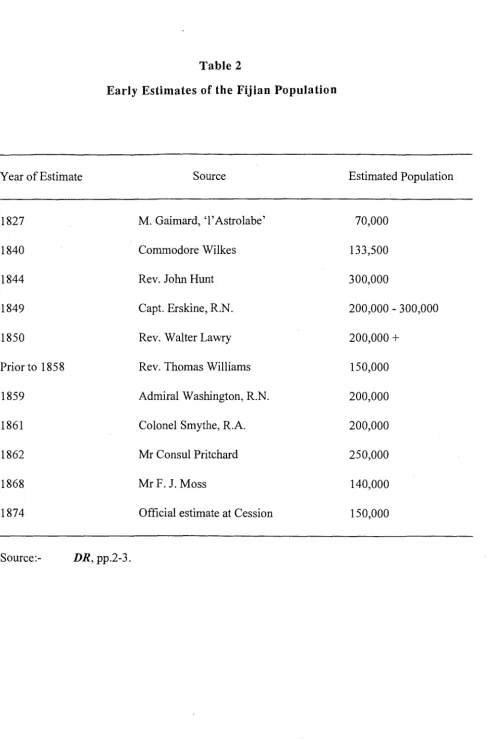
Table 2 Early estimates of the Fijian population 27
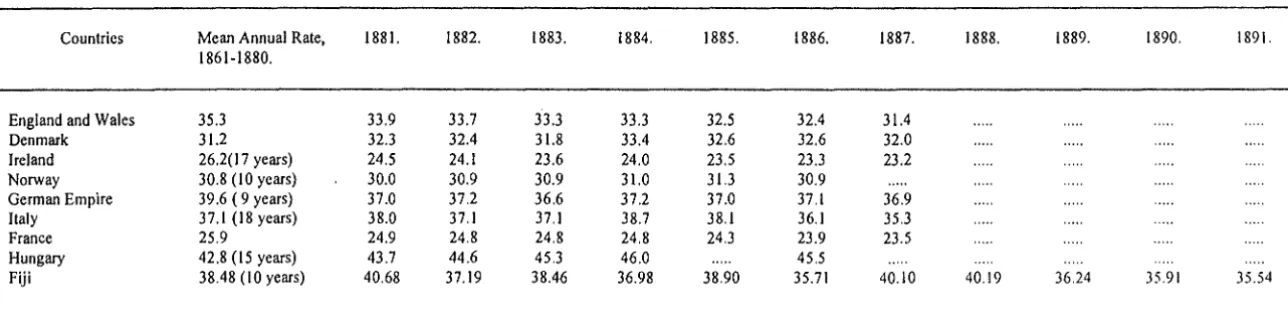
Table 3 Comparative crude birth rates:
Fiji and selected European countries, 1861-1887 41
Table 4 Crude Fijian birth rates and infant mortality rates,
1890, by province 100
Table 5 Crude Fijian birth rates and infant mortality rates,
1891, by province 100
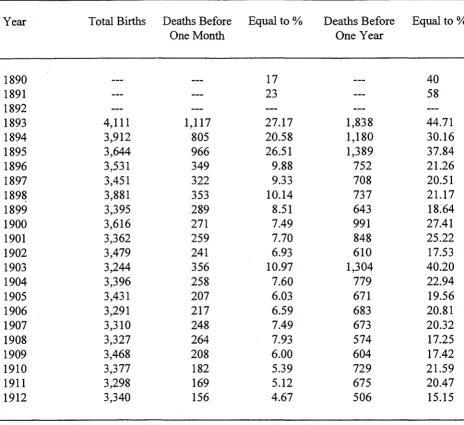
Table 6 Official statistics on Fijian infant mortality
for the years 1890-1912. 101
Table 7 Mortality of Children of Indentured Parents 1890-1900 178
Table 8 Crude infant mortality rates 1925-1970 206
Table 9 Crude birth rates 1895-1970 206
Table 10 Fiji's populations in successive colonial
censuses, 1879-1911, by sex 215
Table 11 Fiji's populations in successive colonial
censuses, 1921 to 1966, by sex 215
Table 12 Fijians living in villages and not living in villages, 1936 226
Figures
Fig. 1 Mother and child title page
after page
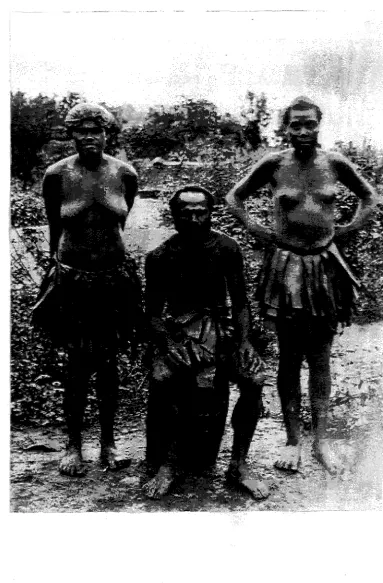
Fig. 2 A man with two women 50
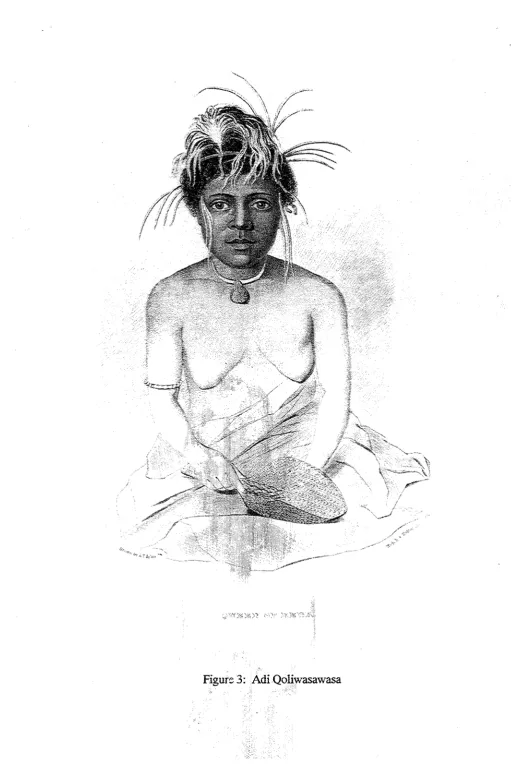
Fig. 3 Adi Qoliwasawasa 66
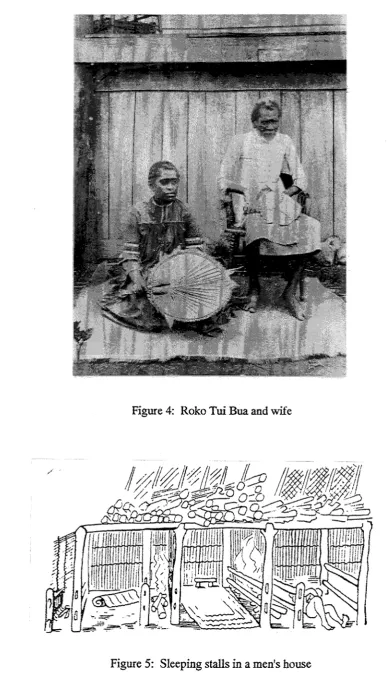
Fig. 4 Roko Tui Bua and wife 67
Fig. 5 Sleeping stalls in a men's house 67
Fig. 6. Fijian preacher 83
Fig. 7. Fijian minister, with wife, and kneeling two children 83
Fig. 8. Man, with woman carrying heavy load 92
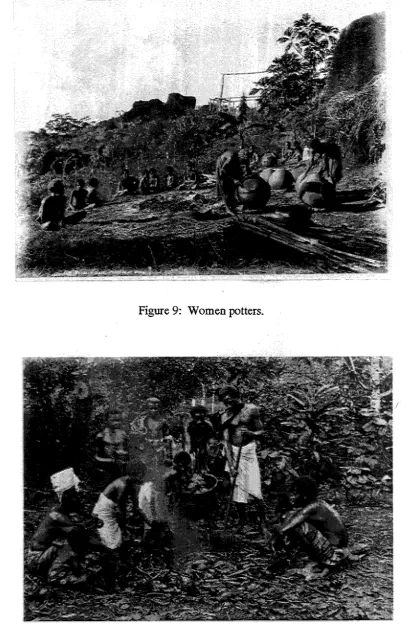
Fig. 9 Women potters 97
Fig. 10 Men and boys at lovo, or earth oven 97
Fig. 11 Nemani Dreu, Roko Tui Ba, receiving whale's tooth 102
Fig. 12 Two women, two infants and bucket 110
Fig. 13 Women fetching water from a new well, Bua 121
Fig. 14 Native Stipendiary Magistrate and family 121
Fig. 15 A domestic picture: the interior of a Fijian minister's house 146
Fig. 16 Pupils from Matavelo, c. 1930, with their handiwork 153
Fig. 17 Indian family 169
Fig. 18 Indian nurses, Ba Methodist Women's Hospital 187
Fig. 19 Dr Hensley & colleagues, Ba Methodist Women's Hospital 187
Fig. 20 Lolohea Waqairawai in 1963 200
Fig. 21 Fijian Child Welfare nurses, Ba 207
Fig. 22 Indian mother, aged 15, and her two children 207
Fig. 23 The Taralala during war-time 234
Fig. 24 Village child welfare inspection during peace 234
(Sources of figures: fig. 3 is reproduced from Wilkes, Narrative of the United States Exploring
Expedition; fig. 5 from Kleinschmidt, 'Theodore Kleinschmidt's Notes on the Hill Tribes'; fig. 8 from Seemann, Viti; fig. 20 from Baro, 'Lolohea Ak:osita Waqairawai'; figs 18-19 from Roth, Fijian Way of
In the 1890s the British administration of Fiji commissioned an inquiry into the decrease of the indigenous population. Its subsequent report - a seminal text - figured Fijian women as both a cause and potential solution to the problem. This study explores what was said and done about Fijian women in the context of 'the decrease'.
The first section addresses the epidemiological conditions which induced Fijian depopulation; and the political and intellectual factors which shaped a discourse alleging the incompetence of Fijian mothers.
The second section tests one popular theory: that this incompetence was due to deleterious effects from the 'abolition of polygamy'. We discuss pre-Christian marriage practices, how they changed, and whether these changes elevated Fijian infant mortality.
The third section examines measures that were taken around the turn of the century on the premise that Fijian mothers were congenitally defective. Attempts were made to change them by edict, education and training. They all failed; and Fijians were abandoned to extinction just when their demographic recovery began.
The fourth section deals with later shifts in the discourse: a period when it lapsed and official attention focussed on Fiji's Indian women; the interwar era when the
discourse was revived in the context, so to speak, of a demographic race between Indians and Fijians; and finally its appropriation by Fijian men in an effort to enhance their control over Fijian women and prevent interracial liaisons.
National Library, Canberra British Museum
Cakobau/Ad-lnterim Government Colonial Office
Confidential Files, Secretariat. Chief Medical Officer
Colonial Secretary's Office Colonial Sugar Refining Co. Ltd District Commissioner
ANL
BM CAIG
co
CF CMOcso
CSR DCDR
F GBPP LCP LC
'Decrease Report' -Report of the Commission Appointed to Inquire into the Decrease of the Native Population, Suva: Government Printer, 1896. 'F series', Secretariat
M
mf ML MMS MOM
Great Britain Parliamentary Papers Legislative Council Papers
Ladies Committee for the Ameliorating the Condition of Women in Heathen Countries
Methodist Archives, Fiji microfilm
Mitchell Library, Sydney Methodist Missionary Society Methodist Overseas Mission ms manuscript
N 'N series', Native Affairs NAF National Archives, Suva NMP Native Medical Practitioner NON Native Obstetric Nurse NSM Native Stipendiary Magistrate
PAH Division of Pacific and Asian History, Research School of Pacific and Asian Studies, Australian National University
PM Peabody Museum
PMB Pacific Manuscripts Bureau PMO Provincial Medical Officer QVS Queen Victoria School for Boys RCAF Roman Catholic Archives, Suva SM Stipendiary Magistrate
b is pronounced as mb in
c is pronounced as th in
d is pronounced as nd in g is pronounced as ng in
q is pronounced as ng in
Note on Fijian terms
number they end sing finger
I italicize Fijian words with the exception of the titles of office-bearers in the Native Administration and certain institutions, as in Turanga ni Koro, the government appointee for administration of the village; or Bosevakaturaga, the Council of Chiefs.
Adi bose Bosevakaturaga buinigone bula Buli buturaki bure bure ni sa cakacaka cauravou cika coka cokadra cokalosi coko dabe dalo davola dauveimaroroi dogai dravu dreke levu girmit girmitya gone gone !alai ibe ivukevuke Glossary
title of respect for a woman, as in 'Lady ... .' meeting, conference
Council of Chiefs
midwife, grandmother, old woman health, life
government appointee for the administration of the district kick, 'bash-up'
house; men's house
men's house, house for guests work
youth, young man conjunctivitis
dysentery, diarrhoea dysentery, pass blood
procedure for draining blood via a man's urethra yaws
infant's sickness due to breaking the post partum taboo taro
cross-cousin of the opposite sex 'carer', nurse
sickness caused by sex with much older partner ashes
carrying heavy loads
indenture contract; indenture an Indian indentured labourer child
babies mats
kai colo kaisi kalourere kania karokaro katakata kawa kawaboko kawadravu kawai kawayali kiripi koro kuma/a leba lila lilabalavu lotu lovo luveniwai magiti mana marama masi mata matainimate matanitu matanivanua mataqali mate matetaka meke
na lutu sobu itaukei na tina ni gone itaukei noqu taki wai
Ovisa qase qaseqase ramusu rara Ratu Roko Tui Ruve sa sa sasaca save so levu soqosoqo Soqosoqo Vakamarama
people from the hilly interior of Viti Levu commoner, low born person
a type of god or spirit; also used for practices to produce ' communion with them
to eat, consume; also verb for a man's sexual intercourse with a woman
skin compaint
fever; sometimes more specifically influenza offspring, progeny, race
to make extinct to make extinct edible tuber to make extinct croup
village sweet potato
a small fragrant tree wasting
the long wasting Christianity earth oven
'spirits of the water' - term also used for practices to produce communion with them
ceremonial feast
power, supernatural power, efficacy lady
bark-cloth
eye, herald, speaking chief
'doctor', person skilled in dealing with sickness/death government
herald, speaking chief
patrilineal descent group, land-owning unit sickness, death
epidemic
dance poem, ballad the decrease of the Taukei Fijian mothers
my water carrier, concubine Officer
old person cunning broken
open village square, area
title of respect for a man, as in 'Sir ... .'
goverment appointee for administration of a province dove; Ruby; name of the Methodist Women's Association dry coconut leaves
a kind of plant
infant's sickness due to conception of a sibling too soon ceremonial exchange
society
talatala tanoa taukei tina tukutuku raraba tulevutaki
Turaga ni Koro
Turaga ni Lewa iTaukei
vasu
vale
vale ni bula vale ni mate vakamau vakamisioneri vakasilima vakatevoro vata vavalagi vu vunikalou vunikoli wai ni vaka lutu vunivalu wai niyava yalewa yaqona yavu yavu lala yavusa
minister of religion
large bowl for mixing yagona owner or possessor of the land mother
histories, traditions pack-rape
Government appointee for administration of a village Native Stipendiary Magistrate
son of a man's sister; he has certain rights among his uncle's people
house
house of health/life; hospital house of sickness/death; hospital formal Christian marriage
missionary collection, meeting
range of therapeutic manipulations, usually through orifices of the body, and usually in water
'devil-like', heathen shelf, ledge
foreigner, white person cough
midwife; priest
'cough of the dog', whooping cough medicine to cause abortion
warlord; title of the high chief of Bau medicine to prevent conception women
kava
house platform, foundation empty house platform, foundation
Introduction
Mothers of the Taukei: Fijian Women and 'the Decrease of the
Race'
This study is set in the southwest Pacific islands of Fiji against the background of Fijian demographic decline during the nineteenth and twentieth centuries. The collapse of American and then Pacific populations following European contact had been widely witnessed since the sixteenth century. Today the dominant explanation of this dying is in terms of non-immunity to introduced disease; but Europeans at the time proposed a range of other theories. Their tendency to see native decrease as ineluctably leading to
extinction was however always strong. Fiji was therefore unusual: the British colonial administration explicitly rejected the inevitability of extinction for Fijians and tried 'to save the race'; and from the 1890s, a local, colonial discourse developed concerning the decrease of the Taukei - Fijian for 'owners' or 'possessors of the land'1 - which focussed attention and directed efforts toward Fijian mothers.
'Discourse' is here defined as a pattern of discussion in which a loose set of ideas, concerns and terminologies recur. The chapters which follow attempt to make some sense of this discourse on decrease in Fiji: its epidemiological circumstances, the political interests which informed it, the validity of some of its theories concerning Fijian infant mortality, the interventions which resulted, and the fate of this discourse, as it was invoked, forgotten, reinvoked, and used to various ends by different parties from the late nineteenth to the mid twentieth century. Throughout this study, implicitly or explicitly, is the presence of the single text that provoked it: the bulky report of a commission of inquiry into the decrease published in 1896, which established Fijian mothers as objects of governmental thought and action and achieved almost biblical status during the next fifty years. 2 In a prominent line of reasoning, depopulation was attributed to high rates
of infant mortality which in turn were attributed to 'bad mothers'. Hence many efforts to 'save the race' attempted to correct the alleged defects of indigenous maternity.
The study falls into four parts. The first deals with the origins of the decrease in the new diseases imported by Europeans to Fiji; and the origins of the discourse in Fiji's native policy and politics, as well as general theories of 'decline', 'degeneracy' 'decay' and 'extinction' applied to both European and indigenous populations in that era. The secorid explores one explanation of Fijian maternal incompetence popular in the 1890s: that it was owing to incapacitating circumstances ensuing from 'the abolition of polygamy'- an interesting proposition which eventually I reject. The third examines
1 The word Taukei in recent times has acquired very specific political and nationalist connotations;
throughout this thesis it is used in its earlier, colonial sense to denote Fiji's indigenous people. 2 Report of the Commission Appointed to Inquire into the Decrease of theN ative Population,
those initiatives taken around the turn of the century based on the premise that Fijian women were congenitally deficient in maternal instinct. Attempts were made to change the mothers of the Taukei by edict, education and special training. When these failed, the administration gave up, consigning the Taukei to their fate. The final part deals with the later permutations of the discourse, which occurred in the shadow of Fiji's other subject races. Chapter nine traces the rise and transformation of the Indian mother, whose prolificity between the wars prompted alarm and redirected attention to Fijian mothers once more. Chapter ten addresses the Child Welfare Scheme which reincarnated the 1890s discourse on decrease in the 1920s and '30s. Chapter eleven discusses its final appropriation by Fijian men in an effort to safeguard their paternity and all that it entailed against the prospect of their economic and political extinction.
Thus chapters one to eleven treat developments linked to demographic trends from the late eighteenth century to the eve of World War 2, during which time the Taukei decreased and recovered; then 'decreased' relative to the rapid growth of the Colony's Indian population. For the purposes of our discussion however, the discourse on decrease had a shorter career: it was born in the 1890s, flourished around the tum of the century, revived in the inter-war era, and died thereafter. The conclusion analyses some of the factors in its death, before addressing two ultimate questions: whether mothers contributed to the decrease of the Taukei as alleged; and whether the initiatives which the discourse authorised were any aid to their increase. To both I answer in the negative.
*****
This is a descriptive and reflective, text-based history. The discourse on decrease in Fiji has served as both a focus in itself and as a lens through which to examine the developments it denotes and the settings in which it was shaped and used. The resulting insights into medicine, disease and gender in empire will, I hope, add to understandings of Fiji's contact and colonial past and contribute more generally to scholarship animated by these concerns.
I feel that this work has been shaped from the 'bottom up' rather than the 'top down'. Its edges and internal divisions were suggested by a contemplation of the
primary material, with each section and chapter raising distinctive interpretative questions. While others might have preferred to tailor the undertaking to a particular paradigm or problem of interpretation, I chose to run with the sources. Though this approach risks formlessness, it can also prove serendipitous and yield unanticipated patterns.
colonialism and the history of health. Insofar as the first chapter and the conclusion address debates concerning the relative weight of biological versus cultural, social and political factors in disease and decrease, this controversy provides a frame of reference for the study as a whole. Selections from a proliferating literature on gender, class and race under colonialism furthered particular lines of thought. Finally, I came to this project entranced by readings in American, British and Antipodean 'women's history'. Traces of this influence can be seen in my treatment of European women, and in some instances, where analogies with Fijian developments are suggested.
My greatest debt however is to the National Archives of Fiji, which leave the researcher awed by their richness and heterogeneity. I was initially attracted by the
Report of A Commission Appointed to Inquire into the Decrease of the Native
Population, because it said so much on women, and planned to track texts related to it or to the themes it raised. Warnings about the silence of man-made sources on the subject of women prepared me for a meagre haul; but the archives yielded a wealth of material caught in the driftnet of colonial inscription. Just as nineteenth and twentieth century anxieties about population trends in Europe and the Neo-Europes3 entangled women in the public record, so they did in Fiji - in complex and fantastic detail.
The main question one might ask of my sources is: what about the mothers of the Taukei themselves? Most of my primary material, both archival and published, was , written by colonial administrators and missionaries. Most of the Fijian voices are those of men - speaking in provincial councils, at meetings of the Council of Chiefs, writing government reports, petitions and sometimes articles for The Native Medical Practitioner
or the Transactions of the Fijian Society. Most of the female voices are European -belonging to mission sisters or missionary wives, wives of officials, workers in the Hygiene Mission, feminists campaigning against indenture, and nurses. Inevitably, these sources lead one to ponder the interrelationships among these speakers and the ways in which they documented the mothers of the Taukei.
Yet the voices of Fijian women, mostly in their native tongue, also break through. They are transcribed in the archives here and there for which my limited proficiency in Fijian was at least adequate to read. The infant death inquiries in chapters one and six record the testimony of Fijian mothers, midwives and other village women, though I sampled but a fraction of them. Reports by Fijian workers in the Native Obstetric Nursing and Child Welfare Schemes, examination answers by Fijian school girls, and letters from the champion of mothers and children, Lolohea Waqairawai are cited in chapters eight and nine. Female witnesses in court, recorded conversations with Fijian women, and a haunting women's meke, or dance poem contribute to the discussion of polygamy in part three. Sources such as these are vastly outnumbered by documents
3 Alfred Crosby's term for the lands of mass European settlement. See Alfred W. Crosby,
Ecological Imperialism: The Biological Expansion of Europe, 900-1900, Cambridge: Cambridge
written by or quoting men, or authored by European women, but are none the less many and vivid.
The oral testimony of living women has played an ambiguous part in this study. Conversations with nurses, workers in women's organisations, village midwives, and others who extended hospitality and friendship, influenced my thinking on many matters. Nurses in particular, though their work, observations and commitment helped me
appreciate the pioneers of their profession, enduring issues in maternal and infant health and the interaction of Fijian and official medicine. But I was struck by how many events and conditions treated in this study simply 'rang no bells' in the present. Memories did not go back so far, and when they did they remembered other things or preferred to forget. Historians must contend with amnesia as with memory; and some experiences addressed in the chapters ahead are, as I explain, particularly prone to erasure.
Certain issues of interpretation were raised by old texts which could perhaps be furthered by anthropological research today into, for instance, distinctively Fijian ideas about conception and pregnancy, or current 'folk' practices of abortion and contraception. My considerations have usually depended on the textual residues, inference, existing studies relating to Fiji or work done in cognate societies. Though I respect the ideal of combining archival and anthropological methods in approaching Pacific pasts, I was not in the position to do this kind of research myself.
Chapter One
A New Age
The foreigner is hove-to,
A sickness is reported among us,
The men are swept away; the women are swept away They are like the plantains that have withered.
Meke on the coming of dysentery, transcribed by Ilai Motonicocoka.l
The arrival of new diseases brought by Europeans in their ships marked a new epoch for many peoples of the Pacific. Two Fijian women from early last century caught this sense of periodization in their lament:
'We have fallen on a new age, io e
infectious disease is spreading among us'.2
The phrase 'fatal impact' automatically springs to mind when thinking of new diseases introduced to the Pacific. Within Pacific scholarship it is a particularly loaded phrase, associated with visions and approaches to the past in which one can trace a full circle in the last thirty years. Ever since the apparent demise of Pacific populations was first observed, theories about the mortal effect of Europeans upon Islanders were
expounded. But shortly after the 'fatal impact' was popularised in 1966 by the title of the most widely read history of the Pacific, Alan Moorehead's The Fatal Impact, the vision suggested -paradise destroyed, life extinguished- went out of academic fashion.3 To
the new school of Pacific historians from the 1960s, many Pacific Islanders were manifestly alive, prolific and shedding colonialism. This vision demanded histories which downsized Europeans, banished victimhood, and stressed Islander resilience and agency. 4 So, when looking to the past, exaggeration in descriptions of disease and in
1 Ilai Motonicocoka, 'The Story of the Lilabalavu (Wasting Sickness) and of the Cokadra (Dysentery); and the Meke (Ballads) relating to those Events', Report of the Commission Appointed to
Inquire into the Decrease of theN ative Population, (henceforth abbreviated DR ) Suva: Government
Printer, 1986, App. 1, pp. 2-3.
2 DR, App. 1, p. 2.
3 Alan Moorehead, The Fatal Impact: An Account of the Invasion of the South Pacific, Harmondsworth: Penguin, 1966.
4 The father of this school, Jim W. Davidson, Professor of Pacific History at the Australian National University, outlined an agenda for Pacific historiography in the first edition of the Journal of
Pacific History which, ironically, was published in the same year as Alan Moorehead's Fatal Impact.
Davidson's essay was a revised version of an inaugural lecture given twelve years previously and argued that historians needed to consider indigenous forces alongside imperial factors. See J. W. Davidson, 'Problems of Pacific History', Journal of Pacific History, 1 (1966), pp. 5-22. Elements of this approach were taken further by AND-trained historians, with Kerry Howe publishing perhaps the strongest attack upon the idea of the 'fatal impact'. See Kerry Howe, 'The Fate of the 'Savage' in Pacific Historiography',
early figures for Pacific populations was especially suspected. Lower estimates tended to be favoured, thus in effect reducing the degree to which Islander numbers could be imagined as having fallen. Various studies have confirmed that there was no uniform 'fatal impact' on the Pacific: some populations were badly affected, others scarcely touched. In this research, the demographer Norma McArthur was a leader.5
Two developments have however revived 'fatal impact' in the Pacific. The first is
the rise of environmental histories which deal with the effects of immigrant microbes as well as flora and fauna, and which highlight the lability of some island ecosystems. Pacific geographers, archaeologists and prehistorians have long been preoccupied with human impact and environmental change, but these themes have been charged with drama and pathos since Crosby touched on the Pacific in his panoramic study of Ecological Imperialism. 6 The second is the huge rewriting of the history of the 'fourth world' - the
indigenous peoples demographically and politically overwhelmed in their ancestral lands -like the Indians of the Americas and the Aborigines of Australia. This scholarship has revised upwards the estimates of native populations at contact and pictured a far greater initial demographic destruction due to disease.7 David Stannard has self-consciously brought this agenda to Pacific historiography in his studies of Hawaii, beginning with his essay Before the Horror. Here he argues that prior to their steep and rapid decline thanks to the introduction of disease, Hawaiians numbered at least 800,000- almost three times greater than the maximum estimate hitherto accepted.s There is now a corpus of work in
5 Norma McArthur, Island Populations of the Pacific, Canberra: Australian National University
Press, 1967. McArthur treated early population estimates and even reports of some epidemics with scepticism. See, for instance, her querying the reports of certain epidemics in Norma McArthur, 'Population and Prehistory: The Late Phase on Aneityum', PhD thesis, Canberra: Australian National University, pp. 93 ff. Recent studies confirming the non-uniformity of the 'fatal impact' include J.-L Rallu, 'Population of the French Overseas Territories in the Pacific, Past, Present and Projected,' Journal
of Pacific History, 26:2 (1991 ), pp. 169-186; and Rallu, Les populations oceaniennes aux XIXe et XXe
siecles, Paris: INED, 1990. Considering the impact of disease on the Cook Islands, Raeburn Lange also addressed the debate on 'Fatal Impact', and while noting the variation in native decline, tended to stress the immensity of 'fatal encounters' with new disease. Raeburn Lange, 'Plagues and Pestilence in Polynesia: The Nineteenth Century Cook Islands Experience', Bulletin of the History of Medicine, 58 (1984), esp. pp. 325-326.
6 Crosby, Ecological Imperialism. See also John Dodson ( ed.), TheN aive Lands: Prehistory and
Environmental Change in Australia and the South-West Pacific, Melbourne: Longman Cheshire, 1992 and .T. R. McNeill, 'Of Rats and Men: A Synoptic Environmental History of the Island Pacific', Journal
of World History, 5:2 (1994), pp. 299-349.
7 A useful survey of these trends in relation to America is given in David E. Stannard, American
Holocaust: Columbus and the Conquest of the New World, New York: Oxford University Press, 1992, App.1, pp. 261-268. The work to pioneer contentious upward revisions of the Australian Aboriginal population was Noel Butlin, Our Original Aggression: Aboriginal Populations of South Eastern
Australia, 1788-1850, Sydney: Allen & Unwin, 1983. Curiously, although some Maori scholars would welcome similarly increased estimates of their population at contact, so strong is the 'anti Fatal impact' position in New Zealand that no such work to my knowledge has been done, and vigorous arguments have been advanced for more conservative estimates of Maori population on contact. Ranganui Walker,
Ka Whawhai TonuMatou: Struggle Without End, Auckland: Penguin, 1990, p. 81; James Belich,
Making Peoples: A History of New Zealanders from Polynesian Settlement to the End of the Nineteenth Century, Auckland: Penguin, 1996, pp. 172-178.
8 David E. Stannard, Before the Horror: The Population of Hawaii on the Eve of Western
dialogue or dispute with Stannard; Hawaiian nationalist historians have embraced
Stannard's vision of 'the horror'; and his estimate is cited as the new, if contested upper limit of Hawaiian population on the eve of contact.9
Three features in this body of 'horror' literature are pertinent for the discussion here. The first is the tension between biological determinism and human agency as explanations of disease. Though Stannard holds Europeans responsible for introducing new diseases to Hawaii, there is a strong quality of biological determinism in his account. By contrast, the epidemiologist Kunitz who has engaged with Stannard's work in his own studies of the European impact upon the health of non-Europeans, stresses that the best explanations of disease must draw upon 'multiple, weakly sufficient causes' and must consider very specific political, social and cultural factors, rather .than universal laws of microbial behaviour.lO As Donald Denoon has pointed out, the first approach tends to correlate with a focus on early contact, the second with a focus on the later colonial period.1 1
A second feature is the obvious desire of Stannard, Kunitz and every author one could cite in this corpus to avoid any explanations which could be construed as 'blaming the victim'. Consequently, while much attention is given to the effect of European actions upon native morbidity and mortality, relatively little attention is given to the ways in which indigenous practices may have interacted, to fatal or beneficial effect, with imported disease. These questions are, for the most part, left in silence; or, as in
Studies, 24:3 (1990), pp. 325-350; Stannard, 'Recounting Fables of Savagery: Native Infanticide and the
Functions of Political Myths', Journal of American Studies, 25:3 (1991), pp. 381-418.
9 The 'Horror' corpus includes: reviews by Eleanor Nordyke and R. C. Schmitt plus Stannard's reply in Before the Horror; Terry L. Hunt, Francis Black, Lynette Cruz and J. Kelani English, Ann F. Ramenofsky and David Stannard in 'Book Review Forum', Pacific Studies, 13:3 (1990), pp. 255-301;
Patrick V. Kirch's review of Stannard in The Contemporary Pacific, 2:2 (1990), pp. 394-396; Alfred W.
Crosby, 'Hawaiian Depopulation as a Model for the Amerindian Experience', Epidemics and Ideas: Essays on the Historical Perception of Pestilence, ed. T. Ranger & Paul Slack, Cambridge: Cambridge University Press, 1992, pp. 175-201; Andrew F. Bushnell,' "The Horror" Reconsidered: An Evaluation of the Historical Evidence for Population Decline in Hawai'i, 1778-1803,' Pacific Studies, 16:3 (1993),
pp. 115-162; 0. A. Bushnell, The Gifts of Civilization: Germs and Genocide in Hawaii, Honolulu:
University of Hawaii Press, 1993; Stephen J. Kunitz, Disease and Social Diversity: The Impact of Europeans on the Health of Non-Europeans, New York: Oxford University Press, 1994. Donald
Denoon, 'Pacific Island Depopulation: Natural or Un-natural History?', New Countries and Old Medicine: Proceedings of An International Conference on the History of Medicine and Health, ed. Linda Bryder &
Derek A. Dow, Auckland: Pyramid Press, 1995, pp. 324-339. Haunani-Kay Trask anticipated the directions of Stannard's research and, with Lila Kame'eleihiwa endorses the upward revisions of estimates of Hawaiian population at contact. See Haunani-Kay Trask,'Hawaii: Colonization and Decolonization',
Class and Culture in the South Pacific, ed. Antony Hooper et al, Suva: Institute of Pacific Studies,
1987, p. 155 and endnote 2, pp. 172-173; Trask, 'From a Native Daughter', From a Native Daughter: Colonialism and Sovereignty in Hawaii, Monroe, Maine: Common Courage Press, 1993, pp. 147-159;
and Lilikala Kame'eleihiwa, 'Book Review Forum, Ganath Obeyesekere's The Apotheosis of Captain Cook', PacificStudies, 17:2, (1994), pp. 111-118.
lO Kunitz, Disease and Social Diversity, p. 188. The geneticist James V. Neel similarly
downplayed 'biological factors' in a consideration of social, cultural and other factors in disease. J. V. Neel, 'Health and Disease in Unacculturated Amerindian Populations', Health and Disease in Tribal Societies, intro. P. Hugh-Jones, Ciba Foundation Symposium 49, Amsterdam: Elsevier, 1977, pp.
155-177.
Stannard's vigorous repudiation of claims that war and infanticide contributed to
population decline in Hawaii, branded as political myths serving to exculpate Europeans for native suffering and loss of life.12 This avoidance is understandable, given (as later chapters illustrate) that so many elaborate explanations of indigenous population decline have 'blamed the victim' or in effect denied the part of European actions or inaction in demographic collapse.13 Moreover, in the politics of redress today, victimhood can provide an empowering identity and a potent tool which some of the survivors of
decimated populations today are keen to wield. The status of victimhood in this discourse accords with a vision of the Pacific and of Pacific scholarship which sees both - not in the process of decolonization forecast in the sixties- but still battling colonialism's hydra.14
A third feature is the renewed examination, found especially in Stannard's and Crosby's studies, of the effect of introduced diseases upon female fertility. Stannard and Crosby agree that lowered fertility was a crucial factor in Hawaiian depopulation, rather than high rates of sickness-induced mortality alone. Stannard has argued that more than syphilis and gonorrhoea need consideration. Other common introduced diseases such as influenza, measles and tuberculosis can impair the female capacity to conceive, to sustain pregnancy and ultimately to deliver live and viable children. Stannard's 'Horror' was thus particularly horrible for Hawaiian women.15
The early introduction of new diseases to Fiji; their interaction with Fijian
practices; and their effect on Fijian women: these are the main questions that will inform this discussion- after some preliminary comment on Fiji and the Fijians.
Fiji and the Fijians
Fiji forms the last island group in a continental chain which stretches eastwards into the Pacific from New Guinea. Vanuatu lies 1000 kilometers to Fiji's west, Tonga and Samoa somewhat nearer to Fiji's east. During the 3,500 years or so of human settlement in Fiji, 16 there have been further migrants from the west, 17 and a pattern of
12 Stannard, Before the Horror, pp. 61-65; Stannard, 'Recounting Fables of Savagery'; see also the warning in Stannard, 'Book Review Forum', p. 295.
13 For a discussion of literary and other representation of indigenous population decline, see Patrick Brantlinger,' "Dying Races": Rationalizing Genocide in the 19th Century', The Decolonization of the
Imagination: Culture, Knowledge and Power, ed. Jan Nederveen Pieterse & Bhikhu Parekh, London: Zed Books, 1995, pp. 43-56.
14 David Chappell, 'Active Agency vs. 'Passive' Victimization: Decolonized Historiography or Problematic Construct?' The Contemporary Pacific, 7:2 (1995), pp. 303-326; Klaus Neumann, 'In Order to Win Their Friendship: Renegotiating First Contact', The Contemporary Pacific, 6:1 (1994), pp. 111-146. Some of the shifts in the 'moral-political' value of agency and, implicitly victimhood are also discussed by Marshall Sahlins, 'The Discovery of the True Savage', Dangerous Liaisons: Essays in
Honour of Greg Denning, ed. Donna Merwick, Melbourne: Department of History, Melbourne University, 1993, esp. pp. 41-47.
15 Stannard, 'Disease and Infertility' and Crosby, 'Hawaiian Depopulation'. See alsoP. Pirie, 'The Effects of Treponematosis and Gonnorrhoea on the Populations of the Pacific Islands', Human Biology
inOceania, 1:3 (1971), pp. 187-206.
m•s
170S
YASA:A .•
rJ.r~YASAWA
.:. GROUPJ!
NACULA · '· .OVIWA /l~AVITI. f:2WAYA,
o'
.
MALOLO"l,
18"S
19"S
1770E
YANUCA
q,
VATULELEVANUA
--, v~_-:;~~rtJIMAKOG~I .
. NAIGANI Q LOMAI'iiiTI GROUP
o/~
.
.... {). ~.W~YA .
~OovALAu· ' ·· · ·.
MoruRIKt . ,
I
:c eKf1i<1 ·17~":'" .. :MATUKUD
C Bua M Natewa
D Cakaudrove N Rakiraki
(D) Cakaudrove 0 Rewa (before Ma'afu) p Serua
E Dreketi Q Tavua
F Macuata R Verata
G Matailobau s Vuda
H Nadi T Vuna
;i .<',L. · .. :))< I Nadrau U Wailevu
VANUA~~
•" J Nadmgaj
v WaimaroSOMOSOMO GROUP 0 VA'TUVARAo
... c
~' ()
.c!/OGEA
c:r ,
interaction within the triangle formed by Fiji, Tonga and Samoa.18 Some geneticists, happily immune to the cultural debates surrounding the terms, describe the genetic influences on the Fijian population as 80% Melanesian and 20% Polynesian.l9
With respect to disease, Fiji's central position entailed some advantages for its inhabitants. Relative genetic diversity may have been one of these. The Fijians' history of infusion and intermingling contrasts with that of some Pacific island populations which grew from a small number of founders, developed largely in isolation and were therefore characterised by relative genetic homogeneity.20 Francis Black has argued that the more genetically homogeneous the population, the more virulent can an infection introduced into its midst become.21
Colonization of the Pacific: Some Current Hypotheses', The Colonization of the Pacific, A Genetic
Trail, ed. Adrian V. S. Hill & Susan W. Serjeantson, Oxford: Clarendon Press, 1989, pp. 1-59. Irwin prefers the date of 1250 BC for the settlement in Fiji. Geoff Irwin, The Prehistoric Exploration of the
Pacific, Cambridge: Cambridge University Press, 1992, p. 215. The possibility of an earlier human presence in Fiji has been raised from evidence of burning by Wendy Southern, The Late Quaternary Environmental History of Fiji, PhD thesis, Canberra: Australian National University, 1986, pp. 202, 213, 217.
17 Former theories which held waves of migration solely responsible for major changes to Fijian society, and for the cultural, linguistic and physical diversity found in Fiji were countered by theories stressing the primacy of localised processes of social evolution. Terry L. Hunt, 'Patterns of Human Interaction and Evolutionary Divergence in the Fiji Islands', Journal of the Polynesian Society, 96:3, 1987, pp. 299-334. More recent genetic studies (see foonote 19 below) however partly reinstate the earlier view. Matthew Spriggs, 'The Lapita Culture and Austronesian Prehistory in Oceania', The
Austronesians: Historical and Comparative Perpsectives, ed. Peter Bellwood, James J. Fox & Darrell Tryon, Canberra: Comparative Austronesian Project, Research School of Pacific and Asian Studies, Australian National University, 1995, p. 124.
18 For the Fiji!fonga/Samoa triangle, see Janet Davidson, 'Western Polynesia and Fiji', Mankind, 11 (1978), pp 383- 390; A. Kaeppler, 'Exchange Patterns in Goods and Spouses, Fiji, Tonga and Samoa',
Mankind, 11:3 (1978), pp. 246-252; A number of traditions and proverbs suggesting interaction over a long period of time between Tonga, Samoa and Fiji have been collated by Morgan Tuimaleali'ifano,
Samoans in Fiji: Migrations, Identity and Communication, Suva: Institute of Pacific Studies, 1990, cbs 2 - 4. Many Fijian communities trace both more recent and distant ancestral links with Tonga and Samoa. For one example, see Marshall Sahlins, Moala: Culture and Nature on a Fijian Island, Ann Arbor: University of Michigan Press, 1962, pp. 16, 234, 235 and passim. Studies of these
interrelationships in more recent times include A. C. Reid, 'The Fruit of the Rewa: Oral Traditions and the Growth of the Pre-Christian Lakeba State' Journal of Pacific History, 12 (1977), pp. 2-24; John T. Parry, 'The Sigatoka Valley- Pathway into Prehistory', Bulletin of the Fiji Museum, 9 (1987), pp. 39-42; Niel Gunson, 'The Tonga-Samoa Connection 1777-1845', Journal of Pacific History, 25:2 (1990), pp. 176-187.
19 S. W. Serjeantson & A. V. S. Hill, 'The Colonization of the Pacific: The Genetic Evidence',
The Colonization of the Pacific, ed. Hill & Serjeantson, pp. 288-289. For general issues relating to the terms 'Melanesia' and 'Polynesia' see Nicholas Thomas, 'The Force of Ethnology: Origins and
Significance of the Melanesia/Polynesia Division' Current Anthropology, 30 (1989), 27-41; Margaret Jolly & MarkS. Mosko 'Prologue' Special Issue, History and Anthropology 7:1-4 (1994), pp. 1-18. 20 Serjeantson & Hill, 'The Colonization of the Pacific' p. 288. For a discussion of the
evolutionary factors shaping Island populations, seeS. W. Serjeantson & X. Gao, 'Homo Sapiens is an Evolving Species: Origins of the Austronesians,' The Austronesians, ed. Bellwood, Fox & Tryon, pp. 165 -180.
Situation also influenced the number of diseases in Fiji before Europeans imported additions.22 Most of the flora and fauna of the Pacific Islands, like Islanders themselves, came from South East Asia, and the greater the distance from this source, the less as a rule the biotic range (map 1).23 Fiji appears to have had more endemic diseases than the distant Polynesian settlements; but less than the islands to its west. Among the ills Fijians acknowledged as their own were coko or yaws, leprosy, filariasis,
rheumatism, boils, ulcers, fungal and other skin complaints. But significantly, malaria never made the jump from Vanuatu, a single factor which renders Fiji a much more benign environment for human beings. 24 On the other hand Fijians suffered yaws which seems not to have reached the farthest flung landfalls of the Pacific migrations. However in view of the encounter with Europeans to come this particular affliction was a blessing. Those who had recovered from yaws enjoyed at least partial immunity to syphilis. Because Fijians had the entrenched belief that every child needed to suffer yaws in order to grow up healthy and therefore diligently inoculated their children with coko, they may have unconsciously implemented their own universal immunization program against syphilis.25
Hitherto I have spoken of Fiji as a single entity. There are 300 to 500 Fijian islands, roughly 100 of which are inhabited. The largest, Viti Levu and Vanua Levu account for 89% of the land area. Two centuries ago the linguistic and cultural diversity within the group was likely to have been more striking, but since the last century
Christianization, the elevation of one Fijian dialect as the language of literacy, and the all encompassing structures of church and state have promoted levels of uniformity.26 Still, considerable local variation persists, with the division on Viti Levu between the wet, windward part of the island and its drier, leeward slopes coinciding with one notable linguistic and cultural break. 27
22 John Miles, Infectious Diseases: Colonising the Pacific, Dunedin: University of Otago Press,
1997, provides an introduction to the pre-contact distribution and subsequent importation of infectious diseases in the Pacific.
23 McNiell, 'Of Rats and Men', p. 301. An exception is Vanuatu, which though west of Fiji has a smaller range of flora.
24 Denoon, 'Pacific Island Depopulation', passim. Miles, Infectious Diseases,pp. 19-29.
25 The distribution of yaws in the Pacific prior to European contact and its ability to confer full immunity to syphilis is debated. Stannard is undecided as to whether yaws existed in Hawaii and argues in any case that while syphilis may grant immunity to yaws, the reverse is less certain. Stannard, Before
the Horror, p. 77. Medical fieldworkers are said to agree that childhood yaws indeed provides protection against syphilis. A. W. Woodruff (ed.), Medicine in the Tropics, Edinburgh & London: Churchill Livingstone, 1974, p. 358 and the Fijian experience tends to confirm this. DR, pp. 127, 160-163. I suspect Bushnell is correct in supposing that yaws had not reached Hawaii so therefore noone had the benefit of yaws-induced immunity to syphilis. Bushnell, Germs and Genocide, p. 38. See also Pirie, 'The Effects of Treponematosis and Gonorrhoea'.
26 E. W. Gifford, 'Anthropological Problems in Fiji', The Journal of the Polynesian Society, 60,
(1951), pp. 122-129.
27 Hunt, 'Patterns of Human Interaction .. ', p. 328; See also generally Paul Geraghty, The History
While the significance of this division is prone to exaggeration - often in terms of contemporary politics28 -here we may do well to think of two Fijis: one centred around the Koro Sea, which the anthropologist Hocart described as Fiji's Mediterranean;29 the other comprising the inhabitants of Viti Levu's hilly interior and its western drylands. At the tum of the nineteenth century the Koro Sea complex was rich. It contained the most powerful chiefdoms of Fiji. Its peoples were linked by relations of tribute, exchange, marriage, kin, refuge, conquest, service. Through the scattering of islands which formed its eastern parameters sailed traffic with Tonga. And in the south eastern comer of Viti Levu, an intensive system of cultivation practised on the 250 square kilometers of the Rewa delta supported a population of possibly 35,000 to 40,000 people at its peak.30 This was the largest concentration of population in Fiji, if not the island Pacific.
Many peoples of the delta and eastern maritime regions claimed ancestors who had come down from the hills of Viti Levu generations earlier. But by the late eighteenth and early nineteenth century relations between the Koro Sea complex and the smaller polities of the interior and the west appear tenuous.31 Probably there was more common, current knowledge among the peoples of the Koro Sea about Tonga and Samoa than there was of their own Fijian hinterland. Early missionaries remarked on the ignorance of coastal Fijians about the 'mountaineers', while many kai colo were imagined never to have seen the sea.32
These two Fijis were likely to have constituted two distinctive networks for the transmission of disease. The people of western and interior Viti Levu probably enjoyed a
28 Deryck Scarr, Fiji: The Politics of Illusion, Sydney: New South Wales University Press,
1988, p. 3; Nicholas Thomas, 'Contrasts: Marriage and Identity in Western Fiji', Oceania, 62:4 (1992), pp. 317-329; and Nicholas Thomas 'Regional Politics, Ethnicity and Custom in Fiji, The Contemporary Pacific, 2:1 (1990), pp. 131-146.
29 AM. Hocart, 'Early Fijians', Journal of the Royal Anthropological Institute, 49, (1919), p. 43.
What I call the 'Koro Sea complex' includes Vanua Levu. Though Hocart contrasted parts of Vanua Levu
with the culture of the Koro Sea as exemplified in chiefdoms of Lau, Cakaudrove and Bau, during the late eighteenth and early nineteenth century western Vanua Levu was nonetheless enmeshed in the Koro Sea complex of trade, intermarriage and exchange. AM. Hocart, The Northern States of Fiji, London:
Royal Anthropological Institute, 1952, pp. 51; 146.
30 John T. Parry, 'Ring Ditch Fortifications in the Rewa Delta, Fiji: Air Photo Interpretation and
Analysis', Bulletin of the Fiji Museum, 3 (1977), p. 73.
31 AM. Hocart, 'Early Fijians', Journal of the Royal Anthropological Institute, 49, (1919), pp
42-51. Thomson described traditions 'of an upheaval among the inland tribes of Viti Levu which sent forth a stream of emigrants to the coast' including the emigrants whose descendants established the chiefdom of Bau. Basil Thomson, The Fijians: A Study in the Decay of Custom, London: William Heinemann,
1908, p. 22. Thomson and Hocart imagined that the descent from the hills was due to the pressure of immigrants arriving from the west. However, it may also be consistent with the general settlement trends Southern has proposed for Fiji: initial coastal settlers moving inland and then returning to the coast to cultivate delta country resulting from the erosion they had caused in the hills. Southern, The Late Quatemmy Environmental History of Fiji, pp. 214-215.
32 David Cargill remarked, 'The Natives assert that many of the inhabitants of the interior of some of the large islands have never seen the sea; that they have no friendly intercourse with those who live on the coast; and that their language and many of their customs differ from those of the maritime tribes.' Missionary Notices, Methodist Magazine, (1838), p. 862. Cf. Berthold Seemann, Viti: An Account of a Government Mission to the Vitian or Fijian Islands in the Years 1860-61, Cambridge: Macmillan & Co.
Kasavu
0 5
kilometres
oNUKULAU
degree of insulation due to their weaker and less frequent connections with the Koro Sea complex, and the barriers interposed by enemy tribes. By way of contrast, the Koro Sea complex was open to influences from the world outside Fiji. Within these distinctive
spheres, transmission was dependent on the incidence and patterns of contact, the destinations, distances and duration of travel. For the interior and west, I imagine a series of interconnecting; shorter-range habits of interaction; while in addition to these, the Koro Sea complex included wider-ranging movements.33 The phrase 'fatal impact' suggests an instantaneous event - in practice the impact of any disease was bound to be fragmented by the differentials of travel over time and space.
New Diseases
In 1890, if you had asked a colonial official in Fiji how many epidemics had afflicted the Fijian people; he might have replied that epidemics occur every year, but there had only ever been one major epidemic to his knowledge: measles in 1875, which had struck three months after Cession and made such a disastrous beginning to colonial rule. Contemporary observers believed the measles had killed one Fijian in four.34 This same, imaginary official would have been keenly aware that since Cession, the Fijian population had been declining. By 1891 it had almost dropped to 100,000, prompting the Commission of Inquiry around whose report our later chapters pivot. 35 Among its findings was the discovery of Fijian oral traditions relating to three earlier epidemics of which most European residents in the second half of the century had been quite unaware. The two earliest of these, according to Fijian reports, had been far worse than the
measles.36
The first was the lila, or lila balavu , meaning long wasting. It was linked in Fijian tradition with the arrival of the first European ship, so the Decrease Commissioners tentatively attributed its introduction to the stay of the HMS 'Pandora's' tender at the Island of Ono-i-Lau in 1791 -though other sources are possible. 37 Most of the sufferers
33 To my knowledge, the only spatial analysis of disease transmission in 19th century Fiji is Andrew D. Cliff and Peter Haggett, The Spread of Measles in Fiji and the Pacific: Spatial Components
in the Transmission of Epidemic Waves through Island Communities, Canberra: Department of Human Geography Publication, Australian National University, 1985. However, Hunt's 'Patterns of Human Interaction' considers factors that have likely implications for disease transmission too.
34 Official accounts of the measles epidemic are found in GBPP, val. 54 (1876), [C.1404] and [C.l624]. See also DR, p. 36; R. A Derrick, 'Fiji's Darkest Hour: An Account of the Measles Epidemic of 1875', Transactions and Proceedings of the Fiji Society, (1955), pp. 3-16; McArthur, Island
Populations of the Pacific, pp. 8-10. Cliff & Haggett, The Spread of the Measles in Fiji.
35 The exact return was 105,800. Fiji Census for the year 1891, Suva: Fiji Government Printer.
36 DR, pp. 32-36; Motonicocoka, 'The Story of the Lilabalavu', DR, App. 1; W. S. Carew, DR, App. 4, p. 4.
37 The journal of Renouard, who served on the Pandora's tender, suggests that intercourse between the vessel's crew and the Fijians was extremely guarded; and only on one occasion did any crew go ashore. Renouard, Voyage of the Pandora's Tender, 1791, ML: *0377. Another possible source of infection was the snow 'Arthur' which anchored off the Yasawas in 1894. There it was attacked by Fijians, some of whom tried to board the vessel. See Im Thurn's 'Introduction' to William Lockerby, The Journal of
of this lingering illness were left to die or were strangled. The lila epidemic cannot be identified with certainty, but tuberculosis fits many of the details. Transmitted largely by droplet infection, tuberculosis can assume an epidemic character on introduction to a previously unexposed population. 38 The second epidemic was the coka or cokadra,
translated as dysentery, a disease transmitted through the contamination of food or water by the faeces of an infected person. Its symptoms were diarrhoea and the passing of blood. Dated to the first decade of the nineteenth century and traced to a shipwreck on the reefs on Oneata, the coka was said to have spread quickly and caused massive death. 39
These were not the only major pre-Cession epidemics. There had also been large-scale epidemics of influenza, though curiously these were not mentioned in the report of Decrease Commission. Captain Charles Wilkes of the United States Exploring
Expedition in 1840 reported that influenza had first appeared in Fiji some years earlier, and again in 1839, when according to his Fijian informants, not enough healthy people had been left to care for the sick. In some villages half of the population had died. Resident Europeans estimated that the death rate among those infected was one in ten. 40
The diaries of missionaries also refer to this 1839 epidemic and testify to its extent.4 1 The possibility of other unrecorded epidemics, especially in the decades prior to 1835 cannot be discounted. After that date missionary diaries provide some form of continuous record. The picture they create is a complex one: of smaller localised epidemics (though this may reflect the limited purview of the missionary, rather than the actual extent of the disease), recurrent outbreaks of dysentery and influenza, and multiple illness. Despite all kinds of variations, these basic disease conditions are attested by missionary accounts until Cession; and for that matter, beyond Cession; after which the reports of medical officers and others do the same.
Some unrecorded and more intimate contact with the crew of a European ship is a possibility, but I think it more likely that the lila -assuming it was TB- was brought to Fiji by indigenous sea traffic from Tonga, which had earlier and closer contacts with European shipping. Every European vessel of the late eighteenth and early nineteenth century almost inevitably carried tuberculous seamen capable of
transmitting this infection. Sir James Watt, 'Medical Aspects and Consequences of Cook's Voyages',
Captain James Cook and His Times, ed. Robin Fisher & Hugh Johnston, Vancouver: Douglas & Mcintyre, 1979, pp. 156-157.
38 F. M Burnet, 'The Natural History of Tuberculosis', MedicalJoumal of Australia, 1:3 (1948), pp. 60-61. The symptoms of recently introduced tuberculosis need not necessarily take the pulmonary form. See William H. McNeill, Plagues and Peoples, New York: Anchor Press, 1976, p. 177. 39 The DR suggested the eclipse may have occurred 7 Sep. 1802 (DR, footnote, p. 35). Though the coka was linked to a number of memorable events, much uncertainty surrounds its date.
4
°
Charles Wilkes, United States Exploring Expedition: Tongataboo, Feejee Group, Honolulu,Vol. 3, Suva: Fiji Museum, 1983 [1845], p. 329.
41 Mary Anne Lyth's diary, in her Papers 1838-1853, ML: 3642, 25 Aug. 1839; Thomas Jaggar,
Unto the Pe1fect Day: The Journal ofThomasJaggar Feejee 1838-1845, ed. Esther Keesing-Styles & William Keesing-Styles, Auckland: Solent Publishing, 1988, entry for 9 Sep. 1839; the Journal of John Hunt, ML: A 3350, 14 Oct. 1839 and 30 Sep. 1839; references are also found in the Diary of Mr
William Cross, MOM 336, 13 Sep. 1839; David Cargill, Memoirs of Mrs Margaret Cargill, London: John Mason, 1841, p. 239; Richard Burdsall Lyth, Journal, ML: B533, 2 Sep. 1839; David Cargill, The
The diary kept by the Reverend Thomas Jaggar during his stay at Rewa in 1840 gives myriad glimpses of sickness during a year that was not considered especially noteworthy for disease.42 In February Jaggar and Joshua (probably Jaggar's son, though Joshua was also the name of a native teacher) were almost blind with cika (that is conjunctivitis) and 'diarrhoea prevalent'. In April, Jaggar's colleague David Cargill was critically ill with dysentery but recovered.43 In May, Margaret Cargill also caught
dysentery, gave birth, but in the beginning of June both child and mother died. Later that month 'The people attacked with a species of influenza' (27.6.40); and in July and August, when the Jaggars were sick with flu and cika, among the people there was 'much sickness' and 'very many sick'. On 9.8.40 he wrote 'Great sick: seized all our Koro -': there was another outbreak of dysentery, and August proved a good month for
conversion by those close to death. One of Jaggar's entries (for 13.8.40) can serve as illustration: 'Another sick joined our number - appears on verge of grave - chill? - Poor Margaretta died, - Distributing 2 others from Bureb: sick embracing Christianity ... '. In September many entries refer to the individual sick, such as 'the poor man - who is only skin and bone to look at' with whom Jaggar prayed (13.9.40). He also mentions an 'abundance' of soki, a complaint caused by ulcers on the soles of the feet due to yaws. On 13.10.40 Jaggar himself was low with a sore throat, severe weakness and headache, and noted "unable to speak but in a low whisper- Nasalai man died- seems to be a genl influenza attacking the people.' References to deaths of both adults and children -continue in his diary till December, when the Rewan chief Raiwalui was dying of dysentery'- Chief bloody stools'. In November Jaggar's comment, 'They are a very diseased people and either too lazy or thoughtless to seek for that which would be useful in time of sickness' is one of the very few general statements he makes about the high levels of morbidity.44 The following year Rewa again coped with great sickness. In August 1841 the chiefs took decisive action: to rid their people of illness, the sick were killed en masse-through shutting them up to die, clubbing or strangling them.45 And 1841 was not regarded by Jaggar as extraordinary for sickness either.
J aggar indeed comments on diseases that existed in Fiji prior to European contact - such as severe conjunctivitis and yaws. One should not romanticize pre-contact Fiji as a place where no-one ailed or died of sickness and - like Diderot's fictive Tahiti - knew only the illness of old age! 46 But most of the death-dealing diseases were new.
42 Jaggar, Unto the Pe7fect Day. While the delta did flood in 1840, which doubtless worsened conditions for disease, this was a common occurrence.
43 Albert Schutz thinks Cargill's affliction was dengue. The Diaries and Co1Tespondence of David
Cargill, p. 176. However theree is some question as to whether dengue was in Fiji at that stage or introduced later. See DR, p. 36.
44 Jaggar, Unto the Pe1ject Day, entry for 17 Nov. 1840.
45 Thomas Jaggar, Unto the Perfect Day, entry for 9 Aug. 1841.
46 Denis Diderot, 'Supplement to the Voyage of Bougainville', Dialogues, trans. Francis Birrell,
Elevated Mortality
Perennial mortality from repeated outbreaks of endemic introduced disease, multiple infections and smaller scale epidemics were likely to have a greater sustained effect on population trends over time than single, massive epidemics alone.47
Inflammations of the bowel, species of influenza, coughs, fevers and loathsome wasting figure repeatedly in missionary accounts. It is not alway easy to identify these diseases. Diarrhoea and the passing of blood could be symptoms of a variety of complaints; the diverse forms of tuberculosis were liable to be named as other diseases; while pleurisy, pneumonia and other respiratory infections could be mistaken for pulmonary tuberculosis and vice versa.48 Fijians in the 1890s however were sure of their generic provenance: 'Coughs came with white men, so did dysentery.'49 Coka was clearly domiciled in Fiji after its introduction, and if the lila was, as I suspect, tuberculosis, then this too was likely endemic by the turn of the century. Consumption was certainly common by the time missionaries had arrived. 'Pulmonary consumption' according to Cargill was not uncommon in Tonga and Fiji; Jaggar remarked, 'I am led to think that consumption carries off very many natives'; Lyth, in Tonga and Fiji, treated numerous patients for ailments that could well have been tuberculosis, though the terms he used - like
'pulmonary disease', 'severe inflammation of the lungs', 'disease of the lungs', 'wasting disease'- were imprecise.50 Both tuberculosis and dysentery, without reference to bouts of inf1uenza or other infections were bound to effect the mortality regime. We should also bear in mind that coka and tuberculosis remained among the major causes of death well into the colonial period; and as virgin populations are all the more vulnerable in the first generations of exposure to exotic infection, one could expect that the mortality from
coka and tuberculosis was higher in the early nineteenth century than later.
An important aspect of the impact of introduced diseases must have been upon infant mortality. Babies and small children are vulnerable in many ways. The effects of some diseases which adults suffer too, are even more fatal for the very young. Further, some infections almost exclusively hit children, while sparing adults. Finally, the very young are vulnerable as the secondary victims of disease, who are orphaned or neglected when their carers are struck down, or deprived of an important source of food if their mothers, due to sickness, lose their milk. In the early colonial period, a high proportion of deaths were accounted by infants under one year of age.51 Among the biggest killers were dysentery and flu, which we can safely assume were killing lots of small children in the pre-Cession period as well. Tuberculosis was also likely to have been a big, if poorly
47 Crosby, 'Hawaiian Depopulation' p. 190. Cf. Thomas McKeown, The Modern Rise of
Population, London: Edward Arnold, 1976, p. 69.
48 C. Metcalf, 'A History of Tuberculosis', A Century of Tuberculosis: South African
Perspectives, ed. H. M. Coovadia & S. R. Benatar, Cape Town: Oxford University Press, 1991, pp. 1-31, tables 1.1 and 1.2.
49 DR, p. 31.
5