Improving the quality of clinical teaching in a restorative clinic via student feedback.
C.C. Youngson1, K. Fox1, E.L.Boyle1, K Blundell1, R.G.Baker2 1Restorative Dentistry
Liverpool University School of Dental Sciences Pembroke Place
Liverpool L3 5PS United Kingdom 2Leeds Dental Institute Clarendon Way
Leeds LS2 9LU United Kingdom.
Correspondence to: Prof CC Youngson
Head of Division of Dentistry/ Professor of Restorative Dentistry Liverpool University School of Dental Sciences
Pembroke Place Liverpool L3 5PS United Kingdom Tel 0151 706 5230 Fax 0151 706 5265
Key words/phrases:
Abstract:
Introduction: A large proportion of the undergraduate curriculum is spent within Restorative Dentistry at the University of Liverpool. As well as supportive “phantom head” courses the undergraduates receive significant amounts of teaching within the clinics themselves. In 2004, to help inform the clinical tutors as to their areas of strengths and weaknesses, undergraduates were invited to complete an anonymous questionnaire on the quality of teaching they received from their clinical supervisors. This process has been repeated subsequently in 2005 and 2006.
Method: A 19 parameter questionnaire, employing a 5-point Likert scale and space for open comments, was circulated to every clinical undergraduate student. Questionnaires were returned anonymously and all data collected by one researcher. Descriptive statistical analysis was performed and the staff provided with individual feedback within the context of the overall departmental profile. The pooled data from each of the years was then compared to determine if any changes had occurred. Statistical analysis used Kruskal Wallis tests to determine whether these were statistically significant.
Results: Although the range varied, median scores of 4 (agree) were gained for each question each year. Following statistical analysis 18 of the parameters showed a statistically significant improvement (p< 0.05) between 2004 and 2006 with only one remaining constant throughout.
Introduction:
The use of a variety of appraisal processes is becoming widespread in the assessment of medical and dental training grade staff in the UK (1). The use of 360° appraisal is also widespread throughout many forms of organisation, although the value of the feedback gained is determined by the structure of the process and recognition of its inherent difficulties (2). There is also a risk that feedback can be used as an aspect of performance management of an individual rather than simply trying to improve the productivity of an organisation (2).
The concept of using a student feedback system to improve teaching is not new (3) and Kidd et al’s work in the mid 1990’s (4) was one of the first in dentistry to assess preclinical teaching by means of a questionnaire. “Phantom head” courses within restorative dentistry lend themselves to longitudinal assessment and have been shown to be able to be improved by a feedback process (5). However, there have been relatively few publications assessing the quality of clinical teaching. A recent paper (6) has outlined the use of a questionnaire to evaluate clinical teaching but no further publications from this group are yet available that could have demonstrated the utility of this feedback in improving the students’ experience.
Methods:
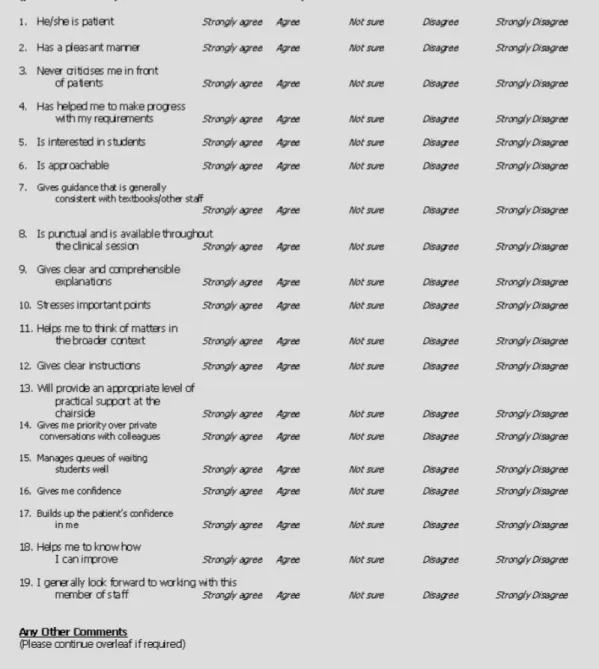
A questionnaire (Fig 1) was devised. This assesses some of the qualities determined by Wilson (3) and has many similarities to the questions asked by Kidd et al, Chadwick and McGrath et al (4-6) despite being devised independently and without intentional reference to them. At the end of each questionnaire was an invitation to provide “open comments”.
Prior to the process starting, all students were addressed via a series of meetings to inform them how their anonymity would be preserved and what the purpose of the questionnaire was. Any open comments would be retyped and edited to ensure that a student could not be identifiable to any individual member of staff.
Similar meetings were held with the staff concerned to gain their consent. It was stressed that this was a formative process, the results of which would remain confidential to the primary reviewer and the staff member themselves, although the overall departmental profile of teaching quality could be made available to appropriate bodies.
one researcher’s (CCY) office. All students were reminded by e-mail before the closing date to reduce non-compliance. Any returns received after the closing date were included as two weeks passed before the data entry was completed.
The questionnaire had several domains: those relating to the staff member’s personality [questions 1, 2, 6] professionalism [questions 3, 8, 14], ability to communicate [questions 9, 10, 11, 12, 18], their teaching skills [questions 5, 7, 13], management [questions 4, 15] and their ability to motivate [questions 16,17, 19].
For ease of analysis the descriptors were changed to numerical values (strongly agree = 5, strongly disagree = 1). This data was entered into a spreadsheet and descriptive statistical analysis undertaken using Minitab 14® (Minitab Inc. State College PA 16801-3008, USA). Comparison between data obtained was performed using Kruskal Wallis tests via the same software package.
After each year’s analysis of the data, in order to maintain confidentiality, all the staff were assigned a number and then informed of their individual scores compared to the others within the department. They were also provided with the (rewritten) open comments. Staff members were invited to discuss their results with the individual who had performed the data analysis and any areas requiring professional development training identified.
Over the three years, one question was removed (focussing on an organisational change instituted in 2004) and one introduced (“Gives priority to me over private conversations with colleagues - Q14”) in response to students’ requests.
whom were present on two consecutive years (either 2004 and 2005, or 2005 and 2006. Group c) comprised all staff (including transient staff i.e. those present on one assessment only).
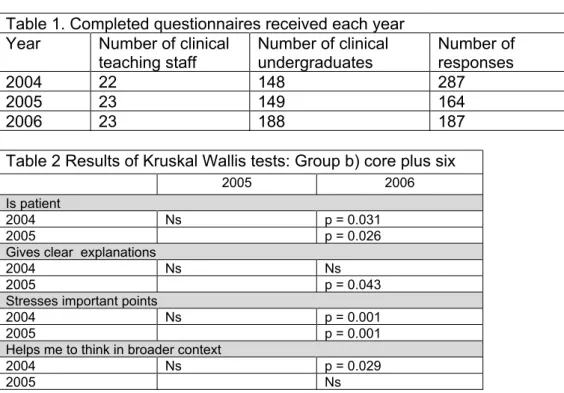
Numbers of responses by undergraduates in each year are shown in Table 1. In the first year there was a large response. As most students have clinical sessions with 2 tutors in a term this indicates about a 100% response rate in the first year dropping to about 50% in subsequent years.
The core of staff formed the majority (14). A total of ten staff were only assessed in one cycle (three in 2004, three in 2005 and four in 2006).
The (internal consistency) reliability of the questionnaire was assessed via Cronbach’s alpha with a score of 0.97 achieved overall and the lowest value achieved being 0.96.
Results:
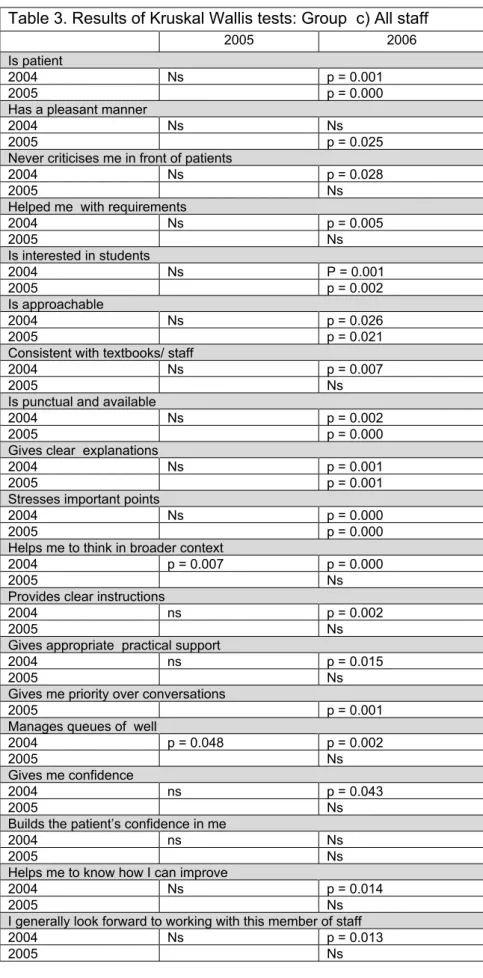
Tables 2 and 3 show the results of the Kruskal Wallis tests per question per year for the staff cohorts (ns = no statistically significant difference [p > 0.05], all other p values shown are the results adjusted for ties).
Over the three years, when comparing the data, there were no questions that showed deterioration in the results in any staff grouping. When the total staff grouping was concerned, only one question “Builds up the patient’s confidence in me” remained the same throughout the three years. All other parameters improved at a statistically significant level (p <0.05) between 2004 and 2006.
Discussion:
Anecdotal evidence from the undergraduate students is that the “atmosphere has improved” within the restorative clinic since 2004 and, the authors believe, a significant contributor to this has been the feedback mechanism reported here.
anonymous nature of the process it was not possible to get a higher response rate as non-responders were not identifiable.
It can be seen from Table 1 that there was an increase in the number of students between 2005 and 2006 without a comparable increase in staff. It would, however, be simplistic to assume that this resulted in increased staff-student ratios. As the students have timetabled allocations to their clinical sessions, and similar numbers of students allocated to each member of staff, it has proven possible to maintain the staff-student ratio by slightly increasing the number of sessions available throughout the week, all staff therefore had the same workload throughout the study period. There were no curricular changes or changes in the demographics of the undergraduates or staff that could account for perceptual changes between 2004 and 2006.
With respect to the post feedback interviews with the staff, on each occasion the majority of staff who had performed well declined the invitation. However, on each of the three years assessed, the three staff who had performed least well attended for interview (a total of five individuals). There was a mix of reaction to the feedback process, Three staff (from the core group) viewed it as a positive method of improving their performance in a guided fashion. Two staff (from the “transient” group) felt that it was a negative process and that it had little value in their professional development. The staff who felt it was valuable showed improvements over the period assessed. There was no clear correlation between the amount of experience of the teaching staff with the positivity of the feedback gained.
between 2005 and 2006. However, from analysis of the whole data it is apparent that the improvements occurred throughout the whole period, but tended to only gain statistical significance latterly.
In formulating the questionnaire a number of different types of question were asked and it could be argued that they are not all equally important e.g. “Never criticises me in front of a patient” -shown to be a high stressor (7) compared to “Is interested is students”. However, the questions were considered to assess desirable aspects of an “ideal” teacher (8), and the original purpose of the questionnaire was to provide feedback to staff of their strengths and weaknesses.
Although the majority of staff were assessed on three occasions, some were only available twice and others only once. It appears that statistically significant differences arose due to changes in personnel, but there was also, limited, improved behaviour within the staff. The “transient” staff consisted of two full-time clinical academic staff who retired after the 2004 assessment, and five who took up clinical teaching duties between 2005 and 2006. The other three of this cohort were general dental practitioners who taught part-time.
It is difficult to understand how ratings of staff patience can have improved as these may be considered to be embedded within their personality trait. On the other hand, knowing that this is an aspect that is open to assessment, the staff may have adopted alternative behaviours within that environment to achieve a higher score at the next assessment (cognitive awareness).
The current process will continue in an attempt to maintain the quality of teaching but alternative methods of data collection are being considered to improve the return rate in future.
Conclusion:
Despite limitations in the methodology, it would appear that the use of a questionnaire based feedback system can result in improved clinical teaching by staff.
Tables.
Table 1. Completed questionnaires received each year Year Number of clinical
teaching staff Number of clinicalundergraduates Number ofresponses
2004 22 148 287
2005 23 149 164
2006 23 188 187
Table 2 Results of Kruskal Wallis tests: Group b) core plus six
2005 2006
Is patient
2004 Ns p = 0.031
2005 p = 0.026
Gives clear explanations
2004 Ns Ns
2005 p = 0.043
Stresses important points
2004 Ns p = 0.001
2005 p = 0.001
Helps me to think in broader context
2004 Ns p = 0.029
Table 3. Results of Kruskal Wallis tests: Group c) All staff
2005 2006
Is patient
2004 Ns p = 0.001
2005 p = 0.000
Has a pleasant manner
2004 Ns Ns
2005 p = 0.025
Never criticises me in front of patients
2004 Ns p = 0.028
2005 Ns
Helped me with requirements
2004 Ns p = 0.005
2005 Ns
Is interested in students
2004 Ns P = 0.001
2005 p = 0.002
Is approachable
2004 Ns p = 0.026
2005 p = 0.021
Consistent with textbooks/ staff
2004 Ns p = 0.007
2005 Ns
Is punctual and available
2004 Ns p = 0.002
2005 p = 0.000
Gives clear explanations
2004 Ns p = 0.001
2005 p = 0.001
Stresses important points
2004 Ns p = 0.000
2005 p = 0.000
Helps me to think in broader context
2004 p = 0.007 p = 0.000
2005 Ns
Provides clear instructions
2004 ns p = 0.002
2005 Ns
Gives appropriate practical support
2004 ns p = 0.015
2005 Ns
Gives me priority over conversations
2005 p = 0.001
Manages queues of well
2004 p = 0.048 p = 0.002
2005 Ns
Gives me confidence
2004 ns p = 0.043
2005 Ns
Builds the patient’s confidence in me
2004 ns Ns
2005 Ns
Helps me to know how I can improve
2004 Ns p = 0.014
2005 Ns
I generally look forward to working with this member of staff
2004 Ns p = 0.013
References
1. Modernising Medical Careers website. Assessment.
http://www.mmc.nhs.uk/pages/assessment
(last accessed 23 Apr 2007)
2. Peiperl MA. Getting 360° feedback right. Harv Bus Rev 2001:79:142-147. 3. Wilson RC. Improving faculty teaching: Effective use of student evaluations and constraints. J Higher Educ 1986: 57: 196-211.
3. Kidd EA, Millard L, Smeeton NC, Millard AJ. Improving the quality of teaching: staff responses to students’ views. Br Dent J 1994: 177: 208-212
4. Chadwick RG. Quality assurance by service quality — an industrial approach to monitoring course delivery. Br Dent J 2002: 192: 285-288
5. C. McGrath, R. Wai Kit Yeung, M. B. Comfort, A. S. McMillan. Development and evaluation of a questionnaire to evaluate clinical dental teachers (ECDT). Br Dent J 2005: 198: 45-48.
6. Z. Morse, U Dravo. Stress levels of dental students at the Fiji School of Medicine. Eur J Dent Educ 2007: 11: 99–103