Interactions in Agent Systems
Thesis submitted in accordance with the requirements of the University of Liverpool for the degree of Doctor in Philosophy by
Martyn Lloyd-Kelly
Agent-based decision-making usually relies upon game theoretic principles that are “ra-tional” i.e. decision-making is purely mathematical based on utilities such as the wealth of an agent. In the context of public goods games, such reasoning can often lead to non-optimal, destructive outcomes for both individuals and the total system, as shown in many scenarios from game theory. This thesis considers how the use of emotions can impact upon decision-making and social interactions amongst agents in the iterated Prisoner’s Dilemma game by modelling emotions in a functional manner.
The background to the thesis is first presented in chapters 2 and 3 where the ar-gument for emotions being included in agent-based decision-making, and evidence to support this proposition, is outlined. Various philosophical issues are also considered such as: do emotions directly motivate an agent’s intentional behaviour and, is an agent’s decision-making still rational if emotions are used? The framework developed to allow for modelling of emotions in agents is then discussed in chapters 4 and 5 where major psychological models of emotion and computational implementations thereof are dis-cussed. Finally chapters 6 to 8 present extensive investigations into how the emotions modelled using the framework affect social interactions amongst agents in the context described above. As of yet, this topic has been relatively unexplored by computer science and there is space for novel, interesting contributions to be made, these contributions are outlined below.
In chapter 6 the emotions ofanger andgratitude are modelled and their effects upon social interactions are analysed. In particular, I look at whether agents endowed with these emotions offer any improvement upon the success of agents using with the “tit-for-tat” strategy when playing against other leading strategies from Axelrod’s famous computer tournament. How these emotions affect rates of cooperation/defection and the fairness of individual scores is considered along with why they do so.
This investigation is furthered in chapter 7 whereadmiration is modelled and an in-vestigation is performed into what emotional characters are selected for under different initial conditions and why. This examination provides a discussion regarding what emo-tional social norms emerge in a population when agents admire the individual success of others. Two salient questions are asked: is it is the case that emotional characters which promote the total wealth of the system are selected for as an emergent property and, do different initial conditions affect the emotional characteristics selected for?.
Finally, chapter 8 extends chapter 7 by modelling hope and enquires as to how particular emotional character populations (after a complete social norm has been es-tablished) deal with destabilisation of cooperation cycles due to periodic defection. The performance of agents endowed with differing emotional characters are again tested un-der different initial conditions and specific behavioural features of particular emotional characters are considered. In doing this I comment upon how different emotional char-acters deal with periodic defection and what the best approach is both in context of an agent’s individual score and the total score of the system.
“For we put the thought of all that we love into all that we make.” J.R.R. Tolkien
Selecting names to mention in this section has been quite a challenge so I extend my sincerest apologies if I have not mentioned certain people; if I have been remiss in text I have not been in thought.
First, I would like to thank my family for their immeasurable support, encouragement and love; your belief in me means more than I could ever hope to explain. In particular, I would like to acknowledge my uncle: Dominic. You have given me a great amount of help during the writing of this thesis (and prior to it) with no expectation of repayment. Without this aid I do not believe that I would have even come close to completing; thank you for being a father in his absence. I also wish to thank Jackie for providing me with somewhere stable when things got difficult at home, I hope this little mention lets you know how much I appreciate your kindness. Last but by no means least, I want to acknowledge my Mum for raising me with dignity, strength and unconditional love. Words would never be able to express my gratitude towards you.
I also wish to acknowledge my partner: Gemma. Since meeting you my life has taken a turn for the better and I do not think I could love anybody more than I do you. I realise that during the writing process of this thesis I have been inordinately pre-occupied with work but your acceptance and patience with regards to this, along with your constant encouragement and understanding, has been invaluable. I do not know if you fully appreciate everything you have done for me since we met but, if not, I hope that I can somehow convey how much of a source of strength, love and motivation you have been.
I must also acknowledge my computer-science office mates: Mr. (hopefully soon, Dr.) Anton Minnion, Mr. Luke Riley, Dr. Muhammad Khan and Dr. Adam Wyner. My time with you all was both enlightening and immensely humorous; G22 is sorely missed and will continue to be long after I have moved onto new ventures. Throughout my Ph.D. I was very lucky to have known such intelligent, friendly and funny people, I could not have wished for a better set of friends. I wish you all the very best in your future careers and I sincerely hope that we stay in touch. Anton: thank you for being a good friend, keep working hard; I’ll see you on the other side. Muhammad: I wish you and your family all the very best I possibly can. Thank you for the interesting and thought-provoking discussions we shared. Luke: thank you for the laughs, collaborations and drinks. Keep eschewing that stereotype of the typical computer science Ph.D. student! Adam: I really wish we could have worked together more in your time at the university but, for the times we did, thank you. Your help with all aspects of my career has been
Also, I must thank the Engineering and Physical Sciences Research Council (EPSRC) of Great Britain for their financial support for the initial three years of my thesis. I would also like to thank the University of Liverpool, the department of Computer Science and the faculty of science for their provision of financial aid and training throughout my time as a Ph.D. student. Without this help I would not have been able to promote my research, meet others from around the world who share in my passion for science or have expanded my world-views in the way that I have.
I would also like to extend my deepest gratitude and utmost respect for my Ph.D. supervisors: Professor Trevor Bench-Capon, Dr. Katie Atkinson and Professor Peter McBurney. Your insights, belief and hard work throughout my time as a Ph.D. student have been immeasurable. Completing this work is rather bitter-sweet in that, I am glad to have finally finished but I am quite sad that we will no longer be able to regularly sit and converse about topics of interest. You have given me some of the most important academic skills imaginable: the ability to present arguments clearly, the ability to com-municate to others about my work, the ability to write persuasively and the ability to undertake and produce quality research. Being supervised by each of you has been an absolute pleasure and I can only hope to become as well-respected and successful should I continue with a career in academia. Thank you for everything, I am forever indebted to each of you.
Finally, I would like to acknowledge two incredibly important people without whom I would not have become the man I am today: my grandmother, Joyce Kelly, who passed away during the writing of this thesis on the 25th of December 2012 and my father, Philip Lloyd, who passed away on the 10th of November 1989. Both of your deaths have left holes in my life that could never be filled. I love you both so very much and although I can never truly express the loss I feel for both of you, I hope that this small acknowledgement will do you both justice. Nan: your friendship, belief in me and your open invitation of a warm bed, food and a place to call home will always live with me. The aid you provided, with no expectation of repayment, is more appreciated than you could ever imagine and for that I thank you from the bottom of my heart. My only regret is that I did not finish this thesis in time for you to see its completion. Dad: above all else, I hope I have done you proud. Everything I have ever done I have done with the intention of honouring your memory. This may seem foolish since I have had a lot to honour especially since your family and friends hold you in the highest regard possible and the love expressed for you is truly awe inspiring. You are my greatest inspiration, my greatest motivation and my greatest loss.
Notations xvii
1 Introduction 1
1.1 Research Question . . . 4
1.2 Overview of Topic . . . 4
1.3 Contribution to Knowledge . . . 6
1.4 Thesis Structure . . . 7
2 Emotions and Human Behaviour 11 2.1 Game Theory and Social Dilemmas . . . 12
2.1.1 The Dictator and Ultimatum Games . . . 12
2.1.2 The Prisoner’s Dilemma . . . 13
2.1.3 The Tragedy of the Commons . . . 15
2.2 Homo Sapiens and Irrationality . . . 15
2.2.1 Anthropological Observations . . . 15
2.2.2 Observations in Experimental Economics . . . 16
2.3 Cooperation within the Prisoner’s Dilemma . . . 19
2.4 Why Cooperate? . . . 21
2.4.1 Reciprocity . . . 22
2.4.2 Reciprocal Altruism . . . 27
2.4.3 Other Notable Strategies . . . 29
2.5 Emotion and Cooperative Behaviour . . . 31
2.6 Chapter Summary . . . 35
3 Emotion, Behaviour and Rationality 39 3.1 Emotion and Behaviour . . . 40
3.1.1 Emotion and Intentionality . . . 41
3.1.2 Emotion-Intention Timing . . . 46
3.2 Emotion-Rationality Dichotomy . . . 52
3.2.1 Definition of Rationality . . . 52
3.2.2 Reconciling Emotion and Rationality . . . 54
3.3 Chapter Summary . . . 55
4 Modelling Emotion 59 4.1 Psychological Models of Emotion . . . 60
4.1.1 Appraisal Models . . . 60
4.1.2 Dimensional Models . . . 67
4.1.3 Anatomical Models . . . 68
4.2.2 Adam et al. . . 73
4.3 Implemented Emotion Models . . . 75
4.3.1 Reilly . . . 75
4.3.2 “ACRES” . . . 78
4.3.3 “Cathexis” . . . 79
4.3.4 “The Affective Reasoner” . . . 81
4.3.5 “EBDI” . . . 82
4.3.6 Oliveira . . . 84
4.3.7 Bazzan and Bordini . . . 86
4.3.8 “SHAME+” . . . 87
4.3.9 “EPBDI” . . . 89
4.4 Chapter Summary . . . 90
5 Research Agenda, Test-Bed and the Emotion Model 95 5.1 Research Questions . . . 95
5.2 Simulation Test-Bed . . . 99
5.2.1 Implementation Details . . . 101
5.2.2 Simulation Progression . . . 102
5.3 The Emotion Model . . . 103
5.3.1 Emotion Elicitation . . . 105
5.3.2 Potential, Activation Thresholds and Saturation . . . 107
5.3.3 Emotional Effect and Probability . . . 109
5.3.4 Emotional Decay . . . 110
5.4 Emotional Characters . . . 111
5.4.1 Emotional “Characteristic” . . . 112
5.4.2 Emotional “Character” . . . 114
5.5 Chapter Summary . . . 114
6 Anger and Gratitude 117 6.1 Research Questions . . . 118
6.2 Emotions Modelled . . . 118
6.2.1 Anger . . . 119
6.2.2 Gratitude . . . 123
6.3 Emotional Characters . . . 126
6.4 Simulation Details . . . 128
6.4.1 Simulation Set-up . . . 128
6.4.2 Agent Details . . . 128
6.4.3 Simulation Progression . . . 129
6.4.4 Anger and Gratitude Algorithm . . . 130
6.5 Results and Analysis . . . 131
6.5.1 Responsiveness and Total System Scores . . . 132
6.5.2 Tolerance and Total System Scores . . . 133
6.5.3 Tolerance, Responsiveness and Individual Scores . . . 133
6.6 Chapter Summary . . . 138
7.2 Why Admiration? . . . 143
7.2.1 Eliciting Conditions and Effects . . . 144
7.2.2 Modelling Admiration Computationally . . . 147
7.3 Emotional Characters . . . 148
7.4 Simulation Details . . . 149
7.4.1 Simulation Set-up . . . 150
7.4.2 Agent Details . . . 152
7.4.3 Simulation Progression . . . 153
7.4.4 Admiration Algorithm . . . 155
7.5 Results and Analysis . . . 156
7.5.1 Emotional Character Prevalence and Initial Cooperation/Defec-tion Percentages . . . 158
7.5.2 Emotional Character Prevalence and Initial Impressionability Per-centages . . . 171
7.5.3 Emotional Character Prevalence and Player/Comparator Sets . . . 177
7.5.4 Overall Emotional Character Prevalence . . . 190
7.6 Chapter Summary . . . 192
8 Hope 195 8.1 Research Questions . . . 196
8.2 Why Hope? . . . 197
8.2.1 Eliciting Conditions and Effects . . . 199
8.2.2 Modelling Hope Computationally . . . 200
8.3 Emotional Characters . . . 201
8.4 Simulation Details . . . 202
8.4.1 Simulation Set-up . . . 203
8.4.2 Agent Details . . . 203
8.4.3 Simulation Progression . . . 204
8.4.4 Hope Algorithm . . . 204
8.5 Results and Analysis . . . 205
8.5.1 Effects of Initial Defection Percentages and Greed Upon Emotional Character Success . . . 207
8.5.2 Behavioural Features of Emotional Characters with Differing Tol-erance and Responsiveness Ratios . . . 227
8.6 Chapter Summary . . . 251
9 Conclusions and Future Work 255 9.1 Major Contributions . . . 260
9.2 Limitations and Future Work . . . 264
9.3 Final Words . . . 267
A Chapter 8 Charts 269
B Analysis of how Emotional Character Types Determine Scores 279
B.1.2 Asymmetric Turn-Taking . . . 280
B.2 Calculating Emotional Character Scores . . . 281
B.3 Substantiating Thesis Results . . . 283
B.4 Conclusion . . . 285
Bibliography 291
List of Figures
3.1 The premises of gratitude according to Spinoza. . . 42 3.2 Graphical representation of the proposed dichotomy between emotional and
rational decision-making. . . 54 3.3 Graphical representation of the proposed two-dimensional
emotional/unemo-tional and raemotional/unemo-tional/irraemotional/unemo-tional plane with examples of each type of decision-making identified in each quadrant. . . 56
4.1 Graphical representation of the global structure of emotion according to the OCC model [142]. . . 62 4.2 Frijda’s model of emotion [67]. . . 65
5.1 Graphical representation of player/comparator subset divisions. . . 101
7.1 Frequency of placing in positions 1-3 in context of scenarios 1-5 for tolerance groups of emotional characters. . . 161 7.2 Frequency of placing in positions 1-3 in context of scenarios 1-5 for
respon-siveness groups of emotional characters. . . 166 7.3 Frequencies of placing in positions 1-3 for tolerance groups in context of
different levels of impressionability. . . 175 7.4 Frequencies of placing in positions 1-3 for responsiveness groups in context
of different levels of impressionability. . . 175 7.5 Frequency of placing in positions 1-3 for all emotional characters in
sub-scenario group 1. . . 179 7.6 Frequency of placing in positions 1-3 for all emotional characters in
sub-scenario group 2. . . 180 7.7 Frequency of placing in positions 1-3 for all emotional characters in
sub-scenario group 3. . . 180 7.8 Frequency of placing in positions 1-3 for all emotional characters in
sub-scenario group 4. . . 181 7.9 Frequency of placing in positions 1-3 for all emotional characters in
sub-scenario group 5. . . 183 7.10 Frequency of placing in positions 1-3 for all emotional characters in
sub-scenario group 6. . . 183 7.11 Frequency of placing in positions 1-3 for all emotional characters in
sub-scenario group 7. . . 184 7.12 Frequency of placing in positions 1-3 for all emotional characters in
sub-scenario group 8. . . 184
7.14 Standard deviations of placing in positions 1-3 for each emotional character in context of sub-scenario groups 5-8. . . 185 7.15 Average frequency of placing in positions 1-3 for each emotional character
in context of sub-scenario groups 1-4. . . 188 7.16 Standard deviations of placing in positions 1-3 for each emotional character
in context of sub-scenario groups 1-4. . . 189
8.1 Final scores of A2:G1:H1 agents from the first repeats of scenarios 1-5. . . . 245 8.2 Final scores of A2:G1:H2 agents from the first repeats of scenarios 1-5. . . . 245 8.3 Final scores of A2:G1:H3 agents from the first repeats of scenarios 1-5. . . . 246 8.4 Final scores of A2:G2:H1 agents from the first repeats of scenarios 1-5. . . . 248 8.5 Final scores of A2:G2:H2 agents from the first repeats of scenarios 1-5. . . . 248 8.6 Final scores of A2:G2:H3 agents from the first repeats of scenarios 1-5. . . . 249 8.7 Final scores of A2:G3:H1 agents from the first repeats of scenarios 1-5. . . . 250 8.8 Final scores of A2:G3:H2 agents from the first repeats of scenarios 1-5. . . . 251 8.9 Final scores of A2:G3:H3 agents from the first repeats of scenarios 1-5. . . . 251
A.1 Final scores of A2:G1:H1 agents from the first repeats of scenarios 1-5. . . . 270 A.2 Final scores of A2:G1:H2 agents from the first repeats of scenarios 1-5. . . . 271 A.3 Final scores of A2:G1:H3 agents from the first repeats of scenarios 1-5. . . . 272 A.4 Final scores of A2:G2:H1 agents from the first repeats of scenarios 1-5. . . . 273 A.5 Final scores of A2:G2:H2 agents from the first repeats of scenarios 1-5. . . . 274 A.6 Final scores of A2:G2:H3 agents from the first repeats of scenarios 1-5. . . . 275 A.7 Final scores of A2:G3:H1 agents from the first repeats of scenarios 1-5. . . . 276 A.8 Final scores of A2:G3:H2 agents from the first repeats of scenarios 1-5. . . . 277 A.9 Final scores of A2:G3:H3 agents from the first repeats of scenarios 1-5. . . . 278
List of Tables
2.1 Prisoner’s Dilemma pay-off matrix. . . 14
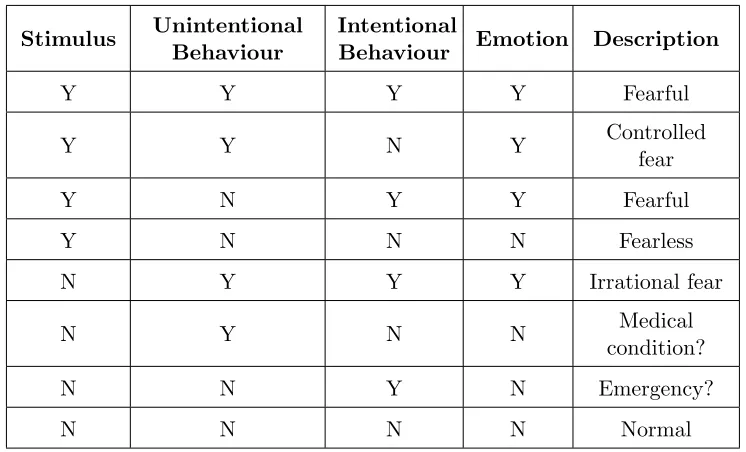
3.1 Truth table outlining Kenny’s proposed relationship between stimulus, un-intentional behaviour, un-intentional behaviour and emotion. . . 46
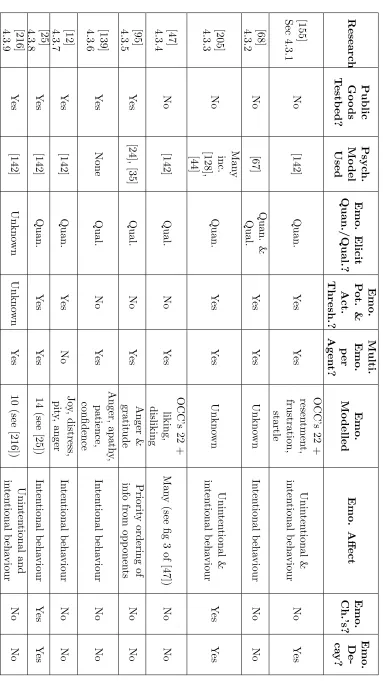
4.1 Key points of research discussed in section 4.3. . . 92
6.1 Emotional character definitions. . . 127 6.2 Descriptions of strategies from Axelrod’s tournament that have been
imple-mented. . . 129 6.3 Aggregated average total system scores of all initially defecting/cooperative
emotional characters. . . 132
playing against Axelrod strategies that periodically defect. . . 132 6.5 Average total system scores (and standard deviations) of initially
coopera-tive emotional characters A1:G1, A2:G1 and A3:G1 when playing against Axelrod strategies that periodically defect. . . 133 6.6 Comparison of the average individual scores (and standard deviations) for
initially cooperative emotional agents with characters A3:G1, A3:G2 and A3:G3 when playing against Axelrod strategies that periodically defect. . . . 134 6.7 How decreased responsiveness causes a reduction and plateau of average
individual score when playing against agents that use TFT and periodically defect. . . 135 6.8 Average individual scores(and standard deviations) of initially cooperative
emotional characters A1:G1, A2:G1 and A3:G1 when playing against Axel-rod strategies that periodically defect. . . 135 6.9 Threshold values present in the simulation with their method of calculation
and maximum/minimum values. . . 137 6.10 Average fairness ratings for emotional character agents with both types of
initial dispositions when playing against random, tester and joss agents. . . . 138
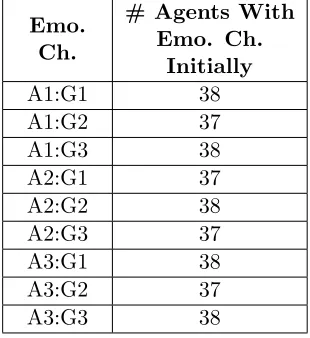
7.1 Number of agents with each emotional character in initial population. . . 150 7.2 Scenario numbers and their associated percentages of initial
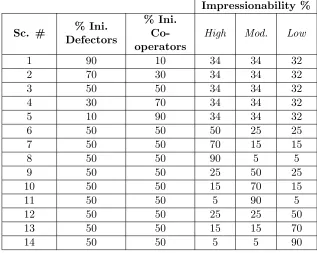
cooperators/de-fectors and percentages of highly/moderately/less impressionable agents. . . 155 7.3 Sub-scenario numbers and their associated player and comparator set
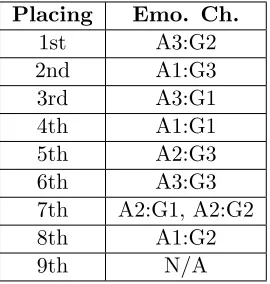
con-figurations. . . 155 7.4 The effect of scenario upon initial play probability. . . 157 7.5 Example of emotional character representation table derived from one repeat
of a sub-scenario. . . 159 7.6 Example of emotional character placing derived from one repeat of a
sub-scenario. . . 159 7.7 Example of total emotional character placing for a sub-scenario. . . 160 7.8 Frequency of placing in positions 1-3 in context of scenarios 1-5 for tolerance
groups of emotional characters. . . 160 7.9 Play histories of an initially cooperative, highly tolerant agent when faced
with less, moderately and highly responsive emotional agents that initially defect. . . 162 7.10 Play histories of an initially cooperative, moderately tolerant agent when
faced with less, moderately and highly responsive emotional agents that initially defect. . . 162 7.11 Play histories of an initially cooperative, less tolerant agent when faced with
less, moderately and highly responsive emotional agents that initially defect. 163
7.13 Play histories for highly responsive agents that initially defect when faced with initially cooperative less, moderately and highly tolerant emotional agents.167 7.14 Play histories for moderately responsive agents that initially defect when
faced with initially cooperative less, moderately and highly tolerant emo-tional agents. . . 167 7.15 Play histories for less responsive agents that initially defect when faced with
initially cooperative less, moderately and highly tolerant emotional agents. . 168 7.16 Comparison of A1:G3, A2:G3 and A3:G3’s frequency of placing in positions
1-3 for scenarios 4 and 5. . . 171 7.17 Frequencies of placing in positions 1-3 for tolerance groups in scenarios 6-14. 174 7.18 Frequencies of placing in positions 1-3 for responsiveness groups in scenarios
6-14. . . 174 7.19 Trend-line gradients of frequency of placing in positions 1-3 for all emotional
characters in context of sub-scenario groups 1-4. . . 181 7.20 Trend-line gradients for average and standard deviations of placing frequency
in positions 1-3 in context of sub-scenario groups 5-8. . . 186 7.21 Trend-line gradients of frequency of placing in positions 1-3 for all emotional
characters in context of sub-scenario groups 5-8. . . 187 7.22 Trend-line gradients for average and standard deviations of placing frequency
in positions 1-3 in context of sub-scenario groups 1-4. . . 189 7.23 Total frequency of placing first in all scenarios for each emotional character. 191
8.1 Scenario Number and Initial Percentage of Cooperators/Defectors in Popu-lation. . . 204 8.2 The effect of scenario upon initial play probability. . . 205 8.3 The effect of hope’s likelihood of activation upon the probability of CC, CD,
DC and DD occurring between an agent and an opponent. . . 206 8.4 Play histories illustrating how increasing the activation threshold for anger
and reducing the activation threshold for gratitude results in emotional char-acters A2:G1, A3:G1 and A3:G2 establishing CC plays from CD/DC plays. . 207 8.5 Play histories illustrating how keeping the activation thresholds for anger
and gratitude equal results in emotional characters A1:G1, A2:G2 and A3:G3 maintaining CD/DC plays after their establishment. . . 207 8.6 Play histories illustrating how decreasing the activation threshold for anger
and increasing the activation threshold for gratitude results in emotional characters A1:G2, A1:G3 and A2:G3 establishing DD plays from CD/DC plays. . . 207 8.7 Emotional character placing based upon maximum individual scores
ob-tained in scenario 1 organised by the probability of hope’s effect being man-ifest after activation. . . 210
ifest after activation. . . 210 8.9 Emotional character placing based upon maximum individual scores
ob-tained in scenario 3 organised by the probability of hope’s effect being man-ifest after activation. . . 211 8.10 Emotional character placing based upon maximum individual scores
ob-tained in scenario 4 organised by the probability of hope’s effect being man-ifest after activation. . . 211 8.11 Emotional character placing based upon maximum individual scores
ob-tained in scenario 5 organised by the probability of hope’s effect being man-ifest after activation. . . 212 8.12 How the increased responsiveness of A3:G1 enables quicker establishment of
CC plays following retaliatory exploitation when compared to the reduced responsiveness of A3:G2. . . 213 8.13 How the increased tolerance of A3:G1 facilitates the maximisation of an
individual’s score even in highly-greedy populations. . . 215 8.14 Emotional character placing based upon minimum individual scores obtained
in scenario 1 organised by the probability of hope’s effect being manifest after activation. . . 216 8.15 Emotional character placing based upon minimum individual scores obtained
in scenario 2 organised by the probability of hope’s effect being manifest after activation. . . 216 8.16 Emotional character placing based upon minimum individual scores obtained
in scenario 3 organised by the probability of hope’s effect being manifest after activation. . . 217 8.17 Emotional character placing based upon minimum individual scores obtained
in scenario 4 organised by the probability of hope’s effect being manifest after activation. . . 217 8.18 Emotional character placing based upon minimum individual scores obtained
in scenario 5 organised by the probability of hope’s effect being manifest after activation. . . 217 8.19 How the increased tolerance of A3:G1 enables the maximisation of an
indi-vidual’s minimum score compared with the less tolerant A2:G1. . . 219 8.20 How the probability of hope’s effect being manifest in an agent after its
activation can cause two similar emotional characters to achieve different minimum scores. . . 219 8.21 How different tolerance levels enable equally tolerant and responsive
emo-tional characters to achieve different minimum system scores. . . 220
minimum score. . . 221
8.23 Emotional character placing based upon maximum total system scores ob-tained in scenario 1 organised by the likelihood of hope’s effect being manifest after activation. . . 223
8.24 Emotional character placing based upon maximum total system scores ob-tained in scenario 2 organised by the likelihood of hope’s effect being manifest after activation. . . 223
8.25 Emotional character placing based upon maximum total system scores ob-tained in scenario 3 organised by the likelihood of hope’s effect being manifest after activation. . . 224
8.26 Emotional character placing based upon maximum total system scores ob-tained in scenario 4 organised by the likelihood of hope’s effect being manifest after activation. . . 224
8.27 Emotional character placing based upon maximum total system scores ob-tained in scenario 5 organised by the likelihood of hope’s effect being manifest after activation. . . 224
8.28 Average number of distinct scores for greedy A2:G1, A2:G2 and A2:G3 pop-ulations in context of scenarios 1-5. . . 232
8.29 Averages and standard deviations for number of distinct scores obtained over scenarios 1-5 for greedy variants of A2:G1, A2:G2 and A2:G3 populations. . 233
8.30 Average percentage of all A2:G1 greedy variant populations that achieved scores within determined score brackets in context of scenarios 1-5. . . 236
8.31 Average percentage of all A2:G2 greedy variant populations that achieved scores within determined score brackets in context of scenarios 1-5. . . 237
8.32 Average percentage of all A2:G3 greedy variant populations that achieved scores within determined score brackets in context of scenarios 1-5. . . 238
8.33 Average Gini coefficients, average median individual scores and average total system scores for all variants of A2:G1. . . 241
8.34 Average Gini coefficients, average median individual scores and average total system scores for all variants of A2:G2. . . 242
8.35 Average Gini coefficients, average median individual scores and average total system scores for all variants of A2:G3. . . 243
9.1 The six elements identified in this thesis required for modelling an emotion along with their type (qualitative/quantitative), a description of the element and an example of the element in the context of this thesis. . . 257
9.2 A summary of notable results from chapter 6. . . 258
9.3 A summary of notable results from chapter 7. . . 259
9.4 A summary of notable results from chapter 8. . . 261
types that initially defect (opp.) for N rounds. . . 286 B.2 Play history and scores of interest for an initially cooperative A1:G2
emo-tional character (player) when pitted against all other emoemo-tional character types that initially defect (opp.) for N rounds. . . 287 B.3 Play history and scores of interest for an initially cooperative A1:G3
emo-tional character (player) when pitted against all other emoemo-tional character types that initially defect (opp.) for N rounds. . . 287 B.4 Play history and scores of interest for an initially cooperative A2:G1
emo-tional character (player) when pitted against all other emoemo-tional character types that initially defect (opp.) for N rounds. . . 288 B.5 Play history and scores of interest for an initially cooperative A2:G2
emo-tional character (player) when pitted against all other emoemo-tional character types that initially defect (opp.) for N rounds. . . 288 B.6 Play history and scores of interest for an initially cooperative A2:G3
emo-tional character (player) when pitted against all other emoemo-tional character types that initially defect (opp.) for N rounds. . . 289 B.7 Play history and scores of interest for an initially cooperative A3:G1
emo-tional character (player) when pitted against all other emoemo-tional character types that initially defect (opp.) for N rounds. . . 289 B.8 Play history and scores of interest for an initially cooperative A3:G2
emo-tional character (player) when pitted against all other emoemo-tional character types that initially defect (opp.) for N rounds. . . 290 B.9 Play history and scores of interest for an initially cooperative A3:G3
emo-tional character (player) when pitted against all other emoemo-tional character types that initially defect (opp.) for N rounds. . . 290
The following notations and abbreviations are found throughout this thesis:
ACRES Artificial Concern Realisation System
BDI Beliefs-Desires-Intentions
CC Cooperate-Cooperate or “mutual cooperation” (in context
of the Prionser’s Dilemma)
CD Defect-Cooperate (in context of the Prionser’s Dilemma)
CPU CentralProcessing Unit
DC Defect-Cooperate (in context of the Prisoner’s Dilemma)
DD Defect-Defect or “mutual defection” (in context of the
Pris-oner’s Dilemma)
EBDI Emotional-Beliefs-Desire-Intentions
GTFT GenerousTit-For-Tat
MAS MultiAgent System(s)
OCC Ortony-Clore-Collins
OCEAN Openness-Conscientiousness-Extraversion-A greeableness-Neuroticism
TFT Tit-For-Tat
VAF Value-Based Argumentation Framework
Introduction
“You don’t get emotions by manipulating 0s and 1s.”
John Searle
Homo economicus, or the economic human, has long been the archetypal model of agency in the context of computer-science and economics. The origin of the term is a research subject in itself with O’Boyle [138] ascribing the earliest known use of the term to Panteleoni [143] in 1889. The model casts humans as rational and self-interested; actors who base all decisions upon a potentially ruthless pursuit of maximisation of subjective utility. The use ofhomo economicus as a model of agency in computer science is especially apparent when modelling or discussing the decision-making of agents in the context of multi-agent systems (hereafter referred to as MAS). The problem however, is that the breadth of human behaviour observed since the dawn ofhomo sapiens cannot be solely explained by such a narrow philosophy. In fact, some researchers in the field of behavioural economics [50], [120] have rejected the notion ofhomo economicus and have turned to a consideration of the effects of emotion upon decision-making. In doing so, these researchers hope that the role of emotion in decision-making may be understood, modelled and thus taken into consideration when predicting human behaviour in an economic context.
Homo economicus casts human beings as being logically adept and entirely rational with respect to its consideration of actions. Indeed the rationality associated withhomo economicusdepends upon logical adeptness buthomo sapiensare not always as logically adept as they would like to believe. Major psychological research such as [203], [71] and [100] highlights the enormous capacity human beings possess when it comes to demonstrating and engaging in irrational behaviour and these works are but a small selection of those available. Works such as those above also show that homo sapiens have a number of innate coping mechanisms for the incredibly complex environment they inhabit. These innate coping mechanisms motivate humans to focus attention
upon certain issues and ignore others, even though probabilistically and statistically-speaking, the issues ignored are just as relevant as they ever were. Gardner in [69] provides a comprehensive discussion of major logical flaws observed in humans and proposes that with respect to decision-making,homo economicus 6=homo sapiens.
Determining what separates homo economicus from homo sapiens is an enormous task but something must, otherwise the observed dissonance between the two models of agency would not exist. Simon’s concept of bounded rationality [174] may serve to explain one facet of the complex difference between the economic human and humanity as we understand it. According to Simon, the convoluted environment that humans inhabit limits the extent to which rationality can be applied since information about the environment may be incomplete due to factors such as probability. Simon posits that human rationality is thereforebounded and that some form of additionalemotional input is required in order to enable an answer to be provided in such a variegated environment. Russell and Norvig’s definition of a rational agent in [161] further highlights the potential breadth of information required in order for a rational agent to act optimally:
“for each possible percept sequence, a rational agent should select an action that is expected to maximize its performance measure, given the evidence provided by the percept sequence and whatever built-in knowledge the agent has.”
In the above quote, the term “whatever built-in knowledge the agent has” is ex-ceptionally important and has far-reaching implications. Indeed, with regards to the decision-making of homo sapiens, it would seem that there is some other input to decision-making other than pure self-interested rationality. Research from psychology, behavioural economics and biology regarding this subject makes frequent use of game theory in order to determine if people act as rationally as the homo economicus agency model predicts and asks: if not, why not? The results of such research are often sur-prising with works such as [86], [57] and [159] illustrating that humans do not indeed always act rationally. In fact such research demonstrates thathomo sapiens can act in complete opposition to thehomo economicus model. For example: in certain situations, human beings will incur a financial loss to themselves in order to either establish or maintain cooperation with others instead of maximising individual utility [58].
Cooperation in MAS is considered as being integral to enable successful interaction between agents. Wooldridge highlights the importance of cooperation in [212], where it is stated that:
“In order to successfully interact, these agents will thus require the ability to cooperate,coordinate and negotiate with each other, in much the same way that we cooperate, coordinate, and negotiate with other people in our daily lives.”
individuals in human society and then to model such mechanisms so that they may be of functional use to autonomous agents secondly. The most notable work regarding motivations of cooperative behaviour in human beings has to be attributed to Fehr and G¨achter who have published numerous papers on the subject advocating the role of emotions in enabling reciprocity of cooperation [57], [56]. In addition to the aforemen-tioned authors there are other researchers who advocate emotion as being an important driver of cooperative behaviour. For example: in [164], Sanfey et al. show how unfair proposals in games from experimental economics cause increased activity in the anterior insula (associated with emotional responses) and dorsolateral pre-frontal cortex regions (associated with cognition) of the human brain. Furthermore, individuals with increased levels of activity in the anterior insula rejected so-called “unfair” offers more frequently. Similar results are observed by Quervain et al. in [40] but, unlike Sanfey et al., they specifically propose that satisfaction and even the anticipation of satisfaction, is the motivation behind some behaviours exhibited by players in such games.
Further psychological research into the role of emotion in decision-making has illu-minated some interesting findings. Perhaps the most famous work regarding the role of human emotion in decision-making is that of Damasio who presents the somatic marker hypothesis in [35]. The hypothesis supports Simon’s conclusions from his work on bounded rationality [174] i.e. Damasio proposes that cognitive processes regarding decision-making may become overloaded due to the complexity of the current situation being considered. In such circumstances somatic markers1 are used to bias the cogni-tive procedures associated with decision-making by creating a somatic state. Damasio proposes that these somatic states help to identify possible, plausible options thereby simplifying the decision-making process. A number of works including [14], [15] and [13] test the decision-making of patients who have suffered bilateral damage to the ventro-medial pre-frontal region of the brain; the area where it is believed that somatic markers are located. Such research concludes that damage to this area results in negative mod-ifications to an individual’s social behaviour and ability to decide advantageously on matters regarding their own lives. Remaining ignorant of the effects of emotion upon decision-making would therefore appear to be equally disadvantageous.
As stated, damage to the ventromedial pre-frontal region causes disruptions to an individual’s social behaviour. It has been posited that emotions are an important de-terminant of such behaviour with works such as [70] arguing that emotional intelligence has a direct influence on the effectiveness of leadership. Other research including [200] concludes that the relationship between infants and adults is mutually regulated by emo-tional expression from both the care-giver and the care-receiver. It is therefore proposed that a major determinant of a child’s development is related to the successful operation of this communication system.
Thus, if cooperative interactions in MAS are to be established and maintained, espe-cially when the details of such interactions are not certain, then it is not just rationality
1
and self-interest that can be considered. There is no need to limit ourselves in this way; pro-social, cooperative behaviour and the mechanisms that enable such behaviour can also be developed. This may yield interesting and useful insights, and perhaps increase the robustness of agent decision making. Therefore, in this thesis, I will attempt to computationally mimic emotional mechanisms since they clearly do have some form of impact on pro-social behavioural choices.
1.1
Research Question
Since emotions can affect people in a variety of ways, I need to select a particular focus for investigation. Consequently, I will attempt to augment the autonomy of agents so that cooperative behaviour may be established when rational, self-interested behaviour will lead to undesirable individual and total system results as in thePrisoner’s Dilemma game [151], the Dictator game [98], the Ultimatum game [80] and the Tragedy of the Commons [83] (all of which will be discussed further in chapter 2). To achieve this, I consider the relatively unexplored role that emotions play in decision-making from an agent-systems perspective; specifically, what input do emotions have upon an agent’s decision to either foster cooperation or destroy it? The salient research question can be therefore stated as:
“How should emotions be modelled functionally in a computational context so as to understand their impact upon the social interactions of agents engaged in public goods games? Which emotions should be modelled, what effects are observed when agents drive their interactions using these emotions and what is the impact on individual and system performance?”
In answering this question I formulate a computational framework for modelling emotions in agents and draw upon various disciplines including computer science, social science, psychology, biology, philosophy, economics and mathematics. I also construct a novel MAS test-bed to facilitate the functional modelling of emotions using the frame-work developed and to allow for the acquisition of relevant data that is used to answer the research question posed. The framework for modelling emotion and the novel MAS test-bed mentioned will be described in detail in forthcoming chapters and the implica-tions of the results obtained are analysed and discussed in detail. This consideration of the results obtained allows me to offer answers to the latter part of the question: “what are the effects of the emotions modelled on the decisions made by agents and on a society of agents as a whole?”.
1.2
Overview of Topic
of the homo economicus model of agency. The aim of this thesis may appear to be the destruction of homo economicus, eradicating its influence not just from computer science but also economics yet I have no such intention. I believe that homo sapiens contains elements of the homo economicus model but postulating that the two models are one in the same with no other input from other models of agency is, in my opinion, a gross oversimplification. My intention in this thesis is to solely consider a model of the emotional man orhomo sensus so that it may in future be married together withhomo economicus to create a truer model of homo sapiens. The justifications for pursuing this aim are given in chapter 2 where the difference between the selfish predictions of homo economicus and the observed benevolence of homo sapiens in economic contexts is presented and discussed. Effectively, I am attempting to functionally model the mech-anisms that enable agents to reach decisions when their rationality may be bounded as Simon posits with the concept ofbounded rationality in [174]. By functionally modelling emotions in an explicit sense I hope to analyse their effects computationally so that I may experimentally verify what effects emotion has upon social interactions between agents when complete information about these interactions does not exist.
MAS. The question of whether emotions can be modelled satisfactorily in the absence of physiological considerations is discussed in detail in chapter 3 along with other pertinent philosophical questions.
It is important to draw attention to the fact that there exists no generally accepted framework for modelling emotion, especially from a computational standpoint. In fact, it would appear that every computer scientist who attempts to use a computational model of emotion invents their own for their own purposes; there is no standard. One of the other major aims of this thesis is to develop a general framework for modelling emotions computationally in the context of agent systems by using solid psychological models of emotion as a basis. I therefore intend to establish this framework as the common frame-work upon which others may model emotions in a functional manner in a computational context. Whilst there have been numerous attempts to formalise psychological models of emotion in agent specific languages; arguably the most successful of these attempts has been made by Stuenebrink et al. in papers such as [186] and [187]. The authors model emotions asfluents i.e. their associated intensities are capable of increasing and decreasing enabling emotions to become activated and deactivated autonomously and dynamically. The most salient contribution of this work is its attempt to prescribe heuristic functions with respect to an agent’s decision-making when emotions are acti-vated. Steunebrink et al. only cover a handful of emotions however, so there is much research to be conducted regarding the remaining emotions. Steunebrink’s framework and other notable examples are considered in chapter 4 and salient aspects of such log-ical formalisms and computational implementations are identified. By doing this I aim to both develop the computational framework used to functionally model emotion that is proposed in this thesis and illustrate how this framework relates to those proposed in the previous work of others discussed in chapter 4.
1.3
Contribution to Knowledge
interactions and why they have these effects. This question comprises a number of sub-questions due to the fact that different emotions are modelled and different effects are observed. As such, there are three chapters: chapter 6, chapter 7 and chapter 8, devoted to providing answers to this question. Each of these chapters discusses the modelling of a single or related pair of emotions using the framework developed and the effects of these emotions upon the societal interactions of agents.
Ultimately, this thesis contributes the following knowledge to the current state of the art:
An experimentally verified method that enables MAS designers to model emotions functionally in a computational context.
A demonstration that emotions can (and arguably should) be an integral part of an agent’s decision-making mechanism.
A demonstration that emotionally-inspired decision-making mechanisms can be beneficial to an agent system.
An understanding of the effects of the emotions modelled on both a micro and macro scale given differing initial system conditions.
An understanding of the effects on both a micro and macro level when combinations of more than one emotionally-inspired decision-making mechanism is considered within a MAS.
1.4
Thesis Structure
The remainder of this thesis is organised into eight chapters, descriptions of which can be found below. Due to the interdisciplinary nature of the work undertaken a consider-able literature review has been produced which spans chapters 2, 3 and 4. The original work comprising chapters 5, 6, 7 and 8 then draws upon various aspects of this literature review.
Chapter 2 provides a review of literature comparing the validity of game theory pre-dictions of public goods game outcomes and the outcomes of such games when played by humans. From here, I review literature that discusses what it is about human players that may drive this deviation from rational predictions namely, emotion.
Chapter 3 is particularly concerned with whether emotions are capable of driving intentional behaviour and whether there is a dichotomy between “emotional” and “ra-tional” decision-making. Answers to both these questions are provided in this chapter following a review of relevant philosophical and psychological literature.
formalisms of some of the aforementioned psychological models of emotion and existing computational implementations of emotion. By taking such work into account I aim to both contextualise the work presented in this thesis and also to identify salient aspects to be carried forward when developing the emotion modelling framework presented. Furthermore, the intention of this chapter is to distinguish an appropriate method for testing how the emotions modelled and implemented using the proposed framework af-fect societal interactions in a computational manner.
Chapter 5 outlines the research agenda of this thesis in detail along with specifics of the test-bed and the computational framework for modelling emotion used in the remaining chapters. Novel terminology that pertains to the emotional modelling frame-work and the thesis in general is also presented and defined in this chapter.
Chapter 6details the simulations constructed and run to experimentally investigate the functional modelling of anger and gratitude. These simulations also serve to ascertain the effects of these emotions upon societal interactions when emotional agents are pitted against notable strategies from Axelrod’sEvolution of Cooperation tournament [7]. The results obtained by these simulations first facilitate a discussion of the importance of anger and gratitude in the context of public goods games. Secondly, the results are used to comment upon whether altering how easy it is to activate these emotions enables an agent to be more “successful” than the “tit-for-tat” (TFT) strategy of Axelrod’s tourna-ment fame. Finally, the chapter discusses how changing the rate at which these emotions are activated affects the agent’s ability to establish and maintain cooperative behaviour and produce fair systems. The work constituting this chapter was published in the 4th International Conference on Agents and Artificial Intelligence (ICCART 2012) [112].
Chapter 7 augments agents implemented with anger and gratitude with admiration. This emotion allows agents to copy the rate at which other individually successful agents activate anger and gratitude. By doing this, it is possible to determine whether there is one configuration of activation rates that becomes more prevalent than others given different initial simulation conditions or how quickly admiration is elicited in others. Es-sentially, this chapter investigates whether one social norm with regards to the rates of anger and gratitude emerges from the system or whether different social norms emerge given different initial circumstances and why. The work in this chapter was published in the 13th International Workshop on Multi-Agent Based Simulation (MABS 2012) [113].
Emotions and Human Behaviour
In this chapter I give an extensive review of background literature that serves to justify why this thesis attempts to both functionally model emotion in agent systems and determine the effects of emotion upon societal interactions in context of public goods games. To achieve this, two general points are made: sections 2.1, 2.2 and 2.3 provide a discussion of literature regarding the predictions of game theory when applied to public goods games and how these predictions do not apply when such games are played by human beings. The issues considered in these chapters have a significant impact upon the design of experiments that will be constructed and run in later chapters of the thesis. Sections 2.4 and 2.5 then provide a review of literature that identifies in what particular ways humans do not adhere to the predictions of game theory and suggests why the behaviour of humans opposes the “rational” strategies suggested. The results of these works both serve to justify and to guide the design of the emotional model proposed.
To demonstrate how the behaviour ofhomo sapiens andhomo economicus does not equate in the context of public goods games, section 2.1 first presents the salient social dilemmas that follow from adopting the rationale prescribed by the homo economicus model of agency used in game theory. General anthropological and experimental eco-nomic evidence that deviates from the predictions made by thehomo economicus model of agency is then considered in section 2.2. The intention of this section is to make clear the disparity between homo economicus and homo sapiens in a general public goods game context. The disparity observed centres around the fact that, instead of maximis-ing rational self-interest, humans in most societies are willmaximis-ing to help others even when some form of loss (in time, food, money etc.) is incurred. Given that this discussion refers to the behaviour of humans in general public goods game situations I then lead into a focused discussion of literature regarding the behaviour of human beings in the Prisoner’s Dilemma game in particular (see section 2.3). This section again illustrates how rational self-interest is not the primary motivation behind the intentional behaviour exhibited when human players are engaged in such games. Rather, there would appear to be something else other than monetary income that players attempt to maximise and it is this “something” which fosters cooperation in situations where rationality would prescribe defection.
At this point it is important to clarify that, in this thesis, I propose that behaviour may be divided into two types: unintentional orinvoluntary behaviour and intentional orvoluntary behaviour. I define unintentional behaviour as being actions that are per-formed by an agent which the agent has no control over (in the context of emotion, such behaviour is usually physiological in nature). For example: sweating when fearful, pupil dilation when happy, clenched jaw when angry etc. I define intentional behaviour as behaviour demonstrated by an agent that the agent has deliberated about and intended to perform prior to its execution to bring about some desire. For example: punishing another in response to anger, rewarding another in response to gratitude etc.
Section 2.4 then proposes an explanation for the cause of the dissonance between homo economicus and homo sapiens. The literature introduced in this section discusses what the additional factor mentioned in section 2.3 that humans attempt to maximise could be. By considering various strategies that are capable of establishing and maintain-ing cooperation in public goods games like the Prisoner’s Dilemma, I posit thatemotion motivates and drives the usage and adherence to the strategies discussed. Section 2.5 then expands upon section 2.4 by reviewing literature that outlines the explanatory power of emotion with respect to the establishment and maintenance of intentional, cooperative behaviour amongst human beings.
2.1
Game Theory and Social Dilemmas
Game theory is a mathematical theory concerned with the study of interactions between self-interested or rational agents [20]. According to Wooldridge [212], game theory is used by economists to study and understand the interactions amongst economic entities in social reality. This section examines some predominant games commonly used in game theory that are of interest to this thesis. The common theme between these games is that there is some concept of social resource that requires consideration when planning strategies. With reference to these strategies, the most rational strategies for such games either result in dilemmas or unfavourable pay-offs for at least one player that can be observed in many human societies today.
2.1.1 The Dictator and Ultimatum Games
The Dictator and Ultimatum games do not create an explicit social dilemma quite like the Prisoner’s Dilemma and the Tragedy of the Commons (described in sections 2.1.2 and 2.1.3 respectively). However, a discussion of this game is included as some understanding needs to be had of the rational actions prescribed by thehomo economicus model in the game so that they may be juxtaposed with the actions of actual human players later in the chapter. It should be noted that the Dictator game in particular presents a very clear example of rational behaviour due to the conditions of the game itself.
are required to play, the role of one is entirely passive. The game is outlined as such: one player, the proposer, decides how to split a given resource (usually some monetary amount) with the other player, the responder, and the responder has no choice but to accept. The homo economicus model of agency would dictate that the most rational course of action would be for the proposer to not offer anything thus securing the entire resource for him/herself whilst the responder receives nothing. In practice however, experimental evidence shows that very few people adhere to such a strategy even across different cultures and when the monetary amount available to split is higher as Engel [54], Cooper and Dutcher [32], Slonim and Roth [176] and Cameron [27] report.
The Ultimatum game permits the responder to have a more active role and was created and utilised by G¨uth et al. in [80]. The game initially proceeds in the same way as the Dictator game: the proposer decides how some resource should be split. The difference between the Ultimatum and the Dictator game is that the proposal may or may not be accepted by the responder. If the responder does not accept then both players receive nothing, otherwise the amount proposed is deducted from the total stake and given to the responder and the proposer receives the remainder. Therefore, the most rational course of action for a proposer is to offer the minimum amount permissible. For the responder, the most rational course of action is to accept any proposal offered since gaining something is better than gaining nothing. Although, as with the Dictator game, when people play this game the rational strategy is rarely employed (see [81], [158] and [183] for experimental evidence that supports this claim). This would suggest that economic gain is not the sole concern of participants.
2.1.2 The Prisoner’s Dilemma
The Prisoner’s Dilemma game is familiar to most people, even if they are not explicitly aware of its name, details or predictions. The game was first devised by Flood and Dresher whilst working for the RAND (Research and Development) corporation and was formalised by Tucker in 1950 with the Prisoner’s Dilemma name and prison sentence pay-offs [151]. The general rules of the game are simple: two players (who are not allowed contact with each other prior to playing) have the choice of two actions: cooperate or defect. In the formalised prison sentence version of the game, the players are suspected of a crime that they committed together. Each player is questioned in separation to each other and is asked if the other prisoner was involved in the crime. To stay quiet and not confess anything is termed as a “cooperation” (as the prisoner cooperates with his accomplice) whilst confessing that the other prisoner was involved in the crime is termed as a “defection” (as the prisoner defects against his accomplice).
Table 2.1: Prisoner’s Dilemma pay-off matrix.
Player i
Co-op Defect Player j Co-op 3i, 3j 5i, 0j
Defect 0i, 5j 1i, 1j
own self-interest, the consequence of the individual’s actions upon the total score of the system may also be considered. Note that in table 2.1, the values represent the utility earned by an agent if a particular joint outcome occurs i.e. 5 is the best outcome for an agent whilst 0 is the worst.
From the individual point of view of player i, the preference ordering of outcomes according to a rational model of agency is: DiCj > CiCj > DiDj > CiDj. Therefore,
the best outcome for playeri is to defect whilst player j cooperates. However, if player j is also rational then j would also defect causing both players to achieve their third most preferred outcome. As can be seen, cooperation carries with it a risk of achieving the worst possible outcome. So in order for i to both maximise its individual score and safeguard against being exploited, it should always defect, no matter whatj does.
If on the other hand the total system score of each outcome is considered then, from the perspective of playeri, the preference orderings may be rearranged: CiCj >DiCj >
CiDj >DiDj. In this context, CC is the most preferred outcome as this yields a total
of 6 whilst DD is the worst outcome as a system total of 2 is achieved. The dilemma here is that if both players are rational, the best action to employ is to defect but as explained, this results in a sub-optimal outcome for both players both in an individual and a total system context. CC on the other hand produces a much better outcome for both the system and the players involved but, if you intend to cooperate, how do you ensure that your opponent will do the same and so ensure that you do not receive the worst possible outcome? This is the true dilemma that the players face.
effect to be manifest. Consequently, the iterated version of the game is normally played over a number of rounds not known to the players.
2.1.3 The Tragedy of the Commons
The social dilemma presented by the Prisoner’s Dilemma in section 2.1.2 is not just confined to that game. In the Tragedy of the Commons [83], a scenario is posed where a number of farmers each share a finite plot of land. Upon this finite plot, farmers may graze cows and these cows in return provide some kind of utility to the farmer. For example: cows are able to produce milk or be butchered for meat etc. The produce of the cows can then be sold, earning the farmer money. Now, supposing each farmer has one cow and there is an abundance of land available on the plot, if a farmer is rational, he may introduce another cow onto the land so that it may also graze, thus doubling the farmer’s utility. The problem though, is that this removes space for other cows on the plot; if this behaviour is extrapolated then the social resource i.e. the finite plot, will eventually become so overgrazed by the cows that it will become unusable. If this should occur, the individual actions of each farmer will be of extreme detriment to both their individual long-term interests and the society of farmers as a whole. Again, rationality creates an outcome that is both of detriment to the individuals in a society and to society as a whole.
2.2
Homo Sapiens
and Irrationality
Following on from the discussion of how thehomo economicus model of agency creates the social dilemmas outlined in section 2.1, this section discusses literature that provides experimental evidence refuting the notion that courses of action posited by this model are followed in practice. The literature presented in this section proposes that thehomo economicus model is neither sufficient nor correct in the majority of cases for predicting the behaviour ofhomo sapiensin public goods games. Instead, the most likely behaviour of homo sapiens in this game context is to cooperate with others rather than to defect.
2.2.1 Anthropological Observations
learning may be fostered considerably more during this time; herein lies the crux of the argument. Whilst in a juvenile state, human beings are dependent upon others for help with regards to food, knowledge etc. so cooperation from others is required. Con-sequently, a selection pressure is also expected upon genes that promote cooperation since, the more cooperative the population, the longer juveniles can spend in education honing their skills and the more juveniles that can be immersed in this education. This ensures a greater pay-off for both the population as a whole and for the individuals that comprise it when juveniles who have emerged from extended periods of education make use of their highly trained skills.
The propensity for cooperation in human beings is also outlined by Hill in [89] where a study of the hunter-gather Ache tribe from eastern Paraguay shows that significant rates of cooperation exist during all phases of food foraging. Hill posits that the Ache share all foods acquired because of the ubiquitous cooperation that exists at all foraging phases. Hill also notes that the three resource types that account for the most foraging time (honey, fibre and meat) are also the resources that are the most widely shared between foraging bands. Therefore, there would appear to be a positive correlation between time devoted to cooperation and amount of resource shared. A further important point made in [89] is that cooperation between individuals also exists for tasks that do not involve food acquisition. For example: Hill observed that Ache women also provided child-care for other families amongst other social activities.
Note that the examples of cooperation reported in these pieces of research do not make it clear whether cooperation is or is not rationally advantageous from the per-spective of the individual in the long term. It may be that one helps another since the cooperator knows or hopes that this cooperation will result in a greater pay-off to them-self at some later date. Suchreciprocal strategies are discussed further in section 2.4. It is important to remember that cooperation and selfishness are not mutually exclusive concepts.
2.2.2 Observations in Experimental Economics
Numerous economic experiments involving human beings also demonstrate the rejection of predictions made by the homo economicus model of agency. Henrich et al. [86] presents extensive evidence derived from 15 different non-industrialised societies playing Ultimatum games. The evidence provided categorically refutes the idea that homo sapiens act in accordance with the homo economicus agency model since the lowest mean stake shares exceeded 25% of the total stake whilst the highest mean stake shares equalled 58% of the total stake.
to accept or reject the highest offer made (if more than one buyer offers the highest price then a winner is selected by lottery). If the seller accepts then the seller earns the highest amount and the successful buyer earns the difference between the object’s value and the price they paid i.e. if I bid $995 for an object that is worth$1000 and I submitted the highest bid then I would earn $5; all other buyers receive $0. If the seller rejects the highest offer then all buyers receive $0. In the experiments, participants are only able to make offers in multiples of 5.
With respect to the market game, optimal strategies were found by all societies tested no earlier than round 3 and no later than round 7. When playing this game it appears that players act in accordance with game theory predictions but no discussion is given to why this may be. A potential answer may be that learned behaviour in the context of a game overrules habitual behaviour in social reality. Essentially, people may learn the game and strategies that will allow them to win; the principles behind such strategies may differ from the principles of how to act in similar, “real” situations. However, with respect to the Ultimatum game the results are markedly different since the optimal strategies of offering 0 or the next smallest amount constitute less than 1% of the data in any society examined. In all societies tested, offers were closer to half the amount to be split and low offers are rejected at substantially higher rates than high offers in all societies. The explanation offered for this result is that of fairness i.e. each society tested has some social norm regarding what is a fair offer and those offers that do not come close to matching this are rejected. Roth et al. note that the results observed appear to be consistent with results from other Ultimatum bargaining games conducted by G¨uth et al. [80], Prasnikar and Roth [152] and Roth [158]. The salient explanation provided by G¨uth et al. and verified by the results obtained by Roth et al. for the rejection of offers by human responders is summed up by the proposed reasoning process of both players:
“The typical consideration of a player 2 (responder) in an easy game seems to be as follows: ‘If player 1 (the proposer) left a fair amount to me, I will accept. If not, and I do not sacrifice too much, I will punish him by choosing conflict’. Correspondingly, a player 1 typically will argue like: ‘I have to have at least an amountc−a1 for player 2 so that he will consider the costs of choosing conflict too high’. ”
In [73], Gintis provides yet more evidence that human beings do not act in accordance with rational models of agency. This literature review provides details of two types of experiments under which the congruence of the homo economicus model to reality is tested: individual choice behaviour and strategic interaction. Having already considered strategic interactions, I will focus upon Gintis’ review of literature regarding individual choice behaviour.
of literature regarding these issues, Gintis proposes that people do not act in accordance with economic theory with respect to time consistency i.e. he claims that people tend to favour short-term gains even when they entail long-term losses. Research by Lowenstein and Sicherman [116], [119] also provides support for the argument that agents have different rates of discounts for different rates of outcomes. The example situation given in [116] is that of a person who is offered two free dinners for themselves and a friend. One meal is to be had next weekend and the other is to be had in two months time. The recipient also has a choice of two restaurants to eat in: a fast food outlet and the fanciest restaurant in town; one meal is to be eaten in each. Rational economic theory would dictate, assuming that discount rates are positive, that the fancy meal should be had first and the fast-food meal second however, people who were offered such a deal made the opposite choice as they preferred the anticipation of eating in the fancy restaurant. Similar results are obtained by Lowenstein and Sicherman in [119].
The second factor investigated with respect to individual choice behaviour is judge-ment under uncertainty; Kahneman et al. supplies the leading piece of literature con-cerned with this topic [100] (this work has already been mentioned in chapter 1). Ex-perimental results from this work show that rational considerations such as statistical probabilities are not considered when people are asked to determine the career of some-one based upon a brief description. For example: when people were asked to determine if someone who has a good sense of humour and likes to entertain friends and family is either a professional comedian or a clerical worker, people are more inclined to say that they are a professional comic. Statistically speaking, such a conclusion is bogus since there are far more clerical workers in the world than there are professional comics therefore, it is much more likely that the person described is a clerical worker.
the framing effect. Framing effects are found regularly in experiments of this kind. The last implication of loss aversion is the status quo effect again investigated by Kahneman [99]. Samuelson and Zeckhauser originally defined status quo bias as being a preference for the current state of affairs as opposed to any other [163]. To clarify this, Kahneman et al. give an example of a friend who bought a bottle of wine originally worth$10 and which could now be worth up to$200 at auction. This friend now neither wants to sell the wine (earning him a considerable profit) or buy the wine at the new price therefore, he is happy with the current status quo. Samuelson and Zeckhauser conducted a range of experiments in order to test this concept and found that:
Given a current situation and the opportunity to change to other alternatives, participants will generally stick with their current situation even if an alternative would endow the participant with increased utility.
If one of the alternatives is designated as the status quo rather than the partici-pant’s current situation the alternative became more popular.
Participants perceived the advantages conferred by the status quo to increase as the number of alternatives increased.
The topic of irrational human behaviour in the context of public dilemma games is notably tackled by Dawes and Thaler in [38] where a comprehensive discussion of the topic of cooperation in such games and related works is provided. With particular reference to the Dictator game, Engel provides an extensive meta-analysis of 616 treat-ments in [54] and reaffirms the results presented in this section along with an elegant presentation of results illustrating how variations in players such as age, the generosity of players etc. affect the offers of proposers. The number of result sets that have been collected and analysed from within the context of one particular public goods game are staggering, so attempting to comment upon all result sets for all public goods games would be a massive undertaking. Taking this into account, it would seem that the most sensible course of action would be to concentrate on one public goods game in particular and attempt to both understand and explain how and why cooperation emerges between human players.
![Figure 4.1: Graphical representation of the global structure of emotion according tothe OCC model [142].](https://thumb-us.123doks.com/thumbv2/123dok_us/8072303.227133/84.596.117.443.80.426/figure-graphical-representation-global-structure-emotion-according-tothe.webp)
![Figure 4.2: Frijda’s model of emotion [67].](https://thumb-us.123doks.com/thumbv2/123dok_us/8072303.227133/87.596.189.445.82.361/figure-frijda-s-model-of-emotion.webp)