Open Access
Short Report
Early postoperative mortality in the elderly: a pilot study
Irene Asouhidou*
1, Theodora Asteri
2, Petros Sountoulides
3,
Konstantinos Natsis
4and George Georgiadis
1Address: 12nd Department of Anesthesia "G. Papanikolaou" Regional Hospital, Thessaloniki, Greece, 2Department of Cardioanesthesia "G.
Papanikolaou" Regional Hospital, Thessaloniki, Greece, 3Medical School, University of California, Irvine, USA and 4Department of Anatomy,
Medical School of Aristotle University of Thessaloniki, Greece
Email: Irene Asouhidou* - [email protected]; Theodora Asteri - [email protected]; Petros Sountoulides - [email protected]; Konstantinos Natsis - [email protected]; George Georgiadis - [email protected]
* Corresponding author
Abstract
Background: As the population ages and as surgical and anaesthetic techniques advance, more elderly people will be referred for surgery. Postoperative mortality and morbidity are certainly associated with increasing age; however the severity of coexisting medical conditions is an equally important risk factor. In the present study we tried to look into the aetiology of early postoperative morbidity of elderly patients following major surgery, in relation to their medical history.
Findings: Fifty patients aged 70 to 95 years of age were enrolled in the study. All patients had undergone major elective orthopedic procedures due to either osteoarthritis of femoral head or femoral neck fracture. Patients were followed up by telephone interview one month following their discharge. 8 out of 50 patients (16%) were reported dead at follow up. For the majority of the patients who died, the cause of death was directly related to their previous medical history.
Conclusion: Despite the detailed preoperative evaluation, and the intensive intraoperative and early postoperative anaesthetic care, most patient's deaths were related to their previous medical history.
Background
It is estimated that by the year 2040, people over the age of 65 will constitute approximately 24% of the earth's population. Half of them will need to undergo certain sur-gical procedures in view of the fact that perioperative mor-bidity has a 3-fold increase in this subset of patients [1].
It becomes quite challenging to distinguish between changes in physiology caused by aging, and the patho-physiology of certain diseases that are very common in the elderly. Functional reserve and maximal capacity of all major organ systems are significantly reduced and may not be able to meet the increased demands associated
with acute illness surgery [2]. Postoperative mortality is thought to be associated with increasing age; however the severity of coexisting medical problems seems to be an equally important risk factor [3-5]. The purpose of this study is to evaluate the effect of previous medical condi-tions on the mortality rate of elderly patients during the early postoperative phase following major orthopedic sur-gery.
Method
All patients (n = 50) aged 70 to 95 years old, that were admitted to our hospital for osteoarthritis of the femoral head or femoral neck fracture between January 2004 to
Published: 1 July 2009
BMC Research Notes 2009, 2:118 doi:10.1186/1756-0500-2-118
Received: 30 September 2008 Accepted: 1 July 2009
This article is available from: http://www.biomedcentral.com/1756-0500/2/118
© 2009 Asouhidou et al; licensee BioMed Central Ltd.
May 2004, were enrolled in the study. The operations per-formed were total hip arthroplasty for those suffering from osteoarthritis of femoral head and internal fixation and hemiarthroplasty of the hip for those suffering from transtrochanteric and femoral neck fracture respectively. None of the patients were excluded.
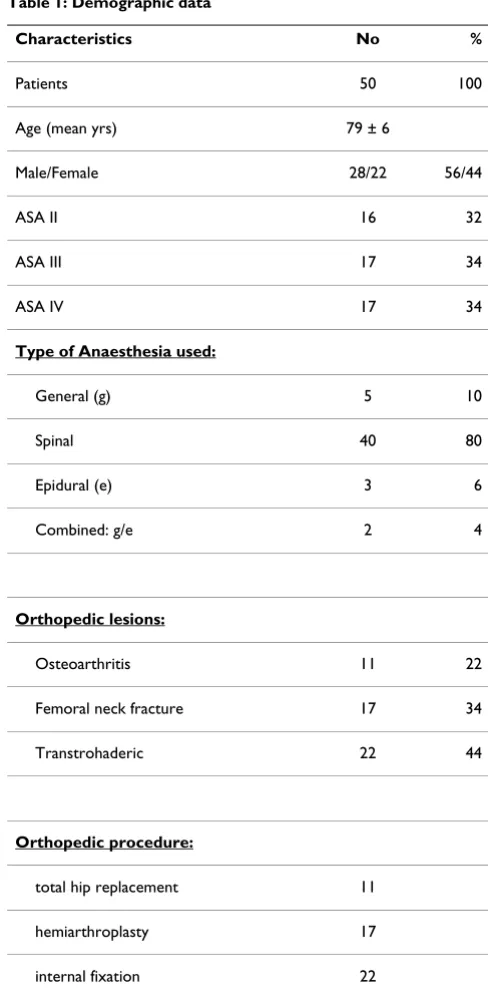
Every patient was preoperatively evaluated and classified according to the physical status classification of the Amer-ican Society of Anesthesiology (ASA) [5]. The preoperative clinical evaluation, the diagnostic work-up and the man-agement of cardiovascular diseases were performed according to the American College of Cardiology and American Heart Association (ACC/AHA) guidelines [6]. The type of anesthesia that was used was mainly regional. Patient characteristics, perioperative assessments accord-ing to the ASA, the type of anesthesia and the type of oper-ations performed were summarized from the patient's clinical charts and are presented in Table 1.
During surgery, basic intraoperative monitoring (ECG,
SpO2, EtCO2, non invasive blood pressure-NIBP) and
invasive blood pressure-IBP was applied to all patients. Central venous catheter or pulmonary catheter was per-formed selectively in patients with increased risk; i.e pre-existing cardiac heart failure or heart valvular disease.
Intraoperative anesthesiological complications (changes in blood pressure, heart rate) were also recorded. Intraop-erative, a fall in blood arterial pressure (BAP) of more than 30% was considered clinically significant and was initially managed with infusion of crystalloids (Ringer Lactate and Normal Saline 0,9%) in order to maintain the appropriate intravascular volume and vasoconstriction (phenylephrine). The hemoglobin threshold for blood transfusion was designated to be 8 mg.dL-1 and 10 mg.dL -1 for patients with coronary artery disease.
The mean length of hospitalization was 6–10 days. The status of all the patients was checked by telephone inter-view one month after their discharge from the hospital. Data regarding the outcome of those patients were col-lected from their medical hospital charts and death certif-icates and were analyzed statistically using the x2-test. Differences were considered significant at p value < 0.05. The pre-assessment and the intraoperative management of the patients were performed by the first author.
Results
During the period of 30 days, 8 out of 50 patients (16%) were reported dead on follow up, their mean age being 85 ± 6 years. Mortality at 30 days was 6% (n = 3) in women and 10% (n = 5) in men, with no significant difference (p > 0.5).
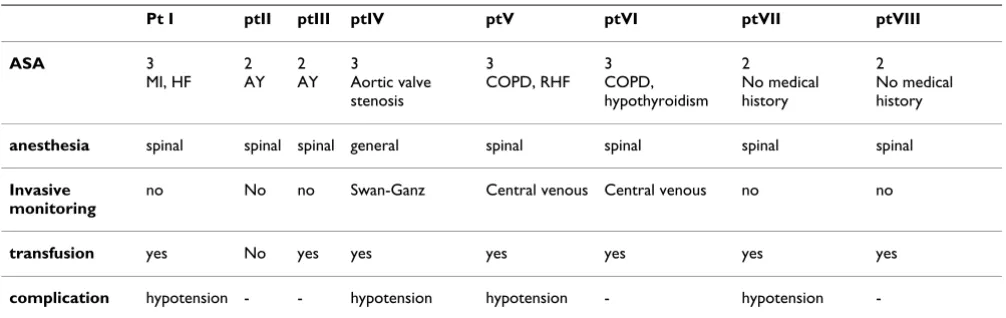
One patient (pt I-Table 2) with a history of a myocardial infarction (MI) more than 5 years ago and heart failure with a moderately good ejection fraction (EF:55%), suf-fered a fatal pulmonary edema. He had not experienced any symptoms of coronary ischemia after MI and he met a 6-MET (metabolic equivalent levels) level before sur-gery.
[image:2.612.310.554.89.586.2]Acute myocardial infarction and cardiac arrest was the cause of death in two patients (pts II&III-Table 2) with the
Table 1: Demographic data
Characteristics No %
Patients 50 100
Age (mean yrs) 79 ± 6
Male/Female 28/22 56/44
ASA II 16 32
ASA III 17 34
ASA IV 17 34
Type of Anaesthesia used:
General (g) 5 10
Spinal 40 80
Epidural (e) 3 6
Combined: g/e 2 4
Orthopedic lesions:
Osteoarthritis 11 22
Femoral neck fracture 17 34
Transtrohaderic 22 44
Orthopedic procedure:
total hip replacement 11
hemiarthroplasty 17
only incriminating evidence from their history being arte-rial hypertension.
A female patient (pt IV-Table 2) with stenosis of the aortic valve died of acute MI. Preoperative tests revealed an ejec-tion fracejec-tion (EF) of 55%, with normal wide pressure and systolic arterial pressure about 150 mmHg. She had mod-erate functional capacity and met a 5-MET level during her normal daily activities.
Acute heart failure was the cause of death in a patient with coexisting chronic obstructive pulmonary disease and right heart failure (pt V-Table 2). He had a normal chest X-ray and spirometry revealed decreased Forced Vital Capacity (FVC), decreased Forced End-expiratory Volume
at 1 minute (FEV1) and decreased Forced Expiratory Flow
Rate (FEF25–75%) at 61%, 73% and 62% of the predicted
values respectively. Echocardiography revealed tricuspid regurgitation +1 and mild enlargement of the right atrium.
Acute renal and respiratory failure was confirmed as the cause of death in a patient (pt VI-Table 2) with a history of chronic obstructive pulmonary disease, medically con-trolled hypothyroidism and aortocoronary bypass 8 years
ago. Spirometry revealed mild abnormalities (FEV1: 68%
and FVC: 72% of the predicted values) while assessment of the arterial blood gases did not disclose any severe hypoxemia or hypercapnia. He had not experienced any symptoms of coronary ischemia and he met a 5-MET level before surgery.
Paralytic ileus was the cause of death in a patient with insignificant history (pt VII-Table 2) while another patient with a free medical history died from septic shock compli-cating a case of pneumonia (pt VIII-Table 2).
Intraoperative complications occurred in 22 patients (44%) with mild hypotension being the most common. Intraop-erative, a temporary fall in blood arterial pressure (BAP) was common in almost all patients. Red blood cells had to be transfused to 32 out of 50 patients (64%) intraoper-ative due to excessive blood loss. None patient died in the operating table or during the hospitalization period. None patient had to be transported to the intensive care unit and also none presented with major postoperative complications during the early postoperative period.
Four of the diseased patients had hemodynamic imbal-ance intraoperative (50%) and 7 out of 8 received blood intraoperative (87,5%). The incidence of intraoperative complications in this group of patients was similar to that of our original group of patients (50% vs. 44%, p = 0.037, and 64% vs 87,5% p < 0,05).
Discussion
Elderly patients suffering from cardiovascular disease undergoing non-cardiac surgery are plagued with high cardiovascular morbidity representing a challenge for the anesthesiologic and surgical team. For patients over 70, there is a consistent 3-fold increase in the mortality rate and according to Goldman, age is one of nine independ-ent predictor factors of morbidity and death [7,8]. In our study, six of the eight patients who died had a history of cardiovascular disease. Five of the 8 patients died because of cardiovascular disease; ischemic heart disease and MI were the causes of death in four patients and heart failure in one.
[image:3.612.54.557.99.258.2]Autopsies of elderly people have revealed ischemia and heart failure as the causes of death for the majority of patients [9]. As Zeldin points out, more than 80% of deaths attributed to cadiovascular disease occur in people over the age of 65 [10]. In our study, the average clinical
Table 2: Data of diseased patients (pt).
Pt I ptII ptIII ptIV ptV ptVI ptVII ptVIII
ASA 3
MI, HF 2 AY
2 AY
3
Aortic valve stenosis
3
COPD, RHF 3 COPD, hypothyroidism
2
No medical history
2
No medical history
anesthesia spinal spinal spinal general spinal spinal spinal spinal
Invasive monitoring
no No no Swan-Ganz Central venous Central venous no no
transfusion yes No yes yes yes yes yes yes
complication hypotension - - hypotension hypotension - hypotension
status, which was evaluated by the MET-levels (all these 6 patients met a 5–6 MET-level), and their tests results (ECG, echocardiography) did not predict an ominous outcome. Increased perioperative and long-term risk of cardiac events has been associated with the inability to function above 4 MET [2]. Still, test results very often do not disclose the severity of the underlying cardiovascular disease [11].
The pre-assessment, clinical findings and echocardiogra-phy failed to reveal the severity of aortic valve stenosis in a patient with a history of this disease. That patient died within a month after surgery from MI. Aortic valve steno-sis has been recognized as a major independent risk factor for perioperative cardiac events in patients undergoing non-cardiac surgery. Patients with aortic valve stenosis have a 5-fold increased risk of perioperative complica-tions in comparison to patients without aortic valve sten-osis [12].
One patient with coexisting chronic obstructive pulmo-nary disease died because of respiratory failure although he had only mild abnormalities in the pulmonary func-tion tests (PFTs). There is evidence that PFTs are not sensi-tive enough to predict the risk of postoperasensi-tive pulmonary complications. PFTs have low positive predic-tive value and should be combined with other assess-ments such as ASA physical status and the Shapiro classification [13].
The patients who died had significant greater blood trans-fusion requirements compared with the initial group of patients enrolled in the study (87,5% vs. 64%, p = 0,03). There is evidence that fluid and blood transfusion might predict myocardial infarction, sepsis and influence mor-tality [14]. The threshold for blood transfusion was less
than 10 mg.dL-1 for patients with cardiac disease and 8
mg.dl-1 for the rest, although some authors insist in blood transfusion when haemoglobin falls below 8 mg/dL or alternatively 7 g.dL-1 [15]. Maintaining very low thresh-olds for transfusion may not be appropriate in the elderly. Even moderate anaemia is poorly tolerated by patients with cardiovascular disease in the perioperative phase. We did not follow a strict transfusion threshold because coro-nary ischemia is frequently silent in the elderly, in both the pre- and postoperative period. In addition, anaemia in the elderly, even when haemoglobin levels are above 12 g.dL-1, is a strong predictor of functional decline and poor prognosis.
Our findings on mortality are broadly comparable with those in other studies of mortality after fractured neck of femur or hip replacement in defined populations [5,16-20]. In a prospective study of 2448 patients over 60 years of age suffering from hip fracture, Roche et al reported mortality rates of 9.6% at 30 days and 33% at one year
[16]. Lie at al, also found increased mortality rates in patients over 70 years after hip replacement [5].
To reduce mortality, attention must focus on optimising health status preoperatively, preventing postoperative complications and when these complications develop providing optimal specialist care. However, it seems that in spite of a detailed preoperative evaluation still many conditions remain unidentified even in the operating room. In 27–31% of autopsies of patients over 65 years of age, the presence of a potentially treatable contributory factor to death that was undiagnosed during life was iden-tified [21]. Approximately 80–90% of patients with obstructive sleep apnea are undiagnosed [22]. Even labo-ratory screening tests have several shortcomings: they fre-quently fail to uncover pathological conditions; they detect abnormalities the discovery of which does not nec-essarily improve patients care outcome; and they are inef-ficient in finding asymptomatic diseases [11].
It is difficult to determine the gold standard method for perioperative management of these patients. For example Gold Directed Haemodynamic Therapy guided by oxygen extraction O2ER is very helpful but it could not be per-formed in our study since it would require central venous monitoring for all patients [23]. Also B-type natriuretic peptide (BNP) is a well known marker of left ventricular dysfunction and heart failure, it provides prognostic infor-mation beyond and above left ventricular ejection frac-tion and is an important and independent prognostic biomarker for both short- and long-term mortality in patients with acute coronary syndromes or chest pain. However, its prognostic value is minimized in asympto-matic patients as in our study [24,25]. Anesthesiologists and all physicians who deal with the peri- and post-oper-ative management of these patients need to be vigilant for any complications that might arise.
Certain limitations of this study are its small population and its short follow up. As we had only 50 patients in our series, a larger population is necessary to confirm our results and explain the cause of misdiagnosis or delayed right diagnosis. The study is retrospective so there could not be obtained a detailed history of patients presented in the ER. Future prospective studies are needed to evaluate the utility of each screening test in the ER for patients sus-picious for AAD. There was no control group, as it would not be ethical not to perform screening tests in a cohort of patients. Certainly the findings of our study can not be generalized, but are indicative of how commonly happens misdiagnosis in AAD.
Conclusion
Publish with BioMed Central and every scientist can read your work free of charge "BioMed Central will be the most significant development for disseminating the results of biomedical researc h in our lifetime."
Sir Paul Nurse, Cancer Research UK
Your research papers will be:
available free of charge to the entire biomedical community
peer reviewed and published immediately upon acceptance
cited in PubMed and archived on PubMed Central
yours — you keep the copyright
Submit your manuscript here:
http://www.biomedcentral.com/info/publishing_adv.asp
BioMedcentral
factors as well. Despite the detailed preoperative evalua-tion, and the intensive intraoperative and early postoper-ative anaesthetic care, most patients' deaths are directly correlated to their previous medical history.
Competing interests
The authors declare that they have no competing interests.
Authors' contributions
AI participated in the design of the study and drafted the manuscript. AT was a major contributor in writing the manuscript. GG participated in the design of the study. PS and KN edited and revised the final manuscript. All authors have read and approved the final manuscript.
References
1. Morgan GE, Mikhail MS: Anesthesia in elderly. Clinical Anesthesiol-ogy 1992:1107-10.
2. Seymour DG, Pringle R: Post-operative complications in the elderly surgical patient. Gerontology 1983, 29(4):262-70. 3. Santaguida PL, Hawker GA, Hudak PL, Glazier R, Mahomed NN,
Kre-der HJ, Coyte PC, Wright JG: Patient characteristics affecting the prognosis of total hip and knee joint arthroplasty: a sys-tematic review. Can J Surg 2008, 51(6):428-36.
4. Lie SA, Engesaeter LB, Havelin LI, Gjessing HK, Vollset SE: Mortality after total hip replacement: 0–10-year follow-up of 39,543 patients in the Norwegian Arthroplasty Register. Acta Orthop Scand 2000, 71(1):19-27.
5. Eagle K, Brundage B, Chaitman B, Ewy GA, Fleisher LA, Hertzer NR, Leppo JA, Ryan T, Schlant RC, Spencer WH 3rd, Spittell JA Jr, Twiss RD, Ritchie JL, Cheitlin MD, Gardner TJ, Garson A Jr, Lewis RP, Gib-bons RJ, O'Rourke RA, Ryan TJ: Guidelines for perioperative car-diovascular evaluation of noncardiac surgery. A report of the American Heart Association/American College of Cardiol-ogy Task Force on Assessment of diagnostic and therapeutic cardiovascular procedures. Circulation 1996, 93:1278-317. 6. Linn BS, Linn MW, Wallen N: Evaluation of results of surgical
procedures in the elderly. Ann Surg 1982, 195:90.
7. Goldman L, Caldera DL, Nussbaum SR, Southwick FS, Krogstad D, Murray B, Burke DS, O'Malley TA, Goroll AH, Caplan CH, Nolan J, Carabello B, Slater EE: Multifactorial index of cardiac risk in noncardiac surgical procedures. N Engl J Med 1977, 297:845-850.
8. Puxty JAH, Horan MA, Fox RA: Necropsies in the elderly. The Lancet 1981, 4:1262-64.
9. Zeldin RA: Assessing cardiac risk in patients who undergo noncardiac surgical procedures. Can J Surg 1984, 27:402-4. 10. Variakojis RJ, Roizen MF: Preoperative evaluation of the elderly.
In Geriatric anaesthesiology Edited by: Mcleskey CH. Williams & Wilkins; 1997:175-178.
11. Morgan GE, Mikhail MS: Anesthesia in cardiovascular patients.
Clinical Anesthesiology 1992:506-7.
12. Kertai MD, Boutioukos M, Boersma E, Bax JJ, Thomson IR, Sozzi F, Klein J, Roelandt JRTC, Poldermans D: Aortic stenosis: an under-estimated risk factor for perioperative complications in patients undergoing noncardiac surgery. Am J Med 2004, 116:8-13.
13. Shapiro BA, Kacmarek RM, Cane RD: Clinical application of res-piratory care. In Year Book of intensive care medicine Mosby, St Louis; 1991:429-32.
14. Tornetta P, Mostafavi H, Riina J, Turen C, Reimer B, Levine R, Beh-rens F, Geller J, Ritter C, Homel P: Morbidity and mortality in elderly trauma patients. J Trauma 1999, 46(4):702-6.
15. Hebert PC: A multicenter, randomized, controlled clinical trial of transfusion requirements in critical care. N Engl J Med
1999, 340:409-417.
16. Roche JJW, Wenn RT, Sahota O, Moran CG: Effect of comorbidi-ties and postoperative complications on mortality after hip fracture in elderly people: prospective observational cohort study. BMJ 2005, 331(7529):1374.
17. Hosking MP, Lobdell CM, Warner MA, Offord KP, Melton LJ: Anaes-thesia for patients over 90 years of age. Outcomes after regional and general anaesthetic techniques for two com-mon surgical procedures. Anaesthesia 1989, 44(2):142-7. 18. Walker N, Norton R, Hoorn S Vander, Rodgers A, MacMahon S,
Clark T, Gray H: Mortality after hip fracture: regional varia-tions in New Zealand. N ZMed J 1999, 112:269-71.
19. Roberts SE, Goldacre MJ: Time trends and demography of mor-tality after fractured neck of femur in an English population, 1968–98: database study. BMJ 2003, 327(7418):771-5. 20. Kenzora JE, McCarthy RE, Lowell JD, Sledge CB: Hip fracture
mor-tality. Relation to age, treatment, preoperative illness, time of surgery, and complications. Clin Orthop Relat Res 1984, 186:45-56.
21. Eagle KA, Berger PB, Calkins H, Chaitman BR, Ewy GA, Fleischmann KE, Fleisher LA, Froehlich JB, Gusberg RJ, Leppo JA, Ryan T, Schlant RC, Winters WL Jr, Gibbons RJ, Antman EM, Alpert JS, Faxon DP, Fuster V, Gregoratos G, Jacobs AK, Hiratzka LF, Russell RO, Smith SC Jr: ACC/AHA guideline update for perioperative cardio-vascular evaluation for non-cardiac surgery – executive sum-mary a report of the American College of Cardiology/ American Heart Association Task Force on Practice Guide-lines (Committee to Update the 1996 GuideGuide-lines on Periop-erative Cardiovascular Evaluation for Non-cardiac Surgery).
Circulation 2002, 105:1257-1267.
22. Tamul Paul C, Peruzzi William T: Assessment and management of patients with pulmonary disease. Crit Care Med 2004, 32(4 Suppl):S137-45.
23. Donati A, Loggi S, Preiser JC, Orsetti G, Münch C, Gabbanelli V, Pelaia P, Pietropaoli P: Goal-directed intraoperative therapy reduces morbidity and length of hospital stay in high-risk sur-gical patients. Chest 2007, 132(6):1817-24.
24. Brügger-Andersen T, Pönitz V, Staines H, Pritchard D, Grundt H, Nilsen DW: B-type natriuretic peptide is a long-term predic-tor of all-cause mortality, whereas high-sensitive C-reactive protein predicts recurrent short-term troponin T positive cardiac events in chest pain patients: a prognostic study.
BMC Cardiovasc Disord 2008, 25;8:34.