
Rochester Institute of Technology
RIT Scholar Works
Theses
Thesis/Dissertation Collections
8-10-2016
Development of a Graduate Course on the
Transition to Internet Protocol Version 6
Venu Gopal Kakarla
Follow this and additional works at:
http://scholarworks.rit.edu/theses
This Thesis is brought to you for free and open access by the Thesis/Dissertation Collections at RIT Scholar Works. It has been accepted for inclusion in Theses by an authorized administrator of RIT Scholar Works. For more information, please [email protected].
Recommended Citation
Development of a Graduate Course on the
Transition to Internet Protocol Version 6
by
Venu Gopal Kakarla
Thesis submitted in partial fulfilment
of the requirements for the degree of
Master of Science in
Networking
&
Systems Administration
Department of
Information Sciences
&
Technologies
B. Thomas Golisano College of
Computing
&
Information Sciences
Rochester Institute of Technology
Rochester, New York
Rochester Institute of Technology
B. Thomas Golisano College of
Computing & Information Sciences
Department of
Information Sciences & Technologies
Master of Science in
Networking & Systems Administration
Thesis Approval Form
Student Name: Venu Gopal Kakarla
Thesis Title: Development of a Graduate Course
on the Transition to Internet Protocol Version 6
Dr. Charles Border
(Committee Chair)
(Signature)
(Date)
Dr. Tae Oh
(Committee Member)
(Signature)
(Date)
Dr. Luther Troell
Abstract
Internet and mobile connectivity has grown tremendously in the last few decades,
creating an ever increasing demand for Internet Protocol (IP) addresses. The pool of
Internet Protocol version 4 (IPv4) addresses, once assumed to be more than sufficient
for every person on this planet, has reached its final stages of depletion. With The
Internet Assigned Numbers Authority’s (IANA) global pools depleted, and four of the
five Regional Internet Registries (RIR) pools down to the their last /8 block, the
remaining addresses will not last very long.
In order to ensure continuous growth of the internet in the foreseeable future, we
would need a newer internet protocol, with a much larger address space. Specifically,
with that goal in mind the Internet Protocol version 6 (IPv6) was designed about two
decades ago. Over the years it has matured, and has proven that it could eventually
replace the existing IPv4.
This thesis presents the development a graduate level course on the transition to
IPv6. The course makes an attempt at understanding how the new IPv6 protocol is
different than the currently used IPv4 protocol. And also tries to emphasize on the
options existing to facilitate a smooth transition of production networks from IPv4 to
Acknowledgements
Thanks to,
—
My parents and family, who have always supported me through the years.
Without their support and patience this thesis would not have been possible.
—
My thesis committee chair Dr. Charles Border and committee members Dr.
Tae Oh and Dr. Luther Troell, for all their guidance throughout the process of
writing this thesis. Without them this thesis would not have been possible.
—
My mentors, advisors, librarians, professors, colleagues, and friends, whose
daily encouragement and inspiration have helped me progress forward.
—
Ms. Tracy Morrow for attending my thesis defense and also for proofreading
this document for language and grammar.
—
Venu Gopal Kakarla
Copyrights
All work in this thesis, unless otherwise noted is licensed under, the permissive and
non-viral Creative Commons Attribution-NonCommercial 4.0 International License.
Table of Contents
Abstract ... iii
Acknowledgements ... iv
Copyrights ... iv
Table of Contents ... v
Table of Figures ... viii
1 Introduction ... 1
1.1 Thesis Statement ... 2
1.2 Motivations of research ... 2
1.3 Purpose Statement ... 3
1.4 Implications of research ... 3
1.5 Approach and Methodology ... 4
1.6 Intended Audience ... 4
1.7 Deliverables ... 5
1.8 Work Plan ... 5
2 Internet Protocol Version 6... 6
2.1 IPv6 Packet Header ... 6
2.1.1 New Fields and Fields changed ... 8
2.1.2 Fields removed ... 8
2.2 Disruptive Innovations in IPv6 ... 9
2.2.1 Extension headers ... 9
2.2.2 Fragmentation ... 9
2.2.4 Neighbour Discovery and Duplicate Address Detection ...10
3 Course Design ...11
3.1 Course Schedule ...11
3.2 Textbook Selection ...12
3.3 Supplemental Books Selection ...13
3.4 Lecture Materials ...13
3.4.1 Lecture 1: Introduction ...13
3.4.2 Lecture 2, 3, 4: Technical Fundamentals ...14
3.4.3 Lecture 5, 6, 7: Routing ...16
3.4.4 Lecture 8, 9: Transition ...16
3.4.5 Lecture 10: Mobility ...16
3.4.6 Lecture 11: Security ...17
3.4.7 Lecture 12: Quality of Service and Network Management ...17
3.4.8 Lecture 13: Case Studies ...18
3.4.9 Lecture 14: Conclusion ...18
3.5 Assignments Design ...19
3.5.1 Assignment 1 – Building a business case for IPv6 ...19
3.5.2 Assignment 2 – Building a plan for IPv6 transition ...19
3.6 Mid Term Quiz Design ...20
3.7 Final Exam Design ...20
3.8 Labs Design ...21
3.8.1 Lab 1 – IPv6 Addressing and SLAAC ...22
3.8.2 Lab 2 – IPv6 Neighbour Discovery ...22
3.8.4 Lab 4, 5 – IPv6 BGPv6 and IPv6 Traffic Filtering ...23
3.8.5 Lab 6 – IPv6 Tunnelling ...23
4 Conclusion ...24
5 Appendices ...26
5.1 Course Proposal Form ...26
5.2 Course Syllabus ...32
5.3 Lecture Slides ...40
5.3.1 Lecture 1 ...40
5.3.2 Lecture 2 ...52
5.3.3 Lecture 8 ...64
5.4 Assignments ...76
5.4.1 Writing Assignment 1 ...76
5.5 Mid Term Quiz ...77
5.5.1 Mid Term Quiz Solution Key ...82
5.6 Practical Labs ...83
5.6.1 Lab Overview ...83
5.6.2 Lab Diagram ...84
5.6.3 Lab 1 ...85
5.6.4 Lab 2 ...87
5.6.5 Lab 3 ...89
Table of Figures
Figure 1: IPv4 Packet Header Format ... 6
Figure 2: Removed fields from IPv4 Header ... 7
Figure 3: IPv6 Packet Header Format ... 7
Figure 4: Unicast Global Address Format ...15
Figure 5: Link Local Address Format ...15
Figure 6: Unique Local Address Format ...15
Figure 7: IPv4 Mapped Address Format ...15
Figure 8: 6to4 Address Format ...15
Figure 9: Loopback Address Format ...15
Figure 10: Multicast Address Format ...15
1
Introduction
The depletion of IPv4 addresses is forcing network administrators everywhere to
implement a new IPv6 addressing scheme to the already complex networks. The
newer IPv6 networks are feature rich and promise to fix a lot of age old issues
prevalent among IPv4 networks.
In spite of all these new mechanisms to better manage networks we have not seen
any major motivations for people to go ahead with an IPv6 implementation. There
have been some successful implementations out there, some of which are pretty large
scale. But they have still not been sufficient to convince IT admins to transition to
IPv6. [1]
Given the current state of the internet, IPv6 transition is not a choice but a
requirement. IPv6 is not going to replace anything in the short term. Most likely it is
going to co-exist with the existing IPv4. But it is safe to say that eventually in the
long term, we can hope that it will eventually replace IPv4. [1]
This thesis presents the development of a course, that describes the concepts and
implementation choices that an enterprise needs to ensure while transitioning all or
a portion of their network from IPv4 to IPv6. The course can be broken into two parts.
One, specifically understanding the IPv6 protocol and routing, and how it differs from
its predecessor IPv4. Two, to focus on the various technologies available to aid in the
into dual stack, tunneling and translation. These three different approaches aim to
make this integration of IPv6 into IPv4 networks possible, thus enabling both the
technologies to coexist for a certain period of time. And eventually transition into a
pure IPv6 landscape.
1.1
Thesis Statement
The goal of this thesis is to design of a graduate level course on the transition from
IPv4 to IPv6 that would build on the knowledge students obtained in the other
courses offered by the department of Information Sciences and Technologies in the
Master’s degree in Networking and System Administration at the Rochester Institute
of Technology. After completion of the course students would have an understanding
of the issues associated with this transition and be able to design and present a plan
for a transition from IPv4 to IPv6.
1.2
Motivations of research
There is no plan B, to tackle the depletion of IPv4 addresses. Despite the long list of
the issues with IPv6 and its deployment, there are no alternatives. There is no way
we can come up with, implement, and deploy an alternative before the lack of IPv4
addresses becomes a serious problem. The only way forward is IPv6. IPv6 has been
in the making for almost two decades. It has matured considerably. Thus it is
Benefits of IPv6 is not just an expanded address space, it brings out a lot of new
features. Such as a new header format, much better support for extensions, flow
labeling, and some authentication and privacy capabilities. These benefits make IPv6
a better match for the way that the internet is used today.
1.3
Purpose Statement
The purpose of this research is to develop a course that allows students to gain a
better understanding of the functionality and operations of IPv6 networks specifically
in how they differ from IPv4 networks. As part of this course students will learn to
identify the risks and understand the transition strategies available, hoping that this
would help them navigate through the IPv6 transition while avoiding the pitfalls of
a poorly planned strategy.
1.4
Implications of research
This course will be beneficial to anyone interested in incorporating IPv6 into their
networks in the near future. The main focus will be on transition strategies
employing the techniques of tunneling and translation to help in a smoother and more
rapid transition to IPv6. Thus this course will help students to formulate a plan for a
rapid IPv6 deployment into current networks. The course will involve applying learnt
concepts from previously taken courses in enterprise computing as well as emerging
computing and network technologies. Students will focus on the available IPv6
for such a transition and study the process involved and understand some of the
issues encountered along the way.
1.5
Approach and Methodology
This thesis and the course proposed, aims to explain some of the answers as to why
IPv6 transition is necessary, how it is expected to work, and what benefits are gained
from implementing it as compared to IPv4. These answers can be provided along with
the development of the graduate course. The development of such a course will
involve lectures, hands on labs, written assignments focusing on active learning,
quizzes and written exams. Thus the completion of this thesis will involve designing
and developing these components of the course. The exact components are further
listed in the deliverables section.
1.6
Intended Audience
The primary audience of this course will be students in the Master’s degree in
Networking and Systems Administration who would be interested in pursuing
careers as network managers, network administrators and IT personnel who are
responsible for managing an enterprise network. The United States Government
Office of Management and Budget (OMB) has also mandated that the various
departments make the transition to IPv6 initially by June 2008, then September
2012, and finally September 2014. 2008, 2012 and 2014 have long gone, but a lot of
the departments have only inched closer to that goal. This course can also help train
1.7
Deliverables
1.
Thesis Report
2.
Course Outline
a.
Learning outcomes and Course objectives
b.
Textbook selection
c.
Course syllabus and Course schedule
3.
Three Lectures
4.
An Exam or Exam Format
5.
Two or three Labs
6.
One Written Assignment
1.8
Work Plan
Week 01: Acceptance of formal proposal by thesis committee and department.
Week 02: Make decisions, get organized.
Week 03: Develop overall plan, draft a list of course topics
Week 04: Decide on the course outline, textbook, lectures, labs, etc.
Week 05: Write lectures, develop labs.
Week 06: Decide on exam format, Prepare exam.
Week 07: Write thesis report.
Week 08: Submission to thesis committee for approval.
Week 09: Submission to department for approval.
2
Internet Protocol Version 6
2.1
IPv6 Packet Header
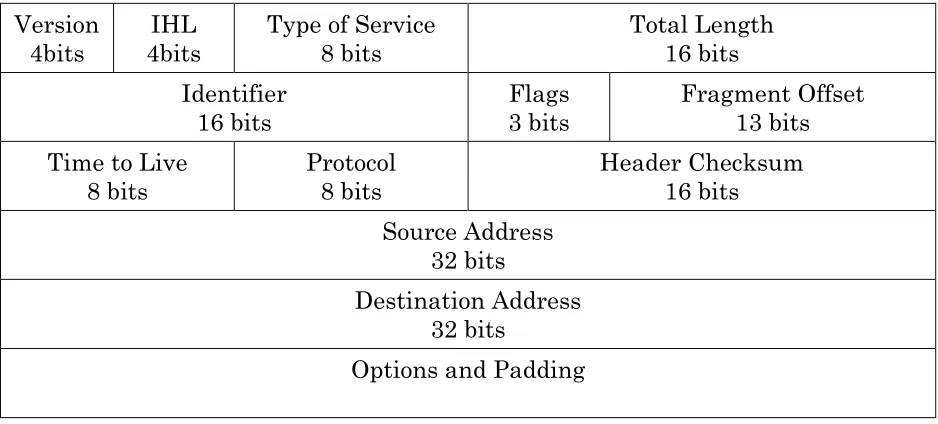
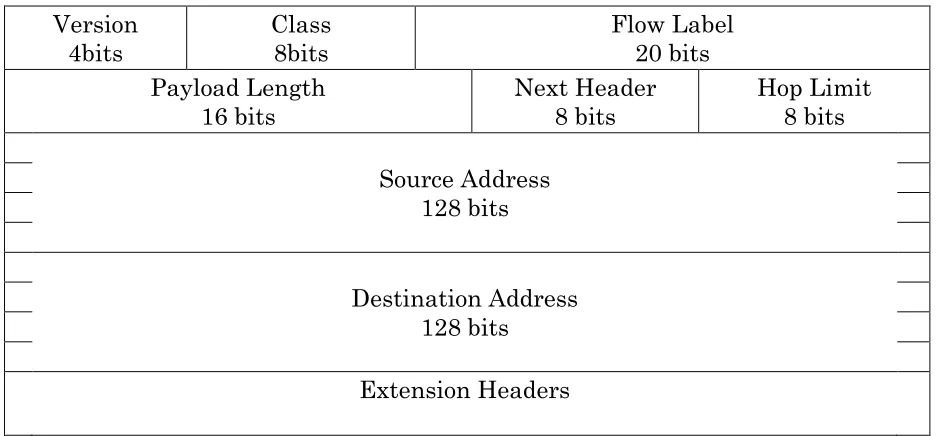
In the five layered TCP/IP network stack, IPv6 is a plug in replacement for IPv4. It
is supposed to function without much change to the TCP and UDP services. Even
though it’s a replacement for IPv4, a lot of the fields in the IPv6 header have changed.
Some fields have been removed and others modified and even newer fields have been
added. Overall, the IPv6 header is much larger than the IPv4 header even though it
has a lesser number of fields and is much simpler. This is because of the larger
address sizes for the source and destination. IPv6 addresses are 128 bit instead of 32
bit. If we can ignore the quadrupling of the address size, the IPv6 header is much
smaller, leaner and simpler. [5][6]
Version
4bits
4bits
IHL
Type of Service
8 bits
Total Length
16 bits
Identifier
16 bits
Flags
3 bits
Fragment Offset
13 bits
Time to Live
8 bits
Protocol
8 bits
Header Checksum
16 bits
Source Address
32 bits
Destination Address
32 bits
[image:15.612.72.541.440.652.2]Options and Padding
Version
4bits
4bits
IHL
Type of Service
8 bits
Total Length
16 bits
Identifier
16 bits
Flags
3 bits
Fragment Offset
13 bits
Time to Live
8 bits
Protocol
8 bits
Header Checksum
16 bits
Source Address
32 bits
Destination Address
32 bits
[image:16.612.72.542.111.302.2]Options and Padding
Figure 2: Removed fields from IPv4 Header
Version
4bits
Class
8bits
Flow Label
20 bits
Payload Length
16 bits
Next Header
8 bits
Hop Limit
8 bits
Source Address
128 bits
Destination Address
128 bits
Extension Headers
[image:16.612.70.539.397.615.2]2.1.1
New Fields and Fields changed
Version has been incremented from four to six, with the size of four bits
remaining the same.
Type of Service has been changed to Traffic Class and Flow Label. Flow
label is the only completely new filed introduced in IPv6.
Time to Live has been renamed to Hop Limit, as we are actually talking of
hops and not time.
Protocol has been renamed to Next Header as IPv6 introduces extension
headers.
Source and Destination Addresses each have their size quadrupled.
2.1.2
Fields removed
The internet header length filled has been eliminated due to the fact that
the IPv6 header is fixed in size.
Identification, Flags and Fragment Offset have been removed due to the
introduction of a dedicated fragmentation extension header.
Header Checksum has been eliminated to reduce the computation load on
routers. In IPv4 due to the TTL value changing at each hop, the checksum
changes, causing each router along the way to recomputed the checksum.
Elimination of this checksum is not a major problem as the higher layers
Options and Padding have been removed as they are no longer required,
due to a fixed size header and the availability of extension headers.
Another change IPv6 brings is the quadrupling of the address size. This
means IPv6 addresses are written down using colon separated hexadecimal
bits of sixteen. The biggest contiguous substring of zeros can be substituted
with two consecutive colons. This can be done only once in an IPv6 address.
2.2
Disruptive Innovations in IPv6
2.2.1
Extension headers
IPv4 packets had up to forty octets as something called options and padding. This
was a kind of limitation in the size, hence IPv4 packets with options were hardly seen.
Layer security vulnerabilities were discovered in the IPv4 source routing options.
Hence source routing was deprecated. [7]
IPv6 kind of extends this with extension headers. Extension headers are optional
add-ons to the IPv6 header to implement additional functionality such as source routing,
fragmentation, encryption etc. Compared to the IPv4 options the IPv6 extension
headers have been improved over the size problem. As they can have up to 255 octets,
and then multiple extension headers can be chained in the same packet. [8][9]
2.2.2
Fragmentation
IPv6 also makes a major change in the way it handles packet fragmentation. Unlike
means the source will need to know the lowest MTU between itself and the
destination. So there is a new protocol for MTU path discovery, which is used to
determine the maximum MTU possible without needing to fragment a packet. IPv6
also defines a minimum MTU of 1280 octets. [10]
2.2.3
Autoconfiguration
One of the biggest advantages of IPv6 over IPv4 is autoconfiguration. That means
nodes on an IPv6 network can optionally, automatically self-assign themselves IPv6
addresses, which are unique, that is not duplicates of other addresses. This enables
something called the stateless addressing of networking, which means that a DHCP
server is not required to assign IPv6 addresses. Hence administrator intervention is
not needed. This is done by using two new protocols called Neighbor Discovery and
Duplicate Address Detection. This new ability of IPv6 networks to autoconfigure, is
said to be the main reason for enabling a much faster adoption of IPv6. [11]
2.2.4
Neighbour Discovery and Duplicate Address Detection
One of the most interesting and innovative features of IPv6 is the Neighbor Discovery
Protocol. It operates at layer three and is responsible for address autoconfiguration
of nodes, discovery of other nodes on the link, determining the link layer addresses of
other nodes, duplicate address detection, finding available routers and domain name
system (DNS) servers, address prefix discovery, and maintaining reachability
information about the paths to other active neighbor nodes. This mechanism is also
3
Course Design
In the following section, the various components of this course are presented
highlighting how the components are broken down. It tries to elaborate on the
different approaches to teaching taken to meet the course objectives. The particular
aspects of the course which make it very useful for students are emphasized. Material
has been broken into a total of fourteen lectures each spanning a week. This has been
done so that the lectures can be aligned with the semester system of instruction at
the Rochester Institute of Technology. The typical semester spans sixteen weeks out
of which fifteen weeks have regular classroom interaction and the last week, the
sixteenth is usually is reserved for the final exams.
3.1
Course Schedule
Week Topics Assigned Reading Activities/Labs Week 1 Introduction TB: 1,2 R1: 1,12
R2: 1 Assignment 1 Discussion
Week 2 Technical Fundamentals 1 TB: 3,4 R1: 2,3 Assignment 1 Due
Week 3 Technical Fundamentals 2 TB: 5,6 R1: 7 Lab1
Week 4 Technical Fundamentals 3 TB: 7,8 R1: 4 Lab2
Week 5 Routing 1 TB: 9 R1: 8 Lab3
Week 6 Routing 2 TB: 10 Lab4
Week 7 Routing 3 TB: 15 Lab5
Week 8 Revision, Study, Mid Term Mid Term Quiz
Week 9 Transition 1 TB: 16 R1: 10 Lab6
Week 10 Transition 2 TB: 17 R2: 3 Lab6
Week 12 Security TB: 13 R1: 5 Assignment 2 Discussion
Week 13 QoS, Network Management TB: 14,19,20 R1: 6,9
Week 14 Porting, Case Studies TB: 21,23 R2: 2 Assignment 2 Due
Week 15 Conclusion, Revision, Study TB: 24
Week 16 Finals Week No Class Final Exam
The TB in the above table refers to the course textbook, specifically “Migrating to
IPv6” written by Mark Blanchet. R1 and R2 used above refer to the two reference
books namely “IPv6 Essentials” and “Planning for IPv6”. Both the reference books
are written by author Silvia Hagen.
3.2
Textbook Selection
The textbook selected for this course is “Migrating to IPv6: A Practical Guide to
Implementing IPv6 in Mobile and Fixed Networks (2nd ed.)”. The book is authored
by Marc Blanchet, and published by John Wiley & Sons Ltd in 2016. The course was
originally created using the first edition of the book published in 2006, and later
updated to use the second edition after it is released in 2016. Out of the many books
reviewed to serve as a textbook for this course. This particular book was selected
because it not only covered the IPv6 protocol, like other books did. But this was also
the only book which covered transition technologies in great detail. So this book also
allows the use a single course textbook. Otherwise separate books would have to have
been chosen for covering the IPv6 protocol and transition mechanisms separately.
Silvia Hagen for reading. These books are not actually used in the class. But are just
provided to support the students with additional reading for each lecture. The
chapters in those books are also mapped to the lectures for student’s convenience.
3.3
Supplemental Books Selection
The course also refers to a few other supplemental books. It has been ensured that
all of these books are available electronically in the RIT’s Wallace memorial library,
so that the students would not need to purchase them. Among these books, the book
“IPv6 Mandates” by Karl Sill is chosen because it takes a project management
approach to designing an IPv6 transition plan. It also presents checklists and
guidelines to follow, which can support the students in their two written assignments.
The Cisco Press book, “Deploying IPv6” by Ciprian Popoviciu, et.al. is chosen because
of the examples it provides for implementing the required transition technologies. It
also includes Cisco IOS command examples needed by the students to successfully
complete the labs component of this course. Since the labs in this course do not include
the commands required, this book will prove to be of substantial help to the students.
3.4
Lecture Materials
3.4.1
Lecture 1: Introduction
Lecture 1 covers chapters 1 and 2 of the textbook. The lecture starts with
understanding some of the reasons for internet growth in last few decades, and tries
the statistics showing the rapid rate of IPv4 address space depletion. Then it covers
some of the ingenious ways devised to conserve this limited IPv4 address space. It
talks about network address translation, variable length subnet masks, classless
internet domain routing, and growth of the global routing table. Then it covers some
of the real issues prevalent in today’s IPv4 networks, issues facing voice over IP and
peer to peer networks. Then it talks about the state of IP security in IPv4. Talks about
renumbering issues and address collisions over VPN networks. It briefly covers the
early history of the internet. And then provides a lot of emphasis on the new features
of IPv6. Finally, this lecture also tries to get your hands dirty, by showing the
students how to enable IPv6 on different operating systems, such as Windows, Mac
OS X, Linux, BSD and Solaris. Examples of commands needed to turn on IPv6 on a
Cisco and Juniper router are also included.
3.4.2
Lecture 2, 3, 4: Technical Fundamentals
Lecture 2, 3, 4 cover chapters 3 through 8 of the textbook. The lecture starts with
describing the structure of the IPv6 protocol, the new IPv6 header format with a
discussion of each field. It also describes what extension headers are, what types of
extension headers have been defined, and how they are used. Then the lecture covers
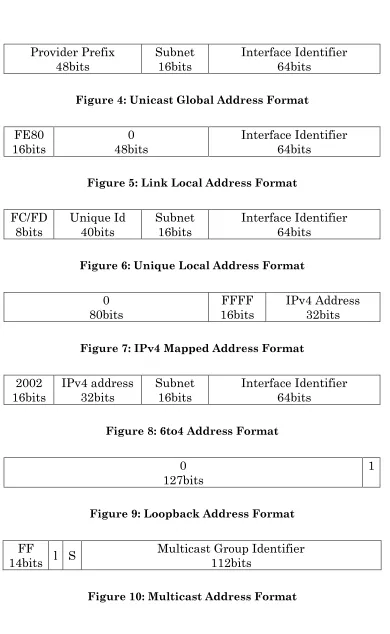
IPv6 addressing. Explaining everything about the new address format, address
notation, address types. Finally, ICMPv6 is covered starting with ICMPv6 message
format, the ICMPv6 error messages This lecture also discusses the extended
functionality based on ICMPv6, such as neighbor discovery, autoconfiguration, path
Provider Prefix
48bits
Subnet
16bits
Interface Identifier
64bits
Figure 4: Unicast Global Address Format
[image:24.612.114.504.69.703.2]FE80
16bits
0
48bits
Interface Identifier
64bits
Figure 5: Link Local Address Format
FC/FD
8bits
Unique Id
40bits
Subnet
16bits
Interface Identifier
64bits
Figure 6: Unique Local Address Format
0
80bits
FFFF
16bits
IPv4 Address
32bits
Figure 7: IPv4 Mapped Address Format
2002
16bits
IPv4 address
32bits
Subnet
16bits
Interface Identifier
64bits
Figure 8: 6to4 Address Format
0
127bits
1
Figure 9: Loopback Address Format
FF
14bits
l S
Multicast Group Identifier
112bits
3.4.3
Lecture 5, 6, 7: Routing
Lecture 5, 6, 7 cover chapters 9 through 15 of the textbook. In this chapter routing
protocols are discussed with a focus on IPv6. After going through static routing. The
changes made to RIP to become RIPng, OSPF version 3, and Extensions for BGP4
called BGP4+ to handle IPv6 are discussed. Proprietary routing protocols like IS-IS
and EIGRPv6 are also touched upon. MPLS for IPv6 is discussed. DHCPv6 and
DNSv6 changes like quad A records are also discussed. For the last lecture in the
routing series, multicast is extensively studied. Reasons why multicast was not
widely used in IPv4 are studied, and the changes made to ensure that the protocol is
more widely supported in IPv6 are looked into.
3.4.4
Lecture 8, 9: Transition
Lecture 8, 9 cover chapters 16 and 17 of the textbook. Lecture 8 covers how IPv6 can
be deployed in IPv4 dominant networks. Lecture 9 covers how IPv6 dominant
networks can be configured to still support IPv4. Starting with interoperability, the
different transition mechanisms are defined, such as dual stack, tunneling, and
translation techniques. This lecture also highlights how the various mechanisms can
be combined together to work towards a smoother transition. The lecture also tries to
highlight missing aspects. Finally concluding with security and cost considerations.
3.4.5
Lecture 10: Mobility
Lecture 10 covers chapters 11 and 12 of the textbook. This lecture covers Mobile IPv6.
studied. Some concepts which are covered are triangle routing, route optimizations,
handoffs and fast handoffs, home agents, etc. The specific extension headers for
mobility are introduced. Security considerations are discussed. Finally, this lecture
goes through explaining that Mobile IPv6 might be the real reason for the eventual
adoption of IPv6, and thus enabling IPv6 to be the foundation for the next generation
of smart mobile devices and services.
3.4.6
Lecture 11: Security
Lecture 11 covers chapter 13 of the textbook. The lecture begins with a discussion of
various security requirements observed over the years in IPv4. Elaborates on some
of the security concepts. Then goes into detail covering the new IP security
framework, which is a mandatory part of IPv6 unlike IPv4. It stresses on the various
authentication and encryption features of the new IPv6 protocol. Talks about how
extended headers are extensively used for IP security model. Then the lecture
concludes by briefly talking about the kind of new security needs which might arise
in the future with new technologies like internet of things becoming a ubiquitous
reality.
3.4.7
Lecture 12: Quality of Service and Network Management
Lecture 12 covers chapters 14, 19 and 20 of the textbook. This chapter covers quality
of service enhancements available in IPv6. It highlights some ways to implement it
with various service classes. Some configuration examples and performance test
extensively studied. Upper layer protocols like transmission control protocol and user
datagram protocol are studied. Then network management aspects are covered.
Starting with the internet control message protocol. Congestion notification
mechanisms are covered. Then different mechanisms to gather management
information using SNMP and its MIBs are covered. Some network management tools
are touched on.
3.4.8
Lecture 13: Case Studies
Lecture 13 covers chapters 21 and 23 of the textbook. It covers some case studies of
successful IPv6 implementations and transitions around the world in big and small
companies. Lessons learnt in those transitions are presented. The idea is to show the
students that others have faced the issues which they would likely face in their
transition. Some project planning, design, management and execution aspects of
developing an IPv6 transition plan are also covered.
3.4.9
Lecture 14: Conclusion
Lecture 14 covers chapter 24 of the textbook. Concluding the course, it discusses some
future directions in which the internet and the IPv6 protocol are heading. It tries to
forecast about the things yet to come. The project management aspects covered in the
previous lecture are concluded. Then some mechanisms to test if the transition has
been a successful one are presented. Network maintenance topics required after the
transition are also covered with an emphasis on some pointers of what issues to watch
3.5
Assignments Design
3.5.1
Assignment 1 – Building a business case for IPv6
Assignment 1 has to do with the designing of a business case or business proposal for
an IPv6 transition plan. Which is usually the first step in a larger planning process
of the IPv6 transition. The intention here is that this business plan can be built upon
to a more complete transition plan for Assignment 2. The goal of assignment 1 is to
ensure that the student taking this course is convinced that an IPv6 transition is not
a choice, but it is inevitable. The only choice is when the transition needs to be made.
This assignment hopes to make sure the student gets convinced of the advantages of
IPv6 and the reasons why it is needed, early on in the course. So that the course can
build on into the technical aspects of the course early on instead of spending time on
the rationale behind IPv6.
3.5.2
Assignment 2 – Building a plan for IPv6 transition
Assignment 2 is a buildup of Assignment 1. The goal of the Assignment 2 is for the
student to extend the Assignment 1 business case into a more or less complete plan
of an IPv6 transition. This assignment is to be done at the end of the course, and in a
way is a culmination of the course. The goal is to make sure the student has reached
to a point where he feels comfortable with the planning aspects of the course, and is
3.6
Mid Term Quiz Design
The midterm component is a quiz of forty short objective and multiple choice
questions. Out of the forty questions, ten are easy, ten hard and the rest twenty are
chosen to be moderate. Each question typically requires under one minute to answer,
and is equivalent to a quarter point. A quiz is chosen specifically and not a written
exam because of the fact that the course already has a lot of hands on components
like labs and assignments which require the student to come up with plans and
designs. And which require a report to be submitted. So since there is a lot of writing
already in other components, it was decided to use a quiz to introduce variety in the
mix of components. A quiz also helps the course being taught online, so that the
student can take it at home, and it’s possible to randomize questions from a question
bank to eliminate cheating.
3.7
Final Exam Design
Unlike the midterm quiz, the final exam has short essay type questions of around ten
in number. With each question weighing a point and each question requiring about
five to six minutes to answer, such that the whole exam can be completed in an hour.
These questions typically can be answered in about three to five sentences. The
questions are generally analytical in nature, requiring the student to not just
remember information, but also think and reason. Also these questions are designed
answer. Some sample questions which can be asked on the final exam are given
below.
1.
Will IPv6 mean the end of NAT. What is your opinion on the topic?
2.
Why was the Header Checksum filed removed from IPv6, even though it was
present in IPv4?
3.
What is the real goal for the OMB federal government mandate for IPv6?
4.
While using IPv4 mapped IPv6 addresses, what is needed to ensure that a client
only having IPv4 can communicate with a server only having IPv6?
5.
Is it possible for 6to4 to function with dynamically issued IPv4 addresses via
DHCP?
3.8
Labs Design
Since this course is primarily targeted for graduate students, a majority of who are
working professionally. The laboratory components for this course are designed to be
open, unscheduled and structured. By open we mean that the students typically
complete these labs without the assistance or presence of an instructor. Unscheduled
means that even though there is a scheduled time and place in the networking lab
available for the students to work on the activities. If the students choose, they can
do the labs independently and alone at any time by taking advantage of the open
hours in the lab. Or even at home on an open source and freely available simulation
to encourage collective learning and team work, even though the reports are
individual and not team based.
And also the labs are designed to be goal oriented and not process oriented. What this
means is that step by step instructions and the specific commands and syntax
necessary to be typed on the routers are not provided. The labs are divided into
activities, and each activity has certain goals. The students are encouraged to find
the commands needed and document the steps needed to reach the goals. This was
done with the intension that, at the graduate level, it will make students feel more
comfortable with investigating the commands and coming up with their own
processes to achieve the required goals.
3.8.1
Lab 1 – IPv6 Addressing and SLAAC
Lab 1 primarily deals with addressing, both manual addressing and auto
configuration. The students will understand the difference between global unique
addressing and unique local addressing. Students will understand that an interface
can have both of these types of addresses at the same time. EUI-64 is also
experienced. The router solicitation and router advertisement messages used for
autoconfiguration are looked at in detail.
3.8.2
Lab 2 – IPv6 Neighbour Discovery
Lab 2 expands on Lab 1 to understand the neighbour solicitation and neighbour
advertisement messages. These messages are used for neighbour discovery and
resolution protocol to locate other nodes on the subnet. Duplicate address detection
ensures that the auto configured IPv6 addresses are unique. Students also
understand how IPv6 supports easy renumbering, by actually performing the
numbering change from one provided prefix to another.
3.8.3
Lab 3 – IPv6 Static Routing and OSPFv3
Lab 3 finally explores the routing aspects of IPv6. Both static routing and dynamic
routing protocols are experienced. For the dynamic protocol OSPF is specifically
configured. Students are asked to compare the new features in OSPF by looking at
the packet captures to compare between version 2 and version 3.
3.8.4
Lab 4, 5 – IPv6 BGPv6 and IPv6 Traffic Filtering
Lab 4 focusses on exterior routing protocols specifically Border Gateway Protocol in
IPv6. The students are provided with autonomous numbers and are asked to
configure BGP zones and test whether the BGP peering works. In lab 5 students
work with access lists to preform traffic filtering. The goal is to block IPv6 unique
local traffic form reaching a global unicast subnet.
3.8.5
Lab 6 – IPv6 Tunnelling
The last lab, which is lab 6 has students exposed to the various tunnelling options
available in IPv6. Tunnels carry either IPv6 traffic over an IPv4 segment or IPv4
traffic over the IPv6 internet. Students first start with configuring manual tunnels.
Then automatic tunnels like 6to4, and ISATAP are configured. Finally, two
4
Conclusion
RFC 1883 was published in December 1995. This RFC was the first to introduce the
IPv6 protocol. Two decades have since past the publication of the RFC, and there is
as much fear, uncertainty and doubt today as there was in 1995 about this new
protocol. Its predecessor, IPv4 has been doing its job of addressing each and every
node present in the ever expanding internet since 1983.
IPv4 was originally introduced when there were no more than a few dozens of
interconnected nodes, and all these nodes were all cooperating with each other. That
is, they were all connected to the original ARPANET. These nodes were all talking to
each other and were managed by people who were all talking to each other. This is
what enabled the relatively easy upgrade from the Network Control Protocol (NCP)
to IPv4. The typical number of systems which needed to be updated then were less
than what is typically found in a small sized enterprise or branch office of today. That
is, we are talking of an entity with less than a hundred employees. System
administrators back then were also network programmers. And almost all of these
system administrators, knew almost all of each other. It was such a small community,
that if needed they could gather in a single room. The best part about this small sized
community meant that any upgrades needed to be done on the network software,
could be done at the same time by everyone involved. And the process of making such
a change would be requiring very little synchronisation. And in the very rare case, if
code, decide to collectively hold off till a newer date, meanwhile the bug or bugs would
be located, and a fix would be applied instantaneously. [14]
Nevertheless, back then none of those computer systems and networks were
controlling critical systems to the world economy, national defence and
communications like todays computers control the banking system, air traffic,
medical equipment in hospitals, military communication networks controlling missile
systems, etc. So the fact that today’s networks are so omnipresent in people’s lives
and control such important systems affecting people’s lives, means that any
transition to a newer protocol or technology will need to be made after meticulous
planning and study. Also the transition will need to happen while everything is fully
functional. This raises the bar on the risk and complexity involved in the required
transition to IPv6. Because of these challenges, developing a transition plan for IPv6
is no less complicated than building a space program from scratch. The team which
worked on the IPv6 task force at IETF has foreseen this and thus a lot of effort has
been spent on transition technologies. It is these technologies which will act as a
bridge in the transition years, to make IPv6 and IPv4 interoperate smoothly.
This complex plethora of technologies to help with the transition from IPv4 to IPv6 is
the reason for offering this course at RIT. These technologies are so diverse that they
require specialist knowledge. This course has attempted to impart that very specialist
knowledge, thus will be of great help in increasing the level of expertise among the
5
Appendices
5.1
Course Proposal Form
R
•
I
•
T
B. Thomas Golisano College of Computing and Information Sciences
Department of Information Sciences and Technology
NEW (or REVISED) COURSE:
1.0 Title: Transition to IPv6
Date: August 10, 2016
Credit Hours: 3
Prerequisite(s): NSSA 602 Enterprise Computing
NSSA 620 Emerging Computing and Network Technologies
Co-requisite(s): None
Course proposed by: Venu Gopal Kakarla
2.0 Course information:
Contact hours
per week Maximum students per section
Classroom 1.5 30
Lab 2 15
Active Learning / Active Learning Extended
Other (specify) Distance Course 15
Quarter(s) offered (check)
[ Y ] Fall [ ] Intersession [ Y ] Spring [ ] Summer
Students required to take this course: (by program and year, as appropriate)
None
Students who might elect to take the course:
MS in Networking and Systems Administration
MS in Computing Security and Information Assurance
MS in Information Technology
3.0 Goals of the course (including rationale for the course, when appropriate):
This course mainly focusses on understanding how IPv6 is different from IPv4. Students who are already be familiar with IPv4 will understand the differences and improvements made to the protocol stack. The students will be working on coming up with a transition strategy while developing a plan, working on steps in executing it and at the same time they will learn of methods to verify the progress of their plan, and to make it more complex, they will understand that they will need to do all this while managing a live network. Henceforth it is important that the students be made aware of the risks and limitations of IPv6. The students completing this course will also learn to eventually transition their networks from IPv4 to IPv6. Primarily reducing the fear, uncertainty and doubt. Thus making the whole change less intimidating.
4.0 Course description
Renumbering, Multihoming, Mobility, Security, QoS, Network Management, application porting.
(Prerequisite: NSSA 602, NSSA 620) Class 3, Lab 2, Credit 3
5.0 Possible resources (texts, references, computer packages, etc.)
Primary Texts:
1. Marc Blanchet. 2016. Migrating to IPv6: A Practical Guide to Implementing IPv6 in Mobile and Fixed Networks (2nd ed.). John Wiley & Sons, Ltd.
Supplemental Texts:
1. Michael Dooley, Timothy Rooney. 2013. IPv6 Deployment and Management. Wiley-IEEE Press.
2. Karl Sill. 2008. IPv6 Mandates. John Wiley & Sons, Ltd.
3. Ciprian Popoviciu, Eric Levy-Abegnoli, Patrick Grossetete. 2006. Deploying IPv6 Networks. Cisco Press.
4. Silvia Hagen, Vint Cerf. 2014. Ipv6 Essentials (3nd ed.). O'Reilly Media, Inc. 5. Silvia Hagen. 2011. Planning for IPv6 (1st ed.). O'Reilly Media, Inc.
6. Tom Coffeen. 2014. IPv6 Address Planning. O'Reilly Media, Inc.
7. Niall Richard Murphy and David Malone. 2005. IPv6 Network Administration (1st ed.). O'Reilly Media, Inc.
8. Dan York. 2011. Migrating Applications to IPv6 (1st ed.). O'Reilly Media, Inc.
Supporting Materials: None
6.0 Topics (outline):
1. Week 1 Introduction
2. Week 2 Technical Fundamentals 1
Packet Formats, Extension Headers, Unicast Multicast and Anycast Addressing, Scoped Addresses, Addressing Architecture
Static address configuration, Automatic address configuration, DHCPv6, Router Advertisements, ARP, Duplicate Address Detection, EUI-64
4. Week 4 Technical Fundamentals 3
Internet Control Message Protocol, Neighbor Discovery, IPv6 and DNS, Quad A records, DNS Server Discovery
5. Week 5 Routing 1
Source Routing, Static Routing, RIP, OSPF, IS-IS, BGP, 6. Week 6 Routing 2
Configuring Routing, Renumbering, Multihoming 7. Week 7 Routing 3
Multicast Groups, Multicast Routing, Multicast Addressing, Anycast 8. Week 9 Transition 1
Deploying IPv6 in IPv4 dominant networks, Tunneling IPv6 in IPv4, Static Tunneling, 6to4, ISATAP, Tunnel Brokers
9. Week 10 Transition 2
Deploying IPv6 dominant networks with IPv4 support, Tunneling IPv4 in IPv6, DSTM, IP Translation
10.Week 11 Mobility 11.Week 12 Security
12.Week 13 QoS, Network Management, 13.Week 14 Porting, Case Studies
14.Week 15 Conclusion
7.0 Intended learning outcomes and associated assessment methods of those outcomes
At the completion of this course, successful students will be able/prepared to:
1. describe technologies emerging in the field of networking and system administration and their impact on large organizations
3. describe and implement technologies important to the management and deployment of large scale computing environments
4. interface and communicate effectively at all levels of an organization
5. design, plan and manage effective computer and network upgrades that meet the operational and business goals of their organizations
6. participate effectively in research positions, leadership positions, or professional careers in computing in both private and public sectors, or alternatively, for admission to other academic programs
8.0 Program or general education goals supported by this course
1. Communication
a. Express themselves effectively in common college-level written forms using standard American English
b. Revise and improve written and visual content
c. Express themselves effectively in presentations, either in spoken standard American English or sign language (American Sign Language or English-based Signing)
d. Comprehend information accessed through reading and discussion 2. Intellectual Inquiry
a. Review, assess, and draw conclusions about hypotheses and theories
b. Analyze arguments, in relation to their premises, assumptions, contexts, and conclusions
c. Construct logical and reasonable arguments that include anticipation of counter-arguments
d. Use relevant evidence gathered through accepted scholarly methods and properly acknowledge sources of information
3. Ethical, Social and Global Awareness
a. Analyze similarities and differences in human experiences and consequent perspectives
b. Examine connections among the world’s populations
a. Explain basic principles and concepts of one of the natural sciences
b. Apply methods of scientific inquiry and problem solving to contemporary issues
c. Comprehend and evaluate mathematical and statistical information d. Perform college-level mathematical operations on quantitative data e. Describe the potential and the limitations of technology
f. Use appropriate technology to achieve desired outcomes 5. Creativity, Innovation and Artistic Literacy
a. Demonstrate creative/innovative approaches to course-based assignments or projects
b. Interpret and evaluate artistic expression considering the cultural context in which it was created
9.0 Other relevant information (such as special classroom, studio, or lab needs, special
scheduling, media requirements, etc.)
The following lab will be required for the student’s use
GOL 2160 Networking Lab
10.0 Supplemental information
Other relevant books, journal articles, commercial publications, and websites as selected by the course instructor(s).
APPROVALS:
IST Curriculum Committee Chair Date
5.2
Course Syllabus
NSSA XXX Transition to IPv6
Class Time and Location: TRF 17:00 – 17:50 GOL XXXX
Course Mode: On-campus/Online
Prerequisite(s): NSSA 602 Enterprise Computing
NSSA 620 Emerging Computing and Network Technologies
Instructor Information
Instructor: Venu Gopal, Lecturer,
Information Sciences & Technologies.
Contact Information: Office: GOL-XXXX Phone: 585-475-XXXX Email: [email protected]
Contact Policy and Preferences
Office hours:
Online Course
Material/ Course Webpage
The course materials will all be available through MyCourses
Course Description
NSSA XXX Transition to IPv6
later includes tunneling IPv4 in IPv6, DSTM and IP Translation. Special topics include Renumbering, Multihoming, Mobility, Security, QoS, Network Management, application porting. (Prerequisite: NSSA 815, NSSA 850) Class 3, Lab 2, Credit 4
Course Overview
This course mainly focusses on understanding how IPv6 is different from IPv4. Students who are already be familiar with IPv4 will understand the differences and improvements made to the protocol stack. The students will be working on coming up with a transition strategy while developing a plan, working on steps in executing it and at the same time they will learn of methods to verify the progress of their plan, and to make it more complex, they will understand that they will need to do all this while managing a live network. Henceforth it is important that the students be made aware of the risks and limitations of IPv6. The students completing this course will also learn to eventually transition their networks from IPv4 to IPv6. Primarily reducing the fear, uncertainty and doubt. Thus making the whole change less intimidating.
Course Learning Outcomes
At the completion of this course, successful students will be able/prepared to:
1. describe technologies emerging in the field of networking and system administration and their impact on large organizations
2. be a key contributing member in the development, management, or research of the computing infrastructure of an enterprise
3. describe and implement technologies important to the management and deployment of large scale computing environments
4. interface and communicate effectively at all levels of an organization
5. design, plan and manage effective computer and network upgrades that meet the operational and business goals of their organizations
Program Learning Outcomes
1. Communication
a. Express themselves effectively in common college-level written forms using standard American English
b. Revise and improve written and visual content
c. Express themselves effectively in presentations, either in spoken standard American English or sign language (American Sign Language or English-based Signing)
d. Comprehend information accessed through reading and discussion 2. Intellectual Inquiry
a. Review, assess, and draw conclusions about hypotheses and theories
b. Analyze arguments, in relation to their premises, assumptions, contexts, and conclusions
c. Construct logical and reasonable arguments that include anticipation of counter-arguments
d. Use relevant evidence gathered through accepted scholarly methods and properly acknowledge sources of information
3. Ethical, Social and Global Awareness
a. Analyze similarities and differences in human experiences and consequent perspectives
b. Examine connections among the world’s populations
c. Identify contemporary ethical questions and relevant stakeholder positions 4. Scientific, Mathematical and Technological Literacy
a. Explain basic principles and concepts of one of the natural sciences
b. Apply methods of scientific inquiry and problem solving to contemporary issues c. Comprehend and evaluate mathematical and statistical information
d. Perform college-level mathematical operations on quantitative data e. Describe the potential and the limitations of technology
f. Use appropriate technology to achieve desired outcomes 5. Creativity, Innovation and Artistic Literacy
b. Interpret and evaluate artistic expression considering the cultural context in which it was created.
Teaching Philosophy
I enjoy teaching classes based on problem based learning. I feel that students learn best when they can try technologies out to see how they translate into solutions for business problems. My goal in structuring my classes is to create an environment where student feel free to try new things and to try new and innovative things even at the risk of failure.
Audience
This course is meant for students who are network managers or are aspiring to be network managers or anyone who has a stake in running or operating a network.
Course Topics
15.Week 1 Introduction
16.Week 2 Technical Fundamentals 1
Packet Formats, Extension Headers, Unicast Multicast and Anycast Addressing, Scoped Addresses, Addressing Architecture
17.Week 3 Technical Fundamentals 2
Static address configuration, Automatic address configuration, DHCPv6, Router Advertisements, ARP, Duplicate Address Detection, EUI-64
18.Week 4 Technical Fundamentals 3
Internet Control Message Protocol, Neighbor Discovery, IPv6 and DNS, Quad A records, DNS Server Discovery
19.Week 5 Routing 1
Source Routing, Static Routing, RIP, OSPF, IS-IS, BGP, 20.Week 6 Routing 2
Configuring Routing, Renumbering, Multihoming 21.Week 7 Routing 3
Deploying IPv6 in IPv4 dominant networks, Tunneling IPv6 in IPv4, Static Tunneling, 6to4, ISATAP, Tunnel Brokers
23.Week 10 Transition 2
Deploying IPv6 dominant networks with IPv4 support, Tunneling IPv4 in IPv6, DSTM, IP Translation
24.Week 11 Mobility 25.Week 12 Security
26.Week 13 QoS, Network Management, 27.Week 14 Porting, Case Studies
28.Week 15 Conclusion
Course Materials
Required Texts:
1. Marc Blanchet. 2016. Migrating to IPv6: A Practical Guide to Implementing IPv6 in Mobile and Fixed Networks (2nd ed.). John Wiley & Sons, Ltd.
Supplemental Texts:
1. Michael Dooley, Timothy Rooney. 2013. IPv6 Deployment and Management. Wiley-IEEE Press.
2. Karl Sill. 2008. IPv6 Mandates. John Wiley & Sons, Ltd.
3. Ciprian Popoviciu, Eric Levy-Abegnoli, Patrick Grossetete. 2006. Deploying IPv6 Networks. Cisco Press.
4. Silvia Hagen, Vint Cerf. 2014. Ipv6 Essentials (3nd ed.). O'Reilly Media, Inc. 5. Silvia Hagen. 2011. Planning for IPv6 (1st ed.). O'Reilly Media, Inc.
6. Tom Coffeen. 2014. IPv6 Address Planning. O'Reilly Media, Inc.
7. Niall Richard Murphy and David Malone. 2005. IPv6 Network Administration (1st ed.). O'Reilly Media, Inc.
Course Schedule
Class meeting sections will be divided into lectures and labs. Tuesday and Thursday classes will be devoted to lectures on new technologies while Fridays will be used for labs and student group work and will meet in the Networking lab GOL 2160.
Week Topics Assigned Reading Activities/Labs Week 1 Introduction TB: 1,2 R1: 1,12
R2: 1 Assignment 1 Discussion
Week 2 Technical Fundamentals 1 TB: 3,4 R1: 2,3 Assignment 1 Due
Week 3 Technical Fundamentals 2 TB: 5,6 R1: 7 Lab1
Week 4 Technical Fundamentals 3 TB: 7,8 R1: 4 Lab2
Week 5 Routing 1 TB: 9 R1: 8 Lab3
Week 6 Routing 2 TB: 10 Lab4
Week 7 Routing 3 TB: 15 Lab5
Week 8 Revision, Study, Mid Term Mid Term Quiz
Week 9 Transition 1 TB: 16 R1: 10 Lab6
Week 10 Transition 2 TB: 17 R2: 3 Lab6
Week 11 Mobility TB: 11,12 R1: 11 Catchup Lab
Week 12 Security TB: 13 R1: 5 Assignment 2 Discussion
Week 13 QoS, Network Management TB: 14,19,20 R1: 6,9
Week 14 Porting, Case Studies TB: 21,23 R2: 2 Assignment 2 Due
Week 15 Conclusion, Revision, Study TB: 24
Week 16 Finals Week No Class Final Exam
TB: Mark Blanchet. Migrating to IPv6: A Practical Guide to Implementing IPv6 in Mobile and Fixed Networks. Wiley (2nd ed.). 2016.
R1: Silvia Hagen. Ipv6 Essentials (3nd ed.). O'Reilly Media, Inc. 2014. R2: Silvia Hagen. Planning for IPv6 (1st ed.). O'Reilly Media, Inc. 2011.
Note any breaks, holidays or planned absences (such as for conferences) during the semester.
Grading / Evaluation
Grade Scale
Based on the 100% total listed above, letter grades will be assigned as follows:
Grading Weightage Range Grade
Lectures 0% Greater than 90 A
Labs 60% Between 80 and 90 B
Assignments 20% Between 70 and 80 C
Mid Term Quiz 10% Between 60 and 70 D
Final Exam 10% Less than 60 F
Total 100% Incomplete I
Late Work
Assignments are due when assigned. Please let me know if an assignment is going to be late.
Attendance and Participation
There is a positive correlation between attending class and doing well in the class. Don’t fall behind and don’t blow off class.
Expectations
From students
I expect you to come to class prepared to learn and interested in the subject of our course. This will be an interesting class, but it will only be fun if you make it that way. Do the outside reading, take notes in class, don’t expect to learn everything on one review of the material.
Time commitment
Since this is a three-credit hour course, you should plan to spend two hours per week in class, two hours in lab, and an additional six to twelve hours on readings, research, discussions, lab write-ups, assignments, etc. The rule-of-thumb is two to three hours per week outside the “classroom” for every credit hour per week in the classroom. If you do the math, it adds to twelve–sixteen hours per week, total.
Writing standards
spelling, grammar, and punctuation, as well as demonstration of knowledge gained in the course and your ability to apply it.
Course Policies
Academic Integrity Statement
As an institution of higher learning, RIT expects students to behave honestly and ethically at all times, especially when submitting work for evaluation in conjunction with any course or degree requirement. The Department of Information Science and Technology encourages all students to become familiar with the RIT Honor Code and with RIT’s Academic Honesty Policy.
Statement on Reasonable Accommodations
RIT is committed to providing reasonable accommodations to students with disabilities. If you would like to request accommodations such as special seating or testing modifications due to a disability, please contact the Disability Services Office. It is located in the Student Alumni Union, Room 1150; the Web site is www.rit.edu/dso. After you receive accommodation approval, it is imperative that you see me during office hours so that we can work out whatever arrangement is necessary.
Other Elements
Changes to the syllabus
I have provided this syllabus as guide to our course and have made every attempt to provide an accurate overview of the course. However, as instructor, I reserve the right to modify this document during the semester, if necessary, to ensure that we achieve course learning objectives. You will receive advance notice of any changes to the syllabus through myCourses/email.
Concluding statement
5.3
Lecture Slides
5.3.1
Lecture 1
Slide 1
Transitioning to IPv6:
Introduction
Venu Gopal Kakarla [email protected]
Slide 2
Agenda
Topics to be covered today are as follows
•Internet Growth and History
•Prolonging IPv4
•Issues with IPv4
•IPv6 Facts and Features
•Enabling IPv6
•Windows, Linux, BSD, Solaris, Cisco, Juniper •Tunnel Service Provider Client
Slide 3
Internet: A Brief History
•1983: Internet was a research network for about 100 computers
•1992: Internet goes commercial
•IETF starts work on IPng Protocol
•1993: Class B address space is exhausted
•RFC 1519 Published – CIDR •1995: RFC 1883 Published: IPv6
Slide 4
Prolonging IPv4
•Internet Growth
•Addressing shortage
•Network Address Translation
•HTTP Version 1.1 Virtual Hosting
•Variable Length Subnet Mask (VLSM)
Slide 5
Issues with IPv4
•Voice over IP (VoIP)
•IP Security (IPSec)
•Application Security
•Video Conferencing
•Server at Home
•Remote Procedure Calls (RPC)
•Virtual Private Networks
•Merging / Connecting two Networks
•Large Networks
Slide 6
IPng Proposal Candidates
IP encaps Internet Protocol Encapsulation SIP Simple Internet Protocol PIP P Internet Protocol
Simple CLNP Simple Connectionless-mode Network Layer Protocol Nimrod New IP Routing and Addressing Architecture TP/IX The Next Internet
IPAE IP Address Encapsulation
TUBA TCP and UDP with Bigger Addresses, CATNIP Common Architecture for Next-Generation IP SIPP Simple Internet Protocol Plus
SIPP 128bits ver Simple Internet Protocol Plus, 128 bits address version IPng Internet Protocol Next Generation
Slide 7
IP Encaps
IPAE
SIP
SIP
SIPP PIP
SIPP
SIPP 128 bit version
IPng
IPv6
TP/IX
CATNIP
CATNIP TUBA
TUBA
Simple CLNP Nimrod
Protocols closely evaluated
Slide 8
IPv6 Quick Facts
•IPv6 address
•has 128 bits
•is written in Hexadecimal •: is used as a separator
•between 8 hex digits •or 16 bits
•::1 is the loopback address
Slide 9
IPv6 Features
•Larger addresses – From 32 to 128 bits
•Removes need for network address translation •Restores the end-to-end model enables all nodes
to be addressable and reachable •Improves Security
•Hierarchical Addressing - Multiple levels of addressing provide better
•aggregation of routes
•easier allocation of addresses to downstream •scalability of the global routing table
Slide 10
•Scoped Addressing
•Enables easy filtering at boundaries
•Thus better security against attack on link layer. •Fixed Subnet Masks
•/48 for sites, /64 for a link •enables easier addressing
•decreases the network management costs. •Each subnet provides virtually unlimited
numbers of nodes •Privacy Enhancements
•IP address cannot be used for tracking traffic usage
Figure
Related documents
2 Drag a Body Actuator block from the Sensors & Actuators library into your model and connect its output port to a Body CS port on the Body. 3 Open the Actuator’s
According to a Democratic Alliance councillor (Andrew Gibbon) at the Nelson Mandela Bay municipality, who was a former Port Elizabeth municipal director of
advantages like a duly identification and the subsequent mild disease, allowing to assess the impact of clinical and morphological risk factors on the renal
WHEREFORE, in view of all the foregoing considerations, this Court hereby finds the accused FELIX PECATO and ERENEO PERUDA guilty beyond reasonable doubt of the crime of Robbery
Team-based learning (TBL) is an instructional pedagogy that has gained recent popularity due to its effectiveness in disciplines such as medicine and business. However, TBL has not
9 different customers, and therefore needs different skills.. They just press
• Create, manage, delete site-to-site IPsec VPNs to your virtual private cloud
Copyright © 1976 Renewed CASS COUNTY MUSIC, RED CLOUD MUSIC and FINGERS MUSIC All Rights for CASS COUNTY MUSIC and RED CLOUD MUSIC Administered by WARNER-TAMERLANE PUBLISHING CORP
