0022-538X/94/$04.00+0
Copyright C) 1994, American Society for Microbiology
Serum
Response
Factor Has Functional Roles both in
Indirect Binding
to
the
CArG Box and in the
Transcriptional Activation Function
of
Human T-Cell Leukemia Virus
Type I Tax
MASAHIRO FUJII,1* HARUOTSUCHIYA,'tTATSUYACHUHJO,1'2TOMOYOSHI MINAMINO1,3 KEN-ICHI MIYAMOTO,3AND MOTOHARUSEIKI1
Department ofMolecular Virology and Oncology, Cancer Research Institute,1 and Third Department of Internal Medicine,2 Kanazawa University, 13-1 Takara-machi andResearch Laboratory forDevelopment ofMedicine,
Schoolof Pharmacy, Hokuriku University, Ho-3Kanagawa-machi,3Kanazawa, Ishikawa 920, Japan Received 28 March 1994/Accepted10 August 1994
We previously reported that Taxl ofhuman T-cell leukemia virus type I interacts directly with serum response factor (SRF) and that Taxl activates the transcription ofseveral cellular immediate-early genes
throughthe SRFbinding site (CArGbox). This activation required the transcriptional activation function of Taxl, identified as an activity ofGALTax (achimericTaxlwith theyeasttranscriptionfactorGAL4) at the GALA-binding site. In this study, we examined whether SRF playsa role in the transcriptional activation
function ofTaxl.Expression ofTaxl suppressed the GALTax activityatthe GAL4 siteas aresultof squelching, and thesuppressed activitywas recoveredbytheoverexpression of SRF, suggestingthatSRF isafactorthat
is required for GALTaxactivityand that is inhibited by competition with Taxl.Theexpression of antisense SRF RNAspecificallyinhibitedGALTax activitytolessthan20%o.DeletionoftheTaxlinteraction domain of SRFatits C terminusconverted SRFfromanactivator ofGALTaxtoaninhibitor.Theseresultssuggestthat
SRF isanessentialcomponentof the transcriptional activation of Taxlinadditiontoamediator of CArGbox
binding.
Human T-cell leukemia virustype I (HTLV-I) is the
caus-ative agent ofan aggressive form of human leukemia, and it
encodes a 40-kDa nuclear protein, Taxl (for reviews, see
references18, 20, 49,and58).Taxl is thoughttoplayapivotal
role in leukemogenesis by HTLV-I, because it transforms fibroblast cells invitro, inducesmesenchymaltumorsin trans-genic mice, and immortalizes T cells in the presence of interleukin 2 (IL-2) (1, 17, 38, 40, 51).
Taxl wasoriginally identified as atranscriptional activator for the viral gene through Taxl-responsive enhancers in the long terminal repeat (LTR) (8, 14, 43, 45, 46). Taxl also activates the expression of several cellular genes, such as
cellularimmediate-earlygenes (c-fos, fra-1,
c-jun,
junD, egr-1,andegr-2), cytokinegenes(IL-2, granulocyte-macrophage col-ony-stimulating factor, transforming growthfactor,B etc.),and
genesfor tissue inhibitor ofmetalloproteinases 1 and for the IL-2receptora-chain, andsuppresses expressionof the DNA polymerase ,3gene(2, 5, 9, 10, 25, 26, 36, 37, 53, 55;forreviews,
see references 18 and 58). It has been suggested that the
deregulation of these cellular genes is a critical step for the Taxl-mediated transformation process in HTLV-I leukemo-genesis (49, 58).
Taxl-responsive enhancer elements have been determined in the viralgeneand several cellulargenes,such asthe21-bp sequenceincludingthecyclic AMP-responsiveelement(CRE) inthe viralgene,CArG boxes forc-fos, egr-1,andegr-2,and the NF-KBsite in the IL-2receptora-chain andc-myc genes(2-4, 7,11, 13, 31, 41, 44).SinceTaxl lacksDNA-binding activityto these responsive enhancers, cellular factors that canbind to
*Correspondingauthor.
tPresent address: Division of Experimental Pathology, Cancer
Institute, Kami-Ikebukuro, Toshima-ku, Tokyo 170, Japan.
these enhancers were assumed to mediate the activation. In fact, three classes of transcription factors, serum response
factor (SRF), CRE-binding protein (CREB), and p105, a
precursor of NF-KB transcription factors, reportedly interact with Taxl (11, 23, 50, 59). Among them, the interaction of Taxl with SRF mediates the activation of transcriptionof the c-fos, egr-1,andegr-2genesby Taxl throughCArGboxes(11). Taxl hastwofunctional domainsrequired for activation of transcription through the CArG box (11). One domain is involved in the interaction with SRF (amino acids [aa] 10 to 312 ofTaxl), and the other is involved in thetranscriptional activation function (aa 2 to 337 of Taxl) identified as an
activityofGALTax(a Taxlfusion with theyeasttranscription factor GAL4) atthe GAL4 site (11). These distinctive func-tional domains ofTaxl indicate thatTaxl activates transcrip-tionthroughtheCArGboxas abridgingfactor between SRF
and the basaltranscriptionmachinery. Regardless,the domain involved in transcriptional activation consists of 95% Taxl (Taxlconsists of 353aa),and itcannotbe separatedfrom the domain involved in interaction with SRF(11).These features distinguish Taxlfrom otherbridging-type transcriptionfactors suchasVP16ofherpes simplexvirus and ElA ofadenovirus, in which the domains involved intranscriptionalactivationcan
beseparatedfrom the domain involved in interactionwith the
DNA-binding proteins (32, 34, 47, 52). The unusually large transcriptional activation domain of Taxl suggests that it consists ofmultiple indispensable functional units. Since the
N-terminal portionof this domain interacts with SRFthat has itsown transcriptional activation domains atthe Cterminus, SRF may be a cellular factor mediating the transcriptional activation function ofTaxl, in addition to a bridgebetween Taxl and the CArGbox. On the basis of thishypothesis, we
examined whether SRFacts as an essentialcomponentof the 7275
on November 9, 2019 by guest
http://jvi.asm.org/
transcriptional activation function of Taxl in additiontoacting as amediator of its indirectbindingtothe CArGbox.
MATERIALS AND METHODS
Plasmid construction.ToexpressTaxl,GAL4, LexA,SRF, p105, and CREB andtheir fusionproteins, thecorresponding cDNAs were subcloned into pSG5 that contains the simian virus 40 early promoter(19). The names of the fusion proteins arepresented from the amino terminus to thecarboxyl termi-nus inorder (for example,GALTax), and the regions of Taxl in the fusionproteins areindicatedin theparentheses bythe corresponding amino acidpositions [for example, GALTax(2-353)]. The plasmids encoding epitope-tagged SRF, CREB, and p105 proteins, SRF, CREB, and pSGHA-p105, respectively, were constructedby linkingeach cDNA in frame with the sequence correspondingto theinfluenza virus hemagglutinin (HA) protein MYPYDVPDYA (29). To ex-pressantisense SRF RNA, SRF cDNA wascloned in reverse orientation into pCMV that contained the cytomegalovirus promoter. The DNA-binding domain ofGAL4 is the amino-terminal 147 aa, and theDNA-binding domain of LexA is 202 aafrom the amino terminus. Reporter plasmids measuring the site-dependenttranscription of GAL4 (GlOBCAT) and LexA (L6BCAT) have a GAL4 (decamer)- and LexA (hexamer)-binding site upstream of the enhancerless adenovirus ElB promoter linked to the chloramphenicol acetyltransferase (CAT) gene, respectively (11). Reporter plasmid 21x2CAT contains a dimer consisting of the HTLV-I 21-bp sequence (AAGGCTCTGACGTCTCCCCCC) and the enhancerless basalHTLV-I promoterlinkedtothe CAT gene. BL-CAT has the CAT gene under the control of the bovine leukemia virus
(BLV)
LTR(28).
Cell cultureandtransfection. NIH 3T3 cellswerecultured in Dulbecco's modified Eagle's medium supplemented with 5%fetal calfserum.Fortransfection, cellswereseededat2x
105 cells per 40-mm-diameter dish, and cultured for 16 h. Reporter CAT plasmids(2 to 7 ,ug) were cotransfected with or without 1 p,g of Taxl expression plasmids by calcium phos-phate coprecipitation. After a 36-h incubation, the cells were harvested, and CAT activity was determined(16).The conver-sion rate(percent) of chloramphenicol to the acetylated form wascalculatedby measuring the radioactivity in acetylated and nonacetylated spots. The average values of more than three independent experiments are presented. At least two prepara-tions of plasmids were used to confirm the reproducibility of the results. The standarddeviation waswithin20%.
Western immunoblotting. Cell lysateswere preparedfrom NIH 3T3 cells transiently transfected with expressionvectors encoding the HA-tagged proteins, GALTax, or SRF deriva-tives. These lysates were resolved by electrophoresis on dis-continuous8% polyacrylamide gels,followedby transfer of the proteins to polyvinylidene difluoride membranes. Blots were incubated with anti-GALA antibody, anti-SRF antibody, or mouse anti-HA monoclonal antibody (29). The membranes were then rinsed and incubated with biotinylated protein A (anti-GAL4oranti-SRF) orbiotinylated anti-mouse antibody (anti-HA), rinsed again, and incubated in streptavidin-conju-gated horseradish peroxidase. Sites of antibody binding were visualized with the ECL Western blotting detection system (Amersham).Anti-GAL4 and anti-SRF antibodies were rabbit hyperimmune sera against GST-GAL4 [GAL4(1-147) fusion protein with glutathione S-transferase expressed in bacteria] and against asynthetic peptide of the N-terminal portion of SRF(EGDSESGEEEELGAERR), respectively.
Gel shift assays. For the gel shift assay, SRF protein
synthesizedinvitro(1
[lI
of the translation mixturecontaining reticulocytelysate)
wasincubatedwith 2 ,ug ofpoly(dI:dC)
in 20[lI
ofMbufferconsistingof 20 mM HEPES(N-2-hydroxy-ethylpiperazine-N'-2-ethanesulfonic
acid) (pH 7.9),
40 mM KCl,0.2 mMEDTA,8 mMMgCl2,10%glycerol,2%polyvinyl alcohol, and 1 mM dithiothreitol for 5 minat room tempera-ture. About 1 ng of 32P-labeled double-stranded synthetic oligonucleotide was added to the reaction mixture and incu-bated for an additional 20 min. Thecomplex
formed wasseparated
byelectrophoresis
ina4%polyacrylamide gel
with 0.25X TBE(Tris-borate-EDTA)
buffer. Thegels
were dried and thenexposedtoX-rayfilm. Theoligonucleotide
sequence usedas a probewasderived from the CArG box of the c-fos gene:CACAGGATGTCCATATTAGGACATCTGCGT.RESULTS
SRF is a cellular factor required for the transcriptional activation function of Taxl.
Transcription
wasanalyzed by
monitoringthe
expression
ofthe CAT gene that isregulated by
GAL4-binding
sites and the EiB TATA element. Transientexpression
ofafusionprotein
ofTaxlwith the GALADNA-binding domain,
GALTax(2-353),
in NIH 3T3 cells activated CATexpression
fromthe reporter(Fig. 1A,
bars 1 and2) (12,
15,
54). Coexpression
of Taxlsuppressed
theCATexpression
stimulated
by
GALTax(bars
2 to5)
in adose-dependent
manner,
probably by
competing
with some essential cellularcomponent(s) required
for thetranscriptional
activation func-tion(the
phenomenon is known assquelching) (35).
Since Taxl interacts withatleastthree cellularfactors, SRF,
CREB,
and
p105,
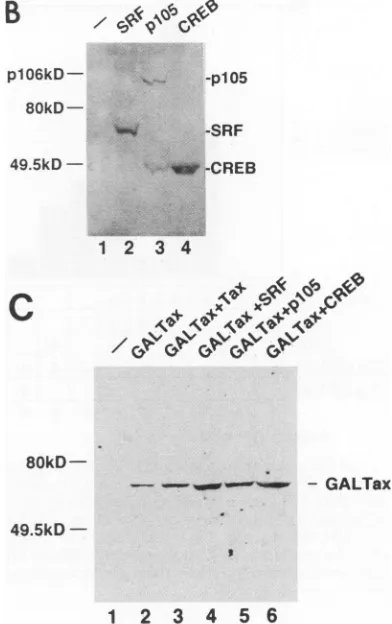
plasmids encodingthese factorswerecotransfected togetherwith those for GALTax and/or Taxl. The levels ofexpression
of these threeproteins
were similar in thetrans-fected cells
(Fig.
1B),
butonly
SRF restored the GALTax activity suppressedby
Taxlinadose-dependent
manner(Fig.
1A, bars 5 to
8),
whereas SRF itself did not activate CAT expression from the reporterplasmid (bar
11).
Inaddition,
SRF stimulated GALTax
activity
eveninthe absence of free Taxl(bar
12).Thestimulatoryeffect of SRFonGALTaxwasalso observed in other cell types such asthe teratocarcinoma P19and the human T-cell line Jurkat(datanot
shown).
On the otherhand,
CREB did not restore thesuppressed
GALTaxactivity
(bar 9),
andp105
reduced it(bar 10).
Takentogether,
these results
suggested
that SRF isan essential factor for the transcriptional activation function of Taxl measured asGALTax
activity.
The
expression
levels of GALTax in the transfected cells weremeasuredby Westernblottingwith anantibody against
GAL4
(Fig.
1C). NeitherTaxlnorSRFaffected the expression levels of GALTax(lanes
2to4).
Thus,the effects of Taxl and SRF on GALTaxactivity
were not causedby
the alteredexpression
levels of the GALTaxproteins.
SpecificityofSRFfor HTLV-I Tax. The
specificity
of SRF for theHTLV-ITaxwasexaminedby using
theTax(BLV)
of BLV.Tax(BLV)
activates viraltranscription through
the21-bp
BLVenhancerintheLTR
(6,
28,56).
However, unlikeTaxl,Tax(BLV)
didnotactivate theexpression
ofc-fos through
the CArG box(11).
The fusion protein GALTax(BLV) activated transcription through the
GAL4-binding
site (Fig. 2, bar7) (57),
and theactivity
wassuppressed by
freeTax(BLV) (bar 9).
Coexpres-sion of SRF didnot restorethesuppressed activityof
GALTax-(BLV)
attheGALAsiteand insteadsuppresseditboth in the presenceand absence ofTax(BLV) (bars
8and10). Thus,
theability
of SRFto restorethesquelched activity
wasspecific
toHTLV-ITax.
on November 9, 2019 by guest
http://jvi.asm.org/
A
40
CAT activity (%conversion)
20-GALTax(2-353)
_ _
+_+1+
+-+-+l+
1+1+
Tax(1 -353)
1o.
0.3
1 1 1111
1
1
SRF(1 -508)
_
_-
0.3 1 66
6 6_
CRI~IEB1
161
p105
__
6=;
GAL4site++
+ +++
++
+ ++
+
--1 2 3 4 5 6 7 8 9 10 1112 13 14
FIG. 1. SRF restores the activity of GALTax squelched by Taxl. (A)ACATreporterplasmid(GlOBCAT)(3 ,ug) was transfected into NIH3T3 cellstogether with theexpressionplasmid pSGGALTax(0.1 j,g)(bars2 to 10, 12,and14) and/orpSGTaxl(0.1to1 ,ug) (bars3 to 10), pSGSRF (bars6 to8,11,and12),pSGCREB(bar 9),orpSGplO5 (bar 10). The doses (in micrograms) of the transfected plasmids encoding Tax, SRF, CREB, or p105 are indicated. Transient CAT expression wasmonitoredasdescribedinMaterials andMethods, and theaveragevalues of CATactivity(percent conversion) determinedin threeindependent experimentsarepresented.(B) Expression plasmid encodingepitope-tagged protein (HA-SRF, HA-CREB,orHA-p1O5) wastransfected intoNIH3T3cells.Theexpression of eachproteinin thetransfected cellswasmeasuredby Westernblotting withanti-HA antibody. The faster-migrating band observed in the lysate ofthe p105-transfectedcellsislikelytobep5O processedfromp105NF-KB precursorprotein. (C) Plasmid pSGGALTax(0.1 ,ug) (lanes2 to 6) wastransfected togetherwithpSGTaxl (1 ,ug) (lane 3), pSGSRF (6 ,ug) (lane 4),pSGplO5(6 jig)(lane5),orpSGCREB(6jig) (lane6). TheexpressionofGALTaxprotein inNIH3T3cells transfectedwith the plasmids was measured by Western blotting with anti-GAL4 antibody.
The transcriptional activity of GALTax depends on the cellular SRF levels. Wethen examined whether endogenous SRFcontributes to the transcriptional activation function of Taxl. Since SRF isexpressedinawidevarietyofcells,weused antisense RNAtoreduce theexpressionofendogenousSRF in NIH3T3 cells.GALTax(BLV)andGALVP,aGAL4 chimera with theC-terminal activation domain ofherpes simplexvirus VP16,wereused as controls. The activity of GALTax at the GAL4 site was suppressed by the antisense SRF RNA, de-pendingupon theamountofthe transfected expression plas-mid (Fig. 3). More than 85% of the GALTax activity was suppressed by the largest amounts of the antisense plasmid. Since less than 5% of the cells
expressed
the antisense SRF transcript bythe transienttransfection methodweemployed,it is impossibleto detect the reduction of theendogenous SRF mRNA or proteins in the transfected cells. To establish the specificityof this experiment,we then cotransfected the anti-senseSRFplasmidtogetherwith thesenseSRFplasmidwhich doesnotexpress thefunctional SRFprotein. Upto83%of the original activityrepressed byantisense SRF RNAwasrestoredB
,- plO6kD-
8OkD-49.5kD
-C
8OkD--p105
%04 -SRF
W-CREB
1 2 3 4
- GALTax
49.5kD-1 2 3 4 5 6
by cotransfection with the sense SRF plasmid encoding only the N-terminal part of SRF, SRF(1-201). The SRF(1-201) mutantcannotbind to CArG boxes, since it does not have the dimerizationdomain (39).Thus, recovery appearsto occur at the RNA level. Suppression by theantisense SRF RNA was specific to the activity ofGALTax, because neither GALVP norGALTax(BLV)was affected(Fig. 3).
Taxl domain required for the suppression of GALTax
activity.
Toidentifythe Taxl domainresponsiblefor squelch-ing, we used LexTax (Taxl fusionprotein with the bacterial DNA-binding protein LexA) as an effector with which to measurethetranscriptional activationfunction ofTaxl,andwe used GALTaxmutants ascompetitors.LexTaxactivated tran-scription throughLexA-bindingsites in the CAT reporter, and activitywas suppressed eitherbyGALTax(2-353)
or byTaxl (Fig. 4A, bars 1 to 3). GALTax(10-353) with a deletion of N-terminal 9aasuppressedLexTaxactivity, althoughitlost its function as an activator of the GAL4 site(bar
6).
Another N-terminal deletion mutant,GALTax(64-353),
did not sup-press LexTax (bar 7).GALTax(2-337),
witha deletion of 16 C-terminal amino acids, was active at the GALA site and inhibitedLexTaxactivityatthe LexA site(bar
8).
GALTax(2-322), GALTax(2-317), and
GALTax(2-312) suppressed
Lex-Tax, but theywere inactive at the GALA site(bars
9 to11).
GALTax(2-285)
andGALTax(2-255)
had intermediateability
andvirtuallyno abilityto suppressLexTax,
respectively
(bars
12 and 13,
respectively).
Western blottingconfirmed that the inactive GALTax fusion proteins were alsoexpressed
effi-cientlyinthe cells (Fig.4B).
Thus, aa 10to 312 ofTaxl was sufficienttoinhibit theactivity
of LexTaxatthe LexAsite,
eventhough thisportionwas notsufficienttoactivate
transcription
on November 9, 2019 by guest
http://jvi.asm.org/
[image:3.612.337.533.75.387.2]CATactivity 25
(%conversion)S
0-GALTax
Tax
_
SRF
_
GALTax(BLV) _
Tax(BLV)
1 2 3 4 5 6 7 8 9 10
Reporter:GAL4-CAT
FIG. 2. SRFisaspecificregulator ofGALTax(HTLV)but not of GALTax(BLV). The GlOBCAT reporter plasmid (3
jig)
was trans-fected into NIH 3T3 cells with pSGGALTax(HTLV) (0.1 ,ug) or pSGGALTax(BLV) (0.1 ,ug), and/or pSGTaxl (1 ,ug), pSGTax(BLV) (1 p,g), or pSGSRF (6 ,ug). CAT expression was monitored as describedinthelegendtoFig. 1, and the averagevalues of theCAT activity (percent conversion) fromfour independentexperimentsare presented.through the GALA site. The Taxl portion of aa 10 to 312 is sufficient for interaction with SRF (11). In addition, the LexTax activity suppressed by these GALTax mutants was restored by the expression of SRF (data not shown). These
results further supported the idea that SRF is an essential componentof the transcriptional activation function ofTaxl, identified as GALTaxactivity at theGAL4 site. The internal deletionsin GALTax(A109-170) and GALTax(A153-170) ab-rogated the inhibitory function againstLexTax, indicatingthat Tax(10-312), which is required for the inhibition ofLexTax activity,cannotbe divided into the two functional domainsby the GALTaxmutants weemployed (data notshown).
TheSRF domain stimulating the GALTax function. Using various SRF mutants,we examined whichportion of SRF is requiredto restoreGALTaxactivity fromsuppression byTaxl. The wild-type SRF and a C-terminally truncated version, SRF(1-460), retained the abilityto restorethe GALTaxactivity suppressed byTaxl(Fig. 5A,bars 6 and7).SRF(1-435),having a further deletion of 25 amino acids from the C terminus, restoredthesuppressedactivity partially,butSRF(1-397)and SRF(1-243) did not (Fig. 5A, bars 8 to 10). Thus, the C-terminalboundaryofSRF necessary for the recovery of activity is betweenaa435 and 397.TheGALTaxactivity suppressed by Taxlwasalsorestoredby SRF(142-508) whichcannotbindto DNA (39), indicating that the activity is not mediated by cellular factors inducedbySRF and that the N-terminal 141-aa sequenceof SRF isdispensable for theactivity(Fig.5A,bar 11, andFig.SC).
The effects of the SRFmutantson GALTax activityinthe absence of free Taxlwere also examined. Expression ofthe wild-type SRF(1-508) augmented the activity of GALTax at the GAL4 site (Fig. 5A, bar 12). Similarly, SRF(1-460) and SRF(1-435) stimulatedGALTaxactivity, butSRF(1-397) and SRF(1-243) suppressed GALTax activity by 20 and 65%, respectively(Fig.5A, bars 13 to16).The inhibition ofGALTax activitybySRF(1-243)is notlimited to NIH 3T3cells, because the inhibitory effects were also reproducible in HeLa and Jurkat cells (data not shown). Since these inhibitory SRF mutantshave the dimerization domain, we speculate that they form inactive heterodimers with endogenous SRF and then suppress GALTax activity. The results are consistent with
*GALTax *GALVP
I
GALBLV
SGALTax
+S-SRF(N)
CAT
activity
(%conversion)
251
AS-SRF °
plasmid(pg)
1
2
4
Reporter:GAL4-CAT
FIG. 3. EndogenousSRF is required for the transcriptional activation function ofTaxl.The GlOBCATreporterplasmid (3 ,ug) and the indicatedamountof pCMVAS-SRF (antisense SRF plasmid) were transfected either with 0.1 ,g of pSGGALTax, pSGGALTax(BLV), or pSGG ALVP.The total amount of DNA was adjusted by using the cytomegalovirus plasmid that was used for the expression ofantisense RNA.S-SRF(N), SRF(1-201) protein thatcannotbind to the c-fos CArG box. CATexpressionwas monitored and presented as described in thelegend to Fig. 1.
I
+
+
+ + ++
+1+ +1
1+-+
on November 9, 2019 by guest
http://jvi.asm.org/
[image:4.612.72.296.74.297.2] [image:4.612.156.468.465.680.2]Effector Competitor (LexTax)
1 _
2 _
3 Tax
4 GAL
5 GALTax(2-353) 6 GALTax(10-353) 7 GALTax(64-353) 8 GALTax(2-337) 9 GALTax(2-322) 10 GALTax(2-317) 11 GALTax(2-312) 12 GALTax(2-285) 13 GALTax(2-255)
+ + + + + + + + + + + +
LexCAT
0 10 20 30
CAT activity (%convers ion)
Activation function of competitor
(%conversion)
U
-ND <1 43 <1
<1
41 2
<1 <1 <1 <1 40
GALTaxor
GALTaxmutants
49.5kD-Tax(1-317) did not activate the viral enhancer but inhibited activation by wild-type Taxl (Fig. 6, bars 4, 5, 8, and 9). Moreover, these inhibitory effects were abolished by the coex-pression of SRF(bars 12 and 13). In contrast, Tax(1-285) and Tax(1-255), which do not interact with SRF, did not inhibit activation by wild-type Taxl (bars 10 and 11) (11). Thus, all the Taxl mutants that interact with SRF specifically inhibited activation of the viral enhancer by wild-type Taxl. These results suggested that SRF is an essential component of the Taxl function for the viral enhancer, even though SRF does notbind to this sequence.
Next we examined the SRF domain involved in Taxl acti-vationthrough the 21-bp viral enhancer. Taxl was coexpressed with wild-type SRF or SRF mutants that inhibit GALTax activity. SRF showed little, if any, activity for the 21-bp enhancer but augmented the activity of Taxl for the 21-bp enhancer (Fig. 7, bars 3 and 4). Similarly, SRF(1-460) and SRF(1-435), which restored the activity of GALTax for the GAL4site, augmented the activity of Taxl for the 21-bp viral enhancer(bars 5 and 6). In contrast, SRF(1-264) and SRF(l-397), which suppressed the activity of GALTax at the GAL4 site,inhibited the activity of Taxl for the 21-bp viral enhancer aswell(bars 7 and 8). Thus, the domain of SRF involved in the activity of GALTax at the GAL4 site was also required for the activity of Taxl for the 21-bp viral enhancer. UnlikeHTLV-I Tax,theactivation of BLV longterminalrepeatbyTax(BLV) was little affected by SRF and SRF mutants, indicating that SRFspecificallyaugmentsthe activity ofHTLV-ITax (bars9 to 16).
1 2 3 4 5 6 7 8
FIG. 4. The Taxl domain that is required for the inhibition of
LexTaxactivity. (A) EitherL8BCAT (LexCAT) plus pSGLexTax (for
theassayofsquelching)orGlOBCAT (toassaytheactivation function
ofcompetitors; GALTax activity at the GAL4 site) wastransfected
into NIH 3T3 cells together with plasmids encoding the indicated
GALTax mutants. The amounts of expression plasmids were as
follows:LexTax,0.1,ug;GALTaxderivatives,3,ugforLexAand 0.1,ug
for GAL4 sites. CAT expression was monitored and presented as
described in the legend to Fig. 1. ND, not done. (B) Expression
plasmids encoding the GALTax derivativesweretransfectedintoNIH
3T3 cells. The expression ofGALTax derivatives in the transfected
cellswasmeasuredbyWesternblottingwithanti-GAL4antibody.
those of the antisense RNA experiments, indicating that endogenous SRF isan essentialcomponentfor the transcrip-tional activation function of theTaxl identifiedas a GALTax
fusion protein. We confirmed that the C-terminal deletion mutants of SRF were expressed in the cells by using an
antibodyagainstSRF(Fig.5B).Thehigherlevel ofexpression ofSRF(1-243)than ofSRF(1-397)inthe cellsmayexplainthe strongerinhibitoryeffect ofSRF(1-243) againstGALTax than that ofSRF(1-397) (Fig. SB). In addition, these SRF deriva-tives showed similar abilities to bind to the c-fos CArG box (Fig.5C).
SRF is required fortranscriptional activationthrough the viral enhancerby Taxl. Taxl activates transcription through the21-bpviral enhanceraswell asthrough the CArGbox(8,
13, 44). The transcriptional activation function ofTaxl iden-tifiedas aGALTax fusionprotein isconsideredimportantfor activationthroughthe viral enhanceraswell(12,15).Wenext examined whether SRFplays arole in the Taxl function for
the viral enhancer by squelching studies. The C-terminal deletionmutantsTax(1-322)andTax(1-317)wereinactivefor the GAL4 site when measured as GAL4 fusion proteinsbut retained theabilitytointeract withSRF(11).Tax(1-322) and
DISCUSSION
Bridging-type viral transcription factors, such as VP16 or
ElA, havetwofunctional domains,onefor interactionwith the DNA-binding factor and the other for transcriptional activa-tion (32, 34, 47, 52). Taxl also acts as abridging-type tran-scriptionfactor that has thesetwofunctionaldomains(11, 12). In Taxl, however, these two functional domains cannot be separated and, instead, thedomain involved in the transcrip-tional activation includes the domain involved in interaction with SRF (11). In this study, we showed that the SRF
mediatingtheinteraction ofTaxlwith theresponsiveenhancer is an essential component for the transcriptional activation functionaswell. This bifunctional activityofSRFexplainsthe
overlapping functional domains of Taxl for interaction with SRF and fortranscriptional activation.
Taxl interacts with two other transcription factors, CREB andp105(23, 50, 59). Unlike SRF,thesefactorsdidnot restore the activity of GALTax inhibited by Taxl (Fig. 1A). Thus, thesefactorsare thoughtto actas aspecificmediatorofTaxl
activationthroughtheviralenhancer andNF-KB, respectively, but theirroles in thetranscriptionalactivation function ofTaxl
areunclear. Theexpression ofp105suppressed the GALTax activityatthe GAL4 site (Fig. 1).Thisinhibitoryeffectmight be explained by the sequestration of GALTax in cytoplasm, sincep105localizes incytoplasm (21).
TheC-terminal boundaryof SRF, which isrequiredfor the
recoveryofGALTaxactivityagainsttheGAL4site,isbetween
aa 397 and 435 (Fig. 5). The previous data showed that SRF(266-484) hasaTaxl interactiondomain (11).Moreover, a GALSRF(397-435)VP, a fusion protein of SRF(397-435), GALA DNA-binding domain, and the transcriptional activa-tion domain ofVP16, activated thetranscription throughthe LexA-binding site only in the presence of LexTax, a fusion protein of Taxl and a DNA-binding domain of LexA.
SRF(397-435) may thus have a Taxl interaction domain. A
I
B .~~~~~~~~~~~~~~z:., ...
B
on November 9, 2019 by guest
http://jvi.asm.org/
[image:5.612.58.300.76.378.2]A
40-CAT activity (%conversion)
20_
Iim
l
o 0'l
GALTax(2-353) +
Tax(l1-353) +
SRF(1-508) +
SRF(1-460) L
SRF(1-435) _L_
SRF(1-397)
SR F(1-243) SRF(142-508)
1 3
2 4
Reporter:GAL4-C
BX
68kD- ^ wv
40kD_
15 2345
, h
C is
.:x>: NCS .::::...:,
asb:
sI:+-+I-+ :+ 4+I+I
+1 +j
+l
+T+l
+1
+l
+s1+1
+++1
'+
++ -
---..+11
1
11+1+
TT + +
5 7 9 11 13 15 17
6 8 10 12 14 16
JAT
SRF(1-243), with a deletion of the Taxl interaction domain, inhibited GALTax activity at the GAL4 site (Fig. 5A). The inhibition could beexplained bythe formation ofan inactive heterodimer with endogenous SRF, since this inhibitory mu-tant has an N-terminal dimerization domain.
The C-terminal region of SRF, SRF(266-508), is thoughtto act asitstranscriptional activationdomain, since GAL4 fusion with SRF(266-508) activates transcription through the GAL4 site, and the deletion of thisportion reduces the transcriptional activation mediated by SRF in vitro and in vivo (11, 22, 27). SRF(1-435), having a partial deletion of this portion, had a lower restoration ability for GALTax than that of SRF(1-460) or thewild-typeSRF(1-508) [Fig. 5A, compare the activity of SRF(1-460) with that ofSRF(1-435)]. Thus, it is likely that the transcriptional activation domain of SRF located at the C terminus is utilized asapartof the Taxl activation domain.
The interaction with SRF isnotsufficient for the transcrip-tional activation function of Taxl, because GALTax(10-312), which alone is sufficient forinteraction withSRF,didnothave anyactivityattheGAL4 site. Twoadditionalportionsof Taxl were indispensable for the activity; one consisted of 9 N-terminalaaand theother consistedof 25C-terminalaa(312to 337) (Fig. 4). The nine N-terminal amino acids did not have anyknown motif for thetranscriptionalactivation domain. On theother hand,the 25 C-terminal amino acids ofTaxicontain a stretch of acidic amino acids, which is a feature of the transcriptional activation domain of several transcription fac-tors, as represented by VP16 (42). On the basis of this observation, we speculate that the C-terminal acidic amino acidportionof Taxl cooperateswithSRFtointeract with the basaltranscription machineryasillustrated inFig.8.The acidic activation domain of VP16 interacts withtwobasal transcrip-tion factors, TFIIB and TBP (24, 30, 33, 48). Thus, it is of interest tostudy whether either Taxl or the complex with SRF interacts with these basaltranscription factors.
Inadditiontothe CArGbox,SRF maybe involved in Taxl activation through theviral enhancer (Fig. 6). Taxl mutants that areinactiveforthe viral enhancer but which still interact with SRFinhibited activation through the viral enhancer by wild-type Taxl. The inhibited activity was restored by the overexpressionof SRF. SRFmutantsthat inhibit theactivityof GALTaxatthe GAILA site also inhibited theactivityof Taxl for the viral enhancer. Wild-type SRF and its mutants that stimulated the activity of GALTax at the GALA site aug-mented the activity of Taxl for the viral enhancer. The transcriptional activationfunction measured as an activity of GALTaxattheGAILA site isrequiredfor theactivity of Taxl for the viralenhancer(12, 15).Since SRF doesnotbindtothe viral enhancer, the present results suggested that SRF is required for activation through the viral enhancer by Taxl, possibly by acting as amediator of the transcriptional activa-tionfunction. The presentresults,however,donotruleoutthe possibilitythat SRF could induce theexpressionof the cellular
FIG. 5. The SRFdomain mediatingthetranscriptional activation functionofTaxl.(A)TheGlOBCATreporterplasmidwastransfected into NIH 3T3 cellswithplasmidsencodingtheindicatedSRF mutants and/or pSGTaxl. CAT expression was monitored and presented as describedin thelegendtoFig.1.(B)Plasmidsencoding the indicated SRFderivatives and plasmid pSG5 (-)weretransfected into NIH 3T3 cells.Theexpressionof SRFderivativesin NIH 3T3cells transfected with
_Free the
plasmids
wasanalyzed by Western blotting
with the anti-SRFanti-probe
body.
(C)
SRF derivativessynthesized
inthereticulocyte lysate
system 1 2 3 4 5 6 7 were mixed with a c-fos CArG box probe. The DNA-protein complex wasseparatedby 4%
acrylamide
gelelectrophoresis. RL,reticulocytelysate. It*bi
on November 9, 2019 by guest
http://jvi.asm.org/
[image:6.612.66.297.77.711.2]-M
Tax(1-353)
1+1+1
T
I+I+I+I+I+I+I+I+I
Tax(l1-322)
+l
1+1
1+X I
Tax(l1-317)
I1IX
1+1
1
+1
Tax(l -285)
-
+I I +1+
IA
SRF
l+_
_T_T_ TITIl+
___1 3 5 7 9 11 13 15
2 4 6 8 10 12 14
[image:7.612.60.300.76.323.2]Reporter:21
-bp-CAT
FIG. 6. Inhibitionof Taxl activation through the viral enhancer by Taxl mutants. A reporter(21-bp CAT) was transfected into NIH 3T3 cells with the indicated expression plasmids. The amounts of expres-sionplasmidswere asfollows:Taxl mutants, 3 ,ug;Taxl, 0.1 ,ug; SRF, 6jig.CAT expressionwasmonitored and presentedasdescribedin the legendtoFig.1.
factor(s) which mediates the Taxl transactivation of the viral enhancer.
Wealso examined whether thetransactivation of the native HTLV-I LTRby Taxl is also regulated by SRF. Unfortunately, wecould not study this possibility, sinceHTLV-I LTR had a
40
30
CATactivty (0/oconversion) 20
10
0
Tax(HTLV)
Tax(BLV) SRF(1-508) SRF(1-460) SRF(1-435) SRF(1-397) SRF(1-264)
HTLV-CAT
lI
1+
-U_
BLV-CAT
I E I
+ + +
1+
+1+
+ ++I
TT
+ ++ +I
+ I+
II
+ 1 ++
1 2 3 4 5 6 7 8 9 10 11 12 13 14 15 16
FIG. 7. Inhibition ofTaxlactivationthroughthe viral enhancerby
SRFmutants.The21-bpCAT reporterplasmid (HTLV-CAT)orthe
BL-CAT plasmid (BLV-CAT) was transfected into NIH 3T3 cells
togetherwithplasmids encoding the indicated SRF mutants (6 jig)
and/orTaxl(1 jig).CATexpressionwasmonitored andpresentedas
described in thelegendtoFig. 1.
FIG. 8. Models of Taxl transactivation through the CArG box. Taxl interacts with SRF bound to the CArG box. The C-terminal activation domain of SRF and the C-terminal acidic amino acid portion of Taxl cooperatively interact with the basal transcription machinery.
SRF-responsiveelement which isdifferent from the 21-bp viral enhancer. Interestingly, this novel SRF-responsive element colocalizes with the element that cooperates with the 21-bp viral enhancerto respondto Taxl; thus, this SRF-responsive element might play some roles on Taxl activation of the
HTLV-I LTR.
Therequirement of SRF for theTaxl functionmaynotbe limited to the two enhancers, because the transcriptional activation function of Taxl identifiedasGALTax activityatthe GAL4 sitewasalso essential for theactivation of the
promot-ersforfra-l and tissue inhibitor of metalloproteinase 1 genes
(datanotshown). Astudyto confirm this possibility is under
way. Unlike these promoters, Taxl activation through the NF-KB element, another Taxl-responsive enhancer element,
was not augmented by SRF and was not repressed by SRF
mutantswhich inhibit theGALTax activation, and the activity of Taxl for the NF-KB element did not correlate with the activation function ofTaxlmeasuredasGALTaxactivity (data notshown). Thus, Taxl could activate the NF-KB element via
adifferentpathway from thoseof theCArG boxandthe21-bp
viralenhancer.
ACKNOWLEDGMENTS
WethankH.Sato and J. Tanaka forhelpful discussions and advice. This work was supported in part by a grant-in aid for cancer
research, from the Ministry of Education, Science and Culture of Japan, and inpartby the Mochida Memorial foundation for Medical andPharmaceutical Research.
ADDENDUM INPROOF
After the manuscript was accepted for publication, we
learned that Taxl canfunctionally andbiochemically interact
with TBP (C. Caron, R. Rousset, C. Beraud, V. Moncollin, J. M. Egly, and P.Jalinot,EMBO J. 12:4269-4278, 1993).
REFERENCES
1. Akagi, T., and K. Shimotohno. 1993. Proliferative response of
Taxl-transduced primary human T cells to anti-CD3 antibody
stimulation by an interleukin-2-independent pathway. J. Virol.
67:1211-1217.
2. Alexandre, C., P. Charnay,andB. Verrier. 1991.Transactivation
of Krox-20 and Krox-24 promotersbytheHTLV-1 Taxprotein
throughcommonregulatoryelements.Oncogene6:1851-1857.
3. Alexandre,C.,and B. Vemer. 1991. Four regulatoryelements in
the humanc-fospromotermediate transactivationby HTLV-1Tax
protein. Oncogene6:543-551.
4. Ballard, D. W., E. Bohnlein, J. W. Lowenthal,Y. Wano, B. R Franza, and W. C. Greene. 1988. HTLV-I tax induces cellular
proteinsthat activate thekappaB element in the IL-2receptor 1tv'
CAT activity
(%conversion)
on November 9, 2019 by guest
http://jvi.asm.org/
[image:7.612.317.558.83.172.2] [image:7.612.60.297.483.666.2]alphagene. Science 241:1652-1655.
5. Cross, S. L., M. B. Feinberg, J. B. Wolf, N. J. Holbrook, F. Wong-Staal, and W. J. Leonard. 1987. Regulation of the human interleukin-2 receptorachainpromoter: activation ofa
nonfunc-tional promoter by the transactivator gene of HTLV-I. Cell
49:47-56.
6. Derse,D. 1987. Bovine leukemia virus transcription is controlled
byavirus-encodedtrans-acting factor and by cis-acting response
elements. J. Virol. 61:2462-2471.
7. Duyao, M. P., D.J. Kessler, D. B. Spicer, C. Bartholomew,J. L.
Cleveland, M. Siekevitz, and G. E. Sonenshein. 1992. Transacti-vation of the c-myc promoter by human T cell leukemia virus
type 1taxismediated by NFkappa B. J. Biol. Chem. 267:16288-16291.
8. Felber, B. K., H. Paskaris, C. Kleinman-Ewing, F. Wong-Staal, and G. N. Pavlakis. 1985. The pX protein of HTLV-I is a
transcriptional activator of its long terminal repeats. Science 229:675-679.
9. Fujii, M., T. Niki,T.Mori, T. Matsuda, M.Matsui, N. Nomura,
and M. Seiki. 1991. HTLV-1 Tax induces expression of various immediateearlyserum responsivegenes.Oncogene 6:1023-1029.
10. Fujii, M., P. Sassone-Corsi, and I.M. Verma.1988.c-fospromoter
trans-activation by thetax,protein of humanT-cell leukemia virus
typeI. Proc. Natl.Acad. Sci. USA 85:8526-8530.
11. Fujii, M., H. Tsuchiya,T.Chuhjo,T.Akizawa,and M.Seiki.1992. Interaction of HTLV-1 Taxl with p67SRF causes the aberrant
induction of cellularimmediate earlygenesthrough CArG boxes. Genes Dev. 6:2066-2076.
12. Fujii, M., H. Tsuchiya, and M. Seiki. 1991. HTLV-1 Tax has distinct butoverlapping domains fortranscriptional activation and forenhancerspecificity. Oncogene 6:2349-2352.
13. Fujisawa, J., M. Seiki, M. Sato, and M. Yoshida. 1986. A
tran-scriptional enhancer sequence of HTLV-I is responsible for transactivationmediatedby p4Ox of HTLV-I. EMBO J. 4:713-718. 14. Fujisawa, J., M. Seiki, and M. Yoshida. 1985. Functional activa-tion of the human T-cell leukemia virus type I by trans-acting factor.Proc. Natl. Acad.Sci. USA 82:2277-2281.
15. Fujisawa, J.-I., M. Toita, T. Yoshimura, and M.Yoshida. 1991.
The indirect association of human T-cell leukemia virus tax
protein with DNA results in transcriptional activation. J. Virol. 65:4525-4528.
16. Gorman, C. M., L. F. Moffat, andB.H. Howard. 1982.
Recombi-nantgenomeswhichexpresschloramphenicol acetyltransferase in
mammalian cells. Mol. Cell. Biol. 2:1044-1051.
17. Grassmann, R., S. Berchtold, L.Radant, M. Alt, B. Fleckenstein,
J. G. Sodroski, W. A. Haseltine, and U. Ramstedt. 1992. Role of human T-cell leukemiavirustype 1Xregion proteins in immor-talization of primary human lymphocytes in culture. J. Virol. 66:4570-4575.
18. Green, P. L., and I. S. Chen. 1990. Regulation of human Tcell leukemia virusexpression. FASEB J. 4:169-175.
19. Green, S.,I.Issemann, and S. Elisabeth. 1988. Aversatilein vitro
and in vivoeucaryotic expressionvector for protein engineering. Nucleic Acids Res. 16:369.
20. Greene, W. C., E. Bohnlein, and D. W. Ballard. 1989. HIV-1,
HTLV-1 and normalT-cell growth: transcriptional strategies and surprises. Immunol. Today 10:272-278.
21. Henkel, T., U. Zabel, K.V. Zee, J. M. Muller,E.Fanning, and P. A.
Bauerle. 1992. Intramolecular masking of the nuclear location signal and dimerization domain in the precursor for the p50
NF-KBsubunit. Cell 68:1121-1133.
22. Hill, C. S., R. Marais, S. John, J. Wynne, S. Dalton, and R.
Treisman. 1993. Functionalanalysis ofagrowthfactor-responsive
transcription factor complex. Cell73:395-406.
23. Hirai, H., J. Fujisawa, T. Suzuki, K. Ueda, M. Muramatsu, A.
Tsuboi, N. Arai,and M.Yoshida. 1992. Transcriptional activator Taxof HTLV-1bindstothe NF-kappaBprecursorp105.
Onco-gene7:1737-1742.
24. Horikoshi, M., K. Maguire,A. Kralli, E. Maldonado, D. Reinberg,
and R Weinmann. 1991. Direct interaction between adenovirus
ElA protein and TATA box binding transcription factor IID.
Proc.Natl.Acad. Sci. USA 88:5124-5128.
25. Inoue,J.,M.Seiki, T. Taniguchi, S.Tsuru, and M.Yoshida.1986.
Induction of interleukin 2 receptor gene expression by p4Ox encoded by humanT-cell leukemia virus type I.EMBOJ. 5:2883-2888.
26. Jeang, K. T., S. G. Widen,0. J. Semmes IV,and S. H. Wilson. 1990. HTLV-I trans-activator protein, tax, is atrans-repressor of the humanbeta-polymerase gene. Science 247:1082-1084. 27. Johansen, F.-E., and R.Prywes. 1993.Identification of
transcrip-tional activation and inhibitorydomains in serumresponsefactor (SRF) by using GAL4-SRF constructs. Mol. Cell. Biol. 13:4640-4647.
28. Katoh, I., Y. Yoshinaga, and Y. Ikawa. 1989.Bovineleukemia virus trans-activator p38t"' activates heterologous promoters with a common sequence known as a cAMP-responsive element or the binding site of a cellular transcription factor ATF. EMBO J. 8:497-503.
29. Kolodziej, P. A., and R. A. Young. 1991. Epitope tagging and protein surveillance. Methods Enzymol. 194:508-519.
30. Lee, W. S., C. Kao, G. 0. Bryant, X. Liu, and A. J. Berk. 1991. Adenovirus ElA activation domain binds the basic repeat in the TATA box transcription factor. Cell67:365-376.
31. Leung, K., and G. J. Nabel. 1988. HTLV-1 transactivator induces interleukin-2 receptor expression through an NF-kappa B-like factor. Nature (London) 333:776-778.
32. Lillie, J. W., and M. R. Green. 1989. Transcription activation by the adenovirus Ela protein. Nature(London) 388:39-44. 33. Lin, Y.-S., and M.R. Greene. 1991. Mechanism of action of an
acidictranscriptional activator in vitro. Cell 64:971-981. 34. Liu, F., and M. R. Green. 1990. Aspecific member of the ATF
transcription factor family can mediate transcription activation by adenovirusElAprotein. Cell 61:1217-1224.
35. Martin, K. J., J. W. Lillie, and M. R. Greene. 1990. Evidence for interaction ofdifferent eukaryotic transcriptional activators with distinct cellular targets. Nature (London) 346:147-152.
36. Maruyama, M., H. Shibuya, H. Harada, M. Hatakeyama, M. Seiki, M. Yoshida, and T. Taniguchi. 1987. Evidence for aberrant activation of the interleukin-2 autocrine loop byHTLV-Iencoded p4OxandT3/Ticomplex triggering. Cell 48:343-350.
37. Nagata, K., K. Ohtani, M. Nakamura, and K. Sugamura. 1989. Activation of endogenous c-fos proto-oncogene expression by human T-cell leukemia virus type I-encodedp40"'a protein in the humanT-cell line Jurkat. J. Virol.63:3220-3226.
38. Nerenberg, M., S. H. Hinricks, R. K. Reynolds, G. Khoury, and G. Jay. 1988. The tat gene of human T-lymphotropic virus type I induces mesenchymal tumors in transgenic mice. Science 237: 1324-1329.
39. Norman, C., M. Runswick, R. Pollock, and R. Treisman. 1988. Isolation and properties of cDNA clones encoding SRF, a tran-scription factor that binds to thec-fos serum response element. Cell55:989-1003.
40. Pozzatti, R., J. Vogel, and G. Jay. 1990. The human T-lympho-tropic virus type I tax gene can cooperate with the ras oncogene to induce neoplastic transformation of cells. Mol. Cell. Biol. 10:413-417.
41. Ruben, S., H. Poteat, T. H. Tan, K. Kawakami, R. Roeder, W. Haseltine, and C. A. Rosen. 1988. Cellular transcription factors andregulation of IL-2 receptor gene expression by HTLV-I tax geneproduct.Science241:89-92.
42. Sadowski, H., J. Ma, S. Triezenberg, and M. Ptashne. 1988. GAL4-VP16 is an unusually potent transcriptional activator. Na-ture(London) 335:563-564.
43. Seiki, M.,S. Hattori, Y. Hirayama, and M. Yoshida. 1986. Direct evidence that p40" of human T-cell leukemia virus type I is a trans-acting transcriptional activator. EMBO J. 5:561-565. 44. Shimotohno, K, M. Takano, T. Teruchi, and M. Miwa. 1986.
Requirement of multiple copies of a 21-nucleotide sequence in the U3region ofhumanT-cell leukemia virus type I and type II long terminal repeats for trans-acting activation of transcription. Proc. Natl. Acad. Sci. USA83:8112-8116.
45. Slamon, D., K. Shimotohno, M. J. Cline, D. W.Golde,and I. S. Y. Chen.1984.Identificationof the putative transforming protein of the human T-cell leukemia virus HTLV-I andHTLV-II.Science 226:61-65.
46. Sodroski, J. C., C. A. Rosen, and W. A. Haseltine. 1984.
on November 9, 2019 by guest
http://jvi.asm.org/
acting transcriptional activation of the long terminal repeat of human Tlymphotropic viruses ininfected cells.Science 225:381-385.
47. Stern,S., M. Tanaka, and W. Herr. 1989. The oct-1homeodomain directs formationof amultiprotein-DNA complexwith the HSV transactivator VP16. Nature(London)341:624-630.
48. Stringer, K. F., C. J. Ingles, and J. Greenblatt. 1990. Directand selectivebindingofanacidictranscriptional activatordomain to theTATA-box factorTFIID. Nature (London)345:783-786. 49. Sugamura, K., and Y. Hinuma. 1993. Human retroviruses:
HTLV-I and HTLV-II, p. 399-435. In J. A. Levy (ed.), The retroviridae. vol. 2.PlenumPress, NewYork.
50. Suzuki, T., J.I. Fujisawa, M. Toita, and M. Yoshida. 1993. The trans-activator tax of human T-cell leukemia virus type 1 (HTLV-1) interacts with cAMP-responsive element (CRE) bind-ing and CRE modulator proteins that bind to the 21-base-pair enhancerofHTLV-1.Proc. Natl. Acad.Sci.USA90:610-614. 51. Tanaka, Y., C. Takahashi, S. Yamaoka, T. Nosaka, M. Maki, and
M.Hatanaka. 1990.Oncogenictransformation by thetax geneof humanT-cell leukemiavirus type I in vitro. Proc.Natl. Acad. Sci. USA 87:1071-1075.
52. Triezenberg, S. J., R C. Kingsbury, and S. L. McKnight. 1988. Functional dissection of VP16, the trans-activator ofherpes sim-plex virus immediate earlygene expression. Genes Dev. 2:718-729.
53. Tsuchiya, H., M. Fujii, T. Niki, M. Tokuhara, M. Matsui, and M.
Seiki. 1993. HumanT-cell leukemia virus type 1 Tax activates transcription of the human
fra-1
gene through multiplecis ele-ments responsive to transmembrane signals. J. Virol. 67:7001-7007.54. Tsuchiya, H., M. Fujii, Y. Tanaka, H. Tozawa, and M. Seiki. 1994. Two distinctregionsforma functional activation domain ofthe HTLV-1trans-activatorTaxl.Oncogene 9:337-340.
55. Uchijima, M.,H.Sato,M.Fujii,and M.Seiki. 1994. Taxprotein of HTLV-1and-2induceexpression of thegeneencoding erythroid-potentiating activity (tissue inhibitor of metalloproteinases-1; TIMP-1). J. Biol. Chem.269:14946-14950.
56. Willems, L, G. Chen, D. Portetelle, R Mamoun, A. Burny, and R Kettmann. 1987. Structural and functional characterization of mutantsof thebovine leukemia virus transactivatorprotein p34. Virology 171:615-618.
57. Willems, L*, R Kettman, and A Burny. 1991. The amino acid (157-197) peptidesegmentof bovine leukemia virusp34tax encom-passaleucine-rich globally neutral activation domain. Oncogene 6:159-163.
58. Yoshida, M., J. Inoue, J.Fujisawa,and M.Seiki. 1989. Molecular mechanisms of regulation of HTLV-1 gene expression and its association withleukemogenesis. Genome 31:662-667.
59. Zhao, LJ., and C. Z. Giam. 1992. HumanT-cell lymphotropic virus type I (HTLV-I) transcriptional activator, Tax, enhances CREBbindingtoHTLV-I21-base-pairrepeatsbyprotein-protein interaction.Proc.Natl. Acad. Sci. USA89:7070-7074.