Copyright © 2003, American Society for Microbiology. All Rights Reserved.
Caprine Arthritis-Encephalitis Virus Envelope Surface Glycoprotein
Regions Interacting with the Transmembrane Glycoprotein:
Structural and Functional Parallels with Human
Immunodeficiency Virus Type 1 gp120
Isidro Ho¨tzel* and William P. Cheevers
Department of Veterinary Microbiology and Pathology, Washington State University, Pullman, Washington 99164-7040
Received 24 March 2003/Accepted 5 August 2003
A sequence similarity between surface envelope glycoprotein (SU) gp135 of the lentiviruses maedi-visna virus and caprine arthritis-encephalitis virus (CAEV) and human immunodeficiency virus type 1 (HIV-1) gp120 has been described. The regions of sequence similarity are in the second and fifth conserved regions of gp120, and the similarity is highest in sequences coinciding with-strands 4 to 8 and 25, which are located in the most virion-proximal region of the gp120 inner domain. A subset of this structure, formed by gp120-strands 4, 5, and 25, is conserved in most or all lentiviruses. Because of the orientation of gp120 on the virion, this highly conserved virion-proximal region of the gp120 core may interact with the transmembrane glycoprotein (TM) together with the amino and carboxy termini of full-length gp120. Therefore, interactions between SU and TM of lentiviruses may be structurally related. Here we tested whether the amino acid residues in the putative virion-proximal region of CAEV gp135 comprising putative-strands 4, 5, and 25, as well as its amino and carboxy termini, are important for stable interactions with TM. An amino acid change at gp135 position 119 or 521, located in the turn between putative-strands 4 and 5 and near-strand 25, respectively, specifically disrupted the epitope recognized by monoclonal antibody 29A. Thus, similar to the corresponding gp120 regions, these gp135 residues are located in close proximity to each other in the folded protein, supporting the hypothesis of a structural similarity between the gp120 virion-proximal inner domain and gp135. Amino acid changes in the amino- and carboxy-terminal and putative virion-proximal regions of gp135 increased gp135 shedding from the cell surface, indicating that these gp135 regions are involved in interactions with TM. Our results indicate structural and functional parallels between CAEV gp135 and HIV-1 gp120 that may be more broadly applicable to the SU of other lentiviruses.
The lentivirus caprine arthritis-encephalitis virus (CAEV) induces a chronic progressive inflammation of connective tis-sues in goats that is manifested mainly by arthritis of synovial joints and mastitis (2, 23). CAEV shares sequence homology and genome organization with the maedi-visna viruses (MVV)
of sheep but less homology with other members of the
Lenti-virus genus, especially in the env gene products. Extensive
sequence similarity between theenvgene products of divergent
lentiviruses occurs in the ectodomain of the transmembrane glycoprotein (TM) but not in the envelope surface glycoprotein (SU) (1). Therefore, it has not been clear to what extent functional aspects of the SU of highly divergent lentiviruses are based on common structural features. However, the relative sequence conservation of lentivirus TM ectodomains suggests that at least one functional aspect of SU, its interaction with TM in the oligomeric envelope complex, may be based on structural features of SU that are common to different lenti-viruses.
The structure of the human immunodeficiency virus type 1 (HIV-1) gp120 core bound to CD4, the primary HIV-1 recep-tor, has been described (15). The gp120 core, which lacks
variable loops V1, V2, and V3, as well as the amino and carboxy termini of gp120, bound to CD4 folds into two major domains, the inner and outer domains, and a “bridging sheet”
formed by four antiparallel -strands projecting from both
major domains (Fig. 1B). Noncovalent interactions between gp120 and transmembrane glycoprotein gp41 in the oligomeric envelope are mediated by residues in the amino and carboxy termini of gp120 located almost entirely outside the core struc-ture (6, 14, 27). However, surfaces of the gp120 core inner domain would also be expected to mediate noncovalent inter-actions with gp41, either directly or by interinter-actions of the gp120 core with the amino and carboxy termini of gp120 me-diating the association to gp41. One of such proposed surfaces
is formed by␣-helix 1, which is located close to the axis of the
envelope oligomer (26). Another highly conserved gp120 core
surface contiguous with ␣-helix 1 that may also potentially
interact with gp41 is formed by parts of-strands 4, 5, and 25
in the inner domain (15). Modeling of the gp120 oligomeric
structure places these-strands in the vertex of a
virion-prox-imal region of the gp120 core facing the oligomer axis (Fig. 1B) and, presumably, gp41 (16). Indeed, at least one amino acid
residue at the end of gp120-strand 25, isoleucine 491 in the
HXB2 strain of HIV-1, is necessary for stable interaction of gp120 with gp41 (6), suggesting a similar role for residues located nearby in folded gp120 such as the turn between
-strands 4 and 5.
* Corresponding author. Mailing address: Department of Veteri-nary Microbiology and Pathology, Washington State University, Pull-man, WA 99164-7040. Phone: (509) 335-6072. Fax: (509) 335-8529. E-mail: [email protected].
11578
on November 8, 2019 by guest
http://jvi.asm.org/
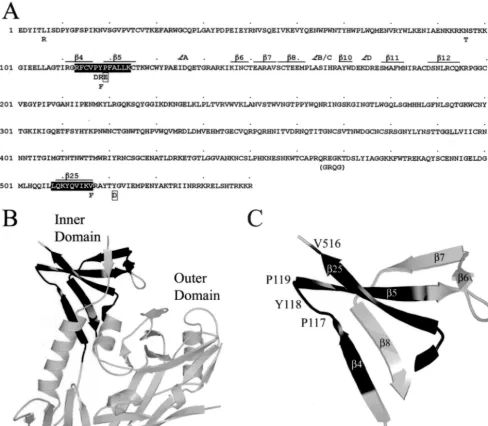
We have described a sequence similarity between the second conserved (C2) region of gp120 and gp135 of CAEV and MVV (8). The most conserved segments between the gp120 C2
re-gion and gp135 coincide with -strands 4 through 8 in the
virion-proximal region of the gp120 inner domain (Fig. 1A and
B), although sequences up to-strand 12 in the outer domain
of gp120 also appear to be conserved in gp135. Sequences in loops and turns of the gp120 C2 region are less conserved in gp135. The four cysteines forming two disulfide bonds in the inner domain of gp120 are conserved in the same positions in
gp135, suggesting a common structural fold of the gp120 inner domain and part of gp135 (8, 15, 19). In addition, gp120
-strand 25, which is antiparallel to-strand 5, in the C5 region
is also conserved in gp135 (9). Remarkably, sequences similar
to gp120 -strands 4, 5, and 25, some of the most
virion-proximal in the gp120 core and the most conserved in gp135, are also present in similar locations in the SU of most or all
lentiviruses (Fig. 1C), with the4-5 sequence being present
[image:2.603.47.535.72.497.2]even in the SU of betaretroviruses (9). Thus, the region at the vertex of the virion-proximal region of the gp120 core inner
FIG. 1. Mutations introduced into CAEV-63 gp135. (A) Mature gp135 sequence with mutations shown for each amino acid position below the sequence. The sequence between parentheses indicates multiple substitutions in mutant HV2-GRQG. The CAEV gp135 regions homologous to -strands 4 to 12 and 25 and loops LA to LD of HIV-1 gp120 (8, 15) are shown above the sequence. The gp135 sequences conserved in most or all lentiviruses (9) are highlighted. The mutations reducing MAb 29A binding are boxed. (B) Ribbon diagram of the CD4-bound gp120 core. The gp120 inner and outer domains are indicated. The region most conserved between HIV-1 gp120 and CAEV gp135 (-strands 4 to 8 and 25 in the inner-proximal region) is indicated in black. The virion envelope is located toward the top. (C) Detail of the inner-proximal region of HIV-1 gp120 indicating the position of-strands 4 to 8 and 25. The conserved4-5 and25 regions highlighted in panel A are highlighted in black. The locations of gp120 residues corresponding to CAEV gp135 residues P117, Y118, P119, and V516 are shown. The ribbon diagrams in panels B and C were produced with the Pymol software.
on November 8, 2019 by guest
http://jvi.asm.org/
domain formed by-strands 4, 5, and 25 represents a highly conserved domain of SU in the lentiviruses and perhaps the betaretroviruses. We suggested that this conserved SU domain may represent a common structure involved in interactions with TM (9). Here, we tested the functional role of selected regions of the putative inner-proximal domain of CAEV gp135 in interactions with gp38 TM (20) and show some structural and functional parallels between gp120 and gp135.
MATERIALS AND METHODS
Cell lines.Goat synovial membrane (GSM) and human 293T cells were grown in Dulbecco’s modified Eagle’s medium (DMEM) supplemented with 2 mM glutamine, 100 U of penicillin G per ml, 100g of streptomycin per ml, and 10% fetal bovine serum (FBS).
MAbs.Monoclonal antibody (MAb) F7-299 is produced by a xenohybridoma obtained from a goat persistently infected with CAEV-63 and immunized with a recombinant vaccinia virus expressing the full-length CAEV-63 envelope glyco-protein and CAEV-63-infected GSM cells (24). MAbs 29A and 74A were ob-tained from mice immunized with purified native CAEV-63 SU (24).
Envelope and vector plasmids.Plasmids pCMVCO2, expressing full-length CAEV-CO gp135; pCMV63S (a VR1012 vector [Vical] carrying the CAEV-63 envgene region between the initiation codon and the end of the TM ectodomain with phenylalanine 715 mutated to a stop codon); and pCRev63, expressing CAEVrev, have been described previously (5, 10, 11). Plasmid pCMV63, en-coding the full-length CAEV-63envgene, was constructed by replacing the 3⬘ end of pCMV63S between theBsiWI andBglII sites with a PCR product am-plified from DNA of CAEV-63-infected GSM cells with primers ENVTF (5⬘ -CACGAGGAAGAAGAGAGGGCGTTGGCTTGGTC-3⬘) and REVR (11). CAEV vector pCAEV-X30 was constructed by replacing theSbfI-SmaI fragment of pCAEV⌬11 (10) in thevif-tatregion with the cytomegalovirus promoter of plasmid pCR3 (Invitrogen) upstream from a synthetic multiple cloning site with the unique restriction sitesNheI,SalI,BssHII, andSmaI. The gene encoding the human placental alkaline phosphatase (HPAP) gene from pLAPSN (21) be-tween theSpeI andBamHI sites was transferred to pBluescript SK⫺ (Strat-agene) to yield pBSAP. The HPAP gene between theXbaI andEcoRV sites of pBSAP was then subcloned between theNheI andSmaI sites of pCAEV-X30 to produce pCAEV-AP, a CAEV vector similar to the previously described pCAEVneo10 vector (10) but expressing the HPAP reporter gene from a cyto-megalovirus promoter. All envelope and vector constructs were propagated in Escherichia coliJM109 at 30°C. Plasmids for transfection were purified with the Qiagen miniprep and midiprep kits.
Site-directed mutagenesis.Amino acid mutations were introduced by a two-round recombinant PCR with overlapping oligonucleotide primers from the plus and minus strands encoding the amino acid mutations. First-round PCRs were performed with outside forward primer VR1012F (5⬘-CATATAGCTGACAGA CTAACAGACT-3⬘) and a reverse mutagenic primer or with outside reverse primer 2132R (5⬘-GATGATAGTGCCAGCAATCCAATTCTTG-3⬘) and a for-ward mutagenic primer in a 25-l reaction mixture containing 25 ng of each primer, 0.125 U ofTaqDNA polymerase, and 0.1 ng of pCMV63 as the template for 15 cycles with an annealing temperature of 42°C. Five microliters of each first-round reaction mixture was mixed in a 100-l PCR mixture with 200 ng of each outside primer and 0.5 U ofTaqDNA polymerase and subjected to 10 additional cycles at an annealing temperature of 50°C. PCR fragments with the mutations L6R, N96T, P117D, Y118R, Y118F, and P119E were digested with PstI andEcoRV and used to replace the 855-bp pCMV63PstI-EcoRV fragment. PCR fragments with the mutations HV2-GRQG, V516F, and Y521D were digested withBamHI andBsiWI and used to replace the 1,030-bp pCMV63 BamHI-BsiWI fragment. Plasmids were screened by restriction analysis and sequencing of the entire insert. Plasmids carrying the desired mutations but not second-site mutations were selected for protein expression. The sequences of mutagenic primers are available on request.
Expression of envelope glycoproteins.Human 293T cells were plated in 60-mm-diameter plates or 25-cm2flasks and grown for 24 h until they reached about
50% confluence. Cells were cotransfected with 1g ofenvplasmid with 11g of empty VR1012 vector as carrier DNA with a ProFection calcium phosphate mammalian transfection kit (Promega). For pCMV63S transfections, 1g of pCRev63 plasmid was also added. Culture medium was replaced 16 h after transfection with 4 ml of DMEM–10% FBS. For radiolabeling of envelope glycoproteins, culture medium was replaced 16 h after transfection with 3 ml of methionine- and cysteine-deficient DMEM–10% FBS and 150Ci of [35
S]me-thionine added at 19 h posttransfection. Supernatants with soluble envelope glycoproteins were collected at 40 h posttransfection, clarified by centrifugation at 3,000⫻gfor 30 min at 4°C, and frozen at⫺20°C. Cell lysates were produced by gently rinsing transfected cells with 1 ml of DMEM and incubating them for 10 min at room temperature with 1 ml of TEN buffer (10 mM Tris [pH 7.5], 1 mM EDTA, 100 mM NaCl) containing 1% Nonidet P-40 (NP-40), 0.5% so-dium deoxycholate, and 0.1% soso-dium dodecyl sulfate (SDS). Cell lysates were clarified by centrifugation at 14,000⫻gfor 10 min at 4°C and frozen at⫺20°C. Immunoprecipitation assays.Diluted supernatants with radiolabeled soluble envelope glycoproteins (100l) were mixed with 100l of phosphate-buffered saline (PBS; 10 mM sodium phosphate [pH 7.5], 150 mM NaCl) containing 0.1% Tween 20 (PBS-T) and 10l of serum from CAEV-63-infected goat 8517 or gp135-immunized goat 9308 or 4g of affinity-purified goat immunoglobulin G1 MAb F7-299 or murine immunoglobulin G1 MAb 29A or 74A (3, 12, 24). Following incubation for 1 h at room temperature, immune complexes were precipitated with 25l of protein G-Sepharose beads for 1 h at 4°C under constant agitation and washed four times with TEN buffer containing 1% NP-40, twice with TEN buffer containing 2 M NaCl, and once with TEN buffer. MAb 74A and 29A immunoprecipitates were washed six times with TEN buffer con-taining 1% NP-40 and once with TEN buffer. The immunoprecipitates were denatured by boiling for 3 min, resolved under reducing conditions by SDS–4 to 20% gradient polyacrylamide gel electrophoresis, and autoradiographed.
Production and titration of pseudotyped virus.CAEV-AP pseudotyped with the CAEV-CO, CAEV-63, or mutated envelope glycoprotein was produced by cotransfection of 293T cells in 60-mm-diameter plates with 1g of envelope plasmids and 11g of pCAEV-AP by the calcium phosphate coprecipitation method as previously described (10). Pseudotyped virus was clarified by centrif-ugation at 3,000⫻gfor 20 min at 4°C and frozen in aliquots at⫺80°C. Sub-confluent GSM cell cultures in 24-well plates were inoculated with 200l of serial 1:10 dilutions of CAEV-AP(CO). Following a 1-h incubation at 37°C with occasional agitation of the plates, 1 ml of DMEM–10% FBS was added to the cells and incubation proceeded for 72 h at 37°C. Foci of infected cells were identified by HPAP staining. Briefly, cells were fixed in 0.5% glutaraldehyde (Sigma) in PBS for 10 min and washed three times with PBS, and the endogenous alkaline phosphatase activity of GSM cells was inactivated by heating the cells in PBS for 1 h at 65°C. Cells were rinsed once with AP buffer (100 mM Tris [pH 8.5], 100 mM NaCl, 50 mM MgCl2), and incubated for 20 h at room temperature
in the dark in 200l of AP buffer containing 500g of Nitro Blue Tetrazolium per ml and 125g of 5-bromo-4-chloro-3-indolylphosphate (Sigma) per ml. Cells were then rinsed once in PBS, and foci of blue cells were counted with an inverted microscope under diffuse light. Titers were expressed as focus-forming units (FFU) per milliliter.
Interference assays.Receptor binding of gp135 variants was tested by a mod-ification of a previously described interference assay with soluble gp135 (11). Briefly, 70% confluent GSM cells in 24-well plates were incubated in triplicate with 200l of diluted supernatants containing recombinant gp135 variants for 1 h at 37°C. Cells were then challenged with 100 FFU of CAEV-AP(CO) for 1 h at 37°C, washed with 1 ml of DMEM, and incubated for 72 h in DMEM–10% FBS containing 100g of purified CAEV-63 gp135 per ml to minimize the infectivity of the residual pseudotyped virus after the wash step. Infectivity was scored by HPAP staining.
Quantitative enzyme-linked immunoassay (ELISA) of gp135. Immulon-2 plates were coated with 720 ng of MAb F7-299 per well in 50l of carbonate buffer (0.1 M sodium carbonate, pH 9.6). Following overnight incubation at room temperature, plates were blocked for 30 min at 37°C with 200l of PBS-T containing 1% nonfat milk and washed three times with PBS-T. Purified native gp135 diluted at 10 to 160 ng/ml in PBS, the linear range of the assay, and recombinant gp135 in supernatants or cell lysates diluted 1:2 to 1:60 in PBS were added to triplicate wells (50l/well). Following incubation for 2 h at room temperature, plates were washed three times with PBS-T and incubated with horseradish peroxidase (HRP)-conjugated MAb 74A or 29A for 30 min at room temperature. Following three washes with PBS-T, 50l of peroxidase substrate (TMB, Microwell; Kirkegaard & Perry) was added and reactions were allowed to develop for 5 to 10 min and stopped by addition of 50l of a 1.5% sodium fluoride solution. Plates were read at 620 nm with a Titertek Multiscan plate reader. Absorbance values within the linear range were used to calculate the concentration of SU on the basis of the standard curve and SU dilution factor.
RESULTS
Formation of syncytia in human 293T cells by mutant en-velope glycoproteins.Eight sites of CAEV-63 gp135 were
on November 8, 2019 by guest
http://jvi.asm.org/
lected for site-directed mutagenesis to test their role on inter-actions with gp38. These sites and their position relative to the regions of sequence similarity with HIV-1 gp120 are shown in Fig. 1A, B, and C. Proline 117, tyrosine 118, and proline 119 (CAEV-63 numbering from the first amino acid of mature
gp135 [13]) are located in a turn between putative-strands 4
and 5 (8, 9) and were mutated to aspartic acid, arginine or phenylalanine, and glutamic acid, respectively. The putative
4-5 turn sequence was chosen for mutagenesis to minimize
the possibility of disruption of secondary structures of gp135 within that region. Valine 516 corresponds to isoleucine 491 in
-strand 25 of HIV-1 HXB2 gp120, which is known to increase
shedding of gp120 when mutated to phenylalanine (6, 9). Therefore, valine 516 was also mutated to phenylalanine. Ty-rosine 521 was mutated to aspartic acid. TyTy-rosine 521 is located five amino acids from the carboxy terminus of putative
-strand 25 of gp135 in a position analogous to a
carboxy-terminal region outside the gp120 core that mediates
interac-tions with gp41 (6). Strands 5 and 25 are antiparallel in
gp120 (15). Therefore, despite their distance in the primary structure of gp135, regions defined by residues 117 to 119 and 516 to 521, respectively, are expected to be located close to each other in folded gp135 (Fig. 1C). As conserved residues in the gp120 amino terminus also mediate interactions with gp41 (6), we mutated the conserved leucine 6 residue in the gp135 amino terminus to arginine. In addition, two sites were se-lected to produce control mutant forms: a strictly conserved potential glycosylation site at asparagine 96 in the gp135 V1 region and hypervariable region HV2 of CAEV-63 gp135 be-tween positions 466 and 469 (7, 25). These two sites are ex-pected to be exposed on the oligomer surface and not to mediate interactions with gp41. All mutations, except the ones in HV2, are identified by the notation amino acid-position-mutation. Therefore, L6R indicates leucine 6 mutated to argi-nine. The HV2 sequence was mutated from REGK to GRQG in the HV2-GRQG mutant. Envelope glycoproteins were ex-pressed by transfecting human 293T cells with wild-type and mutant envelope plasmids.
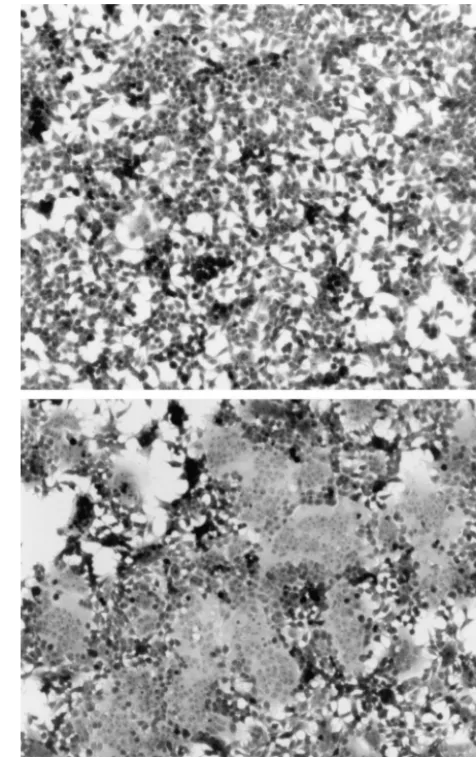
The P117D mutant reproducibly and efficiently induced syn-cytia in transfected 293T cells as early as 18 h posttransfection, unlike the wild-type glycoprotein, which induced only a few small scattered syncytia in 293T cells (Fig. 2). Mutants N96T and HV2-GRQG also induced small scattered syncytia in 293T cells, similar to the wild-type CAEV-63 envelope (data not shown). However, mutants L6R, Y118R, Y118F, P119E, V516F, and Y521D did not induce any syncytia in 293T cells (data not shown).
Effects of envelope mutations on MAb binding.We sought to determine whether gp135 mutations affect the binding of MAbs F7-299, 74A, and 29A, which recognize different con-formation-dependent epitopes on gp135 (24). Radiolabeled soluble gp135 in cell-free supernatants of transfected 293T cells was quantified by ELISA by capturing gp135 with MAb F7-299 and detecting captured gp135 with HRP-conjugated MAb 74A (24). Equal amounts of gp135 for each variant were then immunoprecipitated under native conditions with an ex-cess amount of serum from CAEV-63-infected goat 8517 or MAbs.
MAbs F7-299 and 74A immunoprecipitated all of the gp135 variants tested with efficiencies similar to that obtained with
[image:4.603.302.540.71.449.2]wild-type gp135 (Fig. 3), indicating that the epitopes recog-nized by these MAbs do not include mutated residues. In fact, quantitation of the relative gp135 concentrations by immuno-precipitation with MAbs F7-299 and 74A and by ELISA, with MAbs F7-299 and 74A as capture and detection reagents, respectively, yielded similar results, with no more than a 10% difference for any gp135 variant (data not shown). These re-sults indicate that MAbs F7-299 and 74A bind to wild-type and mutant gp135 with similar affinities. Thus, none of the gp135 mutations affected the F7-299 or 74A epitope. In contrast, MAb 29A immunoprecipitated all of the gp135 variants tested except the P119E and Y521D mutants (Fig. 3). Similar results were obtained by ELISA when reacting HRP-conjugated MAb 29A or 74A with F7-299-captured gp135 variants in parallel (data not shown). These results indicate a close proximity of proline 119 and tyrosine 521 on folded gp135, similar to the proposed corresponding residues (glycine 222 and valine or isoleucine 496, respectively) of HIV-1 gp120 (8, 9, 15).
FIG. 2. Formation of syncytia in human cells by CAEV envelope glycoprotein mutant P117D. Transfected 293T cells expressing the wild-type (top) and P117D mutant (bottom) CAEV-63 envelopes, re-spectively, were fixed in PBS containing 0.5% glutaraldehyde 24 h posttransfection and stained with hematoxylin and eosin.
on November 8, 2019 by guest
http://jvi.asm.org/
Effects of envelope mutations on association of gp135 with gp38.SU shedding is an indirect indicator of the association affinity between SU and TM (6). Therefore, the association of gp135 with gp38 was estimated by measuring the relative amounts of shed and gp38-associated gp135 in supernatants and cell lysates, respectively, of transfected 293T cells. First, we assessed the specificity of immune serum from goat 8517 in immunoprecipitation of envelopes in cell lysates. Two predom-inant bands were observed in SDS-polyacrylamide gel electro-phoresis gels of cell lysates of 293T cells expressing either CAEV-CO or CAEV-63 envelope glycoprotein immunopre-cipitated with serum from goat 8517: a 135-kDa protein cor-responding to processed gp135 and a 150-kDa protein corre-sponding to the unprocessed envelope precursor (4) (Fig. 4A, lanes 1 and 2). These proteins were not recognized by control serum from goat 8505 (Fig. 4A, lanes 5 and 6). The same proteins were also observed in cell lysates immunoprecipitated with the gp135-specific serum from goat 9308 (data not shown). Goat 8517 serum did not immunoprecipitate any of these polypeptides from lysates of cells transfected with control plasmid VR1012 (Fig. 4A, lane 4). As expected, cells trans-fected with plasmid pCMV63S expressing a truncated enve-lope glycoprotein lacking the transmembrane anchor produced a protein of about 140 kDa corresponding to the truncated envelope precursor but retained minimal amounts of gp135, if any (Fig. 4A, lane 3).
The amounts of cell-associated and soluble gp135 were then determined by immunoprecipitation of lysates of 293T cells expressing envelope variants with an excess of goat 8517 se-rum. Approximately equal amounts of soluble gp135 were present in the supernatant of cells expressing the wild-type
envelope or the N96T or HV2-GRQG mutant form (Fig. 4B, top, lanes 8 to 10). The amounts of cell-associated gp135 for these envelope variants were also approximately equal and proportional to the amount of gp135 in supernatants (Fig. 4B, bottom, lanes 8 to 10), indicating that gp135 association to gp38 in the N96T and HV2-GRQG mutant forms is similar to that of the wild-type envelope glycoprotein. Increased levels of soluble gp135 were present in the supernatants of envelope mutant forms P117D and Y118F relative to that in the wild-type envelope (Fig. 4B, top, lanes 2 and 4). However, levels of cell-associated gp135 for the P117D and Y118F envelope mu-tant forms were reduced relative to that of the wild-type en-velope (Fig. 4B, bottom, lanes 2 and 4), indicating increased gp135 shedding of these two envelopes. Levels of soluble gp135 in the supernatants of cells expressing the L6R, Y118R, P119E, V516F, and Y521D envelope mutants were reduced compared
[image:5.603.314.516.276.603.2]FIG. 3. Immunoprecipitation of gp135 mutants with MAbs against CAEV-63 gp135. Supernatants of [35S]methionine-labeled 293T cells expressing the wild-type and mutant CAEV-63 envelopes were immu-noprecipitated with 10l of immune serum from goat 8517 or 4g of MAb F7-299, 74A, or 29A. The amounts of gp135 in the supernatants were determined by ELISA with MAb F7-299 and HRP-labeled MAb 74A as capture and detection reagents, respectively, and 60 ng of gp135 was used in each reaction mixture. Representative results of at least two experiments are shown.
FIG. 4. Immunoprecipitation of envelope glycoproteins from cell lysates and supernatants of transfected 293T cells. (A) Sera from CAEV-63-infected goat 8517 (lanes 1 to 4) and uninfected goat 8505 (lanes 5 to 8) were used to immunoprecipitate envelope glycoproteins from 293T cells transfected with plasmid pCMVCO2 (CAEV-CO), pCMV63 (CAEV-63), or pCMV63S (F715/Stop) or control plasmid VR1012. Positions of14C-labeled markers are shown on the right. The positions of gp135 and the envelope glycoprotein precursor (gPr150) are shown on the left. (B) Immunoprecipitation of envelope glycopro-teins in supernatants (top) and cell lysates (bottom) of 293T cells expressing the mutant or wild-type CAEV-63 envelope glycoprotein with an excess amount of serum from goat 8517. Representative results of at least two experiments are shown.
on November 8, 2019 by guest
http://jvi.asm.org/
to that of the wild-type glycoprotein (Fig. 4B, top, lanes 1, 3, 5, 6, and 7). In addition, gp135 was undetectable in cell lysates, except for the P119E envelope mutant form, which retained minimal amounts of gp135 (Fig. 4B, bottom, lanes 1, 3, 5, 6, and 7). These results suggested a lower level of expression, as well as increased shedding, of gp135 by these envelope mutants relative to that of the wild-type envelope. To address this question, we used an ELISA to quantify the association of gp135 to gp38 more accurately.
To determine the suitability of MAbs F7-299, 74A, and 29A for quantitation of gp135 in cell lysates in an ELISA, we tested whether these MAbs specifically recognize processed gp135. Some MAbs against epitopes in gp120 regions interacting with gp41 and the coreceptor binding site do not bind the envelope precursor efficiently (27). In this regard, the epitope recog-nized by MAb 29A is probably occluded in the envelope pre-cursor because of its location in the putative inner-proximal domain of gp135 defined by proline 119 and tyrosine 521. MAbs were used to immunoprecipitate soluble envelope gly-coproteins in supernatants of radiolabeled 293T cells express-ing an envelope truncated just before the TM hydrophobic membrane anchor (F715/Stop) or the full-length envelope gly-coprotein. Soluble glycoproteins were used because of the min-imal background in immunoprecipitations of cell supernatants. Cells expressing the F715/Stop mutant should release two types of envelope glycoproteins to the supernatant, the unproc-essed truncated envelope precursor of about 140 kDa and processed gp135. Indeed, the anti-gp135 serum from goat 9308 immunoprecipitated these two proteins from the supernatant of cells expressing the F715/Stop mutant form while it immu-noprecipitated only gp135 from the supernatant of cells ex-pressing the full-length envelope glycoprotein (Fig. 5, lanes 1 and 2). As expected, all MAbs reacted with gp135 in the su-pernatants from cells expressing the F715/Stop mutant or the full-length envelope glycoprotein (Fig. 5, lanes 3 to 8). How-ever, none of the MAbs reacted with the unprocessed envelope precursor (Fig. 5, lanes 3, 5, and 7).
The lack of reactivity of MAbs F7-299, 29A, and 74A with the envelope precursor allowed the use of an ELISA to mea-sure the relative amounts of gp135 in supernatants and cell lysates. In this assay, supernatants of transfected cells were harvested and cells were briefly rinsed and lysed in buffer containing NP-40, which does not affect MAb F7-299 reactivity (data not shown). The gp135 in serially diluted cell lysates and supernatants was captured by MAb F7-299 bound to ELISA plates and detected with HRP-conjugated MAb 29A for mu-tant glycoproteins L6R, P117D, Y118R, Y118F, and V516F.
As MAb 29A does not bind mutant glycoproteins P119E and Y521D (Fig. 3), HRP-conjugated MAb 74A was used to detect these two mutants. The apparent concentrations of gp135 in cell lysates and supernatants were extrapolated from a stan-dard curve obtained with purified native gp135, and the asso-ciation indexes were calculated.
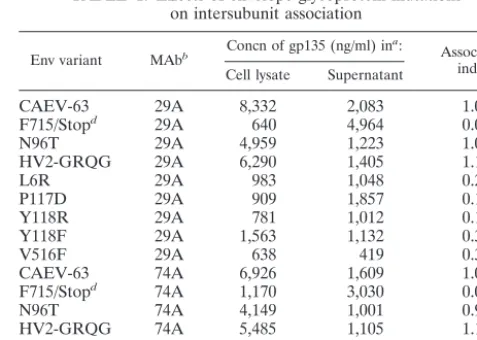
Consistent with the results of immunoprecipitation assays shown in Fig. 4A and B, the F715/Stop mutant, which lacks a transmembrane anchor, had association indexes of only 0.03 and 0.09 when measured with MAbs 29A and 74A, respectively (Table 1). In addition, envelope mutants N96T and HV2-GRQG had association indexes close to 1 with either MAb 74A or 29A as the detecting reagent (Table 1), confirming that the association of gp135 to gp38 in these mutants is similar to that of the wild-type envelope glycoprotein. However, consis-tent with the results shown in Fig. 4B, the L6R, P117D, Y118R, Y118F, P119E, V516F, and Y521D mutant glycoproteins had lower association indexes in several experiments, ranging from a 2.5-fold to an 8-fold reduction in different mutants (Table 1). It should be noted that the low association index of envelope mutant P117D is not due to fusion-induced lysis of cells, as little cell debris was observed in the supernatant of cells ex-pressing this envelope at the time of cell lysate preparation. This is confirmed by the presence of similar levels of envelope glycoprotein precursor and nonspecific backgrounds in immu-noprecipitations of lysates of cells expressing P117D or other envelope variants (Fig. 4B). Collectively, our results indicate that mutations in the amino and carboxy termini of gp135, as
well as in the turn between putative-strands 4 and 5, decrease
the association of gp135 to gp38.
[image:6.603.56.268.70.122.2]Functional activity of mutant envelope glycoproteins.The lower association index of mutant envelope glycoproteins could be due to mutation-induced global misfolding of gp135. The
FIG. 5. Immunoprecipitation of gp135 and gp150 envelope precur-sor by MAbs. Supernatants of 293T cells expressing full-length (lanes 2, 4, 6, and 8) and truncated (lanes 1, 3, 5, and 7) CAEV envelope glycoproteins were immunoprecipitated with serum from goat 9308 (lanes 1 and 2) or MAb F7-299 (lanes 3 and 4), 74A (lanes 5 and 6), or 29A (lanes 7 and 8). The positions of soluble gp135 and the soluble envelope glycoprotein precursor (gPr140) are shown on the left.
TABLE 1. Effects of envelope glycoprotein mutations on intersubunit association
Env variant MAbb Concn of gp135 (ng/ml) in a:
Association indexc
Cell lysate Supernatant
CAEV-63 29A 8,332 2,083 1.00
F715/Stopd 29A 640 4,964 0.03
N96T 29A 4,959 1,223 1.01
HV2-GRQG 29A 6,290 1,405 1.12
L6R 29A 983 1,048 0.23
P117D 29A 909 1,857 0.12
Y118R 29A 781 1,012 0.19
Y118F 29A 1,563 1,132 0.35
V516F 29A 638 419 0.38
CAEV-63 74A 6,926 1,609 1.00
F715/Stopd 74A 1,170 3,030 0.09
N96T 74A 4,149 1,001 0.96
HV2-GRQG 74A 5,485 1,105 1.15
P119E 74A 605 650 0.22
Y521D 74A 1,361 753 0.42
aThe culture medium of transfected cell cultures was replaced, and
superna-tants (4 ml) and cell lysates (1 ml) were harvested at 20 and 44 h posttransfection, respectively.
bHRP-conjugated MAb used for detection of F7-299-captured SU. cThe index of gp135 association to gp38 was calculated by the following
formula: ([mutant gp135cell lysate] ⫻ [wild-type gp135supernatant])/([wild-type
gp135cell lysate]⫻[mutant gp135supernatant]).
dThe F715/Stop mutant expresses an envelope glycoprotein truncated just
before the transmembrane anchor of TM.
on November 8, 2019 by guest
http://jvi.asm.org/
[image:6.603.301.540.480.650.2]structural integrity of gp135 mutants was determined by the functional activity of envelope glycoproteins in receptor bind-ing, fusion, and infectivity assays with GSM cells.
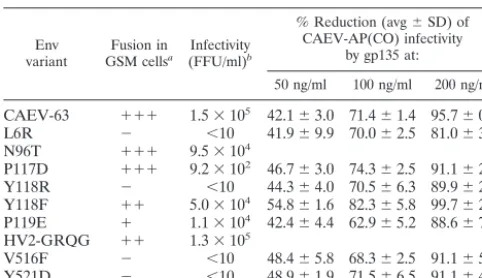
For syncytium formation assays, 293T cells were transfected with envelope plasmids and, after an overnight incubation, the transfected cells were lifted in PBS and cocultured with GSM cells at a 1:5 or 1:10 ratio for 12 h. Syncytium formation was scored by counting the nuclei within syncytia in five random low-power fields. Similar to the wild-type CAEV-63 envelope, the N96T and HV2-GRQG mutants induced syncytia in GSM cells (Table 2), although mutant HV2-GRQG was less fuso-genic than the wild-type envelope. Of the seven mutants with defective intersubunit interactions, P117D, Y118F, and P119E induced syncytia in GSM cells. Mutant form P117D induced syncytia in GSM cells as well as the wild-type envelope did, while mutants Y118F and P119E fused GSM cells less effi-ciently than the wild-type envelope did (Table 2). The other four mutants with defective intersubunit interactions (L6R, Y118R, V516F, and Y521D) did not induce syncytia in GSM cells (Table 2).
The ability of mutant envelope glycoproteins to mediate infection of GSM cells was assessed by complementation as-says with the CAEV-AP vector expressing the HPAP gene. Pseudotyped vectors were produced by cotransfecting 293T cells with the pCAEV-AP vector and envelope plasmids and titrated in GSM cells. Except for the P117D mutant, results of infectivity complementation assays reflected the results of syn-cytium formation assays with GSM cells. CAEV-AP pseudotyped with the wild-type CAEV-63 envelope [CAEV-AP(63)], CAEV-AP(N96T), and CAEV-AP(HV2-GRQG)
in-fected GSM cells with titers of about 105FFU/ml or greater
(Table 2). The CAEV-AP(Y118F) and CAEV-AP(P119E) pseudotypes infected cells with efficiencies about 3- and 13-fold lower than that of CAEV-AP(63), respectively, similar to the relatively lower fusion of GSM cells induced by the Y118F and P119E envelopes (Table 2). However, titers of the CAEV-AP(P117D) pseudotype were about 150-fold lower than that of the wild-type envelope (Table 2), despite the ability of the P117D mutant envelope glycoprotein to induce syncytia in GSM cells efficiently. Consistent with their inability to induce
syncytia in GSM cells, no infectivity was detected for CAEV-AP pseudotyped with the L6R, Y118F, V516F, and Y521D en-velope glycoproteins (Table 2). The infectivity of all CAEV-AP pseudotypes for human 293T cells was below the detection
level (⬍10 FFU/ml), consistent with previous results showing
the inability of CAEV envelope glycoproteins to mediate in-fection of human cells (10, 22).
As the identity of the CAEV receptor is not known, receptor binding of wild-type and mutant glycoproteins was measured with a quantitative interference assay as previously described (11). Briefly, GSM cells were incubated with diluted gp135 supernatants at 37°C, infected with the CAEV-AP(CO) pseu-dotype in the presence of gp135, washed to remove free virus, incubated for 3 days for HPAP expression, and scored for infectivity by counting foci of HPAP-expressing cells. Super-natants used in the interference assay were diluted to a gp135 concentration of 50 to 200 ng/ml, which was determined in preliminary experiments to be in the linear range of the assay with wild-type gp135. The concentration of gp135 in superna-tants was measured by a quantitative ELISA with MAbs F7-299 and 74A as capture and detection reagents, respectively. As described above, quantitation of gp135 concentrations in supernatants of transfected 293T cells obtained by immuno-precipitation with an excess amount of immune serum from goat 8517 or ELISA yielded similar results, indicating that the ELISA can be used to accurately determine the relative con-centration of gp135 in supernatants of this panel of mutant envelope glycoproteins.
Incubation of GSM cells with wild-type gp135 at 50, 100, and 200 ng/ml resulted in a dose-dependent reduction in CAEV-AP(CO) titers relative to those of control cultures incubated with supernatants from vector-transfected cells, with reduc-tions ranging from 42 to 95% (Table 2). These results were similar to those of previously reported experiments with a different CAEV vector (11). The reduction in CAEV-AP(CO) titers of gp135 mutants L6R, P117D, Y118R, Y118F, P119E, V516F, and Y521D was at least as great as for wild-type gp135, ranging from 42 to 54% with gp135 at 50 ng/ml to 81 to 99% with gp135 at 200 ng/ml (Table 2). These results indicate that these mutant glycoproteins bind to receptors in GSM cells as efficiently as does wild-type gp135. Thus, the results indicate that gp135 mutants L6R, P117D, Y118F, Y118R, P119E, V516F, and Y521D can bind efficiently to receptors on GSM cells and that the reduced intersubunit association of these mutant forms is not due to global misfolding of gp135.
DISCUSSION
Our results support the hypothesis that the region around
the putative 4-5 turn and -strand 25 of CAEV gp135 is
structurally similar to the gp120 core inner domain and show that residues within these regions, as well as residues in the amino- and carboxy-terminal regions of CAEV gp135, are im-portant in mediating stable interactions between gp135 and gp38. Given the previously described conservation of some of the CAEV gp135 sequences involved in intersubunit interac-tions shown here (gp135 residues 117, 118, 119, and 516, cor-responding to HIV-1 gp120 residues 220, 221, 222, and 491, respectively) in the SU of other lentiviruses and
betaretrovi-TABLE 2. Functional activity of mutant envelope glycoproteins
Env
variant GSM cellsFusion ina (FFU/ml)Infectivityb
% Reduction (avg⫾SD) of CAEV-AP(CO) infectivity
by gp135 at:
50 ng/ml 100 ng/ml 200 ng/ml
CAEV-63 ⫹⫹⫹ 1.5⫻105 42.1⫾3.0 71.4⫾1.4 95.7⫾0.9
L6R ⫺ ⬍10 41.9⫾9.9 70.0⫾2.5 81.0⫾3.8
N96T ⫹⫹⫹ 9.5⫻104
P117D ⫹⫹⫹ 9.2⫻102 46.7⫾3.0 74.3⫾2.5 91.1⫾2.2
Y118R ⫺ ⬍10 44.3⫾4.0 70.5⫾6.3 89.9⫾2.2
Y118F ⫹⫹ 5.0⫻104 54.8⫾1.6 82.3⫾5.8 99.7⫾2.2
P119E ⫹ 1.1⫻104 42.4⫾4.4 62.9⫾5.2 88.6⫾7.6
HV2-GRQG ⫹⫹ 1.3⫻105
V516F ⫺ ⬍10 48.4⫾5.8 68.3⫾2.5 91.1⫾5.8
Y521D ⫺ ⬍10 48.9⫾1.9 71.5⫾6.5 91.1⫾4.4
aFusion of transfected 293T cells with GSM cells relative to CAEV-63 Env in
at least two experiments:⫹⫹⫹,⬎66% relative fusion;⫹⫹, 33 to 66% relative fusion;⫹,⬍33% relative fusion;⫺, no fusion.
bInfectivity of CAEV-AP pseudotyped with indicated envelopes in GSM cells.
Values are averages of two experiments.
on November 8, 2019 by guest
http://jvi.asm.org/
[image:7.603.43.284.80.219.2]ruses (9), our results may be relevant and directly applied to structural and functional studies of the SU of these viruses.
The regions immediately preceding putative-strand 5 and
near the end of putative antiparallel-strand 25 of gp135 are
predicted to be located close to each other in the folded gp135, by analogy to the gp120 core structure (8, 9). Mutations in the proline 119 and tyrosine 521 residues, located in these two regions of gp135, abolished the binding of MAb 29A (Fig. 1 and 3). Although antibody footprints can encompass a wide area relative to individual amino acid residues, the results indicate that, despite their distance in the primary structure, proline 119 and tyrosine 521 are located close to each other in folded gp135. The lack of MAb 29A reactivity with mutants P119E and Y521D is not due to global misfolding effects, as indicated by the efficient receptor interference activity of these two mutants, which is comparable to that of the wild-type glycoprotein (Table 2). A native or near-native conformation of these gp135 mutants is further indicated by their normal reactivity with MAbs F7-299 and 74A, which recognize differ-ent conformation-dependdiffer-ent epitopes (24), and by the partial ability of mutant P119E to induce syncytia and mediate infec-tion of GSM cells. Although it is possible that these mutainfec-tions induce some minor structural changes in gp135, our results indicate that such changes, if they occur, are local, consistent with our interpretation that proline 119 and tyrosine 521 are both located within or very near the 29A epitope. Thus, col-lectively, our results indicate that the structures of the virion-proximal regions of the gp120 core and gp135 are similar. Interestingly, despite the heavy glycosylation of CAEV gp135, the 29A epitope is not affected by deglycosylation of gp135, indicating that this epitope is situated in a gp135 face devoid of carbohydrate, similar to the inner-proximal region of the gp120 core (15, 24, 26).
Interactions between HIV-1 gp120 and gp41 have been iden-tified by the effects of mutations on the relative levels of cell-associated and soluble gp120 released in supernatants (6). We have used a similar approach in this study to define residues of CAEV gp135 critical in SU-TM interactions. A reduction of more than 50% in the association index was observed for some of the mutant envelope glycoproteins by ELISA. Although not as profound as the effect of some mutations in the association of gp120 to gp41, the reductions in intersubunit association shown here were consistent and reproducible in different ex-periments. The different magnitudes of the effects of mutations on SU association indexes in HIV-1 and CAEV could be due to differences in the sensitivities of the experimental systems used to quantitate SU in cell supernatants and cell lysates (ELISA and immunoprecipitation; compare Fig. 4B and Table 1) or differences in the rate of production, processing, trans-port to the cell surface, internalization, and stability of the envelopes of these viruses. In addition, it is possible that the third cysteine residue present in the ectodomain of TM of small-ruminant lentiviruses, but not other lentiviruses (1), forms a stabilizing interchain disulfide bond with SU. In any case, our results indicate that similar domains of SU are in-volved in stable interactions with TM in CAEV and HIV-1. For instance, as in HIV-1 gp120, mutations in conserved res-idues in the amino (L6R)- or carboxy (Y521D)-terminal do-main of gp135 reduced its association to TM (6). Furthermore,
the conservative V516F mutation in putative -strand 25 of
gp135 also resulted in a significantly reduced association index,
similar to the analogous I491F mutation in -strand 25 of
HIV-1 gp120 (6). Thus, although the results shown here are not an exhaustive survey of gp135 residues involved in stable association with gp38, they indicate that the amino and carboxy termini of gp135 and gp120 have similar roles in envelope intersubunit association. Because of its location in the apex of the virion-proximal face of the gp120 core and its closeness to
the carboxy-terminal part of -strand 25 (15, 16), which
par-ticipates in interactions with gp41, the turn between-strands
4 and 5 of gp120 is probably also critical for the association of gp120 with gp41, although this has not been tested. In fact, mutation of gp135 residues 117, 118, and 119 in the turn
between putative-strands 4 and 5 resulted in lower
associa-tion indexes relative to that of the wild-type glycoprotein,
in-dicating a role for the putative 4-5 turn of gp135 in
inter-subunit association. The reduced association index occurred even in the envelope glycoprotein with the conservative Y118F mutation, indicating that even subtle changes in the putative
4-5 turn of gp135 have an effect on intersubunit association.
The results indicate that the lower association index of mu-tants L6R, P119D, Y118R, Y118F, V516F, and Y521D is not due to global misfolding of gp135. None of the mutants had a reduced recognition of receptors in goat cells, and three of these mutants (P117D, Y118F, and P119E) can also induce syncytia and mediate virus infection in GSM cells. The biolog-ical activity of these mutants thus indicates proper folding of the mutated glycoproteins. An additional indicator of native conformation for HIV-1 gp120 mutants, the processing of the glycoprotein precursor, is usually measured by the ratio be-tween the amounts of total gp120 and the precursor glycopro-tein (6). We have not been able to determine the processing rate of envelope mutants with confidence because of the rela-tively high background of immunoprecipitation of cell lysates with an excess of goat serum and the presence of proteins of an apparent mass greater than 220 kDa (Fig. 4A, lanes 1 and 2), presumed to be complexes of envelope glycoprotein precur-sors. This precluded accurate quantitation of glycoprotein pre-cursors in cell lysates by densitometry. In addition, the propor-tion of gp135 relative to the precursor glycoprotein in cell lysates was affected by the amount of envelope plasmid used for transfection, transfection efficiency, and levels of envelope glycoprotein expression (data not shown), possibly because of saturation of the processing enzymes in transfected cells over-expressing envelope glycoproteins. It is possible that some of these mutations affected envelope glycoprotein processing as some mutants produced less gp135 relative to other mutants and the wild-type glycoprotein. Reduced processing was ob-served in some of the HIV-1 mutant envelope glycoproteins with reduced intersubunit association (6). However, even if some of the mutants are processed less efficiently, the pro-cessed fraction appears to be properly folded, as indicated by their biological activity. In addition, mutants P117D and Y118F produced gp135 at levels comparable to that of the wild-type glycoprotein (Fig. 4B), indicating that at least these two mutants with reduced intersubunit association are pro-cessed efficiently.
We show that three mutants with reduced intersubunit as-sociation (P117D, Y118F, and P119E) retained not only re-ceptor binding activity but also cell-to-cell and virus-to-cell
on November 8, 2019 by guest
http://jvi.asm.org/
fusogenicity, although with reduced efficiencies relative to that of the wild-type glycoprotein. The fusogenicity of these mu-tants contrasts with the lack of fusogenicity of other mumu-tants with similar or higher association indexes or levels of cell-associated gp135. This indicates that intersubunit association and expression levels are not the only factors affecting fusoge-nicity and suggests that some mutations may affect other func-tions in gp135 or gp38 besides intersubunit association. How-ever, infectivity, but not cell-to-cell fusion, appears to be related to the association index of mutants P119D, Y118F, and P119E. This suggests that virus infectivity is affected by the mutant-specific rate of gp135 shedding and decay of envelope glycoprotein oligomers on virion envelopes.
The phenotype of the P117D mutant glycoprotein was dif-ferent from that of all other mutants in this study. Proline 117
is located in the turn between putative -strands 4 and 5 of
gp135, and mutation of this residue resulted in an unstable association of gp135 with gp38. However, in contrast to other envelope mutants with low association indexes, this mutant strongly induced fusion of transfected 293T cells. There are at least three possible explanations for the phenotype of this mutant. First, instability of envelopes with the P117D mutation may result in spontaneous gp135 shedding, which allows the functional deployment of gp38 through a receptor-indepen-dent pathway. In this case, shedding would directly cause fusion. Two other nonexclusive possibilities would explain gp135 shedding as a consequence of fusion. The P117D mu-tation may result in a better-exposed receptor binding site of gp135 that allows the recognition of human receptors and the development of receptor-dependent fusion. However, this is unlikely as this mutant glycoprotein did not have the increased interference activity in goat cells relative to wild-type gp135 that would be expected from such changes in receptor binding site exposure. Perhaps more interestingly, it is possible that gp135 with the P117D mutation has a reduced activation threshold for the conformational changes induced by receptor binding that trigger the fusion process, allowing the functional deployment of gp38 and gp135 shedding upon binding of sub-optimal human receptors. In this regard, the phenotype of the P117D mutant form was strikingly similar to that of some unstable amphotropic murine leukemia virus envelope mu-tants (mumu-tants A2 and A3) reported by Lavillette et al. (17, 18). Mutations in the A2 and A3 envelope glycoproteins were
lo-cated in certain proline residues in putative -turns of the
proline-rich region of SU and induced high levels of SU shed-ding and cell-to-cell fusion but poor infectivity. The instability of the A2 and A3 mutant glycoproteins was attributed to spon-taneous acquisition by SU of conformations similar to those induced by receptor binding that resulted in the requirement of lower receptor levels to trigger fusion because of a reduced threshold for fusion activation (17). The centrally located pro-line-rich region does not bind the receptor but rather modu-lates interactions between the amino-terminal receptor bind-ing domain and the TM-interactbind-ing carboxy-terminal domain of murine leukemia virus SU that change the conformation of SU after receptor binding to trigger fusion by TM (18). There-fore, in view of the similarity of the P117D and A2-A3 mutant phenotypes, it is possible that CAEV gp135 proline 117, and
perhaps corresponding proline 220 in the4-5 turn of HIV-1
gp120, has a similar role in modulating the ultimate
confor-mational changes in SU occurring after receptor binding that trigger membrane fusion by TM.
ACKNOWLEDGMENTS
This work was supported by National Institutes of Health grants RO1 AR 43718 and R21 AI 42690.
We thank Dusty Miller for the pLAPSN plasmid and suggestions for vector development. We also thank Kathy Pretty On Top and Nancy Kumpula-McWhirter for technical assistance.
REFERENCES
1. Braun, M. J., J. E. Clements, and M. A. Gonda.1987. The visna virus genome: evidence for a hypervariable site in theenvgene and sequence homology among lentivirus envelope proteins. J. Virol.61:4046–4054. 2. Cheevers, W. P., and T. C. McGuire.1988. The lentiviruses: maedi/visna,
caprine arthritis-encephalitis, and equine infectious anemia. Adv. Virus Res. 34:189–215.
3. Cheevers, W. P., D. P. Knowles, and L. K. Norton.1991. Neutralization resistant antigenic variants of caprine arthritis-encephalitis lentivirus associ-ated with progressive arthritis. J. Infect. Dis.164:679–685.
4. Cheevers, W. P., T. A. Stem, D. P. Knowles, and T. C. McGuire.1988. Precursor polypeptides of caprine arthritis-encephalitis lentivirus structural proteins. J. Gen. Virol.69:675–681.
5. Crawford, T. B., D. S. Adams, W. P. Cheevers, and L. C. Cork.1980. Chronic arthritis in goats caused by a retrovirus. Science207:997–999.
6. Helseth, E., U. Olshevsky, C. Furman, and J. Sodroski.1991. Human im-munodeficiency virus type 1 gp120 envelope glycoprotein regions important for association with the gp41 transmembrane glycoprotein. J. Virol.65:2119– 2123.
7. Ho¨tzel, I., N. Kumpula-McWhirter, and W. P. Cheevers.2002. Rapid evo-lution of two discrete regions of the caprine arthritis-encephalitis virus en-velope surface glycoprotein during persistent infection. Virus Res.84:17–25. 8. Ho¨tzel, I., and W. P. Cheevers.2000. Sequence similarity between the enve-lope surface unit (SU) glycoproteins of primate and small ruminant lentivi-ruses. Virus Res.69:47–54.
9. Ho¨tzel, I., and W. P. Cheevers.2001. Conservation of human immunodefi-ciency virus type 1 gp120 inner-domain sequences in lentivirus and type A and B retrovirus envelope surface glycoproteins. J. Virol.75:2014–2018. 10. Ho¨tzel, I., and W. P. Cheevers.2001. Host range of small-ruminant lentivirus
cytopathic variants determined with a selectable caprine arthritis-encepha-litis virus pseudotype system. J. Virol.75:7384–7391.
11. Ho¨tzel, I., and W. P. Cheevers.2002. Differential receptor usage of small ruminant lentiviruses in ovine and caprine cells: host range but not cyto-pathic phenotype is determined by receptor usage. Virology301:21–31. 12. Kemp, R. K., D. P. Knowles, L. L. Perry, T. C. McGuire, T. E. Besser, and
W. P. Cheevers.2000. Crossreactive neutralizing antibodies induced by im-munization with caprine arthritis-encephalitis virus surface glycoprotein. Vaccine18:1282–1287.
13. Knowles, D. P., W. P. Cheevers, T. C. McGuire, A. L. Brassfield, W. G. Harwood, and T. A. Stem.1991. Structure and genetic variability of envelope glycoproteins of two antigenic variants of caprine arthritis-encephalitis len-tivirus. J. Virol.65:5744–5750.
14. Kowalski, M., J. Potz, L. Basiripour, T. Dorfman, W. C. Goh, E. Terwilliger, A. Dayton, C. Rosen, W. Haseltine, and J. Sodroski.1987. Functional regions of the envelope glycoprotein of human immunodeficiency virus type 1. Sci-ence237:1351–1355.
15. Kwong, P. D., R. Wyatt, J. Robinson, R. W. Sweet, J. Sodroski, and W. A. Hendrickson.1998. Structure of an HIV gp120 envelope glycoprotein in complex with the CD4 receptor and a neutralizing human antibody. Nature 393:648–659.
16. Kwong, P. D., R. Wyatt, Q. J. Sattentau, J. Sodroski, and W. A. Hendrickson. 2000. Oligomeric modeling and electrostatic analysis of the gp120 envelope glycoprotein of human immunodeficiency virus. J. Virol.74:1961–1972. 17. Lavillette, D., M. Maurice, C. Roche, S. J. Russell, M. Sitbon, and F. Cosset.
1998. A proline-rich motif downstream of the receptor binding domain modulates conformation and fusogenicity of murine retroviral envelopes. J. Virol.72:9955–9965.
18. Lavillette, D., A. Ruggieri, B. Boson, M. Maurice, C., and F. Cosset.2002. Relationship between SU subdomains that regulate the receptor-mediated transition from the native (fusion-inhibited) to the fusion-active conforma-tion of the murine leukemia virus glycoprotein. J. Virol.76:9673–9685. 19. Leonard, C. K., M. W. Spellman, L. Riddle, R. J. Harris, J. N. Thomas, and
T. J. Gregory.1990. Assignment of intrachain disulfide bonds and charac-terization of potential glycosylation sites of the type 1 recombinant human immunodeficiency virus envelope glycoprotein (gp120) expressed in Chinese hamster ovary cells. J. Biol. Chem.265:10373–10382.
20. McGuire, T. C., D. P. Knowles, W. C. Davis, A. L. Brassfield, T. A. Stem, and W. P. Cheevers.1992. Transmembrane protein oligomers of caprine arthri-tis-encephalitis lentivirus are immunodominant in goats with progressive arthritis. J. Virol.66:3247–3250.
on November 8, 2019 by guest
http://jvi.asm.org/
21. Miller, D. G., R. H. Edwards, and A. D. Miller.1994. Cloning of the cellular receptor for amphotropic murine retroviruses reveals homology to that for gibbon ape leukemia virus. Proc. Natl. Acad. Sci. USA91:78–82. 22. Mselli-Lakhal, L., C. Favier, K. Leung, F. Guiguen, D. Grezel, P. Miossec,
J. F. Mornex, O. Narayan, G. Querat, and Y. Chebloune.2000. Lack of functional receptors is the only barrier that prevents caprine arthritis-en-cephalitis virus from infecting human cells. J. Virol.74:8343–8348. 23. Narayan, O., M. Zink, M. Gorrel, S. Crane, D. Huso, P. Jolly, M. Saltarelli,
R. Adams, and J. Clements.1993. The lentiviruses of sheep and goats, p. 229–256.InJ. A. Levy (ed.), The Retroviridae. Plenum Press, New York, N.Y.
24. O¨ zyo¨ru¨k, F., W. P. Cheevers, G. A. Hullinger, T. C. McGuire, M. Hutton, and D. P. Knowles.2001. Monoclonal antibodies to conformational epitopes of
the surface glycoprotein of caprine arthritis-encephalitis virus: potential ap-plication to competitive-inhibition enzyme-linked immunosorbent assay for detecting antibodies in goat sera. Clin. Diagn. Lab. Immunol.8:44–51. 25. Valas, S., C. Benoit, C. Baudry, G. Perrin, and R. Z. Mamoun.2000.
Vari-ability and immunogenicity of caprine arthritis-encephalitis virus surface glycoprotein. J. Virol.74:6178–6185.
26. Wyatt, R., P. D. Kwong, E. Desjardins, R. W. Sweet, J. Robinson, W. A. Hendrickson, and J. Sodroski.1998. The antigenic structure of the HIV gp120 envelope glycoprotein. Nature393:705–711.
27. Wyatt, R., E. Desjardin, U. Olshevsky, C. Nixon, J. Binley, V. Olshevsky, and J. Sodroski.1997. Analysis of the interaction of the human immunodefi-ciency virus type 1 gp120 envelope glycoprotein with the gp41 transmem-brane glycoprotein. J. Virol.71:9722–9731.