Rochester Institute of Technology
RIT Scholar Works
Theses
Thesis/Dissertation Collections
5-17-2017
Design and Analysis of Multiple-Load Automated
Guided Vehicle Dispatching Algorithms
Maojia Li
[email protected]Follow this and additional works at:
http://scholarworks.rit.edu/theses
This Thesis is brought to you for free and open access by the Thesis/Dissertation Collections at RIT Scholar Works. It has been accepted for inclusion in Theses by an authorized administrator of RIT Scholar Works. For more information, please [email protected].
Recommended Citation
DESIGN AND ANALYSIS OF MULTIPLE-LOAD AUTOMATED
GUIDED VEHICLE DISPATCHING ALGORITHMS
By
Maojia Li
A Thesis Submitted in Partial Fulfilment of the Requirement
for the Degree of Master of Science in
Manufacturing and Mechanical Systems Integration
Department of Manufacturing and Mechanical Engineering Technology
College of Applied Science and Technology
Rochester Institute of Technology
Rochester, NY
i
ACKNOWLEDGMENTS
ii
ABSTRACT
This paper addresses the problems of dispatching multiple-load automated guided vehicles
(AGVs) in flexible manufacturing systems (FMSs). A pickup-or-delivery-en-route (PDER) rule is
proposed to address the task-determination problem that indicates if a partially loaded AGV’s next
task should be picking up a new job or dropping off a carried load. A workload-balancing (WLB)
algorithm is developed to deal with the pickup-dispatching problem that determines which job
should be assigned to an AGV. A simulation experiment is conducted to compare the PDER rule
with an existing task-determination rule in 2 representative FMSs. We use another simulation
experiment to compare the WLB rule with 4 existing pickup-dispatching rules in 3 FMSs. The
results show that the PDER rule can significantly improve the system throughput and reduce the
average time in system of parts, while the WLB rule also has an outstanding throughput
iii
Table of Contents
ACKNOWLEDGMENTS ... i
ABSTRACT ... ii
Table of Contents ... iii
List of Tables ... v
List of Figures ... vi
Notation ... viii
1.INTRODUCTION ... 1
2.PROBLEM STATEMENT ... 3
3.LITERATURE REVIEW ... 4
3.1 Scheduling vs. Dispatching ... 4
3.2 Multiple-load AGV Dispatching ... 4
3.3 Workcenter-initiated vs. Vehicle-initiated Dispatching Rules ... 6
3.4 Multi-attributed vs. Hierarchical Dispatching Algorithms ... 8
3.5 Discussion... 8
4.ALGORITHM DESIGN ... 12
4.1 Pickup-or-Delivery-En-Route Rule ... 12
4.1.1 Important Queues ... 12
4.1.2 Flowchart ... 13
4.1.3 Example of PDER Rule ... 15
4.2 Workload Balancing Rule ... 17
4.2.1 Workload Balancing Concept ... 17
4.2.2 Job Evaluation ... 18
4.2.3 Example of WLB Algorithm ... 18
4.3 AGV Control Rules ... 19
4.3.1 Workcenter-initiated Rule ... 19
4.3.2 Delivery-dispatching Rule ... 19
4.3.3 Load-selection Rule... 19
4.3.4 Pickup-dispatching Rules ... 20
4.3.5 Task-determination Rule ... 20
5.IMPLEMENTATION ... 22
5.1 Implementation of PDER ... 22
iv
5.3 Implementation of WLB ... 27
6.EXPERIMENT FOR THE PDER RULE ... 29
6.1 Experiment Design (Experiment 1) ... 29
6.1.1 FMS 1 Configuration (Experiment 1) ... 29
6.1.2 FMS 2 Configuration (Experiment 1) ... 30
6.2 Output Analysis (Experiment 1) ... 32
7.EXPERIMENT FOR THE PDER AND WLB RULES... 36
7.1 Experiment Design (Experiment 2) ... 36
7.1.1 FMS 1 Configuration (Experiment 2) ... 36
7.1.2 FMS 2 Configuration (Experiment 2) ... 37
7.1.3 FMS 3 Configuration (Experiment 2) ... 37
7.2 Output Analysis (Experiment 2) ... 38
7.2.1 FMS 1 Output Analysis (Experiment 2) ... 40
7.2.2 FMS 2 Output Analysis (Experiment 2) ... 43
7.2.3 FMS 3 Output Analysis (Experiment 2) ... 47
8.MAJOR FINDINGS ... 51
9.CONCLUSION ... 54
REFERENCES ... 55
APPENDIX ... 57
Simio Processes... 57
Throughput Analysis ... 60
v
List of Tables
Table 1: Differences in vehicle states between single- and dual-load AGVs. ... 12
Table 2: Factors considered in experiment 1. ... 29
Table 3: Part routing and processing information for FMS 1, experiment 1. ... 30
Table 4: Part routing and production volume percentages for FMS 2. ... 31
Table 5: Processing time distributions at each workstation for FMS 2, experiment 1. ... 31
Table 6: Scenarios that are the focus of analysis in experiment 1. ... 33
Table 7: Mean (standard deviation) of throughput for selected scenarios in FMS 1, experiment 1. ... 33
Table 8: Mean (standard deviation) of throughput for selected scenarios in FMS 2, experiment 1. ... 34
Table 9: Mean (standard deviation) of ATIS in minutes for selected scenarios in FMS 1, experiment 1. . 34
Table 10: Mean (standard deviation) of ATIS in minutes for selected scenarios in FMS 2, experiment 1. 35 Table 11: Factors considered in experiment 2. ... 36
Table 12: Part routing and processing information for FMS 1, experiment 2. ... 37
Table 13: Processing time distributions at each workstation for FMS 2, experiment 2. ... 37
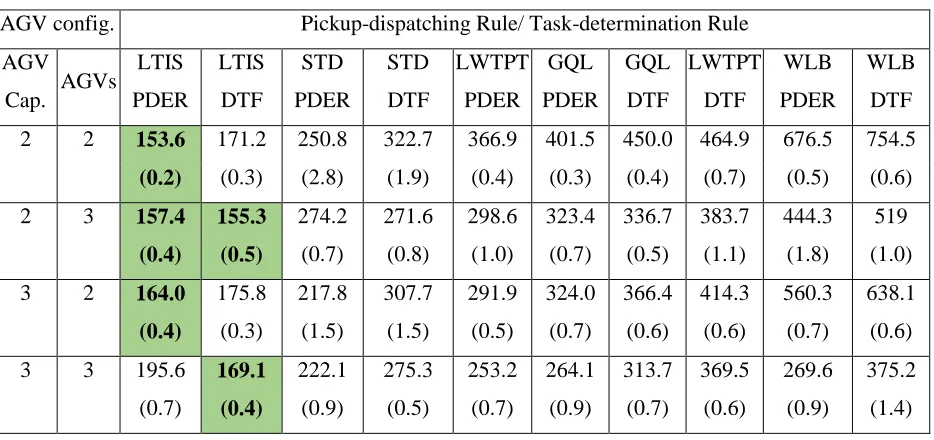
Table 14: Scenarios that are the focus of the analysis in experiment 2. ... 40
Table 15: Mean (standard deviation) of throughput for selected scenarios in FMS 1, experiment 2. ... 40
Table 16: Mean (standard deviation) of ATIS in minutes for selected scenarios in FMS 1, experiment 2. 43 Table 17: Mean (standard deviation) of throughput for selected scenarios in FMS 2, experiment 2. ... 44
vi
List of Figures
Figure 1: Four problem associated with dispatching multiple-load AGVs (Ho and Chien, 2006) ... 5
Figure 2: The first example of the DTF rule. ... 9
Figure 3: The second example of the DTF rule. ... 10
Figure 4: The flowchart of PDER rule ... 14
Figure 5: An example of the PDER rule. ... 16
Figure 6: An example of Rule 1. ... 17
Figure 7: An example of Rule 2 with machine blocking. ... 17
Figure 8: An example of Rule 3. ... 18
Figure 9: DTF rule flowchart. ... 21
Figure 10: A portion of OnVisitingNode process for the Vehicle object in Simio. ... 22
Figure 11: Modification of Vehicle object that determines the next distance. ... 23
Figure 12: Modification of Vehicle object that assigns a job to empty AGV. ... 23
Figure 13: Modification of Vehicle object that determines low-cost-pickup-point and low-cost-job lists. 23 Figure 14: Modification of Vehicle object that assigns a low-cost job to AGV. ... 24
Figure 15: A portion of OnVisitingNode process for the Vehicle object in Simio. ... 25
Figure 16: Modification of Vehicle object that only allows the Vehicle to pick up assigned jobs. ... 26
Figure 17: Modification of Vehicle object that adds the input-buffer constrain. ... 26
Figure 18: Modification of Vehicle object implement the pickup-dispatching rule using the DTF rule. ... 27
Figure 19: The WLB rule in Simio. ... 28
Figure 20: Layout of FMS 1. ... 30
Figure 21: Layout of FMS 2 (Ho and Chien, 2006). ... 31
Figure 22: System throughput results for experiment 1. ... 32
Figure 23: Layout of FMS 3. ... 38
Figure 24: Throughput analysis of FMS 1 with dual-load AGVs in experiment 2. ... 39
Figure 25: Throughput analysis of FMS 1 with triple-load AGVs in experiment 2. ... 39
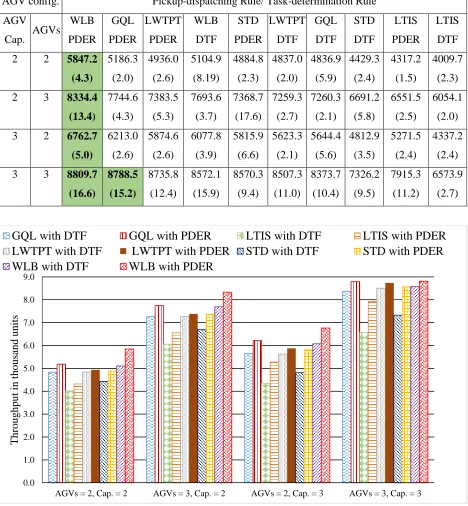
Figure 26: Throughput Analysis of FMS 1, experiment 2. ... 41
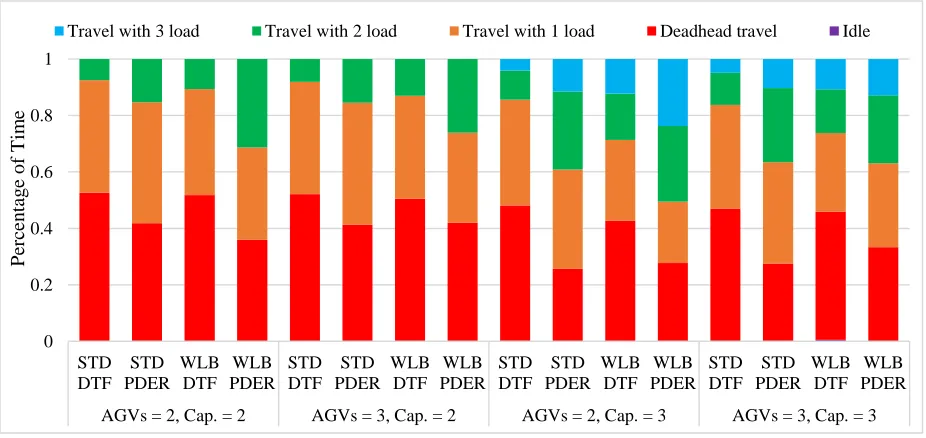
Figure 27: AGV capacity utilization analysis in FMS 1, experiment 2. ... 41
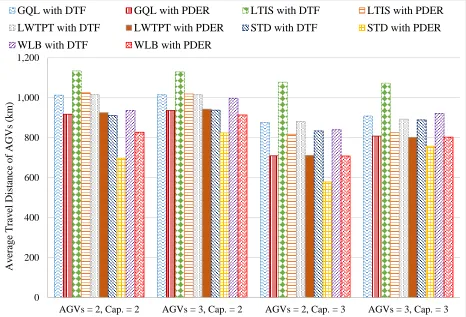
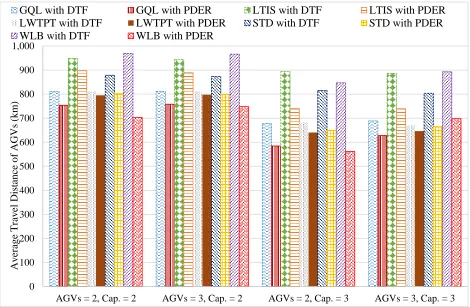
Figure 28: Average travel distance of AGVs in FMS 1, experiment 2. ... 42
Figure 29: Throughput Analysis of FMS 3, experiment 2. ... 44
Figure 30: AGV capacity utilization in FMS 2, experiment 2. ... 45
Figure 31: Average travel distance of AGVs in FMS 2, experiment 2. ... 46
vii
Figure 33: AGV capacity utilization in FMS 3, experiment 2. ... 49
Figure 34: Average travel distance of AGVs in FMS 3, experiment 2. ... 49
Figure 35: Add-on process for the Source in Simio.. ... 57
Figure 36: Theprocess invoked by the FindClosestPoint in Figure 13.. ... 57
Figure 37: The process invoked by FindEnRouteNode in Figure 13. ... 58
Figure 38: Th=e process invoked by FindEnRoutePart in Figure 13. ... 58
Figure 39: The process invoked by RemoveEnrouteNode in Figure 14. ... 58
Figure 40: The process invoked by Reset in Figure 14 and 18. ... 59
Figure 41: The process invoked by DecideContinue in Figure 17. ... 59
Figure 42: The process invoked by the AssignPriority in Figure 12 and 18. ... 59
Figure 43: Throughput Analysis of FMS 2 with dual-load AGVs. ... 60
Figure 44: Throughput Analysis of FMS 2 with triple-load AGVs. ... 60
Figure 45: Throughput Analysis of FMS 3 with dual-load AGVs. ... 61
Figure 46: Throughput Analysis of FMS 3 with triple-load AGVs. ... 61
Figure 47: AGV capacity utilization when using 2 (a) and 3 (b) dual-load AGVs in FMS 1. ... 62
Figure 48: AGV capacity utilization when using 2 (a) and 3 (b) triple-load AGVs in FMS 1. ... 62
Figure 49: AGV capacity utilization when using 2 (a) and 3 (b) dual-load AGVs in FMS 2. ... 63
Figure 50: AGV capacity utilization when using 2 (a) and 3 (b) triple-load AGVs in FMS 2. ... 63
Figure 51: AGV capacity utilization when using 2 (a) and 3 (b) dual-load AGVs in FMS 3. ... 64
viii
Notation
𝐵𝑎 A Boolean variable that indicates if workstation 𝑎 is blocked.
𝐶𝐼𝐵𝑏 Capacity of input buffer of workstation 𝑏.
𝐶𝑂𝑄𝑎 Capacity of output buffer of workstation 𝑎.
𝐷 The shortest distance between AGV, 𝑉, and job 𝑖.
𝐷𝑉 List of destinations for AGV, 𝑉, corresponding to its assigned and carried jobs.
𝑖 A transportation job (load) in the system.
𝐼 Waiting list of all unassigned jobs in the system.
𝐼𝑉 Set of low-cost jobs waiting at pickup points 𝑃𝑉 where 𝐼𝑉⊆ 𝐼. 𝐼𝐵𝑏 Input buffer of workstation 𝑏.
𝑁𝐼𝐵𝑏 number of parts in the input buffer of workstation 𝑏
𝑁𝑂𝐵𝑎 number of parts in the output buffer of workstation 𝑎
𝑂𝐵𝑎 Output buffer of workstation 𝑎.
𝑃𝑖 Priority of job 𝑖.
𝑃𝑉 List of pickup points located between the AGV’s current location and next destination.
𝑆𝑏 A Boolean variable that indicates if workstation 𝑏 is starved.
𝑉 An AGV in the system.
1
1. INTRODUCTION
As the business environment constantly changes and customer preferences keep evolving, firms
can no longer expect superior returns while producing standardized products. The increase in
tailoring, expanding in product range, and diminishing of order quantities have caused
controllability and financial issues (Kull, 2015). In this case, many firms try to redevelop their
competitive edges through transforming from mass production to flexible manufacturing.
Shivanand, Benal, and Koti (2006) define a flexible manufacturing system as a group of
workstations and storage systems interconnected by an automated material handling system and
controlled by an integrated computer system. Such a system is characterized by several complex
features, such as stochastic demands, large product variation, and random patterns of material flow,
where traditional material handling methods can no longer meet the challenges.
Automated guided vehicles are commonly used to provide efficient material flow and
distribution in a FMS. An AGV can be reviewed as a self-driven forklift or vehicle that
automatically loads, transports, and unloads work in progress (WIP) among storages and
workstations. An AGV system may outperform traditional material handling methods, such as
conveyors and forklifts in terms of higher flexibility and lower labor cost. However, the slow travel
speed, loading and unloading time, and limited capacity of AGVs can slow down the material flow
in a manufacturing system. Thus, a FMS with high traffic intensity usually requires a large number
of vehicles to avoid bottlenecks in material distribution. A large fleet size involves several issues,
such as large financial costs, traffic congestion, and large space requirement. One possible
alternative is to implement multiple-load AGVs that can carry more than one unit a time.
Multiple-load AGVs may help an FMS to achieve a high leve
l of throughput with a smaller fleet size when compared to single-load AGVs. However, the management of single- and multiple-load AGVs can be much different, especially for vehicle dispatching problems. As a single-load AGV only has loaded and unloaded states, dispatching only involves the determination of which job should be assigned to an available vehicle. In contrast, the extra loading spaces on multiple-load AGVs introduce a partially loaded state, which produces several other decision-making problems.2
to determine which point the AGV should visit next. As multiple-load AGVs are managed by more efficient task-determination and pickup-dispatching rules, we believe the system throughput and average time in system of parts will be maximized and minimized respectively in a FMS.
3
2. PROBLEM STATEMENT
One common problem for AGV systems in FMSs is that they require a large number of AGVs to deal with the dynamic environment and large product variation. Instead of moving material continuously like a conveyor, an AGV transports material in a discrete manner, which increases the flexibility but reduces the speed of material handling process. This is the reason that most AGV systems are only implemented in low to medium production volume systems. One common way to improve the speed of material flow is to increase the number of AGVs in the system. However, a large fleet size can produce several problems, such as traffic congestion, large financial cost, and large requirement of space. One possible alternative is to implement multiple-load AGVs that can carry most than one unit a time.
Despite the considerable amount of recent research on AGV dispatching rules, only few authors study multiple-load AGVs in FMS. However, the management of single- and multiple-load AGVs are much different. A single-load AGV only has empty and loaded states. When the AGV is empty, it only needs to decide which load should be picked up next. When the AGV is loaded, it only needs to find the destination of the carried load. The additional loading spaces on multiple-load AGVs introduce a partially loaded state. When an AGV is partially loaded, it needs to determine if the next task should be picking up a new load or dropping off a carried load, which is a task-determination problem. It is found that many researchers studying multiple-load AGVs use a delivery-task-first (DTF) rule to deal with the task determination problem. The DTF rule suggests that an AGV should always choose to deliver parts when it is partially loaded. However, as the DTF rule gives delivery tasks higher priorities, after an AGV drops off a load, the empty loading space will not be utilized until the AGV frees up all loading spaces. Such a problem will reduce the AGV capacity utilization and hence limits the system throughput.
It is found that most of pickup-dispatching rules are designed for single-load AGVs. Some researchers apply single-attribute rules on multiple-load AGVs to test their performances. As many researchers found that multi-attribute dispatching rules usually outperform single-attribute dispatching rules in terms of system throughput and average time in system, we believe the benefits of multiple-load AGVs are not fully captured by applying single-attribute dispatching rules.
4
3. LITERATURE REVIEW
This section reviews the previous research on automated guided vehicle management. The common ways to manage the coordination of AGVs are introduced and compared. The previous researches on multiple-load AGVs are demonstrated. The classification of AGV dispatching algorithm is summarized, and some common dispatching rules are introduced. Finally, the major findings from the literature review are discussed.
3.1 Scheduling vs. Dispatching
According to Vivaldini, Rocha, Becker, and Moreira (2015), the major design challenge of an AGV system is to assure that vehicles efficiently arrive to the desired destinations at the desired time within highly dynamic environments so that traffic conflicts, machine overloads, starvations, and other unpredicted events will be avoided. The most common approaches to manage the coordination among AGVs are dispatching and scheduling. Original AGV dispatching was defined as a function that assigns transportation tasks to vehicles, where scheduling determines the time at which vehicles should enter and leave the guide-path segments to avoid conflicts (Langevin, Lauzon, & Riopel, 1996). However, in recent years, scheduling becomes a task allocation process for AGVs considering the time and cost of operations (Corréa, Langevin, & Rousseau, 2007). A scheduling system can decide when, where, and how a vehicle performs tasks including the route it should take (Le-Anh & De Koster, 2006). With an on-line scheduling system, these decisions are specified and updated after a time horizon (Yang, Jaillet, & Mahmassani, 2004).
An AGV system designer can think of dispatching as a scheduling system with zero time horizon so that decisions are made once a vehicle reaches its destination or a new request is generated. Le-Anh et al. (2006) have conducted a comprehensive review study that lists pros and cons of dispatching and scheduling. Dispatching algorithms are typically more favorable in a highly stochastic environment, since it is difficult to schedule vehicles over a long period in such an uncertain environment. In case of a high job density, AGVs frequently move from one workstation to another so that a complicated scheduling system may not be as useful. Four common objectives of AGV dispatching rules are minimizing average time in system of parts, maximizing system throughput, minimizing queue length, and guaranteeing a certain service level at stations (Le-Anh and De Koster, 2006).
3.2 Multiple-load AGV Dispatching
5
a simulation on multiple-load AGVs in a highly automated seaport container terminal. The numerical results indicate that using dual-load AGVs can significantly improve the system efficiency with respect to average lateness and berthing time when compare to single-load AGVs. Ozden (1988) conducts a study to compare the performance of single- and multiple-load AGVs in an FMS. The results show that multiple-load AGVs can often help an FMS to achieve a higher level of throughput with a smaller fleet size. Some other benefits of multiple-load AGVs include improving machine utilizations and better utilization of AGVs (Bilge and Tanchoco, 1997).
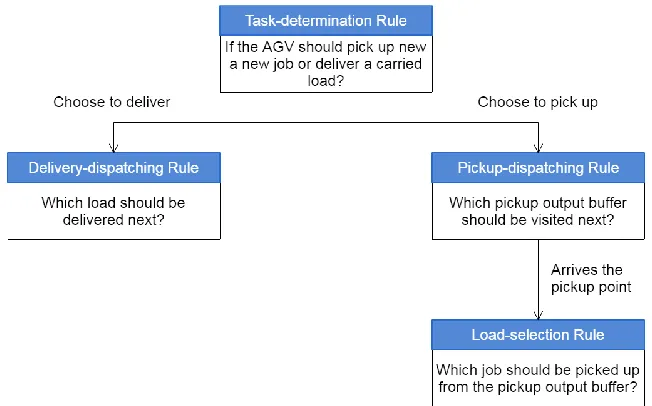
The major challenge of managing multiple-load AGVs is that the additional loading spaces increases the number of decision-making states. According to Ho and Chien (2006), a single-load AGV only has two decision-making states, which are empty and loaded, while a multiple-load AGV can be empty, partially loaded, and fully loaded. As shown in Figure 1, Ho and Chien (2006) define four major problems associated with dispatching multiple-load AGVs, which are,
Task-determination problem: determines if the AGV’s next task should be picking up a new job or dropping off a carried load when it is partially loaded.
Pickup-dispatching problem: determines which pickup point should the AGV visits when the vehicle has already decided its next task to be picking up a new load.
Delivery-dispatching problem: determines which load should be delivered next when the AGV has already decided its next task to be delivering a carried load.
[image:15.612.143.469.471.674.2] Task-selection problem: determines which load should be picked up when the AGV is visiting a pickup point.
6
Ho and Chien (2006) propose three rules to handle the task-determination problem. The pickup-task-first (PTF) rule indicates that when an AGV is partially loaded, it should always pick up new loads until it becomes full. A delivery-task-first (DTF) rule suggests that an AGV should always perform a delivery task when it is partially loaded. With either the PTF or DTF rule, an AGV should pick up as many parts as it can at a pickup point. Rather than giving the pickup or delivery task a higher priority, a load-ratio (LR) rule determines the AGV’s next task based on the load ratio on the vehicle. In order to compare the performance of these task-determination rules, Ho and Chien (2006) couple them with different delivery-dispatching rules and test them in a representitive FMS through simulation models. The results show that the DTF rule is more favorable in terms of maximizing throughput and minimizing average time in system. Based on their results, other authors also examine different pickup-dispatching, delivery-dispatching, and load-selection rules (Ho and Liu 2006, Ho and Liu 2009).
Azimi, Haleh, and Alidoost (2010) study pickup-dispatching and delivery-dispatching rules for multiple-load AGVs in an FMS. To evaluate the performances of different combinations of rules, the authors develop a fuzzy multi-attribute decision-making method that takes into account ten performance criteria, including system throughput (ST), mean flow time of parts (MFTP), mean tardiness of parts (MFTP), AGV idle time (AGVIT), AGV travel full (AGVTF), AGV travel empty (AGVTE), AGV load time (AGVLT), AGV unload time (AGVUT), mean queue length (MQL), and mean queue waiting (MQW). Their findings indicate that the best pickup-dispatching rule is Earliest Due Time (EDT), and the best delivery-dispatching rule is Shortest Distance (SD).
3.3 Workcenter-initiated vs. Vehicle-initiated Dispatching Rules
Pickup-dispatching rules can be categorized as either workcenter-initiated or vehicle-initiated rules (Egbelu, & Tanchoco, 1984). A workcenter-initiated rule involves the selection of a vehicle from a set of idle vehicles to be assigned to a transportation job. A vehicle-initiated rule involves the selection of a job from a set of unassigned jobs when there is only one available vehicle. Some well-known dispatching rules, first recognized in 1980s, are listed below. Notice that these rules are the key components of multi-attribute algorithms that are popular today.
A. Workcenter-initiated rules (single request and multiple vehicles):
a) Random Vehicle Rule (RV): the request is randomly assigned to any available vehicle. b) Nearest Vehicle Rule (NV): the vehicle with the shortest travel distance to the pickup point is
dispatched.
7
d) Longest Idle Vehicle Rule (LIV): assigns the vehicle that has been idle for the longest among all available vehicles.
e) Least Utilized Vehicle Rule (LUVR): assigns the vehicle that has the lowest utilization among all available vehicles.
B. Vehicle-initiated rules (multiple requests and single available vehicle):
a) Random Work-center (RW): the vehicle is randomly dispatched to any request.
b) Shortest Travel Time/Distance Rule (STT/D): releases the vehicle to the work station whose pickup point is closest to the vehicle’s current location.
c) Longest Travel Time/Distance Rule (LTT/D): an antithetical rule that releases the vehicle to the workstation whose pickup point is farthest to the vehicle’s current location.
d) Maximum Outgoing Queue Size Rule (MOQS): releases the vehicle to the workstation that has the longest outgoing queue.
e) Minimum Remaining Outgoing Queue Size Rule (MROQS): releases the vehicle to the workstation whose output queue length is closest to the output queue capacity.
f) Modified First Come First Serve Rule (MFCFS): dispatches the vehicle to the workstation that made the earliest request.
g) Unit Load Shop Arrival Time (ULSAT): assigns the vehicle to the load that has been in the system for the longest time.
Egbelu and Tanchoco (1984) present a simulation model that shows the performance of an AGV system is mainly governed by vehicle-initiated rules, while the impacts of workcenter-initiated rules are not significant. This is because in an efficient AGV system, the odds of having a workcenter-initiated condition should be relatively small.
8
3.4 Multi-attributed vs. Hierarchical Dispatching Algorithms
Le-Anh et al. (2006) classifies centralized dispatching rules as single-attribute, multi-attribute, hierarchical, look-ahead, and pre-emption dispatching rules. The single-attribute rules listed in section 2.3 are only concerned with one system parameter. As different attributes reflect different system conditions, a combination of several attributes are designed to give more comprehensive view of the system. A multi-attribute dispatching rule uses more than one parameters and generally outperforms single-multi-attribute rules. Weights are carefully assigned to the parameters depending on the objective of the function and influence of each parameter.
Kim, Tanchoco, and Koo (1991) propose a workload balancing algorithm that takes into account both the input and output queue lengths of workstations. The algorithm combines demand- and source-driven rules, which is outstanding in terms of system throughput. Jeong and Randhawa (2001) develop a workload balancing algorithm based on a bidding concept. Workstations holding transportation requests in their output buffers will bid for the available AGV based on the input queue length, output queue length, and distance from the AGV’s current location to the workstation. Rather than solely counting the number of parts at each workstation, the work content balancing algorithm proposed by Zamiri and Choobineh (2014) takes into account the processing time of each part. The algorithm has eliminated the bias introduced by the processing time of different part types and hence outperforms other balancing rules.
Rather than comparing all candidate jobs at once, a hierarchical rule will evaluate them at different levels (Tan & Tang, 2001). The candidates that cannot pass the first level are eliminated, and the rest will be evaluated in the next level. There can be more than two levels, and the last level will make the final decision. For a look-ahead dispatching rule, the transportation jobs that will be generated shortly in the future are foreseen and are taken into account to dispatch vehicles. De Koster, Le-Anh, and van der Meer (2004) show that a very short look-ahead period can significantly improve the efficiency of an AGV system. Pre-emption dispatching rules allow vehicles to be reassigned if certain conditions are met (Bozer & Yen, 1996).
3.5 Discussion
9
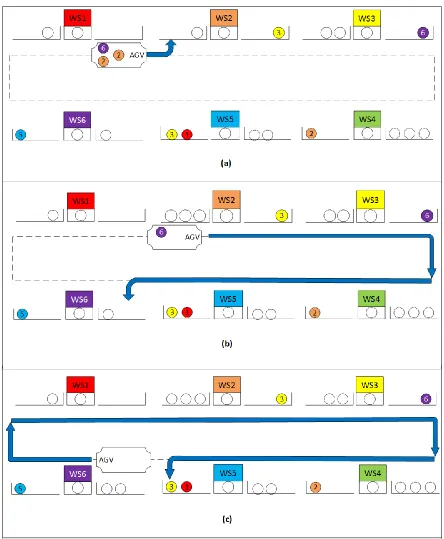
[image:19.612.84.528.123.662.2]the manner that an AGV will first visit the input buffer and then visit the output buffer of a workstation. The number and color of a part waiting at an output buffer or on the AGV indicate the part’s destination.
10
Figure 3: The second example of the DTF rule.
11
empty, it chooses the next pickup point to be the output buffer of WS5. In this example, the two empty loading spaces have not been utilized since the first two loads are dropped at the beginning.
Another problem is that when the AGV decides to visit a pickup point, the output queue of the workstation may not have enough loads to fill up the vehicle. In such a case, the empty space will not be utilized until the AGV delivers all parts loaded from this output queue. As shown in Figure 3(a), the triple-load AGV only finds two parts from the output buffer of the WS5. The AGV picks the triple-loads and deliver them to the WS1 and WS3 respectively. After it drops off the last load, it chooses the input buffer of the WS4 as its next pickup point. In this example, the AGV has an empty loading space since the beginning.
12
4. ALGORITHM DESIGN
In this section, we first introduce the pickup-or-delivery-en-route rule that deals with the task-determination problem. Then, we explain the workload balancing rule that is used for the pickup-dispatching problem. Besides the task-termination and pickup-dispatching rules, some other AGV control rules employed on the AGVs in the experiment are described. Finally, we introduce the task-determination rules and the pickup-dispatching rules that are used to compare with the PDER and WLB rules, respectively.
4.1 Pickup-or-Delivery-En-Route Rule
The task-determination rule proposed in this study is the pickup-or-delivery-en-route rule. The essential goal of the PDER rule is to maximize the utilization of loading spaces on multiple-load AGVs. The utilization can be increased by allowing a partially loaded AGV to pick up additional loads on its way moving towards the next destination. The PDER rule suggests that when a multiple-load AGV just completes all the necessary tasks at a pickup or delivery point and becomes partially loaded, it should search for a new assignment among the jobs whose pickup points are geographically located on the shortest path between the AGV’s current location and next destination. These jobs are named as low-cost jobs because it is very convenient for the AGV to pick them up. The next destination is the closest pickup or delivery point corresponding to a job that have been assigned to or carried by the AGV.
4.1.1 Important Queues
Ho and Chien (2006) defines the three states of a multiple-load AGV as empty, partially loaded and fully loaded. As the PDER rule allows an AGV to pick up additional loads on its way moving towards the next destination, an additional job assigning step must be considered to ensure that an AGV will “remember” the previously assigned jobs after it picks up a low-cost job. Table 1 demonstrates the differences in vehicle states between single-load and dual-load AGVs when the assigning step is introduced.
Table 1: Differences in vehicle states between single- and dual-load AGVs.
Single-load AGV states Dual-load AGV states
Empty Empty
Empty but assigned Empty but assigned to one job Empty but assigned to two jobs Loaded One carried load and one empty space
13
With a PDER rule, a transportation job 𝑖will be kept in any one of the three queues: the waiting list, 𝐼, presents all unassigned jobs in the system; an AGV’s assignment list indicates the jobs that have been assigned to the AGV; and an AGV’s workload list demonstrates the jobs that have been picked up and carried by the AGV. Once a job is assigned to an AGV, it will be removed from the waiting list of the system and added to the AGV’s assignment list. As the job is picked up by the AGV, it will be transferred from the AGV’s assignment list to the workload list. Finally, the jobwill be removed from the workload list when the AGV drops it off at its destination.
A destination list, 𝐷𝑉,is a list of destinations for AGV, 𝑉, corresponding to its assigned and carried
jobs. For each time 𝑉 is assigned to a new job, the pickup point (𝑂𝐵𝑎) and drop-off point (𝐼𝐵𝑏) of the job
will be added to 𝐷𝑉. As 𝑉 picks up or drops off a job, 𝐵𝑂𝑎 or 𝐼𝐵𝑏will be removed from 𝐷𝑉respectively.
An AGV’s low-cost-pickup-point list 𝑃𝑉 is a list of pickup points that geometrically locate between the AGV’s current location and next destination (including the current location and next destination). An AGV’s low-cost-job list 𝐼𝑉 ⊆ 𝐼 is a subset of the waiting list that records all jobs waiting at the low-cost-pickup points. These jobs are considered to have low costs since it is very convenient for the AGV to pick them up.
4.1.2 Flowchart
Egbelu and Tanchoco (1984) categorize AGV dispatching problems as workcenter-initiated and vehicle-initiated. Under a workcenter-initiated condition, there are many idle AGVs and one transportation request so that the AGVs will compete for the request. Under a vehicle-initiated condition, there is only one available AGV and many transportation requests so that the requests will compete for the AGV. We convert these two conditions into events that will invoke the decision-making processes in the PDER rule. As shown in Figure 4, a workcenter-initiated event occurs when a partgenerates a new request for being transported to the succeeding workstation based on its processing sequence. As a part is finished by workstation 𝑊𝑆𝑎
and passed to the output buffer, a transportation job 𝑖(𝑂𝐵𝑎, 𝐼𝐵𝑏) will be generated. The output buffer of 𝑊𝑆𝑎 (𝑂𝐵𝑎) and the input buffer of 𝑊𝑆𝑏 (𝐼𝐵𝑏) indicate the pickup and drop-off points of the job
14
Figure 4: The flowchart of PDER rule
A vehicle-initiated event occurs when an AGV reaches a pickup or delivery point. As shown in Figure 4, when an AGV reaches a point, it will first perform the pickup or drop-off task that is pre-determined for the assigned or carried job respectively. Notice that rather than picking up as many parts as the AGV can like a DTF rule, the PDER rule only allows the AGV to pick up the jobs in it its assignment list. Once the AGV completes the pre-determined task, it will be in one of the three conditions:
15
Case 2: As 𝑉 is assigned to or carrying one or more loads, it will first define its next destination, which is the closest pickup or drop-off point in its destination list 𝐷𝑣. If the total number of jobs
assigned to and carried by 𝑉 is smaller than the vehicle capacity, 𝑉 will define its low-cost-pickup-point list 𝑃𝑉 and low-cost-job list 𝐼𝑉. If 𝐼𝑉 is not empty, 𝑉 will use a pickup-dispatching rule to
determine the low-cost-pickup point that has the highest priority. A low-cost job waiting at this pickup point will be selected based on the task-selection rule. If 𝐼𝑉 is empty, 𝑉 will move to the next destination.
Case 3: As 𝑉 is assigned to or carrying one or more loads, it will first define its next destination. The total number of assigned and carried jobs equals vehicle capacity. In this case, 𝑉 will move to the next destination.
In Case 1 and 2, after i is assigned to 𝑉 and removed from 𝐼, 𝑉’s subsequent states will follow either Case 2 or Case 3. In other words, 𝑉 will not leave the pickup or drop-off point unless the vehicle is fully assigned, 𝐼 in Case 1 is empty, or 𝐼𝑉 in Case 2 is empty. As the next destination is defined as the closest pickup or drop-off point in 𝑉’s destination list, the delivery-dispatching decisions always follow the STD rule.
4.1.3 Example of PDER Rule
Figure 5 demonstrates an example of using the PDER rule. The AGV in this example has three loading spaces, and it has just completed a delivery task and become partially loaded at 𝐼𝐵2. The
pickup-dispatching, delivery-pickup-dispatching, and load-selection rules are the greatest-queue-length, shortest-travel-distance, and first-in-queue-first-out rules. The following steps demonstrate the process of a PDER rule,
a) Since 𝑉 is not empty nor fully assigned, it needs to find another assignment to depart from 𝐼𝐵2. Its
next destination is 𝐼𝐵6 so that 𝑉 defines 𝑃𝑉= {𝑂𝐵2, 𝑂𝐵3, 𝑂𝐵4, 𝑂𝐵5}. There are 6 low-cost jobs
in 𝐼𝑉.
b) Based on the greatest-queue-length rule, 𝑉finds that 𝑂𝐵5has the highest urgency level to be served
among the low-cost pickup points. The first part in 𝑂𝐵5 is assigned to 𝑉, which needs to be
transported to 𝐼𝐵3. After assigning the job, 𝑉is still not fully assigned. Its next destination becomes 𝑂𝐵5since it is closer than 𝐼𝐵6. 𝑉 defines 𝑃𝑉 = {𝑂𝐵2, 𝑂𝐵3, 𝑂𝐵4, 𝑂𝐵5} and 𝐼𝑉, which contains 5
low-cost jobs. As 𝑂𝐵5 still has the greatest output queue length, another job at 𝑂𝐵5 is assigned
to 𝑉, which needs to be transported to 𝐼𝐵1. As 𝑉 becomes fully assigned, it departs from 𝐼𝐵2.
c) After 𝑉 reaches 𝑂𝐵5, it first perform the predetermined pickup tasks for the assigned jobs. 𝑉
defines the current destination list 𝐷𝑉= {𝐼𝐵1, 𝐼𝐵3, 𝐼𝐵6} and finds that 𝐼𝐵6 is the closest
16
17
4.2 Workload Balancing Rule
4.2.1 Workload Balancing Concept
The proposed pickup-dispatching rule operates on a bidding concept. When an AGV becomes empty or partially loaded, the jobs in 𝐼 or 𝐼𝑉 will bid for the AGV, respectively. The job with the highest bidding score will win the auction. The bidding score is based on a workload-balancing concept. The essential goal is to avoid machine blocking and starvation and hence improve the throughput.
Four rules are used to rank job priorities. For Rule 1, if the delivery of a job can avoid both machine blocking and starvation problems, such a job should have the highest priority. Figure 6 gives an example of Rule 1. All parts waiting at 𝑂𝐵1need to be transported to 𝐼𝐵2 and parts at 𝑂𝐵3 need to be delivered to 𝐼𝐵4. We only consider the two parts at the beginning of the output queues at WS1 and WS3. All the output and input buffer capacities are 3. As there is a machine blocking at WS1 and WS3 and a starvation at WS2, the part at 𝑂𝐵1has a higher priority.
For Rule 2, if the delivery of a job can avoid a machine blocking or starvation problem, such a job should have a high priority. Figure 7 gives an example of Rule 2. A machine blocking occurs at WS1, and there is no machine blocking at WS3 nor starvation at WS4. In this case, the part waiting at 𝑂𝐵1has a
higher priority.
Figure 6: An example of Rule 1.
18
For Rule 3, a workstation that is closer to have a machine blocking or starvation should have a higher priority. Figure 8 demonstrate an example of Rule 3. There is no machine blocking nor starvation observed in the system. However, there are more parts waiting at 𝑂𝐵1when compare to 𝑂𝐵2 so that WS1 is closer
to a machine blocking. In this case, the part waiting at 𝑂𝐵1has a higher priority. For Rule 4, a
shortest-travel-distance rule is applied to break the tie. If multiple jobs tie by using Rule 1, 2, and 3, the job whose pickup point is closer to the AGV’s current location will have a higher priority.
Figure 8: An example of Rule 3.
4.2.2 Job Evaluation
We convert the job ranking rules into a compound algorithm. When 𝑉 arrives a pickup or delivery point (𝐼𝐵𝑐/𝑂𝐵𝑑). If 𝐼in Case 1 or𝐼𝑉 in Case 2 is not empty, 𝑉 will evaluate the score of each job in the list. The score of job𝑖(𝑂𝐵𝑎, 𝐼𝐵𝑏) is determined by,
𝑃𝑖 = 𝐵𝑎∗ 100 + 𝑆𝑏∗ 100 + 10 ∗ ( 𝑁𝑂𝑄𝑎
𝐶𝑂𝑄𝑎+
𝐶𝐼𝑄𝑏− 𝑁𝐼𝑄𝑏 𝐶𝐼𝑄𝑏 ) +
1
𝐷 + 1. (1)
The term 𝐵𝑎is a Boolean variable that indicates if there is a machine blocking at 𝑖’s current output
buffer 𝑂𝐵𝑎, while 𝑆𝑏specifies if there is a starvation at 𝑖’s succeeding buffer 𝐼𝐵𝑏. The term 𝑁𝑂𝑄𝐶𝑂𝑄𝑎
𝑎is the
normalized output queue size of job 𝑖’s current workstation. The 𝑁𝑂𝑄𝑎represents the number of parts in
the output buffer and 𝐶𝑂𝑄𝑎is the buffer capacity. The term𝐶𝐼𝑄𝐶𝐼𝑄𝑏−𝑁𝐼𝑄𝑏
𝑏 is the normalized input queue size of
job 𝑖’s succeeding workstation. The 𝑁𝐼𝑄𝑏represents the number of parts in the input buffer and 𝐶𝐼𝑄𝑏is the buffer capacity. D is the shortest distance from AGV’s current location to 𝑖’s pickup point.
4.2.3 Example of WLB Algorithm
This section demonstrates an example of the WLB rule. We compare the bidding scores of the parts shown in Figure 6. The job that needs to be transported from 𝑂𝐵1 to 𝐼𝐵2is named job 1 and the job that needs to be delivered from 𝑂𝐵3 to 𝐼𝐵4 is name job 2. We assume the distance from the AGV’s current location to
19
𝑆1= 100 ∗ 1 + 100 ∗ 1 + 10 ∗ (3 3+
3 − 0 3 ) +
1
1 + 1= 220.5
𝑆2= 100 ∗ 1 + 100 ∗ 0 + 10 ∗ (3 3+
3 − 0 3 ) +
1
1 + 1= 120.5
In this case, job 1 has a higher priority.
4.3 AGV Control Rules
This section introduces the other AGV control rules that are necessary to manage AGVs besides the task-determination and pickup-dispatching rules. These rules include the workcenter-initiated rule, delivery-dispatching rule, and load-selection rules. There is no degree of freedom introduced to them since they are not the focus of this study. This section also explains the task-determination and pickup-dispatching rules that are used to compare with the PDER and WLB rules.
4.3.1 Workcenter-initiated Rule
Egbelu and Tanchoco’s study (1984) shows that the performance of an AGV system is mainly governed by the vehicle-initiated rule, since the workcenter-initiated condition only has a small odd to occur. Our preliminary study also shows that the AGV utilizations in most systems are high around 99%. In this case, a single-attribute workcenter-initiate rule is applied to the system. Egbelu and Tanchoco (1984) list several workcenter-initiated rules. The nearest-vehicle (NV) rule has an outstanding throughput performance when compare to other single-attribute rules. In this case, we simply apply the NV rule for the workcenter-initiated conditions. When a new transportation request is generated and more than one AGVs are idle at the moment, each AGV will find the shortest path to the pickup point of the job. The AGV that has the smallest travel distance to the pickup point will be assigned for the job.
4.3.2 Delivery-dispatching Rule
The SD rule is used to determine which load should be dropped off first. With a DTF task-selection rule, when an AGV identifies its next movement as a delivery task, the AGV will determine the shortest path to each required delivery point. The delivery point that is closest to the AGV’s current location will be visited next. With a PDER rule, an AGV’s next destination will always be the pickup or delivery point in its destination list that is closest to its current location.
4.3.3 Load-selection Rule
20
higher priority. With a PDER task-determination rule, the FIQFO rule will be invoked during the job assigning process demonstrated in Figure 4. For example, with a GQL pickup-dispatching rule, if 𝑉 finds that 𝑂𝐵𝑎has the longest queue, the vehicle will only be assigned for the job that has the longest waiting time at 𝑂𝐵𝑎.
4.3.4 Pickup-dispatching Rules
Four different pickup-dispatching rules are used to compare with the WLB rule. A pickup-dispatching rule is used to determine which pickup point the AGV should visit next. An additional constraint is employed in each pickup-dispatching rule including the WLB with DTF rule. We allow an AGV to pick up a job only when the job’s succeeding input buffer has less than 6 parts. The input-buffer constraint will avoid the overflow in input buffers. The other four pickup-dispatching rules in this study are:
Longest-Time-In-System (LTIS): V identifies the time in system, TIS, for all the parts whose transportation request is still unassigned in 𝐼 or 𝐼𝑉 depending on 𝑉’s current status. The part with a
longer TIS will have a higher pickup priority.
Longest-Waiting-Time-at-Pickup-poinT (LWTPT): 𝑉 identifies the amount of time that a job has been waiting at the pickup point, WTPT, for all jobs in 𝐼 or 𝐼𝑉 depending on 𝑉’s current condition. The job with a longer WTPT will have a higher pickup priority.
Shortest-Travel-Distance (STD): 𝑉 identifies all the unassigned jobs in 𝐼 or 𝐼𝑉and determines the
shortest path to each job’s pickup point. Vselects the closest pickup point.
Greatest-Queue-Length (GQL): 𝑉 identifies all the unassigned jobs in 𝐼 or 𝐼𝑉and determines the output
queue length of each job’s pickup point. V will select the job whose pickup point has the longest queue.
4.3.5 Task-determination Rule
21
22
5. IMPLEMENTATION
Two simulation models were constructed using Simio simulation software version 9.147. We use six modeling objects to build the hypothetical FMSs in Simio, including Source, Sink, Server, Modelentity, Path, Vehicle, and Modelentity objects. The Source and Sink objects are the entry and exit of a system. A Modelentity object is used as a part, which is created by a Source, processed by Servers, and destroyed by a Sink. The Vehicle object is used to reproduce the behaviors of AGV that moves along the Paths. This section explains the implementations of the PDER, DTF, and WLB rules in Simio.
5.1 Implementation of PDER
The Vehicle object in Simio 9.147 has the basic characteristics of a DTF task-determination rule. After a Vehicle reaches an assigned output buffer, it will continue to load parts until all loading spaces are filled or the output buffer becomes empty. Then, the Vehicle will continue to deliver the carried loads until it frees up all loading spaces. In order to implement the PDER rule, the first step is to change the continue loading behavior. With a PDER rule, an AGV should only pick up the assigned job at a pickup point. Figure 10 demonstrates a portion of OnVisitingNode process for the Vehicle object in Simio. The OnVisitingNode
process is invoked whenever the Vehicle reaches a node (point). Figure 11 through 14 show the modifications for the PDER rule. The blocks in gray are default steps. The block in green indicates that it is a new or revised step. A block in red means it is a new or revised decision-making step. Each block in yellow will invoke another process, which is demonstrated in the Appendix.
23
Figure 11: Modification of Vehicle object that determines the next distance.
Figure 12: Modification of Vehicle object that assigns a job to empty AGV.
24
Figure 14: Modification of Vehicle object that assigns a low-cost job to AGV.
As shown in Figure 10, a Vehicle with original setup will first go through the NextDropoff step. If the Vehicle is not empty, it will find the next delivery point based on a delivery-dispatching rule and then leave the current location. If the Vehicle fails to find a part to deliver, it uses the NextPickup step to find the next job to pick up among the assigned jobs. If there is no job assigned to the Vehicle, it will go through the NewRequests step to find a new assignment based on a pickup-dispatching rule.
In the PDER setup, two local variables are used to record the closest pickup and delivery points for the assigned and carried jobs. As shown in Figure 11, the ResetDropoffNode and RestpickupNode steps are used to reset the variables. The NextDropoff and NextPickup steps will find the closest delivery and pickup points. The AssigndropoffNode and AssignPickupNode steps assign the values of the variables to be the closest pickup and delivery points. The IfFullyLoaded step examines if the AGV is fully loaded.
If the Vehicle fails to find a delivery point, the process will jump to the NextPickup step. If the Vehicle is fully loaded, it will leave the current workstation and moves towards the closest delivery point (Case 3). If the Vehicle fails to find neither a delivery point nor a pickup point, it indicates that the vehicle is empty and unassigned (Case 1). The process will jump to the AssignPriority Step shown in Figure 12. The AssignedPriority step assigns each job in the waiting list a priority based on a pickup-dispatching rule. Notice that if the job’s succeeding input buffer has more than 6 parts waiting, the priority of the job becomes 0. The IfAllowPickup step examines if there is any part waiting in the system that can satisfy the input-buffer constraint. If the waiting list is empty or no job can satisfy the constraint, the vehicle will park at the current workstation. If there is at least one job that can satisfy the constraint, the job with the highest priority will be assigned to the Vehicle through the NewRequests step.
25
destination (Case 3). Otherwise, the process moves to the ResetStarNode step. At this point, the AGV’s current state should be partially loaded (Case 2). The ResetStarNode, FindEnRouteNode, IfStopSearching, and ResetStarNode steps are used to define the low-cost-pickup-point list. The FindEnRoutePart step is used to search and assign priorities to low-cost jobs based on a pickup-dispatching rule.
As shown in Figure 14, after assigning priorities to low-cost jobs, the Vehicle clears the low-cost-pickup-point list through the RemoveEnRNode step. The AnyEnRouteJob and ResetEnroute steps are used to examine the low-cost-job list. If the Vehicle fails to find any low cost job that can satisfy the constraint, the Vehicle moves to the closest destination. Otherwise, the AssignLowCostJob step will assign the low-cost job with the highest priority to the Vehicle. The reset step sets the priorities of all jobs in the system to be 0. After that, the process moves back to the ResetDropOff step and starts over again.
Figure 15 demonstrates the process that makes the Vehicle object continuously load new parts when arrives a pickup point in Simio 9.147. Figure 16 shows the modifications that change the continuous loading behavior. As shown in Figure 15, the Rider, IfWaitUntilRiderLoad, and UntilRiderLoaded steps form a loop process that as long as the Vehicle is not fully loaded and the output buffer is not empty, the Vehicle will continue to pick up. As shown in Figure 16, we add the IfMoreAssignedJob process that will return true only if another job in the current pickup point has been assigned to the Vehicle from a previous process. The NumbOfLoad step is used to record the statistics of loading space utilization, which is irrelevant to the continuous loading behavior.
26
Figure 16: Modification of Vehicle object that only allows the Vehicle to pick up assigned jobs.
5.2 Implementation of DTF
Although the default setup of a Vehicle object follows the DTF rule, some additional steps need to be added to implement the pickup-dispatching rules and set the input-buffer constraint. Figure 17 and 18 demonstrate the modifications for the Vehicle using DTF. As shown in Figure 17, the ResetContinue, DecideContinue and IfContinue steps determine if the next part in the current output buffer can satisfy the input-buffer constraint. If the constraint is satisfied, the IfCountinue step returns true and the Vehicle loads one more part. Otherwise, the process moves to the IfMinimumDwell step. Again the NumberOfLoad step is used to record the statistics of AGV capacity utilization.
27
Figure 18: Modification of Vehicle object implement the pickup-dispatching rule when using the DTF rule.
As shown in Figure 18, if the Vehicle with DTF is not assigned to or carrying any job, the process will move to the Reset step. The Reset step sets the priority of each job in the waiting list to 0. Then, the AssignPriority step searches for jobs that can satisfy the input-buffer constraint and gives each them a priority based on the pickup-dispatching rule. The IfAllowPickup step examines if any job can satisfy the constraint. Finally, if there is at least one job that can satisfy the constraint, the NewRequests step will assign the job with the highest priority to the Vehicle.
5.3 Implementation of WLB
Figure 19 demonstrates the process invoked by the AssignPriority steps in Figure 12 and 18 when using the WLB pickup-dispatching rule. The ForAllParts step searches the waiting list and find the jobs that can satisfy the input-buffer constraint. The IfPreventStarving amd PreventStarving steps assign an appropriate value to the Boolean variable 𝑆𝑏, which indicates if the job’s succeeding workstation is starving. The
IfPreventBlocking amd PreventBlocking steps assign an appropriate value to the Boolean variable 𝐵𝑎,
28
29
6. EXPERIMENT FOR THE PDER RULE
In this study, we conduct two simulation-based experiments. The first experiment (experiment 1) compares the PDER rule with the DTF rule in two hypothetical FMSs. The second experiment (experiment 2) compares the WLB rule with four pickup-dispatching rules while using both DTF and PDER task-determination rules. This section presents the experiment design and output analysis of experiment 1.
6.1 Experiment Design (Experiment 1)
The first experiment compares the performance of the PDER and DTF task-selection rules paired with four alternative pickup-dispatching rules in two FMS configurations, FMS 1 and FMS 2. The other factors under consideration include the AGV fleet size ranging from 1 to 4 vehicles, and the vehicle types include dual- and triple-load AGVs resulting in a total of 128 test scenarios. The experimental factors and their levels are presented in Table 2. The primary performance measures considered for this experiment are throughput and average time in system (ATIS).
Both FMS 1 and FMS 2 operate on a pull concept, that a new part with a random part type will enter the system when the Entry station’s queue length is smaller than its capacity. The capacity of the Entry station is 6 in both FMSs. In both configurations, an AGV’s loading and unloading times are 15 seconds per part, and its travel speed is 2 miles per hour. The simulation experiments are set up to run 20 replication of each scenario consisting of 500 hours of continuous operations which includes a warm-up period of 6 and 12 hours for FMS 1 and FMS 2, respectively.
Table 2: Factors considered in experiment 1. Dispatching rules System Configuration
Pickup-Dispatching
Task-determination
Flexible manufacturing system (FMS)
Number of AGV (AGVs)
AGV Capacity (AGV Cap.)
QGL PDER 1 1 2
LTIS DTF 2 2 3
LWTPT 3
STD 4
6.1.1 FMS 1 Configuration (Experiment 1)
30
Table 3. In addition, Table 3 lists the processing sequence for each part type as well as the average processing time. We assume that the processing time of a part at a workstation follows an exponential distribution. A completed part will leave the system from the Exit station.
Figure 20: Layout of FMS 1.
Table 3: Part routing and processing information for FMS 1, experiment 1. Part Type Operation Sequence and Average Process Time
Station (Time in Seconds)
Production Volume Percentage A 1(270)-5(180)-4(360)-6(270)-2(360)-7(270) 20% B 7(270)-5(360)-4(180)-8(270)-6(270)-2(180) 20% C 3(180)-2(360)-5(270)-6(180)-8(180) 20% D 4(270)-3(360)-8(180)-5(180)-1(270) 20% E 3(270)-1(360)-5(180)-6(360)-7(270) 20%
6.1.2 FMS 2 Configuration (Experiment 1)
31
Figure 21: Layout of FMS 2 (Ho and Chien, 2006).
Table 4: Part routing and production volume percentages for FMS 2. Part type Operation Sequence Production Volume Percentage
A 2-4-6-8-10 16%
B 1-3-5-7-9 17%
C 3-4-6-8-9 18%
D 2-3-4-8-10 15%
E 1-2-5-7-8 14%
F 4-5-6-9-10 20%
Table 5: Processing time distributions at each workstation for FMS 2, experiment 1.
Workstation Processing Time (Minutes) Workstation Processing Time (Minutes) 1 N(1, 0.1) 6 N(2, 0.2)
32
6.2 Output Analysis (Experiment 1)
For each of the treatment combinations of the simulation experiment, statistics on throughput and time in system are recorded. The throughput results for FMS 1 and FMS 2 are presented in Figures 22.
Figure 22: System throughput results for (a) FMS1 with dual-load AGVs; (b) FMS 1 with triple-load AGVs; (c) FMS2 with dual-load AGVs; and (d) FMS 2 with triple-load AGVs in experiment 1.
As a reference point, a simulation configuration that assumes instantaneous material handle has been run to establish an upper bound for throughput. The upper bound is 6,000 parts for FMS 1 and 9,800 parts for FMS 2. Given the results presented in Figure 22, we observe several cases where the system is under
1 2 3 4 5 6
1 2 3 4
T h ro u g h p u t ( th o u sa n d u n it s)
Number Of AGV (a)
LWTPT With PDER LTIS With PDER
LWTPT with DTF LTIS With DTF
1 2 3 4 5 6
1 2 3 4
T h ro u g h p u t ( th o u sa n d u n it s)
Number Of AGV (b)
GQL With PDER STD With PDER
GQL With DTF STD With DTF
2 3 4 5 6 7 8 9 10
1 2 3 4
T h ro u g h p u t ( th o u sa n d u n it s)
Number Of AGV (c) 2 3 4 5 6 7 8 9 10
1 2 3 4
T h ro u g h p u t ( th o u sa n d u n it s)
33
capacitated (FMS 1 with one AGV regardless of AGV capacity; and FMS 2 with one or two dual-load AGVs, and one triple-load AGV.) In addition, in FMS 1 when four AGVs are utilized and in FMS 2 when four dual-load or three or four triple-load AGVs are used, the system becomes over capacitated in terms of AGVs. That is, there is sufficient vehicle capacity that AGV control rules do not have a significant impact (at 𝛼 ≤ 0.05) on throughput. Therefore, we focus our analysis on the scenarios in Table 6.
Table 6: Scenarios that are the focus of analysis in experiment 1. Scenario Scenario
FMS AGVs Capacity FMS AGVs Capacity
1 2 2 2 3 2
1 3 2 2 2 3
1 2 3
Tables 7 and 8 show the throughput mean and standard deviation of the selected scenarios in FMS 1 and FMS 2, respectively. For each scenario, a Tukey multiple-means comparison test is conducted at a significance level of 0.05 to compare the mean throughput under each pair of AGV control rules. The shaded throughput values indicate that the corresponding combination of rules yields the highest throughput in the scenario. Where multiple values are shaded for a particular scenario, the means are in the highest group of mean throughput, but the means are not significantly different than one another.
Table 7: Mean (standard deviation) of throughput for selected scenarios in FMS 1, experiment 1. AGV Config. Pickup-Dispatching Rule / Task-Selection Rule
AGVs
AGV Cap.
STD PDER
LWTPT PDER
GQL PDER
LTIS PDER
STD DTF
LWTPT DTF
GQL DTF
LTIS DTF 2 2 5,376.2 4,508.0 4,503.5 4,338.8 3,604.9 3,493.5 3,484.2 2,851.7
(17.9) (15.3) (14.0) (13.2) (42.5) (16.0) (12.2) (14.2) 3 2 5,959.3 5,958.3 5,948.5 5,933.9 5,610.5 5,240.3 5,264.1 4,307.5
(89.8) (68.5) (91.5) (60.0) (37.5) (14.2) (17.2) (17.2) 2 3 5,976.9 5,956.4 5,951.2 5,829.9 4,410.5 4,614.1 4,635.4 3,528.1
34
Table 8: Mean (standard deviation) of throughput for selected scenarios in FMS 2, experiment 1. AGV Config. Pickup-Dispatching Rule / Task-Selection Rule
AGVs AGV Cap. LWTPT PDER STD PDER GQL PDER LTIS PDER GQL DTF LWTPT DTF STD DTF LTIS DTF 3 3 9,580.4 9,454.7 9,527.4 9,470.5 9,555.6 9,420.0 8,884.1 8,217.1
(55.9) (52.2) (80.6) (53.2) (49.4) (41.0) (27.4) (21.2) 2 2 8,451.9 8,438.4 8,426.3 8,251.3 8,077.7 7,877.4 7,096.6 6,593.5
(17.7) (22.5) (18.7) (10.2) (14.9) (15.1) (21.0) (20.7)
In Table 6 we observe that the highest throughput is always achieved using the STD with PDER rules. When there are 3 dual-load AGVs and 2 triple-load AGVs, any pickup-dispatching rule can reach the highest throughput as long as it is coupled with a PDER task-determination rule. If using the same pickup-dispatching rule, PDER outperforms DTF in terms of throughput. Similarly, in Table 7 when using 3 dual-load or 2 triple-dual-load AGVs, the highest throughput is always achieved with a PDER rule. When using the same pickup-dispatching rule in these two scenarios, the PDER rule yields a higher throughput.
In addition to throughput, we analyze the performance of the AGV control rules with respect to the average time parts spend in the system. Tables 8 and 9 summarize the mean and standard deviation of the average time is systems for each of the selected scenario in FMS 1 and FMS 2, respectively. We conduct an analogous multiple-means comparison test on these means and shade the highest performing group for each scenario.
Table 9: Mean (standard deviation) of ATIS in minutes for selected scenarios in FMS 1, experiment 1. AGV Config. Pickup-Dispatching Rule / Task-Selection Rule
AGVs AGV Cap. STD PDER LTIS DTF LTIS PDER LWTPT PDER GQL PDER LWTPT DTF GQL DTF STD DTF 2 2 216.0 219.7 298.6 488.3 572.0 663.8 850.7 2645.9
(9.9) (1.2) (3.8) (4.9) (4.5) (6.4) (3.3) (271.1) 3 2 110.9 171.4 145.8 143.9 143.1 388.3 524.6 227.8
(3.6) (1.8) (6.2) (7.1) (9.2) (6.1) (12.1) (16.3) 2 3 128.6 214.2 148.2 161.0 164.9 468.0 607.8 1571.8
35
Table 10: Mean (standard deviation) of ATIS in minutes for selected scenarios in FMS 2, experiment 1. AGV Config. Pickup-Dispatching Rule / Task-Selection Rule
AGVs
AGV Cap.
STD PDER
LTIS DTF
LTIS PDER
LWTPT PDER
GQL PDER
LWTPT DTF
GQL DTF
STD DTF
3 2 48.5 68.4 93.2 99.4 102.8 116.3 167.5 713.4
(0.8) (1.8) (3.6) (5.4) (7.3) (4.7) (17.2) (148.0) 2 3 80.1 99.7 137.8 159.4 161.3 187.6 345.4 1354.8
(0.7) (12.5) (1.8) (2.3) (2.8) (1.9) (3.2) (96.4)
36
7. EXPERIMENT FOR THE PDER AND WLB RULES
7.1 Experiment Design (Experiment 2)
In this section, we present the second simulation experiment to evaluate the effectiveness of the PDER task-determination rule and the WLB pickup-dispatching rule. As shown in Table 11, the WLB and PDER rules are compared to 4 pickup-dispatching and 1 task-determination rules respectively, which end up with 10 rule combinations. Each rule combination is tested in three system configurations where we vary the number of AGVs in the system as well as the AGV capacity. A simulation-experiment is conducted to compare the performances of the rule combinations under the various system configurations where the performance measures are system throughput, AGV capacity utilization, travel distance, and average time in system. There are total of 240 scenarios, and each scenario is run for 20 replications with a 500-hour run time and a 12-hour warm-up period.
Table 11: Factors considered in experiment 2. Dispatching rules System Configuration
Pickup-Dispatching
Task-determination
Flexible manufacturing system (FMS)
Number of AGV (AGVs)
AGV Capacity (AGV Cap.)
WLB PDER 1 1 2
QGL DTF 2 2 3
LTIS 3 3
LWTPT 4
STD
We consider three Flexible Manufacturing Systems in experiment 2, FMS 1, FMS 2, and FMS 3. All systems operate on a pull concept, that a new part with a random part type will enter the system when the Entry station’s queue length is smaller than its capacity. In all configurations, an AGV’s loading and unloading times are 30 seconds per part, and its travel speed is 2 miles per hour. We ignore the traffic problem that multiple AGVs can move on the same path at the same moment without causing a traffic congestion. The AGVs will park at the home point at the beginning of the simulation and wait at the last delivery point when it becomes idle.
7.1.1 FMS 1 Configuration (Experiment 2)
37
Table 12: Part routing and processing information for FMS 1, experiment 2. Part
Type
Operation Sequence and Average Process Time Station (Time in Seconds)
Production Volume Percentage A 1(270)-2(180)-3(360)-5(270)-7(360)-8(270) 20% B 2(270)-4(360)-5(180)-6(270)-7(270)-8(180) 20% C 1(180)-2(360)-3(270)-5(180)-8(180) 20% D 2(270)-3(360)-4(180)-5(180)-6(270) 20% E 1(270)-3(360)-4(180)-6(360)-7(270) 20%
7.1.2 FMS 2 Configuration (Experiment 2)
The layout of FMS 2 in the second experiment is generally the same as the layout of FMS 2 in the first experiment. The exceptions are the input and output buffer capacities are set to 6 and 12 respectively and the processing time has been changed as shown in Table 13.
Table 13: Processing time distributions at each workstation for FMS 2, experiment 2.
Workstation Processing Time (Minutes) Workstation Processing Time (Minutes) 1 N(3, 0.3) 6 N(6, 0.6)
2 N(4.5, 0.45) 7 N(4.5, 0.45) 3 N(6, 0.6) 8 N(4.5, 0.45) 4 N(3, 0.3) 9 N(6, 0.6) 5 N(6, 0.6) 10 N(3, 0.3)
7.1.3 FMS 3 Configuration (Experiment 2)
38
Figure 23: Layout of FMS 3.
7.2 Output Analysis (Experiment 2)
This section presents the numerical results from experiment 2. For each system configuration shown in Table 11, 10 rule combinations are tested. Four of them are existing rules; five of them uses the PDER task-determination rule; and the last rule is the WLB with DTF combination. For each of the rule combinations of the simulation experiment, statistics on throughput, AGV capacity utilization, travel distance, and average time in system (ATIS) are recorded.
39
Figure 24: Throughput analysis of FMS 1 with dual-load AGVs in experiment 2.
Figure 25: Throughput analysis of FMS 1 with triple-load AGVs in experiment 2.
1 2 3 4 5 6 7
1 2 3 4
T h ro u g h p u t in T h o u san d Un its
Number of AGV
GQL with DTF GQL with PDER LTIS with DTF LTIS with PDER
LWTPT with DTF LWTPT with PDER STD with DTF STD with PDER
WLB with DTF WLB with PDER
1 2 3 4 5 6 7
1 2 3 4
T h ro u g h p u t in T h o u san d Un its
Number of AGV
GQL with DTF GQL with PDER LTIS with DTF LTIS with PDER
LWTPT with DTF LWTPT with PDER STD with DTF STD with PDER
40
Table 14: Scenarios that are the focus of the analysis in experiment 2.
System Config. System Config. System Config.
FMS AGVs Capacity FMS AGVs Capacity FMS AGVs Capacity
1 2 2 2 2 2 3 2 2
1 3 2 2 3 2 3 2 3
1 2 3 2 2 3 3 3 2
1 3 3 2 3 3 3 3 3
7.2.1 FMS 1 Output Analysis (Experiment 2)
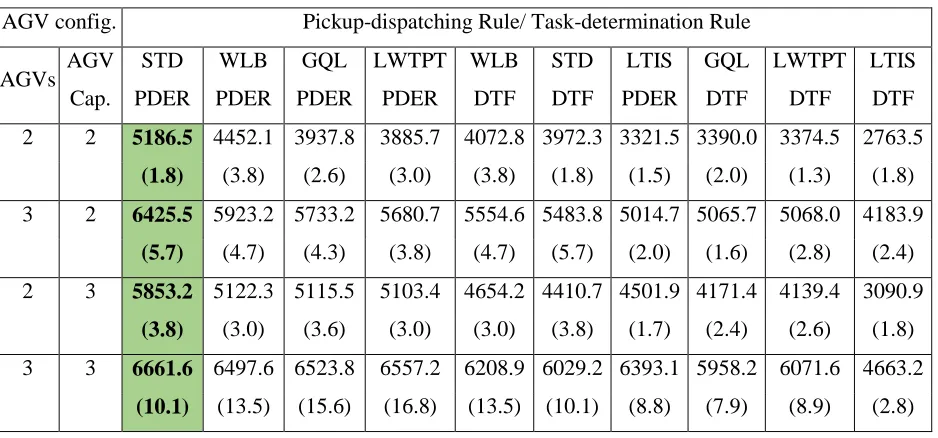
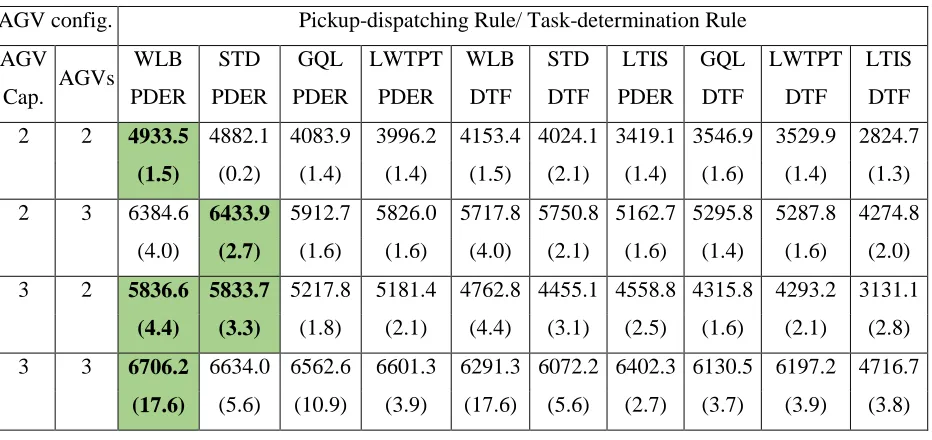
[image:50.612.74.543.437.656.2]Table 15 shows the throughput mean and standard deviation of the selected scenarios in FMS 1. For each scenario, a Tukey multiple-means comparison test is conducted at a significance level of 0.05 to compare the mean throughput under each pair of AGV control rules. The shaded throughput values indicate that the corresponding combination of rules yields the highest throughput in the scenario. Where multiple values are shaded for a particular scenario, the means are in the highest group of mean throughput, but the means are not significantly different than one another. In Table 15, we observe that the highest throughput is always achieved using STD with PDER. If using the same pickup-dispatching rule, PDER outperforms DTF in terms of throughput.
Table 15: Mean (standard deviation) of throughput for selected scenarios in FMS 1, experiment 2. AGV config. Pickup-dispatching Rule/ Task-determination Rule
AGVs AGV Cap.
STD PDER
WLB PDER
GQL PDER
LWTPT PDER
WLB DTF
STD DTF
LTIS PDER
GQL DTF
LWTPT DTF
LTIS DTF 2 2 5186.5 4452.1 3937.8 3885.7 4072.8 3972.3 3321.5 3390.0 3374.5 2763.5
(1.8) (3.8) (2.6) (3.0) (3.8) (1.8) (1.5) (2.0) (1.3) (1.8) 3 2 6425.5 5923.2 5733.2 5680.7 5554.6 5483.8 5014.7 5065.7 5068.0 4183.9
(5.7) (4.7) (4.3) (3.8) (4.7) (5.7) (2.0) (1.6) (2.8) (2.4) 2 3 5853.2 5122.3 5115.5 5103.4 4654.2 4410.7 4501.9 4171.4 4139.4 3090.9
(3.8) (3.0) (3.6) (3.0) (3.0) (3.8) (1.7) (2.4) (2.6) (1.8) 3 3 6661.6 6497.6 6523.8 6557.2 6208.9 6029.2 6393.1 5958.2 6071.6 4663.2
(10.1) (13.5) (15.6) (16.8) (13.5) (10.1) (8.8) (7.9) (8.9) (2.8)
41
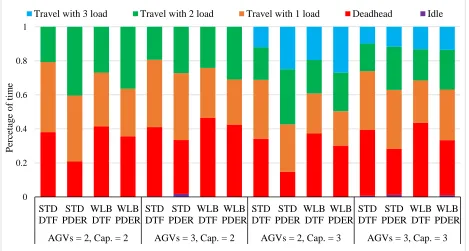
[image:51.612.73.542.128.403.2]combinations. The full analysis for capacity utilization can be found in the Appendix. Figure 28 demonstrates the average travel distance of AGVs in FMS 1.
Figure 26: Throughput Analysis of FMS 1, experiment 2.
Figure 27: AGV capacity utilization analysis in FMS 1, experiment 2.
0.0 1.0 2.0 3.0 4.0 5.0 6.0 7.0
AGVs = 2, Cap. = 2 AGVs = 3, Cap. = 2 AGVs = 2, Cap. = 3 AGVs = 3, Cap. = 3
T hr oug hput i n thousa n