Rochester Institute of Technology
RIT Scholar Works
Theses Thesis/Dissertation Collections
5-2017
The Adoption of Project Based Learning in Graphic
Communication Programs
Aezzaddin Aisyah Zainuddin
Follow this and additional works at:http://scholarworks.rit.edu/theses
Recommended Citation
The Adoption of Project Based Learning in Graphic Communication
Programs
by Aezzaddin Aisyah Zainuddin
A Thesis submitted in partial fulfillment of the requirements
for the degree of Master of Science in the School of Media Sciences
in the College of Imaging Arts and Sciences of the Rochester Institute of
Technology
May 2017
Primary Thesis Advisor: Professor Bruce Myers
School of Media Sciences Rochester Institute of Technology
Rochester, New York
Certificate of Approval
The Adoption of Project Based Learning in Graphic Communication Programs
This is to certify that the Master’s Thesis of Aezzaddin Aisyah Zainuddin
has been approved by the Thesis Committee as satisfactory
for the Thesis requirement for the Master of Science in Print Media degree at the convocation of May 2017 Thesis Committee:
_______________________________________________ Bruce Leigh Myers, Ph.D.
Primary Thesis Advisor
_____________________________________________________ Michael Riordan
Secondary Thesis Advisor
_________________________________________________ Christine Heusner
Graduate Program Director
TABLE OF CONTENTS
Acknowledgement ... iv
LIST OF TABLES ... v
TABLE OF FIGURES ... vi
Abstract ... 1
Chapter 1 ... 3
Introduction ... 3
Background ... 5
Statement of the Problem ... 6
Reason of Interest ... 9
Chapter 2 ... 10
Theoretical Basis ... 10
Characteristics of an Innovation ... 11
Critical components of DOI ... 12
Adoption Characterization on the Basis of Innovativeness ... 17
Rogers DOI and the Present Research ... 18
Chapter 3 ... 19
Literature Review ... 19
The Graphic Communications Industry ... 19
Industry Link to Educational Institutions ... 23
Project Based Learning (PBL) ... 27
Factors that comprise Project Based Learning ... 28
Project Based Learning (PBL) – Pedagogically Successful ... 30
Implementation of PBL in Post-Secondary Schools ... 32
Conclusion ... 35
Chapter 4 ... 36
Research Questions ... 36
Chapter 5 ... 38
Methodology ... 38
Questionnaire ... 38
Sample ... 39
Procedure ... 39
Chapter 6 ... 41
Results ... 41
Demographic Information ... 41
Types of Degrees for Graphic Communications Programs in the U.S. ... 43
Types of Graphic Communications Courses Offered by Degree-Granting
Institutions ... 47
Structures That Support Professional Development ... 50
Chapter 7 ... 54
Summary and Conclusions ... 54
Analysis and Interpretation of the Data ... 54
Future Research ... 63
Bibliography ... 65
Appendix A ... 67
Human Subject Approval ... 67
Appendix B ... 68
Pre-notice Email Prior to Survey ... 68
Appendix C ... 69
Cover Letter Email and Survey Instrument ... 69
Appendix D ... 70
Survey Questionnaire (Online) ... 70
Appendix E ... 84
Acknowledgement
Firstly, I would like to express my sincere gratitude to my advisors, both
Professor Myers and Professor Riordan for their continuous support of my
research, for their patience, motivation, and immense knowledge. Their guidance
helped me through completing the research and writing of this thesis. I could not
have imagined having a better advisors and mentors for my study. I would also
like to thank my thesis committee which includes my advisors and Professor
Heusner for their insightful comments and support. My sincere thanks also go to
all School of Media Sciences faculty and staffs, I am grateful and indebted to
them for sharing their expertise, sincere and valuable guidance and for all the
encouragement extended to me.
Getting through my thesis required more than academic support. I would
like to thank my parents, Zainuddin Suradi and Zaharah Abd Jalal for their
unconditional love, never-ending support, attention and prayers. Also to my
husband, Muhammad Asyraf Ab. Wahab and all my siblings, Aezzaddin Azalea,
Aezzaddin Emir Arif and Aezzaddin Emir Imran, for supporting me spiritually
throughout the process of this thesis and my life in general. Not forgetting all my
LIST OF TABLES
Table 1. Critical Success Factors for Print Businesses ... 22 Table 2. The commons skills associated with P21. ... 26 Table 3. Phases of Project Based Learning Implementation ... 33 Table 4. Types of Degrees Offered for Graphic Communications Programs: Frequencies and Percentages (n = 49) ... 44
Table 5. Types of Degrees Offered for Graphic Communications Programs: Frequencies and Percentages (n = 49) ... 44
Table 6. Comparisons of PBL Factors between Lecture-Based and Laboratory-Based Courses in Graphic Communications Programs. (n=49) ... 46
Table 7. Lists the Topic Area by School Type for Lecture-Based and Laboratory-Based Courses (Associate Degree vs. Bachelors’ and Masters’ Degree):
Frequencies and Percentages ... 48
Table 8. Support Structures for Educators’ Professional Development between Lecture-Based and Laboratory-Based Courses in Graphic Communications Programs: Frequencies and Percentages ... 51
Table 9. Support Structures for Educators’ Professional Development between Lecture-Based and Laboratory-Based Courses in Graphic Communications Programs (Associate Degree vs. Bachelor Degree and Masters’ Degree):
LIST OF FIGURES
Figure 1 Percentage of Graphic Communications Educators Age Distribution ... 42
Abstract
Project Based Learning (PBL) is widely recognized as an effective
teaching method when compared to traditional lecture-based approaches in the
classroom. Recognizing that the graphic communications industry needs
employees with requisite skill sets and the established efficacy of PBL as a
pedagogical technique for teaching those skills, the researcher examined the
implementation of PBL in post-secondary institutions serving the graphic
communications industry.
A cross-sectional survey was conducted to solicit information from
educators in graphic communications programs in the United States. The
questionnaire was designed to examine the factors which comprise PBL utilized
in the classroom. PBL factors were derived from an extensive search of the
relevant literature, and included critical thinking, collaboration, communication,
creativity and innovation, self-direction, and local connections.
In the examination of the differences between lecture- and
laboratory-based courses with PBL implementation, similarities as well as differences were
noted when the mean ranks of the various factors were analyzed. The study also
examined the various types of graphic communication courses taught by different
degree programs; it is found that the associates' level schools are focused almost
diverse topics, including Business Management and Entrepreneurship and
Materials and Sciences.
Finally, the research investigated the support-structures which are in place
to support professional development for graphic communications educators.
Respondents indicated that over three-quarters of administrators support
teachers in their professional development, however funding and release time for
development were not as widely cited.
Overall, to fully adopt these PBL activities as part of their pedagogy, it is
crucial for them to prepare themselves with these teaching techniques. Further,
having a clear goal of exposing students to real-work outcomes could help
educators to shift the mindset of their students with not only requisite technical
skills but also the desired soft-skills such as working collaboratively and
Chapter 1 Introduction
The graphic communications industry has been subject to rapid
technological change which brings both opportunities and challenges.
Traditionally, the majority of the revenue for this industry was obtained from the
printing side of the business, so-called "ink-on-paper" from traditional printing
presses. Market segments within graphic communications include commercial
printing, book publishing, and package printing. Today, the industry represents a
broader range of communication packages that facilitate the communication and
packaging needs of business. In addition to helping their customers
communicate across a wide range of platforms, many processes in this industry
also incorporate emerging technologies and current engineering.
These rapid advancements and the ensuing changes have had an impact
on the formal educational institutions which support the industry. It is important
for schools to align their course content to the changing needs of the industry. In
response, many post-secondary educational institutions have embraced a
cross-media curriculum, designed to support the broader needs of employers. It is also
important to recognize that the graphic communications industry has shifted from
one that required skill sets emphasizing craft-based work to one requiring more
adaptable skill sets, including manufacturing, project management, and
In 2014, McCutcheon of U.S. Industrial Products, a recognized leader for
the professional services network PricewaterhouseCoopers, highlighted that
there are significant prospects and employment opportunities within
manufacturing fields such as graphic communications that are not being filled. He
added that there is a need for training programs resulting in skill-sets for the
needs of employers. Further, Wells (2014) indicates that one of the ways to
resolve this skills gap is for companies to work together with local educational
institutions: graphic communications organizations need to communicate their
needs to educational institutions to assist in the development of relevant training
programs.
Furthermore, today’s graphic communication companies, similar to other
manufacturing companies, are increasingly integrating high-tech equipment that
requires specific knowledge that overlaps into design and programming. This
suggests that an emphasis on Science, Technology, Engineering and Math
(STEM) skills are a good place to start. Wells (2014) indicates that skills such as
deep planning, thinking, judging and collaborating are needed in the
manufacturing industry to complement technical skills. He added that
professionals in this industry need to be leaders and have leadership skills to
Background
In 2014, Asian Development Bank (ADB) emphasized the role of
educational institutions, including research centers, universities, and other such
organizations, in imparting the knowledge and skill sets required by a
technologically advanced industry. They also suggest that when knowledge is
acquired effectively, it enables the assimilation and adaptation of that knowledge
to the local needs of industry.
Moreover, ADB (2014) reports that the proportion of employees with
tertiary level qualifications employed in knowledge-intensive industries is
growing. However, there is a noted gap in knowledge and skills competency
among these new employees. Therefore, there is a demand for education and
training institutions to develop and provide flexible and responsive programs in
shaping skilled technical professionals.
The role of educational institutions is critical in incubating and nurturing
both the soft-skills and technical skills in their pupils. An improved system of
education and training will enable the production of knowledgeable professionals
Statement of the Problem
Knowledge and skills are intertwined. Technological advancements and
automation have largely replaced the need for employees who perform routine
tasks, while providing greater opportunities to those with higher-level skills.
Technology also helps to empower workers to be more productive and creative.
In an interview, Whitehead (2016) supports these statements when he states that
the needs for specified skills and expertise are still crucial in the printing industry,
both today and in the future.
A recent study by Kivunja (2014a) agreed that there is a need of a
pedagogical shift in ensuring graduate’s marketability in the job market.
Observing the skills of the new learning that relates to career and life, he cited a
landmark 2013 report published by The Partnership for 21st Century Skills (P21).
This diverse array of skills is essential in both secondary education and in the
workplace, and include those that convey the importance of goal- and
time-management, while encouraging students to work independently and become
self-directed learners.
Furthermore, students should also learn to interact effectively with others,
working productively in diverse teams, and demonstrate both leadership and
responsibility. Although these skills are not new, many cite that they have not
been adopted universally among post-secondary programs. Kivunja (2014a)
added that the higher education sector plays a major role in instilling these skills
employment opportunities. In an article by Lewington (2015), Fenton, a former
instructor at Brown University commented that:
"The technical skills are getting better and better in terms of what is being
taught, becoming more targeted to specific industries and jobs, but the
soft skills, the people skills, how to work with people traditionally have
been left to the side," (Colleges respond to industry demands for ‘soft
skills’, para.6)
It is widely recognized that specific technical skills need to be combined
with project management, customer engagement, and general business
knowledge. In order to be aligned with industry needs, curriculum innovations
should be directed in this manner. It is important for students to experience
environments that mimic the real-world workplace as many researchers cite this
will enhance the development of these skills.
Ehiyazaryan and Barraclough (2009) found that there is a significant
correlation between real world experience and students’ employability. Through
such activity, students are more motivated and engaged with the subject matter.
This also impacted students’ confidence level and reflective thinking. Effective
learning requires suitable teaching methodologies and assessments.
problem-solving. He suggests that the new pedagogy should be applied as
interactive activity within dynamic communities.
Correspondingly, the literature presently reviewed underscores the
effectiveness of pedagogy incorporating project-based learning (PBL). Research
supports that PBL is an effective method that can result in better-quality content
learning, higher levels of engagement and more positive perceptions of the
subject matter.
PBL, therefore, is widely recognized as an effective and successful
method when compared to traditional lecture-based teaching. Recognizing the
needs for employees in the graphic communications industry with the
aforementioned skill sets and the established efficacy of PBL as a pedagogical
technique in teaching those skills to students, it is curious that an extensive
review of the literature revealed no studies which examined the implementation
of PBL in post-secondary institutions serving this industry. Therefore, the present
thesis examined the adoption of PBL in post-secondary institutions teaching
Reason for Interest
The researcher would like to recognize the value in monitoring and
leveraging trends of the printing industry that will impact graphic communication
education in the future. This interest is developed from the researcher’s
undergraduate study and working experience in the printing industry as well as
her future career prospect. The researcher would also like to help build
knowledge of pedagogical approaches in graphic communications. The
researcher would like to use the obtained knowledge as a graphic
communication educator in the future. The researcher hopes that this study will
provide insight to other educators and curriculum designers that teach in graphic
Chapter 2 Theoretical Basis
The present research is designed to add to an extensive body of studies
that examine the diffusion and adoption of educational initiatives. These studies
share a common foundation: they are built largely upon the formative work of
Everett Rogers in his Diffusion of Innovations (2003). First published in 1962,
Diffusion of Innovations has been reprinted four additional times. Today, Rogers'
concepts provide foundational underpinnings for nearly all adoption studies; the
study proposed here is no exception.
Sahin and Thompson (2006) state that Rogers' Diffusion of Innovations
(DOI) "…looks at both the adoption and the diffusion of an innovation" (p. 82)
and Holland (1997) underscores the preeminence of this model, writing that it
describes the "…process by which innovations are adopted, and the criteria that
individuals use to access each innovation and the types of individuals who are
likely to adopt an innovation through the process of dissemination" (p. 394).
Rogers describes not only the characteristics of an innovation, but also outlines
critical components necessary for the diffusion. These factors, which are outlined
Characteristics of an Innovation
Rogers (1995) describes five characteristics of innovation that attract or repel
adopters—relative advantage, compatibility, complexity, trialability, and
observability. Each is summarized below.
• Relative advantage is defined as the extent to which the innovation is
perceived as being superior to the current practice that it is intended to
supplant (Rogers, 1995). In this manner, the relative advantage construct
speaks to any benefits perceived by the potential adopter. In many
contexts, these benefits are largely fiduciary; however, others include
ease of use, social prestige, the possible immediacy of reward and even
preventative measures.
• Compatibility is described as a factor that examines the congruence of the
innovation with the needs of the potential adopter, including values,
experience, and perceived needs (Rogers, 1995). In some instances, the
innovation may or may not be compatible with the values and beliefs of
the potential adopter or adopting organization.
• Complexity is defined as a characteristic of the innovation itself. Rogers
makes their lives more difficult" (p. 242). As such, complexity can be
thought of as perceived ease of adoption and use of the innovation.
• Trialability depicts extent to which a potential adopter can examine an
innovation before committing to full adoption (Rogers, 1995). Trialability
may mitigate concerns among adopters and is especially critical in
organizational contexts where multiple stakeholders can have influence
over the adoption process.
• Observability explains the extent to which a potential adopter can view the
innovation as used by others (Rogers, 1995). Like trialability, observability
presents the opportunity to see the innovation prior to a full commitment to
adopt. In this manner, observability serves as a means of potentially
persuading an adopter to accept the change.
Critical components of DOI
In addition to the characteristics which describe the characteristics of an
innovation germane to its diffusion, Rogers (1995) outlines four critical
components of diffusion: the innovation, communication channels, time, and the
social system. Within the social system construct, the author details stages of the
persuasion, decision, implementation, and confirmation. As several of these
constructs are pertinent to the present research, they are described below.
Innovation
Rogers (1995) describes an innovation as an "…idea, practice, or object
that is perceived as new by an individual or other unit of adoption" (p. 11). This
description is an especially apt one for the present study, where the innovation
proposed to be investigated is PBL.
Communication Channels
Having established the salient characteristics of innovations, the exchange
of information and ideas among potential adopters comprise important aspects of
DOI. Communication channelsare the means for communicating the innovation
among individuals and organizations. Communication channels are necessary to
connect parties wishing to discuss the innovation (Rogers, 1995). These
channels represent the manner in which the message is conveyed: typical
examples range from mass media to face-to-face communications and even
Time
Rogers (1995) further recognizes a temporal element: time is seen
throughout the diffusion process and is evident in the innovation-decision
process as a person moves from "…knowledge of the innovation through to its
adoption or rejection…" (Rogers, 1995, p. 20). Time is also relevant in describing
individuals as early or late adopters, how time affects the rate of adoption, and is
"…usually measured as the number of members of the system that adopt the
innovation in a given time period." (Rogers, 1995, p. 20).
Social System
The innovation-decision process is a sequence of processes and choices
that ensue over a period; these processes are critical components of a social
system. Through the innovation-decision process, an individual passes from
"…first knowledge of an innovation, to forming an attitude toward the innovation,
to making a decision to adopt or reject the innovation, to implementing the new
idea, to confirming or rejecting the adoption of the decision" (Rogers, 1995, p.
161).
The innovation-decision process itself frequently has five stages as cited
by Rogers (1995); namely, knowledge, persuasion, decision, implementation,
and confirmation. Knowledge is comprised of exposure to an innovation as well
as a comprehension of its functions. In some instances, knowledge may be
knowledge which details the information necessary to properly utilize the
innovation. Rogers (1995) describes knowledge as the "…functioning principles
underlying how the innovation works" (p.166). In the awareness knowledge
stage, the innovation is introduced to peers. Rogers also recognizes the critical
nature of the advocacy of the adoption of a given innovation.
Rogers (1995) recognizes the importance of attitude or beliefs held by an
individual about the innovation. He contends that the stakeholder may have
"…much to say about his or her passage through the innovation- knowledge
process" (p. 167).
Persuasion is recognized as the next step in the innovation-decision
process. This entails the formation of a favorable or unfavorable attitude towards
the innovation. Rogers (1995) describes this stage in the process as where a
person becomes more "psychologically involved" (p. 168) Here, an individual
considers how it will apply to a current or future situation. It is during this stage
that the person considers the potential benefits of the innovation (Rogers, 2003).
The Decision stage is a critical stage in the adoption of an innovation:
here, a commitment to adopt or not adopt an innovation takes place. Decisions
include full adoption, partial adoption, or non-adoption. Rejection is recognized
by Rogers as two variants: active in which an adopter fully considers the
innovation and then decides to reject, and passive in which the adopter never
Implementation refers to carrying out the processes involved in putting the
innovation to use. Before implementation, Rogers (1995) describes the adoption
process as being merely a "…mental exercise." (p. 172). Since implementation
requires behavior modifications, problems often are encountered at this stage,
particularly in organizational contexts. When those tasked with implementation
differ from the adoption decision makers, problems with implementation
frequently ensue and are to be expected.
It is important to recognize that during the process of implementation,
re-invention, otherwise known as adaption may occur and is described by Rogers
(1995) as how the innovation "…changes and evolves during the diffusion
process" (p. 174). Frequently, the outcome of re-invention is an innovation that
more specifically meets the needs of the organization or of the adopters. Rogers
(1995) lists factors driving reinvention:
"1. Innovations can be complex and difficult to understand;
2. Adopters lack full knowledge about the innovation;
3. The innovation is abstract;
4. Innovation is implemented to solve too many problems;
5. Local pride of ownership of the innovation; and
6. Change agent encourages adopters to fit the innovation to their needs"
Re-invention is a reflection of adopter behavior and a "process of social
construction" (Rogers, 1995, p. 179) within organizations.
Finally, the confirmation stage represents the time of reinforcement of the
innovation. This is the result of positive outcomes that are produced in the
implementation process. Here, the adopter "…seeks reinforcement of the
innovation-decision already made or reverses a previous decision to adopt or
reject the innovation if exposed to conflicting messages about the innovation"
(Rogers, 1995, p. 181). It is in this stage that adopters may decide to discontinue
the innovation in favor of another type of innovation, known as replacement
discontinuance; or because of dissatisfaction with the innovation, named
disenchantment discontinuance (Rogers, 1995).
Adoption Characterization on the Basis of Innovativeness
Rogers' Adoption Characterization on the Basis of Innovativeness
comprises what is perhaps the most widely-recognized aspects of his seminal
work. Here, the innovativeness dimension is measured by the time in which an
individual or organization adopts the innovation and is divided into five distinct
categories, namely: Innovators, Early Adopters, Early Majority, Late Majority, and
Laggards. Important characteristics are posited to distinguish those in each
category. For example, early adopters are purported to exhibit greater social
Other cited variables include differences in socioeconomic status, personality,
and communication behavior.
Rogers DOI and the Present Research
While the present study is cross-sectional in nature, those components of
Rogers' DOI that examine "why" questions represent a delimitation and are
therefore left to future researchers. Further, as the present study is not
longitudinal in nature establishing the stage of adopters (e.g.: early, late) is not
addressed. However, by defining the constructs that comprise PBL and inquiring
about the adoption of these elements in lecture and laboratory classes in
post-secondary institutions teaching graphic communications, critical components of
Rogers' theories are examined. Those elements germane to the context of the
proposed research include the recognition of PBL as an innovation as defined by
Rogers, and the obtained results will potentially speak to the relative advantage,
compatibility, complexity, and trialability of PBL to post-secondary graphic
communications institutions. The recognition of DOI by Kautz and Larsen (2000)
as "…largely a communication process, an information seeking and processing
activity" (p. 12) underscores the appropriateness of Rogers' work to the research
Chapter 3 Literature Review
The review of pertinent literature begins with published information
regarding the status of the graphic communications industry, the goal of which is
to support the need for an educated and skilled workforce. Once the status of the
industry is established, the review cites studies that underscore the need for the
industry to work cooperatively with post-secondary educational intuitions.
Following this, the review concludes with research that supports the
effectiveness of PBL as a teaching methodology.This review also concentrates
on how PBL pedagogy could effectively impart industry-relevant skills to
students.
The Graphic Communications Industry
Today, graphic communications include several diverse fields including
traditional printing, digital printing, publishing, packaging, digital imaging,
computer graphics, website development, cross-media application, digital data
management, digital photography, printed electronics, and functional printing.
Drupa (2016) cites the impact of automation on each of these sectors and notes
that graphic communications firms need to be versant in multichannel
change, which brings both threats and opportunities to established graphic
communications organizations.
Digital printing has seen growth since its introduction in the early 1990's.
In 2008, Pira International Ltd cited significant trends of the digital printing
industry, concluding that digital printing is a reproduction process that has
become dominant in complementing the conventional printing process as the
development of this technology encompasses a broad range of printed products.
As reported, the expansion of this technology is vast and substantial.
According to Smyth (2015), the digital print penetration is forecasted to grow to
17.4% in value by 2020 from 13.9% in the year of 2015. In volume, it is
forecasted to increase to 3.4% in 2020 from 2.5% in 2015. He also reviewed that
this positive increase is due to the advantages that digital technology can offer to
the field. Together with this advancement, new developments and innovations
are introduced in the shape of new applications and business modes.
Consequently, it also attracts new market embellishment.
Today, many manufacturers utilize hybrid printing and advanced
multi-function applications. Many traditional printers have increased efficiencies via the
internet using technologies such as web-to-print implementation and the Internet
of Things (Gordon, 2014). Such innovations enable cross-media implementation
and workflow optimization. Smyth (2015) also underscores that the collaboration
of digital technology and print manufacturing results in effectiveness process
automation. Process automation reduces human errors, enabling printers to be
more cost-effective and save time, and frequently results in improved quality.
The needs of the industry are summarized by Pira International (2015).
Table 1 displays the significant elements that business owners should look to in
order to improve their organizational operations. It is clear that a workforce
capable of thriving in an environment where these skills are required would need
to be knowledgeable and prepared to embrace the dynamic nature of such a
workplace.
Moreover, according to Fuller and Haefliger (2013), a business model is a
critical part of an organization system. The model helps to manage the
deliverance of jobs in the organization effectively; the workforce needs to be
skilled in areas such as problem-solving, customer needs engagement,
satisfaction delivery, and value monetization. Smyth (2015) added that training is
needed in areas of management, sales, and marketing. Therefore, educators
wishing to prepare students for this industry need to effectively implement
Table 1
Critical Success Factors for Print Businesses
Not at all important Relevant but not important Fairly important Very
important Critical
Ability to speed up turnaround
times 0.0% 3.7% 19.6% 51.4% 25.5%
Development of a broader range of products and
services 0.0% 6.5% 28.0% 41.1% 24.3%
Improvements in management
skills 0.0% 8.4% 26.2% 51.4% 14.0%
Improvements in operator
skills 0.0% 6.5% 29.9% 50.5% 13.1%
Cashflow
improvements 2.8% 11.2% 21.5% 42.1% 22.4%
Overhead
reductions 2.8% 6.5% 24.3% 52.3% 14.0%
Greater access to investment
capital 4.7% 17.8% 35.5% 27.1% 15.0%
Source: Pira International Ltd
Industry Link to Educational Institutions
The Print and Graphic Scholarship Foundation (PGSF) cited that the
graphic communications industry is the most diverse manufacturing industry in
the U.S. Jobs offered in the industry include positions from professional and
managerial to production positions including machine operation. PGSF (2015)
projected that 40,000 employees would be needed each year through 2020.
These employees will need to be versed not only in established and emerging
technologies, but will also need to be able to adopt and implement innovations as
they are introduced.
Marco (2014) urged that it is crucial for the educational institutions to
complement the graduates’ future needs. In order for them to produce and supply
an educated workforce for the industry, it is necessary to instill new and diverse
skills sets that match the current industry requirements. Among the skill sets
required by industry are verbal and written communication, math skills, computer
literacy, thinking skills and problem solving skills. (PGSF, 2015). In a 2015 ME
Printer article, Romano stated that knowledge and training in both technical and
management are vital. The educational institutions serving the graphic
communications industry should be progressive alongside the development of
the industry in order to help equip their graduates with the right skills. Also, in the
same article, Starke supports these statements; he agrees that it is very
In the United States, post-secondary institutes include those offering
courses in graphic communications programs in two-year associate's degrees
(including colleges and degree-granting vocational institutions) and four-year
undergraduate schools in which students aim to earn a bachelor’s degree. Most
courses in these programs are taught in two modes: lecture-only classes and
those classes that also incorporate a laboratory component. In many institutions,
these modes are offered concurrently in the same semester depending on the
need of the subject course. Besides that, some schools also offer certificates and
non-degree certifications.
McKeachie and Svinicki (2014) define lecture-based classes as those that
utilize an instructional method which focuses on key concepts, principles, or
ideas of a particular subject matter, the goal of which is to impart a general
knowledge of the course content. In short, in lecture classes, students are
exposed to the theoretical part of the learning. Laboratory classes, on the other
hand, normally utilize a hands-on practical approach. Instructions are designed
for students to be physically engaged with concepts in the field through active
experimentation.
A recent study by Kivunja (2014a) agreed that there is a need for a
pedagogical shift in ensuring graduate’s marketability in the job market. The
researcher observed the skills of the new learning that relates to both career and
workplace. These skills initiated students to manage goals and time, work
independently, and become self-directed learners.
Besides that, students should also learn to interact effectively with others,
including demonstrating the ability to work effectively in diverse teams while
sharpening leadership skills and showing responsibility. Kivunja (2014a) cites
that although these skills are not new, they have not been adopted by many
institutions entirely. The researcher added that the higher education sector plays
a major role in instilling these skills in their students in order for them to be ready
for employment.
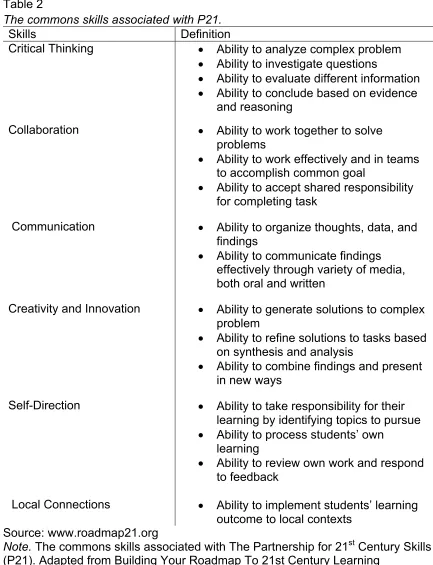
The Partnership for 21st Century Skills (P21) introduced "21st century
skills," the goal of which is to improve the structure of teaching and learning in
educational institutions. In so doing, P21 advises educators to foster these skills
in their students through their curriculum and pedagogical approach. It has been
identified that the commons skills associated and can be divided into main
categories which include critical thinking, collaboration, communication, creativity
Table 2
The commons skills associated with P21.
Skills Definition
Critical Thinking • Ability to analyze complex problem • Ability to investigate questions
• Ability to evaluate different information • Ability to conclude based on evidence
and reasoning
Collaboration • Ability to work together to solve problems
• Ability to work effectively and in teams to accomplish common goal
• Ability to accept shared responsibility for completing task
Communication • Ability to organize thoughts, data, and findings
• Ability to communicate findings effectively through variety of media, both oral and written
Creativity and Innovation • Ability to generate solutions to complex problem
• Ability to refine solutions to tasks based on synthesis and analysis
• Ability to combine findings and present in new ways
Self-Direction • Ability to take responsibility for their learning by identifying topics to pursue • Ability to process students’ own
learning
• Ability to review own work and respond to feedback
Local Connections • Ability to implement students’ learning outcome to local contexts
Source: www.roadmap21.org
Note. The commons skills associated with The Partnership for 21st Century Skills (P21). Adapted from Building Your Roadmap To 21st Century Learning
Clearly, both theoretical knowledge and skills are intertwined. Skills
including technical skills, management skills, and soft skills, are needed by
industry. Technology helps to empower knowledgeable workers to be more
productive and creative. Whitehead (2016) agreed when he states that the needs
for specified skills and expertise are still crucial in the printing industry today and
in the future.
Project Based Learning (PBL)
PBL is an umbrella term encompassing an array of pedagogical
approaches designed to prepare students for the skill sets needed by industry.
Marco (2014) suggested that it is fundamental that instructors in graphic
communication programs apply collaborative pedagogy that will provide students
with more practical experience and engaged learning. He cites the demographic
characteristics of Generation-Z (birth years 2005 - 2025) along with the so-called
"Millenials," otherwise known as Generation-Y (birth years 1983-2004.)The
researcher added that understanding the learning preference of these two
generational groups would assist instructors to better facilitate the curriculum
design, content creation as well as teaching technique.
Correspondingly, the PBL approach is a student-centered teaching
methodology. PBL adopted curriculum and instructional models support the
could be described as a systematic pedagogy that engages students learning the
course content and skills. This process is applied through an extended inquiry
process structured around complex, authentic questions of the subject matter, as
well as guided with thoroughly designed projects and tasks.
Moreover, The Buck Institute for Education also supported that the PBL
instruction method or PBL as an instructional method in which students acquire
knowledge and skills by functioning to examine and respond to engaging and
complex questions. Larmer and Mergendoller (2015) highlighted that their
students could learn the contents and develop the skills through PBL as it
imparts the important of concepts and in-depth understandings that are essential
to academic disciplines. They also recommended that critical thinking,
problem-solving, collaboration, and self-management should be emphasized in the
projects. This is because these critical skills are vital for students to be
successful in the future.
Having discussed the association of PBL, the factors that comprise PBL
are now introduced.
Factors that comprise Project Based Learning
Barron and Darling-Hammond (2008) outlined the fundamentals of PBL as
i. students tackle realistic problems through the application of
learning knowledge,
iii. students work in a team, and
iv. program instructors function as coaches and inquiry
facilitators.
The researchers added that PBL involves complex tasks and requires
students to demonstrate solutions through a presentation or produce an actual
proposed outcome. Furthermore, Harmer and Stokes (2014) reviewed the
literature on benefits and challenges of implementing PBL. The researchers
outlined factors that support PBL methodology in teaching as outlined by Barron
and Darling-Hammond (2008). The significant factors are identified as learning
by doing, real-world problems, role of the tutor, interdisciplinary, collaboration
and group work, and an end product.
Similarly, Larmer and Mergendoller (2015) have also outlined seven
elements that are required for a successful PBL projects in order to maximize
students’ learning and engagement in the classroom. These are described as
challenging problem or questions, sustained inquiry, authenticity, student voice
and choice, reflection, critique and revision, and public product.
Through thorough assessment of these outlined fundamentals and finding
overlapping models of these concepts with the construct outlined by the 21st
century skills, these factors were operationalized in the present study to better
Project Based Learning (PBL) – Pedagogically Successful
Many researchers conclude that PBL is an effective pedagogical approach
and indicated that the techniques produce better-quality content learning, higher
levels of engagement and more positive perceptions of the subject matter. This
supports that PBL is an effective and successful method when compared to
traditional lecture-based teaching. Mergendoller and Maxwell (2006) suggest that
PBL is able to boost achievement in students who struggle with traditional
approaches. PBL was also discovered to nurture relatively higher interest in the
subject matter.
Mioduser and Betzer (2007) agreed that PBL allows higher advantages in
academic content knowledge when compared to the more traditional
approaches. It is further noted that with PBL curricula, there is a great
development of attitude towards technology. Furthermore, Walker & Leary
(2009) supposed that students demonstrate improved and better-quality attitudes
toward learning. Not only they are able to exhibit more engagement, but students
also become more self-reliant, and have better attendance than in more
traditional classroom settings.
Many researchers concluded that PBL is an effective and enjoyable
learning technique. Vega (2012) reviewed in an article that an effective
implementation of PBL increases the learning of content and improves one’s
In addition, Capraro and Slough (2013) suggested that PBL has been
implemented in various fields including medicine, education, economics,
business, and engineering. Therefore, there is no reason to believe that graphic
communications would be an exception to the effectiveness of PBL approaches.
The concept of PBL provides contextualized and realistic experience for
students, as it requires them to think critically and analytically. PBL also demands
students to collaboration, peer communication, problem-solving and self-directed
learning. Moreover, PBL requires students to demonstrate solutions through
deliverables. These deliverables require hands-on work from the students
themselves: examples here include dimensionally printed models and bound and
finished printed matter.
Further, Valdez (2015) discussed that student participation in PBL
increased their level of understanding of prospects beyond high school as well as
learning and application of skills. Instructors have a greater awareness of the
value that PBL creates for students together with the understanding of different
ways to upkeep students’ learning process.
Valdez (2015) added that there is a consistent focus on the requirement
for PBL as a process used in supporting student learning and engagement. This
process further assists the need for both students and instructors to collaborate
in solving the issue at hand. While students acquire problem-solving skills, they
they create are used as a tool of assessment. Thus, students are able to fulfill
their academic and professional goals.
Implementation of PBL in Post-Secondary Schools
Components of PBL have been adopted in many post-secondary
educational institutions. As indicated, student competencies in the
post-secondary level need to go beyond content knowledge. Jones (2014) highlighted
that today’s bosses would likely hire employees who not only are able to
demonstrate their degree knowledge but them who has the ability to apply this
knowledge effectively in a diverse workforce situation. It is important to prepare
and challenge the student to direct their own learning, solve problems of
academic significance and to move beyond controlled information containment.
PBL implementation aligned with the need of students exploring, developing,
integrating, and resolving within the context of a particular assignment as
knowledge construction at advanced levels take on new meaning.
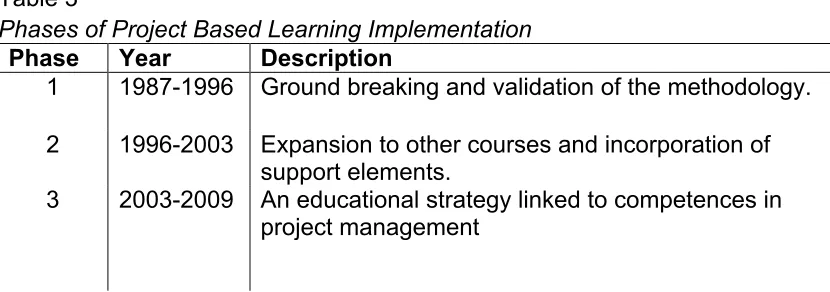
In a landmark longitudinal study on the effectiveness of PBL, Rios,
Cazorla, Diaz-Puente and Yague (2010) examine the advantages and difficulties
of implementing PBL in engineering programs in Spain. The study observed the
Table 3
Phases of Project Based Learning Implementation
Phase Year Description
1 1987-1996 Ground breaking and validation of the methodology.
2 1996-2003 Expansion to other courses and incorporation of support elements.
3 2003-2009 An educational strategy linked to competences in project management
Note.Phases of Project Based Learning Implementation. Adapted from Project– Based Learning in Engineering Higher Education: Two Decades of Teaching Competences in Real Environments. (2010)
In this first phase, PBL is essential for completion of the coursework and is
based on the construction of new knowledge from direct experience of the
students. Students should acquire knowledge and be able to apply it to actual
cases: this is one of the main elements of the strategy. Students participate in
projects and procedures involving real-world content; this would provide students
the opportunity to solve problems directly with external agents.
Rioz et al., (2010) added that in the second phase, only selected courses
applied PBL methods. Most of these courses were of the final year semester.
Collaboration with the industry and multidisciplinary groups were enhanced.
Similar to the first phase, students are asked to observe and analyze facts
through debates and exercises that discussed real situations involved in the
projects. Thus, it will improve better understanding on linking theory and reality.
learning methods to evaluate how it complements the approach of the IPMA
Competence Baseline (ICB). The ICB outlined that there are three competence
spheres of technical, behavioral, and contextual. This eventually enables the
development of personal competencies such as teamwork, communication,
openness, creativity, and the capacity for adaptation and innovation in
problem-solving.
Also, in this phase the usage of technology is established as online
support for teaching this method. Through this platform, both instructors and
students are able to improve their communication. It is learned from this study
that PBL is considered as a reasonable pedagogy to support the improvement of
competences, and also linking teaching with the professional scope. PBL is also
able to offer multiple possibilities for developing the three main competences;
technical, behavioral, and contextual within its method of collaboration and active
involvement.
In a similar case study, Fernandes (2014) reports that PBL implementation
in higher education provides the techniques that help to improve student learning
and prepare graduates for professional practice. This research focused on three
main categories: linking theory to practice, developing skills for professional
practices, and challenges in PBL implementation. Through questionnaires and
focus group interviews of both students and teachers, it was found that PBL
practices. According to students, they were greatly satisfied with the level of
interdisciplinary applied in their assignments through PBL.
Further, it is suggested that projects developed in the application of PBL
are able to link theoretical understanding to real work practice. Students
commented that PBL-based projects allow them to be more interested in learning
the concepts application and enables them to develop the technical skills needed
to accomplish given projects. Also, students confirmed that they were able to
acquire transversal skills such as problem-solving, time management and
communication skills. They realized the importance of teamwork and established
the significance of developing these skills in order to work effectively in their
future professional practice.
Conclusion
While there are many published studies that examine PBL and its
effectiveness in delivering course curriculum in various programs such as
medical and engineering, there is no found research that discussed the adoption
of PBL in teaching graphic communications at post-secondary institutions.
Therefore, it is suggested that an investigation in this area could be meaningful to
educational institutions, the graphic communications industry, and future
Chapter 4 Research Questions
The objective of this research is to determine U.S. post-secondary
institutions utilizing Project Based Learning (PBL) in Graphic Communication
courses. This research will address the following research questions:
1. Does the adoption of PBL factors differ based on class types (lecture
classes and laboratory classes) of Graphic Communications courses?
2. Is there a difference in the types of Graphic Communication courses
taught by different degree programs? Specifically, do institutions
granting Associate’s Degrees offer different types of Graphic
Communication courses than institutions offering Bachelors’ and
Masters’ Degrees? Types of courses are defined as:
a. Graphic, Digital, and New Media
b. Printing Technologies and Processes
c. Material and Science
3. What is the nature of the structures that support the professional
development of Graphic Communication post-secondary educators in
Chapter 5 Methodology
This chapter discussed the methodology used in the present research. A
cross-sectional survey will be conducted, soliciting information from educators in
graphic communication programs at post-secondary institutions in the U.S.
Questionnaire
A questionnaire was designed to determine the activities that describe
PBL applications in teaching graphic communication courses. This thesis used
skills defined as 21st century skills as the variables. The types of skills that were
examined were critical thinking, collaboration, communication, creativity and
innovation, self-direction, and local connections.
The survey included three sections, the first of which elicited demographic
information from the respondents. Besides that, the questionnaire was designed
to examine the utilization of PBL factors to understand if there is difference
between the application of PBL constructs in lecture-based classes versus
laboratory-based classes, and to compare two-year degree programs with those
offering four-year degrees. Finally, the third section of the questionnaire asked if
support-structures were in place to provide professional development and
Sample
Graphic communication programs were identified by conducting keyword
searches. The present study utilized the Print and Graphic Scholarship
Foundation: 2016 -2017 Directory of Schools (PGSF) as a sampling frame.
Initially, there were 210 listed schools in the directory. It was then reduced to 180
after crosschecking the entries with their respective websites. It is found that 30
schools no longer offered graphic communication programs.
According to PGSF, these institutions offer a complete course of study in
graphic communication technology, which includes instruction in prepress, press,
and finishing operations. Besides that, they also deliver specialized graphic
communication training in fields such as science, chemistry, management, or
education. These included institutions offering two-year degree programs,
four-year degree programs, and graduate school.
Procedure
Prior to contacting identified institutions, approval was granted by the
Human Subjects Resource Office of Rochester Institute of Technology (RIT).
This office serves as an internal review board, with a goal of protecting human
subjects consistent with RIT's mission and vision in this area. Once the approval
Using a procedure suggested by Dillman, Smyth and Christian (2015),
introductory emails were sent to all the potential participants informing them that
they were selected to participate in the study, the introduction included
background and contact information. After three days, the initial survey invitations
were sent out to the sampling frame. These emails consisted of an invitation,
instructions, a link to the online survey and the informed consent information.
After one week, a second reminder email was sent to remind non-respondents of
the survey. At the end of the third week, final reminder emails were sent.
Finally, the participants were sent thank-you correspondents. The
collection of data was closed after four weeks. As this was web-based
quantitative research, all correspondence with the potential participants was
done via email. Finally, the data were analyzed by applying descriptive statistics.
Chapter 6 Results
This chapter describes the analysis of the data collected for the study of
the adoption of PBL in graphic communications programs for post-secondary
education in the U.S. It is very important to understand the meaning of the
collected data in order to draw relevant conclusions. The results of the data
analysis are presented in graphical and tabular form.
Demographic Information
The first section of the survey observed the demographic information of
the respondents. Graphic communications educators were identified through the
PGSF directory. One hundred and eighty of the qualifying institutions received
the introductory letter, of these three disqualified themselves from participation
via email correspondence prior to receiving the link to the survey. Of the 177
remaining institutions, 51 responded to the survey representing a 28% response
rate. Of these, however, two indicated that their institution no longer offered
graphic communication courses, therefore their response was not included in the
analysis. Forty-nine usable responses remained for the subsequent analysis.
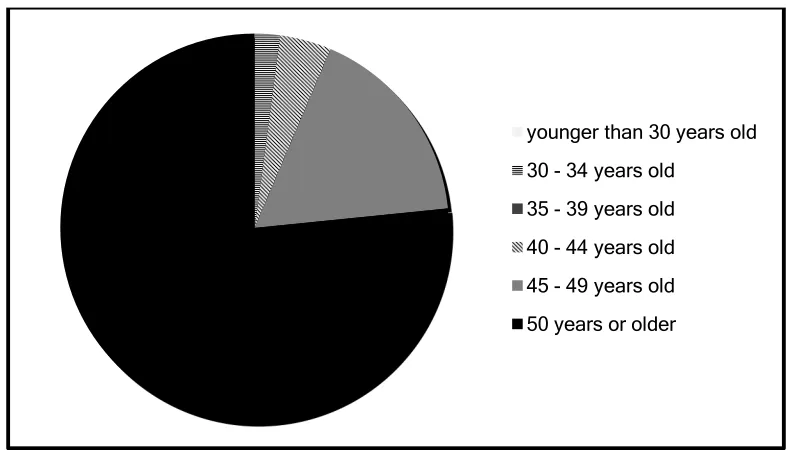
49%, 4.3% of respondents are 40 to 44 years old and 2.1% who are between 30
[image:50.612.126.520.169.394.2]to 34 years old.
Figure 1. Percentage of Graphic Communications Educators Age Distribution
Respondents also reported their years of experience in the graphic
communication industry as displayed in Figure 2. Here, 78.7% of the educators
reported more than 15 years of experience. Besides that, 14.9% of the
respondents have approximately ten to 14 years of the relevant industry
experience, and nearly 6.5% of the respondents have less than ten years of
industry experience. In summary, the respondents were therefore overall
experienced educators and veterans in the graphic communications industry. younger than 30 years old 30 - 34 years old
35 - 39 years old
40 - 44 years old
45 - 49 years old
Figure 2. Percentage of Graphic Communications Industry Experience (Years)
Having discussed the sampling frame, response rate, and demographic
information, the analysis now turns to the types of degrees offered by the
responding institutions.
Types of Degrees for Graphic Communications Programs in the U.S.
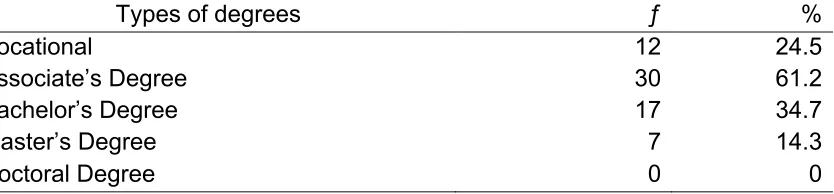
As indicated in Table 4, over 24% of the responding institutions offered
vocational certificates, over 61% offered associate’s degrees, nearly 35% were
bachelor’s degree-granting institutions, and over 14% offered a master’s degree.
None of the responding institutions indicated that they offered any type of
doctoral degree.
< than 1 year
1 - 4 years
5 - 9 years
10 - 14 years
Table 4
Types of Degrees Offered for Graphic Communications Programs: Frequencies and Percentages (n = 49)
Types of degrees ƒ %
Vocational 12 24.5
Associate’s Degree 30 61.2
Bachelor’s Degree 17 34.7
Master’s Degree 7 14.3
Doctoral Degree 0 0
In subsequent analyses, the present study categorizes the institution by
those where the highest degree granted is associate’s, including those that offer
vocational and certificate programs in addition to the two-year degree. A second
category for the present analysis are those institutions where the highest degree
granted is a bachelor’s or a master’s, as indicated in Table 5.
Table 5
Types of Degrees Offered for Graphic Communications Programs: Frequencies and Percentages (n = 49)
Types of degrees ƒ %
Vocational and Associate’s Degree 12 24.5
Associate’s Degree Only 16 32.7
Others 21 42.9
Having discussed the types of degrees offered by the responding
institutions, differences in lecture-based and laboratory-based courses are
The Influence of PBL Factors in Content Delivery
Using the PBL factors identified in the literature, respondents were asked
to indicate whether the particular activities were part of their lecture-based and
laboratory-based coursework. Using a Likert-like scale, respondents indicated
whether they strongly agreed, agreed, neither agreed or disagreed, disagreed, or
strongly disagreed with each factor as a component in their respective course.
The data were coded with strongly agree at 5, agree at 4, neither agree nor
disagree at 3, disagree at 2, and strongly disagree at 1. The arithmetic means
were calculated, and the factors were ranked from highest to lowest in both
Table 6
Comparisons of PBL Factors between Lecture-Based and Laboratory-Based Courses in Graphic Communications Programs. (n=49)
Lecture-Based Courses Laboratory-Based Courses
PBL Factors x̅ PBL Factors x̅
Analyze and solve problems, think critically in an in-depth and sustained way
4.08 Work in collaborative teams that employ the skills of group
members when completing projects
3.53
Do presentation of findings, results or conclusion for projects assigned
3.98 Reflect on the quality of the
project or their learning 3.53
Present work in front of an
audience 3.84 Do presentation of findings, results or conclusion for projects assigned
3.51
Reflect on the quality of the project or their learning
3.84 Engage in extended investigations
3.40
Inquire into a topic in depth 3.80 Inquire into a topic in depth 3.40
Engage in extended
investigations 3.78 Present work in front of an audience 3.40 Specify content standards that
projects were designed to meet 3.65 Taught before the project started 3.36
Taught before the project
started 3.57 Specify content standards that projects were designed to meet 3.28
Use driving question or problem statement to focus projects
3.49 Analyze and solve problems, think critically in in-depth and sustained way
3.19
Work in collaborative teams that employ the skills of group members when completing projects
3.37 Use driving question or problem
statement to focus projects 3.04
Use planning template to design projects
3.10 Use planning template to design projects
Having examined differences in PBL constructs for lecture-based and
laboratory-based courses, the analysis now examines the types of graphic
communication courses offered by the degree-granting institutions.
Types of Graphic Communication Courses Offered by Degree-Granting Institutions
Graphic communication incorporates diverse fields which include
traditional printing, digital printing, publishing, packaging, digital imaging,
computer graphics, website development, cross media application, digital data
management, digital photography, printed electronics, and 3D printing. Today,
graphic communication courses generally emphasize one of the below content
areas:
a. Graphic, Digital, and New Media,
b. Printing Technologies and Processes,
c. Material and Sciences,
d. Business Management and Entrepreneurship.
The research inquired about the types of courses offered in graphic
communication programs. As previously indicated, respondents were grouped
into those offering an Associate’s degree as the highest degree granted, versus
those that offered baccalaureate and above. Respondents indicated their
Table 7
Lists the Topic Area by School Type for Lecture-Based and Laboratory-Based Courses (Associate Degree vs. Bachelors’ and Masters’ Degree): Frequencies and Percentages Topic Area Associate’s Degree Bachelors’ and Masters’ Degree
ƒ (%) ƒ (%)
Lecture-Based Courses (n=28) (n=21)
• Graphic, Digital and New Media
Yes 23 82.1 14 66.7
No 5 17.9 7 33.3
• Printing Technologies and Processes
Yes 15 53.6 12 57.1
No 13 46.4 9 42.9
• Material and Sciences
Yes 0 0 2 9.5
No 28 100 19 90.5
• Business Management and Entrepreneurship
Yes 0 0 8 38.1
No 28 100 13 61.9
Laboratory-Based Courses (n=28) (n=19)
• Graphic, Digital and New Media
Yes 19 67.9 8 42.1
No 9 32.1 11 57.9
• Printing Technologies and Processes
Yes 14 50.0 7 36.8
No 14 50.0 12 63.2
• Material and Sciences
Yes 0 0 1 5.3
No 28 100 18 94.7
• Business Management and Entrepreneurship
Yes 2 7.1 3 15.8
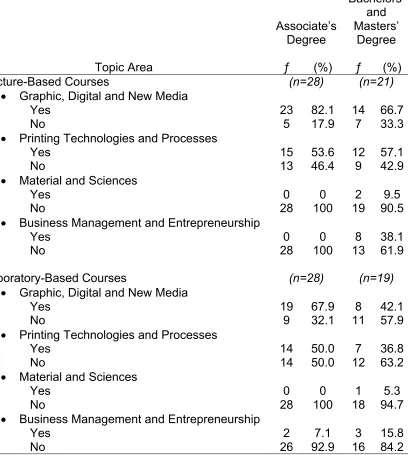
Furthermore, respondents were asked about the primary focus of the
graphic communications programs with regard to lecture-based courses. In Table
7, the result shows that graphic, digital, and new media has the highest
percentage at 82% in the lecture-based courses for associate’s degree
programs. This is then followed by printing technologies and processes which is
over 53%, while for the bachelor’s and master’s degree programs, both showed
responses of 66.7% and 57.1%, respectively.
In addition, 100% of the respondents recognized that the content for
lecture-based courses in the associate’s degree programs did not emphasize
materials science or business management or entrepreneurship. Conversely,
9.5% of the respondents from the higher-degree institutions teach materials and
sciences for lecture-based courses while 38.1%reported business management
and entrepreneurship as a primary topic.
The thesis now turns to the topic areas in graphic communication
programs for laboratory-based courses. Interestingly, the primary concentrated
topic area that was reported was nearly the same for laboratory-based courses
as it was for lecture-based courses. Specifically, graphic, digital and new media
was reported at 67.9% for associate’s degree and 42.1% for the higher degree
programs. Nearly 50% of the laboratory-based courses focused on printing
technologies and processes, which is slightly lower when compared to
compared to the courses offers in Bachelors’ and Masters’ degree programs,
which is reported at 36.8%
Furthermore, over 7% of the content for laboratory-based courses focused
on business management and entrepreneurship for associate’s degree
institutions while 15.8% is being taught in the bachelor’s and master’s programs.
In comparison, only 5.3% of laboratory-based courses focus on material and
sciences content at the institutions which are granting higher degrees. Like the
lecture-based courses, associates' degree institutions reported no offerings in
materials science.
Identifying the structures that are in place to support professional
development was also a key goal of the present research. The analysis now
discusses the obtained results from this part of the survey.
Structures That Support Professional Development
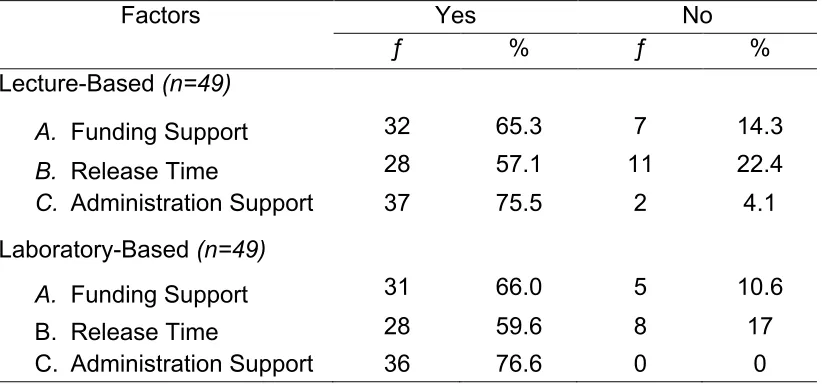
Respondents were asked about the support structures that are in place to
facilitate the continuing education of teachers of lecture- and laboratory-based
graphic communication courses. Specifically, for the present study support
structures are manifest in three ways: support in terms of funding, support in
release time from teaching responsibilities, and general support from the
administration within the institution. Results are listed in Table 8 and Table 9: the