White Rose Research Online URL for this paper: http://eprints.whiterose.ac.uk/120457/
Version: Accepted Version
Article:
Emerson, L.M. orcid.org/0000-0001-5238-0170, Rowse, G. and Sills, J. (2017) Developing a Mindfulness-Based Program for Infant Schools: Feasibility, Acceptability, and Initial Effects. Journal of Research in Childhood Education. ISSN 0256-8543
https://doi.org/10.1080/02568543.2017.1343211
Reuse
Items deposited in White Rose Research Online are protected by copyright, with all rights reserved unless indicated otherwise. They may be downloaded and/or printed for private study, or other acts as permitted by national copyright laws. The publisher or other rights holders may allow further reproduction and re-use of the full text version. This is indicated by the licence information on the White Rose Research Online record for the item.
Takedown
If you consider content in White Rose Research Online to be in breach of UK law, please notify us by
Abstract
Mindfulness has a growing evidence for supporting the well-being of older children in schools;
less is known about the effects in early years schooling. This study aimed to test the feasibility
and acceptability of a programme of mindfulness-based activities to a non-clinical sample of
young children within a school setting. In addition, the impact of the programme on measures of
attention, inhibition, well-being and mindfulness were assessed. A four-week programme of
mindfulness-based activities was delivered within the classroom of 26 children aged 6-7 years.
The programme was feasible to implement, and acceptable to the majority of participants.
Outcomes assessed at four time points (baseline, pre-, post-intervention and follow-up)
demonstrated mixed effects. Sustained attention significantly increased post-intervention and
inhibition increased significantly during the baseline and intervention period. There was no
change in well-being and mindfulness. Limitations on measurements are considered in light of
the findings; appropriate measures of mindfulness and well-being need to be developed for this
age group.
Emotional and behavioural problems are common in childhood, with 10% of children aged 5-16
years diagnosed with a mental health difficulty (Green, McGinnity, Meltzer, Ford, & Goodman,
2004). Child well-being is strongly associated with their academic success (Berger, Alcalay,
Torretti, & Milicic, 2011; Valentine, DuBois, & Cooper, 2004), and offers protection against
future mental health difficulties (Joseph & Wood, 2010). Consequently, well-being is now high
on the education agenda, with early intervention and preventative approaches in schools aiming
to reduce the likelihood of later mental ill-health (Wood & Tarrier, 2010). The relevance of
mindfulness programmes for schools is gaining specific interest in recent research (see review by
Waters, Barsky, Ridd & Allen, 2014). This paper presents findings relating to the feasibility and
acceptability of delivering a mindfulness-based school program with young children; we relate
the potential for the program within an understanding of mindfulness and self-regulation.
Mindfulness practices encourage the individual to attend to their present moment
experience, to cultivate a particular quality of awareness, commonly defined as Òpaying attention
in a particular way, on purpose, in the present moment and non-judgmentallyÓ (Kabat-Zinn,
1994, p. 2). The body of research which explores the effectiveness of mindfulness with children
with a range of difficulties, including emotional, behavioural and developmental is growing;
interventions are being implemented both directly with young people, and indirectly through
parent-based mindfulness programs. A number of reviews have confirmed the feasibility of
mindfulness-based approaches with children and highlighted positive effects on psychological,
physical, behavioural and cognitive outcomes in clinical and nonclinical populations (e.g. Black,
Milam & Sussman, 2009; Burke, 2010; Greenberg & Harris, 2012; Harnett & Dawe, 2012;
Rempel, 2012). Studies have reported improvements in coping, anxiety, rumination,
& Miller, 2010; Sibinga et al., 2013; White, 2012). Furthermore, studies exploring the
effectiveness of mindfulness-based interventions with younger children aged between 4 and 6
years have reported benefits in self-regulation, pro-social behaviour, positive coping strategies,
attention and concentration (Flook, Goldberg, Pinger, & Davidson, 2015; Tébar & Parra, 2015).
Mindfulness and Self-Regulation
The relationship between mindfulness and self-regulation has been explored in terms of the
possible cognitive processes underlying them. Self-regulation, the management of thoughts,
emotions and behaviour, has been consistently linked to positive well-being and mental health
(e.g. Gross & Mũnoz, 1995; Schutte, Manes & Malouff, 2009; Quoidbach, Berry, Hansenne, &
Mikolajczak, 2010; Simon & Durand-Bush, 2015). In childhood, self-regulation skills are key
aspects of cognitive development, and contribute to school readiness and socio-emotional
competence (Zelazo & Lyons, 2012). The Iterative Reprocessing Model (Cunningham et al.,
2007) describes self-regulation as involving both top-down and bottom-up processes. Top-down
processes are cognitive in nature and include components of executive functioning such as
sustained attention, inhibition and cognitive flexibility: bottom-up processes are more reactive in
nature and are closely connected to emotional responding. Zelazo and Lyons (2012) argue that
mindfulness interventions can promote top-down processing, thus reducing the likelihood of
automatic emotion-driven responses, and increasing the extent to which the child can
purposefully regulate their own behaviour, resulting in greater emotional stability and
well-being. In support of this notion, research within cognitive and neuropsychology suggests that
mindfulness may offer a promising approach to promote these very skills by leading to changes
in executive functions (Chiesa, Calati & Serretti, 2010). Furthermore, mindfulness intervention
self-regulation (Flook, Goldberg, Pinger, & Davidson, 2015; Pat-Horenczyk , Sim Wei Shi,
Schramm-Yavin, Bar-Halpern, Tan, 2015).
Mindfulness in Schools
School is uniquely central to the lives of the majority of children, and offers a prime
opportunity for the delivery of well-being programmes. Recent research on mindfulness-based
programmes in schools have reported reductions in symptoms of depression (Joyce et al., 2010;
Raes, Griffith, van der Gucht, & Williams; Kuyken et al., 2013) and stress (Kuyken et al., 2013)
for adolescents (10-20 years).Furthermore, mindfulness-based programmes for adolescents have
improved positive outcomes, such as well-being (Huppert & Johnson, 2010; Kuyken et al., 2013;
Lau & Hue, 2011), optimism, and socio-emotional competence (Schonert-Reichl & Lawlor,
2010). Studies with samples of younger children have focused on the potential protective aspects
of mindfulness. Two randomized controlled trials (Van de Weijer-Bergsma, et al., 2012; Gould,
Dariotis, Mendelson, & Greenberg, 2012) have demonstrated preventative effects of mindfulness
on stress and well-being for children aged 8-12 years.
Furthermore, classroom-based mindfulness interventions with children have led to positive
changes in behaviour relating to executive functions. Black and Fernando (2013) reported
improved teacher-rated outcomes for children aged 4-12 years on self-control and attention
following a 5-week mindfulness programme. Additionally, studies with control group
comparisons have demonstrated improvements in selective attention, and attention-related
behaviour for children aged 6-9 years (Napoli, Krech, & Holley, 2005) and executive functions
and working memory for children aged 4-13 years (Flook et al., 2008; Flook et al., 2010; Ricarte,
benefits of mindfulness practices in the classroom.
Previous research demonstrates the feasibility of applying mindfulness in school settings
with older children and adolescents. There are relatively fewer studies with younger children, at
the start of the education system. This age is of particular importance in the development of
self-regulation skills, including executive functions, as they will ready the child for the competing
social and emotional demands of school, and further influence their success as they progress
through the education system. In the current paper, we build upon emerging research, by
extending the application of mindfulness to the earliest formal school years in the UK (age 4-7
years). We aimed to ascertain the feasibility and acceptability of integrating mindfulness
practices into the infant school classroom. Furthermore, a range of outcome measures assessed
the potential benefits of mindfulness for young children: an objective measure of executive
functioning (inhibition); subjective teacher reports on attention and behaviour; and child
self-reported well-being and mindfulness. Based on previous literature, we hypothesised that the
mindfulness practices delivered within the classroom setting would be feasible and acceptable,
and have a positive effect on all outcomes.
Method
Design
A quasi-experimental design was adopted with time-interrupted series data collection:
baseline (T1), pre-intervention (T2; 4 weeks after baseline), post-intervention (T3; 4 weeks after
pre-intervention) and follow-up (T4; 6 weeks after post-intervention). T1 and T2 data provided
Participants
Twenty-six children with parental consent (14 girls), aged 6 years (M = 6.6, SD = 0.3) from
a suburban primary school in Northern England participated as a whole class. The school was
smaller than an average UK primary school (Ofsted report, 2013). The population of the school
was mostly white British, but with an increasing proportion from minority ethnic backgrounds,
particularly Eastern European. The proportion that spoke English as an additional language was
below average. The proportion supported by school action, school action plus or with a statement
of special educational needs was high, and the proportion of pupils known to be eligible for free
school meals and receive pupil premium was also high. Within the participating class, the
majority of children were White British with a small proportion from minority ethnic
backgrounds. There were a number of additional needs within the sample: Autism Spectrum
Disorder (n = 1), DownÕs syndrome (n = 1), physical disability (n = 1) and English as a second
language (n = 1).
Intervention.
All children participated in a 4-week programme of mindfulness-based activities based on
classical mindfulness practices, which have been adapted for children (see supplementary
material for example session; Flook et al., 2010; Kaiser- Greenland, 2009; Willard, 2010). The
programme aimed to cultivate awareness of self, others, and the environment; introspective
practices, movement practices and cooperative practices all emphasized sensory awareness,
attention regulation and awareness of thoughts and feelings. Following previous research with
older children (Flook et al., 2010), each session was divided into three sub-sections. The children
Ôthank youÕ exercise. The programme was delivered by the first author (trainee clinical
psychologist with mindfulness training and established home practice) within the classroom
during regular school hours. Two 30-minute sessions were delivered each week over a 4-week
period. The classroom teacher participated in all but one session.
Measures
Observed attention and behaviour.
The Conners Teacher Rating Scale Ð Short form (CTRS-SF, Conners, 1997). Twenty-eight
items assess oppositional behaviours, cognitive problems, inattention, and hyperactivity in
children aged 3 to 17 years. Each item is rated on a 4- point scale indicating how true each
statement has been over the past week (not at all - very much true). The CTRS-SF has a
normative sample of 3,400 children and young people across North America. Test-retest
reliability (CronbachÕs = .71 - .98) and internal consistency (coefficients = .77 to .97) are
good. Inter-rater reliability is acceptable (coefficients = .52 - .94).
Executive function and attention.
LuriaÕs Hand Game (Hughes, 1996). A brief executive function task provides an objective
measure of inhibition. Children are asked to imitate the experimenter's hand shape for a series of
12 trials (which are not scored) with two different hand shapes (a ÔfistÕ shape and a ÔpointÕ,
where the hand is in a fist shape with the index finger extended), they are then asked to switch to
making the opposite hand shape to the experimenter for a further 12 ÒconflictÓ trials. A positive
score is given for each correct conflict trial, with a possible total score of 12. Whilst this is a
been utilized in previous research to assess inhibition in young children (e.g. 4 year olds, Flynn,
2007; 4-7 years, Pellicano, 2007) with sensitivity to change over time (Flynn, 2007).
Test of Everyday Attention for Children (TEA-Ch; Manly et al., 2001): Score! and
Walk-DonÕt-Walk (WDW). The TEA-Ch is a standardised battery of nine objective subtests of
attentional capacity for children aged 6-16 years old. Two forms (A and B) allowed
administration at T2 and T3 only. Score! (test-retest reliability, = .64) requires children to keep
a silent count of the number of sounds they hear on an audio recording over 10 trials. WDW
(test-retest reliability, = .73) requires children to move along a path of 14 squares on A4 paper,
following two sounds from an audio recording that respectively indicate whether the child can
move or not. Following two demonstration and two practice trials, the child may obtain a score
of correct responses out of 20 items. Higher score indicate better sustained attention.
Well-being.
Index of ChildrenÕs Subjective Well-Being (ICSWB; Rees, Goswami, & Bradshaw, 2010).
An adapted version was utilised. The original self-report measure explores different areas of a
childÕs life including family, friends and school. For the purposes of this study, five statements
measuring general well-being were used. Participants indicated their level of agreement with
each statement on a five-point scale (strongly agree to strongly disagree), resulting in a total life
satisfaction score. This measure also includes a ÔdonÕt knowÕ option. The index has been
validated with children aged 8-15 years in the UK, and has been shown to be a reliable and stable
measure of life satisfaction (CronbachÕs α = .83).
adapted during a two-stage pilot study with eight children (five boys; all White British), aged 5-6
years, from a separate school in Northern England. Qualitative feedback on the original
questionnaire from four children confirmed some difficulty in understanding items and the
concept of time. Consequently, after consultation with clinical psychologists working in child
mental health services and child-focused research, some of the questions were re-phrased
through making the language simpler and more concrete, and visual aids were developed to
support the Likert scale in the questionnaire. A further four children provided feedback on the
adapted ICSWB, and reported a good level of understanding on this version.
CantrilÕs ladder (Cantril, 1965) is a visual approach to measuring general well-being, using
a ladder with steps numbered 0-10. Participants were asked to rate how they felt in that moment,
if the bottom of the ladder represented the worst possible life and the top represented the best
possible life.
Overall happiness (Abdallah, Steuer, Marks, & Page, 2008). Participants were asked to rate
how happy they were with life (school, friends and home) using a five-point scale of faces that
ranged from Ôreally happyÕ to Ôreally not happyÕ.
Mindfulness.
The Child and Adolescent Mindfulness Measure (CAMM; Greco, Baer, & Smith, 2011) is a
10-item questionnaire, which measures trait mindfulness and acceptance. Respondents were
asked to rate each item on a five-point scale ranging from never true to always true. A total score
was calculated from all 10 responses, with a lower score indicating greater mindfulness. The
CAMM has been validated with children aged 10 years and above, has good internal consistency
Due to the lack of validation with young children, the same protocol for adaptation of the
ICSWB was followed for the CAMM. The phrasing of items was altered where necessary to aid
understanding, without losing the meaning of the item, e.g. ÔI wish I had a different kind of lifeÕ
changed to ÔI wish my life was differentÕ. The adapted CAMM was sent to the first author for
consultation, who approved the changes.
Acceptability.
A brief acceptability questionnaire was designed for the purposes of this study. Participating
children, their parents and teacher completed the questionnaire at T3. Questionnaire items
included enjoyment and perceived benefits of participating in mindfulness. The class teacher and
parents rated their agreement with statements on a 5-point scale (Ôstrongly disagreeÕ to Ôstrongly
agreeÕ); participating children rated their answers on a 3-point scale (ÔagreeÕ to ÔdisagreeÕ). In
order to reduce response bias, the principal researcher (who facilitated the intervention) did not
complete the acceptability questionnaires with the children.
Data analysis
Due to the exploratory nature of the study and the small sample size, outliers (3) were
included in the analysis and pairwise deletion was used to deal with missing data (Tabachnick &
Fidell, 2013). Means, standard deviations and uncontrolled effect sizes were calculated for all
measures. Effect sizes were classified according to CohenÕs (1988) categories (0.2 = small, 0.5 =
medium and 0.8 = large) and 95% confidence intervals (CIÕs) were calculated.
In order to determine baseline stability, T1 and T2 scores were compared using paired
test for non-normal distribution). No statistical difference between T1 and T2 mean scores
indicated a stable baseline. Mean scores from each time point were compared to ascertain
statistical differences and effect sizes. Mean change scores were also calculated for the baseline
(T2-T1), intervention (T3-T2) and follow-up period (T4-T3). Change scores were compared to
see whether any observed changes in the intervention and follow-up periods were greater than
the baseline period.
Acceptability data is presented in descriptive format.
Results
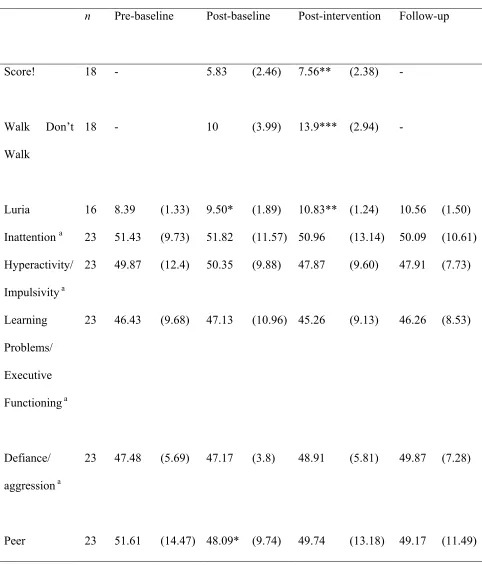
The means and standard deviations for all measures at each time point are presented in Table
1.
[Insert Table 1 here]
Baseline stability
The baseline period was stable for all but two of the measures: inhibition and peer relations.
There was a large effect size on the Luria handgame (d = 0.83, 95% CI = 0.16-1.51); a Related
Sample Wilcoxon Signed Rank test confirmed a significant improvement from T1 to T2 (Z =
-2.151, p = .03). There was a small effect size on the peer relations subscale of the CTRS-SF (d =
0.24, 95% CI = -0.82 - 0.34); a Related Sample Wilcoxon Signed Rank test confirmed a
significant improvement from T1 to T2 (Z = -2.319, p = .02).
Behaviour
indicated an improvement. All mean scores remained in the normal (non-clinical) range across
all time points. There was a small effect size on the Hyperactivity/Impulsivity subscale between
T2 and T3 (d = 0.25, 95% CI = -0.54 - 0.62), indicating a decrease in hyperactivity. A Related
Samples Wilcoxon Signed Rank test confirmed that this post-intervention decrease was
significant (Z = -2.391, p = 0.02). However, comparison of change over the baseline and
intervention periods was not significant (Z = -1.84, p = .07).The significant improvement on the
Peer Relations subscale in the baseline period was greater than change during the intervention
period (Z = -1.961, p = .05). A medium effect size between T2 and T3 scores on the
Defiance/Aggression subscale (d = 0.46, 95% CI = -0.12-1.04) indicated that participants
became more defiant after the intervention. A Related Samples Wilcoxon Signed Rank test
confirmed that this difference approached significance (Z = -1.947, p = .051); however, there
was no significant difference between baseline and intervention change scores (p = .27),
indicating that the increase was in line with expected trajectory.
All other differences from T2 to T3 were non-significant; comparisons of T3 and T4 were
all non-significant (p > .05).
Executive functions
Sustained attention.
On both subtests of the TEA-Ch, a higher score indicated increased sustained attention.
Comparison of T2 and T3 scores on the Score! subtest indicated a medium effect size (d = 0.70,
95% CI= 0.03-1.38); a Related Sample Wilcoxon Signed Rank confirmed a significant
improvement from T2 to T3 (Z = -2.838, p = .005). Comparison of T2 and T3 scores on the
t-test confirmed a significant improvement from T2 to T3 (Z = 3.132, p = .002) indicating an
increase in sustained attention.
Inhibition.
As outlined, the baseline period for the Luria hand game was not stable. A medium effect
size (d = 0.70, 95% CI = 0.02 1.38) and significant difference between T2 and T3 scores (Z =
-2.790, p = .005) indicated improvement in inhibition during both the baseline and intervention
periods. However, a Related Sample Wilcoxon Signed Rank test confirmed that the difference
between baseline and intervention change scores was not significant (Z = -.257, p = .797).
There was no significant difference between scores at T3 and T4 (Z = -.74, p = .46).
However, there was a significant difference between the intervention and follow-up change
scores (Z = -2.277, p = .02), with greater change occurring during the intervention phase. The
difference between baseline and follow-up change scores approached significance (Z = -1.909, p
= .06). As can be seen in Figure 1, the mean scores reached a peak at T3,remaining stable at T4.
[Insert Figure 1 here]
Well-being
The Index of ChildrenÕs Subjective Well-Being.
Across all participantsÕ responses to the five questions, 10.3% of the responses given were
ÔdonÕt knowÕ and 77% of participants responded ÔdonÕt knowÕ to at least one question over the
four time-points. This is much higher than the 1.5% reported in the original validation study.
not be calculated for the majority of participants. However, five participants gave responses that
could be scored across all four time-points. Mean scores remained stable over time with a slight
trend towards improvement at follow-up, indicating a relatively high level of overall well-being
in this sample. As this is such a small proportion of the overall sample, statistical analyses were
not performed.
CantrilÕs ladder and overall happiness.
Data from 18 participants were included. Self-reported life satisfaction and happiness was
high across all time points on both questions, with mean scores falling in the top 20%. Related
samples Wilcoxon signed rank analysis confirmed no significant differences between the four
timepoints, and no difference between baseline, intervention and follow-up periods on either of
the questions (all p values > .07).
Mindfulness
Mindfulness scores remained relatively stable across time. A small effect size between T2
and T3 scores (d = 0.28, 95% CI = -0.97 - 0.42), indicated an increase in self-reported
mindfulness; however, this difference was not significant (t(15) = 1.146, p = .27), and baseline
and intervention change scores did not significantly differ (t(15)= -.40. p = .69).
Acceptability
Twenty-two children completed the acceptability questionnaires (missing data was due to
pupil sickness absence). Seventy-seven per cent of children enjoyed the mindfulness sessions,
mindfulness sessions. Therefore, the mindfulness programme was acceptable to the majority of
children.
Quantitative responses from the teacher indicated that they had enjoyed participating in the
mindfulness activities; that mindfulness was a good way of meeting the childrenÕs social and
emotional needs; that they would recommend it to colleagues and that the intervention had
provided them with ideas and knowledge that they could use in future teaching sessions.
Qualitatively, the teacher reported that the mindfulness intervention had helped the children to
become more aware of what they noticed and to draw upon all of their senses. The teacher
reported that the length of the programme could be increased beyond 4 weeks to give the
children an opportunity to re-visit some of the activities.
Three parent acceptability questionnaires were returned (13% return rate) limiting the
analysis that could be performed on this data.
Feasibility
Successful participant recruitment, engagement in the sessions and completion of the study
confirms that it is feasible to incorporate adapted mindfulness activities within infant school
classrooms. During the design and implementation of the intervention, a number of feasibility
issues were considered. The additional needs of some participants (e.g. physical disability and
developmental disorders) were taken into consideration in the selection of appropriate
mindfulness practices. The classroom teacher and teaching assistants provided additional support
to those that needed it during the mindfulness sessions; and clear and concrete instructions were
provided before and during the mindfulness exercises to increase accessibility for different
Overall, it was feasible to complete child and teacher measures within a school setting.
However, the researchers raised concerns regarding a small number of participants who did not
understand questions on the CAMM; identified through systematic responding or the child
selecting an answer before the question had been fully read out. Distributions of scores on the
CantrilÕs ladder and overall happiness measures were significantly negatively skewed across all
time points and the most frequent response was at the top end of each scale; participants often
chose responses from the extreme ends of the scale. These two concerns highlight a general issue
around the validity of self-report measures with children of this age, and a query about their
ability to quantify their experiences.
The low return rate of parent measures highlights a feasibility issue of collecting parent data
via sending questionnaires home to be returned to school.
The classroom teacher participated in all but one of the mindfulness sessions and was very
effective in providing support with regards to discipline. It was feasible to implement the
intervention in the classroom with little cost as all but one of the mindfulness sessions were
facilitated in the classroom and required minimal props (singing bowl, wind-chime and raisins).
Discussion
This study demonstrated the feasibility and acceptability of embedding a programme of
mindfulness-based activities into an infant school curriculum. Furthermore, the results indicate
that mindfulness shows promise as a means of promoting the development of attention. Positive
quantitative responses from the majority of children and the class teacher indicated acceptability
of the mindfulness intervention. Whilst undertaking a group mindfulness intervention with
completion of data collection were highlighted, including the validity of self-report measures for
young children and engaging parents with data collection.
Data from well-being and mindfulness outcome measures indicated stability over time.
Despite adaptation, some children had difficulty understanding all the items in the measures. The
CAMM has been validated for children over the age of ten years (Greco, Baer, & Smith, 2011),
but there is no reported data for younger children. The vast differences in cognitive and social
development in these age groups could account for the difference in understanding of the
CAMM items. Alternative methods of measuring mindfulness might be more appropriate for
young children, such as an indirect behavioural measure or a teacher-observational report
measure. When considering well-being questions, the childrenÕs answers were at the extreme end
of the scale and appeared to be state-dependent. Again, this reflects the cognitive limitations of
this age group and difficulties quantifying their experiences. Therefore, data generated through
the use of self-report measures with children of this age needs to be treated with caution.
In terms of executive functioning, there were significant improvements on post-intervention
measures of sustained attention and inhibition (demonstrating large and medium effect sizes).
There was a significant improvement on the objective measure of sustained attention from pre- to
post intervention, suggesting that the mindfulness programme had a significant impact on
sustained attention. However, the results must be interpreted with caution as the relatively low
test re-test reliability of the sustained attention subtest may account for some of this significance.
Additionally, it was not possible to ascertain whether the post-intervention improvement is above
and beyond what would have been seen due to normal development due to the limitation of
repeated administration of the TEA-Ch. Where it was possible to compare change in the
improvement from pre- to post intervention was not significantly greater than that seen in the
baseline period. This demonstrates how rapid developmental changes can occur in this age
group, highlighting the importance of taking into account the expected developmental trajectory
when completing measures of cognitive functioning.
A decrease in teacher-reported hyperactivity (on the CTRS-SF) post-intervention, and a
trend towards this decrease being greater than the change seen in the baseline period, was
identified. It should be noted that the teacher report measure utilized is a clinical tool for
identifying specific behavourial difficulties in children; therefore, the sensitivity amongst
nonclinical samples is reduced. Future studies should therefore include a measure with greater
sensitivity across a nonclinical range.
Limitations
The primary aim of this study was the exploration of feasibility and acceptability of a
mindfulness programme with young children within a classroom setting. As such, a control
group did not feature in the design. Two pre-intervention time points allowed a within-groups
control to compare post-intervention changes with that of an expected trajectory. However,
future studies should include a control group. In addition, it was not possible to explore whether
those who scored lowest at baseline benefitted the most from the mindfulness intervention, as
was reported in Flook et al. (2010). Therefore, future research with a larger sample size could
explore whether this finding is replicable.
The wording of two of the measures used within the main study was modified. Although the
aim of this was to increase simplicity and therefore understanding, the adapted questionnaires
Wider implications and future research
One issue to consider is whether mindfulness is suitable for any infant curriculum, and what
cultural considerations might need to be considered when implementing such a programme
within schools. As practices are experiential by their nature, language is not a barrier to engaging
in mindfulness exercises. Although mindfulness has its roots within eastern Buddhist practice,
the implementation of mindfulness within schools has tended towards the use of secular
programmes, such as the Mindfulness in Schools Project. Moving away from the religious
underpinnings of mindfulness has its pros and cons (Burnett, 2011); a significant advantage of
secular mindfulness is that children of all faiths are able access it, without any potential conflict
with their own religion.
Studies drawing upon populations from a wide range of cultural contexts such as the US,
Australia, Asia and Europe, are reporting positive outcomes post-mindfulness intervention.
Furthermore, the CAMM has been validated in several non-English speaking countries,
including the Netherlands (de Bruin, Zijlstra, & Bšgels, 2014) and Spain (Vi–as, Malo,
Gonz‡lez, Navarro & Casas, 2014), and has been demonstrated to be a reliable and valid
self-report measure of mindfulness in a non-clinical sample of young people. These developments
suggest that mindfulness-based interventions could be applicable and measurable across a range
of cultural contexts. This study has highlighted a number of areas for future research to further
explore the impact of mindfulness on young childrenÕs psychological and emotional
development. A key issue is to develop a valid and reliable measure of mindfulness for children
of this age. This might involve further adaptation and validation of the CAMM for younger
children, as some participants did demonstrate an understanding of the questions. An alternative
of a questionnaire measuring observable characteristics of mindfulness such as acting with
awareness. This is also relevant to the measurement of well-being: future research could
incorporate alternative methods of rating well-being, such as teacher report.
The inclusion of a control group receiving school as usual would avoid the issue of being
unable to attain baseline measurement on some measures, whilst accounting for normal
development. This study highlighted that a mindfulness intervention was not acceptable to all of
the children who participated; therefore it would be useful for future research to explore this
further through the inclusion of qualitative questions to the acceptability measure and prompting
a child for further information if they give a negative response to one of the questions.
Furthermore, there has been an increase in school-based preventative programmes, which
aim to promote healthy psychological and emotional well-being in order to reduce the likelihood
of later mental health difficulties (August, Bloomquist, Realmuto, & Hektner, 2003; Ialongo,
Poduska, Werthamer, & Kellam, 2001; Lonczak, Abbott, Hawkins, Kosterman, & Catalano,
2002). Therefore, therapeutic approaches such as mindfulness could be embedded within
exisiting school programmes focusing on improving social and emotional well-being.
Practice recommendations and implications
The findings reported in this study have implications for practitioners and educators in terms
of potentially improving well-being, attendance and attainment. It is recommended that
mindfulness be implemented as a whole-school approach in order to improve well-being for the
pupils who attend the school. This can be facilitated by supporting the staff within the school to
develop and maintain an understanding of mindfulness and how it can be applied within the
the school environment, such as mindful walking or during physical education lessons.
Furthermore, mindfulness practices can be integrated into the daily classroom schedule, such as
at the beginning and end of each period/session. The use of a singing bowl or chime could be
used to signal this transition to the children. This can be supported through engagement with
parents, perhaps through offering a mindfulness taster session.
There are many creative and interactive ways to explain the concept of mindfulness to young
children, through the use of visual and audio clips and experiential practices. Utilising
mindfulness practices which engage as many of the senses as possible helps to keep the children
engaged and interested.
Conclusions
This study contributes to the limited research that has explored the use of mindfulness with
young children. The findings suggest that facilitating a mindfulness-based programme with
infant aged children within the school environment is both feasible and acceptable to the
majority of participants. However, due to the issues highlighted around the use of self-report
measures in this study, it was not possible to conclude whether increased mindfulness had a
positive impact on well-being and executive functioning. Additionally due to mixed findings on
measures of executive functioning, it remains unclear whether mindfulness had an impact on
cognitive functioning above and beyond a normal developmental trajectory. As outlined, issues
around valid and reliable measurement need to be addressed before future research can fully
explore the relationship between mindfulness, well-being and cognitive functioning in children
References
Abdallah, S., Steuer, N., Marks, N., Page, N. (2008). Well-being evaluation tools: a research and
development project for the big lottery fund. London: nef.
August, G. J., Lee, S. S., Bloomquist, M. L., Realmuto, G. M., & Hektner, J. M. (2003).
Dissemination of an evidence-based prevention innovation for aggressive children living
in culturally diverse, urban neighborhoods: the early risers effectiveness study.
Prevention Science, 4, 271Ð286. doi:10.1023/1026 072316380.
Baumeister, R. F., Heatherton, T. F., & Tice, D. M. (1994). Losing control: How and why people
fail at self-regulation. California: Academic Press.
Berger, C., Alcalay, L., Torretti, A., & Milicic, N. (2011). Socio-emotional well-being and
academic achievement: evidence from a multilevel approach. Psicologia: Reflex‹o e
Cr’tica, 24, 344-351. doi: 10.1590/S0102-79722011000200016
Biederman, J., Monuteaux, M. C., Doyle, A. E., Seidman, L. J., Wilens, T. E., Ferrero, F., . . .
Faraone, S. V. (2004). Impact of executive function deficits and attention
deficit/hyperactivity disorder (ADHD) on academic outcomes in children. Journal of
Consulting and Clinical Psychology, 72, 757Ð766. doi: 10.1037/0022-006X.72.5.757
Black, D. S., Milam, J., & Sussman, S. (2009). Sitting-meditation interventions among youth: A
review of treatment efficacy. Pediatrics, 124, e532-e541. doi: 10.1542/peds.2008-3434
Blair, C. (2002). School readiness. Integrating cognition and emotion in a neurobiological
111Ð127. 10.1037//0003-066X.57.2.111
Blair, C., Zelazo, P. D., & Greenberg, M. T. (2005). The measurement of executive function in
early childhood, Developmental Neuropsychology, 28, 561-571. doi:
10.1207/s15326942dn2802_1
Brown, K. W., & Ryan, R. M. (2003). The benefits of being present: mindfulness and its role in
psychological well-being. Journal of Personality and Social Psychology, 84, 822-848.
doi: 10.1037/0022-3514.84.4.822
Brown, K. W., Ryan, R. M., & Creswell, J. D. (2007). Mindfulness: theoretical foundations and
evidence for its salutary effects. Psychological Inquiry, 18, 211Ð237. doi:
10.1080/10478400701598298
Burke, C. (2010). Mindfulness-based approaches with children and adolescents: a preliminary
review of current research in an emergent field. Journal of Child and Family Studies, 19,
133-144. doi:10.1007/s10826-009-9282-x
Burnett, R. (2011). Mindfulness in Schools: Learning lessons from the adults, secular and
Buddhist. Buddhist Studies Review, 2011, 28.1, 79-120. doi:10.1558/bsrv.v28i1.79
Cantril, H. (1965). Pattern of human concerns. New Brunswick, New Jersey: Rutgers University
Press
Carlson, L. E., & Brown, K. W. (2005). Validation of the mindful attention awareness scale in a
cancer population. Journal of Psychosomatic Research 58, 29-33.
Children Act (2004). Retrieved from: http://www.legislation.gov.uk/ukpga/ 2004/31/contents
Cohen, J. (1988). Statistical power analysis for the behavioral sciences. New Jersey: Lawrence
Erlbaum.
Coholic, D. A. (2011). Exploring the feasibility and benefits of arts-based mindfulness-based
practices with young people in need: Aiming to improve aspects of self-awareness and
resilience. Child and Youth Care Forum, 40, 303-317. doi:10.1007/s10566-010-9139-x
Conners, C. K. (2008). Conners 3rd edition: Manual. New York: Multi-Health Systems.
Cunningham, W. A., Zelazo, P. D., Packer, D. J., & Van Bavel, J. J. (2007). The iterative
reprocessing model: A multilevel framework for attitudes and evaluation. Social
Cognition, 25, 736-760. doi: 10.1521/soco.2007.25.5.736
de Bruin, E. I., Zijlstra, B. J., & Bšgels, S. M. (2014). The meaning of mindfulness in children
and adolescents: further validation of the Child and Adolescent Mindfulness Measure
(CAMM) in two independent samples from The Netherlands. Mindfulness, 5, 422-430.
doi:10.1007/s12671-013-0196-8
Department for Education and Skills. (2003). Every Child Matters: Presented to Parliament by
the Chief Secretary to the Treasury by Command of Her Majesty. London: Stationery
Office. Retrieved from
https://www.education.gov.uk/publications/eOrderingDownload/CM5860.pdf
Department for Education and Skills. (2005). Excellence and enjoyment: social and emotional
http://webarchive.nationalarchives.gov.uk/
20130401151715/https://www.education.gov.uk/publications/eOrderingDownload/SEAL
%20Guidance%202005.pdf
Felder, J. N., Dimidjian, S., & Segal, Z. (2012). Collaboration in mindfulness‐based cognitive
therapy. Journal of Clinical Psychology, 68, 179-186. doi: 10.1002/jclp.21832
Fisher, R. (2006). Still thinking: the case for meditation with children. Thinking Skills and
Creativity, 1, 146Ð151. doi:10.1016/j.tsc.2006.06.004
Flook, L., Goldberg, S. B., Pinger, L., & Davidson, R.J. (2015). Promoting prosocial behavior
and self-regulatory skills in preschool children through a mindfulness-based kindness
curriculum. Developmental Psychology, 51, 44Ð51. doi:10.1037/a0038256
Flook, L., Smalley, S. L., Kitil, M. J., Dang, J., Cho, J., Kaiser-Greenland, S., . . . Kasari, C.
(2008, April). Mindful awareness practices improve executive function in preschool
children. Poster session presented at the Center for Mindfulness in Medicine, Health
Care, and Society 6th Annual Conference, Worcester, Massachusetts.
Flook, L., Smalley, S. L., Kitil, M. J., Gala, B. M., Kaiser-Greenland, S., Locke, J., . . . Kasari,
C. (2010). Effects of mindful awareness practice on executive functions in elementary
school children. Journal of Applied School Psychology, 26, 70-95. doi:
10.1080/15377900903379125
Greco, L. A., Baer, R. A., & Smith, G. T. (2011). Assessing mindfulness in children and
adolescents: development and validation of the child and adolescent mindfulness measure
Green, H., McGinnity, A., Meltzer, H., Ford, T., & Goodman, R. (2004). Mental health of
children and young people in Great Britain. Newport, South Wales: Office for National
Statistics.
Greenberg, M. T., Domitrovich, C., & Bumbarger, B. (2001). The prevention of mental disorders
in school-aged children: current state of the field. Prevention & Treatment, 4, 1a. doi:
10.1037/1522-3736.4.1.41a
Greenberg, M. T., & Harris, A. R. (2012). Nurturing mindfulness in children and youth: current
state of research. Child Development Perspectives, 6, 161-166. doi:
10.1111/j.1750-8606.2011.00215.x
Gross, J.J., & Mũnoz, R.F. (1995). Emotion regulation and mental health. Clinical Psychology:
Science and Practice, 2, 151-164.
Harnett, P. H., & Dawe, S. (2012). The contribution of mindfulness‐based therapies for children
and families and proposed conceptual integration. Child and Adolescent Mental Health,
17, 195-208. doi:10.1111/j.1475-3588.2011.00643.x
Hughes, C. (1996). Control of action and thought: normal development and dysfunction in
autism: a research note. Journal of Child Psychology and Psychiatry, 37, 229-236.
doi: 10.1111/j.1469-7610.1996.tb01396.x
Huppert, F., & Johnson, D. (2010). A controlled trial of mindfulness training in schools; the
importance of practice for an impact on well-being. The Journal of Positive Psychology,
Ialongo, N., Poduska, J., Werthamer, L., & Kellam, S. (2001). The distal impact of two
first-grade preventive interventions on conduct problems and disorder in early adolescence.
Journal of Emotional and Behavioral Disorders, 9, 146Ð160.
doi:10.1177/106342660100900301
Joseph, S., & Wood, A. (2010). Assessment of positive functioning in clinical psychology:
theoretical and practical issues. Clinical Psychology Review, 30, 830-838. doi:
10.1016/j.cpr.2010.01.002
Kabat-Zinn, J. (1994). Wherever you go, there you are: Mindfulness meditation in everyday life.
New York: Hyperion.
Khoury, B., Lecomte, T., Fortin, G., Masse, M., Therien, P., Bouchard, V., . . . Hofmann, S. G.
(2013). Mindfulness-based therapy: a comprehensive meta-analysis. Clinical Psychology
Review, 33, 763-771. doi: 10.1016/j.cpr.2013.05.005
Kuyken, W., Weare, K., Ukoumunne, O. C., Vicary, R., Motton, N., Burnett, R., . . . Huppert, F.
(2013). Effectiveness of the mindfulness in schools programme: non-randomised
controlled feasibility study. The British Journal of Psychiatry, 203, 126-131. doi:
10.1192/bjp.bp.113.126649
Lau, N., & Hue, M. (2011). Preliminary outcomes of a mindfulness-based programme for Hong
Kong adolescents in schools: well-being, stress and depressive symptoms. International
Journal of ChildrenÕs Spirituality, 16, 315Ð330. doi:10.1080/1364436X.2011.639747
Lonczak, H. S., Abbott, R. D., Hawkins, J. D., Kosterman, R., & Catalano, R. F. (2002). Effects
sexually transmitted disease outcomes by age 21 years. Archives of Pediatrics and
Adolescent Medicine, 156, 438Ð447. doi: 10.1001/archpedi.156.5.438.
Luria, A. R., Pribram, K. H., & Homskaya, E. D. (1964). An experimental analysis of the
behavioral disturbance produced by a left frontal arachnoidal endothelioma
(meningioma). Neuropsychologia, 2, 257-280. doi: 10.1016/0028-3932(64)90034-X
Manly, T., Anderson, V., Nimmo‐Smith, I., Turner, A., Watson, P., & Robertson, I. H. (2001).
The differential assessment of children's attention: The Test of Everyday Attention for
Children (TEA‐Ch), normative sample and ADHD performance. Journal of Child
Psychology and Psychiatry, 42, 1065-1081. doi: 10.1111/1469-7610.00806
Mendelson, T., Greenberg, M. T., Dariotis, J. K., Gould, L. F., Rhoades, B. L., & Leaf, P. J.
(2010). Feasibility and preliminary outcomes of a school-based mindfulness intervention
for urban youth. Journal of Abnormal Child Psychology, 38, 985-994. doi:
10.1007/s10802-010-9418-x
Napoli, M., Krech, P. R., & Holley, L. C. (2005). Mindfulness training for elementary school
students: The attention academy. Journal of Applied School Psychology, 21, 99-125.
doi:10.1300/J370v21n01_05
National Institute for Clinical Excellence (NICE). (2009). Depression: the treatment and
management of depression in adults (update). Clinical Guideline 90. Retrieved from
http://www.nice.org.uk/CG023- NICEguideline
Oberle, E., Schonert-Reichl, K. A., Lawlor, M. S., & Thomson, K. C. (2011). Mindfulness and
doi:10.1177/0272431611403741
Quoidbach, J., Berry, E.V., Hansenne, M., Mikolajczak, M. (2010). Emotion regulation and
well-being: Comparing the impact of eight savoring and dampening strategies.
Personality and Individual Differences, 49, 368-373.
Rees, G., Goswami, H., & Bradshaw, J. (2010). Developing an index of children's subjective
well-being in England. Retrieved from:
http://www.childrenssociety.org.uk/sites/default/files/tcs/research_docs/Developing%20a
n%20Index%20of%20Children%27s%20Subjective%20Wellbeing%20in%20England_0.
Rempel, K. D. (2012). Mindfulness for children and youth: a review of the literature with an
argument for school-based implementation. Canadian Journal of Counselling &
Psychotherapy, 46, 201-220. Retrieved from
http://cjc-rcc.ucalgary.ca/cjc/index.php/rcc/article/viewFile/1547/2428
Ricarte, J.J., Ros, L., Latorre, J.M., Beltran, M.T. (2015). Mindfulness-based intervention in a
rural primary school: Effects on attention, concentration and mood. International Journal
of Cognitive Therapy, 8, 258-270.
Rydell, A. M., Berlin, L., & Bohlin, G. (2003). Emotionality, emotion regulation, and adaptation
among 5-to 8-year-old children. Emotion, 3, 30-47. doi: 10.1037/1528-3542.3.1.30
Saarni, C. (1984). An observational study of childrenÕs attempts to monitor their expressive
Schutte, N.S., Manes, R.R., Malouff, J.M. (2009). Antecedent-Focused emotion regulation,
response modulation and well-being. Current Psychology, 28, 21-31.
Segal, Z., Teasdale, J., & Williams, M. (2002). Mindfulness-based cognitive therapy for
depression. New York: Guilford Press.
Seligman, M. E. P. (2002). Positive psychology, positive prevention, and positive therapy. In C.
Snyder & S. J. Lopez (Eds.), Handbook of Positive Psychology (pp. 3Ð9). New York:
Oxford University Press
Semple, R., Lee, J., Rosa, D., & Miller, L. (2010). A randomized trial of mindfulness-based
cognitive therapy for children: promoting mindful attention to enhance social-emotional
resiliency in children. Journal of Child & Family Studies, 19, 218Ð229.
doi:10.1007/s10826-009-9301-y
Sibinga, E., Perry-Parrish, C., Chung, S. E., Johnson, S. B., Smith, M., & Ellen, J. M. (2013).
School-based mindfulness instruction for urban male youth: a small randomized
controlled trial. Preventive medicine, 57, 799-801. doi:10.1016/j.ypmed.2013.08.027
Tabachnick, B. G., & Fidell, L. S. (2013). Using Multivariate Statistics, 6th ed. Boston: Pearson
Tang, Y. Y., Yang, L., Leve, L. D., & Harold, G. T. (2012). Improving executive function and its
neurobiological mechanisms through a mindfulness‐based intervention: advances within
the field of developmental neuroscience. Child Development Perspectives, 6, 361-366.
doi: 10.1111/j.1750-8606.2012.00250.x
year of preschool education. Ensayos-revista de la facultad de educacion de Albacete, 30,
85-97.
UNICEF Innocenti Research Centre (2007). Child poverty in perspective: An overview of child
well-being in rich countries. Retrieved from
http://www.unicef-irc.org/publications/pdf/rc7_eng.pdf
Valentine, J. C., DuBois, D. L., & Cooper, H. (2004). The relation between self-beliefs and
academic achievement: A meta-analytic review. Educational Psychologist, 39, 111-133.
doi: 10.1207/s15326985ep3902_3
Vi–as, F., Malo, S., Gonz‡lez, M., Navarro, D., & Casas, F. (2015). Assessing mindfulness on a
Sample of Catalan-Speaking Spanish Adolescents: Validation of the Catalan version of
the Child and Adolescent Mindfulness Measure. The Spanish Journal of psychology, 18,
E46. doi:10.1017/sjp.2015.48
Weyandt, L. L. (2005). Executive function in children, adolescents, and adults with attention
deficit hyperactivity disorder: introduction to the special issue, Developmental
Neuropsychology, 27, 1-10, doi: 10.1207/ s15326942dn2701_1
White, L. S. (2012). Reducing stress in school-age girls through mindful yoga. Journal of
Pediatric Health Care, 26, 45-56.doi:10.1016/j.pedhc.2011.01.002
Wood, A. M., & Tarrier, N. (2010). Positive clinical psychology: a new vision and strategy for
integrated research and practice. Clinical Psychology Review, 30, 819-829. doi:
Zelazo, P. D., & Lyons, K. E. (2012). The potential benefits of mindfulness training in early
childhood: A developmental social cognitive neuroscience perspective. Child
Table 1
Mean scores (standard deviation) for all measures
n Pre-baseline Post-baseline Post-intervention Follow-up
Score! 18 - 5.83 (2.46) 7.56** (2.38) -
Walk DonÕt
Walk
18 - 10 (3.99) 13.9*** (2.94) -
Luria 16 8.39 (1.33) 9.50* (1.89) 10.83** (1.24) 10.56 (1.50)
Inattention a 23 51.43 (9.73) 51.82 (11.57) 50.96 (13.14) 50.09 (10.61)
Hyperactivity/
Impulsivity a
23 49.87 (12.4) 50.35 (9.88) 47.87 (9.60) 47.91 (7.73)
Learning
Problems/
Executive
Functioning a
23 46.43 (9.68) 47.13 (10.96) 45.26 (9.13) 46.26 (8.53)
Defiance/
aggression a
23 47.48 (5.69) 47.17 (3.8) 48.91 (5.81) 49.87 (7.28)
n Pre-baseline Post-baseline Post-intervention Follow-up
Relationsa
Overall life
satisfaction b
5 14 (2.7) 13.8 (3.3) 14.2 (2.95) 14.6 (5)
Overall
satisfaction c
18 8.22 (2.24) 8.72 (2.37) 8.06 (1.95) 9.06 (1.73)
Overall
happiness
18 4.61 (0.78) 4.28 (1.32) 4.17 (1.25) 4.56 (0.71)
CAMM 21.06 (7.98) 20.50 (5.22) 19.06 (5.76) 20.13 (6.39)
Note. a= CTRS-SF 3 subscales (Conners, 1997), b= Index of childrenÕs subjective well-being
(Rees, Goswami & Bradshaw, 2010); c = CantrilÕs ladder (Cantril, 1965).