White Rose Research Online URL for this paper:
http://eprints.whiterose.ac.uk/117418/
Version: Published Version
Article:
Eitzel, Melissa, Cappadonna, Jessica, Santos-Lang, Chris et al. (20 more authors) (2017)
Citizen Science Terminology Matters: Exploring Key Terms. Citizen Science: Theory and
Practice. pp. 1-20. ISSN 2057-4991
[email protected] https://eprints.whiterose.ac.uk/
Reuse
This article is distributed under the terms of the Creative Commons Attribution (CC BY) licence. This licence allows you to distribute, remix, tweak, and build upon the work, even commercially, as long as you credit the authors for the original work. More information and the full terms of the licence here:
https://creativecommons.org/licenses/
Takedown
If you consider content in White Rose Research Online to be in breach of UK law, please notify us by
REVIEW AND SYNTHESIS PAPER
Citizen Science Terminology Matters: Exploring Key
Terms
M V Eitzel
*, Jessica L Cappadonna
†, Chris Santos-Lang
‡, Ruth Ellen Duerr
§,
Arika Virapongse
§, Sarah Elizabeth West , Christopher Conrad Maximillian Kyba
¶,
Anne Bowser
**, Caren Beth Cooper
††, Andrea Sforzi
‡‡, Anya Nova Metcalfe
§§,
Edward S Harris , Martin Thiel
¶¶, Mordechai Haklay
***, Lesandro Ponciano
†††,
Joseph Roche
‡‡‡, Luigi Ceccaroni
§§§, Fraser Mark Shilling , Daniel Dörler
¶¶¶,
Florian Heigl
¶¶¶, Tim Kiessling
****, Brittany Y Davis
††††and Qijun Jiang
‡‡‡‡Much can be at stake depending on the choice of words used to describe citizen science, because termi-nology impacts how knowledge is developed. Citizen science is a quickly evolving eld that is mobilizing people’s involvement in information development, social action and justice, and large-scale information gathering. Currently, a wide variety of terms and expressions are being used to refer to the concept of ‘citizen science’ and its practitioners. Here, we explore these terms to help provide guidance for the future growth of this eld. We do this by reviewing the theoretical, historical, geopolitical, and disciplinary con -text of citizen science terminology; discussing what citizen science is and reviewing related terms; and providing a collection of potential terms and de nitions for citizen science and people participating in citizen science projects. This collection of terms was generated primarily from the broad knowledge base and on-the-ground experience of the authors, by recognizing the potential issues associated with various terms. While our examples may not be systematic or exhaustive, they are intended to be suggestive and invitational of future consideration. In our collective experience with citizen science projects, no single term is appropriate for all contexts. In a given citizen science project, we suggest that terms should be chosen carefully and their usage explained; direct communication with participants about how terminol-ogy a ects them and what they would prefer to be called also should occur. We further recommend that a more systematic study of terminology trends in citizen science be conducted.
Keywords: crowdsourcing; community-based participatory research; epistemology; public participation in science and research; ontology; participatory action research
* Science and Justice Research Center, University of California Santa Cruz, 1156 High St, Santa Cruz, CA 95064, US † Queensland University of Technology S Block, Level
10, Room 1002, Gardens Point Campus, Brisbane, Queensland, AU
‡ Citizen Science Belleville, US
§ Ronin Institute for Independent Scholarship, US
Stockholm Environment Institute, University of York, UK ¶ GFZ German Research Centre for Geosciences, DE ** Woodrow Wilson International Center for Scholars, US
†† North Carolina State University and North Carolina Museum of Natural Sciences, US
‡‡ Maremma Natural History Museum, IT
§§ Northern Arizona University, US
Scleroderma Education Project Ltd., 2726 Van Hise Ave, Madison, WI 53705, US
¶¶ Universidad Católica del Norte, Millennium Nucleus Ecology and Sustainable Management of Oceanic Island (ESMOI), Centro de Estudios Avanzados en Zonas Áridas (CEAZA), CL
*** University College London, UK
††† Federal University of Campina Grande, BR ‡‡‡ Trinity College Dublin, IE
§§§ 1000001 Labs, ES
University of California, Davis, US
¶¶¶ Citizen Science Working Group, Institute of Zoology, University of Natural Resources and Life Sciences, Vienna, AT **** Universidad Católica del Norte, CL
†††† Allegheny College, US
Introduction
Terminology matters. People draw boundaries using lan-guage, choosing terms that include or exclude ideas, activ-ities, and people (Gieryn 1999). As a quickly evolving and still nascent field, citizen science is already a broad concept, and inclusion (in the sense of broadening participation in science) is central in many of its meanings (Solomon 1993, Irwin 1995, Bonney 1996). Given this underlying tenet of inclusion, practitioners should give careful thought to the words they choose to describe activities, programs, and participants. Such care is important because terminology is also a part of how we construct our mental models of the world, what values we live by, and how we relate to each other (Haraway 1988, Barad 2007). Relationships between all members of research programs are particu-larly important for citizen science due to the large number of people involved, their varying motivations for involve-ment, and the power dynamics inherent in the way we produce knowledge. As an added challenge, terminology is never static and is constantly evolving. Terminology is particularly dynamic in citizen science, because the field is currently experiencing enormous expansion and a rapidly diversifying group of participants.
Our primary goal for this paper is to discuss the con-temporary terminology of science involving the public. To do so, we summarize contexts for citizen science and different ideas of what citizen science is, making con-nections with and distinctions among related terms. Our secondary goal is to raise questions regarding the termi-nology for citizen science participants. We therefore iden-tify common terms used, particularly as they relate to different types of citizen science initiatives and contexts. Finally, we note that some groups may prefer to avoid the term citizen science altogether. Because less famil-iar terms may be less useful for mobilizing resources to develop and maintain projects (e.g., funding, volunteers, media buzz, legal precedent), we propose that the defi-nition of ‘citizen science’1 be as broad as possible,
mak-ing it available for diverse groups to claim if they choose. We also share our perspective on what citizen science is
not and offer suggestions for how to maintain coherent shared practice while allowing for plurality. We intend our suggestions to apply broadly to any currently popu-lar set of terms as well as any future terms that may be used to describe kindred forms of public participation in scientific research.
Questioning Terminology
This paper developed as a result of a lively conversation on the citsci-discussion-l email list, a Citizen Science Association (CSA) resource that was maintained by the Cornell Lab of Ornithology at the time this paper was developed.2 Initially, one list member raised the question
of what to call the people involved in a citizen science project:
“I am talking to a lot of journalists this week, and I’m struggling with how to best differentiate between anonymous citizen scientists and people like me who have known credentials and training.” (C.C.M Kyba).
Our discussions moved from the citsci-discussion list to an email thread with a more targeted group of contribu-tors who were interested in pursuing the development of a paper on the topic of terminology. Leadership then emerged to facilitate the synthesis of our discussions (first author); a shared Google doc was used as a tool to docu-ment and refine our discussion. The topic of word choice (for ‘participants,’ ‘scientists,’ and ‘citizen science’) further expanded into the question of what citizen science is, reflecting the entanglement of terminology and ontology, i.e., what we call things is linked to what we think they are. This paper therefore begins by establishing contexts for citizen science terminology, then discusses what citizen science is (including relationships to other terms), next offers a starting point for discussions around terminology used for participants, and finally concludes with thoughts about balancing plurality with coherent shared practice.
Although we intend to present some degree of consen-sus on terminology, we also seek to represent the diversity of our experiences, contexts, and perspectives. Not all of the opinions expressed in this paper are shared by all of the authors. We work in 11 countries around the world and represent a wide range of experiences with and com-mitments to citizen science (Table 1). Our terms, distinc-tions, definidistinc-tions, and contexts originate from extensive collective experiences. While this paper does not exhaus-tively capture all perspectives of the larger citizen science community, we believe it is reasonably representative. We note, however, that most of the authors of this paper are academics and/or citizen science project leaders, many of whom are from the United States (U.S.) or Europe; we welcome comments from participants of and contributors to citizen science projects in other countries and regions.
We intend this paper to be useful to a wide variety of people interested in any form of citizen science. We there-fore explore the term ‘citizen science’ in a broad sense, including generation of any theory or hypothesis, research, scientific data collection, and/or data analysis in which the public (individuals or communities) participates. If readers prefer a different phrase for ’citizen science,’ we encourage them to mentally substitute that phrase whenever we use the term here. Groups that are working to advocate and advance the development of citizen science, such as asso-ciations from around the world, may find our collection of terms and related starting points for discussion helpful for their own work on terminology, audience, and scope.3
Our definitions and taxonomy of terms related to citizen science can be useful as a reference to students, guidelines for journal editors, and to inform academic scientists as they engage with the public. Finally, we hope this paper can be useful to policymakers, funders who seek to sup-port citizen science, and participants in citizen science including managers, planners, and practitioners.
Background and Contexts for Citizen Science
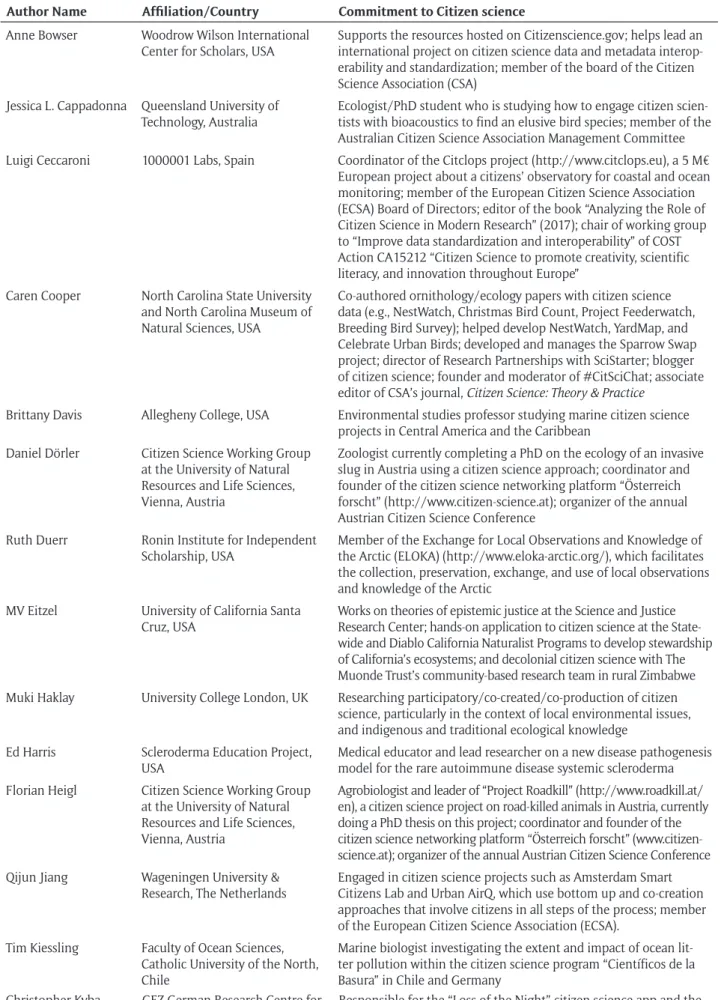
Table 1: Authors’ affiliations and commitments to citizen science, in alphabetical order by last name.
Author Name Afiliation/Country Commitment to Citizen science
Anne Bowser Woodrow Wilson International Center for Scholars, USA
Supports the resources hosted on Citizenscience.gov; helps lead an international project on citizen science data and metadata interop-erability and standardization; member of the board of the Citizen Science Association (CSA)
Jessica L. Cappadonna Queensland University of Technology, Australia
Ecologist/PhD student who is studying how to engage citizen scien-tists with bioacoustics to find an elusive bird species; member of the Australian Citizen Science Association Management Committee Luigi Ceccaroni 1000001 Labs, Spain Coordinator of the Citclops project (http://www.citclops.eu), a 5 M€
European project about a citizens’ observatory for coastal and ocean monitoring; member of the European Citizen Science Association (ECSA) Board of Directors; editor of the book “Analyzing the Role of Citizen Science in Modern Research” (2017); chair of working group to “Improve data standardization and interoperability” of COST Action CA15212 “Citizen Science to promote creativity, scientific literacy, and innovation throughout Europe”
Caren Cooper North Carolina State University and North Carolina Museum of Natural Sciences, USA
Co-authored ornithology/ecology papers with citizen science data (e.g., NestWatch, Christmas Bird Count, Project Feederwatch, Breeding Bird Survey); helped develop NestWatch, YardMap, and Celebrate Urban Birds; developed and manages the Sparrow Swap project; director of Research Partnerships with SciStarter; blogger of citizen science; founder and moderator of #CitSciChat; associate editor of CSA’s journal, Citizen Science: Theory & Practice
Brittany Davis Allegheny College, USA Environmental studies professor studying marine citizen science projects in Central America and the Caribbean
Daniel Dörler Citizen Science Working Group at the University of Natural Resources and Life Sciences, Vienna, Austria
Zoologist currently completing a PhD on the ecology of an invasive slug in Austria using a citizen science approach; coordinator and founder of the citizen science networking platform “Österreich forscht” (http://www.citizen-science.at); organizer of the annual Austrian Citizen Science Conference
Ruth Duerr Ronin Institute for Independent Scholarship, USA
Member of the Exchange for Local Observations and Knowledge of the Arctic (ELOKA) (http://www.eloka-arctic.org/), which facilitates the collection, preservation, exchange, and use of local observations and knowledge of the Arctic
MV Eitzel University of California Santa Cruz, USA
Works on theories of epistemic justice at the Science and Justice Research Center; hands-on application to citizen science at the State-wide and Diablo California Naturalist Programs to develop stewardship of California’s ecosystems; and decolonial citizen science with The Muonde Trust’s community-based research team in rural Zimbabwe Muki Haklay University College London, UK Researching participatory/co-created/co-production of citizen
science, particularly in the context of local environmental issues, and indigenous and traditional ecological knowledge
Ed Harris Scleroderma Education Project, USA
Medical educator and lead researcher on a new disease pathogenesis model for the rare autoimmune disease systemic scleroderma Florian Heigl Citizen Science Working Group
at the University of Natural Resources and Life Sciences, Vienna, Austria
Agrobiologist and leader of “Project Roadkill” (http://www.roadkill.at/ en), a citizen science project on road-killed animals in Austria, currently doing a PhD thesis on this project; coordinator and founder of the citizen science networking platform “Österreich forscht” (www.citizen-science.at); organizer of the annual Austrian Citizen Science Conference Qijun Jiang Wageningen University &
Research, The Netherlands
Engaged in citizen science projects such as Amsterdam Smart Citizens Lab and Urban AirQ, which use bottom up and co-creation approaches that involve citizens in all steps of the process; member of the European Citizen Science Association (ECSA).
Tim Kiessling Faculty of Ocean Sciences, Catholic University of the North, Chile
Marine biologist investigating the extent and impact of ocean lit-ter pollution within the citizen science program “Científicos de la Basura” in Chile and Germany
Christopher Kyba GFZ German Research Centre for Geosciences, Germany
Responsible for the “Loss of the Night” citizen science app and the “http://www.myskyatnight.com” webapp that allows users to view and analyze light pollution data
Finally, we discuss geopolitical and disciplinary contexts for the terminology of citizen science.
Theoretical Context: Why Words Matter
Scholars of science argue that language is not merely representational. Instead, language and materiality are co-produced; that is, the words that we use for what we observe are fashioned simultaneously with our percep-tions of what those things are (Haraway 1988). Language is a sensitizing concept, or in psychology terms, language can prime us to see certain things and not others. This entanglement extends further. Barad (2007) states that how we know about the world (epistemology), what we believe exists in the world (ontology), and the values by which we live our lives (ethics), are not separate. Because science is a way of knowing about the world, and because naming things is simultaneous with our ontological con-ception of what we are naming, the role of language in Barad’s (2007) entangled ethics/epistemology/ontology is a critical point for consideration in citizen science.
Furthermore, language is an important part of the con-struction of what is considered science vs. not-science (‘boundary-work,’ Gieryn 1999). Citizen science is typically intended to broaden participation in science, so we are essentially in the business of redefining or even disassem-bling boundaries. Therefore, attention to the terminology we use is an important part of effective practice. Because citizen science is a form of knowledge production, citizen science terminology has the power to allow some peoples’ knowledge to be included and the knowledge of others to be excluded. This power potentially presents epistemic (knowledge) justice issues (Fricker 2007) and has conse-quences for the quality of our understanding of the world (Haraway 1988).
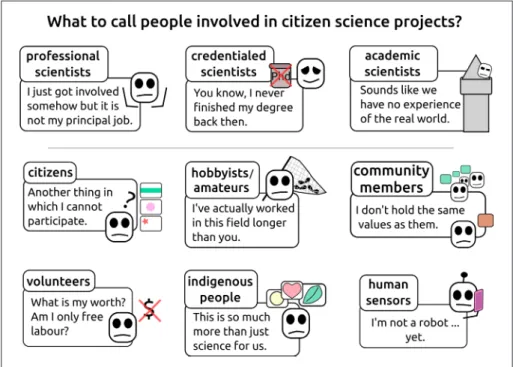
As in many other participatory contexts, terminology can matter deeply to participants in citizen science pro-jects. The terminology used to describe participants can potentially change the way they are treated or how they feel about themselves and their participation in the activity (Figure 1). The language used to refer to people,
Chris Santos-Lang Citizen Science Belleville, USA Leads citizen science of a bible study that tests replicability of experiments to improve health, relationships, and well being for future generations (http://www.osf.io/fqn7v/wiki/home)
Anya Metcalfe United States Geological Survey, Arizona, USA
Stream ecologist and entomologist who manages and utilizes a citizen science project across western U.S. examining aquatic insect distribution and emergence in a dam-regulated riverscape (http:// www.gcmrc.gov)
Lesandro Ponciano Federal University of Campina Grande and Pontifical Catholic University of Minas Gerais, Brazil
Computer science professor studying participation of volunteers in citizen science projects conducted through crowdsourcing and human computation systems, such as Zooniverse, Crowdcrafting, and Socientize platforms
Joseph Roche Trinity College Dublin, Ireland Astrophysicist and Assistant Professor in Science Education who lec-tures on citizen science for the M.Ed program in Science Education; on the science team for Sunspotter.org (Zooniverse project)
Andrea Sforzi Maremma Natural History Museum, Italy
Director of the museum and responsible for the citizen science pro-ject (naturaesocialmapping.it) that includes a recording website and courses for citizen scientists and bioblitzes; member of the ECSA Board of Directors
Fraser Shilling University of California, Davis, USA
Ecologist who co-directs the Road Ecology Center; trained water quality monitors for California’s longest running watershed-monitoring program (Yuba); co-developed the largest volunteer-contribution, roadkill-observing system in world; develops standard approaches and web-tools for public science; and tries not to use the term ‘citizen science’
Martin Thiel Faculty of Ocean Sciences, Catho-lic University of the North; Millennium Nucleus Ecology and Sustainable Management of Oceanic Island (ESMOI); Center of Advanced Studies in Arid Zones (CEAZA), Coquimbo, Chile
Professor of Marine Biology, Director of the citizen science program “Científicos de la Basura” (http://www.cientificosdelabasura.cl), which has been investigating marine litter along the coast of Chile for the past 10 years, involving the participation of K-12 students and their teachers; associate editor of CSA’s journal, Citizen Science: Theory & Practice
Arika Virapongse Ronin Institute for Independent Scholarship, USA
Social ecologist with expertise in conservation and development, including participatory approaches, and studying the role of citizen scientists in social-ecological observing and community develop-ment
Sarah West Stockholm Environment Insti-tute, University of York, UK
activities, and objects can have deep-seated resonance with racial inequities and histories of colonization. For example, the Standing Rock Sioux, as part of their resist-ance to the Dakota Access pipeline, object to being referred to as ‘stakeholders.’ Chairman Archambault said, “They would consider us a stakeholder, but we’re a nation” (quoted in Mufson 2016). Therefore, the use of terms like ‘stakeholder engagement’ is in conflict with how the Standing Rock Sioux view themselves, and in this case, the mismatch resulted in the tribe not partici-pating in ‘stakeholder’ meetings. Or consider farmers in Colombia who, faced with social and armed conflict as well as militarized U.S.-Colombia anti-narcotics policy, are critical of the colonial legacies and capitalist influ-ences of agricultural sciinflu-ences (Lyons in press). Though these farmers conduct their own experimentation in their farming practices, they would not claim the term ‘citizen science’ to describe what they do when, for example, they use different ways of looking at and relating to soils than typical ‘scientific’ research. And in the U.S., the National Institutes of Health’s (NIH) International HapMap Project was designed to map human genome diversity from indi-viduals around the world. Questions arose concerning what to label samples: If a sample was labeled ‘African’ or ‘Asian’ would the results be generalized as ‘all Africans’ or ‘all Asians?’ The NIH researchers spent considerable time and funding working with study participants to determine appropriate names, despite concerns that names could reproduce racial biases. Ultimately, the names suggested by participants were not used (Reardon in press).
Finally, as boundary-work, terminology selection is inherently strategic. This issue has been a part of our group’s discussions and has revealed our diversity of opin-ions. Some terms may be better for egalitarian purposes
of democratizing knowledge production, while others may be better used for establishing the validity of citi-zen knowledge and authority to policy-makers. Still other terms are appropriate when working with indigenous people. We all came to this project with different goals in mind, and our orientations regarding terminology reflect this diversity. Different terms serve different goals, and dif-ferent terms are appropriate for difdif-ferent audiences–e.g., prospective participants in projects vs. skeptical policy-makers vs. academics defending the concept of value-free science. In many ways, the range of goals and associated terms reflects the expansion of contemporary science beyond professional boundaries to include many facets of civil society.
Dictionary De nitions and the Two Strands of
Citizen Science
In regard to definitions of terms, which activities fall under the guise of ‘citizen science’ is both nuanced and in a state of flux, although it is generally agreed that citizen science refers to the inclusion of members of the public in some aspect of scientific research. While the term ‘public’ or ‘the public’ is often used to describe the general population, well established research in public understanding of sci-ence and public engagement reminds us that the public cannot be assumed to be a monolithic entity (Chilvers and Kearnes 2015; Marres 2007).
The term ‘citizen science’ was added to the Oxford English Dictionary in 2014 as “Scientific work undertaken by members of the general public, often in collabora-tion with or under the direccollabora-tion of professional scientists and scientific institutions” (OED 2016a). This definition of citizen science fails to consider the broader use of the term as initially coined by Alan Irwin (1995). Cooper and
Lewenstein (2016) discuss these two meanings or ‘strands’ of citizen science. The first strand, from Irwin’s defini-tion, emphasizes the responsibility of science to society, which they call “democratic” citizen science. At the other end of the spectrum they position the second strand, “par-ticipatory” citizen science, as practice in which people mostly contribute observations or efforts to the scientific enterprise, a meaning that originated with Rick Bonney’s (1996) work at the Cornell Lab of Ornithology. Bonney et al. (2016) suggest that future iterations of the OED defi-nition should highlight the diversity, scale, and value of citizen science projects from both strands. Ceccaroni et al. (2017) focus on the convergence of these viewpoints to define citizen science in relation to civic education as work undertaken with citizen communities to advance science, foster a broad scientific mentality, and/or encour-age democratic engencour-agement, which helps society address complex modern problems.
Citizen science terms are dynamic and change over time, therefore
“it would be a shame for us to ignore widespread public interpretations of key terms and the reasons for those interpretations.” (Daniela Soleri, personal communication)
In that vein, using the word ‘citizen’ also can be an issue, as this word may be defined as “A legally recognized sub-ject or national of a state” or “An inhabitant of a city or town” (OED 2016b). The first definition is problematic in some parts of the world where legal recognition is com-plex, and legal citizenship may not be relevant in many citizen science projects. The second definition appears to prioritize urban inhabitants. Citizenship can be more broadly construed, but the term remains problematic in practice; these difficulties also vary by country. While we cannot erase the potential problems associated with the term and we understand that many community members may not want to be called ‘citizens,’ in this paper we use the word ‘citizen’ as part of ‘citizen science’ because the term is familiar to most, and define ‘citizen’ here to mean a member of a broadly construed community.
Historical Context for Professional and Citizen Science
The term ‘scientist’ was coined in 1833 (Yeo 1993) and slowly grew in use. The Eurocentric scientist-as-profession paradigm is relatively new, emerging slowly throughout the 17th to 19th centuries. Initially called ‘philosophers of
science’ or ‘natural philosophers,’ individuals who pursued research made their living in another profession, were sponsored by a benefactor, or had independent means. Truth was accepted from “gentlemen” as reliable, in con-trast to other groups, and technicians in gentlemen’s labs were regarded as “invisible” (Shapin 1994).
Sometimes these early scientists investigated top-ics by recruiting others through peer networks to assist with data collection and/or analyses (Miller-Rushing et al. 2012). For example, Charles Darwin was not a profes-sional researcher but an unpaid companion on the Beagle,
though he had medical training (Silvertown 2009). In 1874, many governments engaged prominent astrono-mers around the world to measure the Earth’s distance to the Sun in the “Transit of Venus” project (Ratcliff 2008). Some individuals outside the gentry also were able to con-tribute to discoveries. For example, Mary Anning–who had no training initially–found the first British Ichthyosaur (among other fascinating fossils) and became one of the most influential women in British paleontology, particu-larly posthumously (Hall 2002).
Citizen science as participatory data collection (part of Bonney’s 1996 definition) has existed for a long time with-out specific descriptive terminology. Members of the pub-lic have collected observations of nature for hundreds of years in such fields as archaeology, astronomy, and natural history (Silvertown 2009). In the late 1800s, amateurs were valued only for their observations rather than their abil-ity to elucidate meaning from observations. An attitude prevailed that all observations, fossils, specimens, and so forth should be brought to a central place in England so that ‘scientists’ could use the materials and information to generate knowledge and advance science. So even after scientific research was professionalized and institutional-ized, a partnership occurred between amateur and profes-sional scientists (Miller-Rushing et al. 2012), although in some disciplines such as veterinary science, the quality of information collected by amateurs was progressively viewed with skepticism (Ruth Duerr, personal commu-nication). In many cases, citizen science is often viewed through this lens of a partnership between amateur data collectors and professional elucidators.
As another example, the Audubon Christmas Bird Count in the U.S. was founded in 1900, and the United Kingdom (U.K.) also has a long and rich history of wild-life recording by volunteers; such existing programs are now labeled as ‘citizen science,’ which contributes to the recent perceived and actual rise in citizen science projects (Roy et al. 2012). ‘Citizen scientist’ (meaning scientist independent of institutions) was used at least as early as 1912 (Scott 1912). ‘Participatory Action Research’ (PAR), also termed ‘Community Action Research’ (CAR), became popular during the social movements in the 1960s and 1970s, especially in Latin America (McTaggart 1991, Torres 1992, Kindon et al. 2008). ‘Citizen science’ as a demo-cratic concept was used in the 1990s (Solomon 1993; Irwin 1995), around the same time that Bonney first used ‘citizen science’ to describe his long-running participatory data collection projects (1996). ‘Crowdsourcing,’ as a term to describe an open call to a wide group to aid in some kind of labor, originated in WIRED magazine in a 2006 article; even in this first use, the term included examples of crowdsourced science and research (Howe 2006).
Disciplinary and Sectoral Context
‘community-based participatory research’ (CBPR) is more commonly used (see, for example, Minkler and Wallerstein 2011), and terms for participants tend toward ‘resident,’ ‘neighbor,’ or ‘community member.’ Jason Corburn (2005) very carefully chooses the term ‘local knowledge’ for his study of community-based public health research. In geography, ‘volunteered geographic information’ is commonly used to describe engagement of large numbers of participants involved in the digital creation of geographic information (Goodchild 2007; Sieber and Haklay 2015), and despite the term’s focus on data, it is widely used to describe the ‘citizen science’ activity itself. The term ‘participant’ in medical research may refer to those participating in studies as human sub-jects of research, which contrasts with how the term is typically used in citizen science projects.
Differences in disciplinary contexts, vocabularies, and norms may make it difficult for researchers in one disci-pline to understand the engagement practices, methods, data, and impacts of researchers in another discipline. These differences also may create confusion among partic-ipants about the type and depth of their own involvement in the project. In some cases, developing standardized vocabularies for citizen science which articulate shared aspects, such as quality assurance/quality control con-cerns, may transcend disciplinary differences (Ceccaroni et al. 2017). However, these shared vocabularies must be co-developed by, and later used by, a wide range of rel-evant stakeholders.
Geopolitical and Language Context
Although the term ‘citizen science’ was coined in the U.S. and the U.K., the practice of scientists working together with other people occurs in many different countries, so various terms for this method exist (Table 2). What most of the terms have in common is their language-specific word for ‘citizen,’ in the sense of ‘inhabitant of a nation’ (some-times associated with legal attributes, i.e., ‘civil rights’), and the translation of the term ‘science,’ which characterizes the scientific approach behind the activity. In many coun-tries, for example Australia, Austria, Brazil, Chile, Ireland, and the Arctic regions, citizen science was established by grassroots activities through a bottom-up approach, and the terms that practitioners in these geographies use echo this grassroots development. In Europe, citizen science is also driven by universities, research centers, and muse-ums. Governmental support and/or structures are avail-able only very recently in some countries (e.g., Austria), whereas in Germany and the U.S., the government cur-rently funds and sometimes even runs citizen science networking activities and projects. Considering the social diversity involved in the grassroots origins of citizen sci-ence in many countries, it may not be enough to simply translate the term, because the history, context, and prac-tices must be looked at more closely. In some countries, for example Austria and Switzerland, the term is so novel and unusual that it is not translated at all, and the meaning of ‘citizen science’ is adapted to the country-specific context. To partially bridge this gap, the European Citizen Science Association (ECSA) is supporting the translation of their
“Ten Principles of Citizen Science” (ECSA 2015) in as many languages as possible (27 languages by December 2016).
What is Citizen Science? What do We Call it?
Our discussions raised questions regarding what terms to use to describe science, and the range of objectives and commitments of citizen science, which depended on the intent and practices of a given citizen science project. The degree of engagement of participants in different phases of science may affect the terminology used (or desired by participants). Public Participation in Scientific Research ( PPSR) is a term explored by Bonney et al. (2009b) and Shirk et al. (2012) which covers a wide range of participa-tory approaches, including citizen science, crowdsourcing, participatory action research, community-based research, and volunteered geographic information. Within PPSR, these approaches also can be distinguished by the degree of participation and the stage of the scientific process at which people are involved (Shirk et al. 2012). The term has proven to be difficult to use and has gained less traction in the face of the already well-established ‘citizen science’; although in the U.S. some granting agencies, including the National Science Foundation (NSF), do use PPSR to describe the projects in their portfolio. ‘Community and citizen science’ is a more recent term intended to be more accessible and serve the same ‘umbrella’ purpose as PPSR (Ballard et al. 2016).
Citizen Science as Tool vs. Movement vs. Social Capacity
Many researchers and practitioners characterize citizen science instrumentally, that is, as a tool, method, or form of research collaboration (e.g., Bonney et al. 2009b; Wiggins and Crowston 2011; Follett and Streznov 2015). In these cases, citizen science is often contextualized within tradi-tional, hierarchical science and policy-making processes. Advocates of the instrumental view often suggest that citizen science allows traditional scientific research prac-tices to reach larger scales (e.g., geographically, sample size) than have ever been possible for many fields. Indeed, interest in citizen science has grown alongside the big data and open data phenomena, which are touted as the new future for many sciences (Auer et al. 2007; Dickinson et al. 2010). When considered as a tool, method, or form of research collaboration, citizen science is associated with the potential for significant benefits for volunteers, for example, for improving ecological literacy (Bonney et al. 2009b). Citizen science is often seen as an informal way to achieve both educational and scientific objectives, and can be seen as a parallel activity to the efforts of museums and science centers in informal education (Bonney et al. 2009a; Sforzi et al. In press).
Table 2: Geopolitical contexts, in alphabetical order.
Country Citizen science terminology and context Arctic regions
Traditional Ecological Knowledge (TEK)
As noted in a Community White Paper (Noor Johnson et al. 2013), “Arctic Indigenous peoples have been systematically observing the environment for millennia” where such monitoring “plays a significant role in daily life, providing information that is critical to safe travel and successful hunt-ing and harvesthunt-ing activities.” The term ‘Citizen Science’ is rarely if ever used for research in these regions, perhaps due to the existence of the Arctic Council which has “promoted cooperation, coordination and interaction among the Arctic States, Arctic indigenous communities and other Arctic inhabitants on common Arctic issues, in particular on issues of sustainable development and environmental protection in the Arctic” for the last 20 years.
Australia
Citizen science While members of the public have contributed to scientific research in Australia for decades, the term ‘citizen science’ and the ubiquity of such activities was relatively unknown until recently.
Citizen science leaders recognized the need to connect this community, which led to the forma-tion of the Australian Citizen Science Associaforma-tion (ACSA; http://www.citizenscience.org.au) in May 2014 and the first Australian citizen science conference in July 2015. To date, citizen science activities have been identified at community, regional, state, and national levels. For most projects, citizen scientists contribute observations of fauna, flora, and habitat, though a few projects exist in astronomy, meteorology, and seismology. Citizen science in Australia is also rapidly diversifying into new domains (e.g., online) and disciplines (e.g., biomedical sciences).
Austria
Bürgerwissenschaft Citizen science has developed rapidly over the last 3–4 years in Austria, although the approach has been known for more than100 years. In 2014, the first Austrian online platform for citizen science
projects (Österreich forscht, http://www.citizen-science.at) began to connect citizen science pro-jects and actors to foster this method and to ensure quality. The platform is borne by citizen sci-ence project leaders, so it is independent from institutions. In parallel, a second platform (Centre for Citizen Science, http://www.zentrumfuercitizenscience.at) was developed at Österreichischer Austauschdienst.
Brazil
Ciência cidadã
The Citizen Science Movement (“Movimento Ciência Cidadã,” http://www.movimentocienciaci-dada.org) is an effort focused on democratizing access to Brazilian scientific production on topics of social interest. Some examples of citizen science projects are Farmer-Experimenter Groups, the ForestWatchers Project (http://www.forestwatchers.net), and Contribua (http://www.contribua. org). Participants are usually called volunteer (‘voluntário’) or participant (‘participante’).
Chile
Ciencia ciudadana Chile has a long-standing tradition of Participatory Action Research (Investigación-Acción Participativa), which became widespread during social movements of the 1960s and early 1970s.
There is also a legacy of close collaboration with artisanal fishermen and small-scale farmers, using Traditional Ecological Knowledge (TEK), which has only recently been considered ‘citizen science.’
China
or (Simplified Chinese),
or (Traditional Chinese)
The term ‘citizen science’ is translated to “ ” or “ ” in simplified Chinese or tra-ditional Chinese respectively. This translation is close to ‘public science’ in English. A more direct translation is ‘ ’ or ‘ ’ in simplified Chinese or traditional Chinese respectively.
Estonia
Kodanikuteadus The collaboration of citizens and scientists has a long tradition in Estonia, with roots beginning with the Estonian Naturalists’ Society, which was founded in 1853. However, the awareness and
understanding of citizen science is still expanding in Estonian society. There are many parallel translations of the term citizen science: Kodanikuteadus translates to ‘citizen science’ and can be misunderstood as “science about being citizen,” which is rather formal; harrastusteadus translates to “hobby or amateur science,” rahvateadus translates to ‘people science,’ and huviteadus translates to ‘hobby or lay science.’ There are no existing associations for Estonian citizen science practition-ers and there is no common website.
Europe Citizen science
Citizen science in Europe is mainly represented by the activities of the European Citizen Science Association (ECSA), which is a non-profit association organized to encourage the growth of citizen science in Europe. It draws on 200 individual and organizational members from more than 28 countries across the European Union and beyond. Launched in 2013, ECSA has grown from an informal network of civic educators interested in citizen science into the reference network of citizen-science initiatives for Europe.
Germany
Bürgerwissenschaften Citizen science in Germany has long been visible among prestigious local groups, but has rapidly increased in the past decade. The project GEWISS (BürGEr schaffen WISSen, literally translated as
“citizens create knowledge,” is an initiative of different university and non-universitary organiza-tions, funded by the German Ministry of Education and Research. GEWISS reflects, promotes, and supports citizen science in Germany. As of August 2016, the online platform buergerschaffenwis-sen.de lists 73 current German citizen science projects.
(Georgalakis et al. 2017) as well as more transparent and inclusive of the perspectives of constituents. Proponents of democratizing science may strive toward greater inclu-sion, suggesting that the public has the right and respon-sibility to set research agendas along with ‘professionals’ (e.g., Irwin 1995; Ramirez-Andreotta et al. 2015). This per-spective is inherently political (Mueller and Tippins 2012). Elitism, whether or not intentional, permeates many sci-ence and policy-making processes, from setting research priorities and study design (e.g., often determined by insti-tutional funding) to conducting analyses and interpreta-tion (e.g., which may require specialized equipment or data literacy), and communication of results (e.g., through scholarly journals, many of which are behind paywalls). Citizen science can take place “in the peripheries of established institutions” and thus be considered a form of resistance to elitism (Kullenberg 2015). In this case
citizen science is a sibling of the open science movement, which aims to purge barriers to accessing science. A truly democratic science would involve the public in all aspects of science, potentially combining open science and citi-zen science. Citiciti-zen science is also seen as a community engagement tool, particularly as governing entities face increasing pressure to include community in convention-ally top-down decision-making processes. For example, the City of Boulder, Colorado, U.S. has prioritized a citizen science program as a way to engage communities in the city’s urban resilience strategy (City of Boulder 2016).
Finally, citizen science that qualifies as public science can be thought of as a knowledge-producing capacity of society and a path to evidence-based decision-mak-ing. Public science is conceived as being for the public good, sometimes (but not always) funded by the public through taxes and according to government priorities
Ireland
Citizen science Citizen science in Ireland has grown in the last decade, but it is still a relatively unknown concept. Most of the citizen science projects that have taken place are localized, with few having the support
needed to become national endeavors. The projects that do gain traction tend to be contributory, and are often led by environmental or biodiversity-focused organizations such as the Environmen-tal Protection Agency, the National Biodiversity Data Centre, the Irish Wildlife Trust, and Science Gallery Dublin.
Italy
Citizen science Although citizen science in Italy has become more common in the last few years, it is not a widespread concept. Defining citizen science in Italy relies on first discovering the existing citizen
science projects, and this is hindered from a lack of clear terminology for this field. However, the international citizen science movement has recently activated some citizen science projects at the local, regional, and national scales of Italy. In 2015, an informal group called Citizen Science Italy was formed with the purpose of sharing experiences and developing the concept of citizen science. Most members, however, are observers or simply interested in supporting the development of citizen science in Italy. Nevertheless, Italy is among the most represented countries (i.e., number of members) in ECSA, demonstrating great interest and potential growth for this field in the future.
The Netherlands
Burgerwetenschap Dutch people are involved in a variety of citizen science projects, for example, air quality moni-toring (Jiang et al. 2016) and noise monitoring and gas extraction-induced earthquakes (Carton and Ache 2017). These projects are often bottom-up in origin. The term ‘citizen science’ is ‘Burgerwetenschap’ in Dutch, but the English term is also widely used.
Spain
Citizen science The context of citizen science in Spain is similar to other countries in Europe, except for the language used by contributors, which is mainly Spanish and Catalan, and to a lesser extent Euskera
and Galician.
UK
Citizen science In the late 2000s, the term citizen science gained popularity as projects, such as OPAL, began to use the term. Many biological recording schemes rebranded themselves as citizen science (Roy et
al 2012), as use of the term caught on in the media. Most citizen science projects in the UK are contributory, but there are some examples of co-created projects, for example, the ExCites group at UCL, which emerged from participatory action research.
U.S.
Citizen science Citizen science is widespread in the U.S., which has the highest percentage of members of the Citizen Science Association. However, citizen science activities are not particularly coordinated
among host groups. One important and growing network is within U.S. government agencies, which are coordinated through the Federal Community of Practice for Crowdsourcing and Citizen Science (CCS) and the formal Agency Coordinators. In an effort to expand and accelerate the role of crowdsourcing and citizen science in the U.S. government, a collaborative group of agencies released the Federal Crowdsourcing and Citizen Science Toolkit (http://www.citizenscience.gov/) as a venue for finding, planning, and maintaining federal citizen science projects.
Zimbabwe
N/A Most scientific work done by citizens in Zimbabwe is currently undocumented and occurring at a grassroots level, though there is little evidence of its existence. This work is conducted on such topics
(Nielsen 2011). Citizen science can empower communi-ties to advocate for their local environments through sci-entific research, for example, by gathering the evidence to articulate issues, share these results via social media with the public, and thereby influence decision makers to act on environmental problems. This type of citizen sci-ence is rooted within the principles of participatory action research (PAR), considered “a collaborative process of research, education, and action explicitly oriented toward social change. PAR involves academic researchers (usu-ally full-time and paid) and non-academic co-researchers and participants (usually part-time on the project and not paid) working together to examine a problematic situa-tion in order to change it for the better on participants’ own terms” (Kindon et al. 2008). Results of some such projects in the U.S. have revealed significant environmen-tal degradation, which then resulted in broader investiga-tions led by or supported by the federal government. For example, following citizen engagement in water quality monitoring during the recent Flint, Michigan water crisis, the U.S. Environmental Protection Agency (EPA) awarded $80,000 to a team of researchers at Virginia Tech to test the city’s water (Hohn 2016). As citizen science expands in public health and the social sciences, particularly in its community-based forms (Kindon et al. 2008), one can eas-ily imagine societies experiencing similar benefits in these domains.
Science vs. Research vs. Monitoring
‘Science’ is not the only way to refer to systematic inves-tigation. Irwin (1995) used the term ‘science’ broadly, “to encompass a whole worldview and a set of institutions within society” (p. 8). In principle, we also interpreted the term in many different ways: Knowledge production, model-building, explanation-generating, investigation, question-posing, or theorizing. In practice, citizen science projects in our collective experience could be referred to as citizen analysis, investigation, monitoring, or research. To give a sense of how these terms can have different meanings for different people, we encountered several different attitudes about the definition of ‘monitoring.’ From our initial email discussion:
“In the Wisconsin Citizen-based Monitoring Net-work, we use the term monitoring to mean con-tinually tracking, or taking repeated measures. So, we view monitoring as a subset of citizen science that focuses on repeated data collection, often to look at trends over time, as opposed to other forms of citizen science which could be one-time
experi-ments or looking at speciic snapshots in time.”
(Eva Lewandowski)
In contrast, another list member uses the term ‘monitoring’
“to raise awareness among academic researchers, for example, that they’re not really fostering citizen science if they’re not engaging [citizens] in formu-lating the questions or interpreting the results.” (Pam DiBona)
Conservation biologists often make distinctions between hypothesis-driven research and monitoring (Lovett et al. 2007). ‘Research’ is also a term that may be used outside of academia, e.g., in industry or by natural resource monitoring groups.4 The reason that these notions about
the activity being conducted are important is that they are linked to the way the contribution is assessed and valued. For example, some academic researchers might view moni-toring, or applied science, as scientific activity of a lesser value than new discoveries, while community members who want to address environmental issues may care more about the credibility of the results and less about publishing in a highly regarded journal or about calling their work ‘research’ (e.g., the example of the Colombian farmer).
Citizen Science and Crowdsourcing
Crowdsourcing designates the practice of obtaining needed services, ideas, or content by soliciting contribu-tions from a large group of people, especially through online collaboration and participation. As it applies to scientific research projects, crowdsourcing can be con-sidered science in which the general public participates (e.g., not just people with credentials), often without fully understanding the concepts or implications motivating a research project. For example, individuals contribut-ing to crowdsourccontribut-ing projects may contribute or analyze data, but they rarely determine the questions or initial motivations of research. This model is similar to the ‘con-tributory’ citizen science projects described by Shirk et al. (2012), and the Level 1 citizen science projects described by Haklay (2013). It is important to note that despite their reliance on micro-tasking and light engagement, there is evidence (Eveleigh et al. 2014) that some participants use the opportunity to develop deeper interest and engage-ment in science.
Citizen science in its contributory forms does have the potential to become a neoliberal tool, divesting the state of responsibility for important societal functions and del-egating it to individuals (Brown 2015). Citizen scientist participants can be used for their labor without being given resources to do the work or authority to act on the outcome. But not all contributory projects do this, and well-designed crowdsourcing projects have the potential to contribute to democracy. Furthermore, not all citizen science projects need to make strides for social justice. All projects are still well advised to be aware of the concerns raised by STS critics of citizen science, though, and to give consideration to terminology and other justice aspects of their work.
At the same time, we focus on the synergies between these terms and connecting both terms to other forms of open innovation, such as motivation through prizes and challenges, which can help a range of stakeholders understand and continue to value these forms of par-ticipatory research.
What Isn t Citizen Science?
Given the broad vision of citizen science that we are suggesting, a few words are necessary to mark some boundaries. The OED definition and our discussion above indicate that the public should be involved in some aspect of the project. We do not consider projects to be citizen science if they use citizen data, biological samples, or labor without indicating what these are to be used for. Some form of transparency or informed consent should be a necessary part of the ethical con-duct of citizen science projects. In addition, ECSA’s “Ten principles of citizen science” lay out the commit-ments that projects should have to their participants (ECSA 2015). In general, these principles position the public participants within the science program or project as allies and collaborators with professional scientists, given the same respect that a professional scientist would be accorded in conceiving of, imple-menting, interpreting, and publishing scientific results (see Sarna-Wojcicki et al. 2017 for a discussion about participatory work and coauthorship). Much as stand-ards of ethics change over time, the ethical criteria that a project must meet to qualify as citizen science may shift over time–the ECSA principles may currently be ahead of their time and/or may someday become out-dated, but the boundaries of citizen science are ethical
boundaries, as we pointed out in our theoretical grounding (Gieryn 1999; Barad 2007).
What do we Call the People Involved in Citizen Science?
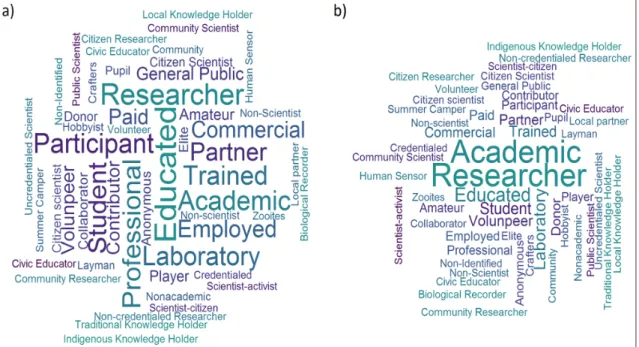
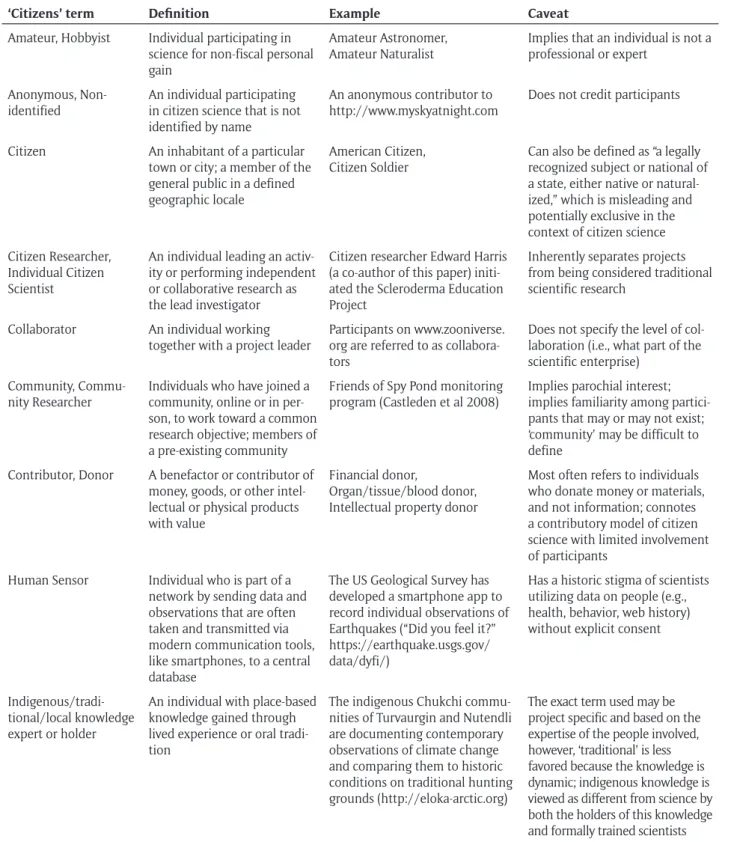
As shown in the previous section, there are many different types of citizen science and associated initia-tives. Similarly, the terms used to describe participants in citizen science also vary. Our original discussion had a pragmatic origin: What words do we use for people, when some words are clearly inappropriate for our par-ticular situation? Ultimately we generated a large list of terms that varied in their popular and academic usage (Figure 2). In the following sections, we highlight some of the emergent themes in these terms, and we summarize some of their intentional and unintentional meanings in
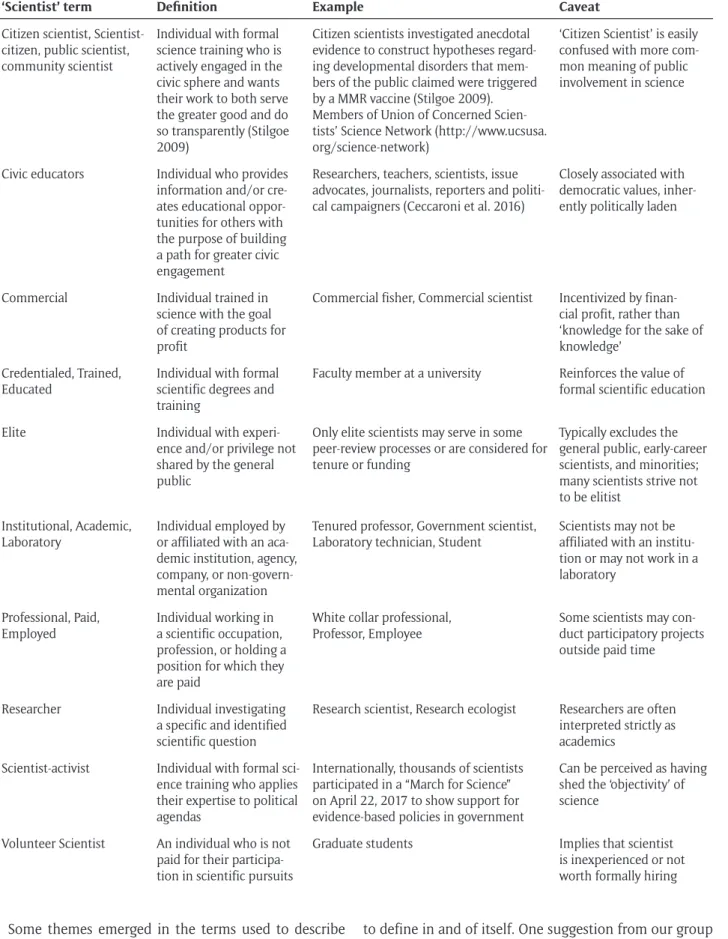
Tables 3 and 4.
Scientists
Scientists may have many different motivations for participating in or leading citizen science projects. Some may need labor to collect or analyze data (which can lead to contributory models of engagement, such as crowdsourcing). Others may strongly believe that science should serve the public interest, and want to incorporate egalitarian ideals into their work. Increas-ingly, these latter types of scientists are referred to as ‘public scientists’ or, as Stilgoe (2009) calls them, ‘ citizen scientists’ in the sense of scientists who put for-ward their citizenship as central to their work. These individuals are often the leaders of a project, although calling them ‘project leaders’ is focused specifically on the person’s leadership role.
Some themes emerged in the terms used to describe scientists involved with citizen science (see Table 3). Some terms are related to employment (‘paid’ or ‘profes-sional’), though these could be problematic in situations in which ‘citizens’ are paid to help with projects, or are professionals in other fields. ‘Professional’ is also difficult
to define in and of itself. One suggestion from our group was that a ‘professional’ is ‘able to make a living by con-tributing to science,’ however that definition raises its own issues, for example, how to define ‘a living,’ particu-larly as the science community becomes increasingly frac-tionally employed (Arbesman 2012). Another set of terms
Table 3: Terms describing scientists who work with citizens in ‘citizen science.’
‘Scientist’ term Deinition Example Caveat
Citizen scientist, Scientist-citizen, public scientist, community scientist
Individual with formal science training who is actively engaged in the civic sphere and wants their work to both serve the greater good and do so transparently (Stilgoe 2009)
Citizen scientists investigated anecdotal evidence to construct hypotheses regard-ing developmental disorders that mem-bers of the public claimed were triggered by a MMR vaccine (Stilgoe 2009). Members of Union of Concerned Scien-tists’ Science Network (http://www.ucsusa. org/science-network)
‘Citizen Scientist’ is easily confused with more com-mon meaning of public involvement in science
Civic educators Individual who provides information and/or cre-ates educational oppor-tunities for others with the purpose of building a path for greater civic engagement
Researchers, teachers, scientists, issue advocates, journalists, reporters and politi-cal campaigners (Ceccaroni et al. 2016)
Closely associated with democratic values, inher-ently politically laden
Commercial Individual trained in science with the goal of creating products for profit
Commercial fisher, Commercial scientist Incentivized by finan-cial profit, rather than ‘knowledge for the sake of knowledge’
Credentialed, Trained, Educated
Individual with formal scientific degrees and training
Faculty member at a university Reinforces the value of formal scientific education
Elite Individual with experi-ence and/or privilege not shared by the general public
Only elite scientists may serve in some peer-review processes or are considered for tenure or funding
Typically excludes the general public, early-career scientists, and minorities; many scientists strive not to be elitist
Institutional, Academic, Laboratory
Individual employed by or affiliated with an aca-demic institution, agency, company, or non-govern-mental organization
Tenured professor, Government scientist, Laboratory technician, Student
Scientists may not be affiliated with an institu-tion or may not work in a laboratory
Professional, Paid, Employed
Individual working in a scientific occupation, profession, or holding a position for which they are paid
White collar professional, Professor, Employee
Some scientists may con-duct participatory projects outside paid time
Researcher Individual investigating a specific and identified scientific question
Research scientist, Research ecologist Researchers are often interpreted strictly as academics
Scientist-activist Individual with formal sci-ence training who applies their expertise to political agendas
Internationally, thousands of scientists participated in a “March for Science” on April 22, 2017 to show support for evidence-based policies in government
Can be perceived as having shed the ‘objectivity’ of science
Volunteer Scientist An individual who is not paid for their participa-tion in scientific pursuits
referred to affiliation, for example ‘academic scientist’ or ‘institutional scientist,’ although these terms may not be appropriate for scientists working in industry or as private consultants. Finally, a last set of terms referenced training or the possession of a credential. Einstein’s great intel-lectual success while working as a patent clerk is a good example of a scientific contributor without a credential (Clark 1971).
Among the authors, we have examples where the ‘lead scientist’ of the project is a person without academic cre-dentials (Edward Harris).5 While uncommon, a number of
cases involve individuals with little or no formal educa-tion who have advanced science in diverse fields includ-ing astronomy, paleontology, and even medicine.6 In some
cases, these self-taught individuals later went on to obtain formal credentials in their field, but in other cases they remained ‘amateurs’ as they continued to advance research in their field. Barriers to individuals such as these include complex concepts and research that is kept behind a pay-wall. Such barriers are slowly being broken down by online education (e.g., Khan Academy) and the rise of open science and open-access journals, but these are currently limited in their scope. Becoming a self-trained expert is a major challenge in any field, but that is only part of the battle. Learning how to navigate the written and unwrit-ten rules, and even the politics of a particular field, are critical skills that are needed if one wants to become a researcher who helps to advance knowledge in that field.
Another relevant criticism of ‘trained scientist’ as the description of a project leader is that participants are also trained in some way; without their training, there could be no project.
“If the manner in which people think is important, then whether someone is a professional/employed/ lab/institutional scientist may not matter so much as the fact that they are ‘formally educated in west-ern science.’ This might most usefully be contrasted with experientially trained or traditional or local knowledge based researchers” (Daniela Soleri, per-sonal communication).
Nevertheless, we do acknowledge that the level of training among those involved in a project may vary, but also that these differences may not directly correspond to one’s for-mal education.
A related topic that emerged as we discussed the ter-minology of citizen science was the question of whether ‘professional’ scientists’ were committed to civic action, whether they volunteered on their own or other projects, and whether they saw activism as a part of their work. Many scientists who lead citizen science projects identify as ‘pub-lic scientists who want their work to both serve the greater good and do so transparently (Irwin 1995; Stilgoe 2009).
Citizens
We also generated a long list of terms to describe project participants (Table 4). This is unsurprising, as Geoghegan et al. (2016) found that citizen science stakeholders in the
U.K. referred to environmental monitoring citizen scientists by using a range of terms, including volunteers, amateurs, amateur naturalists, natural historians, and biological recorders. ‘Amateur’ can be viewed differently depending on the discipline. For example, in astronomy, paleontology, and ornithology, the term ‘amateur,’ as in ‘amateur astronomer’ is widely used and accepted in a non-pejorative sense. However, anyone calling themselves an ‘amateur medical researcher’ would presumably be taken less seriously.
Members of the public may have varied motivations for participating in citizen science projects (West and Pateman 2016). Some may be drawn to a particular physical object of study or place, while others may enjoy contributing through crowdsourcing. Still others use science to defend their basic rights (e.g., Flint, Michigan water crisis and many other environmental justice projects). These moti-vations may change the terminology that is appropriate to describe their participation, or their own choices about what they want to be called.
The idea of citizenship is also worth a second look. Being a citizen of a nation state can be a source of pride, how-ever, national citizenship can often be a sensitive topic and contested space. As such, practitioners may want to be aware of attitudes around citizenship in the geopoliti-cal context they work in. The word ‘citizen’ may need to be explained or augmented to ensure that the right sense is received by potential participants. For example, John James Audubon was a French citizen living in the newly established U.S. when he first banded birds, painted them, and began studying their behavior–all without citizenship or credentials (Rhodes 2004).
Local, traditional, or indigenous knowledge holders are in some cases an important group of ‘citizen scientists.’ Local and Indigenous knowledge could be considered citizen science, but the term ‘science’ may or may not be appropriate for or acceptable to all groups. On the other hand, indigenous knowledge development may represent the first example of science by human societies, and indig-enous people the first scientists (Snively and Corsiglia 2001). Outside authorities do not always consider tra-ditional or local knowledge to be legitimate, although these sources of knowledge may be evidence-based and their validity well established. As one example, the com-munity white paper “Strengthening comcom-munity-based monitoring in the Arctic: Key challenges and opportuni-ties” (Johnson et al. 2013) notes that “Arctic Indigenous peoples have been systematically observing the environ-ment for millennia,” where monitoring “plays a significant role in daily life, providing information that is critical to safe travel and successful hunting and harvesting activi-ties.” What has been missing until recently are efforts to document and connect all of these activities.7 Going well
beyond environmental studies, such efforts include a wide variety of initiatives important to the communities involved such as mental health and wellness.8 It may also
be inadvisable to refer to indigenous peoples as ‘citizens’ due to the legacies of colonialism.
Table 4: Terms describing the ‘citizens’ in ‘citizen science.’
‘Citizens’ term Deinition Example Caveat
Amateur, Hobbyist Individual participating in science for non-fiscal personal gain
Amateur Astronomer, Amateur Naturalist
Implies that an individual is not a professional or expert
Anonymous, Non-identified
An individual participating in citizen science that is not identified by name
An anonymous contributor to http://www.myskyatnight.com
Does not credit participants
Citizen An inhabitant of a particular town or city; a member of the general public in a defined geographic locale
American Citizen, Citizen Soldier
Can also be defined as “alegally recognizedsubject or national of a state, either native or natural-ized,” which is misleading and potentially exclusive in the context of citizen science
Citizen Researcher, Individual Citizen Scientist
An individual leading an activ-ity or performing independent or collaborative research as the lead investigator
Citizen researcher Edward Harris (a co-author of this paper) initi-ated the Scleroderma Education Project
Inherently separates projects from being considered traditional scientific research
Collaborator An individual working together with a project leader
Participants on www.zooniverse. org are referred to as collabora-tors
Does not specify the level of col-laboration (i.e., what part of the scientific enterprise)
Community, Commu-nity Researcher
Individuals who have joined a community, online or in per-son, to work toward a common research objective; members of a pre-existing community
Friends of Spy Pond monitoring program (Castleden et al 2008)
Implies parochial interest; implies familiarity among partici-pants that may or may not exist; ‘community’ may be difficult to define
Contributor, Donor A benefactor or contributor of money, goods, or other intel-lectual or physical products with value
Financial donor,
Organ/tissue/blood donor, Intellectual property donor
Most often refers to individuals who donate money or materials, and not information; connotes a contributory model of citizen science with limited involvement of participants
Human Sensor Individual who is part of a network by sending data and observations that are often taken and transmitted via modern communication tools, like smartphones, to a central database
The US Geological Survey has developed a smartphone app to record individual observations of Earthquakes (“Did you feel it?” https://earthquake.usgs.gov/ data/dyfi/)
Has a historic stigma of scientists utilizing data on people (e.g., health, behavior, web history) without explicit consent
Indigenous/tradi-tional/local knowledge expert or holder
An individual with place-based knowledge gained through lived experience or oral tradi-tion
The indigenous Chukchi commu-nities of Turvaurgin and Nutendli are documenting contemporary observations of climate change and comparing them to historic conditions on traditional hunting grounds (http://eloka-arctic.org)
The exact term used may be project specific and based on the expertise of the people involved, however, ‘traditional’ is less favored because the knowledge is dynamic; indigenous knowledge is viewed as different from science by both the holders of this knowledge and formally trained scientists
Lay Knowledge Holder, General Public
An individual who is not affili-ated with a scientific estab-lishment, but may possess specialized knowledge
People applying their knowledge of local geography to identify cities at night (http://www.citie-satnight.org)
‘Lay knowledge’ is broad and sug-gests that everyone has this
Layman A person without specialized knowledge or training of a specific subject
A farmer providing novel pest specimens to agricultural research
Outdated term; was more com-monly used during 19th century than in past 100 years
Participant An individual involved in research
The Audubon Christmas Bird Count enlists thousands of par-ticipants to observe and quantify migratory birds
This term is used by those running a project; the term comes from participatory research and ‘volun-teer’ may be preferred instead