ISSN 1392-2785 ENGINEERING ECONOMICS. 2006. No 5 (50)
THEECONOMICCONDITIONSOFENTERPRISEFUNCTIONING
Development of the Innovation System in Grodno Region: Condition, Problems,
Prospects
Elena Opekun
Yanka Kupala Grodno State University Ozheshko str., 22, Grodno, 230023 Belarus
The innovational system has multilevel character. On the over national level tendencies to global use of na-tional technological potential, to global cooperation in sphere of innovations are shown. Alongside with it the special urgency is got with a regional level of innova-tional systems. It is connected because а) at a nainnova-tional level the regional environment in determines competi-tiveness of business as innovations on the greater degree grow out environments many. б) the postindustrial econ-omy has high dynamism and an individualization both in sphere of manufacture, and in sphere of consumption; в) in connection with глобализацией regions are involved in the international exchange without national borders.
The social economic policy of the Republic of Bela-rus is based on the following priority directions: increase of the level and quality of living of the population and maintenance of steady socio economic development of the state.
Currently the Republic Belarus is developing its in-dustrial and scientific potential, individual elements of the innovations infrastructure (science-technology parks, business incubators, centers for transfer of technologies etc.) are being actively developed, however there exists a lack of communication between these elements as well as between these elements and other sectors of the economy. As a result, despite of positive experience of a number of initiatives, break of innovative development of the econ-omy has not taken place.
In connection with the beforesaid in the course of de-velopment of the innovation system of the Republic of Belarus a significant role is played by the regional inno-vations policy, creation of the regional innovation sys-tem, development of the effective mechanism promoting social-economic development of the region, first of all through effective constant interaction of science and manufacturing and attracting the necessary resources at all stages of the innovation of activity. The research is developed to regional innovation system creation.
Aim of the research – to provide recommendations on facilitation of conditions for development and functioning of the regional innovation system.
The regional innovation system can be defined as a set of interrelated subsystems facilitating access to vari-ous resources and services to the participants of the in-novation activity. The regional inin-novation system should be regarded as a process of interaction and feedback between all subsystems ensuring realization of all the processes leading to creation of a product such as inno-vation. The above approach enables to develop the areas
the promotion and stimulation whereof will promote in-novation activity and lead to the achievement of the set objectives.
The development and promoting of the innovation system requires performance of requirements of princi-ples:
compatibility – the regional system should be a con-sistent part of the national innovation system as well as the national social-economic system and global economic relations:
integrityof the system – unity of the system and co-ordinated performance of functions by each element of the system;
development – ensuring development of the subsys-tems (management);
standardization – the quality of the object being de-velopment shall be ensured adhering to the modern standards and first of all meet the requirements of the quality management system.
Keywords: innovation, regional innovation system, su-bsystem, innovation activity, innovation ma-nagement, innovation development.
Introduction
The innovational system has multilevel character. On overnational a level tendencies to global use of national technological potential, to global cooperation in sphere of innovations are shown. Alongside with it the special ur-gency is got with a regional level of innovational sys-tems. It is connected by that а) at a national level the re-gional environment in determines competitiveness of business as innovations on the greater degree grow out environments many. b) the postindustrial economy has high dynamism and an individualization both in sphere of manufacture, and in sphere of consumption; c) in connec-tion with globalisaconnec-tion regions are involved in the inter-national exchange without inter-national borders (Богдан,2004).
research and experimental-production activities in the real sector as well as serve as the lever of economic rise and allow transition to qualitatively different level of public manufacturing, release of competitive production, saving and exploitation of resources (Мясникович, 2004).
Currently the Republic Belarus is developing its in-dustrial and scientific potential, individual elements of the innovations infrastructure (science-technology parks, business incubators, centers for transfer of technologies etc.) are being actively developed, however there exists a lack of communication between these elements as well as between these elements and other sectors of the economy. As a result, despite of positive experience of a number of initiatives, break of innovative development of the econ-omy has not taken place (Недилько, 2004).
In connection with the before said in the course of development of the innovation system of the Republic of Belarus a significant role is played by the regional inno-vations policy, creation of the regional innovation sys-tem, development of the effective mechanism promoting social-economic development of the region, first of all through effective constant interaction of science and manufacturing and attracting the necessary resources at all stages of the innovation of activity (Нехорошева, 1998). The research is developed to regional innovation system creation.
Aim of the research – to provide recommendations on facilitation of conditions for development and func-tioning of the regional innovation system.
The regional innovation system can be defined as a set of interrelated subsystems facilitating access to vari-ous resources and services to the participants of the inno-vation activity. The regional innoinno-vation system should be regarded as a process of interaction and feedback be-tween all subsystems ensuring realization of all the proc-esses leading to creation of a product such as innovation. The above approach enables to develop the areas the promotion and stimulation whereof will promote innova-tion activity and lead to the achievement of the set objec-tives (Соловьев, 2004).
The development and promoting of the innovation system requires performance of requirements of princi-ples):
1. compatibility – the regional system should be a consistent part of the national innovation system as well as the national social-economic system and global economic relations.
2. integrity of the system – unity of the system and coordinated performance of functions by each element of the system,
3. development – ensuring development of the sub-systems (management)
4. standardization – the quality of the object being development shall be ensured adhering to the modern standards and first of all meet the re-quirements of the quality management system (Голиченко, 2003).
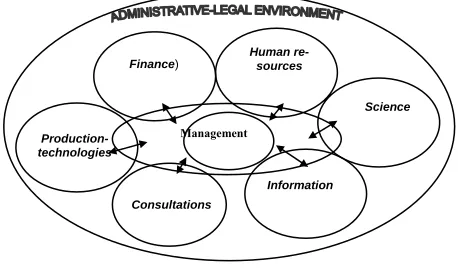
According to 1 principle it is possible to present, that the regional innovation system consists of the following subsystems: production-technologies, finance, science,
human resources, expert consultations, information, man-agement (administrative, legal governing), including the area of their interaction (Figure)(Опекун, 2005).
Figure. Regional innovational system
The analysis of the innovation activity of region
Let's analyze the current status of each of subsystems of the innovation activities in Grodno region and the re-lated problems(Статистическийежегодник, 2005).
The production-technology subsystem includes: • industrial enterprises and organizations, including
small and medium;
• joint ventures in a free economic zone;
• scientific – technological parks (under develop-ment).
The development of the regional industries is quote dynamic. In the 2005 Industry growth compared to 1990 is 146 %. Moreover, the number of the industrial person-nel decreased from 117 000 (which was the level in 2001) to 88 800 (in 2005)(Социально-экономическое поло -жениеРБ, 2005).
The share of the output produced by the organiza-tions, certificated under ISO 9000, ISO 14000 and con-taining the label “CE” accounts for more than 58 % of the total industrial output. However, it should be also noted that in 2005 only 10 % of the organizations of the region were recognized to be engaged in innovation activities; furthermore, the number of small and medium enterprises releasing innovative production is decreasing.
The research has allowed to identify the factors pre-venting the development of innovation activity in the industrial sector (Отчет, 2005)
Factors of organizational – legal character:
• insufficient and imperfect legal framework gov-erning innovation activities;
• low level of absorption of innovations at the level of enterprises and organizations of the region; • insufficient development level of the innovations
infrastructure, market economy;
• uncertainty of terms of the innovation process. Factors of economic character:
• lack of own financial resources;
• insufficient financial support on the part of the state,
• high costs of innovations;
Consultations Finance)
Production-technologies
Human re-sources
Science
• high economic risk connected to realization of projects of innovations;
• low purchasing power of the consumers of innova-tions.
Factors of industrial character:
• low innovation potential of the enterprises; • lack of preparedness of the enterprises for
imple-mentation of scientific and technical achieve-ments;
• shortage of the qualified personnel;
• absence of changes based on reorganization; • lack of the information about new technologies
and markets.
The above leads to a conclusion that production-technologies subsystem is in place and is developing, however in the meantime there exists other serious prob-lems the settlement of which will help to achieve efficient functioning of the innovation system.
The financial subsystem includes:
• Innovations fund raised by contributions of the le-gal entities based in the Grodno area. At least 30 % of the means of fund must be spent for financ-ing of measures on development of manufacturfinanc-ing, including research and experimental-production activities, innovation projects, computerization, certification, energy efficiency.
• The regional scientific-technical program (Sus-tainable development: science, innovations, tech-nology) and state scientific-technical programs of applied researches are an effective mechanism to promote innovation activity of organizations. • Innovations Fund of Belarus.
• Banks.
• The main problem – absence of mechanism to at-tract venture capital, capitalize innovation projects and enterprises.
Science subsystem (universities, Biochemistry Insti-tute, Department of Resource Saving Problems of the Science Academy of Belarus, regional Institute of Agri-culture, Institute of Nitrogen Industry)
The researches (Сидоренко, 2004) have demon-strated that the functioning of science, as a subsystem of innovation activities, is prevented by the following fac-tors:
• the number of the personnel engaged in research and development in Grodno region is constantly decreasing;
• the majority of researches have no relation with manufacturing and do not carry applied character; • the areas of the researches carried out by the
or-ganizations of Grodno region poorly correlate with the needs of the region; consequently, the results of the scientific activity are not employed in the production-technologies subsystem;
• there is no motivation inducing the science per-sonnel to undertake scientific activity, which might form the background (in terms of theory, technologies, ways, the processes, etc.) for ex-perimental-production activity and implementation of innovations;
• lack of commercial orientation of the majority of results of research activity;
• out-of-date material base of scientific researches; • gaps of the system or protection of the intellectual
property and underdeveloped market of patent ser-vices.
Information subsystem (Institute of Statistics, Infor-mation Centre, World Wide Computer Web and data-bases) (Москвина, 2003).
The number of the users of the Internet and modern computer technologies, the extent of the geo-information computerized network follows positive dynamics; organi-zations are developing and using different information systems, including automated design systems. All this has a positive effect on the innovations potential of the re-gion. It should be also mentioned that about 35 % of the industrial enterprises of Grodno region have no access to Internet.
Management subsystem (Regional Scientific and Technical Council, Division of Industry, Scientific-Technical and Innovative Activities, Economic Depart-ment of the Executive Committee of Grodno region) so far has not shown itself as an active element of the inno-vation system (Бабенко, 2005), i.e.:
• the priorities of the innovation development of the region have not been identified;
• there exists a lack of regional strategic marketing and coordination of innovation processes in re-gion.
Consultations subsystem includes Regional depart-ment of the national center for technologies transfer, spe-cialized departments and units of enterprises and organi-zations rendering services on the areas of intellectual property, standardization, business planning, project management. The basic problems (Отчет, 2005):
• functional inconsistency with other subsystems; • absence of the precise mechanism for transfer of
technologies;
• lack of qualified staff.
Human resources subsystem. The functioning and development of the innovation system is impossible without the qualified staff working in this sphere. Solu-tion of the following problems is therefore a part of de-velopment of the innovation system:
• lack of knowledge in the area of innovations man-agement and lack of practical experience in plan-ning of technologies-oriented project activities; • lack of the administrative staff for maintenance
steady development of innovations of the region; • lack of administrative and legal knowledge. The environment of interaction between the basic participants of the innovation process (developers and consumers of innovations) is called to stimulate transfer of new technologies from an academic, high education and branch sciences level to the manufacturing level and from the high technology enterprises to other enterprises. Such environment is needed because of the bellow rea-sons (Москвина, 2004):
• underdevelopment of innovations infrastructure; • lack of constant communications between the
ba-sic participants of the innovations process (devel-opers and consumers of innovations);
• lack of systematic monitoring of the internal mar-ket for science and technical production as well as the demand of enterprises and organization for technologies, which results in the lack of informa-tion transparency.
Administrative environment of the regional innova-tion system combines institutes of legal, financial and social character, which in many respects sets models and mechanisms of interaction of the subjects of innovation process. It is necessary to note, that the creation in the country of administrative-legal conditions has not stimu-lated innovation of activity in the region at all, while the indirect regulation (tax, customs, amortization) had a neutral effect on the areas of high technologies. (Нуретдинов, 2004).
The basic directions of the decision of problems
The innovation system developing in the region re-quires solution of the above problems through the follow-ing measures (Опекун, 2005).
At the institutional level:
• to undertake measures to improve administrative-legal system, crediting and tax policy as well as off-budget funding system.
According to 3 principle, the choice of strategy of development of region should be carried out on the basis of the analysis existing and forecasting of the future stra-tegic, strategic segmentation of the market of require-ments, forecasting competitive advantages, etc. The choice of correct focus of strategic development, an esti-mation results, directions correction is main tasks of sphere of management. For efficient management of functioning of the innovation system:
• to create Regional Coordination Council, which should include the managers of administrative au-thorities, leading enterprises, representatives of the education, science, small business and finance sec-tors of the region. The basic tasks to be assigned to the Council: a) to identify priorities for social-economic and scientific-technical development of the Grodno region, b) to prepare the program of regional development, c) to prepare program im-plementation plan, and d0 to monitor implementa-tion of the program;
• to facilitate and implement mechanism of coopera-tion between the regional authorities in order to promote innovation activities of the enterprises and organizations of the region.
In the production-technologies subsystem (Гузинов, 1998):
• to establish technological audit divisions in large enterprises which, using new technologies and equipment, together with the departments of new production and marketing services and following
the principles of quality management system would generate a comprehensive, long-term pro-gram of technical modernization with defined pri-orities, terms, costs, return, or would adjust the ex-isting technological processes and equipment as well as would carry out the necessary analysis of the economic efficiency of implementation of in-novations;
• to establish and develop new enterprises, in par-ticular small and medium ones, which are science-intensive, energy and resources efficient, as cus-tomers of science and technologies parks, or affili-ated innovation enterprises, thus, improving tech-nological structure of manufacturing of products that are replacing the import and are export ori-ented.
To further develop scientific – technological parks, as an element of consulting subsystem, which provide ser-vices and resources on favorable terms to new innovation enterprises.
In the science subsystem:
• to orient the scientific activity to applied re-searches directed at solving of scientific and tech-nical problems of the industrial enterprises of the region;
• to ensure development of scientific-technical (in-tellectual) potential that is necessary for develop-ment and impledevelop-mentation of innovations in com-merce;
• to develop the network of technologies transfer in scientific and educational establishments through active use of the world wide computerized web. The system of staff training for innovation activity should be flexible and comprehensive, including univer-sity and post-graduate training, short-term courses, semi-nars, conferences and round table discussions to improve professional skills of the existing managers (Нехо -рошева, 1996).
pol-icy (business, the trading organizations, universities, banks, the centres transfer technologies etc.) (Богдан, 2005).
For observance of 4-th principle of development in-novational systems it is necessary (Евланов, 1978):
1. To estimate end results of efficiency of innova-tional processes.
2. To develop it in hierarchy of local criteria, having received finally complete system of criteria «inno-vationalness» economy.
3. To determine directions of its increase through in-fluence on structural elements in the formula of his(its) calculation.
The structure of integrated criterion «innovational-ness» economy should be invariant, "through", covering simultaneously three levels: national; regional; corporate. Especially it is necessary to note, that it is necessary to distinguish concepts «innovationalness» social devel-opment and «innovationalness» economy (Садовская, 2006). The concept «innovationalness» social develop-ment is much wider than concept «innovationalness» economy and should include:
• «innovationalness» development of economy; • «innovationalness» development of social sphere; • «innovationalness» development of ecological
sphere.
The concept «innovationalness» social development, thus, covers both social, and ecological, and economic innovations.
As integrated criterion of an estimation of a degree «innovationalness» social development can be c the ac-count resource social development (consumption of re-sources on unit of an index of harmonious development of a civilization in the analyzed period. Such approach can become a basis for perfection of statistics and plan-ning of innovational activity.
Development of the regional innovation system, tran-sition to innovations-based development and broad em-ployment of scientific achievements determine the pace of economic growth and improvement of the level of liv-ing of the population.
References
1. Мясникович, М.В. Инновационная деятельность вРеспублике Беларусь: теорияипрактика. – Мн.: 2004. c. 5-7.
2. Недилько В.И. Инновации в Республике Беларусь: состояние и перспективы/ Белорусский институт системного анализа и ин
-формационного обеспечения научной сферы.
http://belisa.org.by/ru/izd/stnewsmag/1_2005/e6661f75495e3180.html 3. Богдан, Н.И. Региональная инновационная политика. Новопо
-лоцк: 2000.c. 56-64.
4. Нехорошева, Л.Н. Регулированиеразвитиянаукоемкихотраслей и высокотехнологичных производств// Белорусский эконо
-мическийжурнал, 1998. №1, с.51-64.
5. Статистический ежегодник Гродненской области 2005. Грод
-ненскоеобластноеуправлениестатистики. Гродно, 2005. 408с. 6. Отчет по научно-исследовательской работе «Прогноз научно
-техническогопрогрессапо Гродненской областина 2006-2025
годысболееподробнымегообоснованиемна 2006-2010 годы». 2005, Гродно. 99 с.
7. Отчет по научно-исследовательской работе «Анализ гроднен
-ского регионального рынка научно-технической продукции и
формирование эффективного механизма трансфера технологи. 2005, Гродно. 68 с.
8. Богдан, Н.И., Корзун, Т.С.Опыт реформирования инновацион
-ной политики в новых странах-членах Евросоюза и странах кондидатахнавступлениевЕС// Наукаиинновации; 2005, №
8(30), с.62-70.
9. Соловьев, В.П. Инновационная деятельность как системный процессвконкурентнойэкономике. Киев, 2004. – 120 с. 10. Гузинов, В.П. Экономикапредприятий. Мн.,1998. 154с. 11. Москвина, О.С. Волгоградскийнаучно-координационныйцентр,
г.Волгоград// http//innovbusiness.ru/doc/mendg.shtml.
12. Сидоренко, Г.Д. Об эффективности научной деятельности
(оценкафундаментальныхиприкладныхисследований) // Наука иинновации, 2004, № 5(15), с.46-49.
13. Социально-экономическое положение РБ. Статистические материалы// Белорусский экономический журнал, 2005.-№ 3,
с.136-137.
14. ЛиЧонКу, Опекун, Е.В. Управлениенаучно-инновационной деятельностьювГродненском регионе//Материалыконферен
-ции «Управлениевнаучно-инновационнойсфере», 2004. c.34-36.
15. Нехорошева, Л.Н. Научно-технологическое развитие и рынок.
Минск, 1996. 212 с.
16. Садовская, Т.М. Методологическиеаспекты оценки инноваци
-онногопотенциала // Наукаиинновации, 2006, № 1(35), с.43-47. 17. Опекун, Е.В., Клевзович, В.И. Управлениесубъектамииннова
-ционной инфраструктуры региона//Материалы конференции
«Научно-инновационнаяполитикаврегионахБеларуси», 2005, c.68-71.
18. Бабенко, А.И. Управление инвестиционно-инновационной деятельностью в регионе: автореф. дис. канд. экон. наук.М., 2005. 24 с.
19. ГоличенкоО.Г. НациональнаяинновационнаясистемаРоссиии основные направления ее развития//Инновации.- 2003.-№6.-С. 25-32.
20. Нуретдинов, Р.Р. Региональнаяинновационнаяполитика: целии приоритеты развития// Материалы межд. конф. Общество, го
-сударство, личность: проблемывзаимодействиявусловияхры
-ночнойэкономики. Казань, 2004.- С.129-133
21. Евланов, Л.Г., Кутузов, В.А. Экспертныеоценкивуправлении.
М.: Экономика, 1978. 133 с.
Elena Opekun
Inovacijų sistemos vystymas Grodno regione: sąlygos, problemos, perspektyvos
Santrauka
Kuriant Baltarusijos Respublikos inovacijų sistemą, svarbus vaidmuo tenka regiono inovacijų politikai ir inovacinės sistemos sukūrimui, veiksmingo mechanizmo, užtikrinančio socialinį ir eko-nominį inovacijomis grindžiamą regiono vystymąsi, įgyvendinimui, visų pirma sukuriant nuolatinį veiksmingą ryšį tarp mokslo ir gamy-bos sektorių, visuose inovacinės veiklos etapuose pritraukiant rei-kalingų išteklių.
Regiono inovacijų sistema – tarpusavyje sąveikaujančių posis-temių, kurie inovacijų proceso subjektams padeda pasinaudoti
įvairiais ištekliais ir tam tikromis paslaugomis, visuma. Regiono inovacijų sistemą reikia vertinti kaip visų posistemių, užtikrinančių
visų procesų, reikalingų sukurti tokiam produktui kaip inovacijos, vyksmą, sąveikos ir grįžtamojo ryšio visumą.
Kuriant ir plėtojant inovacijų sistemą būtina užtikrinti:
sistemos vienumą – vientisą sistemą, kurioje kiekvienas
elemen-tas atliktų savo funkcijas;
plėtrą – užtikrinti posistemių plėtrą (valdymą);
suderinamumą – regiono sistema turi tapti visos valstybės
standartizaciją – kuriamo objekto kokybė turi būti užtikrinta, at-sižvelgiant į šiuolaikinius standartus, visų pirma – atitikti koky-bės valdymo sistemos reikalavimus.
Regiono inovacinės sistemos dalis sudaro šio posistemio: gamy-bos ir technologijų, finansų, mokslo, žmogiškųjų išteklių, ekspertinių
konsultacijų, informacijos, valdymo (administracinio ir teisinio valdymo) – ir jų tarpusavio sąveika.
Siekiant sukurti inovacijų sistemą regione ir išspręsti išdėstytą -sias problemas, būtina:
• imtis priemonių administracinei ir teisinei sistemai, kreditų ir mokesčių politikai bei nebiudžetinio finansavimo sistemai tobulinti;
• sukurti regioninę koordinavimo Tarybą, į kurios sudėtį turėtų įeiti regiono administravimo institucijų, stambiausiųįmonių
vadovai, švietimo ir mokslo, smulkiojo verslo ir finansų
struktūros atstovai;
• kurti ir plėtoti naujas mokslui imlias, išteklius ir energiją
taupančias įmones, visų pirma mažąsias ir vidutinio dydžio
įmones;
• orientuoti mokslinę veikląį taikomuosius tyrimus, kurių tik-slas – spręsti mokslines, technines problemas, su kuriomis
susiduria regiono pramonės įmonės;
• užtikrinti mokslinio ir techninio (intelektinio) potencialo, kuris būtinas inovacijoms kurti ir pritaikyti komercijoje, vystymąsi;
• plėtoti technologijų perdavimo tinklus mokslo ir švietimo į s-taigose, aktyviai pasitelkiant pasaulinį informacinį kompi-uterinį tinklą.
Inovacinių procesų efektyvumas ekonomikoje priklauso ne tik nuo pačiųūkio subjektų (įmonių, firmų, mokslo organizacijų ir pan.) veik-los efektyvumo, bet ir nuo to, kaip jie bendradarbiauja tarpusavyje kaip kolektyvinės inovacijų kūrimo, panaudojimo, skleidimo sistemos ele-mentai, taip pat nuo jų ryšio su visuomeniniais institutais (tokiais kaip vertybės, normos, teisė). Pagrindinė tokio bendradarbiavimo, apimančio
įmonių, organizacijų ir viso regiono inovacinio ir mokslinio bei tech-ninio vystymosi koordinavimą, monitoringą ir auditą, grandis – Re-gioninis inovacijų plėtros centras (nuo regioninės inovacinės sistemos sukūrimo, perėjimo prie inovacinio vystymosi ir plataus šalies mokslo pasiekimų panaudojimo gamybos sektoriuje priklauso ir ekonomikos augimo dinamika bei visuomenės gyvenimo lygio kilimas).
Raktažodžiai: regiono inovacijų sistema, inovacinė veikla, inovacijos, ino-vacinių procesų efektyvumas
.