Argument-based Belief in Topological Structures
∗Chenwei Shi, Sonja Smets, and Fernando R. Velázquez-Quesada
Institute for Logic, Language and Computation, Universiteit van Amsterdam. Amsterdam, The Netherlands.
{C.Shi, S.J.L.Smets, F.R.VelazquezQuesada}@uva.nl
Abstract
This paper combines two studies: a topological semantics for epistemic notions and abstract argumentation theory. In our combined setting, we use a topological semantics to represent the structure of an agent’s collection of evidence, and we use argumentation theory to single out the relevant sets of evidence through which a notion ofbeliefs grounded on argumentsis defined. We discuss the formal properties of this newly defined notion, providing also a formal language with a matching modality together with a sound and complete axiom system for it. Despite the fact that our agent can combine her evidence in a ‘rational’ way (captured via the topological structure), argument-based beliefs are not closed under conjunction. This illustrates the difference between an agent’s reasoning abilities (i.e. the way she is able to combine her available evidence) and the closure properties of her beliefs. We use this point to argue for why the failure of closure under conjunction of belief should not bear the burden of the failure of rationality.
1
Introduction
The concept of belief has been extensively studied in philosophy, logic and com-puter science. The representations range from purely qualitative structures in-cluding the relational models with serial, transitive and Euclidean relations (the KD45representation in doxastic logic;Hintikka 1962,Meyer and van Der Hoek 1995), plausibility models (Baltag and Smets 2008a,Board 2004) and topolog-ical models (Baltag et al. 2013,2015,2016a) to quantitative structures includ-ing rankinclud-ing-based plausibility representations (Spohn 1988), Bayesian models using subjective probability functions and conditional probabilistic spaces de-signed to represent conditional belief (Baltag and Smets 2008b).
Despite the success of the early qualitative and quantitative approaches, most of them have one important disadvantage: they represent only what the agent believes, without dealing with the reasons, justifications or evidence on which such beliefs are grounded.1 To remedy this shortcoming, the last decade
witnessed a number of different frameworks that can portray the evidence or
∗
TARK_12-pp.tex.Published versionin J. Lang, Ed, TARK 2017.
1An important exception are the so calledtruth maintenance systems(Doyle 1979,de Kleer 1986)
justifications on which different epistemic attitudes are based. For instance, the work inBaltag et al.(2014,2012) combines dynamic epistemic logic with justifi-cation logic in the tradition ofArtemov(2008) andArtemov and Nogina(2005), where justifications are syntactic terms. In van Benthem and Pacuit (2011) andvan Benthem et al.(2014), a semantic approach is adopted, representing evidence as a set of possible worlds so beliefs are defined by the maximally consistent ways in which evidence can be combined (so calledevidence models). The work inBaltag et al.(2016a) follows the latter direction, adding a topolog-ical structure which represents the different ways in which the available pieces of evidence can be combined, and then using topological notions to single out relevant sets ofcombinedpieces of evidence.
The present contribution follows the mentioned topological approachBaltag et al.(2016a), where we view arguments as special types of evidence that an agent possesses. By combining the topological approach to evidence logic with the tools from abstract argumentation theory (Dung 1995), we can single out the sets of pieces of evidence (or arguments) on which a new notion ofbelief grounded on argumentscan be defined. This new concept ofgrounded beliefprovides the bridge between an agent’s doxastic attitude and the arguments she has at her disposal. While argumentation theorists such asDung(1995) informally talk about the relation between beliefs and arguments, the formalization of the details has only recently gained more attention (e.g., Schwarzentruber et al. 2012,Grossi and van der Hoek 2014). The approach in this paper is related to works which study abstract argumentation theory by using the tools and techniques of modal logic (Grossi 2013,Caminada and Gabbay 2009) and to those that introduce a notion of justified belief by combining doxastic logic and abstract argumentation theory (Grossi and van der Hoek 2014). Yet in contrast to the work on relational models for modal logic, we do turn to the topological semantics ofBaltag et al.(2016a).
Outline. Section2 recalls the work on evidence and belief that our proposal is based on (van Benthem and Pacuit 2011, Baltag et al. 2016a). Section 3 introduces our framework, defining our notion ofbelief grounded on arguments and comparing it with the topological notion of evidence-based belief inBaltag et al.(2016a). Section 4provides a sound and complete logic characterizing the properties of our notion of belief. Section5compares our setting with the probabilistic notion of belief, re-examining the criticism faced by notions of belief which are not closed under conjunction. We conclude in Section6, listing several directions for future work.
2
Preliminaries
In this section we recall the basic concepts and definitions of the framework in
van Benthem and Pacuit(2011) designed to present evidence logic as well as the further topological development presented inBaltag et al.(2016a).
Beliefs in Evidence ModelsThe evidence an agent has for supporting her beliefs can be represented in different ways. The proposal invan Benthem and Pacuit
(2011) takes a semantic perspective and uses neighborhood models (Scott 1970,
Montague 1970), a generalisation of relational models, in which a so-called neighborhood functionassigns a family of subsets of the domain to each possible world.2 3
Definition 2.1(Evidence model (van Benthem and Pacuit 2011)). Anevidence modelis a tupleM=(X,E0,V)where X,∅is a set of possible worlds, E0 ⊆2X− {∅}
is a family of non-empty sets calledpieces of evidence, and V : Prop → 2W is a
valuation function for a given setPropof atomic propositions. The family E0is required
to include X (i.e. X∈E0).
Note that the above definition mentions two explicit constraints on evidence models: Xis always in the neighborhood (the whole domain is always a piece of evidence) but∅is never there (evidence per se is never contradictory). As
these are the only possible constrains, it can happen that two pieces of evidence inE0 are in conflict with each other (i.e., there might bee1,e2 ∈ E0 such that
e1∩e2 =∅). Moreover, in this settingE0 is not required to satisfy any closure
property, e.g. closure under finite/arbitrary unions and/or intersections. Still, the lack of closure properties inthe familyof pieces of evidence does not imply thatthe agentis not able to combine the evidence pieces in a meaningful way. Following the terminology inBaltag et al.(2016b,a), we introduce the notion of a body of evidence:
2For our purposes, we work only with the so-calleduniformevidence models invan Benthem and Pacuit(2011), in which the neighborhood function is world-invariant.
3As Definition2.1shows, the concept of evidence represented in evidence models is rather
Definition 2.2(Body of evidence). LetM = (X,E0,V)be an evidence model. A
body of evidence F ⊆ E0 is a subfamily of E0 which has the finite intersection
property.4 A body of evidence is maximal if it cannot be properly extended to any other
body of evidence.
Next we indicate when a body of evidence supports a propositionP(Baltag et al. 2016b,a):
Definition 2.3 (Support of a proposition). Let M = (X,E0,V) be an evidence
model. Abody of evidenceF⊆E0supports a proposition P if and only ifT F⊆P.
The notion of belief à la van Benthem and Pacuit is based on the agent’s body of evidence. Invan Benthem and Pacuit(2011), an agentbelieves a proposition P ⊆ Xif and only if everymaximal body of evidenceF ⊆ E0 supportsP(i.e.,
T
F ⊆ P). According to this definition in evidence logic, the agent is able to
combine her available evidence in a maximally consistent way. Yet as explicitly indicated inBaltag et al.(2016a), this does not mean that all her beliefs will be consistent. Indeed, while the mentioned concept of belief works well in the finite case, it can yield inconsistent beliefs in the infinite case:
Example 2.1. Consider the evidence model(N,E0={[n,+∞)|n∈N},∅). Note how
E0itself is a body of evidence and, moreover, is the unique maximal one. ButTE0=∅,
and thus the agent believes∅.
Such examples have been the main motivation inBaltag et al. (2016a) to provide an improved semantics for evidence-based beliefs which changes the above given definition of van Benthem and Pacuit. Their revised concept of belief is provided in the context of a topological semantics:
Topological Semantics for BeliefsThetopologicalapproach ofBaltag et al.(2016a) generalizes the setting ofvan Benthem and Pacuit(2011), as it introduces a con-cept of belief which is always consistent. Moreover, the definitions it provides for knowledge and other related epistemic notions have both epistemic and topological significance. We limit ourselves here to the basic doxastic concept:
Definition 2.4(Topological evidence model (Baltag et al. 2016a)). Atopological evidence modelM=(X,E0, τE
0,V)extends an evidence model(X,E0,V)(Definition
2.1) withτE0, the topology over X generated by E0.
5 For simplicity, and when no
confusion arises,τE0will be denoted simply byτ.
A topological evidence model extends an evidence model with a topology: a structure describing the different ways in which the available pieces of ev-idence can be combined. Note that pieces of evev-idence are modeled as opens in the topology; since a topology is closed under finiteintersection, this fits our intuition about the agent’s limited ability for combining evidence. Further reasons for modeling evidence as opens can be found inVickers(1989, Chapter 2),Kelly(1996) andBaltag et al.(2016a). In this setting, Baltag et al. provide an improved version of evidence-based belief:
4A familyF⊆2Xhas thefinite intersection propertywhen the intersection of every finite subset
ofFis non-empty.
5AtopologyoverX
,∅is a familyτ⊆2X containing bothXand∅, and closed under finite
Definition 2.5(Evidence-based belief (Baltag et al. 2016a)). LetMbe a topological
evidence model(X,E0, τ,V). The agentbelieves a propositionP⊆X if and only if
every non-empty open set can be ‘strengthened’ into an open set supporting P (i.e., for any t∈τ\ {∅}there is t0∈τ\ {∅}such that t0⊆t and t0⊆P).
This notion of belief, which we callevidence-based belief (Bel), coincides with the concept of belief à la van Benthem and Pacuit in evidence models when the domain is finite. However,Beldoes remain consistent in the infinite case (i.e., in topological evidence models,Bel∅=∅).
Based on these ingredients, the next section will extend the topological evidence models by adding tools from formal argumentation theory (Dung 1995).
3
Topological Argumentation Models
Recall how, in the above evidence models ofvan Benthem and Pacuit(2011), pieces of evidence may be in conflict (i.e., there may be e1,e2 ∈ E0 such that
e1∩e2 = ∅). This is a natural assumption, as an agent may collect different
pieces of evidence (from, e.g., different sources) supporting contradictory facts. The crucial issue is then to find reasonable ways for combining these pieces of evidence or, in other words, to single out meaningful subsets ofE0that can be
used to define a notion of belief. In the above mentioned approach, this role is played by maximal bodies of evidence.
Something similar happens in the topological approach of Baltag et al.
(2016a): even though combined pieces of evidence may be in conflict (there may bet1,t2∈τsuch thatt1∩t2=∅), the authors singled out those whose
com-plement isnowhere densein order to define their topological notion of evidence-based belief.6 This suggests that different doxastic concepts can be provided
by singling out alternative (but, of course, reasonable) combined pieces of evi-dence.
Let us now focus on specific pieces of evidence that we can think of as examples of an agent’s arguments. As readers familiar with the abstract argu-mentation theory ofDung(1995) know, its framework and the various concepts that are defined upon it, can be understood as a collection of tools that allow us to single out acceptable arguments (in our context, amounting to ‘acceptable’ pieces of evidence) from all given arguments. In order to combine such tools with the semantic setting of topological evidence models, one only needs to provide a reasonable definition of what it means for a piece of evidence (or ‘argument’) to attack another, where a piece of evidence is represented as a set of worlds. It is natural to say that two pieces of evidence attack each other when they are in conflict, that is, when their intersection is empty. For example, in a given topological evidence model,
for anyt1,t2 ∈τ\ {∅}:t1andt2attack each otherifft1∩t2=∅.
Note that in this example the attack is mutual (i.e., the attack relation is sym-metric), yet that does not always need to be the case.
6SeeBaltag et al.(2016a) for the definition ofdense,nowhere denseand other topological notions,
From Conflict to AttackIn this paragraph we use an attack relation that is not necessarily symmetric, but it is still related to the mentioned notion of conflict.
Definition 3.1(Topological argumentation model). Atopological argumenta-tion modelM=(X,E0, τE
0,,V)extends a topological evidence model(X,E0, τ,V) (Definition2.4) with a relation ⊆ (τ×τ), called theattack relation onτ(with
t1t2read as“t2attackst1”), which is required to satisfy the following conditions:
1. for any t1,t2∈τ: t1∩t2=∅if and only if t1t2or t2t1;
2. for any t,t1,t01,∈τ: if t1t and t01⊆t1, then t01t;
3. for every t∈τ\ {∅}:∅t and t6∅.
The first condition states that attack implies conflict (right to left), but also that, while conflict implies attack, the implied attack does not need to be mutual (left to right). The second condition asks that, iftattackst1, then it should also
attack any stronger t0
1. The last condition establishes that the empty set is
attacked by all non-empty opens, and that it does not attack any of them.7
3.1
Grounded Semantics for Argument-based Belief
The attack relation defines, together with its domain τ, an attack graph
Aτ=(τ,). Given such a structure, it is possible to use the tools from abstract
argumentation theory in order to single out ‘good’ families of combined evi-dence (or arguments), which in turn will allow us to define a notion of belief grounded in arguments. In order to do that, here is first a quick recollection of the basic concepts of argumentation theory put forward in our framework:
Definition 3.2(Characteristic (defense) function). LetMbe a topological
argu-mentation model, and letAτ = (τ,)be the attack graph onτ. A subset T ⊆τis
said todefendt∈ τif and only if any open t0
attacking t (i.e, for all t0 ∈τ
such that tt0
) is itself attacked by some open in T (i.e., there is t00∈
T such that t0
t00
). The characteristic function ofAτ, denoted by dτ and also called thedefense function,
receives a set of opens T⊆τand returns the set of opens that are defended by T:
dτ(T) :={t∈τ|t is defended by T}
When t∈dτ(T), it is said that t isacceptablewith respect to T.
The characteristic functiondτ is monotonic (Dung 1995, Lemma 19), and
therefore it has a least fixed pointLFPτ (i.e.,LFPτ is the smallest subset ofτ satisfyingLFPτ=dτ(LFPτ)). Note, then, how this least fixed point is a set that
can defend all (⊆) and only (⊇) its members against any attack. Moreover, it
can be proved that the set is also conflict-free (i.e., there are not,t0∈LFPτsuch
that t t0). Due to these properties, LFPτ provides an excellent candidate for the relevant family of open sets in τ over which beliefs can be defined. (In abstract argumentation,LFPτis calledthe grounded extension.) There are, of course, other alternatives on which we can base beliefs: abstract argumentation theory defines also, e.g., the notions of anadmissible set(a set that is conflict-free and all its arguments are acceptable with respect to it), acomplete set(one
that is admissible and contains every acceptable argument with respect to it), apreferred set(a maximal admissible set) and astable set(a conflict-free set that attacks every argument not in it). One of the reasons why the grounded set has been chosen is that, while the other alternatives provide more than one set (there is, in general, more than one admissible/complete/preferred/stable set), the grounded set is always unique; this guarantees that beliefs will be consistent, a property that is typically desirable.8 One possible drawback of the grounded extension is that, in general, it may be empty; however, this is not the case in our framework, asXis never attacked (it is in conflict only with the empty set, which does not attack anybody) and thus it is always inLFPτ. Moreover, the grounded extension is closely related to the topological notion of belief defined inBaltag et al.(2016a), as we will show later. Thus we propose the following definition of belief grounded on arguments:
Definition 3.3(Grounded Belief). LetMbe the topological argumentation model
(X,E0, τE0,,V). The agentbelieves a propositionP ⊆X (notation: BP) if and only if there is an open set inLFPτsupporting P, that is
BP if and only if ∃f ∈LFPτ: f ⊆P
The definition says that the agent has grounded belief ofPif and only if the agent has a “good" argument forPwhich is a member of the least fixed point.
Properties of grounded beliefsFrom its definition (Definition3.3) we observe that grounded beliefs are upward-closed (BPandP⊆QimplyBQ). But a stronger
claim also holds: LFPτitself is closed upwards.
Proposition 3.1. Given a topological argumentation model, if f ∈LFPτand f0 ∈τ
is such that f ⊆ f0, then f0∈LFPτ.
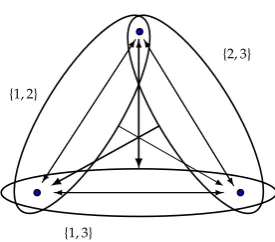
However, grounded beliefs are not closed under conjunction. To illustrate this fact, consider the topological argumentation model
M=({1,2,3},E0={{1},{2},{3},{1,2},{2,3}}, τ=2X,,V) (1)
withan attack relation in which singletons attack each other and{3}{1,2}, {1}{2,3},{2}{1,3}and{1,3}{2}, and the empty set is attacked by any
sets in τ, as shown in Figure 1.9 Thus, according to the definition, LFP
τ is
{{1,2},{2,3},{1,2,3}}, a set that is not closed under intersection.
To get a better grasp of the whole framework, consider the following sce-nario which can be modeled by the above topological argumentation model.
Example 3.1. The zoo in Tom’s town bought a new animal and had it under exhibition. Tom was curious about what the animal is, so he asked his colleagues. However, he got different answers from them. Some told him that the animal was a penguin ({1}), some
told him that the animal was a pterosaur ({2}) and some told him that the animal was
a bat ({3}). Moreover, two other colleagues he really trusts told him that the animal
could fly ({2,3}) and the animal was not a mammal ({1,2}). After receiving all these
pieces of information, Tom was very puzzled. After all, it was very hard to imagine that
8Of course, consistency can be also achieved when some of the other mentioned sets are used,
but this would require the use of an external mechanism, and that might not be desirable for simplicity reasons.
{1,3} {1,2}
[image:8.595.227.365.123.244.2]{2,3}
Figure 1: Grounded beliefs are not closed under conjunction.
there could be a pterosaur (although genetic technology has developed fast). So in such a situation, Tom believed that the animal could fly and the animal was not a mammal, but he did not believe that the animal was a pterosaur.
The lack of closure under conjunction does not indicate that our agent lacks formal reasoning abilities, as is usually the case in weaker epistemic notions. In-deed, as the topology shows, our agent can put her pieces of evidence together in a meaningful way. In section5, we further elaborate on this distinction be-tween the agent’s reasoning abilities and the closure properties of her grounded beliefs. For now we focus first on the reasons behind the failure of this closure property, by identifying additional conditions under which the property holds.
Proposition 3.2. LetMbe a topological argumentation model andAτ =(τ,)its
attack graph.
• Ifis transitive (i.e. for any t1,t2,t3∈τ, t1t2and t2t3imply t1t3),
thenLFPτis closed under intersections;
• Ifis unambiguous (i.e. for any t1,t2,t3 ∈ τ, if t1 t2and t2 t3, then
t16t3and t36t1), thenLFPτis closed under intersections;
• Ifis symmetric (i.e. for any t1,t2∈τ, if t1 t2then t2t1), thenLFPτis
closed under intersections.
Note here how whenis symmetric, our notion of belief boils down to the evidence-based belief in topological evidence models of Baltag et al.(2016a), and thus it is closed under conjunction. We will elaborate on this point below. With respect to transitivity, one may wonder whether closure under conjunction still holds under a weaker requirement that asks for the transitivity of the attack relation only when the involved sets are in conflict (i.e., for anyt1,t2,t3 ∈τ, if
t1 t2,t2 t3 andt1∩t3 = ∅, thent1 t3). We defer the answer to this
question till Section5, where we compare our concept of grounded belief with a probabilistic notion of belief.
We conclude this section with a comparison between our concept of grounded beliefs and the evidence-based beliefs under the topological semantics ofBaltag et al.(2016a). Recall that, in the latter, the agent believesP(denoted byBel P) if and only if for anyt∈ τ\ {∅}there ist0 ∈ τ\ {∅}such thatt0 ⊆ tandt0 ⊆ P
Definition 3.4(Family of Bodies of evidence, Combined Evidence). Following Baltag et al.(2016a),
• letF denote thefamily of all bodies of evidence(see Definition2.2); • letFfinitedenote the family of allfinitebodies of evidence;
• define E as the family of the combined evidence given by finite bodies of evidence:
E:={\F⊆X|F∈ Ffinite}.
According toBaltag et al.(2016a, Proposition 2), evidence-based beliefs can be equivalently defined as Bel Pif and only if there is an open that supports Pand is also consistent with any combined evidence given by finite bodies of evidence (i.e., iffthere ist∈τsuch thatt⊆Pandt∩e,∅for anye∈E).
Now, given a topological argumentation modelM, letJMdenote the set of
opens that are consistent with any combined evidence given by finite bodies:
JM:={t∈τ| ∀e∈E:e∩t,∅} 10
Note that ifin the topological argumentation modelMis symmetric, then LFPτ=JM.
The following result shows that the notion of grounded belief is weaker than the evidence-based belief ofBaltag et al.(2016a).
Proposition 3.3. Given any topological argumentation modelM, JM⊆dτ(∅).
It follows from this proposition thatJM⊆LFPτ, and thusBel PimpliesBP
in any given topological argumentation model. Therefore, grounded beliefs are weaker in the sense of being less restrictive and therefore allow more formulas to be believed by the agent. In the next section we study the logic of beliefs grounded on arguments.
4
The Logic of Beliefs Grounded on Arguments (ABBL)
This section studies the logic of the notion of belief grounded on arguments. In order to provide a complete axiomatic characterization of the logic of grounded belief, we work for now with a language that extends the propositional part with a belief operator.
Definition 4.1(Language). The languageLof ABBL is generated by the following
grammar, where p∈Prop.
ϕ::=p| ¬ϕ|ϕ∧ϕ| Bϕ
Definition 4.2(Semantics). Given a topological argumentation modelM=(X,E0, τE
0,
,V)and a possible world x∈X, the truth condition of formulas inLis defined as usual
for atomic propositions and Boolean operators. For the grounded belief modality,
M,x|=Bϕ iff there exists f ∈LFPτsuch that f ⊆~ϕM
with~ϕM:={x∈X| M,x|=ϕ}the set ofϕ-worlds inM.
Axiom SystemTable1shows the axiom system ABBS, which below (Theorem 4.1) will be shown to be sound and complete for the language ABBL with respect to topological argumentation models.
Table 1: Axiom system ABBS for ABBL Propositional Tautologies and Modus Ponens
4: Bϕ→ B Bϕ 5: ¬ Bϕ→ B ¬ Bϕ
RE: fromϕ↔ψinferBϕ↔ Bψ D: Bϕ→ ¬ B ¬ϕ
M: B(ϕ∧ψ)→ Bϕ∧ Bψ N: B >
The axiom system ABBS extends the well-known axiom system EMN (the propositional fragment, the RE rule and axioms M and N) with axioms 4, 5 and D. It is known that EMN is sound and complete with respect to the class of neighborhood models that aresupplemented(i.e., closed under conjunction elimination or, equivalently, closed under supersets) and contain the unit (i.e., the domain is in the neighborhood) Chellas (1980). This suggest a detour for proving the completeness result for our logic with respect to topological argumentation models.
Theorem 4.1. For anyϕ∈ LandΦ⊆ L,
Φ`ABBSϕ if and only if Φ|=ϕ
whereΦ`ABBSϕindicates thatϕis derivable fromΦin the axiom system ABBS and
Φ|=ϕindicates that, for any topological argumentation modelMand any x∈X, if M,x|= Φ(i.e. M,x|=φfor allφ∈Φ) thenM,x|=ϕ.
Proof sketch. Soundness is straightforward; for completeness, the proof uses a modal equivalence result. First, define abelief neighborhood modelMas a uniform neighborhood model (X,NB,V) where the neighborhood function NB ⊆ 2X
satisfies the following conditions:
• X∈NB(NBcontains the unit); • ifb ∈ NB, thenb0 ∈
NB for anyb0 such thatb ⊆ b0(NB is closed under
supersets);
• ifb∈NB, thenX\b<NB(NBdoes not contain the complement of any of
its elements).
In such structures, the semantic interpretation of a modality for this neighborhood-based belief is given by
M,x|=Bϕ iff ~ϕM∈NB
The following lemma states that every topological argumentation model gives raise to a modally equivalent belief neighborhood model, and vice-versa. Since the axiom system ABBS is sound and complete with respect to belief neighborhood models (see, e.g.,Chellas 1980), it follows that the system is also sound and complete with respect to topological argumentation models.
Lemma 4.1. For any topological argumentation modelM=(X,E0, τ,,V)there is a
belief neighborhood modelM=(X,NB,V)with the same domain and atomic valuation
such thatMandMare point-wise modally equivalent with respect to the languageL
(i.e. for anyϕ∈ Land any x∈X,M,x|=ϕif and only ifM,x|=ϕ.) And vice versa.
Lemma 4.2. LFPτ=NB
Hence,MandMare modally equivalent.
Thus, our notion of grounded belief can be completely characterized by the axiom system ABBS.
5
Failure of Closure and Rational Belief
One of the distinctive features of our notion of grounded belief is its lack of closure under conjunction. This feature is also a distinctive mark of the well-knownprobabilisticnotion of belief, where belief is interpreted as high enough probability (typically, above threshold12). It is thus worthwhile to compare the two approaches.
Definition 5.1(Probabilistic Belief Model (Lenzen 1980,van Eijck and Renne 2014)). A probabilistic belief model is a tupleM= (X, µ,V)where X is a countable space andµ: 2X→ [0,1]is a probability function satisfying Kolmogorov’s Axioms:
(1) µ(Q) ≥ 0 for any Q ⊆ X, (2)µ(X) = 1, and (3) for any countable sequence of
disjoint sets S1,S2, . . .,µ(S
∞
i=1Si)= Σi∞=1µ(Si).
In this probabilistic belief model, µ is interpreted as agent’s credence func-tion which measures the agent’s credence in each proposifunc-tion. Hence credible enough propositions can be taken to represent the agent’s beliefs, where “cred-ible enough" means “above some threshold". In order to illustrate the relation between our concept of grounded belief and this quantitative counterpart, we consider the threshold to be 0.5. Thus, the concept ofprobabilistic belief that we consider in this paper is defined as
M,x|=Bϕ iff µ(~ϕM)>0.5
It is important to note that the axiom system ABBS is sound with respect to the probabilistic belief model. Moreover, for any probabilistic belief model we can construct a modally equivalent belief neighborhood model (see the proof of Theorem4.1): it is enough to put in the neighbourhoodNB all subsets of
the domain whose probability is greater than 0.5, i.e. NB = {S ⊆ X | µ(S) >
0.5}. Given Kolmogorov’s axioms, the resulting structure indeed satisfies the
belief neighborhood requirements. Even more: by Lemma4.1, we can build a topological argumentation model from the belief neighborhood model, which is modally equivalent to the belief neighborhood model and thus modally equivalent to the probabilistic belief model. However, not every topological argumentation model has a modally equivalent probabilistic belief model. This is because the axiom system ABBS is sound but not complete with respect to the probabilistic belief model (c.f. Klein et al. 2015, Section 3.1, Lenzen 1980
andvan Eijck and Renne 2014).
Thus, probabilistic belief can be seen as a special form of grounded belief, in the sense that the former can be defined through a special attack relation on 2X: for anye,e0∈2X, defineeµe0if and only ife∩e0=∅andµ(e)6µ(e0). This
attack relation satisfies extra conditions, for example, for anye1,e2,e3 ∈ 2X, if
e1e2,e2 e3ande1∩e3=∅, thene1e3. Since the probabilistic notion of
the failure of closure under conjunction, which answers the question we posed in Section 2.
Philosophical Debate. Let us re-examine one of the most important criticisms faced by probabilistic beliefs from the perspective of our topological argumen-tation models. The criticism is based on theconjunction rulewhich states that if it is ‘rational’ for an agent to believeϕand it is ‘rational’ to believeψ, then it is ‘rational’ to believeϕandψ. As stated inFoley(2009),
there are [. . . ] prima facie worries associated with rejecting the rule, the most fundamental of which is that if we are not required on pains of irrationality to believe the conjunction of propositions that we ra-tionally believe, we might seem to lose some of our most powerful argumentative and deliberative tools. (p.42)
Thus, according to this (whichFoley 2009actually criticizes), a rational agent should follow the conjunction rule. Since probabilistic beliefs violate the rule, philosophers have debated whether probabilistic beliefs are good candidates for representing a rational concept of belief. In this discussion it is essential to note that if “rational" is viewed as the willingness and capability of following logical rules, it implicitly burdens belief with a requirement about the agent’s ability of deductive reasoning.11 InFoley(2009), the author argues not only
that this worry is misplaced, but also that beliefs should not be burdened with the agents’ deductive reasoning abilities. Note that Foley proposes a clear distinction between two reasoning processes, one involving an agent’s beliefs (not closed under conjunction) and deductive processes (which are closed under conjunction). What our proposal shows is that the two processes are distinct but can be united in one formal framework.
The topological argumentation model shows how the notion of grounded belief is based on the agents’ topology of evidence and the attack relation on the topology. So on the one hand, the agent modelled by a topological argumentation model is a powerful logician: she can generate a full topology from her collections of pieces of evidence. On the other hand, this logician’ grounded belief does not follow the conjunction rule. So even if the agent has a good argument/reason to believeϕand a good argument/reason to believeψ, she may not have a good argument/reason to believeϕ∧ψ. In contrast to many
probabilistic belief models where these parts are hidden, our setting makes the different processes explicit.
6
Conclusion and Future Work
This paper studies a notion of grounded belief. It does so by applying ideas from both abstract argumentation theory and the topological semantics for evidence.
From the perspective of abstract argumentation theory, our work can be seen as an attempt of giving structure to the otherwise abstract arguments in
11Our discussion does not exclude the possibility that ‘rationality’ may well require more than
an attack graph. Here arguments are instantiated as sets of possible worlds, and thus we can use logical tools to define not only which propositions they support, but also when one of them attacks another. From the perspective of the topological semantics for evidence, our work provides a generalization of the conflict relation between pieces of evidence. The integration of these ingredients from two different fields brings to fruition a notion ofbelief grounded on argumentswhose logical behavior is proved to be characterized by the axiom system ABBS. This notion is compared with other forms of belief, including the evidence-based belief ofBaltag et al.(2016a) and the probabilistic notion of belief inLenzen(1980) andvan Eijck and Renne(2014).
One of the most intriguing features of the introduced concept of grounded belief is its failure of closure under conjunction. In the philosophical literature, this failure is widely taken as a failure of rationality, especially when it comes down to the agent’s beliefs. However, as our setting shows, even if the con-junction rule is adopted by the agent on the level ofreasoningabout evidence or arguments, it does not need to be adopted to form newbeliefs.
In future work we extend our formal language to include operators that address the agent’s arguments explicitly. While our current restricted language allows us to characterize the behavior of our notion of belief, it does lack the expressive power to talk about the relationship between beliefs and the arguments supporting it. Another dimension worthwhile to explore further is the understanding of argumentation not as a single agent’s inner reasoning mechanism, but rather as a social process that involves several agents. There exists work in argumentation theory dedicated to this dimension, as the study of methods for merging different attack graphs Coste-Marquis et al. (2007) shows. This line of work can further be related to the recent developments in social choice theory Endriss and Grandi(2017). In our context, the question of merging different agent’s attack graphs can shed new light at group-related notions, in particular, distributed belief, which can then be understood from the perspective of abstract argumentation theory.
Finally, while we have restricted our attention to the concept of ground-ed belief, epistemologists will be interestground-ed to see a connection to the seminal studies of knowledge, belief, justifications and their relation (e.g.,Lehrer 1990, where knowledge is understood as belief with a correct justification that cannot be defeated by any further true justification). There exist new proposals in this direction (e.g.,Baltag et al. 2016a), which, with the help of argumentation theory can shed more light on different epistemic theories and, in particular, on the different notions of knowledge.
AcknowledgmentsWe thank Johan van Benthem and Abyüke Özgün for feed-back and discussions on the topic of this paper. We also thank the anonymous referees of TARK 2017 for their useful comments.
Appendix
Proof ofProposition3.1 Take any f ∈LFPτ and any f0 ∈τsuch that f ⊆ f0.
Suppose no one attacks f0
one of such opens attacking f0
; it is enough to find a f00 ∈
LFPτ attackingt, as then f0
would be defended by someone inLFPτ and thus, by definition, f0
would be inLFPτ. Now, sincetattacksf0
, it should also attack the strongerf(as required by’s definition); but then, sincef is inLFPτ, it should be defended by someone inLFPτ, that is, there is a f00inLFPτ attackingt. This completes the proof.
Proof ofProposition3.2 The following lemma will be useful.
Lemma .1. LetM=(X,E0, τE
0,,V)be a topological argumentation model. Then, for any f1,f2 ∈ LFPτ , f1,f2 ∈ LFPτ implies f1∩ f2 ∈ LFPτ if and only if for any
t∈τ, if f1∩ f2t, then t∩ f =∅for some f ∈LFPτ.
Proof. (⇒) From left to right, take arbitrary f1,f2 ∈LFPτ. Suppose there is an
opent∈τsuch thattattacks f1∩f2but is not in conflict with anybody inLFPτ.
From the latter it follows that nobody inLFPτattackst, and thus the attacked f1∩f2is not defended byLFPτ; therefore, f1∩f2is not inLFPτ.(⇐) From right
to left, take arbitrary f1,f2∈LFPτ. If there is not∈τsuch that f1∩f2t, then
we are done. Otherwise, take arbitraryt∈ τsuch that f1∩ f2 t. It implies
that there is f0 ∈
LFPτ such thatt∩ f0 =∅
. Thus either f0
attackstor elset attacks f0
. The former case implies that there is f00 ∈
LFPτ such thatt f00
by virtue of f0
’s membership inLFPτ; together with the latter case, i.e.t f0
, we can conclude that there is f ∈ LFPτ such thatt f. Hence for anyt∈ τ
such that f1∩ f2 t, there is f ∈ LFPτ such thatt f, which implies that
f1∩ f2∈LFPτ.
Now, for proposition 3.2. The proof for transitivity and the relation being unambiguous, proceeds by contraposition, so take any f1,f2 ∈LFPτ such that f1∩ f2is not inLFPτ. Then, by Lemma.1, there is an opent∈ τwho attacks
f1∩ f2 (i.e., f1∩ f2 t) and who is not in conflict with elements ofLFPτ(i.e.,
f ∈LFPτimpliest∩ f ,∅). The goal is to show thatis not transitive.
Definet1,t2andt3as
t1 := f1∩t, t2:= f2∩t, t3:= f1∩ f2,
and note that none of them are empty. Note also that due to the fact that t attacks f1∩ f2(f1∩ f2 t),tmust be in conflict with f∩f2 ((f1∩ f2)∩t= ∅);
hence,t1∩t2=t2∩t3=t3∩t1=∅.
For transitivity, consider now the following two mutually exclusive and collectively exhaustive cases: (1) t1 t3ort2t3,(2) t1 6t3andt26t3. In
the first, assume the leftmost disjunctt1t3; that, together witht3t(recall:
t3 = f1∩ f2) andt1 6t(ast1∩t= f1∩t,∅) shows thatis not transitive.
If the rightmost disjunctt2t3is assumed, a similar reasoning yieldst3 t
andt26t, and thus lack of transitivity again.
Now the second case, which implies t3 t1 and t3 t2, as the ti are all in conflict. Since t1 and f2 are in conflict, at least one of them should
attack the other. Ift1 f2, then this together witht3 t1 and t3 6 f2 (as
t3 ∩t = f1 ∩ f2 , ∅, and thus they are not in conflict shows that is not
transitive. Otherwise, f2 t1should be the case; hence, since f2 is inLFPτ,
it should be defended fromt1by some f ∈LFPτ, that is,t1 f. But then we
have f2 t1,t1 f and f2 6 f (sinceLFPτ) is conflict-free. Thus, again,
For the relation being unambiguous, consider two cases,t1t2ort2t1.
In the case of t1 t2, if t2 t3, then no matter t1 t3 or t3 t1, it is
not unambiguous. If t3 t2, then no mattert1 t3 or t3 t1, is not
unambiguous. The proof for the case oft2 t1 follows a similar argument.
Therefore, we reach the conclusion thatcannot be unambiguous.
For symmetry, assume thatis symmetric. Observe thatLFPτ = {t∈ τ| ∀e∈E:e∩t,∅}, which is closed under conjunction.
Proof ofProposition3.3 Take anytinJM. Sincetis consistent with anye∈E,
it is also consistent with any opent0∈τ
, that is, for any sucht0
we havet∩t0 ,∅.
But thentis not attacked at all, and thus it is defended by the empty set, i.e. t∈dτ(∅). Therefore,JM⊆dτ(∅).
Proof of Lemma 4.1 Given a topological argumentation model, it is easy to
build a point-wise modally equivalent belief neighborhood model: it is enough to define the neighborhood functionNBasLFPτplus all its element’s supersets
(NB := {b ∈ 2X | f ⊆ bfor some f ∈ LFPτ}). For the other direction, given
a belief neighborhood model M = (X,NB,V), let MM = (X,E0, τ,NB,V) be the topological argumentation model that shares domain and atomic valuation withM, and in which the family of pieces of evidence is given by the singletons inX(E0:={{x} ∈2X|x∈X}) and therefore the generated topology is the power
set of the domain (τ=2X). Moreover, define the attack relation NBas
tNB t
0
iff (
t∩t0=∅
andt<NB whent0,∅
t=∅ whent0=∅
for everyt,t0∈τ
, so a non-emptyt0
attacks a non-emptytif and only if they are in conflict andtis not inNB, and while the empty set does not attack non-empty
sets, it is attacked by everybody (including itself). It is easy to verify that this model is a topological argumentation model.
Proof ofLemma4.2 (⊇) Take anyb∈NB. ByN
B’s definition, no element ofτ who is in conflict withbattacks it (i.e., there is not∈τsuch thatb∩t=∅and
bNBt); therefore, no one attacksband henceb∈LFPτ.
(⊆) Take an arbitraryt∈ τsuch thatt< NB. Iftis not in conflict with any
open inτ, thentmust beX, soX<NB, contradicting the fact thatNBcontains
the unit. Hence,tshould have a conflict with some open, that is, there is at least onet0 ∈τ
such thatt∩t0=∅
. From this andNB’s definition it follows thatt0attackst,tNBt
0
.
If at least one of sucht0is inNB, then it is also inLFPτ(the(⊇) case above),
and thus the fact thatt0attackstimplies thatt<LFPτ, as this set is conflict-free.
Then we are done. Otherwise no sucht0
is inNB, that is, every open in conflict
withtis outsideNB; in other words, no element ofNBis in conflict witht(b∈NB
impliest∩b,∅).
Define now the setsas the union of the non-tparts of every element ofNB,
that is,s:=S
b∈NB(b\t). Sinceτis the full power set,sis inτ. Thissis in conflict witht(s∩t=∅, by construction), but it is consistent with allb∈NB(b∩s,∅for
all suchb, as otherwise theb0∈
NBin conflict withswould have been a subset
oft, and thus closure under supersets ofNBwould implyt∈NB, contradicting
our initial assumption). These two facts tells us that we have found an open s∈τthat attackst(tN
it is not attacked by anyone inNB(b∈NBimpliess6NB b, from the second fact andNB’s definition). Moreover, it attacks every open not inNB with whom it has conflict (x<NBimpliesx∩s=∅, again fromNB’s definition). Thus,s (1)attacks everybody inτthat is not inNB, and(2)is not attacked by anybody in
NB; hence no one outsideNBcan be protected byNBagainsts, which means that
dτ(NB)=NB. Together with the fact thatNB⊆LFPτ, it implies thatNB=LFPτ.
In particular, sincet<NB, we get the requiredt<LFPτ.
References
S. N. Artemov. The logic of justification. The Review of Symbolic Logic, 1(4): 477–513, 2008. doi: 10.1017/S1755020308090060.
S. N. Artemov and E. Nogina. Introducing justification into epistemic logic. Journal of Logic and Computation, 15(6):1059–1073, 2005. doi: 10.1093/logcom/ exi053.
A. Baltag and S. Smets. A qualitative theory of dynamic interactive belief revision. Texts in logic and games, 3:9–58, 2008a. URL http://www.vub.ac. be/CLWF/SS/chapter.pdf.
A. Baltag and S. Smets. Probabilistic dynamic belief revision. Synthese, 165(2): 179, 2008b. ISSN 1573-0964. doi: 10.1007/s11229-008-9369-8.
A. Baltag, B. Renne, and S. Smets. The logic of justified belief change, soft evidence and defeasible knowledge. In C. L. Ong and R. J. G. B. de Queiroz, editors,Logic, Language, Information and Computation - 19th International Work-shop, WoLLIC 2012, Buenos Aires, Argentina, September 3-6, 2012. Proceedings, volume 7456 ofLecture Notes in Computer Science, pages 168–190. Springer, 2012. ISBN 978-3-642-32620-2. doi: 10.1007/978-3-642-32621-9_13.
A. Baltag, N. Bezhanishvili, A. Özgün, and S. Smets. The topology of belief, belief revision and defeasible knowledge. In D. Grossi, O. Roy, and H. Huang, editors, Logic, Rationality, and Interaction: 4th International Workshop, LORI 2013, Hangzhou, China, October 9-12, 2013, Proceedings, pages 27–40, Berlin, Heidelberg, 2013. Springer Berlin Heidelberg. ISBN 978-3-642-40948-6. doi: 10.1007/978-3-642-40948-6_3.
A. Baltag, B. Renne, and S. Smets. The logic of justified belief, explicit knowledge and conclusive evidence.Annals of Pure and Applied Logic, 165(1):49–81, 2014. doi: 10.1016/j.apal.2013.07.005.
A. Baltag, N. Bezhanishvili, A. Özgün, and S. Smets. The topological theory of belief. Technical Report PP-2015-18, ILLC, University of Amsterdam, 2015. URLhttps://www.illc.uva.nl/Research/Publications/Reports/ PP-2015-18.text.pdf.
pages 83–103. Springer Berlin Heidelberg, Berlin, Heidelberg, 2016a. doi: 10.1007/978-3-662-52921-8_6.
A. Baltag, V. Fiutek, and S. Smets. Beliefs and evidence in justification models. In S. D. L. Beklemishev and A. Mate, editors, Proceedings of Advances in Modal Logic, pages 156–176, Oxford, UK, 2016b. College Publications. URL http://www.aiml.net/volumes/volume11/Baltag-Fiutek-Smets.pdf.
O. Board. Dynamic interactive epistemology.Games and Economic Behaviour, 49 (1):49–80, 2004. doi: 10.1016/j.geb.2003.10.006.
M. W. A. Caminada and D. M. Gabbay. A Logical Account of Formal Argu-mentation. Studia Logica, 93(2-3):109, 2009. ISSN 0039-3215, 1572-8730. doi: 10.1007/s11225-009-9218-x.
B. F. Chellas. Modal Logic: An Introduction. Cambridge University Press, Cambridge, Mass., Feb. 1980. ISBN 978-0-521-29515-4. doi: 10.1017/ CBO9780511621192.
S. Coste-Marquis, C. Devred, S. Konieczny, M.-C. Lagasquie-Schiex, and P. Mar-quis. On the merging of Dung’s argumentation systems.Artificial Intelligence, 171(10):730–753, July 2007. ISSN 0004-3702. doi: 10.1016/j.artint.2007.04.012.
J. de Kleer. An assumption-based TMS. Artificial Intelligence, 28(2):127–162, 1986. doi: 10.1016/0004-3702(86)90080-9.
J. Doyle. A truth maintenance system.Artificial Intelligence, 12(3):231–272, Nov. 1979. ISSN 0004-3702. doi: 10.1016/0004-3702(79)90008-0.
P. M. Dung. On the acceptability of arguments and its fundamental role in nonmonotonic reasoning, logic programming and n-person games.Artificial intelligence, 77:321–357, 1995. doi: 10.1016/0004-3702(94)00041-X.
U. Endriss and U. Grandi. Graph aggregation.Artificial Intelligence, 245:86–114, 2017. doi: 10.1016/j.artint.2017.01.001.
R. Foley. Beliefs, Degrees of Belief, and the Lockean Thesis. In F. Huber and C. Schmidt-Petri, editors, Degrees of Belief, number 342 in Synthese Library, pages 37–47. Springer Netherlands, 2009. ISBN 9197-1 978-1-4020-9198-8. doi: 10.1007/978-1-4020-9198-8_2.
D. Grossi. Abstract argument games via modal logic. Synthese, 190:5–29, 2013. doi: 10.1007/s11229-012-0237-1.
D. Grossi and W. van der Hoek. Justified beliefs by justified arguments. In Proceedings of the Fourteenth International Conference on Principles of Knowledge Representation and Reasoning, pages 131–140. AAAI Press, 2014. URLhttp: //www.aaai.org/ocs/index.php/KR/KR14/paper/view/7997.
J. Hintikka. Knowledge and Belief. Cornell University Press, 1962.
T. Kelly. Evidence. In E. N. Zalta, editor,The Stanford Encyclopedia of Philos-ophy. Metaphysics Research Lab, Stanford University, winter 2016 edition, 2016. URL https://plato.stanford.edu/archives/win2016/entries/ evidence/.
D. Klein, N. Gratzl, and O. Roy. Introspection, Normality and Agglomeration. In Logic, Rationality, and Interaction, pages 195–206. Springer, Berlin, Heidelberg, Oct. 2015. doi: 10.1007/978-3-662-48561-3_16.
K. Lehrer. Theory of Knowledge. Routledge, 1st edition, Sept. 1990. ISBN 978-0-415-05408-9.
W. Lenzen. Glauben, Wissen und Wahrscheinlichkeit: Systeme der epistemis-chen Logik. Springer, 1980. ISBN 978-3-211-81598-4. doi: 10.1007/ 978-3-7091-8594-0. Google-Books-ID: 6mwIAQAAIAAJ.
J.-J. C. Meyer and W. van Der Hoek.Epistemic Logic for AI and Computer Science. Cambridge University Press, New York, N.Y., U.S.A., 1995. ISBN 0-521-46014-7. doi: 10.1017/CBO9780511569852.
R. Montague. Universal grammar. Theoria, 36(3):373–398, 1970. doi: 10.1111/j. 1755-2567.1970.tb00434.x.
G. Pappas. Internalist vs. externalist conceptions of epistemic justification. In E. N. Zalta, editor, The Stanford Encyclopedia of Philosophy. Metaphysics Research Lab, Stanford University, fall 2014 edition, 2014. URL https:// plato.stanford.edu/archives/fall2014/entries/justep-intext/.
F. Schwarzentruber, S. Vesic, and T. Rienstra. Building an epistemic logic for argumentation. In L. F. del Cerro, A. Herzig, and J. Mengin, editors,Logics in Artificial Intelligence - 13th European Conference, JELIA 2012, Toulouse, France, September 26-28, 2012. Proceedings, volume 7519 ofLecture Notes in Computer Science, pages 359–371. Springer, 2012. ISBN 978-3-642-33352-1. doi: 10.1007/ 978-3-642-33353-8_28.
D. Scott. Advice on modal logic. In K. Lambert, editor,Philosophical Problems in Logic, pages 143–173. Reidel, Dordrecht, The Netherlands, 1970. ISBN 978-94-010-3272-8. doi: 10.1007/978-94-010-3272-8\_7.
W. Spohn. Ordinal conditional functions: A dynamic theory of epistemic states. In W. L. Harper and B. Skyrms, editors, Causation in decision, belief change, and statistics: Proceedings of the Irvine Conference on Probability and Causation, number 42 in The Western Ontario Series in Philosophy of Science, pages 105–134. Kluwer, Dordrecht, 1988. doi: 10.1007/978-94-009-2865-7_6.
J. van Benthem and E. Pacuit. Dynamic logics of evidence-based beliefs.Studia Logica, 99(1-3):61–92, 2011. doi: 10.1007/s11225-011-9347-x.
J. van Benthem, D. F. Duque, and E. Pacuit. Evidence and plausibility in neighborhood structures. Ann. Pure Appl. Logic, 165(1):106–133, 2014. doi: 10.1016/j.apal.2013.07.007.