A parameter study of the eclipsing CV in the
Kepler
field, KIS
J192748.53
+
444724.5
S. P. Littlefair,
1‹V. S. Dhillon,
1B. T. G¨ansicke,
2M. C. P. Bours,
2C. M. Copperwheat
3and T. R. Marsh
21Department of Physics and Astronomy, University of Sheffield, Sheffield S3 7RH, UK 2Department of Physics, University of Warwick, Coventry CV4 7AL, UK
3Astrophysics Research Institute, Liverpool John Moores University, Twelve Quays House, Birkenhead CH41 1LD, UK
Accepted 2014 June 9. Received 2014 June 9; in original form 2014 January 25
A B S T R A C T
We present high-speed, three-colour photometry of the eclipsing dwarf nova KIS J192748.53+444724.5 (KISJ1927) which is located in the Kepler field. Our data reveal sharp features corresponding to the eclipses of the accreting white dwarf followed by the bright spot where the gas stream joins the accretion disc. We determine the system param-eters via a parametrized model of the eclipse fitted to the observed light curve. We obtain a mass ratio of q = 0.570 ± 0.011 and an orbital inclination of 84.◦6 ± 0◦.3. The pri-mary mass is Mw=0.69±0.07 M. The donor star’s mass and radius are found to be
Md=0.39±0.04 MandRd=0.43±0.01 R, respectively. From the fluxes of the white
dwarf eclipse, we find a white dwarf temperature ofTw=23000±3000 K, and a photometric distance to the system of 1600±200 pc, neglecting the effects of interstellar reddening. The white dwarf temperature in KISJ1927 implies the white dwarf is accreting at an average rate of ˙M=1.4±0.8×10⁻⁹Myr−1, in agreement with estimates of the secular mass loss rate
from the donor.
Key words: binaries: close – binaries: eclipsing – stars: dwarf novae – novae, cataclysmic variables.
1 I N T R O D U C T I O N
Cataclysmic variable stars (CVs) are a class of interacting binary system undergoing mass transfer, usually via a gas stream and ac-cretion disc, from a Roche lobe filling secondary to a white dwarf primary. In addition a ‘bright spot’ is formed at the intersection
of the disc and gas stream. Warner (1995) gives a comprehensive
review of CVs.
In recent years, continuous monitoring of CVs in theKeplerfield
have provided significant improvements in our understanding of accretion physics in close binaries. These observations have shed
light on the strength of the disc viscosity (Cannizzo et al.2010),
the origin of superhumps (Wood et al. 2011) and superoutbursts
(Osaki & Kato 2013) in the dwarf nova subclass of CVs, which
exhibit quasi-periodic outbursts of a few magnitudes that arise in the accretion disc.
Eclipsing dwarf novae in the Kepler field are particularly
in-teresting, since modelling the eclipses allows the evolution of the accretion disc radius to be studied over the outburst cycle. The light curves of eclipsing dwarf novae can be quite complex, with the
E-mail:[email protected]
accretion disc, white dwarf and bright spot all being eclipsed in rapid succession. Foreshortening of the bright spot gives rise to an ‘orbital hump’ in the light curve at phases 0.6–1.0. With sufficient time resolution, the eclipse structure allows the system parame-ters to be determined to a high degree of precision (Wood et al.
1986). In turn, knowledge of the system parameters allows for more
accurate modelling of the accretion disc dynamics. Eclipsing sys-tems also allow us to measure the precise flux contribution of the white dwarf. With colours one can then estimate its temperature
(e.g. Littlefair et al.2006; Savoury et al.2011). The temperatures
of accreting white dwarfs reflect the accretion rate averaged over
the past 103–105yr (Townsley & G¨ansicke2009) and hence give a
more representative picture of the long-term behaviour of the sys-tem than any present-day measurement can achieve. This method requires that the contribution of the white dwarf is significant. For
short-period systems (P<2 h), this is typically the case, but the
higher accretion rates of long-period systems can often mask the white dwarf. Long-period systems where the white dwarfs can be seen are hence of particular interest.
KIS J192748.53+444724.5 (hereafter KISJ1927) is the second
eclipsing CV known in theKeplerfield (Scaringi, Groot & Still
2013), after V477 Lyr (Ramsay et al. 2012). It is a dwarf nova
with an orbital period of 3.97 h. Analysis of long-cadence (30 min)
C
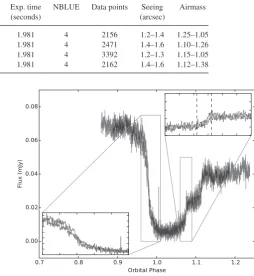
Table 1. Journal of observations. Most observing nights were clear of cloud, but the night of 2013 Aug 4 suffered from some light cirrus towards the end of observations. The dead-time between exposures was 0.025 s for all observations. The relative GPS timestamping on each data point is accurate to 50µs, with an absolute accuracy better than 1 ms.Tmidgives the time of
mid-eclipse (see Section 3.5). NBLUE indicates the number of blue frames which were co-added on-chip to reduce the impact of read noise.
Date Start phase End phase Tmid Exp. time NBLUE Data points Seeing Airmass
BMJD(TDB) (seconds) (arcsec)
2013 Aug 04 1834.89 1835.19 56508.92767(2) 1.981 4 2156 1.2–1.4 1.25–1.05 2013 Aug 04 1835.86 1836.24 56509.09294(2) 1.981 4 2471 1.4–1.6 1.10–1.26 2013 Aug 05 1840.74 1841.21 56509.91955(2) 1.981 4 3392 1.2–1.3 1.15–1.05 2013 Aug 05 1841.84 1842.14 56510.08486(2) 1.981 4 2162 1.4–1.6 1.12–1.38
Keplerdata from a single quarter has already revealed disc radius
variations over an outburst (Scaringi et al.2013). TheKeplerlight
curves also show a strong bright spot and eclipses of the disc and white dwarf, although they lack the time resolution necessary to resolve them. Here, we present high-time resolution ULTRACAM
ugrlight-curves of KISJ1927 and use these light curves to estimate
the system parameters. The observations are described in Section 2, the results are presented in Section 3, and discussed in Section 4.
2 O B S E RVAT I O N S
On the nights of 2013 Aug 4 and 5 KISJ1927 was observed
simulta-neously in the Sloan Digital Sky Survey (SDSS)-ugrcolour bands
using ULTRACAM (Dhillon et al.2007) on the 4.2-m William
Herschel Telescope (WHT) on La Palma. A complete journal of
observations is shown in Table1. Four eclipses were observed in
total. Data reduction was carried out in a standard manner using the
ULTRACAMpipeline reduction software, as described in Feline et al.
(2004a), and a nearby comparison star (separation 55 arcsec) was used to correct the data for transparency variations. Us-ing a second star to check for variability in the comparison star revealed its flux to be constant to better than 1 per cent.
The photometry was transformed into the ugr standard
sys-tem (Smith et al. 2002) using observations of the standard star
BD +33 2642 taken at the start of the night of Aug 4. The
photometry was corrected for extinction using nightly
measure-ments of the r-band extinction from the Carlsberg Meridian
Telescope (http://www.ast.cam.ac.uk/∼dwe/SRF/camc_extinction
.html), which was converted to an extinction in the u and g bands using the information provided in La Palma Technical Note 31 (http://www.ing.iac.es/Astronomy/observing/manuals/ps/tech_ notes/tn031.pdf).
3 R E S U LT S
3.1 Light-curve morphology and variations
The individual eclipse light curves from the nights of 2013 Aug 4
and 5 are shown in Figs1and2, respectively. All data in this paper
are shown folded on the ephemeris of Scaringi et al. (2013). The
WHT/ULTRACAM data are taken at much higher time resolution
than that of the long-cadenceKeplerdata of Scaringi et al. (2013,
[image:2.595.311.547.481.661.2]2 versus 1800 s) and reveal the detailed eclipse shape. The eclipses on the night of Aug 4 are particularly clean, with little flickering, and show clear and separated egresses of the white dwarf and bright spot. The ingresses of the white dwarf and bright spot are harder to separate without averaging multiple eclipses. On the night of
Figure 1. g light curves of two eclipses from the night of 2013 Aug 4, folded on the ephemeris of Scaringi et al. (2013). Insets show the sections of the light curve around white dwarf/bright spot ingress and white dwarf egress. Dashed lines in the inset mark the beginning and end of the white dwarf egress, as determined from our best-fitting model.
r’
g’
[image:3.595.45.280.51.534.2]u’
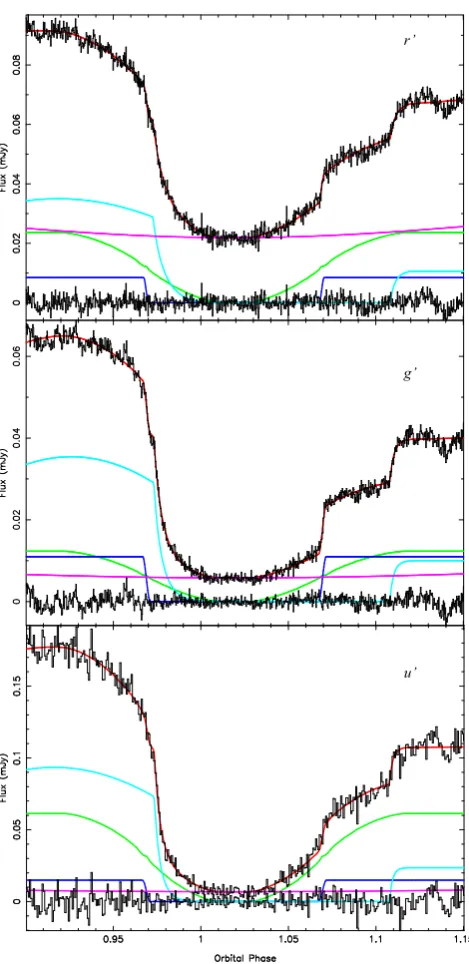
Figure 3. The phased-foldedugrlight curves of KISJ1927, fitted using the model outlined in Section 3.2. In each panel, the data (black) are shown with the fit (red) overlaid and the residuals plotted below (black). Also plotted are the separate light curves of the white dwarf (dark blue), bright spot (light blue), accretion disc (green) and the secondary star (purple).
Aug 5, the amplitude of flickering increased significantly, being particularly high in the data taken around cycle 1841. Inspection
of the region around white dwarf egress (see the inset of Fig.2)
shows that large amplitude flickering begins immediately following white dwarf egress, implying a physical location close to the white dwarf, either the inner disc or a boundary layer. Due to the large amplitude flickering and extended bright spot ingress (which is likely to blend with any white dwarf ingress features), we exclude cycle 1841 from the following determination of system parameters.
Fig.3shows that, in the phase-binned light curve excluding cycle
1841, the white dwarf and bright spot ingress are resolved, allowing a determination of the system parameters for KISJ1927.
3.2 A parametrized model of the eclipse
To determine the system parameters, we used a physical model of the binary system to calculate eclipse light curves similar to that
first developed by Horne et al. (1994). Feline et al. (2004b) showed
that this method gives a more robust determination of the system parameters in the presence of flickering than the derivative method
of Wood et al. (1986). Extracting the system parameters from the
eclipse light curve depends on four assumptions that the bright spot lies on the ballistic trajectory from the secondary star; that the white dwarf is accurately described by a theoretical mass–radius relation; that the whole of the white dwarf is visible out of eclipse and that the donor star fills its Roche lobe. We cannot be sure that all of these assumptions hold for every system, but we point out here that dynamical mass determinations of CVs agree with those found via
the photometric method (Tulloch, Rodr´ıguez-Gil & Dhillon2009;
Copperwheat et al.2010,2012; Savoury et al.2012).
The model we fit is described in detail by Savoury et al. (2011).
To summarize, the free parameters of the model are as follows:
(i) the mass ratio,q;
(ii) the white dwarf eclipse phase full width at half-depth,φ;
(iii) the (linear) white dwarf limb-darkening parameter,Uw;
(iv) the white dwarf radius, scaled to the orbital separation,Rw/a;
(v) seven parameters describing the emission from the bright spot;
(vi) a disc exponent,b, describing the power law of the radial
intensity distribution of the disc;
(vii) a phase offset,φ0; and
(viii) the flux contributions of the white dwarf, donor star, accretion disc and bright spot.
The data are not of sufficient quality to constrain the white dwarf limb-darkening parameter. Instead, we perform an initial fit of the model described above to estimate the flux from the white dwarf in
theugr bands and to estimate the white dwarf temperature (see
Section 3.3). Limb-darkening parameters for the appropriate white
dwarf temperature and loggare then interpolated from the tables
in Gianninas et al. (2013). We adopt limb-darkening parameters of
0.516, 0.412 and 0.361 foru,gandr, respectively. Uncertainties
on the limb-darkening parameters lead to uncertainty inRw/aof
∼1 per cent, which is small compared to our errors (Littlefair et al.
2007).
All parameters barUware then fitted to the light curve using the
Markov Chain Monte Carlo (MCMC) method. The aim is to obtain a set of models whose parameters are distributed according to the
posterior probability distribution of the modelM, given the data
D, i.e.P(M|D). This is accomplished by stochastic jumping of the
model parameters followed by selection or rejection according to
P(M)P(D|M), whereP(M) is the prior probability of the model, and
P(D|M) is the likelihood, which we estimate using exp (−χ2/2).
The choice of distribution for jumping between models can dras-tically affect the efficiency and convergence of the MCMC fitting. During the initial, burn-in phase, we draw candidate models from a distribution defined by a covariance matrix which we obtain from an initial Levenberg–Marquardt fit. In the second phase, we draw models from the distribution defined by the last 10 000 steps of the burn-in phase. These jumps are scaled by a factor which is chosen to give an acceptance rate of approximately 0.25, and fixed thereafter. We adopt uniform priors for most parameters. The exceptions are
the bright spot, which is constrained to lie along a line within 40◦of
prior onqandφ, which forbids combinations which would imply
an inclination greater than 90◦.
Theg- andr-models were fitted to the respective light curves
using the above procedure. MCMC chains of 200 000 jumps were obtained. The first 100 000 jumps (the burn-in phase) are discarded
and the second 100 000 steps used to estimateP(M|D). We visually
examined the chains for convergence, requiring that the means and root-mean-square values for all parameters showed no long-term
trends. Theu-data are not of sufficiently high quality to constrain
the full model, but theu-fluxes of the white dwarf are necessary to
constrain the white dwarf temperature. We determine the relative
contributions of the binary components to theu-band light by
hold-ing the parameter set (q, φ, Rw/a, φ0) fixed at the best-fitting
values from theg-model and fitting the remaining parameters (bar
Uw) via Levenberg–Marquardt minimization. The results of this
model fitting are only used to determine theu-band fluxes of the
various binary components. The model fits and phase-binned light
curves are shown in Fig.3.
3.3 White dwarf temperature and photometric distance
We fit theugr white dwarf fluxes with predictions from white
dwarf model atmospheres (Bergeron, Wesemael & Beauchamp
1995) to derive the white dwarf temperature and distance to
KISJ1927. Because the formal errors on our white dwarf fluxes do not take account of any uncertainties in our absolute photometry, we add systematic errors of 1 per cent to the white dwarf fluxes.
Theugr fluxes are fitted simultaneously to the tabulated values
in Bergeron et al. (1995), which depend upon loggand effective
temperature, with the distance to the white dwarf and the reddening as additional parameters. Parameters are optimized using MCMC, with uninformative priors on the effective temperature and distance. We initially set the priors to enforce no reddening.
An initial guess of the white dwarf temperature is derived by
allowing loggto vary as a free parameter. This guess is then used in
the light-curve fitting to derive logg, as described in Section 3.4. Our
final white dwarf temperature and distance are then derived with a
prior on loggwhich enforces the constraints suggested by the
light-curve fitting, including the uncertainties in logg. The suggested
white dwarf temperature isTwd=23 000±3000 K. The distance
is found to bed=1600±200 pc, where the error is dominated
by the uncertainties in logg. These formal errors do not include
any systematic effects, including contamination of our white dwarf colours, or the effect of neglecting reddening.
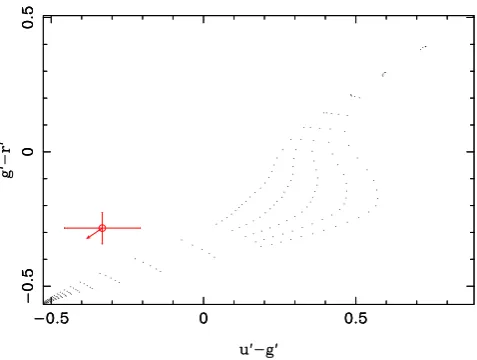
Fig.4shows that the white dwarf colours lie about 2σoutside the
range predicted by the model atmospheres. It is therefore likely that our white dwarf colours are affected by contamination from the disc or bright-spot, or an un-modelled light source such as the boundary layer. Another possibility is that the flickering which begins imme-diately after the egress of the white dwarf is affecting our estimate of the white dwarf colours. If our white dwarf colours are incorrect, then our derived white dwarf temperature and photometric distance will be affected. An additional source of uncertainty is the extinc-tion towards KISJ1927, which is unknown. The Galactic extincextinc-tion
in this direction isE(B−V)=0.121 (Schlafly & Finkbeiner2011),
and with a distance in excess of a kiloparsec a substantial amount of this may be in front of the CV. If we relax the prior constraint
on the reddening to be between zero andE(B−V)=0.121, we
obtain measurements of the white dwarf temperature and distance
ofTwd=28 000±7000 K andd=1700±400 pc. The posterior
[image:4.595.310.549.55.235.2]probability distribution for the reddening does not allow us to rule
Figure 4. The white dwarf colours derived from our model plotted together with the white dwarf models of Bergeron et al. (1995). From top to bottom, each curve represents logg=9.0, 8.5, 8.0, 7.5 and 7.0, respectively. The measured white dwarf colours are shown here in red, and are used to derive the white dwarf temperature, which in turn is used to correct the white dwarf mass–radius relationships used later to obtain the final system parameters. An arrow marks the shift in observed white dwarf colours if they were de-reddened assuming a Galactic reddening ofE(B−V)=0.121.
out any values less thanE(B−V)=0.121, but the most likely value
isE(B−V)=0.09.
We can use the colours of the donor star as an independent check on the reddening towards KISJ1927. We estimate the donor flux in each band using the results of the model fitting described in
Section 3.2. This implies donor magnitudes ofr=20.17±0.01
andg = 21.64±0.01. Theg −r colour of 1.47±0.02 is in
reasonable agreement with the spectral type of M3 expected for a
donor star at this orbital period (Covey et al.2007; Knigge, Baraffe
& Patterson2011). If the reddening towards KISJ1927 is as high
asE(B−V)=0.121, it would imply an intrinsicg−rcolour for
the donor star of∼1.33. In turn this would suggest a spectral type
of roughly M0, or a mass of∼0.6 M. This is much earlier than
the evolutionary models of Knigge et al. (2011) predict for a CV
of this orbital period, and the mass is higher than the donor mass measured in Section 3.4. For this reason, we adopt the white dwarf parameters assuming low reddening towards KISJ1927. However,
we must point out thatg−ris almost constant for spectral types
later than M0, (Finlator et al.2000), and we cannot rule out higher
reddening values.
The donor star colours can also provide an independent constraint
on the distance. Theg−rcolour can be used to estimate the
sur-face brightness which, in combination with the apparent magnitude of the donor, constrains the distance. The zero-magnitude angular
diameter,θ(mλ=0), is a measure of surface brightness, defined as the
angular diameter a star would have if its apparent magnitudemλ=0.
Thus, ifθis the actual angular diameter of the star,
log10θ(mλ=0)=log10θ+0.2mλ. (1)
The distance to the star is therefore given by
log10d=log10(2R)+0.2mλ−log10θ(mλ=0), (2)
wheredis measured in parsecs,Ris the radius of the star, measured
in au and the angular diameter is measured in arcseconds. Boyajian,
g−rcolour using a compilation of interferometric observations of stars. Using equation (1), we find
log10θ(r=0)=log10θ(g=0)−0.2(g−r),
which we use in combination with equation 5 of Boyajian et al.
(2014), assuming solar metallicity, to find log10θ(r=0)= −1.53±
0.05. Using equation (2) and our r-band donor magnitude, we
findd=1500±200 pc, in good agreement with the white dwarf
photometric distance.
3.4 System parameters
Our MCMC chains provide an estimate of the joint posterior
prob-ability distributions of (q, φ, Rw/a). At each step in the chain,
we can calculate the system parameters from these three values, Kepler’s third law, the orbital period, and a white dwarf mass–radius relationship (corrected to our derived white dwarf temperature). We
favour the mass–radius relationships of Wood (1995), because they
have thicker hydrogen layers which may be more appropriate for CVs. Adopting other white dwarf models (e.g. Panei, Althaus &
Benvenuto2000) changes our results by less than 1 per cent. The
result is an estimate of the posterior probability distribution for the
mass ratioq, white dwarf massMw, white dwarf radius,Rw, white
dwarf gravity logg, donor massMd, donor radiusRd, inclination
i, binary separationa, and the radial velocities of the white dwarf
and donor star (KwandKd, respectively). We can then combine the
posterior distributions obtained for each band into the total posterior
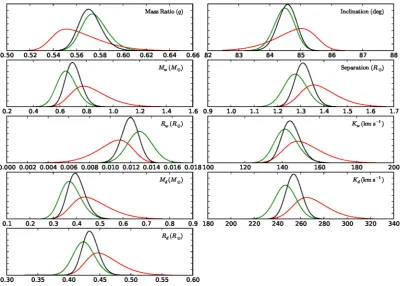
distribution for the system parameters, as shown in Fig.5. We note
that most parameters show a Gaussian distribution with very little
asymmetry. Our adopted value for a given parameter is taken from the peak of the posterior distribution function. Upper and lower error bounds are derived from the 67 per cent confidence levels.
Since the white dwarf temperature is used to correct the adopted white dwarf mass–radius relationship, uncertainties in white dwarf temperature will have a knock-on effect on the derived system
parameters. Savoury et al. (2011) examined the consequences of a
2000 K systematic error in the white dwarf temperature, and found it introduced negligible errors into the white dwarf mass and radius,
and distance errors of∼20 pc. Therefore, we do not believe that
uncertainty in the white dwarf temperature is significantly affecting our derived system parameters.
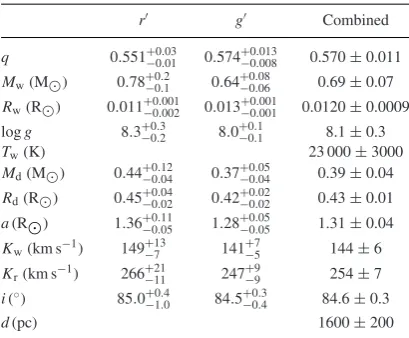
The resulting system parameters are listed in Table2. Note the
uncertainties in Table2reflect the uncertainties from our MCMC
fitting alone; they do not account for uncertainties arising from the failure of the assumptions listed in Section 3.2, nor do they account for the effects of flickering. Flickering can be considered an additional noise source which we do not model; perhaps the best way to reduce the impact of flickering is to average many eclipses. Unfortunately, we only have three suitable eclipses of this system to combine. As a result, continued monitoring of KISJ1927 is needed to improve both the accuracy and the precision of the system parameters.
3.5 Eclipse times
Mid-eclipse times for each eclipse were determined by fitting the model described in Section 3.2 to each eclipse individually.
[image:5.595.95.496.386.672.2]Parameters which ought to be time-invariant (q, φ, Uw, Rw/a)
Figure 5. The normalized posterior probability density functions (PDFs) for the system parameters of KISJ1927. Each PDF was derived using the MCMC chains for model fit parameters described in Section 3.2, combined with Kepler’s third law and a mass–radius relationship for the white dwarf component corrected to the appropriate effective temperature. The red curve represents the PDF from fitting ther-band light curve, the green curve the PDF from the
g-band light curve and the black represents the total, combined, PDF. PDFs are shown for the mass ratio,q, the white dwarf mass and radiusMw, Rw, the
Table 2. System parameters for KISJ1927 as derived from the PDFs shown in figure 5.Rd is the volume radius of the donor
star’s Roche lobe as defined by Eggleton (1983).
r g Combined
q 0.551+−00..0301 0.574+−00..013008 0.570±0.011
Mw(M) 0.78+−00..21 0.64+ 0.08
−0.06 0.69±0.07
Rw(R) 0.011+−00..001002 0.013+ 0.001
−0.001 0.0120±0.0009
logg 8.3+−00..32 8.0+−00..11 8.1±0.3
Tw(K) 23 000±3000
Md(M) 0.44+−00..1204 0.37+ 0.05
−0.04 0.39±0.04
Rd(R) 0.45+−00..0402 0.42+ 0.02
−0.02 0.43±0.01
a(R) 1.36+−00..0511 1.28+−00..0505 1.31±0.04 Kw(km s−1) 149+−137 141+
7
−5 144±6
Kr(km s−1) 266+−2111 247+ 9
−9 254±7
i(◦) 85.0+−01..04 84.5+−00..34 84.6±0.3
d(pc) 1600±200
were held fixed at the best-fitting values derived from the average
glight curve, whilst all other parameters, including the phase
off-setφ0were allowed to vary. An initial fit was performed using an
implementation of the simplex algorithm. A final value forφ0, and
corresponding uncertainty, was found using a further fitting step
us-ing a Levenberg–Marquardt algorithm to minimizeχ2. Mid-eclipse
times are shown in Table1. We note here that our eclipse times
are for the middle of white dwarf eclipse, whilst the ephemeris
in Scaringi et al. (2013) gives the times of minimum light, after
smoothing by an 1800-s running mean. Comparing our mid-eclipse
times with the ephemeris in Scaringi et al. (2013) suggests that, for
our observations, the predicted time of minimum light is offset from the white dwarf mid-eclipse by 0.0031(2) d, as one would expect given the overall asymmetry of the eclipse.
4 D I S C U S S I O N
The presence of both stable (nova-likes) and unstable (dwarf novae) accreting CVs at the same orbital period is a long-standing puzzle. According to the disc instability model, the difference between nova-likes and dwarf novae is the rate at which mass is supplied to the disc. Above some critical rate, the disc is bright and stable, and the system is a nova-like. At lower rates, the system shows
dwarf nova outbursts. At an orbital period of∼3.97 h, KISJ1927
is (like most systems a period of 4 h) a dwarf nova (see Knigge
et al.2011, for example). Mass transfer rates in CVs are driven by
angular momentum loss. For long-period CVs (P>3 h), the
angu-lar momentum loss is thought to be dominated by magnetic wind braking, whilst the shorter period CVs have much lower rates of wind braking, and angular momentum losses dominated by grav-itational radiation. By tuning the angular momentum loss rates to fit the location of CV donors in a mass–orbital period diagram,
Knigge et al. (2011) obtain a semi-empirical estimate of the secular
mass transfer rates in CVs. Somewhat surprisingly, the secular mass
transfer rate is everywherelowerthan the critical rate required for
stable accretion, and especially so in the period range 3–4 h, where the nova-like variables are strongly concentrated. Viewed in this light, the observed existence of nova-likes at any orbital period can be viewed as surprising.
There are several ways to explain the existence of nova-like vari-ables. It is possible that short-term cycles in mass transfer rates
exists. Nova-likes would then be systems in the high state of a cycle. However, it is also possible that estimates of the critical mass
transfer rate (e.g. Lasota2001), or the semi-empirical estimate of
the secular mass transfer rate (Knigge et al.2011) are in error.
Temperature estimates for white dwarfs with well-known masses can help address these questions. Together, the white dwarf tem-perature and mass provide a measure of the average accretion rate
over a time-scale of the order of 103–105yr (Townsley & Bildsten
2003). This time-scale is too short to provide a reliable estimate of
thesecularmass transfer rate (Townsley & G¨ansicke2009), and so the mass transfer rate from white dwarf temperatures can be compared to estimates of the secular rate to look for evidence of mass-transfer rate cycles.
With an orbital period of ∼3.97 h, KISJ1927 is similar to
the well-studied system IP Peg, which has an orbital period of
∼3.8 h. The white dwarf temperature and mass in KISJ1927
im-plies an average mass transfer rate over the medium term of ˙
M=1.4±0.8×10⁻⁹M
yr−1, which compares well with
esti-mates of the secular mass transfer rate at this orbital period of ˙
M∼2×10⁻⁹M
yr−1(Knigge et al.2011). The agreement
be-tween these rates suggests that the critical mass transfer rate for stability exceeds the secular rate at these periods, and that uncer-tainties in these rates may not explain the dominance of nova-like variables between 3 and 4 h.
By contrast to KISJ1927, IP Peg’s white dwarf temperature is much cooler, despite the higher mass white dwarf, implying a mass
transfer rate of ˙M <5×10⁻¹¹M
yr−1(Copperwheat et al.2010).
The low temperature in IP Peg is well below the expected secular mass transfer rate. This may be evidence for mass-transfer rate cycles which long enough to alter the white dwarf temperature, or perhaps that IP Peg has only begun mass transfer recently, and the white dwarf has yet to reach equilibrium temperature (Copperwheat
et al.2010; Zorotovic, Schreiber & G¨ansicke2011).
A final possibility is that the white dwarf temperature in KISJ1927 is higher than that in IP Peg due to heating during a recent dwarf
nova outburst (e.g Godon & Sion2003). This might affect
measure-ments of the white dwarf temperature for a duration of a few days to
weeks after the outburst. The publicKeplerdata for KISJ1927 shows
three outbursts, with quiescent periods lasting 94 and 59 d between
them. The most recent outburst in theKeplerdata is 143 d prior to
our observations. However, theKeplerdata stops 88 d before our
observations due to the reaction wheel failures on theKepler
space-craft. A high white dwarf temperature due to an outburst remains a possibility.
We stress that the conclusions reached here regarding the white dwarf temperature in KISJ9172 are preliminary. The white dwarf temperature has been determined from the colours of white dwarf ingress/egress in only three eclipses. As discussed in Section 3.3, it is possible that systematic errors affect our white dwarf temperature.
Indeed, Copperwheat et al. (2010) found that the colours of white
dwarf egress in IP Peg were variable between eclipses, and attribute this to changing obscuration of the white dwarf by the inner disc. If, however, our preliminary estimate of the white dwarf temperature turns out to be accurate, the implication is that KISJ1927 has an
average ˙Min line with expectations of the secular rate.
The component masses of KISJ1927 compare reasonably well
with expectations. The white dwarf mass of 0.69±0.07 Mis
com-parable to the average white dwarf mass in CVs of 0.79±0.03 M
(Savoury et al. 2011). As a result, we can compare our donor
star properties directly to the revised theoretical tracks of Knigge
et al. (2011), which are computed for a white dwarf mass of
slightly more massive and larger than expected; the predicted donor
mass at this period is 0.32 M, compared to a measured value
of 0.39 ±0.04 M, and the predicted donor radius is 0.40 R,
compared to our measured value of 0.43± 0.01 M. It will be
interesting to see if this discrepancy survives the test of additional data.
5 C O N C L U S I O N S
We present high-speed, three-colour photometry of KISJ1927, an
eclipsing dwarf nova in theKeplerfield. Taken over two
succes-sive nights, the eclipses show appreciable evolution of the flick-ering and hotspot features over time-scales as short as one orbit. Averaging of the three eclipses least affected by flickering allows us to separate the white dwarf and bright spot ingress and hence obtain a photometric measure of the system parameters. We
ob-tain a mass ratio ofq=0.570±0.011 and an orbital inclination of
84◦.6±0◦.3. The primary mass isMw=0.69±0.07 M. The donor
star’s mass and radius are found to beMd=0.39±0.04 Mand
Rd=0.43±0.01 R, respectively. From the fluxes of the white
dwarf eclipse, we find a white dwarf temperature ofTw=23 000±
3000 K, and a photometric distance to the system of 1600±200 pc.
These system parameters will improve the utility of KISJ1927 as a test bed for accretion disc physics using the continuous coverage of theKeplersatellite.
Whilst the system parameters of KISJ1927 are in line with theo-retical expectations for a CV of this orbital period, the white dwarf temperature is strikingly different from that of IP Peg, a dwarf nova at a similar orbital period. This large difference in temperatures may be explained either by the recent onset of mass transfer in IP Peg, or by the presence of relatively long-term mass transfer rate cycles in CVs at this orbital period.
AC K N OW L E D G E M E N T S
We thank the anonymous referee for a careful reading of this text. VSD, SPL and ULTRACAM are supported by STFC grant ST/J001589/1. The results presented in this paper are based on observations made with the WHT operated on the island of La Palma by the Isaac Newton Group in the Spanish Observatorio del Roque de los Muchachos of the Instituto de Astrofisica de Canarias. This research has made use of NASA’s Astrophysics Data System Bibliographic Services and the SIMBAD data base, operated at CDS, Strasbourg, France.
R E F E R E N C E S
Bergeron P., Wesemael F., Beauchamp A., 1995, PASP, 107, 1047 Boyajian T. S., van Belle G., von Braun K., 2014, AJ, 147, 47
Cannizzo J. K., Still M. D., Howell S. B., Wood M. A., Smale A. P., 2010, ApJ, 725, 1393
Copperwheat C. M., Marsh T. R., Dhillon V. S., Littlefair S. P., Hickman R., G¨ansicke B. T., Southworth J., 2010, MNRAS, 402, 1824
Copperwheat C. M. et al., 2012, MNRAS, 421, 149 Covey K. R. et al., 2007, AJ, 134, 2398
Dhillon V. S. et al., 2007, MNRAS, 378, 825 Eggleton P. P., 1983, ApJ, 268, 368
Feline W. J., Dhillon V. S., Marsh T. R., Stevenson M. J., Watson C. A., Brinkworth C. S., 2004a, MNRAS, 347, 1173
Feline W. J., Dhillon V. S., Marsh T. R., Brinkworth C. S., 2004b, MNRAS, 355, 1
Finlator K. et al., 2000, AJ, 120, 2615
Gianninas A., Strickland B. D., Kilic M., Bergeron P., 2013, ApJ, 766, 3 Godon P., Sion E. M., 2003, ApJ, 586, 427
Horne K., Marsh T. R., Cheng F. H., Hubeny I., Lanz T., 1994, ApJ, 426, 294
Knigge C., Baraffe I., Patterson J., 2011, ApJS, 194, 28 Lasota J.-P., 2001, New Astron. Rev., 45, 449
Littlefair S. P., Dhillon V. S., Marsh T. R., G¨ansicke B. T., Southworth J., Watson C. A., 2006, Science, 314, 1578
Littlefair S. P., Dhillon V. S., Marsh T. R., G¨ansicke B. T., Baraffe I., Watson C. A., 2007, MNRAS, 381, 827
Osaki Y., Kato T., 2013, PASJ, 65, 50
Panei J. A., Althaus L. G., Benvenuto O. G., 2000, A&A, 353, 970 Ramsay G., Cannizzo J. K., Howell S. B., Wood M. A., Still M., Barclay T.,
Smale A., 2012, MNRAS, 425, 1479 Savoury C. D. J. et al., 2011, MNRAS, 415, 2025
Savoury C. D. J., Littlefair S. P., Marsh T. R., Dhillon V. S., Parsons S. G., Copperwheat C. M., Steeghs D., 2012, MNRAS, 422, 469
Scaringi S., Groot P. J., Still M., 2013, MNRAS, 435, L68 Schlafly E. F., Finkbeiner D. P., 2011, ApJ, 737, 103 Smith J. A. et al., 2002, AJ, 123, 2121
Townsley D. M., Bildsten L., 2003, ApJ, 596, L227 Townsley D. M., G¨ansicke B. T., 2009, ApJ, 693, 1007
Tulloch S. M., Rodr´ıguez-Gil P., Dhillon V. S., 2009, MNRAS, 397, L82 Warner B., 1995, Cataclysmic Variable Stars. Cambridge Univ. Press,
Cambridge
Wood M. A., 1995, in Koester D., Werner K., eds, Lecture Notes in Physics, Vol. 443, White Dwarfs. Springer-Verlag, Berlin, p. 41
Wood J. H., Horne K., Berriman G., Wade R., O’Donoghue D., Warner B., 1986, MNRAS, 219, 629
Wood M. A., Still M. D., Howell S. B., Cannizzo J. K., Smale A. P., 2011, ApJ, 741, 105
Zorotovic M., Schreiber M. R., G¨ansicke B. T., 2011, A&A, 536, A42