VOLUME 17 ISSUE 32 AUgUSt 2013 ISSN 1366-5278
Home telemonitoring or structured telephone
support programmes after recent discharge in
patients with heart failure: systematic review and
economic evaluation
A Pandor, P Thokala, T Gomersall, H Baalbaki, JW Stevens, J Wang, R Wong,
A Brennan and P Fitzgerald
programmes for patients with heart failure:literature search strategy, a
MEDLINE example
Appendix 2 Methodological assessment (adapted) criteria for randomised
controlled trials61 and observational studies62
Appendix 3 Statistical model used to analyse the data
Appendix 4 Comparison of included studies from existing reviews
Appendix 5 Methodological assessment tool for systematic reviews and
meta-analysis66
Appendix 6 Clinical effectiveness review: table of excluded studies with rationale
Appendix 7 Summary of the trials included in the base-case network
meta-analysis of recently discharged patients with heart failure
Appendix 8 Additional analyses: summary of the design and patient
characteristics of included studies of stable patients with heart failure
Appendix 9 Summary of the trials included in the base-case network
meta-analysis of patients with stable heart failure
Appendix 10 MEDLINE search strategy for the cost-effectiveness review
Quality-of-life filter in MEDLINE
Appendix 11 table of excluded cost-effectiveness studies
Appendix 12 Results for higher usual care cost scenarios
Economic analysis using base-case estimates
Economic analysis using data from predictive distributions
Economic analysis using data excluding the Home-HF study67
This report should be referenced as follows:
Pandor A, Thokala P, Gomersall T, Baalbaki H, Stevens JW, Wang J, et al. Home telemonitoring or structured telephone support programmes after recent discharge in patients with heart failure: systematic review and economic evaluation. Health Technol Assess 2013;17(32).
Health Technology Assessment is indexed and abstracted in Index Medicus/MEDLINE, Excerpta Medica/EMBASE, Science Citation Index Expanded (SciSearch®) and Current Contents®/ Clinical Medicine.
telephone support programmes after
recent discharge in patients with heart
failure: systematic review and economic
evaluation
A Pandor,* P Thokala, T Gomersall,
H Baalbaki, JW Stevens, J Wang, R Wong,
A Brennan and P Fitzgerald
School of Health and Related Research (ScHARR), University of Sheffield,
Sheffield, UK
*Corresponding author
Declared competing interests of authors: none
ISSN 1366-5278 (Print)
ISSN 2046-4924 (Online)
Five-year impact factor: 5.804
Health Technology Assessment is indexed in MEDLINE, CINAHL, EMBASE, The Cochrane Library and the ISI Science Citation Index and is assessed for inclusion in the Database of Abstracts of Reviews of Effects.
This journal is a member of and subscribes to the principles of the Committee on Publication Ethics (COPE) (www.publicationethics.org/).
Editorial contact: [email protected]
The full HTA archive is freely available to view online at www.journalslibrary.nihr.ac.uk/hta. Print-on-demand copies can be purchased from the report pages of the NIHR Journals Library website: www.journalslibrary.nihr.ac.uk
Criteria for inclusion in the Health Technology Assessment journal
Reports are published in Health Technology Assessment (HTA) if (1) they have resulted from work for the HTA programme, and (2) they are of a sufficiently high scientific quality as assessed by the reviewers and editors.
Reviews in Health Technology Assessment are termed ‘systematic’ when the account of the search appraisal and synthesis methods (to minimise biases and random errors) would, in theory, permit the replication of the review by others.
HTA programme
The HTA programme, part of the National Institute for Health Research (NIHR), was set up in 1993. It produces high-quality research information on the effectiveness, costs and broader impact of health technologies for those who use, manage and provide care in the NHS. ‘Health technologies’ are broadly defined as all interventions used to promote health, prevent and treat disease, and improve rehabilitation and long-term care.
The journal is indexed in NHS Evidence via its abstracts included in MEDLINE and its Technology Assessment Reports inform National Institute for Health and Care Excellence (NICE) guidance. HTA research is also an important source of evidence for National Screening Committee (NSC) policy decisions.
For more information about the HTA programme please visit the website: www.hta.ac.uk/
This report
The research reported in this issue of the journal was funded by the HTA programme as project number 09/107/01. The contractual start date was in July 2010. The draft report began editorial review in May 2012 and was accepted for publication in August 2012. The authors have been wholly responsible for all data collection, analysis and interpretation, and for writing up their work. The HTA editors and publisher have tried to ensure the accuracy of the authors’ report and would like to thank the reviewers for their constructive comments on the draft document. However, they do not accept liability for damages or losses arising from material published in this report.
This report presents independent research funded by the National Institute for Health Research (NIHR). The views and opinions expressed by authors in this publication are those of the authors and do not necessarily reflect those of the NHS, the NIHR, NETSCC, the HTA programme or the Department of Health. If there are verbatim quotations included in this publication the views and opinions expressed by the interviewees are those of the interviewees and do not necessarily reflect those of the authors, those of the NHS, the NIHR, NETSCC, the HTA programme or the Department of Health.
© Queen’s Printer and Controller of HMSO 2013. This work was produced by Pandor et al. under the terms of a commissioning
contract issued by the Secretary of State for Health. This issue may be freely reproduced for the purposes of private research and study and extracts (or indeed, the full report) may be included in professional journals provided that suitable acknowledgement is made and the reproduction is not associated with any form of advertising. Applications for commercial reproduction should be addressed to: NIHR Journals Library, National Institute for Health Research, Evaluation, Trials and Studies Coordinating Centre, Alpha House, University of Southampton Science Park, Southampton SO16 7NS, UK.
Professor Tom Walley Director, NIHR Evaluation, Trials and Studies and Director of the HTA Programme, UK
NIHR Journals Library Editors
Professor Ken Stein Chair of HTA Editorial Board and Professor of Public Health, University of Exeter Medical School, UK
Professor Andree Le May Chair of NIHR Journals Library Editorial Group (EME, HS&DR, PGfAR, PHR journals) Dr Martin Ashton-Key Consultant in Public Health Medicine/Consultant Advisor, NETSCC, UK
Professor Matthias Beck Chair in Public Sector Management and Subject Leader (Management Group), Queen’s University Management School, Queen’s University Belfast, UK
Professor Aileen Clarke Professor of Health Sciences, Warwick Medical School, University of Warwick, UK Dr Tessa Crilly Director, Crystal Blue Consulting Ltd, UK
Dr Peter Davidson Director of NETSCC, HTA, UK Ms Tara Lamont Scientific Advisor, NETSCC, UK
Dr Tom Marshall Reader in Primary Care, School of Health and Population Sciences, University of Birmingham, UK Professor William McGuire Professor of Child Health, Hull York Medical School, University of York, UK
Professor Geoffrey Meads Honorary Professor, Business School, Winchester University and Medical School, University of Warwick, UK
Professor Jane Norman Professor of Maternal and Fetal Health, University of Edinburgh, UK Professor John Powell Consultant Clinical Adviser, NICE, UK
Professor James Raftery Professor of Health Technology Assessment, Wessex Institute, Faculty of Medicine, University of Southampton, UK
Dr Rob Riemsma Reviews Manager, Kleijnen Systematic Reviews Ltd, UK
Professor Helen Roberts Professorial Research Associate, University College London, UK
Professor Helen Snooks Professor of Health Services Research, Institute of Life Science, College of Medicine, Swansea University, UK
Please visit the website for a list of members of the NIHR Journals Library Board: www.journalslibrary.nihr.ac.uk/about/editors
Abstract
Home telemonitoring or structured telephone support
programmes after recent discharge in patients with heart
failure: systematic review and economic evaluation
A Pandor,* P Thokala, T Gomersall, H Baalbaki, JW Stevens,
J Wang, R Wong, A Brennan and P Fitzgerald
School of Health and Related Research (ScHARR), University of Sheffield, Sheffield, UK
*Corresponding author
Background: Remote monitoring (RM) strategies have the potential to deliver specialised care and management to patients with heart failure (HF).
Objective: To determine the clinical effectiveness and cost-effectiveness of home telemonitoring (TM) or structured telephone support (STS) strategies compared with usual care for adult patients who have been recently discharged (within 28 days) from acute care after a recent exacerbation of HF.
Data sources: Fourteen electronic databases (including MEDLINE, EMBASE, PsycINFO and The Cochrane Library) and research registers were searched to January 2012, supplemented by hand-searching relevant articles and contact with experts. The review included randomised controlled trials (RCTs) or observational cohort studies with a contemporaneous control group that included the following RM interventions: (1) TM (including cardiovascular implanted monitoring devices) with medical support provided during office hours or 24/7; (2) STS programmes delivered by human-to-human contact (HH) or human-to-machine interface (HM).
Review methods: A systematic review and network meta-analysis (where appropriate) of the clinical evidence was carried out using standard methods. A Markov model was developed to evaluate the cost-effectiveness of different RM packages compared with usual care for recently discharged HF patients. TM 24/7 or using cardiovascular monitoring devices was not considered in the economic model because of the lack of data and/or unsuitability for the UK setting. Given the heterogeneity in the components of usual care and RM interventions, the cost-effectiveness analysis was performed using a set of costing scenarios designed to reflect the different configurations of usual care and RM in the UK.
better-than-usual support to the control group, showed larger beneficial effects for most outcomes, particularly for TM during office hours. In the cost-effectiveness analyses, TM during office hours was the most cost-effective strategy with an estimated incremental cost-effectiveness ratio (ICER) of £11,873 per quality-adjusted life-year (QALY) compared with usual care, whereas STS HH had an ICER of £228,035 per QALY compared with TM during office hours. STS HM was dominated by usual care. Similar results were observed in scenario analyses performed using higher costs of usual care, higher costs of STS HH and lower costs of TM during office hours.
Limitations: The RM interventions included in the review were heterogeneous in terms of monitored parameters and HF selection criteria and lacked detail in the components of the RM care packages and usual care (e.g. communication protocols, routine staff visits and resources used). As a result, the
economic model developed scenarios for different RM classifications and their costs were estimated using bottom-up costing methods. Although the users can decide which of these scenarios is most
representative of their setting, uncertainties still remain about the assumptions made in the estimation of these costs. In addition, the model assumed that the effectiveness of the interventions was constant over time, irrespective of the duration of deployment, and that the intervention was equally effective in different age/severity groups.
Conclusion: Despite wide variation in usual care and RM strategies, cost-effectiveness analyses suggest that TM during office hours was an optimal strategy (in most costing scenarios). However, clarity was lacking among descriptions of the components of RM packages and usual care and there was a lack of robust estimation of costs. Further research is needed in these areas.
Study registration: PROSPERO registration no. CRD42011001368.
Contents
Glossary ix
List of abbreviations xi
Scientific summary xiii
Chapter 1 Background 1
Description of the health problem 1
Current service provision 3
Description of technology under assessment 5
Chapter 2 Definition of the decision problem 7
Purpose of the decision to be made 7
Overall aims and objectives of the assessment 8
Chapter 3 Assessment of clinical effectiveness 9
Methods for reviewing effectiveness 9
Results of the clinical effectiveness review 12
Chapter 4 Assessment of cost-effectiveness 39
Review of cost-effectiveness evidence 39
Independent economic assessment methods 42
Results of the independent economic assessment 63
Discussion of the cost-effectiveness results 87
Chapter 5 Assessment of factors relevant to the NHS and other parties 91
Chapter 6 Discussion 93
Statement of principal findings 93
Strengths and limitations of the assessment 94
Uncertainties 96
Chapter 7 Conclusions 97
Implications for service provision 97
Suggested research priorities 97
Acknowledgements 99
References 101
Appendix 1 Home telemonitoring or structured telephone support programmes for
patients with heart failure:literature search strategy, a MEDLINE example 123
Appendix 2 Methodological assessment (adapted) criteria for randomised controlled
trials and observational studies 125
Appendix 4 Comparison of included studies from existing reviews 129
Appendix 5 Methodological assessment tool for systematic reviews and meta-analysis 133
Appendix 6 Clinical effectiveness review: table of excluded studies with rationale 135
Appendix 7 Summary of the trials included in the base-case network meta-analysis of
recently discharged patients with heart failure 141
Appendix 8 Additional analyses: summary of the design and patient characteristics of
included studies of stable patients with heart failure 145
Appendix 9 Summary of the trials included in the base-case network meta-analysis of
patients with stable heart failure 151
Appendix 10 MEDLINE search strategy for the cost-effectiveness review 155
Appendix 11 Table of excluded cost-effectiveness studies 157
Appendix 12 Results for higher usual care cost scenarios 159
Appendix 13 Results for lower-cost telemonitoring during office hours scenarios 165
Appendix 14 Results for higher-cost telemonitoring during office hours scenarios 171
Appendix 15 Results for higher-cost structured telephone support human-to-human
contact cost scenarios 177
Appendix 16 Results for lower-cost structured telephone support human-to-human
contact cost scenarios 183
Appendix 17 Results for 12-month treatment duration scenario 189
Glossary
T
echnical terms and abbreviations are used throughout this report. The meaning is usually clear from the context, but a glossary is provided for the non-specialist reader. In some cases, usage differs in the literature, but the term has a constant meaning throughout this review.Base-case analysis In modelling, the base case is the primary analysis based on the best estimates of each model input (cf. sensitivity analysis).
Baseline risk The probability of an event (e.g. death) occurring in the comparator arm. This is a term used in modelling in which the baseline risk from one data source might be combined with a risk ratio from another source to estimate the probability of an event occurring for patients receiving a different intervention.
Conservative assumption When there is uncertainty, modellers may have a choice of which value to give to a model input. A conservative assumption is when the modeller chooses the parameter in such a way that it cannot bias in favour of the new treatment (and is likely to be biasing in favour of the standard treatment).
Cost-effectiveness acceptability curve A way of illustrating cost-effectiveness results by plotting the probability that the intervention is cost-effective (y-axis) against the maximum that society is willing to pay for an improvement in health (x-axis).
Cost-effectiveness plane A way of illustrating cost-effectiveness results by plotting the mean
incremental cost and effectiveness on a four-quadrant graph. Interventions that are more costly and more effective fall in the north-east quadrant.
Incremental cost-effectiveness ratio The difference in costs between one intervention and an alternative divided by the difference in outcomes.
Length of stay The total number of days that a participant stays in hospital.
Meta-analysis A statistical technique for combining (pooling) the results of a number of studies that address the same question and report on the same outcomes to produce a summary result. The aim is to derive more precise and clear information from a large data pool. It is generally more reliably likely to confirm or refute a hypothesis than the individual trials.
List of abbreviations
ACE angiotensin-converting enzyme ARB angiotensin receptor blocker BHF British Heart Foundation CAD coronary artery disease
CEAC cost-effectiveness acceptability curve
CHARM Candesartan in Heart failure: Assessment of Reduction in Mortality and morbidity
CHF chronic heart failure CI confidence interval COPD chronic obstructive
pulmonary disease CrI credible interval DRG diagnosis-related group EQ-5D European Quality of
Life-5 Dimensions
ESC European Society of Cardiology EVPI expected value of
perfect information GPRD General Practice
Research Database HDS Health Distress Score HF heart failure
HH human-to-human contact
HM human-to-machine interface Home-HF Home Heart Failure Study
HR hazard ratio
HRQoL health-related quality of life ICER incremental
cost-effectiveness ratio
LVEF left ventricular ejection fraction LVSD left ventricular
systolic dysfunction
LYG life-years gained
MCMC Markov chain Monte Carlo MLHFQ Minnesota Living with Heart
Failure Questionnaire
NICE National Institute for Health and Care Excellence
NMA network meta-analysis NMB net monetary benefit
NY&Y NHS North Yorkshire and York NYHA New York Heart Association
PSA probabilistic sensitivity analysis PSSRU Personal Social Services
Research Unit
QALY quality-adjusted life-year QoL quality of life
RCT randomised controlled trial
RM remote monitoring
RR risk ratio
ScHARR School of Health and Related Research
SF-12 Short Form
SF-36 Short Form
questionnaire-36 items STS structured telephone support TEN-HMS Trans-European Network –
Home-Care Management System
TIM-HF Telemedical Interventional Monitoring in Heart Failure TM telemonitoring
WTP willingness to pay
WSD Whole System Demonstrator
All abbreviations that have been used in this report are listed here unless the abbreviation is well known (e.g. NHS), or it has been used only once, or it is a non-standard
Scientific summary
Background
Heart failure (HF) is a complex clinical syndrome. It is associated with significant morbidity, mortality and reduced quality of life (QoL) and as such exerts a substantial burden on health-care systems, mainly because of repeated and lengthy admissions to hospital. The highest risk period for rehospitalisation is in the first few weeks after discharge from hospital, with 20–30% of patients being readmitted within a month, rising to 50% at 6 months. Early remote monitoring (RM) of patients (as a component of a care package) using structured telephone support (STS) or telemonitoring (TM) may be one way to meet the growing needs of HF patients.
Objectives
The aim was to determine the clinical effectiveness and cost-effectiveness of home TM or STS strategies compared with usual care for adult patients who have been recently discharged (within 28 days) from an acute care setting after a recent exacerbation of HF. Specifically, the objectives were to (1) update two existing systematic reviews (published between 2009 and 2010) of TM or STS programmes for patients with HF within the scope of the current review; (2) evaluate the effectiveness and cost-effectiveness of home TM and/or STS packages compared with usual post-discharge care; and (3) identify key areas for primary research.
Methods
Fourteen electronic databases (including MEDLINE, EMBASE, PsycINFO and The Cochrane Library) and research registers were searched to January 2012. Searches were supplemented by hand searching of relevant articles (including citation searching) and contacting experts in the field. The systematic review included randomised controlled trials (RCTs) or observational cohort studies with a contemporaneous control group that met the following criteria: remote home TM (using patient-initiated external electronic devices or cardiovascular implanted monitoring devices, with transfer of physiological data from patient to health-care provider using telecommunications technology) or STS programmes (including regular telephone contact between patients and health-care providers and reporting of symptoms and/or physiological data) in adults (≥ 18 years of age) with a HF diagnosis and discharged from acute care (within 28 days) to home. The methodological quality of each included study was assessed according to established criteria. Where sufficient data existed, a random-effects network meta-analysis (NMA) was conducted using Markov chain Monte Carlo (MCMC) simulation.
costs and higher- and lower-cost scenarios were developed for each RM strategy whereas base-case and higher-cost scenarios were developed for usual care.
The costs and quality-adjusted life-years (QALYs) accrued by each strategy were estimated using monthly probabilities of death and of hospitalisations (HF-related complications or other causes), dependent on the type of RM intervention. Cost-effectiveness was assessed using both an incremental cost-effectiveness analysis and a net benefit approach at the £20,000 per QALY threshold. Probabilistic sensitivity analysis (PSA) and expected value of perfect information (EVPI) analysis were performed to capture uncertainty in the model parameters. A 30-year time horizon was taken and the economic perspective of the model was the NHS in England and Wales.
Results
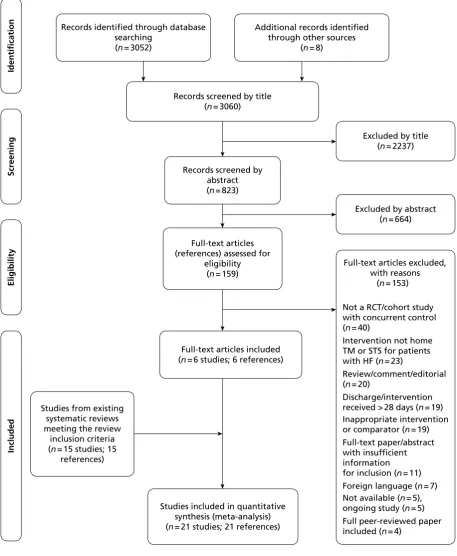
The literature searches identified 3060 citations. Six RCTs met the inclusion criteria and were added to the 15 trials identified from the previous systematic reviews. No trials of cardiovascular implanted monitoring devices or observational studies met the inclusion criteria. The methodological quality of the 21 included studies varied widely and reporting was generally poor on random sequence generation, allocation concealment, blinding of outcome assessment, definition and confirmation of HF diagnosis, and intention-to-treat analysis. Twenty studies contributed to the network comparing different pairs or triplets of treatment for TM or STS programmes with usual care, although not all studies provided information on each outcome. One study was excluded from the NMA because there were no events in either
intervention group. For adults who have recently been discharged from an acute care setting after a recent HF exacerbation, the NMA found that, compared with usual care, RM was beneficial in reducing all-cause mortality by 23%, 24% and 51% for STS HH [hazard ratio (HR) 0.77, 95% credible interval (CrI) 0.55 to 1.08], TM with medical support during office hours (HR 0.76, 95% CrI 0.49 to 1.18) and TM 24/7 (HR 0.49, 95% CrI 0.20 to 1.18) respectively; however, the results for TM 24/7 should be treated with caution because of the poor methodological quality of the only study in this network. No beneficial effect on mortality was observed with STS HM. TM with medical support during office hours or 24/7 was associated with 25% (HR 0.75, 95% CrI 0.49 to 1.10) or 19% (HR 0.81, 95% CrI 0.33 to 2.00) reduction in all-cause hospitalisations, respectively, whereas there was no major effect of STS HM (HR 1.06, 95% CrI 0.44 to 2.53) or STS HH (HR 0.97, 95% CrI 0.70 to 1.31). Although there were no major effects on HF-related hospitalisation for STS HM (HR 1.03, 95% CrI 0.66 to 1.54) and TM with medical support during office hours (HR 0.95, 95% CrI 0.70 to1.34), STS HH (HR 0.77, 95% CrI 0.62 to 0.96) was associated with a 23% reduction. The posterior predictive distributions for the HRs estimated from the NMA as predictive intervals (PrIs) also provided similar results as CrIs, albeit with more uncertainty. Whilst data were limited, care packages that included STS and TM generally improved QoL and were acceptable to HF patients.
A sensitivity analysis that excluded data from the Home Heart Failure Study (Home-HF) (as it provided better-than-usual support and optimal medical treatment to patients in the control group and appeared to be inconsistent with the data from the remaining studies, i.e. an outlier) found that TM with medical support during office hours was more effective than STS HH for all-cause mortality (HR 0.62, 95% CrI 0.42 to 0.89 and HR 0.75, 95% CrI 0.59 to 0.96 respectively) and all-cause hospitalisation (HR 0.67, 95% CrI 0.42 to 0.97 and HR 0.96, 95% CrI 0.72 to 1.27 respectively) but not HF-related hospitalisation (HR 0.86, 95% CrI 0.61 to 1.21 and HR 0.76, 95% CrI 0.61 to 0.94 respectively). By excluding this study from the NMA, larger reductions in effects were observed for all-cause mortality, all-cause hospitalisation and HF-related hospitalisation for TM during office hours.
The full incremental cost-effectiveness analysis using the base-case costs found that TM during office hours was likely to be the most cost-effective strategy at a £20,000 per QALY threshold. TM during office hours had an estimated incremental cost-effectiveness ratio (ICER) of £11,873 per QALY compared with usual care, whereas STS HH had an ICER of £228,035 per QALY compared with TM during office hours. STS HM was dominated by usual care. PSA showed substantial uncertainty in the most probable cost-effective strategy. TM during office hours was the most cost-effective strategy in 40% of the PSA runs whereas STS HH was most cost-effective in 35% of the PSA runs. STS HM and usual care were the most cost-effective in 19% and 6% of the runs respectively. Cost-effectiveness analysis performed using the HRs from the NMA that excluded the data from the Home-HF trial showed an improvement in the cost-effectiveness of TM during office hours. STS HM and STS HH were dominated and extendedly dominated, respectively, with the ICER of TM during office hours against usual care estimated as £6942 per QALY. The results from the uncertainty analyses suggest that TM during office hours was cost-effective in 73% of the runs, whereas STS HH and STS HM were cost-effective in 19% and 7% of the runs respectively.
Scenario analysis using higher costs of TM during office hours (£215 per month) increased uncertainty. TM during office hours and STS HH were both cost-effective in 37% of PSA runs, but TM during office hours was dominated by STS HH. The same scenario analysis (i.e. higher cost of TM during office hours of £215 per month) performed using the HRs from the NMA that excluded the data from the Home-HF trial suggested that TM during office hours would still be the most cost-effective strategy with an ICER of £8223 per QALY compared with usual care (STS HH is extendedly dominated by a combination of usual care and TM during office hours). Threshold analysis performed excluding the data from the Home-HF trial suggested that the monthly cost of TM during office hours has to be > £390 to have an ICER > £20,000 per QALY compared with STS HH. The ICER of TM during office hours compared with usual care, at a monthly cost of £390, is £13,357 per QALY. Scenario analyses performed using higher costs of usual care, higher costs of STS HH and lower costs of TM during office hours do not substantially change the conclusions. TM during office hours was estimated to be the most cost-effective strategy in all of these scenarios.
Discussion
Although an extensive literature search was conducted, it is possible that some relevant studies may have been missed. However, such omissions are likely to have been minimal as the search included all identifiable publications in the grey literature (including contact with clinical experts in the field).
Data were analysed exactly by assuming a binomial likelihood function for the sample data. The statistical model acknowledged the fact that events accumulate over time by adjusting for the varying durations of each study using a complementary log-log link function. Parameter estimates, including between-study standard deviation, were estimated using MCMC simulation, which allows for uncertainty in estimates of between-study standard deviation; it also allowed estimation of the predictive distribution of the effect of each intervention in a new study.
in the cost-effectiveness model. Furthermore, optimal duration for each of the RM interventions can also be identified.
None of the reviewed studies provided estimates for patient utility and whether or not there was a difference between the RM and usual care groups; thus, in the economic model, similar utility values were used for HF patients undergoing both RM strategies and usual care. However, the validity of this assumption is unclear. Furthermore, the lack of detail provided in research studies concerning the components of RM packages and usual care (e.g. communication protocols, routine staff visits and resources used) made it difficult to estimate costs. Costing scenarios for different RM classifications were developed and costs were estimated using microcosting methods. Although users can decide which of these analyses is most representative of their setting, uncertainties remain about the assumptions made in the costing estimation. This uncertainty in costing was a limitation, especially given the small difference in QALYs between STS HH and TM during office hours. Hence, a small change in the difference between costs of TM during office hours and STS HH can lead to a marked change in the ICER. A further limitation was that the effectiveness remained the same for the different cost scenarios whereas in reality there might be some correlation between the costs and effectiveness of different RM strategies.
Hazard ratios of mortality and hospitalisation were the key drivers in the cost-effectiveness model, as mortality reductions lead to a gain in QALYs whereas reductions in hospitalisations lead to fewer costs and more QALYs. The intervention costs were only a small part of the overall costs (hospitalisation costs being the main contributor); thus, RM is likely to be cost-effective if it can save lives and reduce hospitalisations to a sufficient extent. However, some uncertainty persisted in the effectiveness parameters as suggested in the EVPI analysis.
Conclusions
In general, although the effectiveness of the interventions varied widely according to the type of RM system used, STS HH and TM with medical support provided during office hours showed beneficial effects, particularly in reducing all-cause mortality for recently discharged patients with HF; however, these results were statistically inconclusive.
Given the variation in usual care and RM strategies, the cost-effectiveness analysis was performed using a set of costing scenarios. These scenarios were designed to reflect the different configurations of usual care and RM interventions present in the UK. The cost-effectiveness analyses suggest that TM during office hours was an optimal strategy in most scenarios.
Research recommendations include:
1. new research should seek to examine the ‘active ingredients’ of RM
2. qualitative research on patient experiences of RM may be useful to understand the processes by which RM works
3. RM studies should publish data in such a way as to identify which patient subgroups benefited most from the intervention
4. RM studies should include clear descriptions of the interventions and usual care to enable robust costing estimations
5. RM studies should report health outcomes at specific time intervals to identify temporal trends in effectiveness
Study registration
This study is registered as PROSPERO registration no. CRD42011001368.
Funding
Chapter 1
Background
Description of the health problem
Heart failure (HF) is a complex condition in which cardiac abnormality or dysfunction impairs the capacity of the heart to maintain output without a rise in filling pressures. Clinical presentation typically includes dyspnoea, fatigue, effort intolerance and signs of fluid retention (such as swelling in the extremities).1 HF is often defined as impaired left ventricular ejection fraction (LVEF) of ≤ 40%. However, uncertainties remain concerning the appropriate threshold for diagnosis.2,3 For formal diagnosis, clinical examination is usually supplemented with objective assessments of the underlying structural or functional abnormality of the heart and severity of the syndrome, using techniques including electrocardiography, chest radiography and laboratory tests.1,4
Aetiology, pathology and prognosis
In Western countries, hypertension and coronary artery disease (CAD) are the most common causes of HF, whereas nutritional cardiac disease and valvular heart disease are more common in the developing world.5 In one Scottish survey, hypertension and CAD (alone or in combination) were identified as the cause of HF in > 90% of cases.6 HF has also been associated with neurohormonal changes7 – in particular, to brain natriuretic peptide and noradrenaline. Elevated levels of each of these hormones is an independent predictor of morbidity and mortality among HF patients.8 Behavioural factors, such as smoking and chronic alcoholism, were strongly associated with HF in a large cohort study of men residing in the USA (n = 20,900), with men not adhering to any of the six measured health behaviours (normal weight, not smoking, regular exercise, moderate alcohol intake, consumption of breakfast cereals, consumption of fruit and vegetables) being at the highest risk [21.2%, 95% confidence interval (CI) 16.8 to 25.6%].9 Finally, socioeconomic status appears to play a role in the development of HF: a national HF audit commissioned by the NHS10 found that people with a home address in the highest quintile of deprivation are admitted to hospital with HF on average 5 years earlier than those in the lowest quintile (most affluent). A brief list of causal factors is included in Table 1.
Severity of HF is usually assessed using the New York Heart Association (NYHA) system. This system classifies HF as mild (stage I–II), moderate (stage III) or severe (stage IV) based on symptomatic markers
TABLE 1 Causes of HF
CAD Myocardial infarction, ischaemia
Hypertension
Cardiomyopathy Dilated (congestive), hypertrophic/obstructive, restrictive (e.g. amyloidosis, sarcoidosis,
haemochromatosis)
Valvular and congenital heart
disease Mitral valve disease, aortic valve disease, atrial septal defect, ventricular septal defect
Arrhythmias Atrial fibrillation
Alcohol and drugs Alcohol, cardiac depressant drugs (beta-blockers, calcium antagonists)
‘High output’ failure Anaemia, thyrotoxicosis, arteriovenous fistulae, Paget’s disease
Pericardial disease Constrictive pericarditis, pericardial effusion
Primary right HF Pulmonary hypertension, tricuspid incompetence
(Table 2).11Although the NYHA class system does not necessarily reflect the severity of underlying heart dysfunction, it is a useful clinical tool which provides a standardised description of symptom severity that can be used to guide clinical management. Furthermore, NYHA class has been shown to be a strong independent predictor of quality of life (QoL) for patients with HF.12
Patients with a new HF diagnosis have a 40% risk of mortality within the first year.13,14 However, post-discharge mortality incidence varies substantially according to the care setting to which patients are admitted. A recent UK HF audit (between April 2010 and March 2011)14 found annual post-discharge mortality rates of 26.2%, 38.2% and 42.0% for cardiovascular, general medical and other wards respectively (p < 0.001). On average, patients who are discharged have an approximately 28% risk of mortality within the first year after HF discharge.14 The highest risk period for further complications is immediately after an acute decompensation.15 Between 20% and 30% of patients are readmitted within 30 days, rising to 50% at 6 months.16 Prognosis is poor even among people receiving optimal pharmaceutical therapy and so preventative strategies should ideally be pursued with at-risk patients.17
Epidemiology
Given the ongoing debate around appropriate HF diagnostic criteria,2,3 it is difficult to provide confident estimates of incidence and prevalence of HF. Early epidemiological studies used unreliable diagnostic criteria,18 and although some later surveys incorporated objective assessments of LVEF using echocardiogram6,19 they were limited by excluding adults > 85 years of age and by restricting HF to those with left ventricular systolic dysfunction (LVSD).20 More recently, a UK population survey in 2009, drawing on an audit of GP registries, estimated total all-age prevalence of HF to be 0.9% for men and 0.7% for women.10 The largest recent community-based survey, the Echocardiographic Heart of England Screening (ECHOES) study,21 utilised objective European Society of Cardiology (ESC) criteria to determine the presence of HF. A LVEF < 40% was found in 1.8% of the population > 45 years of age (95% CI 1.4 to 2.3%), and definite HF in 2.3% (95% CI 1.9 to 2.8%). In those >75 years of age, prevalence of LVEF of
< 40% and definite HF rose to 3.7% and 6.9% respectively. A recent British Heart Foundation (BHF) survey of the General Practice Research Database (GPRD) found an all-age prevalence rate of 0.9% for the UK, which was lowest in England (0.9%) and highest in Northern Ireland (1.1%). In those > 75 years of age, prevalence rose to 13.7% and 15.3% respectively.10
Cowie et al.22 found a crude incidence rate of 1.3 cases per 1000 population in a large West London cohort, rising to 11.6 cases per 1000 population in those > 85 years of age. The age-adjusted incidence was higher among men than among women (incidence ratio 1.75, 95% CI 1.34 to 2.29).22,23 However, there are important regional variations in incidence. Using data from the GPRD, the BHF found that the incidence of HF in the UK was highest in Northern Ireland and lowest in England (58.1 per 100,000 and 37.5 per 100,000 respectively), with the overall incidence rate being approximately 75% higher among men than among women.10 The Rotterdam cohort study found similar patterns, with an overall incidence rate of 14.4 per 1000 person-years (95% CI 13.4 to 15.5) rising to 47.4 per 1000 person-years among
TABLE 2 New York Heart Association classification system for HF severity11
NYHA
class Severity Symptoms
I Mild No limitations. No fatigue, breathlessness or palpitations in response to ordinary levels of physical
activity
II Mild Comfortable at rest with slight limitation of physical activity. Ordinary physical activity leads to
breathlessness, fatigue or angina pectoris
III Moderate Marked limitation of physical activity. Comfortable at rest but less than ordinary physical activity
leads to symptoms
IV Severe Inability to carry out any physical activity without discomfort. Symptoms of cardiac insufficiency
those aged > 90 years, and a higher incidence rate for men than women (17.6 per 1000 man-years, 95% CI 15.8 to 19.5 and 12.5 per 1000 woman-years, 95% CI 11.3 to 13.8 respectively).23 The Rochester epidemiology project in the USA also found a higher incidence among men than among women (3.78 per 1000, 95% CI 3.61 to 3.95 and 2.89 per 1000, 95% CI 2.77 to 3.00).24 HF incidence and prevalence in the UK are set to increase in conjunction with life expectancy as medical therapies for cardiac conditions such as hypertension and myocardial infarction improve.25
Impact of the health problem
Heart failure is associated with high levels of morbidity and mortality, particularly among those aged
> 60 years.10 One-year mortality for HF patients > 75 years may be twice as high as for those < 75 years.26 The illness trajectory of HF is unpredictable: NYHA functional classification can improve as well as
deteriorate, and sometimes changes unevenly over time.10 HF also has a substantial impact on patient QoL. In one German cohort study, the Short Form questionnaire-36 items (SF-36) measure was administered to 205 HF inpatients.12 Using multiple regressions to control for confounders, this research found that NYHA functional class was the only consistent independent predictor of QoL. Evidence suggests a 25–50% prevalence of anxiety and a 18–47% prevalence of depression among HF patients, depending on age, time since diagnosis and other prognostic indicators.27,28
Heart failure imposes a significant burden on NHS resources. The cost of inpatient bed-days for HF alone has been estimated at £563M per year,29 whereas total HF-related costs have been estimated at £625M per year.30 HF is a leading cause of hospitalisation in the UK, with 58,164 admissions recorded for HF (as first diagnoses) between April 2009 and March 2010 in England and Wales.30 Around 90% of HF admissions are to emergency departments,31 with hospitalisations lasting a median of 9 days.30 As the proportion of people > 60 years of age in the UK continues to increase, and improvements are made in treatment for and survival from cardiac disorders, the burden of HF on the NHS looks set to increase.32,33
Current service provision
Optimal HF treatment can vary depending on aetiology and severity. Evidence-based treatment guidelines from the National Institute for Health and Care Excellence (NICE)34 advocate pharmaceutical treatment of HF with angiotensin-converting enzyme (ACE) inhibitors and beta-blockers as first line (Table 3). These should be administered initially at a low dose and up-titrated at short intervals until the optimal dosage, or tolerance limit, is reached. If the patient remains symptomatic despite optimal treatment with these agents, a second line of treatment comprising one of three options, an aldosterone antagonist, an angiotensin receptor blocker (ARB) or hydralazine in combination with nitrate, should be considered.39 For stable patients without clinical contraindications to exercise, supervised, exercise-based group rehabilitation programmes for HF should be offered. Finally, patients should be regularly monitored, although the frequency depends on the clinical status of the patient. Stable patients should be monitored at least every 6 months whereas those with recent changes to medication and/or clinical status should be monitored every few days to every 2 weeks39 (see Table 3).
TABLE 3 National and international guidelines for the treatment of HF
Issuing
body Country Drug therapya Outpatient monitoring Device based/surgical
NICE34 England
and Wales First line: ACE inhibitors; beta-blockers. Second line:
aldosterone antagonist; angiotensin II receptor
antagonist;b hydralazine in
combination with nitrateb
Clinical assessment of functional capacity, fluid status, cardiac rhythm and BNP; regular medication review; serum urea, electrolytes, creatinine and eGFR; review at least every 6 months for stable outpatients or every few days to 2 weeks if recent medication change/clinical deterioration; education, support and group-based exercise rehabilitation
Coronary revascularisation, heart
transplantation, CRT
SIGN35 Scotland First line: ACE inhibitors;
beta-blockers. Second line: ARBs;b
aldosterone antagonists;c
diuretics/loop diuretics/ metolazone (to relieve symptoms of congestion/fluid
retention); digoxin;d hydralazine
and isorbide dinitrateb,c
Patient education and communication including a nurse-led, home-based element; behaviour change (smoking cessation, limiting alcohol, supervised exercise training, dietary change); pharmacist input to assess knowledge of drugs and compliance; tailored self-management advice; patient support groups CRT; assisted ventilation; left ventricular assist devices; cardiac transplantation; intra-aortic balloon counterpulsation
CREST36 Northern
Ireland First line: ACE inhibitors; beta-blockers. Second line:
aldosterone antagonists;c
diuretics/loop diuretics (for congestion/fluid overload);
digoxin;c nitrates and
hydralazineb
Multidisciplinary, nurse-led management; action plan for all patients; education (exercise training, sexual activity, smoking cessation, alcohol intake, fluid intake, salt intake, daily weighing, obesity, cachexia, immunisations, travel, medication advice); psychological management
Heart
transplantation; CRT; coronary revascularisation
ESC37 Europe First line: ACE inhibitors;
beta-blockers. Second line:
aldosterone antagonists;c,d
ARBs;b,d hydralazine and
isorbide dinitrate;b,d digoxin (for
arrhythmias); diuretics (to relieve congestions); statins (for systolic dysfunction caused by CAD)
Multidisciplinary approach led by HF nurses; early follow-up post-discharge; patient education with emphasis on self-care; physical activity training; self-monitoring of weight, symptoms, diet, fluid intake and alcohol; involve patient in symptom monitoring and flexible diuretic use; remote monitoring; psychosocial support Revascularisation; valvular surgery; CRT; heart transplantation; left ventricular assist devices and artificial hearts; ultrafiltration (to relieve congestion)
AHA38 USA First line: ACE inhibitors;
beta-blockers. Second line: ARBs;b
aldosterone antagonist;c
hydralazine and nitrates;b,c
digitalis; diuretics/loop diuretics and salt restriction (for congestion/fluid overload); vasodilators (to relieve congestion if adequate blood pressure); intravenous inotropes (only in patients with low blood pressure and cardiac output who can be closely monitored)
Close observation and follow-up; exercise training; written educational materials (activity level, diet, discharge medications, follow-up appointment, weight monitoring and response to symptoms); discharge planning with emphasis on medication compliance; psychosocial support; access to palliative services CRT; coronary revascularisation; cardiac transplantation; left ventricular assist device; pulmonary artery catheter placement; ultrafiltration (if pharmacological diuretic strategies unsuccessful)
AHA, American Heart Association; BNP, B-type natriuretic peptide; CREST, Clinical Resource Efficiency Support Team; CRT, cardiac resynchronisation therapy (including implanted cardiac defibrillators and biventricular pacing); eGFR, estimated glomerular filtration rate; SIGN, Scottish Intercollegiate Guidelines Network.
a Drug therapy is specific to LVSD unless otherwise stated.
b Consider as alternative if first-line treatments contraindicated/not tolerated. c Indicated for patients with moderate to severe HF.
Description of technology under assessment
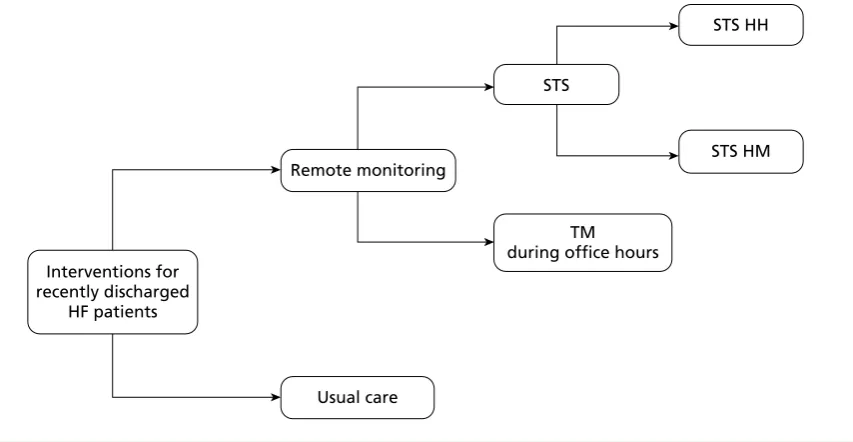
Telemedicine is an emerging approach utilising remote monitoring (RM) of prognostic indicators (e.g. weight, arrhythmias, blood pressure, intrathoracic impedance, heart rates during rest and exertion) to facilitate early detection of clinically significant changes, prevent emergency admissions and avoid complications.46 Guidelines from the ESC currently recommend RM for patients with HF (see Table 3). Because the highest risk period for rehospitalisation is the first few weeks after discharge, RM interventions should be performed at least once in the first 28 days following discharge. RM encompasses a range of approaches depending on what physiological data are transferred to clinicians, how the data are transferred (e.g. automatically or manually, by telephone contact or through a secure web server) and how these data are utilised. Broadly speaking, two main approaches have emerged: telemonitoring (TM), in which physiological data are electronically transmitted to a health-care team, and structured telephone support (STS), that is, the use of telephone calls, usually by specialist nurses, to deliver self-care support and/or management.47,48 For STS, support can be provided by human-to-human contact (HH) or through a human-to-machine interface (HM), that is, STS with an interactive response system. For TM, support can be provided during office hours (9 amto 5 pm, Monday to Friday) only or 24 hours a day, 7 days a week (24/7), although few studies have used the latter approach. Further details are provided in Table 4. Cardiovascular implanted monitoring devices such as modern pacemakers, implantable cardioverter defibrillators or cardiac resynchronisation devices are also capable of delivering remote physiological
TABLE 4 Summary of various RM strategies
TM STS
Office hours only 24/7 HH HM
Description Patients take measurements
(manual or automated) of vital parameters (most commonly weight, BP and HR) at home, which are transmitted to a health-care team or HF specialist centre by telephone, mobile telephone, cable network or broadband technology. Transmitted data are reviewed by medical staff (in some cases readings outside of prespecified limits may generate automated warnings) during office hours (including provision of medical support)
Same as TM during office hours but constant presence of medical personnel required to operate the support system, i.e. 24 hours a day, 7 days a week
Patients followed up with regular telephone calls by a care provider. Calls typically from HF specialist nurses and include advice on self-care and medication. STS may also incorporate basic monitoring of physiological parameters (e.g. weight) Patients monitored by automated telephone-based interactive response system. May include questions about HF symptoms to which patients can respond on telephone keypad
Example Cleland et al.49 provided
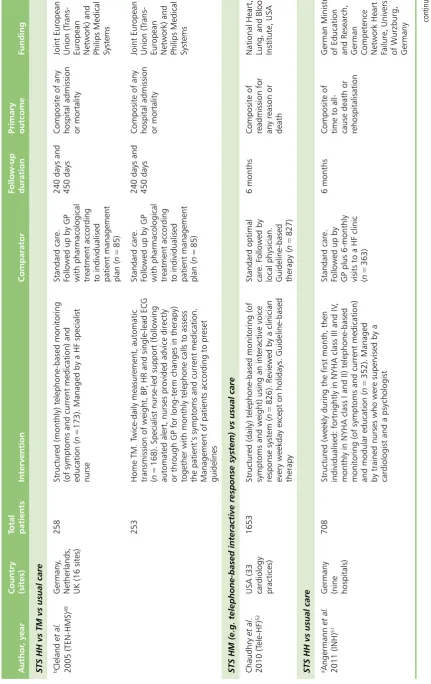
patients with a scale and sphygmomanometer. Patients took twice daily measurements of vital parameters (weight, BP, HR and single lead ECG using wristband electrodes). Results were encrypted and sent via a secure web server to a computer at each investigator site. Medical support was provided during office hours
Koehler et al.50 provided
a wireless Bluetooth system with a personal digital assistant and three integrated devices: an ECG lead, a BP cuff and weighing scales. Encrypted measurements were sent via a secure server to participating sites. These sites provided physician-led medical support 24 hours a day, 7 days a week
Angermann et al.51
provided telephone-based structured monitoring delivered by trained nurses (supervised by a cardiologist and a psychologist), which included educational material/self-monitoring schemes and
multidisciplinary advice
Chaudhry et
al.52used an
interactive system that required patients to provide daily readings of vital parameters, which were sent to a secure internet site and reviewed by clinicians on weekdays
monitoring, often without the need for a patient to trigger the transmission of data.53 The equipment and personnel requirements vary according to the type of RM and a number of systems have been described.54
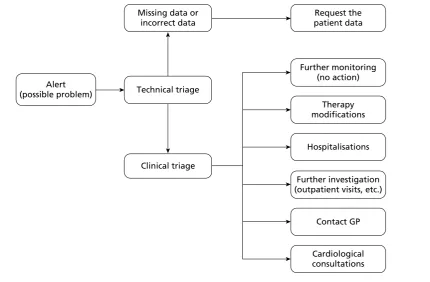
Use of information communication technology may help provide wider access to HF programmes for a larger number of patients, including those constrained by geography, transport or infirmity.15 When a care plan has been agreed with a patient, TM and STS interventions can promote a rapid response when vital clinical signs fall outside agreed parameters, for example by up-titrating medication or arranging for a clinical visit. RM could also minimise the incidence of difficult-to-treat complications, and use early warning signs to avoid hospitalisation. Conversely, RM may generate false alerts leading to inappropriate hospitalisation55 and it may not be feasible for health-care providers to contact all patients regularly or provide specialist equipment to all patients who may potentially benefit.
Telemedical interventions for a variety of chronic conditions are currently being investigated and rolled out by a number of UK NHS trusts. For example, NHS North Yorkshire and York (NY&Y) has seen approximately 500 patients with long-term conditions including HF receive a TM intervention. HF patients were supplied with RM equipment, which generated medication prompts, along with weighing scales and a blood pressure and pulse meter (Julie Ryan, Telehealth Project Manager, NHS NY&Y, 2 April 2012, personal communication). NY&Y are in the process of rolling out the initiative to cover 2000 people.56 In addition, the UK Department of Health released headline findings from the Whole System Demonstrator (WSD) programme for telehealth in December 2011.57 This randomised evaluation of the impact of telehealth for people with chronic conditions [diabetes, HF and chronic obstructive pulmonary disease (COPD)] included over 6000 patients from sites in Newham, Kent and Cornwall, and reported strongly positive results, including a 45% reduction in mortality. However, these results should be interpreted with caution. The Department of Health’s release of these findings before peer review makes their robustness difficult to evaluate, and data on potential confounding factors, such as face-to-face clinical contact, are not yet publicly available. Nevertheless, the early release of these findings underscores the enthusiasm for telehealth among some quarters of the UK health-care authorities.
Chapter 2
Definition of the decision problem
Purpose of the decision to be made
The aim of this assessment was to investigate the clinical effectiveness and cost-effectiveness of home TM or STS programmes for adults who have been recently discharged (within 28 days) from an acute care setting after a recent exacerbation of HF (including subgroups such as those with transiently or persistently severe HF).
Clear definition of the intervention
Telemonitoring, defined as the use of information and communication technologies to monitor and transmit items related to patient health status between geographically separated individuals,54 permits home monitoring of patients (living at home or in nursing or residential care homes) using external electronic devices in conjunction with a telecommunications system (landline or mobile telephone, cable network or broadband technology). TM allows frequent or continuous assessment of HF signs and symptoms measured by patients, family or caregivers at home, while allowing patients to remain under close supervision.37,59 Symptoms reported by patients can be remotely reviewed by a health-care professional and appropriate action can be initiated. Telephone support is another form of remote management that can be provided through structured telephone contact between patients and health-care providers (with or without home visits) and reporting of symptoms and/or physiological data.58,59 Cardiovascular implanted monitoring devices such as modern pacemakers, implantable cardioverter defibrillators or cardiac resynchronisation devices are also capable of delivering remote physiological monitoring, often without the need for a patient to trigger the transmission of data.53
The highest risk period for rehospitalisation is in the first few weeks after discharge from hospital.15 STS and/or home TM interventions should be performed at least once within the first 28 days following discharge from hospital and must be targeted towards patients and intended to address patient concerns and problems and not those of caregivers.59 The optimum time period for TM is unclear; however, it is likely that services will provide TM or STS for at least 4–6 months following discharge from hospital with its usefulness evaluated at 30-day intervals thereafter. The review focuses on the use of home TM or STS programmes for patients who have been discharged from an acute care setting after a recent exacerbation of HF.
Population and relevant subgroups
The population included any adults (defined as ≥ 18 years of age) of either sex or any ethnic group with a diagnosis of HF and discharged from an acute care setting (including emergency departments and 1-day stay procedures) to home (including a relative’s home, nursing home or residential care home). The identification of subgroups of patients for whom home TM or STS programmes are appropriate or inappropriate was governed by the available evidence; however, on a priori grounds, information was sought for people with transiently or persistently severe HF.
Relevant comparators
Outcomes
The outcomes of the review were mortality (all-cause), all-cause admission to hospital, HF-related admission to hospital, length of stay (days in hospital), health-related quality of life (HRQoL) and acceptability of interventions to patients.
Overall aims and objectives of the assessment
The review had the following objectives:
1. update two existing systematic reviews48,58 of TM or STS programmes for patients with HF within the scope of the current review
2. evaluate the effectiveness and cost-effectiveness of home TM and/or STS packages compared with usual post-discharge care
Chapter 3
Assessment of clinical effectiveness
A
systematic review of the literature and (network) meta-analysis (where appropriate) was undertaken to evaluate the clinical effectiveness of home TM or STS strategies compared with usual care for adults who have been recently discharged (within 28 days) from an acute care setting after a recent exacerbation of HF.A review of the evidence was undertaken in accordance with the general principles recommended in the Preferred Reporting Items for Systematic Reviews and Meta-Analyses (PRISMA) statement (www.prisma-statement.org/).
Methods for reviewing effectiveness
Identification of studies
Electronic databases
Studies were identified by searching the following electronic databases and research registers:
z MEDLINE(R) In-Process & Other Non-Indexed Citations and MEDLINE(R) (Ovid) 1948–January 2012 z EMBASE (Ovid) 1980–January 2012
z Science Citation Index Expanded (Web of Science) 1899–January 2012
z Conference Proceedings Citation Index – Science (Web of Science) 1990–January 2012 z Cochrane Database of Systematic Reviews (Wiley Online Library) 1996–January 2012 z Cochrane Central Register of Controlled Trials (Wiley Online Library) 1898–January 2012 z Health Technology Assessment database (Wiley Online Library) 1995–January 2012 z Database of Abstracts of Reviews of Effects (Wiley Online Library) 1995–January 2012 z PsycINFO (Ovid) 1806–January 2012
z Cumulative Index to Nursing and Allied Health Literature (EBSCOhost) 1982–January 2012 z Allied and Complementary Medicine Database (Ovid) 1985–January 2012
z UK Clinical Research Network (CRN) Portfolio Database [National Institute for Health Research (NIHR)] 2001–January 2012
z ClinicalTrials.gov (US NIH) 2000–January 2012
z Institute of Electrical and Electronics Engineers/Institution of Engineering and Technology (IEEE/IET) Electronic Library (IEEE Xplore) 1988–January 2012.
Sensitive keyword strategies using free text and, where available, thesaurus terms using Boolean operators and database-specific syntax were developed to search the electronic databases. Synonyms relating to the condition (e.g. HF) were combined with terms for TM. No language restrictions were used on any database; however, the clinical effectiveness searches were restricted by date. The current review updated two existing systematic reviews48,58 of TM or STS programmes for patients with HF (within the scope of the current review). In the review by Inglis et al.48 the searches examined the period from January 2006 to November 2008 and in Klersy et al.58 the searches examined the period from January 2000 to October 2008. As the search strategies from the existing systematic reviews were of good quality (and clearly reported) it was assumed that all studies prior to 2008 should have been identified. Thus, the clinical effectiveness searches were limited by date from 2008 to January 2012. An example of the MEDLINE search strategy is provided in Appendix 1.
Other resources
of Science Science Citation Index was also undertaken to identify articles that cite the relevant articles. In addition, key experts in the field were contacted.
All identified citations from the electronic searches and other resources were imported into and managed using Reference Manager bibliographic software (version 12; Thomson Reuters, Philadelphia, PA).
Inclusion and exclusion criteria
The inclusion of potentially relevant articles was undertaken using a two-step process. First, all titles were examined for inclusion by one reviewer. Any citations that clearly did not meet the inclusion criteria, that is, non-human, unrelated to TM and/or HF, were excluded. Second, all abstracts and full-text articles were examined independently by two reviewers. Any disagreements in the selection process were resolved through discussion. The relevance of each article for the systematic review was assessed according to the following criteria.
Study design
All RCTs or observational cohort studies with a contemporaneous control group published from 2008 to January 2012 (as well as those identified by the existing systematic reviews) that evaluated home TM or STS programmes compared with usual post-discharge multidisciplinary care for adults who have been recently discharged (within 28 days) from an acute care setting to home (including a relative’s home, nursing home or residential care home) after a recent exacerbation of HF were included. Before-and-after studies without a concurrent control group were excluded because the absence of a control group to record concurrent changes over time means that changes due to the intervention or due to temporal trends, concurrent changes or a Hawthorne effect would be conflated. Such studies therefore represent very weak evidence of effectiveness.
Reviews of primary studies were not included in the analysis but were retained for discussion and identification of additional studies. Moreover, the following publication types were excluded from the review: animal models; preclinical and biological studies; narrative reviews, editorials, opinions; non-English-language papers and reports published as meeting abstracts only when insufficient methodological details are reported to allow critical appraisal of study quality.
Population
The population comprised adults (defined as ≥ 18 years of age) with a diagnosis of HF and discharged from an acute care setting to home (including a relative’s home, nursing home or residential care home).
Interventions
The following interventions were included: (1) remote home TM using patient-initiated external electronic devices or cardiovascular implanted monitoring devices, with transfer of physiological data from the patient to the health-care provider by landline or mobile telephone, cable network or broadband technology, (2) STS including regularly scheduled telephone contact between patients and health-care providers and reporting of symptoms and/or physiological data. In addition, STS and/or home TM
interventions were required to be performed at least once within the first 28 days following discharge from hospital, and to be targeted towards patients and intended to address patient concerns and problems and not those of caregivers.
Relevant comparators
The relevant comparator was considered as usual care. This involved standard post-discharge
Outcomes
The outcomes of the review included mortality (all-cause), all-cause admission to hospital, HF-related admission to hospital, length of stay (days in hospital), HRQoL and acceptability of interventions to patients.
Data abstraction strategy
Data abstraction was performed by one reviewer into a standardised data extraction form and independently checked for accuracy by a second. Discrepancies were resolved by discussion between the two reviewers; if agreement could not be reached a third reviewer was consulted. When multiple publications of the same study were identified, data were extracted and reported as a single study. Moreover, as this was an update of two existing reviews,48,58 all relevant data were extracted from the reviews in the first instance and cross-checked for accuracy with the original papers. When necessary, additional data were extracted from the original papers or, in cases in which information was missing from the articles, authors of the respective studies were contacted to provide further details.
The following information was extracted for all studies when reported: study characteristics (e.g. author, year of publication, country, study design, setting, duration of follow-up, funding), participant details (e.g. inclusion and exclusion criteria, age, sex, autonomy, comorbidities), intervention and comparator details (e.g. description, system activity, frequency of measurement, parameters measured) and outcomes (including definitions).
Quality assessment strategy
The methodological quality of each included study was assessed by one reviewer and independently checked by another. Disagreements were resolved by discussion between the two reviewers and, if agreement could not be reached, a third reviewer was consulted. The study quality characteristics were assessed according to (adapted) criteria based on those proposed by Verhagen et al.61 for RCTs and by Wells et al.62 for observational studies. Further details are provided in Appendix 2.
Methods of data synthesis
Primary analyses (recently discharged patients with heart failure)
heterogeneity in intervention effects between studies, the posterior predictive distribution for the HR of a new study was also presented.
The original intention was to use meta-regression in an attempt to explain any heterogeneity in the effects of the interventions amongst the studies. Potential treatment effect modifiers were quality of usual care, different telehealth intervention settings, adherence, age, sex and autonomy (i.e. single vs couple). However, because of the lack of availability of data on these study-level covariates, meta-regressions were not performed.
Additional analyses (patients with stable heart failure)
Following advice from clinical experts, additional analyses were undertaken to assess whether or not the results from the primary analysis differed markedly from results in those with stable HF who were managed in the community. In this supplementary analysis the following studies were included: RCTs comparing HF management delivered via STS, TM or cardiovascular implanted monitoring devices with HF management delivered via usual post-discharge care in stable HF patients (defined as having no acute event or
deterioration in the past 28 days) who were managed in the community setting (ambulatory or outpatient care). Studies that included intensified management with additional home or clinic visits were excluded. Although no formal critical appraisal of these studies was undertaken, the results were meta-analysed (as per the methods of the primary analysis) and presented for information only. All studies published before 2008 were identified from Inglis et al.48 and Klersy et al.,58 whereas more recent studies (meeting these criteria) were identified using the current review.
Results of the clinical effectiveness review
This section first provides a brief overview of the evidence from the two existing systematic reviews48,58 of RM for HF [including a methodological quality assessment using a measurement tool developed by Shea et al.66 for the ‘assessment of multiple systematic reviews’ (AMSTAR)]. Second, this section presents the results of the current systematic review, including additional analyses.
Overview of existing systematic reviews
The first of the two existing systematic reviews and meta-analyses was published by Clark et al. in 200759 and later updated by Inglis et al.in 2010.48 The review included RCTs comparing HF management strategies delivered via STS or TM with usual post-discharge care in HF patients recently discharged from an acute care setting to home or while managed in the community setting. Any interventions that included home visits by specialised HF health-care professionals or study personnel for the purpose of education or clinical assessment, other than an initial visit to set up equipment, were excluded. The primary outcomes of interest were all-cause mortality, HF-related admission to hospital and all-cause readmissions to hospital. Secondary outcomes included length of stay, QoL, health-care cost savings in patients with HF and
acceptability of the intervention to patients with HF. Overall, 30 RCTs of STS and TM were identified (25 peer-reviewed publications and five abstracts). Of the 25 peer-reviewed studies, 11 evaluated TM and 16 evaluated STS, with two testing both STS and TM in separate intervention arms compared with usual care.