This is a repository copy of The challenges of evaluating large-scale, multi-partner programmes: the case of NIHR CLAHRCs.
White Rose Research Online URL for this paper: http://eprints.whiterose.ac.uk/86476/
Article:
Martin, GP, Ward, V, Hendy, J et al. (6 more authors) (2011) The challenges of evaluating large-scale, multi-partner programmes: the case of NIHR CLAHRCs. Evidence and Policy, 7 (4). pp. 489-509. ISSN 1744-2648
https://doi.org/10.1332/174426411X603470
© 2011, Policy Press. This is a post-peer-review, pre-copy edited version of an article published in Evidence and Policy. The definitive publisher-authenticated version Martin, GP, Ward, V, Hendy, J et al. (6 more authors) (2011) The challenges of evaluating
large-scale, multi-partner programmes: the case of NIHR CLAHRCs. Evidence and Policy, 7 (4). pp. 489-509 is available online at: http://dx.doi.org/10.1332/174426411X603470
[email protected] https://eprints.whiterose.ac.uk/
Reuse
Unless indicated otherwise, fulltext items are protected by copyright with all rights reserved. The copyright exception in section 29 of the Copyright, Designs and Patents Act 1988 allows the making of a single copy solely for the purpose of non-commercial research or private study within the limits of fair dealing. The publisher or other rights-holder may allow further reproduction and re-use of this version - refer to the White Rose Research Online record for this item. Where records identify the publisher as the copyright holder, users can verify any specific terms of use on the publisher’s website.
Takedown
If you consider content in White Rose Research Online to be in breach of UK law, please notify us by
The challenges of evaluating large-scale, multi-partner programmes: the
case of NIHR CLAHRCs
Graham P. Martin,1 Vicky Ward,2 Jane Hendy,3 Emma Rowley,4 Susan Nancarrow,5 Janet Heaton,6 Nicky Britten,6 Sandra Fielden,7 Steven Ariss.8
7745 words
Please address all correspondence to Graham Martin, Senior Lecturer in Social Science applied to Health, University of Leicester, Department of Health Sciences, Adrian Building, Leicester LE1 7RH, United Kingdom. E-mail [email protected]; telephone +44 116 229 7203.
Acknowledgements: The authors would like to thank their CLAHRCs for their support for this work. This article presents independent research commissioned by the National Institute for Health Research (NIHR). The views expressed in this publication are those of the authors and not necessarily those of the NHS, the NIHR or the Department of Health.
1 University of Leicester 2 University of Leeds 3 Imperial College, London 4 University of Nottingham 5 Southern Cross University 6 University of Exeter 7 University of Manchester 8 University of Sheffield
This is a post-peer-review, pre-copy edited version of an article published in Evidence & Policy. The definitive
publisher-authenticated version The challenges of evaluating large-scale, multi-partner programmes: the case of NIHR CLAHRCs Graham P. Martin, Vicky Ward, Jane Hendy, Emma Rowley, Susan Nancarrow, Janet Heaton, Nicky Britten, Sandra Fielden, Steven Ariss, Evidence & Policy A Journal of Research Debate and Practice
10/2011; 7(4):489-509 is available online at:
The challenges of evaluating large-scale, multi-partner programmes: the case of NIHR
CLAHRCs
Abstract
The limited extent to which research evidence is utilised in healthcare and other public services is widely acknowledged. The UK government has attempted to address this gap by funding nine
Collaborations for Leadership in Applied Health Research and Care (CLAHRCs). CLAHRCs
aim to carry out health research, implement research findings in local healthcare organisations, and build capacity across organisations for generating and using evidence. This wide-ranging
brief requires multifaceted approaches; assessing CLAHRCs’ success thus poses challenges for evaluation. This paper discusses these challenges in relation to seven CLAHRC evaluations,
eliciting implications and suggestions for others evaluating similarly complex interventions with diverse objectives.
Background
A persistent feature of healthcare provision worldwide is the gap between evidence-based ‘best
practice’ and what is actually delivered routinely by health practitioners. In the United States, for
example, it is estimated around 45 per cent of patients receive care that deviates from current
scientific evidence (McGlynn et al. 2003), while 20-30 per cent of care provided is unnecessary or
even contra-indicated (Schuster et al. 2005). In the United Kingdom, there has been growing awareness in policy circles of the research-practice gap, and of the associated issue of the delay
between the publication of robust findings on the effectiveness and cost-effectiveness of healthcare interventions and their implementation in routine clinical practice. A review
commissioned by HM Treasury (Cooksey 2006) highlighted the need for concerted effort to
address this gap, known as the ‘second gap in translation’1, to ensure that following robust
the limitations of traditional ‘linear’ modes of research translation, noting that current
predominant modes of dissemination and implementation such as decision-support systems,
direct marketing and information campaigns were “unlikely to be entirely sufficient” to secure
changes in practice (Cooksey 2006, p.102).
The review made a number of recommendations about how to close the second
translation gap, including new funding initiatives and an expansion of the NHS’s Health
Technology Assessment (HTA) programme to facilitate the provision of a high-quality and accessible evidence base to NHS decision makers (Cooksey 2006). It also fed into the
development of a revised NHS research and development strategy (Department of Health 2006), which included a number of new initiatives focused on the translation of research into practice.
Among these were Collaborations for Leadership in Applied Health Research and Care (CLAHRCs). CLAHRCs were to work on “the evaluation and identification of those new
interventions that are effective and appropriate for everyday use in the NHS, and the process of
their implementation into routine clinical practice,” by adopting a “community-wide outward
facing focus” (Call for CLAHRC proposals, October 2007). Focusing on long-term, chronic conditions (such as cancer and cardiovascular disease) and public health, they were both to carry
out applied health-related research focused on the needs of their local populations, and to work towards implementing the findings of research, by nurturing connections between those carrying
out research and those responsible for delivering healthcare.
The language used in describing the aims and objectives of CLAHRCs, and the means they were to use to achieve these, mirrors the increasingly nuanced understanding of the vagaries of
implementing research held by academics and policymakers. Linear, one-way models of research implementation, often aimed at changing the practice of individual practitioners, through for
example the provision of up-to-date information on the evidence for healthcare interventions by the HTA, or the imposition of clinical guidelines by agencies such as the National Institute for
improving the way in which individuals and organisations draw on evidence in their work are
illustrated by the continuing prevalence of sub-optimal clinical practice, and increasingly acknowledged by policymakers, as noted above. Implementation of clinical evidence is thus
increasingly recognised as resting not just on dissemination to and regulation of individual practitioners, but also on addressing social, organisational and professional impediments (Eccles
et al. 2009). Furthermore, the linear model of research uptake constructs evidence as an inert,
apolitical entity to be implemented universally and unilaterally: it does not recognise that some research evidence—especially evidence around non-pharmaceutical, social interventions—may
be partial, particular, open to adaptation and revision in the course of the implementation process (e.g. Nutley et al. 2007; Gabbay & le May 2010). As collaborations between research
producers in academic institutions and users in the NHS deploying distributed leadership to produce evidence sensitive to the needs of a particular region, CLAHRCs can be seen as efforts to
move beyond the linear model of the research-practice relationship. They seek to bring researchers and practitioners together in a productive dialogue that closes the second translation
gap by altering the way research is produced as well as taken up. In doing this, they have built on more recent non-linear models of research translation. These include the Knowledge-to-Action
(K2A) framework (Graham et al. 2006), which distinguishes between knowledge creation and action but which points out that the relationship between the two may be complex, recursive and
non-sequential, and the Promoting Action on Research Implementation in Health Services
(PARIHS) framework (Rycroft-Malone & Bucknall 2010), which accounts for factors such as the nature of the evidence, context and facilitation processes, and which seeks to be flexible enough
to be applied to a wide variety of clinical settings, patient groups and professional areas. Some CLAHRCs have built explicitly on such models; others have incorporated non-linear ideas more
implicitly into their work.
This is reflected too in the activities CLAHRCs are undertaking. Nine CLAHRCs were
Research (NIHR) subject to matched funding being committed by its local university and NHS
partners, over five years. Their high-level aims are several; the means by which they are seeking to achieve these are diverse and multifaceted. Consequently, CLAHRCs themselves might be
viewed as complex, programmatic sets of interventions, the success or failure of which is not amenable to straightforward, outcomes-based evaluation. Rather, evaluating CLAHRCs requires
attention to process, opening the ‘black box’ of what CLAHRCs are doing and how they are
doing it: understanding the causal mechanisms that emerge from particular configurations of conditions, relationships and actions, and how and why these result in specific outcomes. What
to evaluate, and how, therefore represents in itself a difficult question requiring extensive consideration, deliberation and value judgement; furthermore the novel organisation of
CLAHRCs, as multi-organisational partnerships cutting across sectors, gives rise to further challenges for evaluation (cf. Provan & Milward 2001; Russell et al. 2004).
This paper explores these methodological, axiological and practical challenges. It offers reflections and insights from the experiences to date of internal evaluation leads in seven of the
nine commissioned CLAHRCs, noting some of the conceptual and practical quandaries common to their evaluations, and offering putative solutions to these that are likely to be of benefit to
others seeking to evaluate other, similar ventures with diverse aims, complex organisational arrangements and multi-level strategies. It is presented in two main sections. First, we offer an
overview of the programme of CLAHRCs, describing the features common to all nine
CLAHRCs, and some of the particularities which make each of the seven CLAHRCs with which we are working distinctive. We also explain how our internal evaluations seek to understand and
assess their work. Then, in the second section, we explore some of the key challenges common to our evaluations, and how we are seeking to address these. We conclude by summarising the
The CLAHRCs and their internal evaluations
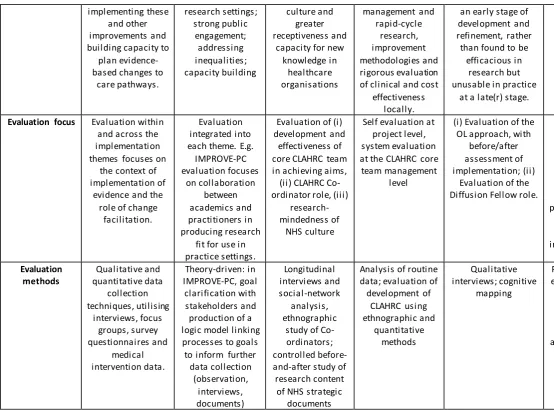
First, then, we seek to describe the common and distinctive features of the CLAHRCs, and the approaches we are taking in evaluating them (see also Table 1).
[Table 1 about here]
An overview of the CLAHRCs
Though the CLAHRCs vary in the manner in which they have responded to the call to close the
‘second gap in translation’ (Cooksey 2006), they have in common a number of features. Some of
these were specific requirements of the NIHR in funding the CLAHRCs programme. The
mission statements of all CLAHRCs, then, are informed by the aims set out by the NIHR,
around developing “an innovative model for conducting applied health research and translating research findings into improved outcomes,” fostering “a new, distributed model” thatlinks “those
who conduct applied health research with all those who use it in practice,” and creating
“approaches to research and its dissemination that […] take account of the way that health care
is increasingly delivered across sectors” (Call for CLAHRC proposals, October 2007; emphasis in
original). Some CLAHRCs have emphasised particular aspects of the brief: for example, the CLAHRC for the South-west Peninsula (PenCLAHRC) includes a particular emphasis on
creating and embedding a research-receptive culture in its NHS organisations. All CLAHRCs involve a collaboration between at least one university and several (or all) of a region’s NHS
organisations; some CLAHRCs also include other bodies, such as local authorities and
third-sector organisations. They also draw on the involvement of patients and the public in their work, or on regional bodies representing patient and public views on health research and
implementation. Also in accordance with the NIHR brief, all CLAHRCs are composed of a
number of ‘themes’, including at least one ‘research theme’—focused primarily on carrying out
applied health research that meets the needs of the region—and at least one ‘implementation
taken a variety of approaches in designing these themes in ways that seek to be innovative in the
carrying out and application of health research. For example, the CLAHRC for Leicestershire, Northamptonshire and Rutland (LNR) involves research themes that cut across chronic disease
areas, aiming to facilitate knowledge sharing between researchers and practitioners involved in
different stages of the chronic disease pathway, from ‘Prevention’ to ‘Rehabilitation’ (Baker et al.
2009). CLAHRC Nottinghamshire, Derbyshire and Lincolnshire (NDL) includes two
implementation themes, ‘Implementation’ and ‘Engagement, Synthesis and Dissemination’,
which aim, in particular, to facilitate the contribution of NHS organisations and practitioners to
research at all stages, and ensure that the new approaches to care being tested are relevant and feasible in practice.
There are other features which many or all CLAHRCs have in common, though these were not stipulated by the NIHR. Most CLAHRCs have adopted a model for integrating the
production and utilisation of research knowledge, such as the K2A framework promoted by the Canadian Institutes for Health Research (Graham et al. 2006). Putting these frameworks into
practice involves the development of a range of activities that straddle universities and NHS organisations, for example South Yorkshire’s (SY) ‘Translating knowledge into action’ theme,
which is trialling innovative strategies to implement research findings to improve patient care locally, and address national priorities such as nutrition in acute care. While all CLAHRCs
involve patients and the public in their work, some have set up specific groups to ensure a
high-level contribution to the management of their programmes of research and implementation, such
as NDL’s service users and carers panel, which works to ensure active patient and public
participation in each of the CLAHRC’s projects. Several CLAHRCs include specific ‘boundary
-spanning’ and ‘knowledge-brokering’ roles (Lomas 2007) to help ensure co-ordination and
integration between the research-producing and research-using sides of the collaboration. These
include CLAHRC Greater Manchester’s (GM) Knowledge Transfer Agents, LNR’s Co
and LNR have developed new, full-time roles focused on increasing interaction between
partners, NDL’s Diffusion Fellows are seconded from health and social care provider
organisations to work in partnership with researchers.
CLAHRCs also differ in the extent to which they have predefined the foci of their research efforts, and the extent to which they rely on stakeholder engagement to define priorities. While
all have included some mechanisms to ensure that NHS organisations and practitioners can feed
into research priorities and design, PenCLAHRC and the CLAHRC for North-west London (NWL) have included explicit mechanisms for scoping, prioritising and initiating research
projects with the input of academics, practitioners, service users and carers and others, in the
form of their ‘Engagement by Design’© process and ‘Collaborative Learning and Delivery
Pathway’ respectively. Just as stakeholder engagement is crucial for addressing the priorities of
many of the CLAHRCs in general, the effectiveness of the internal evaluations of CLAHRC
programmes also relies on collaborating appropriately with a number of individuals and organisations. Engagement with stakeholders is essential to ensure that evaluation priorities
meet the needs of a variety of sponsors and beneficiaries, and that knowledge produced through evaluation can be translated effectively into improved services and better ways of working across
the university-healthcare divide. The various CLAHRC internal evaluation teams have thus sought to develop locally tailored methods of stakeholder engagement (see below).
A common purpose across CLAHRCs, then, is accompanied by differences in the means
by which each CLAHRC is seeking to achieve those aims, but what they all have in common is a multiple set of objectives, and a multiplicity of approaches by which they are seeking to meet
those objectives. While on one level CLAHRCs can be understood as (highly complex and multifaceted) interventions in themselves, in order to be able to provide meaningful knowledge
about the variety of mechanisms they are deploying to achieve their aims, evaluations need to be able to consider their constituent parts, accounting for the different levels at which they might be
is planned to provide this understanding, including four external evaluations funded by the
NIHR Service Delivery and Organisation (SDO) programme (e.g. Rycroft-Malone et al. 2011; see also www.sdo.nihr.ac.uk/projlisting.php?srtid=30), but here our focus is on the internal
evaluations we are developing for our CLAHRCs. We discuss these next.
CLAHRC internal evaluations
In working with our respective CLAHRCs, each of us has sought to develop a programme of
evaluation that is appropriate for this challenge, and which is able to account for and provide meaningful understanding of the complex range of aims, means, organisations and stakeholders
they need to address. Again, for brevity, we highlight here certain commonalities and differences between our evaluation approaches; more detail about each CLAHRC’s evaluation is presented
in Table 1.
All of our CLAHRC evaluation plans include a focus on process, but a commitment to
connecting this to outcomes as well. The vascular event prevention theme of CLAHRC Leeds, York and Bradford (LYB), for example, is using a theory-based evaluation following the
methodology developed by Carol Weiss (1995), which seeks to identify stakeholders’ programme theories of change, link these to the specific activities being undertaken by the theme, and
elucidate whether and how far these programme activities can be seen to have given rise to the outcomes intended. CLAHRC SY and PenCLAHRC are also deploying a theory-based
evaluation methodology, Pawson and Tilley’s (1997) realist evaluation approach, to understand
the theories of change underpinning programme activities and how the specific contexts in which these are pursued affect outcomes for certain stakeholders in certain respects. NDL’s
evaluation puts to the test the concept of ‘organisational learning’ on which this CLAHRC is
premised, examining whether it represents an effective means of securing better implementation
of research findings. In adopting explicitly theory-based approaches, we are seeking to find a
complex, real-life contexts, and on the other, a nihilistic, extreme-relativistic outlook that
supposes that the volume of potential causal variables and the interactions between them renders any explanatory account invalid. A commitment to understanding stakeholders’ theories of
change, and closely and qualitatively examining the programme activities through which they are realised, will enable us to produce credible accounts of whether, how and why CLAHRCs’
actions have worked, with both local utility and wider generalisability.
To ensure that our work is of practical use to our CLAHRCs, all of our evaluations include a prominent formative component.2 This implies more than merely committing to feed back
findings to stakeholders; rather, to ensure impact, it requires that the whole evaluation process be oriented towards the needs and interest of (the plurality of) stakeholders. CLAHRC SY’s
evaluation draws on the premises of Patton’s (2008) ‘utilisation-focused evaluation’. This is a 12
-stage process which includes activities intended to help maximise the usefulness of evaluation,
including assessing organisational readiness, identifying intended users, determining priorities, and facilitating the use of findings. CLAHRC SY’s evaluation team has carried out a stakeholder
mapping exercise and engagement events, asking stakeholders: ‘What two things do you want from this evaluation?’. The information derived from this process is used to monitor changing
priorities, refine the focus of the evaluation activities and develop dissemination and knowledge translation activities which are useful and sensitive to the setting. CLAHRC NWL has involved
CLAHRC partners by facilitating them in the development of their own logic model of
collaboration, and by holding interactive sessions where they can discuss emerging findings. CLAHRC LYB has also worked with primary stakeholders (the core project team and those
identified through a network mapping exercise) to clarify project goals and uncover assumptions about how they are to be achieved using interviews, online voting, and group discussion. Other
opportunities are being used to incorporate stakeholders’ views, including data gathering activities and project management meetings. PenCLAHRC is using a ‘participatory’ form of
NHS staff, academics, and patients and the public in establishing programme theories, and in the
ongoing design of the evaluation, for example, in giving advice about how to assess achievement of goals. This information is used to articulate and select the programme theories to be tested,
and to refine evaluation strategies. Issues raised through this process also form feedback to a range of stakeholders including managers, executive boards, the wider PenCLAHRC community,
and project leads, to inform the ongoing development of PenCLAHRC.
Other evaluation teams have similarly sought to consult and engage with potential evaluation users from the start, in order both to secure influence and also to minimise overlap
with other evaluation activities, such as the SDO-funded external evaluations, which also include formative aspects. The theme-based nature of several of our evaluations further helps to ensure
their relevance and appropriateness to the range of primary stakeholders who may benefit from the insights they produce, including ongoing formative lessons fed back regularly.
Our evaluations are also characterised by a sensitivity to the particularities of the CLAHRCs, or even of individual themes and projects within the CLAHRCs. The initial job of
evaluators in several CLAHRCs is to work with stakeholders to define what the goals of projects are, and to clarify the means by which it is hoped these will be achieved. Again, this is in keeping
with the tenets of theory-based evaluation, but it is especially important given the multifaceted aims of CLAHRCs, and the fact that different stakeholders will prioritise and value different
objectives. In order to ensure that evaluation recognises and addresses the intentions of all
stakeholders, not just the powerful few, PenCLAHRC’s evaluation team is taking an explicitly participatory approach, not just consulting stakeholders but actively involving them in the
evaluation process,and encouraging and supporting self-evaluation of activities where possible. Similarly, the GM evaluation includes co-operative enquiry with the CLAHRC’s Knowledge
Transfer Agents, whose novel, emergent role means they are best placed to contribute to the design and development of evaluation. In LNR, the similarly novel CLAHRC Co-ordinators are
well as to provide the evaluation with something of an ‘insider perspective’ on the role.
However, there are of course limits to the desirability of such joint approa ches to evaluation. The evaluation at NWL, for example, involves several parallel approaches, including
self-evaluation by projects, but also an independent team evaluating patient and public involvement (PPI) within the CLAHRC, where an evaluation led by those co-ordinating PPI might risk being
partial.
Given the parallels between the CLAHRCs and the similarities and complementarities between our evaluations, there is also clearly scope for cross-pollination in our work, and mutual
enrichment through joint, comparative evaluation outputs. Several of us have already played important roles in facilitating cross-CLAHRC dialogue, notably through joint workshops at the
CLAHRC learning events that are held quarterly: for example a recent one-day forum for those in boundary-spanning and knowledge-brokering roles in CLAHRC drew on early findings from
several of our evaluations. Forums such as these enable us to share the learning from each of the CLAHRCs internal evaluations in a way that benefits all nine CLAHRCs, as well as to work
towards combined outputs. Already, there have been some joint presentations: for example, CLAHRCs GM, LYB, NDL and LNR jointly presented a paper on mediating institutional
challenges through change agency at the 2010 Organisational Behaviour in Health Care conference, while CLAHRCs GM, NDL and LNR presented on their diverse change agent
models at the 2010 HSRN/SDO conference, and CLAHRCs SY and NWL presented on the
utilisation focus of their evaluations at the 2011 HSRN/SDO conference. Through these discussion and dissemination activities, we will meet the wider aim of learning from the
CLAHRCS as a whole.
While diverse in terms of the specific approaches adopted, then, our evaluations have been
shaped by a number of similar concerns, including fitness for the complex contexts they are addressing, the need to ensure that evaluation priorities are driven by a plurality of stakeholders
perspective of the outsider, and a desire to ensure formative utility. Naturally, these concerns
bring with them a number of tensions, trade-offs and compromises, familiar to all practitioners of evaluation, but arguably particularly acute and contentious in the kinds of multifaceted,
multi-organisational and multi-stakeholder enterprises that CLAHRCs represent. In the next section, we turn to consider these more explicitly. We describe the challenges we have faced, and some
of the potential solutions we are starting to develop, and which may be of some use to others
seeking to evaluate similar ventures in a way that is methodologically defensible, practically useful and pragmatically achievable.
Challenges in the evaluation of CLAHRCs—and putative solutions
Having described our seven CLAHRCs and our approaches to their evaluation, in this section
we outline under five headings some of the early theoretical, methodological and practical challenges that we are facing in putting our plans into practice. These relate to the nature of the
CLAHRCs and their status as diffuse collaborations with multiple aims and activities, the purpose and remit of evaluation, and the wider health-service context in which the CLAHRCs
and their evaluations are set.
Evaluating disparate, developing activities
In seeking to evaluate any programme, the evaluator faces several choices which are constrained
and informed by the nature of the programme itself. As we have already highlighted, CLAHRCs are highly ambitious, complex and innovative ventures which seek to address the gap between
research and practice in a dynamic and fluid way. This poses a number of challenges for evaluation, from the question of how to define and evaluate impact (Provan & Milward 2001) to
the more prosaic issue of encouraging participation in an evaluation of an enterprise with which many stakeholders may see themselves as only loosely associated (Popp et al. 2005). Here we
which consist of both disparate and developing activities.
The first choice facing the evaluator is how impact-focused their evaluation can and should be. It is well recognised that evaluating the impact of a programme involves considering a
range of outcomes which are usually linked together in a logical outcome hierarchy (Owen 2007), but it is also recognised that focusing on impact requires programmes to have clearly defined and
stable goals and activities (Patton 2008). In evaluating the CLAHRCs, focusing on impact
therefore raises two main challenges. First, both the nature of the CLAHRCs and the range of stakeholders involved make it extremely difficult to identify a stable set of goals (cf. Provan &
Milward 2001). Second, in diverse programmes such as the CLAHRCs it is not always possible to place the goals which have been identified into a logical hierarchy since they are likely to be
wide-ranging and disparate. This makes it necessary to engage in a process of goal selection and prioritisation, which necessarily narrows the evaluation focus and heightens the political stakes
by increasing the risk that there will be conflicts and disagreements about the goals prioritised (Patton 2008; McGuire & Agranoff 2011). Although selecting and prioritising goals can be risky,
several of us have seen this process as a developmental opportunity for our CLAHRC programmes since it has enabled us to instigate collaboration and deliberation between project
stakeholders, as discussed under ‘CLAHRC internal evaluations’ above.
One of the major criticisms of impact-focused evaluation is that it frequently fails to
identify the underlying causal mechanisms that generate impact (Chen 1990). This often leads
evaluators to choose to evaluate processes rather than outcomes, in an attempt to uncover how a programme has worked. Traditional approaches to process evaluation focus on uncovering
whether a programme has been implemented in the way it was designed. This is particularly appropriate for investigating the difficulties and complications involved in implementing
complex social programmes such as CLAHRCs (Weiss 1998; Chen 1990). For instance, CLAHRC NWL is examining how various management processes have been implemented to
changing realities associated with implementation (Patton 2010). The major challenge, however,
is that the emergent and flexible nature of the CLAHRCs makes it difficult to examine the implementation process because it is unclear precisely what is supposed to be implemented in
any given case. Whilst management processes and procedures may lend themselves to this type of evaluation due to strict governance arrangements, many of the collaborative processes in
which we are interested cannot be fixed in the same way.
We have highlighted the challenges of choosing between impact and processes in evaluating experimental and developmental programmes such as the CLAHRCs. These
challenges have led many evaluators, ourselves included, to utilise theory-driven approaches to evaluation. A theory-driven approach to evaluation involves uncovering the pathways by which
programme activities are presumed to lead to programme goals (Weiss 1995). The approach enables the evaluator to focus on both outcomes and processes in an effort to understand how
and why a programme works. In the context of the CLAHRCs, this evaluation approach can help to address some of the issues discussed above. For instance, by demanding that the
assumptions of multiple stakeholders are articulated and discussed, a theory-driven approach provides opportunities for negotiation and collaborative goal setting, enables the evaluator to ask
deeper questions about what is going on and question those assumptions (Patton 2010), and links disparate, developing activities together via a common theoretical framework (Chen 1990).
Although a theory-driven approach is not a panacea for the challenges associated with evaluating
complex, experimental and developmental programmes such as the CLAHRCs, it has nevertheless offered the most feasible approach for the majority of the internal evaluation teams
across the CLAHRCs.
Evaluating the right things in the right ways
stakeholders it needs to please. In terms of our evaluations, this presents two challenges in
particular: (i) the criteria against which to evaluate the performance of the CLAHRCs; and (ii) generating outputs that are both acceptable and useful to the audiences being addressed.
Firstly, then, we face the challenge of determining exactly what should be evaluated. As already noted, CLAHRCs are seeking to achieve a host of diverse outcomes, from increasing the
volume of applied research produced, through changing the way in which evidence is generated
by fostering partnerships between academia and the NHS, to facilitating the implementation of evidence-based practice in local health economies. Besides their diversity, ma ny of these
objectives are difficult to measure, and attribution of causality is especially thorny. Consequently, as noted in the previous subsection, many of us are adopting theory -based
approaches to evaluation which pay attention to process as well as outcome, and seek to link the two.
This can secondly, however, give rise to its own challenges. In moving beyond approaches focused purely on outcomes, which seek to determine whether initiatives have worked and
attribute causality in quantitative terms, our evaluations move into methodological territory that is foreign to many CLAHRC stakeholders. Attention to process, use of qualitative methods and
shifts in mode of reasoning away from statistical-probabilistic approaches may be increasingly accepted in the academic literature on evaluating complex entities such as CLAHRCs (Grol &
Grimshaw 1999; Graham et al. 2006; Kontos & Poland 2009), but for those used to traditional
biomedical models of evaluation, they remain contentious (Wood et al. 1998).
This poses challenges in terms of the questions of what the outputs of our evaluations
should look like, and what they should seek to provide to the CLAHRCs. Evaluation approaches that incorporate action research and models of social learning (Kolb 1984; Eden &
Huxham, 1996; Lave & Wenger 1991; Raelin 2009) are prominent in our work, with a view to ensuring outputs that are useful to practitioners, and embedded into real-world practice
CLAHRC has ‘worked’ will be disappointed. However, the process orientation of many of our
evaluations is likely to offer its own value. It may also find receptive audiences among those working outside traditional academic and biomedical environments, for whom definitive,
universal results of evaluations are less useful than context-sensitive, action-oriented accounts of how combinations of mechanisms, actors and contexts have helped and hindered the
CLAHRCs’ various efforts to do and implement research in novel ways. Formative outputs
from our evaluations, which feed into the ways in which our CLAHRCs develop, are thus a crucial source of their value (see next section), even if summative results will not offer a
definitive assessment of success or failure.
Evaluating neutrally and contributing formatively
For many of us, an important part of our roles is to make an ongoing contribution to the development of the CLAHRC by providing social-scientific perspectives on the approaches
being taken to their missions, the obstacles they are likely to encounter, and the ways in which they might deal with these. For those CLAHRCs which are primarily being led and run by
clinicians and clinical academics especially, the insights provided by formative evaluation (on issues such as the advantages and challenges of collaborative, networked approaches to
organisational change, alignment of CLAHRC aims with NHS staff’s incentive structures, and
the art of change management in public-service bureaucracies) are potentially of considerable
utility in maximising CLAHRCs’ abilities to achieve their aims. Through ‘generative dialogic
encounters’ (Beech et al. 2010) with key CLAHRC actors, it is possible to make general
social-scientific theory, and specific emergent findings from evaluation, directly relevant and instructive
for those involved in the day-to-day clamour of putting CLAHRCs into practice. Formative input of this kind is a key part of many of our evaluations, ensuring that they make a relevant
embrace a dialectical approach that is closely tied to practice (Raelin 2009), and which draws on
the ideas of authors such as Lave & Wenger (1991) by seeking to engage a wide range of practitioners in group learning activities with a view to fostering a new collective identity and
common purpose. CLAHRC SY’s evaluation, for example, included a stakeholder engagement
event at which different understandings of and work within the CLAHRC were brought together
to increase consensus and joint work. In CLAHRC NWL, a dialectical, learning approach to
evaluation takes the form of sustainability models and Plan-Do-Study-Act (PDSA) processes that mirror the learning cycles of Kolb (1984), with practitioners actively engaged in iteratively
evaluating and informing their learning and project progress.
However, this aspect of the evaluations also brings with it challenges. Besides the general
difficulty of bringing partial and limited evaluation data to bear on development at an early stage (considered above), there is the tension between conducting an evaluation which is even-handed
in its treatment of issues facing CLAHRCs and providing constructive feedback and reflection on how their aims might be achieved. As with all endeavours at making organisational change,
CLAHRCs are often politically charged groupings, and not all actors within them will subscribe equally to their various aims—indeed, some actors may actively resist some or all CLAHRC
aims, seeing them as threatening or illegitimate or unachievable. Making evaluation relevant and usable for CLAHRCs may mean apparently or actually taking sides in such disputes, offering
expertise to those on one side but not the other. The fact that many of us are funded, directly or
indirectly, by CLAHRC money exacerbates this threat to our neutrality.
Resolving this tension is not straightforward. Some of us are seeking to ensure that the
way in which we feed back is as even-handed as possible, making our services and our findings available widely to try to ensure that all can draw on them as they see fit. Others are embracing
the rich tradition of fields such as action research in rejecting the possibility—and desirability— of political neutrality, and instead see their formative-evaluation role as a legitimate aspect of
CLAHRCs (around applied health research and its implementation and uptake) are desirable
ones, and deploying evaluation as one means of informing the process of achieving these aims— while of course conducting their evaluations ethically in terms of expectations a round
confidentiality, anonymity and rigour.
Evaluating sustainability of change
The NHS Institute (20052) describes sustainability of change in the following terms:
“Not only have the process and outcome changed, but the thinking and attitudes behind
them are fundamentally altered [… and] change has become an integrated or mainstream
way of working rather than something ‘added on’. […] Further, it has been able to
withstand challenge and variation; it has evolved alongside other changes and perhaps has
continued to improve over time. Sustainability means holding the gains and evolving as required—definitely not going back.”
Evaluating the sustainability of large-scale, multi-partner programmes such as the CLAHRCs presents the evaluator with a number of conceptual and practical considerations. Regarding the
definition above, the first major challenge is to define the ambitions of the programme concerning issues of sustainability. It is not only important for evaluators to establish what is
intended to “become an integrated or mainstream way of working,” but also to what extent these ambitions reflect the values of the various partners. Therefore, evaluators need to have a clear
understanding of the underlying principles of the programme, and how the partner organisations
view these principles in terms of potential benefits and conflicting pressures.
As with many large-scale programmes, sustainability in the context of CLAHRCs can be
interpreted at two levels: the project-level and the programme-level. At the project-level the key concern for evaluating sustainability is the extent to which the changes in systems, structures,
The approach taken to evaluating project sustainability will depend on the details of
specific projects implemented within the regional programmes. Whilst some changes, once made, are self-sustaining, others will be more vulnerable to individual, organisational and
financial pressures. For instance some changes will face difficulties if they need ongoing commitment of individuals or long-term additional (or redistributed) resources. At this level
evaluating sustainability requires assumptions to be made about long-term risks to implemented
changes and possible remedial actions and availability of structured support to prevent losing any gains made. While some initiatives will involve a ‘static’ view of sustainability, certain initiatives
will require a more ‘dynamic’ focus on ongoing cycles of change and development (Modernisation Agency 2004). In these cases sustaining organisational commitment and
individual responsibility for managing change will be crucial for sustaining the principles of the programme.
The second form of sustainability is at the programme level. This relates to the extent to which the CLAHRCs themselves as organisational entities continue to exist, and in what form.
This is likely to depend on the success of the regional programmes in demonstrating their effectiveness. It is likely to be contingent on local factors, but will also depend on wider
contextual circumstances, in particular, policy priorities and resources. In all cases, the CLAHRCs will need to generate strong partnerships, and evidence clear benefits to the NHS to
continue to be sustained. At this level evaluation activities have three potential roles: assessing
the likelihood of sustaining organisational integrity; contributing to development of sustainable organisational practices and structures; and providing evidence of effectiveness.
Given the limited resources of the CLAHRC evaluation activities and the size and complexity of the programmes, a key concern is the focus of evaluating sustainability. Whilst
which the objectives of evaluations are either to assess potential for sustainability or cont ribute
towards sustainability.
Several factors are likely to influence the sustainability of CLAHRCs themselves and
thereby provide additional practical and conceptual challenges to evaluation of sustainability. In particular, the landscape of healthcare provision is changing rapidly and dramatically, so in many
cases, the partner organisations will either cease to exist, or will look dramatically different.
Partner organisations are likely to have less funding available to support activities not directly related to service delivery.
The primary concern for the CLAHRCs will be sustaining the increased collaboration between research and services they have initiated for improved healthcare in the long-term.
Therefore the fundamental questions concerning evaluation of sustainability of the CLAHRC programme as a whole are: can CLAHRCs achieve self-sustaining regional integration of their
collaborative principles into mainstream practices (i.e. can CLAHRCs make themselves redundant as their ethos becomes taken-for-granted by partner organisations)? If not, what are
the most efficient and effective ways to organise ongoing infrastructure for collaboration?
Practical challenges
Finally, there are also certain mundane—and unfortunately increasingly routine—challenges that present themselves in the course of the carrying out evaluations of this nature. Three examples
are briefly discussed here.
Governance: As evaluation teams, we have faced different experiences of working with the NHS’s research governance system. Some of the evaluations have been classified as audits, thus not
requiring NHS research ethics, whilst others have had to obtain all the necessary clearances, even when the evaluations are researching—and taking place within—our own organisations. These
inconsistent in their decisions about whether NHS ethical and governance approvals are needed.
Secondly, this has required much time and effort to secure apparently necessary governance approvals for evaluative research that focuses on our own daily work and talking to our own
colleagues!
On top of everything else: Many of the internal evaluation teams have wider roles in their CLAHRCs’ programmes of work, or have other research and teaching responsibilities. This means that the
internal evaluation activities can end up being just one of the ‘other’ things that need to be
completed. Yet the evaluations offer the opportunity to develop a programme of implementation
research about the CLAHRCs—which, as we have seen, are novel, innovative means of bridging the research-practice gap—and so should not be sacrificed to competing interests. Rather, the
evaluations promise considerable insight into how these collaborative endeavours actually work, and as we have discussed above, whether this new way of working can be sustained.
‘Another’ evaluation?: CLAHRCs, as a new way of implementing research evidence, have
(unsurprisingly) become a topic of research in themselves. Each of the nine CLAHRCs is
participating in at least one (if not several) external evaluation, funded by the NIHR’s Service Delivery and Organisation programme. Moreover, other researchers have also taken an interest
in the organisation and work of CLAHRCs. Despite careful attempts to manage the involvement of CLAHRC study teams, CLAHRCs and their work sometimes seem overburdened and
over-studied. Participating in other studies has put time pressures on the work that CLAHRCs have
been funded to do. It is in this context that the internal evaluations are taking place. Consequently, there is a risk that CLAHRCs might be prone to fatigue and that over-evaluation
of CLAHRCs might itself skew the ‘reality’ of the practice of doing and being ‘CLAHRC’. As we have previously discussed, whilst our internal evaluations are being carried out in a stretched and
competitive space, they offer the possibility of providing formative outcomes and learning points which can take forward and develop both the empirical work being undertaken and the
real-time manner, rather than relying on hindsight or recommendations for change that are made
after the end of our funded period. To some extent, managing the burden of evaluation will depend on how far the activities of the internal and external evaluations can result in
collaboration and mutually beneficial and co-ordinated distribution of resources. Difficulty in achieving this might lead to the question of what should take priority—internal evaluations,
sensitive to the particularities and needs of CLAHRCs, or external evaluations whose priority is
generalisable theoretical knowledge?
Conclusion
As new models for carrying out and implementing the results of research, CLAHRCs reflect
wider developments in the way research is produced and used, not just in bridging the ‘second
translation gap’ in healthcare, but in other fields too (Nowotny et al. 2003). The transition of
healthcare research and delivery towards complex networked forms requires a parallel shift in
approaches to evaluation. In attempting to navigate these choppy waters, there might be a tendency to fall back on previous thinking, and promote one dominant paradigm. However, the
multiple diverse stakeholders and their associated goals involved in the nine CLAHRCs prevent homogeneity of aim, approach or method in evaluation. On the contrary, and as others have
pointed out in various contexts, the challenge for evaluation is to find a breadth of approaches that addresses the breadth of activities and goals being undertaken by such enterprises (Provan &
Milward 2001; Russell et al. 2004; Popp et al. 2005; McGuire & Agranoff 2011). Rathe r,
“evaluation of a network must allow for the fact that various stakeholders involved in the
network evaluate its effectiveness using multiple criteria, and that different constituencies expect
different outcomes” (McGuire & Agranoff 2011, p.274).
In outlining our evaluation approaches, we have highlighted areas of convergence and
sought explicitly to account for the fact that evaluation has varied meanings for all stakeholders
involved (Provan & Milward 2001), with no definitive right way ahead. The focus of CLAHRCs on reconstituting the link between research and practice, and their emphasis on collaboration
between multiple stakeholders, makes this challenge especially pressing. The nebulous nature of
‘knowledge transfer’ necessitates considerable work with various stakeholders in defining what
desired outcomes would look like, in a similar vein to the work of other authors who have
sought to evaluate knowledge exchange initiatives (e.g. Russell et al. 2004). To an even greater extent than in evaluating other complex interventions, then, a great deal of work has been
needed in engaging stakeholders on this question and seeking to reach a degree of consensus about what it is that their CLAHRCs are seeking to achieve. Our evaluations also seek to
account for the fact that the CLAHRCs’ work takes place at several levels, micro to macro, and
through complex political, social, professional, organisational and economic systems. Attention
must be paid to the vagaries of these systems, to what works and how for which stakeholders as they negotiate these systems, and to outcomes (and unintended consequences) at all of these
levels (Provan & Milward 2001). Attention must be paid to both processes and outcomes, even if both of these are unfixed. A balance must be struck between immersion, reflection a nd
engagement on the one hand, and critical distance and scientific robustness and on the other. Beyond these common convergence points, there is also strength in the diversity of our
approaches. The complexity of the CLAHRCs themselves, and disagreement over what
constitutes proper evaluation and useful knowledge, means that our evaluations have taken diverse approaches across (and sometimes within) CLAHRCs. In attempting to meet the plural
objectives of evaluation we have deployed a wide range of theoretical, methodological and practical approaches, and as our discussion of these suggests, for all the challenges it can present,
this flexibility may well be important to others facing similar evaluation quandaries. As evaluation methodology develops to address increasingly multifaceted initiatives crossing
emphasis on public-service modernisation has been replaced by the notion of the ‘Big Society’,
with new scope for collaboration between the state, the private sector and civil society—it is important to accept that for evaluation, ‘one size does not fit all’. In moving beyond traditional
one-dimensional quantitative approaches to defining success, there is a wealth of approaches to be taken, but these bring with them a range of challenges. In discussing these and the attempts
we have made to surmount them, we hope to have provided a set of reflections and insights that
will be useful to others evaluating similarly complex processes, in healthcare, public services and beyond. While our paper undoubtedly raises more questions than answers, the issues it
highlights undoubtedly extent to initiatives other than CLAHRCs, and in seeking to articulate these issues, we hope that our contribution will be of value to others as they confront similar
evaluation challenges.
1This is in contradistinction to the ‘first gap in translation’, between basic and clinical research
and its translation into ideas for products and modes of treatment (Cooksey 2006).
2By ‘formative evaluation’, we mean that our evaluations will help to shape the CLAHRCs as they develop over the five-year pilot phase. This has similarities with what Patton (2008) refers to
as ‘developmental evaluation’, especially in that the role of our evaluations is not specifically or explicitly to help the CLAHRCs achieve a ‘steady state’ that can be subjected to summative
evaluation.
References
Baker, R. et al., 2009. The National Institute of Health Research (NIHR) Collaboration for Leadership in Applied Health Research and Care (CLAHRC) for Leicestershire,
Northamptonshire and Rutland (LNR): a programme protocol. Implementation Science, 4(1), p.72.
Beech, N., MacIntosh, R. & MacLean, D., 2010. Dialogues between academics and practitioners: the role of generative dialogic encounters. Organization Studies, 31(9-10), pp.1341 -1367. Chen, H.-T., 1990. Theory-driven evaluations, Newbury Park, CA: Sage.
Cooksey, D., 2006. A review of UK health research funding, London: The Stationery Office. Department of Health, 2006. Best research for best health: a new national research strategy, London:
Department of Health.
Eccles, M. et al., 2009. An implementation research agenda. Implementation Science, 4(1), p.18. Eden, C. & Huxham, C., 1996. Action research for the study of organizations. In S.R. Clegg, C.
Gabbay, J. & le May, A., 2010. Practice-based evidence for healthcare, London: Routledge.
Graham, I.D. et al., 2006. Lost in knowledge translation: time for a map? Journal of Continuing Education in the Health Professions, 26(1), pp.13-24.
Grol, R. & Grimshaw, J., 1999. Evidence-based implementation of evidence-based medicine.
Joint Commission Journal on Quality Improvement, 25(10), pp.503-513. Kolb, D.A., 1984. Experiential learning, Englewood Cliffs, NJ: Prentice-Hall.
Kontos, P. & Poland, B., 2009. Mapping new theoretical and methodological terrain for knowledge translation: contributions from critical realism and the arts. Implementation Science, 4(1), p.1.
Lave, J. & Wenger, E., 1991. Situated learning: legitimate peripheral participation, Cambridge: Cambridge University Press.
Lomas, J., 2007. The in-between world of knowledge brokering. British Medical Journal, 334(7585), pp.129-132.
McGlynn, E.A., Asch, S.M., et al., 2003. The quality of health care delivered to adults in the United States. New England Journal of Medicine, 348(26), pp.2635-2645.
McGuire, M. & Agranoff, R., 2011. The limitations of public management networks. Public Administration 89(2): 265-284.
Modernisation Agency, 2004. Complexity of sustaining healthcare improvements: what have we lea rned so far, London: NHS Modernisation Agency.
NHS Institute, 2005. Sustainability model and guide, Coventry: NHS Institute for Innovation and Improvement.
Nowotny, H., Scott, P. & Gibbons, M., 2003. “Mode 2” revisited: the new production of
knowledge. Minerva, 41(3), pp.179-194.
Nutley, S.M., Walter, I. & Davies, H.T.O., 2007. Using evidence, Bristol: Policy Press. Owen, J.M., 2007. Program evaluation: forms and approaches, London: Guilford Press. Patton, M.Q., 2008. Utilization-focused evaluation, Sage Publications.
Patton, M.Q., 2010. Developmental evaluation: applying complexity concepts to enhance innovation and use, New York: Guilford Press.
Pawson, R. & Tilley, N., 1997. Realistic evaluation, London: Sage.
Popp, J.K., L’Heureux, L.N., Dolinksi, C.M., Adair, C.E., Tough, S.C., Casebeer, A.L., Douglas-England, K.L. & Morrison, C.C., 2005. How do you evaluate a network? A Canadian child and youth health network experience. Canadian Journal of Program Evaluation 20(3): 123-150.
Raelin, J., 2009. Seeking conceptual clarity in the action modalities. Action Learning: Researchand Practice, 6(1), pp.17-24.
Russell, J., Greenhalgh, T., Boynton, P. & Rigby, M., 2004. Soft networks for bridging the gap between research and practice: illuminative evaluation of CHAIN. British Medical Journal
328: pp.1174-1177.
Rycroft-Malone, J. & Bucknall, T., 2010. Models and frameworks for implementing evidence-based practice: linking evidence to action, Chichester: Wiley.
Rycroft-Malone, J., Wilkinson, J.E., Burton, C.R., Andrews, G., Ariss, S., Baker, R., Dopson, S., Graham, I., Harvey, G., Martin, G., McCormack, B.G., Staniszewska, S. & Thompson, C., 2011. Implementing health research through academic and clinical partnerships: a realistic evaluation of the Collaborations for Leadership in Applied Health Researc h and Care (CLAHRC). Implementation Science 6:74.
Schuster, M.A., McGlynn, E.A. & Brook, R.H., 2005. How good is the quality of health care in the United States? Milbank Quarterly, 83(4), pp.843-895.
Weiss, C.H., 1995. Nothing as practical as good theory: exploring theory-based evaluation for comprehensive community initiatives for children and families. In J. P. Connell et al., eds. New approaches to evaluating community initiatives: concepts, methods, and contexts, New York: Aspen Institute.
Weiss, C.H., 1998. Evaluation: methods for studying programs and policies, New Jersey: Prentice Hall. Wood, M., Ferlie, E. & Fitzgerald, L., 1998. Achieving clinical behaviour change: a case of
CLAHRC Greater Manchester (GM)
Leeds, York and Bradford (LYB)
Leicestershire, Northamptonshire and Rutland (LNR)
North-west London (NWL) Nottinghamshire, Derbyshire and Lincolnshire (NDL) South-west Peninsula (PenCLAHRC) South Yorkshire (SY)
Universities 1 (Manchester) 2 (Leeds; York) 1 (Leicester) 2 (Imperial College;
LSHTM)
1 (Nottingham) 2 (Exeter, Plymouth) 2 (Sheffield; Sheffield Hallam) Healthcare
organisations
20 (10 PCTs1, 6
acute trusts, 3 mental health trusts, 1 ambulance
trust)
6 (2 PCTs, 2 acute trusts, 1 mental
health trust, 1 SHA2)
9 (3 PCTs, 3 acute trusts, 2 mental
health trusts, 1 SHA)
16 (8 PCTs, 7 acute trusts, 1 mental
health trust)
10 (5 PCTs, 1 acute trust, 3 mental health
trusts, 1 SHA)
13 (3 PCTs, 6 acute trusts, 2 mental
health trusts, 1 ambulance trust, 1
SHA)
12 (4 PCTs, 5 acute trusts, 2 mental health trusts, 1
SHA)
Other organisations
- 3 (2 LAs3, 1 private
company)
- - - 1 (South West
Peninsula Clinical Research Collaboration)
2 (1 charity, 1 NHS innovation hub)
Research themes
People with long-term conditions; Healthcare practitioners; Healthcare services; Health information systems
Physical health and addiction; Improving prevention of vascular events in
primary care (IMPROVE-PC); Stroke care Prevention; Early detection; Education and self-management; Rehabilitation Acute care; Chronic care Stroke rehabilitation; Primary care; Mental health; Children and
young people
Diabetes and cardiovascular health; Mental health
and neurology; Development and ageing; Environment
and human health
Depression; Chronic obstructive pulmonary disease; Diabetes; Stroke; Obesity; Technology; Genetics Implementation themes Heart disease; Diabetes; Chronic kidney disease; Stroke Translating Research into practice in Leeds and Bradford
(TRiP-LaB); Maternal and child health
Implementation Collaborative learning and delivery; patient and public involvement; evaluation Implementation; Engagement, synthesis and dissemination
Implementation User-centred healthcare design; Translating knowledge into action; Intelligent commissioning; Inequalities Summary of CLAHRC approach
A core team is responsible for developing and evaluating ways for the NHS to support
people managing vascular disease,
Focuses on: high-quality applied research;
research-informed commissioning; a
main base, but distributed
Aims to transform the relationship between research and practice in the
service by creating a research-minded
A core team is responsible for bringing research more rapidly into everyday practice, utilising project focused Organisational learning (OL) approach, viewing change as a social
phenomenon; interventions are tailored to the NHS at
Brings together NHS and academic organisations to plan and conduct research
into key local questions, to implement findings ,
Each of the 11 themes funds or supports individual
research and implementation projects (around 80
implementing these and other improvements and building capacity to
plan evidence-based changes to
care pathways. research settings; strong public engagement; addressing inequalities; capacity building culture and greater receptiveness and
capacity for new knowledge in
healthcare organisations
management and rapid-cycle
research, improvement methodologies and rigorous evaluation of clinical and cost
effectiveness locally.
an early stage of development and refinement, rather
than found to be efficacious in
research but unusable in practice
at a late(r) stage.
and to evaluate if and how this
E
D
leads to more evidence-based practice and better
outcomes
CLAHRC core management team
supports and monitors theme activities.
Evaluation focus Evaluation within
and across the implementation themes focuses on
the context of implementation of
evidence and the role of change
facilitation.
Evaluation integrated into each theme. E.g.
IMPROVE-PC evaluation focuses on collaboration between academics and practitioners in producing research
fit for use in practice settings.
Evaluation of (i) development and
effectiveness of core CLAHRC team in achieving aims,
(ii) CLAHRC Co-ordinator role, (iii)
research-mindedness of
NHS culture
Self evaluation at project level, system evaluation at the CLAHRC core
team management level
(i) Evaluation of the OL approach, with
before/after assessment of implementation; (ii)
Evaluation of the Diffusion Fellow role.
Three levels: evaluation of whether CLAHRC
achieves goals; embedded process
evaluationsby projects; participatory realistic
evaluation to examine changes intended and realised
Self evaluation at project level, system evaluation
at the theme and CLAHRC core team management level
Evaluation methods Qualitative and quantitative data collection techniques, utilising interviews, focus groups, survey questionnaires and medical intervention data. Theory-driven: in IMPROVE-PC, goal clarification with stakeholders and production of a logic model linking processes to goals
to inform further data collection (observation, interviews, documents) Longitudinal interviews and social-network analysis, ethnographic
study of Co-ordinators; controlled before-and-after study of research content
of NHS strategic documents
Analysis of routine data; evaluation of development of
CLAHRC using ethnographic and quantitative methods Qualitative interviews; cognitive mapping Participatory realist evaluation involving analysis of routine
data, stakeholder interviews, documentary analysis, participant observation Mixed-method realist evaluation, including analysis of routine data,
interviews and focus groups, integrating a utilization-focused evaluation methodology
[image:30.842.66.621.68.478.2]1 Primary Care Trust; 2Strategic Health Authority; 3Local Authority