APPLICATION OF BUSINESS INTELLIGENCE TO SUPPORT
MARKETING STRATEGIES: A CASE STUDY APPROACH
YOHANNES KURNIAWAN, ALI GUNAWAN, STEPHEN GREGORIUS KURNIA
Bina Nusantara University, Department of Information Systems, Jakarta – 11480, Indonesia
E-mail: [email protected], [email protected], [email protected]
ABSTRACT
This paper discusses the business intelligence and its role to improve the company’s competitive advantage through the utilization of various data, information and knowledge held by the company as a raw material in the decision making process. The tight of market competition and its changes has forced the marketers to apply an appropriate strategy in order to survive and to follow the market changes and even to come out as a market leader. The implementation of this business intelligence should be based on the understanding of basic concept of marketing, the focus on customer’s need, the sense of market changing, and also the support of all components in the company.
Keywords: Business Intelligence, Marketing Strategies, Application.
1. INTRODUCTION
This paper discusses the concepts of business intelligence (BI), emergence of business intelligence and marketing mix. The paper would be useful for budding researchers in the field of business intelligence for marketing to understand the basic concepts.
In general, the BI has three main objectives. The first, BI provide fast and accurate information so it can help to make the better decisions. The Second, it’s make corporate data into information. And third, it’s make the decision-making process more transparent.
How does BI in order to meet the three objectives above? Judging from the system, BI actually includes several applications that are integrated and customized according to the user needs. These applications work by collecting operational data into a data warehouse.
And based on data in the data warehouse, the data will process, it’s called data mining. Activity data mining itself covers a variety of things. For example, the clustering process, it can be used by marketers to segmentation the consumers, and many more other processes that can be used for different purposes.
And for the marketing purposes, what can be done with BI applications? Seeing its potential, BI
applications can be used to analyze customer, product, and also delivery channels used. This application will help analyze the advantages and effectiveness of each case.
After briefly explaining how the study was conducted, the paper presents evidence of business intelligence for decision making to support marketing mix strategy. Then the relevance of theories to marketing are discussed, and what the literature has to say about each of the major marketing tactics is presented. From the summary of the literature, a concept of business intelligence for decision making in marketing mix perspective is presented. Finally, the implications of this concept for marketers and case study are provided.
The environment of business on a global basis is becoming extremely complex and has been experiencing unprecedented continuous, rapid change [1], [2], [3] and [4]. Marketers have to be able to anticipate, cope with and adapt to changes in the external environment. In a stable and predictable business environment, this coping and adapting is relatively easy, but as the environment becomes more complex, and changes happen more rapidly, coping and adapting becomes more problematic and difficult.
purchase decision. According Buchari [5], the purchase decision is an act of consumers to buy a product supplied by a shop. The buyer will affected by information about the product, price, place and promotion. The consumers will manage all of the information and conclusions of responses to purchase the products.
Marketing mix will affect of consumer purchasing decisions, because the marketing mix as a strategy used in marketing to achieving corporate goals and its make a profit by increase the volume of sales of its products (the company's products will increase, if the consumer decided to buy the product).
Marketing is a key activity of the company in an effort to achieve its goals, namely profit. However, the marketing will be useless if we can’t do the right marketing strategy. Such as: marketing done in the wrong place, the wrong target market, and so forth. And the question is:
• How to get accurate information about the
customer?
• How to get information quickly and
accurately?
• How to analyze data obtained?
• How to make an appropriate decision
based on the information that has been obtained?
2. LITERATURE REVIEW
According to Nadia Branon [7], Business Intelligence is a category that is commonly used for applications and technologies for gathering, storing, analyzing, and providing access to data to help the users from the company in order to take better and appropriate decisions.
Stackowiak et al. [6] define Business intelligence as the process of taking large amounts of data, analyzing that data, and presenting a high-level set of reports that condense the essence of that data into the basis of business actions, enabling management to make fundamental daily business decisions.
In general, the solution provided by the BI in the form of data sources where the transactional nature of data collected, data warehouses / data marts, reporting and visualization tools, such as predictive analysis and modeling. BI is technically much broader, potentially encompassing knowledge management, enterprise resource planning, decision support systems and data mining [8].
In the journal of Management [9], Ivana Kursan and Mirela Mihic states that the term of BI refers to the variation of software solutions, including the technologies and methodologies that are needed to get the right information in order to be able to make business decisions with the ultimate goal of improving the overall business performance on the market.
The businesses today are faced with a lot of information, the main problem is to focus on appropriate operational information. BI helps to identify the causes and reasons that appear in business to help the business stakeholders in a variety of predictions, calculations, and analysis. Thus, knowledge required can be extracted from a lot of data and sometimes it comes from the hidden data.
The meaning of marketing by Kotler is a social process and managerial in which individuals and groups obtain what they needs by creating, offering and exchanging value of product with the other stakeholders [10]. Marketing involves many individuals and organizations in different situations. But they are all the same, that involves one or more individuals or organizations to persuade others to do something. Marketing in its broadest sense is defined as all activities designed to encourage and manage any exchange to satisfy the customer needs. A narrower definition of marketing as a whole system of business activities designed to provide something for groups, individuals or organizations that satisfy them, in order to achieve organizational goals.
Borden [11] claim to be the first to have used the term marketing mix. Marketing mix is originating from the single P (price) of microeconomic theory [12]. Marketing mix is not a scientific theory, but merely a conceptual framework that identifies thee principal decision making managers make in configuring their offerings to suit consumer’s needs. The tools can be used to develop both long-term strategies and short-long-term tactical programs [13].
The marketing mix is defined as 4P’s namely the product, price, place and promotion [15]. They are often designed to influence consumer decision-making and lead to profitable exchanges. Each element of the marketing mix can affect consumers in many ways [16]. The marketing mix is the set of marketing tools a firm utilizes to pursue its marketing objectives in the target market [17]. When a store markets it’s products, it needs to create a successful mix of the right product, sold at the right price, in the right place and using the most suitable promotion.
The marketing mix concept also has the important benefits. It is an important tool used to enable one to see that the marketing manager’s job is, in a large part, a matter of trading off the benefits of one’s competitive strengths in the marketing mix against the benefits of others.
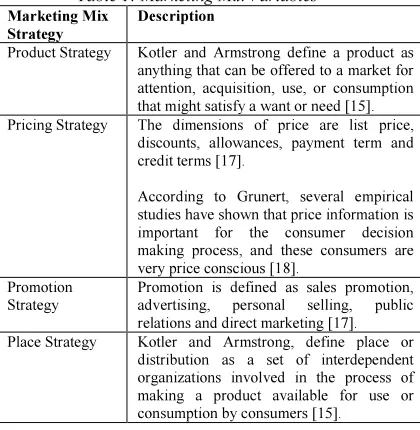
[image:3.595.84.294.526.741.2]The marketing mix consists of everything that can be done by companies to influence the demand for its products. The activities in question is the decision of the four variables, namely product, price, place and promotion. To reach the target market and meet or serve customers as effectively as possible so these activities should be combined. In this case the company or organization does not just have the best combination, but also had to coordinate the various elements of the marketing mix to implement effective marketing programs. In summary of each marketing mix variables are described as follows (See Table 1).
Table 1: Marketing Mix Variables Marketing Mix
Strategy
Description
Product Strategy Kotler and Armstrong define a product as anything that can be offered to a market for attention, acquisition, use, or consumption that might satisfy a want or need [15]. Pricing Strategy The dimensions of price are list price,
discounts, allowances, payment term and credit terms [17].
According to Grunert, several empirical studies have shown that price information is important for the consumer decision making process, and these consumers are very price conscious [18].
Promotion Strategy
Promotion is defined as sales promotion, advertising, personal selling, public relations and direct marketing [17]. Place Strategy Kotler and Armstrong, define place or
distribution as a set of interdependent organizations involved in the process of making a product available for use or consumption by consumers [15].
According to Schiffman, Kanuk, the purchase decision is the selection of two or more alternative option purchase decision, meaning that one can make a decision, it should be available some alternative options [19]. The decision to purchase can lead to how the decision-making process is done. Consumer purchasing decisions are influenced by consumer behavior. Consumer behavior is the actions directly involved in obtaining, consuming, and spent products and services, including the decision processes that follow these actions [20].
According to Peter and Olson argues that the core of the consumer decision-making is a process of integration that combines the knowledge to evaluate the behavior of two or more alternatives, and choose one of them [21]. The result of this integration process is an option, which is presented as a desire to behave cognitively
.
4. RESEARCH METHOD
Since this is a relatively poorly researched field, a broad methodology was used to gather and analyze the literature, which was not restricted to scholarly material. Writing method for this paper is qualitative. The method used in data collection was reviews from the literature and direct observation at Kamikaze restaurant. Reference sources used are a variety of books and journals. Another source of internet is includes supporting sites. Retrieving information or data by quoting the contents of the books, journals or from the internet and using the available data to be used as supporting evidence the authors put forward of a statement. The form of paper will be presented in descriptive format.
5. RESULTS AND DISCUSSION
Summarizing the findings of the above literature review, a theoretical approach was developed of the concept business intelligence to support marketing mix strategy. In the business world, the utilization of information technology is a particularly urgent need to look at the opportunities and information from various sources for decision making in the selection of business strategy by management.
query, reporting, online analytical processing (OLAP), statistical analysis, forecasting, and data mining.
The objective of business intelligence is to improve the timeliness and quality of information. Timely and good quality information that can give an indication of what's the best decision to take. Business intelligence reveals:
• The position of the company as in
comparison to it’s competitors.
• Changes in customer behavioral and
spending patterns.
• Market conditions, future trends,
demographic and economic information.
• The political, regulatory, and social
environment.
• What the other companies (competitors) in
the market are doing.
• The capabilities of the company.
To bind the loyalty of its customers, every company is required to recognize needs and desires of each customer. "Know your customer". That's the words that is often spoken of the consultants marketing while giving discourse about how to satisfy the customer. However, how to identify customer wants? At the technical level, an attempt to recognize that the customer desires and another solution by adopting Business Intelligence (BI) as a tool that has ability to draw on a variety of data, information and knowledge as raw material in the decision making process.
BI applications are used to calculate the profitability of each customer or each segment. In this process, BI helps companies analyze the cost to serve each customer segment and compared to the revenue of the company, so the company can determine which customer segments are profitable or detrimental. For management, this kind of information is of course very important for decision-making where the segments to be served, or which segments should be prioritized in the service.
From the consumer side, BI can also be used to analyze the Customer Lifetime Value (CLV). The CLV parameter count how consumers value for the company in the future. The principle is to predict how products / services to be purchased by consumers in the future, based on historical data of purchase, and also the possibility of cross-selling of other products.
In addition to analyzing the consumer, BI can also be used to assess the level of profitability of products / services, so that it can be used for the management of the portfolio products / services as a whole. Not just information the profitability of each product / service, but can also be combined with a variety of other parameters, for example to analysis the areas where the products / services the most profitable, consumers in each region, and others.
The other used of BI is to assess the effectiveness of distribution channel. Just as when analyzing consumer, every distribution channel calculated how much the cost as compared to its revenue through the channel. From there, information about the effectiveness and profitability of an unknown distribution channels can be access easily.
An accurate analysis of competitors, based on updated data and number of different parameters, represents a precious tool for a company’s marketing department. The application offers marketing users many interactive comparasion options between product and price.
Meanwhile, to make the marketing plan, the company can limit the marketing area with four criteria decision variables in the marketing management like price, product, place, and promotion. This requires a system that can generate decision alternatives in forecasting the sales of goods. The incorporation of hardware, software, and the decision process results in Decision Support System which allows users to make more effective decisions [22].
The quality of managerial decision making is the single most determining factor for the success of marketing management. Marketing decision makers bring an impressive set of assets to the table. Usually, they know a lot about marketing phenomena and marketing processes in general.
such as via the internet or in catalogues, can create the consumer perception that the products are innovative, exclusive, or tailored for specific target markets.
Based on the table below (Table 2), we can see that any strategy to be made by the company, whether it's time perspective, dominating marketing function, price elasticity, dominating quality dimension, measurement of customer satisfaction, and customer information systems that required information technology support, especially business intelligence supports for all transactions marketing contained in the company's included marketing mix activities. Tools that can assist companies in analyzing marketing transactions can be viewed in Table 2.
Table 2: The Marketing Strategy Continuum: Some Implications [23]
The Strategy Transaction Marketing
Time perspective
Short-term focus
Dominating marketing function
Marketing mix activities
Price elasticity Customers tend to be more sensitive to price
Dominating quality dimension
Quality of output (technical quality dimension) is dominating
Measurement of customer satisfaction
Monitoring market share (indirect approach)
Customer information system
Ad hoc customer satisfaction surveys
The system developed by Technology enables users to concentrate on data analysis, leaving it up to the system to collect data and produce reports. Excel files are no longer used, thus reducing the danger of having different versions of the same data and minimizing errors incurred when copying data from original sources. BI tools enable data navigation and analysis according to new dimensions and perspectives which were not possible before. The graphic output of reports produces using the new system is fully in line with company standards and reports are produced in a massive and automatic way. These can then be categorized into a series of data mining techniques in BI, which are classified in Table 3 [24]. The capability of BI included decision support, OLAP (online analytical
processing), statistical analysis, forecasting, and data mining.
Table 3: Business Intelligence Techniques
Tecniques Description
Predictive modeling Predict value for a specific data item attribute
Characterization and descriptive data Mining
Data distribution, dispersion and exception
Association, correlation, causality analysis
(Link Analysis)
Identify relationships between attributes
Classification Determine to which class a data item belongs
Clustering and outlier analysis
Partition a set into classes, whereby items with similar characteristics are grouped together
Temporal and sequential patterns analysis
Trend and deviation, sequential patterns, periodicity
OLAP (OnLine Analytical Processing)
OLAP tools enable users to analyze different dimensions of multidimensional data. For example, it provides time series and trend analysis views.
Model Visualization Making discovered knowledge easily understood using charts, plots, histograms, and other visual means Exploratory Data
Analysis (EDA)
Explores a data set without a strong dependence on assumptions or models; goal is to identify patterns in an exploratory manner
Some companies are setting information systems in an attempt to improve the quality and quantity of decision related information available to their managers (esp. Marketing). Sometimes this means expanding the role assigned to the marketing research departments, turning them into marketing information centres. A business intelligence has been designed to generate an orderly flow of pertinent information collected from both inside and outside companies sources for use as the bases for decision making in specific responsibility areas of marketing management.
The following Table 4 summarizes few possible utilities of each task and when they can be used, by the marketer. Also the data requirements of each task are also provided in the same. This matrix has been drawn from conceptual understanding of the theory in the area. After that the author conducted a mapping with the marketing mix strategy based on the preceeding discussion.
Table 4: Mapping of Task, Data requirement and Utility to the marketer [25]
Task Type of
customer information
Utility to marketer
needed
Cluster analysis Psychographic, demographics, product preferences
Segment identificati on, need identificati on
Product and Place Strategy
Classification Psychographic, demographics, product preferences, other related data. Segmentati on of customers, dan future purchase prediction
Product and Place Strategy Pattern association Purchase behavior records, basket data information Predicting future purchases Product Strategy
Summarization Segment purchase details, customer details
Profitable and non-profitable segment identificati on Price Strategy Predictive modeling Psychographic, demographics, past trends in behavior, acceptance of campaign/new products Predict campaign take-up, loyalty, dan hence profitabilit y
Product, promotion, and Place Strategy
Social network analysis
Social network with whom the customer interacts Identifying early adopters, influencers for product launches, viral marketing Promotion Strategy
The need for business intelligence, grows out of the recognition that most companies can or could generate more market related data than they can possibly digest and turn into useful information. Computers can now print out much faster than any human can read. Some way must be found to convert raw data into information. And the one can build up to a business intelligences. Careful analysis of this data and perhaps specially arranged experiments can help the company stakeholders develop greater insights into the relation of marketing inputs to outputs, i.e. their response functions.
There are many other things that could be done by BI, especially in presenting a wide range of useful information for the company. But that should not be forgotten, basically BI as a data analysis tools. This system can’t do the function optimally if there is no supporting data are adequate.
Therefore, BI requires raw data from various applications that have already implemented enterprise, both custom-made applications and
various applications that have been? Finished? such as CRM, ERP, SCM, and a variety of other applications that are used to contain and collect the data. All data are the basis for BI applications to manage and analyze it into useful information for the company. Without accurate data, it is difficult to produce accurate information anyway.
6. CASE STUDY
A. Challenges
Kamikaze restaurant as one of the restaurants with six outlet has many kinds of food and beverage menu. The needs of Kamikaze for quickly and accurately information in order decision-making is the one thing that is absolutely filled. Currently any information scattered within each business unit or any function. To obtain an integrated information to support the decision making process takes one step synchronization process information of each unit or function, which would require time and effort in implementation. It required an Integrated Information Services tools in the form of performance indicators that will be used to support the decision making process.
The need for integrated tools such information services is business intelligence. The use of BI currently as a major concern of the company, the implication for companies if they not used BI are:
• Information provided is not integrated,
because information is spread in every business unit or any function.
• It takes effort in the synchronization
process or compilation of information to support the decision making process.
• Errors in the compilation process (human
error) can not be avoided.
Kamikaze restaurant has two cores and processing systems for the manufacture (retail food) and corporate system. Both of these systems are separated programs and can not be put together. Therefore the scope of problem is the use of business intelligence techniques in Arbella corporation which holds the kamikaze management.
B. Solutions
recommendations for a raptor implementation and proposed a ‘one day’ solution.
The consultants helped capture and define new business processes and then try to matched with the raptor application functionality. They try to making innovative use of raptor ETL (Extract, Transform, and Loading) tools, they delivered real-time integration with a series of externally-held client information forms - saving approximately 45 minutes per customers sales as well as increasing data accuracy. They delivered:
• Lead management. • Client management. • Activity management.
• Campaign/promotion management. • Opportunity management.
The project delivered a tightly integrated, highly tailored raptor solution that excited both users and management as they realised the potential and they would have to exceed their various objectives and targets using the new system.
[image:7.595.308.513.154.250.2]In the framework of information systems architecture, BI may be a software package or stand-alone module, or a part (embedded) of an application package. Most software-related decisions that developed after 1993 have had the BI facility in it. Meanwhile, some of the previously developed software modules require additional special, which serves as a BI Tools, which served to integrate and combine a variety of data and information that is scattered on a number of different applications within an enterprise (Figure 1)
Figure 1: Architecture framework for Business Intelligence in Information Systems
[image:7.595.89.286.532.663.2]One of the tools used for the development of Business Intelligence for kamikaze is SQL Server 2005, which consists of integration services, analysis services and reporting services (Table 5).
Table 5: Three Phases for BI Process in SQL Server 2005
The process development of BI in SQL Server 2005 is divided into three stages. The first stage is integration. This stage is a process for integrating a variety of operational data. And enter it into the data warehouse. The data from operational systems must be validated, extracted, summarized, or given a particular formula in accordance with the results of business analysis. This process is also known as extract, transform, loading (ETL) which uses SQL Server Integration Services (SSIS). The data source is not limited to SQL Server, but also Oracle, DB2, flat files, XML, and all data sources that are compatible with the ODBC or OLEDB. The process of data integration is not just importing it from the data source, but including also the process of validation, aggregation, and calculations using various formulas desired. With this process, the data entered into the data warehouse is really ready to be analyzed
The Second is analysis. In this stage, the data in the data warehouse are analyzed using Analysis Services. Analysis Services is a tool that provides various methods of data mining and OLAP (Online Analytical Processing). In the process of data mining, SQL Server 2005 provides 7 statistical methods that can be used to analyze the data, the Microsoft Association Rules, Microsoft Clustering, Microsoft Decision Trees, Microsoft Linear Regression, Microsoft Logistic Regression, Naive Bayes Microsoft, and Microsoft Neural Network.
The Third is the presentation of the report. Reporting services is a major statement presentation stage. This device has been available in SQL Server 2005 and integrated with Business Intelligence Development Studio. On the server side, there is a report server that is serving the processing and performance reports for end users. Reporting service will running in a web browser so it is easy to be distributed on the intranet. Thus,
Integration Services
Analysis Services Reporting Services
Data acquisition from the source of systems and integration data.
• Data
enrichment with business logic, hierarchical views.
• Data discovery via data mining.
• Data
presentatio n and distribution .
• Data access
there is a component that must be installed on the client side.
C. Business Benefits
The solution delivered addressed the key challenges faced by the customer relationship. Specifically, it improved the end-to-end business processes related to: lead management; sales management campaign delivery and measurement; so that they could efficiently:
• Increase the volume and quality of
customer interactions.
• Identify and target prospective new
customers.
• View real time results via management
reports and dashboards.
• Obtain better understanding of customer
potential value.
The additional capabilities that were delivered enabled each of the teams to easily focus on serving their clients, while allowing real-time management reporting of sales activity. And from the results achieved from the dimensions of day, which the results from the analysis of data (day dimension) can be seen the lowest total transaction. And based on the analysis results the company able to implemented promotional strategies to increase the number of sales transactions. Data and results of the application can also be used to enhance the promotion on days with the less visitors, ie Monday to Friday. (The lowest sales transaction outlet at BSD Square (12.19%), and special for the stores in BSD Square the company do the additional promotional strategy, because this is a shop outlet and separated from the mall).
The other advanced analysis can be done by creating a cluster analysis based on the type of store, by region, based on the customer community, including cooperation with the various of banks. The results from the implementation of the campaign can be followed by an analysis of campaign effectiveness to determine the appropriate type of promotion to increase sales and market expansion.
7. CONCLUSIONS
This paper proposes a concept of business intelligence for decision making to support marketing mix strategy (product, price, place and promotion). Business intelligence should be adopted for a company to increase its chances of success in a complex and turbulent business
environment. This paper we have shown a management tool that helps the marketing manager make decisions not based on the feel and intuition, but useful information. The manager should understand management’s problems of planning, executing and controlling marketing department.
Some companies have even developed business intelligence which enable them to make better estimates of the shape of their response functions, and therefore, better decisions. And others are making more effective use of sales and cost analysis techniques.
This paper contributes an approach to help marketing management to advance the understanding of marketing decision making by further use of business intelligence.
REFRENCES:
[1] P.K. Ahmed, G. Hardaker, and M. Carpenter, “Integrated Flexibility - Key to Competition in a Turbulent Environment,” Long Range Planning, 29(4), 1996, pp. 562– 571.
[2] J. H. Gilmore and B. J. Pine II, “The Four Faces of Mass Customization,” Harvard Business Review, January – February, 1997, pp. 91–101.
[3] N. Doherty and N. Delener, “Chaos Theory: Marketing and Management Implications,” Journal of Marketing Theory and Practice, 9(4), 2001, pp. 66–75.
[4] N. Yadav, S. Swami, and P. Pal, “High Technology Marketing: Conceptualization and Case Study,” VIKALPA, 31(2), 2006, pp. 57-74.
[5] A. Buchari, Manajemen Pemasaran dan Pemasaran Jasa. 6th edition, Bandung: Alfabeta, 2004.
[6] R. Stackowiak, J. Rayman, and R. Greenwald, Oracle Data Warehousing and Business Intelligence Solution. Indianapolis: Wiley Publishing, Inc,, 2007.
[7] N. Brannon, “Business Intelligence and E-Discovery,” Intellectual Property & Technology Law Journal, Vol. 22, 2010.
[9] I. Kursan and M. Mihic. “Business Intelligence: The role of the Internet in
marketing research,
Journal of Management, vol. 15, 1, 2010, pp. 69-86.
[10] P. Kotler and G. Amstrong. Prinsip-prinsip Pemasaran. 3rd edition. Jakarta: Erlangga, 1997.
[11] N. H. Borden, “The concept of the marketing mix,” In Schwartz, G. (Ed), Science in marketing. New York: John Wiley & Sons, 1965, pp. 386-397.
[12] K. W. Chong, The Role of Pricing in Relationship Marketing - A Study of the Singapore Heavy Equipment Spare Parts Industry, PhD Dissertation, International Graduate School of Management, University of South Australia, 2003.
[13] A. Palmer, Introduction to Marketing - Theory and Practice. UK: Oxford University Press, 2004.
[14] E. J. McCarthy, Basic Marketing. IL: Richard D. Irwin, 1964.
[15] P. Kotler, and G. Amstrong, Principles of marketing (11th ed.). New York: Pearson International, 2006.
[16] P. J. Peter and J. H. Donnelly, Marketing management: Knowledge and skills (8th ed.). New York: McGraw-Hill, 2007.
[17] N. H. Borden, “The concept of marketing mix,” Journal of Advertising Research, 1 (9), 1984, pp. 2-7.
[18] K. G. Grunert, L. Esbjerg, and T. Bech-Larsen, “Consumer preferences for retailer brand architectures: Results from a conjoint study,” International Journal Of retail & Distribution Management, 34 (8), 2006, pp. 597-608.
[19] L. Schiffman and L. L. Kanuk, Consumer behavior (8th ed.). Upper Saddle River, NJ: Prentice Hall, 2004.
[20] F.J. Engel, Consumen Behaviour, 9th edition, Orlando: Harcourt, 2001.
[21] P.J. Peter. and C. O. Jerry, Perilaku Konsumen dan Strategi Pemasaran. Jakarta: Erlangga, 2000.
[22] E. Turban, Decision Support Systems and Expert Systems and Intelligent Systems, 6th Edition, New Jersey: Prentice Hall Internasional, Inc., 2001.
[23] C. Grönroos, “The Marketing Strategy Continuum: A Marketing Concept for the 1990s,” Management Decision, vol. 29 no. 1, 1991, pp. 7-13.
[24] G. Michael and L. Gruenwald. A survey of data mining and knowledge discovery software tools, Volume 1 , Issue 1 (June 1999) NY: Publisher ACM New York, USA, 1999.