R E S E A R C H A R T I C L E
Open Access
Using intervention mapping to deconstruct
cognitive work hardening: a return-to-work
intervention for people with depression
Adeena Wisenthal
*and Terry Krupa
Abstract
Background:Mental health related work disability leaves are increasing at alarming rates with depression emerging as the most common mental disorder in the workforce. Treatments are available to alleviate depressive symptoms and associated functional impacts; however, they are not specifically aimed at preparing people to return to work. Cognitive work hardening (CWH) is a novel intervention that addresses this gap in the health care system. This paper presents a theoretical analysis of the components and underlying mechanisms of CWH using Intervention Mapping (IM) as a tool to deconstruct its elements.
Methods:The cognitive sequelae of depression and their relevance to return-to-work (RTW) are examined together with interpersonal skills and other work-related competencies that affect work ability. IM, a tool typically used to create programs, is used to deconstruct an existing program, namely CWH, into its component parts and link them to theories and models in the literature.
Results:CWH has been deconstructed into intervention elements which are linked to program performance objectives through underlying theoretical models. In this way, linkages are made between tools and materials of the intervention and the overall program objective of?successful RTW for people with depression?. An empirical study of the efficacy of CWH is currently underway which should provide added insight and understanding into this intervention.
Conclusions:The application of IM to CWH illustrates the theoretical underpinnings of the treatment intervention and assists with better understanding the linkage between intervention elements and intervention objective. Applying IM to deconstruct an existing program (rather than create a program) presents an alternate application of the IM tool which can have implications for other programs in terms of enhancing understanding, grounding in theoretical foundations, communicating program design, and establishing a basis for program evaluation and improvement.
Keywords:Intervention mapping, Cognitive work hardening, Return-to-work, Depression, Program planning
Background
Cognitive work hardening (CWH) is a treatment inter-vention for preparing people off work due to depression to return to work following a disability leave [1,2]. It is based on the same principles as?classical work hardening? (discussed in the following section on Principles of work hardening) but applies the concepts to the mental health domain [1]. CWH fills a gap in the health care system where there has been targeted intervention to prepare for
return to work (RTW) following an injury (e.g., physical work hardening) but there has been no comparable inter-vention in the mental health domain.
The need for a specific intervention to address the RTW needs of people with depression is supported by evidence related to the prevalence of mental illness, and depression in particular, and its impact on work prod-uctivity. In Canada, mental health disorders account for 25% of all diseases with 13% attributable to depression alone [3]. The World Health Organization predicts that by 2020, depression will be the leading cause of disability * Correspondence:[email protected]
Queen?s University, School of Rehabilitation Therapy, Kingston, ON, Canada
worldwide, second only to heart disease [4]. Lost product-ivity per year due to mental health problems in Canada has risen from $14 billion (1999) to $33 billion (2004) with mental illness related disability claims accounting for one third of workplace claims ? approximately 70% of work-place costs [3-6]. Dewa et al. [3] studied the rising costs associated with poor mental health among workers inter-nationally. They found similar trends in costs due to lost productivity and absenteeism resulting from mental health problems among many countries such as Sweden (more than 2/3 of costs), The Netherlands (? 1.44 billion annu-ally), England (30% of absences due to stress), and the United States (average depression-related absenteeism productivity loss is equivalent to $8.3 billion).
Depression is one of the most common mental disor-ders in the workforce [7,8]. It impacts an employee?s health, functioning, life satisfaction, and overall self-esteem. It typically results in decreased energy, fatigue, poor sleep, diminished/loss of appetite, feelings of worth-lessness, hopeworth-lessness, and apathy [9,10]. Many cognitive deficits are associated with depression including impair-ments in concentration, memory, attention, and decision making. These problems can interfere with the ability to meet the cognitive, emotional and behavioural demands of a job [11-13]. In addition, these forms of work disability can contribute to the stigma of mental illness that is prevalent in workplaces, fuelling the assumption that competence to work is compromised [14,15].
A person no longer able to work due to depression may go on a medical disability leave. During this time, treatment may be available in the form of psychotropic medications, psychotherapy, and psychological support. These treatments can be effective in helping to alleviate depression and its functional impacts. They are not, however, specifically aimed at preparing the person to return to work.
CWH addresses this intervention gap by targeting a broad range of functional issues that people with depres-sion face in their workplaces which are critical for resum-ing job duties and achievresum-ing RTW success. These include the cognitive skills required to assume job duties and meet work demands, the coping skills required to manage work-related stress and deal with interpersonal issues, and the overall stamina and functional ability to adopt a work routine and adhere to a work schedule [1,2].
The purpose of this paper is to formalize a structured framework for CWH by integrating theory and practice using the structured process of Intervention Mapping (IM). The IM process provides a systematic framework for planning, designing, and implementing health promo-tion programs [16,17]. This paper shows how IM can also be used to deconstruct an existing intervention for the purpose of analysis, communication, and improvement. The analysis in this paper has resulted in a structured and
detailed program theory for the CWH intervention con-sistent with the goals of program theory evaluation [18].
There are several approaches for program evaluation [18-20]. IM was chosen for the current program analysis because its inherent structured step-wise approach is ideal for making linkages between program elements and expected program outcomes. Furthermore, IM has been used by other researchers to tailor programs for tar-geted groups (e.g., mental disorders) as well as tartar-geted domains (e.g., occupational health) [21,22] both directly relating to the target population served by the CWH inter-vention. Empirical research is currently being conducted to study the efficacy of CWH which should complement the current analysis.
Principles of work hardening
CWH is grounded in the principles of classical work hardening which was developed in the 1970?s to address the needs of injured workers [23-27]. While classical work hardening is applicable to a wide range of disabil-ities, in practice it has almost exclusively been applied to people with physical injuries. For the purpose of this paper, the term ?physical work hardening? (PWH) refers to the application of work hardening to this population.
Both physical and cognitive forms of work hardening are rooted in common underlying principles while the differences are based on the functional and work-related needs of the population they specifically address. Both forms of work hardening use graded work activities to simulate a person?s actual work tasks and demands. They both aim to improve a client?s work performance skills to enable the safe and productive return to the work-force [1,2,23-27].
The goals of graded work activities in PWH encom-pass the neuromuscular aspects of an injury; in CWH, graded work activities focus on the cognitive aspects of the client?s condition. RTW outcomes are enhanced in PWH by increasing physical endurance, pain management, injury prevention, pacing and application of ergonomic principles [26-28] while they are enhanced in CWH by in-creasing mental stamina, mental fatigue management, cop-ing skills, as well as paccop-ing, and application of ergonomic principles [1,2].
benefit from coping skills training. Both groups benefit from education on pacing and ergonomic principles as these have been found to impact employee functioning, productivity, and mental health [31-33].
Cognitive work hardening
CWH is a multi-element intervention, typically offered by an occupational therapist (OT) in a simulated work setting preferably in the community away from a clinic environment [1,2]. Consistent with principles of occupa-tional therapy practice, the intervention is grounded in the analysis of the client?s job and the work environment in which the client works. Key occupational performance issues are identified by the client in an intake interview (and supported by medical documentation and other file data) and typically include fatigue, cognitive impairments (e.g., poor concentration, reduced memory, difficulty mul-titasking), interpersonal issues (e.g., effective communi-cation, conflict management), and reduced coping skills (e.g., time management, organizational skills, goal setting). These performance issues are matched to work demands obtained from a job description and form the basis of the CWH intervention rendering the strategies selected indi-vidualized, highly relevant and enabling of a collaborative relationship with the client served.
In addition to the building of key cognitive and coping skills, interpersonal and organizational competencies to deal with work-related situations are typically addressed. Educational components support the development of effective coping skills, communications strategies, and approaches to facilitate the handling of workplace is-sues. Interventions that have an educational component contribute to one?s sense of well-being, sense of control and empowerment which can contribute to success at work [34,35].
A structured work schedule is a critical component of CWH. It provides the client a routine of meaningful and work-related activities which is typically lacking when off work on disability. Structure to the day can assist with improving feelings of self-esteem, enhancing motiv-ation and offsetting general feelings of hopelessness that are often reported by people who experience mental
illness [36]. The progressive work schedule that is inher-ent in CWH, together with the gradual increase in cog-nitive skill development, enables the client to build stamina and the levels of energy required to match work demands. Since fatigue and reduced energy are commonly associated with depression and have been found to have a negative effect on work performance [29,37], stamina and energy are addressed in CWH with close attention to the balance of work-life demands and the importance of maintaining meaningful activity participation outside of the realm of the workplace.
Through the CWH process clients become aware of their functioning and gain insight into their strengths and limitations, which can have implications for RTW. More specifically, coping skills are developed, stamina is enhanced, a routine is established, and other work-related skills are gained thereby preparing the client to meet work demands while experiencing success within the CWH simulated work environment. These gains provide the client with self-confidence to return to work. Feeling that one has the competence and ability to perform one?s job can contribute to self-efficacy, which has been found to be an essential factor in the work rehabilitation process impacting RTW outcomes [38,39]. Indeed, acquir-ing efficacy can improve esteem and reduce self-stigma which is often a barrier to social activity and employability [40].
Methods
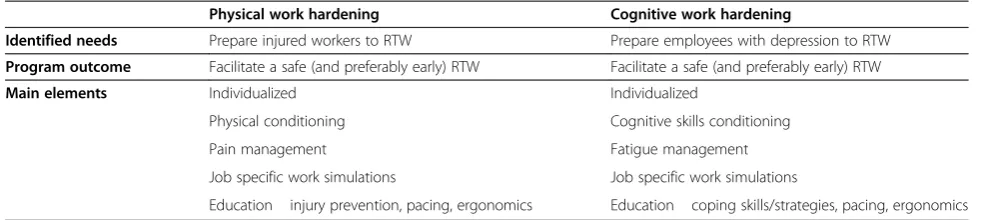
[image:3.595.54.545.100.210.2]IM has been used to create new programs to address problems in health care either through original design [21,41-43] or by adapting an existing intervention to meet the needs of a different population [22,44,45]. In particular, some researchers have used the IM approach to develop workplace interventions for employees on leave due to mental disorders based on existing programs for workers with musculoskeletal conditions [22,45]. Given that CWH emerged from the more established PWH, IM is used in this paper to examine overall program and per-formance objectives for both forms of work hardening. The IM protocol is then used to deconstruct the CWH intervention for a more detailed analysis of its objectives,
Table 1 Overall comparison of physical work hardening and cognitive work hardening
Physical work hardening Cognitive work hardening
Identified needs Prepare injured workers to RTW Prepare employees with depression to RTW
Program outcome Facilitate a safe (and preferably early) RTW Facilitate a safe (and preferably early) RTW
Main elements Individualized Individualized
Physical conditioning Cognitive skills conditioning
Pain management Fatigue management
Job specific work simulations Job specific work simulations
tools and materials, and linkages to the underlying theor-ies and models providing increased insight into the appli-cation of work hardening to the mental health population.
IM is considered a six step process with each step con-sisting of several tasks which, once completed, set the stage for the next step (Figure 1). The process is an itera-tive one, moving back and forth between tasks and steps as information and perspectives emerge from various ac-tivities. The process is cumulative with each step being based on the previous step in an effort to be comprehen-sive in the planning and maximize the potential effective-ness of the intervention/program [17,46].
IM Step 1 is implicit in this analysis and yields the over-all program objective of?successful return-to-work? for both PWH and CWH applied to their respective populations.
[image:4.595.58.537.281.710.2]Step 2, Tasks 1 and 2 are used to examine the similarities and differences of these two interventions through varia-tions in each of their overall program objectives, behav-ioural and environmental outcomes, and performance objectives. Step 2, Tasks 3 and 4 focus on CWH and are used to select changeable behaviour determinants of per-formance objectives for the behavioural and environmen-tal outcomes with a matrix of change objectives being created that links the determinants to performance objec-tives. Step 3 is then used to select theoretical methods that match to the behaviour determinants and are then linked to practical strategies largely drawn from direct experience with the CWH intervention. Step 4 and Step 5 are not ap-plicable in the current analysis because they relate to pro-gram creation and implementation whereas CWH is an
existing treatment intervention. Step 6 is discussed in terms of its value in monitoring the CWH intervention under discussion, fine tuning details to enhance outcome, and contributing to research and clinical knowledge to ad-vance health outcomes.
An ethics statement is not included in this paper as there was no study conducted and there was no research conducted on human subjects.
Results
IM Step 1: Needs assessment
A Needs Assessment review is not within the scope of this analysis because CWH is an existing program and its cre-ation is not being addressed in this paper. Nevertheless, many of the elements comprising this step (e.g., discussion with stakeholders, examination of client needs) were ini-tially used to adapt PWH to the client population served by CWH [1].
The output of this step is the overall program objective which is then used to drive the remaining IM steps. In PWH, the overall program objective is?successful RTW for people with a physical injury?. In CWH, the program ob-jective is?successful RTW for people with depression?.
IM Step 2: Matrices of change objectives
Tasks 1 and 2: Behavioural/environmental outcomes and Performance objectives
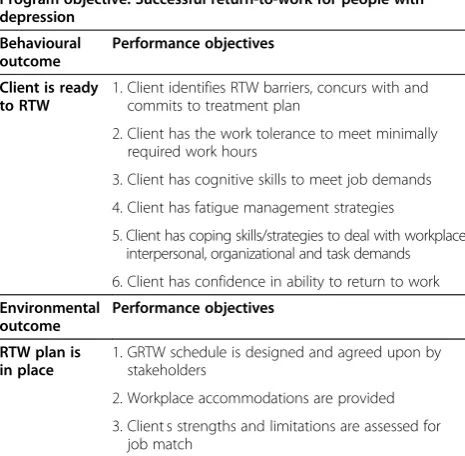
The first task in IM Step 2 is to state the behavioural and environmental outcomes that need to be achieved in order to reach the overall program objective. The next task is to specify what change is necessary in the behav-ioural and environmental outcomes by stating perform-ance objectives. Performperform-ance objectives refer to the effects of the intervention in terms of behaviour that should be learned or changed (behavioural outcome) or aspects of the environment that need to be changed (environmental outcome) [17,47]. In both forms of work hardening, the behavioural outcome is?Client is ready to RTW? while the environmental outcome is?RTW plan is in place?. Tables 2 and 3 present the performance objectives for PWH and CWH, respectively.
Tolerance to work hours (performance objective 2) is a common objective to both forms of work hardening but is achieved in different ways through related per-formance objectives 3 and 4. For example, pain is often a limiting factor for an injured worker?s work tolerance whereas (mental) fatigue often limits work tolerance for persons with depression.
Attention now shifts to focus solely on the CWH inter-vention under study. The IM structure is used to further deconstruct CWH in order to enhance the understanding of the intervention and to provide a systematic way of de-scribing the intervention and the underlying theory.
Tasks 3 and 4: Select determinants and Create matrices of change objectives
[image:5.595.303.540.124.341.2]By breaking down each performance objective into its learn-ing objectives (for the behavioural outcome) and change objectives (for the environmental outcome) important and changeable behaviour determinants are selected. This results in matrices of change objectives that are
Table 2 Performance objectives for behavioural and environmental outcomes: PWH
Program objective: Successful return-to-work for people with physical injury
Behavioural outcome
Performance objectives
Client is ready to RTW
1. Client identifies RTW barriers and accepts proposed treatment plan
2. Client has the work tolerance to meet minimally required work hours
3. Client has physical tolerance to meet job demands
4. Client has pain management strategies
5. Client is aware of injury prevention strategies
6. Client has confidence in ability to return to work
Environmental outcome
Performance objectives
RTW plan is in place
1. GRTW schedule is designed and agreed upon by stakeholders
2. Workplace accommodations are provided
3. Client?s strengths and limitations are assessed for job match
GRTW = gradual return-to-work.
Table 3 Performance objectives for behavioural and environmental outcomes: CWH
Program objective: Successful return-to-work for people with depression
Behavioural outcome
Performance objectives
Client is ready to RTW
1. Client identifies RTW barriers, concurs with and commits to treatment plan
2. Client has the work tolerance to meet minimally required work hours
3. Client has cognitive skills to meet job demands
4. Client has fatigue management strategies
5. Client has coping skills/strategies to deal with workplace interpersonal, organizational and task demands
6. Client has confidence in ability to return to work
Environmental outcome
Performance objectives
RTW plan is in place
1. GRTW schedule is designed and agreed upon by stakeholders
2. Workplace accommodations are provided
3. Client?s strengths and limitations are assessed for job match
[image:5.595.305.538.495.723.2]specific to each performance objective. Determinants selected in this current analysis are based on those set out by Bartholomew et al. [16] as well as those used by other researchers [17,22,41,46-48].
The determinants of attitude, norms, and self-efficacy can be traced to the de Vries ASE model of behaviour intention [49]. This model suggests that a person?s intention to perform a certain behaviour is determined by personal conceptions regarding the behaviour (atti-tude), the social pressures by others regarding the behav-iour (norms), and personal belief in one?s ability to engage in the behaviour (self-efficacy). The realization of the behaviour is dependent on a positive intention but also requires the person having the skills/abilities to carry out the behaviour. This model is based on the Fishbein and Ajzen model for change behaviour [50] and Bandura?s Social Learning Model [51]. These three determinants, in addition to risk perception and knowledge, have been successfully utilized by other re-searchers applying IM to RTW interventions [22,41]. The determinant outcome expectations has been studied by Bartholomew et al. [16,17] and is also included in the current analysis. Skills is also used as a determin-ant based on de Vries? [49] contention that this is a re-lated factor to behaviour change and the assertion by Kok et al. [46] that having the necessary skills to per-form the behaviour is among the necessary and sufficient determinants for behaviour change.
The environmental determinants were selected based on evidence from the literature related to determinants already used in the development of RTW interventions for employees with musculoskeletal conditions as well as for employees with mental health problems [22,41] in addition to other related literature [17]. These include norms, support, resources, organizational climate, and safety and equality. In this paper, the concept ?norms? is used to refer to the norms in the client?s workplace; most notably, related to the job tasks. Safety and equalityrefers to feeling secure in one?s workplace. It includes an envir-onment which is psychologically?safe? from provoking re-lapse where everyone is treated fairly and given what they need to succeed at their work (e.g., accommodations, if re-quired) and an?equal? environment is one where one?s hu-man rights are considered. The accommodation process
addresses both these aspects and is therefore an inherent part of this external determinant.
Table 4 presents an example oflearning objectivesthat are associated with the performance objective: ? Client identifies RTW barriers, concurs with and commits to treatment plan?. This performance objective is one among the six already presented that are associated with the behavioural outcome: Client is ready to RTW. Deter-minants of behaviour change are presented across the top of the matrix and include risk perception and knowledge, attitude, skills, self-efficacy, and outcome expectations. For each determinant, a change objective is created that links that determinant to the performance objective. The same process is applied with each of the other performance objectives resulting in a matrix being created by linking each determinant with each perform-ance objective.
Table 5 presents an example ofchange objectiveswhich are associated with the performance objective:? GRTW is designed and agreed upon by stakeholders?. This perform-ance objective is one among the three already presented that are associated with the environmental outcome:RTW plan is in place. Determinants of behaviour change are presented across the top of the matrix and includenorms, support, resources, organizational climate, and safety & equality. For each determinant, a change objective is again created linking that determinant to the performance objective. The same process is applied with each of the other performance objectives resulting in a matrix being created by linking each determinant with each perform-ance objective.
Step 3: Theory-based intervention methods and practical applications
[image:6.595.57.539.644.732.2]Step 3 of the IM process involves choosing methods and practice strategies that are theoretically grounded and clarifying the underlying mechanisms that contribute to change objectives and ultimately program objectives [17]. This aligns with what Bartholomew et al. [17] describe as ? the causal chain from determinants to ob-jectives to methods to applications? (p. 313) which they note is often not reported in program descriptions; hence, it is difficult to judge the theory and evidence base behind what planners have chosen to include in
Table 4 Example of learning objectives based on combination of performance objective and determinants
Performance objectives for client
Learning objectives
Risk perception and knowledge
Attitude Skills Self-efficacy Outcome
expectations
Client identifies RTW barriers, concurs with and commits to treatment plan.
Client identifies occupational performance issues and how they impact RTW readiness.
Client understands nature of intervention and has a positive attitude towards it.
Client recognizes occupational performance issues.
Client believes
occupational performance issues can be overcome.
their intervention. This step involves studying each deter-minant and the methods of behaviour change related to each determinant both at the individual and the envir-onment level. It is precisely this step, discussed below, that explores methods and theories and links them to the tools/materials used in the CWH intervention. In so doing, a better understanding of the theoretical under-pinnings of the CWH process that can explain the inter-vention outcome ? RTW preparation for people with depression? is achieved.This is consistent with the goals of process evaluation which espouses to study program implementation in order to understand the relationship between program elements and program outcome(s) [19].
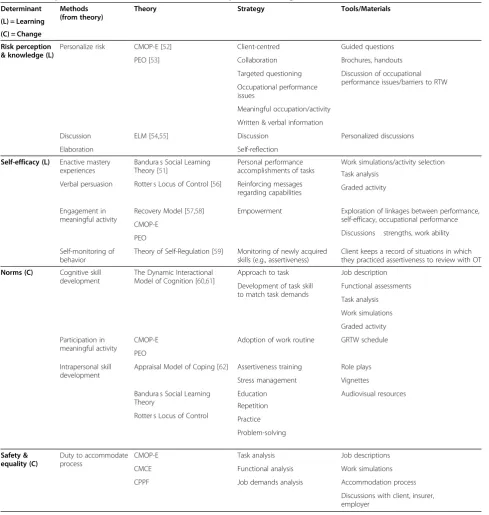
The detailed analysis of IM Step 3 provides insight into how each determinant relates to a theoretical method, a strategy, and ultimately to CWH tools. Matching practical applications to theory has affirmed strategies such as collaboration, targeted questioning, engagement in mean-ingful activity, empowerment, and education. Tools and materials are understood as having been selected as con-crete and tangible ways of implementing a particular strat-egy. These items ultimately comprise the elements of the CWH intervention (Table 6).
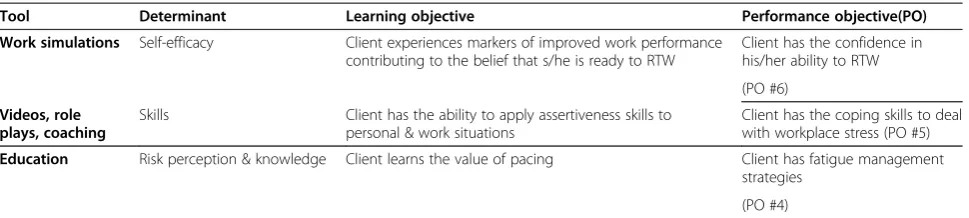
The detailed work of IM Step 3 establishes the rela-tionship among program tools/materials, determinants, and performance objectives. Table 7 illustrates how se-lect CWH tools/materials are linked to and shown to support a determinant and, in turn, how the determinant is linked to and is shown to support a performance ob-jective. This draws a much clearer association between performance objectives and the program elements (i.e. tools/materials) which together contribute to the overall CWH program objective of RTW.
Special attention is drawn in this analysis to ?s elf-effi-cacy? as a determinant of behaviour change because it is linked to the tool ?work simulations? which are a funda-mental element of CWH. Work simulations are used to simulate a client?s pre-disability task demands in order to facilitate cognitive skill development. They are devel-oped by the OT, with input from the client, through a task analysis of the client?s work duties and are graded in complexity as the client progresses in the CWH process.
Engagement in meaningful occupation is the central process of change in CWH and guides the occupational therapy process [1,2]. Indeed?engagement? is a hallmark of the occupational therapy profession and a key concept of the Canadian Model of Occupational Performance and Engagement (CMOP-E) which presents an occupa-tional perspective that includes and extends beyond oc-cupational performance to include engagement [52]. In this way, the link is made between intervention tools and determinants through underlying occupational ther-apy theory which guides practice through methods and strategies.
[image:7.595.57.541.108.200.2]The determinant ?self-efficacy? is also informed by Bandura?s Social Learning Theory [51] which indicates the importance of a person?s personal mastery expec-tations regarding a desired behaviour. Self-efficacy re-fers to one?s beliefs about one?s ability to perform a specific behaviour. Individuals with low self-efficacy will likely avoid situations and/or not engage in behav-iours that they feel unable to cope with or perform. Individuals with high levels of self-efficacy will be more likely to engage in behaviour in which they feel more confident to perform and will likely persist with behaviours that may become difficult which in turn increases their self-efficacy expectations further. Through engaging in meaningful work simulations in CWH, an individual gains mastery through personal performance accomplishments which instills confi-dence and reinforces one?s sense of self-efficacy. Learning through experience is one of four main sources of self-efficacy that Bandura highlighted in his theory and has been noted to be the most effective [51,63].
Drawing from the work of van Oostrom et al. [22] and Vermeulen et al. [41], the RTW process requires not only one?s attitude, social influence, and self-efficacy to drive one?s intention for behaviour change but must also consider the influence of barriers and facilitators together with knowledge and skills to achieve RTW. With this in mind, focus on occupa-tional performance issues through targeted question-ing and discussions contribute to the role that
Table 5 Example of change objectives based on combination of performance objective and determinants
Performance objectives for environment
Change objectives
Norms Support Resources Organizational
climate
Safety & Equality
GRTW is designed and agreed upon by stakeholders.
OT designs a typical GRTW schedule (e.g., 6? 8 weeks).
OT reviews GRTW with client and addresses questions/concerns.
Roles of OT, insurer, and employer in GRTW process are clearly delineated.
Insurer reviews GRTW with employer for clarity and buy-in.
RTW concerns are addressed; questions answered.
?knowledge? plays as a determinant of RTW in the CWH process. Clients are engaged in RTW prepar-ation by examining their occupprepar-ational performance is-sues as they relate to their cognitive functioning and skills, their environment (home/work), and the actual job demands at the workplace. This is consistent with client-centred models which stress that occupational performance and engagement result from the dynamic
relationship between people, their occupations, and the environments in which they live, work, and play [52,53].
Step 4: Intervention program and Step 5: Adoption and implementation
[image:8.595.56.546.98.614.2]IM Step 4 and Step 5 involve program creation and im-plementation and are not applicable in this analysis
Table 6 Example of determinants linked to theories and practical strategies
Determinant Methods
(from theory)
Theory Strategy Tools/Materials
(L) = Learning
(C) = Change
Risk perception & knowledge (L)
Personalize risk CMOP-E [52] Client-centred Guided questions
PEO [53] Collaboration Brochures, handouts
Targeted questioning Discussion of occupational performance issues/barriers to RTW Occupational performance
issues
Meaningful occupation/activity
Written & verbal information
Discussion ELM [54,55] Discussion Personalized discussions
Elaboration Self-reflection
Self-efficacy (L) Enactive mastery
experiences
Bandura?s Social Learning Theory [51]
Personal performance accomplishments of tasks
Work simulations/activity selection
Verbal persuasion Rotter?s Locus of Control [56] Reinforcing messages regarding capabilities
Task analysis
Graded activity
Engagement in meaningful activity
Recovery Model [57,58] Empowerment Exploration of linkages between performance, self-efficacy, occupational performance CMOP-E
Discussions? strengths, work ability PEO
Self-monitoring of behavior
Theory of Self-Regulation [59] Monitoring of newly acquired skills (e.g., assertiveness)
Client keeps a record of situations in which they practiced assertiveness to review with OT
Norms (C) Cognitive skill
development
The Dynamic Interactional Model of Cognition [60,61]
Approach to task Job description
Development of task skill to match task demands
Functional assessments
Task analysis
Work simulations
Graded activity
Participation in meaningful activity
CMOP-E Adoption of work routine GRTW schedule
PEO
Intrapersonal skill development
Appraisal Model of Coping [62] Assertiveness training Role plays
Stress management Vignettes
Bandura?s Social Learning Theory
Education Audiovisual resources
Rotter?s Locus of Control
Repetition
Practice
Problem-solving
Safety & equality (C)
Duty to accommodate process
CMOP-E Task analysis Job descriptions
CMCE Functional analysis Work simulations
CPPF Job demands analysis Accommodation process
where IM is being used to deconstruct an existing intervention.
Step 6: Evaluation
IM Step 6 can be applied as it would be in the usual IM process for a newly designed program for the purpose of program monitoring and evaluation. This is indeed an im-portant step that guides and enriches health education re-search through potential program enhancement [16,17].
Using IM to deconstruct CWH provides increased insight into the intervention?s underlying models and the-ory of change which, according to Bartholomew et al. [17], drives the evaluation process. In addition, the current ana-lysis highlights the relationship between intervention change/learning objectives, behaviour change techniques, and intervention tools/materials within the over arching theoretical base of the intervention. This allows for evaluation of process and effect of the intervention to determine if any changes are needed for program im-provement [43,64].
Through this analysis, self-efficacy (and its impact on one?s belief in one?s work ability) as well as fatigue emerged as critical RTW success factors; however, it became ap-parent that no standardized measurement tools were implemented to measure either of these constructs. The inclusion of such measurement tools emerged as an intervention improvement to gage work ability and fatigue status from intake (baseline) to discharge (program completion). Scores on standardized measures and dif-ference scores may indeed have implications for RTW success. This is being studied in the first author?s current research study.
Although a focused process evaluation is not within the scope of this analysis, a few aspects of the process evaluation approach are worth noting. Implementation fidelity refers to the fidelity with which a program is im-plemented and has been discussed as an important fac-tor mediating between interventions and their outcomes [19,20]. This may indeed influence the success of the CWH intervention and would need to be addressed in knowledge transfer activities related to the CWH interven-tion (e.g., workshops, training manuals). Contextual issues [19] include resource considerations such as adequately
trained therapists to implement the CWH intervention, stakeholders that would be willing to support CWH for their clients/employees, and the physical environment consistent with the ideals of CWH (e.g., community-based, non-clinical).
Deconstruction of an existing intervention contributes to the field of health research. Feedback from this analysis builds on the fundamental goal of evaluation ? program enhancement? by adding a layer of insight into the inter-vention?s underlying theoretical models and strategies which can then strengthen the body of knowledge used to address other health issues. Indeed, learnings obtained re-garding models and in vivo strategies have the potential to influence their usage and possible further evolvement.
Discussion
This paper provided a theoretical analysis of CWH by adapting the IM process to deconstruct the treatment intervention. CWH is a treatment intervention designed to prepare people to return to work following a depression and is based on established work hardening principles. Providing opportunity for mastery prior to returning to work helps to mitigate the prevalence of stigma against depression in today?s workplaces [65].
As part of a strategy to familiarize the health care and vocational rehabilitation community with this tailored approach, communication, knowledge development, re-search and evaluation of the intervention is being under-taken and is enhanced by the systematic development of a formal program description. IM provided the frame-work with which to methodically analyze CWH to gain a better understanding and appreciation of its component parts and underlying theoretical foundation. At the same time, CWH served as an illustrative example of the adapted IM process which has been formulated and pre-sented here.
[image:9.595.57.542.99.208.2]The structured IM process provided a roadmap for the detailed intervention analysis of CWH that included es-tablishing performance objectives and change objectives. Matrices were developed that linked determinants of be-haviour change to performance objectives resulting in change objectives that were then mapped to CWH tools that are the basic elements of the intervention.
Table 7 Example of CWH tools mapped to performance objectives
Tool Determinant Learning objective Performance objective(PO)
Work simulations Self-efficacy Client experiences markers of improved work performance
contributing to the belief that s/he is ready to RTW
Client has the confidence in his/her ability to RTW
(PO #6)
Videos, role plays, coaching
Skills Client has the ability to apply assertiveness skills to personal & work situations
Client has the coping skills to deal with workplace stress (PO #5)
Education Risk perception & knowledge Client learns the value of pacing Client has fatigue management
strategies
Application of the IM protocol enabled the linking of strategies and tools to theories to analyze the interven-tion?s underlying mechanisms that are believed to impact the desired intervention outcomes. Empirical study of the efficacy of the intervention and client feedback on useful intervention elements is currently underway, and findings should provide added insight and understanding into this intervention.
The current analysis contributes to the scientific litera-ture and the clinical field by providing insight into CWH that is not only descriptive but is also theory-based thereby enhancing understanding of this treatment inter-vention. The sequential deconstruction of CWH has the potential to highlight gaps in the intervention which can then be addressed to improve the intervention and treat-ment outcome. This is consistent with the feedback loop that is inherent in the structured IM framework which consists of program evaluation for continued interven-tion improvement.
The IM structure provides a common language to share intervention content and rationale [64] and, indeed, using the IM tool to deconstruct an existing intervention contrib-utes to the field of research through this shared language. In this way, the scientific knowledge base is enhanced through communication of an intervention?s underlying theoretical models, strategies, and program tools which can then be applied to other treatment interventions and health concerns thereby benefiting the broader research and clinical communities. In addition, intervention ana-lysis encompasses in-depth study of intervention models and practical strategies that can lead to improvement and evolvement of these elements which can also enhance the body of scientific and clinical knowledge.
Although IM was originally designed as a program de-velopment tool, by embracing the application of its protocol as described in this paper, other existing inter-ventions can be deconstructed to gain insight into their programs for the purpose of program description, evalu-ation and ultimately improved health outcomes. Adop-tion by more program designers and researchers results in a larger pool of interventions being systematically studied with findings informing the health research com-munity and facilitating the exchange of best practices.
Conclusions
The use of IM to deconstruct an existing intervention proved to be a useful tool to systematically analyze and de-scribe the intervention?s theoretical underpinnings which promotes knowledge sharing and lays the foundation for intervention evaluation and improvement. This approach has implications for other existing interventions where using a common systematic protocol provides a shared language enhancing knowledge exchange among practi-tioners and the research community.
Abbreviations
CWH:Cognitive work hardening; IM: Intervention mapping; RTW: Return to work; PWH: Physical work hardening; OT: Occupational therapist; GRTW: Gradual return-to-work; CMOP-E: Canadian Model of Occupational Performance and Engagement; PEO: Person Environment Occupation; ELM: Elaboration Likelihood Model; CMCE: Canadian Model of Client-Centred Enablement; CPPF: Canadian Practice Process Framework.
Competing interests
The authors declare that they have no competing interests.
Authors? contributions
Both authors contributed to the concepts presented in this paper and both reviewed and approved the final manuscript. The detailed deconstruction specifically applied to CWH was carried out by AW as part of her doctoral research.
Authors? information
AW, B.Sc. (OT), M.Ed., is a PhD Candidate in Rehabilitation Science at Queen?s University in Kingston, Ontario. Her clinical practice spans over 20 years with a specialization in workplace mental health and return-to-work. TK, PhD, OT Reg (Ont), is a Professor in the School of Rehabilitation Therapy at Queen?s University in Kingston, Ontario. Her research interests focus on the occupational lives of people with mental illness, with a special focus on productivity.
Acknowledgements
Other than the co-authors, there are no individuals or funding organizations who contributed directly or indirectly to this manuscript.
Received: 28 January 2014 Accepted: 14 October 2014
References
1. Wisenthal A:Occupational therapy provides the bridge back to work.
Occup Ther Now2004,6:17? 19.
2. Wisenthal A, Krupa T:Cognitive work hardening: a return-to-work intervention for people with depression.Work2013,45:423?430. 3. Dewa C, McDaid D, Ettner S:An international perspective on worker mental health problems: who bears the burden and how are costs addressed?Can J Psychiatr2007,52:346? 356.
4. Murray C, Lopez A:The Global Burden of Disease: A Comprehensive Assessment of Mortality and Disability from Diseases, Injuries, and Risk Factors
in 1990 and Projected to 2020. Geneva: World Health Organization; 1996.
5. Watson Wyatt Worldwide:Staying @ Work 2005: Making the connection to a
healthy organization.Watson Wyatt Worldwide; 2005.
6. Wilson M, Joffe R, Wilkerson B:The unheralded business crisis in Canada:
Depression at work.Toronto: GPC; 2000.
7. Myette T:Research on depression in the workplace: where do we go from here?J Occup Environ Med2008,50:492? 500.
8. Dewa C, Lesage A, Goering P, Caveen M:Nature and prevalence of mental illness in the workplace.Healthcare Papers2004,5:12? 25.
9. Bruce ML:Depression and Disability.InPhysical Illness and Depression in
Older Adults.Edited by Williamson GM, Shaffer DR, Parmelee PA. New York:
Kluwer Academic/Plenum Publishers; 2000:11?29.
10. Kennedy S:Core symptoms of major depressive disorder: relevance to diagnosis and treatment.Dialogues Clin Neurosci2008,10:271?277. 11. Hammar A, Ardal G:Cognitive functioning in major depression - a summary.
Front Hum Neurosci2009,3:1?7.
12. Gualtieri CT, Johnson LG, Benedict KB:Neurocognition in depression: patients on and off medication versus healthy comparison subjects.
J Neuropsychiatry Clin Neurosci2006,18:217? 225.
13. Miller D:Psychosocial issues and the return-to-work process.OT Pract
Online, Am Occup Ther Assoc2004,9:16?20.
14. Krupa T, Kirsh B, Cockburn L, Gewurtz R:Understanding the stigma of mental illness in employment.Work2009,33:413? 425.
15. Stuart H:Mental illness and employment discrimination.Curr Opin
Psychiatry2006,19:522?526.
16. Bartholomew L, Parcel G, Kok G:Intervention mapping: a process for developing theory and evidence-based health education programs.
17. Bartholomew L, Parcel G, Kok G, Gottlieb N, Fernandez M:Planning Health
Programs: an intervention mapping approach.3rd edition. San Francisco:
Jossey-Bass; 2011.
18. Rogers P, Petrosino A, Huebner T, Hacsi T:Program theory evaluation: practice, promise, and problems.N Dir Eval2000,87:5? 13.
19. Saunders R, Evans M, Joshi P:Developing a process-evaluation plan for assessing health promotion program implementation: a how-to guide.
Health Promot Pract2005,6:134? 147.
20. Carroll C, Patterson M, Wood S, Booth A, Rick J, Balain S:A conceptual framework for implementation fidelity.Implement Sci2007,2:1? 9. 21. Koekkoek B, van Meijel B, Schene A, Hutschemaekers G:Development of an
intervention program to increase effective behaviours by patients and clinicians in psychiatric services: intervention mapping study.BMC Health
Serv Res2010,10:293.
22. van Oostrom S, Anema J, Terluin B, Venema A, de Vet H, van Mechelen W: Development of a workplace intervention for sick-listed employees with stress-related mental disorders: intervention mapping as a useful tool.
BMC Health Serv Res2007,7:127.
23. Brewer C, Stroms B:The final phase of rehabilitation: work hardening.
Orthop Nurs1993,12:9? 15.
24. Demers L:Work Hardening: A Practical Guide.Stoneham, Massachusetts: Butterworth-Heinemann; 1992.
25. Ogden-Niemeyer L, Jacobs K:Work Hardening: State of the Art.N.J: Slack Incorporated; 1989.
26. Johnson L, Archer-Heese G, Caron-Powles D, Dowson T:Work hardening: outdated fad or effective intervention?Work2001,16:235?243. 27. Sang L, Eria L:Outcome evaluation of work hardening program for
manual workers with work-related back injury.Work2005,25:297?305. 28. Joy J, Lowy J, Mansoor J:Increased pain tolerance as an indicator of
return to work in low-back injuries after work hardening.Am J Occup Ther2001,55:200? 205.
29. Kessler R, White L, Birnbaum H, Qiu Y, Kidolezi Y, Mallett D, Swindle R: Comparative and interactive effects of depression relative to other health problems on work performance in the workforce of a large employer.JOEM2008,50:809? 816.
30. Demyttenaere K, De Fruyt J, Stahl S:The many faces of fatigue in major depressive disorder.Int J Neuropsychopharmacol2005,8:93? 105. 31. Dal Cason D:Ergonomic principles and tools for best interdisciplinary
psycho-physical stress prevention.Work2012,41:3920? 3922.
32. Rocha L, Debert-Ribeiro M:Working conditions, visual fatigue, and mental health among systems analysts in Sao Paulo, Brazil.Occup Environ Med 2004,61:24? 32.
33. Wahlstrom J:Ergonomics, musculoskeletal disorders and computer work.
Occup Med2005,55:168?176.
34. Baynton M:Return to work: strategies for engaging the employee in the return-to-work process when mental health is a factor.OOHNA J2010, 29:16?20.
35. Eklund M, Backstrom M:The role of perceived control for the perception of health by patients with persistent mental illness.Scand J Occup Ther 2006,12:249? 256.
36. Mee J, Sumsion T:Mental health clients confirm the motivating power of occupation.Br J Occup Ther2001,64:121?128.
37. Johnson S:Depression and Fatigue.InFatigue as a Window to the Brain. Edited by DeLuca J. Cambridge: Massachusetts Institute of Technology; 2007:157? 172.
38. Labriola M, Lund T, Christensen K, Albertson K, Bultmann U:Does self-efficacy predict return-to-work after sickness absence? A prospective study among 930 employees with sickness absence for three weeks or more.Work2007, 29:233?238.
39. D'Amato A, Zijlstra F:Toward a climate for work resumption: the nonmedical determinants of return to work.J Occup Environ Med2010, 52:67?80.
40. Stuart H:Stigma and work.Healthcare Papers2004,5:100? 111. 41. Vermeulen S, Anema J, Schellart A, van Mechelen W, van der Beek A:
Intervention mapping for development of a participatory return-to-work intervention for temporary agency workers and unemployed workers sick-listed due to musculoskeletal disorders.BMC Public Health2009, 9:1? 15.
42. Lloyd J, Logan S, Greaves C, Wyatt K:Evidence, theory and context-using intervention mapping to develop a school-based intervention to prevent obesity in children.Int J Behav Nutr Phys Act2011,8:1?15.
43. Schmid A, Anderson J, Kent T, Williams L, Damush T:Using intervention mapping to develop and adapt a secondary stroke prevention program in Veterans Health Administration medical centers.Implement Sci2010,5:1?11. 44. Detaille S, van der Gulden J, Engels J, Heerkens Y, van Dijk F:Using
intervention mapping (IM) to develop a self-management programme for employees with a chronic disease in the Netherlands.BMC Public
Health2010,10:1? 12.
45. Briand C, Durand MJ, St-Arnaud L, Corbiere M:Work and mental health: Learning from return-to-work rehabilitation programs designed for workers with musculoskeletal disorders.Int J Law Psychiatry2007, 30:444?457.
46. Kok G, Bartholomew L, Parcel G, Gottlieb N, Fernandez M:Finding theory-and evidence-based alternatives to fear appeals: intervention mapping.Int J
Psychol2014,49(2):98?107.
47. Oude Hengel K, Joling C, Proper K, van der Molen H, Bongers P:Intervention mapping as a framework for developing an intervention at the worksite for older construction workers.Am J Health Promot2011,26:e1?e10.
48. Kok G, Schaalma H, Ruiter R, Van Empelen P:Intervention mapping: a protocol for applying health psychology theory to prevention programmes.J Health Psychol2004,9:85? 98.
49. de Vries H, Dijkstra M, Kuhlman P:Self-efficacy: the third factor besides attitude and subjective norm as a predictor of behavioural intentions.
Health Educ Res1988,3:273? 282.
50. Liska A:A critical examination of the causal structure of the Fishbein/ Ajzen attitude-behavior model.Soc Psychol Q1984,47:61?74. 51. Bandura A:Toward a unifying theory of behavioral change.Psychol Rev
1977,84:101? 215.
52. Polotajko H, Davis J, Stewart D, Cantin N, Amoroso B, Purdie L, Zimmerman D: Specifying the Domain of Concern: Occupation as Core.InEnabling Occupation II: Advancing an Occupational Therapy Vision for Health, Well-Being,
& Justice through Occupation.Edited by Townsend E, Polatajko H. Ottawa:
CAOT Publications ACE; 2007:13?36.
53. Law M, Cooper B, Strong S, Stewart D, Rigby P, Letts L:The Person-Environment-Occupation Model: a transactive approach to occupational performance.Can J Occup Ther1996,63:9? 23.
54. Petty R, Cacioppo J:The Elaboration Likelihood Model of Persuasion.In
Communication and Persuasion.New York: Springer; 1986:1?24.
55. Petty R, Heesacker M, Hughes J:The elaboration likelihood model: implications for the practice of school psychology.J Sch Psychol1997, 35:107?136.
56. Rotter J:Generalized expectancies for internal versus external control of reinforcement.Psychol Monogr1966,80:1?27.
57. Davidson L:Recovery in Serious Mental Illness: Paradigm Shift or Shibboleth.InRecovery from Severe Mental Illnesses: Research Evidence and
Implications for Practice, Volume 1. Edited by L. D, Harding C, Spaniol L.
Boston, Mass: Centre for Psychiatric Rehabilitation, Boston University; 2005:5?26.
58. Millward L, Lutte A, Purvis R:Depression and the perpetuation of an incapacitated identity as an inhibitor of return to work.J Psychiatr Ment
Health Nurs2005,12:565? 573.
59. Kuhl J:A theory of regulation: action versus state orientation, self-discrimination, and some applications.Appl Psychol1992,41:97?129. 60. Cole M, Tufano R:Applied Theories in Occupational Therapy: A Practical
Approach.Slack Incorporated: Thorofare; 2008.
61. Katz N (Ed):Cognition, Occupation, and Participation Across the Life Span.3rd edition. Bethesda: The American Occupational Therapy Association; 2011. 62. Gage M:The appraisal model of coping: an assessment and intervention
model for occupational therapy.Am J Occup Ther1992,46:353? 362. 63. Bandura A (Ed):Self-Efficacy in Changing Societies.Cambridge: Cambridge
University Press; 1995.
64. Schaalma H, Kok G:Decoding health education interventions: the times are a-changin?.Psychol Health2009,24:5? 9.
65. Wang J:Mental Health Literacy and Stigma Associated With Depression in the Working Population.InWork Accommodation and Retention in
Mental Health.Edited by Schultz IZ, Rogers ES. New York: Springer Science
+Business Media; 2011:341? 351.
doi:10.1186/s12913-014-0530-4
Cite this article as:Wisenthal and Krupa:Using intervention mapping to
deconstruct cognitive work hardening: a return-to-work intervention for
![Figure 1 Intervention mapping process [17].](https://thumb-us.123doks.com/thumbv2/123dok_us/8311464.292839/4.595.58.537.281.710/figure-intervention-mapping-process.webp)