ORDER-CONTROLLED MULTIPLE SHIFT SBR2 ALGORITHM FOR PARA-HERMITIAN
POLYNOMIAL MATRICES
Zeliang Wang
∗, John G. McWhirter
∗, Jamie Corr
†and Stephan Weiss
†∗
School of Engineering, Cardiff University, Cardiff, Wales, UK
†
Department of Electronic & Electrical Engineering, University of Strathclyde, Glasgow, Scotland, UK
ABSTRACT
In this work we present a new method of controlling the order growth of polynomial matrices in the multiple shift second order sequential best rotation (MS-SBR2) algorithm which has been recently proposed by the authors for calculating the polynomial matrix eigenvalue decomposition (PEVD) for para-Hermitian matrices. In effect, the proposed method introduces a new elementary delay strategy which keeps all the row (column) shifts in the same direction throughout each iteration, which therefore gives us the flexibility to control the polynomial order growth by selecting shifts that ensure non-zero coefficients are kept closer to the zero-lag plane. Simulation results confirm that further order reductions of polynomial matrices can be achieved by using this direction-fixed delay strategy for the MS-SBR2 algorithm.
Index Terms— MS-SBR2, Polynomial Matrix EVD,
Or-der Growth Control.
1. INTRODUCTION
Polynomial matrices [1] often arise in describing the convo-lutive mixing for broadband sensor array processing. Assum-ing the sensor output signalsx[t]∈CM have zero mean, the space-time covariance matrixR[τ]∈CM×M can be used to formulate the correlation of the sensor outputs, which is ex-pressed asR[τ] =E{x[t]xH[t−τ]}. Heret, τ ∈ Z,E{·}
represents the expectation operation and{·}Hdenotes conju-gate transposition. Therefore, itsz-transform yields a poly-nomial cross-spectral density (CSD) matrix taking the form of
R(z) =
T
τ=−T
R[τ]z−τ = ⎡ ⎢ ⎣
r11(z) · · · r1M(z)
..
. . .. ...
rM1(z) · · · rMM(z) ⎤ ⎥ ⎦,
(1) with the polynomial order given by2T+ 1, such thatR[τ] =
0∀|τ|> T, and each element of this matrix is a polynomial represented byrmn(z) = τrmn[τ]z−τ. Note that the CSD
matrix is para-Hermitian (PH) which satisfiesR(z) =R(z). The notation{·}upon a polynomial matrix denotes the para-conjugate operation, i.e., R(z) = RH(1/z), which means
take the conjugate transposition for all the coefficient matri-cesR[τ]and time-reversing all the elements inside. Unless otherwise stated, polynomial matrices in this paper are repre-sented by underscored upper case bold characters.
The conventional eigenvalue decomposition (EVD) can be used to diagonalize the covariance matrix which corre-sponds to decorrelating instantaneously mixed signals in the narrowband situation, but it is not suitable to generate the equivalent decomposition of a polynomial matrixR(z). To solve this problem, an extension of the EVD to polynomial matrices has been proposed in [2], and its idea has been gen-eralized as
H(z)R(z)H(z)≈D(z) , (2) whereH(z)is a paraunitary (PU) matrix, i.e.,H(z)H(z) =
H(z)H(z) = IM×M, and it aims to diagonalizeR(z) by
means of paraunitary similarity transformation.D(z)is (ide-ally) a diagonal matrix.
Several algorithms exist for calculating the PEVD in (2), including the most established SBR2 algorithm [2], its faster converging version, MS-SBR2 [3] and the family of sequen-tial matrix diagonalization (SMD) algorithms [4–6]. One common feature among these PEVD algorithms is that the order of polynomial matrices continuously increases with each iteration. This is problematic, as such order growth will lead to a significant increasing in computational complexity. In addition, paraunitary matrices with high order will cause costly implementation for applications including subband coding [7], precoding and equalization design for broadband MIMO systems [8], blind source separation from convolutive mixtures [9], and spectral factorization [10] etc.
This paper introduces a new elementary delay strategy for the MS-SBR2 algorithm which can be used to restrict the di-rection of all row (column) shifts throughout iterations. The benefit of doing this is that all the zero filled outer lags of polynomial matrices can be precisely tracked and removed without affecting the algorithm convergence. In other words, it is a lossless process.
during the truncation process [2, 11, 12] while the direction-fixed delay strategy is involved in the MS-SBR2 algorithm.
To accomplish this, we start by briefly reviewing the SBR2 and MS-SBR2 algorithms in Sec. 2. Sec. 3 presents the details of the method for controlling the polynomial order growth in the MS-SBR2 algorithm. Simulation results and conclusions are shown in Sec. 4 and Sec. 5 respectively.
2. STATE OF THE ART 2.1. SBR2 Algorithm
The SBR2 algorithm calculates the PEVD by using a se-quence of elementary paraunitary operations to iteratively diagonalize the para-Hermitian matrixR(z). Each elemen-tary paraunielemen-tary operation consists of two steps, i.e., an el-ementary delay and a Jacobi transformation. At the i-th iteration, the SBR2 algorithm starts by finding the maximum off-diagonal elementr(i)jk[τ]within the upper triangular area ofR(i−1)[τ]. Thus the location ofr(i)jk[τ],(k > j)satisfies
{j(i), k(i), τ(i)}= arg max
j,k>j,τR
(i−1)[τ]
∞ , (3) wherej(i),k(i) andτ(i) are the corresponding row, column and time lag index.
Then the maximum elementr(i)jk[τ]and its complex con-jugater(i)kj[−τ]are shifted onto the zero-lag (τ= 0) by using the elementary delay matrix, such that
R(i)(z) =P(i)(z)R(i−1)(z)P(i)(z) , (4)
whereR(i)(z)denotes the intermediate matrix after the ele-mentary delay operation, and the delay matrixP(i)(z)takes the form of
P(i)(z) =diag{1 · · ·1
k(i)−1
z−τ(i) 1 · · ·1
M−k(i)
} , (5)
which means shifting the maximum element in thek(i)-th row by|τ(i)|lags onto the zero-lag. Finally the maximum element is brought onto the diagonal using the Jacobi transformation
Q(i)[2], which results in
R(i)(z) =Q(i)R(i)(z)QH(i) . (6) Thus the elementary paraunitary matrixE(i)(z)for the i-th iteration can be expressed as
E(i)(z) =Q(i)P(i)(z) . (7)
The algorithm continues its iterations until all the off-diagonal elements are below a given threshold, with a smaller threshold giving greater accuracy. Assuming that the algorithm has con-verged at theN-th iteration, the diagonalized para-Hermitian matrix in (2) takes the form of
D(z) =diag{d1(z)d2(z) · · · dM(z)} , (8)
and the generated paraunitary polynomial matrix is given by
H(z) = N
i=1
E(i)(z) =E(N)(z)· · ·E(2)(z)E(1)(z) . (9)
2.2. MS-SBR2 Algorithm
The MS-SBR2 algorithm [3] is an improved version of the SBR2 algorithm in terms of the convergence speed. It adopts the faster convergence property from the multiple shift max-imum element SMD (MSME-SMD) algorithm [5] while still preserving the benefit of lower computational cost from the SBR2 algorithm. It uses a different search strategy of the off-diagonal elements which is akin to that of the MSME-SMD algorithm, so that it can achieve the diagonalization with less iterations than the SBR2 algorithm.
For the i-th iteration, the MS-SBR2 algorithm involves multiple shifts operations Pˆ(i)(z), followed by a sequence of Jacobi transformationsQˆ(i). Therefore the resulting para-Hermitian matrix is computed by
R(i)(z) = ˆQ(i)Pˆ(i)(
z)R(i−1)(z)Pˆ
(i)
(z) ˆQH(i)
, (10)
wherePˆ(i)(z) = Ll=1(i)P(l,i)(z), Qˆ(i) = Ll=1(i)Q(l,i) and
L(i)denotes the total number of off-diagonal elements shifted onto the zero-lag at thei-th iteration (L(i) ∈Z, 1≤L(i) ≤
M/2).
Accordingly the delay matrix at thel-th delay stage within
i-th iteration is represented by
P(l,i)(z) =diag{1· · ·1
k(l,i)−1
z−τ(l,i) 1 · · ·1
M−k(l,i)
} , (11)
and the elementary paraunitary matrix can be expressed as
ˆ
E(i)(z) = ˆQ(i)Pˆ(i)(z). Note that whenL(i) = 1, the MS-SBR2 algorithm is identical to the MS-SBR2 algorithm. For fur-ther details of the algorithm, including numerical examples and proof of convergence, see [3].
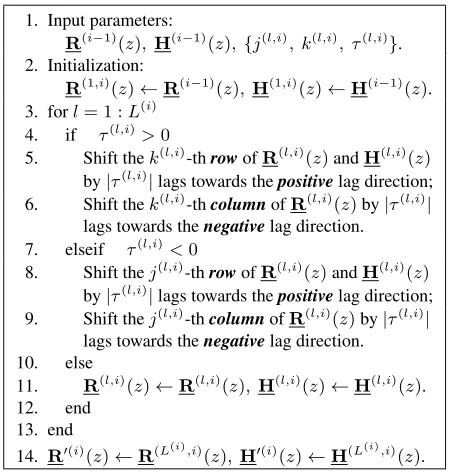
3. POLYNOMIAL ORDER GROWTH CONTROL The idea of controlling order growth of polynomial matrices for MS-SBR2 is implemented by using the direction-fixed de-lay strategy. This process also involves removing zero-filled outer matrices after each iteration. Thus the whole scheme is entitled order-controlled MS-SBR2 (OC-MS-SBR2) algo-rithm.
For each delay stage in MS-SBR2, the conventional delay strategy [3] operates by shifting thek(l,i)-th row ofR(l,i)(z)
towards either positive (τ(l,i) > 0) or negative (τ(l,i) < 0) lag direction, and so thek(l,i)-th column to the opposite di-rection. In some cases, the directions of row (column) shifts at different delay stages within one iteration might be differ-ent, which will result in some non-zero elements to be shifted further away from zero-lag plane and cause the unnecessary order growth of polynomial matrices.
In other words, it maximises the number of zero-filled lags which can be easily eliminated without loss of any energy or affecting the accuracy of algorithm. In the context of this pa-per, the direction of all the row shifts is confined towards the positive time lag, while the direction of all the column shifts towards the negative time lag. The summary of the direction-fixed delay strategy is shown in Tab. 1.
Table 1.Direction-Fixed Delay Strategy for thei-th Iteration in the OC-MS-SBR2 Algorithm
1. Input parameters:
R(i−1)(z), H(i−1)(z), {j(l,i), k(l,i), τ(l,i)}. 2. Initialization:
R(1,i)(z)←R(i−1)(z),H(1,i)(z)←H(i−1)(z). 3. forl= 1 :L(i)
4. if τ(l,i)>0
5. Shift thek(l,i)-throwofR(l,i)(z)andH(l,i)(z) by|τ(l,i)|lags towards thepositivelag direction; 6. Shift thek(l,i)-thcolumnofR(l,i)(z)by|τ(l,i)|
lags towards thenegativelag direction. 7. elseif τ(l,i)<0
8. Shift thej(l,i)-throwofR(l,i)(z)andH(l,i)(z) by|τ(l,i)|lags towards thepositivelag direction; 9. Shift thej(l,i)-thcolumnofR(l,i)(z)by|τ(l,i)|
lags towards thenegativelag direction. 10. else
11. R(l,i)(z)←R(l,i)(z), H(l,i)(z)←H(l,i)(z). 12. end
13. end
14. R(i)(z)←R(L(i),i)(z), H(i)(z)←H(L(i),i)(z).
Assuming no order truncation scheme is applied when computing the PEVD via OC-MS-SBR2, the order growth onR(i)(z)andH(i)(z)are now bounded by the maximum modulus of the delays|τ(lmax,i)|, whereby
lmax= arg max l |τ
(l,i)|, ∀l= 1· · ·L(i) , (12)
and|τ(l,i)|denotes the modulus of the delay needed for
bring-ing the maximum element onto the zero-lag at thel-th de-lay stage withini-th iteration. With zero-filled outer matrices being removed, the resulting polynomial orders can be esti-mated as
O(N)R =O(0)R + 2 N
i=1
|τ(lmax,i)| ,
O(N)H = 1 + N
i=1
|τ(lmax,i)| ,
(13)
where OR(N) denotes the order of para-Hermitian matrix
R(N)(z) at the N-th iteration with the initial order value ofO(0)R , andO(N)H denotes the order of the paraunitary ma-trix H(N)(z). Bear in mind that the benefit of using the direction-fixed delay strategy can only be reflected when
L(i)≥2,∃i= 1· · ·N, meaning that in OC-MS-SBR2 there exists at least one iteration at which two or more shift steps arise. For example, the best scenario forR(z)with dimen-sion of6×6is that there are3 off-diagonal elements to be shifted and rotated at each iteration.
Due to the manner in which PEVD algorithms operate, the resulting para-Hermitian matrix R(i)(z) at each itera-tion is usually with highly sparse outer coefficient matrices which generally accounts for a small proportion of the total energy of R(z). To truncate the negligibly small amount of energy and also to reduce the computational complexity, the para-Hermitian [11] and paraunitary [12] truncation ap-proaches are respectively applied toR(i)(z)andH(i)(z)with pre-defined truncation parametersμPHandμPUwhose values
indicate the proportion of the total energy ofR(z)andH(z)
to be truncated. Further details about how the OC-MS-SBR2 algorithm performs after introducing the truncation schemes will be presented in the next section.
4. RESULTS
To examine the performance of the different PEVD algo-rithms, the performance metrics are firstly defined, followed by the description of the simulation scenario and results of comparison.
4.1. Performance Metrics
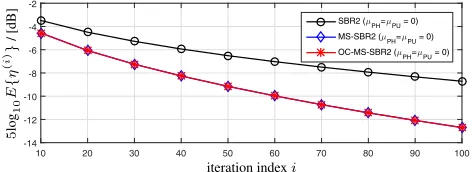
To confirm that the OC-MS-SBR2 algorithm shifts a similar amount of energy at each iteration as the conventional MS-SBR2 algorithm, the first test is to measure the diagonaliza-tion performance, i.e., the remaining off-diagonal energy af-teri iterations normalized by the energy of the input para-Hermitian matrixR(z),
η(i)= τ
M
m,n,m=n|r(i)mn[τ]|2
τR[τ]2F
, (14)
where the notation·Fdenotes the Frobenius norm.
The paraunitary property, i.e.,H(i)(z)H(i)(z) =IM×M, is lost after applying the truncation, therefore the difference from paraunitary is given by
Φ(i)(z) =I
M×M −H(i)T (z)H (i)
T (z) , (15)
whereH(i)T (z)denotes the truncated matrix. Thus the loss of the paraunitarity can be measured as
ξ(i)= 1
M
τ
Φ(i)[τ]2
F . (16)
4.2. Simulation Scenario
para-10 20 30 40 50 60 70 80 90 100 -14 -12 -10 -8 -6 -4 -2
SBR2 (μPH=μPU = 0)
MS-SBR2 (μPH=μPU = 0)
OC-MS-SBR2 (μPH=μPU = 0)
iteration indexi
[image:4.612.318.554.81.168.2]5 log 10 E { η ( i )} /[ d B ]
Fig. 1.Comparison of the convergence speed among different ver-sions of SBR2, showing the ensemble averages of normalized off-diagonal energyη(i)versus iterations.
Hermitian matricesR(z), which can be generated from ma-tricesA(z)∈C6×6of order 3 with i.i.d. zero mean unit vari-ance complex Gaussian entries, such thatR(z) =A(z)A(z). Each of the PEVD algorithms was run for100iterations with the performance metrics recorded after every10 iterations. The simulations was firstly set up with the para-Hermitian and paraunitary truncation parametersμPH = μPU = 0, i.e.,
no truncation scheme is applied, then repeated over the same ensemble forμPH= 10−4andμPU= 10−3.
4.3. Algorithm Convergence & Polynomial Order As shown in Fig. 1, both versions of MS-SBR2 algorithm require much fewer iterations than the SBR2 algorithm to achieve the same level of diagonalization. However, it should be noticed that each iteration within MS-SBR2 involves more rotation steps, which means the computational costs among them are comparable. Also, the elimination of zero-valued coefficient matrices in MS-SBR2 seems no impact on the al-gorithm convergence.
Without using the truncation schemes, Fig. 2 presents the results of the average number of lags versus iterations among different PEVD algorithms, and it shows almost half amount of lag reductions achieved inR(i)(z)for the OC-MS-SBR2 algorithm. After applying the truncations withμPH = 10−4
andμPU = 10−3, the average polynomial orders ofR(i)(z)
[image:4.612.59.295.82.168.2]and H(i)(z) versus iterations are respectively depicted in Fig. 3 and 4. The benefit in terms of order reduction from the OC-MS-SBR2 algorithm is reduced when non-zero val-ues are truncated. Fig. 5 shows the reconstruction error of paraunitarity for different PEVD methods. Initially the error curves start very low but they quickly increase as the trunca-tion algorithms begin to remove the proportrunca-tion of energy. In particular, both versions of MS-SBR2 algorithms have shown very similar reconstruction error throughout iterations. Again it proves that the introduction of the order growth control scheme for MS-SBR2 does not affect the convergence of the algorithm.
5. CONCLUSION
We have proposed an order-controlled version of MS-SBR2 algorithm for calculating the PEVD. The OC-MS-SBR2
algo-10 20 30 40 50 60 70 80 90 100
0 1000 2000 3000 4000
SBR2 (μPH=μPU = 0)
MS-SBR2 (μPH=μPU = 0)
OC-MS-SBR2 (μPH=μPU = 0)
iteration indexi
av er age num ber o f lags
Fig. 2.Comparison of the average number of lags ofR(i)(z)among different versions of SBR2. Note that the number of lags is not equivalent to the number of orders.
10 20 30 40 50 60 70 80 90 100
10 20 30 40 50
SBR2 (μPH = 10 -4
) MS-SBR2 (μPH = 10
-4
) OC-MS-SBR2 (μPH = 10
-4
)
iteration indexi
[image:4.612.319.558.226.314.2] [image:4.612.319.554.471.558.2]av er age p ol ynom ia l o rd er
Fig. 3. Average order ofR(i)(z)after truncation [11] withμPH= 10−4, showing the comparison among different versions of SBR2.
rithm uses a direction fixed delay strategy which can limit the polynomial order growth by selecting shifts that ensure non-zero coefficients are kept closer to the non-zero-lag plane. It pre-serves the similar algorithm convergence property and same level of computational cost as the conventional MS-SBR2 al-gorithm. Simulation results have suggested that further order reductions can be achieved after introducing the order trunca-tion process to the OC-MS-SBR2 algorithm.
10 20 30 40 50 60 70 80 90 100
0 50 100 150 200 250
SBR2 (μPU = 10 -3
) MS-SBR2 (μPU = 10
-3
) OC-MS-SBR2 (μPU = 10
-3
)
iteration indexi
[image:4.612.319.556.598.685.2]av er age polynomial o rd er
Fig. 4. Average order ofH(i)(z)after truncation [12] withμPU= 10−3, showing the comparison among different versions of SBR2.
0 10 20 30 40 50 60 70 80 90 100
10-4 10-3
SBR2 (μPU = 10 -3
) MS-SBR2 (μPU = 10
-3
) OC-MS-SBR2 (μPU = 10
-3
)
iteration indexi
av e. rec. er ro r E { ξ ( i )}
Fig. 5. Average reconstruction error E{ξ(i)} versus iterations, showing the comparison among different versions of SBR2 for
6. REFERENCES
[1] P. P. Vaidyanathan, Multirate Systems and Filter Banks, Prentice-Hall, 1993.
[2] J.G. McWhirter, P.D. Baxter, T. Cooper, S. Redif, J. Fos-ter, “An EVD Algorithm for Para-Hermitian Polyno-mial Matrices,”IEEE Transactions on Signal Processing, 55(5):2158–2169, May 2007.
[3] Z. Wang, J.G. McWhirter, J. Corr, S. Weiss, “Multi-ple Shift Second Order Sequential Best Rotation Algo-rithm for Polynomial Matrix EVD,” inEuropean
Sig-nal Processing Conference, pp. 844–848, Nice, France,
Aug. 2015.
[4] S. Redif, S. Weiss, J.G. McWhirter, “Sequential Ma-trix Diagonalization Algorithms for Polynomial EVD of Parahermitian Matrices,” IEEE Transactions on Signal
Processing, 63(1):81–89, Jan. 2015.
[5] J. Corr, K. Thompson, S. Weiss, J.G. McWhirter, S. Redif, I.K. Proudler, “Multiple Shift Maximum Ele-ment Sequential Matrix Diagonalisation for Parahermi-tian Matrices,” in IEEE Workshop on Statistical
Sig-nal Processing, pp. 312–315, Gold Coast, Australia,
Jun. 2014.
[6] J. Corr, K. Thompson, S. Weiss, J.G. McWhirter, I.K. Proudler, “Causality-constrained Multiple Shift Se-quential Matrix Diagonalisation for Parahermitian Ma-trices,” in European Signal Processing Conference, pp. 1277–1281, Lisbon, Portugal, Sep. 2014.
[7] S. Redif, J.G. McWhirter, S. Weiss, “Design of FIR Pa-raunitary Filter Banks for Subband Coding Using a Poly-nomial Eigenvalue Decomposition,” IEEE Transactions
on Signal Processing, 59(11):5253–5264, Nov. 2011.
[8] C.H. Ta, S. Weiss, “A Design of Precoding and Equalisa-tion for Broadband MIMO Systems,” inAsilomar
Con-ference on Signals, Systems and Computers, pp. 1616–
1620, CA, USA, Nov. 2007.
[9] P. Comon, L. Rota, “Blind Separation of Independent Sources from Convolutive Mixtures,” IEICE Transac-tions on Fundamentals of Electronics, CommunicaTransac-tions
and Computer Sciences, 86(3):542–549, Mar. 2003.
[10] Z. Wang, J.G. McWhirter, S. Weiss, “Multichannel Spectral Factorization Algorithm using Polynomial Ma-trix Eigenvalue Decomposition,” inAsilomar Conference
on Signals, Systems and Computers, pp. 1714–1718, CA,
USA, Nov. 2015.
[11] J. Foster, J.G. McWhirter, J. Chambers, “Limiting the Order of Polynomial Matrices Within the SBR2 Algo-rithm,” inIMA International Conference on Mathematics
in Signal Processing, Cirencester, UK, Dec. 2006.
[12] C.H. Ta, S. Weiss, “Shortening the Order of Paraunitary Matrices in SBR2 Algorithm,” inInternational Confer-ence on Information, Communications & Signal Process-ing, pp. 1–5, Singapore, 2007.
[13] J. Corr, K. Thompson, S. Weiss, I.K. Proudler, J.G. McWhirter, “Row-shift Corrected Truncation of Paraunitary Matrices for PEVD Algorithms,” in
Euro-pean Signal Processing Conference, pp. 849–853, Nice,