o
!o
-ni
ht
{,}
Progress
and
strategy
paper
Enterprise
Restructuring
and
*Eq't
330,113
3lp,1,fz
338
,12/
t//t,
z
L
3,)
fu;
r
PilA0r-Progress and strategy paper
Jnte{pri
se
Restructuring
and
Privatisation
(
Lead
Author
Editors
Simona Gatti
,t
Vittoria
Alliata,
Jonathan
Hatwell
Foreword
This
paper is
part
of
a series
which
will
cover each
of
the
main
areasof
Phare
activity. It
describes
the nature
of
the problems faced
in
Phare's partner
countries
during their transition
from
planned
to
market
economies.
It
goes on
to
examine actions undertaken
to
date, and
to
assesstheir impact
on
the
transformation
process.
There is
clearly
aneed
to
ensure that the approach being taken
in
any grven sector is relevant
to
the
longer-term goals
of
economic
transformation. For this
reason, these papers also
contain
the
thinking
of
those responsible
for
operating
Phare
on
actions
for
the
future
and
how
Phare should
contribute to the next phase
of
the
transition.
The
papers
do not
reflect
any
official
position
of
the
European
Commission.
They
have
been
written
by
the
Phare
Operational
Units
and are
intended
as
a
stimulus
to
discussion
for all
those
involved
in
the debate on economic
transformation
in
central and eastern Europe.
Alan Mayhew
The
Phare
Programme
The Phare Programme
is
a EuropeanUnion initiative
which supports the developmentof
a larger democraticfamily of nations within a prosperous and stable Europe.
Its aim is to
help the countriesof
central and eastern Europe rejoin the mainsteamof
European development andbuild
closerpolitical
and economicties with
the European Union.Phare does this by providing grant finance to support the process
of
economic transformation andto
strengthennewly created democratic societies. Phare also provides grant finance to help counties
with
Europe Agreements integrate with the European Union.In
its first five
yearsof
operationto
1994, Phare hasmade available ECU 4,283
million
to
l1
partner
countries, making
Phare
the
largest
assistanceprograrnme of its kind.
Phare
works
in
close cooperation
with
its
partner
countries to decide how funds are to be spent,
within
aframework
agreedwith
the
EuropeanUnion.
This
ensures
that
Phare
funding
is
relevant
to
eachgovernment's own reform policies and
priorities.
Eachcountry
takes theresponsibility
for
running
its
ownprograrnmes.
Phare provides know-how
from
a wide rangeof
non-commercial, public
andprivate
organisationsto
its
partner countries.
It
acts as a multiplierby
stimulating investment and responding to needs that cannot be metby others.
Phare
acts as a
powerful
catalyst by
unlocking funds
for
important projects
from
other
donors
through studies, capital grants,
guaranteeschemes and
credit
lines.
It
also investsdirectly in
infrastructure, which
will
accountfor
more Phare funds as the restructuring process progresses.The main priorities for Phare funding are common to
all
countries, although every one
is
at a different stageof
transformation. The key areas include restructuringof
state enterprises
including agriculture, private
sectordevelopment,
reform
of
institutions
and
public
administration, reform
of
social services, employment, education and health, developmentof
energy, transport and telecommunications infrastructure, and environmentand
nuclear
safety.
Under the
Europe Agreements,Phare funding
is
being usedto
make laws compatibleTable
of
contents
Executive Summary
Introduction
Section 1 - Background
l1
The importance of privatisation and restucturing for market reforms
Main obstacles to privatisation and restructuring at the outset of the reform process The wider policy framework for privatisation and restructuring
Section 2 - Phare assistance programmes
11 11
t2
l3
Phare commitrnents by country, 1990-1993 Phare assistance and the process
ofreform
Core areas ofPhare support in restructuring and privatisation Section 3 -
Impact
assessment of Pharesupport
13
t3
L4 15 Examples of privatisation/restructuring achievements
Donor coordination Constraints
External Internal
Section 4 - Stratcgic orientations
for future
actions15
t7
17
18 Phare and the Europe Agreements
Strategic orientation and conclusions
Annex
I
-Main
areas ofactivity in privatisation
andrestructuring
bycountry, Um-1993
18 18
2t
Executive sufllmary
The
privatisation
of
state
enterprises,
including
restructuring, is a central element in the establishment
of
a market economy as
well
asfor
increasing productionefficiency and output. Since 1990, Phare has provided the largest source of grant assistance
in
this field, with atotal allocation
of
overECU
250million
for
variousactions
in
support
of
enterprise privatisation,
restructuring, de-monopolisation and
facilitating
investment through transactions and
joint
ventures.As
a resultof this
assistance,a
significant impact hasbeen
achieved by
Pharein
the central
and easternEuropean
countries both
in
establishing
their
basic institutions and related legal framework, aswell
asin
effectively privatising
enterprises
which may not
otherwise havesurvived.
The impact can befelt
notonly at the level of each enterprise concerned, but also
in
terms of setting models and creating momentum.
This
paper beginsby defining
the importanceof
theprivatisation and restucturing processes
for
the successof
the wider transition to a working market economy inthe central
and eastern Europeancountries.
It
alsoidentifies the main obstacles which existed at the outset
of
reform,
andthe importance
of
the wider policy
framework.
It
goes onto
assess the role playedby
Pharein
theseprocesses. Reflecting the
needsof
the reforming
countries
at that time, this
initially
took the form
primarily of traditional know-how transfer (i.e. technical assistance such as sfudies, consultancy services,short-term
training).
This helped create the
necessary legislative, regulatory andinstitutional
framework, to formulate policies, and to prepare and initiate sffuctural reformsin
key economic sectors. However, aftershort-term stabilisation, the central
and eastern Europe countries havenow
embarkedon
a more fundamental medium-term restructuringof
the economy,in
order tocreate the basis
for
recovery
andlong-term
growth, including a substantial shiftof
production to the privatesector.
The
type
of
support
required
is
changing
accordingly, a processin
which the entryinto
forceof
the
frst
Europe Agreementsin
February 1994 must alsobe taken
into
consideration.
These association
agreements create a new framework which prepares the
central and eastern European countries concerned
for
future membership of the European Union.
In
thelight of
these changes, the paper concludes by putting forward future orientationsfor
Phare actionin
support of privatisation and restructuring:
.
resources needto
be concentratedon
stabilising andencouraging
investment
in
the large number
of
enterpriseswhich
remainin
state hands,given
thedifficulties
inherentin
seekingto
privatise manyof
them quickly over the short term
.
more assistance should be disburseddirectly to
the enterprisesector.
In
the areasof
enterprise supportand
prevention
of
enterprise failure,
investment-oriented mechanisms (restucturing funds, investment-support funds, etc.) should be used
.
know-how transfer should concentrate on institutionalreform and development. These objectives gain a new importance under the Europe Agreements,
with
theirIntroduction
Since 1990, the number
of
Phare partner countries hasexpanded
to
11 (Poland,Hungary,
Czech Republic, Slovak Republic, Estonia, Latvia, Lithuania, Romania,Bulgaria,
Slovenia,Albania)
andthe total financing
committed under the programme has increasedfrom
ECU 300million in
1990 to ECU 1,004million in
1993, coming to a totalof
ECU 3,294 nttlhon over the period. Phare is now recognised as a major contributor to reformand the largest source
of
grant assistancein
the central and eastern European countries.Development
of
the private sectoris
crucialto
ensure that the macro-economic stabilisation measures pursuedby
mostcentral
and Eastern Europeancountries
are sustainablein
the longterm.
Broadly speaking, private sector development is defined as including the followingareas:
.
enterprise support:privatisation and restructuring of state-owned enterprises
.
small businesssupport:
establishment and promotion of SMEs
.
regulatory framework/incentives:sectoral and large enterprise de-monopolisation investrnent promotion
establishment of a liberalised financial and banking sector.
Financial assistance made available by Phare since 1990
specifically
for
privatisation and restructuring amountsto
over ECU 250
million,
andcertain factors
have changed over thistime.
The placeof
privatisation andresfucturing within the broader process of private sector
development
is
now better understood by national
governments and donors
alike.
In those countries wherePhare
has
the
longest experience
of
supporting
privatisation and restructuring (Poland, Hungary and the
Czech
Republic),
experience has shown
that
theprocesses are more complex than
initially
expec0ed.The stage has now been reached where
it
is necessary to assess the role and impactof
Phare support, bearingin
mind the wide variations between the circumstances andof
the different beneficiarycounties.
Given also that most programmes are still underway and that theprocess
of
restructuring
in
the
central
and eastern European countriesis still in its
early stage, this report aims to assess to what extent Phare assistance has been11
Section
1
- Background
The importance
of privatisation
and
restructuring
for
the
market reforms
Because of the economic, social and political importance
of
the state-owned enterprise (SOE) sector in most central and east€rn European counties, privatisation and restucturing
of
SOEs has been oneof
the authorities' top prioritiesfor
ensuring a durable transformation
from
a plannedto
a market economy. The aim of privatisation is not transferof
ownenhip per se, but enterprise survival. Emphasis should be placed on the speed
of
privatisation, which must be pursuedwhile controlling
the social consequencesof
reform. Furthermore, while rapid privatisation must remain a fundamental objective, it must be seen as only one partof
the
processin
developing a viable private
sector.Establishing new
enterprises andnew employment
oppornrnities are of paramount importance as well.
Privatisations have been delayed mainly
for
social andpolitical reasons. Indeed,
it
has proved verydifficult for
central and eastern European countries governments to strike a political$'acceptable balance between economic efficiency and the social costs associated with its pursuit. Privatisations have also been delayed
for
technical and structural reasons, mainly due to the lack of a functioningfinancial sector as
well
as to the absenceof
alternative employment opportunities.While privatisation
remainsthe overall objective
of
enterprise refonn, pre-privatisation restmchring could be a necessary step for some specific SOEs or sectors. Indeed,
in
some cases an enterprisewill
need to be restructured prior to privatisation andwill
need stabilisation finance andturn-around management
to
superviseits
transfer intoprivate ownership. In addition, other enterprises which
will
remain
in
state ownershipwill
need to be restructured inview of their importance for the overall economy.
Privatisation and restructuring are increasingly regarded as
two integrat€d steps in a process leading to the sustainable development of the private sector. The priorities
will
vary from country to county depending on their current stageof
economic reform as
well
as on other, country specific, socio-economic factors. The stagein
the reform process reachedby
mostof
the Phareparher
countriesis
quitedifferent
from
one another asis
the levelof
economicdevelopment
which
varies considerably among these countries. Privatisation methods and strategies pursued bynational authorities are therefore taking into account this diversity.
Main
obstacles
to
privatisation
and
restructuring
at
the
outset
of
the
reform
process
The
fansfer
of
ownershipfrom
state-ownedto
private sector requires the establishment of transfer mechanisms and institutions which did not exist at the beginningof
economicreform
in
the central and eastern Europeancountries. Other factors which emerged as constraints to the rapid completion of the privatisation process include
.
the absence of clear property rights: who actually actsas
owner
of
the
SOEs;is
it
the government,
thefounding ministry,
the
workers'
council,
the
management?
.
the lackof
local financial intermediariesor
domestic investment capital combined with a perception of high risk by foreign investors, and,in
some cases, a lackof
political support towards foreign investment.
thepoor financial
andphysical condition
of
someSOEs
which would
make
rapid
privatisation
unattractive
to
prospective buyers andimply
sharpdecreases
in
production,
liquidation
and high
unemployment
.
thedifficulty
in
valuing assetsfor
privatisation: this process has turned outto
be lengthy, expensive and not always accurate or relevant.
the
difficulty in
reaching a social and
political
consensus on privatisation methods and strategy: the
price at which
state assets have beensold
and towhom, have been often questioned afterwards
.
the
difficulty
andtime required
for
establishing
aregulatory framework which could
sustain
theprivatisation process have been often underestimated
.
thedifficulty
andtime
requiredfor
establishing theinstitutional capacity to
managethe privatisation
12
BackgroundThe
wider
policy
framework
for
privatisation
and
restructuring
The need to take account
ofthe
problems setout
abovein
order
to
accomplish successful programmes
of
privatisation and restructuring has confirmed that such prograrnmes cannot exist
in
a yacuum. The frameworkwhich
is
created at macro, meso and micro level has adetermining
influence
on the
outcome.
The key
elements are summarised below.
Experience
to
datein
central
and eastern European countries has shown that three levels can be identifiedduring the process of privatisation
with
key elementsof
success in each one of them.
Macro level: macro-economic reforms have
to
bewell
underway while
in
parallel
aregulatory framework
aiming particularly at the
establishmentof
a
stock-exchange and at the design of privatisation laws must be
set
up.
Most important
of all
is the socio-political
consensus on how to proceed and at what speed.
Meso
level: public
awareness campaigns,
at
theenterprise level
aswell,
are essential elements
of
success.
In
parallel, social safety net provisions shouldbe incorporated
in
large privatisations, particularly
where there
is
a regionalor
employment dimension to them. Foreign investment has depended very much on thefiscal
incentives and perceived transparencyof
the process.Micro
level: attentionto
institutional issues, aswell
as setting up a transparent process, have proven important.Maintaining diversity
andflexibility
for
privatisationtransactions has been a successful method although the problem of corporate governance for either privatised or to-be-restructured enterprises remains throughout the
region. Thus pre- and post-privatisation support through
haining
of
managers and supervisory board members isessential. Finally,
someform
of
massprivatisation
scheme has been shown
to
be necessaryto
promote private ownershipin
the central and eastern European countries.Section
2
will
illustrate
thecontribution
of
the Phare13
Section 2 -
Phare assistance
programmes
Phare
commitments by country,
1990 -1993
The Phare Programme has considered
private
sectordevelopment as a
priority from
the beginningof
thereform process and has made available over ECU 250
million
between 1990 and 1993 to a numberof
country prograrnmesin
supportof
privatisation, restructuring, de-monopolisation and investmentpromotion. This
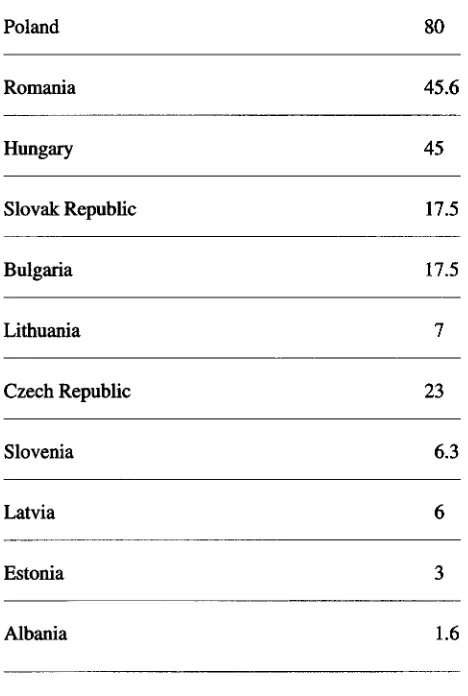
is shown in the table belowl.
Table
2:
Phare supportfor
enterprise privatisation and restructuring 1990-1993, by countryECU
million
Poland Romania 45.6 Hungary Slovak Republic Bulgaria Lithuania
Czech Republic Slovenia Latvia
Estonia
Albania
1
Cumulative amounts made available per counfy for 1990, 199I,1992and 1993 including support !o restructuring, privatisation and foreign
investment promotion. Detailed information is provided on a country basis in annex tr. The figures for Poland, Hungary, Romania the Slovak
Republic, the Czech Republic, Latvia, Lithuania, and Estonia include investnent promotion activities.
80
Phare assistance and the process
of
reform
The
frst
stageof
the transformation process includesshort-term macro-economic stabilisation (such
as measures to reduce the budget deficit and inflation, alignexchange rates and reduce subsidies
to
state-owned industies), combined with an opening up of the economyby
liberalising frade, prices and foreign exchange. The legal, regulatory and institutional framework needed for amarket
system must
be
established, and reform
programmes formulated and started in key sectors. Up to 1992, the focus
of
Phare assistancefor
privatisation andrestructuring,
asfor
other sectors, reflected
theserequirements. Support was concentrated on traditional
forms of technical assistance, such as the studies, training and expertise needed
for policy,
legislation,institution-building or for initiating reforms.
Example 1: the process of transformation - stage 1
Background:
in
Poland, Hungary, Romania, Bulgaria andin
Estonia, Latvia and Lithuania, thefirst
stageof
the
economic transformation process implied
addressing the absence of privatisation laws, regulations and policies. Other key elements missing include: (i) no institutions to carry out reforms;
(ii)
no capital markets; as well as(iii)
a huge need fortaining
both for staffof
those new institutions and for enterprise ilumagers.
Outcome:
in
Bulgaria
and Romania,
the
legal
framework for privatisation and de-monopolisation
of
state indusnial conglomerates has been achieved parfly
with
Pharesupport.
The Mass PrivatisationLaw in
Poland was draftedwith
assistancefrom
the Phare Programme:it
set up the Budapest Stock Exchange,which now
has a market capitalisationof
about $1billion.
In all
countries
mentioned above, Phareprovided know-how,
training,
equipment
andinformation technology to
establishprivatisation
ministries or agencies.
The second stage
is
morecomplex.
It
concerns thefundamental long-term restructuring
of
the nationaleconomy,
involving,
inter alia, a substantialshift
to private ownership, and reorganisationof
remainingstate enterprises. As counties move into the second stage
of
reforms the needfor traditional
technicalassistance
will
diminish,
and the requirementfor
investnrent and direct financing for the above purposes
[image:14.580.46.280.339.687.2]14
Pharc assistance progammesExample 2: the process of transformation - stage2
Background: once macro-economic
measuresto
stabilise the economy have been taken, and after the regulatory and institutional frameworks are
in
place, the second stage of economic transformation includeslonger term
issues suchas:
(i)
sustainability
of
reforms;
(ii)
strengthening the private business sectoremerged
in
stage 1;
aswell
as(iii)
measures tomobilise investment and upgrade infrastructure.
Outcome:
in
Lithuania, the
Phare Programme is providing fundingfor
the setting upof
an enterpriserestructuring
agency.
The importance
of
this
programme
is
that, after the
initial
stage
of
transformation, there are a number
of
medium-sizedand larger enterprises which may
needvarying
degreesof
restructuring
in
order
to
make
themattractive
to
newinvestors.
Thus the agency wouldprovide pre-privatisation support. On the other hand, post-privatisation support
will
also be provided by theagency
in
orderto
ensurethat
companies alreadyprivatised have a chance to survive commercially.
Core
areas
of
Phare
support
in
restructuring
and
privatisation
Through the
provision
of
technical and financial
assistance, Phare-funded privatisation and restructuring prograrnmes aim
to
support the governments' efforts to restructure andreform
ownershipof
state enterprises.As
illustratedin
table2,
major prograflrmes have beenfinanced
in
almost
all
central
and eastern European countries,with
themix of
operations tailored accordingto
thepolicies,
strategies and needsof
the particularcountry concerned (see annex
I).
The
assistanceprovided includes
policy
formulation, privatisation
strategy
and
techniques,
establishment
of
theinstitutional framework, industrial
sector strategies, enterprise restructuring and design and preparationof
l5
Section
3
-
Impact
assessment
of
Phare
support
Examples of
privatisation/
re
structuring
achievements
Following is
a selectedlist
of
activitiesin
the areaof
privatisation
and
restructuring which
have
beenundertaken
with
substantial support from Phare.A
more detailed summary is providedfor all
Phare countries inannexes
I
and tr.In
Poland, Phare provided extemal expertise,in
the early years, which confributed to the establishment of the Ministryof
Privatisation.At
the enterprise level, Phare-supportedadvisory
work
has ledto
the conclusionof
important privatisationsin
Polandincluding, but not limited
to, Fabryka Samochodow Malych and Tarpan (automobiles), Huta Warszawa (steel) and Huta Sandomierz (glass). Some other Phare-supported transactions occurredin
the medical equipment, shoe and cement sectors. The example below illusfrates major investor-led privatisations in several centaland eastem European counffies.
Example 3: preparing for major, investor-led privatisatiors
Background: preparing the ground
for
major foreign investmentinto
a state-owned company ranges fromcomplete enterprise diagnostic, to the search for strategic parmers, and includes legal and financial advice on behalf
ofthe
recipient counuy during negotiations. On average, the large deals de.soibed below have taken two years tonegotiate and Phare has provided assistance during
negotiations, seting up regulations and incentives as well
as assisting during enterprise screening and valuation. Outcome: in Polan( successfully negotiated priv*isations with a strategic investor include tlre $2 billion FIAT-FSM and Volkswagen-Tarpan car ventures, the $300 million
Lucchini-Huta Warszawa steel joint-venure, as well as the
Pilkington glass acquisition
of
Huta Sandomierz withanticipated plant and equipment modernisation
of
$65million. In
Lithuania, Klaipeda Tobacco Factory was privatised through a joint vennre with a tansaction value offfi
611ion (of which $30 million in new invesfinents), as was the Kaunas Confectionery Company with a new investmentof
$12million
foreseenby Kraft
Jacobs Suchard. Altogetlrer over 15 large Lithuanian enterprises intextiles, electonics, agro-processing, construction and leisurc are cunently for sale to foreign investors. kr
laWia
a consortium of Cable and Wireless and Finnish Telephone Company has purchased 49 per cent of latelekom (Latvian telephone company), a privatisation expected to digitalise the Latvian netnork with a user penetation equal to thatof
western Europe within ten years.
Other
examples
of
success
in
promoting
the establishment of the private sector in cenfial and eastem European counties and the privatisation process have included not only investor-led privatisations, but also provisionof
training or establishmentof
a conducive regulatory framework and are shown overleaf.In summary, a significant impact was achieved by Phare
in
central
and easternEuropean countries both in
establishingtheir
basicinstitutions
and related legalframework,
as
well
as
in
effectively
privatising
enterprises which may not otherwise have survived. The impact can be felt not only at the level of each enterprise
concerned,
but also
in
terms
of
setting models
and creating momentum.When measuring
impact
in
terms
of
short-term
objectives, such as studies completed and implemented
at the
enterpriselevel or
establishing the regulatoryframework
for
privatisation,
Phare assistance in
central
and eastern Europeancountries
has indeed acted as amajor
catalystfor reform.
Thebox
belowillustrates
the continuous supportprovided by
Pharesince
1990for
one specific programme
in
Poland which.rangedfrom
legal support,providing
high level policy'ddvisersall
the way through to funding a major public awareness campaign and funding the printingof
share certificates.
Example 4: continuous support for mass
privatisation
In
Poland, the
Phare Programmeprovided
initial
support
for
the preparatory work leading to the MassPrivatisation Law (now called Law on National
Investment Funds,NIFs)
aswell
asproviding two
high-level
policy
advisers
to
work
within
thePrivatisation
Ministry
on
designing
the
massprivatisation programme. Support
to
the programme was providedin
cooperation with theUK
Know-HowFund and the World Bank. Following adoption by the
Polish Parliament last year
of
theNIF
law, Phare isnow continuing
its
support to the process by fundinga major public awareness campaign, the setting up
of
Examples
of
achievements
in
various central
and eastern
European countries
with
contribution from
Phare
In
Hungary, the programme assistedin
settingup
the State Property Agency, the organisation responsiblefor
privatisation, and provided funds
to
prepare enterprisesfor privatisation, as well as for restructuring, management and
staff
training. In
addition, Phare assistanceto
theBudapest
Stock
Exchangewill
have
animpact
uponprivatisation through facilitating public share offerings.
In the Czech Republic and the Slovak Republic, the focus has been
on
supportto
enterprises andtraining.
Coresectors such as steel
in
the
Czech
Republic
and armamentsin
the Slovak Republic have received direct supportfrom the
PhareProgramme. Other
areasfor
which
restructuring advice was providedin the
CzechRepublic include the steel, pharmaceutical, textile,
chemicals and metallurgy sectors. Environmental issues
were specifically emphasised
in
the pharmaceutical andchemical sectors.
In
the Slovak Republic, restructuringadvice was
provided
for
companiesin
the
armament, textile, chemicals, metallurgy and mechanical sectors.In
Romania,
Phareprovided extensive institutional
support
for
a
massprivatisation
scheme and
alsocontributed
to policy
and strategy formulation,
the creationof
basic institutions, screening enterprises andsupported
active privatisations
involving
foreign
investment. Phare support has led to thefirst
two large-scale privatisationsin
thecountry
in
theclothing
andbrewery
sectors
involving Italian
and
Germaninternational investors.
In
Bulgaria, Phare has helpedwith
key steps such as theestablishment
of
the
regulatory framework for
privatisation,
developing accounting systems,
andscreening enterprises
for
privatisation
as
well
asorganising a roundtable
in
orderto facilitate
consensus between the government and parliament on the adoption of the Privatisation Law.Phare has
contributed
to
setting up the basic legal
framework and institutional structurein
Estonia,Lawia
and Lithuania, screening enterprises, restructuring, and supporting active privatisations. In Estonia assistance has been provided
to
the Privatisation Agencyfor
drafting privatisation and contract laws andfor
establishing the new statutes of theAgency. In
Lithuania, Audeas textilecompany was privatised through a management buy-out
and
training
for
local privatisation consultants
was provided. More recently, work was launched to design anEnterprise Restructuring Agency
within
the Lithuanian Ministry of Industry, specifically for provision of pre- andConstraints 17
Donor coordination
Coordination
with
other donors (other bilateral donorsand
international financial institutions
such asEIB,
EBRD,World
Bank)is
importantto
maximisepolicy
impact and avoid duplication.
Cooperation
with
the EBRDis
already rather advancedin
areas such asindustrial
restructuring,provision of
venture capital and establishment of investment funds as
well
asin
the high-level privatisation advice given bythe EBRD Privatisation Team
to
the Phare Programme,covering countries such as Estonia,
Latvia,
Lithuania, Poland,Bulgaria,
the Slovak Republic, Romania andHungary. Coordination with the World Bank has proved
particularly effective
in
Poland, where the
supportprovided by Phare for the banks'bad loan porffolio units complements the efforts
of
theWorld
Bank Enterpriseand
Financial
Restructuring Adjustment
Loan.
Furthermore, Phare is exploring the possibility of further developing cooperation
with
EuropeanUnion
MemberStates'
administrations
andinstitutions
in
order to
promote greater
efficiency
in
the provision of
know-how.
Example 5 : successful donor coordination and co-financing
In
Poland a major programmeto
recapitalise bankswith
a substantial bad loanportfolio
and restructure those enterprises is being co-financedwith
the WorldBank, EBRD, and
UK,
French and US aid, involving atotal donor contribution
in
excessof
ECU
500million.
A
similar programmeis
under discussionin
Hungary.
In
Lithuania,
DrobeWool
Companyat
Kaunas is being restructuredwith
assistancefrom
both Phareand
the EBRD
in
preparation
for
subsequentprivatisation.
Furthermore,
the
Enterprise
Restructuring
Agency currently being
setup in
Vilnius is
underjoint
financingfrom
Phare and theWorld Bank.
Other coordinated activities
in
the privatisation areainclude possible co-financing with the EBRD
onestablishing
an enterprise-restructuring vehiclein
Poland,
the Slovak Republic and Slovenia,
andproviding know-how as a complement
to
the World Bank Enterprise andFinancial
Sector AdjustmentLoan in Poland and Hungary.
Constraints
External
As an examination
of
the examplesof
privatisation and restructuring achievements (section 3 and annexesI
andII)
illustrates, there has been considerable progressin
overcoming the main
obstaclesto privatisation
andrestructuring which existed at the outset
of
the reform process (seesection
1).
Nevertheless, there are
a number of ongoing difficulties in this regard..
policy
commitment and
political,
social,
and
economic considerations: policies have changed aspolitical consensus on privatisation sffategy could not be reached, since the social cost
of
enterprise closures became higho
public
support issues: public support for privatisation has lessenedin
some countriesin
connectionwith
concerns over national ownership and reductions
in
the level of employment
.
turnover rate:
since 1990,
ahigh turnover
rateamongst goyernment counterparts and ministries has
made
continuity on policy dialogue
for
the
Phare Programme implementation moredfficult.
Internal
Delivery mechanisms: Phare is designed so that each
of
the central and eastern European countries,
in
thelight
of
its own reform prograflrme, decidespriority
areasfor
funding, within a framework set by the European Union. Each country also takes responsibility
for
implementing its own prograrnme. However, this has meant that Phare assistanceto privatisation
and restructuring has beenprovided primarily
for
andthrough the
governmentl8
Section
4 -
Strategic
orientation
for
future
actions
Phare and the
Europe Agreements
Six countries (Poland, Hungary, the Czech Republic, the
Slovak Republic, Romania and Bulgaria) have signed Europe Agreements,
which
are the frameworks whichprepare them
for
membershipof
the European Union.At
the Copenhagen summitin
June 1993, the European Council of EC heads of state and government offered the associated countries the prospectof
membership. Phare has taken on an extra dimension as a result,in
thatit
is oneof
the main financing instrumentsfor
the necessary transformation process.In
the contextof
the progressive integrationwhich
is provided for under the Europe Agreements, private sector development, and private ownership/entrepreneursin
the central and eastem European countrieswill
additionally benefit from.
approximationof
laws, reductionof
state aids, and de-monopolisation.
integratedregional
reconversion and developmentprograrnmes to address restructuring
of
large industry sectors (such as steel, coal or textiles).
EuropeanUnion
measuresto improve
accessto
itsmarkets (as provided
for
under existing agreements, and accelerated at the Copenhagen summit).For the six central and eastern European countries who have signed Europe Agreements, convergence criteria
will
also have to be takeninto
account when designing integrated programmes, particularlyin
areas related toprivate
sector developmentwhich
have adirect
link
with, inter alia, macro-economic and trade liberalisation issues.
Finally,
integrated and more targeted programmesfor
enterprise supportproviding
amix
of
technical
andfinancial assistance directly
to
end-userswill
require agreater concentration
on fewer priority
sectors whencountry specific multi-annual
programming
isconsidered.
Strategic orientation
and
conclusions
The main conclusions from this report on the impact
of
Phare support
for
privatisation and restructuring stateindustry
cenre
around thefollowing
points, which also provide orientation for future action..
On
the
basis
of
experience
so
far,
the
Phare hogramme should continueits
supportfor
industrialrestructuring and privatisation,
whilst
understandingthat there
is not
one particularform
of
privatisation which is appropriatein all
circumstances and that thesubject
is highly political
in
all
central and eastern European countries. For thesix
associated countries, the introduction of competition and state aid rules andtrade
liberalisation
measures, asforeseen
in
theEurope Agreements, should also complement financial
and technical assistance for the enterprise sector.
.
Know-how transfer (technical assistancein
the formof
studies, consultancy services, short-term training)will
remain an important partof Phare.
Trainingin
particular
will
remainof
great relevance.It
is
likely,however,
that greater impact
will
be achieved
if
transfer
of
technical know-how to
targeted,well-defined prograrnmes increasingly replaces the broad-based large technical assistance programmes which
proved useful in the early stages of reform.
.
Furthermore, know-how transfer should concentrateon institutional
reform,/development,particularly
asthey relate
to
the crucial
issues
of
corporate
governance and state asset management. Preparation
of
the associated countriesfor
membershipis
alsoimportant. Finally,
in
the
central
and
eastern European countries andfor all
sectors,continuing
Strategic orientation and conclusions 19
However,
at a time
when restructuring
stateenterprises and related state
asset management schemesare the
crucial next
stepsin
the reform
process
in
the central and eastem European countries,insufficient
resources aregoing
directly into
thestabilisation
of
enterprises awaiting privatisation andinto stimulation
of
investment. Phare resources are availableto
support investmentin
recipient countriesand
to
design
financial
mechanisms
to
support
investmentwhich would benefit
end-users directly.Therefore,
Pharemust continue
to
move finance
towards investment-related activities for pre- and
post-privatisation support,
as
well
as towards fast
disbursing medium-term mechanisms.
Indeed,
in
areasdealing
directly with
enterprisesupport the need
for
managementskills
and physicalinvestment (such
aspre- and post-privatisation
support)
will
increase. There arefour
main typesof
operations
in
supportof
the enterprise sector where Phare could increase its impact on end-users:-
restructuring funds: including stabilisation finance, turn-around management and privatisation activities,such as
the
Special Restructuring
Funds in
collaboration with the EBRD
-
investment supportfunds mixing know-how
andfinancial assistance on an individual enterprise basis through a financial intermediary and on the basis
of
a business plan
-
possibly
alsoin
certain countries, interest
rates bonification for infrastructure development-
small
and
medium-sized enterprise
financial
schemes, at least
for
the next three years, since the market does not yet address the needs of small firmsand start-ups.
Schemes aimed
at providing
enterprises,public
orprivate,
with
access to investment, management skillsand other expertise to increase efficiency are therefore
needed. Experience has shown that the government-to-government nature of Phare assistance may need to
be complemented
by
other mechanisms delivered to end-users through a financial intermediary such as a bankin
order to reach end-userseffectively.
Clearly,though,
this
would
have
to
be
done
in
a
way
compatible
with
prudent useof
publicfunds. In
this area, continued cooperationwith
the EBRD, the EIBand
with
business organisations
(for
instance
2t
Annex
I
-
Main
areas
of activity
in privatisation
and
restucturing by
countg,
1990
-
1993
Typeofsupport
AJbaniaBulCuia Czech
HungaryPoland
RomaniaSlovak
Slovenir F.stonia Latvia LithuaniaRep.
Rep.Policy, strategy
and I
I
regulations (a)
III
Institutionlltlllll
building (b) Transaction
support (c)
ttr
Il!
TI
Industial sector sfrategy
ITIIIIIIII
Enterprise support (d)
IIIIIIIIII
Training
(e)
IIII!TIIII
(a) Including privatisation laws and mass privatisation schemes
@) Including support to new privatisation ministries and agencies, and state-owned organisations
(c) Including legal and financial assistance in negotiating privatisation or joint-venture transactions
(d) Covering support to enterprises for establishing business plans and for implementing restructuring
a)
Annex
II
-
Programme summary
sheets
Albania
Phare has,
from
anearly
stagein
thereform
process, been involved in helping Albania to reform its economy.Within
the contextof
integrated assistancefor
private-sector development (with projectsin
small and medium-sized enterprises' development, banking and tourism also now underway) support connected with privatisation and restructuring has included:.
accountancy: training-the-trainers
programme
targeted at public and private accountants, officials at the
Ministry of
Finance's accounting department, andaccountants
within
state-owned enterprises;pilot
project introducing new chart
of
accountinto
tenmajor state-owned enterprises; assistance
for
Ministryof
Finance
in
introducing a formal
accountancyprofession (including a Court
of
Auditors,
and aprofessional
body
-
cf.
France's Ordre des Experts Comptables).
privatisation:
adviser
to National
Agency
for
Privatisation, assisting
in
establishing valuation
procedures
for
privatisation,
initiating
light
restructuring
for
state-owned enterprises throughmanagement support,
industrial
specialists' support, etc.Bulgaria
Phare
initially
played a major role
in
assisting
theBulgarian
governmentwith the
establishmentof
theregulatory framework
for
the privatisation
process,notably
in
fostering
a consensuson
the PrivatisationLaw,
aswell
asin
setting up and supporting
thePrivatisation Agency
itself.
More recently:support has been granted
for
privatisationin
certain sectors (roadfreight,
cement, pharmaceuticals, andtourism).
The
first
two
of
theseoperations
are presently in their final phasemunicipal privatisation
has been supported through assistanceto
theMunicipal
Privatisation Agency,in
Sofia, and a prograrnme of information and training on
privatisation
managementfor
other municipalities.Pilot
programmes
of
assistance
to
two
more
municipalities are foreseen
know-how
has beenprovided
for
the design
of
a revolving fund to facilitate privatisation (through loans to buyers). Following the recent decision to establishthe
Fund,
provision
of initial
funding
to
it
isenvisaged.
In the field of restructuring:
.
the maininitial
actions of Phare have been an analysisof
competitiyenessin
the most important industrialsectors,
followed
by a numberof
sector-restructuringstudies.
Suchwork is
proceeding, and moreor
lessclose
to
completion
in
pulp
andpaper,
machinebuilding,
electronics and
steel.
The
final
phase includes working closelywith
enterprise managers on the restructuring measures to be adopted, together withprospection forjoint-venture partners (in some cases)
.
a systemof
financial monitoringof
state enterprises has been establishedto begin to
addressfinancial
restructuring concerns.
Additional
assistancewill
beprovided
to
support the processof
reducing losses inthe state-owned sector
.
a programmeof
management-led restructuring wasinitiated
at the endof
1993to help
volunteer state enterprises, especially in the middle tier, to design andimplement
their
own restructuring plans with
assistance
from
EuropeanUnion
managersfrom
the samesectors.
It
has received avery
encouragingresponse from enterprises in its starting phase
.
a complementary programme
for
the
training of
managers has been run successfully over the last two
Programme summary sheets
2l
Czech
Republic
Phare support started before the split
of
the Czech andSlovak Federal
Republic.
The Czechoslovak federalauthorities decided
to
setup a
massprivatisation
programme which did not specifically require transfer
of
know-how to government institutions. Phare support
for
private sector developmentin
the Czech Republic has therefore been targeted at the enterprise level rather than towards building the institutional set-up for privatisation. Given the fast transformation of the ownership structureof
the country, assistance has covered both state-owned and privatised companies..
an emergency sector study was performed on the steelindustry, which
is of
particular importance
to
the economy of the Czech Republic.It
has been the basisfor
discussionof
an overall resfucturing prograrnmefor the sector
.
other sector studies have included the pharmaceuticalsand textiles
industries.
A
study
of
the
knitting
industry is about to be launched
.
company restructuring advice has been provided. Themain sectors covered include steel, pharmaceuticals,
textiles, chemicals, metallurgy and mechanical.
Environmental issues were specifically emphasised
in
the pharrnaceutical and chemical sectors
.
privatisation
of
gas and
electricity
networks.
Consideration is underway
of
a project to support this important privatisation.Overall, 43 projects have either been completed
or
are underway.Estonia
Phare has provided a team
of
lawyers and accountantswho gave advice on the creation
of
the legal frameworkfor privatisation, the setting up
of
an accounting system and the screening of companies for privatisation.In
addition,
Phareis
helping
to
provide
a resident privatisation adviserto
give Estonia ready accessto
a large pool of expertise in the areas of policy formulation, implementation and the strengthening of institutions. The following concrete achievements can be noted:.
institutional:
Phare
has contributed
to
the
establishment of Estonia's Privatisation Agency
.
legalframework:
privatisation and confiact laws have been adopted with Phare assistance.
studies: diagnostic studyfor
Krenholm TextileMill,
as precursor
to restructuring study
(a turn-aroundmanagement team has also been
put in
place at this enterprise). Balance sheet studyfor
400 state-ownedenterprises
to
establish inter-company debts
and receivables24
Programme summary sheetsHungary
Phare support
for
privatisation
andrestructuring in
Hungary
beganin
1990-1991.
[t
hasincluded
thefollowing elements:
.
direct
assistanceto
the StatePrivatisation
Agency: training for key personnel, equipment, and know-how.
transaction
support:
after setting up a
generalframework (procedural guidelines, tendering
of
framework contracts),
Phareis
now supporting
aregular
flow
of
three
to
four
medium-sized
privatisations per month and working on larger-scale sectoral operations
.
support
to
small-scaleprivatisation: this
includesactive
marketing
of
assets,
fostering
domestic
investment, monitoring and turn-around
of
companies to be privatised.
state-holding company:
extensiveknow-how
and other assistance provided overtwo years.
Currently, supportis
providedfor
strategic reviewsof
selected companies in the holding's portfolio, in the automotive and telecommunications sectors.
training
for
managersof
state-owned enterprises:1000 top-level managers have been trained so far
.
Restructuring and Privatisation
Investment
Company:
the HYFERP,effectively
ahybrid
fund for enterprise restructuring and privatisation providinga mix of know-how and financial assistance, is already operating
.
assistanceto
the Budapest Stock
Exchange: Thiswas the
first
stock exchange to begin trading after thecollapse
of
communism
in
eastern
Europe.
It
reopened in June 1991 after a closure of 43 years, and
saw
the
successfulinstallation
of its
new trading
system
on
ll
March 1993.
The new trading system, fundedby
Phare, Britain's Know-How Fund and the Budapest Stock Exchange members themselves, aimsto provide market capacity to
handlethe
plannedprivatisation of more Hungarian companies, as well as
attracting
ahigher volume
of
market turnover
byholding trading costs down to competitive levels.
Latvia
Phare has provided a team
of
lawyers and accountants who gave advice on the creation of the legal framework for privatisation, the setting upof
an accounting system and the screening of companies for privatisation.In
addition,
Phareis helping
to
provide
a residentprivatisation
adviserto give Latvia
ready accessto
a large pool of expertise in the areas of policy formulation, implementation and the strengthening of institutions. The following concrete achievements can be noted:.
review and amendment
of
legislation:
this took
place so as to support domestic and foreign investment
in privatisation. The British Know-How Fund, World
Bank and EBRD are also involved in this project
.
privatisation
agency and State
Property
Fund
established: the complete statutes and functional andorganisational plans were drawn
up through
Phare assistance.
databank and
classification systemfor
enterprisesto be privatised
.
recruitment
and
training
of
local
privatisation
Lithuania
Phare has provided a team
of
lawyers and accountants who gave advice on the creation of the legal frameworkand
institutional
aspects relatedto privatisation,
the setting upof
an accounting system and the screeningof
companies
for
privatisation.As
a result, a privatisationAgency and State
hoperty
Fund are being created and important new legislation introduced.A
resident privatisation adviser has given the Lithuanian authorities ready accessto
a largepool of
expertisein
areasof
policy formulation,
implementation,
andinstitution
building.
This
has assistedthe
CentralPrivatisation
Committee (CPC)
in
planning
andpreparing large state-owned enterprises
for
privatisation(foreign sales), and allowed adjustments
to
be made to the voucher-based domestic privatisation scheme. The following concrete achievements can also be noted:.
pilot
large-scaleprivatisations: with
co-financingprovided
by USAID,
Phare
contributed
to
theprivatisation
of
Klaipeda
TobaccoFactory
with
a transaction value of $40million
(of which $30million
were
in
new investments).
KaunasConfectionery
Company was privatised
with
new investmentof
$12million
foreseen bylkaft
Jacobs Suchard. Altogether, some 15 large companiesin
textiles, electronics,agro-processing,
construction
andleisure,
arecurrently
offered for sale to foreiga investors with the support
of
Phare
.
best-business
plan project:
development
of
guidelinesfor
handling state companieswhich
have not found buyers.
training:
separate projects covering trainingof
localprivatisation
consultants andof
managersof
state owned enterprises.Poland
In
1990-1991, Phare supported both the establishmentof
the
Ministry
of Privatisation and the development of thelegal framework
for
privatisation.Initial
assistance hasalso been
provided
to
set
up the
Warsaw Stock
Exchange. Perhaps the most concrete examplesof
thecontribution made by Phare to privatisation
in
poland is the support to the government during negotiationof
thefinancial
andlegal
aspectsof
threemajor
successfulprivatisations during the
secondhalf
of
1992in
the following sectors:Automobiles
Inlate
1992,FIAT
of Italy signed an agreement to take a90 per
centmajority
stakein
FSM, poland's
largestproducer
of
small cars, and to invest $2billion in
plantrehabilitation. Under the terms
of
the deal,FIAT
has agreedto
assumeFSM's
debts andliabilities, worth
approximately $1
billion,
and
to
contribute
the
remaining $1
billion in
capital and investmentfor
plant modernisation. The FSM factory, which currently buildsFIAT's
Cinquecentomodel, is planning to
reach an output of about 250,000 units a year in three years, time. The $2billion
deal is the largest ever foreign investrnentin
Poland and, apartfrom the
saleof
the
Skoda carmaker
in
former
Czechoslovakia,
the
largest
privatisationin
the whole eastern European region. Itsimpact on Poland's credibility in the field of privatisation
and foreign investment
will
expand the economic
benefits of the deal well beyond the Polish car industry.
Another
significant joint-venture
agreement
wasconcluded
in
May
1992 between Volkswagen
of
Germany and
the Polish
carmaker FSR Tarpan.
Volkswagen
is
taking a26
per cent equity stakein
theprivatised
companyfor
contribution
of
machinery,equipment,
know-how
and
training.
VW's total
investment
in
the company
is
in
excessof DM
10million.
Funding
for
the advisory
work
on the
two
major
privatisation agreements above was entirely provided by
Phare. The advisory work, which started
in
the summerof
1991,included legal
andfinancial
adviceduring
negotiations as