Physics and Astronomy Publications
Physics and Astronomy
1984
Competing irreversible cooperative reactions on
polymer chains
James W. Evans
Iowa State University, [email protected]
D. K. Hoffman
Iowa State University
D. R. Burgess
Iowa State University
Follow this and additional works at:
http://lib.dr.iastate.edu/physastro_pubs
Part of the
Biological and Chemical Physics Commons
, and the
Chemistry Commons
The complete bibliographic information for this item can be found athttp://lib.dr.iastate.edu/physastro_pubs/437. For information on how to cite this item, please visithttp://lib.dr.iastate.edu/howtocite.html.
Competing irreversible cooperative reactions on polymer chains
Abstract
We analyze model processes involving competition between several irreversible reactions at the sites of a 1
D
,
infinite, uniform polymer chain. These reactionscan be cooperative, i.e., the corresponding rates depend on
the state of the surrounding sites. An infinite hierarchy of rate equations is readily derived for the probabilities
of various subconfigurations. By exploiting a shielding property of suitable blocks of unreacted sites, we show
how
exact
hierarchy truncation and solution is sometimes possible. The behavior of solutions is illustrated in
several cases by plotting families of ‘‘reaction trajectories’’ for varying ratios of reactant concentrations. As a
specific application, we consider competition between coordination of ZnCl2 to pairs of oxygen atoms and to
single oxygen atoms in poly(propylene oxide). The observed glass transition temperature behavior is
eludicated.
Disciplines
Biological and Chemical Physics | Chemistry | Physics
Comments
This article is published as Evans, J. W., D. K. Hoffman, and D. R. Burgess. "Competing irreversible
cooperative reactions on polymer chains."
The Journal of chemical physics
80, no. 2 (1984): 936-943,
doi:
10.1063/1.446751
. Posted with permission.
Competing irreversible cooperative reactions on polymer chains
J. W. Evans, D. K. Hoffman, and D. R. Burgess8 )
Ames Laboratoryl') and Department o/Chemistry, Iowa State University, Ames, Iowa 50010
(Received 29 August 1983; accepted 14 October 1983)
We analyze model processes involving competition between several irreversible reactions at the sites of a ID, infinite, uniform polymer chain. These reactions can be cooperative, i.e., the corresponding rates depend on the state of the surrounding sites. An infinite hierarchy of rate equations is readily derived for the probabilities of various subconfigurations. By exploiting a shielding property of suitable blocks of unreacted sites, we show how exact hierarchy truncation and solution is sometimes possible. The behavior of solutions is illustrated in several cases by plotting families of "reaction trajectories" for varying ratios of reactant concentrations. As a specific application, we consider competition between coordination of ZnCl2 to pairs of oxygen atoms and to single oxygen atoms in poly(propylene oxide). The observed glass transition temperature behavior is eludicated.
I. INTRODUCTION
The kinetics of chemical transformations on polymer chains has been the subject of extensive investigation over the last two decades. I An important class of processes can be modeled by assuming reactions occur irreversibly at the in-dividual sites (monomer units or pendant groups) along a polymer chain. If reaction at any site is independent of the state of the others, then the distribution of reacted sites is obviously random. However, typically, the probability of re-action at a site depends on the state of both its neighbors I and sometimes as well on the second nearest neighbor,2 etc. The
kinetics of such processes can always be described by a hier-archy of rate equations for the probabilities of various sub-configurations ofsites.3 Although these hierarchies are finite
for long (but finite) polymers, they involve many equations and so are effectively infinite. Furthermore, polymers are often modeled by infinite chains so the hierarchy becomes strictly infinite. Extension to the description of processes where reactions involve more than one site (e.g., cyclization or large ligand binding) is straightforward.3
-6
For an infinite, uniform polymer chain, it is easy to see that reaction at single sites with range r blocking and further range r' general cooperative effects is isomorphic to the bind-ing of (r
+
I)-mers (to r+
1 consecutive sites) with corre-sponding range r' general cooperative effects. Several workers have given exact closed form solutions for r' = 1 [nearest neighbor (nn) cooperative effectsJ and general r.4-6 More general, exactly solvable problems are discussed by Wolf.6 Extensions have been made to finite and semi-infinite polymers6
•7 and to nonuniform polymers, e.g., binary peri-odic and stochastic copolymers.8 The common basis of the
method of solution is the unreacted site shielding property: Consider a block of unreacted sites sufficiently wide that reactions are not simultaneously affected by the state of sites on both sides. Then this block shields sites on one side from the influence of those on the others.3 This property together
81 Present address: Marycrest College, Davenport, IA 52804.
hi Ames Laboratory is operated for the U.S. Department of Energy under Contract No. W-7405-ENG-82. This work was supported by the Office of Basic Energy Sciences.
with the fact that one has an exact closed hierarchy for the probabilities of "unreacted subconfigurations," and in the above cases, for unreacted n-tuples of sites, leads to exact hierarchy truncation.
To date, processes involving several competing irre-versible reactions have received little attention. In general here one can not write a closed hierarchy for the probabilities ofunreacted subconfigurations. The only exception is where the rates of reaction depend only on whether sites in the influencing environment have reacted and not on the type of reaction that they have undergone. Solution for unreacted subconfiguration probabilities is then similar to the single type reaction case (Epstein5 has discussed the special case of
binding of n-mers of various lengths to a polymer chain). Here we analyze more general irreversible processes involv-ing competinvolv-ing reactions. The only such previous analysis involved formal "density" (conversion) expansions for which convergence problems can arise.9
In this work we show that the unreacted site shielding property, as stated above, is still valid3 and in some cases
leads to exact hierarchy truncation and solution in closed form. In Sec. II, we consider processes involving several competing irreversible reactions at single sites, with nn coop-erative effects, on an infinite, uniform polymer chain. An explicit proof of shielding is given together with the exact solution. Generic cases considered in detail include poison-ing of an autoinhibitory by a random reaction, and competi-tion between two autoinhibitory reaccompeti-tions. In Sec. III, we discuss the extension of this analysis to more general reac-tions and cooperative effects. We consider in detail competi-tion between a single site reaccompeti-tion and a cyclizacompeti-tion reaccompeti-tion (involving nn pairs of sites), both with nn cooperative effects. In Sec. IV this particular model is applied to the analysis of competition between coordination of ZnCl2 to pairs of oxy-gen atoms and to single oxyoxy-gen atoms in poly(propylene ox-ide). Experimentally observed glass transition temperature behavior associated with varying degrees of coordination is elucidated. Some brief concluding remarks are made in Sec. V together with indication of the applicability of these analy-ses.
Evans, Hoffman, and Burgess: Irreversible reactions on polymer chains 937
The following notation is used. The probability of find-ing a subconfiguration
a
is denoted/0"
We sometimes refer to the conditional probabilities q0'0'
---.==
/0'
+ 0"I/O'.
of a given_
a'. For typographic reasons, empty conditioning sites°
are sometimes denoted byt/J.
Translational invariance is always assumed.II. COMPETING IRREVERSIBLE REACTIONS AT SINGLE SITES ON A POLYMER CHAIN: NN COOPERATIVE EFFECTS
A. Exact solution for N competing reactions
We consider here a process on an infinite, uniform poly-mer chain where each site can undergo anyone of N types of
competing irreversible reactions denoted ~1,~2,
... ,~N. Furthermore, we suppose that the probability of reaction at a site depends on the state of both its neighbors (only). The corresponding rates for ~i (i = I, 2, ... ,N) are denoted by rJk wherej(k) = 0, I, ... ,N is the state of the left-(right)-hand neighbor. Thus, in general, there are N (N
+
1)2 such independent rates [or !N(N+
l)(N+
2) with reflection symmetry). It is also convenient to defineN
'Tjk = L rJk, (2.1)
i~ 1
the total reaction rate for a site given its left-(right)-hand neighbor is in statej(k).
Hierarchial rate equations for the probabilities of var-ious subconfigurations (which are translationally invariant) can be written down intuitively. For example,
N
d Idt/o = - L 'TkdkO" (2.2a)
k.l=O
N N
d Idt/oo
= -
L 'TkO/koo - L'Todoo" (2.2b)k~O ,~O
N N
d Idt!oj
= -
L 'Tkj/kOj+
L'T6doo" (2.2c)k~O ,~o
N N
d Idt/p =
+
L 'Tfohoo - L'Tjk/Pk' (2.2d),~O k~O
N N
dldt/iOj
=
+
L ~o hooj -'Tij /iOj+
L'T6k/iOOk',~o k=O
(2.2e)
where l<J,j<N.
Note that we have not assumed reflection invariance of the rates. The basis of the truncation method of solution for this hierarchy is the "shielding property" of an adjacent pair of unreacted sites (i.e., these shield sites on one side from the effect of those on the other). The proof of this property is discussed in a very general context in Ref. 3 and is based on consistency with respect to the hierarchy equations. For completeness, a more explicit proof for the quantities of in-terest here is given in Appendix A.
The key shielding results used here are that
q, ook (==hookl/ook) = q, 00 (=q'H=hool/oo), (2.3)
where k, 1=0, 1, ... ,N,
together with an analogous identity for the corresponding reflected quantities. The closed equations for this set of q's
follow from the q-hierarchy equations given in Appendix A and are
d Idt qo",,,, = - 'T~o<p", (note that qo",,,,=qHO)' (2.4a)
d Idt q'H = cto'TkOqkH - 'T/O )q,,,,,,,
N
+
L 1{oqkHqoH' (2.4b)k~O
where I<I<N,
and analogous "reflected" set of equations for q",,,,,. Note first that Eq. (2.4a) has precisely the same form as for the case of a single type of reaction.IO
•11 Second, we mention that the above q's are not all independent, since by conservation of probability
(2.5)
This is consistent with Eq. (2.4) which, when summed, gives
dldtctoq'H)
=
cto'TkOqkH )ctoq,,,,,,, -1). (2.6)Using Eq. (2.5), one of the equations in Eq. (2.4) can, of course, be eliminated.
It is clear from Eq. (2.5) that at least one of
q,,,,,,,,
1= 1, 2, ... ,N, must be nonzero atl = 00. However, typicallyonly a subset of these q's, characterized below, is nonzero. Suppose first that 'T,oo <'TkO for k = 1, 2, ... ,N (except '*). Then we have shown in Appendix B that q,oH = 1 and qk",'"
=
0, k =/=1* att=
00. More generally, ifseveral 'T/O, I E L(C [ 1, 2, ... ,N )) are equal and less than the rest, then q '''''''
I
t ~ 00>
0 only for these I ELand their values depend on the other rates.To solve Eq. (2.2) for/o,Joo,Jp, /OJ, and/iOj as functions of time, we must simply substitute into the right-hand side the identities
/koo =qk"'.p/oo, lOOk =/~Hk' hOOk =q,,,,.p/~"''''k (2.7) and integrate the resulting set of equations together with Eq. (2.4) (which close the set). Just as for the q equations, some of the/ equations can be eliminated using conservation of prob-ability, e.g.,
N
~=k-L~' ~~
j=O
..m
N N N
/mOm =!o - L
/p -
L!oj+
L /Pk' (2.8b)j=O j~O Ak~O
"m .. m .. m
From the above quantities, it is possible to also determine exactly
/8
= qi",,,, (qo",,,,)" - 2 /OOj' n>2"
(2.9)
for any i,j.
Note that since/;, /ij' i,j=/= 1, can not be determined from the above/'S, it may be convenient to add the equations
N
d Idt/;
=
L -iktikol' (2.9a)k.'~O
N N
d Idt/ij = L -ikjfkOj
+
L'T{kfiOk'k=O k=O (2.9b)
938 Evans, Hoffman, and Burgess: Irreversible reactions on polymer chains
which close together with the above set. Obviously we still cannot determine all subconfiguration probabilities from the above quantities. For example, one can not determine r . Ji-j
(-represents separating unspecified sites)'/;jk' i,j, k ;f0, or probabilities for larger clusters of reacted sites. Analogous difficulty for the case of single type of reaction has been not-ed by several authors and this problem was first solvnot-ed exact-ly by Plate et al. II The essential feature (as discussed in Ref. 3 in a general context) is that larger hierarchies for probabili-ties of disconnected configurations must be exactly truncat-ed (using shielding) and integrattruncat-ed with the minimal set of closed equations. The same approach is required for this more general problem and is quite straightforward so details are not given. The two-site and other correlations will exhib-it the same sort of large separation "fast" asymptotic decay as discussed in Ref. 12.
B. An example: Two competing reactions
Here we restrict our attention to the special case of two competing irreversible reactions, denoted Q.--.a, O---+b (re-placing i
=
1, 2). We also assume that the polymeris initially completely unreacted and that the rates have reflection sym-metry (so 12 generally independent rates are required as in-put to our equations). These assumptions guarantee that sub-configuration probabilities are invariant under reflection (of the subconfiguration).From the preceding analysis, it should be clear that a minimal closed set of equations can be obtained for
qOH' qaH and/o,/oo.JaQ'/aOa
(or the corresponding quantities with "a" replaced by "b "). Solution of these equations also allows one to evaluate qb#,io.'/aO.'/bo • .JaO.a'/aO.b' and/bo•b for n;;;.t (On repre-sents an n-tuple of un reacted sites) and corresponding (equal) reflected quantities. It is convenient to add the equation for
/a
which closes with the above set and allows one to calculate in addition/a'/b' Adding the equation for faa also yields faa'/ab,h,b'In the specific cases discussed below, we assume that the rates are proportional to the
a-
(b-) reactant concentra-tions Ca (cb ) and the rates prescribed are for unitconcentra-tions. We shall typically plot the "reaction trajectories" in the (fa .Jb ) plane for various C b lea. To elucidate the behavior of solutions in various cooperativity regimes, it will often prove useful to examine their behavior in the corresponding limiting cases.
First we consider competition between a random reac-tion O---+b (all rates equal T) and a highly autoinhibitory reac-tion Q.--.a (with rates T, lOT, CT for 0, 1,2 a-reacted nn, where E<I, irrespective of the number of b-reacted nn). When
Cb = 0, the Q.--.a reaction occurs in three stages: reaction of
sites with 0, 1, 2 reacted nn and final conversions
!(
1 - e - 2),!(1
+
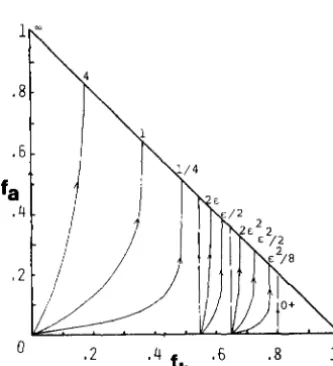
e-Z), 1 consecutively.2.3·13 This is reflected in thereac-tion trajectories for infinitesimal E, varying cblea (Fig. 1).
Corresponding behavior away from the limit is shown in Fig. 2 where ~oo, ~aQ'
r::a
correspond to reaction of CH3SOCHzNa onto atactic PMMA.14
Second we consider competition between two highly autoinhibitory reactions Q.--.a (with rates T, ET, CT for 0, 1,2
1 w
.2
a
.4 .6fa .8 1
FIG. 1. Random reaction O--b (and rate TCb ) competing with a highly au-toinhibitory reaction O-.a with rates T CQ, ETCQ, eTcQ for 0, 1,2 a-reacted nn and infinitesimal E. "Reaction trajectories" for various Cb/CQ are shown.
a-reacted nn where E<l) andO---+b (with rates T, ET, cTforO, 1,2 b-reacted nn). Thus b-reacted nn do not affect Q.--.a and vice versa. Here we have the symmetry property that if (fa.Jb)
= (8
1, 8z) is on thecblca=
a trajectory, then (fa'/b)=
(8z' 81) is on the Caleb = a trajectory. We have plotted the reaction trajectories, for infinitesimal E, in Fig. 3.As the trajectory behavior is complicated here, some features deserve further comment. When cblea
=
0(1), the first stage of the process corresponds to Q.--.a (and O---+b ) reac-tionwithnoa-(b-)reactednnandattheendofwhichr -Ja - Jb r(= s, say). The minimum s:::::;0.40803 occurs when cblca = 1 and the maximums:::::;!(l-
e-
Z):::::;0.432 33 whenC b I C a -0 or 00. At the end of this stage, "0" appears only in aOb or b Oa subconfigurations so clearly these then react such that 8h,18fa = cblca (i.e., the trajectories are linear). The zig-zag trajectory of the case where l>cblca >E is particu-larly interesting. Here reactions Q.--.a dominates up to con-version 8:::::; fa :::::;!(l -
e-
Z) where there are no remaining tri-ples 000. [Here3/aOOa :::::;/oo:::::;e-z, /aOa :::::;!(l - 3e-Z)]. Since further Q.--.a reactions would have at least one a-reacted nn instead O---+b now dominates creating aba, ab Oa, and
aOb~
configurations [SO/b increases to !(1 - e- z)]. Finally Q.--.aoccurs at remaining b Oa, aOb, subconfigurations.
FIG. 2. Almost random reaction O--b competing with an autoinhibitory reaction O-.a: 7"00 = 2.4, 7"aO = 0.14, ~o = 0.5,
r.:b
= 0.07,r.:Q
= 0.022, ~b = 0.25, ~ = 1, r"aO = 0.5,-r!o
= 1, ~b = 0.5, ~Q = 0.25,-r!b
= 1 for unit concentrations. Various cblcQ are shown. [image:5.609.319.476.57.219.2] [image:5.609.316.451.575.715.2]Evans. Hoffman. and Burgess: Irreversible reactions on polymer chains 939
.2 .4 fa .6 . 8 1
FIG. 3. Competition between two highly autoinhibitory reactions Q...a.
Q...b. Rates for (}-.a(b). respectively. are TCa(bl' ETCa(b)' CTCa(b) for O. 1.2
a(b )-reacted nn and infinitesimal E. Various Cblc. are shown.
The above discussion and Fig. 3 shows that reaction trajectories can interesect. This has important ramifications for formal density expansions.9
Similar crossing behavior a specific (nonlimiting) choice of rates is shown in Fig. 4.
An example of competition between autoinhibitory re-actions for physically reasonable rates! is shown in Fig. 5. Notice the similar features to the above limiting case. The unusual behavior of qaH vs qi>H' for various
cblc
a,de-scribed previously in a general context, is shown in Fig. 6. Various probabilities are plotted as a function of total con-version 8 =
fa
+
ib
forcblc
a = 0.25 in Fig. 7.III. OTHER COMPETING IRREVERSIBLE REACTIONS
The method of proof of the unreacted site shielding con-dition and corresponding exact hierarchy truncation proce-dure described for the special process of Sec. II have more general applicability. It is not difficult to see that if one can exactly solve the hierarchy equations separately for each of several types of competing irreversible events, then one can also solve them for a process involving competition between these. Here we consider only competition between
irrevers-FIG. 4. Trajectory crossing for different cblc. (shown): 1"00 = 1,1""" = 10-3• ~O = 1, r.:b = 10-3, 1" .. = O.1"bb = 1 for unit c •. For ~ let a .... b.
.2 .4 fa .6 .8
FIG. 5. Competition between two autoinhibitory reactions {}-.a, Q...b:
1"'00 = 1, 1""" = 0.04, ~o = 0.5, r.:b = 0.02, r.:. = 0.0016. 1"'bb = 0.25 • ~ = 1.
T!o
= 0.5,Tto
= 10-2, ~b = 10-2/2, ~. = 0.25, ~bb = 10-4 for
unit concentrations. Various cblc. are shown.
FIG. 6. Behavior of q.H vd qbH for the process of Fig. 5. Note that
TaO = TbO when cblc. = 46/49.
1
.8
.6
.4
.2
o
\ qo~~
\ \
\ \
fO~\
.2
\ \
\ \
\ \
.4
e
.6 .8 1FIG. 7. Various probabilities as functions of 9 =.f.,
+
J" for the process of Fig. 5 with cblc. = 0.25. Note that Cbb < 10-2• [image:6.609.57.257.52.265.2] [image:6.609.318.477.58.219.2] [image:6.609.314.497.287.461.2] [image:6.609.313.530.513.735.2] [image:6.609.54.202.596.728.2]940 Evans, Hoffman, and Burgess: Irreversible reactions on polymer chains
ible cyclization of (or binding to pairs of) nn sites OO----+bb and a single site reaction~, both with nn cooperative effects. The rates for OO---+bb (~) are denoted r!a'(~a') where (J, (J' = 0, a, b.
The hierarchial rate equations for the (translationally invariant) probabilities are
d Idtlo = - 2Ir!a' laOOa' - I~a' laOa" (3.la)
U,u' a,a'
d Idtla = I~a' laOa" (3.1b)
a,a'
a a
(3.1c)
where l:a denotes summation of (J over 0,
a,
b.For this process a triple of unreacted sites shield com-pletely, as may be shown by an analysis similar to Appendix A. Specifically, such an analysis shows that, e.g.,
and
qoona
=
ion+laliona=
qOOoo(=qo"'4)(")qa 0na = laonallona
=
qaooo(=qa",,,,,,,)for n;;.3 and (J = 0, a, b (3.2)
together with analogous identities for corresponding reflect-ed quantities (note that qo o;;-=q 0;;0)' Furthermore one has that
d Idt In qo",,,,,,, = (d Idtloooo)//oooo - (d Idtlooo)//ooo
= - (~oo
+
1""00) (3.3a)d Idt In qa",,,,'" = (d Idtlaooo)/Iaooo - (d Idtlooo)//ooo
= - (T~o
+
'T.:o)+
(qo",,,,,,,+
l)IT~qa",,,,,,,+
(qO"'''''''+
l)I1""aOqa"""'" qa",,,,,,, a(3.3b)
and a similar equation holds for q",,,,"'a' Note that
qo",,,,,,,
+
qa"'''''''+
qb"''''''' = 1, (3.4)which closes Eq. (3.3) for qo",,,,,,, , qa"'w Using Eqs. (3.1), (3.2), and (3.3) and conservation of a probability [e.g., Eq. (3.4)],an exact closed set of equations may be obtained for
10' 100' 1000'
lao ,I aOO ,Iaoa ,Iaooa' qo",,,,,,, , q a"''''''' 'and the corresponding reflected quantities. (Alternatively a closed set of equations could be obtained for a corresponding subset of/'s and q's involving only sites specified
°
and/or b.)Equations for other!,s can be added, e.g., that forla closes with the above set. Below we analyze several special cases for reaction on an initially completely unreacted polymer chain and for reflection invariant rates (and thus!,s). In the specific cases discussed below, we assume that the ~ rates are proportional to the a-reactant concentration Ca' The OO----+bb rates are assumed proportional to Cbb which represents a reactant concentration or is set to unity as, e.g., with cyc1iza-tion where no external reactant is involved. Rates prescribed below are for unit concentrations. Again "reaction
trajector-1 00
.8
.6
fa
.4
,2
o
.2 ,4 f ,6b
,8 1
FIG. 8. Competition between random reactions ~ with rate Ca and
fYJ-+bb with rate Cbb . Various CalCbb are shown.
ies" are plotted varying Ca/Cbb for several cooperatively re-gimes (usually in the appropriate limits).
First we consider the case where both ~ and OO----+bb occur randomly (with equal rates when CalCbb
=
1, say) (see Fig. 8). The low CalCbb regime might correspond to poison-ing of the Flory dimer fillpoison-ing problem [i.e., of poly(methyl-vinyl) ketone condensation] IS and the high CalCbb regime topoisoning of random single site reaction by cyclization. Sec-ond we consider the competition between a random reaction
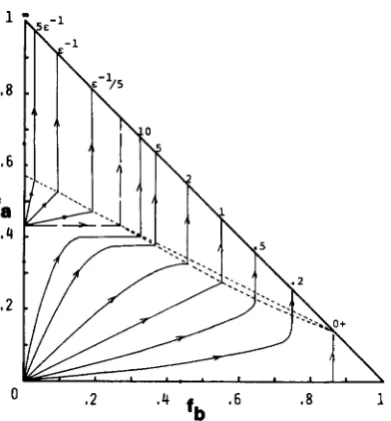
~ (all rates equal T) and a highly autoinhibitory reaction OO----+bb (with rates T, ET, ~T for 0, 1,2 b-reacted nn where E<l). When Ca = 0, OO----+bb reaction occurs in three stages: reaction of pairs of sites with 0, 1, 2 reacted nn and final conversions 0.549 10 ... , 0.648 68 ... , 0.802 22 ... , respectively. (These values were obtained from the analysis in Ref. 16 of the isomorphic process of monomer filling with nn blocking and highly autoinhibitory second nn rates.) This staged fill-ing behavior is reflected in the reaction trajectories varyfill-ing CalCbb . These are plotted, for infinitesimal E, in Fig. 9.
.6
fa .4
,2
o
.2 .4 f .6b .8 1
FIG. 9. Random reaction ~ (and rate TCa ) competing with a highly au-toinhibitory reaction fYJ-+bb with rates TCM , ETCbb , eTcbb , for 0, 1, 2
b-reacted nn and infinitesimal E. Various CalCbb are shown.
[image:7.616.315.462.59.212.2] [image:7.616.318.485.540.723.2]Evans, Hoffman, and Burgess: Irreversible reactions on polymer chains 941
1 •
,8
.6
".
fa ,4
,2
.2 .4 f .6
b .8 1
FIG. 10. Random reaction OO---.bb (and rate rcbb ) competing with a highly autoinhibitory reaction O--+a with rates rCa' ErCa , ilrca for 0, 1,2
a-react-ed nn and infinitesimal E. Various CalCbb are shown.
Finally we consider the competition between a highly autoinhibitory reaction
o-a
(with rates 7', E7', c-7', for 0, I, 2 a-reacted nn whereE<
I) and a random reaction OO---+bb (all rates equal 7'). Reaction trajectories, for infinitesimal E, plot-ted in Fig. 10. When Ca/cbb=
0(1), the first stage of the pro-cess corresponds to randomo-a
reaction at sites withno
a-reacted nn competing with random OO---+bb reaction. Note that when Ca = CbbJb =
21a
throughout this stage. This ob-vious from an "event lattice" picture of the process (see Fig.II) where OO---+bb is represented by ~b • on sites between the physical polymer sites. The process is "symmetric" in
o-aand~b·.
At the end of this stage the only remaining 0 sites have nn either a or b reacted so the process proceeds via
o-a
reac-tion to complereac-tion. The case where E-I>Ca/Cbb>1 is par-ticularly interesting. Here reactiono-a
dominates up to a conversion(};::::;Ia;::::;W -
e-2) where there are no remaining triples 000 and
laOOa
;::::;e-2• Since furthero-a
reactions would have at least one a-reacted nn, instead OO---+bb domi-nates (specifically, aOOa-+abba) soIb
increases to ;::::;2e-2• Finallyo-a occurs at the remaining aOa subconfigurations. Other features of Fig. 10 can be similarly explained.
IV. COORDINATION OF ZINC HALIDES WITH POL Y(PROPYLENE OXIDE): ANALYSIS OF GLASS TRANSITION TEMPERATURE DATA
Here we apply the model of the preceding section to analyze in detail a specific process involving ZnCI2
coordina-a b b b b a 0 a
I
I
I
I
I
I
I
I
I
I
a 0 0 b* 0 0 0 b* 0 0 a 0 0 0 a 0
tion to poly(propylene oxide). Observed behavior of the glass transition temperature (see below) is adequately reproduced (admittedly by appropriate choice of several parameters).
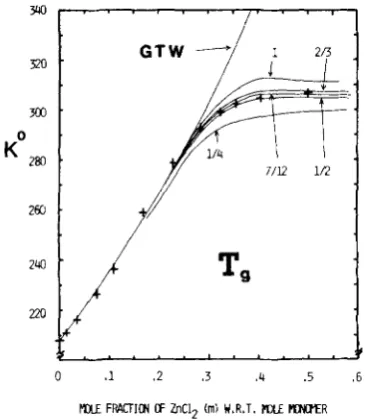
The temperature Tg at which a polymer undergoes a transition from a glassy/brittle state to a rubbery state is called the glass transition temperature. Considerable unres-tricted localized segmental (micro-Brownian) motion can occur above Tg • It has been shown that addition of metal salts to amorphous poly(propylene oxide) PPO(L) often creates a single phase complex with elevated Tg • 17 In Fig. 12, we have displayed the experimental Tg data of James et al. 18 for PPO(L)-ZnCI2 complexes prepared with various mole
fractions m of the salt [with respect to moles of the monomer repeat unit in PPO(L)].
The observation that Tg levels out at m~0.35 motivat-ed the working hypothesis that most ZnCI2 molecules are coordinated to two oxygen atoms (see Fig. 13), i.e., a single cyclization reaction OO---+bb, say, occurs. Elevation of Tg caused by the consequent stiffening of the polymer chain can be modeled by the Gordon-Taylor-Wood equationl8
•19
(4.1)
where Wbb(WO = I - Wbb ) are weight fractions of coordi-nated (uncoordicoordi-nated) units, respectively, so here Wbb :Wo
=
1261b: 5810' Also10
+
it,
=
I, m=
it,/2,
(4.2)and k = 0.3, T~ = 208 K, T~ = 400 K (the latter chosen to fit experimental data). Equations (4.1) and (4.2) repro-duce Tg accurately up to m~0.25 (see Fig. 13).
The limitation of the above analysis should be obvious. First we remark that above the value of m for which no further coordination occurs, ZnCI2 forms a second phase
and Tg should remain constant. Now if ZnCI2 coordination occurs only to pairs of oxygen atoms and is not autocatalytic, an upper bound onlb of I -
e-2 -0.846 (m -0.432) follows
from Flory's work.15 Since Tg still increases slightly above this value, James et al.18 conclude that ZnCI
2 must also be
able to coordinate to single units causing a further slight increase in Tg • Thus the process is actually of the type
de-scribed in Sec. III involving competition between coordina-tion to pairs OO---+bb and to single units
o-a,
the former having a much greater effect on Tg and dominating the pro-cess for low m. Consequently, we expect Tg to be described more accurately by a relationship of the formkWbb(Tg - T~)
+
k 'Wa(Tg - T;)+
Wo(Tg - T~) = 0, (4.3)where Wbb , Wa, Wo are the weight fractions of b-coordinat-ed, a-coordinatb-coordinat-ed, and uncoordinated units, respectively so Wbb: Wa: Wo = 1261b: 194/a :58/0' Equation (4.3) reproduces
b b a 0 FIG. 11. Competition between
I
I
I
I
I
random reaction dom reaction 0 ->ll OO---.bb except at sites andran-0 b* 0 0 a 0 0 with a-reacted n.1.
[image:8.609.56.252.55.266.2]942 Evans, Hoffman, and Burgess: Irreversible reactions on polymer chains
GTW - - 1 213 320
J
o
K
2807/12 112
2f{)
240
220
.1 .2 .3 .4 .5 .6
M.ll FMCfICflIF ZnC12 (m) W.R.T. rolE I'U'«J'£R
FIG. 12. Glass transition temperatures for ZnClz-PPO\L) complexes; + indicate experimental results of James et al. (Ref. 18); the GTW curve fol-lows from the Gordon-Taylor-Wood [Eqs. (4.1) and (4.2)]; other curves follow from our detailed competing process analysis (various values of the rate parameter a are shown).
the correct low m behavior irrespective of the as yet uncho-sen values of k' and T; since Wa ::::;0 there. Here Eq. (4.3) is supplemented by the relationships
10
+
fa+
Ib =
I, m=
J;,12+
fa (4.4) (the latter assumes all ZnCl2 are coordinated).Finally we consider the cooperativity required to repro-duce Tg • If~bb coordination was random (and initially dominated 0---+0), one would expect Eqs. (4.1) and (4.2) to be accurate up tolb~0.864 (m~0_432). Instead, marked devi-ation atlb ~O. 54 (m~0.27) suggests that ~bb occurs with highly autoinhibitory nn cooperative effects (no doubt, at least in part due to steric hindrance) whence oo..-.bb first occurs on sites with no coordinated nn up to conversionlb
~0.549 (see Sec. III). To achieve deviation for higher m, we assume that next the processes b OOOb-+bbb Ob or b Obbb and b OOOb-+b QaOb dominate and are competitive. Aftercomple-tion of this stage, we suppose that b OOb-+bbbb and b OOb-+baob are competitive and finally 0---+0 occurs on re-maining isolated unreacted sites. The details of the latter two stages are obviously speculative. The point we wish to em-phasize, however, is that analysis of the model of Sec. III is clearly required for a quantitative understanding of this pro-cess and can explain the observed behavior.
[image:9.609.52.235.59.269.2]To obtain explicit results from the model of Sec. III, the following somewhat arbitrary assignments are made. For Tg
FIG. 13. Coordination ofZnClz to a pair of oxygen atoms in poly(propy\ene oxide).
to be approximately constant T;~307° K at high m where
~fb = 0 and ~fa
+
~fo=
0, Eq. (4.3) implies 194 k' (T. - T;) = 58 (T; - T~). Here we choose k '.= 1 so T;= g275° K. The cooperativity described above IS modeled
choosing~. to be reduced from ~oo by a factor of € for each a
or b reacted nn,
€<
I, and ~./~oo equal to €/a times a further factor of € for each a or b reacted nn. Here we set €=
1/50 and a is varied to obtain the best fit to experimental data of ::::;7/12 (see Figure 12). Note that changing k' to 1/2 has negligible effect on the a = 7/12 curve but causes those for higher and lower a to spread slightly more.In conclusion, we note that our model provides quite a good fit to the experimental data. We recognize however that the observed behavior could, in part, be due to other features not included. For example, coordination ofZnCl2 to
a pair of oxygen atoms could have intrinsically more e~ect on the flexibility of the chain, and thus on Tg , when no
neIgh-boring oxygen atoms are already coordinated.
V. DISCUSSION
Although the processes considered here have much more structure than those analyzed previously with a single type of reaction, in certain fundamental cases we have still been able to obtain exact solutions. The use of an un reacted site shielding property was central to achieving the required exact hierarchy truncation. Although all previous detailed analyses of irreversible cooperative processes on polymer chains deal with single reactions, there are doubtless many cases where this is an oversimplification_ Also competitive reaction offers the possibility of creating copolymers of var-ious compositions and hopefully the results presented here would facilitate such preparations. Given the generality of the applicability of these models, most of the specific results presented were for several generic types of competitive reac-tion. However, the analysis provided of ZnCl2 coordination
on PPO(L) illustrates their utility in treating specific cesses. We also remark that results obtained here should pro-vide insight to the behavior of corresponding processes on higher dimensional lattices, e.g., competitive irreversible coadsorption on a W (substrate) lattice. Approximate hier-archy truncation techniques could be developed from those of Ref. 3.
APPENDIX A
Let On denote an
n
tuple ofunreacted sites. Then using3d Idt In q -. = S(a
+
a') - S(a'), (AI)'NT
where S (a")
=
(d 1 dtj,,-)I fa- , and suitably rewriting terms on the right-hand side where appropriate, one obtains, forn;;.2,
N
d Idt In qoo;; = - 1~/'IO(ql 0.+ 1 - ql 0;;)
N
- LTodq~/-qo)
1=0 n+ "
(A2a)
(and note that qo
o;;=q
0;;0)Evans, Hoffman, and Burgess: Irreversible reactions on polymer chains 943
N
dldt In qiOn
= -
L
Todhlk -qok)k=O " n
N
N
- TiO
+
L
Tkoqk 0;;-k=Od Idt In qiOnj
=
L
T6dq iO"k - q o;;k) k=ON
- TiO
+
L
Tkoqk Onj k=ON
(A2b)
+
L
~oqk ~orlq'r' iJfO.k = 0 n + 11 "' , " ,
(A2c)
Analogous reflected sets of equations hold for q o;;i and q jOni' i,j:fO.
By inspection, it is clear that a set of solutions to these equations satisfies.
qoO;;-
=
%00'
qiO;;-=
qiOnj=
qiOO' i:;60 for n>2.We assume this is the unique solution.
APPENDIXB
Using Eq. (2.5), it is convenient to rewrite Eq. (2.4b) as
N
d Idt q/"""
=
L
(TkO - T/O)qk"""q/""" k=ON
+
L
-r{oqk"""qQ#' k=O(BI)
SupposethatT/oo <TkO fork = 1, 2, ... N (except for! *). Then from Eq. (BI),
d Idt q/o",,,, = (Too - T/oo)qoq,,,,q/o,,,,,, N
+
L
(TkO - T/oO)qk"""q/o",,,, k=O+
positive terms, (B2)where the second term is also strictly positive (for finite time). If also T/ oo <,Too, then d Idt q/o",,,, > 0 for t
<
00 so q /0""" It = 00>
O. Suppose next that Too<
T/oo, and thatq/o"",,--D as t--+oo. Then clearly the first (negative) term in
Eq. (B 1) must dominate the others for large t. However since q k 0""" It = 00
>
0 for some k*
and(TkoO - T/oO)qko",,,,q/o,,,,,,>(T/oo - Too)qo",,,,q/o,,,,,, (B3)
for large times, this is not possible. Thus we conclude, in this case also, that q/o""" It = "" > O.
Now from Eq. (B2) at t = 00, we have
N
L
(TkO - T/oO)qk",,,, It= 00 = 0,k=1 #/0
(B4)
where all q coefficients are positive. From this we conclude that qk"''''
I,
= 00 = 0, k ;61*.
It should be clear that when several T/o , I € L
(C [I, 2, ... ,N
J)
are equal and less than the rest, thenq/"""
1,=
00 >0 only for these I € L.Ipaul Rempp, Pure Appl. Chern. 46, 9 (1976); E. A. Boucher, Prog. Polym. Sci. 6, 63 (1978); N. A. Plate and O. V. Noah, Adv. Polym. Sci. 31, 133 (1979).
2M. Higuchi and R. Senju, Polym. J. 3, 370 (1972).
3J. W. Evans, D. R. Burgess, and D. K. Hoffman, J. Chern. Phys. 79, 5011 (1983).
4E. A. Boucher, Faraday Trans. 269, 1839 (1973); I. I. Gonzalez, P. C. Hemmer, and I. S. H0ye, Chern. Phys. 3, 228 (1974).
51. R. Epstein, Biolypolymers 18, 765 (1979).
6N. O. Wolf, Ph.D. thesis, Iowa State University, 1979.
7Treatments of finite polymers often use recursive, combinational tech-niques. See, for example, I. K. McKenzie, I. Chern. Phys. 37, 723 (1962); M. Gordon and I. H. HiJlier, ibid. 38, 1376 (1963).
81. I. Gonzalez and P. C. Hemmer, Polym. Lett. Ed. 14, 645 (1976); I.
Chern. Phys. 67, 2496, 2509(1977).
91. W. Evans, Physica A (in press).
101. B. Keller, I. Chern. Phys. 38, 325(1963), and references therein; R. L. Dobrushin, Probl. Pered. Inform. 7, 57 (1971).
liN. A. Plate, A. O. Litmanovich, O. V. Noah, A. L. Toom, and N. B. Vasileyev, I. Polym. Sci. 12,2165(1974).
121. W. Evans, D. R. Burgess and D. K. Hoffman, I. Math. Phys. (submit-ted).
I3N. O. Wolf, D. R. Burgess, and D. K. Hoffman, Surf. Sci. 100, 453 (1980). 140. R. Burgess, Ph.D. thesis, Iowa State University, 1982, which reeva-luates the rates for reaction ofCH3SOCH2Na onto atactic PMMA given by Rempp (Ref. I).
15p. I. Flory, I. Am. Chern. Soc. 61,1518(1939).
16
1. W. Evans and D. R. Burgess, I. Chern. Phys. 79, 5023(1983). 17 A. Eisenberg, Macromolecules 4, 125 (1971); A. Eisenberg and M. King,
Ion Containing Polymers, Polymer Physics, edited by R. S. Stein
(Aca-demic, New York, 1977), Vol. 2.
180. B. lames, R. E. Wetton, and D. S. Brown, Polymer 20,187 (1979). 19M. Gordon and I. S. Taylor, I. Appl. Chern. 2,493(1952); L. A. Wood, I.
Polym. Sci. 28, 319(1958).