International Journal of Innovative Technology and Exploring Engineering (IJITEE) ISSN: 2278-3075, Volume-8 Issue-12, October 2019
Moth-Dolphin Optimization Algorithm: A Nature
Inspired Technique
Amit Kumar, Sanjay Singla, Meenakshi Sharma, Shakti Kundu
AbstractThis paper proposes a moth-dolphin based nature inspired optimization algorithm. This algorithm embeds the communication behavior of dolphin to Moth. The Moth route towards moon through the moon light in an optimized manner. But each moth doesn’t follow optimized path to travel towards the moon. The communication among the moth enables them to follow the best path towards moon. Thus, moth-dolphin algorithm uses the communication between moths to enhance the performance. The Moth–dolphin is an optimization algorithm which uses the exploration as well as exploitation search to achieve the global optima. The performance comparison of proposed algorithm with the moth-flame optimization algorithm, modified particle swarm optimization algorithm, differential evaluation and non-dominated sorting genetic algorithm over unimodal as well as multimodal functions ensures better results.
Keywords: Optimization, Moth, Moth-flame, Dolphin, Global Optima.
I. INTRODUCTION AND MOTIVATION FOR
RESEARCH
Optimization is a technique to find the global optima i.e. best solution(s) possible for any particular problem. The complexity of problems is increasing everyday due to the advancement of technology. Initially the optimization problems are solved mathematically but this leads to the convergence towards local optima. This requires new optimization algorithms to avoid local optima and move towards the global optima. The new optimization algorithms use the heuristic search to avoid the local optima. The current researches suggest using the natural computing for the heuristic search [1].
Natural Computing is a field of research that declarations against the specialization of orders in science. It appears, with its three principle regions of examination, that information from different fields of research are important for a superior comprehension of life, for the review and reproduction of characteristic frameworks and forms, and for the proposition of novel registering ideal models. Physicists, scientific experts,
Revised Manuscript Received on October 05, 2019.
Amit Kumar, Research Scholar, Department of Computer Science & Engineering, PTU University, Jalandhar, Punjab, India.
Sanjay Singla, Department of Computer Science & Engineering Guru Gobind Singh College of Modern Technology, Kharar, Mohali, Punjab, India. [email protected]
Meenakshi Sharma, Department of Computer Science & Engineering, Chandigarh University, Kharar, Mohali, Punjab, India. [email protected]
Shakti Kundu, Faculty of Engineering & Computing Sciences, Teerthanker Mahaveer University, Moradabad, Uttar Pradesh, India.
engineers, researcher, PC researchers, among others, all need to act together or possibly share thoughts and information with a specific end goal to make normal registering practical.
The greater part of the computational methodologies common processing manages depends on exceedingly streamlined variants of the instruments and procedures introduce in the comparing normal wonders. The purposes behind such improvements and deliberations are complex. As a matter of first importance, most disentanglement is important to make the calculation with an extensive number of elements tractable. Likewise, it can be profitable to highlight the insignificant components important to empower some specific parts of a framework to be recreated and to watch some eminent properties. These eminent properties lead to the use of the nature inspired algorithms for heuristic search. So, nature inspired techniques can be used for optimization [2].
The next section covers the MFOA algorithm followed by the section containing detail of dolphin. Then moth-dolphin algorithm and its performance evaluation have been done in next two sections.
II. MOTH -FLAME OPTIMIZATION
ALGORITHM
Moth is a type of butterfly and it uses the moon radiance (light) to route towards the moon. The routing of the moth comprises of straight as well as the spiral motion depending upon whether the moon(destination) is far or near from the current position of moth. This phenomenon of routing of the moth towards the moon can be used to in sensor network to transfer the data from source to the destination in an optimized manner [1]. This section describes the moth-flame optimization algorithm as follow
In the MFOA, n moths are travelling towards the moon in d dimensions then the position matrix can be given shown as eq. 1.
(1)
The evaluation of the position of the moth can be done by using the objective (fitness) function and corresponding matrix is given in eq. (2).
(2)
The best position in the matrix of equation (1) can be found by analyzing the corresponding values in eq. (2) (best solution can be minimum or maximum value depending upon the problem). The best position vector is the form of a matrix (known as flame matrix) displayed in eq. (3).
(3)
The corresponding values of the objective function in shown in the equation (4)
(4)
When the moth reaches nearer to the moon then the moth starts to follow the spiral motion which can be specified by using eq.(5) as shown:
(5)
The MPi,idenotes the updated position using the spiral motion while the b is a constant to define shape of the motion. The t is used to define the moth and flame relationship if the value of t is 1 then the moth follows the flame, resulting the best possible position near the flame is selected otherwise the moth selects the best far position from the flame. This updated position is used to move towards the optimization. The number of flames is
decreasing with the increase in iteration which can be represented by eq. (6)
(6)
Where the total number of iterations and the current iteration number is given by theMAXitr and itrnorespectively [1]. This process is used attain the global optima. The detail of dolphin has been described in next section.
III. DOLPHIN
International Journal of Innovative Technology and Exploring Engineering (IJITEE) ISSN: 2278-3075, Volume-8 Issue-12, October 2019
(7)
EQ calculations consider allometric impacts, which detail that the skeleton turns out to be especially more hearty and enormous in connection to the extent of the body as the last increments.
It is conjectured that EQ gives a gauge of the knowledge level or discernment of a specific creature. The normal human cerebrum weighs around 1.3 kg, yet the bottlenose dolphin mind, averaging 1.7 kg, is around 25% heavier. The bigger brains of dolphins and whales may be because of their bigger bodies. Current people have the most astounding EQ: around 7, so our brains are around 7 times the size one would expect for a creature of our body estimate. Yet, numerous dolphins have EQs in the 4–5 territory, tantalizingly near the present day human level, and essentially higher than every other creature. Like people, dolphins are, unquestionably, brainiacs of the set of all animals. Due to such emanant properties dolphin can be mimicked for the optimization process discussed in next section.
IV. MOTH DOLPHIN OPTIMIZATION
ALGORITHM
The previous section describes the dolphin and its various features. The Dolphins, similar to people, have expansive brains, live in obviously complex social gatherings, and speak with a broad collection of acoustic signs [17][18]. This paper embeds the communication behavior of the dolphin to the Moth, resulting. The moth follows the flames already described in the section 2 to travel towards the moon. Each moth follow different path based on its conditions. Here, Moth can communicate with each other and the best path as well as the worst path can be communicated among all Moth. This process leads to the position updation of the moth towards the best path to the moon. This can be denoted by the eq. (8)
(8)
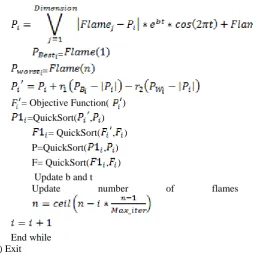
Here, the current position of the moth is updated which moves towards the best route position and avoids the worst route. This updated position is selected only if the corresponding fitness value is better than the existing fitness value. The detail procedure is shown in the form of algorithm given in next subsection.
Algorithm: a) Initialize each Moth
For i=1:n
For j=1:Dimension
Pi,j= random point within given region End
Fi = Objective Function( Pi) End
b) [Flame_F index]=sort(F) c) Flame=P(index)
d) Initiate Iteration say i=1 e) While
FPi = Objective Function( Pi)
= Objective Function( ) =QuickSort( , )
= QuickSort( , ) P=QuickSort( , ) F= QuickSort( , ) Update b and t
Update number of flames
End while f) Exit
The above algorithm follows the flame for the optimization along with the position updation based on worst and best position. This algorithm must converge towards the global optima due to use of exploration as well as exploitation search. The initialization process uses the exploration search. While the position updation uses the exploration as well as the exploitation along with the convergence. The performance analysis of the algorithm is done in next section.
V. PERFORMANCE EVALUATION
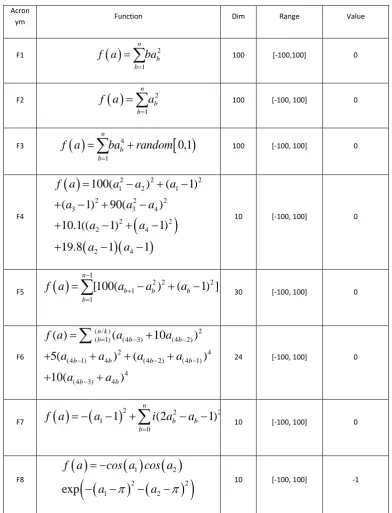
[image:3.595.309.563.45.301.2]Table 1: Unimodal Benchmark Functions
Acron
ym Function Dim Range Value
F1
21
n bb
a
f
ba
100 [-100,100] 0F2
21
n bb
a
f
a
100 [-100, 100] 0F3
4
1
0,1
n b
b
f
a
ba
rand m
o
100 [-100, 100] 0F4
2 2 2
1 2 1
2 2 2
3 3 4
2 2
2 4
2 4
100(
)
(
1)
(
1)
90(
)
10.1((
1)
1)
19.8
1
1
f
a
a
a
a
a
a
a
a
a
a
a
10 [-100, 100] 0F5
1
2 2 2
1 1
[100(
)
(
1) ]
n b
b
b
b
a
a
a
a
f
30 [-100, 100] 0F6
( / ) 2
( 1) (4 3) (4 2)
2 4
(4 1) 4 (4 2) (4 1) 4
(4 3) 4
( )
(
10
)
5(
)
(
)
10(
)
n kb b b
b b b b
b b
f a
a
a
a
a
a
a
a
a
24 [-100, 100] 0
F7
2 2 2
1
0
1
(2
1)
n b
bb
i a
a
a
a
f
10 [-100, 100] 0F8
21 2 2
1 2
exp
a
a
f
a
a
a
cos
cos
10 [-100, 100] -1
International Journal of Innovative Technology and Exploring Engineering (IJITEE) ISSN: 2278-3075, Volume-8 Issue-12, October 2019
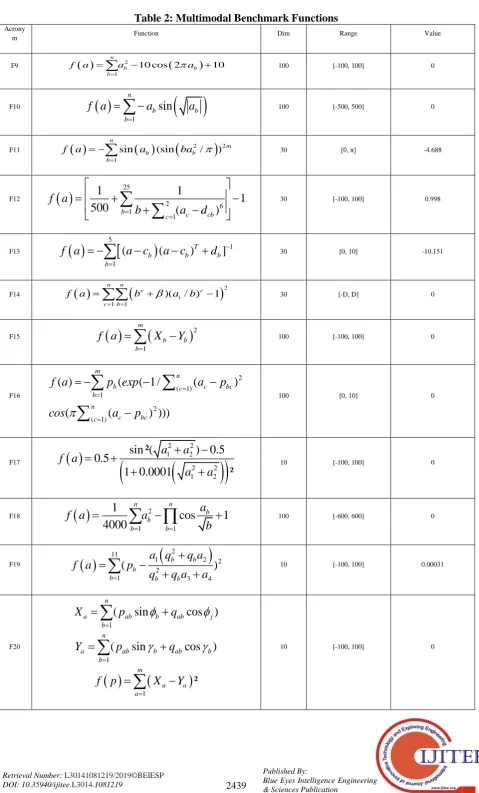
Table 2: Multimodal Benchmark Functions
Acrony
m Function Dim Range Value
F9
2
1
10 cos 2 10
n b b b
a a
a
f 100 [-100, 100] 0
F10
1
sin
n
b bb
a
a
a
f
100 [-500, 500] 0F11
2
21
sin (sin /
)
n mb b
b
ba
a a
f 30 [0, π] -4.688
F12
25 2 6 1 1
1
1
1
500
(
)
b
c cb
c
a
a
f
b
d
30 [-100, 100] 0.998
F13
5
1 1
(
(
)
]
b
T
b b
b
f
a
a c
a
c
d
30 [0, 10] -10.151F14
2
1 1
)( / ) 1
c n n
i c b
c
f a b a b 30 [-D, D] 0
F15
21
m
b
b b
a
X
f
Y
100 [-100, 100] 0F16 2 ( 1) 1 2 ( 1)
( )
(
( 1/
(
)
(
(
) )))
m n c bc c b n c bc c bf a
p
exp
a
p
cos
a
p
100 [0, 10] 0
F17
2 2 1 2 2 2 1 2sin ²(
) 0.5
0.5
1 0.0001
²
a
a
a
a
a
f
10 [-100, 100] 0F18
21 1
1
cos
1
4000
n
n b
b b b
a
a
f
a
b
100 [-600, 600] 0
F19
2 11
1 2 2
2
1 3 4
(
)
b bb
b b b
q
f
p
a q
a
a
a
a
q
q
10 [-100, 100] 0.00031
F20
1
(
sin
cos
)
n ab b
ab jb
a
p
X
q
1
(
sin
cos
)
a b b
n ab ab b
p
Y
q
1²
m
a
a a
p
X
f
Y
Table 2 presents several multimodal functions. The
description contains the dimension, range and value.
Each function has been assigned an acronym to be
used for notation in the rest paper. The comparison of
mean and the standard deviation for the score obtained
on the different benchmarks functions described in
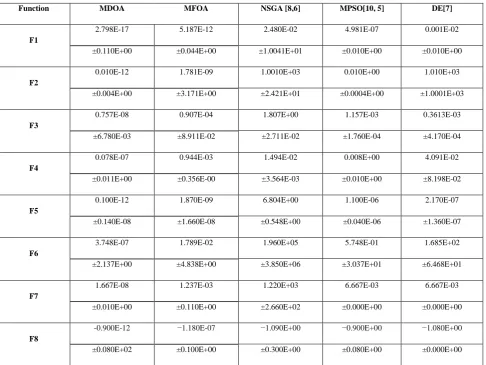
[image:6.595.57.544.146.511.2]table 1 and table 2 are shown in the table 3 and table 4
respectively. The process is repeated for the 1000
iteration in each algorithm. The number of moths is
300 while all the other parameters are taken as used by
corresponding authors.
Table 3: Performance Evaluation on Unimodal Functions
Function MDOA MFOA NSGA [8,6] MPSO[10, 5] DE[7]
F1
2.798E-17 5.187E-12 2.480E-02 4.981E-07 0.001E-02 ±0.110E+00 ±0.044E+00 ±1.0041E+01 ±0.010E+00 ±0.010E+00
F2
0.010E-12 1.781E-09 1.0010E+03 0.010E+00 1.010E+03 ±0.004E+00 ±3.171E+00 ±2.421E+01 ±0.0004E+00 ±1.0001E+03
F3
0.757E-08 0.907E-04 1.807E+00 1.157E-03 0.3613E-03 ±6.780E-03 ±8.911E-02 ±2.711E-02 ±1.760E-04 ±4.170E-04
F4
0.078E-07 0.944E-03 1.494E-02 0.008E+00 4.091E-02 ±0.011E+00 ±0.356E-00 ±3.564E-03 ±0.010E+00 ±8.198E-02
F5
0.100E-12 1.870E-09 6.804E+00 1.100E-06 2.170E-07 ±0.140E-08 ±1.660E-08 ±0.548E+00 ±0.040E-06 ±1.360E-07
F6
3.748E-07 1.789E-02 1.960E+05 5.748E-01 1.685E+02 ±2.137E+00 ±4.838E+00 ±3.850E+06 ±3.037E+01 ±6.468E+01
F7
1.667E-08 1.237E-03 1.220E+03 6.667E-03 6.667E-03 ±0.010E+00 ±0.110E+00 ±2.660E+02 ±0.000E+00 ±0.000E+00
F8
-0.900E-12 −1.180E-07 −1.090E+00 −0.900E+00 −1.080E+00
±0.080E+02 ±0.100E+00 ±0.300E+00 ±0.080E+00 ±0.000E+00
International Journal of Innovative Technology and Exploring Engineering (IJITEE) ISSN: 2278-3075, Volume-8 Issue-12, October 2019
Table 4: Performance Evaluation on Multimodal Functions
Function MDOA MFOA NSGA [8,6] MPSO[10, 5] DE[7]
F9
-1.239E-12 -1.0266E-08 -1.159E-02 -6.909E-7 -1.0266E-04 ±1.875E-02 ±2.208E-02 ±3.325E+01 ±6.790E+02 ±3.208E+02
F10
1.373E-09 0.225E-05 4.292E-01 1.681E-01 0.172E-01 ±2.564E-03 ±1.538E-01 ±4.564E+00 ±7.412E+00 ±2.538E+00
F12
6.993E-10 1.034-03 9.890E-03 9.890E-03 9.890E-03 ±0.110E-02 ±0.540E-01 ±0.010E+00 ±0.030E+00 ±0.040E+00
F13
-1.652E-09 -0.315E-03 -3.661E-02 -1.087E-01 -0.715E-01 ±2.121E-03 ±0.309E-02 ±4.877E+00 ±5.878E+00 ±0.009E-08
F14
0.419E-09 3.786E-06 1.927E-04 3.605E-03 1.301E-03 ±0.478E-01 ±2.137E-02 ±1.933E-01 ±4.893E-02 ±4.603E-02
F15
0.100E-29 0.070E-12 0.110E-08 0.070E-05 0.110E-07 ±0.110E-02 ±0.600E-01 ±0.110E-09 ±0.600E-08 ±0.400E-04
F16
-2.694E-07 -1.423E-04 -7.694E-03 0.100E-08 -1.181E-03 ±1.101E-03 ±1.812E-02 ±1.865E-02 ±0.010E+00 ±1.551E-04
F17
1.139E-13 1.189E-09 2.139E-03 5.760E-03 0.010E+00 ±3.834E-03 ±3.785E-03 ±3.839E-03 ±1.000E-02 ±0.110E-01
F18
0.794E-09 0.183E-05 0.083E-01 9.877E-05 0.108E-03 ±1.161E-01 ±2.291E-01 ±0.161E+00 ±1.158E-02 ±8.470E-04
F19
1.927E-11 1.187E-05 3.827E-03 3.976E-04 3.176E-05 ±0.981E-05 ±8.781E-05 ±7.971E-05 ±1.860E-04 ±1.730E-05
F20
1.457E+03 4.303E-03 4.303E-03 1.457E-02 5.989E+00 ±1.269E+03 ±9.469E-03 ±9.469E-03 ±1.269E-02 ±7.334E+00
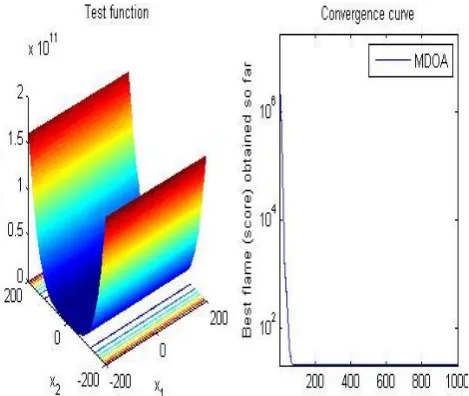
Figure 1. Unimodal Test Function and Convergence Curve of MDOA
Figure 2. Multimodal Test Function and Convergence Curve of MDOA
The convergence curve shown for multimodal and the unimodal function, converges in less than 100 and less than 200 iterations in the unimodal and multimodal functions respectively. The better performance of the proposed algorithm is better than other state of art techniques due to the use of exploration and exploitation search.
VI.
CONCLUSIONThis paper proposes a moth-dolphin based optimization algorithm. The proposed algorithm hybrid the routing behavior of moth and communication behavior of dolphin to achieve the global optima. The dolphin behavior enables moth to select the best path and to avoid the worst path i.e. to avoid the local optima and to achieve the global optima. The performance comparison of the algorithm is done latest stable version of the genetic algorithm, particle swarm optimization i.e. non dominated sorting genetic algorithm and modified particle swarm optimization. The algorithm is also compared with moth flame optimization and differential evolution over 20 unimodal and multimodal functions. The better performance of the algorithm as compared to existing state of art techniques proves significance of the algorithm. In future, MDOA can be applied in various application areas including routing, feature selection etc.
REFERENCES
1. Mirjalili S.: “Moth-flame optimization algorithm: A novel nature-inspired heuristic paradigm”, Knowledge-Based Systems, Volume 89, pp. 228-249, 2015.
2. de Castro L. N.: “Fundamentals of natural computing: an overview”, Physics of Life Reviews, Volume 4, Issue 1, pp. 1-36, 2007.
3. Rashedi E., Nezamabadi-Pour H. and Saryazdi S.: “GSA: A gravitational search algorithm”, Information Sciences, Volume 179, Issue 13, pp. 2232-2248, 2009.
4. Mirjalili S., Mirjalili S. M. and Lewis A.: “Grey wolf optimizer”, Advances in Engineering Software, Volume 69, pp. 46-61, 2014. 5. Eberhart R. C. and Kennedy J.: “A new optimizer using particle swarm
theory”, Proceedings of the sixth international symposium on micro machine and human science, pp. 39-43, 1995.
6. Goldberg D. E. and Holland J. H.: “Genetic algorithms and machine learning”, Machine learning, Volume 3, Issue 2, pp. 95-99, 1998. 7. Storn R. and Price K.: “Differential evolution–a simple and efficient
heuristic for global optimization over continuous spaces”, Journal of global optimization, Volume 11, Issue 4, pp. 341-359, 1997.
8. Deb K., Pratap A., Agarwal S. and Meyarivan T. A.: “A fast and elitist multiobjective genetic algorithm: NSGA-II”, Evolutionary Computation, IEEE Transactions, Volume 6, Issue 2, pp. 182-197, 2002.
International Journal of Innovative Technology and Exploring Engineering (IJITEE) ISSN: 2278-3075, Volume-8 Issue-12, October 2019
10. Vieira S. M., Mendonça L. F., Farinha G. J. and Sousa J. M.: “Modified binary PSO for feature selection using SVM applied to mortality prediction of septic patients”, Applied Soft Computing, Volume 13, Issue 8, pp. 3494-3504, 2013.
11. Marino L.: “Dolphin cognition”, Curr. Biol., 14, R910–R911, 2004. 12. Connor R. C., Heithaus M. R. and Barre L. M.: “Complex social
structure, alliance stability and mating access in a bottlenose dolphin „super-alliance‟”, Proc. R. Soc. Lond. B 268, pp. 263–267, 2001. 13. Lilly J. C.: Man and Dolphin (New York: Doubleday), 1961.
14. Fripp D., Owen C., Quintana-rizzo E., Shapiro A., Buckstaff K., Jankowski K., Wells R. S. and Tyack P.: “Bottlenose dolphin (Tursiops truncatus) calves appear to model their signature whistles on the signature whistles of community members”. Anim. Cog, Volume 8, pp. 17–26, 2005.
15. Janik V. M.: “Whistle matching in wild bottlenose dolphins” (Tursiops truncatus), Science Volume 289, pp. 1355–1357, 2000.
16. Weilgart L. and Whitehead H.: “Group-specific dialects and geographical variation in coda repertoire in South Pacific sperm whales”, Behav. Ecol. Sociobiol., Volume 40, pp. 277–285, 1997. 17. Rendell L. and Whitehead H.: “Culture in whales and dolphins”,
Behav. Brain Sci., Volume 24, pp. 309–382, 2001.
18. Janik V. M., Saigh L. S. and Wells R. S.: “Signature whistle shape conveys identity information to bottlenose dolphins”, Proc. Natl. Acad. Sci. USA, Volume 103, pp. 8293–8297, 2006.
AUTHORS FROFILE
Dr. Amit Kumar, working in University Computer Informatics Centre (UCIC) at Chaudhary Ranbir Singh University (CRSU), Jind, Haryana, India. He received his Ph.D. in Computer Science and Engineering from I.K. Gujral Punjab Technical University, Jalandhar (Punjab), India in 2019, M. Tech. & B.Tech. degree in Computer Science and Technology from Guru Jambheshwar University of Science & Technology, Hisar in 2010 and 2008 respectively. His current research interests include the implementation of routing protocols using Natural Computing Technique for Wireless Sensor Networks.
Dr. Sanjay Singla, is Head of department in Department of Computer Science & Engineering at IET Bhaddal Technical Campus, Ropar, Punjab. He has more than 10 years of Teaching/Research/Administration Experience. His research areas are Network and Routing Technique, Advance Operating System and Network Security.
Dr. Meenakshi Sharma, is working as Associate Professor and Research Coordinator at Chandigarh University, Mohali, Punjab, India. She has been awarded with Ph.D. in Computer Science and Engineering from Kurukshetra University in 2012 and received M.Tech in Computer Science and Engineering from Kurukshetra University, Kurukshetra. Her research interests are Data compression, Digital Image Processing and data warehousing. Her research contributions include publications of 96+ research papers in repute international journals and international / national conferences.
![Table 4: Performance Evaluation on Multimodal Functions MDOA MFOA NSGA [8,6] MPSO[10, 5]](https://thumb-us.123doks.com/thumbv2/123dok_us/8166000.250970/7.595.60.540.57.557/table-performance-evaluation-multimodal-functions-mdoa-mfoa-nsga.webp)