International Journal of Innovative Technology and Exploring Engineering (IJITEE) ISSN: 2278-3075, Volume-8 Issue-12, October 2019
Abstract: Concrete is the most widely used composite material today. The constituents of concrete are coarse aggregate, fine aggregate, binding material, and water. A rapid increase in construction activities leads to an acute shortage of conventional construction materials. Conventionally, sand is being used as fine aggregate in concrete. The function of the fine aggregate is to assist in producing workability ad uniformity in the mixture.
The river deposits are the most common source of fine aggregate. So there are great demands within the construction industries for river sand as fine aggregate used in the production of concrete. This has created a very difficult situation, also there is great fear from environmentalist and the ecology will be distorted. Hence, the need to find the materials which are affordable and available partially or totally replaced river sand in the production of concrete. Hence we are forced to think the alternative materials.
This report aims to present the study done to establish scientific data regarding the compressive strength, tensile strength and flexural strength of concrete on partial replacement of fine aggregate with laterite soil in concrete mix of M50 grade. The sand shall be replaced gradually in the mentioned grade of concrete by 0%, 10%, 20% and 30% with laterite soil and the specimen shall be tested at curing intervals of 3days, 7days, and 28days. For compressive strength and at curing interval of 3days, 7days, and 28days for tensile strength as well as for flexural strength.
Keywords- Laterite soil, steel fibers, super plasticizer (conplast Sp-430)
I. INTRODUCTION
Visual observation of the laterite material shows that the variation of sand is much sharper than those considered in previous works. This is confirmed by the preliminary assessment of its particle size distributions. There is, therefore, every reason to believe that this lateritic sand can be used in structural concrete production. The particle sizes of aggregates are known to affect the strength properties of concrete greatly. In related developments, substantial quantities of lateritic soil are found in heaps around the low as a replacement material in concreting operations. The focus of a good national development is to look inward with the intent to mobilize all-natural resources for economics purposes. One of the policy thrusts of the present government is to provide affordable housing for the people.
Compressive strength is arguably the most widely used strength parameter for concrete. This may be due to the nature
Revised Manuscript Received on October 05, 2019 * Correspondence Author
Shaik Manzoor Ilahi, Department of Highway Technology, VTU Regional Centre for PG studies, Kalaburagi, India.
Maneeth P D, Assistant Professor, Department of Civil Engineering, VTU Regional centre for PG studies, Kalaburagi, India.
of concrete, being strong in compression and weak in tension. The use of lateritic as a partial sand replacer can help achieve this purpose and impact positively in reducing the cost of building materials. This study aims to proper documentation of the material to support their specification in design and construction.
II. OBJECTIVES
The objective of this study is to determine the strength of concrete by partially replacing river sand with laterite sand at 0%, 10%, 20%, and 30% and curing they concrete for 3days, 7days, and 28 days for compressive strength, tensile strength as well as for flexural strength.
Preparing the normal concrete by utilizing normal quality river bedded sand of Shapur and ascertaining its strength via methods prescribed by applicable IS Codes of testing
Comparing the strength development of concrete and ascertaining the feasibility of using laterite soil concerning practically and economy of the study. To conclude the effect of lateralized concrete
concerning its adaption to normal mixes for equivalent gain of strength and economy of the mix so created.
III. LITERATUREREVIEW
Biju Mathew, Dr. Freeda Christy C, Souyma C, Dr. Benny Joseph: In this investigation, a study conducted to determine the suitability of partial replacement of sand with laterite soil and manufactured sand in M20 grade concrete. Concrete mixes containing 0%, 10%, 20%, 30%, and 40% sand replacement levels were cast, with super plasticizer. Split tensile strength, compressive strength test, and flexural strength test conducted. Results show a maximum of 20% replacement levels of sand by laterite attained workable concrete with satisfactory strength.
Shuaibu R.A, Mutuku R.N, and Nyomboi T
The research shows that the results of laterite soil make concrete less workable. However, laterite soil produced concrete that compares in strength with a normal concrete. It also showed that laterite soil can enhance some properties of concrete depending on the nature of the laterite and also blended material.
Joseph O. Ukpata, Maurice E. Ephraim, Godwin A. Akeke: In this investigation, a study the results of concrete mix with partial replacement of fine aggregate by laterite soil and simultaneous partial replacement of coarse aggregate by laterite stone aggregate respectively on compressive strength, split tensile strength, flexural
strength, and workability of concrete. Concrete mixes
“Partially Replacement of Fine Aggregate with
Laterite Soil for M-50 Concrete”
containing 0%, 10%, 20%, 25 %, and 30%, replacement (by weight) of fine aggregate with laterite soil and simultaneously 25% replacement of coarse aggregate (by weight) with laterite stone were cast in lab and checked for compressive strength, split tensile strength, flexure strength and workability . This replacement results in making the concrete more economically available.
Jushua O, Amusan L.m, Fagbenie O, Kukoyi P.O In this investigation, the lateritic soil could be utilized in hollow sand Crete block production in Ota, Ogun State, Nigeria. Sand Crete blocks were made with lateritic soil taken from different sources replacing the conventional fine aggregate (local river sand) in steps of 10% up to 60%. Revealed that the lateritic soils are mostly sandy clay of high plasticity and may replace sand by up to 20%, though an approximately linear decrease in strength with increasing sand replacement with lateritic soil was observed.
A.Jayaraman, V.Senthikumar, M.Saravanan
A study investigating the structural characteristics of concrete using various combinations of lateritic sand and limestone filler as complete replacement for conventional river sand fine aggregate. The quantity of laterite is varied from 0% to 100% against limestone filler at intervals of 25%. Samples of concrete (e.g., cubes and cylinders) are made in three different grades, namely: M15, M20, andiM25. It was found that 0.55 water/cement ratio produced higher compressive strength’s, tensile strength and better workability for M20 mix, proportion. The concrete was found to be suitable for use as structural members for buildings and related structures, where laterite content did not exceed 50%.
G.Sabarish, M.K.M.V Ratnam, A.C.S.V Prasad, U. Ranga Raju
In this investigation, M30 grade concrete is used, mix proportions 1:1.274: 3.126 (Cement: sand/laterite: granite) with water/cement ratio of 0.45 was used. Curing period of 7days, 28days, 60days, and 90days. In this investigation, percentage laterite content (0%, 10%, 20%, 30%, 40%, and 50%) used. Data results revealed that the laterite fines used could satisfactorily replace the sand up to 30%.
IV. MATERIALSANDMIXPROPORTION
A. MATERIALS
[image:2.595.297.556.53.146.2]CEMENT: - In this research work, 53 grades Ordinary Portland Cement is used for all concreting purposes. Free from lumps. That was good in color. The tests on cement were done as per standard codal provisions. The physical properties are shown below.
Table 1: -Physical properties of cement Properties Results of Conducted
Tests
Fineness 8%
Specific Gravity 3.03
Normal consistency 33%
Table 2: -Physical property of fine aggregate Properties Results of test conducted
Sp. Gr. 2.65
Fineness Modulus 3.27
Water absorption 0.9
[image:2.595.296.556.56.271.2] [image:2.595.297.556.189.284.2]Coarse aggregates (CA):- The aggregate size more than 4.75mm they are called as coarse aggregates. In this exploration work, 20mm down size aggregates are utilized.
Table 3: -Physical properties of Coarse aggregate Properties Results of test conducted
Sp. Gr. 2.68
B.density(kg/m3) 2086
Water absorption 0.5
Water:- The water is used in concrete plays an important part in the mixing, laying compaction setting and hardening of concrete. The strength of concrete directly depends on the quality and quantity of water is used in the mix.
[image:2.595.320.534.426.518.2]Laterite soil:- Chemical composition of laterite soil/gravel varies widely based on genesis, climate conditions, and age of laterization. Lateritic soil contains more than 60% Fe203 and little of Al203. The chemical analysis of Indian soils shows that soils rich in iron and aluminum but poor in nitrogen, potassium, lime and organic matter. The specific gravity of laterite soil is done according to Is codes. Is found to be 2.44
Fig 1 Laterite soil
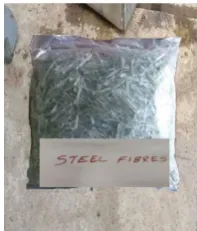
Fibers:- Double-end hooked steel fibers with an aspect ratio of 50, length 5cm and diameter 1mm were used in this research work Methodology
Fig 2 steel fibers used in the project
[image:2.595.381.480.554.670.2]International Journal of Innovative Technology and Exploring Engineering (IJITEE) ISSN: 2278-3075, Volume-8 Issue-12, October 2019
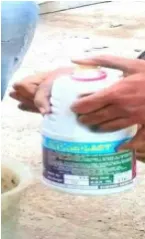
Fig 3 Super Plasticizer used in the project B. MIX DESIGN
[image:3.595.137.210.50.170.2]According to IS: 10262-2009 mix design was done for the purpose of concrete casting of various mixes with the help of all the above preliminary investigation test outcomes. The mix design was done for M50 grade. From the mix design, the conventional trial mix was prepared and it having mix ratio is 1:1.92:2.76 and the w/c of 0.40.
Table 4: -Mix Proportion of concrete
Material Quantity
(kg/m3)
Proportion
Cement 412 1
F.A 793.6 1.92
C.A 1137.6 2.76
Water 156.73 0.40
Chemical admixture 4.5 1%
V. EXPERIMENTALPROGRAM
A. General
In this research work total 84 cubes, 63 cylinders, 63 prisms are cast and tested at 3, 7 & 28 days respectively. For finding out the mechanical properties as well as permanence properties of the concrete.
.
Table 5:- Mix Proportion were involved in this project Cement
kg/m3
% Laterite
Fine Aggregate Coarse Aggregate
sand
Laterite
412 0% 793.6 0 1137.6
412 10% 714 79.36 1137.6
412 20% 634.88 158.72 1137.6
412 30% 555.52 238.08 1137.6
B. MIXING AND CASTING
The mixture of all materials was hand-made by mixing on a steel plate. Cement, Laterite soil, F.A, C.A, and fibers are thoroughly mixed before adding water. After dry mixing then the water, curing agent and super plasticizer are added and then mixed until a treatable concrete mixture is obtained. Then oil the internal surface of molds, they are filled by concrete and compaction is done by stuffing rod.
.
Fig 4 Mixing and casting C. RESULTS AND DISCUSSIONS
1. Compaction Factor Test
Workability given an idea of the capability of being workability. That workability of concrete can be found out by the compaction factor test.
2. Slump cone test
Slump test was conducted to determine the workability. Table 6: -Results of compaction factor and slump cone
test
MIX Compaction factor Slump (mm)
M0 0.85 75
M10 0.90 60
M20 0.92 55
M30 0.95 52
3. Compressive strength:
This is one of the essential properties of the concrete. Alternate properties of concrete have an unmistakable association with compressive strength. On the off chance that the compressive strength of concrete is enhanced at that point there is change in different properties of concrete, in this manner compressive strength of the concrete is basic test. Cube of size 150X150X150mm is cast according to different mix proportions of this research work. after curing for the number of days these cubes are tested in a compressive machine, to get a desired compressive strength for different days of curing.
Table 7: -Results of Compressivestrength test Mix Compressive Strength in N/mm2
3 days 7days 28 days
CC 21.96 34.50 56.67
Mix1 22.37 34.73 56.32
Mix2 24.51 36.81 60.05
[image:3.595.318.512.155.248.2]Fig 5 Graph of Compressive strength test 4. Split Tensile Strength
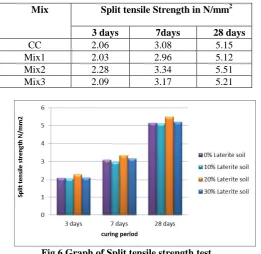
[image:4.595.287.557.50.187.2]It is the standard test to determine the tensile strength of concrete indirectly. stand. Size of cylinder of concrete specimen of dia 150mm and length 300mm is placed horizontally between the loading surfaces of compression testing machine.
Table 8: -Results of Split tensile strength test
Mix Split tensile Strength in N/mm2
3 days 7days 28 days
CC 2.06 3.08 5.15
Mix1 2.03 2.96 5.12
Mix2 2.28 3.34 5.51
Mix3 2.09 3.17 5.21
Fig 6 Graph of Split tensile strength test 5. Flexural Strength Test
This test is performed by the center point loading method to determine the flexural strength of concrete. The size of the specimen is 100x100x500 mm was utilized.
Table 9: -Results of Flexuralstrength test
Mix Flexural Strength in N/mm2
3 days 7days 28 days
CC 3.08 4.06 5.28
Mix1 3.14 4.13 5.29
Mix2 3.45 4.27 5.56
Fig 7 Graph of Flexural strength test
VI. CONCLUSIONS
In this research, the fresh property of M50 Grade concrete that is workability is gone on increasing by increase in the curing period.
From the results, it can be seen that the maximum compressive strength is obtained at 20% replacement of laterite soil.
Addition to laterite to any particular concrete mix is found to reduce its compressive strength. This is due to fineness of laterite which ultimately increase the air voids as fine particle at bottom, side and air voids at the top level do not fill properly.
In porosity, in red soil mixed concrete, porosity is higher than plain concrete but the permeability is low in red soil compared to the plain concrete. Due to tiny pores in fine soil, it can hold water tighter in small pores so that it is low in permeability, It resists the fluid passage. Hence it is impervious.
Red soil can be used in RCC as well as prestressed concrete.
Compressive strength decreases with an increase in the replacement level of sand.
Specific gravity of laterite soil and sand is nearly equal. Hence density remains the same.
From the results, it can be seen that the maximum tensile strength is obtained at 20% replacement of laterite soil
REFERENCES
1. Prakash.S, Rajeshkumar.K, Sakthi. S&Shembiang Marthong, Kumutha &Vijai k., “Feasibility study on utilization of laterite soil for stabilized earth blocks”, Research Desk 2013, Jul-Sep (2)3.229-236. 2. TarhReema, Ajanta Kalita, “Strength characteristics of red soils
blended with fly ash and lime”, International Journal of Innovative Research in science,Engineering and Technology, Vol. 4(3), March 2014.
3. T. Subramani and K.S.Ramesh “Experimental Study on Partial Replacement of Cement and Fly ash And Complete Replacement Of sand With M Sand”, InternationalJournal
4. M.S. Shetty, Concrete Technology: Theory and Practice fifth edition 5. Amar R Dongapura and Shivaraj S Mangalgi “Strength of Concrete
[image:4.595.43.305.304.558.2]International Journal of Innovative Technology and Exploring Engineering (IJITEE) ISSN: 2278-3075, Volume-8 Issue-12, October 2019
8. J Santhiya Jenifer, S Ramasundaram, “Strength and Durability Characteristic of Laterite Sand Mixed Concrete”, International Journal of Chemtech Research Volume 8, No 3, April 2015.
9. Concrete Technology by M.S Shetty. 10. Properties of Concrete by A.M. Neville.
AUTHORSPROFILE
Shaik Manzoor Ilahi, Department of Highway Technology, VTU Regional Centre for PG studies, Kalaburagi, India.
Maneeth P D, Assistant Professor, Department of Civil Engineering, VTU Regional centre for PG studies, Kalaburagi, India.