Abstract: In this paper, we propose a method of feature differential application based on dictionary data structure for the generation of a super-resolution image in a single image. The existing method of generating super-resolution based on the dictionary data structure results in poor quality, such as artifacts or the staircase. because it refers to the value of the dictionary data without analyzing the configuration of each area. In order to overcome this problem, the proposed method generates a low-resolution image for the dictionary data construction and constructs a pair of dictionary data of low resolution and high resolution through feature extraction with the original image. In order to differentially apply the dictionary features, we estimated the feature loss area in the bicubic interpolation process and analyzed the composition of the details of the area, then weighed it. Using the calculated weight values, we applied the feature data of the dictionary data to each region differentially in order to generate an improved super-resolution image. For experimentation, the original image was compared with the reconstructed image with PSNR and SSIM.
Key words: Super Resolution, Linear Interpolation, Patch Information, Region Segmentation, PSNR
I.INTRODUCTION
The super-resolution technique restores low-resolution images with high image quality to high resolution. Among them, SISR (SINGLE IMAGE SUPER-RESOLUTION), which aims to create visually improved high-resolution images from a single low-resolution image, is an ongoing challenge in the field of image processing. SISR has a problem of quality deterioration caused by differences in information because the number of pixels estimated from a high-resolution image is generally much larger than the number of pixels in a given low-resolution image. It is very difficult to reconstruct fine image details, such as boundaries and textures, from the limited information provided by low-resolution images [1,2]. One of the existing SISR
approaches is a simple and efficient linear
interpolation-based method [3]. However, this method tends to generate an excessively smooth image, which is difficult for practical application. In order to develop a more effective SISR method, a method of generating and using an image
Revised Manuscript Received on May 22, 2019.
1Hyun Ho Han, Graduate School, Kwangwoon university, Korea
2
Sang Hun Lee, 2Jong Yong Lee, 2Young Soo Park, Ingenium college of
liberal arts, Kwangwoon university, Korea
3Ki Bong Kim, Department of computer information, Daejeon health
institute of technology, Korea *E-mail:[email protected]
dictionary using the center of gravity of the amount of change existing in the image or the spatial priority of the learning form has been proposed [4,5]. In addition, after selecting a sample image to use as a reference of reconstruction type, learning and using information to mitigate the side effect of SISR has enabled the inclusion of many details, such as border and texture, in a generated high-resolution image [6,7]. However, these methods are generally time-consuming and affect the quality and time depending on the size and scale of the data to be restored. Therefore, many experiments must be conducted to determine the optimum point. In addition, irrespective of the configuration of each area, unnecessary artifacts or staircase phenomena may occur due to reflection of all the data formed in advance. In this paper, we propose a method of applying weights differently in each estimated loss area by extracting patches of an input image and a pair of low-resolution images in order to obtain an improved super-resolution result. The proposed method consists of generating dictionary data, estimating the feature loss area of the image, and differentially applying the feature patch weights.
II.RELATEDWORKS
A number of algorithms have been developed to handle image super-resolution work over the last few decades. In order to compensate for non-existent details in the generation of super-resolution, a sparse-coding algorithm was proposed, in which a natural image can be represented by several minimum feature units. An algorithm has been proposed that learns this feature unit to dictionary form, then analyzes and replaces the similarity with the learned features. In addition, a number of studies have been conducted to improve the sparse coding process. In order to accelerate simple approximate computation, a dictionary is learned using Singular Value Decomposition (K-SVD) [8], and the optimization-based method is replaced by an Orthogonal Matching Pursuit (OMP). Research has been conducted to improve the processing speed of this approach. The ANR (Anchored Neighborhood Regression) method also improved the original sparse information decomposition optimization using feature regression analysis [9]. This method is characterized by the fact that the speed is greatly improved due to sample neighbor
learning and a preliminary calculation of a minimum specific unit. Rather than
Application of Different Feature Weights Based
on Learning Feature Dictionary for Image
Super-Resolution
learning regression variables in advance, the A+ method based on features and fixed regression analysis has been proposed based on ANR [10]. In addition, a method of complementing natural image learning based on self-similarity by sensing perspective geometry has been proposed as well. The dictionary-learning method is classified into two categories: First, there is an external dictionary method that selects a sample image, constructs a database by learning characteristic features of the sample image, and generates patches to supplement the details [11]. This method can improve the results of super-resolution by using detailed information from various natural images, but it involves a large amount of time in the learning step and the results may vary depending on the number of sample images and the selection of a sample image. Secondly, there is an internal dictionary (self-similarity) method that analyzes the input image, assuming that there is a similar pattern in the image [12]. In this method, the patches are generated by characterizing the main features, and the details necessary for the super-resolution generation process are interpolated by referring to patches having similar patterns. Secondly, assuming that a similar pattern exists in the image, the input image is analyzed, and the patch is then generated by characterizing the main features. Next, the details necessary for the generation of the super-resolution are referred to the patch having a similar pattern, (Self-similarity) method. This method is advantageous in that there is no pre-learning process for generating a super-resolution and in that it has a faster processing speed than an external dictionary. The
internal dictionary method has been continuously studied in order to obtain a quicker approach, which has resulted in the recent SISR method based on a single image. In recent years, attempts have been made to apply super-resolution imaging to generate high-resolution images because of the high-end results of low-level image processing through efficient data-based learning algorithms through Deep Learning or Convolutional Neural Network (CNN).
III.PROPOSEDMETHOD
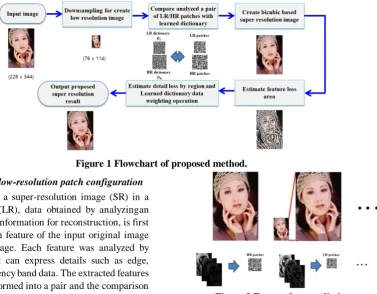
[image:2.595.141.519.419.713.2]In the proposed method, first learning data is constructed first for generating a super resolution in a single image, and a low resolution image is generated by downsampling the input high resolution image. We analyze the details of the generated low-resolution images and input images to generate high-resolution and low-resolution patches, respectively, and look for patches similar to the pre-learned data. Then, to analyze the composition of the basic interpolation and detail loss region, a Bicubic-based super resolution was generated and the feature loss region was estimated by analyzing detailed information such as boundary and texture of the Bicubic image. We proposed a method to apply the learned dictionary data, which is the detailed restoration data, in a process for generating the super resolution by applying the weighting by analyzing the constitution per feature loss area. Figure 1 shows a flowchart of the proposed method.
Figure 1 Flowchart of proposed method. 3.1. High-resolution / low-resolution patch configuration
In order to generate a super-resolution image (SR) in a low-resolution image (LR), data obtained by analyzingan feature, which is basic information for reconstruction, is first generated. Extract each feature of the input original image and low-resolution image. Each feature was analyzed by extracting images that can express details such as edge, texture, and high frequency band data. The extracted features of each resolution are formed into a pair and the comparison with the previously learned data is performed.Figure 2 shows feature extraction for generating dictionary learning data from an image.
Figure 2 Extract feature dictionary
The model for generating the super resolution is defined as the following equation (1).
downsampling coefficients, the noise generated in the processing, and the processed image, respectively. In order to reconstruct a low-resolution or degraded image into a super-resolution image similar to the original image, it is necessary to improve data lost due to deterioration or downsampling, as well as noise that may be generated additionally. In order to obtain a result close to the original image corresponding to the previously learned data, the patch of the image may be expressed as a linear combination ( ) in the data of the dictionary form ( ), and the following formula is used.
In order to restore to the most similar form, it must be minimized, but it can be expressed by the following formula according to the minimization optimization that solves the NP-hard problem which is difficult to solve.
In order to reconstruct the super resolution based on the degraded image, the degradation coefficient is defined as follows.
The simplified learning preliminary model equation including the relation coefficient between each feature of the high-resolution image and the low-resolution image can be expressed by the following equation (5).
The generated learning dictionary model can be used as a criterion for reconstructing details in the generation of a super resolution by selecting the data of the most similar high resolution / low resolution pair among the learning databases in comparison with each extracted feature.
3.2. Basic interpolation and feature loss estimation It is necessary to expand the image and restore the lost details for super-resolution generation. Therefore, in order to expand the image to a resolution of a super-resolution, first, the image is expanded to a super-resolution size using bicubic interpolation as a basic interpolation method. The formula for carrying out the bicubic interpolation at low resolution is shown in Equation (6). Figure 3 shows bicubic interpolation result.
(a) (b) (c)
Figure 3 Bicubic interpolation result (a) original image, (b) LR image, (c) Bicubic interpolation result
In the first interpolation image using the bicubic method, loss of details such as texture and boundary of the image occurs. In order to analyze the detail area, the quality analysis is performed with the bicubic interpolation image generated from the input image. The quality analysis process analyzes
the features of edges, textures, and high frequency bands included in the dictionary data. The quality comparison between the original image and the low resolution compares the loss of the corresponding features and extracts the estimated portion as the lost region. The loss region extraction process is shown in Equation (7).Figure 4 shows estimated loss area result by analyzed features.
(a) (b) (c)
Figure 4 Estimated loss area result (a) Original image, (b) Bicubic interpolation result, (c) Estimated loss area
The extracted loss region includes a plurality of information of the boundary, texture, and high frequency region, which are details of the image, which may be lost in the process of enlarging the low resolution. In the process of analyzing the information of the lost area, the configuration of the lost detailed information can be confirmed in each area. In general, if the prior learning data to be used as the restoration data for the lost area is selectively applied based on the similarity degree, unnecessary artifacts or staircase phenomena may occur. Therefore, the configuration of the prior learning data and weights are separately calculated and improved.
3.3. Details of loss area and density analysis
The details are first analyzed using the estimated loss area values. In the estimation process of the lossy region, the region where the values exist in the edge and the high frequency band is relatively large, so it is determined that the possibility of loss is large due to the large change amount. And a combination of very similar patterns or colors such as texture has a characteristic that the loss information is small due to a relatively small amount of change, and the difference in the contrast value of the same position of the original image is small. In the area where the deviation of the value is large, there is a possibility that the staircase phenomenon is likely to occur when the dictionary data is utilized in the super resolution restoration process, and sharp processing is required, and the utilization rate of the dictionary data is increased. On the contrary, the area with a small value deviation is similar to the existing pattern when using the dictionary data, but the area where the artifacts are likely to occur due to the incompatible form is high. In order to make the data similar to the original image data through smooth processing, The utilization rate of the system must be relatively lowered. Therefore, we analyze the value structure of the image, analyze how large the color difference of the original image is, and determine the apply rate of the dictionary data by analyzing
be obtained as shown in the following equation (8).
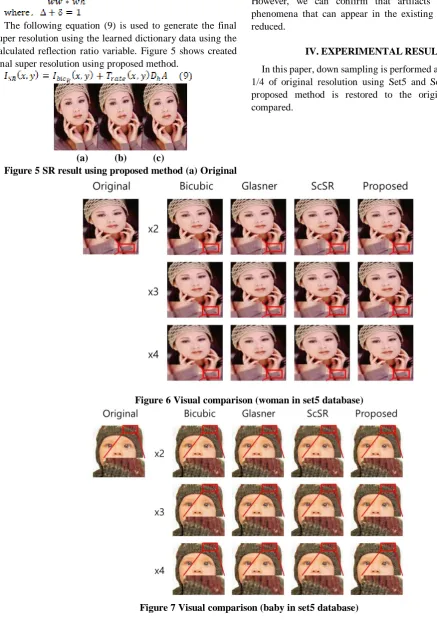
The following equation (9) is used to generate the final super resolution using the learned dictionary data using the calculated reflection ratio variable. Figure 5 shows created final super resolution using proposed method.
(a) (b) (c)
Figure 5 SR result using proposed method (a) Original
image, (b) LR Image, (c) Proposed SR result
Finally, we performed the process of enlarging the image from the low resolution image to the original image size. However, we can confirm that artifacts and staircase phenomena that can appear in the existing algorithm are reduced.
IV.EXPERIMENTALRESULT
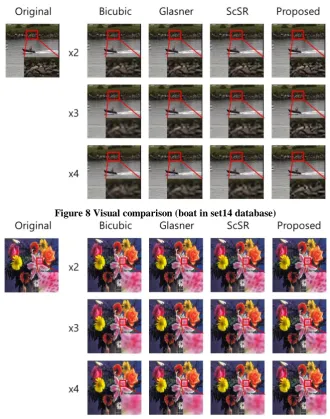
[image:4.595.53.491.94.715.2]In this paper, down sampling is performed at 1/2, 1/3, and 1/4 of original resolution using Set5 and Set14. And the proposed method is restored to the original size and compared.
[image:4.595.145.459.486.689.2]Figure 6 Visual comparison (woman in set5 database)
Figure 8 Visual comparison (boat in set14 database)
Figure 9 Visual comparison (flower in set14 database)
Experimental Results As shown in Figures 6, 7, 8, and 9, the conventional simple restoration method, the Bicubic method, lacks detailed information on the details of the visual comparison, resulting in an overall blurred result. Although the relative degree of blurring is somewhat reduced in the similarity-based Glasner method [13] that generates detailed information, depending on the size of the similarity comparison or the area of information to be restored in the image, an excessive region invasion and an inaccurate result May appear. In addition, the ScSR method [14], which is an external dictionary learning method, has a comparatively improved shape similar to the original image, but has a problem in that the results are different according to the time required for the learning process and the configuration level of the learning data. In the proposed method, instead of using only the extracted patches for the restoration of a relatively complex pattern, a part of the super resolution image to be generated is correlated to the low resolution image, and the data pattern of the surrounding area is analyzed. It can be confirmed that the visual parts such as boundary and texture are improved. Also, in the proposed method, artifacts and staircase phenomena are minimized in the texture region and the boundary region, and a clear image can be obtained even when the super resolution magnification is specified to be
high.
For the quantitative evaluation of the proposed method, the entire dataset used in the experiment was compared with the PSNR (Peak Signal-to-Noise Ratio) and SSIM (Structural Similarity Index) method. The PSNR is used to measure the quality of the image. The resultant level of the super-resolution image can be confirmed by comparing the original image with the generated super-resolution image. The formula of PSNR is as follows.
Where is the maximum color variation width value of the input image. To obtain the PSNR, the average deviation value of the image was calculated by the following equation.
Here, the generated super resolution image, is the original image, and the average deviation value is obtained by comparing and analyzing the same points of each image.The SSIM method was also evaluated for further evaluation. The formula of
Where is brightness, is contrast ratio, is structure. The value starts from 1 at the maximum according to the degree of similarity of the image.
The results of the quantitative evaluation show that the proposed method is superior to the proposed super resolution method in comparison evaluation using PSNR and SSIM.
Table 1 Quantitative comparisons (average) Scale Method Set5 Dataset Set14 Dataset
PSNR(db) SSIM PSNR(db) SSIM
2x
Bicubic 33.64 0.9292 30.22 0.8683
Glasner 35.43 0.9452 31.41 0.8881
ScSR 35.78 0.9485 31.64 0.8940
Proposed 36.21 0.9514 32.49 0.9152
3x
Bicubic 30.39 0.8678 27.53 0.7737
Glasner 31.10 0.8811 28.21 0.7926
ScSR 31.34 0.8869 28.19 0.7977
Proposed 32.09 0.9011 29.18 0.8003
4x
Bicubic 28.42 0.8101 25.99 0.7023
Glasner 28.84 0.8201 26.43 0.7163
ScSR 29.07 0.8263 26.40 0.7218
Proposed 30.18 0.8582 27.38 0.7398
V.CONCLUSION
In this paper, a super resolution image is generated from a single image by differentially applying it according to the weights of extracted features using learned data from low resolution images. In the existing super-resolution generation method, extraction using self-similarity or learning in the sample image is used to extract details for quality improvement, but it is not possible to show the same result as the surrounding data for each region, Results. However, in the proposed method, it was possible to express more clearly than the existing proposed method by using the learned advance information. In the application process of the advance information, the weight of the advance information of the region was calculated and applied instead of the reference based on the simple similarity, Minimization of artifacts and clarity in the boundary region.
REFERENCES
1. Kumar, G and Singh, K. Image Super Resolution on the Basis of DWT and Bicubic Interpolation. International Journal of Computer Applications, Vol. 65, No. 15, 2013.
2. Yang, J., Wright, J. andHuang, T. S. Image super-resolution as sparse representation of raw image patches. 2008 IEEE Conference on Computer Vision and Pattern Recognition.Vol. 8, No. 6, 29-36, 2017.
3. Rasti, P., Nasrollahi, K., Orlova, O., Tamberg, G., Ozcinar, C., Moeslund, T. B., &Anbarjafari, G. A new low-complexity patch-based image super-resolution. IET Computer Vision 11.7 : 567-576, 2017.
4. Zhang, K., Wang, B., Zuo, W., Zhang, H., & Zhang, L. Joint learning of multiple regressors for single image super-resolution. IEEE Signal Processing Letters, 23(1), 102-106, 2016.
5. Mokari, A., &Ahmadyfard, A. Fast single image SR via dictionary learning. IET Image Processing, 11(2), 135-144, 2016.
6. Yang, J., Wang, Z., Lin, Z., Cohen, S., &Huang, T. Coupled dictionary training for image super-resolution. IEEE transactions on image processing, 21(8), 3467-3478, 2012.
7. Freeman, W. T., Jones, T. R., &Pasztor, E. C. Example-based super-resolution. IEEE Computer graphics and Applications, 22(2), 56-65, 2012.
8. Aharon, M., Elad, M., &Bruckstein, A. K-SVD: An algorithm for designing overcomplete dictionaries for sparse representation. IEEE Transactions on signal processing, 54(11), 4311-4322, 2006.
9. Timofte, R., De, V., &Van Gool, L.Anchored neighborhood regression for fast example-based super-resolution. In Computer Vision (ICCV), 2013 IEEE International Conference on, 1920-1927.IEEE, 2013.
10. Timofte, R., De Smet, V., &Van Gool, L. A+: Adjusted anchored neighborhood regression for fast super-resolution. In Asian Conference on Computer Vision, 111-126,Springer, Cham, 2014.
11. Zhao, L., Sun, Q., &Zhang, Z. Single Image Super-Resolution Based on Deep Learning Features and Dictionary Model. IEEE Access, 5, 17126-17135, 2017.
12. Huang, J. J., Liu, T., Dragotti, P. L., &Stathaki, T. SRHRF+: Self-Example Enhanced Single Image Super-Resolution Using Hierarchical Random Forests. In Proceedings of the IEEE Conference on Computer Vision and Pattern Recognition Workshops, 71-79, 2017. 13. Glasner, D., Bagon, S., &Irani, M. Super-resolution from a single image.
In Computer Vision, 2009 IEEE 12th International Conference, 349-356, IEEE, 2009.