Abstract: Cellular planning and dimensioning plays a vital role for streamlining the wireless system design and its optimal roll-out. The state-of-art of radio network design depends on thorough initial planning, clear dimensioning and optimal deployment. Mathematical characterization of user coverage and proper modelling is the prime step to design, optimize and automate a wireless network. A novel dimensioning technique using collaborative communication, for cellular network design has been discussed in the paper and the corresponding radio network parameters like transmission power, receiver throughput and Base Station position has been optimized using modern technique of optimization. With proper cellular network planning, the base station parameters could be tuned to achieve the required QoS (Quality of Service) for meeting the requirements of NG (Next Generation) wireless mobile network. Proposed strategy has been analysed with adaptable radii cells establishing a cluster of users to be dimensioned in a given area. Based on minimum distance between the centroid of two cells in a cluster, the inner coverage for the BS deployment is obtained and outer radial coverage is taken double of the inner radius. The total transmission power requirement is calculated and minimized by adjusting the coordinates of the BS using Genetic Algorithm (GA). With the proposed method, 17.6% power saving and 65.68% improvement in throughput was found at the receiver side as compared to conventional constant radius method.
Index Terms: Cellular network planning, Collaborative Communication, dimensioning, Genetic Algorithm, optimization
I. INTRODUCTION
NG of wireless mobile network will be truly holistic heterogeneous network with the integration of different
network topologies like WCDMA network (3G- Wide-band Code Division Multiple Access), GSM (2G- Global System of Mobile Communication), LTE-A (Advance 4G: Long Term Evolution – Advanced), D-to-D (Device-to-Device) communication, Wi-Fi (Wireless-fidelity) network, adhoc-vehicular network and so on. Hence unifying, dimensioning and final roll-out of the network requires appropriate radio network planning with optimization. Heterogeneity is also observed in terms of radial dimensions of cells functioning as micro-cell and pico-cell, depending on the user density and power requirement. Various performance parameters like EE (Energy Efficiency), QoS, SINR (Signal to Interference + Noise Ratio), throughput,
Revised Manuscript Received on July 09, 2019
Sarosh Dastoor, Electronics and Communication Department, Sarvajanik College of Engineering and Technology, Surat, India.
Upena Dalal, Department of Electronics Engineering, Sardar Vallabhbhai National Institute of Technology, Surat, India
Jignesh Sarvaiya, Department of Electronics Engineering, Sardar Vallabhbhai National Institute of Technology, Surat, India.
spectrum efficiency etc. could be augmented using proper planning. The physical position of BS, transmission power requirements, capacity and network coverage is the consequence of thorough cellular planning in a given terrain. Probability of coverage for the edge users increases with the introduction of coordinated communication among various BS involved in the pool.
In this approach recipient UE (User Equipment) data is provided to the complete set of coordinating BS that transmits unanimously the data in the given sub-frame at the same downlink frequency. The integrated transmission from the complete coordinating set of BS, improves the overall SINR at the recipient UE. This results in the overall improvement of coverage probability and throughput of the edge users, decrement of adjacent channel interference and hence it results in the conservation of energy.
The basic physical layer design of any wireless network gains momentum from the strategic design and dimensioning leading to the optimized cost of the network. A HetNet (Heterogeneous-Network) comprising of macro-cell, micro-cell, pico-cell, femto-cell etc. does not ensure centralized co-ordination, hence a decentralized control mechanism, spatial-filtering as well as resource sharing frame-work is required to be formulated for the effective coordination of the wireless system.
The main objective of the paper lies in cellular planning and mathematical dimensioning of a heterogeneous network using collaborative communication among the serving BS. In addition the required transmission power is to be minimized by appropriate positioning of the BS using modern optimization technique. Research goal also lies in comparing the performance of various strategies of cellular planning and thereby optimization of the various radio network performance parameters.
This research paper proposes the network design of a HetNet with different radii cells in a cluster. The position of BS has been obtained using K-means clustering algorithm and performance parameters like transmission power, throughput and SINR have been optimized. The current trends, significance, and the corresponding solution related to the developmental strategy of a HetNet have been discussed in detail.
Further organization of the paper is as follows: Introduction is followed by literature survey related to the approach followed in radio network planning. After literature survey, third section covers the path loss propagation model,
Collaborative Communication Based Modern
Cellular Planning and Optimization of the
Network Performance Parameters using Ga
the system model for power transmission and reception in addition to key performance parameters in detail. Simulation results from the system parameters are analyzed in section four. Finally, conclusion with the summary of results and future modifications are provided.
II. RELATED WORK SURVEY
NG cellular mobile network truly depends on stochastic planning, energy-efficient green planning, coordinated planning and M-MIMO (Massive-Multi Input Multi Output) based mmWave (millimetre Wave) planning.
NOMA (Non-Orthogonal Multiple Access) systems using collaborative multi-point approach in DL transmission has been proposed in [1]. A strong signal when received from multiple cells, NOMA is adopted by each cell for the purpose of resource allocation to all the active users in the cell. Energy efficiency and throughput is improved using this approach. In [2] content based caching strategy at BS is introduced to improve QoS and decrease backhaul payload. With the framework combination of frequency reuse and coordinated communication spectral capacity and fairness could be enhanced in a network [3]. The parametric design of frequency reuse plays a vital role for augmenting the net performance of the network. HetNet with focus on energy conservation from deployment to roll-out has been considered in [4]. The approach was decomposed into deployment and operation categories at peak-hours and off-peak hours respectively. With the proposed greedy algorithm, the energy consumption was reduced along with the minimization of number of micro BS.
Location and number of BS optimization was jointly proposed in [5] for enhancing the coverage probability of cell-edge users with the overlap coverage of BS in coordinated transmission. The inner cell radius of a cell was kept constant and using Joint coordinated transmission scheme, number of BS required in the given area was minimized. A flexible and precise framework of HetNets comprising of K tiers of randomly located BS, with variable density, transmission power, and radio access techniques could be used to model the interference in real sense with variation of network load.
In [7] it shown that coverage and capacity of a heterogeneous network, could also be boosted using an edge-cutting terrain division method. It disintegrates a serving terrain into multiple sub-sections having approximately equal traffic distribution. Here a dynamic radio network planning structure was developed by reducing the CapEx and OpEx of the system considerably. An auto parameter-planning technique for the power control scheme in the Physical UL (Up Link) Shared Channel (PUSCH) LTE has been proposed in [8]. The method shows improvement in average throughput and coverage probability of the edge user.
Improvement in productivity requires real-time energy trading and heuristic planning, but it seems to be extremely challenging due to great variations in physical features of any wireless channel [9]. An efficient control theory based on Lyapunov approach has been applied to stochastically optimize energy conservation and scheduling, leading to 65 % decrement in the operational expenses of 5G on energy requirements when compared to conventional practices. In [10] cognitive (adaptive) and cooperative techniques are
described for devices as well as for the complete network infrastructure.
Co-ordination of a cluster of BS could be modelled as an optimization problem as shown in [11]. A smart modelling has been proposed providing an optimal-feasible solution in the ten cell clusters, which can respond to the traffic changes in real-time. Optimal coordinated scheduling provides a substantial improvement in coverage. In [12] Received Signal Strength (RSS) from a commercial BS working at GSM Bands (800 MHz, 900 MHz, 1800 MHz) was calculated along various pathways. The correlation between received signal with local geographical parameters has been examined to predict Path Loss, coverage, interference avoidance and handover optimization.
Various traffic configurations using stochastic geometry method has been proposed for energy-efficient model to arrange and deploy small cells according to the existing pattern of data-traffic [13]. Efficient dimensioning based on various network parameters and dimensioning a network using various strategies like Voronoi distribution, AHC clustering, and traditional K-means has been discussed in [14] to improve RSS at the UE. Various parameters of BS like the power control factors, BS antenna tilt, and azimuth angle orientations of a macro-cell are optimized using modern optimization approach. A comparative analysis of different modern techniques of optimization has been made in [15]. GA, Particle Swarm Optimization (PSO), Simulated Annealing (SA) and Taguchi’s optimization technique have been qualitatively compared with cellular network planning parameters like BS power, antenna-tilt and azimuthal angle of antenna. Various problems concerning cellular planning and the associated solutions were discussed in [16] along with optimization of HetNet. A novel cellular nnetwork planning with stochastic approach using two-tier network was applied to a dense region (Surat city) as a part of real-time dimensioning [18]. The improvement in SINR and energy efficiency was obtained using the proposed method.
Cellular planning in a perfectly symmetrical domain could be linked with the real time situation using spatial transformation design [20]. Terminal nodes could be mapped with the service design to obtain power optimization. In a dense HetNet, the existing resources are segregated orthogonally between various slices, serviced by the cells [22]. The research was found to jointly optimize the resource sharing among the network slices and the users assignment to the respective cells. A remarkable increase in the spectrum reuse factor is attained by deploying Micro cells (Small cells) tiers, which allows the allocation of more bandwidth per user equipment (UE) [23]. The corresponding positions of micro cells could be adjusted using unsupervised Self Organizing Maps maximizing the network throughput and the coverage probability.
position and network parameters provides the improvement in SINR, throughput and reduction of transmission power requirements.
III. SYSTEM MODEL
Design of NG wireless system is an NPH problem (Non-deterministic Polynomial-time Hard) due to complete HetNet nature of the system. For realizing NPH problem, single parameter is considered at one time with its impact over the second and then it is moved with priority in the downward order of the pyramid. Radio network planning is initiated with the information collection of the operator’s site with density and geography. For deployment in urban area large cell concept for coverage is taken into consideration and small cell for capacity.
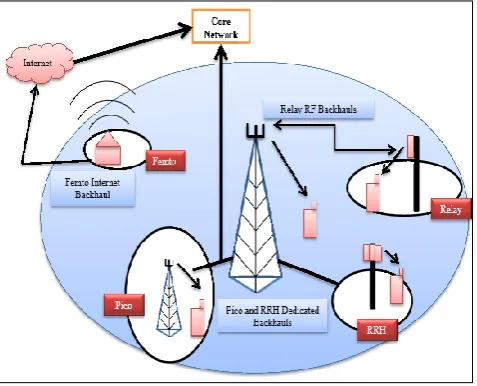
[image:3.595.49.288.383.576.2]Clustering of estimated UE is done using clustering algorithms like K-means or AHC (Agglomerative Hierarchical Clustering). Link-budget and capacity analysis is done using KPI (Key Performance Indicators) like accessibility, mobility, integrity and availability. The outcome of this detail design is coverage probability, BS power, number of sites, position of BS deployment, spectral efficiency, throughput etc. A complete HetNet with its reliance over core internet has been shown in Fig. 1. The UE are connected to relay station and RRH (Radio Resource Head) to improve edge-user connectivity and pico-cell along with micro-cell are integrated with the macro BS transmitter.
Fig. 1: A Complete Heterogeneous Network Practical cellular network planning starts with the available data of UE position and clutter in the 2-D Cartesian plane of a region. Path loss parameter is obtained using modified Hata model which is used for frequency more than 2 GHz and in a region with transmitter-receiver distance, in the range of 5-10 km. For large cell deployment, the strategy of roof-top mechanism is taken into consideration but with small cell capacity.
A. Modified Hata Model for Path Loss Propagation
For an urban region having high population density, the corresponding median PL at a distance d is obtained using modified Hata model given by:
(1)
Here, f refers to the operating frequency, hb and hr refers to the height of BS and receiver UE respectively. Cm denotes the gain of antenna approximated to 0 dB for urban areas. a(hr) refers to gain function of the receiver given by:
(2)
B. Power Model for BS Planning
For users scattered in a given region, if Pre,k is the Power of kth user and Iout,k is the interference found at kth user, the corresponding SINR of user k is obtained by:
(3)
Where, δ2 refers to the receiver thermal Noise. P
re,k, the received power of user k is obtained as:
(
(4) Where, is the power of serving (nearest) BS to the user k and is the PL of serving BS to user k. The received power in the above equation is the sum of all powers of s BS which form a coordinating cluster serving that user k. The inter-cell interference of user k is given by the expression:
(
(5)
If Pi is the total power requirement of Nb BS, the location model of BS in the given region could be formulated as:
(6)
ST
SINRk ≤ SINRth , Ɐk=1, 2, 3,…, Nu (7)
The UE in a given region are clustered using MGD (Multi-Gaussian Distribution). If UE are greater than 150 then two cells are formed and between 100-150 then two cells are created and so on. The centroid of the cell obtained using K-means clustering technique indicates the location for positioning the BS. The minimum distance between two cell’s centroid in a given cluster is obtained and it defines the coverage area of that cell. The inner circle is taken half of outer circle where service is provided by only one serving BS. The UE falling between inner and outer circle are served by more than one BS, thus improving the coverage probability. The received power is measured from the PL measurement and total transmission power is calculated.
C. Transmitting Antenna Parametric Model
(8)
The terms involved in all remaining equations have been defined in Table 1. Similarly the vertical antenna pattern
Bθ(Θc, θ) of transmitting antenna is expressed by:
(9)
with angle θ given as:
Considering the 3 Dimensional radiation pattern of the serving BS in a given sector c, the cumulative modelling of the pattern could be provided as [16]:
(10)
The total signal reduction Lc of a user associated with the serving cell c is given by:
, , )= (11)
Hence the total transmit power for uth UE connected to cth cell for the PUSCH is given by the expression:
(12)
D. Collaborative Communication Model
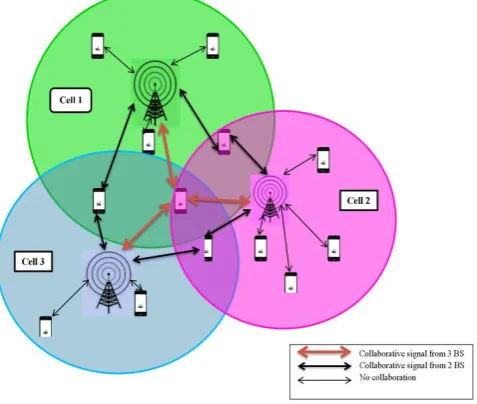
[image:4.595.304.551.297.410.2]A UE is generally connected to multiple BS in the overlap region between two cells, which forms a cluster of serving stations. If all such UE cumulatively receive the signal information form this coordinating group of BS, it augments the received SINR, throughput and QoS. All such cooperating BS synchronize their working over same sub-frame available in the RB (Resource Block) of LTE.
Fig. 2:Collaborative Communication Model As a result, interference from the adjacent cells is converted into combined signal strength, resulting into lower transmission power requirements and strengthening the coverage probability. A 40 MHz LTE band has been considered here with 100 RB and 1200 sub-carriers available
for DL LTE frame. Fig. 2 shows the collaborative communication model forming a heterogeneous network. As indicated, if a UE is located at the overlying area of coordinating cells, the transmission power from all such overlapping cells (BS) is combined to serve the edge user. The main idea is to convert the inter BS interference into useful signal.
E. Radio Network Parameters optimization model
[image:4.595.51.290.498.700.2]Genetic Algorithm could be used as a global search tool for obtaining best solution from the given search space. It’s a biologically inspired technique motivated from inheritance, mutation, selection, and crossover of genes from the parent generation to the offspring. It clearly affirms the postulate of Darwin, “Survival of the fittest and the nature’s selection”. It requires chromosomal depiction of the search space and the corresponding fitness function. The case as an example including six chromosomes (strings) for optimization of a general fitness computation has been diagrammatically represented in Fig. 3.
Fig. 3: Fitness function of Genetic Algorithm The algorithm terminates when the best fitness ranking is accomplished or the fitness value has reached a plateau such that succeeding iterations does not show significant improvement in the result. Following steps are involved in GA:
1. Initialization: It involves the selection of total number of chromosomes and bits per chromosome. It initiates from a population of randomly generated agents depending on accuracy and number of variables involved in the fitness function. If n variables are there in the objective function then 4(n) number of agents (strings) are selected. The number of bits in a string is directly related to the range of variables in search space.
2. Pertaining to that generation, the fitness of each agent in the real-space is calculated with reference to the overall fitness. Multiple fit individuals (GA agents) are selected based on Rowlett wheel approach from the present iteration (on the basis of relative fitness), and worst agents are neglected. Thus a new population set of all healthy agents is produced. At the end of each generation, average fitness value is calculated along with the normalized fitness of each agent.
present iteration exceeds that of the former generation, 4. then the chromosomal values are accepted as it is,
otherwise by the rule of 5%, the bits in the chromosomes are complemented and the average fitness is calculated again.
The GA algorithm generally terminates when there is no significant change in the fitness evaluation function over next successive generations or when stall time ends.
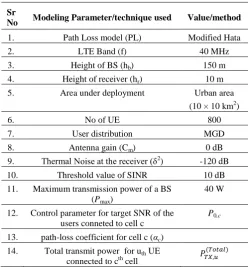
[image:5.595.309.551.61.349.2]The parameters along with their symbols (used in the equation) related to the deployment scenario of a radio network in an urban region with considerable population, as suggested in [17, 19] have been tabulated in Table 1.
Table 1: Urban regiondeployment parameters
Sr
No Modeling Parameter/technique used Value/method
1. Path Loss model (PL) Modified Hata
2. LTE Band (f) 40 MHz
3. Height of BS (hb) 150 m
4. Height of receiver (hr) 10 m
5. Area under deployment Urban area
(10 × 10 km2)
6. No of UE 800
7. User distribution MGD
8. Antenna gain (Cm) 0 dB
9. Thermal Noise at the receiver (δ2) -120 dB
10. Threshold value of SINR 10 dB
11. Maximum transmission power of a BS (Pmax)
40 W
12. Control parameter for target SNR of the users conneted to cell c
P0,c
13. path-loss coefficient for cell c (αc)
14. Total transmit power for uth UE
connected to cth cell
The complete strategy followed for the design and dimensioning of the given network using collaborative communication has been shown in Algorithm 1. The design starts with the initialization of a given geographic area and distributing the users using MGD. Density contours provide the number of clusters required. The number of cells per cluster is obtained as indicated in step 4 of the algorithm. With the use of coordinated multipoint protocol, the BS forming a cluster, jointly transmits the information to the user, thereby decreases the interference and hence overall SINR is improved. The conventional method dimensions the cells using fix radius, fixed environment and hence the constant overlap between the BS coverage area. Using minimum distance between two cells in a given cluster, the outer radius of the cell is created in the proposed approach. The input to the algorithm includes a geographical area with definite number of users.
With 800 users and Path loss exponent taken four for dense urban region, MGD has been used for distributing the users. BS position is optimized using GA based optimizing technique to minimize the total transmission power. The output of Algorithm 1 is the optimal position of BS for serving the given number of users.Using GA, the transmission power requirement of the BS is decreased.
Algorithm 1: Novel Dimensioning Algorithm
1) Initialize a given terrain 2) Distribute the users using MGD 3) Obtain user density contours 4) Find the Nuin each cluster
If
150 >Nu> 100 3 cells/cluster
100 >Nu> 50 2 cells/cluster
Nu< 50 1 cell/cluster
end
5) Obtain the centroid of each cell using K-means Clustering a. Find dmin between two cell centroids of a cluster
b. Plot the inner cell radius Rc =
c. Plot the outer cell radius R = 2Rc
6) Apply CoMP Protocol to overcome interference 7) Obtain Nu served by corresponding Nb
a. If d(Nu) <Rc served by single BS
else b. served by > 1 BS
8) Obtain the distance and path loss from ‘S’ to Nu in the cell
9) Find the power required by each user and hence the cell in a cluster 10) Apply GA to obtain optimization of network performance
parameters.
11) Obtain the minimization of transmission power
IV. SIMULATION RESULTS AND ANALYSIS A geographical region of 10 × 10 km2 was taken into consideration for simulating the model based on the parameters used in Table 1. The approach of dimensioning has been divided into two parts. First part shows the conventional method used for network planning with constant radius, while the second proposed approach finds the minimum distance between two cells and forms the radial dimension of the cells in that cluster forming a true HetNet. In the conventional approach of designing a network, fixed cell radius is taken into consideration and number of cells is decided to cover them. Here the power requirement for transmission is quite high as there is no coordination between the simultaneous transmitting BS.
[image:5.595.40.290.210.478.2]Fig. 4: Clustering 800 users using Conventional method
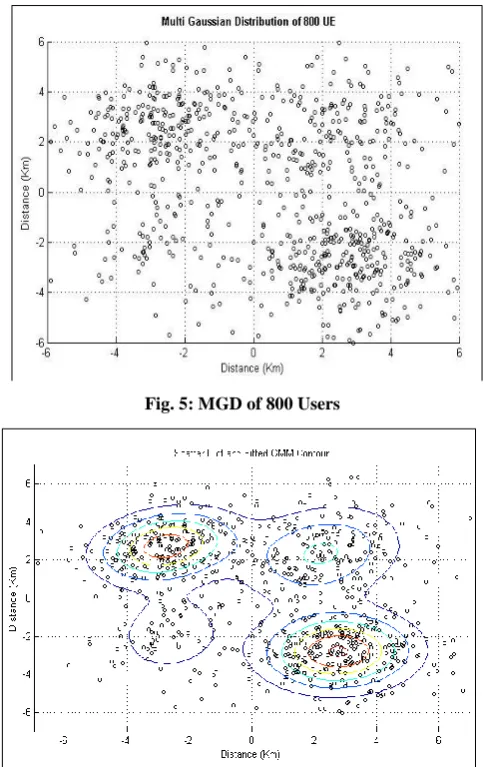
Fig. 5: MGD of 800 Users
Fig. 6: GMM contour formation for the porposed method
[image:6.595.306.552.51.250.2]Data clustering is obtained using Gaussian Mixture Model (GMM) contour plot as shown in Fig.6. For a given GMM, query data is assigned by the cluster to the component yielding the highest posterior probability. This technique in which data point is assigned to a unique cluster is known as Hard clustering. Depending on similarity index of adjacent users, they are kept in same cluster while with higher variance, boundary is created between clusters.
Fig 7: Clustering of 800 users using proposed method
Fig. 8: Throughput comparison between two approaches
Fig. 9: K-means clustering on Surat region (India)
[image:6.595.54.284.52.247.2] [image:6.595.47.289.270.654.2] [image:6.595.305.558.469.689.2]cluster differ from one cluster to other cluster. Number of cells forming a cluster is decided by the user density in that cluster.
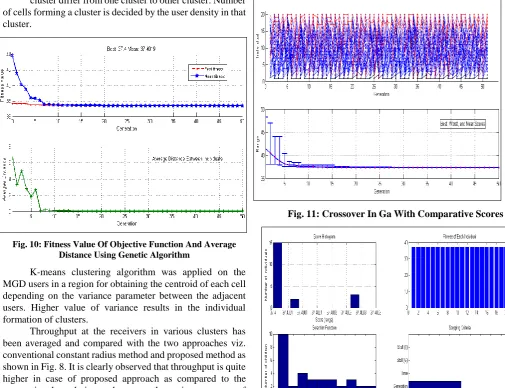
Fig. 10:Fitness Value Of Objective Function And Average Distance Using Genetic Algorithm
K-means clustering algorithm was applied on the MGD users in a region for obtaining the centroid of each cell depending on the variance parameter between the adjacent users. Higher value of variance results in the individual formation of clusters.
Throughput at the receivers in various clusters has been averaged and compared with the two approaches viz. conventional constant radius method and proposed method as shown in Fig. 8. It is clearly observed that throughput is quite higher in case of proposed approach as compared to the conventional technique, because there is no use of collaborative communication in the conventional method resulting in the involvement of interference and hence the reduction of SINR.
Fig. 9 shows the clustering made on certain region of Surat city (21.1° N, 72.8° E) in Gujarat state of India. Google_plot function has been used to super-impose the clustering of UE on the Surat region. As per the density of users, four clusters with 11 BS were obtained and centroid of each cluster has been shown by a bold square.
The transmission power required is minimized using GA, based on slightly shifting the actual position of BS from their mean centroid.
[image:7.595.294.547.56.475.2]Fig. 11: Crossover In Ga With Comparative Scores
Fig. 12: Histogram Score, Individual Fitness, Selection Function And
The upper graph in Fig. 10 indicates the mean distance between individual points in all generations. The reduction in the amount of mutation is directly related with the reduction in the average distance between individuals. The plot shown below with an erect line at every generation indicates the range of fitness values.
It could be inferred that by dropping the extent of mutation, the variety of successive iterations drop. The Cross-over section field shown in the upper part of Fig. 11 identifies the segment of each population, apart from elite children, that comprise of cross-over children. Cross-over fractions are shown with red and blue colour. Blue colour means that all children apart from elite individuals are cross-over ones, while red colour shows that they are mutation children. Here cross-over fraction value is selected as 0.8 and elite count is 0.05 times the population size.
[image:7.595.307.559.268.474.2]included. GA halts with designated number of stall generations when there is negligible change in the average
[image:8.595.46.289.121.277.2]value of fitness function. It also halts with the total number of iterations reach the threshold value of set generations.
Fig. 13: Comparative Analysis Of Different Deployment Strategies
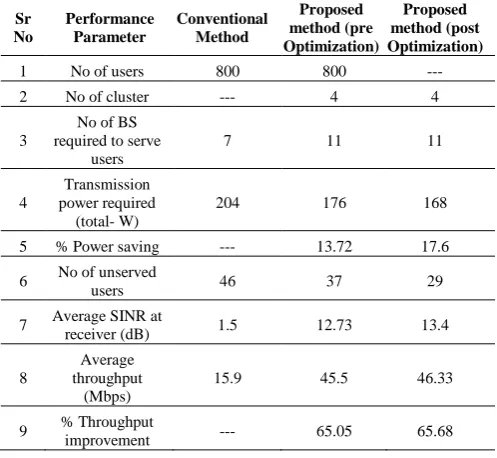
The complete comparative analysis of different deployment strategies with reference to the key performance parameters is depicted in Fig. 13. Corresponding analytical comparison between the proposed method and the conventional method has been tabulated in table 2.
Table 2 Comparative Analysis Of Various Approaches Followed For Deployment And Dimensioning
Sr No
Performance Parameter
Conventional Method
Proposed method (pre Optimization)
Proposed method (post Optimization)
1 No of users 800 800 --- 2 No of cluster --- 4 4 3
No of BS required to serve
users
7 11 11
4
Transmission power required (total- W)
204 176 168 5 % Power saving --- 13.72 17.6 6 No of unserved
users 46 37 29 7 Average SINR at
receiver (dB) 1.5 12.73 13.4 8
Average throughput
(Mbps)
15.9 45.5 46.33 9 % Throughput
improvement --- 65.05 65.68
From Table 2 it is clear that the proposed method proves to be better for strategic dimensioning of a network. Transmission power requirement is highly reduced to 17.6% after optimization procedure. Average SINR and throughput are quite enhanced in case of proposed method. Percentage improvement in throughput is measured to be 65.68 %.
V. CONCLUSION AND FUTURE RESEARCH
WORK
MGD was used as a distribution parameter for distributing the UE in a given region. Depending on number
of users in each cluster, total number of cells is defined and K-means clustering technique was used to attain the centroid of each cell for locating the position of BS. For a given cluster the minimum distance between the centroid of two cells was calculated and outer radius coverage was obtained with the same value. Inner coverage radius was taken half of it. At the overlap region of two cells, the UE was provided the connectivity from both BS, enhancing the strength of the signal and the coverage probability of the cluster. The unserved users could be connected through a pico-cell or mobile femto-cell, thereby creating a holistic HetNet.
Genetic Algorithm has been used for obtaining global minima, that is transmission power, for serving 800 users in a given region. Nearly 17.6% power saving was found using proposed method after optimization. There was a drastic improvement in average throughput in the dimensioned region by 65.68% as compared to the conventional method.
Using switch-off strategy of BS at non-peak hours for bursty traffic, more energy saving may take place. Cooperative communication amalgamated with MIMO and mmWave communication will be the future of wireless dimensioning network opening the gate of hundreds of Gbps.
Declarations Competing Interest
The authors declare that they have no competing interests.
ACKNOWLEDGMENT
The corresponding author is heartily thankful to the co-authors Upena Dalal and Jignesh Sarvaiya who helped in the analysis of results and in complete supervision of the proposed work. Also special thanks to Reliance Jio for providing the complete excel sheet of the users and position of BS deployed in the Surat region and for providing the technical know-how of the deployment procedure.
REFERENCES
1. M. S. Ali, E. Hossain and D. I. Kim, “Coordinated Multipoint
Transmission in Downlink Multi-Cell NOMA Systems: Models and Spectral Efficiency Performance”, IEEE Wireless Communications, vol. 25, no. 2, April 2018, pp. 24-31.
2. F. Zhou, L. Fan, N. Wang, G. Luo, J. Tang and W. Chen, “A Cache-Aided Communication Scheme for Downlink Coordinated Multipoint Transmission”, IEEE Access, vol. 6, 2018, pp. 1416-1427. 3. J. A. Pastor Pérez, F. Riera-Palou and G. Femenias, "Multi-Objective
Optimization of Coordinated Multipoint-Aided MIMO-OFDMA Systems With Frequency Reuse," in IEEE Access, vol. 5, pp. 15448-15467, 2017.
4. Kyuho Son, Eunsung Oh, BhaskarKrishnamachari, “Energy-efficient design of heterogeneous cellular networks from deployment to operation, Elsevier Journal of Computer Networks”, Volume 78, pp. 95-106, 2015.
5. Xiaoping Zeng, Meng Sun, XinJian, Derong Du, Lijuan Miao, “Optimal base stations planning for Coordinated Multi-Point system”, Elsevier International Journal of Electronics and Communications, Vol. 73, pp 193-201, 2017.
6. G. Arvanitakis, T. Spyropoulos and F. Kaltenberger, "An Analytical Model for Flow-Level Performance in Heterogeneous Wireless Networks," IEEE Transactions on Wireless Communications, vol. 17, no. 3, pp. 1488-1501, 2018.
[image:8.595.41.290.415.644.2]8. Fernández-Segovia et al., “A computationally efficient method for self-planning uplink power control parameters in LTE”, EURASIP Journal on Wireless Communications and Networking, 2015.
9. X. Chen, W. Ni, T. Chen, I. B. Collings, X. Wang and G. B. Guanacos, “Real-Time Energy Trading and Future Planning for Fifth Generation Wireless Communications”, IEEE Wireless Communications, vol. 24, no. 4, pp. 24-30, 2017.
10. Samir S. Soliman; Bongyong Song, “Fifth generation cellular and the network for tomorrow: cognitive and cooperative approach for energy savings”, Elsevier Journal of Network and Computer Applications, Vol: 85, pp: 84-93, 2017.
11. G. Nardini; G. Stea; A. Virdis; A. Frangioni; L. Galli; D. Sabella; G. M. Dell'Aera, “Practical feasibility, scalability and effectiveness of coordinated scheduling algorithms in cellular networks towards 5G”, Elsevier Journal of Network and Computer Applications, Vol: 106, pp: 1-16 2018.
12. Popoola, Segun I; Atayero, Aderemi A; Faruk, Nasir, “Received signal strength and local terrain profile data for radio network planning and optimization at GSM frequency bands”, Elsevier Journal Data in Brief, Vol: 16, pp. 972-981, 2018.
13. Li Zhou A, Zhengguo Sheng B, Lei Wei D, et. al, “Green cell planning and deployment for small cell networks in smart cities”, Elsevier Journal of Ad Hoc networks, Volume 43, pp. 30-42, 2016.
14. Sarosh Dastoor, Upena Dalal, Jignesh Sarvaiya, “Efficient Dimensioning and Deployment Criteria for Next Generation Wireless Mobile Network”, International Conference on Information and Communication Technology for Intelligent Systems, Volume 2, pp. 427-436 2017. (Part of the Smart Innovation, Systems and Technologies book series: SIST, volume 84).
15. A. Awada, B. Wegmann, I. Viering and A. Klein, “Optimizing the Radio Network Parameters of the Long Term Evolution System Using Taguchi's Method”, in IEEE Transactions on VehicularTechnology, vol. 60, no. 8, pp. 3825-3839, 2011.
16. S. Dastoor, U. Dalal and J. Sarvaiya, “Issues, solutions and radio network optimization for the next generation heterogeneous cellular network—A review”, 2017 IEEE International Conference on Wireless Communications, Signal Processing and Networking (WiSPNET-2017), Chennai, pp. 1388-1393.
17. http://www.3gpp.org/ftp//Specs/date: 27/6/2019
18. S. Dastoor, U. Dalal and J. Sarvaiya, “Cellular planning for next generation wireless mobile network using novel energy efficient CoMP”, Cluster Computing, vol. 21 pp. 1-13, 2018.
19. http://www.3gpp.org/ftp//Specs/archive/36_series/36.741/
(3GPP specifications portal for CoMP)
20. D. González G., H. Hakula, A. Rasila and J. Hämäläinen, "Spatial Mappings for Planning and Optimization of Cellular Networks,",IEEE/ACM Transactions on Networking, vol. 26, no. 1, pp. 175-188, 2018.
21. T. Calinski, J. Harabasz, “A dendrite method for cluster analysis”, International journal of Communications in Statistics, Vol 34, no. 8, 1974.
22. F. Bahlke, O. D. Ramos-Cantor, S. Henneberger and M. Pesavento, "Optimized Cell Planning for Network Slicing in Heterogeneous Wireless Communication Networks," IEEE Communications Letters, vol. 22, no. 8, pp. 1676-1679, 2018.
23. J. Gazda, E. Šlapak, G. Bugár, D. Horváth, T. Maksymyuk and M. Jo, "Unsupervised Learning Algorithm for Intelligent Coverage Planning and Performance Optimization of Multitier Heterogeneous Network," in
IEEE Access, vol. 6, pp. 39807-39819, 2018.
AUTHORS PROFILE
Sarosh K. Dastoor is pursuing PhD from Sardar Vallabhbhai National Institute of Technology, Surat. He is presently associated with department of Electronics and Communication, Sarvajanik College of Engineering and Technology, Surat. His area of interest includes Wireless communication and Digital network, Optimization in Electronics, machine learning etc.
Upena D Dalal received her PhD degree from Sardar Vallabhbhai National Institute of Technology, Surat. Currently she is Associated with Department of Electronics Engineering at SVNIT, Surat. She is the author of four books on Wireless Communication theme. She is one of the reviewers of IEEE transactions on Wireless Communication and various International conferences. She is working with
the project of ISROon IRNSS tracking system. She was awarded with IETE N V Gadadhar Award (2006) for outstanding contribution in Radio and mobile communication. Her research areas include Wireless Communication & Networks and Digital Signal Processing.