Verified and Verifiable
Computation with STV Algorithms
Milad K. Ghale
A thesis submitted for the degree of
Doctor of Philosophy
The Australian National University
Except where otherwise indicated, this thesis is my own original work.
Acknowledgements
I am hugely grateful to my lovely parents, Mehrnaz and Parviz. They have done for me whatever that was in their capacity and I shall remember them all until my last breath.
This process could have hardly reached to the current point had Dirk Pattinson and Michael Norrish not been supervising me. I am truly thankful to Dirk for his insightful remarks, ethical and professional manner, cooperativeness and having his door open to me whenever I needed a direction and technical guidance. Also, I am thankful to Michael for offering prompt advice which I always kept before me as a compass for navigating through and also for his guidance on using HOL4.
Life is not great without good friends. I have a few best friends who I keep close to my heart. Two of my best friends, Mohammad Sangtarashan and Sanaz Sheikhi, were the best company in different stages of the PhD process. They were there for me whenever I needed someone who knew me well and with whom I could have a meaningful deep conversation that I always enjoy. The other best friend of mine, Vahid Ashrafian, helped me crucially when I was going through the process of coming to Australia. Also I am grateful to two kind-hearted friends of mine, Hajar Sadeghi and Firouzeh Khoshnoodiparast, who assisted and guided me through the admission process of ANU and upon my arrival to Canberra. Moreover, I thank all of my friends at ANU for the cheerful occasional fun we had together and the warmth of friendship in brutal Canberra winters.
I also am thankful to Ramana Kumar for his help with CakeML and answering all of my questions kindly and patiently. More generally, I am thankful to the CakeML community for replying to my emails or messages in their chatroom which was significantly helpful. Also, I like to thank Laurent Thery for suggesting me on how to overcome a challenging problem I was facing with Coq about two years ago. His help resulted in making the extracted executable vote counting program considerably faster.
Also, I would like to thank anonymous reviewers of my papers and the thesis. Some of their comments gave me insight into aspects of my work and how to com-municate it more effectively with readers. I have been attentive to their reviews constantly while composing the final version of my thesis towards creating a more satisfactory end result.
I also like to express my gratitude to ANU, particularly research school of com-puter science (RSISE). Part of the reason that all of these amazing experiences hap-pened to me during and immediately after PhD is because of the admission and the scholarship that RSISE provided me with.
Last but never the least, I am one of the most fortunate humans on earth for
Ludwig Wittgenstein, Martin Heidegger, Jürgen Habermas, Thomas Khun, Ferdi-nand de Saussure, Max Weber, Michel Foucault, Aristotle, Ludwig von Mises, Harry S. Sulivan, Alfred Adler, Martin Seligman, Sigmund Freud, Eric Fromm, Abdulkarim Soroush, and Farhang Holakouie. Most of them have passed away long ago. How-ever, the presence of all of them in my life through their work has been a source of “awakening from slumbers of dogmas”. They have “shined on” me when I was in many moments of doubts not having the confidence which direction to go further along.
Milad Ketabi
Abstract
Single Transferable Vote (STV) is a family of preferential voting systems, different instances of which are used in binding elections throughout the world. Most coun-tries with an STV system rely on archaic manual vote counting or opaque unreliable computerised methods. Although the technology exists to enhance the situation by building significantly more transparent, trustworthy, reliable vote counting tools, in practice these technologies are ignored. We introduce a framework which formalises and verifies the similarities of STV algorithms as an abstract machine and realises differences of various STV algorithms as instantiations into the machine. The frame-work provides a uniform and modular process of (a) producing tools that carry out verified computation with an STV algorithm and (b) synthesising means for verify-ing the computation carried out independently of the computation’s source code. It also provides flexibility and ease for adapting and extending it to a variety of STV schemes. We minimise the trusted base in the correctness of the tools synthesised by using the Coq and HOL4 theorem provers and the ecosystem of CakeML as the technical basis. Moreover, we automate almost all proofs that we establish in Coq, HOL4 and CakeML so that new instances of verified and verifying tools for compu-tation with a variety of STV algorithms can be created with no (or minimal) extra verification. Finally, our experimental results with executable code demonstrate the feasibility of deploying the framework for verifying real size elections having an STV counting mechanism.
Contents
Acknowledgements vii
Abstract ix
1 Introduction 1
1.1 Approach . . . 5
1.2 Solution . . . 7
1.3 Contributions . . . 9
1.3.1 On Integrating Our Framework into A Voting System . . . 11
1.4 Publications . . . 12
1.5 Thesis Outline . . . 13
1.6 Tools Used for Constructing the Framework . . . 14
1.6.1 Source Code of the Framework . . . 16
2 Specification of the Generic STV Machine 19 2.1 The Generic STV . . . 19
2.1.1 A Concrete Instance of STV . . . 20
2.1.2 Data Structure . . . 22
2.1.3 Algorithmic Pattern . . . 24
2.2 The Generic STV Machine . . . 26
2.2.1 The Small-Step Semantics . . . 28
Start sanity check. . . 30
Count sanity check. . . 30
Elect sanity check. . . 31
Transfer-elected sanity check. . . 31
Eliminate sanity check. . . 32
Transfer-removed sanity check. . . 32
2.3 Properties of the Machine . . . 34
2.4 More Detail on the Machine Semantics . . . 35
3 Formalisation and Verification of the Model in Coq 41 3.1 The Architecture of the Coq Framework . . . 41
3.2 Inductive Type of the Machine States . . . 44
3.3 The Formal Semantics . . . 47
3.3.1 Complexity Measure on the States . . . 47
3.3.2 The Formal STV Model of Computation . . . 50
3.4 Verification of the Machine Properties . . . 55
3.4.1 Reducibility Proof . . . 55
3.4.2 Applicability Proof . . . 57
Termination . . . 59
4 Instantiation of the Model 61 4.1 Analysis of the ACT STV . . . 62
clause 1. . . 64
clause 5. . . 64
clause 7. . . 64
clause 10. . . 65
4.2 Formalisation and Verification of the ACT STV . . . 66
4.2.1 Formalisation and Verification of Auxiliary Assertions . . . 69
4.2.2 Instantiation of the Machine with the Formally Verified ACT STV 70 4.2.3 A Concrete Example of Counting Votes with the ACT STV . . . 72
4.3 The Victoria and CADE STV Algorithms . . . 75
4.4 Alternative Formalisations for One Same STV Scheme . . . 78
4.5 Extraction of Certifying Programs . . . 82
4.5.1 What to Extract and How . . . 82
4.5.2 Formal Certificates and Run-Time Certificates . . . 84
4.5.3 Grammar of Certificates . . . 86
4.5.4 Experimental Results . . . 89
5 The Generic STV Verifier 93 5.1 Generic STV for Verifying Computation . . . 94
5.2 The Architecture of the Second Component . . . 101
5.3 The Generic Machine in HOL4 . . . 103
5.3.1 Data Structure of Machine States . . . 103
5.3.2 Specification, Implementation and Verification of the Small-Step Semantics . . . 105
5.3.3 Verifying a Sample Concrete Certificate . . . 109
6 Instantiating the Generic Machine for Automated Synthesis of Specific Ver-ifiers 113 6.1 Instantiation with the ACT STV . . . 114
6.2 Instantiations with the Victoria and CADE STV . . . 117
6.2.1 Instantiation with the CADE STV . . . 118
6.3 Automating Verification of the Semantics Implementations . . . 120
6.4 Verifier in HOL4: Specification, Implementation and Verification . . . . 121
6.5 Modular Automated Synthesis of Executable Verifiers Using CakeML . 125 Parsing. . . 125
Translation into CakeML and I/O Wrapper. . . 125
Compilation in Logic . . . 128
Contents xiii
6.7.1 The Toolchain . . . 131
Verified Parts of the Toolchain . . . 131
Trusted Parts of the Toolchain. . . 132
6.8 Adequacy of Evidence Representation . . . 134
7 Related Work 137 7.1 Certifying Algorithms and Checking Computation . . . 137
7.2 Theorem Provers for Vote Counting . . . 142
7.3 Light-weight Formal Methods for Vote Counting . . . 147
7.4 TCB of the Related Work’s Approach Compared with Ours . . . 148
7.4.1 Smaller TCB Using Our Framewrok . . . 150
7.5 Literature on Security of the Preferential Voting Protocols . . . 151
7.6 Social Choice Theoretic and Political Studies on STV . . . 155
8 Conclusion 157 8.1 Future Work . . . 158
8.1.1 Tie-breaking . . . 159
8.1.2 Future Work on the Coq Component . . . 163
8.1.3 Future Work on the HOL4-CakeML Component . . . 165
List of Figures
2.1 Table of Symbols . . . 27
3.1 Architecture of the Coq Framework . . . 42
3.2 Parameters of the Machine . . . 42
3.3 Constraints on Candidates . . . 43
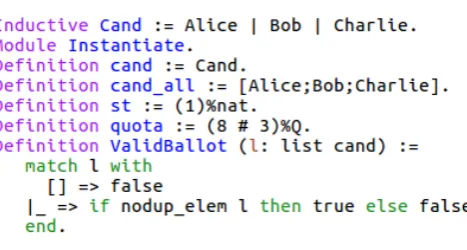
3.4 Example of Instantiation of parameters . . . 44
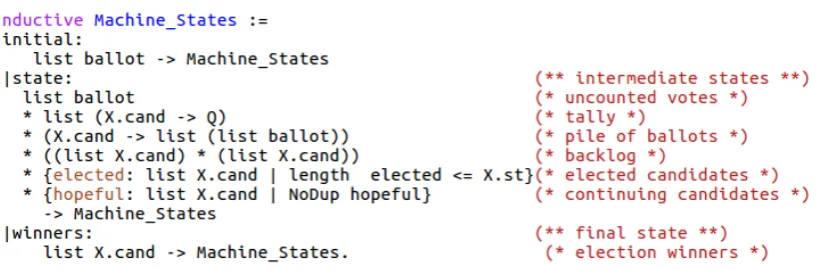
3.5 Inductive Type for Machine States . . . 45
3.6 Type of Ballots . . . 45
3.7 Declaration of Sigma Types . . . 46
3.8 Dependent lexicographic Ordering . . . 47
3.9 Dependent pairs onN6 . . . 48
3.10 Imposing Dependent construct onN6 . . . 48
3.11 Lexicographic ordering onDependentNat_Prod5 . . . 49
3.12 Well-foundedness ofLexOrdNat . . . 49
3.13 Lexicographic Ordering onN6 . . . 50
3.14 Lexicographic Ordering onN6 . . . 50
3.15 Correctness ofMeasure_States . . . 50
3.16 Sanity Check of Elect Transition . . . 51
3.17 Sanity Check of Transfer-elected Transition . . . 53
3.18 Semantics of the Transfer-removed Transition . . . 54
3.19 The STV Machine . . . 55
3.20 Measure Decrease for Elect, Transfer-elected and Transfer-removed . . . 56
3.21 Reducibility Property of the Machine . . . 56
3.22 Applicability Property of the Machine . . . 57
3.23 Structure of Applicability Proof . . . 58
3.24 Termination Theorem . . . 59
4.1 Formal Specification of the ACT’s elect transition . . . 67
4.2 The formal counterpart of clause 12 . . . 70
4.3 The implemented function for computing list differences . . . 70
4.4 The function Removel satisfies the formal counterpart of Clause 12 . . . 70
4.5 ACT STV’s Evidence for the Applicaility Sanity Check . . . 71
4.6 ACT STV’s Evidence for the Reducibility Sanity Check . . . 71
4.7 The ACT STV Version of the Machine . . . 72
4.8 Ballots’ Preferences of a Sample Election with ACT STV . . . 73
4.9 A Trace of Machine States Visited to Compute the Winners . . . 73
4.10 Formal Specification of the Victoria’s elect transition . . . 76
4.11 Formal Specification of the CADE’s elect transition . . . 77
4.12 Ballots’ Preferences of a Sample Election with CADE . . . 78
4.13 A Transcript of Computing Winners for the Small Election with CADE 78 4.14 Termination Property of the Machine . . . 83
4.15 Termination Property of the ACT version of the Machine . . . 83
4.16 Extracting ACT Machine into a Haskell Program . . . 84
4.17 The Formal Inductively Defined Certificate Type . . . 85
4.18 A Concrete Instance of a Certificate . . . 88
4.19 ACT Legislative Assembly 2008 and 2012 . . . 89
5.1 Our Approach in a Picture . . . 96
5.2 List of Symbols for characterising the Generic Verifier . . . 98
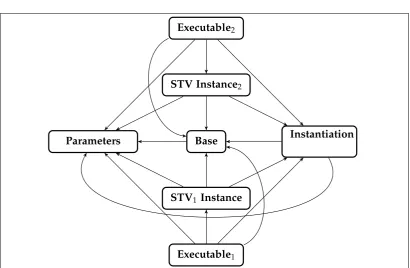
5.3 Architecture of the Framework, note that direction of arrow represents module dependencies . . . 102
5.4 Data Structure of the Generic Machine in HOL4 . . . 104
5.5 The Generic Transfer-elect transition . . . 106
5.6 Correspondence of the Informal Clauses with the Formalised Ones . . . 107
5.7 Specification of the Checks for the List of Competing Candidates . . . . 107
5.8 A Specification of Allocation of Piles and Tallies . . . 107
5.9 Implementation ofValid_Pile_TallyPart I . . . 108
5.10 Implementation ofValid_Pile_TallyPart II . . . 108
5.11 Proof of the Correctness ofValid_PileTallyImplementation . . . 108
5.12 A Boolean-valued Function for Finding Tally of Candidates . . . 109
5.13 Uniqueness of Candidate’s Tally in Implementation . . . 109
5.14 A Function for Deciding if Everyone is Below the Quota . . . 110
5.15 less_than_quotaComputationally Realises Its Specification . . . 110
5.16 Implementation of the Generic Transfer-Elected’s Semantics . . . 110
5.17 Implementation and Specification of Generic Transfer-Elected’s Seman-tics Match . . . 110
5.18 Ballots’ Preferences of a Sample Election with ACT STV . . . 111
5.19 A Concrete Certificate of an Election . . . 111
6.1 Specification of the ACT STV’s Transfer-elected Semantics . . . 115
6.2 Implementation of the Lines 63 and 64 in Figure 6.1 . . . 115
6.3 Logical Specifications of subpile1 and subpile2 Force their Computa-tional Contents . . . 116
6.4 The Computational Content ofsubpile1andsubpile2Forces their Log-ical Specifications . . . 116
6.5 Implementation of the Semantics of the ACT STV’s Transfer-elected . . 116
6.6 Implementation of the Victoria’s Transfer-elected . . . 118
6.7 Implementation of the CADE’s Transfer-elected . . . 119
6.8 Specification of a Valid Initial Machine State . . . 123
6.9 Specification of a Valid Step From one State to Another . . . 124
LIST OF FIGURES xvii
6.11 Specification of a Valid Formal Certificate . . . 124 6.12 Implementation of the Formal Certificate Verifier . . . 124
6.13 Proofs of the Implementations Correctness for Sub-procedures ofCheck_Parsed_Certificate125 6.14 Correctness of the Formal Certificate Verifier . . . 125
6.15 Shallow Embedding of Certificate Verifier in CakeML’s Ecosystem . . . 126 6.16 The Deeply EmbeddedloopFunction in CakeML . . . 127 6.17 The Deeply Embedded Certificate loop Function Returned Value Is
Correct with Respect to the HOL4 Definition of Certificate Verifier . . . 127 6.18 An End-to-End Specification and Proof of Correct Behaviour of the
Executable Version of theloopFunction in an Operating System . . . . 128 6.19 Correctness of the Executable Concrete Certificate Verifier with
Re-spect to Its Logical Specification . . . 128 6.20 Certificate Validation; ACT Legislative Assembly Elections in 2008/2012 129 6.21 The Toolchain of Synthesising an Executable Certificate Verifier . . . 131
Chapter1
Introduction
Most countries with a single transferable vote (STV) [53] system rely on archaic man-ual vote counting or opaque unreliable computerised methods. Although technology exists to enhance the situation by building significantly more transparent, trustwor-thy, reliable vote counting tools, in practice these technologies are ignored. This thesis introduces a modular framework for formalisation, verification and construc-tion of provably correct, efficient, independently verifiable tools for counting votes with various STV algorithms. It builds on lessons learned from theoretical computer science, such as automata theory and programming semantics, together with formal engineering and verification methods.
STV is a family of preferential-proportional schemes embraced in several coun-tries, such as Ireland, New Zealand and Australia. STV schemes are used for a range of significant elections including presidential, Senate, and parliamentary. The STV family has risen to such a prominent status because it has survived numerous polit-ical challenges [54]. As a result, it has grown more mature over the decades, being successfully adapted and assimilated within divergent political environments [54]. In spite of the maturity and importance of STV schemes, the current practice of vote counting methods with STV algorithms are next to an embarrassment.
History has witnessed tragic performances for conducting harmful methods in counting under STV. In 2013 the authorities in Western Australia (WA) informed the public that mistakes had happened throughout the manual process of counting in the Senate election [95]. They were ashamed that 1370 ballot papers had disappeared. The loss was so striking that it could change the outcome, even who was a winner. Consequently, the initially announced result was aborted. The public embarrass-ment led to repeating the election, financed by taxpayers, costing some 20 million Australian dollars.
The public vote and trust in the integrity of the electoral system is a cornerstone of modern democracy. One instance of such failures is enough to cast questions on the authenticity and trustworthiness of elections procedure and democratic institutions where they take place in. Mistakes like this subsequently disfigure the delicate face of trust in democracy both as a process and an ideal to desire. To safeguard this fragile trust, and also save resources, electoral authorities have come to rely on computerised vote counting as an alternative.
Adapting an electronic method for operating an election is progress. However,
it does not automatically eliminate every problem. Indeed, some standards such as integrity of the election, guaranteeing the correctness of the outcome, the privacy of both a voter and his/her cast vote, and transparency of process become more challenging as compared to manually operated elections. For example, in a tradi-tionally held election part of the process, such as the physical ballot box is tangibly observable and also a voter can readily know whether or not their vote is included among the cast votes. In the electronic counterpart, however, the voter interacts with a machine for casting and recording their votes and they do not readily know what the machine does with the vote(s) cast and if their vote is recorded to be tallied to-wards electing winners. Consequently, the integrity and correctness of the outcome together with the transparency of the process and concerns over privacy preservation in an electronic election face question marks to be answered.
Despite the expectations for using provably reliable trustworthy means in elec-tronic elections, the current state of affairs leaves much to be desired. Indeed some electronic voting tools as they are used now may be seen as a step back from tradi-tional paper-based elections where tallying proceeds manually. For example, states of Australia rely on software which essentially resemble magic boxes [142]. No trans-parent information is provided so that observers know howexactly thecounting has proceeded. Nor any form of independently verifiable evidence is yielded for the correctness of the computation carried out. This situation results in a low level of transparency and a huge trusted computing base (TCB) required from voters and third-party users to invest in the tools for employing them. The unsatisfactory state of affairs with using many of the electronic voting systems is unfortunately not sim-ply limited to this specific instance.
What makes the situation worse is that, contrary to the election transparency requirements, these programs are mostly black boxes as well. The implementations of the tallying module of many of these voting systems are very often, although not always, kept secret due to legal excuses of confidentiality and protecting the property of the companies that produce them [95]. Therefore one can neither audit the election data and the process of computing winners of the election carried by the software nor they can audit the source code of the implementation of the vote counting algorithm to investigate its correctness.
The notion of end-to-end verifiability [17, 126] has been introduced in the context of election security in order to establish guarantees into the integrity and trustwor-thiness of an election result and also confidence in the preservation of voter privacy. End-to-end verifiability of an election comprises satisfying several sub-properties in-cluding eligibility verifiability, cast-as-intended verifiability, recorded-as-cast verifia-bility, and tallied-as-recorded verifiability.
• eligibility Verifiability.The electronic means employed in the election must verify that only eligible voters are able to cast a vote.
3
• recorded-as-cast verifiability.Also, they must guarantee that the machine correctly records the cast-as-intended vote into the system.
• tallied-as-recorded verifiability. Moreover, it must yield evidence that the tally-ing progresses correctly accordtally-ing to the vote-counttally-ing algorithm used in the election and the ballots recorded as cast.
• privacy preservation.Also, the voting system must demonstrate proofs that con-tent of the vote cast and the identity of the voter (as in relation with their vote and its content) is not tractable by either of the machinery employed or any third parties. As a result, the voters cannot be coerced to behave in any specific ways when participating in the election and their vote cannot be bought by any interested third party.
Some knowledgeable scholars together with skilful engineers have drawn on solid academic studies and technology to design, develop and implement a voting system that accommodate STV schemes. As end-to-end verifiability is a highly regarded security standard, it has become a selling point for many such implemented voting systems. However, truth be told, end-to-end verifiability is an ideal attainable only in principle but not in practice. Although the theory behind the design and develop-ment of these voting systems is hardly questionable, there is nonetheless a gap from the theory to engineering a concrete provably trustworthy voting system. When it comes to engineering, there are several trusted layers that have to be removed. In particular, assuming that the cast-as-intended and recorded-as-cast properties are verifiably correctly engineered, there are trusted layers encountered while engineer-ing software for tallyengineer-ing votes that must be addressed as well. Currently, the tallyengineer-ing module of every voting system implementing an STV algorithm for counting votes suffers from a considerable TCB.
Every implemented voting system currently in use for STV family of algorithms which claims to satisfy the end-to-end verifiability criteria either does not formally verify the correctness of the tallying component or it relies on the so-called light-weight tools for the verification of the tallying program. Unfortunately, light-light-weight tools are themselves complex programs which lack proofs of correctness. Conse-quently, using them requires a significant amount of trust. Moreover, even the theo-retical framework behind a light-weight verification software, let alone its implemen-tation, is not proven to be complete. Consequently, the tool may not, and one can never be absolutely sure when and if it does, identify every possible error in the tal-lying software code. As a result, a light-weight verification tool can only increase the confidence in the correctness of a program. It however does not provide a guarantee into the full correctness of the vote counting software.
such simplifications, correct implementation of complex algorithms such as an STV scheme is not a straightforward task. For instance, the vote counting software that is used in Australia’s most populous state, NSW, was found to contain errors that had an impact in at least one seat that was wrongly filled with high probability. This was reported in specialist publications [18] as well as the national press[112, 24].
To avoid repeating mistakes such as the above in tallying votes with STV schemes, a voting system must provide trustworthy means and techniques to guarantee the correctness of counting votes in a verifiable way. End-to-end verifiability alone is not enough for engineering such a trustworthy voting system for two reasons:
a. to-end verifiability, and naturally every existing implementation of an end-to-end verifiable system, basically aims at proving the correctness of the tallying phase by giving every voter the chance toaudit data flowwhile counting votes. Unfortunately, auditability can only facilitate but not cultivate trustworthiness of the tallying correctness as mistakes mentioned above have happened in front of the public eyes. Auditability may work for detecting errors while counting with simple voting schemes such as first-past-the-post but not for computation with STV algorithms which are known for their complexities. For detecting possible errors in an instance of vote counting with an STV algorithm, au-ditability has to be accompanied by second provably trustworthy standalone software that meticulously checks, based on the auditable recorded ballots, if computation performed by the vote counting software has progressed correctly. However, none of the existing implementations of an end-to-end verifiable vot-ing system for STV offers such standalone software.
§1.1 Approach 5
Formal verification tools and techniques are now mature enough for creating a provably trustworthy tallying module for satisfying the universal verifiability of tallied-as-recorded property. This thesis focuses (only) on the tallying phase in an electronic election where the vote counting algorithm implemented as a choice func-tion operates on some input ballots and outputs the final end result where the win-ners are produced. Therefore, we do not question how the input ballots have been obtained and if the security expectations in casting and recording phases have all been met. We do guarantee, as we shall demonstrate, that our framework accom-plishes the following milestones.
• Universal verifiability of tallying with a minimal TCB.We provide auditabil-ity of tallying data and verified tools that have a minimal TCB. Using them allows any voter to satisfy themselves that a vote counting program synthe-sised from our framework correctly computes the output winners for given input ballots recorded.
• Software/Computation Correctness. Counting votes must proceed based on proven correct, hence reliable, tools. We design and develop a framework for formal specification and verification of various STV schemes in a modular way. The framework provides the construction of formally proven correct implemen-tations of a wide range of STV schemes for computing election winners.
• Transparency of tallying. The constructed implementations above, upon each execution on an input, produce a printout that consists of all of the necessary information to know how winners are computed. This printout makes the tallying phase auditable which, in turn, allows the verifiability of the tallying result.
• Practicality. We are motivated to better our world by resolving the embarrass-ing situation of countembarrass-ing with STV schemes. Therefore feasibility of deployembarrass-ing the software for real-world elections and ease of adapting it for enhanced us-ability are factors to which we are attentive.
1
.
1
Approach
Our quest for achieving the above horizon begins by asking simple but central ques-tions. What is STV really? Why despite conspicuous differences perceived among STV algorithms, they are still categorised as members of one family named STV? What is it that constitutes a family resemblance which unites these diverging schemes as STV?
is fundamental to the thesis, we shall provide further details to shed light on the way in which we are characterising STV.
To count an election according to STV, one usually computes a quota dependent on the number of ballots cast (often the Droop quota [46] and then proceeds as follows:
1. Count all first preferences on ballot papers;
2. Elect all candidates whose first preferences meet or exceed the quota;
3. Transfer surplus votes, i.e. votes of elected candidates beyond and over the quota are transferred to the next preference;
4. If all transfers are concluded and there are still vacant seats, eliminate the least preferred candidate, and transfer his/her votes to the next preference.
On the other hand, all variants of STV share a large set of similarities. All use the same mechanism (transfer, count, elect, eliminate) to progress the count and, for example, all cease counting once all vacancies are filled. description hides lots of detail, in particular concerning precisely which ballots are to be transferred to the next preference. Indeed, many jurisdictions differ in precisely that detail and stipulate a different subset of ballots be transferred, typically at a fractional weight (the so-calledtransfer value). For example, in the Australian Capital Territory (ACT) lower house STV election scheme, only the last parcel of an elected candidate (the ballots attributed to the candidate at the last count) is transferred. In contrast, the STV variant used in the upper house of the The Australian state of Victoria transfers
allballots (at a reduced transfer value). Similar differences also exist for the transfer of votes when a candidate is being eliminated.
We abstract the commonalities of all different flavours of STV into a set of minimal requirements that we (consequently) callminimalor genericSTV. It consists of:
• the data (structure) that captures all states of the count
• the requirements that building blocks (transfer, count, . . . ) must obey.
In particular, we formally understand each single discrete state of counting as a mathematical object which comprises some data. Based on the kind of data that such an object encapsulates, we separate them into three sets: initial states (all ballots un-counted), final states (election winners are declared) and intermediate states. The lat-ter carry seven pieces of information: the list of remaining uncounted ballots which must be dealt with; the current tally of each candidate; the pile of ballots counted in each candidate’s favour; the list of elected candidates whose votes await transfer; the list of eliminated candidates whose votes await transfer; the list of elected candidates; and the list of continuing candidates. Basically, they record the current state of the tally computation.
§1.2 Solution 7
pre-state and a post-state. These rules are what varies between different flavours of STV, so minimal STV does not define them. Instead, it postulates minimalconditions
that each rule must satisfy. Aninstanceof STV is then given by:
1. definitionsof the rules for counting, electing, eliminating, and transferring;
2. formalproofsthat the rules satisfy the respective conditions.
We sometimes refer, somewhat informally, to the conditions the various rules must satisfy as sanity checks. They are the formal counterparts of the legislation that in-forms counting officers which action to perform and when. Each sanity check con-sists of two parts: the applicability conditionspecifies under what conditions the rule can be applied while theprogress conditionspecifies the effect of the rule on the state of the count. For example, the count rule is applicable if there are uncounted ballots and reduces the number of uncounted ballots.
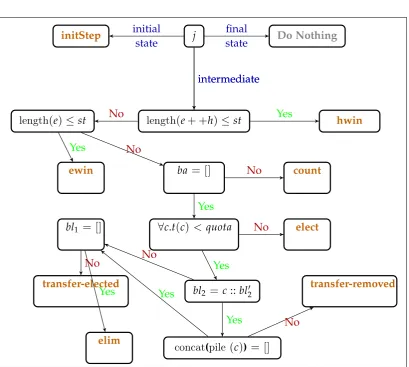
The STV Machine. A marvellous phenomenon emerges from our analysis; we can see STV as a finite state machine. The aforementioned discrete states of compu-tation constitute the states of the machine. The transitions which enable us to move from one state to another are the transition labels of the machine. Moreover, the sanity checks collectively comprise a small-step semantics for the machine.
The machine is conceptualised to have a feature which traditional finite state machines lack. Given an input x to the machine, the model produces as output a value yand a certificateω. The certificate, also called evidence, is essentially a trace
of all of the states and the transitions that the machine visits from the initial state where x was given to the machine all the way through intermediate states of the machine to finally reach the terminal state where the valueyis obtained. We refer to this property as certification and name the act of certification as certifying.
We establish three main properties of this generic STV machine. The first, called reducibility property, asserts that each application of any of the STV generic transi-tions reduces a complexity measure. The second property called applicability states that at any non-final state of the computation, at least one of the generic transitions is applicable because it satisfies its sanity check requirements. Drawing on the re-ducibility and applicability properties of the machine, we establish a third property stating that the generic STV machine terminates at a final state y, upon each exe-cution on a given input x, where a certificate ω for this instance of computation is
constructed as well.
1
.
2
Solution
the transition labels of the machine are formalised as generic parameters to be in-stantiated later. The machine is specified as the record of the transition labels which satisfy the formal sanity check requirements (small-step [132] constraints). We then prove that the generic machine has the three aforementioned properties, namely re-ducing a defined complexity measure, the applicability of a transition label at each non-final state, and the termination property.
On the other hand, the framework has several dependent modules each of which is devoted to formalisation and verification of concrete instances of STV. Basically, formalisation of the instances happens through instantiations of the generic transition labels. To instantiate the transitions, one has to specify them in Coq based on the textual description of the counting mechanism of that particular STV. To verify them one only needs to discharge the sanity checks to show that the instance is indeed legitimately an STV algorithm and to therefore automatically extend the verification obtained for the machine to the instance.
Coq has automatic means of extracting program [91] into the Haskell program-ming language. By using the extraction facility, we extract each dependent module from Coq into Haskell to obtain executable vote-counting programs for a variety of STV algorithms. Thanks to the extraction mechanism of Coq, we are given a high level of guarantee that the executable vote counters behave in accordance with their specification in Coq.
Each extracted program, upon any execution on a given input x, outputs winners of the election y which is accompanied by a run-time generated certificate ω. The
run-time certificate is essentially the extracted counterpart of the formally specified certificate notion inside Coq. Consequently, ω comprises the list of machine states
visited and transitions applied in order to compute the winnersy for the inputx. A certificate therefore consists of all of the necessary and sufficient information to know in order to see how the extracted program has computed the final result. Also the certification provides the opportunity for independent validation of the computation carried out without relying on the source program used for computing the election’s result and the certificate.
Offering a certificate to voters is fantastic but by itself is not perfect. Suppose some program P, whose source code is confidential, is an implementation of some STV algorithm S. Also suppose that this program is executed on an input x and produces the output y and the certificateω, where it is claimed that yis the correct
output witnessed by the evidenceω. How can one verify or reject the claim without
redoing the computation on x? More interestingly, how can one investigate such claims in a way that the method can be modularly extended to work for any STV algorithm rather than merely S and any implementation of S instead of only P? Such a method can particularly, but not exclusively, be applied to independently of how extracted vote-counting programs above are produced, check the correctness of their output certificate.
§1.3 Contributions 9
place in the environment of the theorem prover HOL4 [131]. By using the proven trustworthy translation tool of the CakeML [136], we obtain equivalent certificate checkers inside the environment of CakeML. We then synthesise machine executable certificate checkers for numerous STV algorithms by relying on the verified compiler of CakeML.
Formalisation, verification and synthesis of certificate checkers proceed modu-larly. However, each single certificate checker operates for a particular STV instance. A checker for a scheme S accepts as input a certificate produced based on comput-ing under S. Recall that a certificate is a list of states of computation. The checker recursively consumes two consecutive states in the certificate and checks if the tran-sition from the antecedent state to its succedent has happened in accordance with the counting mechanism of S. This process continues until either all of the steps in the certificate are verified as valid or an error occurs where an invalid step is encountered. In the former case, the certificate checker returns a message communi-cating validity of the certificate, whereas in the latter an error message of invalidity is output informing us where the error happens.
1
.
3
Contributions
A good tree bringeth not forth corrupt fruit; neither doth a corrupt tree brings forth good fruit1. A new perspective is weighted against the fruits that it bears and the
possibilities which it opens. Our work results in immense fecundity.
1. Correctness. Every single computational assertion which we rely on for com-putation is verified. Moreover, in light of the content of the proofs of the the-orems which we establish in Coq and HOL4, the counting mechanism with STV algorithms is also proven correct. Additionally, the certificate checkers in their entirety are verified. Hence not only auxiliary components are provably reliable, but also the whole processes of computation are verified as well.
2. Transparency. We offer certificates which consist of all of the necessary infor-mation to transparently see how winners are obtained. Having a certificate available allows any voter to audit the tallying process independently of any election authorities.
3. Universal verifiability of tallying. A certificate, through auditability of data, gives the opportunity to any voter for independently investigating the correct-ness of the tallying procedure by themselves. They can check a certificate man-ually or have a certificate checker to machine check its correctness. However, we offer verified means that can effectively carry out this task for voters.
The trusted base to lay in vote counting authorities and tools which they use should become ideally zero but at least practically as small as possible. By minimising the TCB while engineering a tallying module, we approximate the
universal verifiability of the tallying phase as much as the currently available state-of-art-technology allows us to. Our certificate checkers are proven correct down to machine code. We obtain this by using CakeML which provides us with end-to-end verification of checkers. Therefore several untrusted verifica-tion layers, such as translaverifica-tion of asserverifica-tions from the theorem prover to the compiler environment or from the compiler to machine executable code are eliminated. We hence minimise the trusted base required to invest in our tools.
4. Practicality. The theoretical insight behind the framework together with ele-gance in employing formal engineering tools brings about several advantages. In particular, we benefit from the followings.
(a) Efficiency: Experimental results on real historical data of elections con-ducted in the ACT state of Australia witness feasibility of the software produced by our framework. For example, our software computes win-ners of the biggest electoral district for the legislative assembly elections in Australia in just 22 minutes and checks the certificate produced in simply five minutes.
(b) Adaptability: We achieve a great degree of adaptability of the frame-work. It is adaptable to various STV algorithms used in parliamentary and Senate elections, and also in institutions and unions across continents for electing their board of trustees or presidents.
(c) Usability: Modularity of the framework’s design provides us with satis-factory usability. It brings about two fruits in particular;
• Proof automation:We automate a significant amount of formalisation and verification away so that they are dealt with by us, rather than users, and done once and for all. In the framework developed in Coq, we mainly automate proofs through instantiations into the base mod-ule. For the framework in HOL4, we automate proofs by developing the bulk of the formalisation and verification in the base and then simply calling the base inside dependent modules.
• Abstraction:technicalities of formalisation, verification, and discharg-ing tedious complicated proof obligations, such as termination proof, are sufficiently hidden from users who may need not knowing about them. Especially, since CakeML has a challenging learning curve, we fully automate and abstract dealing with CakeML. Therefore when it comes to synthesising machine executable code for checkers, users only need to follow instructions presented to them.
imple-§1.3 Contributions 11
mentations for correctness. To guarantee every one of trustworthiness of this procedure, we then verify the certificate checker once and for all.
5. The Framework.the unique environment that we have created allows a modu-lar treatment and comparison of various STV algorithms froma purely syntactic point of view. This in turn opens the chance for those interested in studying and comparing STV algorithms from a computational social choice theory per-spective. They can use our framework for modifying specific parts of one or some STV algorithms, extract an executable program and objectively measure the effect of the modifications. Such analysis of the STV family is subject of our future work.
1.3.1 On Integrating Our Framework into A Voting System
We note that our framework is obviously not meant to be a standalone piece of software for running an entire electronic election. In contrast, for the sake of end-to-end verifiability criteria, tools generated from our framework should be embedded as part of a more encompassing voting system that takes care of the secure vote casting and vote recording as well. At this point, we find it useful to outline how our work can be combined with the existing voting systems for STV schemes such as Prêt à Voter [124] and vVote [5].
The existing voting systems that aim at establishing end-to-end verifiability and accommodate STV algorithms, basically the Prêt à Voter and vVote, can deploy the vote counting programs extracted from our Coq component to compute election win-ners and output a certificate for the computation performed. These systems can also make the corresponding certificate verifier of the STV algorithm used in the election publicly available so that any voter can run the verifier on the certificate.
We note that every certificate contains the plaintext votes as recorded in the voting system. As it is known [106, 16], STV voting schemes are potentially more vulner-able to the “Italian attack” [106] than non-preferential voting schemes [106]. There-fore an astute reader may object that any voting system wanting to adapt our tools would also suffer from the voter coercion problem. In our defence, we next elaborate more on the current situation with the existing implemented voting systems for STV schemes to see that indeed the problem stems from their technique used for vote anonymisation.
high chance if their votes appear among the plaintext supposedly anonymised votes. This attack is technically referred to as the Italian attack. Consequently, the existing voting systems for STV, and any other emerging ones that rely on the same method of mixing suffer from vulnerability to voter coercion phenomena.
We do claim that a certificate does not make the hosting voting system any more vulnerable to the voter coercion problem than the mixing technique as currently exercised by the voting systems does. Indeed, our work basically addresses the tallying phase which happens independently of voters interactions that mainly take place during vote casting and vote recording. Privacy matters mainly arise at the vote casting and recording which preceded the tallying stage. Consequently, the level of the voters’ privacy is not generically affected by using our tools.
To the best of our knowledge, there exists no end-to-end verifiable voting system currently deployed in real elections that use a homomorphic tallying technique for counting votes based on an STV algorithm. However, assuming there was one, our framework as it stands is more suited with mixnet techniques rather than homomor-phic methods. Nonetheless, this is not a generic constraint on using our framework. In the future work, we shall outline how a voting system relying on homomorphic tallying may adapt our tools.
1
.
4
Publications
The author of this thesis is the main contributor to the following publications, all of which were accomplished during the PhD process.
1. Milad K. Ghale, Rajeev Goré, Dirk Pattinson: A Formally Verified Single Trans-ferable Voting Scheme with Fractional Values Electronic Voting - Second In-ternational Joint Conference, E-Vote-ID 2017, Bregenz, Austria, October 24-27, 2017, Proceedings (won the best paper award)
2. Milad K. Ghale, Dirk Pattinson, Ramana Kummar, Michael Norrish: Verified Certificate Checking for Counting Votes, Verified Software. Theories, Tools, and Experiments- 10th Int. Conf. VSTTE 2018, Oxford, UK, LNCS Springer 2018
3. Milad K. Ghale, Rajeev Goré, Dirk Pattinson, Mukesh Tiwari: Modular For-malisation and Verification of STV Algorithms. Electronic Voting - Third Inter-national Joint Conference, E-Vote-ID 2018, Bregenz, Austria, October 2-5, 2018, Proceedings
4. Milad K. Ghale: Engineering Software for Modular Formalisation and Verifi-cation of STV Algorithms, 20th Int. Conf. on Formal Engineering Methods (ICFEM) 2018, Gold Coast, QLD, Australia, Nov. 12-16, 2018, Proceedings, 459-463.
§1.5 Thesis Outline 13
1
.
5
Thesis Outline
The thesis is organised as follows.
Chapter 2. We begin the chapter by analysing the data structure and the algorithmic vote counting mechanism that is common between STV algorithms. We then discuss how to model these underlying commonalities as an abstract state machine. For ped-agogical purposes and also limitations of presenting all of our actual formalisation of the machine, in Chapter 2 we only discuss an informal mathematical, pen-and-paper presentation of the machine components.2
Chapter 3 and Chapter 4. These chapters together discuss the first standalone com-ponent of our framework which we use to construct verified vote counting programs for various STV schemes. The chapter presents the formalisation and verification of the generic STV machine in Coq. In chapter 4, we demonstrate how a concrete STV algorithm is realised as an instantiation of the formalised STV machine discussed in Chapter 3. We present three such instantiations and discuss technicalities of the implementation and verification of the machine instantiations. Also, we explain how to obtain Haskell executable programs for these instantiations of the machine. Addi-tionally, we demonstrate instances of concrete certificates and present experimental data as evidence for the feasibility of deploying the vote counting tools created in real-size elections.
Chapter 5 and Chapter 6. These chapters discuss the second component of the framework which deal with producing certificate verifiers for checking the correct-ness of different STV algorithms. Chapter 5 details how we formalise the generic STV machine in HOL4 as a generic tool for verifying the correctness of computation carried out by STV vote counting programs. Chapter 5 also includes implementing a computational counterpart of this generic machine and then verifying the correct-ness of the implementation against the formalised specification of the machine. In Chapter 6, we discuss what an instantiation of the machine in HOL4 amounts to and illustrate the process of the instantiation for some STV algorithms that are used in real elections. Moreover, we discuss how from an instantiation one can obtain a verifier that checks the correctness of certificates produces for computation with the STV algorithm instantiated in the generic machine. Furthermore, we show how to proceed with translating and compiling executable verifiers using CakeML. Finally, we present experimental results with the executable verifiers on concrete certificates.
Chapter 7 and Chapter 8. We discuss the related work in Chapter 7 and conclude the thesis with an elaboration on future work in Chapter 8.
2Throughout the monograph, we reserve the word “formal” specifically referring to formalisation
1
.
6
Tools Used for Constructing the Framework
Trustworthy correct software is built by proven reliable means. We develop both components of the framework in safe provably reliable environments of the theorem provers. A theorem prover itself is software that has a calculus for manipulating computation and provides an interactive interface to users to formalise (implement) their model in a general purpose language given by the theorem prover and then verify the formalised model against its specification. By the term formalisation one simply refers to the practice of implementing the model in a theorem prover. Speci-fication means defining properties in the language of the theorem prover which one expects the formalised model to satisfy. Verifying an implementation then amounts to relying on the calculus used by the theorem prover to prove that the formalised model indeed meets its speciication.
The process of verification proceeds through interaction with the theorem prover environment where the user uses so-called tactics to guide the theorem prover to-wards finalising the proof of the statement desired to be proved. As the implemen-tation of the calculus (and tactics as well) is proven correct, one can be confident that proofs carried out in these environments are highly reliable. Moreover, theorem provers are excellent at identifying corner cases which a human may fail to recognise. Therefore some trusted computing base is eliminated in light of the verification car-ried out to demonstrate that the implementation behaves correctly in every possibly occurring situation.
We briefly describe the theorem provers Coq and HOL4 and the CakeML com-piler used to build our work on. We develop the first component of the framework in the environment of Coq. We note three characteristics of Coq on which the wrok heavily relys.
• Dependent types. Calculus of (Co-)Inductive of Constructions (CIC) [35] is the underlying calculus based on which Coq operates. CIC not only allows defin-ing primitive data types such as lists and trees but it also accommodates con-structing types whose definition depend on terms. These later constructs called dependent types can be used, among many other applications, to reason about program properties and behaviour [117, 31]. For example, one can define a function whose input is a list of trees and whose return value is a dependent type where the second value is a proof that the first component consists of only those trees in the input that their height does not exceed some particular number.
§1.6 Tools Used for Constructing the Framework 15
as a type) is called a proof-object. Proof-objects are basically constructed by application of CIC’s rules, including the lambda abstraction, for building new terms/types. Therefore in Coq, a theorem or lemma is simply a type and a proof carried out in Coq to establish the correctness of the theorem or lemma is a program that constructs a proof-object inhabiting the type.
• Extraction of proof carrying code. Coq has a built-in code extraction mechanism. The extraction facilitates producing functional programs into Haskell, OCaml, or Scheme language. The extracted code is the pretty-printed versions of the entities formalised in Coq. In view of the preceding points on dependent types and proofs operating as programs, the extracted compilable functional code carries its correctness proof within itself (e.g. see Wadler [140]).
We develop the second component of the framework using HOL4 and CakeML. HOL4 is a theorem prover which uses the ML-style of programming for defining data types, functions and other computational entities. It uses a variant of classi-cal Higher Order Logic [4] for declaring predicative assertions and reasoning about declarations specified in the theorem prover. The core calculus of HOL4 is a rewrit-ing system [10] workrewrit-ing alongside well-developed libraries of theorems established on a variety of data structures, including lists and tactics developed for automating rewriting definitions to prove desired properties about the formalised model. We particularly benefit from three features that HOL4 offers:
• Well-developed libraries/tactics. HOL4 has well-developed libraries comprised of verified assertions of operations on list structure. This motivates developing the data structure of the second software component on top of list structures. By structuring the data on lists, we facilitate us and users with the exploitation of already verified tools to formalise the framework and avoid inventing the unnecessary from the scratch. HOL4 also has well-developed tactics for dis-charging proof obligations on assertions involving list structure and operations on it. We therefore come to provide us with means for ease of verification of the formalised assertions.
specification of a program happens using a syntax similar to first-order logic which many users have already encountered having done courses in mathe-matics as high school or undergraduate students.
• Connectability to CakeML. One of our main motivation for using HOL4 is the proven trustworthy connection that is has with the CakeML through CakeML’s verifed proof-translator tool. Once assertions are translated correctly from HOL4 environment into CakeML’s, using the CakeML verified compiler, we can then synthesise machine executable code for certificate verifiers that are guaranteed to behave according to their formal specifications. The combina-tion of HOL4 and CakeML thus allows us to minimise the TCB in means used for producing certificate checkers and also in performing computation with the verifiers produced.
CakeML is a terminology used in three different but interrelated senses.
• First of all, the word CakeML refers to a functional programming language comprising a large subset of the ML-style functional language.
• Second, the word also refers to an ecosystem of proven correct programs and proofs, and verified tools including a compiler backend and two compiler front-ends. The first compiler front-end is a PEG parser3 itself consisting of a parser and a type inferencer that have been proven sound and complete. The sec-ond front-end is a proof-translator proven to produce an equivalent abstract syntactic representation (AST) of a computational assertion in HOL4 into an assertion in CakeMl’s environment. The CakeML backend compiler mainly transforms an untyped AST to concrete machine code for some target architec-tures including x86_64, ARMv6 and ARMv8. The compiler backend has been proved to only produce machine code that is compatible with the behaviours of the source programs. Also, CakeML’s ecosystem contains libraries of verified functions and definitions for modelling I/O interactions of a program with an operating system. The ecosystem, including the compiler backend and front-ends, are activated and accessed from within HOL4.
• Finally, the word CakeML also refers to the executable compiler of the language which we mentioned above. This executable compiler is obtained by boot-strapping itself. As the compiler backend which has boot-strapped itself is proven correct together with the front-ends, the resulting executable compiler provably correctly compiles the language.
1.6.1 Source Code of the Framework
The interested reader can find the source code of our framework, including the mod-elling, implementation, and the proofs online at the following address:
3PEG stands for Parsing Expression Grammar, which is a type of formal grammar for describing a
§1.6 Tools Used for Constructing the Framework 17
https://github.com/MiladKetabGhale
As you see in the above Github account, there are four repositories that host the earlier versions of the framework components and the most recent ones based on which the thesis has been written. More specifically, the source code of the Coq com-ponent is at https://github.com/MiladKetabGhale/Modular-STVCalculi and the one for the HOL4-CakeML component is found athttps://github.com/MiladKetabGhale/
Chapter2
Specification of the Generic STV
Machine
In the first section of this chapter, we provide an explication [96] of the underlying data and algorithmic structure found in STV algorithms. Through this analysis, we come to abstract a general version of STV that we call generic STV. We then in the subsequent sections formulate the generic STV as an abstract finite state machine and explain the machine’s components in a simple mathematical language. Finally, we discuss some of the main mathematical properties which this model of computation has.1
2
.
1
The Generic STV
STV algorithms are mostly described as texts in natural language. Our quest there-fore begins with analysis of the textual specification of these schemes. The objective is to attain an insight into what STV is in a way that realises similarities of instances and also accommodates particularities of each case.
Our thorough examination of different STV algorithms reveals a common under-lying data and algorithmic structure which lays the foundation of the STV family. Despite the fact that concrete embodiments of the structure vary, the structure itself invariably remains there. Presence of the structure in each individual STV separates them from other vote counting schemes which are not STV. On the other hand, vari-ations in the embodiment of the structure produces distinguished individual STV schemes. We detail about the structure in the current chapter. We shall discuss how various STV algorithms emerge from the way the structure is materialised in chapters 3 and 4.
To provide a tangible foothold for the discussion, we first present the algorithm used in the Australian Capital Territory (ACT) of Australia for electing representa-tives of the lower house. Hence the reader comes to a clearer image of the kind of algorithms which are subject of our curiosity. We then sensibly illustrate what our approach is and outline how it unfolds into a solution.
1We remind the reader that the content of this chapter is entirely considered as an informal
discus-sion. Formal treatments of the STV are presented in the four subsequent chapters.
2.1.1 A Concrete Instance of STV
The counting protocol determines design of the ballots and the acceptable way of expressing one’s vote on the ballot.
Voting. Voters mark preferences for candidates in the order of their choice by using the numbers 1, 2, 3, 4, 5 and so on · · · If a voter does not fill in the minimum number of squares as instructed, the vote will be counted up to the point where preferences stop, so long as a single first preference is shown.
Ballot Paper. Candidates’ names are listed on the ballot papers in columns.
Moreover, the protocol dictates how to perform computations in two sets of instruc-tions. It first gives the general steps to be taken whenever appropriate and then details conditions required for those steps to occur.
Step 1. Count the first preference votes for each candidate.
Step 2. calculate the quota according to the following formula; (total number of valid votes / (number of vacancies) + 1) + 1
Step 3. Any candidate with votes equal to or greater than the quota is declared elected.
• if all vacancies have been filled, then the election is complete.
• if all vacancies have not been filled, does any candidate have more votes than the quota?
– if yes, then go to step 4
– if not then go to step 5
Step 4. Distribute the successful candidate’s surplus votes to continuing candidates according to the further preferences shown on the ballot papers by those voters.
Step 5. If there are more continuing candidates than there are vacancies remaining unfilled, exclude the candidate with the fewest votes and distribute this can-didate’s votes to continuing candidates according to the further preferences shown by those voters. Calculate each continuing candidate’s new total votes then go back to step 3. Or, if the number of continuing candidates is equal to the number of vacancies remaining, all of those candidates are declared elected and the election is completed.
The protocol further elaborates on the constraints for and effects of application of counting, electing, transferring, or eliminating candidates;
§2.1 The Generic STV 21
Transferring surplus votes from elected candidates. If a candidate receives a total number of votes equal to or greater than the quota, the candidate is elected. If an elected candidate has received an exact quota of votes, all of those votes are set aside and not counted further. The value of the surplus votes gained by an elected candidate is passed on to other candidates according to the preferences indicated on ballot papers by the voters. If a candidate has received more than a quota of first preference votes, all the ballot papers received by the candidate are distributed at a reduced value called a fractional transfer value (see be-low). If a candidate has received more votes than the quota following a transfer of votes from another elected candidate or from an excluded candidate, only that “ last parcel”of ballot papers that the candidate received are distributed to continuing candidates at a fractional transfer value.
After the surplus votes from an elected candidate have been distributed, the total number of votes which each candidate has received is recalculated. Any further candidates that have votes equal to or greater than the quota are elected. Provided vacancies remain to be filled, the surplus votes of any newly elected candidate are now also distributed one by one.
The fractional transfer value. The fractional transfer value is calculated using the following formula:
(number of surplus votes) / (total number of ballot papers with further prefer-ences shown)
Excluded candidates. If vacancies remain to be filled after all surplus votes from elected candidates have been distributed, the process of excluding the lowest-scoring candidate begins. The candidate with the smallest number of votes is "excluded" and his or her ballot papers are distributed to continuing can-didates according to the preferences shown by the voters. Ballot papers from excluded candidates are distributed at the value at which they were received by the excluded candidate. Ballot papers received by the candidate as first pref-erence votes have a value of “ 1” , while ballot papers received following the distribution of a surplus will have a fractional transfer value. This will vary depending on the group of surplus votes from which they were received. At each stage after ballot papers have been distributed from an excluded candi-date, the total votes received by each continuing candidate are recalculated to determine whether any candidate has received votes equal to or greater than the quota. The process of distributing surplus votes from elected candidates and excluding the candidate with the fewest votes continues until all vacancies are filled.
2.1.2 Data Structure
Conspicuous data structure similarities exist between different STV algorithms. We identify six types of data consistently present in the schemes.
• Ballot format. STV belongs to the category of preferential voting system. In preferential voting, voters have the privilege of choosing more than one candi-date by ranking them according to an order. As a result ballots are designed to facilitate the preferentiality of the scheme. This usually happens by positioning the list of competing candidates in columns or rows and placing boxes beneath or in front of their names to be filled by numbers.
Moreover, each ballot has a fractional value which is initially set as 1/1. The fractional value may reduce to another fractional value as the counting proceeds in accordance with the algorithm used.
• Valid vote. STV protocols have restrictions on the legitimate way of expressing preferences on a ballot paper. There are mainly two kinds of constraint. One of them regards the least number of preferences that voters must state on the ballot. The other one concerns ordering candidates on the ballot. If and when a ballot respects the legal way of filling a ballot out, the vote cast is calledvalidor
formal. However, any ballot filled with disregard to such conditions is set aside asinvalid, orinformal.
The least number of preferences that must appear on a ballot differs among STV protocols. For example the STV of ACT state requires at least five candi-dates to be ranked on a ballot. But the STV used for the local government elections in Tasmania state of Australia instructs voters to express at least one preference.
There is nonetheless accordance on the ordering of the candidates on bal-lots. STV enforces voters to order candidates by using ordinal numbers start-ing at 1, and continustart-ing until the requirement for statstart-ing (at least) a minimum number of preferences dictated is met.
§2.1 The Generic STV 23
• Quota. The least amount of votes needed for a candidate to attract in order to be declared elected, is called quota. Various STV algorithms define this threshold according to different formulae. Regardless of the particular formula chosen, usually definition of the quota depends on the number of valid ballots and vacancies. For example a popular formula for defining the quota called Droop [46], specifies the quota according to the following.
(number of valid ballots) (number of vacancies) + 1 + 1
However the CADE STV [28] uses a majoritarian quota, which is defined as half of the valid ballots incremented by one, independently of how many the vacancies are.
• Candidates. Another significant parameter in STV schemes is the collection of individual candidates who compete for winning. Counting votes in STV systems proceeds based on the preferences for individual candidates rather than preferences for parties, as it is with PR systems [53].
The fact that under STV candidates precede parties impacts on how we formally encapsulate the notion of ballots and subsequently design the input ballots to implementations of concrete STV algorithms. We therefore wish to exclude any chance for misunderstanding. We acknowledge that ballots in some elections under STV, such as the Senate in Australia, do offer the choice of voting for parties which is called group ticket vote [54]. Nonetheless, the option of voting for party with a group ticket vote does not essentially counter the point that the collection of individual candidates rather than parties is the main subject of interest in STV. The reason is simply that counting mechanism of STV schemes considers ordering of individual candidates on ballots and does not take into account to which party they belong‘[54]. Indeed, voting for party only means that the voter has accepted to rank his preferred candidates in accordance with the way that the party to which they belong has listed them to be placed on the ballot papers.
• Discrete Counting States. Calculating winners of elections happening under STV protocol reaches an end after going through asequence of discrete states of counting. Each of these states stores local information that informs the tally of-ficers and scrutineers of the current status of the process. Having the necessary data available, the protocol can then instruct officers on how to progress the counting by specifying the way that current information should be updated to move to a new state.
1. A set of uncounted ballots, which must be counted;
2. A tally function recording the number of votes for each candidate;
3. A pile function recording which ballots are assigned to which candidate;
4. A list of already elected candidates whose votes await transfer;
5. A list of the eliminated candidates whose votes need to be dealt with;
6. A list of elected candidates; and
7. A list of continuing candidates.
The last set of states are thefinalones where counting has terminated by announcing the end result. We shall demonstrate that knowledge of this much information is necessary and sufficient for any external observer to transpar-ently understand how winners of an instance of any counting is calculated.
2.1.3 Algorithmic Pattern
Every STV algorithm has a mechanism for advancing the counting process. The mechanism instructs on how to move from one state of computation to another un-til a final state is reached where winners are announced. The mechanism basically comprises a collection of defined actions to take and two sets of constraints, namely applicability and progress conditions defined for each action. Applicability restric-tions are the legislative clauses that specify to what states of computation and under what circumstances an action applies. On the other hand, the progress constraints are the legal clauses that determine the immediate consequences of applying the action by specifying the next state to which counting proceeds.
We revisit the STV of ACT presented earlier as an example. Step 4 requires the action of distributing the surplus votes of an elected candidate. In the second part of the protocol, it further explains under what conditions this action comes into ef-fect. For instance, Step 3 delineates two of the constraints on transferring votes of a successful candidate which are (a) there still exist vacancies to fill and (b) some candi-date(s) has already exceeded the quota so that there are votes to distribute in the first place. Moreover, it informs us of what an application of such a transfer brings about. For example, continuing candidates receive new votes and their tally subsequently changes. Finally, the Step 3 introduces an ordering on executing actions. If all vacan-cies have been filled, then an action for finishing the process executes. However, if there are vacancies, then either transferring applies or the action of eliminating.
The exact content of counting actions varies from one STV algorithm to another. For example, STV of ACT requires transferring only a portion, called last parcel, of the surplus votes of an elected candidate. But the STV used for the upper house elections in the Victoria state of Australia transfers all of the surplus votes rather than just the last parcel.