Physics and Astronomy Publications
Physics and Astronomy
5-2012
Formation of a Novel Ordered Ni3Al Surface
Structure by Codeposition on NiAl(110)
Yong Han
Iowa State University
Baris Unal
Iowa State UniversityJames W. Evans
Iowa State University, [email protected]
Follow this and additional works at:
http://lib.dr.iastate.edu/physastro_pubs
Part of the
Chemical Engineering Commons
, and the
Physics Commons
The complete bibliographic information for this item can be found athttp://lib.dr.iastate.edu/physastro_pubs/187. For information on how to cite this item, please visithttp://lib.dr.iastate.edu/howtocite.html.
on NiAl(110)
Abstract
The formation of a new type of ordered 2D Ni3Al overlayer by low-temperature codeposition on NiAl(110) is demonstrated by kinetic Monte Carlo simulation of a multisite atomistic lattice-gas model with a precise treatment of surface diffusion kinetics. Simultaneous codeposition with 3 1 Ni Al yields poor ordering at 300 K but well-ordered structures by ~500K. Sequential codeposition of Ni then Al yields unmixed core-ring nanostructures at 300 K but strong intermixing and ordering by ~500K.
Keywords
Institute for Physical Research and Technology, codeposition, diffusion kinetics, kinetic monte carlo simulation, lattice gas model, low temperatures
Disciplines
Chemical Engineering | Physics
Comments
This article is fromPhysical Review Letters108 (2012): 216102, doi:10.1103/PhysRevLett.108.216102. Posted with permission.
Formation of a Novel Ordered
Ni
3Al
Surface Structure by Codeposition on NiAl(110)
Yong Han,1,*Bars¸ U¨ nal,2,3and J. W. Evans3,4
1Institute for Physical Research and Technology, Iowa State University, Ames, Iowa 50011, USA
2Department of Chemical Engineering, Massachusetts Institute of Technology, Cambridge, Massachusetts 02139, USA 3
Ames Laboratory-USDOE, Iowa State University, Ames, Iowa 50011, USA
4Department of Physics and Astronomy, Iowa State University, Ames, Iowa 50011, USA
(Received 23 January 2012; published 23 May 2012)
The formation of a new type of ordered 2DNi3Aloverlayer by low-temperature codeposition on NiAl (110) is demonstrated by kinetic Monte Carlo simulation of a multisite atomistic lattice-gas model with a precise treatment of surface diffusion kinetics. Simultaneous codeposition with 3:1 Ni:Al yields poor ordering at 300 K but well-ordered structures by500 K. Sequential codeposition of Ni then Al yields unmixed core-ring nanostructures at 300 K but strong intermixing and ordering by500 K.
DOI:10.1103/PhysRevLett.108.216102 PACS numbers: 68.35.bd, 68.35.Md, 68.55.A, 68.55.J
Intermetallics based on Ni aluminides have been studied extensively for structural applications due to their wear, oxidation, and corrosion resistance [1,2]. Such alloys are also used in steam reforming,Ni3Alin particular resisting carburization and metal dusting [3], and for broader ca-talysis applications [4]. Intensive recent activity has in-volved the use of Ni aluminides as substrates for ultrathin oxide films [5,6], which support transition metal nano-clusters constituting model catalyst systems [7,8], and also to direct assembly of arrays of magnetic metal nano-clusters for spintronics applications [9]. The structure and properties of the ultrathin oxide surface are impacted by the underlying substrates. All these examples motivate our theoretical exploration of novel routes for fabrication of modified types of Ni aluminide surfaces with refined sur-face properties compared to bulk terminations of NiAl and
Ni3Al.
As background to our study, we note that Ni-Al films have been created previously by deposition or codeposition procedures followed by annealing. Deposition of Al on Ni(111) produces various ordered compositions after an-nealing to 780 K [10]. Other studies deposited Ni on Al(111) [11]. Sequential codeposition of alternating layers of Ni and Al forms an intermixed alloy at higher tempera-tures (T) [12] or after applying a reaction trigger [13]. Our approach also involves codeposition of Ni and Al, but contrasts with previous studies: (i) dynamics is constrained to a single layer avoiding intermixing with the substrate, and (ii) a realistic atomistic-level model is developed elucidating the complex kinetics of alloy ordering. Thus, our work also connects with broad interest in elucidating not just equilibria but kinetics of metallic surface alloys [14,15].
Our specific goal is to demonstrate the viability of synthesizing a new type of Ni3Al surface structure by low-T codeposition of Ni and Al on NiAl(110). The NiAl(110) surface has1:1 Ni:Al stoichiometry with rect-angular unit cell dimensionsax ¼0:4083 nmin the½110
xdirection, and ay¼0:2887 nmin the [001] ydirection
(in our schematics). Our new Ni3Al structure with a
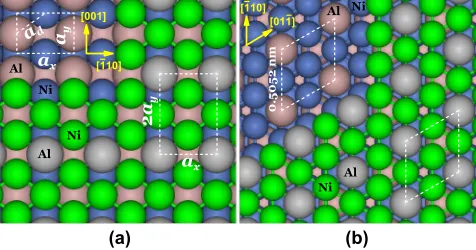
ax2ay unit cell is shown in Fig. 1(a). This structure is
distinct from all surface structures of bulkNi3Al, including the (111) surface with 3:1 Ni:Al composition [16]; see Fig. 1(b). Our density functional theory (DFT) analysis (details in [17,18]) shows that the distinct geometric struc-ture implies distinct electronic and related properties, but here we focus on formation kinetics.
Success of our codeposition approach requires the ex-istence of a low-T far-from-equilibrium formation path-way to avoid intermixing. DFT analysis finds a high 1.14 eV barrier for thermodynamically unfavorable ex-change of a Ni adatom with surface Al, and barriers for other exchange processes are higher. Thus, intermixing processes are too slow to occur on the short time scale of diffusion-mediated incorporation of deposited atoms into surface nanostructures at 300–600 K (incorporation locks adatoms in the overlayer). The situation is different from Ni deposition on Al, or Al on Ni, where there is a strong driving force for intermixing. Another feature implying a 2D growth mode is the lack of a strong thermodynamic driving force for multilayer growth, together with strong
FIG. 1 (color online). (a) Ni3Al=NiAlð110Þ; (b) Ni3Alð111Þ. Structure of underlying layers is indicated upper left. Top (lower) layer Ni is green (blue); top (lower) layer Al is grey (purple).
PRL108,216102 (2012) P H Y S I C A L R E V I E W L E T T E R S 25 MAY 2012week ending
[image:3.612.319.557.551.676.2]kinetic inhibition to upward transport and higher-layer nucleation at lower T and low coverages. (DFT finds an energy per Ni3Al unit in the monolayer structure of Fig.1(a)only marginally higher by0:11;0:17;. . . eVthan in the analogous bilayer, trilayer,. . .structures).
For realistic atomistic-level modeling of the far-from-equilibrium formation of 2DNi3Alalloy nanostructures, it is essential to describe not just the surface thermodynamics (e.g., the relative energies of various 2D structures) but also the surface diffusion kinetics. In addition to accurately describing the adsorption site energies and diffusion of isolated Ni and Al adatoms, the major challenge is to also precisely describe edge diffusion, rearrangement, and attachment-detachment processes for vast numbers of local step-edge configurations and compositions occurring in irregular multicomponent surface nanostructures. Growth structures are extremely sensitive to the associated hopping barriers [19].
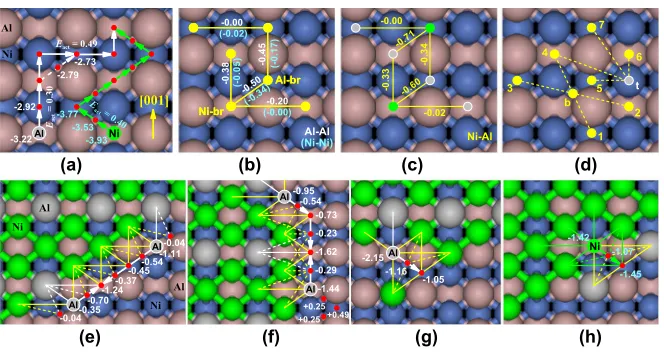
To successfully address this challenge, we exploit a recently developed multisite lattice-gas model formulation that can describe multiple adsorption sites and diffusion paths with precise hopping barriers [17,18]. We now briefly describe this model and its validation. We allow occupation of two types of stable adsorption site, Ni-br (and Al-br) denoting the short bridge between two surface Ni (and Al) atoms separated in theydirection byay. Fig.2(a) shows both DFT adsorption energies and diffusion paths and barriers for isolated Ni and Al adatoms. Both prefer the Ni-br site, even though Ni resides at the Al-br site in an equilibrated NiAl alloy overlayer.
Adlayer thermodynamics is determined by adsorption energies and by interactions between adatoms at Ni-br and Al-br sites. DFT-guided estimates for Al-Al and Ni-Ni (Ni-Al) pair interactions are shown in Fig.2(b)[Fig.2(c)].
There are 16 such significant interactions. Many-body in-teractions are not substantial; see below. When adatoms aggregate, there is a preference for ‘‘dense’’ islands with both Al-br and Ni-br sites populated, the cost of populating less favorable Al-br sites being offset by strong diagonal attractions for separationad¼0:2500 nm.
Model thermodynamics is validated by comparing en-ergies from direct DFT analysis of complete overlayers with predictions from our pairwise interaction model for (i) dense single-species islands versus ‘‘dilute’’ islands with adatoms on just Ni-br or just Al-br sites, and (ii) a perfectly ordered alloy overlayer propagating bulk struc-ture versus one with Ni and Al on the wrong sites (Ni on Ni-br, Al on Al-br) versus ‘‘phase-separated’’ dense Ni and Al domains. The model predicts the correct ordering of energies (i.e., the correct relative stability) [18,20].
Next, we describe the model treatment of diffusion kinetics. Ni always makes diagonal hops. Al diffusion along island edges can occur by hops in the x and y
directions as for isolated Al or by diagonal hops. See Figs.2(a)–2(h). Hopping barriers are determined asEact¼
ETSEinit, where EinitðETSÞ is the total energy in the
initial (transition) state. Both energies are obtained from a sum of the relevant adsorption energy and all pair inter-action energies. Thus, in addition to conventional pair interactions between adatoms both at adsorption sites, we must also assess a second set of ‘‘unconventional’’ pair interactions with one adatom at a TS and another at nearby adsorption site. There are 24 such significant interactions:
AlðtÞ-Mð4–7Þ,AlðbÞ-Mð1–4Þ,NiðbÞ-Mð1–4Þ, withM¼Al
or Ni; see Fig. 2(d) and TableI. Adatom hopping occurs with Arrhenius ratesh¼exp½Eact=ðkBTÞfor prefactor ¼1013=s. Detailed balance is automatically satisfied. Kinetic Monte Carlo (KMC) simulation of the model
FIG. 2 (color online). (a) Adsorption energies in eV and diffusion paths for Ni and Al on NiAl(110); (b),(c) pair interactions (attraction<0) with atoms at Ni-br or Al-br sites; (b) Unconventional pair interactions with one atom at a ‘‘b’’ or ‘‘t’’ TS and one at Ni-br or Al-br; (e)–(f ) Al diffusion along diagonal (e) and [001] (f ) edges of aNi3Alisland finding the ‘‘correct’’ site; (g) Al diffusion at a½110edge disrupting NiAl ordering. (h) Extraction of Ni aided by peripheral Al. In (e)–(h): site energies given relative to a Ni-br terrace site are impacted by standard (unconventional) interactions shown as thin solid (dashed) lines.
[image:4.612.141.473.479.655.2]simply implements deposition and hopping with probabil-ities proportional to the relevant rates.
To validate model kinetics, we have checked that the model recovers STM observations of (i) transitions with varyingT between various complex growth shapes of Ni islands for Ni deposition on NiAl(110) [20], (ii) the change with increasing size from compact to irregular growth shapes of Al islands formed by Al deposition at 300 K [18], and (iii) robust Al-core plus Ni-ring nanostructures obtained by sequential deposition of Al then Ni at 300 K [17]. Distinct behavior for deposition of Ni then Al at 300 K is also recovered (see below).
Thermodynamics for3:1 Ni:Alcompositions.—First, we determine the preferred adlayer ordering for our model for complete overlayers with 3:1 Ni:Al stoichiometry and where Ni and Al adatoms occur with just a few distinct types of local configurations. For each such configuration, we calculate the adatom energy by summing the adsorption energy and half the shared lateral pairwise interactions, and then average over adatom configurations to obtain the mean energy per Ni atom, ENi, and per Al atom, EAl.
Finally, the overlayer energies, E3NiþAl¼3ENiþEAl,
are compared for (i) ‘‘perfect’’ Ni3Al ordering with Ni on all Al-br sites, and alternating Ni and Al in vertical rows of Ni-br sites with in-phase occupancy of adjacent Ni-br rows [Fig.1(a)]; (ii)Ni3Alordering but with out-of-phase occupancy of adjacent Ni-br rows (antiout-of-phase AP); (iii) perfectNi3Alordering but shifted with Ni on all Ni-br and in-phase alternating Ni and Al on Al-br rows (antisite AS); (iv) phase separation into regions of equal areas with perfect NiAl ordering (with Ni on all Al-br and Al on all Ni-br) and with a dense Ni overlayer; and (v) phase sepa-ration into regions with a dense Ni overlayer and with dense Al overlayer with areas in the ratio3:1forNi:Al.
Ni3Al ordering (i) or (ii) is preferred over 2D phase
separation into NiAl and Ni regions (iv). Why? This reflects a preference for alternating ordering versus 1D phase separation of Ni and Al within each Ni-br row (since the nearest-neighbor (NN) attraction for Ni-Al pairs in Ni-rows of 0.33 eV is stronger than the average NN attrac-tion for Ni-Ni and Al-Al pairs). Preference for perfect
Ni3Alordering (i) versus anti-phase ordering (ii) derives from a strong NN attraction of 0.20 eV between Al-Al pairs in adjacent Ni-br rows far exceeding NN attractions
between other pairs of species. We find that Eð3NiiÞþAl< Eð3NiiiÞþAl< Eð3NiivÞþAl< Eð3NiiiiÞþAl< Eð3NivÞþAl, demonstrating that perfectNi3Alordering is most favorable. This preference is consistent with that from direct DFT analysis for com-plete adlayers; see TableII.
We can also determine the distorted octagonal equilib-rium shapes of perfect Ni3Alalloy islands. Our analysis assumes that ½110, [001], and ‘‘diagonal’’ steps, with lengths Lx, Ly, and Ld, respectively, are dominant. (‘‘Diagonal’’ steps are aligned with the diagonals of the rectangular NiAl(110) unit cell.) Evaluation for our model of step energies and incorporation into a Wulff construc-tion yieldsLd:Lx:Ly¼1:19:1:39:1.
Kinetics of simultaneous and sequential codeposition.—
The most efficient pathway for formation of the thermo-dynamically preferred Ni3Al overlayer nanostructures should be simultaneous codeposition of Ni and Al in a
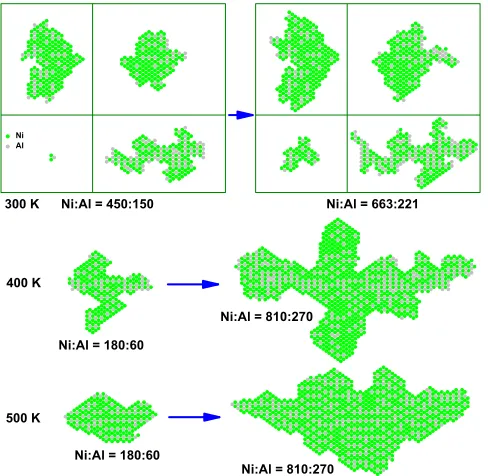
3:1 ratio. KMC simulation reveals very irregular islands with poor alloy ordering at 300 K. At 400 K, there are local regions of NiAl ordering and of pure Ni but little Ni3Al ordering. Significant perfect in-phase Ni3Alordering oc-curs by 500 K, but islands contain local regions of NiAl ordering. ‘‘Excess’’ Ni in these Ni3AlþNiAl islands (overall 3:1 Ni:Al) results in predominantly Ni island edges, as incorporating Al into the interior lowers the island energy. By 600 K, one has primarily perfect Ni3Al order but still some regions of NiAl order and Ni-rich edges (not shown). Shapes of smaller islands at higher T
are compact, but irregular nonequilibrium growth shapes develop for larger islands. See Fig.3.
Our model provides detailed insight into the kinetics of
Ni3Al ordering. Given strong Ni-Al attraction for
diago-nally neighboring Ni-br and Al-br sites, Al at island edges can be trapped in the ‘‘wrong’’ sites. Indeed, Figs.2(e)and
2(f )show the presence of such trap sites (with energies far below the terrace Ni-br site) on diagonal and [001] edges of alloy islands. The barrier for Al to migrate to the ‘‘correct’’ site forNi3Alorder on the [001] edge is around 1.15 eV, so the process is active at 500 K with rate 25=sbut not at 400 K or lower T. Note that different diffusion paths operate on different step edges, necessitating inclusion of all such paths in our model. Fig.2(g)shows an Al atom at the ½110 edge in a trap site corresponding to NiAl order. The barrier to escape such a site aided by two suitably-located nearby Ni is 1.10 eV but higher at 1.37 (1.95) eV for one (zero) nearby Ni. This explains why NiAl order persists even at 500 K.
[image:5.612.52.297.72.172.2] [image:5.612.315.561.669.716.2]Island growth shapes reflect edge-diffusion kinetics. Diffusion of Ni along step edges is fairly facile (effective
TABLE I. Pair interactions in eV: one adatom at a Al-br or Ni-br site and one at atorbTS; see Fig.2(d).
NiðbÞ-Nið1Þ 0:30 AlðbÞ-Alð1Þ 0:45 AlðtÞ-Alð4Þ 0:02
NiðbÞ-Nið2Þ 0:14 AlðbÞ-Alð2Þ 0:40 AlðtÞ-Alð5Þ þ1:00
NiðbÞ-Nið3Þ 0:18 AlðbÞ-Alð3Þ 0:20 AlðtÞ-Alð6Þ þ12:00
NiðbÞ-Nið4Þ 0:25 AlðbÞ-Alð4Þ 0:29 AlðtÞ-Alð7Þ 0:12
NiðbÞ-Alð1Þ 0:85 AlðbÞ-Nið1Þ 0:73 AlðtÞ-Nið4Þ 0:01
NiðbÞ-Alð2Þ 0:28 AlðbÞ-Nið2Þ 0:24 AlðtÞ-Nið5Þ 0:44
NiðbÞ-Alð3Þ 0:14 AlðbÞ-Nið3Þ 0:18 AlðtÞ-Nið6Þ þ6:55
NiðbÞ-Alð4Þ 0:71 AlðbÞ-Nið4Þ 0:62 AlðtÞ-Nið7Þ 0:06
TABLE II. Pair and DFT energies in eV for various adlayers.
i.Ni3Al ii. AP iii. AS iv.NiAlþ2Ni v.3NiþAl
Pair 20:13 19:97 18:92 19:90 18:44
DFT 19:27 19:24 18:77 19:14 17:80
PRL108,216102 (2012) P H Y S I C A L R E V I E W L E T T E R S 25 MAY 2012week ending
barrier 0.71 eV along diagonal edges and somewhat higher for other orientations). This process is active above 300 K, partly quenching growth shape instability and aiding for-mation of locally compact islands. However, Al edge diffusion is slower [see Figs.2(e)–2(g)], producing irregu-lar irregu-larger islands even at 500 K.
Note that perfectNi3Aldomains are twofold degenerate. Deposition creates roughly equal populations of these domains (no long-range order), even within single large islands above500 K. Thus, superlattice diffraction spots for Ni3Alorder are diffuse, their inverse width reflecting domain size [19].
Sequential codeposition.—This could provide a conve-nient alternative to simultaneous codeposition with better control over stoichiometry. However, can Ni3Al order develop? Previous studies of the deposition of Al then Ni revealed the formation of a robust Al core resistant to intermixing with Ni forming a surrounding ring [17]. The barrier for extraction of Al from the core, even aided by two peripheral Ni, is high, around 1.7 eV for prominent [001] edges. Thus, here we consider only deposition of Ni then Al. In this case, the Ni core is vulnerable to disruption due to extraction of Ni aided by Al aggregation at the periphery. Fig. 2(h) reveals a Ni extraction barrier of only 0.35 eV aided by two Al. The Al atom below the extracted Ni can then readily take its place hopping over the Ni-top site with barrier 0.71 eV. Note that extraction aided by a single Al is still facile with barrier 0.66 eV. KMC simulation results shown in Fig. 4indicate that at 300 K, there is some disruption of the Ni core but negli-gible intermixing. But at 400 K, there is some intermixing
at the Ni core-Al ring interface with limited NiAl and
Ni3Alordering. By 500 K, there is complete intermixing and significant alloy ordering. For1:3 Al:Nicompositions, there is a significant tendency for Ni3Al ordering. With more extensive Al deposition and1:1 Al:Nicompositions, NiAl ordering is more prominent. Interestingly, the Ni core can be completely disrupted and fragmented by aggregat-ing Al at 500 K or above.
In summary, either simultaneous or sequential codepo-sition provides an effective pathway to form a novelNi3Al surface structure on NiAl(110) at low T. Contrasting pre-vious codeposition protocols for alloy formation in thin films, we exert finer atomic-layer control and elucidate kinetics with realistic atomistic-level modeling.
This work was supported by NSF Grant No. CHE-1111500. Ames Laboratory is operated for the USDOE by ISU under Contract No. DE-AC02-07CH11358.
[1] V. K. Sikka, S. C. Deevi, S. Viswanathan, R. W. Swindeman, and M. L. Santella,Intermetallics8, 1329 (2000).
[2] S. B. Mishra, K. Chandra, S. Prakash, and B. Venkataraman, Mater. Lett.59, 3694 (2005).
[3] S. Saadi, B. Hinnemann, C. C. Appel, S. Helveg, F. Abild-Pedersen, and J. K. Nørskov,Surf. Sci.605, 582 (2011). [4] A. T. Hanbicki, A. P. Baddorf, E.W. Plummer, B. Hammer,
and M. Scheffler,Surf. Sci.331–333, 811 (1995). [5] M. Schmid, M. Shishkin, G. Kresse, E. Napetschnig, P.
Varga, M. Kulawik, N. Nilius, H.-P. Rust, and H.-J. Freund,Phys. Rev. Lett.97, 046101 (2006).
[6] E. Vesselli, A. Baraldi, S. Lizzit, and G. Comelli,Phys. Rev. Lett.105, 046102 (2010).
[7] M. Kulawik, N. Nilius, and H.-J. Freund,Phys. Rev. Lett.
96, 036103 (2006).
[8] M. Chen and D. W. Goodman, The Chemical Physics of Solid Surfaces(Elsevier, Amsterdam, 2007), Vol. 12, p. 201. FIG. 4 (color online). KMC simulation of 2D island growth for sequential codeposition of Ni first then Al. Flux:0:003 ML=s.
FIG. 3 (color online). KMC simulation of 2D island growth for simultaneous codeposition with3:1 Ni:Al. Individual small islands at 300 K show composition fluctuations. Flux:0:003 ML=s.
[image:6.612.55.299.46.284.2] [image:6.612.314.553.50.225.2][9] A. Lehnert, A. Krupski, S. Degen, K. Franke, R. Decker, S. Rusponi, M. Kralj, C. Becker, H. Brune, and K. Wandelt,Surf. Sci.600, 1804 (2006).
[10] G. Pre´vot, D. Schmaus, and S. Le Moal,Surf. Sci. 604, 770 (2010).
[11] M. Petrantoni, A. Hemeryck, J. M. Duce´re´, A. Este`ve, C. Rossi, M. Djafari Rouhani, D. Este`ve, and G. Landa, J. Vac. Sci. Technol. A28, L15 (2010).
[12] J.-K. Ho and K.L. Lin,J. Vac. Sci. Technol. A13, 2170 (1995). [13] A. J. Gavens, D. Van Heerden, A. B. Mann, M. E. Reiss,
and T. P. Weihs,J. Appl. Phys.87, 1255 (2000).
[14] M. L. Anderson, N. C. Bartelt, P. J. Feibelman, B. S. Swartzentruber, and G. L. Kellogg,Phys. Rev. Lett. 98, 096106 (2007).
[15] A. K. Schmid, N. C. Bartelt and R. Q. Hwang, Science
290, 1561 (2000).
[16] E. Vesselli, L. Bianchettin, A. Baraldi, A. Sala, G. Comelli, S. Lizzit, L. Petaccia, and S. de Gironcoli, J. Phys. Condens. Matter20, 195223 (2008).
[17] T. Duguet, Y. Han, C. Yuen, D. Jing, B. U¨ nal, J. W. Evans, and P. A. Thiel, Proc. Natl. Acad. Sci. U.S.A. 108, 989 (2011).
[18] Y. Han D. Jing, B. U¨ nal, P. A. Thiel, and J. W. Evans,Phys. Rev. B84, 113414 (2011).
[19] J. W. Evans, P. A. Thiel, and M. C. Bartelt,Surf. Sci. Rep.
61, 1 (2006).
[20] Y. Han, B. U¨ nal, D. Jing, P. A. Thiel, and J. W. Evans,J. Chem. Phys.135, 084706 (2011).
PRL108,216102 (2012) P H Y S I C A L R E V I E W L E T T E R S 25 MAY 2012week ending