Abstract— Seismic forces acting on the structure mainly depends onto the weight of structure, the primary theme of this work is to reduce the self-weight of the concrete structures, which can be done by using the structural lightweight concrete, it will help in minimizing the lateral seismic forces on the structure and also helps in reducing the size of the structural members and area of reinforcement required while designing. This paper consists of a comparative study on seismic behaviour of G+15 high-rise building made with structural lightweight concrete (SLWC) and normal weight concrete (NWC) for different soil conditions and different zones, by using SLWC at critical conditions results shown that maximum bending moment and shear force got reduced by 40% and 34% respectively and maximum member sizes and steel reinforcement got reduced by 31% and 38% respectively, it has also been found that seismic forces on the structure got reduced considerably.
Key words: Seismic weight, Storey drift, Base shear, SLWC, Natural frequency and Time period.
1. INTRODUCTION
In order to reduce the usage of more land for a building, engineers came up with a concept of a multi-story building; the natural time period for a high-rise structure is more when compared to the low-rise structure which shows that natural frequency is less for high-rise buildings. The natural frequency of structure depends on mass and stiffness of the structure, the natural frequency is inversely proportional to the square root of structure mass, so if we can reduce the mass of building considerably then the natural frequency of structure gets increased. In India, most of the structures are made up of concrete by which construction cost is minimized when compared to steel structures. By using the properties of structural lightweight concrete for high-rise building seismic performance is studied by using standard software i.e. ETABS (Extended three-dimensional analysis of building systems) [1]
Structural lightweight concrete can be made of using a lightweight aggregate like expanded clay aggregate, tuff aggregate, pumice or perlite aggregate e.t.c. From the applications of structural point of view, lightweight aggregate concrete are light in weight with good thermal and sound insulation properties [2], by using scoria lightweight aggregate it is possible to produce a lightweight concrete of
Revised Manuscript Received on April 12, 2019.
Palanati Durga Prasad, P.G student, VFSTR (Deemed to be University), Guntur, Andhra Pradesh. (Email: [email protected]) Contact: +91-8885790528
C MAHALINGAM, Assistant professor, VFSTR (Deemed to be University), Guntur, Andhra Pradesh. (Email: [email protected]) Contact: +91-9840256971
YALAVARTY NITHIN, P.G student, VFSTR (Deemed to be
University), Guntur, Andhra Pradesh, India (Email: [email protected]) Contact: +91-9494399889
density 1800 kg/m3 with cylindrical compressive strength of 40 Mpa by the use of silica fume [3], The naturally occurring tuff aggregates which are available in north-eastern Jordan produces high strength lightweight concrete. The results shown that for various concrete mixes, and using normal techniques it is able to achieve a high-quality lightweight concrete which is appropriate for the use in reinforced and prestressed concrete structures, with maximum compressive strength of 60 Mpa at 90 days, poison ratio for this type of concrete which was moist cured is found to be 0.21 which is nearly equal to poison ratio of normal weight concrete.[4]
The mechanical properties of lightweight aggregate concrete are given by ACI 318 Building code, the modulus of elasticity for normal weight concrete is more when compared to the structural lightweight aggregate concrete. Elastic modulus for SLWC is a function of density and characteristic compressive strength of concrete. Most of the experimental studies concluded that poisons ratio of SLWAC and normal concrete are nearly equal. The coefficient of thermal expansion for normal concrete and lightweight aggregate concrete is 12×10−6 and 17×10−6 respectively was identified in various experimental studies. Shear strength reduction factor or modification factor (λ) is given in ACI 318-14, Table 19.2.4.2 for different types of lightweight concrete. The equation of elastic modulus for lightweight concrete given by the ACI code [5] is shown below
E = 0.043 × 𝜔1.5 ×√𝑓 𝑐
Where; 𝜔 = density of concrete (kg/m3)
fc = compressive strength of concrete (Mpa)
2. OBJECTIVE:-
➢ Identifying the seismic behavior of structural lightweight concrete and normal weight concrete high-rise buildings by linear static and linear dynamic methods and then comparing the results obtained. ➢ Performing gravity analysis and design of high-rise
structural lightweight concrete building and identifying the behaviour of the structure.
➢ After designing the structure for seismic we need to identify the amount of reduction in member sizes and reinforcement required by using SLWC concrete.
A Comparative Study on Seismic Analysis
and Design of Structural Lightweight and
Normal Weight Concrete High Rise Building
NORMAL WEIGHT CONCRETE HIGH RISE BUILDING ➢ By studying the seismic response of SLWC buildings in
different zones and soil conditions, we need to decide where it is suitable to construct such buildings.
3. METHODOLOGY:
Fig 1: Methodology of project
4. ANALYTICAL STUDY & RESULTS
4.1 Modeling and material properties:- A G+15 high-rise building framed structure is modeled in ETABS (Extended three dimensional analysis of building system), with storey height of 3m, length of the structure in X direction is 20.5m and in Y direction it is 20.58m, total height of the structure is 45m and the member sizes are varied as per the design requirements. Slab thickness is taken as 150mm; the external and internal wall thickness is 230 mm and 115 mm respectively. The model is analyzed with two different material properties one is structural lightweight concrete (SLWC) and other is normal weight concrete (NWC) and designed according to IS 456-2000 [6], the elastic modulus of SLWC is less when compared to NWC.
The material properties required for a structure is the density of concrete, elastic modulus, poisons ratio, compressive strength and modification factor. Density of structural lightweight aggregate concrete and normal weight concrete is 1800 kg/m3 and 2500 kg/m3, poisons ratio for SLWC and NWC is 0.20 and 0.15, compressive strength for both the concrete is taken as 30 to 40 Mpa, modulus of elasticity for SLWC as per ACI formulae is 17986.13 Mpa and normal weight concrete is 27386.13 Mpa.
Fig 2: Model of structure (3D view)
4.2 Loads and combinations:- Loads are taken from Indian standard codebooks for dead loads we have IS 875 part 1 (1987), for Live loads IS 875 part 2 (1987) [7], Wind load calculations are done according to IS 875 part 3 (1987) code and seismic analysis is done according to the IS 1893 part 1 (2002).
Table 1: Load data
Type of Load Intensity of Load
Live load 3 kN/m2 (IS 875 part 2)
Floor finishing 1.1 kN/m2 (IS 875 part 1)
Wall loads External = 14 kN/m
Internal = 7 kN/m
Wind load As per IS 875 part 3
Seismic zones I,II,III and IV
Type of soil Soft, medium and hard
The structure is analyzed for three soil conditions with varying zones and then the structure is designed for only critical conditions.
The load combination which shall be considered during the design of structure in seismic zones as per IS 1893 part 1(2002) code is given as below
4.3 Analysis and Results:-
4.3.1 Gravity analysis and design result: In gravity analysis the maximum bending moments and shear force obtained for NWC structures are 120 kN-m and 141 kN respectively, whereas for SLWC structures the gravity analysis result shows maximum bending moment as 82 kN-m and kN-maxikN-mukN-m shear force as 124 kN. It is observed in gravity analysis that percentage of bending moment and shear force increment for NWC is 46% and 14% respectively compared to SLWC.
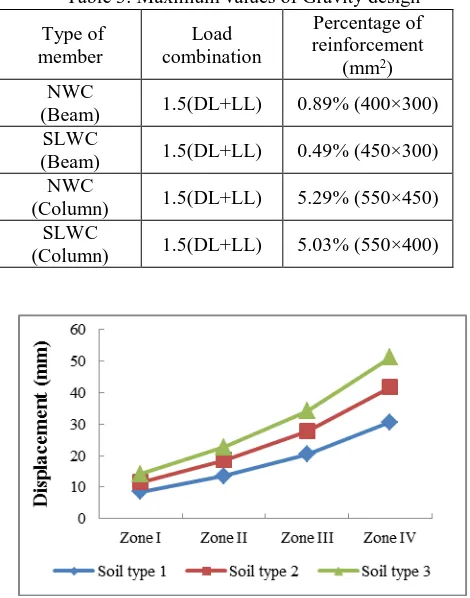
The maximum axial load, bending moment and shear force in columns by using SLWC structure got reduced by 14%, 14.5% and 15% respectively. Twisting moment is found to be the same in both types of structures. The maximum values for gravity analysis result are shown in below table. After designing NWC and SLWC structures the percentage of reduction in reinforcement is found to be 37%.
4.3.2 Seismic analysis and design result:- Seismic analysis is done by equivalent static (linear static) and response spectrum method (linear dynamic), structural responses like lateral displacement, story drifts, overturning moment, story stiffness and base shear for both SLWC and NWC are identified. It has been found that after designing seismic weight of structure for SLWC structure is 18000 kN less than NWC structure.
Fig 3: Maximum lateral displacement for NWC
Table 2: Maximum values of Gravity analysis
Type of member
Load Combination
Bending moment (kN-m)
Shear force (kN) NWC
(Beam)
1.5(DL+LL) 119.6779 141.1831
SLWC (Beam)
1.5(DL+LL) 81.6956 124.2849
NWC (Column)
1.5(DL+LL) 93.8934 66.2715
SLWC (Column)
[image:3.595.305.540.58.357.2]1.5(DL+LL) 110.7021 78.1787
Table 3: Maximum values of Gravity design
Type of member
Load combination
Percentage of reinforcement
(mm2) NWC
(Beam) 1.5(DL+LL) 0.89% (400×300)
SLWC
(Beam) 1.5(DL+LL) 0.49% (450×300)
NWC
(Column) 1.5(DL+LL) 5.29% (550×450) SLWC
[image:3.595.295.537.369.695.2](Column) 1.5(DL+LL) 5.03% (550×400)
Fig 4: Maximum lateral displacement for SLWC
Fig 5: Maximum base shear for NWC
[image:3.595.54.277.378.520.2]NORMAL WEIGHT CONCRETE HIGH RISE BUILDING
[image:4.595.67.267.64.239.2]Fig 7: Maximum overturning moment for NWC
Fig 8: Maximum overturning moment for SLWC
Fig 9: Maximum storey drift for NWC
Fig 10: Maximum storey drift for SLWC
4.3.3 Time period and Natural frequency:- As the building consists of 15 storey’s then the total number of modes obtained to the structure is 45. The frequency and time
period for first and last mode to both type of structure is
shown in below table
,
time period has given to Etabs calculated from formulae given in IS 1893 (part 1) 2002 [8].Table 4: Natural frequency and Time period Type of
structure Mode
Time period
(sec) Frequency (cycle/sec)
NWC 1 2.428 0.412
45 0.029 34.585
SLWC 1 2.803 0.357
[image:4.595.65.269.175.331.2]45 0.031 32.073
Table 5: Seismic design result of beam members
Type of structure
Cross section of member (mm × mm)
Moment
(kN-m) Load combinations
Area of reinforcement
(mm2)
NWC (Beam) 600 × 400 491.2958 1.5(DL+EQX) 2702
600 × 400 -560.0659 1.5(DL+EQX) 2968
SLWC (Beam) 550 × 300 281.4846 1.5(DL-EQX) 1673
550 × 300 -360.0083 1.5(DL-EQX) 2234
Table 6: Seismic design result of column members
Type of structure
Axial load (kN)
Major moment
(kN-m)
Minor moment
(kN-m)
Load combinations Percentage of Reinforcement
NWC (column)
6167.00 -152.94 -12.1168 1.5(DL+LL) 1.87% (600 × 500)
-1373.29 -1.1071 -27.4659 0.9DL+1.5EQX 1.68% (600 × 450)
SLWC (column)
5159.68 -25.710 -103.1937 1.5(DL+LL) 2.31% (600 × 400)
[image:4.595.46.552.433.745.2]5. DISCUSSION OF RESULTS:-
• Maximum lateral displacement for SLWC structure is more when compared to the NWC structure due to the lower elastic modulus of SLWC structural members.
• Maximum base shear for SLWC structure is 5326 kN and for NWC structure it is 5941 kN due to lesser weight of SLWC structure it is found that maximum lateral force on SLWC structure is 300 kN less than NWC structure.
• The difference of maximum overturning moment in SLWC and NWC structure was found to be nearly 16000 kN-m; here SLWC structure has lesser overturning moment.
• The maximum allowable storey drift as per the Indian standard code was given by 0.004 times the storey height, i.e. 0.004×3= 0.012. But is observed that for SLWC structure the storey drift is more than the allowable limit in zone III and IV, but whereas for NWC structure except in hard soil condition storey drift exceeds allowable limits in zone III and IV.
6. CONCLUSION:-
• By using structural lightweight aggregate concrete results shown that shear force and bending moment reduced considerably in seismic analysis of high-rise structure.
• After the design of structural members area of steel reinforcement and cross section of members lowered to the significant amount for SLWC structure.
•
Due to less modulus of elasticity for SLWC structure the lateral displacement and storey drift was found to be more compared to normal weight concrete buildings.• Lightweight concrete structure crosses the permissible limit of storey drift in zone III and zone IV, by which we can conclude that seismic behavior of lightweight concrete structure gives the best performance in low seismic zones.
• Performance of lightweight concrete structure in high seismic zones can be enhanced by providing bracings to the structure.
REFERENCES:-
1. www.csiamerica.com, “computer and structures.inc,
structural and earthquake engineering software”.
2. Murat Emre Dilli, Hakan Nuri Atahan, Cengiz Sengül,
“A comparison of strength and elastic properties between conventional and lightweight structural concretes designed with expanded clay aggregates”.
3. Alaettin Kılıc¸, Cengiz Duran Atis, Ergu¨l Yas¸ar, Fatih
O¨ zcan, “High-strength lightweight concrete made with
scoria aggregate containing mineral admixtures”.
4. Mohammad Smadi and Ezzddeen Migdady, rperties of
Hi “Properties of High strength tuff Lightweight Aggregate Concrete”.
5. ACI Committe-213, “Guide for Structural Lightweight-
Aggregate Concrete”, pp. 1–38, American Concrete Institute, Farmington Hills, MI, USA, 2003.
6. IS 456–2000, “plain and reinforced concrete code of
practice” ,Bureau of Indian Standards, New Delhi, India, 2000.
7. IS 875 (part 1 and part 2) 1987 “code of practice for
design loads (other than earthquake) for buildings and structures”.
8. IS 1893 (part 1) 2002, “criteria for earthquake resistant
design of structures”.
9. Obada Kayali, “Flashag-new lightweight aggregate for
high strength and durable concrete”.
10. “Engineering Properties of Structural Lightweight Concrete” , Expanded Shale, Clay & Slate Institute (ESCSI) 2225 E. Murray Holladay Rd, Suite 102.
11. ACI 318-14, “Building Code Requirements for
Structural Concrete and Commentary, American Concrete Institute”, 2014.
12. A.Kadid and D.Yahiaoui, “seismic assessment of braced