ISSN (Online): 2320-9364, ISSN (Print): 2320-9356
www.ijres.org Volume 1 Issue 8 ǁ Dec 2013 ǁ PP.20-27
Research on Stability of Software Structure Based On Design
Patterns
Zheng Liu
1, Qian Zhang
2, Hai Zhao
11(College of Information Science and Engineering, Northeastern University, China) 2(Technology Strategy & Development Department, Neusoft Corporation, China)
ABSTRACT:
In view of metric for stability of software structure, a metric method based on design pattern is
presented, which makes use of the influence of design patterns in OO software network as typical microstructure. Firstly, the application of design patterns is studied in software network, and then the stability of microstructure extracted from design patterns is analyzed by Lyapunov method. The concept of Coverage of Design Patterns is presented according to the application of design pattern in software system, and is used to metric for the stability of the whole software structure.Keywords -
stability of software structure, design patterns, software network, OO softwareI.
Introduction
From the point of view of software design, internal structure of software will bring great influence on the system reliability. Generally, the more complex the software structure is, the worse the structure stability is, and more structural defects are implied in the system which can affect the system reliability. As to structural stability, Elish believes that it is a sign of the ability that maintain their original structural characteristics during the evolution, the greater the stability is, the stronger the ability maintaining original characteristics when some arguments such as scale or structure change[1]. Recently, researchers find that the software network presents typical characteristics of complex network if many reusable elements such as class, object, module, and subroutine are regarded as the nodes and the relationship between these elements are regarded as arcs in network [2-8].
II.
Design patterns in software network
2.1 Establish software network
The process of establishing software network is: starting from source code, extracting the structural of system firstly, then abstracting to network model. As to OO software, class is the basic constituent elements and class-level software network is that the nodes are abstracted from classes and the arcs are abstracted from relationship between classes. The specific operation is shown as Fig.1.
class Point{ int x,y; }
class CGrid{
void setCharAt (char ch, Point p); void getCharFrom (Point p); }
abstract class CGObject{ Point location; }
class PointGrid extends CGrid{ CGObject displayList[]; void addCGObject (CGObject obj); void deleteCGObject (int index); }
class BorderedPrintCGrid extends PrintCGrid{ void setBorderCharacter (char ch); void displayGrid();
}
CGrid
PrintCGrid
BorderedPrintCGrid
Point
CGObject Extract class
diagram from source
code
Abstract to network
Fig.1 Extraction of software network
This network model is described as: N=(V, A, T, W). Among them, V(Vertices)={vi | i = 1, 2, …, n } represents the set of n nodes in network, and each node represents a class in software system. A(Arcs)={(vi, vj, t) | vi∈ V, vj ∈ V, t ∈ T, i≠j } represents the set of arcs in network and each arc represents the relationship between two classes. There is usually not single relationship between two classes in real software system, for example, there is dependency and also generalization between class A and class B, so t is a composite value. T(Type)={t | t ∈{G, U, D} } represents the relationship between two classes. Here G means generalization, D means Dependency and U means usage including association and aggregation. W(Weight)={w(a)|w(a)=f(t, δ, N), a ∈ A, t ∈ T, δ ∈ (0,1), N ∈{0,1,2……}}represents the weight of each arc.
2.2 extracting the network structure of design pattern
There are 23 design patterns for OO software. In order to study the influence on software structure brought by design patterns, the structural network of design patterns are extracted according to the definition of design pattern and its structural description. The specific extracting method is as follows:
(1) describing the design pattern structure by UML according to its definition, and then analyzing the relationship between classes, interfaces and objects.
(2) Abstracting nodes in software network from classes, interfaces and objects in UML class diagram. (3) Abstracting arcs in software network from the relationship between two elements in UML class diagram,
and determined the type value of the arc according to the relationship type.
Taking Flyweight pattern as example, its structure is shown as Fig.2, and its network model is shown as Fig.3.
FlyweightFactory
flyweight
+getFlyweight (in key)
Flyweight
+operation (in extrinsicState)
UnsharedConcreteFlyweight - intrinsicState
+operation (in extrinsicState)
ConcreteFlyweight - allState
+operation (in extrinsicState)
U(t)
G G
Fig.2 Frame of Flyweight Fig.3 Software network of Flyweight Pattern
2.3 Match design pattern in software network
Among all the 23 design patterns, Singleton pattern, Memento pattern and Template pattern have simple structure due to there’s only one or two nodes in their structural networks, so the affection on structure stability is limit. There is only generalization arc in Façade pattern’s structural network, which is confused with general generalization in software network during matching and reduces the match accuracy. So there are only 19 patterns will be matched in this paper.
The essence of matching design patterns is searching the exact network structure in software network. If local network structure has the same characteristics with some design pattern, the design pattern is found. In order to match all the design patterns accurately and quickly, the network structure of each pattern should be described mathematically firstly, and then search for a feature arc of pattern structure in software network, compare characteristics of the terminal node and the arc connecting the terminal node and another one in design pattern network with those in software network one by one until find all the nodes and arcs in pattern network.
According to description of mathematical model of design pattern structure, the nodes are represented by v, w, and the arc between two nodes is represented by <v, w>. v is initial node and w is terminal node. Taking the Flyweight pattern as example, the description of its mathematics model is as follows:
There are two class nodes v and w in software network and the type of arc between v and w is U(t), and there is a node set cw that satisfied the following conditions:
(1) All the nodes in cw are class node.
(2) There is arc between nodes in cw and w whose type is generalization. (3) The number of nodes in cw is 2.
The structure composed with node v, w, node set cw and arc <v, w>, <cw, w> is called Flyweight pattern.
According to the mathematics description above, the critical points in matching algorithm are: (1) The type of arc between v and w is just template usage.
(2) Penetration of w whose type is generalization is 2. So, matching algorithm for Flyweight pattern is as following: (1) Select any arc <v, w> in software network;
(2) Determine if v, w are class nodes, if not, turn to (8);
(3) Determine if the type of arc <v, w> is U(t) and it is single type, if not, turn to (8);
(4) Determine if the penetration of w whose type is generalization is 2, and the penetration of v is 0, if not ,turn to (8);
(5) Save v, w;
(8) Determine if have traversed all the arcs in software network, if not ,turn to (1); (9) End.
III.
Analysis on structural stability of design pattern
3.1 Stability of microstructure
Recently, researchers find that the frequency of occurrence of different relationship between nodes is non-randomness, and the frequency is different in different networks along with the deepening of the research on complex network theory. Milo et al called the typical interactive structure appears in real network more frequently than in random network as motif, and believed the motif is the basic unit to compose the whole network and achieves main function of system. Researching on these basic units are benefit for understanding the overall characteristics of the whole network and grasping the formation mechanism of macroscopic characteristics by investigating the way that composing macroscopic topology of software network using motif. According to the research on design patterns in OO software, the pattern structure is just the motif of software network by ignoring the specific context in each pattern.
According to perspective of system science, the structural characteristics and dynamic behavior of a local network topology are determined by connection mode including of the direction or weight of which between nodes. So, the differential equation representing the corresponding dynamic system of a local network structure is as follows:
) , , 2 , 1 ( ) , , ,
(x1 x2 x i n
f
xi i n (1)
Among them, xi represents the status of node i, and fi represents how much all the other nodes connecting with node i influence on it [9]. Eigenvalue of Jacobian
i i ij
x f a
J should be calculated in order to determine the stability of microstructure by Lyapunov method according to literature [10]. aij represents how much node j influence node i , and its value is the weight of directed arc form node i to node j in software network. Since nodes have no influence on themselves in software network, the value on diagonal of matrix is less than 0. The value is set -1 except in special circumstances so as to research further.
Prill et al find that the robustness of typical microstructure appears when the network structure changes slightly highly correlates with frequency of this microstructure’s occurrence in networks in the study on biological networks. At the same time, structural stability score (SSS) is presented to metric on the stability of microstructure [11]. Generally, the value of SSS is related with the number and size of feedback loops in the structure. The larger the number and size are, the smaller the value is, which leads to the stability declining. Complexity and McCabe loop in program have similar relationship in software design. When the number and scale turn to larger, the program will be more complex [12]. So loops should be avoided in order to reduce complexity and improve stability in software design [13].
3.2 structural stability of design pattern
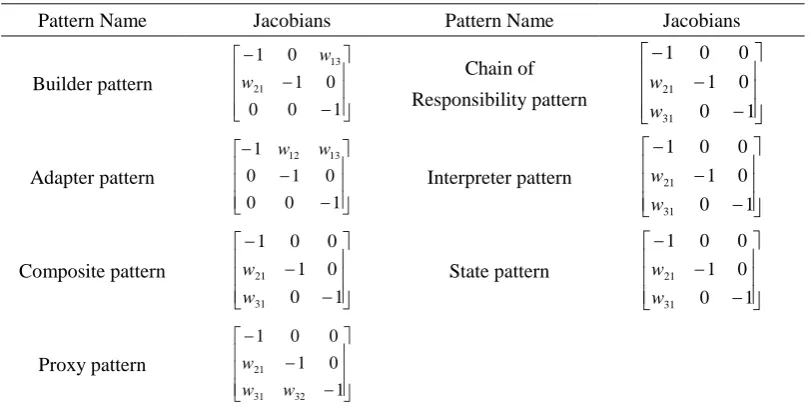
Table 1 Jacobians of design patterns composed of three nodes
Pattern Name Jacobians Pattern Name Jacobians
Builder pattern 1 0 0 0 1 0 1 21 13 w w Chain of
Responsibility pattern
1 0 0 1 0 0 1 31 21 w w Adapter pattern 1 0 0 0 1 0
1 w12 w13
Interpreter pattern 1 0 0 1 0 0 1 31 21 w w Composite pattern 1 0 0 1 0 0 1 31 21 w
w State pattern
1 0 0 1 0 0 1 31 21 w w Proxy pattern 1 0 1 0 0 1 32 31 21 w w w
Table 2 Jacobians of design patterns composed of four nodes
Pattern name Jacobians Pattern name Jacobians
Factory Method
pattern
1 0 0 0 1 0 0 0 1 0 0 0 1 34 32 21 w w w Command pattern 1 0 0 0 1 0 0 0 1 0 0 0 1 34 32 14 w w w Prototype pattern 1 0 0 0 1 0 0 0 1 0 0 0 1 34 24 14 w w w Observer pattern 1 0 0 0 1 0 0 0 1 0 0 1 34 32 21 14 w w w w Flyweight pattern 1 0 0 0 1 0 0 0 1 0 0 0 1 34 24 14 w w w
Table 3 Jacobian matrixes of design patterns composed of five nodes
Pattern name Jacobians Pattern name Jacobians
Itarator pattern 1 0 0 0 1 0 0 0 0 1 0 0 0 1 0 0 0 0 1 54 51 34 32 23 21 w w w w w w
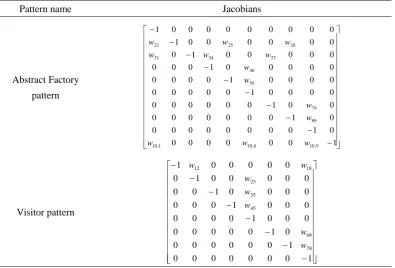
Table 4 Jacobian matrixes of design patterns composed of more than five nodes
Pattern name Jacobians
Abstract Factory pattern 1 0 0 0 0 0 0 0 1 0 0 0 0 0 0 0 0 0 1 0 0 0 0 0 0 0 0 0 1 0 0 0 0 0 0 0 0 0 0 1 0 0 0 0 0 0 0 0 0 1 0 0 0 0 0 0 0 0 0 1 0 0 0 0 0 0 0 0 1 0 0 0 0 0 0 0 1 0 0 0 0 0 0 0 0 0 1 9 , 10 6 , 10 1 , 10 89 79 56 46 37 34 31 28 25 21 w w w w w w w w w w w w w Visitor pattern 1 0 0 0 0 0 0 0 1 0 0 0 0 0 0 0 1 0 0 0 0 0 0 0 0 1 0 0 0 0 0 0 0 1 0 0 0 0 0 0 0 1 0 0 0 0 0 0 0 1 0 0 0 0 0 0 1 78 68 45 35 25 18 12 w w w w w w w
Eigenvalue of each the Jacobian above is calculated and it is find that all value are -1, that means structural stability of these design patterns has nothing to do with the connection between nodes in network. According to the definition of SSS, all SSS values of microstructures described by Jacobians are 1. So, all design patters have stable structure.
IV.
Metrics on stability of software structure
Because the structures of all design patterns are stable, applying design patterns in software system to realize system’s function can not only improve efficiency of development due to reusability of these patterns but also help the system structure maintain its structural stability. The more patterns are applied in a OO software, the higher the structural stability of the system. Definition of coverage of design patterns is presented to metric the proportion of nodes belong to design patterns in the software network as follows:
Definition 1 Coverage of Design Patterns: the proportion of nodes belongs to some design pattern among all the nodes in software network is called Coverage of Design Patterns of this software system, which is marked as C, and
3,4,5,8,10
, 19 1
i i i i n N f nIn this paper, 50 open source software are selected as study sample to analyze Coverage of Design Patterns of them, and the statistics result is shown as Fig.4. It can be find that among these software, Octave has the highest value of C that is 0.764, and Subversion has the lowest value of C that is 0.012. The average value of C is 0.294 and the standard deviation is 0.18.
Fig.4 Stat. of Coverage of design patterns
The relationship between C and the scale of software is described in Fig.5. The abscissa is the number of nodes in software network that shown in logarithmic form. It is find that software whose C value is larger always have fewer nodes, that means microstructure of design patterns have greater influence on the whole network in the software network with fewer nodes. For example, the number of nodes in a software network whose C value is larger than 0.5 is always within 500. Leading role that design patterns play on the structure is declining along with the software’s scale increasing, and the value of C will keep on a stable level. According to statistical data, it can be believed that if the value of C is larger than 0.4, design patterns have great influence on the software structure and the structure of this software is stable due to the stable structure of design pattern. If the value of C is less than 0.2, the stability of software structure should be metric by other means due to design patterns have little influence on the software system.
Number of nodes
C
o
v
er
ag
e
D
eg
re
e
o
f
P
at
te
rn
Fig.5 Relationship between the coverage of design pattern and software scale
V.
Conclusion
Different kinds of networks have different typical connection mode. The local network compose of these connections is considered as the basic constituent element of the whole network, the structural characteristics of which reflect the overall characteristics of network. Design patterns are basic elements constituting OO software system. The macrostructure stability of OO software system is analyzed according to
0 0.1 0.2 0.3 0.4 0.5 0.6 0.7 0.8
1 3 5 7 9 11 13 15 17 19 21 23 25 27 29 31 33 35 37 39 41 43 45 47 49
the study on structural characteristics of design patterns and patterns’ application in the system. It is finds that design patterns have positive impact on stability of software structure described by Coverage of Design Patterns defined in this paper based on analysis on stability of design patterns according to Lyapunov method. It is a new research tool that metric stability of software system by that of microstructure of design patterns according to stable structure of design patterns has positive impact on the stability of whole system structure, but the quantitative relationship between these two kinds of structures needs to be studied further. As to the software in
which design patterns are applied infrequently, it is needed other supplementary tools to metric the structural stability. That is what we’ll do in further research.
VI.
Acknowledgements
The research work was supported by Fundamental Research Foundation of the Ministry of Education
of China under Grant No. N110304003
References
[1] Elish M O and Rine D. Indicators of structural stabilitu of object-oriented designs: a case study. Proc. 29th Annual IEEE/NASA
Software Engineering Workshop, Marriott Greenbelt, MD, 2005, 183-192.
[2] Valverde S, Cancho R F, SoléR. Scale Free Networks from Optimal Design, Europhysics Letters, 60(4), 2002, 512-517.
[3] Myers C R. Software systems as complex networks: Structure, function, and evolvability of software collaboration graphs ,
Physics Review E, 68, 2003, 1-15.
[4] Wheeldon R and Counsell S. Power law distributions in class relationships, Proc. 3rd IEEE International Workshop on Source
Code Analysis and Manipulation, Amsterdam, 2003, 45-54.
[5] Baxter G, Frean M, Noble J, et al. Understanding the shape of Java software, ACM SIGPLAN Notices, 41(10), 2006, 397-412.
[6] Potanin A, Noble J, Frean M, et al. Scale-free geometry in OO programs, Communications of the ACM, 48(5), 2005, 99-103.
[7] Moura A P S, Lai Y-C and Motter A E. Signatures of small-world and scale-free properties in large computer programs, Physical
Review E, 68, 2003, 17-22.
[8] Liu B, Li D Y, Liu J, et al. Classifying Class and Finding Community in UML Metamodel Network. In Proceedings of ADMA
2005, Springer-Verlag LNAI 3584: 690-695.
[9] Keqing He, Yutao Ma, Jing Liu, et al. Software Network (Beijing: Science Press, 2008).
[10] Khalil H K. Nonlinear Systems ( Englewood Cliffs, NJ: Prentice Hall, 2002).
[11] Prill R J, Iglesias P A and Levchenko A. Dynamic properties of network motifs contribute to biological network organization.
PLos Biology, 3(11), 2005, 1881-1892.
[12] Parnas D L. Designing software for ease of extension and contraction. Proc. 3rd International Conference on Software
Engineering, Atlanta, USA, 1976, 264-277.
[13] Melton H and Tempero E. An empirical study of cycles among classes in Java. Technical Report UoASE-2006-1, Department of