Dong, Changyu and Chen, Liqun (2014) A fast single server private
information retrieval protocol with low communication cost. In:
Computer Security - ESORICS 2014. Lecture Notes in Computer
Science . Springer, pp. 380-399. ISBN 9783319112022 ,
http://dx.doi.org/10.1007/978-3-319-11203-9_22
This version is available at
https://strathprints.strath.ac.uk/49093/
Strathprints is designed to allow users to access the research output of the University of Strathclyde. Unless otherwise explicitly stated on the manuscript, Copyright © and Moral Rights for the papers on this site are retained by the individual authors and/or other copyright owners. Please check the manuscript for details of any other licences that may have been applied. You may not engage in further distribution of the material for any profitmaking activities or any commercial gain. You may freely distribute both the url (https://strathprints.strath.ac.uk/) and the content of this paper for research or private study, educational, or not-for-profit purposes without prior permission or charge.
Any correspondence concerning this service should be sent to the Strathprints administrator: [email protected]
The Strathprints institutional repository (https://strathprints.strath.ac.uk) is a digital archive of University of Strathclyde research outputs. It has been developed to disseminate open access research outputs, expose data about those outputs, and enable the
A Fast Single Server Private Information Retrieval
Protocol with Low Communication Cost
Changyu Dong1and Liqun Chen2
1 Department of Computer and Information Sciences, University of Strathclyde, Glasgow, UK
2 Hewlett-Packard Laboratories, Bristol, UK
Abstract. Existing single server Private Information Retrieval (PIR) protocols
are far from practical. To be practical, a single server PIR protocol has to be both communicationally and computationally efficient. In this paper, we present a sin-gle server PIR protocol that has low communication cost and is much faster than existing protocols. A major building block of the PIR protocol in this paper is a tree-based compression scheme, which we call folding/unfolding. This
compres-sion scheme enables us to lower the communication complexity toO(log logn).
The other major building block is the BGV fully homomorphic encryption scheme. We show how we design the protocol to exploit the internal parallelism of the BGV scheme. This significantly reduces the server side computational overhead and makes our protocol much faster than the existing protocols. Our protocol can be further accelerated by utilising hardware parallelism. We have built a proto-type of the protocol. We report on the performance of our protocol based on the prototype and compare it with the current most efficient protocols.
Keywords: Private Information Retrieval, Fully Homomorphic Encryption, Privacy
1
Introduction
Private Information Retrieval (PIR) is an important primitive with many applications. A PIR protocol allows a client to retrieve information from a database without revealing what has been retrieved. We have seen PIR being applied in areas such as location-based services [1] and e-commerce [2]. There are two types of PIR protocols: multi-server PIR [3] and single server PIR [4]. In a multi-server PIR protocol, the database is replicated to multiple servers and the queries will be answered jointly by the servers. In a single server PIR protocol, only one server hosts and serves the database. In this paper, we con-sider single server PIR. It is well-known that designing a non-trivial yet practical single server PIR protocol is a challenging task. For single server PIR, there exists a trivial protocol such that the server simply sends the whole database to the client. Therefore the first design criteria for non-trivial single server PIR protocols is to have sub-linear communication complexity. Traditionally, research in single server PIR focused almost entirely on how to minimise the communication cost [4–12]. However, low communi-cation cost does not mean the protocols are practical. As pointed out by Sion et al [13], due to costly server side computation, single server PIR protocols are often slower than the trivial solution despite that they transmit less bits. The most computationally effi-cient PIR protocol to date [4] requiresnbig integer modular multiplications, wheren
faster has become another important consideration.
There has been some work in reducing server side computation time. One approach is to use trusted hardware [14, 15]. Another approach is to base privacy on anonymity by mixing queries from different users [16]. Lipmaa proposed a BDD-based protocol [17] that is very efficient when the database is sparse, but in general case it requires
O(n/logn)modular exponentiations, which is more expensive thannmodular multi-plications. Those approaches can improve performance but rely on extra assumptions. To the best of our knowledge, the only work that can significantly reduce server side computation time and without extra assumptions is [18]. Unfortunately as we will dis-cuss in section 2, this protocol is not secure.
Contributions. In this paper, we present a fast single server PIR protocol with low communication cost. Our protocol belongs to the homomorphic encryption based PIR family [19]. Namely, we utilise the ring homomorphism provided by the BGV fully homomorphic encryption (FHE) scheme [20] to privately retrieve the bit. Communica-tion wise, the protocol has low communicaCommunica-tion complexityO(log logn). To achieve low communication, we designed a tree-based compression scheme called folding/unfolding. Computation wise, the protocol is much faster than all previous ones. We show how we design the PIR protocol to take advantage of the internal parallelism provided by the BGV FHE scheme, which allows us to amortise the server side computation. Most oper-ations on the server side will be applied to103−104bits in the database simultaneously. The amortised cost per bit is quite low: only around twelve 64-bit modular multiplica-tions at 128-bit security. In contrast, per bit computational cost in previous protocols is one or more big integer modular multiplications (e.g. 3072-bit integers at 128-bit secu-rity). So overall, the server side computational overhead in our protocol is much lower. The security of our protocol is based on the security of the BGV FHE scheme, which is based on the well studied Ring Learning with Errors assumption [21].
We have implemented a prototype. We report performance measurements based on this prototype and make comparison with existing protocols. The performance test shows that our protocol consumes only a few hundreds KB bandwidth and is much faster than the previous fastest protocol by Kushilevitz et al [4]. For example, when the database is 4MB, our protocol consumes only 372 KB bandwidth and is 12 times faster than Kushilevitz’s protocol; when the database is 4 GB, our protocol consumes only 423 KB bandwidth and is 90 times faster than Kushilevitz’s protocol. With some hardware parallelism, our protocol can beat the trivial solution in 100 Mbps LAN.
2
Related Work
There has been abundant research in multi-server PIR, e.g. [3, 22–25]. We will not elaborate them here since our focus is single server PIR. In the single server case, Kushilevitz et al [4] proposed a protocol based on the Goldwasser-Micali homomor-phic encrytion with communication complexityO(nǫ)forǫ > 0. This homomorphic
approach is then generalised by Stern [5], Chang [8] and Lipmaa [10, 17] . Stern and Chang uses the Pallier’s scheme [26] and the communication complexity is superpoly-logarithmic. Lipmaa uses the Damg˚ard-Jurik scheme [27]. The protocol can achieve
generalised Cachin et al’s approach and proposed a very communication efficient PIR protocol. The total communication cost of the protocol is 3 messages, each of the size of
Ω(log3−o(1)n)bits. Kushilevitz et al [7] showed a single server PIR protocol can also be based on one-way trapdoor permutations (TDPs). The communication complexity isn− cn
k +O(k
2)bits, wherecis a constant andkis the security parameter of the
one-way trapdoor permutation. Sion et al [13] showed that the trivial single server PIR protocol often out-performed non-trivial ones. To improve computational efficiency, a few approaches have been taken. Williams et al [14] proposed a PIR protocol that has
O(log2n)server side computational complexity. However it requires trusted temper-resistant hardware. Similarly with trusted hardware, Ding et al [15] developed a proto-col that requiresO(n)offline computation and constant online computation. Ishai et al [16] showed that anonymous communication could be used as a building block to imple-ment more efficient single serve PIR protocols when there are multiple users. Melchor et al [18] proposed a lattice-based PIR protocol. However a practical attack by Bi et al [28] can be applied to break the security of this protocol. Namely the server can obtain the secret matrixes used to generate the request by constructing a reduced-dimension lattice and then recovers the index being queried.
Our protocol is based on FHE. It has been shown that PIR protocols with low com-munication can be easily obtained by using FHE. In [11], Brakerski et al proposed a generic PIR protocol that uses an FHE scheme with a symmetric encryption scheme. In the protocol, the client encrypts the index bit-by-bit using a symmetric key and encrypts the key using the FHE scheme. Then with the encrypted index and encrypted key, the server evaluates a circuit homomorphically to retrieve from its database the requested bit. The communication cost isO(logn)but the computational cost can be quite high because of the deep circuit. Gentry [29] proposed a PIR protocol. In the protocol, the client encrypts the indexibit-by-bit using FHE, then sends the ciphertexts to the server. The server homomorphically evaluatesPnt=1xt·Qj⌊log=1n+1⌋(tj−ij+ 1), wheretj, ij
are thejth bit of indexestandi. This approach is also used by Yi et al [12], instantiated using the DGHV FHE scheme [31]. The communication complexity isO(logn)and the computational complexity isO(nlogn). Our approach is different from previous FHE based PIR protocols, and better both in terms of computation and communication. Yi’s paper showed better performance results than ours in their experiments. But in their experiments,γ was set to 2205, which should be at the level of106to prevent lattice based attack at the targeted security level. If the parameters were set correctly, then the performance of the protocol would be worse than ours.
3
Preliminaries
3.1 NotationWe use bit string and bit vector interchangeably. We use lower case bold face letters to denote vectors, e.g.q. The vector indexes always start at 1. Depending on context,
we use bit vectors as plain bit vectors or to represent binary polynomials or vectors of binary polynomials. In the folding/unfolding algorithms, bit vectors are plain bit vectors. On the server side, a query string is viewed as a vector of constant polynomials, i.e.0·x0or1·x0. When encoding server’s database, we view a bit vector as a binary polynomial in its coefficient form. Namely, a bit vectoraof sizedrepresents a binary
denote matrices, We denote theith row of a matrixM byMi, itsjth column byMj,
and a single element at theith row and thejth column byMij. Naturally, each row or
column in a matrix can be viewed as a vector (not necessarily binary). The base oflog is 2 throughout the paper.
3.2 Security Definition for Single Server PIR
A single server PIR protocol is between two parties: a server that has ann-bit database
x=x1x2...xn, a client that has some indexi∈[1, n]. The client wants to obtain theith
bitxiwithout revealingi. Any database can be represented in this string form by
con-catenating all records into a single bit string. The protocol consists of four algorithms: 1. Init: Takes as input a security parameterλand the sizenof the database, outputs a
set of private parametersSand a set of public parametersP, denoted as(S,P) = Init(λ, n).
2. QGen: Takes as inputS,P, the sizenof the database, and the indexiof the bit to retrieve, outputs a queryQ=QGen(S,P, n, i).
3. RGen: Takes as inputQ,P andx, outputs a responseR=RGen(Q,P,x).
4. RExt: Takes as inputR,S,P, the indexiand the size of the databasen, extracts a bitb=RExt(R,S,P, i, n)such thatb=xi.
In this paper, we consider a PIR protocol to be secure in the sense that it is com-putationally infeasible for an adversary to distinguish two queries. We say a function
µ(·)isnegligible inn, or justnegligible, if for every positive polynomialp(·)and any sufficiently largenit holds thatµ(n)≤1/p(n). Formally the security of a single server PIR protocol is defined as follows:
Definition 1. We say a single server PIR protocol is secure if for any PPT adversary A, the advantage of distinguishing two queries is negligible:
P r
b′ =b
(S,P) =Init(λ, n), i0, i1← AQGen(S,P,·,·)(P,x),
b← {R 0,1},
Q=QGen(S,P, n, ib),
b′
← AQGen(S,P,·,·)(P,x,Q)
−1
2 < negl(λ)
3.3 The BGV Fully Homomorphic Encryption
A homomorphic encryption scheme allows certain operations to be performed on ci-phertexts without decrypting the cici-phertexts first. In 2009, Gentry [30] developed the first FHE scheme. Following the breakthrough, several FHE schemes based on differ-ent hardness assumptions have been proposed, e.g. [31, 20, 32]. In this paper, we use the BGV FHE scheme [20]. We describe it here with improvements introduced in [33, 20, 34]. The security of this scheme is based on the ring-LWE (RLWE) [21] problem.
LetΦm(x)be them-th cyclotomic polynomial with degreeφ(m), then we have a
polynomial ringA =Z[x]/Φm(x), i.e. the set of integer polynomials of degree up to
φ(m)−1. Hereφ(·)is the Euler’s totient function. The ciphertext space of the BGV encryption scheme consists of polynomials overAq =A/qA, i.e. elements inAreduced
moduloq whereq is an odd integer3. The plaintext space is usually the ringA
2 =
3In the BGV encryption scheme, there are actually a chain of moduliq
0 < q1 < · · · < qL
A/2A, i.e. binary polynomials of degree up toφ(m)−1. We also have the following distributions that we will use later in the key generation and encryption algorithms:
– Uq: The uniform distribution overAq.
– DGq(σ2): The discrete Gaussian distribution overAqwith mean and variance(0, σ2).
– ZO(p): For a probabilityp,ZO(p)draws a polynomial inAqsuch that each
coef-ficient is 0 with a probability of1−p, and is±1with a probability ofp/2each. – HWT(h): Uniformly draws a polynomial inAqwith exactlyhnonzero coefficient
and each nonzero coefficient is either 1 or−1.
The BGV encryption scheme has 3 basic algorithms(G, E, D):
– G(λ, L): GivenλandLsuch thatλis the security parameter andLis the depth of the arithmetic circuit to be evaluated, the key generation algorithm chooses
Φm(x), q, σ, h, generates a secret key, the corresponding public key and a set of
public parameters. Namely, we sample
s← HWT(h), a← Uq, e← DGq(σ2)
Then the secret key issk = s and the public key ispk = (a, b) ∈ A2q where
b = a·s+ 2e. The public parameter setparam = {m, φ(m), q, σ, L, l}, where
m, φ(m), qdefinesAq andlis the number of plaintext slots (will explain later).
– Epk(m): Givenpk = (a, b), to encrypt an elementm∈ A2, we choose one small polynomial and two Gaussian polynomials:
v← ZO(0.5), e0, e1← DGq(σ2)
Then we setd0=b·v+ 2e0+m, d1=a·v+ 2·e1, the ciphertext isc= (d0, d1). – Dsk(c): Given sk = s, to decrypt a ciphertext c = (d0, d1), we computem =
(d0−s·d1modq) mod 2.
We denote homomorphic addition by⊞and homomorphic multiplication by⊠. At
a high level, we can express the homomorphic operations as the following:
– Homomorphic Addition: Given two ciphertextsc=Epk(m)andc′=Epk(m′)for
m, m′ ∈
A2, thencadd=c⊞c′=Epk(m+m′).
– Homomorphic Multiplication: Given two ciphertextsc=Epk(m)andc′=Epk(m′)
form, m′∈A
2, thencmult=c⊠c′=Epk(m·m′).
– Homomorphic Addition (with a plaintext): Given a ciphertextc =Epk(m)and a
plaintextm′form, m′ ∈
A2, thencadd=c⊞m′ =Epk(m+m′).
– Homomorphic Multiplication (with a plaintext): Given a ciphertextc = Epk(m)
and a plaintextm′form, m′∈A
2, thencmult=c⊠m′=Epk(m·m′).
Apart from the above operations, the BGV scheme also has two maintenance oper-ations: modulus switching and key switching. These two operations are used to control noise in cihpertexts and to keep ciphertext size down. We do not go into the details of them because they do not change the plaintext encrypted in a ciphertext. They can be viewed as background routines that are invoked automatically when necessary.
Another important feature of the BGV scheme is that it allows packing plaintexts and batching homomorphic computation. It was first observed in [33] that the native plaintext spaceA2 can be partitioned into a vector of plaintext slots. The idea is that although the ring polynomialΦm(x)is irreducible moduloq, it can be factorised into
distinct factors modulo 2. More specifically, we can factorΦm(x)modulo 2 intol
ir-reducible factorsΦm(x) = F1(x)·F2(x)· · ·Fl(x) mod 2, each factor is of degree
have a mappingπ:Fl
2d →A2that packslelements in fieldF2dinto a single element inA2. Then we can encrypt this packed plaintext as usual. The packed plaintext can be unpacked by the inverse mappingπ−1 :
A2 → Fl2d. For convenience, we usecin normal font to denote a ciphertext that encrypts a native element inA2, and usecin Fraktur font to denote a packed ciphertext that encrypts anl-vector.
A homomorphic operation on packed ciphertexts adds or multiplies component-wise the entire plaintext vectors in anSIMD(single instruction multiple data) fashion. Namely, if we have two ciphertextsc = Epk(π(p))andc′ = Epk(π(p′)), wherep
andp′ are plaintext vectors of sizel. Thencadd = c⊞c′ encryptsπ(p+)such that p+i =pi+pi′,cmult=c⊠c′encryptsπ(p×)such thatpi×=pi·p′i. Similarly in the
multiplication with a plaintext vector case,cmult=c⊠π(p′)encryptsπ(p×)such that p×i =pi·p′i.
We can also homomorphically rotate, i.e. circularly shift, a plaintext vector en-crypted in a ciphertext. At a high level, we have:
– Homomorphic rotation: Given an integerisuch that1 ≤i < land a ciphertextc that encryptsπ(p)wherepis anl-vector, , the ciphertextcrot = c⊳iencrypts
π(p⊳)such thatp⊳ =p≪i= (pi+1. . .plp1. . .pi)
4
The Single Server PIR Protocol
4.1 Some IntuitionsWe start from a non-private protocol. The server has ann-bit databasex, and the client
wants to retrieve theith bitxi. Firstly, the server picks an integert < nand arranges
its database into an n′ ×t matrix X, where n′ = ⌈n
t⌉. Now xi becomes Xjk for
somej andkin the matrix. To retrieve the bit, it is sufficient that the client retrieves thejth row. Each row inX is a bit vector and can be viewed as a binary polynomial of degree at most t −1. To retrieve a row, the client creates an n′-bit query string q=q1q2. . .qn′ such that all bits are 0 exceptqj. This query string can be viewed as
a vector of constant binary polynomials. The client sends the query string to the server. The server computes the inner product ofqandX (viewed as ann′-vector of binary
polynomials)q1·X1+q2·X2+...+qn′·Xn′. Here·and+are polynomial multiplication and addition operations. The server sends the inner product to the client. Clearly, since onlyqjis 1, the inner product equalsXj. GivenXjwhich is thejth row in the server’s
matrix, the client checks the kth bit. This is the bit it wants to retrieve. If we use an FHE scheme, we can make the above protocol private. However, the communication complexity is too high. To deal with this problem, we use a tree-based compression scheme described in the next section to compress the query string.
4.2 Folding and Unfolding
In this section we show the folding/unfolding compression scheme we designed to com-press query strings in the protocol4. Without loss of generality, in the following we
always assume the parametern′ = 2ζfor someζthat is a positive integer.
Given a query stringq, which isn′-bit long and with only one bit at indexjset to 1.
To fold it, we create ad1×d2matrixM. Then we fill the query string into the matrix,
4As pointed out by a reviewer, functionally the algorithms are equivalent to the encoder and
starting from the top leftmost cell and wrapping at the end of each row. In the matrix, only one bitMαβis 1, and all other bits are 0. We then obtain two stringsu,vsuch that uisd1-bit andvisd2-bit. Bothuandvhave only a single bit set to 1. A toy example
is shown in Fig. 1. In this example,qis 16-bit andd1 =d2 =
√
n′ = 4. We obtain u
andvsuch that inutheαth (α= 3in the example) bit is 1 and invtheβth (β = 2
in the example) bit is 1. To unfold, we create a two-dimensional matrixM′, then fill it
usinguandvsuch that for each1 ≤a≤d1,1 ≤b ≤d2,Mab′ =ua·vb. Then we
concatenate the rows and get back the original query stringq.
q = 00000000 01000000
0 0 0 0
0 0 0 0
0 1 0 0
0 0 0 0
0 1 0 0
0 0
1 0
u = 0010
v = 0100
Fig. 1: Fold and unfold a query string
Note that sinceuandvare also two strings with only a single bit set to 1, what we
have done toqcan be done touandvin the same way. For each of them, we can fold it
into two shorter strings. In the example, both strings can be represented as a2×2matrix and folded into two 2-bit strings. The four 2-bit strings can be unfolded and allows us to get back touandv. In general, for any bit string of sizen′with only one bit set to 1,
we can always fold it intologn′strings that each one is only 2-bit long.
215
28 27
24 24 24 23
22 22 22 22 22 22 22
[image:8.612.172.447.388.475.2]2 2 2 2 2 2 2 2 2 2 2 2 2 2 2
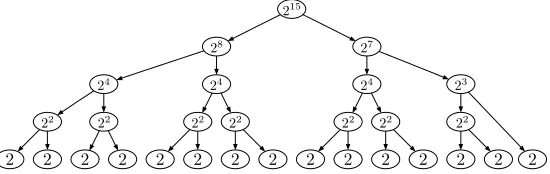
Fig. 2: A folding tree for a215-bit query string. The number in each node is the length of the string to be folded/unfolded at the node.
Folding a string can be done in different ways if we choose different dimensions for the matrix in each step. In the example in Fig. 1, we can also use a2×8matrix to foldq. To be deterministic, we define a tree structure and associated algorithms. The
tree is an auxiliary structure that directs how to fold and unfold a string recursively. To build such a tree, the only information we need is the length of the query string. More formally, we define afolding treeto be a binary tree, such that each non-leaf node has exactly two children (referred to as the left child and the right child). Each node in the folding tree stores a number that is the length of the string to be folded or unfolded at this node. The algorithm to build a folding tree is given in Algorithm 1 and a folding tree built from the algorithm is shown in Fig. 2. It is easy to prove that a folding tree built from the algorithm has heightlog logn′and haslogn′leaf nodes.
n′ = 2ζ1 ·2ζ2. To make it deterministic, we chooseζ
1such thatζ1 is an integer and
2ζ1 < n′ ≤22ζ1. After we findζ
1, we setζ2 = logn′−ζ1. That means we can write
then′-bit string into an2ζ1×2ζ2 matrix, thus the string can be folded into two strings
of2ζ1-bit and2ζ2-bit long. Then we invoke the next level recursions with2ζ1 and2ζ2.
The recursions will end when the input number is 2.
Algorithm 1:buldTree(node, n’)
input : A tree nodenodeand an integern′
= 2ζ output: A folding tree for a query string of lengthn′
1 ifnode== NULLthennode= new node; // a new tree 2 node.strLen=n′;
3 ifn′==2thenreturn; // end condition of the recursion
4 ζ1=⌈logn′/2⌉, ζ2= logn′−ζ1; // determine the dimensions
5 left= new node,right= new node;
6 node.lef t=left,node.right=right;
7 buldTree(left,2ζ1); // recursion
8 buldTree(right,2ζ2);
9 returnnode;
Algorithm 2:fold(T,q)
input : A folding treeTand a query stringqof lengthn′ = 2ζ output: A folded representation ofq, which is a string of2 logn′
bits
1 ifTis a leaf nodethenreturnq;
2 d1=T.lef t.strLen,d2=T.right.strLen;
3 j= the index of the 1 bit inq,α=⌊(j−1)/d2⌋+ 1,β= ((j−1) modd2) + 1;
4 l= new bit string of lengthd1, all bits are initialized to 0;
5 r= new bit string of lengthd2, all bits are initialized to 0;
6 set theαth bit inlto 1;
7 set theβth bit inrto 1;
8 a=fold(T.lef t,l);
9 b=fold(T.right,r);
10 returna||b;
After we have built the folding tree, we can use it to fold and unfold the query string. Each folding tree is built with an inputn′and can only fold/unfold query strings
of lengthn′. The algorithm to fold a query string is shown in Algorithm 2. In the
al-gorithm, we do not really need to fill the string into a matrix. As we can see in line 2, the dimensions of the matrix are stored in the folding tree: the number stored in the left child node is the number of rows and the number stored in the right child node is the number of columns. With this information, then in line 3, given the indexjof the 1 bit in the input string, we can convert the index into a row indexαand a column indexβin the matrix. Then we can generate two strings, one with theαth bit set to 1 and one with theβth bit set to 1. The strings will be passed to the next recursions. At a leaf node, the recursion ends. At the end of the algorithm, the 2-bit strings at all leaf nodes are con-catenated and returned. Since we havelogn′ leaf nodes, the query string is folded into
a string of2 logn′ bits. Unfolding is essentially the inverse process. The folded query
Then starting from the leaf nodes, the strings held by sibling nodes are unfolded into a longer string by multiplying the bits. Eventually at the root the original query string is fully unfolded.
Algorithm 3:unfold(T,s)
input : A folding treeTand a folded query strings
output: A query stringqofn′
bit, unfolded froms
1 ifTis a leaf nodethenreturns;
2 d1=T.lef t.strLen,d2=T.right.strLen,ζ1= 2 logd1,ζ2= 2 logd2;
3 Splitsinto two strings such thats=sl||sr,slisζ1-bit andsrisζ2-bit;
4 l=unfold(T.lef t,sl); 5 r=unfold(T.right,sr);
6 q= new bit string of lengthd1×d2;
7 fora= 1to d1do
8 forb= 1to d2do 9 i= (a−1)·d2+b;
10 qi=la·rb;
11 end
12 end
13 returnq;
The unfolding algorithm can work perfectly with an FHE scheme. Now all strings in the algorithm are replaced by vectors of ciphertexts that encrypt the strings bit-by-bit. The input ciphertext vector is of size 2 logn′ and the output ciphertext vector is
of sizen′. The process is almost identical to the plaintext case. The only difference is
that in line 10 of Algorithm 3, the multiplication operation will be the homomorphic multiplication operation.
4.3 The PIR protocol
Now we are ready to describe our PIR protocol. The protocol is the parallelised version of the protocol described in Section 4.1. Recall that in BGV, we can pack anl-vector of elements inF2din a single ciphertext and process the elements in an SIMD fashion. We will use this feature in our protocol to run l instances of the protocol in section 4.1 simultaneously. On the server side, the server represents its database as ann′×l
matrix, each element in the matrix is a d-bit binary vector that can be viewed as an element inF2d. Later, homomorphic operations will be applied to all elements in the
l-vector simultaneously. That is, we can processl·d = φ(m)bits each time. In this way, we can amortise server side computation. On the client side, the client needs to send the query stringqto the server. It uses the folding algorithm to foldqintos. The folded query stringsis short, only2 logn′ bits. We can always find BGV parameters such that2 logn′ ≤ l. Therefore the client can packsinto one single ciphertext and
sends it to the server. The protocol is as follows and we will explain why this is correct after the description:
slotsl, the server arranges its database into ann′×lmatrixX, wheren′=⌈ n φ(m)⌉.
Each element in the matrix is a bit vector of lengthd, whered=φ(m)/l. 2. QGen: The client does the following to generate a query:
(a) The client convertsiinto(α, β, γ), i.e. the bitxiis theγth bit of the element at
Xαβ. Then the client creates a query stringqof lengthn′, which contains all 0
bits except theαth bit set to 1. The client creates a folding tree withn′ as the
input. Then the client foldsqintosusing the folding algorithm.
(b) The client padsswith 0 tolbits. Then the client circularly right shiftssto get
a new strings′ = s ≫ (β−1) so that ins′ theβth bit is the first bit ins.
Heres′can be viewed as anl-vector of constant binary polynomials. Then the
client uses the packing feature: mapss′ to an element inA2 and encrypts it.
The results=Epk(π(s′))is the queryQand is sent to the server.
3. RGen: GivenQ=s, the server generates a response as follows:
(a) The server generates a vector of ciphertextcthat contains2 logn′ ciphertexts
after receiving Q, such that c1 = sand for each 2 ≤ k ≤ 2 logn′,ck = s⊳(k−1). The server generates a folding tree with n′ as input. Then the server runs the unfolding algorithm homomorphically with the folding tree and
cas input. The resultc′is a vector ofn′ciphertexts.
(b) The server then computes a single ciphertext r = (c′
1 ⊠π(X1))⊞(c′2 ⊠ π(X2)). . .⊞(c′n′ ⊠π(Xn′)). Then the server returns the resoponseR = r to the client.
4. RExt: GivenR=r, the client decryptsrand obtains anl-vector. Theγth bit in the
βth element in the vector is the bitxiit wants to retrieve.
As we said earlier, in this protocol we work with packed ciphertexts. Homomorphic operations involving packed ciphertexts are component-wise. So one major change in this protocol compared to the protocol described in Section 4.1 is that instead of just one single binary polynomial in a row of the matrixX, now in each row we have a vector oflbinary polynomials. The client’s goal is to retrieve theβth polynomial in the
αth row that contains the bit. In step 2a, the client generates a query stringqthat can
be used to retrieve theαth row in the server’s matrix and folds it intos. In step 2b, the
client circularly right shifts the stringsbyβ−1positions. The reason is thatscontains
only information about the row index of the element the client wants to retrieve, by shifting it the results′ contains information about both the row index and the column
index. This becomes clearer in step 3a. The server generates a vector of ciphertextc
by rotating the ciphertext from the client. The first ciphertextc1 encryptss′, and the βth bit ins′ iss1, the second ciphertext encrypts s′ ≪ 1, and theβth bit ins′ ≪ 1
iss2, and so on and so forth. In fact we can viewcas encrypting a bit matrixS of
size2 logn′×l. Theβth columnSβ is the folded query string
sgenerated in step 2a
by the client. The server can unfoldsback toqby running the unfolding algorithm.
This is because the batched homomorphic operations are component-wise. Therefore by running the algorithm with packed ciphertexts, the server actually runslinstances of unfolding simultaneously, each with the same folding tree and a distinct column from
Sas input. The input string to theβth instance issand thusqcan be unfolded. For the
from running the unfolding algorithm can also be viewed as encrypting ann′×lmatrix
such that theβth column isqand the other columns contain useless bits. Then in step
3b, the server again uses batched homomorphic operations to runl instances of inner product evaluation. The input to each instance is a column in the unfolding result matrix and the corresponding column inX. Theβth instance computes the inner product of
q andXβ. The result is Xαβ which is the element the client wants to retrieve. The
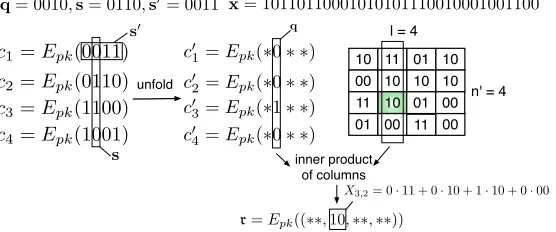
element is encrypted in theβth slot inrand by decrypting the ciphertext, the client can obtain the element. Then by examining theγth bit in the element, the client knows the bit it wants to retrieve. Fig. 3 shows a toy example. In the examplen= 32, l= 4, d= 2 andn′ = 4, so the server’s database is organised as a4×4matrix. The bit the client
wants to retrieve is the first bit inX3,2.
10 l = 4
n' = 4
c1=Epk(0011)
c2=Epk(0110)
c3=Epk(1100)
c4=Epk(1001) c4′ =Epk(∗0∗ ∗) c′
3=Epk(∗1∗ ∗) c′
2=Epk(∗0∗ ∗) c′
1=Epk(∗0∗ ∗)
q= 0010,s= 0110,s ′= 0011
s′
s
q
unfold
inner product of columns
00 11
01
11 01 10 10 10
00 10 01
11 10 00
00
r=Epk((∗∗,10,∗∗,∗∗))
[image:12.612.171.449.257.373.2]X3,2= 0·11+ 0·10 + 1·10 + 0·00 x=10110110001010101110010001001100
Fig. 3: An Example of the PIR Protocol (* means a bit we do not care).
Extensions.With some modifications, we can extend the PIR protocol into a PBR pro-tocol [3] or a symmetric PIR propro-tocol [4]. In a PBR propro-tocol, the client retrieves a block rather than a single bit. In a symmetric PIR protocol, the client retrieves just one bit and learns nothing about the other bits in the server’s database. Due to limited space, we do not discuss them here. They will be presented in the full version of the paper.
4.4 Efficiency Analysis
Communication.In the protocol, the client sends a request that is a single ciphertext and the server returns a single ciphertext. The size of the ciphertexts depends onAq.
For each element inAq, it is a polynomial of degree at mostφ(m)−1. Therefore the
size of a ring element is at mostφ(m)·logqbits. The parametersφ(m)andqare inter-dependent. For simplicity, in our protocol we choose a large enough and fixedφ(m)and thereforeqbecomes a variable independent ofφ(m). Then we havelogq=a+b·L
wherea, bare small constants andLis the depth of circuit to be evaluated. SinceL= log logn′, the bit length of q isO(log logn′). Then overall, the communication cost is
O(log logn′) =O(log log n
φ(m)) =O(log logn).
Server side computation. The server side computation consists of three parts: ho-momorphic rotations, unfolding and hoho-momorphic inner product computation. The complexity of the rotation operation is O(φ(m)logφ(m))multiplications modulo q. We need in total 2 logn′−1 rotations. To unfold the query string, the server needs
Plog logn′
i=0 2i 2√i
n′< n′+ 3√n′homomorphic multiplications. The computational cost
un-derstand the cost of the protocol, we need to unun-derstand the cost of homomorphic mul-tiplication operations. We have two different homomorphic mulmul-tiplication operations: raw multiplications and full multiplications. A raw multiplication simply computes the tensor product of the parts in the ciphertexts, so the cost is 4 (2 if one operand is a plain-text) multiplications overAq. A full multiplication is a raw multiplication followed by a modulus switching and a key switching on the product. The maintenance operations are necessary to ensure correctness and maintain the size of the ciphertext. The cost of a multiplication overAqisφ(m)multiplications moduloq. The complexity of modulus switching and key switching isO(φ(m)logφ(m))multiplications moduloq. Therefore a full multiplication is more costly than a raw multiplication.
Our observation is that in our protocol most homomorphic multiplications can be raw multiplications. Namely, we mean then′ multiplications required by the last step
of the unfolding algorithm and the n′ multiplications required by the inner product
computation. The total cost of this part is4·n′·φ(m) + 2·n′·φ(m) = 6n
multi-plication moduloq(qis less than 64-bit because of previous modulus switching oper-ations). We only need less than3√n′ full multiplications. The total cost of this part is O(√n′φ(m)logφ(m))modular multiplication operations. Each modular multiplication
here can be implemented by 1 or a few 64-bit modular multiplications.
As we can see, the overall computational complexity isO(logn′+√n′ +n′) = O(n). For sufficiently largen, the computational cost of the homomorphic rotation part is insignificant compared to the the other two parts. Moreover, whennis sufficiently large, √n′ will be much smaller thann′. That means the number of total operations
required by full multiplication part is smaller than the raw multiplication part. Then in this case, the server side computation is bounded by12n64-bit modular multiplication operations.
Client side Computation.The client side computation in our protocol is very light. The client needs to do 1 encryption and 1 decryption. The cost of encryption or decryption is
O(φ(m))multiplications moduloq. In practice, each encryption/decryption needs only a couple of milliseconds.
4.5 Security Analysis
In this section, we analyse the security of our PIR protocol. We have the following theorem:
Theorem 1. If the BGV FHE is semantically secure, then our PIR protocol is a secure single server PIR protocol.
Proof. We show that if a PPT adversaryAcan distinguish two queries with a non-negligible advantage, then an adversaryA′ can useAas a subroutine to win the BGV
CPA game with a non-negligible advantage. The BGV CPA game is a standard public key encryption CPA game, in whichA′needs to distinguish two ciphertexts encrypted
under a BGV public key. The game is in the appendix.A′does the following:
– A′choosesnand generates a databasex, choosesλandL, then receives the BGV
public key and parameters(pk, param). It then invokesAwithx, pk, param. – For any indexi,Acan generate the query by itself using the public key. At some
point of time,Aoutputs two indexesi0, i1and sends them toA′.
– A′generatesm0usingi0.A′first generates a query stringqfromi0, foldsqintos
– A′generatesm1in the same way as above but usingi1as input.
– A′sendsm0andm1to the challenger in the BGV CPA game, then receivescb. – A′sendscbtoA, and outputs whateverAoutputs.
It is clear that the probability ofA′winning the BGV game is the same as the
prob-ability ofAoutputtingb′ = b. Since the BGV encryption is semantically secure, the
probability ofA′winning the game is 1
2+η, whereηis negligible. Then the advantage
ofAis also negligible.
5
Implementation and Performance
5.1 ImplementationWe have implemented a prototype in C++. The implementation is based on HElib [36], an open source implementation of the BGV FHE scheme. Currently in the prototype the client and the server run in the same process. This does not affect the evaluation result. To measure network communication, we output the ciphertexts to files and measure the file size. We have done a few optimisations:
Delayed Unfolding.We delay the last unfolding step. Instead of fully unfolding the query string, we combine this step with the inner product computation step. The main reason is that if we fully unfold the query string, we need to storen′ ciphertexts.
Be-causen′can be large, we need enormous memory to store the ciphertexts. If we stop at
the two children of the root, then we only need to store two vectors of approximate√n′
ciphertexts. When we compute the inner product, we can unfold the bit we need on the fly using the two vectors.
Tree Pruning.We can also prune the folding tree to lower the communication cost. The idea is that if we do not fully fold the query string, we will end up with a longer folded string, but we might still be able to pack it into one ciphertext. For space reason, we do not formally present the tree pruning algorithm but use an example to explain the idea. Consider without pruning, the client and the server use the folding tree in Fig. 2, so the client fully folds its query string into a30-bit string and the server can unfold the query string. If we prune the tree to have only 3 nodes: the root node and the two children of it, then with this tree, the client can fold the the query string into a28+27= 384-bit string.
As long as the number of plaintext slotl≥384, the client can pack the string into one ciphertext. With this packed ciphertext, the server can obtaincby 383 rotations, and
then breakscinto two vectors, the first one with28ciphertexts and second one with27
ciphertexts. The encrypted query string can be unfolded from these two vectors, and the server can then compute the inner product. The tree pruning algorithm takes a folding tree andlas input, scans from the root, once it finds a level such that the sum ofstrLen
of all nodes at this level is smaller than l, it prunes all nodes below this level. Tree pruning requires only a minor modification to the unfolding algorithm. Tree pruning can reduce communication cost because lower tree height means lower circuit depth, and then smallerq.
Multithreading.Conceptually, the server side computation in our protocol can be eas-ily parallelised. Each step in unfolding requires d1 · d2 independent homomorphic
multiplications, and the inner product computation step requires n′ independent
to make the raw multiplication and addition operations independent of the NTL library and make the prototype partially multithreaded. This enables our implementation to take advantage of multicore hardware.
5.2 Performance
In this section, we report the performance based on our prototype implementation. All experiments were conducted on a MacBook Pro laptop, with an Intel 2720QM quad-core 2.2 GHz CPU and 16 GB RAM. The choice of the BGV parameters is based on the formula given in [37]:φ(m)≥ log(q/σ7)(.2λ+110), whereσis the noise variance of the
discrete Gaussian distribution andλis the security parameter. The varianceσ = 3.2
in HElib. We chose m = 8191thusφ(m) = 8190and the number of plaintext slot
l = 630. The modulus q is an odd integer of40 + 20Lbits, where Lis the height of the folding tree. Whenλ= 128, the largestLsupported by the chosenmis 7. In other words, the parameters ensure 128-bit security as long as the database is less than
227
= 2128-bit, which is more than enough in any practical settings.
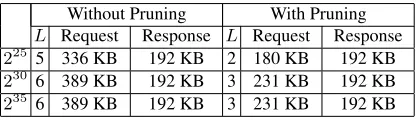
We first show the communication cost (Table 1). One thing to be noticed is that HElib outputs ciphertexts as textual strings of decimal numbers, so the measured size is bigger than the raw bit size. We used database of size225bits (4 MB),230bits (128
MB), and235bits (4 GB) in our experiments. As we can see, the communication cost
is low, only a few hundred KB. The response is only one ciphertext and the size is fixed across all cases. Most time the request is larger than the response despite that it is also just a single ciphertext. The reason is thatqis not fixed in the BGV FHE scheme. We use modulus switching to switch to smallerqduring the homomorphic operations. So the ciphertext in the response uses a smallerqand in consequence the size of the ciphertext is smaller. Another fact about the response is that has 3 ring elements5 because we
omitted the key switching operations in the last unfolding step. This explains why in the first experiment with pruning (database size =225), the request is smaller than the response. We can also see that tree pruning does help reduce the request size.
Without Pruning With Pruning
L Request Response L Request Response
225 5 336 KB 192 KB 2 180 KB 192 KB
230 6 389 KB 192 KB 3 231 KB 192 KB
[image:15.612.204.414.456.516.2]235 6 389 KB 192 KB 3 231 KB 192 KB
Table 1: Communication cost with different database size
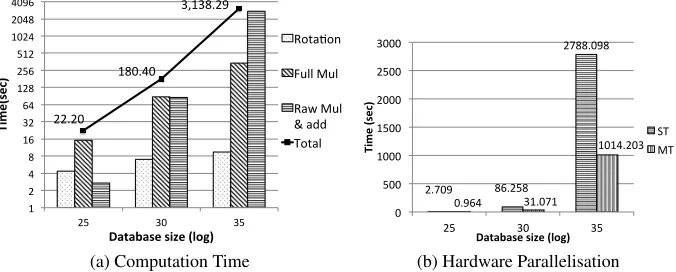
We then show the server side computation time (Fig. 4). In Fig. 4a, we show the computation time for each step as well as the total time. The columns show the time for rotation, full multiplications (unfolding except the last step) and raw multiplications and additions (the last unfolding step plus inner product computation). The line shows the total computation time. As we can see, the rotation step is always fast. When the size of the database is small, the computation is dominated by the full multiplications. But when the size of the database increases, the raw multiplication and addition step starts to become dominant. From the total time, we can estimate the minimal bandwidth needed
5The 3-part ciphertext can still be decrypted correctly, so this does not affect the correctness of
to make the trivial solution faster. When the database is 4 MB, 128 MB and 4 GB, the minimal bandwidth is 1.25 Mbps, 5.65 Mbps and 10.44 Mbps. With a more powerful CPU (our experiments were done on a laptop), the minimal bandwidth would be higher. We can make our protocol more practical by utilising hardware parallelism. In Fig. 4b, we show the performance of our multithreaded implementation versus single threaded one. The time compared in the diagram is the raw multiplication and addition step, which is the only step we can currently implement in parallel. The experiments were done with a quad-core CPU, and the performance improvement was about 2.7 - 3 times. If with a fully thread safe BGV implementation and 2 or 3 more CPUs, the performance of our protocol can compete with the trivial solution in 100 Mbps LAN.
22.20$ 180.40$ 3,138.29$ 1$ 2$ 4$ 8$ 16$ 32$ 64$ 128$ 256$ 512$ 1024$ 2048$ 4096$
25$ 30$ 35$
T im e (se c) ) Database)size)(log)) Rota1on$ Full$Mul$ Raw$Mul$ &$add$ Total$
(a) Computation Time
2.709& 86.258& 2788.098& 0.964& 31.071& 1014.203& 0& 500& 1000& 1500& 2000& 2500& 3000&
25& 30& 35&
T im e %( se c) % Database%size%(log)% ST& MT&
[image:16.612.140.478.241.377.2](b) Hardware Parallelisation
Fig. 4: Server Side Computation Time of Our PIR Protocol 5.3 Performance Comparison
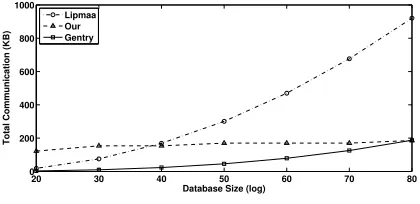
Communication.We compare the communication cost with the current most efficient protocols: Lipmaa’s protocol [10] and Gentry’s protocol [9]. The result is plotted in Fig. 5. Note we use size of ciphertext in the raw bit representation to draw the line for each protocols, so the numbers for our protocol are different from the numbers in Table 1. Lipmaa’s protocol assumes that the n-bit database has n′ entries each ist
bits. The smallest modulus size is2k-bit. Whent= k, the total cost isα·((s+α+ 1)ζ/2)(n′1/α−1)·kbit. In the figure, we setk = 3072for 128-bit security and let α= logn′, s= 1, ζ = 1. Then as we can see, our protocol (without pruning) incurs
more communication when the database is small, but would be better when the database is sufficiently large. This is due to the large ciphertext size in the BGV scheme. Gentry’s protocol is very communication efficient. The communication cost is 3log3−o(1)n-bit integers. With any practical database size, it would be always more efficient than our protocol in terms of communication. However, the difference is less than 200 KB, which is not significant.
Computation.Here we do not compare with Melchor’s protocol [18] because it is not secure. We do not compare with other FHE based protocols [11, 12] because they are obviously less efficient. Among all other existing protocols:
– Kushilevitz’s protocol [4] requiresnmodular multiplications.
20 30 40 50 60 70 80 0
200 400 600 800 1000
Database Size (log)
Total Communication (KB)
[image:17.612.200.410.121.223.2]Lipmaa Our Gentry
Fig. 5: Communication Cost Comparison
– Gentry’s protocol [9] requires only one modular exponentiation but the exponent is
2n-bit. The computational cost is approximatelynmodular multiplications. – Cachin’s protocol [6] requiresnmodular exponentiations. The computational cost
is approximatelylen/2 modular multiplications, whereleis the bit length of the exponent.
– Lipmaa’s protocol [10] requires for each2≤j ≤logn′,2logn′−j
exponentiations. The computational cost is at leastc·nmodular multiplications for somecdepending onlogn′.
– Lipmaa’s BDD based protocol [17] requires O(n/(logn)) modular exponentia-tions. The computational cost is approximatelylen/(2 logn)modular multiplica-tions. Because the exponent sizeleis larger than2 logn, the total cost is larger than nmodular multiplications.
– Chang’s protocol [8] requiresnmodular multiplications and2 lognmodular expo-nentiations.
The most efficient protocol of all above ones is Kushilevitz’s protocol [4] that re-quiresnmodular multiplications. Although the number of operations in Gentry’s pro-tocol is similar to Kushilevitz’s propro-tocol, in practice it would be less efficient due to the large exponent which is twice as big as the database. Another factor that makes Kushile-vitz’s protocol the most efficient one is the modulus size. Some protocols, e.g. Cachin’s, Lipmaa’s (and the BDD-based), and Chang’s, require larger moduli. So the modular multiplication operation is slower in those protocols than in Kushilevitz’s protocol.
We then compare our protocol with Kushilevitz’s protocol. For 128-bit security, the modulus size needs to be at least 3072-bit. We measured time for a 3072-bit modular multiplication using the GMP library [38]. This is done by averaging the time for 1 million operations. The time for a single operation is8.269×10−6second. Thus, when
the database size is225,230 and235bits, Kushilevitz’s protocol would need 277.46, 8878.72and284119.04seconds respectively. That is12.5,49.2and90.5times slower than our protocol in single threaded mode.
6
Conclusion
In future work, we will test and improve performance over large data. We will ex-tend the protocol to multi-query PIR [39]. Namely to further amortise the server-side computation complexity of PIR over multiple queries performed by a single client.
References
1. Khoshgozaran, A., Shahabi, C.: Private information retrieval techniques for enabling location privacy in location-based services. In: Privacy in Location-Based Applications. (2009) 59–83 2. Henry, R., Olumofin, F.G., Goldberg, I.: Practical PIR for electronic commerce. In: ACM
Conference on Computer and Communications Security. (2011) 677–690
3. Chor, B., Goldreich, O., Kushilevitz, E., Sudan, M.: Private information retrieval. In: FOCS. (1995) 41–50
4. Kushilevitz, E., Ostrovsky, R.: Replication is not needed: Single database, computationally-private information retrieval. In: FOCS. (1997) 364–373
5. Stern, J.P.: A new efficient all-or-nothing disclosure of secrets protocol. In: ASIACRYPT. (1998) 357–371
6. Cachin, C., Micali, S., Stadler, M.: Computationally private information retrieval with poly-logarithmic communication. In: EUROCRYPT. (1999) 402–414
7. Kushilevitz, E., Ostrovsky, R.: One-way trapdoor permutations are sufficient for non-trivial single-server private information retrieval. In: EUROCRYPT. (2000) 104–121
8. Chang, Y.C.: Single database private information retrieval with logarithmic communication. In: ACISP. (2004) 50–61
9. Gentry, C., Ramzan, Z.: Single-database private information retrieval with constant commu-nication rate. In: ICALP. (2005) 803–815
10. Lipmaa, H.: An oblivious transfer protocol with log-squared communication. In: ISC. (2005) 314–328
11. Brakerski, Z., Vaikuntanathan, V.: Efficient fully homomorphic encryption from (standard) LWE. In: FOCS. (2011) 97–106
12. Yi, X., Kaosar, M.G., Paulet, R., Bertino, E.: Single-database private information retrieval
from fully homomorphic encryption. IEEE Trans. Knowl. Data Eng.25(5) (2013) 1125–
1134
13. Sion, R., Carbunar, B.: On the practicality of private information retrieval. In: NDSS. (2007) 14. Williams, P., Sion, R.: Usable PIR. In: NDSS. (2008)
15. Ding, X., Yang, Y., Deng, R.H., Wang, S.: A new hardware-assisted PIR with o(n) shuffle
cost. Int. J. Inf. Sec.9(4) (2010) 237–252
16. Ishai, Y., Kushilevitz, E., Ostrovsky, R., Sahai, A.: Cryptography from anonymity. In: FOCS. (2006) 239–248
17. Lipmaa, H.: First CPIR protocol with data-dependent computation. In: ICISC. (2009) 193– 210
18. Melchor, C.A., Gaborit, P.: A fast private information retrieval protocol. In: ISIT. (2008) 1848–1852
19. Ostrovsky, R., III, W.E.S.: A survey of single-database private information retrieval: Tech-niques and applications. In: Public Key Cryptography. (2007) 393–411
20. Brakerski, Z., Gentry, C., Vaikuntanathan, V.: (leveled) fully homomorphic encryption with-out bootstrapping. In: ITCS. (2012) 309–325
21. Lyubashevsky, V., Peikert, C., Regev, O.: On ideal lattices and learning with errors over rings. In: EUROCRYPT. (2010) 1–23
22. Chor, B., Gilboa, N.: Computationally private information retrieval (extended abstract). In: STOC. (1997) 304–313
24. Beimel, A., Ishai, Y., Kushilevitz, E., Raymond, J.F.: Breaking the O(n1/(2k-1)) barrier for information-theoretic private information retrieval. In: FOCS. (2002) 261–270
25. Goldberg, I.: Improving the robustness of private information retrieval. In: IEEE Symposium on Security and Privacy. (2007) 131–148
26. Paillier, P.: Public-key cryptosystems based on composite degree residuosity classes. In: EUROCRYPT. (1999) 223–238
27. Damg˚ard, I., Jurik, M.: A generalisation, a simplification and some applications of Paillier’s probabilistic public-key system. In: Public Key Cryptography. (2001) 119–136
28. Bi, J., Liu, M., Wang, X.: Cryptanalysis of a homomorphic encryption scheme from ISIT 2008. In: ISIT. (2012) 2152–2156
29. Gentry, C.: A fully homomorphic encryption scheme. PhD thesis, Stanford University (2009) 30. Gentry, C.: Fully homomorphic encryption using ideal lattices. In: STOC. (2009) 169–178 31. van Dijk, M., Gentry, C., Halevi, S., Vaikuntanathan, V.: Fully homomorphic encryption
over the integers. In: EUROCRYPT. (2010) 24–43
32. Gentry, C., Sahai, A., Waters, B.: Homomorphic encryption from learning with errors: Conceptually-simpler, asymptotically-faster, attribute-based. In: CRYPTO (1). (2013) 75–92 33. Smart, N.P., Vercauteren, F.: Fully homomorphic SIMD operations. IACR Cryptology ePrint
Archive2011(2011) 133
34. Gentry, C., Halevi, S., Smart, N.P.: Fully homomorphic encryption with polylog overhead. In: EUROCRYPT. (2012) 465–482
35. Savage, J.E.: Models of Computation: Exploring the Power of Computing. 1st edn. Addison-Wesley Longman Publishing Co., Inc., Boston, MA, USA (1997)
36. Halevi, S., Shoup, V.: Algorithms in HElib. IACR Cryptology ePrint Archive2014(2014)
37. Gentry, C., Halevi, S., Smart, N.P.: Homomorphic evaluation of the aes circuit. In: CRYPTO. (2012) 850–867
38. Granlund, T., the GMP development team: GNU MP: The GNU Multiple Precision Arith-metic Library. 5.1.3 edn. (2013) http://gmplib.org/.
39. Ishai, Y., Kushilevitz, E., Ostrovsky, R., Sahai, A.: Batch codes and their applications. In: STOC. (2004) 262–271
A
The CPA game
The security of the BGV scheme is captured by the following CPA game between an adversary and a challenger:
1. The adversary choosesL, then given a security parameterλ, the challenger runs
G(λ, L)to generate the secret keysk, the public keypkand the public parameters
param. The challenger retainsskand gives the adversarypkandparam.
2. The adversary may choose a polynomially bounded number of plaintexts and en-crypts them using the public key.
3. Eventually, the adversary submits two chosen plaintextsm0, m1to the challenger.
4. The challenger selects a bitb∈ {0,1}uniformly at random, and sends the challenge ciphertextc=Epk(mb)back to the adversary.
5. The adversary is free to perform a polynomially bounded number of additional computations or encryptions. Finally, it outputs a guessb′.
The adversary wins the game ifb′=b. Under the RLWE assumption, the BGV scheme
is secure which means the probability of any PPT adversary winning this game is12+η