Collaborative Knowledge Management Systems
for Learning Organisations
Rusli Abdullah
Faculty of Computer Science and Information Technology Universiti Putra Malaysia, 43400 UPM Serdang, Malaysia
Shamsul Sahibudin and Rose Alinda Alias
Faculty of Computer Science and Information Systems Universiti Teknologi Malaysia
81310 UTM Skudai, Malaysia
Mohd Hasan Selamat
Faculty of Computer Science and Information Technology Universiti Putra Malaysia, 43400 UPM Serdang, Malaysia
Abstract. A knowledge management system (KMS) is a concept that can be used for creating knowledge reposito-ries, improving knowledge access and sharing as well as com-municating through collaboration, enhancing the knowledge environment and managing knowledge as an asset for an institution or organisation. In this paper, we propose a collab-orative KMS framework for learning organisations (LOs) and discuss components in the framework that will help organi-sations to increase productivity and quality as well as to gain return on investment from a KMS. These components are KMS functionality, architecture, taxonomy, psychological, sociocul-tural and audit.
Keywords: Knowledge; knowledge management; knowledge management system (KMS); KMS framework; learning organisation.
1.
Introduction
Knowledge is something that humans acquire from pro-cessed information, by using data. It includes their expe-rience, values, insights and contextual information and helps them evaluate and incorporate new experiences and information (O’Leary, 1998). Knowledge originates with and is applied by knowledge workers. People use their knowledge in making decisions. During the last several years, organisations have realised that they own a vast amount of knowledge. This large amount of knowledge needs to be managed so that it can be easily utilised by the organisation. Davenport and Prusak (1998) defined knowledge as a fluid mixture of experience, values, contex-tual information and expert insight that provides a frame-work for evaluating and incorporating new experiences
and information. They argued that knowledge originates and is applied in the minds of people who know about it (Polanyi, 1966). In organisations, it becomes embedded in documents and repositories, in organisational routines, in processes, practices and norms.
There is a slightly different definition given by Alavi and Leidner (1999). Knowledge is viewed as a justification of personal belief that increases an individual’s capacity to take certain action. They used Churchman’s idea that “knowledge resides in the user and not in the collection of information”. In their definition, action refers to physical skills and competencies, cognitive/intellectual activity or both (e.g., surgery involves both).
Knowledge is an asset with the following four char-acteristics (McKinsey, 1998): (1)Extraordinary leverage. Knowledge is not subject to diminishing returns, has a fixed cost to create, but not to manufacture or distribute. (2)Fragmentation, leakage. Over time, knowledge assets become less valuable as they become more widely known. To be successful, knowledge must be refreshed to keep it as a source of competitive advantage. (3) Uncertain value. Value is difficult to estimate and steady growth in knowledge may suddenly halt. (4) Uncertain value shar-ing. Knowledge would be more useful if it could be shared and used among the community.
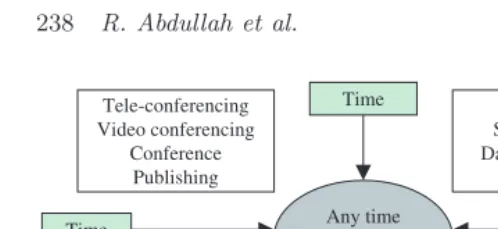
Collaborative computing technology (shown as in Fig. 1) could be used to encourage knowledge sharing in the community.
The management of knowledge was very important in the 1990s because it helped organisations to be more
237
J. Info. Know. Mgmt. 2005.04:237-245. Downloaded from www.worldscientific.com
Tele-conferencing Video conferencing
Conference Publishing
E-mail Searching Data Sharing
BBS
Information Centers Team Rooms Task Delegation
Electronic Meeting Rooms Decision Conference Project Management Any time
Any place Anywhere
Place
Same Different
Place Time
Time
Fig. 1. The collaboration computing technology (Adopted from Bostromet al., 1992).
competitive and effective through sharing activity and re-using knowledge. In the market place of e-business, knowledge management (KM) initiatives are used to systematically leverage information and expertise to improve organisational responsiveness, innovation, com-petency and efficiency (RICE) (Lotus Company, 2002). Besides that, there are more reasons why knowledge should be managed properly. Among these reasons are information overload, technology advancement, increased professional specialisation, competition, workforce mobil-ity and turnover and capitalising on organisational knowledge.
According to Davenport and Prusak (1998), knowl-edge is a fluid mix of framed experience, values, con-textual information and expert insight that provides a framework for evaluating and incorporating new experi-ences and information. It originates and is applied in the minds of those who know. In institutions, it often becomes embedded not only in documents or repositories but also in organisational routines, processes, practices and norms.
KM is the systemically and organisationally speci-fied processes for acquiring, organising and communicat-ing knowledge of employees so that other employees may
make use of it to be more effective and productive in their work (Alavi and Leidner, 1999).
Based on this, Nonaka and Takeuchi (1995) pro-posed four KM interactions that build on the distinc-tions between tacit and explicit knowledge, which was described by Polanyi (1966). Tacit knowledge is something that is implied, not on what is actually documented; some-thing an individual “knows” from experience, other people or from a combination of sources. While explicit knowl-edge is externally visible, tacit knowlknowl-edge is only implied. Technologies supporting each interaction of knowledge are summarised in Table 1.
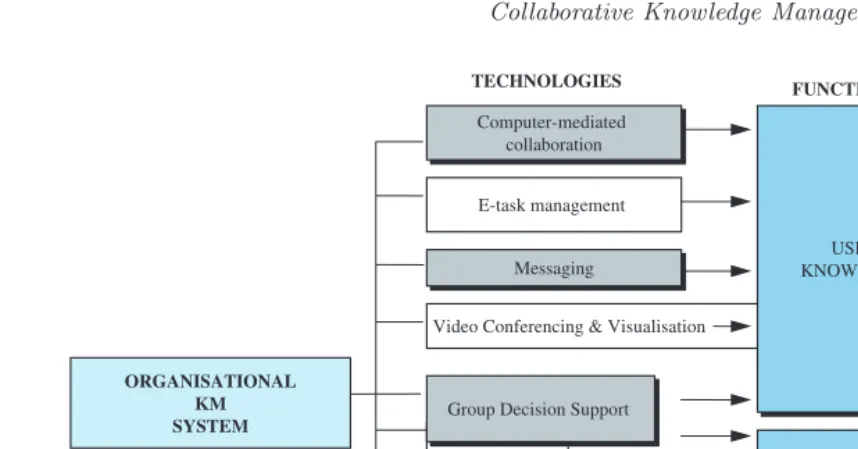
A knowledge management system (KMS) is a sys-tem that needs to be developed in an organisation. There are many perspectives for describing a KMS. One among them is based on the technical perspective, as proposed by Meso and Smith (2000) and shown in Fig. 2. It consists of three components;technology, function and knowledge. A KMS involves the processes for acquiring or collecting, organising, disseminating or sharing knowledge among people in learning organisations (LOs).
2.
Reviews on Knowledge Management
Framework
Numerous researchers have proposed several KM frame-works. The majority of the frameworks are prescriptive frameworks where they provide direction on the type of KM procedures without providing specifics details on how those procedures should be accomplished. For exam-ple, Wiig’s (1997) KM framework proposes the three KM pillars that represent the major functions needed to man-age knowledge. The pillars are based on a broad under-standing of knowledge creation, manifestation, use and transfer. The Leonard-Barton (1995) model highlighted a KM framework that comprised four core capabilities and four knowledge-building activities that are crucial to a
Table 1. Technologies provided in each interaction.
Tacit to tacit knowledge via socialisation Tacit to explicit knowledge via externalisation • Knowledge exchange: one-to-one, one-to-many,
many-to-many
• Traditional knowledge exch. Medium: same place/same time, face-to-face meetings
• Today’s technologies: teleconferencing, desktop video conferencing tools, e-meetings, village wells, synchronous collaboration
• Knowledge exchange: one-to-many
• Traditional knowledge exchange medium: created periodic reports, white papers
• Today’s technologies: electronic mail (e-mail), broadcasting information via distribution lists, answering questions, annotation
Explicit to tacit knowledge via internalisation Explicit to explicit knowledge via combination • This form of knowledge creation depends on
an individual’s ability to make sense out of explicit information
• Today’s technologies: visualisation
• Today’s technologies: e-mail, groupware, homepages
J. Info. Know. Mgmt. 2005.04:237-245. Downloaded from www.worldscientific.com
Video Conferencing & Visualisation
Data Mining Web Browsing
Group Decision Support
Document Management Intelligent Agents Search & Retrieval
FINDING KNOWLEDGE
CREATING KNOWLEDGE
PACKAGING KNOWLEDGE TECHNOLOGIES
ORGANISATIONAL KM SYSTEM
FUNCTIONS
Messaging Computer-mediated
collaboration E-task management
USING KNOWLEDGE
KNOWLEDGE
Know — how
Know — what
Know — why Self-motivated
creativity Personal tacit
Cultural tacit Organisational
tacit Regulatory Assets
Fig. 2. The technical perspective of a knowledge management system.
knowledge-based organisation (KBO). Arthur Andersen and APQC (1996) have advanced a model consisting of seven KM processes that can operate on an organisation’s knowledge: create, identify, collect, adapt, organise, apply and share.
The framework advanced by Van der Spek and Spijkervet (1997) identifies a cycle of four KM stages: con-ceptualise, reflect, act and retrospect. Chih-Ping et al.
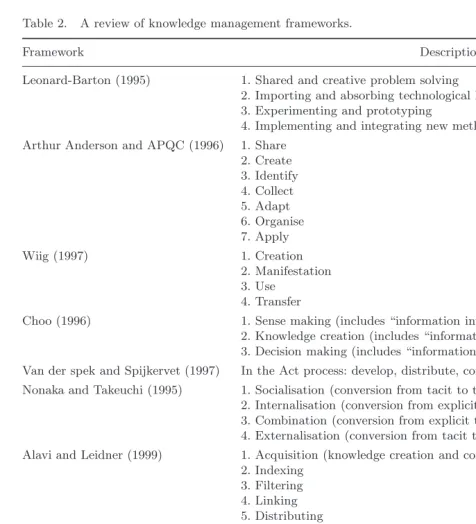
(2002) proposed another framework by integrating the previous frameworks. It consists of three aspects: knowl-edge resources, KM activities and knowlknowl-edge influences. Although Chih-Pinget al.(2002) have conducted a review on these frameworks, the cases used in the study were only based on highly knowledge-intensive companies. There-fore, KMS implementation in other industries such as a global support environment where there is rapid techno-logical advancement and changes has not been studied. The summarisation of the framework review is shown in Table 2.
3.
Knowledge Management Technologies
for a Collaborative Environment at
Learning Organisations
There is an English proverb that states: “Two heads are better than one”. This proverb stresses the importance of having a second person involved in whatever task one is performing. By having two persons working together on one task, the job will be performed faster. If one person is
an expert in a field that the other is not, then, the com-bining of expertise will definitely make the job easier and smoother to run, thus ensuring the best results. This situ-ation is more relevant in the context of LOs that promote knowledge sharing among students, lecturers, administra-tors and other stakeholders. The question here is how do we bring these heads together? Figure 3 illustrates how these individuals emerge together to form a team in the LO.
Working together, whether with two or more peo-ple, means that there is teamwork involved. Teamwork refers to the cooperation and collaboration between the team members. Collaboration can provide a framework for bringing the heads together, organising their efforts, managing the process and producing outstanding results. When each member of a team collaborates on a mission or project, each would be able to contribute his or her own strength, skills and knowledge to ensure the best results for the project. This is why collaboration is very important compared to handling the project alone. Coop-eration, collaboration and teamwork are essential to the survival of any organisation. We realise that the impor-tance of teamwork and collaboration may lead to the suc-cessful conduct of business. In this case, there is a model for collaboration that was proposed by Anumba et al.
(2001), as shown in Fig. 4.
In order to create this kind of environment, there are many KM tools that are available in the market. Among the popular tools are Lotus Notes by IBM/Lotus Com-pany (www.lotus.com), Live Link by Opentext ComCom-pany
J. Info. Know. Mgmt. 2005.04:237-245. Downloaded from www.worldscientific.com
Table 2. A review of knowledge management frameworks.
Framework Description
Leonard-Barton (1995) 1. Shared and creative problem solving
2. Importing and absorbing technological knowledge from the outside of firm 3. Experimenting and prototyping
4. Implementing and integrating new methodologies and tools Arthur Anderson and APQC (1996) 1. Share
2. Create 3. Identify 4. Collect 5. Adapt 6. Organise 7. Apply
Wiig (1997) 1. Creation
2. Manifestation 3. Use
4. Transfer
Choo (1996) 1. Sense making (includes “information interpretation”) 2. Knowledge creation (includes “information transformation”) 3. Decision making (includes “information processing”) Van der spek and Spijkervet (1997) In the Act process: develop, distribute, combine, hold Nonaka and Takeuchi (1995) 1. Socialisation (conversion from tacit to tacit of knowledge)
2. Internalisation (conversion from explicit to tacit of knowledge) 3. Combination (conversion from explicit to explicit of knowledge) 4. Externalisation (conversion from tacit to explicit of knowledge) Alavi and Leidner (1999) 1. Acquisition (knowledge creation and content development
2. Indexing 3. Filtering 4. Linking 5. Distributing 6. Application
Szulanski (1996) 1. Initiation (recognise knowledge need and satisfy that need) 2. Implementation (knowledge transfer takes place)
3. Ramp-up (use the transferred knowledge) 4. Integration (internalise the knowledge)
Students
Administrators Lecturers
KMS
Others
Fig. 3. Call for collaboration in LO.
(www.livelink.com), Microsoft Share Point by Microsoft Company (www.microsoft.com), Verity by Verity Com-pany (www.verity.com) and Infosider Suite by Leading Side (www.leadingside.com).
4.
Research Approach
In order to get input for formulating a framework for a collaborative KM portal in a LO or for any related domain
Same Time Different Time Same Place Face-to-face collaboration
(Synchronous) Distributed Synchronous
Collaboration
Asynchronous Collaboration
Different Place
Distributed Asynchronous Collaboration
Fig. 4. Collaboration of working model.
areas, we employed the following approach: documen-tation study of previous research, followed by a ques-tionnaire survey and interviews in the community of practice in the LO, focusing on those who are involved in KM portal deployments such as system analysts, chief knowledge officers (CKOs), programmers and other active users.
The designing of the questionnaire involved decid-ing what are the most relevant questions that should be included in the KM portal implementation. These
J. Info. Know. Mgmt. 2005.04:237-245. Downloaded from www.worldscientific.com
elements questions are important to ensure the system or KM portal worked according to its specifications of the LO requirements in order to serve a community of prac-tice (CoP) to work collaboratively. These questions also lay emphasis on how the elements played their roles in order to support the CoP, that involved a KM process environment. In this case, the survey was conducted by disseminating the questionnaires to the particular respon-dents involved in the KMS development as mentioned above, and who intend to use a KMS for their purposes in a CoP. From the list of measurement elements factors that were identified, respondents were also asked to rank their opinion about these elements by using a Likert scale that consisted of a ten-point scale for each of the issues. The mean values for the usages were calculated as fol-lows from highest to lowest scale: 10 = very high and 9 = high, and up to 2 = low and 1 = very low. Respon-dents were also asked open-ended questions that allowed them to give views and comments regarding KMS imple-mentation.
The main elements of consideration in this study in order to develop the framework of collaborative KM por-tal were: KMS strategies, KMS architecture, function-alities of a KMS collaborative environment to support communities in the organisation and KMS performance measurement. We also identified other elements suggested by the respondents during the survey. This was followed by formulation of the framework, discussed in the next section.
5.
Results and Discussion
The respondents agreed that a proposed framework should be developed to guide implementation of a KMS in a collaborative environment. These frameworks and concepts are discussed below. The selection of col-laborative KM portal framework was made for LOs because it may be a good start for KMS to enable many parties in LOs. These would include students, lec-turers, administrators and others to work together to solve problems encountered in the organisation. In addi-tion, LOs have many potential projects as initiatives to promote knowledge sharing of KMS framework and implementation.
5.1.
A proposed collaborative
KMS framework
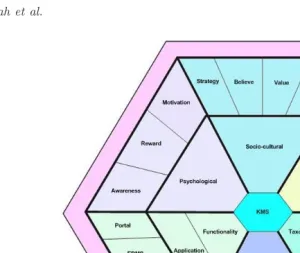
The proposed collaborative KMS framework for the LO implementation consists of six components. This includes KM functionality and system architecture as the backbone in order to support the whole KM portal
system. This is discussed in detail in Section 5.1.1. Section 5.1.2 describes the KMS infrastructure and tech-nology. Section 5.1.3 describes a KMS process model to categorise and process the forms of knowledge before this knowledge is deposited in KM repositories for future use as well as for archiving by the communities. Sec-tion 5.1.4 describes the psychological and sociocultural components necessary to create a collaborative environ-ment for the people who are using KMS in the LO. Finally, Section 5.1.5 describes the KMS audit compo-nent. This collaborative KMS framework is shown in Fig. 5.
5.1.1.
KMS functionality and architecture
The KMS functionality and architecture may include the following features. KMS architecture consists of four lay-ers: infrastructure layer, technology layer, protocol layer and repository layer. Each layer is a client that connects to the system in the server and accesses the knowledge repositories via LAN or WAN, whether in synchronous or asynchronous mode of collaboration among the commu-nities of practice. A KMS may be based on the Internet and extranet platform, as well as intranet infrastructure. The model of KMS network infrastructure is shown in Fig. 6.
The common areas of KMS functionality are: • Knowledge portal: It is a place where users will interact
with the system as a first point of entry. From here, users will do everything that they want in order to accomplish their task or mission.
• Electronic document management system: It serves as containers for important corporate information and explicit knowledge. Many organisations maintain a vast amount of data in these systems, and it is therefore crit-ical to have an effective system for managing these data so that the knowledge can be transferred to potential users.
• Information retrieval engine: It serves as an interface to a diverse set of knowledge silos, and plays a cen-tral role in setting up a KMS. A search engine features relevancy ranking, natural language querying and sum-marisation, which increase the speed and the precision of finding information.
• Data warehouses and data mining tools: Existing legacy databases in organisations contain vast amount of crucial data such as customer information, product data and sales statistics. KMS must provide mean-ingful access to these data warehouses. This is often done by SQL (structured query language) in conjunc-tion with protocols such as ODBC (open database connectivity).
J. Info. Know. Mgmt. 2005.04:237-245. Downloaded from www.worldscientific.com
Fig. 5. The proposed KMS framework for LO implementation.
Domain of KMS #1
Domain of KMS #2 Server/DB
Client
Client
Server/DB
Client
Client WAN/LAN
Fig. 6. The sample architecture of KMS.
5.1.2.
Knowledge management infrastructure
and technology
Since knowledge is stored throughout an organisation and is usually distributed on several different applications and platforms, various technologies are needed in order to retrieve the information and present it to the user. Given below are descriptions of the roles of specific technologies in a KMS environment.
• Intranets (workgroup): The web browser and the web server are the central technologies in KMS. Internet technology provides an easy and customisable interface to the organisations in different knowledge repositories through APIs and middle-ware.
• Groupware: This provides a medium for participants to communicate in a non-real-time manner. Examples are various discussion groups that exist on the Inter-net. This is an important technology for enhancing the exchange of information, and is a popular way of knowl-edge sharing.
• Agent technology: This is a software that monitors knowledge resources and alerts the user when new infor-mation is added or changed. Users can control the agent by specifying the type of knowledge that should be mon-itored. Agent software provides an interface for the user so that little knowledge about search algorithms are required to search for a particular knowledge asset
5.1.3.
The knowledge management taxonomy
and process model
Acquire knowledge. The following elements are adopted from a model by Arthur Andersen and APQC (1996) to acquire knowledge in a collaborative environment.
Processes: in order to make sure that the knowledge could be acquired from the right people, time and place, these steps are suggested:
• Identify knowledge: determine sources and type of knowledge.
• Collect knowledge: Gather and transform knowledge according to the specifications.
• Adapt knowledge: categorise the knowledge.
• Organise knowledge: prepare and map knowledge into the specific requirements.
• Store knowledge: keep and index the knowledge dynamically.
Store knowledge. This is a process in which the knowl-edge is kept in repositories. These can be in the form of
J. Info. Know. Mgmt. 2005.04:237-245. Downloaded from www.worldscientific.com
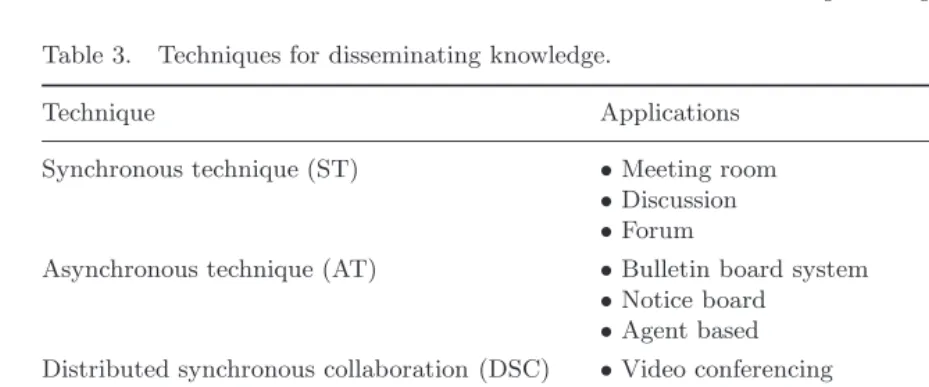
Table 3. Techniques for disseminating knowledge.
Technique Applications Mode of involvement
Synchronous technique (ST) •Meeting room Same time, same place
•Discussion •Forum
Asynchronous technique (AT) •Bulletin board system Different time, same place •Notice board
•Agent based
Distributed synchronous collaboration (DSC) •Video conferencing Same time, different place •Tele-conferencing
•Chatting
Distributed asynchronous collaboration (DAC) •E-mail Different time, different place •Short messaging system (SMS)
•Voice mail •Fax machine •Agent based
Fig. 7. Knowledge, processes and enablers in KM.
documents that are organised and categorised to enable future browsing or speedy access to knowledge.
Disseminate knowledge. The KMS can disseminate knowledge in a collaborative environment in four ways, depending on whether the communication method is syn-chronous, asynchronous or a combination of both. These techniques, either in real time or batch, are shown in Table 3.
Use.In the process of use, knowledge generated by KMS in a collaborative environment will be used by the stake-holders for problem solving, decision making and learning. The relationship of the knowledge, processes and enablers in KM of the LO is shown in Fig. 7.
5.1.4.
Knowledge management system soft issues
There are underlying psychological and cultural issues that are critical in creating an effective collaborative envi-ronment. They influence the development and implemen-tation of a KMS or any technology-based solutions for a
LO (Fennessy, 2002). These issues include roles, values, norms and experiences of the knowledge workers:
• Roles: To carry out a range of activities supporting evi-dence based on the organisation to improve decision making and the quality of the services.
• Norms: These differ according to the post and positions occupied by the groups represented in the team. Such norms when applied to evidence based on organisation services also differ depending on background and train-ing in the area.
• Values: These are intrinsically formed within the group as they interact continuously with the KMS as well as amongst them.
• Experiences: KMS may be a new concept to the partic-ipants; so they may be unable to articulate what they require from a KMS. The members may have extensive but varied experience in using a range of IT applications and may not be a comfortable with newer solutions such as a KMS.
5.1.5.
Knowledge management audit
This component is very important in order to maintain and ensure performance of a KMS is according to its speci-fication. The security and compatibility of the KMS is also critical to ensure the LO benefits from the KMS. KMS audit can also be used to benchmark the KMS to main-tain its quality and productivity, as well as to increase its return of investment.
6.
Conclusions
Technological opportunities to improve interaction and increase collaboration in organisation are expanding
J. Info. Know. Mgmt. 2005.04:237-245. Downloaded from www.worldscientific.com
rapidly. There are many benefits of a well-designed KMS. These include saving time and effort to acquire knowledge, so that all interested parties can use the organisation’s combined knowledge. Knowledge should be able to be used wherever and whenever it is needed. A KMS within a collaborative environment eliminates time-wasting ran-dom dissemination of knowledge just for the sake of possi-bility that it may be of interest to certain people. In order to be more beneficial to the LO (or any other organi-sation), knowledge as an organisational asset should be managed carefully.
There are four core features of a collaborative KMS that should be considered:
• Infrastructure, content and portal • Collaboration and learning
• Social capital, expertise and communities • Business intelligence and integration
However, LOs or organisations that pursue KM policies are more likely to succeed if they complement techno-logical aspects of KMS developments with strategies for a collaborative environment that allow people to work together at any time and any place. The encouragement of employee-run networks or communities of practice seems to be a successful strategy that provides both employees and the company with rewards from KMS within their workspace.
References
Alavi, M and D Leidner (1999). Knowledge management systems: Issues, challenges, and benefits. Communica-tion of AIS, 1, 1–37.
Anumba, CJ, OO Ugwu, L Newnham and A Thorpe (2001). A multi-agent system for distributed collabo-rative design. Journal of Logistics Information Man-agement, 14(5/6), 355–366.
Arthur Andersen and APQC (1996). The KM Assessment Tools: External Benchmarking Version. Winter. Bostrom, RP, RT Watson and S Kinney (1992).
Com-puterized collaborative work support at the University of Georgia. In Computer Augmented Teamwork: A Guided Tour, RP Bostrom, RT Watson and
S Kinney (eds.), pp. 251–257. New York: Van Nostrand Reinhold.
Chih-Ping, W, H Jen-Hwa and C Hung-Huang (2002). Design and evaluation of a knowledge management sys-tem.Software Journal, 19(3), 56–59.
Choo, CW (1996). The Knowing Organization: How Organizations use Information to Construct Mean-ing, Create Knowledge, and Make Decisions. Oxford University Press.
Davenport, TH and L Prusak (1998). Working Knowl-edge: How Organizations Manage What They Know. Boston, MA: Harvard Business School Press.
Fennessy, G (2002). Understanding and selecting knowl-edge management systems for a health information provider. In Proceedings of the 35th Hawaii Interna-tional Conference on System Sciences, IEEE.
Lotus Company (2002). www.lotus.com.
Leonard-Barton, D (1995). The Wellsprings of Knowl-edge. Cambridge, MA: Harvard Business School Press. McKinsey (1998). Best practice and beyond: Knowledge
strategies.The McKinsey Quarterly, (1), 19–25. Meso, P and R Smith (2000). A resources-based view of
organisational knowledge management systems. Jour-nal of Knowledge Management, 4(3), 224–234.
Nonaka, I and H Takeuchi (1995). The Knowledge-Creating Company. New York: Oxford University Press.
O’Leary, DE (1998). Enterprise knowledge management.
IEEE Computer, 31(3), 54–61.
Polanyi, M (1966). The Tacit Dimension. London, UK: Routledge and Kegan Paul.
Szulanski, G (1996). Exploring internal stickiness: Imped-iments to the transfer of best practice within the firm.
Strategic Management Journal, 17 (Winter), 27–43. Van der Spek, R and A Spijkervet (1997). Knowledge
management: Dealing intelligently with knowledge. In
Knowledge Management and Its Integrative Elements, J Liebowitz and L Wilcox (eds.). New York: CRC Press.
Wiig, KM (1997). Roles of knowledge-based systems in support of knowledge management. In Knowledge Management and its Integrative Elements, J Liebowitz and LC Wilcox (eds.), pp. 69–87. New York: CRC Press.
Rusli Abdullahis a lecturer in the Information System Department, Computer Science and Information Technol-ogy Faculty at Universiti Putra Malaysia. He holds B.Sc., M.Sc. degrees in computer science from Universiti Putra Malaysia. Currently, he is completing his Ph.D. in knowl-edge management at the Faculty of Computer Science and Information System at Universiti Teknologi Malaysia. His research interests include knowledge management,
computer supported collaboration of work and workflow management. He has also published and wrote books, arti-cles and technical papers in numerous journals.
Shamsul Shahibuddin is Associate Professor and
the Director in Computer Aided Software Engineer-ing at Universiti Teknologi Malaysia, Kuala Lumpur, Malaysia.
J. Info. Know. Mgmt. 2005.04:237-245. Downloaded from www.worldscientific.com
Rose Alinda Alias is Professor of Information Sys-tems Management at the Faculty of Computer Science and Information Systems, Universiti Teknologi Malaysia, where she held the position of Deputy Dean (Research & Graduate Studies) for 7 years. She is currently the Deputy Dean (Project Management & Finance) at the university’s Research Management Center. She obtained her Ph.D. from University of Salford, U.K., and M.B.A., M.Sc. and B.Sc. from the University of Miami, U.S.A.
Mohd Hasan Selamat is Associate Professor and The
Head Department in the Department of Information Sys-tems, Universiti Putra Malaysia. He holds an M.Sc. degree in computer science from Essex University and an M.Phil. in Information Systems from The University of East Anglia. His KM research interest includes knowledge shar-ing model, transformation of tacit to explicit knowledge and KM practices in service industry.
J. Info. Know. Mgmt. 2005.04:237-245. Downloaded from www.worldscientific.com