Upper limits on a stochastic gravitational-wave background using LIGO
and Virgo interferometers at 600–1000 Hz
J. Abadie,1,aB. P. Abbott,1,aR. Abbott,1,aT. D. Abbott,2,aM. Abernathy,3,aT. Accadia,4,bF. Acernese,5a,5c,bC. Adams,6,a R. Adhikari,1,aC. Affeldt,7,8,aM. Agathos,9a,bK. Agatsuma,10,aP. Ajith,1,aB. Allen,7,11,8,aE. Amador Ceron,11,a D. Amariutei,12,aS. B. Anderson,1,aW. G. Anderson,11,aK. Arai,1,aM. A. Arain,12,aM. C. Araya,1,aS. M. Aston,13,a P. Astone,14a,bD. Atkinson,15,aP. Aufmuth,8,7,aC. Aulbert,7,8,aB. E. Aylott,13,aS. Babak,16,aP. Baker,17,aG. Ballardin,18,b
S. Ballmer,19,aJ. C. B. Barayoga,1,aD. Barker,15,aF. Barone,5a,5c,bB. Barr,3,aL. Barsotti,20,aM. Barsuglia,21,b M. A. Barton,15,aI. Bartos,22,aR. Bassiri,3,aM. Bastarrika,3,aA. Basti,23a,23b,bJ. Batch,15,aJ. Bauchrowitz,7,8,a Th. S. Bauer,9a,bM. Bebronne,4,bD. Beck,24,aB. Behnke,16,aM. Bejger,25c,bM. G. Beker,9a,bA. S. Bell,3,aA. Belletoile,4,b
I. Belopolski,22,aM. Benacquista,26,aJ. M. Berliner,15,aA. Bertolini,7,8,aJ. Betzwieser,1,aN. Beveridge,3,a P. T. Beyersdorf,27,aI. A. Bilenko,28,aG. Billingsley,1,aJ. Birch,6,aR. Biswas,26,aM. Bitossi,23a,bM. A. Bizouard,29a,b E. Black,1,aJ. K. Blackburn,1,aL. Blackburn,30,aD. Blair,31,aB. Bland,15,aM. Blom,9a,bO. Bock,7,8,aT. P. Bodiya,20,a C. Bogan,7,8,aR. Bondarescu,32,aF. Bondu,33b,bL. Bonelli,23a,23b,bR. Bonnand,34,bR. Bork,1,aM. Born,7,8,aV. Boschi,23a,b
S. Bose,35,aL. Bosi,36a,bB. Bouhou,21,bS. Braccini,23a,bC. Bradaschia,23a,bP. R. Brady,11,aV. B. Braginsky,28,a M. Branchesi,37a,37b,bJ. E. Brau,38,aJ. Breyer,7,8,aT. Briant,39,bD. O. Bridges,6,aA. Brillet,33a,bM. Brinkmann,7,8,a V. Brisson,29a,bM. Britzger,7,8,aA. F. Brooks,1,aD. A. Brown,19,aT. Bulik,25b,bH. J. Bulten,9a,9b,bA. Buonanno,40,a J. Burguet–Castell,41,aD. Buskulic,4,bC. Buy,21,bR. L. Byer,24,aL. Cadonati,42,aG. Cagnoli,37a,bE. Calloni,5a,5b,b J. B. Camp,30,aP. Campsie,3,aJ. Cannizzo,30,aK. Cannon,43,aB. Canuel,18,bJ. Cao,44,aC. D. Capano,19,aF. Carbognani,18,b L. Carbone,13,aS. Caride,45,aS. Caudill,46,aM. Cavaglia`,47,aF. Cavalier,29a,bR. Cavalieri,18,bG. Cella,23a,bC. Cepeda,1,a
E. Cesarini,37b,bO. Chaibi,33a,bT. Chalermsongsak,1,aP. Charlton,48,aE. Chassande-Mottin,21,bS. Chelkowski,13,a W. Chen,44,aX. Chen,31,aY. Chen,49,aA. Chincarini,50,bA. Chiummo,18,bH. S. Cho,51,aJ. Chow,52,aN. Christensen,53,a S. S. Y. Chua,52,aC. T. Y. Chung,54,aS. Chung,31,aG. Ciani,12,aF. Clara,15,aD. E. Clark,24,aJ. Clark,55,aJ. H. Clayton,11,a F. Cleva,33a,bE. Coccia,56a,56b,bP.-F. Cohadon,39,bC. N. Colacino,23a,23b,bJ. Colas,18,bA. Colla,14a,14b,bM. Colombini,14b,b A. Conte,14a,14b,bR. Conte,57,aD. Cook,15,aT. R. Corbitt,20,aM. Cordier,27,aN. Cornish,17,aA. Corsi,1,aC. A. Costa,46,a M. Coughlin,53,aJ.-P. Coulon,33a,bP. Couvares,19,aD. M. Coward,31,aM. Cowart,6,aD. C. Coyne,1,aJ. D. E. Creighton,11,a
T. D. Creighton,26,aA. M. Cruise,13,aA. Cumming,3,aL. Cunningham,3,aE. Cuoco,18,bR. M. Cutler,13,aK. Dahl,7,8,a S. L. Danilishin,28,aR. Dannenberg,1,aS. D’Antonio,56a,bK. Danzmann,7,8,aV. Dattilo,18,bB. Daudert,1,aH. Daveloza,26,a
M. Davier,29a,bE. J. Daw,58,aR. Day,18,bT. Dayanga,35,aR. De Rosa,5a,5b,bD. DeBra,24,aG. Debreczeni,59,b W. Del Pozzo,9a,bM. del Prete,60b,bT. Dent,55,aV. Dergachev,1,aR. DeRosa,46,aR. DeSalvo,1,aS. Dhurandhar,61,a L. Di Fiore,5a,bA. Di Lieto,23a,23b,bI. Di Palma,7,8,aM. Di Paolo Emilio,56a,56c,bA. Di Virgilio,23a,bM. Dı´az,26,aA. Dietz,4,b
F. Donovan,20,aK. L. Dooley,12,aM. Drago,60a,60b,bR. W. P. Drever,62,aJ. C. Driggers,1,aZ. Du,44,aJ.-C. Dumas,31,a S. Dwyer,20,aT. Eberle,7,8,aM. Edgar,3,aM. Edwards,55,aA. Effler,46,aP. Ehrens,1,aG. Endro˝czi,59,bR. Engel,1,aT. Etzel,1,a
K. Evans,3,aM. Evans,20,aT. Evans,6,aM. Factourovich,22,aV. Fafone,56a,56b,bS. Fairhurst,55,aY. Fan,31,aB. F. Farr,63,a D. Fazi,63,aH. Fehrmann,7,8,aD. Feldbaum,12,aF. Feroz,64,aI. Ferrante,23a,23b,bF. Fidecaro,23a,23b,bL. S. Finn,32,a I. Fiori,18,bR. P. Fisher,32,aR. Flaminio,34,bM. Flanigan,15,aS. Foley,20,aE. Forsi,6,aL. A. Forte,5a,bN. Fotopoulos,1,a J.-D. Fournier,33a,bJ. Franc,34,bS. Frasca,14a,14b,bF. Frasconi,23a,bM. Frede,7,8,aM. Frei,65,66,aZ. Frei,67,aA. Freise,13,a R. Frey,38,aT. T. Fricke,46,aD. Friedrich,7,8,aP. Fritschel,20,aV. V. Frolov,6,aM.-K. Fujimoto,10,aP. J. Fulda,13,aM. Fyffe,6,a
J. Gair,64,aM. Galimberti,34,bL. Gammaitoni,36a,36b,bJ. Garcia,15,aF. Garufi,5a,5b,bM. E. Ga´spa´r,59,bG. Gemme,50,b R. Geng,44,aE. Genin,18,bA. Gennai,23a,bL. A´ . Gergely,68,aS. Ghosh,35,aJ. A. Giaime,46,6,aS. Giampanis,11,a K. D. Giardina,6,aA. Giazotto,23a,bS. Gil-Casanova,41,aC. Gill,3,aJ. Gleason,12,aE. Goetz,7,8,aL. M. Goggin,11,a G. Gonza´lez,46,aM. L. Gorodetsky,28,aS. Goßler,7,8,aR. Gouaty,4,bC. Graef,7,8,aP. B. Graff,64,aM. Granata,21,bA. Grant,3,a
S. Gras,31,aC. Gray,15,aN. Gray,3,aR. J. S. Greenhalgh,69,aA. M. Gretarsson,70,aC. Greverie,33a,bR. Grosso,26,a H. Grote,7,8,aS. Grunewald,16,aG. M. Guidi,37a,37b,bC.. Guido,6,aR. Gupta,61,aE. K. Gustafson,1,aR. Gustafson,45,a T. Ha,71,aJ. M. Hallam,13,aD. Hammer,11,aG. Hammond,3,aJ. Hanks,15,aC. Hanna,1,72,aJ. Hanson,6,aJ. Harms,62,a G. M. Harry,20,aI. W. Harry,55,aE. D. Harstad,38,aM. T. Hartman,12,aK. Haughian,3,aK. Hayama,10,aJ.-F. Hayau,33b,b
J. Heefner,1,aA. Heidmann,39,bM. C. Heintze,12,aH. Heitmann,33a,bP. Hello,29a,bM. A. Hendry,3,aI. S. Heng,3,a A. W. Heptonstall,1,aV. Herrera,24,aM. Hewitson,7,8,aS. Hild,3,aD. Hoak,42,aK. A. Hodge,1,aK. Holt,6,aM. Holtrop,73,a
T. Hong,49,aS. Hooper,31,aD. J. Hosken,74,aJ. Hough,3,aE. J. Howell,31,aB. Hughey,11,aS. Husa,41,aS. H. Huttner,3,a T. Huynh-Dinh,6,aD. R. Ingram,15,aR. Inta,52,aT. Isogai,53,aA. Ivanov,1,aK. Izumi,10,aM. Jacobson,1,aE. James,1,a
P. Kalmus,1,aV. Kalogera,63,aS. Kandhasamy,76,aG. Kang,77,aJ. B. Kanner,40,aR. Kasturi,78,aE. Katsavounidis,20,a W. Katzman,6,aH. Kaufer,7,8,aK. Kawabe,15,aS. Kawamura,10,aF. Kawazoe,7,8,aD. Kelley,19,aW. Kells,1,aD. G. Keppel,1,a
Z. Keresztes,68,aA. Khalaidovski,7,8,aF. Y. Khalili,28,aE. A. Khazanov,79,aB. K. Kim,77,aC. Kim,80,aH. Kim,7,8,a K. Kim,81,aN. Kim,24,aY. M. Kim,51,aP. J. King,1,aD. L. Kinzel,6,aJ. S. Kissel,20,aS. Klimenko,12,aK. Kokeyama,13,a
V. Kondrashov,1,aS. Koranda,11,aW. Z. Korth,1,aI. Kowalska,25b,bD. Kozak,1,aO. Kranz,7,8,aV. Kringel,7,8,a S. Krishnamurthy,63,aB. Krishnan,16,aA. Kro´lak,25a,25e,bG. Kuehn,7,8,aR. Kumar,3,aP. Kwee,8,7,aP. K. Lam,52,a M. Landry,15,aB. Lantz,24,aN. Lastzka,7,8,aC. Lawrie,3,aA. Lazzarini,1,aP. Leaci,16,aC. H. Lee,51,aH. K. Lee,81,a H. M. Lee,82,aJ. R. Leong,7,8,aI. Leonor,38,aN. Leroy,29a,bN. Letendre,4,bJ. Li,44,aT. G. F. Li,9a,bN. Liguori,60a,60b,b
P. E. Lindquist,1,aY. Liu,44,aZ. Liu,12,aN. A. Lockerbie,83,aD. Lodhia,13,aM. Lorenzini,37a,bV. Loriette,29b,b M. Lormand,6,aG. Losurdo,37a,bJ. Lough,19,aJ. Luan,49,aM. Lubinski,15,aH. Lu¨ck,7,8,aA. P. Lundgren,32,a E. Macdonald,3,aB. Machenschalk,7,8,aM. MacInnis,20,aD. M. Macleod,55,aM. Mageswaran,1,aK. Mailand,1,a E. Majorana,14a,bI. Maksimovic,29b,bN. Man,33a,bI. Mandel,20,aV. Mandic,76,aM. Mantovani,23a,23c,bA. Marandi,24,a
F. Marchesoni,36a,bF. Marion,4,bS. Ma´rka,22,aZ. Ma´rka,22,aA. Markosyan,24,aE. Maros,1,aJ. Marque,18,b F. Martelli,37a,37b,bI. W. Martin,3,aR. M. Martin,12,aJ. N. Marx,1,aK. Mason,20,aA. Masserot,4,bF. Matichard,20,a
L. Matone,22,aR. A. Matzner,65,aN. Mavalvala,20,aG. Mazzolo,7,8,aR. McCarthy,15,aD. E. McClelland,52,a S. C. McGuire,84,aG. McIntyre,1,aJ. McIver,42,aD. J. A. McKechan,55,aS. McWilliams,22,aG. D. Meadors,45,a M. Mehmet,7,8,aT. Meier,8,7,aA. Melatos,54,aA. C. Melissinos,85,aG. Mendell,15,aR. A. Mercer,11,aS. Meshkov,1,a
C. Messenger,55,aM. S. Meyer,6,aH. Miao,49,aC. Michel,34,bL. Milano,5a,5b,bJ. Miller,52,aY. Minenkov,56a,b V. P. Mitrofanov,28,aG. Mitselmakher,12,aR. Mittleman,20,aO. Miyakawa,10,aB. Moe,11,aM. Mohan,18,bS. D. Mohanty,26,a
S. R. P. Mohapatra,42,aD. Moraru,15,aG. Moreno,15,aN. Morgado,34,bA. Morgia,56a,56b,bT. Mori,10,aS. R. Morriss,26,a S. Mosca,5a,5b,bK. Mossavi,7,8,aB. Mours,4,bC. M. Mow–Lowry,52,aC. L. Mueller,12,aG. Mueller,12,aS. Mukherjee,26,a
A. Mullavey,52,aH. Mu¨ller-Ebhardt,7,8,aJ. Munch,74,aD. Murphy,22,aP. G. Murray,3,aA. Mytidis,12,aT. Nash,1,a L. Naticchioni,14a,14b,bV. Necula,12,aJ. Nelson,3,aI. Neri,3,bG. Newton,3,aT. Nguyen,52,aA. Nishizawa,10,aA. Nitz,19,a F. Nocera,18,bD. Nolting,6,aM. E. Normandin,26,aL. Nuttall,55,aE. Ochsner,40,aJ. O’Dell,69,aE. Oelker,20,aG. H. Ogin,1,a
J. J. Oh,71,aS. H. Oh,71,aB. O’Reilly,6,aR. O’Shaughnessy,11,aC. Osthelder,1,aC. D. Ott,49,aD. J. Ottaway,74,a R. S. Ottens,12,aH. Overmier,6,aB. J. Owen,32,aA. Page,13,aG. Pagliaroli,56a,56c,bL. Palladino,56a,56c,bC. Palomba,14a,b Y. Pan,40,aC. Pankow,12,aF. Paoletti,23a,18,bM. A. Papa,16,11,aM. Parisi,5a,5b,bA. Pasqualetti,18,bR. Passaquieti,23a,23b,b D. Passuello,23a,bP. Patel,1,aM. Pedraza,1,aP. Peiris,66,aL. Pekowsky,19,aS. Penn,78,aA. Perreca,19,aG. Persichetti,5a,5b,b
M. Phelps,1,aM. Pichot,1,bM. Pickenpack,7,8,aF. Piergiovanni,37a,37b,bM. Pietka,25d,bL. Pinard,34,bI. M. Pinto,86,a M. Pitkin,3,aH. J. Pletsch,7,8,aM. V. Plissi,3,aR. Poggiani,23a,23b,bJ. Po¨ld,7,8,aF. Postiglione,57,aM. Prato,50,bV. Predoi,55,a
T. Prestegard,76,aL. R. Price,1,aM. Prijatelj,7,8,aM. Principe,86,aS. Privitera,1,aR. Prix,7,8,aG. A. Prodi,60a,60b,b L. G. Prokhorov,28,aO. Puncken,7,8,aM. Punturo,36a,bP. Puppo,14a,bV. Quetschke,26,aR. Quitzow-James,38,aF. J. Raab,15,a
D. S. Rabeling,9a,9b,bI. Ra´cz,59,bH. Radkins,15,aP. Raffai,67,aM. Rakhmanov,26,aB. Rankins,47,aP. Rapagnani,14a,14b,b V. Raymond,63,aV. Re,56a,56b,bK. Redwine,22,aC. M. Reed,15,aT. Reed,87,aT. Regimbau,33a,bS. Reid,3,aD. H. Reitze,12,a
F. Ricci,14a,14b,bR. Riesen,6,aK. Riles,45,aN. A. Robertson,1,3,aF. Robinet,29a,bC. Robinson,55,aE. L. Robinson,16,a A. Rocchi,56a,bS. Roddy,6,aC. Rodriguez,63,aM. Rodruck,15,aL. Rolland,4,bJ. G. Rollins,1,aJ. D. Romano,26,a R. Romano,5a,5c,bJ. H. Romie,6,aD. Rosin´ska,25c,25f,bC. Ro¨ver,7,8,aS. Rowan,3,aA. Ru¨diger,7,8,aP. Ruggi,18,bK. Ryan,15,a
P. Sainathan,12,aF. Salemi,7,8,aL. Sammut,54,aV. Sandberg,15,aV. Sannibale,1,aL. Santamarı´a,1,aI. Santiago-Prieto,3,a G. Santostasi,88,aB. Sassolas,34,bB. S. Sathyaprakash,55,aS. Sato,10,aP. R. Saulson,19,aR. L. Savage,15,aR. Schilling,7,8,a
R. Schnabel,7,8,aR. M. S. Schofield,38,aE. Schreiber,7,8,aB. Schulz,7,8,aB. F. Schutz,16,55,aP. Schwinberg,15,aJ. Scott,3,a S. M. Scott,52,aF. Seifert,1,aD. Sellers,6,aD. Sentenac,18,bA. Sergeev,79,aD. A. Shaddock,52,aM. Shaltev,7,8,a B. Shapiro,20,aP. Shawhan,40,aD. H. Shoemaker,20,aA. Sibley,6,aX. Siemens,11,aD. Sigg,15,aA. Singer,1,aL. Singer,1,a
A. M. Sintes,41,aG. R. Skelton,11,aB. J. J. Slagmolen,52,aJ. Slutsky,46,aJ. R. Smith,2,aM. R. Smith,1,aR. J. E. Smith,13,a N. D. Smith-Lefebvre,15,aK. Somiya,49,aB. Sorazu,3,aJ. Soto,20,aF. C. Speirits,3,aL. Sperandio,56a,56b,bM. Stefszky,52,a
A. J. Stein,20,aL. C. Stein,20,aE. Steinert,15,aJ. Steinlechner,7,8,aS. Steinlechner,7,8,aS. Steplewski,35,aA. Stochino,1,a R. Stone,26,aK. A. Strain,3,aS. E. Strigin,28,aA. S. Stroeer,26,aR. Sturani,37a,37b,bA. L. Stuver,6,aT. Z. Summerscales,89,a
M. Sung,46,aS. Susmithan,31,aP. J. Sutton,55,aB. Swinkels,18,bM. Tacca,18,bL. Taffarello,60c,bD. Talukder,35,a D. B. Tanner,12,aS. P. Tarabrin,7,8,aJ. R. Taylor,7,8,aR. Taylor,1,aP. Thomas,15,aK. A. Thorne,6,aK. S. Thorne,49,a
E. Thrane,76,aA. Thu¨ring,8,7,aK. V. Tokmakov,83,aC. Tomlinson,58,aA. Toncelli,23a,23b,bM. Tonelli,23a,23b,b O. Torre,23a,23c,bC. Torres,6,aC. I. Torrie,1,3,aE. Tournefier,4,bF. Travasso,36a,36b,bG. Traylor,6,aK. Tseng,24,a
S. van der Putten,9a,bA. A. van Veggel,3,aS. Vass,1,aM. Vasuth,59,bR. Vaulin,20,aM. Vavoulidis,29a,bA. Vecchio,13,a G. Vedovato,60c,bJ. Veitch,55,aP. J. Veitch,74,aC. Veltkamp,7,8,aD. Verkindt,4,bF. Vetrano,37a,37b,bA. Vicere´,37a,37b,b A. E. Villar,1,aJ.-Y. Vinet,33a,bS. Vitale,9a,bH. Vocca,36a,bC. Vorvick,15,aS. P. Vyatchanin,28,aA. Wade,52,aL. Wade,11,a
M. Wade,11,aS. J. Waldman,20,aL. Wallace,1,aY. Wan,44,aM. Wang,13,aX. Wang,44,aZ. Wang,44,aA. Wanner,7,8,a R. L. Ward,21,bM. Was,29a,bM. Weinert,7,8,aA. J. Weinstein,1,aR. Weiss,20,aL. Wen,49,31,aP. Wessels,7,8,aM. West,19,a T. Westphal,7,8,aK. Wette,7,8,aJ. T. Whelan,66,aS. E. Whitcomb,1,31,aD. J. White,58,aB. F. Whiting,12,aC. Wilkinson,15,a
P. A. Willems,1,aL. Williams,12,aR. Williams,1,aB. Willke,7,8,aL. Winkelmann,7,8,aW. Winkler,7,8,aC. C. Wipf,20,a A. G. Wiseman,11,aH. Wittel,7,8,aG. Woan,3,aR. Wooley,6,aJ. Worden,15,aI. Yakushin,6,aH. Yamamoto,1,a K. Yamamoto,7,8,60b,60d,a,bC. C. Yancey,40,aH. Yang,49,aD. Yeaton-Massey,1,aS. Yoshida,91,aP. Yu,11,aM. Yvert,4,b A. Zadroz´ny,25e,bM. Zanolin,70,aJ.-P. Zendri,60c,bF. Zhang,44,aL. Zhang,1,aW. Zhang,44,aC. Zhao,31,aN. Zotov,87,a
M. E. Zucker,20,aand J. Zweizig1,a
(aLIGO Scientific Collaboration) (bVirgo Collaboration)
1LIGO-California Institute of Technology, Pasadena, California 91125, USA
2California State University Fullerton, Fullerton California 92831 USA
3SUPA, University of Glasgow, Glasgow, G12 8QQ, United Kingdom
4Laboratoire d’Annecy-le-Vieux de Physique des Particules (LAPP), Universite´ de Savoie,
CNRS/IN2P3, F-74941 Annecy-Le-Vieux, France 5a
INFN, Sezione di Napoli, Italy 5bUniversita` di Napoli ’Federico II’, Italy
5cComplesso Universitario di Monte S. Angelo, I-80126 Napoli and Universita` di Salerno, Fisciano, I-84084 Salerno, Italy
6LIGO-Livingston Observatory, Livingston, Louisiana 70754, USA
7Albert-Einstein-Institut, Max-Planck-Institut fu¨r Gravitationsphysik, D-30167 Hannover, Germany
8Leibniz Universita¨t Hannover, D-30167 Hannover, Germany
9aNikhef, Science Park, Amsterdam, the Netherlands
9bVU University Amsterdam, De Boelelaan 1081, 1081 HV Amsterdam, the Netherlands
10National Astronomical Observatory of Japan, Tokyo 181-8588, Japan
11
University of Wisconsin-Milwaukee, Milwaukee, Wisconsin 53201, USA 12University of Florida, Gainesville, Florida 32611, USA
13University of Birmingham, Birmingham, B15 2TT, United Kingdom
14aINFN, Sezione di Roma, I-00185 Roma, Italy
14bUniversita` ’La Sapienza’, I-00185 Roma, Italy
15LIGO-Hanford Observatory, Richland, Washington 99352, USA
16Albert-Einstein-Institut, Max-Planck-Institut fu¨r Gravitationsphysik, D-14476 Golm, Germany
17Montana State University, Bozeman, Montana 59717, USA
18European Gravitational Observatory (EGO), I-56021 Cascina (PI), Italy
19Syracuse University, Syracuse, New York 13244, USA
20LIGO-Massachusetts Institute of Technology, Cambridge, Massachusetts 02139, USA
21Laboratoire AstroParticule et Cosmologie (APC) Universite´ Paris Diderot, CNRS: IN2P3, CEA: DSM/IRFU,
Observatoire de Paris, 10 rue A. Domon et L. Duquet, 75013 Paris-France 22Columbia University, New York, New York 10027, USA
23aINFN, Sezione di Pisa, I-56127 Pisa, Italy
23bUniversita` di Pisa, I-56127 Pisa, Italy
23c
Universita` di Siena, I-53100 Siena, Italy 24Stanford University, Stanford, California 94305, USA
25aIM-PAN, 00-956 Warsaw, Poland
25bAstronomical Observatory Warsaw University, 00-478 Warsaw, Poland
25cCAMK-PAN, 00-716 Warsaw, Poland
25dBiałystok University, 15-424 Białystok, Poland
25eIPJ, 05-400 S´wierk-Otwock, Poland
25fInstitute of Astronomy, 65-265 Zielona Go´ra, Poland
26The University of Texas at Brownsville and Texas Southmost College, Brownsville, Texas 78520, USA
27
San Jose State University, San Jose, California 95192, USA 28Moscow State University, Moscow, 119992, Russia
29aLAL, Universite´ Paris-Sud, IN2P3/CNRS, F-91898 Orsay, France
30NASA/Goddard Space Flight Center, Greenbelt, Maryland 20771, USA
31University of Western Australia, Crawley, WA 6009, Australia
32The Pennsylvania State University, University Park, Pennsylvania 16802, USA
33aUniversite´ Nice-Sophia-Antipolis, CNRS, Observatoire de la Coˆte d’Azur, F-06304 Nice, France
33bInstitut de Physique de Rennes, CNRS, Universite´ de Rennes 1, 35042 Rennes, France
34Laboratoire des Mate´riaux Avance´s (LMA), IN2P3/CNRS, F-69622 Villeurbanne, Lyon, France
35Washington State University, Pullman, Washington 99164, USA
36aINFN, Sezione di Perugia, I-06123 Perugia, Italy
36b
Universita` di Perugia, I-06123 Perugia, Italy 37aINFN, Sezione di Firenze, I-50019 Sesto Fiorentino, Italy
37bUniversita` degli Studi di Urbino ’Carlo Bo’, I-61029 Urbino, Italy
38University of Oregon, Eugene, Oregon 97403, USA
39Laboratoire Kastler Brossel, ENS, CNRS, UPMC, Universite´ Pierre et Marie Curie, 4 Place Jussieu, F-75005 Paris, France
40University of Maryland, College Park, Maryland 20742 USA
41Universitat de les Illes Balears, E-07122 Palma de Mallorca, Spain
42University of Massachusetts-Amherst, Amherst, Massachusetts 01003, USA
43Canadian Institute for Theoretical Astrophysics, University of Toronto, Toronto, Ontario, M5S 3H8, Canada
44Tsinghua University, Beijing 100084 China
45University of Michigan, Ann Arbor, Michigan 48109, USA
46Louisiana State University, Baton Rouge, Louisiana 70803, USA
47The University of Mississippi, University, Mississippi 38677, USA
48Charles Sturt University, Wagga Wagga, NSW 2678, Australia
49Caltech-CaRT, Pasadena, California 91125, USA
50INFN, Sezione di Genova, I-16146 Genova, Italy
51
Pusan National University, Busan 609-735, Korea 52Australian National University, Canberra, ACT 0200, Australia
53Carleton College, Northfield, Minnesota 55057, USA
54The University of Melbourne, Parkville, VIC 3010, Australia
55Cardiff University, Cardiff, CF24 3AA, United Kingdom
56aINFN, Sezione di Roma Tor Vergata, Italy
56bUniversita` di Roma Tor Vergata, I-00133 Roma, Italy
56cUniversita` dell’Aquila, I-67100 L’Aquila, Italy
57University of Salerno, I-84084 Fisciano (Salerno), Italy and INFN (Sezione di Napoli), Italy
58The University of Sheffield, Sheffield S10 2TN, United Kingdom
59RMKI, H-1121 Budapest, Konkoly Thege Miklo´s u´t 29-33, Hungary
60aINFN, Gruppo Collegato di Trento, I-38050 Povo, Trento, Italy
60bUniversita` di Trento, I-38050 Povo, Trento, Italy
60cINFN, Sezione di Padova, I-35131 Padova, Italy
60dUniversita` di Padova, I-35131 Padova, Italy
61Inter-University Centre for Astronomy and Astrophysics, Pune-411007, India
62California Institute of Technology, Pasadena, California 91125, USA
63Northwestern University, Evanston, Illinois 60208, USA
64University of Cambridge, Cambridge, CB2 1TN, United Kingdom
65The University of Texas at Austin, Austin, Texas 78712, USA
66Rochester Institute of Technology, Rochester, New York 14623, USA
67Eo¨tvo¨s Lora´nd University, Budapest, 1117 Hungary
68University of Szeged, 6720 Szeged, Do´m te´r 9, Hungary
69
Rutherford Appleton Laboratory, HSIC, Chilton, Didcot, Oxon OX11 0QX United Kingdom 70Embry-Riddle Aeronautical University, Prescott, Arizona 86301 USA
71National Institute for Mathematical Sciences, Daejeon 305-390, Korea
72Perimeter Institute for Theoretical Physics, Ontario, N2L 2Y5, Canada
73University of New Hampshire, Durham, New Hampshire 03824, USA
74University of Adelaide, Adelaide, SA 5005, Australia
75University of Southampton, Southampton, SO17 1BJ, United Kingdom
76University of Minnesota, Minneapolis, Minnesota 55455, USA
77Korea Institute of Science and Technology Information, Daejeon 305-806, Korea
78
Hobart and William Smith Colleges, Geneva, New York 14456, USA 79Institute of Applied Physics, Nizhny Novgorod, 603950, Russia
80Lund Observatory, Box 43, SE-221 00, Lund, Sweden
81Hanyang University, Seoul 133-791, Korea
83University of Strathclyde, Glasgow, G1 1XQ, United Kingdom
84Southern University and A&M College, Baton Rouge, Louisiana 70813, USA
85University of Rochester, Rochester, New York 14627, USA
86University of Sannio at Benevento, I-82100 Benevento, Italy and INFN (Sezione di Napoli), Italy
87Louisiana Tech University, Ruston, Louisiana 71272, USA
88McNeese State University, Lake Charles, Louisiana 70609 USA
89Andrews University, Berrien Springs, Michigan 49104 USA
90Trinity University, San Antonio, Texas 78212, USA
91
Southeastern Louisiana University, Hammond, Louisiana 70402, USA
(Received 29 January 2012; published 4 June 2012)
A stochastic background of gravitational waves is expected to arise from a superposition of many incoherent sources of gravitational waves, of either cosmological or astrophysical origin. This background is a target for the current generation of ground-based detectors. In this article we present the first joint search for a stochastic background using data from the LIGO and Virgo interferometers. In a frequency band of 600–1000 Hz, we obtained a 95% upper limit on the amplitude ofGWðfÞ ¼3ðf=900 HzÞ3, of
3<0:32, assuming a value of the Hubble parameter ofh100¼0:71. These new limits are a factor of seven better than the previous best in this frequency band.
DOI:10.1103/PhysRevD.85.122001 PACS numbers: 95.85.Sz, 04.30.Db, 04.80.Nn, 07.05.Kf
I. INTRODUCTION
A major science goal of current and future generations of gravitational-wave detectors is the detection of a sto-chastic gravitational-wave background (SGWB)—a super-position of unresolvable gravitational-wave signals of astrophysical and/or cosmological origin. An astrophysical background is expected to be comprised of signals origi-nating from astrophysical objects, for example, binary neutron stars [1], spinning neutron stars [2], magnetars [3], or core-collapse supernovae [4]. A cosmological back-ground is expected to be generated by various physical processes in the early universe [5] and, as gravitational waves are so weakly interacting, to be essentially unatte-nuated since then. We expect that gravitational waves would decouple much earlier than other radiation, so a cosmological background would carry the earliest infor-mation accessible about the very early universe [6]. There are various production mechanisms from which we might expect cosmological gravitational waves including cosmic strings [7], amplification of vacuum fluctuations following inflation [8,9], pre-Big-Bang models [10,11], or the elec-troweak phase transition [12].
Whatever the production mechanism of a SGWB, the signal is usually described in terms of the dimensionless quantity,
GWðfÞ ¼ f c
dGW
df ; (1)
wheredGWis the energy density of gravitational radiation contained in the frequency rangeftofþdfandcis the critical energy density of the universe [13]. As a SGWB signal is expected to be much smaller than current detector noise, and because we assume both the detector noise and the signal to be Gaussian random variables, it is not fea-sible to distinguish the two in a single interferometer. We must therefore search for the SGWB using two or more
the LIGO and Virgo interferometers, and in part to the fact that the Virgo sensitivity is closest to the LIGO sensitivity at these frequencies. The GEO600 interferometer was not included in this analysis as the strain sensitivity at these frequencies was insufficient to significantly improve the sensitivity of the search.
The structure of this paper is as follows. In Sec.II we describe the method used to analyze the data. In Sec.IIIwe present the results of the analysis of data from the LIGO and Virgo interferometers. We describe validation of the results using software injections in Sec.IV. In Sec.Vwe compare our results to those of previous experiments and in Sec.VIwe summarize our conclusions.
II. ANALYSIS METHOD
The output of an interferometer is assumed to be the sum of instrumental noise and a stochastic background signal,
sðtÞ ¼nðtÞ þhðtÞ: (2) The gravitational-wave signal has a power spectrum, SGWðfÞ, which is related toGWðfÞby [19]
SGWðfÞ ¼ 3H 2 0 102
GWðfÞ
f3 : (3) Our signal model is a power law spectrum,
GWðfÞ ¼
f fR
; (4)
whereis the spectral index, andfRa reference frequency, such that ¼GWðfRÞ. For this analysis we create a filter using a model which corresponds to a white strain amplitude spectrum and choose a reference frequency of 900 Hz, such that
GWðfÞ ¼3
f 900 Hz
3
: (5)
We choose this spectrum as it is expected that some as-trophysical backgrounds will have a risingGWðfÞ spec-trum in the frequency band we are investigating [2–4]. In fact, different models predict different values of the spec-tral index in our frequency band, so we quote upper limits for several values.
For a pair of detectors, with interferometers labeled byi and j, we calculate the cross-correlation statistic in the frequency domain
^
Y ¼Zþ1
1 dfYðfÞ
¼Zþ1
1 df
Zþ1
1 df
0
Tðff0Þ~s?iðfÞs~jðf0ÞQ~ijðf0Þ;
(6) where ~siðfÞ and ~sjðfÞ are the Fourier transforms of the strain time-series of two interferometers,Q~ijðfÞis a filter function, andTis a finite-time approximation to the Dirac delta function, [13]
TðfÞ:¼
ZT=2
T=2dte
i2ft ¼sinðfTÞ
f : (7) We assume the detector noise is Gaussian, stationary, un-correlated between the two interferometers and much larger than the signal. Under these assumptions, the vari-ance of the estimatorY^ is
2Y ¼
Zþ1
0 df
2 YðfÞ
T 2
Zþ1
0 dfPiðfÞPjðfÞ j ~ QijðfÞj2;
(8) where PiðfÞ is the one-sided power spectral density of interferometer i and T is the integration time. By max-imizing the expected signal-to-noise ratio (SNR) for a chosen model of GWðfÞ, we find the optimal filter function,
~
QijðfÞ ¼N
ijðfÞf3 fRPiðfÞPjðfÞ
; (9)
whereijðfÞis the overlap reduction function (ORF) of the two interferometers and N is a normalization factor. We choose the normalization such that the cross-correlation statistic is an estimator of , with expectation value hY^i ¼. It follows that the normalization is
N ¼fR2
T
10
2 3H02
Z1
0 df
f262ijðfÞ PiðfÞPjðfÞ
1
: (10)
Using this filter function and normalization gives an opti-mal SNR of [13]
SNR 3H20 102
ffiffiffiffiffiffi
2T
p Z1
0 df
2ijðfÞ2GWðfÞ f6PiðfÞPjðfÞ
1=2
: (11)
The ORF encodes the separation and orientations of the detectors and is defined as [13,20]
ijðfÞ:¼ 5 8
X
A
Z
S2d^e
i2f^~x=cFA
ið^ÞFjAð^Þ; (12)
where ^is a unit vector specifying a direction on the two-sphere,~x¼ ~xi ~xjis the separation of the two interfer-ometers and
FA
ið^Þ ¼eAabð^Þdabi (13) is the response of theith detector to the A¼ þ, polar-ization, whereeA
abare the transverse traceless polarization tensors. The geometry of each interferometer is described by a response tensor,
dab¼12ðx^ax^by^ay^bÞ; (14)
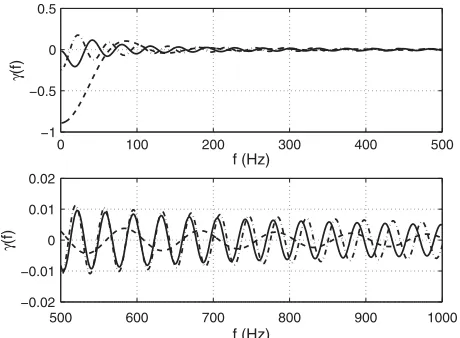
interferometers are oriented in such a way as to maximize the amplitude of the ORF at low frequency, while the relative orientations of the LIGO-Virgo pairs are poor. Thus at low frequency the amplitude of the ORF between the Hanford and Livingston interferometers, HLðfÞ, is larger than that of the overlap between Virgo and any of the LIGO interferometers,HVðfÞorLVðfÞ(note that the ‘‘HL’’ and ‘‘HV’’ overlap reduction functions hold for both H1 and H2 as they are collocated). However, at high frequency the ORF behaves as a sinc function of the frequency multiplied by the light-travel time between the interferometers. As the LIGO interferometers are closer to each other than to Virgo, their ORFHLðfÞoscillates less, but decays more rapidly with frequency than the the ORFs of the LIGO-Virgo pairs. Figure 1 shows the ORFs be-tween the LIGO-Hanford, LIGO-Livingston, and Virgo sites.
We define the ‘‘sensitivity integrand’’,IðfÞ, by inserting Eqs. (9) and (10) into Eq. (8), giving
2Y ¼Z1 0 IðfÞdf
1
¼fR2 8T
10
2 3H20
2Z1
0 df
2ijðfÞf26 PiðfÞPjðfÞ
1
: (15)
This demonstrates the contribution to the inverse of the variance at each frequency. The sensitivity of each pair is dependent on the noise power spectra of the two
interfer-ometers, as well as the observing geometry, described by ijðfÞ. For interferometers operating at design sensitivity, this means that for frequencies above200 Hzthe LIGO-Virgo pairs make the dominant contribution to the sensi-tivity [22]. During its first science run Virgo was closest to design sensitivity at frequencies above several hundred Hz, which informed our decision to use the 600–1000 Hz band. The procedure by which we analyzed the data is as follows. For each pair of interferometers, labeled by I, the coincident data were divided into segments, labeled byJ, of lengthT¼60 s. The data from each segment are Hann windowed in order to minimize spectral leakage. In order not to reduce the effective observation time, the segments are therefore overlapped by 50%. For each segment, the data from both interferometers were Fourier transformed then coarse-grained to a resolution of 0.25 Hz. The data from the adjacent segments were then used to calculate power spectral densities (PSDs) with Welch’s method. The Fourier transformed data and the PSDs were used to calculate the estimator on3,Y^IJ, and its standard deviation,IJ. For each pair, the results from all segments were optimally combined by performing a weighted aver-age (with weights1=2IJ), taking into account the correla-tions that were introduced by the overlapping segments [23]. The weighted average for each pair, Y^I, has an associated standard deviationI, also calculated by com-bining the standard deviations from each segment (note thatIis the equivalent ofY [from Eq. (8)] for each pair, I, but we have dropped the Y subscript to simplify the notation).
A. Data quality
Data quality cuts were made to eliminate data that was too noisy or nonstationary, or that had correlated noise between detectors. Time segments that were known to contain large noise transients in one interferometer were removed from the analysis. We also excluded times when the digitizers were saturated, times with particularly high noise, and times when the calibration was unreliable. This also involved excluding the last thirty seconds before the loss of lock in the interferometers, as they are known to have an increase in noise in this period. Additionally, we ensured that the data were approximately stationary over a period of three minutes, as the PSD estimates,PiðfÞ, used in calculating the optimal filter and standard deviation in each segment are obtained from data in the immediately adjacent segments. This was achieved by calculating a measure of stationarity,
IJ ¼
jIJ0IJj IJ
; (16)
for each segment, where IJ was calculated [following Eq. (8)] using the PSDs estimated from the adjacent seg-ments, and 0IJ was calculated using the PSDs estimated using data from the segment itself. To ensure stationarity,
0 100 200 300 400 500
−1 −0.5 0 0.5
f (Hz)
γ
(f)
500 600 700 800 900 1000
−0.02 −0.01 0 0.01 0.02
f (Hz)
γ
[image:7.612.60.290.404.573.2](f)
we set a threshold value,, and all segments with values of IJ> are discarded. The threshold was tuned by ana-lyzing the data with unphysical time offsets between the interferometers; a value of ¼0:1as this ensures that the remaining data are Gaussian.
In order to exclude correlations between the instruments caused by environmental factors we excluded certain fre-quencies from our analysis. The frequency bins to be removed were identified in two ways. Some correlations between the interferometers were known to exista priori, e.g. there are correlations at multiples of 60 Hz between the interferometers located in the USA due to the frequency of the power supply [19]. These were removed from the analysis, but in order to ensure that all coherent bins were identified, we also calculated the coherence,
ðfÞ ¼j~s?1ðfÞs~2ðfÞj2
P1ðfÞP2ðfÞ ; (17)
which is the ratio of the cross-spectrum to the product of the two power spectral densities, averaged over the whole run. This value was calculated first at a resolution of 0.1 Hz, then at 1 mHz to investigate in more detail the frequency distribution of the coherence. Several frequen-cies showed excess coherence; some had been identified
a prioribut two had not, so these were also removed from
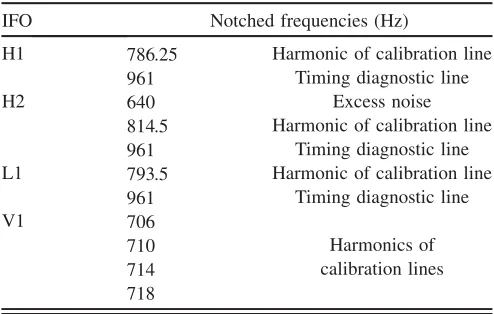
the analysis. The calculations of the power spectra and the cross correlation were carried out at a resolution of 0.25 Hz, so we removed the corresponding 0.25 Hz bin from our analysis. Excess coherence was defined as coher-ence exceeding a threshold of ðfÞ ¼5103. This threshold was also chosen after analyzing the data with unphysical time offsets. The excluded bins for each inter-ferometer can be seen in TableI.
B. Timing accuracy
In order to be sure that the cross correlation is a measure of the gravitational-wave signal present in both detectors in a pair, we must be sure that the data collected in both detectors are truly coincident. Calibration studies were carried out to determine the timing offset, if any, between the detectors and to estimate the error on this offset. These studies are described in more detail in Ref. [24], but we summarize them here.
The output of each interferometer is recorded at a rate of 16 384 Hz. Each data point has an associated time-stamp and we need to ensure that data taken with identical time-stamps are indeed coincident measurements of the strain, to within the calibration errors of the instruments. No offset between the instruments was identified, but several possible sources of timing error were investigated. First, approximations in our models of the interferome-ters can introduce phase errors. For the measurement of strain, we model the interferometers using the long-wavelength approximation (i.e. we assume that the wave-lengths of the gravitational waves that we measure are much longer than the arm-lengths of the interferome-ters). We also make an approximation in the transfer function of the Fabry-Perot cavity; the exact function has several poles or singularities, but we use an approxi-mation which includes only the lowest frequency pole [25]. The errors that these two approximations introduce largely cancel, with a residual error of2sor 1 at 1 kHz [24].
Second, there is some propagation time between strain manifesting in the detectors and the detector output being recorded in a frame file. This is well understood for all detectors and is accounted for (to within calibration errors) when the detector outputs are converted to strain. The time-stamp associated with each data point is therefore taken to be the GPS time at which the differential arm length occurs, to within calibration errors [24].
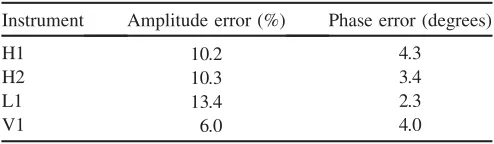
Third, the GPS time recorded at each site has some uncertainty. The timing precision of the GPS system is 30 ns, which corresponds with the stated location accu-racy of 10 m. Each site necessarily uses its own GPS receiver, so the relative accuracy of these receivers has been checked, by taking a Virgo GPS receiver to a LIGO site and comparing the outputs. The relative accuracy was found to be better than1 s. The receivers have also been checked against Network Time Protocol (NTP) and were found to have no offset [24]. The total error in GPS timing is far smaller than the instrumental phase calibration errors in the 600–1000 Hz frequency band (see TableII).
[image:8.612.51.298.559.716.2]These investigations concluded that the timing offset between the instruments is zero for all pairs, with errors on these values that are smaller than the error in the phase calibration of each instrument. The phase calibration errors of the instruments are negligible in this analysis as their inclusion would produce a smaller than 1% change in the TABLE I. Table of the frequency bins excluded from the
analysis for each interferometer. The bins at 640 Hz and 961 Hz were identified using coherence tests, while the others were excludeda priori. Also excluded were harmonics of the power line frequency at multiples of 60 Hz for the LIGO detectors and multiples of 50 Hz for Virgo. Each excluded bin is centered at the frequency listed above and has a width of 0.25 Hz.
IFO Notched frequencies (Hz)
H1 786.25 Harmonic of calibration line
961 Timing diagnostic line
H2 640 Excess noise
814.5 Harmonic of calibration line
961 Timing diagnostic line
L1 793.5 Harmonic of calibration line
961 Timing diagnostic line
V1 706
710 Harmonics of
714 calibration lines
results at this sensitivity, and therefore the relative timing error is negligible.
C. Combination of multiple pairs
We performed an analysis of all of the available data from LIGO’s fifth science run and Virgo’s first science run. However, we excluded the H1–H2 pair as the two instru-ments were built inside the same vacuum system, and so may have significant amounts of correlated noise. There is an ongoing investigation into identifying and removing these correlations [28], and for the present analysis, we consider only the five remaining pairs. As described above, the output of each pair yields an estimator,Y^I, with a standard deviation,I, whereI¼1 . . . 5labels the detector pair.
Using the estimatorsY^I and their associated error bars, I, we construct a Bayesian posterior probability density function (PDF) on3. Bayes theorem says that the poste-rior PDF of a set of unknown parameters, ~, given a set of data,D, is given by
pð~jDÞ ¼pð~ÞpðDj~Þ
pðDÞ ; (18)
wherepð~Þis the prior PDF on the unknown parameters— representing the state of knowledge before the experiment-pðDj~Þ is the likelihood function and pðDÞ is a normalization factor. In this case, the unknown pa-rameters, ~, are the value of3and the amplitude calibra-tion factors of the instruments, which will be discussed below. The data set,D, is the set of five estimators,fY^Ig, we obtain from the five pairs of instruments.
In forming this posterior, we must consider the errors in the calibration of the strain data obtained by the interfer-ometers. In the data from one interferometer, labeled byi, there may be an error on the calibration of both the ampli-tude and the phase, such that the value we measure is
~
siðfÞ ¼eiþii~stiðfÞ; (19)
where~stiðfÞis the ‘‘true’’ value that would be measured if the interferometer were perfectly calibrated. The phase calibration errors given in TableIIare negligible, and the studies described in Sec. II B have shown that there is no significant relative timing error between the
interferometers, so we can simply assume that i¼0. However, the amplitude calibration errors are not negligible, and the calibration factors take the valuesi¼ 0;i, where ;i are the fractional amplitude calibra-tion errors of the instruments, which are quoted in TableII. The calibration factors combine such that the estimator for a pairIis
^
YI¼eI;1þI;2Y^tI; (20)
where Y^tI is the true value that would be measured with perfectly calibrated instruments andI;1 andI;2 are the calibration factors of the two instruments in pair I. The likelihood function for a single estimator is given by
pðY^Ij3; I;IÞ ¼ 1 I
ffiffiffiffiffiffiffi
2
p expðY^IeI3Þ2 22I
;
(21)
where we have usedI ¼I;1þI;2. The joint likelihood function on all the data is the product over all pairs of Eq. (21)
pðfY^Igj3;fIg;fIgÞ ¼
Y
npairs
I¼1
pðY^Ij3; I;IÞ: (22)
In order to form a posterior PDF, we define priors on the calibration factors of the individual interferometers,fig. The calibration factors are assumed to be Gaussian distrib-uted, with variance given by the square of the calibration errors quoted in TableII, such that
pðfigjf;igÞ ¼
Y
nIFO
i¼1 1 ;i
ffiffiffiffiffiffiffi
2
p exp 2i 22;i
; (23)
wherenIFOis the number of interferometers we are using, in this case four. The prior on3 is a top hat function
pð3Þ ¼
8 < :
1
max for 0<max
0 otherwise : (24)
We choose a flat prior on 3 because, although there has been an analysis in this band previously, it did not include data from the whole of the frequency band and an unin-formative flat prior is conservative. We chosemax¼10, which is two orders of magnitude greater than the estima-tors and their standard deviations, such that the prior is essentially unconstrained.
We combine the prior and likelihood functions to give a posterior PDF
pð3;figjfY^Ig;fIg;f;igÞ
¼pð3Þpðfigjf;igÞpðfY^Igj3;fIg;fIgÞ: (25)
[image:9.612.51.298.95.167.2]We marginalize this posterior analytically over alli[36] to give us a posterior on3 alone,
TABLE II. Table of values of the errors in the calibration of amplitude and phase for each of the LIGO [26] and Virgo [27] instruments used in this analysis. The errors are valid over the whole 600–1000 Hz band.
Instrument Amplitude error (%) Phase error (degrees)
H1 10.2 4.3
H2 10.3 3.4
L1 13.4 2.3
pð3jfY^Ig;fIg;f;igÞ ¼
Z1
1d1
Z1
1d2. . .
Z1
1dnIFOpð3;figjf
^ YIg;
fIg;f;igÞ: (26)
Using this posterior PDF we calculate a 95% probability interval,ðlower;upperÞon3. We calculate the values of lower andupper by finding the minimum-width interval that satisfies
Zupper lower
pð3jfY^Ig;fIg;f;igÞd3 ¼0:95: (27)
If we find thatloweris equal to zero, then we have a null result, and we can simply quote the upper limit,upper.
The optimal estimator,Y^, is given by the combination of YI,I andI that maximizses the likelihood, such that
^ Y ¼
P
IeIY^II2
P
Ie2II2
: (28)
It has a variance,, given by
2¼X I
e2I2
I : (29)
Under the assumption that the calibration factorsiare all equal to zero, then the optimal way to combine the results from each pair is to perform a weighted average with weights 1=2I (equivalently to combining results from multiple, uncorrelated, time segments) [22]
^ Y¼
P
IY^II 2
P
II2
(30)
2 ¼X I
I2: (31)
A combined sensitivity integrand can also be found by summing the integrands from each pair: [22]
IðfÞ ¼X
I
IIðfÞ (32)
III. RESULTS
We applied the analysis described in Sec.IIto all of the available data from the LIGO and Virgo interferometers between November 2005 and September 20071 and
obtained estimators of 3 from each of five pairs, which are listed in TableIIIalong with their standard deviations. We also create the combined estimators and their standard deviations, using Eqs. (30) and (31), for the full network, and for the network including only the LIGO interferome-ters. We see that the addition of Virgo to the network reduces the size of the standard deviation by 23%.
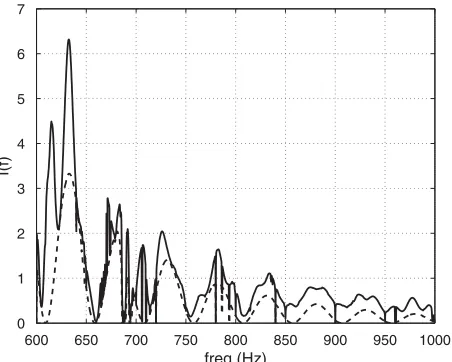
Using the posterior PDF defined in Eq. (26) and the calibration errors in TableII we found a 95% upper limit of3<0:32, assuming the Hubble constant to beh100 ¼ 0:71[29] (see also [30]). while using only the LIGO instru-ments obtained an upper limit of 3<0:30. Both of the lower limits were zero. The posterior PDFs obtained by the search are shown in Fig. 2, while the sensitivity inte-grands, which show the contribution to the sensitivity of the search from each frequency bin, are shown in Fig. 3. The upper limit corresponds to a strain sensitivity of 8:51024 Hz1=2 using just the LIGO interferometers, or 8:71024 Hz1=2 using both LIGO and Virgo. The LIGO-only upper limit is, in fact, lower than the upper
0 0.2 0.4 0.6 0.8 1 0
0.5 1 1.5 2 2.5 3 3.5 4 4.5 5
ΩGW(900 Hz)
p(
ΩGW
[image:10.612.314.561.95.200.2](900 Hz))
FIG. 2. Posterior PDFs on 3. The dashed line shows the posterior PDF obtained using just the LIGO detectors, the solid line shows the PDF obtained using LIGO and Virgo detectors. The filled areas show the 95% probability intervals.
TABLE III. Table of values ofY^I, the estimator of 3, ob-tained by analyzing the data taken during LIGO’s fifth science run and Virgo’s first science run, over a frequency band of 600– 1000 Hz, along with the standard deviation,I, of each result.
Network EstimatorY^I
H1L1 0:110:15
H1V1 0:550:21
H2L1 0:140:25
H2V1 0:510:40
L1V1 0:180:19
LIGO 0:050:13
all 0:150:10
1We initially analyzed only data from times after Virgo had
[image:10.612.324.553.481.664.2]limit using the whole data set, even though the sensitivity of the combined LIGO-Virgo analysis is better. This is not surprising because the addition of Virgo also increases the value of the estimator. The estimator will usually lie some-where between 0 and 2-in this case, the LIGO-only estimator was in the lower part of that range while the LIGO-Virgo estimator was not, but the two results are entirely consistent with each other. When we add Virgo, the likelihood excludes more of the parameter space below 3 ¼0, but this is a region we already exclude by setting the priors. Monte Carlo simulations show that, in the absence of a signal, the probability of the combined LIGO-Virgo upper limit being at least this much larger than the LIGO-only upper limit is 4.3%. This probability is not so small as to indicate a non-null result and we there-fore conclude that the LIGO-Virgo upper limit is larger due to statistical fluctuations.
We also used the same data to calculate the 95% proba-bility intervals for gravitational-wave spectra with spectral indices ranging over44, which correspond with different models of possible backgrounds in our frequency band. For example, a background of magnetar signals would be expected to have a spectral index of¼4[3]. Figure4shows the values of these upper limits. Note that they were all calculated using a reference frequency of 900 Hz, and Hubble parameterh100 ¼0:71.
IV. VALIDATION OF RESULTS
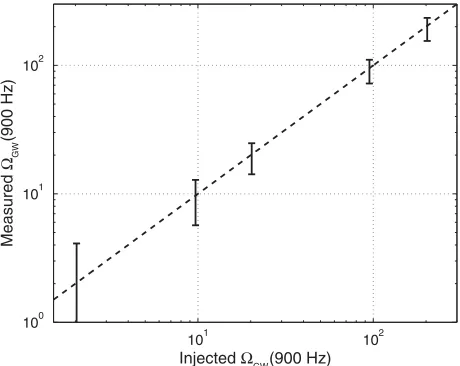
In order to test our analysis pipeline, we created simu-lated signals and used software to add them to the data that had been taken during the first week of Virgo’s first science run (this week was then excluded from the full analysis). We generated frame files containing a simulated isotropic
stochastic background, with GWðfÞ /f3. We were then able to scale this signal to several values of3and add it to the data taken from the instruments. We did not include H2 in this analysis, but used only H1, L1, and V1. Table IV
shows the injected values of 3 and the recovered values and associated standard deviations, along with the SNR of the signal in the H1V1 pair. The recovered 95% probability intervals of the injections can be seen in Fig. 5. The intervals all contain the injected value of3.
It should be noted that, in order to have detectable signals in this short amount of data, the larger injections are no longer in the small-signal limit. We usually make two assumptions based on this limit. The first is the ap-proximation in Eq. (8), which only holds if the signal is much smaller than the noise, as we are ignoring terms that are first and second order in GWðfÞ [13]. The second
−4 −3 −2 −1 0 1 2 3 4 0
0.05 0.1 0.15 0.2 0.25 0.3 0.35 0.4
α
95% upper limit on
[image:11.612.324.552.44.218.2]Ω α
FIG. 4. 95% probability intervals on , calculated using different values of . These upper limits were all calculated using the same data, with a band width of 600–1000 Hz and a reference frequency of 900 Hz. The dashed line shows the upper limit calculated using the LIGO interferometers only, while the solid line shows the upper limits calculated using all of the available data. The lower limits were all zero.
600 650 700 750 800 850 900 950 1000 0
1 2 3 4 5 6 7
freq (Hz)
[image:11.612.63.289.46.227.2]I(f)
[image:11.612.315.560.622.716.2]FIG. 3. Sensitivity integrands for the LIGO-only result (dashed) and for the full LIGO-Virgo result (solid). We can see that the sensitivity is increased across the band by the addition of the Virgo interferometer to the search. The vertical lines correspond to frequency bins removed from the search.
TABLE IV. Table of values of 3 for software injections, along with the recovered values, the 95% probability interval and the expected SNR of each injection in the H1V1 pair. Note that the standard deviations presented in this table are under-estimated, as the injections are not in the small-signal limit, however we still recover the signals within the 95% probability intervals.
Injected3 EstimatorY^
95% probability
interval SNR in H1V1
2.0 1:81:3 (0.0, 4.1) 1.3
9.7 9:11:5 (5.7, 12.8) 6.3
20.2 19:31:8 (14.2, 24.8) 13.3
assumption enters into the calculation of the noise PSDs, PiðfÞ. We calculate these directly from the data, as in the small-signal limit we can assume that hj~siðfÞj2i hjn~iðfÞj2i. The first assumption causes an over-estimation of the standard deviation, while the second causes our ‘‘optimal’’ filter to no longer be quite optimal. If we ignore these assumptions, we will underestimate the theoretical error bar, Y, and the width of the posterior PDFs. However, we still find 95% probability intervals that are consistent with the injected signals.
V. COMPARISON WITH OTHER RESULTS
The previous most sensitive direct upper limit in this frequency band wasGWðfÞ<1:02, obtained by the joint analysis of data from the LIGO-Livingston interferometer and the ALLEGRO bar detector over a frequency band of 850 Hzf950 Hz[18]. This result was obtained us-ing a constantGWðfÞ ¼0, so should be compared with our upper limit for¼0. As can be seen in Fig. 4, our 95% upper limit for ¼0 is 0<0:16 using all the available data, or0<0:15using just the LIGO interfer-ometers, therefore our result has improved on the sensitiv-ity of the LIGO-ALLEGRO result by a factor of7. The comparative strain sensitivity of the upper limits of the current search and the LIGO-ALLEGRO search can be seen in Fig.6.
The previous most sensitive direct limit at any frequency was the analysis of data from the three LIGO detectors in the fifth science run [17]. The analysis was carried out using the same data as the analysis presented in this paper, but was restricted to the frequency band 40 Hzf 500 Hz. This included the most sensitive frequency band of the three detectors. The 95% upper limit on0 in this
band was given as6:9106, which is a factor of2104 times smaller than our upper limit. They also found an upper limit on3of7:1106. In order to compare that to our upper limit on3, we must extend the spectrum to the frequency band analyzed in this paper. The 40 Hz f500 Hz upper limit would correspond to an upper limit at 900 Hz of 3<0:0052, which is a factor of 60smaller than the upper limit presented in this paper. The search at lower frequencies is significantly more sen-sitive and we would expect that in the advanced detector era the combined analysis of LIGO and Virgo detectors at low frequencies will improve even further on the previ-ously published upper limits.
We can also compare our results with indirect upper limits on the stochastic gravitational-wave background. In this band, the most stringent constraints come from Big Bang nucleosynthesis (BBN) and measurements of the cosmic microwave background (CMB). The BBN bound constrains the integrated energy density of gravita-tional waves over frequencies above 1010 Hz, based on observations of different relative abundances of light nuclei today. The BBN upper limit is [6]
101 102 100
101 102
InjectedΩ
GW(900 Hz)
Measured
ΩGW
[image:12.612.321.556.38.223.2](900 Hz)
FIG. 5. Plot of the recovered values of 3 for five software injections. The error bars show the 95% probability intervals. The quietest injection had a lower limit equal to zero. Note that all analyses excluded H2. Each injection used the same data, with the simulated signal scaled to different amplitudes.
600 700 800 900 1000
10−26 10−25 10−24 10−23 10−22
Frequency (Hz)
Strain (Hz
−1/2
[image:12.612.60.290.47.230.2])
FIG. 6. Comparison of the strain sensitivity of two searches for an isotropic stochastic background of gravitational waves. The two solid grey lines show strain sensitivity of the Hanford 4 km interferometer (dark grey) and the Virgo interferometer (light grey), these spectra were obtained by averaging over the data analyzed in this paper. The dot-dashed line shows the main result of this paper, the search for a SGWB withGWðfÞ /f3, which is white in strain amplitude, and corresponds to an upper limit of
3<0:32. The dashed line shows the result of the same search, but for constant GWðfÞ, and corresponds to an upper limit of
0<0:16. The solid black line shows the strain sensitivity of the LIGO-ALLEGRO search, which corresponds to an upper limit of0<1:02and was calculated over a frequency range of
850 Hzf950 Hz [18]. The two dotted lines show the extrapolation of the spectra obtained by the analysis of LIGO data in the frequency band 40 Hzf500 Hz. The lower dotted line corresponds to a 95% upper limit of 0<
Z
GWðfÞdðlnfÞ<1:1105ðN3Þ; (33)
whereNis the effective number of neutrino species at the time of BBN. Recent constraints on N, obtained from CMB measurements, BBN modeling, and the observed abundances of light elements suggest that 3:5&N & 4:4[31–34]. The CMB limit also constrains the integrated gravitational-wave energy density, and is obtained from the observed CMB and matter power spectra, as these would be altered if there were a higher gravitational-wave energy density at the time of decoupling. The CMB upper limit [35] is
Z
GWðfÞdðlnfÞ<1:3105: (34)
Our upper limit is not sensitive enough to improve on these indirect upper limits, however, these indirect bounds only apply to a background of cosmological origin, whereas the bound presented here applies to astrophysical signals as well.
VI. CONCLUSIONS
Data acquired by the LIGO and Virgo interferometers have been analyzed to search for a stochastic background of gravitational waves. This is the first time that data from LIGO and Virgo have been used jointly for such a search, and we have demonstrated that the addition of Virgo increases the sensitivity of the search significantly, re-ducing the error bar by 23% even though the length of time for which Virgo was taking data was approximately one fifth of the time of the LIGO run. The upper limit obtained with the LIGO interferometers only is the most sensitive direct result in this frequency band to date, im-proving on the previous best limit, set with the joint analysis of ALLEGRO and LIGO data, by a factor of7. Adding Virgo improves the sensitivity across the fre-quency band, largely due to the addition of pairs which have different overlap reduction functions. This enables us to cover the frequency band more evenly, as well as effec-tively increasing the total observation time. We can see that the sensitivity of the search is much improved by adding Virgo by comparing the standard deviations in Table III.
However, in this case, the increased sensitivity did not lead to a decreased upper limit, as the joint estimator of 3 obtained by the full LIGO-Virgo search was higher than the estimator obtained by the LIGO-only analysis.
As part of this analysis, we have also developed a method of marginalizing over the error on the amplitude calibration of several interferometers. The methods used in this paper will be useful for future analyses of data from the network of interferometers, which we expect to grow, eventually including not only interferometers in North America and Europe, but also hopefully around the world.
ACKNOWLEDGMENTS
The authors gratefully acknowledge the support of the United States National Science Foundation for the con-struction and operation of the LIGO Laboratory, the Science and Technology Facilities Council of the United Kingdom, the Max-Planck-Society, and the State of Niedersachsen/Germany for support of the construction and operation of the GEO600 detector, and the Italian Istituto Nazionale di Fisica Nucleare and the French Centre National de la Recherche Scientifique for the con-struction and operation of the Virgo detector. The authors also gratefully acknowledge the support of the research by these agencies and by the Australian Research Council, the International Science Linkages program of the Commonwealth of Australia, the Council of Scientific and Industrial Research of India, the Istituto Nazionale di Fisica Nucleare of Italy, the Spanish Ministerio de Educacio´n y Ciencia, the Conselleria d’Economia Hisenda i Innovacio´ of the Govern de les Illes Balears, the Foundation for Fundamental Research on Matter sup-ported by the Netherlands Organisation for Scientific Research, the Polish Ministry of Science and Higher Education, the FOCUS Programme of Foundation for Polish Science, the Royal Society, the Scottish Funding Council, the Scottish Universities Physics Alliance, The National Aeronautics and Space Administration, the Carnegie Trust, the Leverhulme Trust, the David and Lucile Packard Foundation, the Research Corporation, and the Alfred P. Sloan Foundation. This is LIGO docu-ment LIGO-P1000128.
[1] T. Regimbau and J. A. de Freitas Pacheco,Astrophys. J.
642, 455 (2006).
[2] T. Regimbau and J. A. de Freitas Pacheco, Astron. Astrophys.376, 381 (2001).
[3] T. Regimbau and J. A. de Freitas Pacheco, Astron. Astrophys.447, 1 (2006).
[4] V. Ferrari, S. Matarrese, and R. Schneider, Mon. Not. R. Astron. Soc.303, 247 (1999).
[5] L. Grishchuk, JETP Lett. 23, 293 (1976), http://www .jetpletters.ac.ru/ps/1801/article_27514.shtml.
[6] M. Maggiore,Phys. Rep.331, 283 (2000).
[7] X. Siemens, V. Mandic, and J. Creighton,Phys. Rev. Lett.
98, 111101 (2007).
[8] R. Bar-Kana,Phys. Rev. D50, 1157 (1994).
[10] R. Brusteinet al.,Phys. Lett. B361, 45 (1995).
[11] V. Mandic and A. Buonanno,Phys. Rev. D73, 063008 (2006). [12] R. Apredaet al.,Nucl. Phys.B631, 342 (2002).
[13] B. Allen and J. D. Romano, Phys. Rev. D 59, 102001 (1999).
[14] B. P. Abbottet al.,Rep. Prog. Phys.72, 076901 (2009). [15] F. Acerneseet al.,Classical Quantum Gravity25, 114045
(2008).
[16] H. Grote for the LIGO Scientific Collaboration,Classical Quantum Gravity25, 114043 (2008).
[17] B. P. Abbottet al.,Nature (London)460, 990 (2009). [18] B. Abbottet al.,Phys. Rev. D76, 022001 (2007). [19] B. Abbottet al.,Astrophys. J.659, 918 (2007). [20] E. E. Flanagan,Phys. Rev. D48, 2389 (1993). [21] N. Christensen,Phys. Rev. D46, 5250 (1992).
[22] G. Cellaet al.,Classical Quantum Gravity24, S639 (2007). [23] A. Lazzarini and J. R. Romano, LIGO Technical Document Report No. T040089-00, 2004, https://dcc
.ligo.org/cgi-bin/DocDB/ShowDocument?docid=t040089.
[24] W. Anderson et al., Tech. Report No. VIR-0416A-10, 2010,https://tds.ego-gw.it/ql/?c=7701.
[25] M. Rakhmanov, J. D. Romano, and J. T. Whelan,Classical Quantum Gravity25, 184017 (2008).
[26] J. Abadieet al.,Nucl. Instrum. Methods Phys. Res., Sect. A624, 223 (2010).
[27] T. Accadiaet al.,J. Phys. Conf. Ser.228, 012015 (2010). [28] N. V. Fotopoulos (for the LIGO Scientific Collaboration),
J. Phys. Conf. Ser.122, 012032 (2008).
[29] WMAP, Wmap-recommended parameters constraints (2012), http://lambda.gsfc.nasa.gov/product/map/current/ best_params.cfm.
[30] A. G. Riesset al.,Astrophys. J.730, 119 (2011). [31] G. Manganao and P. D. Sperico,Phys. Lett. B701, 296
(2011).
[32] J. Hamann, S. Hannestad, G. G. Raffelt, and Y. Y. Y. Wong,
J. Cosmol. Astropart. Phys. 09 (2011) 034. [33] K. M. Nollett and G. P. Holder,arXiv:1112.2683. [34] R. H. Cyburtet al.,Astropart. Phys.23, 313 (2005). [35] T. L. Smith, E. Pierpaoli, and M. Kamionkowski, Phys.
Rev. Lett.97, 021301 (2006).