WRT’07 Organization ……….v
Proceedings ……….
•
KABA: Automated Refactoring for Improved Cohesion ………..1
G. Snelting, M. Streckenbach (Universitat Passau)
•
Automation of Refactoring and Refactoring Suggestions for TTCN-3 Test
Suites. The TRex TTCN-3 Refactoring and Metrics Tool ………..…………3
H. Neukirchen, B. Zeiss (University of Gottingen)
•
A visual interface for type-related refactorings ……….5
P. Mayer (Ludwig-Maximilians-Universität),
A. Meißner (Fernuniversität in Hagen),
F. Steimann (Fernuniversität in Hagen)
•
ITCORE: A Type Inference Package for Refactoring Tools ………7
H. Kegel (ej-technologies GmbH), F. Steimann (Fernuniversität in Hagen)
•
Flexible Transformation Language ……….9
A. A. Santos, L. Menezes, and M. Cornélio (UPE)
•
A Refactoring Discovering Tool based on Graph Transformation …………11
J. Perez, Y. Crespo (Universidad de Valladolid)
•
Refactoring with Contracts ………13
Y. A. Feldman, M. Goldstein (IBM Haifa Research Lab),
S. Tyszberowicz (The Academic College of Tel-Aviv Yaffo)
•
Synchronizing Refactored UML Class Diagrams
and OCL Constraints ………...15
S. Markovic, T. Baar (Ecole Polytechnique Federale de Lausanne)
•
Code Analyses for Refactoring by Source Code
Patterns and Logical Queries ………...17
D. Speicher, M. Appeltauer, G. Kniesel (University of Bonn)
•
Reuse Based Refactoring Tools ………..21
by Metrics-led Genetic Algorithm ……….……..23
T. Bodhuin, G. Canfora, L. Troiano (University of Sannio)
•
Model-driven Software Refactoring ………..25
T. Mens (Université de Mons-Hainaut)
,
G. Taentzer (Philipps-Universität Marburg)
•
The “Extract Refactoring” Refactoring ………28
R. Robbes, M. Lanza (University of Lugano)
•
Advanced Refactoring in the Eclipse JDT:
Past, Present, and Future ……….30
R. M. Fuhrer (IBM Research), M. Keller (IBM Zurich), A. Kieżun (MIT)
•
Product Line Variability Refactoring Tool ………..…32
F. Calheiros, V. Nepomuceno (Meantime Mobile Creations),
P. Borba , S. Soares (UPFE),
V. Alves (Lancaster University)
•
AJaTS: AspectJ Transformation System ……….34
R. Arcoverde, S. Soares, P. Lustosa, P. Borba (UFPE)
•
Towards a Change Specification Language for API Evolution ………..36
J. Reuter, F. Padberg (Universitat Karlsruhe)
•
Holistic Semi-Automated Software Refactoring ………..38
E. Mealy (University of Queensland)
•
Engineering Usability for Software Refactoring Tools ………...40
E. Mealy (University of Queensland)
•
Automated Testing of Eclipse and NetBeans Refactoring Tools ………42
B. Daniel, D. Dig, K. Garcia, D. Marinov (University of Illinois at Urbana-Champaign)
•
Refactoring in Erlang, a Dynamic Functional Language
………...……44
L. Lovei, Z. Horvath, T. Kozsik, R. Kiraly, A. V
ı
g, T. Nagy (Eotvos Lorand University)
•
Operation-based Merging of Development Histories ………..46
T. Freese (University of Oldenburg)
•
Improving Method Extraction: A Novel Approach to Data Flow
•
The LAN-simulation: A Refactoring Lab Session ………...…52
S. Demeyer, B. Du Bois, M. Rieger, B. Van Rompaey (University Of Antwerp)
•
A Heuristic-Based Approach to Code-Smell Detection ………...54
D. Kirk, M. Roper, M. Wood (University of Strathclyde)
•
Using Java 6 Compiler as a Refactoring and an Analysis Engine …………..56
J. Bečička, P. Zajac, P. Hřebejk (Sun Microsystems, Inc.)
•
Making Programmers Aware Of Refactorings ………58
P. Weißgerber, B. Biegel, S. Diehl (University of Trier)
•
Why Don’t People Use Refactoring Tools? ………..60
E. Murphy-Hill, A. P. Black (Portland State University)
•
Automating Feature-Oriented Refactoring of Legacy Applications ……..…62
C. Kastner, M. Kuhlemann (University of Magdeburg),
D. Batory (University of Texas at Austin)
•
An Adaptation Browser for MOF ……….64
G. Wachsmuth (Universitat zu Berlin)
Organization
Chair and Organizer:
Danny Dig (University of Illinois at Urbana-Champaign)
Program Committee:
Jan Becicka
(NetBeans Refactoring Engine, Sun Microsystems)
Danny Dig
(
University of Illinois at Urbana-Champaign)
William G. Griswold
(
University of California, San Diego)
Ralph Johnson
(
University of Illinois at Urbana-Champaign)
Markus Keller (Eclipse Refactoring Engine, IBM)
KABA: Automated Refactoring for Improved Cohesion
G. Snelting, M. Streckenbach
Universit¨at Passau
1
Overview
Cohesion is one of the most important software en-gineering principles. Cohesion demands in partic-ular that data and function operating on these data are defined together in one class definition. But not all existing Java class hierarchies define a cohesive software architecture.
KABA analyses a class hierarchy together with a set of client programs. It refactors the hierarchy such that data members (fields) and methods oper-ating on the data are always grouped together, and that any class in the refactored hierarchy contains only fields and methods which are indeed needed by some client code using the class. Every class-typed variable is given a new type (namely a class from the refactored hierarchy), while the program state-ments remain essentially unchanged. In contrast to some other refactoring tools, KABA guarantees that program behaviour is unchanged after refactoring.
KABA is based on fine-grained (static or dy-namic) program analysis, namely points-to analysis, type constraints, and mathematical concept lattices. Typically, an original class is split if different clients use different subsets of a class’s functionality. In order to avoid too fine-grained refactorings, the ini-tial refactoring is usually simplified by automatic or manual semantics-preserving transformations.
Thus KABA provides fine-grained insight into the true usage patterns of classes in a program, can serve to evaluate cohesion of existing systems, and will automatically generate semantics-preserving refac-torings which improve cohesion. KABA is imple-mented in form of a refactoring browser.
2
Examples and Experiences
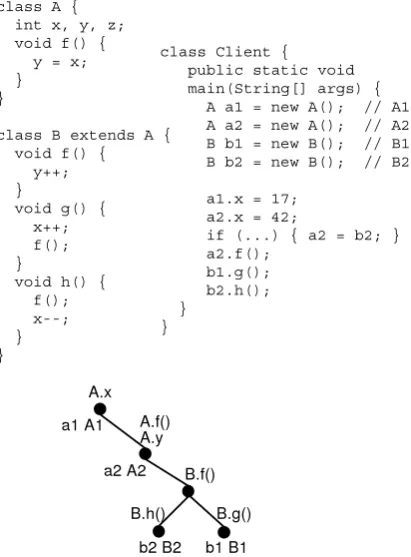
KABA reacts to usage patterns of a class by client code. In figure 1, client objects A1, A2,B1, B2 access different subsets of classAandB:
objectA1accesses onlyxfrom classA, while A2 also accesses f() and thus y; therefore classAis split into two subclasses
class A { int x, y, z; void f() {
y = x; } }
class B extends A { void f() {
y++; }
void g() { x++; f(); }
void h() { f(); x--; } }
class Client { public static void main(String[] args) {
A a1 = new A(); // A1 A a2 = new A(); // A2 B b1 = new B(); // B1 B b2 = new B(); // B2 a1.x = 17;
a2.x = 42;
if (...) { a2 = b2; } a2.f();
b1.g(); b2.h(); }
[image:5.595.300.506.204.483.2]}
Figure 1: A small program and its KABA refactor-ing
B1callsg()whileB2 callsh(), hence two new subclasses forBare introduced.
The new subclasses give fine-grained insight into what objects really do, and maximise cohesion as in the new hierarchy members are grouped together iff they are used together. A nice by-product is that objects are minimized and dead members are elim-inated. But since the refactored hierarchy may be quite fine-grained, the engineer may remerge classes (eg the two top classes in figure 1). In any case, KABA guarantees preservation of semantics. For the complex technical details, see [1].
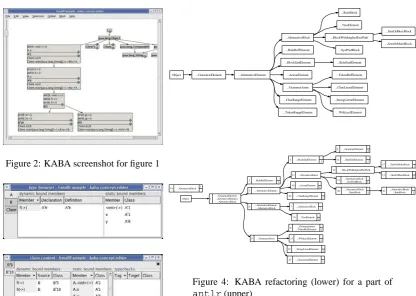
Figure 2: KABA screenshot for figure 1
Figure 3: Browser for original types (top); Browser for class content (bottom).
shown in figures 2 and 3. The user may remerge splitted classes, which can reduce cohesion again but may improve other software quality factors. More details about the KABA refactoring browser and semantics-preserving class merging and elimi-nation of multiple inheritance can be found in [3].
A more realistic case study was theantlrparser generator. KABA discovered problems with cohe-sion in the original design and generated an im-proved class hierarchy (figure 4). For example, KABA discovered that the original classes Gram-marElementandAlternativeElementcan be merged, while preserving semantics and improv-ing cohesion. On the other hand, some original classes were split to 5, 6 or 9 new classes. Thus the hierarchy structure was changed quite a bit. But note that the number of classes remained about the same.
As a third example, we mentionjavac, where KABA reproduced the original class hierarchy al-most exactly. This proved that the originaljavac design was good. More details about refactoring antlrandjavaccan be found in [2].
Object ...GrammarElement ...AlternativeElement
...AlternativeBlock ...RuleRefElement ...BlockEndElement ...ActionElement ...GrammarAtom ...CharRangeElement ...TokenRangeElement
...RuleBlock ...TreeElement ...BlockWithImpliedExitPath
...SynPredBlock ...RuleEndElement
...OneOrMoreBlock ...ZeroOrMoreBlock
...TokenRefElement ...CharLiteralElement ...StringLiteralElement ...WildcardElement
Object 1 ...GrammarElement ...AlternativeElement ...AlternativeBlock
2 ...RuleRefElement 3 3 ...AlternativeElement
6 ...AlternativeElement...AlternativeBlock
8 ...GrammarAtom
4 ...BlockEndElement 2 11...AlternativeBlock 16...ActionElement 1 22 ...CharRangeElement 1
5 ...GrammarElement 1 14 ...RuleEndElement
2
7 ...AlternativeBlock 2 24 ...TreeElement1 9 ...GrammarAtom
...TokenRefElement 1 15 ...WildcardElement
1 18 ...StringLiteralElement
1 23 ...CharLiteralElement
1 10 ...AlternativeBlock 1
12 ...BlockWithImpliedExitPath 19 ...AlternativeBlock
...SynPredBlock 1 20 ...AlternativeBlock
...RuleBlock 1
13 ...ZeroOrMoreBlock 1 17 ...OneOrMoreBlock
1 21 ...AlternativeBlock
[image:6.595.105.522.86.382.2]...RuleBlock 1
Figure 4: KABA refactoring (lower) for a part of antlr(upper)
KABA is a research prototype. It can handle full Java (without reflection). KABA has been applied to several small and medium-scale example systems, and generated useful refactorings. For large sys-tems, the refactorings may be quite fine-grained, thus we are exploring even more agressive simpli-fications of the original refactoring which still im-prove cohesion and guarantee behaviour preserva-tion.
References. Technical details and more experi-ence with KABA can be found in
1. G. Snelting, F. Tip: Reengineering Class Hier-archies Using Concept Analysis. ACM Trans-actions on Programming Languages and Sys-tems (TOPLAS), May 2000, pp. 540-582. 2. M. Streckenbach, G. Snelting: Refactoring
Class Hierarchies with KABA. Proc. OOPSLA 2004, Vancouver, British Columbia, Canada, October 2004, pp. 315-330.
Automation of Refactoring and Refactoring Suggestions
for TTCN-3 Test Suites
The TRex TTCN-3 Refactoring and Metrics Tool
Helmut Neukirchen and Benjamin Zeiss Software Engineering for Distributed Systems Group,
Institute for Informatics, University of G¨ottingen, Lotzestr. 16–18, 37083 G¨ottingen, Germany
{neukirchen|zeiss}@cs.uni-goettingen.de
Abstract Refactoring is not only useful for source code of implementations, but as well for test specifications. The open source TRex tool automates the application of refactorings and the detection of refactoring opportunities for test suites that are specified using the standardised Testing and Test Control Notation (TTCN-3). Depending on the refactoring, the behaviour pre-serving transformations may include syntax tree transformations and direct modification of the source code; for suggesting refactorings, metrics are calculated and code smell patterns are de-tected.
Introduction. The Testing and Test Control Notation (TTCN-3) [1] is a mature standard from the telecommunication and data commu-nication domain that is widely used in indus-try and standardisation to specify and execute test suites. Just like any other software artifact, tests suffer from quality problems [2]. To remove such quality problems from TTCN-3 test suites, we use refactoring [3]. For suggesting refactor-ings, we use a combination of metrics and code smell detection.
In the following, we first present our approach for the quality assessment and improvement of TTCN-3 test suites. Subsequently, the TTCN-3 Refactoring and Metrics Tool TRex and its implementation are described. Finally, future work is discussed in the outlook.
Refactoring, Metrics, and Code Smell De-tection for TTCN-3 Test Suites. Refactor-ing of test suites has so far only been studied in the context of JUnit [2]. Thus, we have de-veloped a refactoring catalogue for TTCN-3 [4, 5] which includes 23 refactorings using language specific concepts of TTCN-3. Furthermore, we found 28 refactorings from Fowler’s Java refac-toring catalogue [3] to be applicable to TTCN-3.
For being able to automatically identify loca-tions in source code where a refactoring is worth-while, we investigated corresponding TTCN-3 metrics and TTCN-3 code smells. For example, a Number of References metric is used to iden-tify definitions that are never referenced and can thus be removed or that are referenced only once and can thus be inlined using a corresponding refactoring. Even though we experienced that metrics are able to detect various issues, they are not sophisticated enough to detect more ad-vanced problems. Therefore, we investigated pattern-analysis of source code and as a result, we have developed a catalogue of TTCN-3 code smells [6]. So far 38 TTCN-3 code smells have been identified.
TRex Implementation. To automate refac-toring for TTCN-3 test specifications, we have implemented the open source TTCN-3 Refac-toring and Metrics tool TRex [4]. The ini-tial version has been developed in collaboration with Motorola Labs, UK [7]. TRex implements state-of-the-art editing capabilities, assessment and improvement techniques for TTCN-3 test suites based on the calculation of metrics, au-tomated smell detection, and refactoring. TRex is based on the Eclipse Platform [8] and thus makes use of the infrastructure offered, e.g. the Language Toolkit (LTK) or the Eclipse Test & Performance Tools Platform (TPTP) static analysis framework. The analysis infrastruc-ture including lexer, parser, symbol table, pretty printer, etc. for TTCN-3 have been implemented using ANother Tool for Language Recognition (ANTLR) [9].
(2) Quality Assessment (3) Automated Refactorings
(1) Static Analysis
Eclipse Platform User
Interface Text Editor TPTP
Language Toolkit ...
TTCN-3 Source Code
ANTLR Lexing, Parsing
Refactoring Processor
Refactored TTCN-3 Source Code Transformed
Subtree of the Syntax Tree
Pretty Printer
Change Weaver Syntax Tree /
Symbol Table Metrics / Code Smell Detection Rule-Based Refactoring Suggestions
Figure 1: The TRex Toolchain
which should be subject to the refactoring or the refactoring is invoked directly by a quick-fix which is provided by the analysis results of the automated quality assessment.
For the assessment, a considerable number of size metrics (such as counting the number of references to a definition) and structural met-rics (using control-flow graphs and call graphs) are calculated. Furthermore, a total number of 11 TTCN-3 code smell detection rules have been implemented that partially allow the use of quick-fixes to invoke automated refactorings. The overall toolchain of TRex is depicted in Fig. 1. Based on the syntax tree and symbol table, the automated refactorings can either be applied directly or invoked through the refac-toring suggestions obtained by means of met-rics and code smell detection. The refactorings are applied directly to the source code using a programmatic text editor and may as well in-volve syntax tree transformations. The corre-sponding text representation from transformed subtrees is reobtained by a pretty printer com-ponent and weaved back into the surrounding TTCN-3 source code.
The implementations of metric calculation, code smell detection, and refactoring are tested usingPlug-in Development Environment(PDE) JUnit tests, e.g. by comparing source code snip-pets before and after the refactoring.
Outlook. A remaining issue open for research is the validation of test refactorings: Unlike Java refactorings, for example, there are no unit tests available for tests and simply running a test suite against an implementation is not enough if the test behaviour consists of more than one path. We are thus investigating bisimulation to validate that the observable behaviour of a refactored test suite has not changed. In addi-tion, we are extending TRex by implementing
further TTCN-3 refactorings and more sophis-ticated code smell detection techniques.
References
[1] ETSI: ETSI Standard (ES) 201 873 V3.2.1: The Testing and Test Control Notation ver-sion 3; Parts 1-8. European Telecommuni-cations Standards Institute (ETSI), Sophia-Antipolis, France (2007)
[2] van Deursen, A., Moonen, L., van den Bergh, A., Kok, G.: Refactoring Test Code. In: XP2001. (2001)
[3] Fowler, M.: Refactoring – Improving the Design of Existing Code. Addison-Wesley, Boston (1999)
[4] TRex Team: TRex Website. http://www. trex.informatik.uni-goettingen.de (2007)
[5] Zeiss, B.: A Refactoring Tool for TTCN-3. Master’s thesis, Institute for Informatics, University of G¨ottingen, Germany, ZFI-BM-2006-05 (2006)
[6] Bisanz, M.: Pattern-based Smell Detec-tion in TTCN-3 Test Suites. Master’s thesis, Institute for Informatics, University of G¨ottingen, Germany, ZFI-BM-2006-44 (2006)
[7] Baker, P., Evans, D., Grabowski, J., Neukirchen, H., Zeiss, B.: TRex – The Refactoring and Metrics Tool for TTCN-3 Test Specifications. In: TAIC PART 2006, IEEE Computer Society (2006) 90–94
[8] Eclipse Foundation: Eclipse. http://www. eclipse.org(2007)
A visual interface for type-related refactorings
Philip Mayer
Institut für Informatik
Ludwig-Maximilians-Universität
D-80538 München
[email protected]
Andreas Meißner
Lehrgebiet Programmiersysteme
Fernuniversität in Hagen
D-58084 Hagen
[email protected]
Friedrich Steimann
Lehrgebiet Programmiersysteme
Fernuniversität in Hagen
D-58084 Hagen
[email protected]
ABSTRACT
In this paper, we present our approach to a visual refactoring tool, the Type Access Analyzer (TAA), which uses program analysis to detect code smells and for suggesting and performing refactorings related to typing. In particular, the TAA is intended to help the developers with consistently programming to interfaces.
1.
INTRODUCTION
When looking at currently available type-related refactoring tools, a noticeable gap shows between simple refactorings like Extract Interface and more complex, “heavyweight” ones like Use Supertype Where Possible and Infer Type [2]: While the former do not provide any analysis-based help to the user, the latter perform complex program analyses, but due to their autonomous workings – without interacting further with the user except for preview functionality – it is not always clear when to apply them, what result to expect, and just how far the changes of the refactorings will reach. For example,
• Extract Interface keeps programmers in the dark about which methods to choose,
• Use Supertype Where Possible replaces all declaration elements found without a proper way of restricting it, • Infer Type creates new types guaranteeing a type-correct
program, but often lacking a conceptual justification. As a remedy, we propose a new approach to refactoring. The contributions of this approach consist of:
• moving precondition checking and parameterization from refactorings to a dedicated program analysis component, • presenting the analysis results visually in such a way that
they suggest refactorings, and
• breaking down existing refactorings into simpler tools which perform predictable changes immediately visible and controllable by the visual refactoring view.
This approach is prototypically realized in our Type Access Analyser (TAA) tool for type-related refactorings.
2.
THE TYPE ACCESS ANALYZER
A loosely coupled and extensible software design can be reached by consistently programming to interfaces [1], specifically to what we have called context-specific interfaces [3]. An interface is considered to be context-specific if it contains exactly – or, in a more relaxed interpretation, not much more than – the set of members of a type required in a certain area of code (which is comprised of variables and methods declared with the interface as their types and their
Refactoring to the use of such interfaces requires an analysis of what is really needed in contexts by analyzing the code to find used or unused members. With this information, the code can be refactored in an informed way by:
• creating, adapting, or removing interfaces, and
• retrofitting existing variable types to the newly introduced, or adapted, interfaces.
The TAA follows the approach discussed in the introduction by analyzing the code using the type inference algorithm we have introduced in [2], presenting the results in a visual form, and providing access to and feedback from simplified versions of refactorings such as Extract Interface or Infer Type.
To give the programmer a comprehensive and concise view of the program that is tailored to the specific problems of interface-based programming, we have developed the supertype lattice view described in [4]. In this view, the supertype hierarchy of the type under consideration is enhanced by displaying a bounded lattice of the set of members of the type, each node being enriched with various kinds of information.
Figure 1 shows a screenshot of the TAA in action on a four-method class (due to space limitations, only a part is shown).
Figure 1: TAA Visual View
Four types of information are immediately visible from the graph:
• Possible types – each node is a possible supertype of the class (which is situated at the bottom; not shown).
• Variables and methods. Each variable or method typed with one of the type(s) under consideration is included in the graph. Assignments between these elements are shown with red arrows.
• Declared placement. A variable or method is shown in the declared placement section of the node containing the declared type of the variable or method.
• Ideal placement. If different from the declared
placement, a variable or method is shown in the ideal placement section of the node which corresponds to the set of members (transitively) invoked on this variable or method.
The quality of the variable and method declarations (i.e. the matching between types and their usage contexts) is shown by the colours of the background of the node. A green colour represents the use of context specific types, while a red colour signals a mismatch between types and usage contexts.
Selecting variables or methods in the graph further enriches the display:
• A line is drawn connecting the ideal and declared placements of an element (if different).
• Additional lines are drawn connecting all elements which the current element is being assigned to (transitively).
This data may be used to detect smells in the code and take appropriate action. The following section will detail this.
3.
VISUAL REFACTORINGS
By analyzing a type in the TAA view, the developer has complete overview of the usages of this type. The annotations on the supertype lattice suggest a number of ways of improving the typing situation; specifically, the arrangements of types and variables/methods visualize code smells which can be removed by applying refactorings.
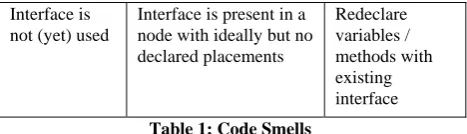
The following table associates design problems in the code, the way these problems show up in the visual view (as smells), and the actions to be taken by the developer to deal with those problems. Later on, we will present refactorings for executing these actions.
Problem Smell Action
No interfaces available for a context
Nodes in the graph with ideal placement of variables/methods, but without interfaces Extract interface and redeclare variables/ methods with new interface Poorly designed interface
Ideal placement of variables/methods swarming around existing interfaces
Move existing interface up or down in hierarchy Two interfaces for the same purpose
Two interfaces share the same/ neighbouring nodes, each with ideally placed variables/ methods Merge interfaces Superfluous interface
Interface present in a node without declared placements; no ideal placements in vicinity
Remove interface from hierarchy
Interface is not (yet) used
[image:10.595.310.544.71.138.2]Interface is present in a node with ideally but no declared placements Redeclare variables / methods with existing interface
Table 1: Code Smells
As can be seen from the table above, the TAA suggests a number of actions to be taken as a result of identified smells. These actions are implemented as refactorings. In line with our approach of putting the developer in charge, these refactorings may be selected as (semantically) appropriate by the user.
Contrary to existing refactorings, the ones invoked from the TAA in general do not require further dialog-based parameterization – all information required for a refactoring is already available in the graph and the way the user invokes the refactoring in a visual way. These visual start procedures are shown in Table 2:
Refactoring Visual start procedure
Extract interface Alt + Drag an interface to another, higher node in the graph Move interface in
hierarchy
Drag an interface to another node in the graph (up or down) Remove interface from
hierarchy
Select an interface, select delete
Merge interfaces Select two interfaces, select merge
Redeclare declaration elements (transitively, i.e. following assignments)
[image:10.595.309.544.278.429.2]Select a variable or method, select redeclare
Table 2: Refactorings
While the Extract Interface refactoring is already available as-is in many tools, the others have been either adapted or specifically written for the TAA.
4.
SUMMARY
In this paper, we have described our approach to visual refactoring. The TAA tool aids the developer by providing valuable information about the typing situation in the code – in itself suitable for program understanding – and thereby suggests refactorings whose effect is more predictable and which can be executed directly from the visual view. The results of the refactorings are likewise directly shown in the graph.
In the future, we will investigate ways of further improving the user interface and add more refactorings to the TAA.
5.
REFERENCES
[1] E Gamma, R Helm, R Johnson, J Vlissides Design Patterns - Elements of Reusable Software (Addison-Wesley, 1995).
[2] F Steimann “The Infer Type refactoring and its use for interface-based programming” JOT 6:2 (2007) 67–89.
[3] F Steimann, P Mayer “Patterns of interface-based programming” JOT 4:5 (2005) 75–94.
IT
CORE
: A Type Inference Package for Refactoring Tools
Hannes Kegel
ej-technologies GmbH Claude-Lorrain-Straße 7
D-81543 München [email protected]
Friedrich Steimann
Lehrgebiet Programmiersysteme Fernuniversität in Hagen
D-58084 Hagen [email protected]
1. Introduction
ECLIPSE’s current distribution comes with various type-related refactoring tools, some of which rely on a built-in framework for solving a set of type constraints derived from the declarations and expressions of a type-correct program. We have adapted this framework to embody the type inference underlying our INFER TYPE refactoring tool for JAVA [6], which extracts the maximally general type for a declaration element (variable or method) based on the use of that element in a program. The new implementation surpasses the original one by greater memory efficiency; it also fully embodies the language extensions of JAVA 5, most notably generics. It has been extensively tested by automatically applying it to all declaration elements of several large code bases.
Experimenting with INFER TYPE, it soon became clear that its type inference procedure can be used for several other refactor-ings and also for program analysis tools such as the TAA [5]. We therefore decided to develop the type inference part as a package in its own right. However, with several uses of this package still under development, its API has not yet settled; therefore, we will only provide an overview of its inner workings here, and of the refactorings that it enables.
2. Type inference with IT
COREType inference computes type annotations for program elements. It is most useful in languages in which type annotations for these elements are not mandatory (“untyped” languages). In typed lan-guages such as JAVA, type inference can compute the difference between a declared and a derived (inferred) type.
In the context of refactoring statically checked, type-correct object-oriented programs, type inference can be used to change the declared types of program elements in one of two di-rections: to the more specific, or to the more general. The former is of interest for instance when Object or a raw type is used where all objects are known to be of a more concrete class or pa-rameterized type; such type inference is, e.g., the basis for the refactoring tool INFER GENERIC TYPE ARGUMENTS described in [3]. The latter is useful for decoupling designs, for instance when turning a monolithic application into a framework; it is the basis of our INFER TYPE refactoring described in [6]. It is this latter variant of type inference that ITCORE performs and that we are looking at here.
The type inference algorithm of ITCORE computes for a given declaration element its maximally general type (interface or ab-stract class), i.e., that type that contains only the members ac-cessed through the declaration element and the ones it gets as-signed to. It does so by performing a static program analysis, (class hierarchy analysis, specifically), which is perfectly ade-quate in our setting, since the static type checking of JAVA would reject any additional precision offered by a dynamic analysis. The inferred type is “minimal” in the sense that if a declaration
ele-ment is typed with its inferred type, no member can be removed from the type without introducing a typing error.
The constraints generated by ITCORE are similar to that of I N-FER GENERIC TYPE ARGUMENTS in that parameterized types are decomposed and separate constraint variables for all type argu-ments are created. For assignargu-ments, individual constraints are generated for the main types and all type arguments. If the re-ceiver of a method invocation is a parameterized type, method and type arguments are also connected through constraints.
ITCORE differs from the engines of its predecessors in various respects:
1. The constraints generated by ITCORE cover the complete type system of JAVA 5. This lets ITCORE change type arguments in-cluding those of nested parametric types, as e.g. Test in class MyComparator implements Comparator<Test>. (Only type bounds are currently not considered for change.) 2. ITCORE attaches to each constraint variable (representing a
declaration element) the required protocol (the access set [7]) of that element, which is the basis for the creation of new types during the solution of the constraint set.
3. The constraint solution procedure works constructively, by visiting the nodes of the constraint graph reachable from the start element(s) in depth-first order and collecting the (transi-tively determined) access sets in the nodes. After the traversal, the new type for the start element has been determined and is created. A second traversal then satisfies all type constraints, by introducing the new type (and possibly others [6]) where necessary.
3. Refactoring tools building on IT
CORE3.1 Existing refactoring tools
A number of existing type-inference based refactoring tools can profit from being migrated to ITCORE:
GENERALIZE DECLARED TYPE The purpose of GENERALIZE D E-CLARED TYPE is to replace the declared type of a variable or method with a supertype, if that is possible. However, in its cur-rent form GENERALIZE DECLARED TYPE can only change the type of the selected declaration element; if this element gets assigned to others of the same type or some other subtype of the general-ized type, the refactoring is impossible. This restricts its practical applicability considerably.
USE SUPERTYPE WHERE POSSIBLE In a similar vein, ITCORE can serve as the basis for USE SUPERTYPE WHERE POSSIBLE: by com-puting the inferred types for all declaration elements of a certain type, it can be checked for a selected supertype where this super-type could be used instead. Again, using ITCORE would make full coverage of generics available to this refactoring.
EXTRACT INTERFACE Current implementations of EXTRACT I N-TERFACE let the developer choose the members of the interface. By naming the declaration elements for which this interface is to be used, ITCORE can be used to preselect the members that are needed, allowing the developer to add (but not delete!) members if deemed appropriate. It is then guaranteed that the new interface can be used where it is intended to be.
INFER TYPE INFER TYPE is a relatively new refactoring de-scribed in some detail elsewhere [6]. It is currently the only one that has already been migrated to ITCORE; see http://www.fernuni-hagen.de/ps/prjs/InferType3/.
3.2 Refactorings awaiting tool support
Many useful refactorings still lack automation. Some of them can be implemented using ITCORE, as the following list suggests.
REPLACE INHERITANCE WITH FORWARDING Suppose a class in-herits many members but needs only few of them, so that its inter-face is needlessly bloated; in this case, it may be better to define a new class with just the required interface, and have it hold an in-stance of its former superclass to which it forwards all service re-quests. The protocol of the new class can be computed using IT-CORE, simply by inferring the types of all declaration elements typed with the class.
In case instances of the new class need to substitute for in-stances of its former superclass (which is often the case in frame-works), subtyping cannot be avoided. However, in these cases ei-ther an existing or an inferred interface of the new class and its former superclass can be used in the places where the substitution occurs (the plug points of the framework). Both can be derived using ITCORE. In fact, as has been pointed out in [7], even the question of whether such a substitution is possible (and corre-sponding subtyping, i.e., interface implementation, is therefore necessary) can be computed by means of ITCORE; all that needs to be done is search for assignment chains from (declaration ele-ments of) the new class to (declaration eleele-ments of) its former su-perclass [7].
REPLACE INHERITANCE WITH DELEGATION A simple, but easily overlooked, twist to the previous refactoring is that a superclass may contain calls to its own, non-final methods. In this case, and if any of the called methods are overridden in the subclass to be refactored, replacing inheritance with forwarding changes pro-gram semantics, because the formerly overriding methods in the subclass no longer override (the extends is removed; the new class is no longer a subclass of its former superclass) so that dy-namic binding of these methods does not apply. In these cases, forwarding must be replaced by delegation [9].
In class-based languages such as JAVA, delegation must be mimicked by subclassing. IDEA’s REPLACE INHERITANCE WITH DELEGATION refactoring tool does exactly this [4]; combining it with REPLACE INHERITANCE WITH FORWARDING as described above would further automate this refactoring.
INJECT DEPENDENCY DEPENDENCY INJECTION is an increasingly popular design pattern that lets components to be assembled into
applications remain independent of each other [1]. Components are independent (decoupled) only if they do not reference each other directly, neither through declarations nor through instance creation (constructor calls). One prerequisite to successful de-pendency injection is therefore that all such references are re-moved. As has been outlined above, this can easily be done by ITCORE, namely by inferring the common type of all references to the class depended upon. The rest, removing constructor calls (as for instance described in [8]) and instrumenting the assembly of components, is independent of ITCORE; it can be done with the standard means of AST manipulation. We are currently working on an implementation for SPRING and EJB3.
CREATE MOCK OBJECT Unit testing requires that each unit is tested independently of others. In practice, however, units depend on others that have not been sufficiently tested to be assumed cor-rect, or whose behaviour cannot be controlled by a test case. In these cases, units depended upon are replaced by mock objects (really: mock classes). These objects exhibit the same provided interface as those they replace; their implementation, though, is different (“mocked”).
Mocking complete classes with many methods may be more than is actually needed. To avoid this, ITCORE can compute from a test case (or test suite) the interface actually required from a mock class, which may be less than what is offered by the class it mocks. This computed interface can drive the creation of the mock class, or the necessary overriding of methods if the mock is derived from the original class. Also, it can serve as a common abstraction of the original and the mock class in the context of the test (suite). Cf. also [2].
4. Conclusion
There seems to be a whole class of refactorings that rely on the determination of the minimal protocol, or the maximally general type, of a program element. The reasons for this may vary: de-creasing coupling and inde-creasing variability as for GENERALIZE DECLARED TYPE, USE SUPERTYPE WHERE POSSIBLE, INJECT D E-PENDENCY, or INFER TYPE; cleaning up the interface as for R E-PLACE INHERITANCE WITH FORWARDING/DELEGATION; or simply reducing the amount of necessary work, as in CREATE MOCK O B-JECT. All have in common that they can be built on the type infer-ence procedure offered by ITCORE.
References
[1] http://www.martinfowler.com/articles/injection.html
[2] S Freeman, T Mackinnon, N Pryce, J Walnes “Mock roles, not ob-jects” in: OOPSLA Companion (2004) 236–246.
[3] RM Fuhrer, F Tip, A Kiezun, J Dolby, M Keller “Efficiently refac-toring Java applications to use generic libraries” in: ECOOP (2005) 71–96.
[4] http://www.jetbrains.com/idea/docs/help/refactoring/ replaceinheritwithdelegat.html
[5] P Mayer, A Meißner, F Steimann “A visual interface for type-related refactorings” submitted to: 1st Workshop onRefactoring Tools.
[6] F Steimann “The Infer Type refactoring and its use for interface-based programming” JOT 6:2 (2007) 67–89.
[7] F Steimann, P Mayer “Type Access Analysis: Towards informed in-terface design” in: TOOLS (2007) to appear.
[8] http://www.fernuni-hagen.de/ps/prjs/InferType/ ReducingDependencyWithInferType.html
Flexible Transformation Language
Alexandre A. Santos1, Luis Menezes1, and Márcio Cornélio1
1 Departamento de Sistemas Computacionais Rua Benfica, 455, 50720-001, Brazil.
{aasj, lcsm, mlc}@dsc.upe.br
1.
Introduction
The use of automatic refactoring [1] in large scale projects has increased in the last few years. Unfortunately the available tools provide a fixed set of program transformations. Thus, if a user needs a refactoring that is not supplied by a development environment, it is necessary to know deeply the environment architecture in order to implement it, which takes a lot of time and usually is not in accordance with project constraints.
This paper presents the Flexible Transformation System, which can be easily extended with language and refactoring descriptions.
2.
The Flexible Transformation System
The transformation system is composed by a set of tools that process a refactoring description and produces a refactoring environment according to the description. The refactoring description makes use of the abstract and concrete syntax of the target language, and its static semantics description, which are written using traditional notations such as BNF and attribute grammars.
During the transformation execution, a validation is performed in order to capture errors like ill-term usage, invalid semantic production, etc. Any error found makes the system abort and return to the initial state with the purpose of avoiding inconsistencies.
The Flexible Transformation System is being developed using Java [2] as programming language and JavaCC [3] as the parser generator. However, the most relevant contribution of our system is a language for describing refactorings.
3.
Transformation Language Operators
The transformation language contains operators designed to ease operations against the decorated abstract syntax tree such as tree searching, pattern matching and term rewriting that are useful in refactorings.
In order to demonstrate the applicability of those operators, a sample program wrote in a pseudo-language is used and analyzed focusing on what is going
to be affected by the transformations; afterwards the transformation code is explained in detail.
3.1.
The Sample Program
Our sample program, written in a pseudo-language, has an attribute x and a get method to return it, called getName. After the transformation, it is going to have the attribute name and all its usage renamed from x to name for a better legibility. This transformation is shown in Figure 1.
1Program temp;
2 string x;
3 string getName()
4 {
5 Return x;
6 }
7End temp;
1Program temp;
2 string name;
3 string getName()
4 {
5 Return name;
6 }
[image:13.595.312.543.352.420.2]7End temp;
Figure 1 – A Sample Program Transformation.
3.2.
The Transformation Code
In this Section, a transformation code written using the Flexible Transformation Language is described to demonstrate how easy are the usage of the operators of this language along with their purposes. Figure 2 presents the code that will be detailed later during this Section.
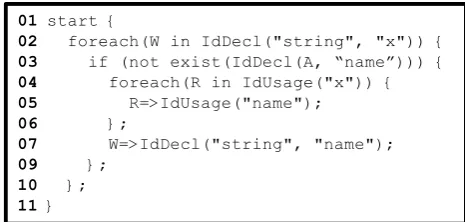
Basically, it looks for an identifier declaration node which has x as name and string as type. If found, it verifies if does not exist an identifier declaration node with any type called name. If not, it replaces each usage of x with name and also renames the node declaration from x to name.
01 start {
02 foreach(W in IdDecl("string", "x")) { 03 if (not exist(IdDecl(A, “name”))) { 04 foreach(R in IdUsage("x")) { 05 R=>IdUsage("name");
06 };
07 W=>IdDecl("string", "name"); 09 };
10 }; 11 }
[image:13.595.308.541.625.736.2]The lines 01 and 11 delimit the program scope called the program start point. Each line inside this block will be executed. However, the start point is not mandatory and someone might implement just procedures to be imported and used by others program transformations. In this case, the program start point will not exist.
Before explaining the foreach statement, it is necessary to elucidate the node function as the foreach uses it. Node function is an expression in the language, responsible for looking in the AST to find a specific node or a set of nodes based on the arguments passed which are filter criteria. Besides searching, the node function could also be used in pattern matching expressions to verify if some variable matches the specified format. In the above example, IdDecl and IdUsage are node functions defined in the abstract syntax of the pseudo-language.
The lines 02,10 and 04,06 delimit the scope of the first and second foreach statement, respectively shown in Figure 2. The command foreach is iterative and uses the node function structure to bring back all tree nodes that matches a format defined. This command iterate over the result list making possible the execution of operations over each node. The node function used in the example was the IdDecl and IdUsage as said before. The first one returns all identifier declarations that have x as name and string as type and the second one returns all identifier usages that have x as name.
The If-Else command could be used to verify the existence of a specific node using the exist clause, or to verify if the current node matches a specific format using the is clause. Both are flexible validations available on the language. The lines 03 and 09 delimit its scope. In this case, it checks if it does not exist an identifier declaration with any type called “name”.
Finally, the term rewriting operation, described by the symbol “=>”, which is used in the lines 05 and 07, responsible for transforming a node in a new one. In the first case, it renames the identifier usage from x to name; in the other case, it renames the identifier declaration from x to name, preserving the same type.
It is important to mention that the language has other features that were not shown here, such as procedures definitions and string operations since they are standard for the existent languages.
4.
Future Plans
In the short term, we are going to have a flexible transformation system based on a generic transformation language, tested against different programming languages. This system will help both refactoring community and developers, in which anyone will be able to define his own transformations and automate the application of complex refactoringas the transformation language defined is easy to understand and to use.
5.
References
1. W. Opdyke: Refactoring Object-Oriented Frameworks. PhD thesis, University of Illinois at Urbana-Champaign, 1992.
2. Sun Microsystems. Retrieved 07-2007, from Java SE: http://java.sun.com/javase/.
A Refactoring Discovering Tool based on Graph Transformation
Javier P´
erez, Yania Crespo
Departamento de Inform´
atica
Universidad de Valladolid
{
jperez,yania
}
@infor.uva.es
Abstract
One of the problems of documenting software evo-lution arises with the extensive use of refactorings. Finding and documenting refactorings is usually harder than other changes performed to an evolving system. We introduce a tool prototype, based on graph trans-formation, to discover refactoring sequences between two versions of a software system. When a refactor-ing sequence exists, our tool can also help reveal the functional equivalence between the two versions of the system, at least, as far as refactorings can assure be-haviour preservation.
1
Introduction
Efforts to include refactorings as a regular tech-nique in software development have led refactoring support to be commonly integrated into development environments (i.e. Eclipse Development Platform, IntelliJR Idea, NetBeans, etc.). Finding refactorings,
now they are extensively used, is one of the problems of software evolution [2, 3]. For version management tools, for example, refactorings are modifications more difficult to deal with than any other kind of changes.
Our tool prototype implements a method, based on graph transformation [5, 8], to discover refactoring se-quences between two versions of a software system. In case a refactoring sequence exists, our tool can also help reveal the functional equivalence between the two versions of the system, at least, as far as refactorings can assure behaviour preservation.
2
Graph parsing approach
To search refactorings we use graph transforma-tion as an underlying formalism to represent Object-Oriented software and refactorings themselves. Refac-torings involve modification of the system structure,
so we believe that graph transformation, which focuses on description and manipulation of structural informa-tion, is a quite appropriate formalism.
In [4, 7] the graph transformation approach is shown to be valid for refactoring formalisation. In these works, programs and refactorings are represented with graphs, in a language independent way, using a kind of abstract syntax trees with an adequate expressive-ness level for the problem. This representation format is claimed to be language independent and very sim-ple, with the purpose of making it easy to use and as flexible as possible. Therefore, as suggested in [7], it was necessary to extend the graph format to represent ‘real’ programs containing specific elements and con-structions of a particular language. We have developed an extension to represent Java programs which we have named ‘Java program graphs’.
Once programs have been represented with graphs, and refactoring operations have been described as graph transformation rules, we apply graph parsing al-gorithms to find the refactoring sequence between two different versions of a software system. We address the problem of finding a transformation sequence from one version of the system to another as a state space search problem. With this approach we identify: the original/old system as a start state, refactoring operations as state changing operations (edges),the refactored/new systemas the goal state,the prob-lem of whether a refactoring sequence existsas a reachability problem, anda refactoring sequence
as the path from the start state to the goal state. We propose a basic search algorithm to look for refactoring sequences. In order to allow some kind of guided search, we base our solution in the use of refactoring preconditions and postconditions. So our approach needs refactoring definitions which include preconditions and postconditions.
iteration is composed just of refactorings whose precon-ditions are held in the current state and whose post-conditions are held in the goal state. When no more refactorings are selectable, the algorithm backtracks to the last transformation applied. The algorithm ends up in success when the current state graph is isomor-phic to the goal state graph. The refactoring sequence is the path found to the goal state. The algorithm ends up in fail when no more refactorings can be executed, and the current and goal states are not isomorphic.
3
Our tool so far
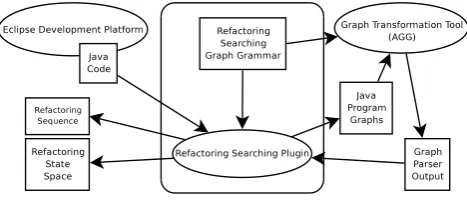
Our refactoring discovering tool consists mainly of a
refactoring searching graph grammarand a plu-gin for the Eclipse Development Platform (see Fig. 1), which has a strong refactoring support.
We have developed a sample implementation of some searching rules to test the validity of our approach. Up to date, the refactoring searching graph grammar searchs for pullUpMethod, renameMethod and useSu-perType, supported by the Eclipse refactoring engine, removeMethod and removeClass. Using graph repre-sentation for source code enables to adjust the detail level by adding or removing elements from the graph model. The set of searchable refactorings can be easily extended by adding more searching rules to the gram-mar.
We use the AGG graph transformation tool [1] as the back-end of our prototype implementation. AGG is a rule-based tool that supports an algebraic approach to graph transformation, and allows rapid prototyping for developing graph transformation systems. We have chosen AGG mainly because it supports graph parsing. Graph parsing can be used to perform depth first search with backtracking, and our algorithm can be partially implemented that way.
Our initial Eclipse plugin [6] obtains the Java pro-gram graph representation from the source code of the two versions of a system, launches the graph transfor-mation parser and shows a part of the output dumped by the parser. From this raw information, we are able to identify the refactoring sequence found, but this is only valid for the purpose of testing our approach. There is a clear need to improve the front-end to show up the search results in a more convenient way.
4
Results and future work
[image:16.595.310.544.71.177.2]We have developed a tool prototype based on graph transformation to find whether a refactoring sequence exists between two versions of a software system or
Figure 1. Outline of our tool
not. Our implementation is a proof of concept that offers very promising results.
Our innmediate objectives are to improve the vi-sualisation of results, to implement refactoring search-ing rules to support more refactorsearch-ing operations and to measure the scalability of our technique over industrial-size systems. This will include improving rule descrip-tions to take benefit of new features being added in the newest versions of the AGG tool or even testing other graph transformation tools for the back-end.
References
[1] Agg home page, graph grammar group, Technische Uni-versit¨at Berlin. http://tfs.cs.tu-berlin.de/agg. [2] S. Demeyer, S. Ducasse, and O. Nierstrasz. Finding
refactorings via change metrics. In OOPSLA, pages
166–177, 2000.
[3] D. Dig, C. Comertoglu, D. Marinov, and R. Johnson. Automatic detection of refactorings in evolving
com-ponents. InECOOP 2006 - Object-Oriented
Program-ming; 20th European Conference, Nantes, France, July 2006, Proceedings, pages 404–428, 2006.
[4] N. V. Eetvelde and D. Janssens. Refactorings as graph transformations. Technical report, Universiteit Antwer-pen, 2005.
[5] H. Ehrig, G. Engels, H.-J. Kreowski, and G.
Rozen-berg, editors.Handbook of Graph Grammars and
Com-puting by Graph Transformations, Volume II: Applica-tions, Languages and Tools, volume 2. World Scientific, 1999.
[6] B. Mart´ın Arranz. Conversor de Java a grafos AGG para Eclipse. Master’s thesis, Escuela T´enica Superior de Ingenier´ıa Inform´atica, Universidad de Valladolid, September 2006.
[7] T. Mens, N. Van Eetvelde, S. Demeyer, and
D. Janssens. Formalizing refactorings with graph
trans-formations.Journal on Software Maintenance and
Evo-lution: Research and Practice, 17(4):247–276, July/Au-gust 2005.
[8] G. Rozenberg, editor. Handbook of Graph Grammars
Refactoring with Contracts
Yishai A. Feldman
IBM Haifa Research Lab
[email protected]
Maayan Goldstein
IBM Haifa Research Lab
[email protected]
Shmuel Tyszberowicz
The Academic College
of Tel-Aviv Yaffo
[email protected]
1 Introduction
Design by contract [9] is a practical methodology for developing object-oriented programs together with their specifications. It offers immediate benefits in terms of early error detection as well as long-term process im-provement. The contract consists of class invariants and method pre- and postconditions. Method preconditions must hold on entry to the method; it is the responsi-bility of the caller to make sure they hold when the call is made. Method postconditions must hold on exit from the method, provided that the preconditions held on entry. Class invariants must hold for every object of the class on entry to and exit from every non-private method. The contract is part of the public information of the class, for use by clients.
The contract has several methodological implications [9]:
• It clearly specifies the assumptions underlying the use of existing classes.
• It places constraints on inheritance, according to the behavioral subtyping principle [8]. A sub-class must honor the contracts made by its parent classes. Hence, subclasses can only weaken pre-conditions, and can only strengthen postconditions and invariants. (Violations of this principle are bugs even when contracts are not explicitly spec-ified; they are more likely to go unnoticed in that case.)
• The assertions can be used to prove the correctness of the program at various levels of rigor.
Design by contract is an integral part of the Eiffel pro-gramming language [9]. There are a number of tools that instrument Java programs with the contract (e.g., [4, 2, 1]).
Design by contract is synergistic with many agile practices, and can be used to replace unit tests to a sig-nificant degree [3]. When refactoring the code, any unit test for affected code must be modified accordingly. If
the assertions in the unit tests are replaced by contract checks, tests need only exercise the code, and can there-fore be written at a higher level than a single method or even class. However, the contracts still need to be refac-tored with the code. This is easier than refactoring unit tests, since what programmers have in mind when refac-toring code is the intended functionality of the modified code, which is directly expressed by the relevant con-tracts. Furthermore, it is possible to automate contract refactoring to a large extent [3, 7].
Automating contract refactoring, in conjunction with other tools (such as code instrumentation, verification, and contract discovery), also has the potential to in-crease acceptance and widespread use of the design-by-contract methodology.
2 Refactoring Contracts
There are several levels of automation required for contract refactoring. Typically, the contract for Java programs is expressed using Javadoc tags such as @inv,@pre, and@post. Contract assertions are just boolean-valued expressions, and therefore need to be treated as code rather than comments in refactorings such as Rename Method or Inline Method. This is rela-tively easy to automate.
contract (which is not always the strongest [7]). Some refactorings, most notably Extract Method, re-quire completely new contracts for arbitrary pieces of code. This is very difficult to do in general, although we have made some steps in this direction [5].
Because of the behavioral subtyping principle, the ap-plicability of some refactorings, such as Move Method, may depend on the contract. If the contract of the method violates behavioral subtyping in its new posi-tion, either the contract must be modified appropriately first, or the refactoring is invalid. Here, too, a theorem prover is necessary to discover such cases.
According to Feldman’s analysis [3], of the 68 refac-torings mentioned in Chapters 6–11 of Fowler’s book [6], 32% do not impact contracts except for treating assertions as code. The applicability of some 13% of Fowler’s refactorings are constrained by the contracts. In 59% of the refactorings (including 4% that overlap with the previous category), new or modified contracts need to be computed.
Feldman estimated that 71% of Fowler’s refactorings can be automated with relative ease, and about 12% re-quire theorem proving for checking constraints. Some 17% require the computation of completely new con-tracts, which is an open problem.
3 Crepe
In order to investigate the techniques necessary for con-tract refactoring, we have implemented Crepe (Concon-tract REfactoring Plugin for Eclipse) [7]. Crepe implements a small number of refactorings, including the full form of Extract Superclass. It demonstrates the treatment of assertions as code, the computation of new or modified contracts in the simpler cases, and the use of theorem prover for checking constraints and simplification. We estimate that 83% of Fowler’s refactorings can be im-plemented using the same techniques.
References
[1] D. Bartetzko, C. Fischer, M. M¨oller, and H. Wehrheim. Jass—Java with assertions. Electronic Notes in Theoretical Computer Science, 55(2), 2001.
[2] L. Burdy, Y. Cheon, D. Cok, M. Ernst, J. Kiniry, G. T. Leavens, K. R. M. Leino, and E. Poll. An overview of JML tools and applications. In T. Arts and W. Fokkink, editors, Eighth Int’l Workshop on Formal Methods for Industrial Critical Systems (FMICS ’03), pages 73–89, June 2003.
[3] Y. A. Feldman. Extreme design by contract. In Fourth Int’l Conf. Extreme Programming and Ag-ile Processes in Software Engineering (XP 2003), pages 261–270, Genova, Italy, 2003.
[4] Y. A. Feldman, O. Barzilay, and S. Tyszberowicz. Jose: Aspects for design by contract. In Proc. Fourth IEEE Int’l Conf. Software Engineering and Formal Methods, pages 80–89, September 2006.
[5] Y. A. Feldman and L. Gendler. DISCERN: Towards the automatic discovery of software contracts. In Proc. Fourth IEEE Int’l Conf. Software Engineer-ing and Formal Methods, pages 90–99, September 2006.
[6] M. Fowler. Refactoring: Improving the Design of Existing Code. Addison-Wesley, 2000.
[7] M. Goldstein, Y. A. Feldman, and S. Tyszberowicz. Refactoring with contracts. InProc. Agile 2006 Int’l Conf., pages 53–64, July 2006.
[8] B. H. Liskov and J. M. Wing. A behavioral notion of subtyping.ACM Trans. Programming Languages and Systems, 16(6):1811–1841, 1994.
Synchronizing Refactored UML Class Diagrams
and OCL Constraints
Slaviˇsa Markovi´c and Thomas Baar
´
Ecole Polytechnique F´ed´erale de Lausanne (EPFL)
School of Computer and Communication Sciences
CH-1015 Lausanne, Switzerland
Email:
{
slavisa.markovic, thomas.baar
}
@epfl.ch
Abstract—UML class diagrams are usually annotated with OCL expressions that constrain their possible instantiation. In our work we have investigated how OCL annotations can be automatically updated each time the underlying diagram is refactored. All our refactoring rules are formally specified using a QVT-based graphical formalism and have been implemented in our tool ROCLET.
I. REFACTORINGCLASSDIAGRAMS
[image:19.595.317.535.485.552.2]In this section we give a motivation for performing UML/ OCL refactorings and show on an example, how OCL con-straints have to be treated when the underlying UML class diagram changes. Note that our approach does not aim to improve the structure of OCL expressions in order to get rid of OCL smells (see [1]). We are just concerned about smells in UML class diagrams, how to eliminate these smells by class diagram refactorings, and how to keep the annotated OCL constraints in sync with these changes.
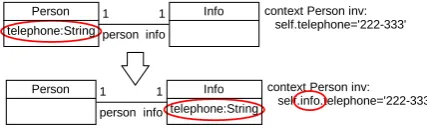
Figure 1 shows the application of refactoring MoveAt-tribute on a class diagram annotated with one OCL invari-ant. The refactoring moves attribute telephonefrom class Person to class Info. In order to preserve the syntacti-cal correctness of annotated constraints, it is necessary to rewrite all navigation expressions of form exp.telephone byexp.info.telephone.
Person telephone:String
Info 1 1
info person
context Person inv: self.telephone='222-333'
Person Info
telephone:String 1
1 info person
context Person inv: self.info.telephone='222-333'
Fig. 1. MoveAttributeExample
The only preconditions for this refactoring are (1) that the attribute is moved over an association with multiplicities 1-1 and (2) that in the destination class (Info), or in any of its descendants and ancestors, there is no attribute with the same name as the name of the moved attribute (telephone).
There are other refactoring rules, which do not influence annotated OCL constraints but whose applicability depends on the absence of OCL expressions of a certain type. One example is the rule PushDownAttribute; Fig. 2 shows an application where attributecoloris pushed down from classVehicle
TABLE I
OVERVIEW OFUML/OCLREFACTORING RULES
Refactoring rules Influence on OCL Precondition
RenameClass No* UML RenameAttribute No* UML RenameOperation No* UML RenameAssociationEnd No* UML PullUpAttribute No UML PullUpOperation No UML/OCL PullUpAssociationEnd No UML/OCL PushDownAttribute No UML/OCL PushDownOperation No UML/OCL PushDownAssociationEnd No UML/OCL ExtractClass No UML ExtractSuperclass No UML MoveAttribute Yes UML MoveOperation Yes UML MoveAssociationEnd Yes UML
*–Renamerefactorings influence textual notation of OCL constraints but not their metamodel representation
to class Car. This refactoring is only possible if for all occurring expressions exp.color the type of subexpression
exp conforms to destination class Car.
Vehicle color:String
context Car inv: self.color='blue' Car
Vehicle
context Car inv: self.color='blue' Car
color:String
Fig. 2. PushDownAttributeExample
In [2], we have investigated and formalized a catalog of class diagram refactorings together with necessary changes of OCL constraints. Table I gives an overview of refactorings that can be applied on a class diagram, together with information whether the refactoring influences OCL constraints, and which part of the UML/OCL model is checked by the refactoring’s application condition.
II. MODELTRANSFORMATIONS
[image:19.595.58.272.534.600.2]RenameAttributeUML(a:Attribute, newName:String)
{when} oldName <> newName and
c.allConflictingNames()->excludes(newName)
a:Attribute name=newName
c:Class c:Class
owner
owner feature a:Attribute
[image:20.595.63.268.53.143.2]name=oldName feature
Fig. 3. QVT Formalization ofRenameAttributeRefactoring
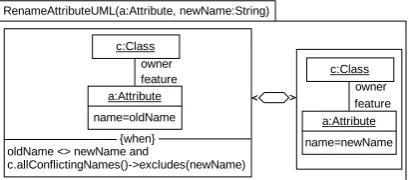
The formalization of the refactoring (RenameAttribute) is shown as a QVT rule in Fig. 3. QVT rules consist of basically two patterns (LHS, RHS). When applying the rule, occurrences of LHS are searched for in the non-refactored model that we want to change. If an occurrence is found, it is substituted with the corresponding instantiation of RHS. Additional constraints specified in the ”when” clause specify formally the application conditions for the refactoring rule (ignoring them could result in syntactically invalid target models). For more information on the formalization of refactorings, we refer the interested reader to [2]. The refactoring rule RenameAttribute does not have an influence on attached OCL constraints. More complicated rules that have an influence (e.g.MoveAttribute), are formalized by two QVT rules; one describing the changes in the class diagram and a second for updating the OCL (see [2] for details).
III. LESSONSLEARNED
A model refactoring is usually defined as a model trans-formation for which source and target model are instances of the same metamodel. During our work on implementing QVT-specified refactoring rules we have noticed that it is sometimes useful to relax this definition and to allow source and target model to have different metamodels.
A. Syntax Preservation
Refactoring rules should be syntax-preserving; i.e. syntacti-cally correct source models should always be mapped to syn-tactically correct target models. However, syntax preservation is sometimes technically difficult to achieve, especially, if the metamodel contains hundreds of well-formedness rules.
Syntax preservation becomes easier to handle when refac-toring is seen as a two-step process: (1) the source model is transformed to an intermediate model, which is an instance of a different metamodel; (2) from the intermediate model the final target model is recovered by a second transformation. In case of UML/OCL refactorings, the intermediate metamodel could represent OCL constraints as text and the refactoring rules just have to ”produce” text in order to represent syn-chronized OCL constraints. The second recovery step would then parse the produced text as OCL constraints and create an instance of the original UML/OCL metamodel. Another possibility for an intermediate metamodel could be to use the original UML/OCL metamodel, but without any of its derived model elements. In this case, the only task of the recovery step would be to complete the intermediate model to an instance
of the original UML/OCL metamodel by adding the (so far missing) derived model elements.
B. Behavior Preservation
In case of UML class diagram refactorings, the definition of behavior preservation in traditional program refactoring as ”same inputs lead to the same output” is not applicable because class diagrams represent only the static structure of a system. Our criterion for behavior preservation is based on the evaluation of OCL constraints in a system snapshot. In [3], we propose to call UML/OCL refactorings behavior preserving
if the evaluation of a non-refactored OCL constraint on a valid instance of a non-refactored UML class diagram yields always the same result as the evaluation of the refactored OCL constraint on the corresponding instance of the refactored UML class diagram.
Contrary to some authors, like [4], we allow object diagrams also to be refactored. We believe that our definition of semantic correctness gives more freedom in performing refactorings and allows wider spectrum of refactoring rules to be applied on a UML class diagram.
IV. CONCLUSIONS
In this paper we have presented our approach of refac-toring UML class diagrams annotated with OCL constraints. All refactorings that can be applied on class diagrams are specified as model transformation rules and implemented in our ROCLET tool [5].
Moreover, an overview of lessons learned during the process of formalization and implementation is given. We think that the technique to handle refactorings as a 2-step process can help to simplify the refactoring of many other software artifacts as well.
REFERENCES
[1] Alexandre Correa and Cl´audia Werner. Applying refactoring techniques to UML/OCL. InUML 2004, volume 3273 ofLNCS, pages 173–187. Springer, 2004.
[2] Slaviˇsa Markovi´c and Thomas Baar. Refactoring OCL annotated UML class diagrams.Software and Systems Modeling (SoSym), 2007. In press. Online available under DOI 10.1007/s10270-007-0056-x.
[3] Thomas Baar and Slaviˇsa Markovi´c. A graphical approach to prove the semantic preservation of UML/OCL refactoring rules. InPSI 2006, volume 4378 ofLNCS, pages 70–83. Springer, 2007.
[4] Rohit Gheyi, Tiago Massoni, and Paulo Borba. A static semantics for alloy and its impact in refactorings. Elsevier’s Electronic Notes in Theoretical Computer Science (To appear), 2006.
![Figure 1 yields the inequality [formally proving the necessity of x ] ≤[ C . m( ) ] ≤[ y ] ≤B x being of type B.](https://thumb-us.123doks.com/thumbv2/123dok_us/1715535.124939/23.595.302.554.234.285/figure-yields-inequality-formally-proving-necessity-c-type.webp)