Event-calculus semantics of Polish aspect
Piotr Labenz
Master of Logic thesis
Institute for Logic, Language and Computation
Universiteit van Amsterdam
Có˙z onrobiłprzez ten rok? Wszystko, albo prawie wszystko. A có˙zzrobił? Nic, albo prawie nic.
Whatwas he doingduring that year? Everything, or almost everything. And whathas he done? Nothing, or almost nothing.
Contents
1 Introduction 5
2 Polish verbal aspect 7
2.1 The linguistic data . . . 8
2.1.1 Perfective and imperfective . . . 8
2.1.2 Habitual . . . 10
2.1.3 Markedness and tense . . . 11
2.2 The aspectual classification . . . 12
2.2.1 Aspectual pairing tests . . . 12
2.2.2 The classification arises . . . 14
2.2.3 Exceptions . . . 18
3 Which semantics for aspect? 21 3.1 Tense logic approach . . . 22
3.2 Why event calculus? . . . 24
3.2.1 Time and planning . . . 25
3.2.2 Evidence from Polish . . . 26
3.2.3 Meaning as computation . . . 28
3.3 Quantificational approaches . . . 28
4 Event calculus 33 4.1 The formal systemEC . . . 33
4.1.1 Syntax . . . 33
4.1.2 Semantics . . . 35
4.2 Minimal models . . . 36
4.2.1 Simple logic programming . . . 37
4.2.2 Negation as failure . . . 38
4.2.3 Constraint logic programming . . . 40
4.2.4 Inertia . . . 40
4.3.1 Scenarios . . . 41
4.3.2 Eventualities . . . 42
4.3.3 Integrity constraints . . . 44
5 Event-calculus semantics for aspect 45 5.1 Tense . . . 45
5.2 Semantics of the Aktionsarten . . . 47
5.2.1 Class1t: transitions . . . 48
5.2.2 Class1s: states . . . 52
5.2.3 Class2: strict activities . . . 53
5.2.4 Class3: accomplishments . . . 59
5.2.5 Class4: semelfactive activities . . . 61
5.2.6 Class5: achievements . . . 63
5.3 Results and outlook . . . 65
5.4 Examples of computations . . . 69
5.4.1 Non-monotonic cancellation . . . 69
5.4.2 Imperfective as background . . . 70
5.4.3 Additive coercion . . . 74
6 Conclusion 77
1 Introduction
Aspect and tense are natural languages’ principal devices for express-ing temporal relationships. Aspect is particularly important in languages which have grammaticalised it, such as the Slavic languages, among them – Polish. Usually it is said (by linguists [9], [28], [37]) that while tense ex-presses the location in time of some occurrence in question, aspect carries the speaker’s subjective temporal perspective on it. But usually aspect is used (by native speakers [25]; cf. 2.1) to indicate some objective temporal information about the occurence, such as whether it has been completed. These views seem to be as correct as they are incompatible. Matters are not made easier by the complicated morphology of the Polish verb, which obscures possible explanations.
This work’s purpose is to develop a semantics of the Polish aspect in the framework of van Lambalgen and Hamm’s [33] event calculus. It may be hoped to relieve the discomforting situation just mentioned. Besides, it can be expected – as always when a formal semantics is developed for a fragment of a natural language – that the phenomenon at hand, viz. as-pect, will be elucidated, and the theory used, viz. event calculus, will be vindicated by a successful application. In particular, e.g. arguments in favour of dividing the Polish verbs into Aktionsarten (cf. 2.2.2) and for treating the notion of planning as underlying the semantics of aspect (cf. 5.3) will be given.
The layout is as follows:
• In Chapter 2 the data are described, namely in 2.1 the basic informa-tions about the Polish verbal aspect are given, while in 2.2 a more systematic treatment is introduced, following Młynarczyk [42].
• Accordingly, Chapter 4 is devoted to introducing the event calculus formally, following [33].
• The gist of the thesis is to be found in Chapter 5, where the formal apparatus is applied to the data. The semantics thus developed in 5.2 is summarised in 5.3, along with the main conclusions of the work. Concrete examples of computations doable in the calculus are dis-cussed in 5.4.
2 Polish verbal aspect
Our topic not being philosophical, we shall not do unwisely by introduc-ing the explanadum first. Hence, in 2.1 the data will be described from a possibly unbiased perspective – which, being thus atheoretical, might appear rather confusing. However, purposefully so, since indeed the data seem prima facie quite bewildering, both to the linguist and to the native speaker. The confusion will be relieved in 2.2 by introducing Młynarczyk’s [42] aspectual classification of Polish verbs, which not only clarifies the data, but also provides the canvas for our further semantic investigations. Preliminary remarks are in order here. Firstly, no general definition of aspect or of aspectual values will be attempted in this work. Such defini-tions are notoriously difficult to formulate; some can be found in Comrie’s [9] textbook – along with a general introduction to aspect – and in [28]. It can be hoped, though, that this work will, by investigating their particular workings, shed some light these general notions. Secondly, verbal aspect is discussed in this chapter, since it is a phenomenon grammaticalised in Polish (as in other Slavic languages) on the lexical level. This perspective will be sustained throughout, but not without a possibility of extending to the sentential level (cf. 3.3).
2.1 The linguistic data
The principal aspectual opposition of perfective and imperfective will be described first, hinting at the problems with accounting for it at the simple morphosyntactic or lexical-semantic level. Secondly we will consider the status of the other aspectual value grammaticalised in Polish, that is, the habitual. We will end with some remarks on tense and markedness that will be needed later on. For more details on Polish grammar, historico-linguistic data and historical details on the study of aspect, [42] can be consulted. A recent major study, albeit in Polish, is [8].
2.1.1 Perfective and imperfective
The aspectual values of perfectivity and imperfectivity are ubiquitous in Polish, since each verb of that language can be ascribed one of them. Im-perfectives can take any of the three tenses available in Polish, namely past, present and future; perfectives cannot take the present tense. Let us consider an imperfective in the past tense:
(1) czytałem(‘I have been, I was reading’)
Now, it seems that the intuition of a theoretically unbiased native speaker is that an imperfective normally has its perfective equivalent; that is to say, Polish verbs come in imperfecitve-perfective pairs. Usually, the perfective is formed by adding one of a number of prefixes that stem from preposi-tions. Thus of (1) one would prima facie say that its perfective form is:
(2) przeczytałem(‘I have read’)
whereprze-– stemming fromprzez, ‘across, through’ – indicates that read-ing has been completed.
However, the perfectivising prefix need not be semantically empty, as it is in the above example; to the contrary, it may contribute new infor-mation. For instance, in some contexts the completion of the process of reading referred to byczytałemmight be, to name a few possibilites:
(3) odczytałem(‘I have read (aloud)’, ‘I have figured out by reading’) (4) wyczytałem(‘I have read out (e.g. a name from a list etc.)’, ‘I have
learned (a piece of trivia) by reading’)
(5) sczytałem(‘I have read off (e.g. a code from an object etc.)’)
(6) czytywałem(‘I used to read (from time to time)’) the habitual; see 2.1.2.
Moreover, prefixation is not the only means of perfectivisation. In some cases, a suffix like-n ˛a-, which has no meaning on its own, is used for deriving the perfective, for instance:
(7) kopałem(‘I was, I have been kicking’) (8) kopn ˛ałem(‘I have kicked (once)’) But also the other way round:
(9) zapytałem(‘I have asked (about something)’)
(10) zapytywałem(‘I was, I have been asking (about something)’)
some imperfectives arise from perfectives by suffixation (e.g. -wa-and a vowel change) similar to that by which the habitual (6) can be derived by from the perfective (1).
Summing up, the aspectual distinction in Polish is not a syntactic one, because it does not account for a regularity in the morphology of the verb. Prefixation may give rise to a perfective, but also add some meaning be-yond changing the aspectual value; suffixation can give rise to a perfective, but also to a habitual. Slavic scholars may then deliberate, whether some particular pre- or suffixes do give rise to ‘genuine’ aspectual pairs, while others change the meaning [11]. That, however is unavoidably arbitrary, since one can define some particularly well-behaved subclass of verbs to be ‘genuine’, but that will not be much of an explanation of the aspectual system. Hence the received view is that, in spite of the intuition of pairing, the perfective and imperfective forms are generally distinct lexical items.
To the contrary, the aspectual distinction is clearly a semantical one; indeed, a seventh-grade textbook says:
We distinguish imperfective and perfective verbs. Imperfective verbs denote the duration of an activity or a state in the present, the past or the future. . . . Perfective verbs denote the comple-tion of an activity or of a state in the past or in the future. They occur in two tenses: the past and the future. [25, pp. 70–71]
promising, because there is no overt regularity in the meanings either. The prefixes do have a semantic ‘flavour’ inherited from the prepositions they originated from, but it is extremely vague. Sometimes it is so weak that the prefix is semantically empty, and adding it only perfectivises the verb (as inczytałem,przeczytałem) – and sometimes it does alter the meaning (as in czytałem,wyczytałem)1. But the alteration may be very slight and not
obvi-ous even for native speakers. For instance, what is the difference between pocałowa´c and ucałowa´c (both ‘to have kissed’, but the latter is of slightly higher register); is it the same as between pokocha´c and ukocha´c (both ‘to have started loving’, but again they differ in some shade of meaning)? To attempt explaining the aspectual system by investigating such questions would be a Sisiphus’ task.
Therefore neither morphology nor lexical semantics alone can system-atise the Polish aspectual system so as to account for the intuition of aspec-tual pairing. Indeed, on both approaches we would be forced to regard an imperfective and a corresponding perfective as distinct items. But that would be unsatisfactory, because there undoubtedly is a systematic con-nection between the meanings of corresponding perfectives and imperfec-tives – and to account for it is an objective of this work. For that, we need another approach to systematising the aspectual system; it seems that one such approach is the aspectual classification proposed by Młynarczyk [42] (cf. 2.2).
2.1.2 Habitual
From some, but not all, Polish imperfectives a habitual form can be de-rived by the formant-yw-or-iw-; for instance, corresponding to (1):
(6) czytywałem(‘I used to read (from time to time)’)
These habituals always have an iterative reading – unlike, for instance, the English habitual ‘used to . . . ’. Not all imperfectives have corresponding habituals; ones that are unlikely to have an iterative reading, for instance pali´c si˛e, ‘to be burning’ do not. Nor are there any habitual perfectives – unlike, for instance, in Bulgarian [9, 1.2.1]). Therefore in terms of school grammar habituals are a subclass of imperfectives. Yet on the whole, re-stricting the discussion of Polish aspect to the perfective-imperfective op-position and neglecting the habitual forms is not likely to be misleading or losing generality. Thus since this restriction significantly simplifies the data, we will follow Młynarczyk [42] in assuming it.
1Such perfectives with added meaning are called ‘Aktionsartal’ by some Slavists; cf.
However, any imperfective, regardless of whether there is a corre-sponding grammatical habitual, can have an iterative or habitual reading, for instance:
(11) Samochody carsacc
to
thisnienotRuscyRussianskradn ˛a,steal3.pl.ipfv
tylko but robi ˛ado3.pl.ipfv
to
thiswła´sniejust Polacy.
Poles
It’s not the Russians who steal cars, indeed Poles do it.2
quite like e.g. the English Simple tenses can, as the translation evinces (cf. [10, p. 39]). Ones likepali´c si˛ementioned above, though, only acquire the iterative reading when coerced by an adverb like ‘usually’ etc. Again, for clarity of presentation we will ignore these readings throghout, even though in principle they could be incorporated in our semantics. In par-ticular, in 5.2.6 we will discuss the few perfectives, such as pozabija´c, ‘to kill several times’, that have only the iterative reading – thus seeming to be derived from the iterative readings of the corresponding imperfectives.
2.1.3 Markedness and tense
In the opposition of imperfectivity and perfectivity, the latter is clearly the marked element (thus the linguistic communis opinio [42, p. 46], [9, 6.1], as well as speaker intuitions). One consequence of this is that an imperfec-tive’s being true does not determine the truth value of the corresponding perfective, while a perfective usually cannot be true when the imperfective is false, e.g.:
(12) * Wypili, drunk3.pl.ep-pfv
chocia ˙z
though nienotpili.drunk3.pl.ipfv
They have drunk up, even though they haven’t been drinking.
Indeed, a perfective can always be replaced by an imperfective – the mean-ing may be less explicit, but it will not be contradicted; but not conversely.
2In glosses, the verbs’ aspect is given in superscript; in subscript, person and
Hence (2) cannot mean ‘I have been reading’, but (1) could mean ‘I have read’ – and indeed in absence of evidence to the contrary it will be thus understood (as in (25)). This default inference from imperfective to per-fective takes place with accomplishment verbs and will be explained in 5.2.4.
Moreover, note that since there are no grammaticalised relative tenses in Polish (apart from seldom-used relics of pluperfect), the three absolute tenses sometimes are used in their stead. Thus the past perfective can sometimes be assigned the rôle fulfilled in English by Past Perfect; past imperfective – Past Perfect Continuous; future perfective – Future Perfect; and future imperfective – Future Perfect Continuous. This can be signalled by temporal adverbs or the ordering of information in discourse, or left to be inferred via world knowledge.
2.2 The aspectual classification
Here we will summarise Młynarczyk’s aspectual classification of Polish verbs [42], suggesting some alterations. To begin with, pairing tests (2.2.1) allow to establish which verbs form aspectual pairs – or, strictly speak-ing, tuples, since sometimes to one imperfective two or three perfectives correspond. A test can formulated to apply to almost all Polish verbs, sug-gesting that there are four morphologically distinct methods of perfectivi-sation – two types of prefixation and two of suffixation. By considering, which verbs can take which methods, the classification emerges, yielding five classes of verbs (2.2.2) – which will be the basis of the semantics we shall develop further on. The exceptions to the classification can be rea-sonably explained away (2.2.3).
2.2.1 Aspectual pairing tests
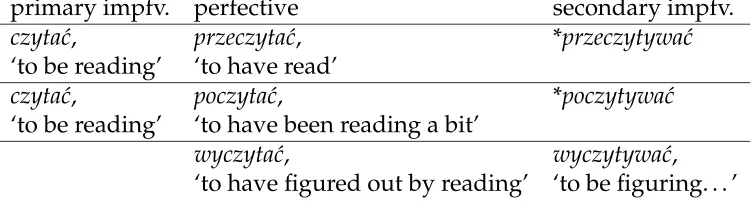
One way of testing whether a perfective corresponds to an imperfective in the sense that they belong to the same aspectual tuple is the secondary im-perfectivisation test [42, p. 116]. A perfective is said to pass it if and only if there is a unique way of imperfectivising it while retaining the single-episode reading; then it belongs in the same aspectual tuple with the re-sulting imperfective. For instance the perfectiveprzeczyta´c, ‘to have read’ can only be imperfectivised toczyta´c, ‘to be reading’, so these two belong in the same aspectual tuple. (It is essential here that we neglect the itera-tive readings.)
candidate form, *przeczytywa´c, is clearly wrong to any competent speaker3.
Now consider (4), in the infinitive: wyczyta´c, ‘to read out (etc.)’; it can clearly be imperfectivised to wyczytywa´c, and indeed these forms belong to the same aspectual tuple. But why not imperfectivisewyczyta´ctoczyta´c, ‘to be, to have been reading’? After all, whenever one has read something out, one has been reading out as well as just reading. The fact thatczyta´c belongs to another aspectual tuple does not affect the test;wyczyta´cfails it. Generalising from this (not untypical) example, it seems that if the imperfective already has a non-empty prefix, the intuitively correspond-ing perfective will fail the test, since it could also be imperfectivised into an imperfective without the prefix. Of course this depends on what do we mean by ‘imperfectivising’ and ‘unique’; but it seems that in order for this test to work properly, these terms would have to be defined so as to beg the question. In other words, the test is inadequate unless we understand these terms as to rule out the alternative way of imperfectivisation. But the above example shows that the latter is very natural, so ruling it out would be rather arbitrary.
One way to avoid this difficulty is to stipulate that the derived imper-fective should have the same lexical meaning as the perimper-fective (modulo aspect, of course) [42, p. 51]. Incidentally, this indicates, what is meant bysecondaryimperfectivisation, as can be seen from Table 1. Then wyczy-ta´c passes the test in tuple withwyczytywa´c, and czyta´cdoes not stand in the way – as it did previously – because it is considered to have different lexical meaning.
primary impfv. perfective secondary impfv.
czyta´c, przeczyta´c, *przeczytywa´c
‘to be reading’ ‘to have read’
czyta´c, poczyta´c, *poczytywa´c
‘to be reading’ ‘to have been reading a bit’
wyczyta´c, wyczytywa´c,
[image:13.595.110.487.493.594.2]‘to have figured out by reading’ ‘to be figuring. . . ’
Table 1: Primary and secondary imperfectivisation
However, while this additional proviso renders the test adequate, it also relies on lexical intuitions heavily. Considerpoczyta´c: according to the above, it has the same lexical meaning (modulo aspect) as czyta´c – while
3Though in some peculiar circumstances it might be used in spite of its incorrectness
wyczyta´cdoes not. Now, whether this is true depends on what one means by ‘modulo aspect’, of course. Given the aspectual classification that is being described here, it in fact is. But a priori it is difficult to think of an intuitive reason for treating poczyta´c as an aspectual variant of czyta´c rather than differing in lexical meaning. To assume there is such a reason is to assume the classification – and thus beg the question again.
This obstacle would dissolve if we could test whether an imperfective and a perfective have the same lexical meaning (modulo aspect) in some operational way – rather than intuitively or by assumption. Now, this seems to be possible by the historical present test, proposed by Maslov [37, p. 53]4. Namely, the two aspectual forms have the same lexical meaning if
translating the perfective’s past tense into the historical present will yield the imperfective. Translation is meant to be as faithful as possible, that is minimising the loss of meaning. Of course this still does rely on speakers’ meaning intuitions, but gives a systematic, operational criterion for testing them. In other words, while it is not obvious, whether poczyta´c has the same lexical meaning as czyta´c, it is clear that the most faithful way of rendering the pastpoczyta´łem, ‘I have been reading a bit’ into the historical present isczytam, ‘I am reading’.
To sum up, the secondary imperfectivisation test is either inadequate – without the stipulation on lexical-meaning identity, or, with it – begging the question. The Maslov test, which can be seen as its operationalised variant avoids these problems. Nevertheless, notwithstanding the previ-ous one’s methodological deficiencies, both tests do give the same results for Polish verbs, that is classify almost all of them into aspectual tuples in a peculiar way, which we will discuss next.
2.2.2 The classification arises
In the aspectual tuples obtained by the pairing test, four systematic ways of perfectivisation, called ‘formants’ (cf. [42, p. 9]), can be distinguished:
• the (semantically) empty prefix, that is any from a group of prefixes like u-, z-, po-, na-, prze- etc. used to contribute no other meaning apart from perfectivisation (ep);
• the semelfactive suffix-n ˛a-;
• morphonological change, that is vowel change and/or removing a suffix from the imperfective, e.g. the-yw-suffix (mp);5
4Reprinted from [36].
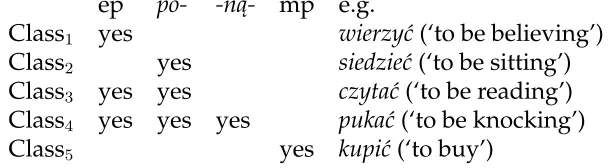
• the delimitative (use of the) prefix po-, that is such that apart from perfectivising induces an ‘a-bit’ – meaning either durationlongerthan usual, or, to the contrary,shorter. We assume that the previous is the semantic meaning and the latter results by pragmatic effects. We take the English expression ‘a bit’ asambiguousbetween ‘quite a bit’ for the previous meaning and ‘only a bit’ for the latter. See 5.2.4. Now the verbs can be segregated according to which formants can they be subject to. (‘The verbs’ meaning almost all Polish verbs; the exceptions are discussed in 2.2.3.) This yields five classes, as shown in Table 2, where ‘yes’ means that verbs of given class can be subject to given formant. This classification, although driven by verbal morphology, turns out to carve at semantic joints:
• Class1 imperfectives denote either states (e.g. lubi´c, ‘to be liking’) or gradual transitions (e.g. chudn ˛a´c, ‘to be getting thinner’); perfec-tives denote either incepted states (polubi´c, ‘to have started liking’) or completed transitions (schudn ˛a´c, ‘to have gotten thinner’).
• Class2 imperfectives denote strict, that is, intransitive activities (e.g. wisie´c, ‘to be hanging’); perfectives denote activities that have been terminated after going on a bit (powisie´c, ‘to have been hanging a bit’).
• Class3 imperfectives denote ongoing and yet not completed accom-plishments (e.g. pisa´c, ‘to be writing’); perfectives formed with the delimitativepo- denote accomplishments that have not been in fact accomplished, but terminated beforehand (popisa´c, ‘to have been writ-ing a bit’); empty-prefix perfectives denote completed accomplish-ments (napisa´c, ‘to have written’).
• Class4 imperfectives denote semelfactive activities, that is activities that can be broken down into minimal instances (e.g. kopa´c, ‘to be kicking’6, consists of single kicks). Perfectives formed by -n ˛a-
de-note such minimal instances (kopn ˛a´c, ‘to have kicked once’); empty-prefix perfectives denote activities completed by iteration of minimal instances (skopa´c, ‘to have beaten by kicking’); finally, delimitative-po- perfectives denote activities terminated after some minimal in-stances, but before completion of the activity (pokopa´c, ‘to have been kicking a bit’).
formant, since the perfective is suffixed to obtain the imperfective. We treat it as a perfec-tivising formant for the sake of uniformity, though.
ep po- -n ˛a- mp e.g.
Class1 yes wierzy´c(‘to be believing’) Class2 yes siedzie´c(‘to be sitting’) Class3 yes yes czyta´c(‘to be reading’) Class4 yes yes yes puka´c(‘to be knocking’)
[image:16.595.144.451.133.217.2]Class5 yes kupi´c(‘to buy’)
Table 2: Aspectual classes according to formant applicability
• Class5 perfectives denote achievements (e.g. zabi´c, ‘to kill’), and im-perfectives achievements ongoing in the sense of still being in the preparatory phase that will lead to the achievement proper (zabija´c, ‘to be killing’).
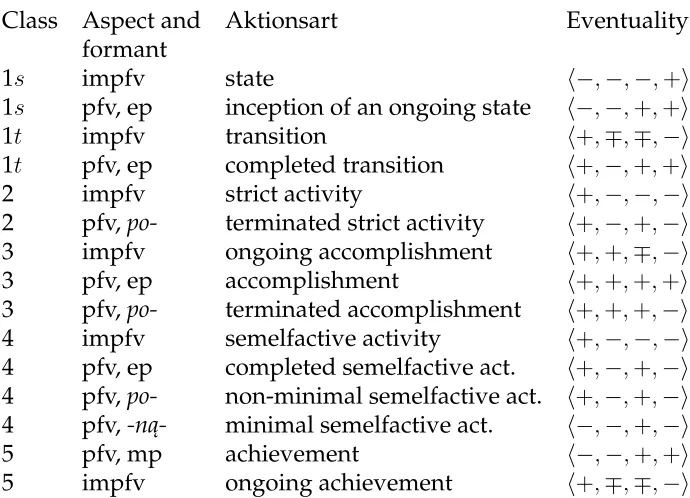
By applying the relevant formants, in total fifteen types of verbs can be obtained – thus exhaustively systematising the Polish aspectual system. Significantly, this emergent classification turns out to be semantic: the fif-teen verb types correspond to different types of occurrences given in Table 3. These types resemble Vendler’s [66]7classification of verbs with respect
to their temporal schemata, taken up by Moens and Steedman [43] as ‘as-pectual classes’ and – following van Lambalgen and Hamm [33, p. 85] – can be calledAktionsarten.8
Now, Class1as defined above encompasses two distinct Aktionsarten, those of states and of gradual transitions. This seems to be a discomfort-ing exception in a classification that otherwise pairs verb classes with Ak-tionsarten. Młynarczyk’s [42, 4.5.1] argument in favour of defining Class1 thus is that the distinction between inchoative and non-inchoative (usages of the) empty prefixes is not a formal one, in the sense that it relies on the speakers’ meaning intuitions rather than on morphology. Hence, she ar-gues, splitting Class1would deprive the classification of its virtue of being a natural semantic pattern emergent from pure morphology. Resorting to semantic intuitions in order to form a semantic pattern would lower the methodological standard.
7See mainly Ch. 4, reprinted from [65].
8Accordingly we change the terminology used in [42] for consistency with [33, p. 88].
Class Aspect and Aktionsart Example formant
1s impfv state wierzy´c‘to be believing’
1s pfv, ep inception of an ongoing state uwierzy´c‘to have started believing’
1t impfv transition grubn ˛a´c‘to be growing fat(ter)’
1t pfv, ep completed transition zgrubn ˛a´c‘to have grown fat’
2 impfv activity siedzie´c‘to be sitting’
2 pfv,po- terminated activity posiedzie´c‘to have been sitting a bit’ 3 impfv ongoing accomplishment czyta´c‘to be reading’
3 pfv, ep accomplishment przeczyta´c‘to have read’
3 pfv,po- terminated accomplishment poczyta´c‘to have been reading a bit’ 4 impfv semelfactive activity puka´c‘to be knocking’
4 pfv, ep completed semelfactive zapuka´c‘to have knocked’
4 pfv,po- non-minimal semelfactive popuka´c‘to have been knocking a bit’ 4 pfv,-n ˛a- minimal semelfactive pukn ˛a´c‘to have knocked once’
5 pfv, mp achievement kupi´c‘to have bought’
5 impfv ongoing achievement kupowa´c‘to be buying’
Table 3: Aktionsarten according to aspect and aspectual class
However, as we have just mentioned above, the classification does relay on some semantic intuitions anyway. Firstly, the secondary imper-fectivisation test, which is indispensable in order to form the classifica-tion, depends on judging whether there is a single way or several ways of imperefectivising a verb. That is an intuitive judgement, for it involves assessing what forms are admissible. For instance, podbija´c (‘to be con-quering’ etc.9) can be derived from podbi´c, but *pobija´c cannot be derived
from pobi´c (‘to have beaten’). One also has to distinguish imperfectives from iteratives, e.g. bija´c, ‘to beat sometimes’.
Furthermore and more importantly, distinguishing the delimitative and empty usages of po- is essential for the classification. Namely, it is necessary in order to distinguish between Class2 and Class1; in the pre-vious, all verbs take the delimitative po-, but in the latter some take the emptypo-. For instance,pokocha´c, ‘to have started loving’, is a Class1s
per-fective, while posiedzie´c, ‘to have been sitting a bit’ is a Class2 one. Such judgements are also intuitive.
Therefore, some semantic intuitions of native speakers are required in order to construct the classification. Then why banish the distinction between Class1t, containing transition verbs and Class1s, containing state
9Namely: ‘to be placing something (a stamp, a heel) by hitting or nailing’, ‘to be
verbs? The intuitive distinction between inchoative and non-inchoative empty prefixes, distinguishing these two classes, seems to be of a similar methodological status as the intuitions mentioned above. Thus, since the distinction is semantically interesting, we will not hesitate to use it.
Hence it seems that what is needed is a semantics for aspect that could account for this classification, by defining the various Aktionsarten. In having emerged from rather concrete data: morphology and but a few simple speakers’ intuitions, it would have the virtue of being grounded in the linguistic data rather than arbitrarily constructed.
2.2.3 Exceptions
There are some verbs that elude the classification, nevertheless not inval-idating it insofar as they are explainable as exceptions. To begin with, modal verbs in Polish have in fact no aspect; grammarians classify them as imperfectiva tantum, but for morphological rather than semantic rea-sons. Thus modals fall out of scope of the classification.
Secondly, there are several suppletive pairs, that is aspectual tuples consisting of morphologically unrelated verbs, as inbra´c, ‘to be taking’ and wzi ˛a´c, ‘to have taken’. Since the classification is driven by morphology, these verbs fall out of its scope as well. However, semantically they be-have just like regular aspectual tuples, and in principle could be ascribed to aspectual classes according to meaning. Thus suppletive pairs do not violate the classification either.
Thirdly, habituals are entirely ignored by the classification, which can be seen as a disadvantage, since they appear to exhibit some aspectual regularity both in terms of morphology and of meaning. Nevertheless, it is neglecting them that has made the picture clear enough for introducing the classification at hand. Extending it to cover habituals as well seems a task rather promising, but requiring further descriptive work – in want of which we are forced to neglect the semantics of the habitual as well. This, however, is admissible insofar as the Polish habitual is of rather small importance, as has been pointed out in 2.1.2. Perhaps more discomfort-ing is that Młynarczyk neglects not only habituals, but all verbs havdiscomfort-ing a multiple-episode reading. In 5.2.6 we will argue that this is not necessary for some non-habitual perfectives having the iterative reading.
Finally and somewhat more importantly, there seem to be a few im-perfectives that can be perfectivised in two distinct ways, using various empty prefixes10. For instance, consider the examples in Table 4, which
imperfective perfective
ty´c ‘to be growing fatter’ uty´c,przyty´c ‘to have grown fatter’
reperowa´c ‘to be repairing’ zreperowa´c,nareperowa´c ‘to have repaired’
całowa´c ‘to be kissing’ pocałowa´c,ucałowa´c ‘to have kissed’
Table 4: Some putative exceptions
could be thought to contradict the classification. However, in some such cases the speaker intuition is not very reliable insofar as on second thoughts one of the perfectives turns out to correspond to a different imperfective; for instance,ucałowa´cseems to correspond to a rather unusual, but admis-sible imperfective ucałowywa´c, ‘to be kissing’. One could at first confuse ucałowa´cto be an empty-prefix perfective ofcałowa´c, because the difference of meaning betweenucałowywa´candcałowa´cis very elusive11.
Yet in the remaining cases there indeed are two synonymous empty-prefix perfectives corresponding to one imperfective. It comes as no sur-prise when the origin of empty prefixes is considered. Namely, verbal prefixes stem from prepositions and even having become empty, that is, having lost their specific meaning content they can can evoke associations with the original prepositions. Thus while e.g. uty´cand przyty´c are fully interchangeable in all contexts, it may be stylistically preferable to use the latter in:
(13) Aleksander
Alexander przytyłput-on3.sg.ep-pfv
pi˛e´c
five kilo.kilosacc
Alexander has put on five kilograms.
because adding a specific number of kilograms evokes przy, ‘at, towards’ rather than u, ‘at, of (possessive)’. Similarly, it can be the case that the alternative empty prefixes stem from different varieties of the language; for instance, zreperowa´c is the prescriptively more correct form, while for some speakersnareperowa´cmay be more natural.
But note that in spite of there being alternative ones, there still is a unique way of imperfectivising the perfectives forming aspectual pairs. It does make the secondaryperfectivisationtest unfeasible, but in fact that test
planning’ perfectivises to zaplanowa´c, ‘to have planned’, which perhaps can be re-imperfectivised to ?zaplanowywa´c([42, p. 116]). The latter sounds admissible, but it is by no means clear what it means; most plausibly, it has an iterative meaning, and thus falls outside the scope of the classification. Otherwise it might be understood as what we call an illegal secondary perfective (see 3.2.2).
11The prefixpo-inpocałowa´cis empty – that is the default reading, regardless of a
3 Which semantics for aspect?
Since the classification introduced above turns out to be essentially seman-tic, a semantic groundwork for it is needed. Its task would be to define the semantic types – Aktionsarten – yielded by the classification. To fulfil this task with merit, the semantics would have to introduce the Aktion-sarten formally and naturally, in the sense that they should follow from the workings of the formalism rather than be additionally stipulated upon it. In other words, the formalism should give an elegant answer to the question: what must semantics be like in order for the Aktionsarten to appear in morphology?
This requirement is not only of æsthetic, but also of methodological nature. That there is some connection between the morphology of a lan-guage and its semantics seems not too extravagant an assumption; it has been phrased by Jackendoff:
The Grammatical Constraint says that one should prefer a se-mantic theory that explains otherwise arbitrary generalizations about the syntax and the lexicon. [23, p. 13]
One such generalisation is the presence of Aktionsarten in the Polish ver-bal system. Thus our requirement is but a special case of the Grammatical Constraint, which is justified in its own right (e.g. as indispensable for language aquisition; cf. [23, 1.5]).12
The purpose of this chapter is to justify the choice of the event cal-culus as our framework by showing that it fulfils the requirement just mentioned, while the alternative approaches do not. Thus first we will briefly discuss the tense-logic approach originally proposed by Młynar-czyk, pointing out its inadequacy. Next and rather crucially, in 3.2, we
12Besides, the requirement can be seen as exemplifying a principle of conservation of
will argue in favour of the event-calculus approach adopted here, adding to the arguments about its cognitive plausibility from [33] some evidence from Polish. Finally, for the sake of completeness, we will have a look at the widespread approach to aspectuality in terms of quantification and argue why it is inadequate for our purposes.
3.1 Tense logic approach
To provide a semantic groudwork for her classification, Młynarczyk [42, 5.3] offers a Priorean [51] semantics, with M = h , <, Ei, where E is the
set of eventualities understood as triples of type, temporal profile and cul-mination. A unique type is ascribed to each aspectual tuple. Temporal profile is a real interval (for Class4a series of intervals), culmination either
∅or the singleton of the interval’s endpoint. Thus Class1 as well as Class2 verbs are represented by eventualities of the form:
(14) hverb,[a, b],∅i
while for Class4there can be more intervals included; for Class3and Class5 the eventualities are of the form:
(15) hverb,[a, b),{b}i
Next, for each Aktionsart (to use our terminology), satisfaction is defined. For imperfectives of all classes, we have:
(16) M, t|=verbiff there is an eventuality of typeverbs.t. t∈[a, b];
and for perfectives,
(17) M, t |= verb iff there is an appropriate eventuality of typeverbs.t.
b < t, wherebis the conclusion ofverb.
The ‘appropriateness’ of an eventuality is defined for some Classes as an informal requirement as to the nature of the eventuality. For instance, for a Class4 perfective po- verb, the condition is: ‘the eventuality is a non-minimal Class4eventuality’.
Moreover, matters are pushed down to the informal lexical level. In order to know, whetherM, t |=verb, we must check theverb’s type, which
amounts to locating it in the lexicon. Only having established the most specific, lexical component of the verb’s meaning, do we look at the more general, structural components: the temporal profile and ‘appropriate-ness’ for the given Aktionsart. Hence the foremost objective of semantics for Polish aspect is frustrated: the aspectual classification’s semantic foun-dations do not follow from the formalism in the sense required by us.
Furthermore, this approach is incomplete in lacking means to capture causal relations among occurrences, or to accommodate for tenses, tempo-ral modifiers, not to mention coercion. An attempt to relieve some of these shortcomings is [6], where a compositional semantics using Davidsonian [12] events is introduced over the Priorean structure described above. For instance, for a Class4 delimitative-po- perfective popuka´c, ‘to have been knocking for a bit’, it gives the representation:
(18) λyλs∃e(PUKA ´C(e)∧¬MINIMAL(e)∧AGENT(e, y)∧CONCLUSION(e, s))
By combining with representations for other constituents and applying some rules provided for tense, the meaning of Polish sentences can be thus calculated.
However, this offers no improvement as far as capturing the gener-alisations about the meaning of Aktionsarten is considered. Using spe-cial predicates like MINIMAL(e) to distinguish the types of eventualities
is merely rewriting the ‘appropriateness’ stipulations symbolically. Per-haps the deficiency could be remedied if such predicates were defined in some uniform way, exhibiting the semantic grounding of the division into Aktionsarten. But that is not done; indeed, they remain undefined. That deficiency is a specific case of what van Lambalgen and Hamm observed generally:
. . . we object to the use of a Davidsonian event argument to-gether with predicates corresponding to thematic rôles, because this device is neither capable of representing the structure in-herent in events, nor of the different perspectives on events. [33, p.75]
Therefore neither the bare Priorean approach nor its Davidsonian au-gumentation can satisfy our requirement.13 That is, they shed no light
on where the semantic distinction into Aktionsarten uncovered by the as-pectual classification of Polish verbs comes from. It seems that in order
for any elucidation to be expected, we would have to turn to a formalism explicitly treating the structure behind Aktionsarten – such as the event calculus.
3.2 Why event calculus?
What must our minds be like for tense and aspect to make sense? The event calculus as a semantics of natural language is an attempt to tackle this question. Thus the basic claims are that the way temporal relations are coded in language reflects the human cognitive representation of time – and that this representation can be modelled in the event calculus [33, p. 9]. That this is indeed so, will be argued in 3.2.1 (basing on [33, Part 1]), followed by some specific evidence from Polish. Another feature of the calculus – namely the algorithmic approach to meaning along with stressing non-monotonicity and coercion rather than compositionality – will be discussed in 3.2.3.
However, to note a general objection first, the question posed above may be seen as too bold. Certainly language requires some underlying cognitive structures; but should semantics speculate about them? Some would rather have it first work with (more) abstract models, which should in principle have empirical significance, but need not be based on more data that some linguistic examples. So for instance ter Meulen introduces her book on tense and aspect:
This book is the result of purely theoretical investigations. . . . The results of this theoretical research are certainly claimed to have empirical signifiacance and hence explanatory and predictive power within the generative linguistic research program of uni-versal grammar. . . . The abstract semantic principles governing tense and aspect constrain the set of possible languages consid-erably. . . [38, pp. ix–x]
(cf. also [38, pp. 119–120]). But that approach also must make bold as-sumptions about some cognitive structures ultimately underlying the uni-versal grammar – except it does not attempt modelling them directly. So, although on different levels, speculations are required in both paradigms. Nevertheless, this is not a place to argue about paradigms’ relative merits. The best we can do is to adopt one, quoting a general principle underlying the above question, Jackendoff’sCognitive Constraint:
from other peripherial systems such as vision . . . If there were no such levels, it would be impossible to use language to report sensory input. [23, p. 16]
which leads to a specific claim directly justifying our work. Namely, one product of the human cognitive capabilites that language must be compat-ible with is the representation of time; whence van Lambalgen and Hamm write14:
. . . we claim that the particular way in which temporal relations are coded in language reflects the human cognitive representa-tion of time; moreover, we claim that the intricate patterns of linguistic encoding of time can only be fully understood if the mental construction of time is taken into account. [33, p. 9]
One such intricate pattern is aspect. As will be seen in the following, one way of accounting for the mental construction of time is the event calculus. To put it tersely, we want a cognitively plausible semantics of aspect, and this section is intended to show why the chosen formalism is cognitively plausible.
3.2.1 Time and planning
The event calculus will be formally introduced in Chapter 4; for now it shall suffice to mention that its lineage lies in robotics, where its ances-tors were explicitly intended to deal with planning. The principal entities it employs are events and so-called fluents, constructed from events, but temporally extended. Its axioms allow for expressing the connections be-tween events and fluents that amount to planning. Since, however, human plans are inherently prone to failure, the event calculus is non-monotonic, so that these connections may be severed by further information.
To begin with, let us briefly review the psychological data on plan-ning cited in [33, Ch.Ch. 1-2]. Trabasso and Stein [64] show that a child’s developing sense of time is connected with its ability to think in terms of plans and goals. They conclude that our thinking about time, consist-ing in mental integration of past, present and future in workconsist-ing memory, depends on our capability of planning. Moreover, as Michon [40], [39] ar-gues, the reason we have a conscious experience of time at all is to tune ourselves to the sequentially ordered environment we live in. But in the longer perspective, goal-oriented, pre-planned action is necessary for such
tuning. Indeed, such longer perspective is only available to humans, not to other animals, who are unable of thinking about the past and the future, as Suddendorf and Corbalis [61] claim.
Therefore it seems plausible to assume that human cognitive repre-sentation of time is based on plans and goals. Since the event calculus captures them well, it can be considered cognitively plausible. Further-more, there is direct linguistic evidence that plans have to be incorporated in any adequate semantics of tense and aspect. For instance, in English the future tense can be expressed with will, be going to, Simple Present or Present Progressive. These constructions are not all available in every con-text; it turns out that it depends on whether the event in question is viewed as a goal to be acheived and whether it is certain to happen [33, pp. 35– 36; Ch. 8]. Some other examples come from the French Passé Simple and Imparfait and English Perfect [33, Ch. 3], [45], [46]; we will consider some Polish data.
3.2.2 Evidence from Polish
One piece of evidence from Polish concerns future markers as well; namely in narrative discourse, as when telling a story in the historical present, chcie´c(‘want to’) is used as the future marker, instead of the regular future tense.15 Two other ones we want to discuss are illegal secondary
imperfec-tivisation and purely intentional readings of some imperfectives.
The first phenomenon, which may also be dubbed re-imperfictivisation is the following. As shown in 2.2.1, normally secondary imperfectivisa-tion derives the imperfective from a perfective of meaning related to, but different from that of the original imperfective (cf. Table 1). Thus no as-pectual tuple contains more than one imperfective. However, sometimes this can be violated: for instance, the imperfective *zbudowywa´c– derived from the perfectivezbudowa´c, ‘to have built’, which derives frombudowa´c, ‘to be building’ – means ‘to be building with the intention of complet-ing’. Despite being marked as substandard, such forms seem to be fairly understandable among competent speakers (and perhaps natural among children who already speak the language, but have not yet been taught the correctness rules). The intended, but not yet achieved completion of a goal is the gist of these forms’ meaning – which is a clear instance of planning. Secondly, Class5 and some readings of Class3 imperfectives can have a purely intentional reading. These verbs describe a phase preparatory to
15This claim is based on several observations, remaining to be confirmed with a
some goal – but the preparatory phase may consist in pure intention, for instance:
(19) Maciej
Matthewzakładałfounded3.sg.ipfv
now ˛a
new parti˛e,partyacc
lecz
but winko ´ncuend jejhergen
nie not zało ˙zył.
founded3.sg.mp-pfv
Matthew was founding a new political party, but eventually he did not found it.16
(20) Lechosław
Lechosławo´swiadczałproposed3.sg.ipfv
si˛e
reflMiriam,Miriamdat
ale
butwobectowardssprzeciwuobjectiongen
rodziny familygen
si˛e
reflrozmy´slił.changed-mind3.sg.mp-pfv
Lechosław was about to propose (lit. ‘has been proposing’) to Miriam, but given the family’s objection he changed his mind.
The subjects might have not actually done anything to realise their goals; merely having had the intention to have done so suffices to use the imperfective. Another interesting example is:
(21) Upili
got-drunk3.pl.mp-pfv
si˛e,
reflchocia ˙zthough si˛ereflnienotupijali.got-drunk3.pl.ipfv
They have gotten drunk, even though they haven’t been getting drunk.
which prima facie could be thought unacceptable just like (12); but in fact it appears plausible – since there is an inherently intentional component in the process of getting drunk.17 Bogusławski [8, p. 140] cites a similar
sentence overheard in a crowded bus: (22) Nie
not wychodz˛e,get-off1.sg.ipfv
ale
butwyjd˛e.get-off1.sg.futuremp-pfv
I wasn’t going to get off (lit. ‘I’m not getting off’), but I will.
meaning that the speaker will get off in spite of not having intended that. Neither of these examples could be accounted for in a purely temporal framework not involving plans.
16For a discussion of a similar sentence (due to Landman [34]) as an example of
accom-plishment cf. [33, p. 163].
17Some speakers find (21) doubtful, on the grounds that for them, getting drunk is
3.2.3 Meaning as computation
In the event calculus the meanings of linguistic items are coded as pro-grams consisting of conditional clauses, as will be explained in 4.3.1. Thus these programs are plans, and can be thought of as algorithms and as sce-narios:
. . . if semantics wants to make contact with the huge psycholin-guistic literature on language comprehension and production, it had better become computational. We propose to identify thesenseof an expression with the algorithm that computes the expression’s denotation. [33, p. 55]
The algorithmic approach to meaning, first proposed by Tichý [62], [63], has recently been developed by Moschovakis [44] and taken up by van Lambalgen and Hamm [32], [33].18 All these authors point out that it is a
particularly adequate reconstruction of Fregean [18] sense and denotation. Frege meant the former as the method of deriving the latter – so algorithm and its value seem quite natural candidates here, certainly more so than possible worlds.
That being a merit in itself, it also opens the connection with psy-cholinguistics, which, as mentioned above, has long been using the algo-rithmic notion of meaning (e.g. [41]). In particular, programs (that is, sce-narios – cf. 4.3.1) can be thought of as plans in the AI or cognitive-science sense of the word (cf. [54, Ch. 4], [47]) – mental representations of linguis-tic meanings as well as of world knowledge.19 A unified treatment of these
two is another advantage, since it easily accounts for the contribution of world knowledge and the ordering of information in discourse (e.g. coer-cion, cf. [33, Ch. 11]) to the interpretation of natural-language expressions – which is a difficulty for purely compositional approaches. That can be formalised in the event calculus due to its non-monotonicity, also enabled by the programming approach (as will be seen in 4.2.1).
3.3 Quantificational approaches
A comprehensive account of aspectuality has been proposed by Verkuyl [67], [68], [69], endeavouring to explain the intricate interaction between
18Though Moschovakis does not refer to Tichý – whose work is being continued as the
Transparent Intensional Logic, e.g. [20].
19It can be added that, as Zacks and Tversky [71] observed, humans resort to goals and
temporal and atemporal components of meaning. It treats aspectuality quite generally as the properties of sentences that serve to express bound-edness, duration, repetition etc. These properties arise compositionally from both temporal and atemporal information submitted by the sentence’s constituents. In investigating how that happens, the theory turns mainly to generalised quantifiers and ponders on problems posed by sentences like:
(23) Three men carried the five pianos on which Zimmermann and Arg-erich played Cage’s ‘403300’ in four minutes for three hours every
other day one week each year.
The atemporal information is contributed by NPs; they can be as-cribed the feature[±SQA], standing for specified vs. unspecified quantity.
VPs, on the other hand, contribute temporal information and can be as-cribed the feature [±ADD TO], standing for dynamicity vs. stativity. By
combining the two features, the sentence’s aspectuality is compositionally derived, yielding three types of eventualities, as shown in Table 5 (from [68, p. 67]). Verkuyl calls the aspectuality corresponding to event ‘termi-nativity’, as opposed to ‘durativity’ in the other cases.
[−ADD TO] [+ADD TO] [−SQA] state process [+SQA] state event
Table 5: Verkuyl’s features and eventuality types
This approach has been mainly applied to Dutch, English and (by Krifka [31]) to German. As far as Slavic languages go, their grammati-calised verbal aspect contributing towards thus understood aspectuality is claimed to be an essentially quantificational phenomenon. In particular, the perfective is argued [69, Ch. 5] to correspond to the Germanic de-terminate article in imposing a[+SQA]interpretation on the direct object.
The theory has been applied to Czech by Filip [16], [17] and to Russian by Schoorlemmer [57], [58], successfully dealing with the perfective, but for the imperfective turning out to be a failure (cf. [42, p. 69]).
Polish aspect being quite similar to Czech and not very different from Russian (cf. [9], [42], [8]), we should expect a similar outcome – which seems to be an argument against using the Verkuylian approach.20
More-20Piñón [49] analysed the perfectiveprzeczyta´c, ‘to have read’ in a Krifkesque style –
over, Młynarczyk [42, pp. 100–107] gives a number of convincing coun-terexamples, showing[−SQA]perfectives, as in:
(24) Poko ´nczył ended3.sg.po-pfv
seminaria, seminarsacc
kursy, coursesacc
fakultety facultiesacc
–
–alebutwci ˛a˙zstill nienot wie
know3.sg.ipfv
nic,
nothingniestety.alas
He has finished seminars, courses, faculties – yet still he knows nothing, alas.
which by no means implies that he should have finishedallthe (contextu-ally relevant) seminars etc., or a specified number of them. On the other hand,[+SQA]imperfectives are also possible, as in:
(25) Wiem, know1.sg.ipfv
jak
howsi˛ereflko ´nczyends „Effi‘Effi Briest”,Briest’ czytałem.read1.sg.pastipfv
I know how ‘Effi Briest’ ends, I’ve read it (lit.: ‘I’ve been reading’). which is a case of the default perfective reading of a grammatical imperfec-tive (cf. 2.1.3). Thus while Polish verbal aspect can have quantificational effects, the Verkuylian approach does not give a satisfactory account of that.
Furthermore, to base a theory on the definite vs. indefinite vs. bare noun distinction in languages lacking (as Slavic languages do) overt arti-cles is a petitio principii. In order for the theory to hold, the distinction must be interpreted into the data, so to speak. That involves a peril of a bias towards theory, which seems to lurk for instance in Piñón’s [49] argument that Polish perfectives cannot take bare plurals as arguments. According to him in:
(26) Wódka
vodka zmroziłafroze3.sg.mp-pfv
si˛e
reflwinzamra ˙zalniku.freezerloc
(The) vodka has cooled in the freezer.
a Pole will interpret the direct argument definitely, not as a bare noun. Perhaps; this is quite obscure for a native speaker intuition.21 But Piñón
avoids mentioning ambiguous cases like (24) or:
21Note also that quite to the contrary, a perfective can be used in a context enforcing
the bare-noun interpretation, for instance: W
inzamra ˙zalnikufreezerloc
wódka
vodka zmrozifreeze3.sg.futuremp-pfv
si˛e. refl In the freezer, vodka will freeze.
(27) Wypró ˙znił emptied3.sg.mp-pfv
butelki. bottlesacc
He has emptied bottles.
with no hint whatsoever as to the bottles’ definiteness or not.22 Similarly,
some Polish data quoted by Verkuyl [68, pp. 137–138] seems to be over-interpreted. On the whole, it is difficult not to be suspicious about the the quantificational approach’s claims on Slavic verbal aspect, given how the relevant data had been treated to yield them.
Moreover, Verkuyl [68], [69] repeatedly bashes Vendler [65] for having introduced what we call Aktionsarten and thus suggested that aspectual properties were inherent in verbs:
The compositional approach . . . is in conflict with the idea of as-pectual classes, such as Vendler’s popular verb classes.. . . This classification is non-linguistic, as it concerns situational cate-gories . . . In my view, Vendler’s classification runs afoul of the evidence emerging from the linguistic tradition in the first half of this century that aspect is essentially a non-lexical property of the sentence structure, both in non-Slavic and Slavic lan-guages. Yet many semanticists use it as part of their aspectual theory. The two things cannot be married: if aspect formation is a process at the structural [i.e., sentential – P.L.] level it is hard to see how a lexical division can be maintained. [68, pp. 3–4]
Yet as we have seen in 2.2, there is evidence emerging from Polish mor-phology to the effect that Aktionsarten are actually present at the lexico-semantic level. Trusting morphology rather than tradition, we want to account for them; hence in order not to run the risks of an impossible mar-riage we will have to ignore the sentential level.23
To sum up, even though the quantificational approach to aspectuality stresses some interesting phenomena, it does not give a good account of the Slavic verbal aspect. In particular, it is ill-suited to deal with our focus of interest – the semantics of Aktionsarten. On a more general level, its main merit, compositionality, can be supplanted by coercion, as is done
22Incidentally, Piñón’s [49] second set of data comprises accomplishment perfectives,
which cannot take durative adverbial. But that is exactly because they are accomplish-ments; cf. [66, p. 101].
23Not entirely, because by coercion the Aktionsart of a sentence can be established in
in event calculus, gaining advantages such as non-monotonicity and cog-nitive plausibility (cf. 3.2). Conversely, it seems possible to deal with the quanificational phenomena, especially incremental theme, within event calculus; some suggestions will be given in 5.3.24
24Let us mention three accounts of aspect we have not discussed here: ter Meulen’s [38]
4 Event calculus
Before presenting the semantics of aspect in the event calculus, the calcu-lus itself must be briefly introduced. It originates from the work in AI by Kowalski and Sergot [30]. In [33], van Lambalgen and Hamm developed Shanahan’s [59] version of the calculus, applying it to natural-language se-mantics. While following them closely, we will omit many details, remain-ing within the basics necessary for our purpose. For a complete account, the interested reader may consult their [33] or [22]; another informal ac-count is available in [45, pp. 72–81].
We will first introduce the formal systemEC, being the basis of the event calculus. Next, in 4.2, the class of its models will be restricted to minimal ones. This will be done by the means of constraint logic pro-gramming and yield some desirable properties such as non-monotonicity. Strictly speaking, in order to express that restriction a constraint language overEC is needed; we will not define that language formally. In all, the system we call theevent calculusconsists ofECrestricted to minimal mod-els plus two auxiliary languages: the constraint language and L0 intro-duced in 4.1.2 below. Finally, the tools the event calculus offers for the semantics of natural language will be presented 4.3.
4.1 The formal system
EC
We will first describe the syntax of the languageECand next a way of con-structing models for it. The latter will involve a technique called Feferman coding, providing the entities to construct the models from.
4.1.1 Syntax
To begin with, assume a many-sorted first-order logic, with the following sorts:
• real numbers, i.e. the structureh , <,+,·,0,1i, one purpose of which
is to represent time;
• properties, calledfluents, that can hold of some individuals over some temporal interval, e.g. snoring, being-sleepy, dreaming-of etc.;
• real variables that can be arguments of fluents thought of as func-tions, such as dimensions or values ascribed to adjectives on a scalar interpretation, e.g. the degree of sleepiness;
• event types, the instantiations (tokens) of which mark the inception and termination of a fluent as well as represent events, e.g. an explo-sion, a single snore etc.
Note that for simplicity we will usually omit the arguments for a flu-ent’s or evflu-ent’s agent, patient etc., sometimes also the real arguments. Now, writingefor a variable ranging over events,f for one ranging over fluents andt– over time points, the following distinguished predicates are introduced, along with their intended interpretations:
• Initially(f), meaning thatf holds at ‘time0’ – that is, holds already
at the beginning of the time scope in consideration;
• Happens(e, t): straightforwardly enough, a token eventehappens at t;
• Initiates(e, f, t)and T erminates(e, f, t): the event e happening at t can, respectively, start or end the interval at whichf holds – which provides for instantaneous change;
• T rajectory(f1, t, f2(x), d): provides for continuous change, where f1 is a force and f2(x) a result of the force being exerted, so that iff1 holds fromtuntilt+d, at which pointf2(x)will hold;
• Releases(e, f, t)is used to connect the two above sorts of change, as
will be seen from Axiom 5 below;
• Clipped(t1, f, t2)means that betweentandt0there is some event
ter-minating or releasingf;
• Declipped(t1, f, t2) means, similarly, that between t and t0 there is
some event initiating or releasingf;
An immediate objection is that admitting a truth predicate in a first-order logic leads to antinomies by Tarski’s limitation theorem. However, that can be remedied by means of partial models (along with some additional axioms). Since the formal details can be found in [33, Ch. 6], here we will neglect this objection as well as the remedying stipulations.
In order to codify the distinguished predicates’ meanings sketched above, the following axioms are added:
Axiom 1. Initially(f) → HoldsAt(f,0)
Axiom 2. HoldsAt(f, r)∧r < t∧¬∃s < rHoldsAt(f, s)∧¬Clipped(r, f, t) → HoldsAt(f, t)
Axiom 3. Happens(e, t)∧Initiates(e, f, t)∧ t < t0 ∧ ¬Clipped(t, f, t0) →
HoldsAt(f, t0)
Axiom 4. Happens(e, t) ∧ Initiates(e, f1, t) ∧ t < t0 ∧ t0 =t+d ∧ T rajectory(f1, t, f2, d) ∧ ¬Clipped(t, f1, t0) → HoldsAt(f2, t0)
Axiom 5. Happens(e, s) ∧ t < s < t0 ∧ (T erminates(e, f, s) ∨
Releases(e, f, s)) → Clipped(t, f, t0)
4.1.2 Semantics
To provide a model for EC, we interpret fluents as finite sets of disjoint real intervals of the form [0, b] or (a, b] such that at a an event initiating the fluent f at hand occurs, and at bthe first (aftera) event terminatingf does. Thus for eachf there are two event types – for events initiating and terminatingf – interpreted as sets of pairs(f, t), wheret-s are the instants
at which the tokens of such type occur. The distinguished predicates can be interpreted accordingly (details for a fragment of EC can be found in [33, pp. 47–48]).
Somewhat surprisingly neither this interpretation norEC itself does require events to be punctual. In fact, they can be extended in time and distinguished not by their structure, but by the rôles they play in the event calculus (cf. [33, p. 69]). If the event e initiating the fluent f is temporally extended, then f starts holding at the first instantt such that Happens(e, t)∧Initiates(e, t), even if these predicates might keep holding
Indeed, this kind of model has it that both fluents and events are, so to speak, of the same stuff – being both in fact nominalised VPs. The event calculus performs the computations on these nominalisations – rather than, for instance, on event-arguments á la Davidson (cf. [33, p. 75]). Thus the temporal structure of the VP is built in the fluent, which allows to repre-sent the aspectual properties of a VP in more detail (than, e.g., in [6] – see 3.1). Moreover, it allows for easily converting events to fluents and vice versa, which is helpful not only for representing nominalisation (in the linguistic sense), but coercion and aspect as well.
The formalism behind this is Feferman coding, originating in [15,§9] and applied in [22] and [33, pp. 76–77]. Let L0 be a first-order language with , +and ·, and letM0 be its model. It is possible to define a Gödel
numbering of the formulas of L0 in it. It is furthermore possible in L0 to define a binary pairing operation ( , ) with two corresponding
projec-tion operaprojec-tions π1, π2 such that π1(x, y) = x and π2(x, y) = y. This in
turn allows for, firstly, defining tuples (τ1, . . . , τk) recursively: (τ1) = τ and (τ1, . . . , τk+1) = ((τ1, . . . , τk), τk+1). Secondly, then the correspond-ing projection operations are generally πk
i, where 1 ≤ i ≤ k, such that: πk
i(x1, . . . , xk) = xi.
Then for ϕ being a formula of L0 let pϕq be its Gödel number inM0
or, interchangeably, the numeral inL0 denoting that number. Ifϕhas free variables among x1, . . . , xk, y1, . . . , yn, then the operation (pϕq, y1, . . . , yn)
abstracts thex1, . . . , xk, treatingy1, . . . , yn as parameters; hence:
Definition 1. ϕ[ˆx1, . . . ,xkˆ , y1, . . . , yn] = (pϕq, y1, . . . , yn).
In particular, fork = 1we haveϕ[ˆx, y1, . . . , yn] = {x|ϕ(x, y1, . . . , yn)}.
Now, sinceEC can be contained inL0, the coding can be applied to its formulas. Thus from a formulaϕ(x1, . . . , xn, t)ofEC, formalising some
VP, a fluent can be constructed as ϕ[x1, . . . , xn,ˆt] and similarly an event
type as ∃t(ϕ[x1, . . . , xn, t]). However, while these are set-like objects, e.g.
ϕ[x1, . . . , xn,ˆt] = {t|ϕ(x1, . . . , xn, t)}, they may be intensional in the sense
that among them co-extensionality does not entail identity. The entites thus constructed can now be used as a universe for models ofEC.
4.2 Minimal models
However, the kind of models just sketched do not preclude unintended interpretations, because they do not prevent events initiating and termi-nating fluents from cropping up arbitrarily. Thus if we stipulate that f starts at aand ends at b, it may not ensure thatHoldsAt(f, t) will be true
and incepting it again. Now, this reminds of the frame problem in AI – and indeed, the same solution is helpful, namely the closed-world assumption has to be made: ‘nothing changes, unless there is explicit evidence that it does’ [22].
For that purpose, we restrict the class of EC’s models to minimal ones, that is such that contain only the events, fluents and relations in-dispensable for renderingECalong with whatever theory we want to as-sert in it true. This prevents e.g. unintended initiations and terminations from cropping up: once a fluent starts, it holds until terminated and no longer. Formally, there are several ways of restricting the class of models to minimal ones (cf. e.g. [35]); one is circumscription, used in [22]. In [33, Ch. 5], however, constraint logic programming is advocated, since it has the advantages of cognitive plausibility discussed in 3.2. Furthermore, it restrictsEC to a decidable fragment.
We will follow [33, Ch. 13], which can be consulted for the details, in introducing logic programming (cf. e.g. [13]). To begin with, in 4.2.1 its simplest version will be sketched, augmented in the following two sec-tions: first to deal with negative evidence and then to extend to predicate logic. Thus constraint logic programming, strong enough to deal withEC, will be reached. Finally, in 4.2.4, we will mention some properties of min-imal models that will be useful later on.
4.2.1 Simple logic programming
Beginning with simple logic programming we will be limited to proposi-tional logic and positive clauses. Briefly speaking, it restricts syntax to positive clausesof the formϕ → q, whereϕ is thebody consisting of a con-junction of propositional variables, or possibly empty. A concon-junction of positive clauses is apositive program. Moreover, aquery(or agoal) is a finite sequence of atomic formulas?p1, . . . , pn; theempty queryis⊥.
Then one derivation rule is used, namely resolution, which takes a positive program p1, . . . , pn → q and a query ?q and yields the query p1, . . . , pn. Resolution is complete in the sense that for any positive pro-gramP and atomic formulaq, P |= qiff the empty query can be derived from?qusingP. If the latter is the case, the derivation is said to be success-ful. Byderivationfor?ϕwe mean, of course, repeatedly applying resolution to obtain the empty query from the initial goal?ϕ. For complex goals this
can involve resolving sub-goals first, so it is in order to talk of derivation trees.
such which satisfy the completion ofP:
Definition 2. Thecompletionof a positive programP, written comp(P), is
obtained by the following syntactic procedure:
(i) for everyq, take all clausesϕi →qand form the expressionWi ϕi → q;
(ii) ifqdoes not occur as a head, add the clause⊥ →q; (iii) replace the implications by equivalences;
(iv) the conjunction of the sentences thus obtained is thecomp(P).
The non-monotonic consequence relation|≈can then be defined thus: P | ≈ϕiffcomp(P)|=ϕ. (For a direct characterisation of the class of models in
question, see [33, p. 229].) Completion realises the closed-world assump-tion by allowing to draw negative conclusions: ifP |=/ ϕ, thenP |≈ ¬ϕ.
4.2.2 Negation as failure
However, simple logic programming does not allow for negativeevidence, that is negative formulas in the body of a clause. That has to be reme-died, since¬Clippedoccurs in the antecedents of Axioms 2-4. Thus let us redefine:
Definition 3. Asimple bodyis a formula of the form L1 ∧ · · · ∧Ln, where each Li is a literal, that is an atomic formula, a negation thereof, >or ⊥. Ifϕ and ψ are simple bodies, thenϕ∧ψ is a body, and so are¬ϕ and¬ψ. A formula of the form ϕ → q, withϕ being a body, is a normal clause. A conjunction of finitely many such clauses is anormal program.
Definition 4. A general query is a finite sentence ?L1, . . . , Ln, where each Li is a literal.
and add the following inference rule ofnegation as (finite) failure. Given a normal program P and a general query containing a negative literal ¬q, we start a derivation for the query ?q. If it gives a finite derivation tree
not having the empty clause at one of its end nodes, then the queryq fails finitely. Then we can erase ¬q from the original query. If, though, the derivation for?qsucceeds finitely, then¬qfails, whence the original query fails too. (Note that this rule runs the risk of looping computations, e.g. for the programP ={¬q →q}). But this risk will be eliminated by defining a canonical form for programs in 4.3.1.)