Kenosis Creativity Architecture
by Randall Scott Lindstrom
B.S.A.S., M.Arch. (University of Illinois)
School of Architecture and Design
Submitted in fulfilment of the requirements for the degree of Doctor of Philosophy
Declaration of Originality
This thesis contains no material that has been accepted for a degree or diploma by the University or any other institution, except by way of background information duly acknowledged in the thesis, and, to the best of my knowledge and belief, no material previously published or written by another person, except where due acknowledgement is made in the text of the thesis; nor does this thesis contain any material that infringes copyright.
Randall Scott Lindstrom
Authority of Access
This thesis may be made available for loan and limited copying and communication in accordance with the Copyright Act 1968.
Randall Scott Lindstrom
Table of Contents
Illustrations ... ix
Abstract ... xi
Acknowledgements ... xiii
Part One – Foundations
1
Introduction: Awaiting Kenosis ... 1
GENESIS ... 2
THESIS ... 5
ANALYSIS ... 7
Thinking About Kenosis ... 7
Thinking About Kenosis Through Architecture ... 10
Thinking About Architecture Through Kenosis ... 14
2
Kenosis: A Synoptic View ... 15
LOCUS CLASSICUS ... 15
Preceding the Kenosis ... 17
The Kenosis... 18
Succeeding the Kenosis ... 22
An Empty Passage ... 23
ANTECEDENTS ... 24
In Philosophy ... 24
In Judaism ... 30
MEDIEVAL THINKING ... 34
Thomas Aquinas and the “Five Ways” ... 35
Meister Eckhart and Gelassenheit ... 39
Rabbi Luria and Kabbalistic Creation ... 41
MODERN DEVELOPMENT AND REVIVAL ... 43
Early Modernity ... 44
Late Modernity ... 46
Gelassenheit Redux ... 51
ANALOGOUS CONCEPTS ... 53
Buddhism and Taoism ... 55
Hinduism ... 60
Islam ... 62
POSTMODERN RADICALISATION ... 64
Secularisation ... 64
Part Two – Manifestations
3
Architecture and Essence: Modernism ... 71
MODERNISM’S RELIGIOSITY (AND KAHN’S) ... 71
KAHN AT THE SALK INSTITUTE ... 78
Idea ... 80
Shadow ... 83
Reality ... 93
KAHN ASCRIBED ... 98
Mystic ... 99
Romantic Idealist ... 101
Essentialist ... 102
Social and Political Activist ... 104
Each, All, and None ... 107
KAHN EXTENDED ... 108
4
Architecture and Empathy:
Postmodern Historicism, Environmentalism, and Regionalism ... 111
GRAVES AT CASTALIA... 112
FOSTER AT THE COMMERZBANK ... 118
PEI AT THE MUSEUM OF ISLAMIC ART ... 126
Container and Contained ... 126
Cultural Translation ... 130
Situational Response ... 139
Materialisation ... 145
Dervish-ness as Kingly-ness ... 162
5
Architecture and Nothingness: Neo-Modernism ... 165
ANDO AT THE CHURCH OF THE LIGHT ... 165
Criticising Perfection ... 165
Potentiality ... 167
Receptivity ... 173
Creativity ... 192
Valorising Imperfection ... 199
6
Architecture and Memory: Critical- and Non-Modernism ... 203
LIBESKIND AT THE JEWISH MUSEUM BERLIN ... 206
Uncanniness ... 208
Hope ... 225
Laughter ... 240
Spectacularity and Exemplarity ... 244
EISENMAN AT THE MEMORIAL TO THE MURDERED JEWS OF EUROPE .. 246
Transformability ... 249
Pointlessness and Arbitrariness ... 251
Valuelessness ... 254
FOSTER AT THE REICHSTAG ... 257
Mutuality ... 257
Governance and Architecture ... 260
Part Three – Amplifications
7
Beyond ‘-ists’ and ‘-isms’: The End of Architecture ... 271
FILLED WITH FULLNESS ... 272
‘-ists’ ... 273
‘-isms’ ... 277
EMPTYING ... 290
Letting-Be and Becoming ... 290
Creativity, Creating, and Creation ... 291
Creators ... 295
Participation ... 307
FILLED WITH EMPTINESS ... 320
END-ING ... 324
8
Conclusion: The Grace of Dis-grace ... 329
Epilogue ... 337
Bibliography ... 339
Appendix One: Primary Project Investigations ... 355
Illustrations
2.1 The Japanese enso ... 59
The Salk Institute, La Jolla, California (USA) 3.1 The central courtyard ... 85
3.2 The courtyard as ‘stage’ ... 90
3.3 The laboratories as ‘stage’ ... 90
3.4 The private study towers as ‘props’ or ‘box seats’ ... 90
3.5 The ‘cloister’ juxtaposes travertine and concrete ... 98
3.6 Detail of the concrete exterior ... 98
Castalia, The Hague, Netherlands 4.1 Castalia, situated adjacent to the historic precinct of The Hague ... 114
4.2 The ‘twin towers’ of Castalia ... 114
4.3 Castalia, viewed in the context of its position... 115
Commerzbank Headquarters, Frankfurt am Main, Germany 4.4 The Commerzbank and its low-rise surround ... 120
Museum of Islamic Art, Doha, Qatar 4.5 A sixteenth century Dervish kashkul, or ‘begging bowl’ ... 127
4.6 The skyline of Doha’s new business district ... 141
4.7 New high-rise buildings compete for attention ... 141
4.8 Islamic motifs applied to modern buildings ... 141
4.9 Doha’s historic market district, the Souq Waqif ... 141
4.10 Pei’s new peninsula, bay, and island-museum ... 142
(Image: Skybox for Good. Licence link https://creativecommons.org/licenses/by/4.0/. Annotations added.) 4.11 Detail of the museum as island ... 142
(Image: Skybox for Good. Licence link https://creativecommons.org/licenses/by/4.0/. Annotations added.) 4.12 Museum of Islamic Art, seen from The Corniche ... 147
4.13 Museum of Islamic Art, seen from the new peninsula ... 148
4.14 The faceted forms of the museum culminate in Pei’s ‘dome’ ... 152
4.15 The museum’s central hall ... 156
4.16 Decoration integrated into architectural and structural elements... 158
4.17 The interior’s traditional domical form ... 158
4.18 The ‘window’ of the central hall ... 159
4.19 The ‘window’ as screen ... 159
Church of the Light, Ibaraki, Japan 5.1 View toward chancel, unoccupied (2006) ... 178
(Photo: Naoya Fujii. Licence link https://creativecommons.org/licenses/by-nc/2.0/.) 5.2 View toward chancel, occupied ... 184
(Photo: Tadao Ando Architect & Associates) 5.3 View toward assembly ... 187
Jewish Museum Berlin, Berlin, Germany
6.1 Aerial view of the Jewish Museum Berlin ... 214
(Photo: Günter Schneider, www.guenterschneider.de.) 6.2 Street level view of the Jewish Museum Berlin ‘extension’ ... 216
(Photo: Mark B. Schlemmer. Licence link https://creativecommons.org/licenses/by-nc/2.0/.) 6.3 View of a typical ‘void fragment’ ... 218
6.4 Typical floor markers ... 218
6.5 View of the primary public circulation and orientation spaces ... 219
6.6 View from within the Holocaust Tower ... 219
6.7 View from within the external Garden of Exile ... 219
6.8 Exterior, Jewish Museum Berlin ... 222
(Photo: Wojtek Gurak. Licence link https://creativecommons.org/licenses/by-nc/2.0/.) 6.9 Exterior, Federation Square at Melbourne, Victoria, Australia ... 222
(Photo: Shutterstock.) 6.10 Typical exhibit spaces, showing curatorial installations ... 234
6.11 A typical exhibit space prior to curatorial installations ... 234
(Photo: Stefan Müller.) 6.12 The same exhibit space after curatorial installations... 234
6.13 Detail views of typical curatorial attempts to ‘negotiate’ with the fenestration .... 235
6.14 On display in the museum, replicas of two statues: Ecclesia and Synagoga ... 238
Memorial to the Murdered Jews of Europe, Berlin, Germany 6.15 Memorial to the Murdered Jews of Europe ... 248
6.16 The memorial and its immediate urban context ... 249
6.17 The memorial, looking toward Tiergarten ... 249
6.18 The Old Jewish Cemetery in Prague ... 252
6.19 The memorial in Berlin ... 252
6.20 View amongst the stelae ... 253
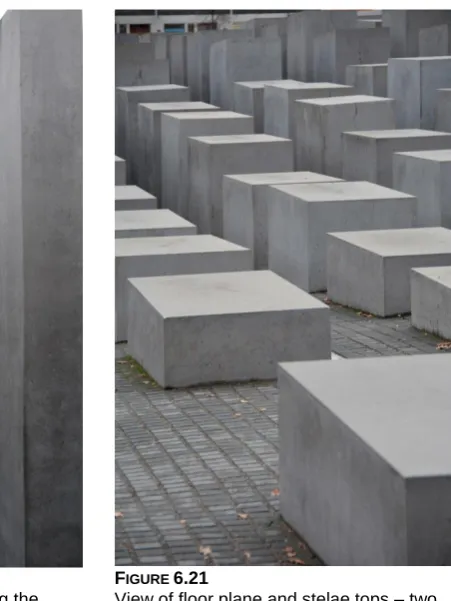
6.21 View of floor plane and stelae tops ... 253
6.22 Memorial to the Murdered Jews of Europe and The Reichstag ... 256
The Reichstag, Berlin, Germany 6.23 Exterior and interior views, showing relationship of ‘old’ and ‘new’ ... 258
6.24 The dome at its base ... 263
6.25 The dome’s interior... 263
6.26 The dome’s double helix ramp system ... 264
6.27 Typical view from the ramp ... 264
7.1 The Japanese enso as a kenotic view of creativity ... 320
Abstract
Acknowledgements
I have always appreciated and enjoyed school, particularly at the tertiary level. In fact, it might be said that, for me, the past forty-plus years of architectural practice have merely been a sabbatical from academe since, during all of those years, I have known a profound longing to return – to once again ‘learn’. Of course, to practice is to constantly learn, but, for the most part, it is to learn practically, amidst established protocols that presume thinking and primarily value doing. I longed to shift the emphasis – at least for a while – from doing to thinking, which is no less doing, because thinking about creativity – not least, creativity in architecture – is ultimately a practical pursuit. So, in 2011, when I found it possible to return to academe and think about creativity, I did so eagerly. Most fortuitous was that the opportunity arose not long after relocating from mainland Australia to the island state of Tasmania, very near to the University of Tasmania and its School of Architecture and Design. I am grateful to all of those at the university who assisted me in capitalising on the opportunity and making it even more rewarding than I expected.
First, I wish to thank my primary supervisor, Professor Stephen Loo, formerly Head of the School of Architecture and Design, and now Director of the university’s Creative Exchange Institute. His steadfast support and encouragement, offered during a demanding time in his own career, has been essential to my work. I recall, in particular, his ability to maintain a professional demeanour when, at our first meeting, he mentioned a then-unfamiliar name – that of Martin Heidegger – and I ignorantly asked him to spell it. I am especially grateful to Professor Loo for introducing me to Jeff Malpas, philosopher and Distinguished Professor at the University of Tasmania. Almost one year into my project, at the conclusion of what I thought would be a one-time consultation, Professor Malpas offered to become part of my supervisory team. He thus gifted me in a way that changed and elevated the course of my studies. (Given his expertise in all things Heideggerian, I was grateful that, by then, I had come to know the esteemed philosopher’s name and its spelling.) As co-supervisor, Professor Malpas introduced me to the world of philosophy, opened-up my thinking, and constantly encouraged my own kenosis, as I researched and applied concepts of kenosis to creativity and architecture. Together, both supervisors challenged and critiqued my work, and were – to my benefit – always willing to tell me when I strayed. As much as school, I have always appreciated teachers and mentors, particularly those willing to ‘push’.
but also offered essential advice and supervision as I began my work. And, while serving as a tutor in his class, I learned more from him than my students did from me. My exposure to the university, however, began at a meeting with the then-soon-retiring Head of School, Professor Roger Fay. His attentiveness, encouragement, and insight left me without any doubt that I had found the right place to learn and think. No less appreciated is the support of the school’s current Graduate Research Coordinator, Dr Steven Fleming, and all of those at the university’s Graduate Research Office. Special mention goes to a most helpful and efficient staff at the university library, and to Ms Wendy Roberts, who helpfully and efficiently proof-read my manuscript, searching for those details that had escaped me.
Outside academe – indeed, outside architecture and philosophy – I have been supported by many from the realms of theology and liturgy; disciplines embedded in kenosis. They know who they are, and I am grateful to each. Three, however, must be named for their special parts in this endeavour, which, even if manifested only as felt presence, were crucially inspirational. I first discussed notions of “assertion versus submission in architecture” with a respected client and friend, Rev John Cunningham of Melbourne, who urged me to pursue those thoughts. And, in the eighteen years since my emigration to Australia, I have enjoyed the unwavering friendship and tutelage of Rev Dr Patrick Negri SSS, who not only supported my application for admission and scholarship but, during my candidacy, also provided invaluable guidance, read key portions of my work, and offered critical comment. Even from as far away as Chicago, I have been cheered by long-time friend and mentor Rev Dr Arthur A.R. Nelson. Clients, too, have been sources of great inspiration, much of which manifests in this work. Indeed, many clients have become friends – but, amongst those in Australia, two stand out: Mr Patrick Donnellan OAM, who also supported my application and did much to bolster my confidence, and Rev Kevin McIntosh, who was one of my first antipodean clients, became one of my most frequent repeat clients, and remains both friend and valued liturgical converser.
This dissertation is not the only tangible product of my current academic experience. During the course of my candidacy, pursuant to the research and writing undertaken, I have been privileged to present two papers at international conferences,1 and to see three papers published; two appearing in peer-reviewed academic journals,2
1
R.S. Lindstrom, "Revisiting Kahn: A Theological Case for Kenotic Design" (paper presented at the 29th Annual Conference of the Society of Architectural Historians Australia and New Zealand: Fabulation: Myth, Nature, Heritage, Launceston, 2012); and R.S. Lindstrom, "Sustainability by Design: Kenosis as a Framework for Environmental, Cultural and Social Dialogue" (paper presented at the Ninth International Conference on Environmental, Cultural, Economic, and Social Sustainability, Hiroshima, Japan, 24 January 2013).
2
and another in a specialised professional journal.3 Thus many concepts included in this discourse – particularly in Chapters 3 and 7 – represent the elaboration of ideas first explored in these previous works. It is also the case that, three decades before the current experience, I had already been attracted to the subject of creativity as I pursued research made possible by the Francis J. Plym Traveling Fellowship in Architecture, a post-graduate award presented by the School of Architecture, University of Illinois at Urbana-Champaign. That early endeavour culminated in the publication of my book, Creativity and Contradiction.4 Although, at the time, I would have had no knowledge of kenosis, I can see now that kenosis was very much embedded in the architectural examples – especially their ‘contradictions’ – that were then the subjects of my (less-developed) exploration and writing.
Connecting past with present, it is especially poignant that during these three and one-half years in which I have gained new and valued mentors, I have lost all but one of those who most significantly shaped my thinking when I was last in academe. Those ‘giants’ from the University of Illinois are Professors Emeriti Jack S. Baker FAIA (1920-2013), Walter H. Lewis FAIA (1928-(1920-2013), Alexander Notaras (1921-2011), and Daniel J. Perrino (1921-2012). By their many gifts to me, each ‘lives’ in this dissertation. So does one other, Professor Emeritus A. Richard Williams FAIA, who marked his 100th year in 2014 and, as much as ever, continues to think critically about architecture – and the world. I continue to be buoyed by his example.
I am also indebted to family and other close friends for untold gestures of encouragement. To friends in the US, including Bradford Newquist, Peter Zelenko, Timothy O’Neil, and Judy Dioszegi, and to those in Australia, particularly Anda Kenne, I say thank you for the gift of genuine and certain support. Despite the tyranny of distance and infrequent visits, I am strengthened by the ‘presence’ of my mother Elizabeth and brother Roger, both in Illinois. I am similarly strengthened by my extended family in Australia – the Emerys – particularly by its matriarch, Hélène, who has not only offered constant encouragement but has read the early drafts of every chapter, remarkably (and, no doubt, prejudicially) without a critical word. It is her son, Justin, however – my best friend and life partner – who is most responsible for enabling my work on this project. For that, and many other reasons he already knows, I dedicate this dissertation to him with the deepest gratitude and love.
ed. S. King, A. Chatterjee, and S. Loo (Launceston: SAHANZ, 2012); and R.S. Lindstrom, "Sustainability by Design: Kenosis as a Framework for Environmental, Cultural and Social Dialogue," The International Journal of Sustainability Policy and Practice 9, no. 1 (2014).
3
R.S. Lindstrom, "Creating Church: Kenosis as Protocol," Faith & Form: The Interfaith Journal on Religion, Art and Architecture XLVI, no. 3 (2013).
4
1
Introduction:
Awaiting Kenosis
“Why do we have to change anything?” Shouted with seeming impertinence from the back of the room, this question came just as the meeting was called to order, and it spontaneously attracted approving applause from many of those present. Nearly 140 people had gathered at a church hall in rural Australia to consider a subject considered before: the possibility of undertaking an architectural project to renew the parish’s nearly century-old church building. This time, however, the parish had been told that things would be different. Uncharacteristic of customary architectural practice, this was to be the beginning of a process that presumed no building project. Instead, it invited the entire parish to participate, if they wished, in creatively discerning its situation and asking of that situation whether architecture was a response it called for – with either the negative or affirmative seen as equally legitimate. In a very real sense, it was a process open to its own collapse. It was called a ‘process’, but, more precisely, it was an event of engagement. Its only strategy was openness, a characteristic that saw the first plenary session begin with what had the potential to close it down. The shouted question had been aggressively asserted. But what was the assertion? Those who did not applaud may have heard a closed question, an answer in the guise of a question, intended to pre-empt listening and suppress dialogue; a kind of emptying-out without an opening-up. Indeed, it may well have been an assertion of resistance. Yet the question could equally have been heard as a challenge to purported but, as yet, untested and unproven openness. It could have been a reaction to previous processes that proved strategic and manipulative. As such, it may have been an emptying-out of barriers – anything from frustration, exhaustion, and fear, to closed-mindedness or fundamentalism – one that might enable the gradual opening-up to an event that gradually proved open. In any case, this event of openness needed to remain open to questions of its openness and challenges to its sufficiency. No less so, the event needed to challenge the self-sufficiency of its questioners. Only then could there be engagement and mutual exchange; something more than debate. Rather than rushing to resolve the question, it could be left to stand as part of the situation, the event itself being a working-out of the situation, including all that it comprised.1
1 A more complete narrative of this event – which eventually proceeds in mutual openness – is found in R.S.
Coincidentally, and not without irony, it was only four weeks earlier that this Catholic parish had joined the rest of Christendom in marking the pinnacle of the church calendar: the celebration of the mystery of Easter, or what theologians refer to as the paschal mystery.2 I mention irony because Easter comprises the events of the Christian myth that present an extreme call to open-up, to change almost everything, to turn world views upside-down. These are events that have changed religious discourse, if not also that of philosophy and architecture, since the time of their promulgation. They are events without whose stories there would be no Christianity, and without which the West and, to varying degrees, the world would be much different. Their interpretation and re-interpretation have changed and continue to change Christianity and all that is influenced thereby. The celebration of the paschal mystery is a celebration of change – change effected by the mysteries of radical selflessness, openness, and relationality on the part of the divine, and by the call of humanity to the same. In the immediate aftermath of such celebration, this parish found itself engaged in an event that opened-up many of the same ‘mysteries’ with far less abstraction; that is, in very human, practical, and experiential terms. How might that affect their approach to and consideration of change, particularly when applied to the created and creative environment – the architecture – that accommodates their celebration of such mysteries? What is it in the concept of Christianity’s paschal mystery, as well as in the myths of many other faith traditions and cultures, which may advantage the emergence of creative thinking and response, not least through architecture? Answers – though likely of the sort that keep the questions open and maintain their mysteries – lie deeper than any religious doctrines. Yet religion proves a useful threshold at which to open-up to the questions.
GENESIS
It is at the intersection of religion and architecture that this project finds its genesis (though not long resting there). The proposition that there could be no other starting point is one requiring brief – and reluctant – autobiographical explication. Although I would avow a strong sense of spirituality, I do not consider myself ‘religious’ and have never been religiously-affiliated. I do not subscribe to theism or to atheism, the latter no less a belief system than the former. Nor am I attracted to agnosticism, since ‘knowing’ of a deity’s existence has not only proven impossible but also largely inessential. Regarding religion, I am without ‘-ism’; content to leave its questions open. Still, I have always been fascinated by the subject, primarily in terms of anthropology, sociology, and architecture –
2 Although the term ‘paschal mystery’ is less frequently deployed in the more Evangelical and Pentecostal
to which I now add philosophy. Religion and I have shared a long, symbiotic but contentious relationship, frequently marked by coincidence, irony, and paradox. At the age of first memory, I became acquainted with religion, or, more precisely, it was then that attempts were made to effect my indoctrination, as a religiously zealous grandmother unilaterally escorted me to the First (Swedish) Evangelical Free Church, where the term ‘free’ bore no relationship whatsoever to theology.3 Yet, serendipitously and ironically, it
was exactly this unwanted experience that provided a pre-adolescent introduction to architecture, long before I could foresee the consequences. During my Sunday school tenure, the church’s Neo-Classical building underwent a major architectural extension, in the only appropriate style of the day, that of ‘Modernism’, and I was very much aware of its happening. Inexplicably, my interest in the project, this first sighting of the intersection of religion and architecture, was more than passing curiosity. It lay deeper and remained dormant for most of a decade. Eventually, the modernised church building – its architectural influence only beginning to stir – would be the site of my ‘Confirmation’, an event offering my grandmother the illusion of a dream fulfilled but providing me with a coming-of-age that sanctioned rebellion and a departure from the church.
Then, owing to an especially progressive seventh-grade Industrial Arts teacher,4 I was introduced to architecture as a potential vocation; an introduction that ignited my emergent interest and, once again, saw religion and architecture intersect, albeit divergently. I enthusiastically fled religion and bounded toward architecture, not yet understanding its underlying potential for ‘religiosity’ – within the discipline and without. Coincidentally, I pursued an architectural education in the waning days of Modernism, perhaps the most ‘religious’ of architecture’s many movements, as evidenced by the zeal of its proponents and its propensity to espouse universal truths. Architecture was on the cusp of Post-Modernism, which, particularly in America, proved to be an often awkward form of Historicism. And, as I approached graduation, Post-Modernism was already being overshadowed by talk (though very little practice) of Deconstructivism. I was perhaps most influenced, however, by a teacher and mentor who never spoke of ‘style’ or ‘movement’. Instead, he taught that “the seed of the solution is in the problem” and championed architecture as “one of the performing arts,” something dynamic, emotional,
3 In Scandinavia, the term ‘free church’ refers to a church that is not part of the official ‘state church’, and
therefore ‘free’ of the tax that is imposed to support the state church. When migrants brought their ‘free church’ to the USA, they retained the term in its name. The denomination is, in fact, of very conservative theology; and was more so in the years I describe.
4
I refer to Mr Orville O. Brown, then Head of the Industrial Arts Department at Thomas Jefferson Junior High School, Rockford, IL (USA), who, during the mid- to late-1960s, introduced Grade 7 to 9 students not only to architecture but also to civil engineering, structural engineering, and computer-controlled machinery, the latter only just being developed with the use of early punch-tape computers. He faced frequent criticism from high school teachers – those who would subsequently receive his students in the upper grade levels – for ‘straying’ from a then-customary industrial arts curriculum that focused on repetitive exercises in the
and of no fixed identity, something “that changes.”5 Under that influence, I began to
wonder – when, for example, looking at the work of architects such as Richard Meier – how it could be that obviously differing circumstances affecting the design of a house in Connecticut and an art museum in Atlanta, GA (and two decades later, a church in Rome), could be calling for such deliberately similar architectural responses, at least in terms of formal expression. What forces could be at work in such cases – exemplified by many architects, in many places, and in many so-called styles – that seemingly sanction the denial of or resistance to a situation’s entirety? What is it that might, instead, make room for and focus attention on the entire situation?
As such questions were germinating, irony was to strike a third time. During graduate school and immediately following, I found myself in the employ of a generalist architectural firm that was establishing a specialisation in ecclesiastical design. Initially successful in avoiding such projects, I was eventually coerced into one and gradually became compelled by the quarry of history, symbolism, and human pursuit that spirituality presents to architecture – if architects are willing to do the hard work of excavation and extraction, work made particularly difficult by spirituality’s aversion to calculative description and insistence on maintaining mystery. Thus it was the church that introduced me to architecture and, then, architecture that ‘saved’ me from the church and, now, architecture that turned me back into the church’s midst, albeit largely in a professional capacity. Again, I found myself at the intersection of architecture and religion, where I had begun. What has followed is a career involving the design of buildings of almost every typology but with a focus on faith-based architecture. Christian projects (Protestant, Roman Catholic, and Orthodox) led to ecumenical projects, which, in turn, led to interfaith projects encompassing the world’s major religions. I can only surmise that my passion for such diverse engagements was born and nurtured in the space made for it by my childhood and early-adolescent experience, which was in fact a kind of ‘emptying’ through which, as Meister Eckhart famously describes it, “God … rid me of God.”6 Not surprisingly, however, a career situated so close to religion periodically
presented a sense of obligation to ‘join in’ and ‘belong to’ some particular tradition. But I was never able to act on such sentiments, never able to honestly accept the proposed creeds or engage in the suspension of thinking so often asked of those who would
5
J.S. Baker, "Thoughts," in Space, Movement, and Light: The Architecture of Jack Sherman Baker, FAIA, ed. P.J. Armstrong and J.S. Poss (Champaign, IL: School of Architecture, University of Illinois at
Urbana-Champaign, 1997), 10-11.
6 This notion and quotation is found in Eckhart’s “Sermon 52”. There, he distinguishes between a hidden God
(instead) ‘believe’. A Chicago theologian and clergyman – a client who became a close friend, and whose thinking is anything but suspended – suggested that my ‘emptiness’ would be filled not at one ‘table’ but at many7; a suggestion that proved assuaging, as
well as patently correct in terms of spiritual and disciplinary pursuits. In many ways, his prophecy is realised by this project.
Having never joined or belonged, and therefore having never been baptised, it is again ironic that I would become intrigued by the Christian concept of the paschal mystery, and its direct extension to baptism, as a kind of ‘dying’ that paradoxically leads to a fuller experience of life; and how – at least conceptually – that resonates with my own experience in the creative act of architectural design. It is out of such interest that this project arose; initially envisaged to focus on the manner in which the concept of the paschal mystery might inform the creative process and, through it, architecture. But the paschal mystery is a complex theological topic, many layers of which are superfluous to its capacity to inform human creativity. In fact, it is primarily one layer – actually, the core of the paschal mystery – which proves most relevant to this discourse. Just as there would be no Christianity without the paschal mystery, there would be no paschal mystery without its claim of divine ‘self-emptying’, or kenosis – an emptying-out that is also an opening-up and, as will be seen, much more. Kenosis can be seen as the ontology of the paschal mystery, and thereby also that of the Christian faith that has been constructed around it. The paradox, of course, is that Christianity’s institutional forms have – to varying degrees – been so successful in presenting the antithesis of kenosis, insofar as they resist opening-up; that is, they resist their own kenosis. It is also the case that the doctrines of the church do not hold the origins of kenosis. Indeed, although Christianity is fundamentally kenotic, kenosis is not fundamentally Christian. The concept is much older and deeper than that, traceable to the earliest philosophers in both Western and Eastern cultures, arising in some form across most faith traditions, and the subject of interdisciplinary discussion across time. In common to all such discourse, however, is the ultimate connection of kenosis to creativity, whether seen as divine or as cosmic, evolutionary, and human.
THESIS
On the foundations of that connection – kenosis to creativity – this project develops its central proposition that humanity’s approach to and execution of creative opportunity can be valuably informed by that which kenosis reveals. In this proposition, I suggest that the understanding of kenosis can be extended from the realm of theologians and
7
philosophers to that of others who also create an increasingly secularised, globalised, and environmentalised – indeed, aestheticised – world. Such creators and their pursuits are, of course, manifold, with no single discipline fully representative of all creativity. Nonetheless, I further suggest that the proposed extension of kenotic understanding can be profitably advanced by using architecture as exemplar. Integrating discovery and design, art and science, calculation and meditation, but being none of those alone, architecture is a fundamental and traditional expression of human creativity – arguably amongst the most primal outside reproduction – one capable of transcendent imagination but constantly susceptible to banal (even violent) fancy.8 Owing to such promising vulnerability – but also raising a question as to what it is about vulnerability that is promising – architecture offers a worthy vantage point from which to await the approach of kenosis. Thus far, however, my proposition fails to suggest why or how human creativity, via architecture, is advantaged by an understanding of kenosis. Why await it?
I proceed to argue that an understanding of kenosis offers architecture, and thereby human creativity, another – perhaps clearer – understanding of itself, its actuality and potentiality. Therein lies the capacity to elevate the contributions that architecture and all of its creators make to the aesthetisation of culture. Kenosis is not abstract. It is fundamental to human being and, in turn, to human creativity and, therefore, to architecture. It opens up questions of each, or, more precisely, it is the opening-up of such questions, and, as that, it inherently resists closure. It asks of architecture the nature of its very being. It sustains the question and refuses simple response. In fact, this question that kenosis opens-up is one that asks not for answers but for kenosis as response, and it is such response that holds transformative potential. Much as philosopher Jacques Derrida proposes a kenosis of language in order to speak anew of God,9 I suggest a similar kenosis – specifically, a kenosis of architectural language – so as to think and speak in new ways about architecture and creativity, ways that include kenosis, itself, as an essential concept to be spoken about. Indeed, to speak of kenosis is already to speak of the creativity and, therefore, the creativity of architecture, which it always embeds.
8
Samuel Coleridge famously distinguishes between imagination (in primary and secondary states) and fancy. “The primary Imagination I hold to be the living power and prime agent of all human perception … The secondary Imagination I consider as an echo of the former, co-existing with the conscious will … It dissolves, diffuses, dissipates, in order to recreate … It is essentially vital.” In contrast, “Fancy … has no other counters to play with, but fixities and definites … a mode of memory emancipated from the order of time and space.” See S.T. Coleridge, Biographia Literaria (Auckland: The Floating Press, (1817) 2009), 236-237.
9 Derrida suggests that such a kenosis of language “frees [it] from all authority, all narrative, all dogma, all
ANALYSIS
As this dissertation commences, it is tempting to invoke notions of an ‘investigation’ or ‘examination’, with measurable goals, objectives, and strategies that expose the subject, test the proposition, and draw conclusions; in other words, to outline a definitive, analytical methodology. But the very nature of kenosis resists such an approach. Kenosis is neither quantifiable nor calculable, and might be seen, by some, to run contrary to conventional logic (often unilinear). In fact, not only does kenosis not operate contrary to logic, it can be seen to offer a more profound – and richly multilinear – basis for thinking. Kenosis is an opening-up that precludes any conclusive shutting-down. It struggles against being strategically corralled, because it ultimately is a struggle. While it is common to think of a researcher approaching and apprehending – even ‘mastering’ – a topic (on the researcher’s terms), kenosis turns that around, suggesting instead that the researcher make-ready or make-room for the topic’s approach and appearance (on the topic’s terms). Like all objective research, that concerning kenosis demands openness, but, thereafter, it less often leads to finite discoveries and more often to the “gates of Mystery.”10 Kenosis questions – even undermines – some of the common conceptions of
methodology and, true to its nature, leaves the question open. It encourages a lighter grip on strategy, if not a counterintuitive letting-go of it; what might be called a ‘kenotic methodology’. Despite such challenges, there is no suggestion that all methodology is futile in the face of kenosis, or that kenosis renders unconcealment impossible. Indeed, kenosis is unconcealing, and unconcealment is kenotic. Nor is there any suggestion that kenotic mysteriousness dooms any unconcealment of kenosis to incoherence or incommunicability. A ‘kenotic methodology’ merely calls for a sufficiently emptied and malleable outlook – though not one ungrounded – with which to invite, await, and engage an experience of kenosis: its struggle, between-ness, and incompleteness, as well as its opportunity.
Thinking About Kenosis
Accordingly, in Part One, I endeavour to establish the foundations of a kenotic outlook. This chapter has already revealed some of the dissertation’s foundations – its genesis and thesis – and shown both to be kenotic in their own right. Now, as another foundational aspect of the project is exposed – its approach, or methodology – that, too, can be seen to be given by kenosis. Although the pursuit of the project and its thesis is personal, it is not merely subjective. It is qualitative, phenomenological, and
10
hermeneutical. It is something like that which Klaus Krippendorff, in Content Analysis, describes as an “interactive-hermeneutic” approach; one involving “a close reading of relatively small amounts of textual matter and the rearticulation of given texts into new narratives,” as well as an acknowledgement of “working within hermeneutic circles in which [the analyst’s] own socially or culturally conditioned understandings constitutively participate.”11 It is a kind of interpretive process (systematic, but neither unilinear nor
determinate), which effects a thinking about kenosis and, consequently, prioritises interpretations that derive from the meditative rather than the calculative. Indeed, the pursuit is kenotic, and the research, thinking, and writing that comprise this dissertation are, in many ways, events of kenosis. It follows, then, that a reading of the dissertation may be equally kenotic.
A ‘kenotic methodology’ – one of emptying and opening-up – commences its deployment in Chapter 2, where the foundations of kenosis, itself, are critically examined; foundations that cross disciplines, cultures, faith traditions, and epochs. Such crossings are evidence that this project, which serendipitously (and somewhat naively) appeared to begin at the intersection of religion and architecture, has, in the course of its pursuit, come to be grounded at a much more complex nexus; one that encompasses matters of philosophy, theology, phenomenology and science, transcendence and immanence, divinity and humanity, East and West, antiquity and modernity – and always creativity. Chapter 2 opens-up a thinking about kenosis through the analysis, correlation, and presentation of kenotic principles from foundational sources; sources that include the orthodox, mystical, and radical. It does so by drawing on several (but, clearly, not all) major theologians, philosophers, and interdisciplinary thinkers, whose work can be seen as contributing to kenotic thinking. Often, however, kenosis is not the explicit subject of such thinker’s thinking; a fact requiring that the actual subjects be examined through a kenotic lens and explicated accordingly, in order to reveal kenotic value and contribute to this discourse. Indeed, the critically-synthesised, synoptic view of kenosis presented in Chapter 2 is, itself, a contribution to kenotic thinking, previously unavailable in such form.
I begin at the so-called locus classicus of kenosis – a short but weighty passage of Christian scripture by the apostle Paul – and do so, in part, by examining and comparing the work of theologians such as Hans Urs von Balthasar, François-Xavier Durrwell, and Jürgen Moltmann, as well as Anne Hunt, Martha Frederiks, and Ian Barbour. Revealed is much more than the merely classical aspects of this centrepiece in Christian thought. But attention then turns to essential antecedents from antiquity –
11
notions of space and place, as well as matrix, medium, and agent – not only seen in Pythagorean and Atomist concepts and, then, in the thinking of Plato and Artistotle, but also in early Judaic theology. Modern philosophers Max Jammer and Edward Casey offer insight into the genealogy and relevance of such thinking, which aids in my effort to locate the kenotic dimensions thereof. While such antecedents prefigure and return to the kenotic claim of Christianity, they also point beyond to medieval thinking, elements of which, I suggest, advance the discussion of kenosis. Contributions are found in the work of Thomas Aquinas (and analyses by Timothy Pawl and Leo Elders), but are especially pertinent in Meister Eckhart’s thinking about Gelassenheit (including interpretations by John Caputo) and in Rabbi Luria’s doctrine of zimzum (with explications by Gershom Scholem). Then, juxtaposed with Early Modernity’s renewed debate about space and place – most famously that between Gottfried Leibniz and Isaac Newton – I explore theology’s necessary engagement with philosophy and science, an engagement that appears increasingly framed by kenotic thinking, even if not named as such.
examining a more contemporary and radicalised philosophy of kenosis, one notably posited by Gianni Vattimo as part of his ‘weak thinking’, which unequivocally names secularisation (and, with it, globalisation) as kenosis; a very real and contemporary phenomenon. It is largely owing to such a view – as well as that of other contemporary philosophers, including John Caputo – that kenosis is most fully opened-up, preparing the way for it to be seen manifested in creativity; indeed, in architecture.
Despite clear linkages to creativity and creation, the kenotic nexus is absent any explicit invocation of kenosis in architecture. In fact, that absence may cause some readers to see Chapter 2 as unrelated or unnecessary to the discussion, perhaps too much outside the discipline of architecture. But kenosis cannot be heard in conversation with architecture unless it is first heard and understood in itself. The purpose of Chapter 2 is such a hearing and understanding, which, once established, reveals that in the conspicuous absence of architecture from kenotic discourse – precisely in that ‘emptiness’ – the primary opportunities and contributions of this project lie.
Thinking About Kenosis Through Architecture
Part Two – Chapters 3 to 6 – addresses that absence and invites kenosis to manifest in architecture, to appear instantiated and concretised. It expands a thinking about kenosis to a thinking about kenosis through architecture. Even as kenosis informs architecture, architecture also informs kenosis by demonstrating that kenosis can be spatially manifested; an unsurprising phenomenon, since, as revealed in Chapter 2, kenosis is first grounded in concepts of space and place. This part of the dissertation makes-room for kenosis (and its antitheses) to be unconcealed in eight specific architectural ‘situations’ (not merely buildings, but ‘places’ in the philosophical sense), selected primarily for what appear to be their kenotic claims – though none explicitly invokes kenosis. Such claims are made either by those who conceived the projects or by those who have critiqued them, or by both. Each chapter offers a new kenotic view of one or more of these projects and, consequently, a new view of kenosis as well. Indeed, each chapter makes its own contribution to the topics of architecture and kenosis – and each could, perhaps, be read independently – but it is in the consideration of these chapters, together, that the fullest view of kenosis can be seen in architecture.
Eisenman, but also included are projects by Michael Graves and Norman Foster. Located in the USA, Europe, the Middle East, and Asia, the contexts of these projects and their architects are geographically diverse. Several are influenced by one or more faith traditions: Judaism, Christianity, Buddhism, Islam, or Hinduism, all of which include kenotic thinking (as Chapter 2 shows). Although these selections are well-known and generally large in scale – some ‘monumental’ – neither attribute produces greater or lesser instantiations of kenosis. As discussed later, the most modest – perhaps vernacular – work can be equally revealing of kenosis.12 Indeed, all of the selected situations are useful and worthy to this dissertation, but they by no means exhaust kenotic manifestations in architecture, nor are they necessarily superior to countless other selections that might have been made. Kenosis, whether by presence or absence, whether by embrace or rejection, is evidenced in every situation.
The opening-up of each situation involves, as well, an opening-up to each. Research centres on a fine grade reading of the situations, not only by way of what Krippendorff calls text, or discourse – verbal, pictorial, and symbolic data – but also through personal visits to observe, record, and critique actual experiences of each, in light of historic and current circumstances. Expanding on Krippendorff, the approach can be seen to align, broadly, with the notions of “interpretive-historical research,” described by Linda Groat and David Wang in Architectural Research Methods. Remembering that kenosis tends to resist the calculative, strategic, and tactical, such an approach can nonetheless survey various types of evidence, including the “determinative, contextual, inferential, and recollective”; and, in addition to the “use of extant documents,” such an approach can employ other tactics, including “on-site familiarity” and “visual inspection” and “comparison with conditions elsewhere,” though primarily as means of opening-up to what kenosis might reveal.13 In some instances, my exploration of selected situations includes aspects of the biographic – that of architects or other situational participants – as inferential or recollective evidence, which, through reasoned analysis, provides a way of understanding an individual whose attitude or approach (either kenotic or not)
12
This notion echoes one made by Martin Heidegger when he relates and discusses a story reported by Aristotle, concerning Heraclitus. Therein, some strangers who visit Heraclitus do so expecting to find the thinker in “circumstances that, contrary to the ordinary round of human life, everywhere bear traces of the exceptional and rare and so of the exciting.” But, to their dismay, the strangers find him “by a stove,” in an “altogether everyday place” that “betrays the entire poverty of his life.” From his modest place, Heraclitus “invites them to come in with the words, ‘Here too the gods come to presence.’” See M. Heidegger, "Letter on Humanism," in Pathways, ed. W. McNeill (Cambridge, New York, Melbourne: Cambridge University Press, (1949) 1998), 169-170.
13
significantly influenced a particular situation’s outcome.14 Likewise, architectural
assessments occasionally include aspects of the descriptive, as determinative, contextual, or, also, inferential evidence. I do not use the descriptive to pictorialise. Rather, I see it as a means to explore – again, through reasoned analysis – particular aspects of kenotic instantiation, the understanding of which is somehow enhanced by such description. Just as kenosis gives this project its ‘methodology’, kenosis also gives the dissertation various ‘voices’, as needed to open-up the diversity that is kenosis.
Similarly, kenosis suggests the avenues of research by which it might be approached and by which its revelations might be invited. Such avenues emerge in the theological and philosophical grounding of kenosis (outlined in Chapter 2), as well as in the architectural grounding of any given situation. Indeed, each of the selected situations is approached, not by the application of standardised assessment criteria (the purpose not actually being comparison), but in ways that the situation, itself, is calling for. Consequently, my readings of these selected situations draw – to various extents and in various combinations – on the evidence provided by kenotic thinking and its thinkers, by architects, clients, and the other ‘creators’ involved in a situation’s realisation, as well as by architectural thinkers, whose reading of the situation, though not through a kenotic lens, is nonetheless helpful to a new, purposefully kenotic reading. There is no preconceived or strategic notion to ‘use’ particular thinkers to extract the kenosis in particular situations. In a sense, the particular situations call on particular thinkers and thinking, those that foster an unconcealment of the situations’ kenotic concealments. That – as Heidegger will be seen to suggest, and as will be further discussed – requires attentiveness not to the act of unconcealing but to the act of respecting the concealment. What I have referred to as a ‘kenotic methodology’ enables exactly that, and, pursuant to such an approach, the situations do reveal differing degrees and aspects of kenotic instantiation. Some convincingly and extensively reveal kenosis, though never perfectly or completely. Others reveal instantiations that initially appear kenotic but, on closer reading, prove less so; while still others present the converse. And some situations reveal the unawareness or ignoring of kenosis, if not the outright resistance thereto. Even the latter revelations, however, are a kind of emptying that make them part of this discourse.
Various thinkers and thinking from Chapter 2 are seen again in Chapters 3 to 6. Still other philosophers are introduced in connection with specific architectural situations,
14 As an example of “inferential evidence,” Groat and Wang cite a biographical photograph of Frederick
Robie, riding in an early and then-very-modern automobile – the Robie Cycle Car – as a means to
their thinking discussed in the detail called for by each exposition. For example, the work of philosopher Andrew Benjamin, especially his exploration of hope and cosmopolitanism and his application of such thought to the Jewish Museum Berlin and the Memorial for the Murdered Jews of Europe, is essential to the unconcealment – in Chapter 6 – of what I see as kenotic (and apparently non-kenotic) instantiations in those two situations. Equally important to the same pursuit is the work of two other scholars: James Young, professor of English and Judaic studies, who writes with first-hand knowledge of both projects, and philosophy professor Renée van Riessen, whose interpretation of Levinasian kenosis likewise benefits my readings of these Berlin projects. A kenotic reading of The Church of the Light, in Japan, is similarly aided, not only by reprising Nishida, Nishitani, and Abe, but also by introducing aspects of the thinking of theologian/professor Jeannine Hill Fletcher and philosopher/professor Steve Odin, especially as seen in their work on religious diversity and interfaith relations, respectively. These and still others – including philosophers Georg Simmel, Walter Benjamin, Anthony Vidler, David Krell, and Bruce Benson, as well as sociologist Thomas Gieryn – add specific insight to the kenotic readings of various architectural situations.
Since, like many who have theorised about architecture, I regularly refer to Heideggerian concepts,15 I am inevitably attracted to the work of philosopher Jeff Malpas, whose development of ‘topology’ and ‘thinking of place’ invaluably strengthens the connection of Heidegger to place and, hence, to architecture – and, so, is important to several of the architectural situations I discuss. Indeed, as Chapters 3 to 6 focus on architecture as a vehicle for exploring kenosis, I am additionally drawn to a further company of diverse but specifically architectural thinkers – critics, theorists, historians, educators, and practitioners – amongst them, Stanley Allen, Ali Alraouf, Jin Baek, Ralf Brand, Deborah Barnstone, Michael Benedikt, Joseph Burton, Kenneth Frampton, Paul Goldberger, Sarah Goldhagen, Simon Guy, Jack Hartray, Charles Jencks, Philip Jodidio, John Lobell, Steven Moore, Christian Norberg-Schulz, Juhani Pallasmaa, Vincent Scully, Paolo Soleri, and Robert Venturi. Regardless of discipline, however, I ask of each thinker’s thinking not so much what has already been told of their subjects but, rather, what such thinking might unconceal about the concept of kenosis, and how it might
15
Although I draw most heavily on the work of Martin Heidegger, I do so not to repeat a search for
up – or assist one in opening-up to – the unconcealment of kenosis in architecture; that which is largely untold. It is the same that I ask of each situation.
Thinking About Architecture Through Kenosis
Finally, with the foundations of kenosis exposed, with kenosis shown to be manifestable in architecture, and still with an open and malleable outlook, Part Three – Chapters 7 and 8 – turns to a thinking about architecture through kenosis. Roles reverse, and kenosis now becomes a vehicle for exploring architecture. Amplified is that by which kenosis can inform architecture and, by extension, creativity in general. Just as Parts One and Two deal primarily with the (past and present) actualities of kenosis and kenosis in architecture, Part Three turns to potentialities. How might architecture look, viewed through a kenotic lens? How might architecture look – or what might it be – amidst its own kenosis; its own emptying?
2
Kenosis:
A Synoptic View
Insofar as kenosis resists any notion of its ‘conquer’ or ‘seizure’, an understanding of the emptying and opening-up that is kenosis requires an emptying and opening-up of kenosis, which, in turn, requires an emptying and opening-up to kenosis. This chapter invites and facilitates all three happenings. For the opened-up reader, it reveals kenosis synoptically, but sufficiently, so as to establish its foundations. Without such revelation, there would be little potential for the extension of kenosis to architecture, for the viewing of architecture through a kenotic lens, or for architecture to be informed thereby. Indeed, the central thesis of this discourse requires exactly such extending, viewing, and informing. Although there is almost nothing of architecture in this chapter, kenosis nonetheless appears on multifarious paths and reveals its inextricable embedment in creation and creative events; those that may be seen as acts of the divine or the cosmos and evolution, as well as those that are clearly acts of humanity. Also uncovered is the genealogy of kenosis from antiquity to its revival and expansion in modernity, and to its radicalisation in postmodernity. This chapter introduces and connects the major thinkers and thinking that ground the subsequent, unfolding discourse. As they emerge in this initial opening-up to kenosis, they promote the ongoing opening-up of kenosis.
LOCUS CLASSICUS
The oft-made claim that Christian theology is the locus classicus of kenosis is not entirely unjustifiable, though, as will become apparent, it is neither the origin nor the culmination of kenosis and kenotic thought.1 Nonetheless, since it was via the Christian doctrine of the paschal mystery that I came to this project and was introduced to kenosis (the doctrine’s essence), there is an element of poetic merit in viewing kenotic genealogy with reference to its classical place in Christianity. Such a viewing position requires a looking back to Plato and before, as well as a looking forward to the present day, not so much in search of a chronological history, but a thematic one. Thus the Christian notion of kenosis can be seen as arising from that which preceded it, as well as that to which subsequent thought reacts, either by expanding or challenging it. The fact that so much of Christian theology originally draws on Platonic and Aristotelian thought, and, furthermore, that the most contemporary and radicalised interpretations of kenosis relate
1
themselves to Christianity, makes the choice to view kenosis from this vantage point all the more fitting. For purposes of this discourse, however, it is important to primarily consider what the Christian narrative proposes about kenosis, as a concept, and largely avoid the skirmishes it stirs within theology. Even in a lengthy and comprehensive treatise on the paschal mystery, noted theologian Hans Urs von Balthasar (1905-1988) states that “the doctrine of Kenosis is so difficult from the viewpoints of exegesis, the history of tradition and of dogma that here we can only touch upon it, and deal with it just so far as it is unavoidable for our theme.”2 As if to corroborate Balthasar’s view,
theologian Jürgen Moltmann (1926-) acknowledges not only “the many individual exegetical problems” associated with kenosis but also “the theological ones.”3 Although
such difficulties and problems are amply debated in theological circles,4 they are essentially unresolvable and, here, largely superfluous. I therefore echo Balthasar’s caveat and limit my exploration, focusing on those aspects of the Christian concept of kenosis that usefully inform a secular reading of kenosis and human creativity, particularly as it might later be applied to architecture.
That which constitutes Christianity as a pivot point of kenotic thought is the fundamentally distinguishing claim of a manifested messiah, the divine in human form, their Christ. (This discussion, however, is indifferent to the factuality of such a claim, since the concept, alone, is sufficiently pivotal.) Although prefigured in Hebrew prophesy (as seen later in this chapter), the appearance of a messiah is claimed to have eventuated only in the Christian narrative, where it is seen through the complex salvific concept called the paschal mystery, referring foremost to the humiliating but paradoxically life-promising death of a messiah who somehow possesses two natures, divine and human (another topic of debate, flowing from kenosis). The paschal mystery courses its way throughout the Christian scriptures but takes on a unique dimension in the [ca.] 60 CE letter from the apostle Paul to a fledgling Christian community in Philippi (Greece).5 In that letter, which appears in the Christian scriptures as ‘Philippians’, Paul discusses the merits of “imitating Christ’s humility” (Phil 2). Most of that discussion centres on a recitation of what is regarded as an early Christian hymn (Phil 2:5-11), now often referred
2
H.U. von Balthasar, Mysterium Paschale: The Mystery of Easter, trans. A. Nichols, English ed. (San Francisco: Ignatius Press, (1970) 2005), 23.
3
J. Moltmann, "God's Kenosis in the Creation and Consummation of the World," in The Work of Love: Creation as Kenosis, ed. J.C. Polkinghorne (Grand Rapids, MI and Cambridge, UK: William B. Eerdmans, 2001), 138.
4
In addition to their own extensive works, both Balthasar and Moltmann direct readers of the above cited references to other sources in which the noted difficulties and problems of kenosis are pursued. An example of such difficulties is briefly discussed at note 11.
5 The HarperCollins Study Bible (NRSV) indicates that Paul’s letter to the Philippians was written sometime
to as the ‘Kenosis Hymn’.6 Therein, an already-existing Word, or Logos, is portrayed as
being “in the form of God” but not inclined to “regard equality with God as something to be exploited.”7 Instead, this Christ who would be named Jesus, “being born in human
likeness,” is said to have “emptied himself” (the original Greek text employs the term ekenosen8), thereby “taking the form of a slave.” Then, “being found in human form, he humbled himself” – a kind of earthly extension of his emptying – and, in obedience to God, willingly suffered crucifixion, all purportedly for humanity’s salvation. Thus the act of ‘self-emptying’ is known by the noun kenosis and, in this narrative, is that which effects particular kinds of servitude and humiliation. Paradoxically, however, it also culminates in the “exaltation” of the self-emptied one. This presentation of kenosis suggests a threefold event. In addition to the kenosis itself, there is that which precedes it and that which succeeds it. Each aspect of the event importantly characterises the conceptual nature of kenosis and warrants elucidation.
Preceding the Kenosis
Prior to his retelling of the hymn, Paul initiates the kenotic theme in his own words. He asks that the Philippians “do nothing from selfish ambition or conceit …” (Phil 2:3). Thus, even before the term kenosis is deployed, before the notion of self-emptying is invoked,
6
Theologians speculate that this hymn may have been used, originally, in connection with baptismal events wherein, according to Christian tradition, catechumens enter the paschal mystery by ‘dying with Christ’ in what is effectively their own act of kenosis; a reciprocation of Christ’s. Paul’s retelling of the hymn, as it appears in Philippians 2:5-11 (NRSV), is as follows:
5
Let the same mind be in you that was in Christ Jesus,
6
who, though he was in the form of God, did not regard equality with God as something to be exploited,
7
but emptied himself,
taking the form of a slave, being born in human likeness. And being found in human form,
8
he humbled himself
and became obedient to the point of death - even death on a cross.
9
Therefore God also highly exalted him and gave him the name that is above every name
10
so that at the name of Jesus every knee should bend
in heaven and on earth and under the earth
11
and every tongue should confess that Jesus Christ is Lord, to the glory of God the Father.
Theologian, Hans Urs von Balthasar, suggests that this is a “rounded off” version of the hymn and that, for emphasis, Paul added a line, “even death on a cross,” as the conclusion of verse 8. See von Balthasar,
Mysterium Paschale: The Mystery of Easter: 23.
7 The New Revised Standard Version uses the term ‘exploited’ and translates it, literally, to mean “‘seized’, as
in a robbery.” In lieu of ‘exploited’, other biblical translations use terms such as ‘grasped’ (English Standard Version, International Standard Version, American Standard Version) or ‘clung to’ (New Living Translation) or ‘used to his own advantage’ (New International Version).
8
there is a call to abandon self-interest. Then, the early phrases of the hymn reinforce that call as they announce the “regard,” or attitude, with which the still-divine and not yet incarnate Christ is said to approach his kenotic event.9 He seemingly recognises that “equality with God” is an impediment to self-emptying, as well as a contradiction to his forthcoming earthly situation. Therefore he chooses not to exploit, grasp at, or cling to the advantage of his divinity. He volitionally distances himself from the privilege of position and lets-go of aspirations to glory or power. Paul’s preamble and the hymn’s initial stanzas thus reveal a kind of prerequisite to kenosis; namely, that it not be approached strategically, especially as a pursuit of privilege. The kenotic paradox, of course, is that this renunciation of power is precisely what produces power, perhaps even a greater power, that of powerlessness. That, however, is a subject to be discussed, later, in connection with events succeeding the kenosis.
The Kenosis
Paul’s preamble goes on to invoke kenosis, itself. After his call for abandonment of self-interest, he writes to the Philippians that they should each “look … to the interests of others”10 in order that they might “be of the same mind” (and also have “the same love,”
from verse 2) “that was in Christ” (Phil 2:4-5). It is in such a mind-set and out of such love that – according to the continuing hymn – Christ underwent his kenotic event, the self-emptying by which he could be human,11 and thereby be consummately relational with humanity and attentive to their shared situation. By virtue of his human-ness, he could open-up and make-room for others, even “to the point of death” on their behalf. Christ’s kenosis, then, is his Passion. Thus the term ‘self-emptying’ comes to be equated with notions such as contraction, withdrawal, surrender, humbling,
9
Balthasar confirms the legitimacy of reading the Kenosis Hymn to mean “that the subject who thus ‘empties’ himself by taking the form of a servant is not the already incarnate Christ, but he who abides beyond this world, being in the form of God.” See von Balthasar, Mysterium Paschale: The Mystery of Easter: 23-24.
10 Notes to the New Standard Revised Version indicate that ‘others’ (in the original text) can be literally
translated to mean ‘one another’ and, thereby, see Paul suggesting that the Philippian Christians “show humility toward one another, not necessarily toward people in general.” Such a suggestion, however, appears inconsistent with the model of Christ’s earthly behaviour, and antithetical to kenosis. As such, it points to one of the ‘problems’ associated with the theological interpretation of this text.
11 It is the exact nature and implications of this ‘self-emptying’ that has stirred so much theological attention