NI
4-
Menzies ResearchInstitute
UNIVERSITY
OFTASMANIA
'There is More to Supervised Exercise
than Exercise Itself'
A Mixed Methods Study of Supervised Exercise with
the Chronic Disease Self-Management Program for
People with COPD
By
HELEN L. CAMERON-TUCKER, BPhty (Hons)
Submitted in Fulfilment of the Requirements for the Degree of Doctor of Philosophy Menzies Research Institute and Faculty of Education, University of Tasmania
(Hobart)
i
DECLARATION OF ORIGINALITY
This thesis contains no material which has been accepted for a degree or diploma by the University or any other institution, except by way of background information and duly acknowledged in the thesis, and to the best of my knowledge and belief no material previously published or written by another person except where due acknowledgement is made in the text of the thesis, nor does the thesis contain any material that infringes copyright.
Signature. 4(
d
,4
1 /•
‘4.'fr*t4'l -‘7
44410.4
"/
Date.
ii
AUTHORITY OF ACCESS
This thesis may be made available for loan and limited copying in accordance with the Copyright Act 1968.
ABSTRACT
'THERE IS MORE TO SUPERVISED EXERCISE THAN EXERCISE ITSELF'
A Mixed Methods Study of Supervised Exercise with the Chronic Disease Self- Management Program for People with COPD
Chronic obstructive pulmonary disease (COPD), a progressive respiratory condition, significantly affects the lives of those managing its daily impact. Exercise is
recognised as an important management strategy. This thesis investigates the addition of supervised exercise to the Stanford Chronic Disease Self-Management Program (CDSMP) in people with COPD. The CDSMP is a group-based program designed to facilitate the acquisition of self-management skills, and does not have an exercise component.
This thesis provides opportunity to consider theories of health behaviour change and the role of self-efficacy in the self-regulation of behaviours, such as exercise. The effect of the CDSMP on self-reported exercise was reviewed, finding a lack of published research concerning supervised exercise with the CDSMP.
To investigate the effect of supervised exercise with the CDSMP older adults were allocated to the CDSMP, with or without supervised exercise, in a parallel group randomised controlled clinical trial with a pre/post test design over two years. A mixed methods approach was used to provide a more detailed analysis of the effect of supervised exercise than one method alone, giving quantitative evidence enriched by the lived experience of participants. Objective outcomes included physical capacity (primary outcome), self-reported exercise, stage of change for exercise, exercise efficacy, shortness of breath, heath-related quality of life and self-management behaviours. Change in outcomes between groups and within group was measured by appropriate statistical tests. Qualitative methods of enquiry using semi-structured interviews and thematic analysis uncovered the lived experience of the people who participated in the CDSMP with or without supervised exercise.
iv
significant increase in physical capacity for the intervention and control groups, but no significant difference between them. However, the clinical significance of the within-group change was not reached. Further research is required in this area. There were no significant differences between groups for any secondary outcome, although analysis of effect sizes indicated that supervised exercise confers a benefit to those who participate: they exercised more frequently, for longer duration, had less breathlessness and improved quality of life physical component summary compared with those who did not have supervised exercise. However, neither one hour of weekly supervised exercise, in the absence of a structured home programme, nor the CDSMP alone, was sufficient to produce more than small improvements in
outcomes.
Qualitative findings revealed participants bring to healthcare interactions a personal meaning of self-management defined by their lived experiences and strategies developed in response to living with COPD. Similar sources of motivation act across the CDSMP and supervised exercise, thereby supporting the construct of
self-efficacy and signifying the pivotal role of perceived personal control as a mediator of behaviour change. However, the experience was not viewed positively by all,
indicating the need to be alert to possible adverse psychological effects of interventions and to identify at-risk individuals. Participants endorsed supervised exercise, emphasising the importance of respecting their preferences.
This study suggests that the process of facilitating behaviour is not concerned with 'who knows best', but rather with how the interaction between health professional and participant facilitates a consideration of self and the best possible behaviours to manage life with long-term health conditions, pointing to a framework for
participant-centred engagement in healthcare.
V
DEDICATION
This thesis is dedicated to the participants who willingly gave of their time and themselves during the research, regardless of the severity of their condition. 'Barry' and 'Gary', two participants who agreed to be interviewed have sadly died. They will be remembered through the insights they openly shared with me.
vi
ACKNOWLEDGMENTS
To the people with chronic obstructive pulmonary disease who participated so willingly in my research, I cannot thank you enough. Without your involvement, this research would not have been possible.
To Lyn Joseph, Respiratory Nurse, who so unselfishly gave of her time, her energy and her unfailing support: my heartfelt thanks. You have 'been there' at all times, to listen, to encourage, to sympathise and to rejoice: a true friend. Without your
willingness to become involved, this research would have been difficult to complete. Together we have shown that it is possible to conduct rigorous research as part of usual clinical practice: thank-you. In addition, your thoroughness has ensured near perfect data entry!
To my primary supervisor, Dr. Christine Owen: how can I convey my sincere thanks for your patience, for teaching me, for sharing resources, for opening up the world of qualitative enquiry and guiding me while allowing me to arrive at my conclusions? Your command of the English language is inspiring! 'Thank-you' seems inadequate for your kindness, understanding and empathy during some of the more challenging times in my personal life. You have helped me to see the world through 'different' eyes and to listen with 'different' ears.
To my co-supervisor, Dr Richard Wood-Baker, who challenged me to constantly question and to seek the highest level of evidence, for your generous support and encouragement to present my work to peers at various conferences and for your untold patience as I undertook the statistical analyses: my sincere and utmost thanks. I am very grateful for your willingness to facilitate conducting this research within my clinical practice, and for 'going in to bat' for me when additional support was needed.
vii
To Professor Leigh Blizzard: your teaching and gentle encouragement during the statistical analyses is profoundly appreciated. I cannot thank you enough for your willingness to assist, especially when you had many other commitments to honour.
To Clinical Support Services and the Physiotherapy Department, Royal Hobart Hospital, thank-you for making it possible for the research and related activities to be undertaken within the department. My special thanks are extended to Janet Millner, manager of the department during this time, for her personal support, and to
Elisabeth Pilgrim, senior cardiothoracic physiotherapist who constantly encouraged me and willingly provided extra assistance whenever it was required.
My thanks are also extended to others who gave of their time to assist: Grant Philpott for data checking, Marie Tenant for assisting with data collection, Wendy Tilley and Lance House who assisted with screening participants. To Sue Frendin and Narelle Smith who showed constant interest, support and encouragement: thank-you for accommodating my commitments and for sharing excellent coffee! To Liz Cummings who shared learning experiences and 'revelations' as we journeyed through our individual research processes: thank-you. To Tina Thornton, thank-you so much for your invaluable assistance with proof reading my work. You have ensured a professional product.
My untold thanks go to my sisters, Anne and Barbara and brother, John and their families who patiently listened as I endlessly enthused and agonised over my research. To my friends: thank-you for ensuring I maintained a social context to my life and for understanding when I could not be present at various events.
viii
THESIS CONTENTS
Authority of Access and Statement of Original Authorship
Abstract
Dedication
Acknowledgements
Table of Contents
List of Tables
List of Figures
ix
TABLE OF CONTENTS
DECLARATION OF ORIGINALITY
AUTHORITY OF ACCESS ii
ABSTRACT iii
DEDICATION
ACKNOWLEDGMENTS vi
THESIS CONTENTS viii
TABLE OF CONTENTS ix
LIST OF FIGURES xiv
LIST OF TABLES xv
CHAPTER ONE 1
CONTEXT TO THE THESIS 1
1. 1 Introduction 1
1.2 Prevalence of COPD 2
1.3 Health 3
1.3.1 Definition of Health 3
1.3.2 Determinants of Health 4
1.4 Exercise 5
1.4.1 Definition 5
1.4.2 Health Benefits of Exercise 5
1.4.3 Behavioural Change: Adoption of Exercise 10
1.5 The Chronic Disease Self-Management Program 12
1.6 Programme Comparisons 14
1.6.1 Aims, Assumptions, Content and Process 14
1.7 Self-Management 18
1.7.1 Self-Management: Definition, Responsibilities and Activities 18
1.8 Self-efficacy 23
1.8.1 Meaning of Self-efficacy 23
1.8.2 Setting Goals 24
1.8.3 Sources of Self-efficacy Information 26
1.8.4 Self-efficacy and the Transtheoretical Model of Change 29
1.9 Contribution of this Thesis 32
1.10 Thesis Aim and Primary Research Questions 33
1.11 Organisation of this Thesis 34
CHAPTER TWO 37
LITERATURE REVIEW 37
2.1 Introduction 37
2.2 Differentiation between Acute and Chronic Conditions 38
2.3 'Sufficient' Exercise 40
2.3.1 Prevalence of Exercise 41
2.4 Chronic Disease Self-Management Program and Exercise 42
2.4.1 Quantitative Studies 42
2.4.2 Qualitative Studies 50
2.5 Exercise Self-efficacy and COPD 53
2.6 Chronic Disease Self-Management Interventions 55 2.6.1 Chronic Disease Self-Management Reviews 55 2.6.2 Chronic Disease Self-Management and COPD 57
2.8 Chapter Summary 60
CHAPTER THREE- 62
METHODOLOGY 62
3.1 Introduction 62
3.2 The Research Questions 62
3.3 Research Design: Triangulation using Mixed Methods 64
3.3.1 Quantitative Study Design Rationale 65
3.3.2 Qualitative Study Design Rationale 65
3.4 Ethical Approval 66
3.5 Study Steps 67
3.5.1 The Study Setting 67
3.5.2 Participants 68
3.5.3 Screening 70
3.5.4 Telephone Reminder of Project Times 71
3.5.5 Pre-Programme Session 71
3.5.6 The Intervention: Supervised Exercise 73 3.5.7 Chronic Disease Self-management Programme 75
3.5.8 Post-Programme Session 76
3.6 Quantitative Study: Outcome Measures 76
3.6.1 Physical Capacity: 6-Minute Walk Test 77
3.6.2 Self-Reported Exercise Questionnaire 82
3.6.3 Exercise Participation and Stages of Change 85
3.6.4 Exercise Self-Efficacy 88
3.6.5 Shortness of Breath 89
3.6.6 Health-Related Quality of Life: SF-36v2 90
3.6.7 Self-Management Behaviours 94
xi
3.7 Analyses 95
3.7.1 Handling Missing Data 95
3.7.2 Determining Data Distribution and Significance 96
3.7.3 Comparisons: Quantitative Study 96
3.7.4 Statistical Tests 97
3.8 Power Calculations 99
3.9 Qualitative Research Methodology 99
3.9.1 Introduction 99
3.9.2 The Sample 100
3.9.3 Theoretical Tradition 103
3.9.4 Data Collection: Semi-structured Interviews 104
3.9.5 Data Analysis 107
3.9.6 The Steps Followed in the Data Analysis 107
3.10 Chapter Summary 112
CHAPTER FOUR 114
THE QUANTITATIVE RESULTS 114
4.1 Introduction 114
4.2 Results 114
4.2.1 Participant Flow 114
4.2.2 Data Inspection 116
4.2.3 Referred Population and Participant Characteristics 119 4.2.4 Comparisons of Baseline Characteristics 121
4.2.5 Exploratory Data Analyses 129
4.2.6 Comparisons: Intervention and Control Groups 133
4.3 Chapter Summary 148
CHAPTER FIVE. 149
DISCUSSION OF QUANTITATIVE OUTCOMES 149
5.1 Introduction 149
5.2 Key Results 150
5.2.1 Primary Outcome: 6-Minute Walk Test Distance 152
5.2.2 Secondary Outcomes 163
5.2.4 Recruitment and Attendance Patterns 172
5.3 Quantitative Study Limitations 177
5.4 Chapter Summary 178
CHAPTER SIX: 181
QUALITATIVE RESEARCH FINDINGS 181
6.1 Introduction 181
6.2 Research Findings 184
6.2.1 Living with COPD 185
xii
6.2.3 A 'Shared' Engagement 199
6.3 Chapter Summary 219
CHAPTER SEVEN: 221
DISCUSSION OF QUALITATIVE FINDINGS 221
7.1 Introduction 221
7.2 Living with COPD 222
7.3 Self-Management: Strategies and Meaning 224
7.4 A 'Shared' Engagement 225
7.4.1 Social Benefits 227
7.4.2 Optimism and Perceived Personal Control 228
7.4.3 Supervised Exercise 229
7.4.4 Action Plans 230
7.5 Toward a Participant-Centred Framework 232
7.6 Qualitative Study Limitations 237
7.7 Implications for Healthcare 238
7.7 Conclusions from Findings 240
CHAPTER EIGHT. 241
CONCLUSIONS AND IMPLICATIONS 241
8.1 Introduction 241
8.2 Synopsis of Quantitative and Qualitative Findings 242 8.3 Implications for Practice and Future Research 244
8.3.1 Supervised Exercise With the CDSMP 244
8.3.2 The Experience of the CDSMP±Exercise 250
8.3.3 Participant-CENTREd Engagement for Healthcare (PCEH) 253
8.4 Summary of Conclusions 256
REFERENCES 260
APPENDICES 294
Appendix A: Information and Forms 294
A.1 Letter to Doctors 295
A.2 Participant Information 296
A.3 Chronic Disease Self-Management Programme Brochure 302
A.4 Eligibility Assessment Form 303
A.5 Consent Form 306
A.6 Questionnaire: Cover Sheets and Demographic Information 307 A.6.1 CHAMPS Activities Questionnaire for Older Adults 311 A.6.2 Stages of Change — Short Form Questionnaire and Exercise
Criteria 321
A.6.3 Exercise: Self-Efficacy Measure 322
A.6.6 Partners in Health Scale 333
A.7 Objective Data Record Sheet 335
A.8 Supervised Exercise Record Sheet 336
A.9 Prompts during the Interviews 338
A.10 Thank-you Letter 340
Appendix B: Data 341
B.1 Initial Coding 342
B.2 Example of Initial Coding from Transcripts 343
B.3 Example of Memos 346
B.4 Raw Quantitative Data 349
B.5 Outcomes: Study Participants versus Balance of Referrals 362
Appendix C: Acronyms 363
Appendix D: Related Conference Abstracts, Professional Development 364
D.1 Related Conference Abstracts 365
D.2 Related Professional Development 373
xiv
LIST OF FIGURES
Figure 1: Steps for the Study 67
Figure 2: Participant Flow 115
Figure 3: Attendances at CDSMP Sessions (n = 84) 129. Figure 4: Attendances at Exercise Sessions (n = 41) 130 Figure 5: Reasons for Non-attendance (n = 95) or Non-participation (n = 136) 132 Figure 6: Reasons for Non-attendance at CDSMP sessions (n = 84) 133 Figure 7: Reasons for Non-attendance at Exercise Sessions (n = 43) 133 Figure 8: Influence of Exercise Frequency and Change in 6MWT Distance 157 Figure 9: Influence of Intervention (Exercise) Duration and Change in 6MWT
Distance 159
Figure 10: Meaning of COPD 185
Figure 11: Self-developed Strategies 189
Figure 12: Living with COPD 193
Figure 13: Personal Meaning of Self-Management 195
Figure 14: Presenting and Participating 201
Figure 15: Social Benefits and a Self-Focus 214
Figure 16: Facilitating Engagement 217
Figure 17: The Lived Experience 233
Figure 18: Model for Participant-CENTREd Engagement for Healthcare 250 Figure 19: Participant-CENTREd Engagement: Skills, Strategies and Outcomes 255
Figure 20: 'Behavioural Ruler' 383
Figure 21: Problem Solving Steps 388
XV
LIST OF TABLES
Table 1: Comparison of Programme Aims 14
Table 2: Comparison of Programme Content 16
Table 3: Comparison of Programme Process 17
Table 4: Responsibilities and Activities Listed by Authors 20 Table 5:Self-Management Responsibilities and Activities 22
Table 6: Prevalence of Physical Activity 41
Table 7: CDSMP Studies and Exercise 43
Table 8: Qualitative CDSMP Studies 51
Table 9: Research Questions and Outcome Measures 63
Table 10: Qualitative Research Questions 64
Table 11: Parameters of Exercise 73
Table 12: Exercise Questionnaires for Older Adults 83
Table 13: Participant Characteristics 102
Table 14: Areas of Inquiry Guiding the Interview 105
Table 15: Missing Data: Items 118
Table 16: Referred Population and Participants 120
Table 17: Screening Appointment Attendees versus Non-Attendees 123
Table 18: Participants versus Non-participants 124
Table 19: Completers versus Withdrawals 125
Table 20: Intervention versus Control Group: Demographic Data 127 Table 21: Intervention and Control Group: Baseline Outcome Variables 128 Table 22: Reasons for Non-Attendance or Non-participation 131
Table 23: Primary and Secondary Outcomes 135
Table 24: Secondary Outcomes 136
Table 25: Secondary Outcomes 137
Table 26: Variables associated with change in 6-Minute Walk Test distance
(metres) 138
Table 27: Association of study allocation plus selected variables on change in 6-
Minute Walk Test distance (metres) 139
Table 28: Association of selected variables on change in 6-Minute Walk Test
distance (metres) 140
Table 29: Effect Sizes for Change in Outcomes 143
xvi
Table 32: Interviewees: Baseline and Post Outcomes Comparisons 147 Table 33: Details of Cardiopulmonary Rehabilitation Studies: Exercise Sessions
and Change in Distance Walked (2000-2008) 154
Table 34: Findings: Categories, Themes and Sub-themes 182 Table 35: Elements of Participant-CENTREd Engagement for Healthcare 254 Table 36: Relationship of Initial Coding to Themes and Categories 342 Table 37: Raw Data: Six-Minute Walk Test, Self-Reported Exercise 350 Table 38: Raw Data: Self-efficacy, Self-management Behaviours, Shortness of
Breath, Exercise Participation, Stage of Change 353 Table 39: Health-related Quality of Life-Physical Function, Role Physical, Bodily
Pain, General Health, Vitality 356
Table 40: Health-related Quality of Life Social Function, Role Emotional, Mental Health, Physical Component Summary, Mental Component Summary 359 Table 41: Study Participants versus the Balance of Referrals 362 Table 42: Expanded Self-Management Responsibilities and Activities 376 Table 43: Communication Skills: Application of'!' Statements 381
Table 44: Goals and Action Plans 384
Table 45: An Example of Using the `SMARTIC' Action Plan 385
Table 46: `SNAPPS' Health Behaviours Menu 386
Chapter One: Context to the Thesis 1
CHAPTER ONE
CONTEXT TO THE THESIS
1. 1 Introduction
This chapter provides the context to the thesis. The timeliness of this research is explained with reference to an increasing prevalence of COPD, an increasing acknowledgement of the health-related benefits of exercise for people with COPD and an increasing focus on self-management of chronic diseases with introduction of programmes such as the Chronic Disease Self-Management Program (CDSMP). Theories explaining how adoption of health-related behaviours may be facilitated are explored, with particular reference to the construct of self-efficacy and its role in the regulation of human behaviour. By understanding how behaviour may be influenced, health professionals will be better situated to assist those for whom behaviour change may be necessary.
As it will become clear in Chapter Two, Literature Review, there is an increasing recognition that an acute model of medical care is not optimal for helping people manage the demands of living with long-term health conditions, or for incorporating behaviour changes that day-to-day disease management may require. Thus
alternative approaches are being sought. A framework that recognises the person as an active partner in their healthcare is being increasingly referred to in the literature (Booth et al. 2000; Gerteis 1993; Harkness 2005; Laine & Davidoff 1996; Lewin et al. 2001; Little et al. 2001; Long 2002; Mead & Bower 2002; Shoor & Long 2002; Stewart 2001; Toop 1998; Von Korff et al. 1997; Wagner, Austin & Von Korff
Chapter One: Context of the Thesis 2
1.2 Prevalence of
COPDThe need to consider the management of COPD is seen in a context of increasing prevalence, incidence and burden of chronic diseases, described as reaching
epidemic proportions in Australia (Australian Institute of Health and Welfare 2001) and worldwide (World Health Organization 2003b). COPD is a chronic progressive, disabling condition characterised by airflow limitation or obstruction due to an abnormal inflammatory response of the lungs to inhaled noxious substances, especially cigarette smoke (Global Initiative for Chronic Obstructive Lung Disease [GOLD] 2007) . Australia's prevalence of COPD in 2004-5 was estimated at 3% (Australian Institute of Health and Welfare 2006) compared to the estimated
worldwide prevalence of 4-10% (Halbert et al. 2003). However, the true prevalence of COPD is difficult to estimate and is probably underestimated, because definitions vary and surveys rely on self-report of chronic bronchitis and/or emphysema
(Australian Institute of Health and Welfare 2005). The inflammatory response of the lungs does not usually become symptomatic until years after its onset, in the fifth to seventh decades of life, resulting in delayed diagnosis (Bellamy, Booker & Fardy 2003).
In Australia the smoking rate for men has decreased over the past thirty years, suggesting there may be a decrease in COPD prevalence in this group as we move into the 21 st century. However, with a greater proportion of females smoking since the late 1970s, it is expected that overall prevalence of COPD will continue to rise (Mannino 2003) and contribute to an increasing health burden in Australia
(Australian Institute of Health and Welfare 2005; Bellamy, Booker & Fardy 2003).
Chapter One: Context of the Thesis 3
1.3 Health
1.3.1 Definition of Health
Health may be defined from a bio-psychosocial viewpoint wherein it is seen as being well physically, mentally and socially (Tulloch 1995; World Health Organization
1946) and not simply the absence of disease (World Health Organization 1946). Others have considered this definition too broad and have defined health as a combination of function and prognosis, enabling the concept to be measured mathematically (Patrick, Bush & Chen 1973). In addition there is a personal
dimension, moulded by personal circumstances, experience, perceptions, values and expectations (Eweles & Simnett 2003; McMurray 2002). Spiritual and emotional dimensions also contribute to a personal meaning of health (Eweles & Simnett 2003). Self-perception appears to be integral to a state of health, in that how people perceive themselves has an impact on their psychological wellbeing, which in turn can
influence physical and social wellbeing (Kempen et al. 2005). This is especially so when life with a chronic condition threatens a sense of self (Charmaz 1983, 1987) .
Health is also seen in a broader context, enabling people to lead a balanced life (McMurray 2002) and to be productive participants in their work and community (World Health Organization 1981). The importance of health is outlined in the
Ottawa Charter for Health Promotion (World Health Organization 1986) as a state of wellbeing, achieved when an individual or a group is able to respond to the
environment while identifying and meeting their needs and ambitions, pointing to health as a 'resource' needed for daily life and not the purpose of living. Good health is needed for economic, social and personal growth (World Health Organization 1986).
Chapter One: Context of the Thesis 4
1.3.2 Determinants of Health
The determinants of health may act singly or, more commonly, interact to influence a person's overall wellbeing (Australian Institute of Health and Welfare 2002, 2006; McMurray 2002). As these authors explain, health may be influenced by:
• biological factors relating to a person's genetic make-up
• individual factors including age, gender, lifestyle choices, behaviours, attitudes and beliefs
• environmental factors pertaining to physical, chemical, biological, socioeconomic, cultural, religious and political influences
• health service delivery including accessibility, quality and response to a person's needs
• policy from governments and institutions to implement and deliver health services.
One way by which intervention programmes may influence the health of people with COPD is to target healthy lifestyle behaviours such as exercise adoption. Some authors assert that a person's attitudes and beliefs affect the decisions they make concerning their lifestyle behaviours, in turn affecting biomedical markers and ultimately health (Australian Institute of Health and Welfare 2002) . However, some psychologists state that the evidence points to behaviour influencing attitudes (Augoustinos & Walker 1995). Whatever the pathway, the literature suggests an attitude—behaviour or behaviour—attitude link with respect to health-related lifestyle choices such as smoking, undertaking exercise or having a healthy diet. The effect of interventions such as cardiopulmonary rehabilitation (Lacasse et al. 2006) or the CDSMP (Long, Sobel et al. 1999) on health behaviours such as exercise has been the subject of prior research. However, there appears to be a lack of research into their effects on attitudes, indicating a need for research in this area.
Chapter One: Context of the Thesis 5
1.4 Exercise
Exercise is considered a key component of interventions offered to people with COPD and is advocated in recently published guidelines (Nici et al. 2007; Abramson 2006; Ries et al. 2007), systematic reviews (Lacasse 2006) and studies of pulmonary rehabilitation (Cockram, Cecins & Jenkins 2006; Elliott et al. 2004; Finnerty et al. 2001; Griffiths etal. 2000; Hui & Hewitt 2003; Miyahara etal. 2000; Singh etal. 2003; Troosters, Gosselink & Decramer 2000). (See Table 33 for details.) This section outlines the benefits of exercise for individuals with COPD, and how its adoption might be facilitated.
1.4.1 Definition
It is relevant for this thesis to define the terms 'physical activity' and 'exercise', which are often used interchangeably. Physical activity refers to any movement of the body (Tulloch 1995), including structured exercise (Seiler 2000; Speck 2002). 'Exercise' is defined as purposeful activity done for training or to maintain or improve health (Tulloch 1995). Exercise is therefore a subset of physical activity. A focus of this thesis is the effect of supervised exercise done to improve or maintain health. Therefore, the term 'exercise' will be used in a context of exercise for health rather than exercise for training or fitness, except in situations where 'physical activity' is in common use, such as in government or health guidelines, population health messages or questionnaire names.
1.4.2 Health Benefits of Exercise
The seminal report in 1996 of the Surgeon General of the United States illuminated the importance of exercise in bestowing health benefits for all (United States
Department of Health and Human Services 1996) . Since then the health benefits of regular exercise have been summarised by a number of authors and are listed below (Bauman & Smith 2000; Egger et al. 1999; Giorgianni, Grana & Sewell 2002; Sewell & Morgan 2002; Sherwood & Jeffery 2000; World Health Organization 2003a):
• decreased risk of premature death from all causes
Chapter One: Context of the Thesis 6
• decreased decline in pulmonary function • improved psychological function and cognition
• decreased decline in musculoskeletal strength, flexibility and coordination which in turn results in decreased risk of incidence of falls and fractures, especially in the elderly.
These benefits are also conferred on those with COPD, and are expanded upon below.
1.4.2.1 Decreased All-cause Mortality
Increased levels of exercise and physical fitness are associated with decreased
mortality. Studies have varied with respect to the independent variable under scrutiny (Egger et al. 1999). Exercise has been measured with respect to frequency and intensity (Kujala et al. 1998) or frequency, intensity and duration (Finucaine et al. 1997), as opposed to physical fitness that has been measured by a bicycle (Erikssen et al. 1998) or treadmill test (Blair et al. 1995). However measured, the association of regular exercise or physical fitness with beneficial health outcomes has been
demonstrated across a range of studies, as presented below.
Early epidemiological studies found lower levels of physical activity in London bus drivers were inversely associated with fatal coronary disease (Morris et al. 1953). More recently a 22-year longitudinal cohort study in Norway of 2,014 healthy men aged 40 to 60 years also found an inverse relationship between physical fitness, as measured by a bicycle exercise tolerance test, with cardiovascular mortality and all-cause mortality. The relative risk of death from any all-cause was 0.45 (95% confidence interval 0.29-0.69) for the fittest compared with 1.00 for the least fit (Erikssen et al. 1998). Similar findings were seen in an earlier prospective five-year follow-up study of 9,777 healthy men that demonstrated a 7.9% decrease in risk of mortality with each additional minute walked during a treadmill exercise tolerance test (Blair et al.
1995).
Studies involving older adults with chronic conditions have particular relevance for people with COPD, many of whom are older. In a cohort of frail elderly Italian adults (78.2 ± 9.5 years of age, n = 2,757) admitted to home health agencies, chronic
Chapter One: Context of the Thesis 7
depression, cognitive impairment and COPD. Those who engaged in moderate intensity exercise or physical activity (light housework, gardening, specific exercises or walking) for greater than two hours per week had decreased all-cause mortality across age groups. The relative risk ratio of dying for most active participants compared with least active was 0.51(95 % confidence interval 0.35-0.73) (Landi et al. 2004).
A random sample of community dwelling people aged 40 and over with two or more of the chronic conditions of heart disease, diabetes, dyslipidemia or hypertension completed a mail survey of physical activity levels (Martinson, O'Connor & Pronk 2001). Low levels of exercise (less than 30 minutes per week) were associated with increased mortality recorded in the ensuing 31/2 years. Compared with people attaining more than 30 minutes of exercise in the previous week, the risk ratio of mortality for the least active group was 2.15 (p < 0.001) after adjusting for
confounding variables. The authors also observed the least active people in this study were most likely to benefit from increasing physical activity levels.
Unfortunately, as Ries et al. (2007) point out, most studies concerning mortality following pulmonary rehabilitation that include exercise are observational. One randomised controlled study of pulmonary rehabilitation reported increased survival at six years for participants compared with controls who received education only (67% versus 56%). Although, the results did not reach statistical significance (p = 0.3), this indicates that moderate exercise is associated with reducing all-cause mortality and clearly more research is needed in this area (Ries et al. 2007) .
1.4.2.2 Decreased Risk of Developing Chronic Conditions and Modification of Risk Factors
Chapter One: Context of the Thesis 8
active was positively associated with the prevention of coronary heart disease and, as such, is a major modifiable risk factor.
Higher levels of exercise are also associated with reduced risk of type two diabetes, as evidenced by two recently reported randomised controlled trials of at-risk mature-age people (The Diabetes Prevention Group 2002; Tuomilehto et al. 2001). Both studies found a reduced incidence of diabetes following an intervention that targeted diet and exercise when compared with usual care (Tuomilehto et al. 2001) or
metformin (The Diabetes Prevention Group 2002). In comparison to usual care, participants who exercised for 240 minutes per week and reached a target weight had a decreased incidence of diabetes of 58% (Tuomilehto et al. 2001). In comparison to metformin, people who exercised for 150 minutes per week and reached a target weight also had a decreased incidence of diabetes of 58% (The Diabetes Prevention Group 2002). Unfortunately, the relative contribution of exercise cannot be deduced from these studies as the researchers did not seek to investigate the differential effects of dietary change, weight loss or exercise.
1.4.2.3 Decreased Decline in Pulmonary Function
Lung function declines with age after full maturity is achieved, thus age is a factor contributing to the decline in lung function seen in COPD (Bellamy, Booker & Fardy 2003). Some authors have found no modifying effect of exercise on decline in lung function. In a longitudinal study comprising a small cohort of 18 fit and healthy older adults, physiological parameters of lung function declined in keeping with healthy ageing, despite the participants' high level of fitness (McLaran et al. 1995). However, other studies have shown a positive association.
In a cross sectional study of 3,111 elderly Japanese-American men, physical activity levels were positively associated with forced vital capacity (FVC) and forced expiratory volume in one second (r = 0.14, p <0.001) (Burchfiel et al. 1997). More recently, a 25-year longitudinal follow-up study of Finnish men concluded that the more physically active a person was, the less their lung function declined,
irrespective of their smoking status. The researchers reported that for men in the highest tertile of physical activity, lung function — as measured by forced expiratory volume in 0.75 seconds — declined by 36.5 (confidence interval -42.9, -30.1)
Chapter One: Context of the Thesis 9
per year for men in the lowest tertile over the 25-year period (p=--- 0.043) (Pelkonen et al. 2003). As smoking contributes to the development of COPD (MacNee & Rennard 2004; Pelkonen et al. 2003), this observation suggests that exercise should be
encouraged for people with this condition.
1.4.2.4 Improved Psychological Function and Cognition
There is also evidence that exercise improves cognitive function and psychological wellbeing for people with COPD (Emery et al. 2001; Emery et al. 1998). Others have also reported improved psychological function following cardiopulmonary
rehabilitation, but have not isolated the effect of exercise (Griffiths et al. 2000; Lacasse et al. 2006; Ries et al. 1995). Emery and colleagues (1998) investigated the effect of 10 weeks of exercise with an education and stress-management programme. The 29 participants randomly assigned to exercise, education and stress-management reported decreased anxiety (p <0.01) and improved verbal fluency, a marker of cognitive functioning (p <0.001) when compared with 25 participants receiving education and stress management but no exercise and with 25 waiting list controls. In a study investigating the acute effects of exercise, verbal fluency was seen to
improve after just 20 minutes of exercise when compared with a video control in 29 participants randomly assigned to each intervention a week apart (p < 0.01) (Emery et al. 2001).
1.4.2.5 Decreased Decline in Musculoskeletal Strength
Decreased exercise compounds the declines in the musculoskeletal systems associated with age: decreased muscle power, strength and endurance, decreased joint flexibility, decreased bone strength and decreased functional ability including
balance and coordination (Vuori 1995). As a result of this impairment, individuals are at a greater risk of falling. A meta-analysis concluded that both general and specific balance exercises reduce the risk of falling in adults aged 60-75 years (Province et al. 1995). A recent study of 59 men (mean age 74 years) showed that a
Chapter One: Context of the Thesis 10
The importance of the positive effect of exercise on the musculoskeletal body systems has significance for people with COPD. It is now recognised that people with COPD experience skeletal muscle dysfunction (American Thoracic Society and European Respiratory Society 1999; Nici et al. 2007). This is particularly so for the muscles of ambulation, which exhibit decreased strength (Mador & Bozkanat 2001; Nici et al. 2007). The American Thoracic Society and European Respiratory Society position statement details this phenomenon (American Thoracic Society and
European Respiratory Society 1999). In brief, it is suggested that the dysfunction is due to deconditioning as a result of decreased exercise and an increasing sedentary lifestyle, malnutrition resulting in profound muscle wasting, reduced circulating anabolic hormones that influence muscle growth, decreased oxidative enzyme
capacity that impairs muscle metabolic capacity, the effect of oral corticosteroids that induce myopathies and perhaps to a COPD-specific myopathy (Casaburi 2003; Rochester 2003). Exercise is now regarded as the best means of improving the skeletal muscle dysfunction associated with COPD and a major factor in improving exercise intolerance in this group of people (Mador & Bozkanat 2001; Nici et al. 2007; Rochester 2003).
Exercise is seen as a major modifiable health-related behaviour (Joint Advisory Group on General Practice and Population Health 2001). However, despite the clear benefits, less than 50% of adult Australians achieve the minimum recommended daily levels of exercise (Armstrong, Bauman & Davies 2000; Australian Institute of Health and Welfare 2003). Indeed, physical inactivity is estimated to account for 7% of the burden of disease in Australia (Mathers et al. 2000). Various theories have attempted to explain the adoption of health-related behaviours such as exercise, the intervention evaluated in this thesis. Those most frequently referred to are briefly outlined below.
1.4.3 Behavioural Change: Adoption of Exercise
Chapter One: Context of the Thesis 11
2005). Crossing this gap is important: if it is not crossed, then the implied health benefits of exercise will not be realised.
Various models and theories have attempted to explain how people adopt health behaviours such as exercise and how their behaviour might be influenced. The most commonly cited models are the health belief model (Becker 1974), the
transtheoretical model of change (Prochaska 1984), the theory of reasoned action (Azjen & Fishbein 1980) and social cognitive theory (Bandura 1986). It is beyond the scope of this thesis to discuss all of these models in detail, which have been synthesised by others (Glanz, Lewis & Rimer 1997; Redding et al. 2000). However, a brief discussion follows.
The health belief model postulates that people take action to manage their heath if they believe they are susceptible to developing a condition or if they believe their actions might decrease the perceived severity of the condition. The benefits of action outweigh the barriers (Becker 1974). The theory of reasoned action suggests that behaviour is under volitional and rational control and is modified by attitudes. It considers that the behaviour will elicit the desired outcome and is modified by social influence in the form of beliefs that are considered to be the 'social norm' (Azjen & Fishbein 1980). The transtheoretical model of change proposes that people
incrementally adopt behaviours, moving through five stages of change (pre-contemplation, (pre-contemplation, preparation, action and maintenance) usually in a cyclical manner, using various processes or strategies during this endeavour
(Prochaska 1984). Social cognitive theory espouses a reciprocal interaction between environmental, individual and behavioural factors as the individual engages in a cycle of self-regulating behaviour (Bandura 1986).
With the exception of the theory of reasoned action, self-efficacy — a belief in one's ability to achieve a desired outcome under varying circumstances (Bandura 1986) — is a construct common to the above models and to many other approaches to health behaviour change (Clark & Dodge 1999; Clark, Gong & Kaciroti 2001; Schwarzer 2001; Schwarzer & Renner 2000; Strecher et al. 1986). Self-efficacy for managing one's condition is commonly measured as an outcome of the CDSMP by a
Chapter One: Context of the Thesis 12
statistically significant increases in self-efficacy for self-management in the United States (Long, Ritter & Gonzalez 2003; Long, Sobel et al. 1999); in China (Fu et al. 2003; Siu et al. 2007), in the United Kingdom (Wright et al. 2003), and in Australia (Swerissen et al. 2006). However, a recent Dutch study found no statistically
significant change in self-efficacy following the CDSMP (Elzen et al. 2007), the only published study to date showing no effect. The authors suggested that the negative result may be due to the high baseline self-efficacy of the participants, or to
publication bias wherein studies reporting negative results were not published. There is no reference to exercise self-efficacy as an outcome of the CDSMP.
Although discussions concerning the construct of self-efficacy for breathlessness or exercise have featured in the COPD-related literature for more than a decade (Atkins et al. 1984; Kaplan et al. 1994; Scherer & Schmieder 1996; Toshima, Kaplan & Ries 1990; Zimmerman, Brown & Bowman 1996), it is only recently that self-efficacy is appearing in relation to intervention programmes (Bourbeau, Nault & Dang-Tan 2004; Monninkhof et al. 2003). The focus on self-efficacy development in the CDSMP is a differentiating feature from traditional cardiopulmonary rehabilitation programmes, which will be discussed in Chapter Two.
The meaning of self-efficacy and its acknowledged role in behaviour regulation, with reference to the CDSMP and for people with COPD, will be discussed later in this chapter. Firstly, the CDSMP and self-management will be described in detail in the following sections.
1.5 The Chronic Disease Self
-Management Program
Traditionally in Australia, comprehensive cardiopulmonary rehabilitation
programmes, with exercise as a key component, are the recommended approach for people with COPD (Abramson et al. 2006; American Thoracic Society 1999; Global Initiative for Chronic Obstructive Lung Disease (GOLD) 2007; McKenzie, Frith & Burdon 2003; Nici et al. 2007; Ries et al. 2007) . With Australian (National Health Priority Action Council 2006) and Tasmanian governments (Department of Health and Human Services 2005) focusing on management of chronic conditions, health professionals involved in coordinating the cardiopulmonary rehabilitation
Chapter One: Context of the Thesis 13
Australian state, undertook training in the Stanford CDSMP (Long, Gonzalez & Laurent 1999) . This approach is designed to help people with chronic conditions such as COPD 'self-manage' the day-to-day impact of the condition on their lives. Subsequently, the CDSMP was offered at the hospital instead of the more traditional cardiopulmonary rehabilitation programme.
Born of the Arthritis Self-Management Program (Long et al. 1985) and grounded in behaviour change theoretical concepts, the CDSMP is a 6-week programme with sessions of 2Y2 hours duration offered weekly (Long, Gonzalez & Laurent 1999) . The CDSMP is built upon patient-perceived issues, acknowledging and including participants as partners during the programme. It recommends working in
collaboration with healthcare professionals in the self-management of the chronic condition. This situates the CDSMP in a participant-centred approach, which will be discussed further in following chapters.
The CDSMP is a highly structured group-based programme facilitated by pairs of trained leaders who have undertaken 24 hours of training. It offers generic education about health-related behaviours and aims to facilitate the development of self-management self-efficacy through guided feedback sessions, problem-solving and completing action plans to achieve participant-defined goals (Long, Gonzalez & Laurent 1999) It does not include supervised exercise.
The CDSMP is being implemented worldwide. Studies of the effect of the CDSMP on health outcomes have been published from research occurring in:
• Australia (Bell & Orpin 2006; Swerissen et al., 2006)
• the United States (Farrell, Wicks & Martin 2004; Long, Ritter et al. 2001; Long, Ritter & Gonzalez 2003; Long, Ritter & Plant 2005; Long, Sobel et al.
1999)
• the United Kingdom (Bancroft, Barlow & Turner 2004; Barlow, Bancroft & Turner 2005a, 2005b; Barlow et al. 2005; Griffiths et al. 2005; Kennedy et al. 2007)
Chapter One: Context of the Thesis 14
The effect of the CDSMP on exercise behaviour will be discussed in Chapter Two. Firstly, and before describing self-management and self-efficacy, a comparison of the CDSMP and cardiopulmonary rehabilitation is offered in the next section.
1.6 Programme Comparisons
The CDSMP replaced cardiopulmonary rehabilitation, the dominant traditional model for COPD management, in the hospital where this research took place. The aims, assumptions and content of each are compared in the following discussion.
1.6.1 Aims, Assumptions, Content and Process
1.6.1.1 Aims of the CDSMP and Cardiopulmonary Rehabilitation
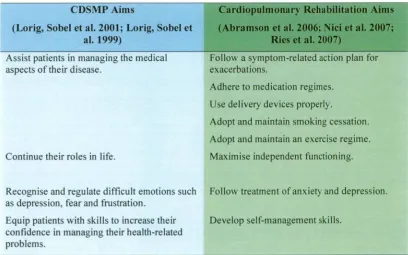
[image:31.559.97.505.457.712.2]The CDSMP aims to help people self-manage their chronic condition (Long 1996). These aims have similarities to those of cardiopulmonary rehabilitation where the overall aim is to maximise independent functioning (Abramson et al. 2006; Nici et al. 2007; Ries et al. 2007). A comparison reveals the CDSMP targets generic health-related behaviours, while cardiopulmonary rehabilitation focuses on condition-specific behaviours (Table 1).
Table 1: Comparison of Programme Aims
CDSMP Aims
(Long, Sobel et al. 2001; Long, Sobel et al. 1999)
Cardiopulmonary Rehabilitation Aims
(Abramson et al. 2006; Nici et al. 2007; Ries et al. 2007)
Assist patients in managing the medical aspects of their disease.
Continue their roles in life.
Recognise and regulate difficult emotions such as depression, fear and frustration.
Equip patients with skills to increase their confidence in managing their health-related problems.
Follo■N a symptom-related action plan for exacerbations.
Adhere to medication regimes.
Use delivery devices properly.
Adopt and maintain smoking cessation.
Adopt and maintain an exercise regime.
Maximise independent functioning.
Follow treatment of anxiety and depression.
Chapter One: Context of the Thesis 15
1.6.1.2 Assumptions of the CDSMP and Cardiopulmonary Rehabilitation
In developing the generic CDSMP, Long and colleagues (Long, Sobel et al. 1999) describe underlying assumptions that relate to the person with the chronic condition:
• similar self-management problems and tasks are faced by people with different chronic conditions
• responsibility for the daily management of chronic conditions can be learnt by patients
• proficient self-managers will experience improved health while accessing fewer medical resources.
As well as these three main assumptions, an additional three relating to the programme are also noted (Long, Sobel et al. 1999):
• inexpensive and widely available programmes are desirable
• peers, non-health professionals with chronic conditions, can be trained to deliver a structured programme effectively
• both patients and professionals would find these trained peer leaders acceptable.
Training peer leaders as positive role models, and so informing self-efficacy by vicarious experiences, is the only one of the above assumptions for which a rationale is given in the literature. No assumptions for cardiopulmonary rehabilitation are reported in the literature.
1.6.1.3 Content of the CDSMP and Cardiopulmonary Rehabilitation
Chapter One: Context of the Thesis 16
Table 2: Comparison of Programme Content
CDSMP Programme Content
Lonaition-specnic iniormation in me
companion book
Symptom management: anger, fear, frustration, depression; shortness of breath, fatigue, pain
Breathing exercises
Muscle relaxation
Endurance exercise (discussion)
Cognitive symptom management
Communication skills
Advance directives for health care
Working with and informing the healthcare team
Medication usage: generic advice, specific information in companion book
Healthy eating
Specific suggestions in the companion book
How to set action plans and problem solve
carwopuImry Rehabilitation Programme Content
(Lecture series, with team member delivering the lecture noted)
Heart and lungs: structure and function in relation to chronic heart and lung conditions
(Physiotherapist)
Monitoring and responding to symptoms: relaxation, breathing exercises, managing breathlessness
Beginning an exercise programme
(Physiotherapist)
Living with heart and lung conditions: emotional and social impact, communication
(Social Worker)
Medications and delivery devices: condition specific (Pharmacist) Nutrition (Dietician) Activity modification (Occupational Therapist)
Not formally addressed
Note: The CDSMP course content is presented in comparison with cardiopulmonary rehabilitation and not as the content of the six individual CDSMP sessions. Cardiopulmonary rehabilitation is shown as the six sessions with the health professional who presented the lecture.
Chapter One: Context of the Thesis 17
1.6.1.4 Comparison of Programme Process
The CDSMP covers six sessions of 21/2 hours duration delivered once weekly over six weeks. There is no predetermined duration for cardiopulmonary rehabilitation. A recent survey of these programmes in Australia indicated that 57% run for eight weeks and with the exception of 2% 'individual classes', they are group-based (Australian Lung Foundation 2007). At the hospital where this research took place, the cardiopulmonary rehabilitation programme offered one session per week over seven weeks, with group-based sessions of two hours' duration.
Both programmes have a focus on delivery of health-related information; however they differ with respect to the process of delivery (Table 3). Cardiopulmonary rehabilitation has a focus on participants receiving education from health
[image:34.562.107.508.488.700.2]professionals, while the CDSMP has a focus on participants sharing knowledge with each other. The latter process is facilitated by the leaders who ensure, with reference to the manual, that all points are covered in the discussion. The CDSMP process actively fosters the development of self-efficacy through role modelling, while cardiopulmonary rehabilitation offered previously at the hospital where the research took place did not deliberately target this. The other differentiating feature is the absence of supervised exercise with the CDSMP.
Table 3: Comparison of Programme Process
CDSMP Programme Process Cardiopulmonary Rehabilitation Programme Process
Several topics per week, delivered in lecturettes with group brainstorming and interaction
Generic information supplemented by
condition-specific information in a companion book
Leaders facilitate group discussion
Structured peers learning from peers
Action planning, problem-solving, with guided feedback to the group
Self-efficacy development actively fostered
No supervised exercise
One topic per week, delivered in a lecture format with discussion
Generic information supplemented by condition-specific advice and written information
Health professionals deliver knowledge
Incidental peers learning from peers
Aims, problem-solving and feedback provided on an individual basis
Self-efficacy development incidental
Chapter One: Context of the Thesis 18
While both approaches facilitate the adoption of health-related behaviours, it will become evident in the following section that adopting health-related behaviours is an acknowledged management activity. The following section defines
self-management, its related responsibilities and the suggested activities involved when self-managing.
1. 7 Self-Management
Self-management is receiving increasing attention in the COPD-related literature. Revised guidelines and recent reviews refer to enhancing self-management as a strategy for people with COPD when incorporating health behaviours into daily life (Bourbeau, Nault & Dang-Tan 2004; Make 2003; Nici et al. 2007; Ries et al. 2007). The CDSMP aims to help people learn to self-manage. It is therefore relevant to this thesis to discuss self-management in this chapter. However, as it will become evident when drawing comparisons between the CDSMP and comprehensive
cardiopulmonary rehabilitation, reports of 'self-management' may either encompass various activities and responsibilities or have a singular focus on symptom
management.
People with chronic conditions develop ways of managing their lives, irrespective of the healthcare interactions they may or may not experience (Taylor & Bury 2007). These coping strategies have been acknowledged by others (Battersby et al. 2003; Clark 2003; Clark et al. 1991; Corbin & Strauss 1988; Kralik et al. 2004; Long 2003). The strategies are often included in an operational definition (Battersby et al. 2003) and, as such, emphasise the 'managing' aspects of self-management. This emphasis is reflected in studies reporting health status and behaviours (Fu et al. 2003; Siu et al. 2007; Swerissen et al. 2006). While adopting health-behaviours is one of the acknowledged self-management activities, self-efficacy is also a measured outcome, bringing into focus the 'self' in self-management (Walker et al. 2003). This works in concert with the 'managing' aspects, both components being integral to a definition of self-management.
1.7.1 Self-Management: Definition, Responsibilities and Activities
Chapter One: Context of the Thesis 19
that people with chronic conditions undertake responsibilities and engage in activities related to three major areas of their lives, first identified by Corbin and Strauss (1988) as being medical issues, quality of life and emotional impact
Chapter One: Context of the Thesis 20
Table 4: Responsibilities and Activities Listed by Authors
Author(s)
Corbin & Strauss Managing the medical aspects of the condition (1988)
Dealing with the emotional impact of living with a chronic condition
Adapting behaviours to maintain a meaningful quality of life
Clark et al. (1991) Monitoring symptoms, physical and emotional aspects and responding appropriately
Managing relationships and the impact of chronicity on one's psychosocial role
Undertaking health-related activities (medication use, diet, exercise, relaxation, smoking cessation) to manage the condition
Interacting with providers of healthcare
Long & Holman Monitoring and managing the daily impact of a chronic condition on one's (2003) life and making informed decisions in response to this
Making short-term action plans in order to adopt new health-related behaviours
Working in partnership with healthcare providers, discussing the pattern of the condition and treatment options
Following problem-solving steps of identifying the problem then suggesting, selecting and implementing a possible solution
Utilising resources and knowing where and how to seek assistance
Battersby et al. Monitoring and responding to the symptoms and signs of condition(s) (2003)
Managing the physical, emotional and social impact of condition(s)
Engaging in health-related activities
Negotiating a plan of care with healthcare providers
Knowing the condition and its treatment options
Kralik et al. Monitoring the condition and its symptoms and recognizing the limitations (2004) these placed on activities of daily life;
Engaging in adaptive behaviours and social interactions
Re-interpreting a self-identity
Planning for, prioritising and pacing activities, while balancing the pros and cons in decision-making
Long and Holman (2003) have drawn on the work of the previous researchers incorporating their concepts into an expanded set of what they term
Chapter One: Context of the Thesis 21
Battersby and colleagues (2003). However, these authors do not mention self-management occurring within the self-tailoring context referred to above.
1.7.1.1 A Synthesis of Self-Management Definition, Responsibilities and Activities
Self-management is a term widely used in the healthcare literature and recently in government policy. Despite this widespread use, there appears to be no universally accepted definition of self-management (Barlow et al. 2002). The term is also used interchangeably with self-determination, self-help or as it is also known, self-care. Therefore a consideration of the definition of these terms is necessary as it points to subtle differences: 'self-determination' implies acting with free will; 'self-help' suggests providing for or improving oneself and 'manage' relates to coping with issues (Tulloch 1995). 'Management' therefore does not necessarily imply by choice or effecting improvement. This distinction is of note for people with chronic
conditions including COPD who have no choice but to manage their lives in one way or another, the only question being how they manage (Long & Holman 2003).
How a person perceives of, thinks of and feels about themselves influences the 'managing' strategies they will employ when coping with a chronic condition. This points to a duality when considering the term 'self-management' and brings into focus the 'self' in self-management (Walker et al. 2003). For this thesis, the duality is incorporated in the definition of 'self-management' and is accompanied by
acknowledged responsibilities and activities.
Chapter One: Context of the Thesis 22
Integral to this is the degree of 'confidence' (self-efficacy) and importance assigned to the goal by the individual (Bandura 1986).
In summary, self-management in this thesis is defined as a dynamic process
incorporating an individual's capability and confidence to undertake responsibilities and to engage in activities that enable them to deal with the impact of living with a chronic condition on all aspects of their life: a sense of self and their medical, emotional and social domains.
[image:39.564.106.513.344.687.2]Drawing together the work of the above authors (as shown in Table 4), it is suggested that in order to retain an acceptable and meaningful quality of life, such management involves the capability to undertake core tasks or responsibilities. Fulfilling responsibilities requires the undertaking of specific activities (Table 5).
Table 5: Self-Management Responsibilities and Activities
Self-management Responsibilities Self-management Activities
Respond to the impact of a chronic condition on one's overall health, incorporating a sense of self and the physical, mental, social, emotional and spiritual aspects of health
Monitor and respond to the symptoms of the chronic condition
Engage in behaviours to promote good health
Utilise resources, both internal (personal) and external (various sources)
Work in partnership with healthcare providers and carers.
Learn core self-management skills
Having awareness of thoughts pertaining to the self, and prioritising, planning and pacing to maintain roles in life
Following a symptom-related action plan that requires knowledge of the condition and its symptoms, the skill to monitor and interpret them, and to follow an agreed plan of action. In this way the person self-regulates.
Having an understanding of health-related behaviours and how these relate to individual circumstances.
Seeking and implementing information concerning health in general and in health-related behaviours
Communication and decision-making skills to effectively work with carers and healthcare providers.
Setting goals with action plans to achieve those goals
Problem-solving skills (problem identification, seek, implement and evaluate possible
solutions).
Chapter One: Context of the Thesis 23
(Bandura 1986), including exercise, an area of enquiry in this thesis. As such it is important and will be discussed in the following section. The construct of self-efficacy underpins the CDSMP (Long, Gonzalez & Laurent 1999) and is receiving increasing attention in the cardiopulmonary rehabilitation-related literature
(Bourbeau, Nault & Dang-Tan 2004).
1.8 Self-efficacy
Self-efficacy is a construct of a broader psychosocial theory, first known as social learning theory when published in Bandura's seminal text in 1977 (Bandura 1977), and now known as social cognitive theory. This theory draws together the reciprocal interaction between personal, social and environmental factors in the regulation of human behaviour (Bandura 1986). These variables are suggested as determinants of exercise behaviour (King 2001; Sherwood & Jeffery 2000; Speck 2002) that can be influenced at the individual level of a socio-ecological model of health (Sparling et al. 2000). Self-efficacy has been suggested as a mediator and an outcome of exercise behaviour (McAuley & Blissmer 2000). The following discussion refers to the CDSMP and people with COPD, demonstrating how self-efficacy contributes to behaviour adoption or maintenance. As a first step, the meaning of self-efficacy will be explored.
1.8.1 Meaning of Self-efficacy
1.8.1.1 Definition
Chapter One: Context of the Thesis 24
His goal is important to him, providing the initial motivation for adopting exercise. He expects his efforts will result in increased fitness, and he believes in his ability to do this.
The term given to this perception or belief that one 'has what it takes' is self-efficacy. Self-efficacy is thus a belief in one's ability to achieve goals, organising and undertaking the necessary action to mange different situations in life, in order to reach the desired outcome (Bandura 1986). The processes involved in setting and pursuing goals are discussed in the following section.
1.8.2 Setting Goals
As people adopt behaviours to achieve their goals they initially observe and make judgments about their own behaviour, implement a course of action to reach the goal, then draw conclusions as to the outcome of the experience. In other words, they monitor or self-regulate their behaviour (Bandura 1978, 1997; Clark, Gong & Kaciroti 2001; Schwarzer 2001). With goal attainment, the person's belief in their ability to achieve their goals is likely to be strengthened, that is, their sense of self-efficacy will be enhanced. Once a robust sense of self-self-efficacy is established, generalisation to related activities can occur (Bandura 1986).
Setting a goal in and of itself does not serve as a motivational force for behaviour change. People must first intend to exercise, for example, and they require a standard by which to judge their endeavours, such as achieving recommendations for daily physical activity. Self-efficacy beliefs act with the goal by influencing the choice of goal, the effort expended in pursuing the goal, and whether the expected outcome will be realised (Bandura 1998). Specific properties of goals contribute to self-efficacy and facilitate motivation to persist with the intended behaviour (Bandura
1977, 1986). These properties are:
Chapter One: Context of the Thesis 25
1.8.2.1 Goal Specificity
Clear specific goals offer a framework for feedback or personal evaluation of the behaviour in question. This helps to regulate the effort required to achieve the goal (Bandura 1986) and provides direction and motivation to the effort (Bandura 1997). In addition, the goal has greater influence if it is personally relevant to the individual, providing the motivation to self-regulate and so develop strategies to self-manage (Clark et al. 1991; Clark, Gong & Kaciroti 2001). Self-efficacy is deemed to be behaviour-specific; therefore goals need to be defined in terms of behaviours and may be approached by specifically formulating a plan of action that further delineates the steps to be taken. Behaviour-specific action plans are formulated by CDSMP participants addressing goals they want to pursue, rather than goals prescribed by others (Long, Gonzalez & Laurent 1999) . This point is pertinent to this thesis, because in clinical practice emphasis is often placed upon an exercise prescription given to the person with COPD. Inviting the participant to define their own exercise parameters is not a feature described in cardiopulmonary rehabilitation programmes.
1.8.2.2 Goal Level or Challenge: 'Setting the Bar'
How high or low to 'set the bar' is a question for people when setting the parameters of their goals. For exercise, these parameters would pertain to frequency, intensity and time or duration. A number of views of other researchers concerning goal level have been summarised by Bandura (1986, p. 473): 'When goals are set
unrealistically high, most performances prove disappointing. Strong effort that produces repeated failure weakens perceived self-efficacy, thereby reducing
motivation to perform the activity.' Similarly, if the 'bar' is set too low and goals are achieved with minimum effort people are inclined to infer low self-efficacy, and perseverance in the face of adversity is likely to be compromised (Bandura 1986).
Chapter One: Context of the Thesis 26
much breathlessness that they give up. In defining action plans during the CDSMP, participants nominate frequency, intensity or duration of the activity with an emphasis on 'setting the bar' at an achievable level (Long, Gonzalez & Laurent
1999).
1.8.2.3 Goal Proximity
Immediate sub goals directed towards attaining a distal goal are purported to be more effective at influencing current behaviour (Bandura 1977, 1986). Based on this work, setting a smaller sub-goal to walk to the letter box 'this week' would be a sub-goal of intending to walk to the shop by the end of the month, which in turn could be
directed towards the overarching goal of wanting to increase fitness. Each sub-goal can be approached by formulating a plan of action, as noted above.
As people strive towards their goals they draw upon four main sources of
information that facilitate the development of self-efficacy (Bandura 1977). These sources are described in the following section.
With goals defined, what contributes to self-efficacy development?
1.8.3 Sources of Self-efficacy Information
The sources that influence the development of self-efficacy are:
• mastery experiences • vicarious experiences • social persuasion
• physiological and emotional states. (Bandura 1977)
1.8.3.1 Mastery Experiences