820 | P a g e
Survey of ACO and PSO based Secure Routing protocols for
Wireless networks
PushpaLakshmi R
1(Associate Professor), Lavanya P
2, Bhuvaneshwari S
3 1Department of Information Technology, PSNACET, (India)
2Department of Information Technology, PSNACET, (India)
3Department of Information Technology, PSNACET,(India)
ABSTRACT
Wireless network are computer network that are not connected by cables any kind. There are radio waves to connect devices .Some of the issues in wireless networks are related to technology connectivity, meeting user demand and security considerations, and network management. Solving security and routing snags in wireless networks is one of the main challenging tasks. With the influence of swarm intelligence snags in security and routing can be cracked in highly decisive. Swarm intelligence (SI) is the collective behavior of decentralized, self-organized systems, natural or artificial. SI can crack very high sophisticated problem.SI induced some of simplified optimization technique such as Ant Colony Optimization (ACO), Particle Swarm Optimization (PSO). This paper presents reviews on several ACO and PSO based secure routing protocols in wireless networks. This survey mainly focuses on: 1.Protrayal of swarm intelligence in networks, 2.classification of SI based techniques on two main snags security, routing, and 3. Comparison and performance analysis of several ACO and PSO based secure routing protocols for wireless networks.
Keywords : Ant Colony Optimization, Particle Swarm Optimization, Swarm Intelligence, Wireless
Networks.
I INTRODUCTION
821 | P a g e
Wireless Local Area Network (LAN):Links two or more devices using a wireless distribution method, providinga connection through access points to the wider Internet.
Wireless Metropolitan Area Networks (MAN): Connects several wireless LANs.
Wireless Wide Area Network (WAN): Covers large areas such as neighboring towns and cities. Wireless
Personal Area Network (PAN): Interconnects devices in a short span, generally within a person‟s reach
822 | P a g e
ACO. The depiction of PSO is given in section III. The issues in network security and routing, study of ACO and PSO based secure routing protocols, and their comparisons are discussed in section IV. Finally, section V concludes the work.
II.THE BACKGROUND OF ACO
2.1Nature of Ant
In nature, ants are well known type of social insects. The size of an ant colony can vary from a few dozen to millions. When searching for food, ants initially explore the area surrounding their nest in a random manner. While moving, ants leave a chemical pheromone trail on the ground. Ants can smell pheromone. When choosing their way, they tend to choose, in probability, paths marked by strong pheromone concentrations. As soon as an ant finds a food source, it evaluates the quantity and the quality of the food and carries some of it back to the nest. During the return trip, the quantity of pheromone that an ant leaves on the ground may depend on the quantity and quality of the food. The pheromone trails will guide other ants to the food source. Ants use indirect coordination in successfully detecting the shortest path between the nest and the food sources. Fig.1. A. shows that ants follow the pheromone trail to reach food from their nest. An obstacle is introduced in B which interrupts the trail. C shows two new paths through obstacle discovered by ants to reach food. Finally D indicates that the ants select only shortest path by using the pheromone trail formed on that path.
Fig.2.1 Natural bahaviour of ants
2.2The Ant Colony Optimization algorithm
Ant colony optimization was introduced by Marco Dorigo in early 1990‟s. ACO algorithms belong to the class of
823 | P a g e
telecommunications, such as routing and load balancing. In ACO algorithms, artificial ants are stochastic candidate solution construction procedures that exploit a pheromone model and possibly available heuristic information of the mathematical model.
At each iteration of the algorithm, each ant moves from a state x to state y, corresponding to a more complete intermediate solution. Thus, each ant k computes a set Ak(x) of feasible expansions to its current state in each
iteration,and moves to one of these in probability. For ant k, the probability of moving from state x to state y depends on the combination of two values, viz., the attractiveness ηxy of the
move, as computed by some heuristic indicating the a priori desirability of that move and the trail level τxy of the
move, indicating how proficient it has been in the past to make that particular move. The trail level represents a posteriori indication of the desirability of that move. Trails are updated usually when all ants have completed their solution, increasing or decreasing the level of trails corresponding to moves that were part of "good" or "bad" solutions, respectively.
In general, the kth ant moves from state x to state y with probability:
equation (1)
Where,
τxy - amount of pheromone deposited for transition from state x to y
0 ≤ α - parameter to control the influence of τxy, ηxy is the desirability of state transition xy
β ≥ 1 - parameter to control the influence of ηxy.
If α value is high, then the pheromone intensity has strong impact to ants. If α value is low, then the ACO algorithm is close to a stochastic greedy algorithm. When α = 0, ants select the next hop node only based on the heuristic
information [10].
Evaluation of the pheromone value τxy at the end of each of the iteration is the core of ACO algorithm. After each
ant has constructed a solution (i.e., at each iteration) the pheromone value on each edge is updated. The goal of the pheromone update is to increase the pheromone values associated with good or promising solutions, and to decrease those that are associated with bad ones. The pheromone updating rule consists of two operations:
The pheromone evaporation operation that reduces the current level of pheromone
The pheromone additive operation: depends on the quality of the solutions generated at the iteration,
pheromone is added to the edge of good solutions.
The updating rule is:
824 | P a g e
Where,
ρ is the pheromone evaporation factor representing the pheromone decay (0 ≤ ρ ≤1), Δτxy is the pheromone addition
for edge xy. The decay of the pheromone levels enables the colony to 'forget' poor edges and increases the probability of good edges being selected. For 1→ρ , only small amounts of pheromone are decayed between
iterations and the convergence rate is slower. This is characterized by the high probability of finding the global optimal solution at the expense computational efficiency. Whereas for 0 →ρ, more pheromone is decayed resulting
in a faster convergence. This trend leads to getting stuck at the local optimal solutions[11].
is the amount of pheromone deposited.
equation(3)
Where,
Lk is the cost of the k
th
ant's tour (typically length) and Q is a constant.
Some of the benefits of ACO are: it can be used in dynamic applications, inherent parallelism, positive feedback leads to rapid discovery of good solutions, and distributed computation avoids premature convergence. Some of the applications of ACO are routing in telecommunication networks, traveling salesman, graph coloring, scheduling, constraint satisfaction, assignment problem, set problem, image processing etc.
Pseudocode of ACO algorithm
\
The ACO algorithm can be generally described as the interplay of three procedures: 1. Construct ants solutions is the procedure in which a colony of ants concurrently find the solutions in the construction graph. 2. Update Pheromones is the process in which ants modify the pheromone trails. 3. Daemon Actions is an optional procedure which is designed for implementing centralized actions. These three procedures conduct many researchers to design their own protocols [12].
intialize
for t=1 to iteration number do for k=1to l do
repeat until ant k has completed a tour select the city x to visited next with the probability pxy
calculate Lk
825 | P a g e
2.3Review of ACO Based Routing Protocols
2.3.1Low Energy Adaptive Clustering Hierarchy( LEACH): Low Energy Adaptive Clustering Hierarchy (LEACH) is probably one of the more referenced protocols in the wireless sensor networks area. It is a powerful, efficient protocol created to be used in sensor networks with continued data flowing (unstopped sensor activity) [13]. This is a protocol that uses a hierarchical topology, randomly creates cluster heads, and presents data aggregation mechanisms. The operation of LEACH is organized in rounds where each round consists of a 2 phases: (1) setup phase, (2) transmission phase. In the setup phase, the nodes classify themselves into clusters with one node selected as the cluster head in each cluster. In transmission phase, cluster heads collect data from the nodes within their respective clusters and they transfer the processed information to the base station [14]. Properties of this algorithm are Cluster based, random cluster head selection each round with rotation (or) cluster head selection based on sensor having highest energy, cluster membership adaptive, data aggregation at cluster head, cluster head communicate directly with sink or user, communication done with cluster head via TDMA, threshold value.
2.3.2Flooded Piggyback Ant Routing (FP): In FP, a novel specimen of ants i.e. Data Ants was introduced. The forward list is carried by FP. In this protocol, forward ants and data ants are combined through constrained flooding to route data packets and search for energy efficient paths in the network.[15] First, the distance to the sink, evaluated by the link probability Pn=1/|N| , where n is an ant's neighbor , N is set of neighbor that is used to
determine which neighbor will first broadcast a piggybacked ant. Second, a random delay is added to each transmission such that other nodes that overhear the same piggybacked ant from another neighbor drop their own copy of the data. The probability distribution constrains the flooding towards the destination for future data ants [16].
2.3.3Flooded Forward Ant Routing (FF): Flooded Forward Ant Routing (FF) was developed to overcome the shortcomings of misguiding paths due to obstacles in sensor –driven cost aware ant routing protocol (SC). It is efficient in reducing delay [15]. In FF, forward ants are flooded to search for the destination, and backward ants help to guide the ants back to the sources which are created by the forward ants. During the backward ant stage, the cost between each hop and the link probabilities are updated. Multiple paths are updated by one flooding phase. Flooding is stopped if the probability distribution is good enough for the data to reach the destination. The rate of release for the flooding ants is reduced when a shorter path is traversed [16]. Two strategies are used to control the forward flooding. First, the distance to the sink is evaluated by the link probability Pn=1/|N| (where n represents an ant's
neighbor and N is the set of neighbors), and this distance is used to determine which neighbor will first broadcast a forward ant to join the forward search. Second, a random delay is added to each transmission such that another node that overhears the same ant from other neighbors will drop its own copy of the ant.
826 | P a g e
route to avoid the overhead caused by the ant. If a node recognizes a link failure then it first sets a pheromone value to zero to deactivate the link and then it search for alternative link. If this fails, it informs to its neighbors. This process will repeat until the alternative route will found. It is very small, because there are no routing tables which are interchanged between the nodes. It only needs the information in the IP header of the data packets. Properties of ARA are Distributed operation, Loop-free, Demand –based operation, Sleep period operation, Locality, Multi-path, Sleep mode [17].
2.3.5Probabilistic emergent routing algorithm (PERA): PERA uses ant like agents to discover the network topology and maintain the routes in dynamic networks. It uses 3 kinds of ants are (1) regular FANTs, (2)uniform FANTs and BANTs, (3) regular and uniform FANTs and BANTs are sent out proactively. It has been designed to fulfill the following requirements: Every robot should be capable of sending data to any other robot, and every robot should be capable of receiving data from any other robot. The movement of robots must not cause any disturbance to ongoing communications. Multiple applications running concurrently on the same robot can use PERA in order to send / receive data independently of each other. Every robot should be capable of sending data to a particular application running on a given robot (end-to-end communication). The library providing the PERA protocol should allow a choice between unicast and multicast transmission [18].
827 | P a g e
III THE BACKGROUND OF PSO
3.1Nature of Particle
A particle is small localized object. In real life, each particle finds a solution to a problem. To do that hypothesis are plotted in a space and selected with a initial velocity and it have communication channel between particles. Once a initial velocity starts, the particle starts moving through the solution space and accelerate towards the other particles which will have a better fitness values between their communications grouping [20]. Through the social behavior of bird flocking PSO was developed. The main aim of birds flocking is a flock of animals that have no leaders will find food by random, follow one of the members of the group that has the closest position with a food source (potential solution). The flocks achieve their best condition simultaneously through communication among members who already have a better situation. Animal which has a better condition will inform it to its flocks and the others will move simultaneously to that place. This would happen repeatedly until the best conditions or a food source discovered.
3.2The Particle Swarm Optimization algorithm
PSO was proposed by Dr.Eberhart and Dr.Kennedy in 1995. The process of PSO algorithm in finding optimal values follows the work of this animal society [21]. Particle PSO is one the swarm intelligence technique. It deals with a problem for finding a best solution in an n-dimensional space it can be represented as surface or point. It is defined as the population based stochastic optimization technique that can stimulate swarm behavior of birds flocking. It exhibits common evolutionary computation attributes including initialization with a population of random solutions and searching for optima by updating generations [20]. PSO shares many similarities with evolutionary computation techniques such as Genetic Algorithms (GA). PSO has no evolution operators such as crossover and mutation. In PSO, the potential solutions, called particles, fly through the problem space by following the current optimum particles. Each particle has a fitness value and a velocity, and it learns the experiences of the swarm to search for the global optima. Each particle has its own velocity and position which are randomly initialized in the start. Each particle have to maintain its positions pbest known as local best position and the gbest known as global best position among all the particles. The equations are used to update the position and velocity of a particle [22].
equation(4)
where,
c1, c2 are acceleration coefficient, and r1, r2 are random vector.
828 | P a g e
xi denote the position of the particle i in the search space at time step t ; t denotes discrete time steps. The positionof particle is changed by adding the velocity vi(t) to the current position.
Pseudocode of PSO algorithm
3.3PSO Variants
Basic variants of PSO are velocity clamping, inertia weight.
Velocity clamping: This was introduced to avoid a phenomenon known as swarm explosion. With no restriction on the maximum velocity of the particles, a simple one-dimensional analysis of the swarm dynamic concludes that the particle velocity can grow unbounded while the particle oscillates around an optimum, increasing its distance to the optimum on each iteration. To control global exploration, velocity clamping is necessary. For that purpose, it‟s
important to set some limit for the velocity of particle so that it will remain in the search area.
Inertia weight: Inertia weight plays an important role in the process of providing balance between exploration and exploitation. Main purpose of inertia weight is to control the initial velocity. It determines contribution of previous velocity to the current step‟s velocity. Basic PSO doesn‟t have any inertia weight. The momentum of particle is
controlled by it by weighting the contribution of previous velocity. Large value of inertia weight leads to global search and small value facilitates a local search. Exploration is supported by larger value of w and smaller value facilitates exploitation.
3.4Review of PSO based routing protocol
3.4.1Binary Particle swarm optimization: Binay PSO is mainly used in cryptanalysis.Here, we define a particle„s
position and ieach particle updates its velocity and move to new position [23].
Initialize the population randomly While (Population Size)
{
Loop Calculate fitness
If fitness value is better from the best fitness value (pbest) in history then
Update pbest with the new pbest End loop
Select the particle with the best fitness value from all particles as gbest
While maximum iterations or minimum error criteria is not attained
{
For each particle
Calculate particle velocity by equation (4) Update particle position according to equation(5) Next
829 | P a g e
Updating the velocity of particle:
equation(6)
Updating the position of particle:
Here
Sig(V)=(1/1+e-V) , if Sig(V)>r3 .
Where,
r3= random value else ,
3.4.2Wave of swarm of particles (WSOP): The principle of WSOP is the existence of wave concept a factor of excitement that will be exercised on certain portions of the search space in order to disperse grouped particles and thus to extend the exploration away from local minima.It is semi automatic.It is force to concerned particles to change the direction inorder toavoid minimal local.It describes the course of particles inorder to optimize the cost function [24][25].
3.4.3Multicast routing based on particle swarm optimization(MSOP): It is fully focused on energy efficient consumption and multicast routing. It selects the node with the minimum energy consumption in the route selection and builds a multicast tree with minimum delay. Then there exists route failure in all route discovery methods resulting in data loss and routing overheads.
3.4.4Particle Swarm Optimization based Lifetime Prediction(PSOLP): It predicts the lifetime of the link and node in the available bandwidth based on the parameters such as relative mobility of nodes and energy drain rate. To decide the node status for prediction these parameters are fuzzified and fuzzy rules have been formed .For verifying status of a node before data transmission the piece of information is exchanged among all the nodes [26].
3.4.5Hybrid PSO and K-means clustering algorithm: The hybrid algorithm first executes the K-means algorithm once. In this case the K-means clustering is terminated when any one constraint satisfied: the maximum number of iterations is exceeded, (or) the average change in centroid vectors is less that 0.0001 (a user specified parameter). The result of the K-means algorithm is then used as one of the particles, while the rest of the swarm is initialized randomly .With the result of K-means algorithm , the performance of PSO clustering algorithm can be improved by seeding the initial swarm [27].
830 | P a g e
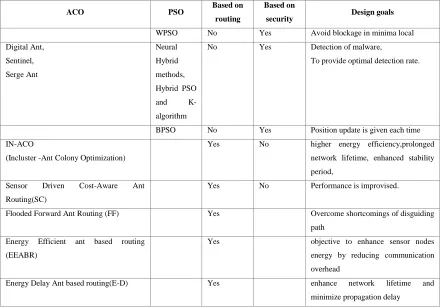
TABLE 1:OVERVIEW OF ACO AND PSO ROUTING PROTOCOLS
ACO PSO Based on
routing
Based on
security Design goals
WPSO No Yes Avoid blockage in minima local
Digital Ant, Sentinel, Serge Ant
Neural Hybrid methods, Hybrid PSO
and
K-algorithm
No Yes Detection of malware,
To provide optimal detection rate.
BPSO No Yes Position update is given each time
IN-ACO
(Incluster -Ant Colony Optimization)
Yes No higher energy efficiency,prolonged network lifetime, enhanced stability period,
Sensor Driven Cost-Aware Ant Routing(SC)
Yes No Performance is improvised.
Flooded Forward Ant Routing (FF) Yes Overcome shortcomings of disguiding
path Energy Efficient ant based routing
(EEABR)
Yes objective to enhance sensor nodes
energy by reducing communication overhead
Energy Delay Ant based routing(E-D) Yes enhance network lifetime and
minimize propagation delay
IV .CONCLUSION
In wireless networks, the network security and routing considered as challenging task. Because of this ACO and PSO had developed more protocols for network security and routing. This work presented various ACO and PSO based routing protocols and their goals. We were keen to extend this work towards research to develop more protocols for network security and routing. The main goal of this work is to give a general overview of ACO and PSO based protocols for network security and routing .We hope that this work will help the protocol designer to know about various algorithms and their properties so far when designing a new ACO and PSO based protocols.
REFERENCES
831 | P a g e
[2] "Wireless networking basics"v1.0,october2005,Publised by:NETGEAR
[3] Bui A. J. Banh, Gary J. Anido, Eryk Dutkiewicz, "Handover Re-routing Schemes for Connection Oriented Services in Mobile ATM Networks"by Telecommunications and Information Technology Research Institute,University of Wollongong, Wollongong Australia, Published in IEEE,1998.
[4] Zoha Pajouhi and Kaushik Roy, “Image Edge Detection based on Swarm Intelligence using Memristive Networks, “ IEEE Transactions on Computer Aided design, 14 Feb 2017.
[5] NazneenTarannum S, H.Rizvi, and Prof.R.R.Keole, “Preliminary Review of swarm Intelligence: A Clever Algorithm and Data Clustering”, International Journal of Computer Science and Information Technologies, Vol
.5(2), pp.1892-1899, 2014.
[6] P. Amudha, S. Karthik, and S. Sivakumari,“A Hybrid Swarm Intelligence Algorithm for Intrusion Detection Using Significant Features”, Scientific World Journal, 2015.
[7] Simranjeet Kaur, Prateek Agarwal, Rajbir Singh Rana, "Ant Colony Optimization :A Technique used for Image Processing", IJCST VoL.2,Issue 2,June 2011.
[8] Chandra Prakash Prabhakar ,Mrs. Kiran Dewangan, "Estimation of Motion Blur Based on Combination of PSO and GA" International Journal of Innovative Research in Electrical, Electronics, Instrumentation and Control Engineering, Vol. 4, Issue 12, December 2016.
[9] Jung-Yoon Kim, Tripti Sharma, Brijesh Kumar,G. S. Tomar, Karan Berry,and Won-Hyung Lee1, "Intercluster Ant Colony Optimization Algorithm for Wireless Sensor Network in Dense Environment", International Journal of Distributed Sensor Networks, 2014.
[10]Urmila M Diwekar , "Efficient Ant Colony Optimization (EACO) Algorithm for Deterministic Optimization" Uncertain Systems: Tools for Optimization & Management (CUSTOM), Vishwamitra Research Institute, Crystal Lake, USA published in International Journal of Swarm Intelligence and Evolutionary Computation. [11]Marco Dorigo and Thomas Stutzle, “Ant Colony Optimization”, Massachusetts Institute of Technology 2004. [12]Dorigo M., Gambardella L.M., Birattari M., Martinoli A., Poli R.,
[13] Stützle T. , "An Energy-Efficient Ant-Based Routing Algorithm for Wireless Sensor Networks", Ant Colony Optimization and Swarm Intelligence. ANTS 2006. Lecture Notes in Computer Science, vol 4150. Springer, Berlin, Heidelberg.
[14]Mandi Gobindgarh Rajeshwar Singh , "A Survey on ant Colony Optimization (ACO) based Routing Protocols for Wireless Sensor Networks (WSN)", International Journal of Advanced Computer Science and Applications, Vol. 8, No. 2, 2017.
[15]Nabil Ali Alrajeh, Mohamad Souheil Alabed, and Mohamed Shaaban , "Secure Ant-Based Routing Protocol for Wireless Sensor Network", Internation journal of Distributed sensor networks,Jan 2013.
832 | P a g e
[17]Carlos AGUERO, Jos e M. CANAS, Miguel ORTUNO , "Design and Implementation of an Ad-Hoc Routing Protocol for Mobile Robots", Turk J Elec Engin, VOL.15, NO.2, 2007.
[18]Ducatelle, F., Di Caro, G., and L.M.Gambardella,, "Principles and Applications of Swarm Intelligence for Adaptive Routing in Telecommunications Networks", Swarm Intelligence, 4(3):173–198, 2010).
[19]Vivek G, Vrinda Shetty, "A Survey on Swarm Intelligence Based Optimization Technique for Image Compression", International Journal of Innovative Research in Computer and Communication Engineering Vol. 3, Issue 2, February 2015.
[20]Dian Palupi Rini,Siti Mariyam Shamsuddin , "Particle Swarm Optimization: Technique, System and Challenges", International journal of computer application in 2011.
[21]Muhammad Imran, Rathiah Hashima and Noor Elaiza Abd Khalidba , "An Overview of Particle Swarm Optimization Variants", Malaysian Technical Universities Conference on Engineering & Technology 2012, MUCET 2012.
[22]S. D. Chavan, Nisha P. Adgokar , "An Overview on Particle Swarm Optimization: Basic Concepts and Modified Variants", International Journal of Science and Research (IJSR).
[23]K.D. Kalambe, A. R. Deshmukh, S.S. Dorle , "Particle Swarm Optimization based Routing Protocol for Vehicular Ad Hoc Network", International Journal of Engineering Research and General Science Volume 3, Issue 1, January-February, 2015.
[24]M.Arthi,M.Jayashree , "An effective technique for pso based clustering and polynomial regression in Wireless sensor networks", International journal of computer science trends &tech(IJCST) volume4,issue 4-Aug 2016. [25]Meng Li, Lin Zhang1, Victor O. K. Li , "An Energy-Aware Multipath Routing Protocol for Mobile Ad Hoc
Networks", ACM Sigcomm Asia‟05, Apr. 10-12, 2005.
[26]Muhammad Saad Iftikhar, Muhammad Raza Fraz, "A Survey on Application of Swarm Intelligence in Network Security" , Transactions on Machine Learning and Artificial Intelligence, Volume 1, No 1, 2013.