This is a repository copy of Recognition and characterisation of turves in archaeological occupation deposits by means of macrofossil plant remains.
White Rose Research Online URL for this paper: http://eprints.whiterose.ac.uk/1949/
Monograph:
Hall, A. (2003) Recognition and characterisation of turves in archaeological occupation deposits by means of macrofossil plant remains. Report. Centre for Archaeology Report . English Heritage , Portsmouth.
[email protected] https://eprints.whiterose.ac.uk/ Reuse
Items deposited in White Rose Research Online are protected by copyright, with all rights reserved unless indicated otherwise. They may be downloaded and/or printed for private study, or other acts as permitted by national copyright laws. The publisher or other rights holders may allow further reproduction and re-use of the full text version. This is indicated by the licence information on the White Rose Research Online record for the item.
Takedown
If you consider content in White Rose Research Online to be in breach of UK law, please notify us by
Centre for Archaeology Report 1 G12 003
Recognition
and Characterisation of Turves in Archaeological
Occupation Deposits by means of Macrofossil Plant Remains
AlIan Hall
0 English Heritage 2003
ISSN 1473-9224
T17e Centre for. Archaeolo~y Report Series incorporates ihejbrmer Ancient Monuments Lnbornroty Report Series. Copies of A prcient Monuments Laboratory Reports will cont inzle to be available from ~ l ~ e Cenrrefor
Centre for Archaeology Report 16/2003
Recognition and Characterisation of Turves in Archaeological
Occupation
Deposits
by
means
of Macrofossil Plant Remains
Summary
Turves (in the senseof blocks or sheets of plant material and soil cut from the surface of an area of living vegetation) have been used for n variety of purposes in the past. They are frequently encountered in certain kinds of archaeological deposits, especistIly major earthworks, but only rather rarely studied from a bioardlaeological point of view.
This study is primarily concerned with the discrimination of turves? or material derived from them, in occupation deposits through she analysis of pIant rnacrofossils. It combines
investigations of deposits thought to contain turves, a survey of assenlblages where evidence for turves may be present (but has in some cases been overlooked), with some discussion or theoretical aspects of deposit formation and macrofossil taphonomy.
Keywords
Plant Remains Taphonomy Turves
Author's address
Allan Halt: Environmental Archaeology Unit, Department of Biology, University of York. PO Box 373,
York Y O I0 5YW. Telephone: 0 l904 43385 1. Email: [email protected]
Mcrny CfA reports are interim reports which make available the resrrtJts of speciaIis~ invesligafio~.rs in advance
of fidl pu blication. T h q use no! suhject to external refereeing, and their conchtsio~ls may sornefimes hmfe to be mod8ed it7 the Jighl of archaeological infonna fion that was not mtoilable at rhe time of the ilrve.s/i~alion. Readers ore therefore advised to co~~sult the alrthor before cirij7g the report in a??vpzthlicntion and to comzrl! rl7e)naI e.rcuwafion- report when available.
Contents
List of tabIes and figures
. . .
3. . .
Background to this study. . .
Examplesin
the archaeological literature of the recognition of turves (Appendix)7
Original archaeobotanical d i e s. . .
8(i) Appletree. Cumbria
Cc
turf wall'). . .
8(ii) Milecastle
79.
Cumbria. . .
9(iii) Cawthorn Camps. N
.
Yorkshire...
9(iv) Wellington Row. York
...
9(v) Deer Park F m s .
CO
.
Antrim.N
.
Ireland. . .
11(vi]
16-22 Coppergate. York...
13(vii) Layerthorpe Bridge. York
...
14(viii)
LOW
Fisher Gate. Doncaster. S.
Yorkshire...
15. . .
(ix) Other sites with (predominantly) charred preservation 16 (a) CarrNaze. Filey. N. Yorkshire. . .
17(b) Flixborough. N
.
LincoEnshire...
17(c) Other sites with charred preservation
. . .
I 8 (X) Diverse sites with mainly 'waterlogged' preservation. . .
I 8 Some theoretical considerations: ethnographic evidence. taphonomy. soil seed banks and vegetative remains...
18Ethnographic studies: the ways in which iurves have been used
...
18A
.
Dwellings and other major structures. . .
19. . .
B.CImpsandkilns 21 E.Manure. . .
22. . .
. . .
Taphonomy.
.
23Plant remains in turves 'in Iife'
. . .
23SoiI seed banks
...
24Vegetative remains from turves
. . .
26...
A possible reinterpretation of some published plant macrofossil records 26 Conclusions. . .
. .
28Acknowledgements
. . .
..
. . .
30. . .
References. . . .
.
30List
of
tables and figuresTable 1. Samples
f
om a section through the Turf Wall and adjoining ditch at Appletree,Cumbria (site code CAS648), subjected to apt assessment of the it. planr
(and
inverre brate)macrofossil content.
Table 2. Plant remains and ether components in the s a m p l e s ~ o m the Appletree Section.
Table 3. Samples from Milecastle 79, near Bo wness, Cumbria (site
code
CAS653), subjected to an assessmentof
their plant macrofossil content.Table 4. Plant
remains
and
other- componentsin the samples f i m
Milecastle 79.Table 5. Results
of
assessmentof
plant remains in samples thought to contain tunes, fromexcavations at Cawthorn Camps,
N.
Yorkshire (CAS654)in
1 999.Table 6. SamplesJi-orn Wellington Row, York (YATsite code 1989-90.24).
Tnble 7. Plant remains and o t h e ~
components
in
a
group of samplesfiom Wellington Row,York
(material examined during the assessment in 1995).Table 8. Plant remains and other components in the samplesfi.ona Wellington
Row,
York (mater in E examined during the present study).Table 9. The more abundant components of the ' f u r - samples (contexts marked
'J'
in Table 7 and all those in Table 8)from Wellington Row, York.Table 10.
Planr
remains(and
other itevns)fiorn samples fi-om three contexfsfiom the Early Christian rath at Deer ParkFarms,
Co.Antrim,
N. Ireland, with a 'turfcharacter recorded
during excavation.
Table I
I (a).
The more abundant plant remains(and
other items)from Dee
PPark Farms.
(b)Some other t a u
considered
likely to represent turves but present at10
wer ovep-all abundances.Table
12. Deer
Park Farms: Numbers of samples and their context fypes for records included in correlation wratrix/species associa f ion represented by Figure 1.Table
13. Numbersof
records and total abundance of 'core ' rurf group taxa(as
dejned atLleer Park Farms, but with the addition of Montia) for Anglo-Scandinavian deposits at 16-22 Coppergate, York.
Table 14 (a). The more abundant plant remains (and other iferns};)fiom
a
group offivesamples from
Period
5CpitJills at16-22
Coppergate in which Danthonia remains were recorded. (b) Some other t m considered likely to represent turves but present at lowerTable 15 (0). The more abrudunr plant remains (nnd other items)
from
selected samples fromseven contexfs at 16-22 Coppergale in which Leucobryum glaucurn or Polytrichum juniperinurn were recorded. (E) Some other tarn considered likely fo represent turves but
present at lower overall abundmces.
Table 16. Context information concerning the samples whose records are inclztded in Table 15.
Table 1 7 . Planr remninsfiorn contexts af Luyerthorpe Bridge, York, in which remains of
fumes may have been preserved: (a) dam present in at least hawof the samples
from
either Anglo-Scandinavian or medieval period. (b) Other taxa which might have arrived with grasssods andor heathlandmoorlmdpeaf turves.
Table 18. Contexts at Layerthorpe Bridge, York, in which remains of turves may have been present.
Table
JP.
Numbers of records (by phase) for plant remains fiom deposits ar Low Fisher Gate,Doncaster, which may represent material used for thatching or have originated in furves (including imported peot).
Tab le 20. Plant and other remains fiom excavations at Carr Naze, Filey Brigg, N. Y o r k hire (from 24 samplesfFon1 10 contexts).
Table 2
I .
Charred plant remains@om Fli~borough, N. Lincolnshire.Table 22. Contex fs fron? a vnriep of sites examined by the author in which at leas[ three ' t a u ' preserved by charring and perhaps buo ught with tunes were recorded.
Table 23. ContextsJj-om a varieg ofsites examined by the author in which at leastfive 'taxa "
preserved by waterlogging andperhaps brought with mrves were recorded
Table 24. Records further to those in Table 22 where the number of 'turf raxa recorded was
four, and also excluding records for Leontodon and Hypochoeris.
Table 25. Sires in the ABCD with two or
more ofthe
follawingplants recorded as chrrrred rernains+om prehistoric and later deposits: Carex sp(p)., Danthonia decumbens, Montia font axla and sspp. andPO
tentilla ( c j ) erecta, sorted by sitename.Table 26. Taxa recorded in assemblages with the 'core' group of taxa in Table 25 (prehistoric
sites only).
Table 27. T a w recorded in assemblages with the 'core 'group of taxa in Table 25 (post- prehistoric sites only).
Background to this study
This study is primarily concerned with the recognition-through macrofossil plant remains--of turves, or material derived from them, in archaeological occupation deposits in the British Isles. Whilst tuwes are frequently recognised (or at least inferred) during excavation of standing earthworks, studies of pIant macrofossiI remains (or, indeed, of any biological materials) from deposits known or thought to contain turves are very few, perhaps partly because of an unspoken assumption that such analyses will shed very little more light on the question of interpretation-it could be seen as 'gilding the Iily' to have an archaeobotanist confirm the nature of deposits which are clearly formed of turves. However, tunes naturally become archaeo~ogically invisible as soon as their characteristic stratification is Iost through redeposition or decay in situ. As Richmond and McIntyre (1 939, 1 13) observed in their description of the rampart of the Roman fort at Fendoch, Scotland, 'it had been built of turf,
but its reduced state and the porosity of the soil below it had induced heavy leaching, with the result that the Iamination typical of turf-built structures had been reduced in defmition'. The invisibility of turves through this kind of 'homogenisation' is, of course, even more
problematic where they have been used for purposes other than construction or where an earthwork has decayed beyond the point where it can be observed. So studies of deposits where the interpretation of the nature of the material present is unequivocal can serve as a baseline for investigations where such clear interpretation is not possible in the field. The recognition that certain remains probably had an origin in tunes will thus assist in
interpretation and understanding at a context and site level, as well as contributing to a fuller appreciation of the processes involved in assemblage and deposit formation. But there are wider issues concerned with the use of turf for making structures for dwelling and other purposes, as well as the question of the exploitation of natural resources (with its corollary of human environmental impact).
Naturally there are regional variations within the British Isles with regard to the exploitation of turves, just as the nature of the raw material varies (and must have varied in the past) with vegetation cover, itseIf a finction of topography, soils, land use history, and se on. Turves are historically very much a resource of the far north and west, areas in which a shortage or absence of timber (but an abundance of moorland and rough pasture) meant that other materiaIs were needed far building and for fuel (the various uses of turves are considered further, below). Outside of the 'Highland Zone', therefore, attention rarely seems to be paid to the possibility that turves were other than a very minor component of daily life in the
prehistoric and early historic past. Moreover, outside of this area there seems, too, to have been little or no acknowledgement to date by archaeobotanists concerned with occupation deposits that turves may have been the source of a component of the plant macrohssil assemblages they study; even archaeobotanists working on material from sites in, for
example, the Northern Isles of Scotland, seem only rather recently to have begun to consider turves as a source for remains in the assemblages they study (an excellent pioneering study is that by Camilla Dickson, 1998).
substantial
buried peat resources, the word has probably only ever been applied to strips or thinblocks
of soilheld
together with a mat ofplant
roots-what Adams (1 976, 102-3) defmesfor
turfas 'surface vegetation, usually grasses, rooted in thesoil
and usually associated&th
well-drained areas'.These
are the turves (or divots) of those who care forgolf-courses,
racecoursesand
gardens,and
are cutpom a surface with a Jivi~zg plant communr'ry.Elsewhere,
as indicated by Evans's comment, turf has (or has had) a quite different meaning:cut blocks of peat
from
a subterranean source (another word for peat tuwes widely usedin
Scotland, especiaIIy
in
connectionwith
building, is feal). Thusin
the East Anglian Fenland, Porter(1
969,160)describes
cut peat as turf; noting that the peatcutters
who
won it madethemselves
sodhouses
(presumably of surface-cutmaterial).
Turf
as cut peat seems tobe
the
general meaning of the word throughmuch
of northern and western Britain, andin
Ireland,h
the North
York
Moors,
on the otherhand,
Hartleyand
Ingilby (1 990) clearly distinguish between the cutting of peatand
turf, andhere
the latter is onlyapplied
to surface-cut sods. NaturaIlyin
this
and
someother
areas of heathlandor
moorland the mat of plant rootswill
be formed largely from ericaceous dwarf shrubs growingon
amor humus
soil, but with agradation
tograss-dominated
turflocal~y,
even here. It will thereforeprobably
sometimes prove difficult to make a separation withinthe
archaeological record between twvesin
the sense of'
root-bound sods'and hulfes
in
thesense
of
'peat blocks'. Evans ( l 969,8 0)emphasises the difficulty
of
clear definitions by referring to 'turf-sods, i.e. the parings of a turf bog', andmany
writers seem 10 me the wordssod
andturf
interchangeably. Unfortunatelyno
clear
distinction may necessarily be made for medieval and later documents referring to'rights
of
turbary', either, since in some areasboth
peatand
sod might be the resourceconcerned, though Fenton (1 978,25) notes that 'turbaries' and 'peatexies' may be
distinguishable at least from the 13Ih C. in Scottish documents
and
Edlin (1 95 1,4) observes that in the New Forest and Dorset, wherebetter
peat-forming plants are scarce, rights of turbary are closely associated withheathlands.
The work presented here
draws on two principal approaches: originalanalyses
ofarchaeological
deposits and a considerationof
published and unpublished data. There is also somediscussion
of the ethnographic evidence for the use of turvesin
a variety of ways. In order to complete this report within a reasonable time,much
materialhas
been set aside concerning the a variety of relatedissues,
such
as the implications of turf cuttingfor
landscapeand
vegetation change, the manpower requirements (and tools needed) for paring, andexamples where evidence for tuwes
has been
provided by otherbiological
remains(principally beetles
and
other insects)in the
absence of studies of plantmacrofossils.
It is hoped that these can be consideredin
a futurereport.
Note that plant
nomenclature
and
taxonomy followTutin
et al.(1964-90)
for vascular plants and Smith (1978)
for mosses,and
that identifications of plant material by the author wereExamples in thc archaeological literature of the recognition of turves (Appendix)
As mentioned above, turves are clearly visible and easily recognised
in
many earthworks, especially major constructions of the prehistoric and Roman periods. They usually appear asrather irregular dark lines of humic-stained sediment within paler material (see, for example, the descriptions by O'Kelly (1987) of material from Newgrange, Ireland, quoted in the Appendix). Turf-built earthworks are mentioned in at least nine of the 1.40-odd separate citations of excavations
and
other studies of Roman deposits in England, Wales and Scotland compiled by WiIson (1968) for 1967, and both of the two largest earthworks in the British Isles-Hadrian's Walland
the Antonine WdI-were turf-built ( h e more northerly wall never being built over in stone). For the far north of Scotland, use of turf (here presumably sods rather than peat) in building has been reported, for example, for excavations at Jarlshof, Shetland (Curle 1 934, recounted by Hamilton 1 95 6 ) and Birsay,
Orkney (Cruden1965)--reflecting a cultural tradition
found
throughout the Viking-influenced world (see Appendix and brief discussion with regard to ethnographic evidence, below). In other cases,the use of turves is inferred rather than proven by excavation: as Longworth (1985, 1 1)
remarks with regard to British neolithic farm settlements in general, 'where traces of houses have survived these are smalI and roughly rectangular, timber-framed with walls made of turf or wattle-and-daub, no doubt surmounted by a thatched or turfed roof.
But few of these excavations have been accompanied by archaeobotanicd studies of the turves reported, despite the fact that preservation may sometimes be very good. Indeed, some of the oldest (neolithic Silbury Hill and Newgrange) offer dear archaeobotanical evidence which has regrettably onIy been rather superficially investigated.
The examples cited in the Appendix for which useful archaeobotanical analyses have been undertaken may be divided into two groups: those yielding primaiy evidence (the turves are identified as, or suspected of being, such during excavation, with studies of plant remains adding 'artistic verisimilitude') and those giving secondary evidence (the interpretation of the presence of turves or material derived
from them
is achieved only through botanical analyses).In the 'primary' category, we may cite neo1ithiclBronze Age examples such as Silbury Hill (with its well-preserved moss flora), Newgrange and Knowth, Roman ones such as Davy gate and Crawford (though the analyses were vanishingly small), and for the post-medieval period Kebister (and a standing building: Causeway House). These do not form a comprehensive
corpus of records of plant remains
from
deposits which were clearly turves, however! Good examples of 'secondary' evidence for turves are Fishamble Street, Dublin, and some of the sites from N. Scotiand (The Biggings and Howe) examined by the late Camilla Dickson. The Irish material here seems likely to have been structural (in roofs, given the context within houses, the uncharred nature of the remains, and the presence of wooden pegs, cf. Geraghty 1996,27) whilst that from theOrkney
and Shetland sites may well have been used for fuel, at least in the last stages of its Iife (since it comprises charred macrofossils, though cf. Kebister, where charred materiaI from turves had presumably not been burnt deliberately as fueI).exploration for such evidence into areas where turves as a resource are much less firmly rooted in the consciousness of excavators and archaeological scientists.
OriginaI archaeabotanical studies
The fdlowing section summarises results fiom some studies undertaken by the author in connection with the characterisation and identification of turves and material derived from them. It is presented as a series of case studies, with a summary of information from a variety of sites examined in recent years at the end. Although the emphasis is on occupation deposits (i.e. fills of features and surface-laid accumulations associated with dwellings of some kind), some material from earthworks is also considered (although in the event it has not proved very informative).
(0
Apple free, Cumbria ('turf wall ')Sections through the 'turf wall' (part of the Hadrian's WaII monument complex) in the vicinity of Appletree, Cumbria, have been studied for
many
years since the first proof of its existence was made in this area by Haverfield in 1895 (Havefield 1897, 187). In this area, a little to the west of Birdoswald, the line of the original turf-built wall of the AD 120s was not subsequently repIaced in stone and its course can easiIy be followed as a bank diverging fiom the stone wall between Milecastles 49 and 5 1. With it are associated a series of minor banks and ditches. Tunres are easily recognised in the 'wall' as alternating bands of black, brown and grey sediment, though no macroscopic remains of plant material are visible when the deposit is examined in the field. (It should be emphasised that k f wall' may be something of a misrepresentation, since it is not constructed entireIy of turves throughout, cf. Wilmott (1997,52) who reminds us that Breeze (1982) has suggested "earth wall' may be more appropriate.) Previous studies have included anaIyses of sediments (McHugh 1993) and of pollen (Wiltshire 1992) from the Appletree section, but not of plant rnacrofassils.In an attempt to explore the plant macrofossil cantent of turves at this site, material was collected by the author during excavations by a team from English Heritage's Centre for Archaeology, led by A. J. WiImott, in summer 1999. Here, a section opened previously for a visit by the decennial Hadrian's Wall Pilgrimage was re-opened and samples were collected from the floor of the trench cutting into the turf wall, from the section itself, and also from some deposits in the deep, steep-sided ditch to the north of the bank in which some turf-like blocks of humic sediment had been observed.
The results of the analysis of the turfwaI1 samples were disappointing: perhaps not
surprisingIy, in a relatively small upstanding monument (the height of the wall at this point
was only about
1.5m3,
decay had been intense and macrofossil plant remains were very sparse (Tables 1 -2).T h e
sample of ?turves from the ditch was more rewarding, however, with some likelycr, heathland, but also on fallow land), waIIs, and rotten wood; Watson (1 968, 155) notes that 'it is a conspicuous plant in its typicaI state in spring, when patches of bare ground or burnt heathland are often purple with the countless setae [the stalks bearing spore capsuIes] of fruiting Cerutodon.' Certainly it has been noted in the succession following burning on lowland heaths and commons, for exmple in Middlesex (Richards 1928) and Surrey (Summerhayes and WilIiams 19261, typically at a stage after the ash left from bonfires has become leached. It seems reasonable to suggest that disturbance to the acid
grassEandheatIdand in the area caused by the builders of the turf wall led to the establishment of such patches of Cerafodon, and these were subsequently incorporated into the monument and thereafter fell with turves from the wall in decay into the ditch beIow.
The much better state of preservation of plant remains in the ditch fill sample is perhaps merely a function of the greater degree of waterlogging in that feature. For the turves in the turf wall, though retaining some micro-stratigraphic integrity (the humic and bleached layers had seemingly undergone very little mixing over the centuries), their raised position within the bank had Led to decay of a11 but the most resistant materials.
Mitecastle 79, Czrmbrin
During work on the Appletree Section in 1999, Centre for Archaeology staff were involved in small-scale excavation at Milecastle 79, near Bowness-on-Solway, Cumbria. Deposits thought to contain turves (from the platform on which the turf wall was built) were encountered and
samples from two contexts, representing the same platform in different trenches, were submitted to the author for assessment of their plant macrofessil content.
Preservation here was extremely poor (TabIes 3-41, the only plant material other than charcoal comprising a very few modem or probably modem seeds, presumably brought by earthworms from above. The Cenococcum sclerotia in one of the samples might aIso fall in this 'intrusive' category. Certainly no remains characteristic of turves were observed.
(iii) Crrw flt orit Crimps, N. Yorkslr ire
The site of Cawthom Camps, near Pickering, is unique in Britain for its row of four rectangular earthworks representing Roman military enclosures. Excavations under the direction of Dr Peter Wilson, Centre for Archaeology, took place at the site in 1999 and 2000 and in various places t w e s , or deposits thought to include turves, were encountered. During the assessment of a series of sampIes from the I999 excavations, two samples were
investigated specifically for surviving plant macrofossils as evidence of t w e s , but none was obserired (Table 5). Ground conditions here were far from ideal for the survival of remains, however: the site was located on somewhat sloping topography over sharply draining sandstones, and the
turves
themselves (presumably cut from the surrounding land when the earthworks and other structures were constructed) were very permeable.(iv) WeIIingfon Row, York
Excavation of a large area in Wellington Row, by York ArchaeoIogical Tmst (under the direction of Dr
P.
J. Ottaway), was undertaken in 1989-90. Much of the sequence at this site consisted of well-stratified Roman deposits which, in one area of one of the several trenchesopened (Trench 4), included I" to mid-Iate c. AD features thought to have been
interpretat ion of the sequence (context groups 4.4.1-3): 'A turf bank was [revealed] at the
south-eastern end of the trench, and survived as a mass of peaty materin1 interpreted as
decayed turves. This [context] group includes at least one context which may represent turves
which fell off the main bank [4181], as well as several which may belong to a later re-turfing
[4197,4138]. It is possible that this turf construction was part of the general preparation of the area for the later road, and equally it may aIso have been a way of levelling up waterlogged land close to the river's edge.'
An assessment exercise during 1995 revealed that there were well-preserved plant (and insect) macrofossils in the samples from these deposits and Carrott et al. (1995,4-5) averred that "hat these are turcres is clear from the biological analyses, even at assessment level', though the actual evidence in support of this is not offered in their inadequately brief report. This shortcoming is rectified in Tables 6 and 7, which show resuIts of archaeobotanical assessment of selected samples from deposits thought to contain turves (samples marked ' J' in Table 6 ) and some others, from both Trenches 4 and 7, in which a 'turfcomponent' was noted. Also presented ate the resuIts of analyses of some other samples from the 'turf bank' and associated
deposits, undertaken as part of the present project (Tables 6
and
8). Unfortunately most of the samples collected were rather small (presumably reflecting the limited extent of the contexts as defined during excavation), so subsamples were usually only of 1 kg.Although quite a wide range of plant taxa was seen in the 'turf' sampIes, and even more in those samples which were not interpreted as containing turves during excavation, the assemblages were actually rather restricted (certainly when compared with occupation
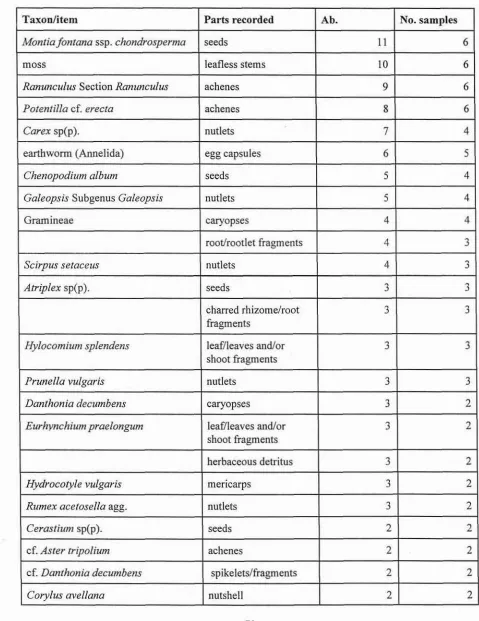
deposits with anoxic waterlogging in general), and many were dominated by a few taxa which occurred repeatedly (Table 9). O f these, Carex sp(p). Montia fontlrna ssp, chond?*osperma, Potenlilla cf. w e e fa, Ranz~nculus Section Ranunculus and Scirpus setnceus all seem quite likely to have arrived in turves, the second and the last in this list strongly suggesting turf formed in a damp place-they seem to be characteristic in lowland areas of short vegetation developing on \vet tracks and pond margins, i.e. the phytosociological alliance Nanocyperion within the class IsoEto-Nanojuncetea, though it should be remarked that S. setaceus is
generally overlooked in the field-it is unrecorded, fur example, in any of the relevtes listed
by RodweIl ( I 992; 1995; 2000) for grassland, wetland or other plant communities in which the plant might have occurred. In a position such as this not far from the river, flooding (or at any rate a seasonally high water table) might be suspected to have brought in wetland plant remains, but if so the stratigraphic evidence for silt deposition was not observed during excavation, or it had become obscured by reworking into the turf layers.
Of the other more frequently recorded remains, Chenopodium albunl and Galeopsis Subgenus
Galeopsis certainly do not suggest turf communities and are therefore perhaps plants which exploited newly-deposited turves left in an area of disturbed soil for long enough to be
coIonised by these annual weeds. Leafless moss stems and earthworm egg capsules seem also to be consistently present and are perhaps candidates for turf 'indicators'. One possibility which should be considered is that the indicators of periodically inundated short vegetation (Nanocyperion) mentioned above might, like the annual weeds, be colonisers of areas of freshly laid (and trainpled?) turf close to a river-as hese-and therefore not primary indicators of imparted turves at all. The seed ecology of taxa like Scirpus setnceus is cleady irnpoflant in
grassland in an area of former heathland in N. BeIgium (presumably part of the seed bank from an earIy stage of succession from bare ground). Herrnan Stieperaere (pers. comm.) comments that 'It pops up
in pIaces where 'improved"rass1and
is returned to a more semi- natural state by sod cutting or when pools are reopened.Thus,
it indicates pIaces which have been disturbed (e.g. after sod cutting, by traffic, etc...). It isin
no way, I think, an indicator for turves/sods being brought in to a site.' However, that it evidently forms a persistent seed bank through which it can easily recolonise areas of bare ground after sod cutting, means that sods cut from grassland may well contain its propagules even though it is not represented in the standing vegetation on that sod or in the recently deposited seeds at the surface of the sod. We should not, therefore, assume that all the seeds brought with a sod or turf arecontemporaneous with the vegetation on it (see further discussion of seed banks, below).
(v) Deer Park Furpns, Co. Antrim, N. Ireland
Studies of plant macrofossil remains from deposits forming on an Early Christian (7"YYh C. AD) rath (circular embanked occupation mound) at the site of Deer Park Farms, Co. Antrim, N. Ireland, have yieIded many assemblages in which a 'turf component' is thought to be
present. During excavation, only one sampled context was recorded explicitIy by the excavator as likely to contain turves (Context 3065, 'stacked turves in space between
Structures X, Eta and Zeta'), with two further contexts indicated as have a 'turfy' appearance (Context 398, 'turfy clay over rath bank" and 2435, 'turfy bank materiaI of [structure]
Gamma'). Many of the deposits forming this mound were very richly organic with excellent preservation (Kenward el al. 2000, and forthcoming), many of the plant macrofossil
assembIages being dominated by remains of heather, bracken, woodland and heathland mosses, and twiggy debris including brushwood and decayed wattle.
Results from examination of four sampIes from the three contexts mentioned above are shown in Table 10. Whilst plant remains were rather sparse in these samples, a number of taxa which might be expected to have arrived in turves are present, and there is a rather modest number of taxa which represent quite other kinds of habitats or vegetation types. Thus the more
frequently recorded plants incIude Ajuga reptans, Carex spb)., PorenriIla cf. erecta, Przmella
vulgaris, and Ranunculusflammula, and it may be no coincidence that clasts of 'peavmor humus' were noted in three of the samples in moderate amounts. Other taxa suggestive of the presence of turves are Dm.~thonia (cleistogenes-see below-were present in one sample in moderate numbers), and (with the exception of Sphagnum) the mosses. Unless these were all brought to the site in, for example, animal dung, or by natural dispersal (including traffic by humans and livestock) from grassland in the vicinity, it is difficult to see how else such a group could be achieved than as remains within imported turves.
It is necessary here to comment on the significance of the cleistogenes of Danthonia. These
structures are cleistogamous (non-opening) spikelets formed in the bases of the culms of this species and resulting in caryopses which are apparently indistinguishable from those formed in 'normal' spikelets. The cleistagenes are rather tough structures and can be identified when well preserved, as here (and, for example, at 16-22 Coppergate, York: see Kenward and Hall 1995, fig. 18 1 (a), p, 653). Their interpretative significance Iies in the fact that they are unlikely to arrive in archaeological occupation deposits unless either the culm-bases themselves are present, or-if the cleistogenes have faIIen from the cuIm-bases in the
turves seems very much the most likely mechanism, but a more thorough understanding of the
dispersal ecology of these structures is desirable.
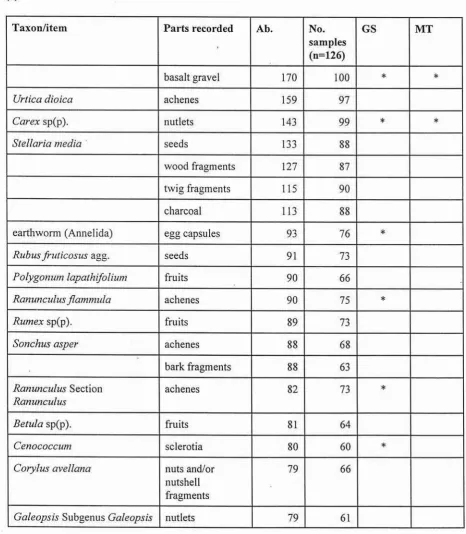
Looking at the plant remains from the Deer Park Farms site as a whole, many of these probable turf indicators are amongst the more frequently recorded taxa (Table 11 $ but there are some which are mare likely to represent turves cut from heathland or moorland soils (i.e. of a kind merging with peat turves rather than grass sods). In an attempt to define groups of taxa tending to occur together in the samples and provide a more objective basis for such an
interpretation, a simple painvise correlation analysis was performed on selected taxa (all those in Table 11 (a) and (b), plus a few others). The broader implications of the analysis wiIl be discussed elsewhere, but for present purposes reference shouId be made to Figure 1, in which a group of very tightly correlated taxa is shown. The starting point for this was a group selected apriori on ecological grounds as being those most likely to represent grass turf. All strong correlations with other taxa (as defined in the caption to Figure 1) were then used to draw in further taxa. Many of the taxa in the diagram do not have any strong correlations
outside the group and may be seen as the care 'turf group': Ajuga, Danthonia (in its various parts; it is not surprising that these are strongly correlated with each other!), Leontodon,
Linzim cnfhauticum, and 'root/rootlet fragments', with Cenocctrm, Jzmcus cf. urliculafus,
Potentilla cf. ereera, Scirpus setaceus and Viola sp(p). very strongly linked to it. The other taxa, all with rather large numbers of external Ifnkages, may sometimes have arrived with turves although other routes are likely. In one case, Ranzrncuius Section
Ranunculus. the low level of identification conceaIs the fact that in some cases the remains concerned could be from weedy or cultivated land (e.g. achenes of R. repens) and not
surprisingly the taxa to which it is most strongly linked beyond the group shown here include
Galeopsis, Polygonurn spp., Rumex, Sonchus asper, Stellaria media and Urtica dioica. 0 ther strong linkages are to a large and diffise group of taxa such as Calluna, Pteridiztm and a wide range of woodland/moorland mosses, which are perhaps best interpreted as representing 'litter' at the site-bedding, 'cavity wall FrI1' (some examples of which were investigated), and
perhaps other constructional material such as roofing (the often rather broad context types for the sampIes included in this analysis, as defined by the excavators, are given in Table 12). Indeed, it may be that one use of the turves at this site was as roofing. Buchanan (1957), for example, discusses a tradition of the use of m e s in roofs in N. E. IreIand which may well be a continuation of what we see at Deer Park Farms, although turves have also been used in recent centuries for walls in Ireland, as elsewhere (e.g. Evans 1969).
One unexpected result of this analysis was the number of strong negative correlations between many of the plant taxa (and certainly a11 the probable 'turf' taxa) and the records for basalt gravel. It had been assumed that layers with much gravel might also be ones where turves had decayed (paralleling the argument put forward by Dickson (1999, 1 14) for the presence of sand and gravel in certain deposits at The Biggings, Papa Stour, Shetland).
(v0
16-22 Coppergate, YorkOccupation deposits of 91h-1 lth C. AD date at a site in Coppergate in the heart of York have provided a huge volume of archaeobotanical data (Kenward and Hat1 19951, but no clear examples of material formed from grass turves to parallel those described by Geraghty (1996) for the contemparaneous deposits in Viking Dublin. A few contexts seemed to contain
material which might have originated in turves horn heathland or moorland, however. One of these (214361, an external layer from Tenement D dated to Period 5B (c. AD 975
-
earlylmidl lth C.), was noted as containing material thought to be mor humus formed under
Callunerum' (heather-dominated vegetation of large tracts of heathland and moorland in the British Isles today), together
with
remains of some heathland mosses, grass cuIm-bases, and a distinctive group of heathland~moorland beetles (op. cit., 61 I ) . Context 20342 (a 'backfill' deposit of the same date from Tenement A) yielded most of the same mosses with quantities of heather and some of the same beetles as 21463, along with Leucobryurn glaucurn (op. cif,589
and
724), a cushion-forming moss (and thus unusual amongst the assemblages of moss from urban occupation sites, where weft-forming pIeurocarpous or 'hypnoid' formspredominate). Many other contexts yieIded remains of Danthonia caryopses, with a few, especially fiom a group of fills from three pits from the latest
AngIo-Scandinavian
phase (SC,mid-later 1 lth C.) towards the rear of the site, producing cleistogenes and perhaps indicating imported grass h w e s .
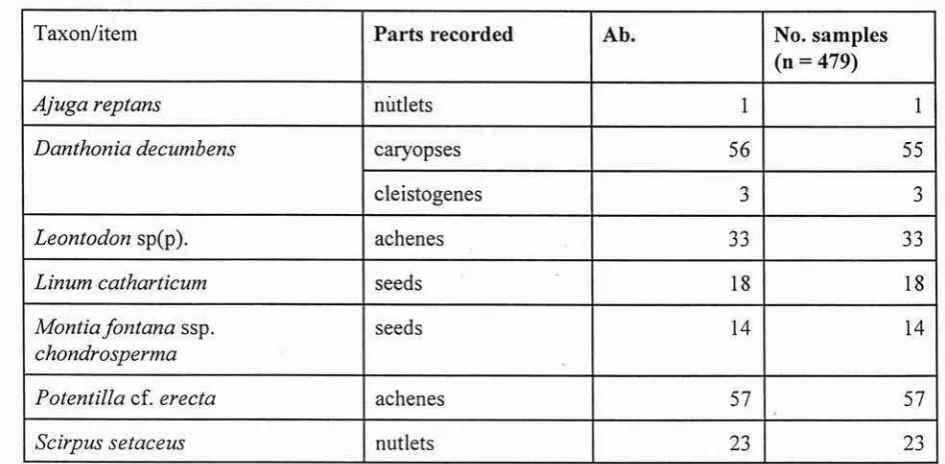
The huge dataset for the plant remains from this site (over 19,000 records of identifiable plant remains from a little over 400 contexts) is not readily amenable to exploration other than through subsets. Turning first to the group of taxa recorded at Deer Park Farms which formed the core 'turf group' (see above), a number of these were quite frequently recorded at
Coppergate, too (Table 13), though even the most abundant of them was present in less than 15% of all the contexts examined. Painvise correIations of the records for this group gave only two significant positive correIations: between Danthonia caryopses and cleistogenes (not unexpectedly) and between Montia and Scirpus setaceus (both at the P < 0.05 Ievel). All other significant correlations were negative ones (between Potentilla cf. erectn and Leontodon, at P
0.001, and between Scirpus sef~ceus and Danthonia, and S. aetaceus and Leontedon, all at P
< 0.01). There is thus no similar grouping of potential turf taxa in the way observed for the Deer Park Farms material.
Considering briefly the Danthonia remains from the Period 5C pit fills mentioned above, there were records here for c q o p s e s fiom five contexts, with cleistogenes present in three cases. Other taxa recorded horn the same fills, including those which might indicate the preserice of turves, are shown in Table 14. CIearIy there are many taxa which might have arrived in turves, aIthough most are recorded in only one or two samples and in small amounts.
The third group of samples in which the remains of turves may be discernible are those with remains of heathIand plants and, specifically, of turo mosses which seem unlikely to have
been collected except with turves: Leucobryum glaucum and PoIyrrichum juniperinurn. Table 15 shows the more frequent taxa recorded from a group of seven samples in which remains of either moss were found, plus some other taxa in the samples which may represent imported turves (with some information about the contexts concerned in Table 16). Here, the bulk of
recorded are either consistent with an origin in heathland dominated by ericaceous shrubs, or may represent grass-dominated turf either on heathland or some other kind of grassland. It is the '?mm humus' which remains perhaps the most convincing evidence for decayed turves in at least one context (214631, though the possibility that it arrived on the roots of dwarf shrubs which had been uprooted cannot be overlooked (cf. the evidence from the contemporaneous deposits at the nearby 6-8 Pavement (Lloyds Bank) site cited in the Appendix). It is
noteworthy that one context (203421, a layer rich in heathIand plants (and with L, gluucum), lay immediately beneath an accumuIation of willow brushwood and might therefore represent either turves or a heather brushwood under-layer from a former roof (Kenward and Hall 1995, 723-4).
Taken overall, then, the evidence for turves
in
deposits af Anglo-Scandinavian date at 16-22 Coppergate is rather unsatisfactory. It may be that turves did not form a significant component of the structures at this site--one might expect them to have featured more significantly in the construction of the post-and-wattle structures of Period 4B (c.AD
93015-c. 975) than the later oak plank buildings of Period 513 (c.975-earlyfmid 1 lth C.)-or that, if used in roofing, for example, they were removed when roofs were replaced. In this regard it may be significant that evidence at Coppergate for roofing of any kind was generally very inconclusive, with no deposits being recorded which contained or represented fallen roofing, except perhaps for the layers of willow brushwood in backfills of Tenements A and B in Period 53, of which one hasjust been mentioned.
( ~ i i ) Layerflr orpe Bridge* York
Excavations of Anglo-Scandinavian and later medieval deposits took place during the realignment of Layerthorpe Bridge, on the western bank of the River Foss, just outside the City Walls on the north-eastem side of York in 1996-7. They yielded occupation deposits with good waterlogged preservation (Hall er al. 20001, though the restricted nature of the
excavation meant that the reIationship of the earIier deposits to any structures or features (other than some wattle revetments and a clay bank) could not be clearly established, and dating was often difficult given a general paucity of datable artefacts. Many deposits were rich in small (0.5-2 mm) structures thought to be sclereids (dusters of lignified ceIls> from
decayed tree bark, and these, together with unusually high concentrations of the beetle Trox
scaber, Ied to the suggestion that bark residues resulting from tanning accumulated here
(ibid.
and Hall and Kenward, in press). After the Anglo-Scandinavia period, most of the deposits were silts and sands which seemed to have formed in the river Foss.
Some
of the
earlierdeposits
gave assemblagesof
unchmed plant remains inwhich
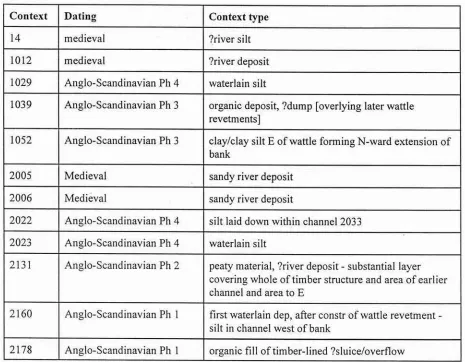
evidence for heathland tunres was thought to be present, whilst more generally there was charred plant material which might represent t u r n s which had been burnt. One of the earhest Anglo- Scandinavian deposits, Context 2178 (the organic fiII of a timber-lined ?sIuice/overflow), was described in the laboratory as a humic, sandy silt, with fine herbaceous detritus locally.Subsamples from it yielded a characteristic group of mosses with moderate abundance scores ('2' on a four-point scale): Aulacomnium paluspe, Dicranum scopnrium, Hypnum cf.
fragments, traces of charred moss
(in
the subsample~examined during the assessment stage)and also some fragments of what may have been rnor humus, all consistent with an origin in turves. Other mosses, such as Aatitrichia curfipendula, were more typical of tree bark and
may well have arrived attached to the bark which was so abundant in the deposit. A possible roof or litter component may be represented by charred and unchamed saw-sedge (Clodium mariscus) leaf fragments, and some very well preserved cereaI chaff and spikelets, and
charred and uncharred grassJcerea1 culm (stem) fragments; it may be no coincidence that these occurred with the ?turf component-perhaps they together represent partly burnt roofing material?
A further deposit, Context 2022 (a siIt laid down within a small channel) was dated to the latest stages of the Anglo-Scandinavian period. As observed in the laboratory, it consisted of
' grey-brown silty sand with patches of 'crisp', fine-grained, black (charred?) plant material, rather like turves'. In view of this, a small subsampIe of 0.5 kg was soaked and more gently disaggregated than was usual for this group of samples. Sieving produced a residue consisting of sand and some Iurnps of what appear to be charred lplus a little uncharred) sandy
Callunetum mor humus, with many loose charred fragments of rootrbasal, twig of ?heather, and also some uncharred roots which might be supposed to have come from unburnt parts of turves, aIthough they might also represent growth of roots from above into the layer after it formed. There seemed Iittle doubt that tlis deposit contained a considerable quantity of material from partly-burnt turves, presumabIy dumped into the channel.
The records for these two contexts, and some others from the site noted by Hall et al. (2000)
as perhaps containing evidence for burnt turves, are compounded in Table I7 (with context information in Table 18). Clearly a wide variety of other remains found their way into the deposits (there are many taxa which have been excluded from the Table 17(b)) but remains which may have originated in turves are consistently present.
(viig
LO
IY Fislr er Gnte, Doncaster, S. Yorkslr ireExcavations took place in S 9 9 3 4 at a site a little to the north of the town centre of Doncaster, as part of the North Bridge road improvement scheme. In the absence of a published report to which to refer, the author is gratehl to the excavator, Sane McComish (York Archaeological Trust), for an archaeoIogica1 summary, from which the following description is a
condensation.
A circular area bounded by n cofferdam 3 7m in diameter was examined, the uppermost 2.5m of deposits, which consisted of Victorian rubble, being cleared by machine before excavation. A further 1.5-2.0m of deposits were excavated by hand, yielding a well-stratified sequence ranging in date from the l lih to the 1 8h centuries. The earliest deposits, which contained some
1
Ih
century pottery, but which could not be excavated fully, were sealed by a 1.0 m-thick deposit of silty clay, interpreted as a flood deposit, the upper surface of which was cut by asmall number of early 12Ih century pits. During the first half of the century the site seems
to have been largely open ground. From the mid 1 2 ' ~ century onwards there is evidence that the site was more intensively used, primarily for iron working (a number of external working areas, hearths, dumps of ash, charcoal and slag, and rubbish pits were located), but there does not appear to have been any formal division of the area into distinct properties. It is possible
fronting onto Low Fisher Gate, and yards to the rear wllicll continued to the banks of the River Cl~eswoId, located in the northern portion of the site. This pattern of land-use remained until the late 1 5Ih century altl~ough the tenement boundaries varied through time. There is some evidence that the site was flooded in the late 14'h/early 15'h century, but that the [and use remained Iargely unaltered as a result of this inundation.
Between the early 13Ih and late 15''' centuries, sixteen timber buildings were constructed in the various tenements on the site. These were generally rectangular in shape with the long axis at
right angles to the street frontage. During the first half of the 13'h century the buildings were timber-framed, with the verticals set into post holes, or on post pads, or set into horizontal sleeper beams, some of which rested upon low clay banks. From the mid 13'h century onwards the dominant method of construction was to place the timber framing on low stone waIls designed to carry either horizontal sleeper beams or vertical posts. Evidence for the use of both ceramic roof tiles and (on the basis of some archaeobotanical evidence) probably also thatch was found on site, There was also evidence for heathland turves, which could have been used either for roofing or as fuel. It was often impossible to determine which type of
roofing material was used for a building, but at least four seem to have been roofed with turves. The tenements seem to have remained primarily industrial in function. Throughout tlre early 131h century there was extensive dumping of industrial rake-out from metalworking. The quantity of dumped slag/ash and charcoal decreased from the mid 1 3Ih century onwards, but was still siyificant.
The evidence for thatch and t u n e s referred to in this summary is presented in Table 19, which gives the numbers of records of charred plant remains which may have originated in these kinds of materials. For the most part, deposits other than some fills of the post-medieval Cut 1519 contained onIy very sparse plant remains, almost always charred, but some types were consistently present. The evidence from remains of Calluna for tunes is not, on its awn, very convincing: all of the relevant plant remains might have arrived with material puIEed or cut wholesale for roofing, fuel, or for some other purpose. However, the records for charred herbaceous roatlrhizorne (probably sedge mdlor grass material) and the tentatively identified charred Juncus squarrosus seeds suggest that turves from heathland may have been burnt. Whether these were originalIy brought for roofing and were burnt subsequently either by accident or deliberately, or whether they served as fuel from the first cannot be estabIished. The charred remains of Clndium and of grasslcereal remains from the same group of deposits do not help to resohe this question; these plants, too, may equally have served as fuel or have been used in roofing and become burnt later. On the other hand, the records of some taxa much more likely to have originated in a mire (or in acid peat) suggest that peat sensu strict0 was probably being brought to the site at times as a fuel. The sometimes abundant unchatted remains of Clnditrm and W7ex in contexts within the Iarge cut, 1519, listed under Period 1 7 in Table 19, seem most likely to represent thatch dumped into the cut; with them were remains of plants from heathland but more particularly some beetles which are very suggestive of imported turves from such a habitat (Kenward et al. in prep,).
(i~) 0 t h er sites ~vitlr (predominan fly) c11 orred preservntion
SmalI quantities of charred plant material, typically including ?heather rootbasal twig
from urban contexts. Many of the analyses have been of small-scaIe evaluations undertaken as part of the local government pIanning and development control processes. In two cases,
however, rather larger corpora of samples with remains preserved only by charring have been studied (as part of projects funded by EngIish Heritage), and these will be considered first.
(a) Carr Naze, Filey,
A!
Yorhhit-eOccupation deposits associated with the remains of a 4 I h C. AD signal station on FiIey Brigg, North Yorkshire, were investigated following excavations in 1993-4 by York Archaeological
Trust, under the direction of Dr P. J. Ottaway. Dobney er al. (2001) describe the results of analyses of plant and animaI remains from the site. Plant remains were sparse but, as Table 20 shows, the more abundant of them included ?heather roodtwig fiagrnents, charred sedge nutlets and rootlrhizome fragments. There were very srnaII numbers of charred cereal grains and some chaff which might as easily have originated in burnt straw as from grain processing waste.
p)
Flix borough, N. LincolnshireExcavations in
E
989 in an extensive area of wind-bIown sand banked against a Iow ridge of Jurassic rocks to the east of the River Trent, close to its confluence with the Humber, near the village of Flixborough, estabiished a sequence of largely mid-late Anglian (71h -1 l I h C.)occupation with abundant and well-preserved assemblages of artefacts and vertebrate remains.
Plant remains were generally very sparse and probably only those preserved by charring were contemporaneous with the occupation of the site. A large number of samples was examined, however, to establish the scale of preservation across a very wide range of combinations of context type and archaeological phase. In those cases where charred plant material other than charcoal was present, there seemed to be indications of the importation of turves, most probably from an area of salt-marsll-as stated by Hall (2000,7), 'the plant material which
was burnt
...
is clearly of an unusual kind, with such low concentrations of cereals, an absence of chaff, and a dearth of crop weeds, but a characteristic suite of remains, including charred herbaceous stems @erhaps from grasses and rushes), rush seed capsules, and some saltmarsh plants, of which the most frequent was sea plantain [Plantago mavitima]'. The pIant taxa recorded are listed in TabIe 2 1.A number of explanations for the presence of these remains seem pPausibIe (in no particular order):
(i) they arrived in cut vegetation for roofs or floors, or as hay, or bedding, or as packing for goods or Iive shellfish;
(ii) they arrived as plant remains brought with turves, or incidentally with or defiberately
1
mixed in what was primarily mineral sediment intended, for example, to make daub;
(iii) they were plant remains within vertebrate guts or in herbivore dung (the dung being collected deliberately fm burning ar some other purpose, or deposited by livestock at the site);
These are al! considered in more detail by HaEl (2000) but no clear conc1usioi-t can currently be drawn. The presence in several contexts containing charred saIt marsh plant remains of
(sometimes burnt) sheIIs of probable salt-marsh snails in the genus
Hydrobia,
especiaIty Hzrlvae (Pennant) in four of them, identified by John Carrott (2000), greatly reinforces the argument that material was brought from a salt-marsh habitat, but does not help to distinguish the precise way in which the resource was used (and, indeed, more than one kind of route may well have operated!).
(c)
Other sites with charred preservationTable 22 presents some results from an analysis of data for charred remains from a very large number of sites of diverse kinds (though mainly of
Roman
and later datefrom
urban contexts) examined by the author over a period of 24 years and in which certain remains thought likely to indicate the presence of t u n e s were recorded (see caption to table for list of taxa). As thetable shows, these remains are frequently encountered, though usuaIIy in small amounts and perhaps representing a 'background rain' on most sites. These is, as might be expected, no particular pattern to the kinds of contexts or sites in which the remains occur other than that these are mainly rural sites (compare data considered in next section)-if they are from turves, the routes by which they might pass from the original turf to the archaeological record are
many (e.g. turf used in roofing or walling or internal structures and subsequently burnt deliberately or accidentally, or turves used as fuel, the remains becoming incorporated into deposits either through chance or through the deliberate discarding of ash, construction materials or post-conflagration debris).
(X) Diverse sites wiflt n2nilzly 'wclterlogged' presewrr tion
Following the same procedures used to compile Table 22, Tables 23 and 24 offer a Iist of sites and contexts where uncharred plant material was preserved which may have originated in mrves. Here the bulk of the 'richer' contexts are urban but there is again no particular pattern with respect to the distribution of remains by context type, although two 'turf contexts
discussed
above from the Wellington Row site 'scrape into' the listin
Table 24,where
contexts with four taxa (but excluding any records for Leontodon and Hypochoeris, both of which may well arrive typically with hay or stable manure) are listed.Some theoretical considerations: ethnographic evidence, taphonomy, soil seed banks and vegetative remains
In discussing the recognition of turves (or perhaps mere particularly remains from them) in archaeological occupation deposits, it is useful to make some observations concerning the uses to which turves are known to have been used (from ethnographic sources), and the ways in which the remains may have (a) arrived at a site and (b) become incorporated into the deposits in question.
Etlinograplr ic sttxrIies: the wlrys in ~ v l ~ i c h ttirves have been rrsed
have very deliberately avoided the question of the use of tunes in construction work where a finished sward is the final aim):
A. Dwellings and other major sfructwes
(i) Roofing: the use of turves as an 'underthatch' beneath a wide variety of other materials (and sometimes at the surface around the base of another material on the waI1 head, or on the ridge) is attested by many writers, primarily for the northern and western parts of the British Isles (see, for example, the list of relevant references drawn together by Letts (1 999,3) and some 'archaeo~ogical' examples
from
surviving roofs investigated by Holden (1.998). The present author examined material of this kind from the roof of a barn at Durdar, near Cumbria in the early 1980s (unpublished data). The Scandinavian tradition of using living turf roofs may we11 have been adopted in areas of the British Isles in which there was a Viking influence but most roofswith
living pIantsare
simpIy ones where thatch has decayed sufhiently to provide a roothold for invading species. (Innocent (1 91 6 , 2 15) discusses aspects of the origins and antiquity of the Scandinavian tradition; for discussions of the plant life of turf roofs of this kind, see, for example, MeIheim (1953) and Jbhansen (1985, and via Dickson's account of plant remains from The Biggings in the Appendix to this report)).(ii) WaIPs: Again, prirnariIy seen in small vernacuIar buildings in the nodhem and western parts of the British Isles, sods have been used as wall construction material on their own (Evans 1957; 1 969; 1974; Fenton and Walker 198 I , 73-4) or with stone. In some cases, turves were simply used as bedding for stone to build walls (e.g.
6
Danachair 19573, or to fill gaps between urnortared stones, but Evans (2974,60) is at pains to stress that 'the use of sods in association with other building materials may also be expIained as a survival rather than a makeshift', and notes that in some parts of ScotIand a characteristic alternation of stone and turf courses is observed, a tradition which Fenton (1968) suggests may be tracedback
at least as far as the Viking period (see also comments regarding the archaeology of structures at Bitsay, Orkney, and Jarlshof, Shetland, in the Appendix), and which survived until relativelyrecently in other areas within the Viking sphere of influence, such as Iceland. NobIe (1984) expEains how the former use of m e s to build walls has been explored experimentally at the Highland Folk Museum in ScotIand.
Examples
from
the FenIand of East Anglia are provided by Porter (1 969, 1631, who alludes to the sod houses of the turf-i.e. peat--cutters and Hurry (1930,21 ff., p1 V), who describes and illustrates the post-medieval 'roller house7 for a woad miI1 at Parson Drove near Wisbech, Cambridgeshire, for whichturf
blocks 1A.
(30 cm) deep were laidin
a herringbone fashion toa height of 4 ft. (1.2 m) (though it is possible that these turves were peat, rather than sods, especially in view of their thickness). Woad mills were essentially short-lived structures since the cropping of woad soon exhausted the land and woad-men (at least for the period for which accounts survive) led a semi-nomadic life. Innocent (1916, 8-12] mentions two other kinds of countrymen whose peripatetic lifestyle (in this case within woodland) involved the erection of sod-built structures for short-term use: charceaI burners and bark-peelers, and illustrates examples from his own observations, made in South Yorkshire and Fmess, Lancashire (ibid., figs. 1-31. A more detaiIed account of charcoal burners' huts in which turf was often a