Pedestrian Detection and
Identification
R
AN
F
EI
Supervised by DR. T. P. STATHAKI
Department of Electrical and Electronic Engineering
Imperial College London
This dissertation is submitted for the degree of
Doctor of Philosophy
Declaration
I hereby declare that except where specific reference is made to the work of others, the contents of this dissertation are original and have not been submitted in whole or in part for consideration for any other degree or qualification in this, or any other University. This dissertation is the result of my own work and includes nothing which is the outcome of work done in collaboration, except where specifically indicated in the text. This dis-sertation contains less than 1,000,000 words including footnotes, tables, equations, references and appendices and has less than 150 figures.
The copyright of this thesis rests with the author and is made available under a Creative Commons Attribution Non-Commercial No Derivatives licence. Researchers are free to copy, distribute or transmit the thesis on the condition that they attribute it, that they do not use it for commercial purposes and that they do not alter, transform or build upon it. For any reuse or redistribution, researchers must make clear to others the licence terms of this work.
RANFEI Supervised by DR. T. P. STATHAKI 2014
To be fond of learning is to be near to knowledge. To practice with vigor is to be near to magnanimity. To possess the feeling of shame is to be near to courage.
Acknowlegements
Worldwide, less than 1% adults experienced or are experiencing the life in purchasing a degree ofDoctor of Philosophy. Thanks for the financial support from my family, I am fortunate enough to be one of them.
I would like to express my gratitude to Dr. T. Stathaki, my supervisor, for her guidance, useful critiques of the research work and her administrative support; to Mrs A. M. Hough, for her advices and assistance in keeping my progress on schedule. I would also like to acknowledge Miss Diao, for her inspiration for the applications of computer vision in material research and production and a generous donation of source images. Furthermore, my grateful appreciation would extend to Ms. Yelland-Sutcliff and others for their tolerance to my ignorance and their encouragement during the struggling period.
Abstract
People are the centre of technologies. Understanding, monitoring and tracking the behaviour of people will benefit in various areas including driving assistance, surveillance for safety and caring purposes and appli-cations for machine-people interaction. Particularly, pedestrians attract more attention for two reasons: they restrict the behaviours of people to standing and moving upright; and applications for pedestrian detection and monitoring have positively impact on the quality of life. Pedestrian detection and identification, aims at recognising pedestrians from still im-ages and video frames. Together with pedestrian recognition and tracking, this topic attempts to train computers to recognise a pedestrian.
The problem is challenging. Though frameworks were designed, various algorithms were proposed in recent years, further efforts are needed to improve the accuracy and reliability of the performance. In this thesis, proposing a modifiable framework for pedestrian identification and im-proving the performances of current pedestrian detection techniques are particularly focused. Based on appearance based pedestrian identifica-tion, a modifiable framework is a novel philosophy of developing frame-works which can be easily improved. For pedestrian identification, a novel protocol where layers of algorithms are hierarchically applied to solve the problem. To compare the detected pedestrians, appearance based fea-tures are selected, the "bag-of-feafea-tures" framework is employed to com-pare the histogram descriptions of pedestrians. To improve the perfor-mances of HOG pedestrian detector, the presence of head-shoulder struc-ture is selected as the evidence of the presence of pedestrian. A novel appearance based framework is developed to detect the head-shoulder structure from the detection results of HOG detector. Furthermore, in order to separate multiple pedestrians detected in one bounding box, a novel algorithm is proposed to detect the approximated symmetry axes of pedestrians.
11
Abbreviations
Abbr. Phrases
AdaBoost Adaptive Boosting
API Application Programming Interface
BG Background
BoF Bag Of Features
CBIR Content Based Image Retrieval
CCTV Closed-Circuit Television
CoHOG Co-occurrence Histogram of Oriented Gradients
CSS Colour Self-Similarity
CV Open Source Computer Vision Library (OpenCV)
Daimler-DB Daimler Benz
DET Detection Error Trade-off
ETH Eidgenössische Technische Hochschule
FG Foreground
FOV Field of View
FPPI False Positives per Image
FPPW False Positives per Window
INRIA Institut National de Recherche en Informatique et en Automatique
(National Institute for Research in Computer Science and Control)
IR Infrared
HOG Histogram of Oriented Gradients
HSL Hue Saturation Lightness
HSV Hue Saturation Value
LPB Local Binary Patterns
MIT Massachusetts Institute of Technology
MSCR Maximally Stable Colour Regions
MSER Maximally Stable Extremal Regions
OpenCV Open Source Computer Vision Library
PDF Probability Density Function
RADAR Radio Detection and Ranging
RGB Red Green Blue
ROC Receiver Operating Characteristic
ROI Region of Interest
TUD Technische Universität Darmstadt
SIFT Scale-Invariant Feature Transform
S-M Symmetry Measurement
SURF Speeded Up Robust Features
SVM Support Vector Machine
Contents
Contents 13
List of Figures 15
List of Tables 17
1 Computer Vision is Incomplete without Pedestrians 19
2 The State of the Art 23
2.1 Strategic Level . . . 25
2.1.1 Training a Global Detector / Identifier (Discriminative) . . . 25
2.1.2 Defining the Logics of Detection / Identification (Generative) . . 29
2.2 Algorithmic Level . . . 30
2.2.1 Distinguish Pedestrians from Non-Pedestrians (Detection) . . . 31
2.2.2 Recognise Different Individuals (Identification) . . . 33
2.2.3 Relevant Image Processing . . . 35
2.3 The Databases of Pedestrians . . . 35
2.4 Conclusions . . . 36
3 Histograms in Pedestrian Re-identification 37 3.1 Review of Pedestrian Re-identification . . . 39
3.2 Code Book Matching . . . 40
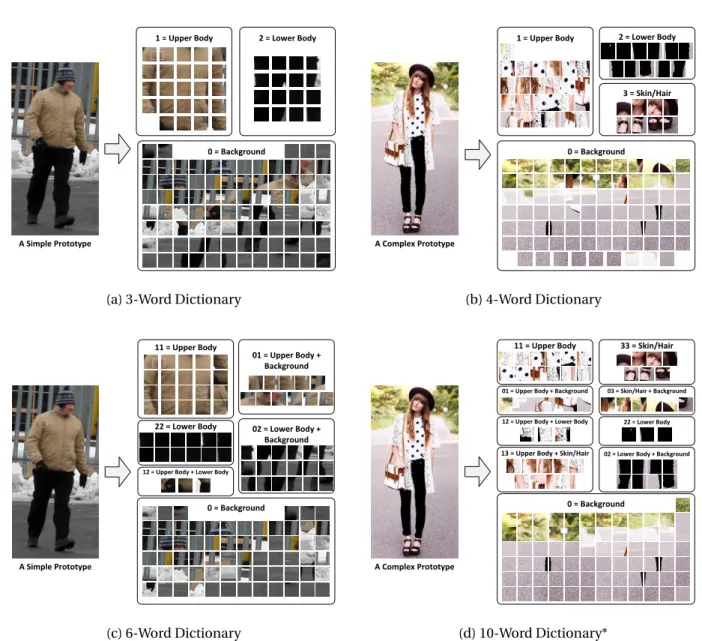
3.2.1 PROTOTYPEDescription: build a dictionary . . . 44
3.2.2 The Fundamental Level: Check the Histogram . . . 47
3.2.3 Analyse thePROTOTYPEwith Simple Appearance . . . 50
3.3 Experiment . . . 59
3.3.1 Parameters: The Number of Words and Patches . . . 59
14 Contents
4 False Alarm Rate Reduction in Videos 73
4.1 HOG Pedestrian Detector in CV (2.4.3) . . . 73
4.1.1 Why HOG? . . . 75
4.1.2 HOG Pedestrian Detector and Its Limitations . . . 78
4.2 Upper-body Detection . . . 85
4.2.1 Viola-Jones Algorithm . . . 86
4.2.2 Appearance Based Upper-body "Detection" . . . 91
4.3 Re-appeared False Alarms in Video Streams . . . 96
4.4 Experiments . . . 97
4.5 Summary . . . 100
5 Multiple Pedestrians Detected in One Box 101 5.1 Multiple Pedestrians Detected in Single Box . . . 101
5.1.1 How Close the Pedestrians Who are Detected as One? . . . 103
5.1.2 The Rough Symmetry Axes Detection . . . 104
5.2 Experiment . . . 112
5.3 Summary . . . 116
6 Conclusions and Future Work 119 6.1 Conclusions . . . 119
6.2 In the Recent Future . . . 121
6.2.1 Clothes Pattern Analysis . . . 121
6.2.2 Symmetrical Appearance based Pedestrian Detection . . . 121
6.2.3 Pattern Recognition in Chemistry and Biology . . . 121
7 An Evolving Recognition System: A Thought 123
References 125
List of Figures
2.1 A General Structure of Pedestrian Detection and Identification . . . 24
2.2 Discriminative and Generative Learning . . . 26
2.3 Algorithms for Feature Detection, Description and Correspondence . . 31
3.1 Pyramid Structured Protocol for Pedestrian Identification . . . 43
3.2 The Manually Built Dictionaries ofPROTOTYPE . . . 46
3.3 Comparing theTARGETto the PROTOTYPE . . . 47
3.4 Appearances of Pedestrians: Clustering the Colour Information . . . . 52
3.5 Appearances of Pedestrians: Examining the Upper / Lower-Body Areas 55 3.6 The Automatically Built Dictionaries ofPROTOTYPE . . . 55
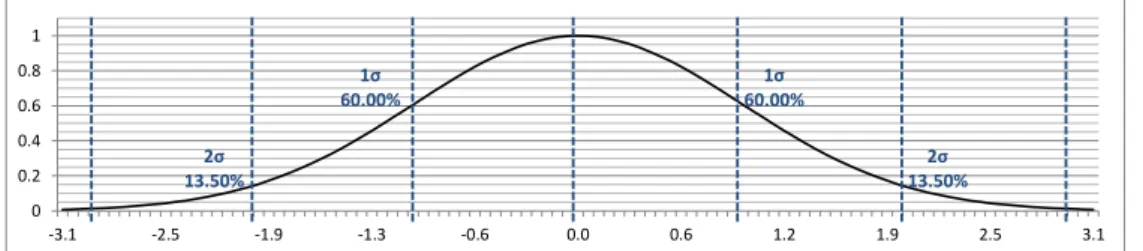
3.7 Demonstration of 1D Normal Distribution (N(µ,σ2)) . . . 57
3.8 PDF of Upper-Body, Lower-Body, Skin-Hair and Background . . . 58
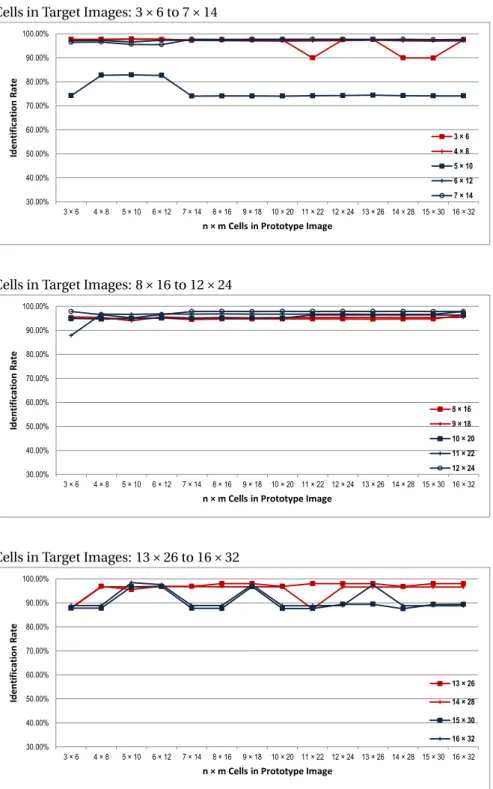
3.9 Results: SimplePROTOTYPE, 3-Code Dictionary . . . 63
3.9 Results: SimplePROTOTYPE, 6-Code Dictionary . . . 64
3.9 Results: SimplePROTOTYPE, 4-Code Dictionary . . . 65
3.9 Results: SimplePROTOTYPE, 10-Code Dictionary . . . 66
3.10 Results: ComplexPROTOTYPE, 3-Code Dictionary. . . 67
3.10 Results: ComplexPROTOTYPE, 6-Code Dictionary. . . 68
3.10 Results: ComplexPROTOTYPE, 4-Code Dictionary. . . 69
3.10 Results: ComplexPROTOTYPE, 10-Code Dictionary . . . 70
4.1 The Applications of HOG and Haar-like Feature based Detectors . . . . 74
4.2 The Comparison of Pedestrian Detectors in CV (2.4.3) . . . 76
4.3 Sample Results of HOG-SVM Pedestrian Detector . . . 82
4.4 The Smallest Detectable Pedestrians of HOG Detector . . . 84
4.5 HOG Performance with Pedestrian near Boundary . . . 85
4.6 Haar-like Feature Bases . . . 86
4.7 The Structures of Cascaded Classifiers . . . 87
16 List of Figures
4.9 High Influential Haar-like Blocks in Trained Cascading Decision Trees . 91
4.10 Verify the Head-Shoulder Structure of Pedestrian Detection Results . . 93
4.11 The Consistent Matrix of the Perspective Head Area . . . 95
5.1 Examples of Multiple Pedestrians Detected as One . . . 102
5.2 Multiple Responses of Multi-Scaled Sliding Windows . . . 103
5.3 HOG Performance in Separating Pedestrians . . . 104
5.4 Demo: The Rough Symmetry Axes Detection . . . 106
5.5 The S-M Matrix of Strong Symmetrical Axes . . . 110
5.6 The Responses of Symmetry Axes and the Echoed Axes . . . 111
5.7 Results: Symmetry Axes in Detected Pedestrians . . . 113
List of Tables
3.1 Frameworks used in Pedestrian Re-identification . . . 41
3.2 Examples of Re-identification: SimplePROTOTYPE . . . 71
3.3 Examples of Re-identification: ComplexPROTOTYPE . . . 72
4.1 The performances of Frameworks for Pedestrian Detection . . . 77
4.2 The Comparison of R-HOG with Other Shape based Descriptors . . . . 81
4.3 Results: Reducing False Alarms of HOG-SVM Pedestrian Detector . . . 98
4.4 Results: Head-Shoulder Verification in Two Ways . . . 99
5.1 Symmetry Responses with widthws . . . 114
5.1 (Cont.) Symmetry Responses with widthws . . . 115
Chapter 1
Computer Vision is Incomplete
without Pedestrians
Χωρίς εικόνες, η σκέψη είναι αδύνατη.1
——Αριστοτέλης
People as a target object in computer vision has been attracting more and more attentions. Detecting, tracking and identifying people is benefited in various re-search fields and applications including driving assistance, patients and disabled monitoring, crime and migration surveillance, robotics and machine interactions etcetera [1–3]. To detect and recognise a person is difficult. As a species, people have intra-class variances, biologically or visually; as an individual, they may appear in crowds, may be occluded by other people and objects; as a non-rigid object, the same person may be visually different due to changed viewing angle, poses, clothes and accessories. People detection focuses on people as a species; people tracking and identification focuses on people as an individual [4,5]. Image files applicable in people detection and identification can be either still images or frames of video clips. People tracking is always applied to frames of video clips. Techniques used in these areas are usually overlapped: identifying the same people detected from ev-ery frame in video clips results in people tracking; motion captured by people track-ing algorithms would benefit the detection and identification of people [6,7]. The majority people or human used in the state of art literature are particularly refer to pedestrians, which restricts the target objects to upright people who are standing, walking or running without carrying complex accessories intervening the appear-ance of human. This simplification not just reduces the complexity of computation,
20 Computer Vision is Incomplete without Pedestrians
it specifies its application area. The majority of datasets for the state of art training and testing were collected from streets, traffic areas where human and auto-mobiles interact [1,8–11]. In this thesis, without particular indication, people or human refer to pedestrians.
Research in this area started decades ago. Studies of learning human motion can date back to the period before digital video systems and the internet were globally commercialised. Frameworks were designed to teach computers to see a walking person [12–15] or to recognise the gestures of a person [16–18]. Early research was re-stricted by the computation system. Pedestrians were usually simply modelled using connected cylinders and sticks representing the topology of body parts. The symme-try of the human body was employed to separate humans from background. During this period, the study of human detection and motion concerned television imag-ing devises (CCTV2) mainly. Early attempts inspired later research though results of most of the early frameworks were not satisfied. With the development of imaging / videoing system, further research covered wider applications using sensors includ-ing conventional camera, wide FOV3 camera, near-IR4, thermal-IR, RADAR5, laser scanner, etcetera [19]. Developments in computational techniques boosted sophis-ticated frameworks, non-linear categorization algorithms and rich descriptions of pedestrians. Well developed frameworks and algorithms together with the growing datasets (in both quantity and variations) contributed to the state of art people de-tection and identification. Accelerated processing speed realised the on-line and real-time applications. More and more real services appeared in market especially in driving-aid systems [1,3,8–11,20,21].
However, even algorithms with commonly recognised high robustness and ac-curacy tested through various databases may fail in certain pedestrian detection and identification occurrences. In this thesis, two problems are mainly addressed: pedestrian re-identification6 after a period of total occlusion and the reduction of false alarms and inaccurate pedestrian detections introduced by the Histogram of Oriented Gradients (HOG) pedestrian detector which was originally proposed in [22]
2CCTV: Closed-Circuit Television
3FOV: Field of View
4IR: Infrared
5RADAR: Radio Detection and Ranging
6Identification is an ambiguous word with different meanings in different registries. In computer
science, human identification referred to the process of identifying a human as individual by their measurable characteristics or traits (biometric is an example of human identification). In this the-sis the measurable characteristics particularly refer to visually perceptive features used in pedestrian identification.
21
and trained by CV (2.4.3)7(version 2.4.3). The contributions of the thesis lie in fol-lowing aspects:
• A novel protocol for pedestrian re-identification containing layers of algorithms is proposed: the appearances of pedestrians are quantified according to the complexity of their descriptions and the identification process (parameter set-tings) can be adjusted according to the complexity of the appearance of the prototype pedestrian. By learning the appearance as well as the complexity of the prototype pedestrian who has been detected in the video / camera sys-tem, a bag-of-appearance-feature is constructed for the prototype pedestrian, which is further adapted to reduce repeated false alarms in pedestrian detec-tion in video streams. The novelties of the protocol are:
– It spends different processing efforts on identifying pedestrians with dif-ferent appearances.
– The strategies of pedestrian identification can easily be adapted by adding new algorithms into the protocol.
• To reduce the false alarms introduced by HOG pedestrian detector, the pres-ence of head-shoulder is selected as the evidpres-ences of correct detections. Viola-Jones frontal face and upper-body detectors are combined with a novel ap-pearance based head-shoulder detection. The combined strategy reduces the false alarms without much affecting the detection rate. This strategy can also be applied to the reduction of false alarms introduced by other pedestrian de-tectors which select shape as the discriminative feature of pedestrians.
• Inaccurate detection results of HOG pedestrian detector are discussed: limita-tions of HOG pedestrian detector caused by parameter settings of the training procedure are analysed; cases that more than one pedestrians recognised as one are particularly focused; a novel framework for separating pedestrians de-tected in one bounding box is proposed.
The thesis is structured in three parts: as an introductory, this chapter and the next one overview the pedestrian detection and identification problem and review the state of art literatures. Followed by three technical chapters, the main body of the thesis: the first one, (Chapter3), based on appearance related pedestrian descrip-tion, a novel protocol is presented to identify the reappeared pedestrian in video
22 Computer Vision is Incomplete without Pedestrians
stream after a period of absolute occlusion, which could retain the tracking of the prototype pedestrian. After that, in (Chapter4), algorithms are promoted to reduce the false alarm rate of the pedestrian detection applied to video streams. The appear-ances of the head-shoulder structures of pedestrians are used as the evidence for the presence of pedestrians. Viola-Jones body-parts detection algorithms are discussed and a novel means of appearance based head-shoulder detection technique is in-troduced. In the third chapter, (Chapter5), issues related to the HOG-SVM8 detec-tor trained by CV (2.4.3) are discussed. Particularly, cases that multiple pedestrians are recognised as one are considered and a novel means of symmetry axes detec-tion is applied to separate individuals bounded in one box. Finally, future works in the development of pedestrian detection strategies and the expansion of vision re-lated applications in other subjects will be summarised. A thought on the outlook of object recognition in language of computer vision and machine intelligence will be presented as the end of the thesis (Chapter6and7).
Chapter 2
The State of the Art
΄Ορος εστίν, ο τινός εστι περας· Σξήμά εστι το υπό τινος ή τινων όρων περιεξόμενον.1
——Ευκλείδης
Literatures related to pedestrian detection and recognition will be reviewed in two levels: the Strategic Level concerns the philosophy of solving the detection / identification related problems and the Algorithmic Levelprovides computational approaches to model and compare target objects to be detected / identified. Strate-gies for detecting and identifying pedestrians are further categorised into supervi-sion based strategies and logic based strategies. The former trains detectors to sep-arate pedestrians from non-pedestrians and identify the prototype pedestrian from other pedestrians; the latter defines logics and rules to detect / identify pedestri-ans. Rules may include the topology of detected body parts / interest points. In
Al-gorithmic Level, emphasis on different purposes of applications, detection or
iden-tification, algorithms are reviewed in two categories: cognitive shape based algo-rithm (Section2.2.1) to distinguish pedestrians from background objects and texture / colour based algorithm to identify the individuals. OpenCV (version 2.4.3)2is em-ployed for the majority of experiments in this thesis, a short introduction of the tool kit is included inAppendixA.
For disambiguation purposes, terms used in this thesis are declared. The pro-totype pedestrians have different meanings in pedestrian detection and identifica-tion: used in pedestrian detection, the prototype pedestrian is related to the model of pedestrians and in pedestrian identification, the prototype pedestrian mean the
1A boundary is that which is an extremity of something. A figure is that which is contained by any
boundary or boundaries.—— Euclid
24 TheStateoftheArt findfivfiduaflwhohasbeendetectedfinthesystem.Identfificatfionfinthfisthes fisfisre-flatedtotheprobflemoftherecognfitfionofpedestrfiansasfindfivfiduafls(usfingthefirv fi-suaflcharacterfistfics)andre-fidentfificatfionfocusesontheverfificatfionofpedestrfians appearfingfindfifferentsegmentsofvfideosorfindfifferentcamerasystems.Theprev fi-ousflydetectedpedestrfiansarerecognfisedastheprototypes3.Ffig.2.1
Pedestr
fian
ADetect
fion F
Ident
fi
f
ficat
fion
: Overv
fiew
Prototypes OtherAPedestrfians Background
Pedestrfians
Pedestrfian/NonmPedestrfian Prototype/Others IMAGES
IMAGES
ShapeAReflatedAFeatures ALGORITHMS: FEATURES ALGORITHMS: FEATURES
CoflourAReflatedAFeatures
GflobaflACflassfiffierATrafinfing Logfics F Probabfiflfitfies STRATEGIES
STRATEGIES
GraphficaflAModefls RESULTS
RESULTS
ALGORITHMS: CORRESPONDING ALGORITHMS: CORRESPONDING
CompareADescrfiptors TopoflogyAofABodymParts BodymPartACflassfiffierATrafinfing
PatternAReflatedAFeatures
fiflflustratesthe reflatfionshfipofaflgorfithmsfinthestrategficandaflgorfithmficfleveflsfinthebas ficstruc-tureofcommonflyappflfiedpedestrfiandetectfionandfidentfificatfionframeworks:the processstartsfromposfitfive&negatfive(notaflwaysrequfired)examp flesfintheIm-ageLeveflandoutputsthedecfisfionofdetectfionandfidentfificatfion;theent firepro-cedurefisdemonstratedfinbutnotrestrfictedtothreefleveflsofaflgorfithms.Theflevefl ofstrategfiesconcernsthe meansofdetectfion/fidentfificatfionandthefleveflofa flgo-rfithmssupportsthethefleveflstrategfies;fineachflevefl,resufltsfromtheprevfiousflevefls areprocessedfinseflectedfunctfionbflock(s)whfichgeneratefinputsforthenextflevefl ofprocessfing.
Ffig.2.1AGeneraflStructureofPedestrfianDetectfionandIdentfificatfion:Inthefimagefleveflandthe
resufltflevefl,theflefthandsfiderepresentsthePedestrfianDetectfionandtherfighthands
fiderepre-sentsthePedestrfianIdentfificatfion. Whfiflefinotherflevefls,thebflocksofaflgorfithmscanbeappflfied
toefitherprobflem,thoughsomebflocksmaybepreferredfinoneaflgorfithmthananother
.Forexam-pfle,fintheaflgorfithmsflevefl,shapereflatedfeaturesare moresufitabflefinPedestrfianDetectfionthan
finPedestrfianIdentfificatfion.
AccordfingtothecategorfiesfinFfig.2.1:finframeworksofPedestrfianDetectfion, aflgorfithmsusedfinthefleveflsof"Aflgorfithms:Feature","Strategfies",and"Aflgorfithms: Correspondfing"are:"ShapeReflatedFeatures","GflobaflCflassfifierTrafin fing"and"Com-pareDescrfiptors"respectfivefly;finframeworksofPedestrfianIdentfificatfion,"Coflour
3Thecomputerfisrequfiredtore-fidentfifythepresentoftheprototypewhohasbeenfidentfifiedby
2.1 Strategic Level 25
Related Features", "Logics & Probabilities" and "Compare Descriptors" are used ac-cordingly.
2.1 Strategic Level
The strategic level of algorithms answers the questions:
1. How to obtain the template of the prototype pedestrians?
2. How to correspond the regions of interest (ROI) areas of input images with the template?
The first question concerns the training of pedestrian detector / identifier and the logics existed in the cognition of pedestrians; the second question aims at analysing the input images and corresponding the ROIs of input images with the templates obtained from the the solution to the first question. Strategies used in pedestrian detection and identification are usually overlapped as both problems can be treated as a binary classification problem: pedestrian detection classifies objects into pedes-trians and non-pedespedes-trians, pedestrian identification classifies detected pedespedes-trians into prototype and other pedestrians. As shown in Fig. 2.2, algorithms in strate-gic level are reviewed in discriminative and generative two groups. Discriminative learning (Section2.1.1) focuses on training the classifier which response differently to varied input and generative learning (Section2.1.2) model pedestrians according to the observations. Discriminative training strategies are employed in HOG and Viola-Jones pedestrian detection frameworks. In HOG, linear / non-linear SVM training are normally used to discriminate pedestrians from non-pedestrians. And the training strategy introduced by Viola-Jones[23] can be treated as a tree based classification where stages of weak classifiers are cascaded to achieve accurate classification of the prototype pedestrian and other pedestrians.
2.1.1 Training a Global Detector / Identifier (Discriminative)
A global detector / identifier recognises pedestrian as an entire object. The binary classification problem for pedestrian detection is to separate pedestrians from back-ground objects. For pedestrian identification it is to distinguish the prototype pedes-trian from other pedespedes-trians. Mathematically, the observationsx∈RN are mapped to the decision space y ∈{0, 1} or {−1,+1} through a classifiery =H(x,φ), whereφ represents the set of parameters used in the classifier H(x,φ). During training, the
26 TheStateoftheArt
D
fiscr
fim
finat
five
Learn
fing
Generat
five
Learn
fing
KERNEL BASED CLASSIFICATION KERNEL BASED
CLASSIFICATION TREECLASS BASEDIFICATION TREE BASED CLASSIFICATION
NON-LINEAR SVM
NON-LINEAR SVM LINEAR CLASSIFICATION LINEAR
CLASSIFICATION MARKOV MODEL OF PEDESTRIANS MARKOV MODEL OF PEDESTRIANS BAYESIAN MODEL OF PEDESTRIANS BAYESIAN MODEL OF PEDESTRIANS
Ffig.2.2ExampflesoftheDfiscrfimfinatfiveandGeneratfivemodeflsusedfinthedetectfionandcflass
fifi-catfion4.Imagesonethefleft-handsfidedemonstrateseverafl meansofbfinarycflassfificatfionoffinput
observatfions;finBayesfian modeflofpedestrfians,body-partsfinflowerfleveflsaredependentonthe
body-partsfinupperfleveflsandfin Markov modeflofpedestrfians,fimageonther
fightshowsthede-pendencfiesoftheposfitfionofbody-partsandfimageontherfightshowthenodemapusedfinjudgfing
thepresentofpedestrfians.
parametersusedfinthecflassfifierareoptfimfisedto maxfimfisethe margfinbetweenthe twocflasses. CommonflyuseddetectorsfincfludeBoostfingCflassfificatfion(especfiaflfly AdaBoost),SupportVector Machfine(SVM)andthefirvarfiatfions[24,25]. SVMre-turnsthehyperpflaneseparatfingtheobservatfionsandBoostfingaflgorfithmsreturn thecombfinatfionofweakcflassfifiers[26].Ada(Adaptfive)finAdaBoostfindficatesthat thewefightsappflfiedtoweakcflassfifiersareadjustedtothefirfinfluencesoncflass fifica-tfionresuflts[27].
WeakbfinarycflassfifiersarerequfiredwhenAdaBoostfisseflectedtotrafinacflass fi-fier[27]. DeveflopedbyVfioflaandJones,Haar-flfikeflocaflfeaturescaflcu flatedonfinte-graflfimagesareoneoftheapparentchoficesforweakcflassfifiersastheyoutputbfinary vafluesfinfastcaflcuflatfion[23,30]. DemonstratedfinSectfion4.2.1,AppendfixA,the performancesoftheAdaBoostcflassfifiertrafinedusfingHaar-flfikeflocafldescrfiptorsfin pedestrfiandetectfion maybeflessstabfleespecfiaflflywhenthesfizesofdom finantHaar-flfikefeaturesarereflatfiveflysmaflfl.Trafinfingflowfleveflfeaturesfintobfinarycflass fifiersus-fingstrategfiesflfikeSVMfisanotherwaytoobtafinweakcflassfifiers.[31]caflcuflatedthe
4Imagesreferencedfrom[24]:flfinearcflassfificatfion,non-flfinearSVMandkerneflbasedcflassfificatfion,
[28]:treebasedcflassfificatfion;[29]:Bayesfian Modefl,[6]:Markov Modefl(Prepresentstheposfitfion,C
2.1 Strategic Level 27
gradient of an image as the low level features which capture the shape features of the object within the region of interest (ROI). The combination of gradients (shapelet) within sliding windows of ROI are trained as the weak classifiers to build the out-put pedestrian detector. Local HOG descriptors trained using SVM were cascaded in [32] as weak classifiers. The weak classifier training could be complicated. Mul-tiple features can be combined in training the local weak classifiers. For instance, [10] combines Haar-like features, shapelet, HOG and shape context in selections of weak classifiers. In [8], integrated features from different channels of images were se-lected in the training of Boosting classifier. Integral features refer the different types of features, such as histogram, shape signatures, etc.. The pre-processed images for calculating those features are recognised as channels of images, for instance, shape signatures are calculated on the edge map channel, histogram is calculated on the original image channel, etc. The introduction of channels of images add another dimension of the weak classifiers. As a result, the influences of selected features cal-culated in one channel will not affect the influences of features calcal-culated in other channels in the trained classifier.
The output classifier of AdaBoost captures both local and global features, which depend on the size and position of the involved weak classifiers. In most literatures, applying AdaBoost training, weak classifiers are calculated in blocks sized from sev-eral square of pixels to the size of the entire ROI. AdaBoost trained classifier has a tree-like structure, of which the branches contain information on the position, size and the way to calculate the local feature related weak classifiers. Boosting algorithms and Haar-like features will be further reviewed in Chapter4where the Haar-like feature based body-part detectors are used in false alarm reduction of HOG pedestrian detector.
Support Vector Machine (SVM) is an extended discriminative model of linear classification, which outputs linear combinations of characteristics of inputsx∈Rd, dis the dimension of the input space:
yi=f(xi)=
X
i
w·xi+b, i=1, 2, . . . ,N (2.1)
w∈Rd is the weight applied toxto classifying the inputs (xi,yi),yi ={+1,−1}. b5is
the offset variable which means the distance betweenw·xi and the desired labels,
5In certain circumstances,bis treated as error or variances. In classification of pedestrian and other
objects, bis less meaningful as the contrast positions of two classes are more focused than the
28 The State of the Art
yi ={+1,−1}. During supervision, the nearest distance (the margin) between
ele-ments in each class ∥w1∥ is maximised. If there exists a hyperplane between the two classes of (xi,yi), the data is separable. In the linear SVM introduced by Vapnik in
[26], the hyperplane is located where:
min
w,b yi(w·xi+b)≥1 (2.2)
In reality, the condition is usually relaxed to a non-separable data case of which classes of observations (training datasets) would overlap in decision space as de-scribed inSection4.1.2. Furthermore, kernels transforming the inputs to other spaces are applied to obtaining better classification results [24,25]:
Φ(xi)=k(xi,xj)=xi·xj (2.3)
Global descriptors used in SVM training are usually concatenated from local fea-tures of one or more types. Single feature used in pedestrian detection ranges from parameters of Haar wavelet transform [33] to HOG descriptors calculated from ROIs [22]. Literatures demonstrated that more than one type of features trained in SVM show promising results: [34] combined HOG with LBP (Local Binary Pattern), [35] combined HOG with CSS (Colour Self-Similarity features)6and in [36] 12 different low level features including moment, contrast, colour entropy etc. are involved in calculating the descriptors of pedestrians. Concatenating different features increase the dimension of descriptors at the same time increase the complexity of training an SVM classifier. [36] concluded that SVM may fail in training adequate amount of samples when the descriptors are too long7. Dimension reduction algorithms may be required when complex descriptors are desired.
The procedure of pedestrian detection is simple after a global pedestrian detector has been trained. Regions of interest are obtained by sliding a window through input images. The trained global detectors perform as a filter which should positively re-sponse to the descriptors of sliding windows where pedestrians present. To achieve scaling invariant, descriptors are calculated from different scaled input images. The performances of trained detector depend on both selected features and the choice of datasets. When more than one type of features are used in describing pedestrians, less information is provided on the significances of features involved in the training.
6A low level feature based on the local colour / texture similarity. SeeSection2.2.1.
7Results in [36] show that SVM fail in training more than 2000 samples when the descriptor is longer
2.1 Strategic Level 29
Once trained the classifier can hardly be modified.
2.1.2 Defining the Logics of Detection / Identification (Generative)
Logics based pedestrian detection and identification normally apply local classifiers to verify the local structures of perspective pedestrians. The topology of local classi-fiers are learned using graphical models. Decisions made by local classiclassi-fiers perform as the nodes of graphical models. The logics among local classifiers and the detec-tion / identificadetec-tion results are modelled using joint probability among the nodes. Two popular strategies employing logic based detection / identification are:
1. Applying several local classifiers to the input image. Output maps of decisions made by local detectors. Explore the map of decisions to detect the best matched topology of local classifiers as described in [37];
2. Using sliding windows to obtain ROIs. Within each window apply the local classifiers and verify the topology of the detected local structures. Then output the final decision on whether a pedestrian is detected / the prototype pedestrian is reappeared.
Graphical models are applied to modelling the topology of the local classifiers. Nodes of local classifiers are normally chosen to catch features of body parts (head, torso and legs for example) [6, 29]. Indirected graphical models like Markov Net-works are applied to modelling the topology of local classifiers when the nodes of models have no obvious causal relationship: the appearance of a head may not indi-cate the appearance of the torso below while the present of both would indiindi-cate the presence of a pedestrian. Examples of Markov indirect map applied to pedestrian detection include: [38], which chose segments of edge-map as nodes and [6], which chose appearance based body-parts as nodes. Directed graph would be used to model the conditional dependence between the nodes within the model. In [29,39]: head-torso-leg parts are modelled from general to specific. The general models of body parts are searched through the images and the suspicious areas are matched with branched specific models which are dependent on the detection of its general version. Bayesian rules are applied to nodes in different levels of models of body parts.
Logics can also be applied to layers of judgements made by different global pedes-trian classifiers which are the nodes of graphical models. The conditional depen-dence / independepen-dence between the nodes are modelled using Bayesian / Markov method [40]. Using logics and rules to describe a pedestrian from using predefined features is not an easy task as it is still not clear how we human recognise objects
30 The State of the Art
visually. In the current stage of research, rules for recognising a pedestrian are re-lated to the context of image, the detection of symmetrical structures, the topology of body parts and the motion of shape when pedestrian detection is applied to video streams. Here, the context of image refers to either the context between frames or the context between pedestrian and other objects in one frame. Using the context of im-age as an application relative fact aims at filtering the low suspicious regions which are less probable to contain pedestrians. For instance, in the driving aid system, the shooting angle of images is parallel to the horizon. As a result, the up-left / up-right corner areas of a scene would be less interested. While these areas would be consid-ered important for CCTV monitoring applications when the camera is equipped in the ceiling.
In topics related to pedestrian detection, the discriminative model is popular in the separation of pedestrians and non-pedestrians due to the nature of binary clas-sifiers and the generative model is more widely applied to recognising the actions of pedestrians and the tracking of pedestrians. In object recognition / image un-derstanding, generative models, such as the ”bag of words” [41] and constellation models [42], are widely employed. Compared to the constellation models, which re-quire the topology of parts of interest, the "bag of words" is simple in computation as it only requires the joint probability of parts of interest. When the topology of parts of interest is simple, the constellation models introduce redundant computa-tion procedures. For pedestrian identificacomputa-tion in this thesis, when parts of interest are restricted to upper-body, lower-body and background, the framework inspired by the "bag of words" is proposed inChapter3.
2.2 Algorithmic Level
Algorithmic level relates to the calculation procedure of the strategic level: how to capture features of different types, how to calculate the descriptors of features and how to compare features when relevant. In pedestrian detection, shape is normally modelled to distinguish pedestrians from background objects. Appearance related features introduced by clothes and skin of pedestrians are usually modelled using colour, texture based descriptions. In this thesis: HOG descriptions are calculated on 1stderivative gradients images; Viola-Jones features are calculated on integral im-ages; the histograms of colour images are selected as the appearance based features; and the correlation distances are employed to compare the histogram based descrip-tions.Section2.2.1reviews the shape / rough shape related feature descriptions and
2.2AflgorfithmficLevefl 31 Sectfion2.2.2
A
flgor
fithms
: Examp
fles
SHAPEGRELATEDGFEATURES
…… EdgeWMaps: EdgefletsB LfinkedWGranuflesB …
NstDerfivatfiveWGradfients:
HOGB CoHOGB ShapefletB … Haar/WavefletWTransformatfion
VJWHaar/flfikeWFeaturesB …
APPEARANCEGRELATEDGFEATURES
…… InterestWPofints: SIFTB SURFB HarrfisWCornerB …
IntensfityWBasedWRegfions: MSERB … ChanneflWFeatures: MomentsWfinWHSVbRGBB …
CORRESPONDING
……
DfistancesWbetweenWVectorsWfin RNSpace
Cflusterfing
Correflatfion
dfiscussestheappearancebasedfeatures.
Ffig.2.3Reflevantaflgorfithmsforfeaturedetectfion,descrfiptfionandcorrespondence.
2
.2
.1 D
fist
fingu
fishPedestr
fiansfromNon-Pedestr
fians(Detect
fion)
Incomputervfisfion,theshapeofanobjectfisdefinedastheareaoccup fiedbytheob-jectfinfimages,whfichfisareflectfionofthespaceoccupfiedbythatobjectfinreaflfity[43]. Shapefisanessentfiaflfeaturefinvfisfionreflatedtasks.Evfidencesshowthatfinhuman vfisfionsystemtheshapefinformatfionofobjectsfispreflfimfinaryprocessedbeforeother sophfistficatedcognfitfiveanaflysfisfinbrafin[43,44].Theshapesofpedestrfiansaredfi ffi-cuflttomodefl.Peopflearenon-rfigfidobjectsandmaycarry/wearaccessorfies.Instead ofcaflcuflatfingaconcreteexpressfion,effortswerepafidtoachfievetherobustdescr fip-tfionsforvarfiousoccurrencesofpedestrfians.Roughshapefisusedfinflaterparagraph referrfingtothecognfitfive meanfingoftherobustshapedescrfiptfions.Generaflfly,there aretwowaysofshape/roughshape modeflflfingappflfiedfinpedestrfiandetectfionto workwfiththestrategfiesrevfiewedfinprevfioussectfions:1.Investfigatfingdescrfiptfionscapturfingthecognfitfiveshapefeatureatthesametfimeto fl-eratfingtheflocaflvarfiatfionsofboundarfies/edges.Thfisfisdesfignedespecfiaflflyforappfl fi-catfionsusfingcflassfifierstrafinedbydfiscrfimfinatfiveflearnfingstrategy.Theshapefeatures capturedbyHOGdescrfiptfionsbeflongtothfiscategory;
2. Enumeratfingvarfiatfionsoftheboundarfiesofpedestrfians.Thfisfiscommonflyservedfin thegeneratfiveflytrafinedcflassfifiers.
Edge-mapfisusuaflflyseflectedasanobvfiousevfidenceofshape.Edge-mapofan finputscenefisabfinaryfimagecatchfingthesharpfintensfitychangewhfichwoufldbe cognfitfiveflyrecognfisedastheboundarfiesofobjectsandsketcheso fpatterns/tex-tures.In mostframeworks,edge mapsaregeneratedusfingsobefl[44]orcanny[45]
32 The State of the Art
edge detection algorithms. Detected edge-map is a cognitive feature demonstrat-ing the shape of objects to human but a pile of scattered pixels to computer [44]. Descriptions of edge-map aims in building context within edge pixels. The con-text between edge pixels of objects can be discovered globally or locally. Applied in pedestrian detection, local edge-map descriptions are normally used to compute the descriptors of edge pixels in a small area. Structures likeEdgeletin [46] orLinked
Granules (LG)in [47], segments of line / curve, are usually introduced as
vocabular-ies in edge-map description. In [47], representative edge segments of pedestrians are learnt by combining connect granules which can be seen as short pieces of straight lines. Preprocessing is usually required to reduce the noise effect.
Histograms of edge orientation are also popular to describe the edge-map. The descriptor of an local area is usually the concatenated histograms of each edge pixels / segments. The descriptors of local edge segments can be either trained into weak classifiers which will be selected by Boosting algorithms or performing as nodes in graphical models indicating the topology of pedestrians. Due to the sensitivity of the edge-map to noise and background objects, descriptors of the entire edge-map within ROI are seldom applied to the training of a global pedestrian detector. Nor-mally, the descriptions of rough shapes are calculated to represent pedestrians in-stead.
Rough shapes do not have to be the exact boundaries of pedestrians at least they could be cognitively recognised as pedestrians. The rough shapes of pedestrians are commonly calculated from 1stderivative gradient image of the input images [22,31]. Other algorithms to calculate the rough shapes include the Haar-wavelet transform as introduced in [33] and Colour Self-Similarity features (CSS) selected in [35] (by cal-culating the local similarity, rough areas of body-parts could be perceived after the transformation). To describe the rough shape, histogram based descriptors captur-ing the local orientations are popular in pedestrian detection. HOG is a SIFT like de-scriptor calculated on gradient image. It is further modified to Co-occurrence HOG (CoHOG) by [48]. CoHOG extends the HOG descriptors of cells of pixels into an-ther dimension by introducing the combination of HOG descriptions in 8-connected neighbourhood cells as the basis of descriptors. Training using CoHOG based de-scriptor is computational expensive due to the increased dimension of dede-scriptors. A detailed review on HOG descriptor and a brief comparison will be demonstrated
2.2 Algorithmic Level 33
In pedestrian detection in video stream, the motion of shape is employed. Two common ways of extracting moving shapes include: the computation of optical flow and the stereo images analysis. The optical flow can be obtained either by follow-ing the motion constraint equation statfollow-ing that the intensities of transported pixels between frames will be the same during the moving interval [49] or by calculating the corresponding segments from both frames. Subtraction between frames is com-monly employed to capture the optical flow when the background objects are as-sumed still. Stereo images capturing the scene in different shooting angles are pop-ular tools to analyse the movement of pedestrians. [50] provided a detailed review of motion capturing and developed a combined algorithm to consider both edge map and colour based image segmentation in motion detection. [2] also reviewed the algorithms to capture the shape features related to pedestrian verification and tracking in video streams. It should be clarified, when motion detection is used with body-parts recognition, the motion of a pedestrian is usually considered as the mo-tion of human for the momo-tions of body-parts (arms and hands for instance) may have different moving directions. Besides, [47,51] introduced an active contour technique to adjust detected edges based on the initial edge detection through video streams.
2.2.2 Recognise Different Individuals (Identification)
Appearance based descriptions play important role in recognising different detected individuals. Differences caused by clothes, skin and accessories are popular selected elements to represent the appearances of pedestrians. In the state of art pedestrian identification, appearance based features, including colour, pattern and textures, are adopted from object classification and image understanding as reviewed in [20,21]. Detecting and corresponding the descriptions ofInterest RegionsandInterest Points are commonly employed techniques to recognise pedestrian as individuals. Strate-gies applied to building the correspondences between detected features are reviewed inSection2.1.
In pedestrian identification, the prototype pedestrian is one of the detection re-sults, selected manually. Other detected pedestrians, either in other frames or in other camera systems, are defined as target pedestrians which will be compared with the prototype pedestrian. Comparing to the pedestrian identification in general im-ages containing pedestrians, the choice of using the results of pedestrian detection as target images simplifies the identification processing in locating the perspective pedestrian. To build the correspondence between the images of the prototype and target pedestrians, interest regions are usually selected from the areas of body-parts,
34 The State of the Art
especially the upper body and lower body which influence the appearance of the pedestrian [19]. The position and size of interested regions can be detected using Boosting algorithms or pre-defined assumptions: symmetrical areas, specially lo-cated regions within the bounding box. The problem to identify the prototype pedes-trians who are presented in pedestrian detection results will be discussed inChapter 3. A detailed review on how to locate interest regions and how to correspond regions between images of target pedestrian the prototype pedestrian will be provided as well.
When target pedestrians are presented in images with majority areas of back-grounds, the detection of interest points is usually performed to locate the suspi-cious pedestrians within the image. Interest Points are detected in local areas which are salient to the change of scales and image transformations. Used in pedestrian identification, the saliency requirements are normally less strict than it is in the ap-plications of image understanding and object classification. The pedestrians are up-right for most of the time and the scaling effects on pedestrian datasets are less sig-nificant especially when shooting cameras are calibrated before the identification. These points can be either pixels located in corner detected using Harris Corner / Harris Laplacian algorithms or pixels located in areas where the gradients are chang-ing significantly, for example, the points detected by SIFT8 [52] and SURF 9 [53] algorithms. SIFT interest points are detected from the pile of difference of Gaus-sian smoothed images (DoG). SIFT interest points detection is an approximation of Laplacian corner detection applied in Gaussian smoothed images. The detected in-terested points that would appear on edge-maps are neglected to avoid the sensitiv-ity of the identification performances to noise. SURF apply a similar strategy to SIFT, rather than calculate a pile of Gaussian smoothed images, SURF apply Haar-like box filter to integrated image10 to approximate the effect of the difference of Gaussian transform. The relationship between SIFT and SURF procedure is similar to the rela-tionship between Haar-wavelet transform and the Viola-Jones Haar-like feature de-tection [30]. Histogram based local area description, SIFT / SURF descriptors are popular in pedestrian identification to describe the regions of interest and local ar-eas surrounding the detected interested pixels.
Using the appearance based features to distinguish pedestrians has limitations especially when the appearances captured in the state of the art algorithms are in-troduced mainly by clothes. This means, two individuals wearing the same clothes
8SIFT: Scale-Invariant Feature Transform
9SURF: Speeded Up Robust Features
2.3 The Databases of Pedestrians 35
will be recognised as the same while one person wearing different clothes will be identified as different persons.
2.2.3 Relevant Image Processing
Image normalisation and equalisation are occasionally required to reduce the il-luminant effect of input images. Gamma correction, histogram normalisation are commonly employed algorithms for image normalisation. When the default colour spaces of input images are RGB11which are default settings applied in OpenCV and Matlab, the colour space transformation would be required to perform the appear-ance based detection / identification in other colour spaces like HSV, HSL12where colours along one dimension (Value in HSV and Lightness in HSL) is cognitively simi-lar to human. This transformation reduces the dimension of colour image intensities and at the same time retains the perceptive meanings of input images to human.
2.3 The Databases of Pedestrians
Databases of pedestrians were established by various research bodies. Frequently cited databases include Caltech [3], ETH [9], INRIA [22], MIT [54], Daimler [55] and TUD [56]. Due to the interest of pedestrians in this thesis, all five listed databases are pedestrian databases. The sources of images (pedestrians and backgrounds) in the databases are obtained according to the research purposes and relevant appli-cations. MIT and INRIA gathered images of pedestrians from photos and images of backgrounds from a random selection in the background area of source images. Im-ages in ETH, TUD and Daimler databases are frames from mobile recordings shot on streets. The training databases may affect the performances of the detectors. Even for the same application, driving assistant for example, different databases would be used to train the detectors: Caltech databases are gathered from both USA and Japan[3,56] and TUD databases are gathered from both Darmstadt and Brussels [56]. Among the five, Caltech contains the largest number of images. Daimler is the only database containing gray-scaled images.
In this thesis, for pedestrian identification, dataset is gathered from the results of HOG pedestrian detector, and website images where pedestrians are wearing pat-terned clothes. The dataset contains around 500 images in which∼150 of them are wearing patterned clothes. For pedestrian detection, focusing on the false alarm re-duction, the testing dataset is a self-established one where high proportional false
36 The State of the Art
alarms exist in the detection results of HOG. The dataset contains a random selec-tions of 1,000 images of the searching results of "Google pedestrian" and ∼3,000 frames of two videos shot in a noisy car park containing sources of false alarms. Pop-ular databases are not employed in this thesis for two reasons:
• Pedestrian Identification in this thesis focuses on how to quantify the com-plexity of the appearances of pedestrian and identify pedestrians with differ-ent appearances. The pedestrians in popular datasets are normally wearing mono-coloured clothes;
• The false alarm rates of HOG pedestrian detector applying to the popular databases are low.
2.4 Conclusions
As reviewed in previous sections, pedestrian detection and identification can be treated as classification problems. Shape is the commonly selected feature to distinguish pedestrian from background objects. Appearance is mainly employed to compare the detected individuals. Generative classification algorithms, such as SVM and Boost-ing classification, have the advantage of simple processBoost-ing procedure in applica-tions. But the classifiers trained using such strategy can hardly be changed. Further-more, complex strategics, which are expensive in computation, may only be com-pulsory for limited difficult circumstances. In this thesis, attention will be focused on developing frameworks which are editable, capable of quantifying the complexi-ties of problems and improving the performances of trained classifiers.
Chapter 3
Histograms in Pedestrian
Re-identification
You cannot build an organ which tells you whether it can be done. —— John von Neumann
People Re-identification solves problems concerning the recognition pedestri-ans, especially the reappeared pedestripedestri-ans, in video streams and camera networks. In video streams, people may be blocked during movement before reappearing in the scene. In camera networks, different views of people may be shot by different surveil-lance cameras. To recognise the same person in scenes shot in different time and space regardless their poses, shooting angles and background objects is the prob-lem addressed by people identification. One important application of people re-identification is the tracking of people, especially the tracking of multiple people for surveillance and monitoring. Due to the probable changes of poses and background of target images with people, the shapes of people are no longer a discriminate fea-ture. The appearances of people, especially the colours and patterns of clothes, play an important role in re-identification problems. Techniques used in content based image retrieval (CBIR), object classification and recognition are usually transferable in this area. Additionally, people re-identification may also consider the informa-tion of video clips including the context between frames and the consistency of light conditions.
In people re-identification, a detection of the prototype pedestrian is required and further detection results are compared to this prototype to examine whether they are the same person. This problem can be dealt in either supervised mode or non-supervised mode. The former requires manually labelled prototype people
38 Histograms in Pedestrian Re-identification
where the latter requires pre-processing steps to separate the prototype people from background so that strategies used in supervised mode can be applied. Even in the supervised mode, people re-identification is a difficult problem. For one thing, there is limited experiences from human cognition and recognition. Until now, how peo-ple recognise peopeo-ple as individual or species regardless their appearances is not well understood. For another, at the current stage, only appearances based descriptors are used in people re-identification, which means people in the same piece of clothes (refer to the same colour / pattern) would be recognised the same and one person would hardly be re-detected if his / her clothes has been changed during his / her absence.
To simplify the problem, as in other chapters, only pedestrians are considered, which restrict the agility of human actions and poses. Both supervised (Section3.2.1, 3.2.2) and non-supervised (Section3.2.3) pedestrian re-identification will be addressed in this chapter. Non-supervised re-identification benefits the applications when it is difficult to select a prototype pedestrian, for example, the tracking of multiple pedes-trians or to update the tracked pedestrian automatically during a relatively long pe-riod of video streams. The contributions of this chapter lie in three areas:
• A novel pyramid protocol is proposed to describe and recognise the reappeared pedestrian. The appearances of pedestrians are quantified to levels of com-plexities according to the richness of required descriptors. The lowest level of descriptions are colour related histograms, which is the fundamental level of description. Followed by the descriptions of regular patterns and then the other sophisticated signatures. The more levels of descriptions are applied in descriptions, the more complex the appearances of pedestrians. The aim of the protocol is to spend different computation efforts on the identification of prototype pedestrians with different appearances. The structure of the pro-tocol is modifiable as new levels of descriptions can be added to improve the performance of the existing system;
• In the fundamental level of pedestrian description and re-identification, tak-ing advantages of the "bag-of-features", a novel histogram based strategy is developed to fast identify the reappeared pedestrians. Histogram based de-scriptions guarantee the speedy processing procedure which is important es-pecially for real-time / online applications. The body parts based codebooks compromise the sensitivity of histogram descriptions to the changes of the size and position of target pedestrians. As a part of the pyramid protocol, fewer his-togram features are used to identify pedestrians with relatively simple
appear-3.1 Review of Pedestrian Re-identification 39
ances than the ones with a complex looking;
• A novel attempt of fast image analysis is investigated as an assistant step in building the dictionary ofPROTOTYPEand determining the levels of
complexi-ties of the appearances. The algorithm is based on the knowledge of pedestrian detection and pixel clustering. The result of the analysis provides the colour and position information of interested cognitive areas within thePROTOTYPEs. This analysis is currently only valid forPROTOTYPEs with simple appearances: mono coloured clothes, bi-coloured simple patterned clothes (dots, strips, lat-tices).
3.1 Review of Pedestrian Re-identification
Pedestrian Re-identification requires two sub-tasks:
1. Building correspondences between images containing pedestrians (one per-forms as the prototype, the other as a target);
2. Generating invariant signature(s) to compare the correspondent parts. Signa-tures used in object recognition and classification are usually transferable in pedestrian re-identification.
Commonly selected signatures related to colour information include histogram and Maximally Stable Extremal Regions (MSER)[57]; to describe a selected region, SIFT[52], SURF[53], HOG and Hessian affine operator are popular algorithms; Shape Context[58], histogram of accumulated responses of edge detectors are used to provide the shape information of an area.
There are ways of building correspondences between images. Below lists a cou-ple of approaches:
• Constructing the "bag-of-features (BoF)" of the prototype. The features can be a group of interest points detected from images, such as SIFT / SURF interest points, Harris Corners, which are originally utilised in object classification and recognition [41,59–
61].
• Locating the body parts of the pedestrians and corresponding the same body parts in images. In [62], triangular graph for modelling the shape of objects and pictorial structures for modelling the deformable shapes were used to model the body parts of pedestrians. In [63], the symmetry feature of pedestrian was examined to detect the corresponding areas between images.
40 Histograms in Pedestrian Re-identification
• Using global signatures and treating the pedestrian as a whole. Biometric features, gaits [64,65], were selected as signatures for instance. [66] introduced the brightness transfer functions between cameras to adjust colour histograms between images. • The discriminative Learning approaches were sometimes applied to train the models
that employ combinations of local descriptors to represent the pedestrian. Boosting algorithms and SVM are popular training algorithms [67,68].
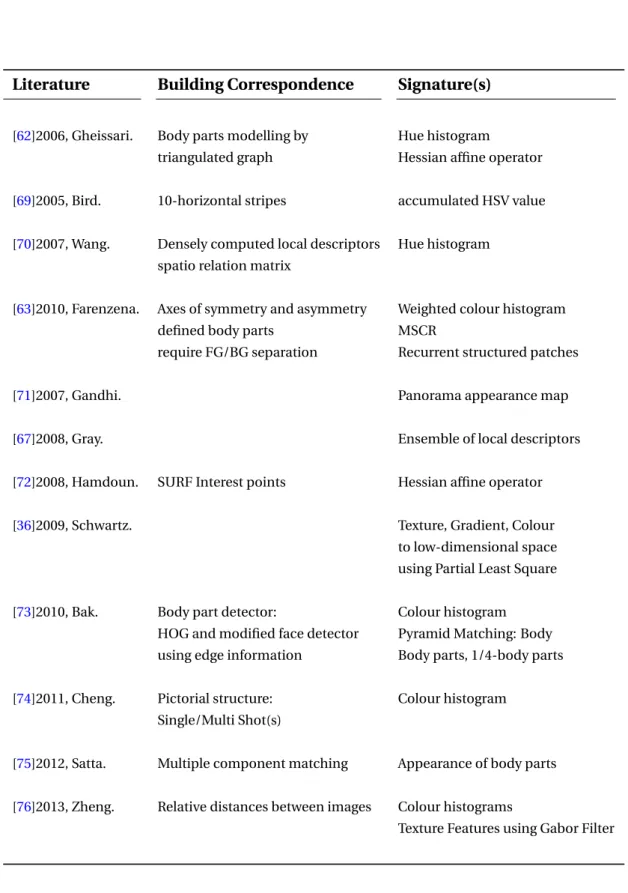
InTable3.1, frameworks used in pedestrian re-identification are summarised
ac-cording to their means of building correspondences between images and the signa-tures selected to describe pedestrians.1
3.2 Code Book Matching
During the tracking of pedestrians, to identify a reappeared pedestrian after a period of complete occlusion can be modelled as a prototype based recognition problem. The pedestrian being tracked is the prototype pedestrian (usePROTOTYPE(s) in later paragraph) and future detections, especially the ones after a period where thePRO
-TOTYPEis blocked and disappeared from the scene, are the target pedestrians (use
TARGET(s) in later paragraph). To retain the tracking activity and update the
infor-mation of thePROTOTYPE, the detectedTARGETs are compared with thePROTOTYPE
to examine if they are the reappearedPROTOTYPE. If the judgement is true, the
infor-mation of thePROTOTYPEwill be updated. When there is no clear clue showing which biometric features play crucial roles in human recognition activity, features used in re-identification relate to the appearances of pedestrians. It means, a TARGET will be judged as a reappearedPROTOTYPEif theTARGETis wearing the similar patterned clothes and having similar skin-hair colours, if any exposure, with thePROTOTYPE. The difficulties of re-identification problems vary according to the complexities of the appearances ofPROTOTYPEs. For example, if the clothes (top / bottom) of aPRO
-TOTYPE are mono-coloured without patterns and are covering the majority of the
body, the re-identification of thePROTOTYPEis simpler than the re-identification of
PROTOTYPEs who are wearing patterned multiple coloured clothes (a multi-coloured
top inside an open jackets for instance). The problem is even harder if the exposed body parts (limbs, hairs, etc.) ofPROTOTYPEs are involved in the the re-identification.
1Some are left blank as less information was provided in the literature. This may be because the
literature focus only one aspect of re-identification, or the algorithms presented in the literature were assumed versatile with various accompanied algorithms in generating signature or building corre-spondences.
3.2 Code Book Matching 41
Literature Building Correspondence Signature(s)
[62]2006, Gheissari. Body parts modelling by Hue histogram
triangulated graph Hessian affine operator
[69]2005, Bird. 10-horizontal stripes accumulated HSV value
[70]2007, Wang. Densely computed local descriptors Hue histogram
spatio relation matrix
[63]2010, Farenzena. Axes of symmetry and asymmetry Weighted colour histogram
defined body parts MSCR
require FG/BG separation Recurrent structured patches
[71]2007, Gandhi. Panorama appearance map
[67]2008, Gray. Ensemble of local descriptors
[72]2008, Hamdoun. SURF Interest points Hessian affine operator
[36]2009, Schwartz. Texture, Gradient, Colour
to low-dimensional space using Partial Least Square
[73]2010, Bak. Body part detector: Colour histogram
HOG and modified face detector Pyramid Matching: Body
using edge information Body parts, 1/4-body parts
[74]2011, Cheng. Pictorial structure: Colour histogram
Single/Multi Shot(s)
[75]2012, Satta. Multiple component matching Appearance of body parts
[76]2013, Zheng. Relative distances between images Colour histograms
Texture Features using Gabor Filter
42 Histograms in Pedestrian Re-identification
Using an appearance based re-identification framework, if the selected features rep-resent simple appearances only, the processing speed of the re-identification is rel-atively fast but the adaptability of the framework is narrowed thereafter. Complex frameworks employing multiple features and dedicated judgements are normally computational expensive. And they are overwhelmed for a simple case especially when fast reaction is crucial for pedestrian tracking and other real-time applications. In this section, using a pyramid structured protocol to solve the re-identification problem, the number of levels of judgements are selected according to the complex-ities of the appearances of pedestrians:
• Level 0: mono-coloured clothes without much skin-hair exposure;
• Level 1: bi-coloured clothes or mono-colour clothes with significant areas of skin-hair exposure;
• Level 2: clothes with regular patterns containing two colours;
• Level 3: clothes with more than one type of regular patterns or containing two colours or more;
• Level 4 (above): clothes with irregular / random patterns
Fig.3.1shows a basic structure to compare thePROTOTYPEwith theTARGETs
us-ing levels of descriptions in a dictionary. In this protocol, the colour related signa-tures (histograms calculated in the HSV colour space in this chapter) are selected as the fundamental descriptions to exempt theTARGETs wearing different clothes with
the PROTOTYPE, upper-body or lower-body. Enough levels of descriptions should
be calculated on the PROTOTYPEs for varied purposes while not all levels of those are required during the identification. The selection of descriptions is related to the consideration of speed, accuracy and the stability of performances in applications.
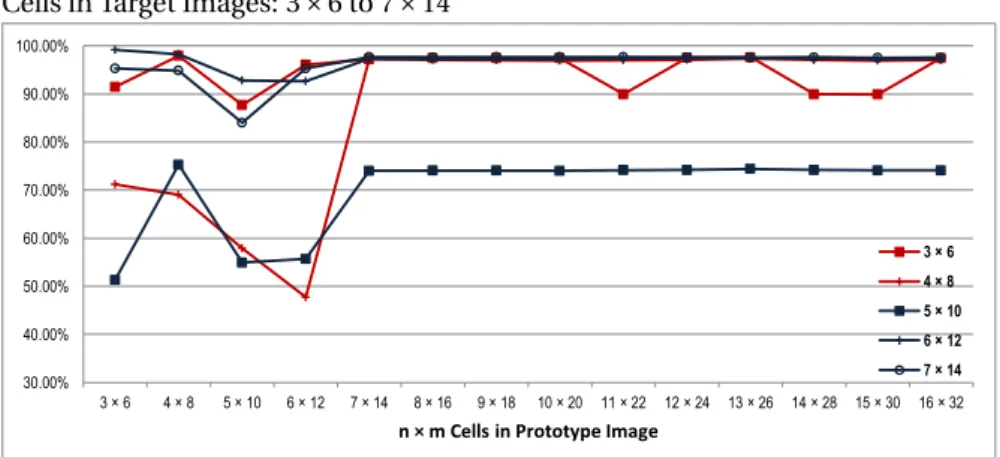
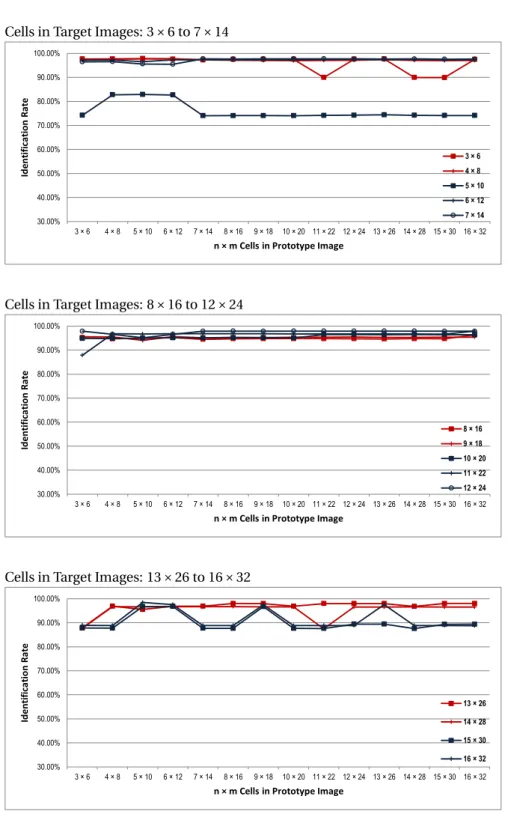
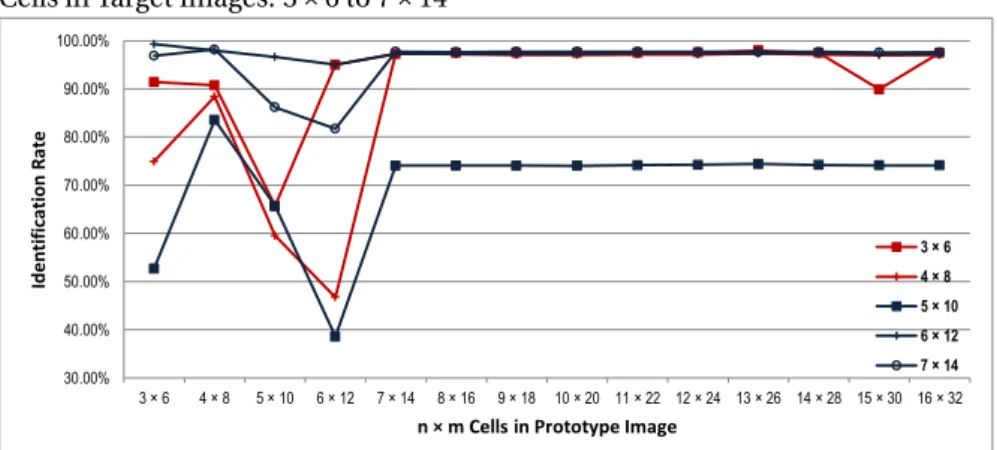
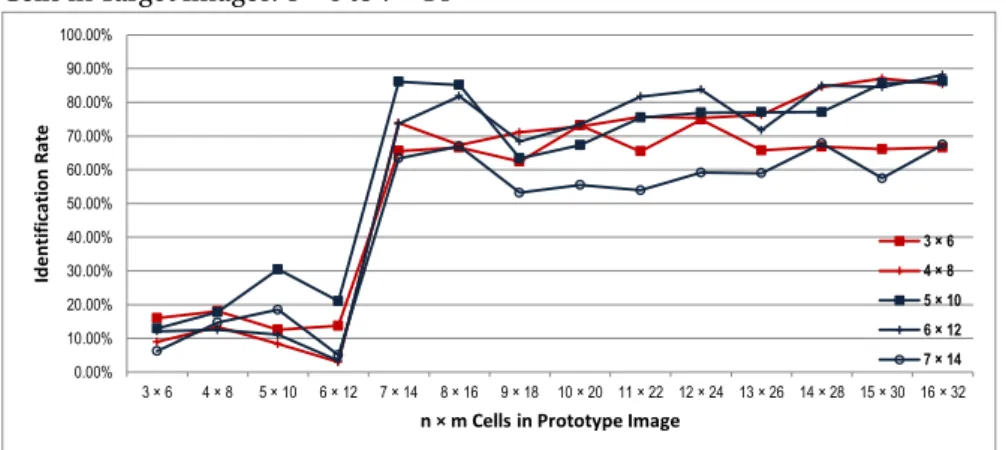
Experiments demonstrate when the PROTOTYPE is wearing mono-coloured clothes
or simple patterned clothes, only colour related histogram description is enough to make decisions with detection rate>90% and false alarm<10%. Observations also demonstrate if pattern information could have been considered in re-identification, the results would be better.
3.2CodeBook Matchfing 43 Co mp fle x L ab efl = 0 Ju dg e me nt (S a me , D fiff er en t) Co mp fle x L ab efl = 1 Co mp fle x L ab efl = 2 Co mp fle x L ab efl = k TA RG ET P at ch es A fl fl La y e rs a bov e Mu fltfi -L ay er ed P at ch De sc rfi ptfi on : Pfi = { H fis to gr a m, C o mp fle x L ab efl ; P att er n De sc rfi ptfi on ; D et afifl ed D es crfi ptfi on ; ... } La ye re d Wo rd s of Fe at ur es : E. g. U pp er Bo dy , L o we r Bo dy , Ba ck gr ou nd , … Bu fifl d t he PR OT OT YP E Dfic tfi on ar y PR OT OT YP E P at ch es La ye r k W or d fi D es crfi ptfi on : Wfi, k = { Pj,k | j W fi } La ye r 2 W or d fi D es crfi ptfi on : Wfi, De ta fifl = { Pj,De ta fifl | j W fi } La ye r 1 W or d fi D es crfi ptfi on : Wfi, Pa tt er n = { Pj,Pa tt er n | j W fi } La ye r 0 W or d fi D es crfi ptfi on : Wfi, Hfis to gr a m = { Pj,Hfis t | j W fi } ... Ffi g. 3. 1 Th e dfi ct fio na rfi es of pr ot ot yp e pe de st rfi an s ar e bu fifl t us fin g vo ca bu fla ry re fla te d pa tc he s. Wo rd s se fle ct ed fin th e dfi ct fio na ry fin cfl ud e up pe r-bo dy ,fl o we r-bo dy an d ba ck gr ou nd , et c.. Th e pa tc he s ar e de sc rfi be d us fin g mu flt fip fle fla ye rs of de sc rfi pt fio ns . Th ef un da me nt afl fle ve fl of de sc rfi pt fio nfi s hfi st og ra mf oflfl o we d by pa tt er n de sc rfi pt fio ns an d ot he r de sc rfi pt fio ns on up pe rfl ev efl s wh en re qu fir ed . By co mp ar fin gt he TA R G E T to th e dfi ct fio na ry of P R OT OT Y P E , pa tc he s of TA R G E T ar e co de d by wo rd s. Th fis co de ma pfi sf ur th er pr oc es se dt o ma ke a fin afl ju dg e me nt.