
This is a repository copy of
Equilibrium onions?
.
White Rose Research Online URL for this paper:
http://eprints.whiterose.ac.uk/1955/
Article:
Ramos, L., Roux, D., Olmsted, P.D. et al. (1 more author) (2004) Equilibrium onions?
Europhysics Letters, 66 (6). pp. 888-894. ISSN 1286-4854
https://doi.org/10.1209/epl/i2003-10260-6
[email protected] https://eprints.whiterose.ac.uk/ Reuse
See Attached
Takedown
If you consider content in White Rose Research Online to be in breach of UK law, please notify us by
DOI:10.1209/epl/i2003-10260-6
Equilibrium onions?
L. Ramos1, D. Roux2, P. D. Olmsted3 and M. E. Cates4
1 Groupe de Dynamique des Phases Condens´ees (UMR CNRS-UM2 5581), CC26 Universit´e Montpellier 2 - 34095Montpellier Cedex 5, France
2 Centre de Recherche Paul Pascal - avenue Schweitzer, 33600 Pessac, France 3 Department of Physics and Astronomy & Polymer IRC, University of Leeds Leeds LS2 9JT, UK
4 School of Physics, University of Edinburgh, JCMB Kings Buildings Mayfield Road, Edinburgh EH9 3JZ, UK
(received 30 July 2003; accepted in final form 15 April 2004)
PACS.82.70.Uv – Surfactants, micellar solutions, vesicles, lamellae, amphiphilic systems (hy-drophilic and hydrophobic interactions).
PACS.68.18.Jk – Surface and interfaces; thin films and low-dimensional systems (structures and nonelectric properties): Phase transitions.
PACS.61.30.St – Lyotropic phases.
Abstract. – We demonstrate the possibility of a stable equilibrium multi-lamellar (“onion”)
phase in pure lamellar systems (no excess solvent) due to a sufficiently negative Gaussian curvature modulus. The onion phase is stabilized by non-linear elastic moduli coupled to a polydisperse size distribution (Apollonian packing) to allow space-filling without appreciable elastic distortion. This model is compared to experiments on copolymer-decorated lamellar surfactant systems, with reasonable qualitative agreement.
Introduction. – The existence of vesicles at thermal equilibrium is a long-standing, and still controversial, problem [1]. Unilamellar and multi-lamellar vesicles (MLVs) were first induced in lyotropic lamellar phases with excess water by adding energy (e.g., shear flow, ultrasound, electric field) [2]. In a very elegant work, using membranes generated by a chemical reaction, Hoffman and co-workers demonstrated that any of lamellae, unilamellar vesicles, or MLVs can be prepared in the same system, depending on the mechanical path chosen [3]. However, in some special cases [4, 5]equilibriumunilamellar vesicles have been demonstrated. These systems are all in the dilute regime (large excess of water). Some experiments have suggested that MLVs (or onions) can be stabilized in the semi-dilute regime (excess water) [5]. Theories to explain the stability of dilute unilamellar vesicles either describe a competition between the entropy of mixing and the curvature energy of the vesicles [5–7] or a symmetry-breaking instability leading to a spontaneous curvature [8]. Onions are also predicted to be stabilized in the dilute and semi-dilute regimes due toan unstable curvature energy; in these cases, a transition towards unilamellar vesicles is avoided by imposing either a core energy [9] or a cutoff in the entropy of the Helfrich interactions [10]. Indeed, Simons and Cates [10] have discussed the stability of unilamellar vesicles and the transition to onions as the concentration increases even when the curvature energy is unfavorable, due to entropic reasons.
c
L. Ramoset al.:Equilibrium onions? 889
In the concentrated regime (homogeneous lamellar phase with no excess water), very monodisperse onions can be prepared under shear [11–13]. The vesicles fill space and remain in the one-phase region without expelling solvent, by distorting into space-filling polyhedra [14]. The resulting texture is a lattice of disclinations which can be either disordered [11] or or-dered [13]. Moreover many experimental systems “spontaneously” exhibit onions in regions of the phase diagrams that seem to be continuously linked to the lamellar phase [15]. This evolution from a texture of polydisperse vesicles to a texture of focal conics upon tuning a parameter, such as a co-surfactant concentration or the volume fraction of solvent, seems to be generic. A striking signature of this evolution is the change in the rheology, from a viscous gel in the “onion” phase to a more fluid phase in the “lamellar” focal conic phase. Thus, whether an onion texture is at equilibrium or not seems yet unclear. In this work we propose a model based on a non-quadratic elastic energy, which shows that a pure lamellar phase, or one of space-filling deformed monodisperse onions, is unstable with respect to a polydisperse space-filling packing (we study an Apollonian packing [16]). We compare these predictions to experiments on copolymer-doped lamellar phases, originally introduced by Ligoureet al.[17].
Model. – The bending free energy per areaF/Afor membranes is usually taken, following Helfrich, as the simplest quadratic function of the mean and Gaussian curvatures, respectively 2H =r−1
1 +r2−1andG= 1/(r1r2), wherer1andr2are the twoprincipal radii of curvature [18].
This suffices for large curvature radiir≫δ, whereδis the layer thickness. However, if onions exist, because of the high concentration of membrane, high curvatures (smallr) are expected near the core of the onions. We will thus use the free energy, relative to a flat state, of a symmetric bilayer expanded toquartic order in the curvature radii [19]:
F
A = 2κ H
2+ ¯κ G+1
4c1H
4+1
4c2G
2+ 2c3GH2, (1)
where κand ¯κare the conventional bending and Gaussian curvature moduli, and the non-linear modulici can be expected toscale askBT δ2.
Stability of a flat membrane requires 2κ > −κ >¯ 0. For ¯κ > 0, an instability towards a phase with G < 0 (e.g., a bicontinuous phase) is possible. However, for ˜κ ≡2κ+ ¯κ < 0 spherical shells are stabilized, with free energy (for radiusr)Fshell(r)<0 given by
Fshell(r) = 4πκ˜+π˜c
r2 , (2)
where ˜c = c1 + 4c2 +c3. Positive ˜c stabilizes spherical shells (vesicles) of finite radius. Unilamellar vesicles cannot accommodate volume fractions close to space filling, so we consider the free energy of an onion of radius R, constructed from k shells of discrete radii rj =jd,
(j = 1, 2, 3,. . .,k) set by the layer spacingd, which we assume remains fixed:
Fonion(R=kd) =
k
j=1 Fshell
rj=jd=
4π˜c d2
λk+S(−2, k)
, (3)
where λ≡κd˜ 2/˜c is the balance between the Helfrich and non-linear elastic coefficients and S(l, m) ≡m
i=1il(1). In the limit R ≫ d, the second term above, due to the fourth-order
coefficients, is equivalent to the core energy introduced by Fournier and Durand [9].
For large dilute monodisperse onions the free energy per unit volume scales as F/V ∼
Fonion(R) ∼ ˜c(λ+d/R)/(d3R2), leading for λ < 0 to stable onions with size R ∼ d/|λ|. (1
)There is, generally, a surface energy due to,e.g., van der Waals attraction, but if we assume an inter-onion
-1.2 -1.0 -0.8 -0.6
1 10 100
0 5 10 15 20 25 30 0 a) Lamellae Onions k ma x λ
~ -(aκ
rb . units ) b) Lamellae Onions φ (%) c)
-1.2 -1.0 -0.8 -0.6
1 10 100
0 5 10 15 20 25 30 0 a) Lamellae Onions k ma x λ
~ -(aκ
rb . units ) b) Lamellae Onions φ (%) c)
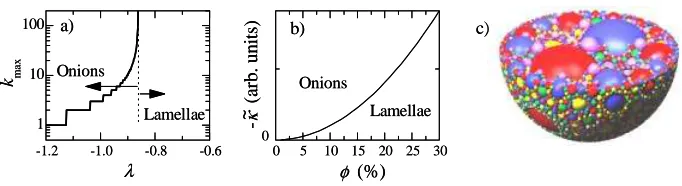
Fig. 1 – (a) Maximum number of layers per onion, kmax, as a function of λ ≡κd˜ 2
/c˜. Apollonian onions are stable for−1.125λ−0.86. (b) Schematic phase diagram in the (˜κ, φ)-plane, ˜κ∗
∼φ2. (c) Schematic packing of the Apollonian distribution (reprinted with permission from [16]).
However, in the concentrated regime monodisperse onions cannot fill space without non-trivial deformations [14]. Typically, onions formed under shear pack as polyhedra, with the deformation of layer j concentrated along the edges of length rj with curvatures of order
1/ξ, where the smectic bending penetration length ξ = K/B¯ depends on the bending
K = κ/d and compression ¯B moduli of the lamellar phase [20]. Summing over all shells in a deformed polyhedron leads to an energy per unit volume that scales as Fel/V ∼˜c[λ+
d2/ξ2]/(Rξd3). Forλ+d2/ξ2<0, this leads toan unphysical unilamellar vesicle phase with R=d(the lower cutoff). However, a polydisperse phase can relax the deformation, leading, for a broad enough distribution to a space-filling distribution of spheres. A candidate space-filling distribution is the Apollonian packing, for which the number distribution of spheres n(R)∼
(R/d)−DA, with a fractal dimension estimated from simulations to beDA
≃3.45 [16, 21, 22] (see fig. 1c). Such a packing has been previously suggested to describe focal conic defects in smectic droplets [23]. In principle we should calculate this distribution from a free energy that incorporates entropy. Although small on the typical scale of the elastic terms, this entropy should widen the parameter range in which onions are stable [10]. Existing equations of state for,e.g., polydisperse hard spheres, fail for widely disperse distributions near space filling [24], sowe have been unable toestimate this contribution toany useful accuracy. Entropic effects will most likely influence the upper and lower cutoffs of the distribution, and would eventually lead (for highly fluctuating systems) to an exponential, rather than power law, size distribution away from space filling [7, 9].
The normalized number distribution of onion sizesRk obeying 43πk
max
k=1 n(Rk)R3k =Vm,
whereVm is the volume of lamellar material, is
˜
n(k=Rk/d) = 3
4πd3
Vm S(3−DA, kmax)
Rk
d
−DA
. (4)
The total energy of the distribution,Ftot =kmax
k=1 n˜(k)Fonion(k), is
4πd3Ftot
3Vm =
λ S(1−DA, kmax) +kmax
j=1 S(−2, j)j−D A
S(3−DA, kmax) . (5)
This energy can then be minimized over the maximum onion size kmax as a function of the single parameter λ to find the lowest free-energy distribution (fig. 1a). Although spheri-cal shells are stable for λ < 0, the stabilizing elastic constants ci assure that a finite and
negative λ ≤λ∗ ≃ −0.86 is required for onion formation. Onions are first stable with
[image:4.516.69.410.98.191.2]L. Ramoset al.:Equilibrium onions? 891
Fig. 2 – Top: gel phase observed between crossed polarizers, for membrane fractionsφand copoly-mer/surfactant weight ratiosαof a)φ= 16%, α= 0.2; b)φ= 16%, α= 0.4; c)φ= 16%,α= 0.8; d)φ = 22%, α= 0.8. Bottom: gel phase in contact with water; e) crossed polarizers, φ = 16%, α= 0.15; f) Differential Interference Constrast microscopy,φ= 16%,α= 1.6. Scale bar 50µm.
nR3 ∼ R3−DA
≃ R−0.45 implies an unbounded total volume. Hence, the size distribution
must have an upper cutoff, which in practice should be the smallest dimension of the sample container. (In fact, the nature of the size distribution for Apollonian packings of spheres is still under debate [21, 22], and appears todepend crucially on the manner in which the packing is constructed.) The maximum onion size then decreases, and forλ −1.125 the stable phase is of unilamellar vesicles. At this point the calculation has presumably broken down, and either another phase such as micelles intervenes(2), or even higher-order curvature
terms become important. Becauseλ= ˜κd2/˜c, and the volume fractionφis of orderδ/d, the conditionλ < λ∗implies a phase boundary ˜κ∗∼φ2, as shown in fig. 1b, in the (˜κ, φ)-plane.
Experiments. – As shown theoretically in [26], adsorption of amphiphilic copolymers to surfactant bilayers is expected todecrease ˜κ, which eventually becomes negative. We therefore prepare lamellar phases decorated with copolymers [17]. Bilayers of thicknessδ0= 2.8 nm com-prising cetylpyridinium chloride (CpCl) and octanol (Oct) (CpCl/Oct = 0.95 w/w) are diluted in brine ([NaCl] = 0.2 M) and decorated with Symperonics F68 (Serva) ((EO)76−(PO)29−
(EO)76, where EO is ethylene oxide and PO is propylene oxide) as amphiphilic copolymer.
The bilayer volume fractionφand the copolymer/surfactant weight ratio αrange from 9 to 23% and 0 to 1.6, respectively. The lamellar structure is preserved upon adding copolymer, with a continuous hardening into a “lamellar gel”. The location of this gel in the (α , φ) phase diagram was studied by Ligoureet al. [17]. They observed gel-like behavior over a range of critical copolymer/surfactant weight ratios that depends on the membrane fraction.
The marked variation of the mechanical properties of the bulk lamellar phase is accompa-nied by modifications of the optical textures. The pictures shown in fig. 2 demonstrate that
(2
5 10 15 20 25 30 0.0
0.5 1.0 1.5
103 104 105 10-4 10-2 100 lamellar phase gel phase (onions) α
φ (%)
a)
2π/q ~ 7 µm -3.7
I (arb. uni
ts
)
q (cm-1)
b)
Fig. 3 – (a) Schematic phase diagram, adapted from [17], overlaid with the experimental points (×), whereαandφare, respectively, the copolymer/surfactant weight ratio and bilayer volume fraction. Experimental phase boundaries are inferred at•. The dotted line is a guide for the eye. (b) Small-and large-angle static light scattering intensity forφ= 16% andα= 0.8. A crossover from power law to constant intensity is noted at a length scale of order 7µm.
the lamellar gels are onion phases. Onions are clearly obtained for both neat lamellar phases and samples put in contact with solvent. In the latter case, individual onions detach from the solvent/gel interface (figs. 2e, f), while in the former case defect textures characteristic of the onion phase are observed between crossed polarizers (figs. 2a-c). The onions are highly polydisperse, with an apparent maximum size which seems to decrease with increasing α. Different textures and the presence of oily streaks are discerned at higher φ(fig. 2d).
While microscopy indicates that the size distribution is very broad and varies withαandφ, a quantitative determination of the size distribution using this technique is delicate. However, assuming an Apollonian distribution we can, for example, estimate the macroscopic elastic modulus as a mass (or volume) average of the elastic moduli of onions of different sizesri. The
elastic energy stored in a linear deformation of strain µof an onion of radiusRis 4πγR2µ2,
where the effective surface tensionγ= 12√KB¯ [27], leading toa modulusGR= 3πγ/R. Thus,
an estimate of the volume-averaged elastic modulus isG0≃ V1
i3γnir2i [20]. Averaging for
Rmax ≫d=δ0/φ, we find G0 ≃ 3dγ
4−DA
DA−3(
d Rmax)
4−DA
≃3.67γ d−0.45R−0.55
max for DA = 3.45.
The linear elastic plateau is measured in a Couette rheometer along two lines in the phase diagram at constant αandφ(fig. 3a). For fixed φ, the modulus G0 increases monotonically with increasingα, while for fixedα, the modulus varies non-monotonically withφ(fig. 4). To extract the maximum onion radiusRmaxfromG0, we must estimate the surface tensionγ. Fo r interlamellar forces dominated by Helfrich entropic undulations,√KB¯= 3π
8
kBT
(d−δ)2, withδthe
100 1000 a)
G0
(P
a)
0.0 0.5 1.0 1.5 0 50 100 Rma x (µ m) α
0.0 0.5 1.0 1.5
100 101 102 10 100 1000 b)
5 10 15 20 25 0
500 1000 1500
[image:6.516.121.364.101.190.2]φ (%)
[image:6.516.123.357.529.627.2]L. Ramoset al.:Equilibrium onions? 893
bilayer thickness [17, 28]. Interestingly, it has been shown [17] that for a decorated lamellar phase the inter-bilayer interactions are still of an effective Helfrich form, with an effective bi-layer thicknessδeff =δ0+2×hpol, wherehpolis the apparent thickness of the polymer layer(3).
In the experimental range ofαwe takehpol=Aα1/3withA= 3.5 nm, although this expression
is strictly valid only in the brush regime (α≥0.5). One can thus calculate the surface tension by takingδ=δeffand hence extract, from the experimental values ofG0, the variations ofRmax
with the twoexperimental parametersφand α. As can be seen in fig. 4, for φ= 16%,Rmax
varies between 1µm and 120µm, with an apparent divergence nearαc≃0.08; while forα= 0.8,Rmaxvaries between 4µm and 1400µm, with an apparent divergence nearφc≃24.5%(4).
The critical-like behavior of the onion maximum size inferred experimentally is remarkably similar, qualitatively, to the prediction of fig. 1. From the observed critical-like variations in
Rmax we have identified two points on the boundary between lamellar and onion phases, in the (α , φ)-plane (fig. 3a). Using the relation between ˜κand the parameterλ, we can estimate experimental values for ˜κ. The onion/lamellae phase boundary is given byλ∗=κ˜∗d2
˜
c =−0.86
with ˜c=kBT δ2
eff. For the two copolymer/surfactant weight ratiosαfor which the boundary
has been determined (fig. 1c), we obtain ˜κ = −0.1kBT for α = 0.08 and ˜κ = −0.6kBT
for α= 0.8. In agreement with theoretical expectations [26], ˜κ is found to be negative, of order 1kBT, and to decrease with increasing copolymer/surfactant weight ratio. Consistent with the theoretical phase diagram (fig. 1b) and with previous experimental observations [17], we alsofind that the critical value of ˜κ, below which the onion phase is stable, decreases whenφincreases.
The radii Rmax estimated from the elastic moduli are similar to those observed by mi-croscopy (figs. 2e, f). For α = 0.15, the largest observable onion is R ≃ 35µm and the calculated Rmax(G0) = 120µm (fig. 2e), and for α = 1.6, the largest observable onion is
R≃5µm (in fig. 2f) and the calculated Rmax(G0) = 1.4µm. We can alsocompare Rmax to static light scattering experiments (fig. 3). The scattering intensityI(q) scales as a po wer law for largeq,I(q)≃q−3.7, and has a plateau for smallerq, indicating that there is nostructure
at lengths larger than the crossover length 2π/q ≃7µm. This provides an estimate for the maximum onion sizeRmax that is very close to the value obtained from G0 (Rmax= 6µm). While similar power law behavior for highq has previously been observed for monodisperse onions obtained by shear, the behavior at largeq[29] was very different, with a peak character-istic of the onions size observed in that case. The flat intensity obtained here clearly indicates the intrinsic polydispersity of the onions. Figures 2e, f also show wide size distributions.
In summary, we have presented experimental evidence for an equilibrium phase of polydis-perse multi-lamellar vesicles (onions), and rationalized this by combining a non-linear Helfrich elastic theory with an assumed polydisperse distribution of onions. Future work should incor-porate the entropy and calculate the nature of the space-filling distribution.
∗ ∗ ∗
We thank the Kavli Institute for Theoretical Physics at the University of Santa Barbara, where part of this work was initiated. LR thanksC. Ligoure for fruitful discussions and
L. Cipelletti for help in the light scattering experiments, and PDO thanks CRPP for hospitality.
(3
)Since the lamellar phase is stabilized by Helfrich interactions, one should in principle incorporate layer undulations into an onion entropy [10]. However, we believe that these effects, important for small onions in dilute systems, would not significantly change the phase diagram at the higher concentrations studied here.
(4
)We note that, at smallφ,Rmaxis a decreasing function ofφ, which may be due tothe nearby
REFERENCES
[1] Laughlin R. G.,Colloid Surf. A,128(1997) 27.
[2] Szoka F.andPapahadjopoulos D.,Ann. Rev. Biophys. Bioeng.,9(1980) 467;Olson F.et al.,Biochim. Biophys. Acta,557(1979) 9.
[3] Bergmeier M., Hoffmann H. and Thunig C., J. Phys. Chem. B, 101 (1997) 5767;
Bergmeier M. et al., Nuovo Cimento D, 20 (1998) 2251; Hoffmann H. et al., Prog. Col-loid Polym. Sci.,109(1998) 13.
[4] Kaler E. W.et al.,Science,245(1989) 1371. [5] Herve P.et al.,J. Phys. II,3(1993) 1255.
[6] Israelachvili J. N.,Intermolecular and Surface Forces(Academic Press, London) 1992. [7] Boltenhagen P., Kleman M.andLavrentovich O. D.,J. Phys. II,4(1994) 1439.
[8] Safran S. A.et al.,Phys. Rev. A,43(1991) 1071.
[9] Fournier J.-B.andDurand G.,J. Phys. II,4(1994) 975. [10] Simons B. D.andCates M. E.,J. Phys. II,2(1992) 1439. [11] Diat O.andRoux D.,J. Phys. II,3(1993) 9.
[12] Diat O., Roux D.andNallet F.,J. Phys. II,3(1993) 1427.
[13] Sierro P.andRoux D.,Phys. Rev. Lett.,78(1997) 1496. [14] Gulik-Krzywicki T.et al.,Langmuir,12(1996) 4668.
[15] Auguste F.et al.,Langmuir,13(1997) 666;Oberdisse J. et al.,Langmuir,12(1996) 1212;
Hoffmann H.et al.,J. Colloid Interface Sci.,163(1994) 217. [16] Bork M., de Paris W.andPeikert R.,Fractals,2(1994) 521.
[17] Castro-Roman F., Porte G.and Ligoure C.,Phys. Rev. Lett.,82(1999) 109; Langmuir,
17(2001) 5045.
[18] Helfrich W. H.,Z. Naturforsch.,28c(1973) 693.
[19] Fournier J.-B.andGalatola P.,Europhys. Lett.,39(1997) 225.
[20] Panizza P.et al.,Langmuir,12(1996) 248.
[21] Anishchik S. V.andMedvedev N. N.,Phys. Rev. Lett.,75(1995) 4314.
[22] Rouault Y.,Powder Technol.,102(1999) 274.
[23] Bidaux R.et al.,J. Phys. (Paris),34(1973) 661;Fournier J.-B.andDurand G.,J. Phys. II,1(1991) 845.
[24] Blaak R.andCuesta J. A.,J. Chem. Phys.,115(2001) 963;Zhang J. F. et al.,J. Chem. Phys.,110(1999) 5318;Salacuse J. J.andStell G.,J. Chem. Phys.,77(1982) 3714.
[25] Gradzielski M.et al.,J. Phys. Chem. B,103(1999) 1416. [26] Porte G.andLigoure C.,J. Chem. Phys.,102(1995) 4290.
[27] van der Linden E.andDr¨oge J. H. M.,Physica A,193(1993) 439. [28] Roux D.andSafinya C. R.,J. Phys. (Paris),49(1988) 307.

![Fig. 3 – (a) Schematic phase diagram, adapted from [17], overlaid with the experimental points (×where), α and φ are, respectively, the copolymer/surfactant weight ratio and bilayer volume fraction.Experimental phase boundaries are inferred at •](https://thumb-us.123doks.com/thumbv2/123dok_us/8090974.231457/6.516.123.357.529.627/schematic-overlaid-experimental-respectively-copolymer-surfactant-experimental-boundaries.webp)
