This is a repository copy of
The Leeds Evaluation of Efficacy of Detoxification Study
(LEEDS) project: An open-label pragmatic randomised control trial comparing the efficacy
of differing therapeutic agents for primary care detoxification from either street heroin or
methadone [ISRCTN07752728]
.
White Rose Research Online URL for this paper:
http://eprints.whiterose.ac.uk/918/
Article:
Oldham, N.S., Wright, N.M.J., Adams, C.E. et al. (2 more authors) (2004) The Leeds
Evaluation of Efficacy of Detoxification Study (LEEDS) project: An open-label pragmatic
randomised control trial comparing the efficacy of differing therapeutic agents for primary
care detoxification from either street heroin or methadone [ISRCTN07752728]. Family
Practice, 5 (9). ISSN 1471-2296
https://doi.org/10.1186/1471-2296-5-9
[email protected] https://eprints.whiterose.ac.uk/
Reuse See Attached
Takedown
If you consider content in White Rose Research Online to be in breach of UK law, please notify us by
Open Access
Study protocol
The Leeds Evaluation of Efficacy of Detoxification Study (LEEDS)
project: An open-label pragmatic randomised control trial
comparing the efficacy of differing therapeutic agents for primary
care detoxification from either street heroin or methadone
[ISRCTN07752728]
Nicola S Oldham
1, Nat MJ Wright*
2, Clive E Adams
3, Laura Sheard
2and
Charlotte NE Tompkins
4Address: 1NFA Health Centre for Homeless People, Leeds, UK, 2Centre for Research in Primary Care, Hallas Wing, 71-75 Clarendon Road, Leeds,
UK, 3The Cochrane Schizophrenia Group, Academic Unit of Psychiatry and Behavioural Sciences, University of Leeds, Leeds, UK and 4NFA Health
Centre for Homeless People & Centre for Research in Primary Care, Leeds, UK
Email: Nicola S Oldham - [email protected]; Nat MJ Wright* - [email protected]; Clive E Adams - [email protected]; Laura Sheard - [email protected]; Charlotte NE Tompkins - [email protected]
* Corresponding author
Abstract
Background: Heroin is a synthetic opioid with an extensive illicit market leading to large numbers of people becoming addicted. Heroin users often present to community treatment services requesting detoxification and in the UK various agents are used to control symptoms of withdrawal. Dissatisfaction with methadone detoxification [8] has lead to the use of clonidine, lofexidine, buprenorphine and dihydrocodeine; however, there remains limited evaluative research. In Leeds, a city of 700,000 people in the North of England, dihydrocodeine is the detoxification agent of choice. Sublingual buprenorphine, however, is being introduced. The comparative value of these two drugs for helping people successfully and comfortably withdraw from heroin has never been compared in a randomised trial. Additionally, there is a paucity of research evaluating interventions among drug users in the primary care setting. This study seeks to address this by randomising drug users presenting in primary care to receive either dihydrocodeine or buprenorphine.
Methods/design: The Leeds Evaluation of Efficacy of Detoxification Study (LEEDS) project is a pragmatic randomised trial which will compare the open use of buprenorphine with dihydrocodeine for illicit opiate detoxification, in the UK primary care setting. The LEEDS project will involve consenting adults and will be run in specialist general practice surgeries throughout Leeds. The primary outcome will be the results of a urine opiate screening at the end of the detoxification regimen. Adverse effects and limited data to three and six months will be acquired.
Published: 29 April 2004
BMC Family Practice 2004, 5:9
Received: 10 April 2003 Accepted: 29 April 2004
This article is available from: http://www.biomedcentral.com/1471-2296/5/9
BMC Family Practice 2004, 5 http://www.biomedcentral.com/1471-2296/5/9
Background
Heroin is a synthetic opioid and a 'Class A' controlled drug [14]. As such, in the United Kingdom, there has been an extensive illicit market for the sale of the drug, leading to large numbers of people becoming addicted. It is diffi-cult however, to give precise figures of how many people are dependent on heroin in the UK as there has never been a national survey of the prevalence of drug misuse [4]. Official statistics, however, record those presenting to treatment. Most recent figures from Regional Drug Misuse Databases show that in the six months ending March 1998, 30,000 people in Great Britain presented to drug treatment services [5]. The UK Home Office Addict Noti-fication System (stopped May 1997) showed a doubling of the number of addicts who approached the treatment system over the six years 1990–1996. The number of drug users notified in 1996 was 43,372 (over 90% of which were notifications for heroin or methadone) [6]. Though possession of the drug is illegal under the Misuse of Drugs Act 1971, there is an extensive range of both statutory and non-statutory services that aim to provide treatment to those who are heroin dependent. This reflects the tradi-tion in the UK that there have been minimal restrictradi-tions placed on doctors wishing to prescribe for drug dependence.
As well as placing a large burden on both health and other services, heroin dependency is dangerous to individual users and society. There were 2,300 drug-related deaths identified in England and Wales in 1998 due to accidental or intentional overdose and there is a rising trend. A young person who is injecting heroin has about a 14 times higher risk of death than someone who is not.[1]. There is an exponential relationship between the likelihood of being drug dependent and living in a deprived commu-nity.[12]. At least one third of all individuals in contact with probation services are drug misusers.[19].
Drug users often present to community treatment services requesting detoxification from heroin. In the UK, various therapeutic agents are used to control symptoms of street opiate withdrawal. Neither national guidelines, nor indeed the evidence base behind rapid detoxification from opiates give a 'drug of choice' for successful rapid detoxification. In the UK, the most commonly used drug has been methadone, employing incremental reductions in the dose over 7–21 days [19]. Dissatisfaction with methadone stems from the fact that it has a long-half life [16,8]. Therefore, though dose reductions are relatively easy to achieve in the initial phase of detoxification pro-gramme, patients report distressing withdrawal symptoms in the latter stages.
This has lead to the use of alternative detoxification agents such as clonidine, lofexidine, buprenorphine and
dihy-drocodeine. Clonidine has been used extensively, but its pronounced hypotensive and sedative effects have now rendered it unsuitable for community detoxification and its use has been superseded by the analogues lofexidine [16], and guanfacine (not used in the UK). Although the hypotensive effects of lofexidine are less than clonidine, its high cost and reduced ability to control the withdrawal effects compared to a substitute opiate [17,15] have resulted in limited clinical uptake. Lofexidine tends to be the treatment of choice for the minority of people who are going straight to opiate-antagonist (naltrexone) relapse prevention medication. Dihydrocodeine is attractive to clinicians as it has a shorter half-life than methadone, seems equally acceptable to users, and is less open to abuse by injecting than methadone tablets. Buprenor-phine, in the form of sub-lingual tablets, has already been used in clinical situations for opiate detoxification (street heroin or prescribed opiates) [13], but is relatively new for this purpose in the UK. There has only been one pub-lished randomised control trial comparing methadone with buprenorphine [2]. Firm conclusions could not be drawn due to small numbers and low completion rates in both groups. There are no published trials comparing the effectiveness of buprenorphine versus lofexidine for opi-ate withdrawal in drug using populations. Buprenorphine has the advantage of having a good safety profile, better retention in treatment and lower withdrawal severity compared to clonidine [10,11,3,7]. As a result, it is likely to become widely used in the UK.
Sublingual buprenorphine has been compared with dihy-drocodeine for postoperative pain [9], but never, in a ran-domised trial, for opiate detoxification (street heroin or prescribed opiates). In the UK there is a narrow window of opportunity to undertake an evaluative study.
Aim
To evaluate whether buprenorphine or dihydrocodeine, given openly to moderately severe users of street opiates presenting for detoxification in the NHS primary care set-ting, helps achieve abstinence at completion of a reducing regimen.
To record primary and secondary outcomes at completion of the reducing regime and at tertiary outcomes at three and six month intervals.
Methods
Settingwith research taking place in secondary care. Much of the current evidence base for pharmacological treatment of drug use comes from studies that have taken place in an in-patient or residential setting. There is an urgent need to verify whether such research is applicable to a community and primary care environment. The ethos of the study will be a collaborative project between primary care and the secondary care, academic departments and service provid-ers. Information is produced for General Practitioners thinking of taking part in the LEEDS project (Additional file 1).
Leeds is an industrial city and financial centre of 700,000 people in the North of England.
Randomisation
Randomisation will be by random block size, stratified by practice. It will be undertaken centrally in the Academic Department of Psychiatry and Behavioural Sciences, Uni-versity of Leeds and not by the primary care teams them-selves. Microsoft Excel 'RAND' function will be used to choose two even numbered block sizes less than ten. Again, using the function in MS Excel, the order of use of these block sizes will be randomised. Which drug regimen is represented by which numbers within the block is then selected, again at random. Finally a table of random num-bers will be used to randomise the order of drugs within the blocks.
Opaque consecutively numbered envelopes will be pre-pared for each practice. If a patient is both eligible and consents to the trial, the next envelope will be opened by the prescribing doctor and the intervention allocated. The envelopes will be used in numerical order so as not to interfere with the randomisation process.
Pragmatic design
The design of the study is to suit the logistics of everyday general practice. Open dosing and giving regimes exist whereby the GP, Addiction Therapist and patients know exactly which opiate detoxification regime they will follow.
Sample size
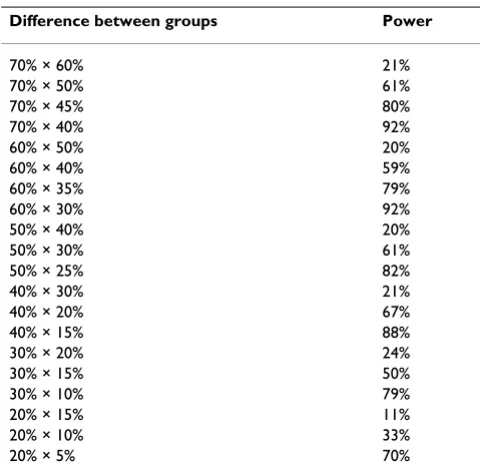
Currently no relevant randomised controlled trials exist. It is therefore problematic to estimate the desired sample size. With the practices currently working in the LEEDS project, it is realistic to estimate that we will be able to accrue 120 people. The sample size will limit the power of the study. Power calculations were undertaken using Sam-ple Power 1.20 developed by SPSS Inc., comparing two groups (60 individuals in each) and for α = 0.05 (two-sided), (Table 1).
We estimate the proportion of people who successfully detoxify on dihydrocodeine to be 50–60%. Should there be a 20% difference in the groups this would give the LEEDS project 60% power. We recognise that this is somewhat low but this power calculation is based on a series of assumptions for which we can find little hard evi-dence. We have also tried to be realistic about accrual, and the LEEDS project will evaluate locally relevant treatments and will, at the very least, provide data so that the next study in this area can be better informed.
Eligibility criteria
A person is eligible if: - aged 18 years or over
- using street opiates as confirmed by heroin metabolites in a urine sample taken at first assessment.
- stating that the level of opiate use is moderate (as detoxi-fication needs to be completed within a three week time period), that is
❍ heroin – not more than ~£20/day injecting – currently this means between 0.4 and 0.7 g/day, or £30/day smok-ing or
[image:4.612.313.553.98.334.2]❍ methadone mixture – use of no more than 30 mg (30 ml)/day
Table 1: Power calculations for sample of 120
Difference between groups Power
70% × 60% 21%
70% × 50% 61%
70% × 45% 80%
70% × 40% 92%
60% × 50% 20%
60% × 40% 59%
60% × 35% 79%
60% × 30% 92%
50% × 40% 20%
50% × 30% 61%
50% × 25% 82%
40% × 30% 21%
40% × 20% 67%
40% × 15% 88%
30% × 20% 24%
30% × 15% 50%
30% × 10% 79%
20% × 15% 11%
20% × 10% 33%
BMC Family Practice 2004, 5 http://www.biomedcentral.com/1471-2296/5/9
- expressing a wish to detoxify through the standard mon-itored process and remain abstinent from opiates. - willing to give informed consent (Additional file 2) after receiving the patient information leaflet (Additional file 3)
- No contra-indications to dihydrocodeine or buprenorphine
❍ Registered at one of the 50 General Practices that form part of the Leeds Shared Care scheme for the management of drug users.
Specifically, polydrug use (e.g. dependence to other sub-stances such as alcohol, benzodiazepines or stimulants) will not be excluded from the trial.
On giving consent
The treatment option will be concealed from both patient and clinician at the time of the eligibility assessment. Both parties will remain blind to the treatment to be prescribed until the envelope is opened.
The General Practitioner will complete the outside of the allocation envelope before it is opened, recording the per-son's unique identifier number, date of birth, date first prescription given and an estimate of severity of addiction and prognosis (see Table 2: Additional file: 5). Adding a rating tool for severity was considered. This would have added complexity and made the study less attractive to busy practitioners. Also, in this pragmatic study, the
pur-pose of the rating was not to be an objective measure of severity. Rather it was to ensure that the randomisation had resulted in equal numbers of similarly rated people entering each group. Even if the external validity is debat-able this technique should ensure that the reader of the final report is reassured that randomisation was successful.
Interventions
1. Dihydrocodeine, given openly, in the context of the standard General Practitioner/Drugs Therapist support. In the UK treatment setting, dihydrocodeine cannot be pre-scribed on FP10 MDA prescriptions. Therefore it is not possible to offer daily pick-up or supervised dispensing of the medication.
There is no evidence base to advise the most effective length of reducing regimen in achieving abstinence. Com-mon reducing regimens vary between 4 and 14 days. Therefore the reducing regimen of dihydrocodeine will be at the discretion of the prescribing doctor and within the standard regimen shown in table 3. What, therefore, is being randomised, is not so much a specific dosing regi-men of dihydrocodeine, but rather the complete package of care.
2. Buprenorphine, given openly, in the context of the standard General Practitioner/Drugs Therapist support. Buprenorphine will be prescribed on an FP10MDA pre-scription and will therefore be dispensed daily under supervision.
Table 3: Dihydrocodeine detoxification
Day Number of 30 mg
tablets
Morning Midday Evening Night-time
1 18 5 4 4 5
2 20 5 5 5 5
3 18 5 4 4 5
4 16 4 4 4 4
5 14 4 3 3 4
6 12 3 3 3 3
7 10 3 2 2 3
8 9 2 2 2 3
9 8 2 2 2 2
10 7 2 1 2 2
11 6 2 1 1 2
12 5 1 1 1 2
13 4 1 1 1 1
14 3 1 1 1
There is no evidence base to advise the most effective length of reducing regimen in achieving abstinence. Com-mon reducing regimens vary between 4 and 14 days. Therefore the reducing regimen of buprenorphine will be at the discretion of the prescribing doctor and within the standard regimen shown in table 4. Again it is the open giving of the regimen of buprenorphine that is being eval-uated, not identical or similar patterns of giving two drugs. This is designed to reflect the real world of primary care rather than more prescriptive environments.
As all sites form part of the city-wide shared care scheme, ancillary Drugs Therapist support will be standardised across all sites. The therapists have all received identical training regarding the trial. This involves the need to offer identical motivational enhancement for those undergoing detoxification, regardless of which pharmacological inter-vention is prescribed.
Data procedures and collection
The initial assessment data, on the randomisation enve-lope, is posted to the LEEDS project co-ordinator. A stamped addressed envelope is enclosed within the ran-domisation envelope. Information is then collated on a
transcription form (Additional file 4) and additional information sought in the patients' primary care notes regarding history and use of opiates. LEEDS project number and details of allocated treatment are also returned to the Academic Department of Psychiatry and Behavioural Sciences, University of Leeds, where ran-domisation was undertaken and where ranran-domisation codes are kept, to ensure that the correct order of alloca-tion is being followed.
The primary outcome is abstinence from street opiates at receiving the final prescription as indicated by a urine test free of illicit opiates or their metabolites (namely heroin, monoacetylmorphine, morphine or codeine)*. Whilst the ideal is that the patient would return for a urine sample the day after completing the detoxification programme, this is not feasible given the high rate of non-attendance by this client group. Failure to complete the course of pre-scribed detoxification medication, saying that they had used street opiates, failure to attend appointments to col-lect repeat prescriptions, refusal to provide a urine sample on receipt of final prescription or providing a urine sam-ple that tests positive for opiates on receipt of final pre-scription will all be counted as unsuccessful detoxification. The authors recognise that dihydrocodeine or buprenorphine in the final urine sample indicates that the user is not opiate free. However the urine sample at receipt of final script is an attempt to record a feasible out-come of interest to people working in primary care and recipients of the detox regimens. Whilst an ideal would be a urine drug sample taken during the detoxification and then five days post-detoxification, this is not considered to be feasible in the primary care setting. Ideally severity of withdrawal symptoms during the detoxification would be monitored using a validated research tool. However this would not be feasible in the multi-site pragmatic set-ting of primary care.
[image:6.612.53.297.99.285.2]*An immunoassay for opiates followed by thin layer chro-matography and in equivocal cases also gas chromatogra-phy mass spectrometry (GC Mass Spec) for the specific opiate. This technique allows heroin and its metabolites to be differentiated from dihydrocodeine and buprenor-phine and their breakdown products.
Table 4: Buprenorphine detoxification
Day Dose (mg)
1 6
2 8
3 8
4 6
5 6
6 4
7 3.6
8 3.2
9 2.8
10 2.4
11 2.0
12 1.6
13 1.2
14 0.8
15 0.4
Table 5: Dummy table for abstinence from street heroin at final prescription as indicated by urine test
Abstinence successful Abstinence not successful Totals
Buprenorphine A C A+C
Dihydrocodeine B D B+D
Totals A+B C+D A+B+C+D
[image:6.612.56.554.628.690.2]BMC Family Practice 2004, 5 http://www.biomedcentral.com/1471-2296/5/9
Practitioners will, as normal, also record details of any sig-nificant adverse effects. The individual notes of each study participant will be scrutinised by the LEEDS project co-ordinator and adverse effects clearly resulting in what seemed to be clinically significant distress will be recorded. Additional information on the inappropriate use of prescribed medication (e.g. intentional overdose), presentation at Accident and Emergency Departments and admission to hospital will also be recorded.
The project team recognise the difficulty in tracking peo-ple with drug problems across a longer period than two to three weeks. However, attempts will be made to record abstinence from opiates, employment, and service utilisa-tion at three and six month intervals after compleutilisa-tion of the allocated detoxification regimen. If possible, this data will be extracted from patient notes/records. Service utili-sation, such as presentation at Accident and Emergency departments, is routinely recorded. Participants will also be asked to provide a contact telephone number (includ-ing mobile and/or next of kin) for the purpose of the project co-ordinator contacting them at the three and six month follow up stage.
All data for the LEEDS project will be collated from the LEEDS envelopes and from routine GP/Addiction Thera-pists notes. Data will be transferred from the transcription forms onto specially created forms using the Microsoft Access Database.
Analysis
Analysis will take place within this package and SPSS. Dummy tables for this analysis are prepared before recruitment of the first patient (Table 5).
Funding
Funding for this project has been acquired from Leeds Health Authority to cover costs of employing a part time Trial Co-ordinator. The funding is part of Leeds Primary Care Trust Addiction Services Strategy.
Ethics
Approval for the trial has been granted from the NHS Local Research Ethics Committee based at Saint James's University Hospital, Leeds.
Authors' contributions
The final report will be authored by all those who contrib-ute to the project under the collective name of "The LEEDS Project Team". At the end of the main report the people making up the collective authorship will be listed in the order above and alphabetically thereafter.
Competing interests
None declared.
Additional material
Acknowledgements
We would like to thank the following people for their helpful input and comments regarding this proposal
Rob Kenyon, Senior Addiction Therapist, Leeds Addiction Unit
Helen Alpin, General Practitioner, Bellbrook Surgery
Paul Hatton, Consultant Public Health, Leeds Health Authority
Shane Pascoe, Research Fellow, Meanwood Group Practice
Duncan Raistrick, Clinical Director, Leeds Addiction Unit
Gillian Tober, Deputy Clinical Director, Leeds Addiction Unit
Yorkshire Research Education Network, Centre for Research in Primary Care, Nuffield Institute
References
1. Advisory Council on the Misuse of Drugs: Reducing drug related deaths: a report by the Advisory Council on the Misuse of Drugs.London: Stationery Office 2000.
2. Bickel WK, Stitzer ML, Bigelow GE, et al.: A clinical trial of buprenorphine: comparison with methadone in the detoxifi-cation of heroin addicts.Clin Pharmacol Ther 1988, 43:72-8.
Additional File 1
GP/Addiction Therapist Information Leaflet (appendix 1.doc) Click here for file
[http://www.biomedcentral.com/content/supplementary/1471-2296-5-9-S1.doc]
Additional File 2
Consent Form for patient (appendix 2.doc) Click here for file
[http://www.biomedcentral.com/content/supplementary/1471-2296-5-9-S2.doc]
Additional File 3
Patient information leaflet (appendix 3.doc) Click here for file
[http://www.biomedcentral.com/content/supplementary/1471-2296-5-9-S3.doc]
Additional File 4
Transcription form (appendix 4.xls) Click here for file[http://www.biomedcentral.com/content/supplementary/1471-2296-5-9-S4.xls]
Additional file 5
Questionare: Outside of the LEEDS Project envelope Questionare: Outside of the LEEDS Project envelope Click here for file
Publish with BioMed Central and every scientist can read your work free of charge
"BioMed Central will be the most significant development for disseminating the results of biomedical researc h in our lifetime."
Sir Paul Nurse, Cancer Research UK
Your research papers will be:
available free of charge to the entire biomedical community
peer reviewed and published immediately upon acceptance
cited in PubMed and archived on PubMed Central
yours — you keep the copyright
Submit your manuscript here:
http://www.biomedcentral.com/info/publishing_adv.asp
BioMedcentral 3. Cheskin LJ, Fudala PJ, Johnson RE: A controlled comparison of
buprenorphine and clonidine for acute detoxification from opioids.Drug Alcohol Depend 1994, 36:115-21.
4. Goddard E: The Feasibility of a National Survey of Drugs Use: New Methodology Series.London. Social Science Division, Office of Population Censuses and Surveys 151987.
5. Great Britain Department of Health, Great Britain Government Sta-tistical Service: Drug misuse statistics for six months ending March 1997.London: Department of Health 1998.
6. Home Office: Statistics of drug addicts notified to the Home Office, United Kingdom, 1996.London. Home Office 1997. 7. Linteris N, Bell J, Bammer G, Jolley DJ, Rushworth L: A randomized
controlled trial of buprenorphine in the management of short term ambulatory heroin withdrawal. Addiction 2002,
97:1395-1404.
8. Lowinson J, Berle B, Langrod J: Detoxification of long-term methadone patients: problems and prospects.Int J Addict 1976,
11:1009-18.
9. Masson AH: Sublingual buprenorphine versus oral dihydroco-deine in post-operative pain.J Int Med Res 1981, 9:506-10. 10. Nigam AK, Ray R, Tripathi BM: Buprenorphine in opiate
with-drawal: a comparison with clonidine.J Subst Abuse Treat 1993,
10:391-4.
11. O'Connor PG, Carroll KM, Shi JM, et al.: Three methods of opioid detoxification in a primary care setting. A randomized trial.
Ann Intern Med 1997, 127:526-30.
12. Ramsay M, Spiller J, Great Britain Home Office Research and Statistics Directorate: Drug misuse declared in 1996: latest results from the British Crime Survey: a Research and Statistics Directo-rate report.London. Home Office, Research and Statistics Directorate
1997.
13. Ritter A: Buprenorphine for the treatment of heroin dependence.Drug and Alcohol Review 2001, 20:5-7.
14. Royal Pharmaceutical Society of Great Britain: British national formulary.London. British Medical Association 2001.
15. San L, Cami J, Peri JM, et al.: Efficacy of clonidine, guanfacine and methadone in the rapid detoxification of heroin addicts: a controlled clinical trial.Br J Addict 1990, 85:141-7.
16. Seivewright N: Community treatment of drug misuse : more than methadone. Cambridge : Cambridge University Press; 2000. 17. Strang J, Bearn J, Gossop M: Lofexidine for opiate detoxification: review of recent randomised and open controlled trials.Am J Addict 1999, 8:337-48.
18. Strang J, Gossop M: The "British System": visionary anticipa-tion or masterly inactivity? In: Heroin addiction and drug policy: the British system Edited by: Strang John, Gossop Michael. Oxford; New York: Oxford University Press; Oxford medical publications; 1994. 19. Strang J, Great Britain Department of Health, Great Britain Clinical
Guidelines on Drug Misuse and Dependence Working Group, et al.:
Drug misuse and dependence: guidelines on clinical manage-ment: an executive summary.London. Stationery Office 1999.
Pre-publication history
The pre-publication history for this paper can be accessed here: