Subject: Psychology, Cognitive Psychology, Affective Science Online Publication Date: Apr 2014 DOI: 10.1093/oxfordhb/9780199660773.013.006
Singing and Emotion
Eduardo Coutinho, Klaus R. Scherer, and Nicola Dibben
Oxford Handbooks Online
Abstract and Keywords
In this chapter the authors discuss the emotional power of the singing voice. The chapter begins by providing an overview of the process of externalization of emotions by the human voice. Then, the authors discuss some fundamental determinants of emotional expression in singing, namely the ‘emotional script’, the artistic
interpretation, and the singer’s affective state. Next, they describe the manner in which expressed emotions are encoded in the voice by singers and recognized by listeners, and compare it with vocal expression in everyday life. Finally, they identify various methodologies that can enhance understanding of the physiology of vocal production and the acoustic cues fundamental to perception and production of expressive sung performance. The authors propose that the knowledge gained from application of these methodologies can inform singing practice, and that interdisciplinary approaches and cooperation are central aspects of a fruitful and sustainable study of the expressive powers of the singing voice.
Keywords: singing, emotion, expression, performance, voice, acoustics, physiology
Introduction
The view that music is a powerful means of emotional expression and communication has a long standing tradition. Indeed, composers, musicologists, philosophers and psychologists interested in music have repeatedly discussed and theorized (often controversially) about the ways in which music is able to express different
emotions, and to induce them in the listener (Bever, 1988;; Clynes, 1977;; Cooke, 1959;; de la Motte-Haber, 1996;; Fonagy, 1981, 1983;; Juslin and Västfjäll, 2008;; Kivy, 1988;; Lundin, 1967;; Scherer, 1991;; Scherer and Coutinho, 2013). In this discussion, vocal music plays a very special role, particularly if we consider the connections between the evolution of non-verbal affective expression, the origins of music, and its power to produce emotions in the listener. The nature of these emotions and their components (physiological arousal, action tendencies, motor expressions, feelings) are a matter of debate (which we cannot go into in this context, but see Scherer and Coutinho, 2013).
In an evolutionary context, it is instructive to review the precursors of emotion expression in speech and singing, in particular animal vocalizations and interjections. Scherer (1985) has reviewed research on animal
‘ouch’, ‘ai’, ‘oh’ or ‘yuck’). Scherer (1994) has reviewed the literature in this domain and proposed the more general notion of ‘affect bursts,’ based on a general theory of emotion processes and the role of communication. Historically, there have been many suggestions by both philosophers (e.g. Rousseau and Herder) and natural scientists (e.g. Helmholtz) that both proto-speech and proto-music have evolved from such primitive affect vocalizations. For instance, Helmholtz (1983), one of the pioneers of music acoustics, proposed that the basics of musical expression originate in the continual refinement of the natural resources of the preverbal
Affektvokalisationen (see Scherer, 1995). In the process of conventionalization and ritualization, expressive signals may have been shaped by the constraints of transmission characteristics, limitations of sensory organs, or other factors, and the resulting flexibility of the communication code may have fostered the evolution of more abstract, symbolic systems, such as language and music. This is likely to have occurred in close conjunction with the evolution of the brain—just as newer neocortical structures with highly cognitive modes of functioning have been superimposed on older ‘emotional’ structures, such as the limbic system, the evolution of human speech as a system of discrete information encoding and transmission (and of musical scales and conventions for singing) has made use of the more primitive, analog (continuous) vocal affect signalling system as a carrier signal (see Scherer, 2013a, 2013 for a more extensive discussion of this evolutionary perspective).
Vocalization, which continued to serve as the carrier for analog emotion expression, became the production system for the highly formalized, segmental systems of language and singing. As a consequence, both of these functions needed to be served at the same time. For example, in speech, changes in fundamental frequency (F0), formant structure, or the spectral characteristics of phonation, can, depending on the language and context, serve to communicate phonological contrasts, syntactic choices, pragmatic meaning, or emotional expression. Similarly, in music, melody, harmonic structure, or timing may reflect the composer’s intentions, depending on specific traditions of music, and may simultaneously induce strong emotional moods (e.g. Gabrielsson and Lindström, 2010). This fusion of two signal systems, which are quite different in function and in structure, into a single underlying production mechanism, vocalization, has proven to be singularly efficient for the purpose of communication.
If the origins of music are indeed rooted in the emotional expression of the human voice, then the singing voice (or vocal music) is the most likely candidate to evoke strong emotional feelings. In this chapter, we approach this issue by providing an overview of the process of externalization of emotions by the human voice, by discussing the determinants of emotional expression in singing, and by describing the manner in which expressed emotions are encoded in the voice by singers and recognized by listeners.
The externalization of emotion by the voice
Emotions produce pervasive, although generally short-lived, changes in the organism as a whole. They represent reactions to events of major significance to the individual and mobilize the necessary and available organismic resources to cope with the respective situation, whether positive or negative. Such changes involve a complex ensemble of physiological and psychological processes and states, and one of the fundamental outcomes of an emotional episode is the production of expressive displays.
As first demonstrated in Darwin’s (1998) classic work on the expression of emotion in man and animals,
emotional expression serves the vital function of externalizing an individual’s reaction and action propensity, and of communicating this information to the social environment. Just as emotion is phylogenetically continuous, found in more or less rudimentary form in many, particularly mammalian, species, so is emotional expression, particularly in species in which social life is based on complex interactions among individuals. All expressive modalities, particularly bodily posture, facial configurations, and vocalization, are involved in emotion
Speech production is mostly controlled by the neocortex (e.g. Schulz et al., 2005). Specific motor commands produce appropriate phonatory and articulatory movements for the desired sequence of speech sounds, including intentionally produced prosodic features (intonation, voice quality). The intended vocal effects are mostly produced by phasic activation of the muscles serving phonation and articulation. The effects of emotional arousal on the vocalization process are primarily controlled by the limbic system (Jürgens, 1979;; Robinson, 1972). They are generally produced via tonic activation in the somatic nervous system (in particular, the striated musculature) and sympathetic, as well as parasympathetic, activation of the autonomous nervous system. In addition, direct sympathetic or parasympathetic effects, such as respiratory changes and the secretion of mucus can affect the vocalization.
Since vocalization mirrors the activity of various functional aspects of the nervous and somatic systems, one would expect many different causal effects of emotion in the voice. Given the manifold determinants of voice production processes, even slight changes in physiological regulation will produce variations in the vocal output. This is shown by the fact that even if a speaker attempts to reproduce a particular utterance in exactly the same way immediately after having spoken it for the first time, some changes are likely to occur.
Despite this description, it should be mentioned that acoustic patterns are not a simple mirror of emotion- produced changes of the internal physiological system. Indeed, since vocalization has developed in part as a social communicative signalling system, the externalization of internal states has been supplemented by display mechanisms producing specific impressions in the listener (independent of internal state). For instance, in constrained (e.g. formal) situations requiring specific emotional displays (such as politeness or cheerfulness) one will likely produce the appropriate (e.g. pleasant) voice quality (in spite of one’s own feelings). Indeed, human vocalization is also partially determined by such social ‘display rules’ (Ekman, 1983;; Wundt, 1900;; see
Leyhausen, 1967, for a thorough discussion on the evolution of expressive communication systems).
One way of understanding the different factors influencing vocal expression of emotion is through the distinction between push- and pull-effects introduced by Scherer (Scherer, 1985, 1989;; Scherer and Kappas, 1988). These two classes of effects distinguish between the determining factors, which operate on vocalization. Push-effects are produced by the physiological changes that accompany emotional arousal (the ones we referred to in the previous paragraphs) and that consequently change the voice production mechanism in stereotypical ways (e.g. increased tension of the laryngeal muscles, in addition to subglottal pressure and other factors, will lead to the production of higher fundamental frequency of the voice). Pull-effects, instead, are independent of the internal physiological processes in the organism. Their origin is found in external factors, such as ritualized or
conventionalized acoustic patterns of communication (which are required to ensure information transfer), constraints on the acoustic signal structure imposed by a communication channel or the environment, or the need for self-presentation (given the impression formation rules of the listeners). In most cases, the acoustic structure of a vocalization, particularly in humans, is determined by both types of effects: the effects of emotion- related physiological changes internal to the organism, and effects of external constraints or social target patterns. Given the difficulty of disentangling the two types of effects, most studies so far have not differentiated between push and pull effects.
Factors determining emotional expression in singing
Having briefly outlined the process by which emotion in the voice is externalized, we describe now some factors that we identify as determining the expression of emotion in the singing voice.
that are involved. For instance, in the case of operatic singing, the expression of emotion is related to the music itself (e.g. the score, interpretation of the score, performance expression), to the psychological interpretation of both the action and the characters by the director, by the timing of the conductor, as well as the singer’s intuition and empathy with the character, and the atmosphere created by the audience. Naturally, all this makes it
extremely difficult to isolate the effects of the singing voice, and to apply the experimental methods that are often used in the study of emotional expression in the speaking voice (see Banse and Scherer, 1996;; Scherer, 1986). Here, we outline three aspects of particular importance to the understanding of emotional expression in singing:
• the emotional expression of the composer’s intentions (hereafter ‘emotional script’);; • the emotional interpretation of the singer;;
• the emotional state of the singer during the performance.
This chapter focuses on emotional expression in the singing voice, but not the way that people perceive those emotions or even feel them. For an exploration of the elements that construct and shape our responses, including emotional, to sung performances, refer to Himonides (2009).
Emotional script
The emotional expression in the singing voice, particularly in the lyric arts, such as operatic and classical singing, is greatly determined by the composer’s score. Composers have a wide variety of musical resources available by means of which they can structure music and convey emotional meaning to listeners. These parameters (or music structural aspects) are often designated in terms of musical notations and include, among others, melody, rhythm, tempo, dynamic markings, pitch, intervals, mode, harmony, and instrumentation, which are crucial carriers of emotional meaning in music (see Gabrielsson and Lindström, 2010) and, together with performance practices determining appropriate interpretation of such notation, leave only a few degrees of freedom for the artist’s personal emotional interpretation of the role.
Not only will the notated music and associated performance practices limit the singers’ freedom to convey
emotion while singing, but in addition, the text of the libretto (or the lyrics) and annotations, establish an ‘emotional script’, which is given to the singers and binds their performance to the way that the piece is presented
emotionally by the composer and writer. These limitations to the singer’s interpretation contrast, for instance, to theatre, in which voice quality and prosodic aspects are designed to be relatively free, and used to show the affective state of the respective character.
In some genres an ‘emotional script’, in the sense of a notated score, may be absent altogether, as is often the case in popular and folk genres, for instance. Nonetheless, a script of sorts still exists, albeit passed on aurally, through ‘sessions’ and recordings. In that sense, singers of popular genres are just as beholden to lyrics, precomposed musical materials, and associated performance conventions. Where the approach differs is perhaps regarding the degree of reverence held for a composer’s intentions, assuming the composer is even known (commonly not the case in folk), and is not the singer him or herself.
Artistic interpretation
Although the emotional script may often determine the emotional expression of the singer, another central aspect to this process is the singer’s own interpretation of it. That includes the understanding of the moods and/or emotions expressed in a song, and, in the case of operatic singing or musical theatre, the emotions that characterize a particular character.
instance, a pervading performance ideology in the lyric arts is that the faithful representation of the emotional qualities of the composer’s work and intentions is an essential aspect of a good vocal performance (see singers’ statements in Scherer, 2013b). In these cases, singers agree that a strong emotional involvement with the composer’s intentions (and specific role) enables them to slip into the role of the protagonist and to portray the appropriate emotional states convincingly.
However, this can be seen as just one approach to emotional expression. In the case of popular genres it is helpful to note the distinction drawn by Frith (1996) between the different layers simultaneously present in sung performance—the idea that the singer is simultaneously:
• performing him or herself, and is therefore personally expressive;;
• performing a star persona;;
• performing a song character.
A prevalent reception ideology associated with this, in opera or Lieder singing, as well as in pop and rock, is the idea of ‘authenticity’;; namely, that the singer expresses sincerely-felt emotions, most often their own, or those of a character they are portraying (Dibben, 2012;; Scherer, 2013b). In the case of popular performance then, it is not truth to a composer’s work or intention which is paramount, but, more commonly, truth to the singer’s self.
Hence, there can be a great deal of expressive leeway in how performers interpret the same song, and even how the same performer may perform a song on different occasions.
So far, we have treated the singer as if their interpretive choices take place outside any historical or social context, yet this is evidently not the case. As we alluded to above in relation to the emotional script, singers work within a set of performance conventions and these will influence both their emotional interpretation of the music and how they realize that interpretation. A large literature on music performance expression has shown that performers manipulate pitch, timing, dynamics, articulation, and timbre to deviate from local or broader stylistic norms (see, for instance, Sundberg et al., 2013), and do this in ways systematically related to musical structure (Windsor, 2009). Models of performance expression argue that one of the purposes of such micro-variation is to convey emotion (Juslin et al., 2002). However, which parameters are varied, to what degree, and with what effect, differs according to social and historical circumstance. A good example of this in the case of singing is the use of portamento (the legato glide between notes). Potter (2006) shows that, having been widely used in art singing up until the Second World War, the use of portamento went into decline, and is now regarded as inappropriate and even vulgar. Conversely, and not coincidentally, the use of portamento increased in popular genres during the same period. Potter attributes this change to the rejection of the sentimentality and emotion perceived to be conveyed by portamento, and its association with low-brow art. Thus, while emotional
expression in singing can be thought of as arising from individual singers and performances, those individual instances are themselves shaped by larger socio-historical patterns.
Singer’s affective state
The physiological changes that accompany emotional responses often affect speakers’ breathing, phonation, and articulation (Scherer, 1986). Analogously, one can assume that the emotional state of a singer has a similar effect on their voice. Unfortunately, there are no systematic studies of naturally occurring emotional responses by singers and the effects on their voice. Investigations of this type are even more difficult to execute in singing than in speech, because singing activity is confined to certain contexts, such as performing arts and very
aspect of singing limits the range and intensity of the emotions performers feel, excluding of course non- professional performances or performances outside the stage—a caregiver singing a lullaby might certainly be experiencing calm and tenderness, a fan singing at a football match might feel strength, unity, elation, etc., while singing. Indeed, many professional singers are of the opinion that their technique would suffer if they let their emotions run wild while singing, as attested to by performances in which singers are visible overtaken by
emotions (for example, see performances by British soul singer Adele, such as ‘Make You Feel My Love’ (2011;; M http://www.youtube.com/watch?v=axBMs-qK2t4). Interviews with professional opera singers (see Scherer, 2013a) show the tremendous concern of opera singers to find the right compromise between abandonment to emotional involvement in the service of the role and the control of physiological symptoms required for the proper technique. Singers’ physiologically determined emotional states are certainly a powerful factor in determining a large number of vocal characteristics and, in some cases, may be necessary to operationalize affective intentions (see Scherer, 1986).
Perception of emotional meaning from the singing voice
When people talk about the emotional effects of music, they usually refer to the perception or inference of
emotional cues expressed in the music, and not necessarily to the induction of these or other emotional states in the listener. While it is parsimoniously accepted that music has, indeed, powerful emotional effects (particularly those related to mood induction and emotional regulation), these experiences can (and must) be clearly
distinguished from the perception or interpretation of emotional content (the expressiveness of music). This duality is also valid for the expression of emotion in the speaking and singing voice, and, in this section, we focus on the perception (or decoding) of emotional content in the singing voice. In particular, we will address two central aspects: listeners’ capacity to infer emotional meaning from the singing voice, and the acoustic cues used that allow listeners to recognize those emotions from the voice alone.
Inference of emotional meaning from the singing voice
While it is legitimate and meaningful to examine whether listeners can accurately perceive particular instances of emotional meaning in the speaking voice, it is unclear if it makes sense to ask the same questions in the field of singing. Vocal music, such as Lieder, chansons, rock or folk songs, are forms of art, which often express diffuse and complex emotional states distinct from utilitarian or basic emotions. Even if the composer or artist intended to express a specific, clearly defined and labelled emotion, the listeners can hardly have access to that intention (except, of course, if mirrored in the lyrics or having direct access to relevant information about the artist). Moreover, the expression of the artist’s intention is often complex and hard to describe with a single label. Many of the intended expressions are frequently subtle, contextual (for instance, with the lyrics), and a mixture of or a journey around several emotion categories or qualities.
Perhaps for these reasons, research studies on emotion recognition from the singing voice are scarce.
Nonetheless, it is certainly possible (and it has been done) to devise research methods to infer the expressive intention of singers. For instance, similarly to studies of emotional expression in the speaking voice, which uses actors to portray particular emotions (see Juslin and Laukka, 2003, for a meta-analysis), we can ask
professional singers to sing pure tones or content-free syllables in such a way that they portray different types of emotions, and then present the recordings of these portrayals to a group of listeners who will judge the
the extent to which listeners are able to distinguish these different interpretations, which differ only in acoustic characteristics of the singing voice and emotional intention.
It should also be mentioned that it would be much more difficult to address the question of how listeners can identify the emotional state of the singer (as opposed to the emotions expressed by the singer) from the voice alone. For practical and ethical reasons, it is impossible to induce distinct emotional states in psychological experiments to obtain the necessary material for such investigations. Nonetheless, it could be possible to record singers’ live performances and ask them to keep a diary of the affective experiences lived in each performance. With this procedure it would be possible to evaluate listeners’ ability to detect variations in singers’ emotional states in their singing. If the same musical work is performed and recorded several times, it would additionally be possible to compare subtle variations in singers’ affective states and their impact on the listeners’ recognition of the singers’ emotional state. However, it is questionable to what extent a singer’s personal emotional state and dramatic interpretation may be consistently separated. Most likely, both will interact in any given performance and, in some cases such as some popular genres, the elision of the affective state of the real person singing, with that of the star persona or song character, is an important part of the reception ideology of the music (Dibben, 2012).
Acoustic cues in the inference process
If listeners are able to recognize vocally-portrayed emotions with better than chance accuracy from the voice alone, it should be possible to determine which acoustic cues they perceive and utilize in the process of recognizing vocal expressions. Indeed, this association has been at the very center of researchers’ attention, who have used various research strategies to unveil vocal expressions with distinct patterns across the emotional spectrum.
Due to the generally limited access to natural affect expression in public settings, and the practical and ethical concerns raised by inducing strong emotions in the laboratory (Scherer et al., 1991;; Wallbott and Scherer, 1986), very frequently researchers ask trained actors to vocally portray or simulate different emotions. These portrayals are then judged by a panel of subjects and analysed in terms of the acoustic features associated with the
expression of particular emotions. Other approaches involve instead the use of natural speech material, including excerpts from social interactions with ‘real-life’, rather than artificially-posed emotions.
From a vocal production perspective, some researchers have also used electro-acoustic or digital equipment and/or voice experts to measure the acoustic and/or phonatory-articulatory characteristics of the vocal emotion portrayals, and to then correlate these with the listeners’ judgments of underlying emotion or attitude of the speaker. Several studies of this type have also yielded important information on which vocal characteristics affect the judges’ inference (Bänziger et al., in press;; van Bezooijen, 1984;; Wallbott and Scherer, 1986).
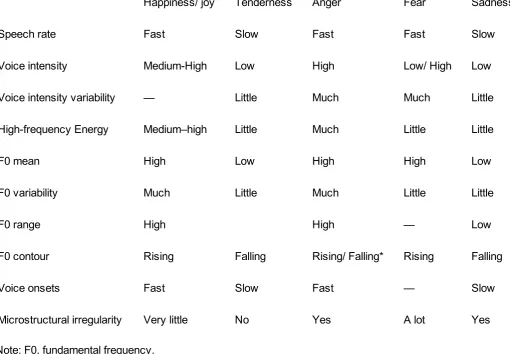
The present state of the evidence in relation to the acoustic patterns related to the perception of specific
Table 1. Emotional attributions consistently associated with acoustic parameters in multiple studies. Table adapted from Juslin & Laukka, 2003 (Table 11, p. 802) and Scherer, 2003 (Table 1, p. 233).
Happiness/ joy Tenderness Anger Fear Sadness
Speech rate Fast Slow Fast Fast Slow
Voice intensity Medium-High Low High Low/ High Low
Voice intensity variability — Little Much Much Little
High-frequency Energy Medium–high Little Much Little Little
F0 mean High Low High High Low
F0 variability Much Little Much Little Little
F0 range High High — Low
F0 contour Rising Falling Rising/ Falling* Rising Falling
Voice onsets Fast Slow Fast — Slow
Microstructural irregularity Very little No Yes A lot Yes
Note: F0, fundamental frequency.
(*) Except in panic fear, which is related to high intensity.
(**) Except (at least) in rage, which is related to falling contours.
One feature of these findings is that most emotions can be distinguished in terms of their arousal level from acoustic cues. Indeed, emotions associated with increased arousal levels (happiness/joy, anger and fear), compared with those characterized by lower arousal level (tenderness and sadness), are associated with faster speaking rates, higher voice intensity, more voice intensity variability, higher F0 mean and range, rising F0 contours, and faster voice onsets. The acoustic characteristic of the voice that most effectively distinguishes the various emotions in terms of hedonic value is microstructural irregularity, which seems to characterize negative emotions. Thus, a recent study (Scherer et al., in press) comparing emotional portrayals of professional opera singers in sung phrases with speech portrayals by professional actors, found that singers tend to rely more on the use of vibrato, possibly because of the restriction of other dynamic cues that are determined by the musical score (e.g. accents, intonation and rhythm).
Unfortunately, whereas a wide range of studies have dealt with these issues in the speaking voice (see Scherer et al., 2008 for an overview), very few have focused on the singing voice. In the next few paragraphs we outline some of these studies and compare their results to studies of the speaking voice.
asked 11 professional singers to perform different pieces in such a way as to portray four full-blown emotions— happiness, sorrow, fear, and anger—and neutrality. They analysed each performance and measured syllable duration, micropauses between syllables, mean sound pressure level (SPL), tone rise, and decay time, and found characteristic combinations in these measures for the various emotions. For instance, performances recognized as sad were characterized by long syllabic durations (that is, a slow rate or tempo), angry and sad performances were associated with higher average SPL than the other emotions, and syllable onsets and decays were faster in anger than other emotions (a detailed description can be found in Sundberg, 1987, pp. 152–153).
In another study, Sundberg et al. (1995) asked a professional singer (also a co-author in the publication) to sing excerpts from Lieder and opera repertoires in two contrasting fashions—(a) in a concert situation, and (b) in an emotionally neutral way. A group of experienced experts in singing then judged both versions of each extract in terms of the degree of expressivity, and the particular emotion conveyed (secure, loving, sad, happy, scared, angry, and hateful). The acoustic analysis revealed that level of expressivity was associated with greater F0 modulations during consonants and with a lowering of vowel formant frequencies. As regards the specific emotional qualities of the performances, renderings characterized by higher arousal levels (happy, scared, angry, and hateful) were associated with louder singing (higher SPL), faster tempi, and higher rate of loudness variation, when compared with renderings of low arousal (secure, loving, sad). These findings are in close agreement with those of Kotlyar and Morozov (1976), and show striking parallels between the expression of emotions in the speaking and singing voice. For instance, as seen in Table 1, joy and anger are associated with high F0 variability (assuming that F0 variability in speech is translated into vibrato extent in singing), and sadness is associated with slow speech rate and low vocal intensity. It is interesting to note that, for most performances, judges chose more than one term to characterize the emotions recognized in each performance, which as the authors note, suggests that it is difficult to describe the emotions in the singing voice using only a single emotion label.
In a study by Jansens et al. (1997), 14 professional singers (seven females) were each asked to sing the phrase ‘Mein Vater, mein Vater, und hörest du nicht, Was Erlkönig mir leise verspricht…?’ from Schubert’s ‘Der Erlkönig’ portraying four different emotions—anger, joy, fear, and sadness (the phrase was also sung neutrally). A group of listeners then rated the strength of the perceived emotions for each performance. Instead of simply correlating acoustic measures with the classes of emotions perceived by listeners, the authors performed a principal
component analyses on the listeners’ ratings. The factors obtained (every listener had a specific loading on each factor) were interpreted as ‘listening strategies’. Listeners who rated the performances in similar ways had similar loadings on similar factors. A combination of six factors explained circa 90 percent of the variance of the ratings for all emotions labels. These factors were then used in stepwise multiple linear regression analyses (separately for each emotion) on the acoustic measures of spectral balance, vibrato, duration, and intensity. The clearest associations were found for anger, sadness, and fear. Anger was associated with the presence of vibrato, whereas sadness was characterized by the absence of vibrato, with longer durations (slower tempi) and with low voice intensity. Fear was related to a steep spectral slope. Once again, these results are similar to those
described in Table 1 for the speaking voice and the ones obtained in the studies described above.
Another method by which to study the link between expressed emotions and acoustics of the singing voice is to obtain recordings of the same songs performed by various singers, and analyze listeners’ judgments of emotions perceived for each particular performer. By fixing the musical material in this way, it is possible to focus with more detail on aspects of voice quality and singing acoustics, and to better understand how different singers encode particular emotions in their singing. In this line of research, Siegwart and Scherer (1995) conducted digital acoustic analyses of two excerpts from the cadenza in the ‘mad scene’ from Donizetti’s ‘Lucia di
substantially with respect to objective acoustic variables, and that these measures could be used to predict a high percentage of the variability in listener judgments of emotional expressiveness, and preference for a particular performer or interpretation.
Howes et al. (2004) used a similar methodology to investigate associations between acoustic cues and perceptual dimensions related to the use of vibrato in Western operatic singing. Their findings showed that the perception of the singers’ vibrato by listeners did not always agree with objective acoustic measurements, but a comparison of the acoustic measurements with preference and emotion judgments indicated that at least some elements of vibrato are likely to affect listeners’ perception of the singing voice and their preference for a particular singer.
Another relevant method to study a wide range of possible acoustic variation in the singing voice (as well as music) is to manipulate acoustic parameters in an independent manner and see how they correlate with listeners’ perception of particular emotions or broad classes of affective qualities. Scherer and Oshinsky (1977) have applied such a procedure to the study of expression in instrumental music. They systematically varied various acoustic parameters (using a Moog synthesizer) of a short speech-like melody and a Beethoven melody and have shown that 66–75 percent of the variance in the emotion attributions can be explained by the manipulated acoustic cues. In the study by Kotlyar and Morozov (1976) described above, the authors have also used a similar procedure to evaluate the role of the acoustic features found to differentiate among emotions. They used electronically-generated signals to manipulate the respective features and also found that judges were able to identify the underlying affect rather well.
Another related and very promising method to systematically vary acoustic cues in the singing voice is to use synthesis (the creation of vocal samples) and resynthesis (variation of an existing vocal sample). The
spectacular advances in the synthesis of the singing voice (e.g. Fonseca, 2011;; Goto et al., 2012;; Kenmochi and Ohshita, 2007;; Risset, 1991;; Sundberg, 1978) make it possible to carry out investigations in which various acoustic voice parameters, fundamental to emotional expression, can be systematically manipulated, and their effects and relevance for the recognition of emotion quantified. Unfortunately, similar techniques do not exist just yet in relation to resynthesis methods, but should they become available it would be extremely advantageous to the understanding of the expression of emotions in natural singing voices. For instance, one could find out which acoustic characteristics need to be modified to alter a singer’s emotional effect (as already used in the study of vocal expression in the speaking voice;; see Bergmann et al., 1988).
A related question is the extent to which the acoustic cues to emotion differ across vocal genres. For instance, popular singing is characterized by an aesthetic of naturalism which manifests as a declamative style prioritizing the clarity of the text and encompassing paralinguistic features such as vocal creaks, roughness and cries (Lacasse, 2009;; Moore, 2012, pp. 102–103). This contrasts with classical singing, for example, in which the emphasis is on maintaining continuity and smoothness of tone, which allows more modification of vowel sounds, but fewer of the ‘noisy’ discontinuities found in popular singing styles. In the absence of any empirical evidence we might anticipate that popular styles will show greater similarity to acoustic cues to emotion in speech than will classical vocal styles.
Concluding remarks: applications in singing performance
and vocal training
our understanding of singing expression. Indeed, the technical procedures for the analysis of voice parameters are relatively well developed, and there are now many methods and software tools that allow researchers to objectively analyse the singing voice in straightforward ways (e.g. Praat: Boersma and Weenink, 2013;; Sonic Visualizer: Cannam et al., 2010;; PsySound3: Cabrera et al., 2008;; MIR Toolbox: Lartillot and Toiviainen, 2007;; OpenSMILE: Eyben et al., 2010;; WaveSurfer: Beskow and Sjölander, 2000).
The application of this knowledge to singing practice is greatly dependent on the knowledge gained from study of the physiological aspects of vocal productions and the acoustic cues produced, which are drivers of listeners’ perceptions of affective meaning. With such knowledge, it is possible to allow singers to practice the expression of certain emotions by systematically producing the configurations of voice parameters characteristic of
particular expressions. Certainly, this would be merely a mechanical procedure by which to reproduce acoustic patterns that supposedly convey certain emotional qualities. However, there is evidence in experimental
psychology that the purely mechanical production of emotion expression by proprioceptive feedback (see McIntosh, 1996) can lead (at least in a rudimentary way) to physiologically measurable emotional experiences: for example, in the face (Levenson et al., 1990), even without the person knowing that his face shows an emotional expression (Strack et al., 1988), in body posture (Riskind and Gotay, 1982) and breathing patterns (Philippot et al., 2002). It seems plausible to assume that the mechanical production of a vocal expression has similar effects, and the striking similarities between the results of the acoustic cues in emotional expression in speaking and singing suggest that this is also true in singing.
It might also be possible to create systems capable of real-time acoustic measurements of the singer’s voice, which could be used to make predictions about the emotions being conveyed, and to provide feedback to singers, during practice or in performance, to allow them to fine-tune their technique. The study of
expressiveness in the speaking voice and music has led to the development of various kinds of statistical, mathematical, and machine learning models, which can make very satisfactory predictions of emotional qualities or states (as perceived by humans) from voice cues alone (e.g. Batliner et al., 2011;; Coutinho and Dibben, 2012). Such systems could also be developed to predict various kinds of affective meaning or responses for the singing voice, provided more systematic work is conducted in the future regarding the link between acoustics and expressiveness in singing. Indeed, there are good reasons to believe that a reliable emotion recognition system could be developed, particularly due to the fact that many of the associations between acoustic cues and emotional qualities found for the speaking voice seem to be, at least partially, also relevant for the singing voice.
There are various specific scenarios to which such systems could be extrapolated and inform singing practice by allowing singers to explore changes in their voice and technique, to produce particular emotions or even subtle variations of the same emotion. For instance, they could be used to provide feedback in singing lessons, by allowing singers to develop their expressive skills. By complementing such a system with a formal database of prototypical expressions of emotion in singing (and perhaps speech) expressions, it would be possible to help students train their emotional interpretation objectively. In point of fact, any singer interested in developing expressive skills could use these feedback systems. Another possibility, in the realm of live performance, and particularly improvisation, would be to use feedback from emotion recognition systems to help singer and musicians to detect each other’s emotions while performing, and to inform vocal and instrumental performance strategies (see Juslin et al., 2006, for an application of this concept to the communication of emotion in guitar performances).
physiologically determined cannot be intentionally manipulated or changed) are factors that determine emotional expression. A feedback system could allow singers to alter certain properties of their singing voice (those consciously controllable) and measure their emotional impact in order to achieve the intended expression.
The interest of emotion recognition in the singing voice is also pertinent to areas outside the performing arts. One possibility is to apply these methodologies to music therapy, where practitioners often focus on the relationship between musical improvisation, emotional states, and social relationships in their clients (Dvorkin, 1982;; Pavlicevic, 1999;; Stephens, 1983). Real-time recognition of emotions in clients’ voices while singing could be a useful tool in support of therapists’ observational work and inform their strategies during specific sessions.
Most of these suggestions still belong to the future. Currently, there are only a few researchers addressing the complex issues surrounding the expression of emotions in the singing voice, and an intensive cooperation between psychologists, musicologists, and performers, is still necessary to accelerate research in this area. One example is The Swiss Center for Affective Sciences, which as part of a Music and Emotion research focus has established singing as a priority research topic. A number of interdisciplinary studies on the acoustics of emotional expression in singing and the effects on listener impressions are currently ongoing. To summarize, interdisciplinary approaches and cooperation are central aspects of a fruitful and sustainable study of the expressive powers of the singing voice.
This research was supported by the National Center of Competence in Research (NCCR) Affective Sciences financed by the Swiss National Science Foundation (51NF40-104897) and hosted by the University of Geneva.
Websites References
Swiss Center for Affective Sciences. Available at: M http://www.affective-sciences.org/musicfocus.
Banse, R., and Scherer, K.R. (1996). Acoustic profiles in vocal emotion expression. Journal of Personality and Social Psychology, 70(3): 614–636.
Find This Resource
Bänziger, T., Patel, S., and Scherer, K.R. (in press). Perceived voice and speech characteristics in emotional expression. Journal of Nonverbal Behavior.
Find This Resource
Batliner, A., Schuller, B., Seppi, D., Steidl, S., Devillers, L., Vidrascu, L., and Amir, N. (2011). The automatic recognition of emotions in speech. In: P. Petta, R. Cowie, and C. Pelachaud (eds), Emotion-oriented Systems: The Humaine Handbook (pp. 71–99). Berlin: Springer.
Find This Resource
Bergmann, G., Goldbeck, T., and Scherer, K.R. (1988). Emotionale Eindruckswirkung von prosodischen Sprechmerkmalen. Zeitschrift für experimentelle und angewandte Psychologie, 35: 167–200.
Find This Resource
Beskow, J., and Sjölander, K. (2000). WaveSurfer (Version 1.8.8) [Computer software]. Stockholm: KTH Royal Institute of Technology. Available at: M http://www.speech.kth.se/wavesurfer/ (accessed July 11 2013).
Find This Resource
Find This Resource
Boersma, P., and Weenink, D. (2013). Praat: doing phonetics by computer [Computer program], Version 5.3.45. Available at: M http://www.praat.org/ (accessed 15 April 2013).
Cabrera, D., Ferguson, S., Rizwi, F., and Schubert, E. (2008). PsySound3: a program for the analysis of sound recordings. Journal of the Acoustical Society of America, 123(5): 3247.
Find This Resource
Cannam, C., Landone, C., and Sandler, M. (2010). Sonic Visualiser: an open source application for viewing, analysing, and annotating music audio files. Proceedings of the ACM International Conference on Multimedia, 1467–1468. Firenze, Italy, October 25–29.
Find This Resource
Clynes, M. (1977). Sentics: The Touch of Emotions. New York: Anchor/Doubleday.
Find This Resource
Cooke, D. (1959). The Language of Music. London: Oxford University.
Find This Resource
Coutinho, E., and Dibben, N. (2013). Psychoacoustic cues to emotion in speech prosody and music. Cognition & Emotion 27 (4): 658–684.
Find This Resource
Darwin, C. (1998) [1872]. The Expression of Emotions in Man and Animals, 3rd edn. P. Ekman, Ed. London: HarperCollins.
Find This Resource
De la Motte-Haber, H. (1996). Handbuch der Musikpsychologie. 2. Aufl. Laaber: Laaber-Verlag.
Find This Resource
Dibben, N. (2012). The intimate singing voice: auditory spatial perception and the performance and perception of emotion in pop recordings. In: D. Zhakarine and N. Meise (eds) Electrified Voices: Medial, Socio-historical and Cultural Aspects of Voice-transfer (pp. 107–122). Göttingen: V&R unipress.
Find This Resource
Dvorkin, J. (1982). Piano improvisation: a therapeutic tool in acceptance and resolution of emotions in a schizo- affective personality. Music Therapy, 2(1): 53–62.
Find This Resource
Ekman, P. (ed.) (1983). Emotion in the Human Face: Guidelines for Research and an Integration of Findings. (2nd ed.). Cambridge: Cambridge University.
Find This Resource
Find This Resource
Fonagy, I. (1981). Emotions, voice and music. In: J. Sundberg (ed.). Research Aspects on Singing (pp. 51–79). Stockholm: Royal Swedish Academy of Music and Payot.
Find This Resource
Fonagy, I. (1983). La vive voix. Paris: Payot.
Find This Resource
Fonseca, N. (2011). Singing voice resynthesis using concatenative-based techniques. Unpublished doctoral dissertation, University of Porto, Portugal.
Find This Resource
Frith, S. (1996). Performing Rites. On the Value of Popular Music. Oxford: Oxford University.
Find This Resource
Gabrielsson, A., and Lindström, E. (2010). The role of structure in the musical expression of emotions. In: P. N. Juslin and J. Sloboda (eds), Handbook of Music and Emotion: Theory, Research, Applications (pp. 367–400). Oxford: Oxford University.
Find This Resource
Goto, M., Nakano, T., Kajita, S., Matsusaka, Y., Nakaoka, S.I., and Yokoi, K. (2012). VocaListener and
VocaWatcher: imitating a human singer by using signal processing. IEEE International Conference on Acoustics, Speech and Signal Processing, 5393–5396.
Find This Resource
Helmholtz, H.L.F., von. (1983). Die Lehre von den Tonempfindungen als physiologische Grundlage für die Theorie der Musik. Braunschweig: Vieweg.
Find This Resource
Himonides, E. (2009). Mapping a beautiful voice: theoretical considerations. Journal of Music, Technology & Education, 2(1): 25–54.
Find This Resource
Howes, P., Callaghan, J., Davis, P., Kenny, D., and Thorpe, W. (2004). The relationship between measured vibrato characteristics and perception in Western operatic singing. Journal of Voice, 18(2): 216–230.
Find This Resource
Jansens, S., Bloothooft, G., and De Krom, G. (1997). Perception and acoustics of emotions in singing.
Proceedings of the Fifth European Conference on Speech Communication and Technology, Vol. IV: 2155–8. Rhodes: ESCA.
Find This Resource
Johnstone, T., and Scherer, K.R. (2000). Vocal communication of emotion. In M. Lewis and J. Haviland (eds),
Handbook of Emotion, 2nd edn (pp. 220–235). New York: Guilford.
Jürgens, U. (1979). Vocalization as an emotional indicator. A neuroethological study in the squirrel monkey.
Behaviour, 69: 88–117.
Find This Resource
Juslin, P.N., Friberg, A., and Bresin, R. (2002). Toward a computational model of expression in music performance: the GERM model. Musicae Scientiae, 63–122.
Find This Resource
Juslin, P.N., Karlsson, J., Lindstrom, E., Friberg, A., and Schoonderwaldt, E. (2006). Play it again with feeling: computer feedback in musical communication of emotions. Journal of Experimental Psychology: Applied, 12(2): 79.
Find This Resource
Juslin, P.N., and Laukka, P. (2003). Communication of emotions in vocal expression and music performance: different channels, same code? Psychological Bulletin, 129(5): 770–814.
Find This Resource
Juslin, P.N., and Västfjäll, D. (2008). Emotional responses to music: the need to consider underlying mechanisms. Behavioral and Brain Sciences, 31(5): 559.
Find This Resource
Kenmochi, H., and Ohshita, H. (2007). Vocaloid–commercial singing synthesizer based on sample concatenation. Proceedings of Interspeech, August: 4009–4010.
Find This Resource
Kivy, P. (1988). Osmin’s Rage: Philosophical Reflections on Opera, Drama, and Text. Princeton: Princeton University.
Find This Resource
Kotlyar, G.M., and Morozov, V.P. (1976). Acoustical correlates of the emotional content of vocalized speech.
Soviet Journal of Physical Acoustics, 22: 208–211.
Find This Resource
Lacasse, S. (2009). The phonographic voice: paralinguistic features and phonographic staging in popular music singing. In: A. Bayley (ed.) Recorded Music: Society, Technology, and Performance (pp. 225–251). Cambridge: Cambridge University.
Find This Resource
Lartillot, O., and Toiviainen, P. (2007). A Matlab toolbox for musical feature extraction from audio. International Conference on Digital Audio Effects, 237–244.
Find This Resource
Levenson, R.W., Ekman, P., and Friesen, W.V. (1990). Voluntary facial action generates emotion-specific autonomic nervous system activity. Psychophysiology, 27(4): 363–384.
Leyhausen, P. (1967). Biologie von Ausdruck und Eindruck (Teil 1) [The biology of expression and impression (Part 1)]. Psychologische Forschung, 31: 113–176.
Find This Resource
Lundin, R.W. (1967). An Objective Psychology of Music. New York: Ronald Press.
Find This Resource
McIntosh, D.N. (1996). Facial feedback hypotheses: evidence, implications, and directions. Motivation and Emotion, 20(2): 121–147.
Find This Resource
Moore, A.F. (2012). Song Means: Analysing and Interpreting Recorded Popular Song. Farnham: Ashgate.
Find This Resource
Pavlicevic, M. (1999). Music therapy improvisation groups with adults: towards de-stressing in South Africa.
South African Journal of Psychology, 29(2): 94–99.
Find This Resource
Philippot, P., Chapelle, G., and Blairy, S. (2002). Respiratory feedback in the generation of emotion. Cognition & Emotion, 16(5): 605–627.
Find This Resource
Potter, J. (2006). Beggar at the door: the rise and fall of portamento in singing. Music & Letters, 87(4): 523–550.
Find This Resource
Riskind, J.H., and Gotay, C.C. (1982). Physical posture: could it have regulatory or feedback effects on motivation and emotion? Motivation and Emotion, 6(3): 273–298.
Find This Resource
Risset, J.C. (1991). Speech and music combined: an overview. In: J. Sundberg, L. Nord, and R. Carlson (eds),
Music, Language, Speech, and Brain (pp. 368–379). London: Macmillan.
Find This Resource
Robinson, B.W. (1972). Anatomical and physiological contrasts between human and other primate vocalizations. In: S. L. Washburn and P. Dolhinow (eds), Perspectives in Human Evolution (pp. 438–443). New York: Holt, Rinehart & Winston.
Find This Resource
Scherer, K.R. (1985). Vocal affect signalling: a comparative approach. In J. Rosenblatt, C. Beer, M-C. Busnel, and P. J. B. Slater (eds), Advances in the Study of Behaviour, Vol. 15 (pp. 189–244). New York: Academic Press.
Find This Resource
Scherer, K.R. (1986). Vocal affect expression: a review and a model for future research. Psychological Bulletin, 99: 143–165.
Scherer, K.R. (1989). Vocal correlates of emotion. In: H. L. Wagner and A. S. R. Manstead (eds), Handbook of Psychophysiology: Emotion and Social Behaviour (pp. 165–197). Chichester: Wiley.
Find This Resource
Scherer, K.R. (1991). Emotion expression in speech and music. In: J. Sundberg, L. Nord, and R. Carlson (eds),
Music, Language, Speech, and Brain, Wenner-Gren Center International Symposium Series (pp. 146–156). London: Macmillan.
Find This Resource
Scherer, K.R. (1994). Affect bursts. In: S. van Goozen, N. E. van de Poll, and J. A. Sergeant (eds), Emotions: Essays on Emotion Theory (pp. 161–196). Hillsdale, NJ: Erlbaum.
Find This Resource
Scherer, K.R. (1995). Expression of emotion in voice and music. Journal of Voice, 9(3): 235–248.
Find This Resource
Scherer, K.R. (2003). Vocal communication of emotion: a review of research paradigms. Speech Communication, 40(1–2): 227–256.
Find This Resource
Scherer K.R. (2013a). Emotion in action, interaction, music, and speech. In: M. A. Arbib, (ed.), Language, Music, and the Brain: A Mysterious Relationship (pp. 107–139). Cambridge, MA: MIT.
Find This Resource
Scherer, K.R. (2013b). The singer’s paradox: on authenticity in emotional expression on the opera stage. In: T. Cochrane, B. Fantini, and K. R. Scherer (eds), The Emotional Power of Music (pp. 55–73). Oxford: Oxford University.
Find This Resource
Scherer, K.R., Banse, R., Wallbott, H.G., and Goldbeck, T. (1991). Vocal cues in emotion encoding and decoding. Motivation and Emotion, 15: 123–148.
Find This Resource
Scherer, K.R., and Coutinho, E. (2013). How music creates emotion: a multifactorial approach. In T. Cochrane, B. Fantini, and K. R. Scherer (eds), The Emotional Power of Music (pp. 122–145). Oxford: Oxford University.
Find This Resource
Scherer, K., Johnstone, T., and Klasmeyer, G. (2008). Vocal expression of emotion. In: R. J. Davidson, K. Scherer, and H. H. Goldsmith (eds), Handbook of Affective Sciences (pp. 433–456). Oxford: Oxford University Press.
Find This Resource
Scherer, K.R., and Kappas, A. (1988). Primate vocal expression of affective states. In: D. Todt, P. Goedeking, and E. Newman (eds), Primate Vocal Communication (pp. 171–194). Heidelberg: Springer.
Scherer, K.R., and Oshinsky, J.S. (1977). Cue utilization in emotion attribution from auditory stimuli. Motivation and Emotion, 1: 331–346.
Find This Resource
Scherer, K.R., Sundberg, J., Tamarit, L., and Salomão, G.L. (in press). Comparing the expression of emotion in the speaking and the singing voice. Computer Speech & Language.
http://dx.doi.org/10.1016/j.csl.2013.10.002
Schulz, G.M., Varga, M., Jeffires, K., Ludlow, C.L., and Braun, A.R. (2005). Functional neuroanatomy of human vocalization: an H215O PET study. Cerebral Cortex, 15(12): 1835–1847.
Find This Resource
Siegwart, H., and Scherer, K.R. (1995). Acoustic concomitants of emotional expression in operatic singing: the case of Lucia in Ardi gli incensi. Journal of Voice, 9(3): 249–260.
Find This Resource
Stephens, G. (1983). The use of improvisation for developing relatedness in the adult client. Music Therapy, 3(1): 29–42.
Find This Resource
Strack, F., Martin, L., and Stepper, S. (1988). Inhibiting and facilitating conditions of the human smile: a
nonobtrusive test of the facial feedback hypothesis. Journal of Personality and Social Psychology, 54: 768–777.
Find This Resource
Sundberg, J. (1978). Synthesis of singing. Swedish Journal of Musicology, 60: 107–112.
Find This Resource
Sundberg, J. (1987). The Science of the Singing Voice. DeKalb, IL: Northern Illinois University Press.
Find This Resource
Sundberg, J., Iwarsson, J., and Hagegard, H. (1995). A singer’s expression of emotions in sung performance. In: M. Hirano and O. Fujimura (eds), Proceedings of the Vocal Folds Physiology Conference 1994 (pp. 217–232). San Diego, CA: Singular Publishing Group.
Find This Resource
Sundberg, J., Lã, F.M.B., and Himonides, E. (2013). Intonation and expressivity: a single case study of classical western singing. Journal of Voice, 27(3): 391.
Find This Resource
van Bezooijen, R. (1984). The Characteristics and Recognizability of Vocal Expressions of Emotion. Dordrecht: Foris.
Find This Resource
Wallbott, H.G., and Scherer, K.R. (1986). Cues and channels in emotion recognition. Journal of Personality and Social Psychology, 51: 690–699.
Welch, G.F. (2005). Singing as communication. In: D. Miell, R. MacDonald, and D. Hargreaves (eds), Musical Communication (pp. 239–259). Oxford: Oxford University.
Find This Resource
Windsor, W.L. (2009). Measurement and models of performance. In: S. Hallam, I. Cross, and M. Thaut (eds), The Oxford Handbook of Music Psychology (pp. 323–331). New York: Oxford University.
Find This Resource
Wundt, W. (1900). Völkerpsychologie. Eine Untersuchung der Entwicklungsgesetze von Sprache, Mythos und Sitte. Band I. Die Sprache. Leipzig: Kröner.
Find This Resource
Notes:
(*) Except in panic fear, which is related to high intensity.
(**) Except (at least) in rage, which is related to falling contours.
Eduardo Coutinho
Eduardo Coutinho, Swiss Center for Affective Sciences
Klaus R. Scherer
Klaus R. Scherer is Professor of Psychology and director of the Swiss Center for Affective Sciences in Geneva.
Nicola Dibben
Nicola Dibben, Senior Lecturer in Music, University of Sheffield, UK.
PRINTED FROM OXFORD HANDBOOKS ONLINE (www.oxfordhandbooks.com). (c) Oxford University Press, 2013. All Rights Reserved. Under the terms of the licence agreement, an individual user may print out a PDF of a single chapter of a title in Oxford Handbooks Online for personal use (for details see Privacy Policy).
Subscriber: Oxford University Press - Master Gratis Access;; date: 03 April 2014