This is a repository copy of Three-dimensional face recognition: An Eigensurface
approach.
White Rose Research Online URL for this paper:
http://eprints.whiterose.ac.uk/1526/
Book Section:
Heseltine, T, Pears, N orcid.org/0000-0001-9513-5634 and Austin, J
orcid.org/0000-0001-5762-8614 (2004) Three-dimensional face recognition: An
Eigensurface approach. In: ICIP: 2004 INTERNATIONAL CONFERENCE ON IMAGE
PROCESSING, VOLS 1- 5. IEEE , Singapore , pp. 1421-1424.
https://doi.org/10.1109/ICIP.2004.1419769
[email protected]
https://eprints.whiterose.ac.uk/
Reuse
Items deposited in White Rose Research Online are protected by copyright, with all rights reserved unless
indicated otherwise. They may be downloaded and/or printed for private study, or other acts as permitted by
national copyright laws. The publisher or other rights holders may allow further reproduction and re-use of
the full text version. This is indicated by the licence information on the White Rose Research Online record
for the item.
Takedown
If you consider content in White Rose Research Online to be in breach of UK law, please notify us by
2004
International
Conference on Image Processing (ICIP)THREE-DIMENSIONAL FACE RECOGNITION: AN EIGENSURFACE
APPROACH
Tlronins Heselrirre, A';& Peors. Jim Airstiir
Advanced Computcr Architecture Group, Skpartlnent of Computer Scicnce, The University of York ABSTRACT
We evaliwte a new approach to facc recognition ming a varicty of surfacc representations of three-dimcnrional facial stnictnire. Applying principal comlmncnt analysis (ITA), w e show that high levels of rccugnition accuracy can
tx
achieved on a largedatabase of 3D face modcls, captured umdcr conditions that present typical ditticullios to more conventional two-
dimcnsioil;il approiiches. Applying a range of image procasing
tccluiqnes wc identify the most effective sorf>cc representation
for use in such application artils as security, surveillance, data
compression and archive searching.
1. LNTRODUCTION
Despitc significant advances i i face recognition tecluiology~ it
ha.. yct to achievc the levels of acciimcy required for many commercial and industrid applications, mainly due to the inaccuracies caised hy the environmental circimistances imder
which iniages are captured. Variation in lighting, facial expression and orientation
all
significantly increase m o r r a t s , making it necessary to maintain colisistent condhons betwecm q " y and gallcry images far the syslnn to function adequately. However, this approach eliminates some of the key advantagesott'rred by face recognition: a passive biomelric in the sense that it does not require subject co-operation.
The use of 3D face models is motivated by a number of factors. Firstly, by relying purely on geometric shape, rather
than colour and texture information, we render the system invariant to lighting conditions. Secondly, the ability to rotate a facial ' slmcture in threedimensional space, allowing for
compensation of variations in pose, aids
those
methods requiring alignment prior to recognition. Finally, additional discriminating information is captured, when compared with 2Dsystems. As
an
example,eye
separationcan be
recovered
from
both sets of data, hut nose depth can only easily be recovered from three-dimensional data. We do recognise, however, that two-dimensional colour-texture information provides a rich source of discriminatory information, which is forfeit if ke-
dimensional data alone is used. Therefore, the focus of this
paper is to determine the ahility of threedimensional data alone
to form the basis of a face recognition system, as compared to 2D systems. Additional research can then identify methods of reintroducing nomialised two-dimensional texture data in onler
to reduce error rates further.
We investigate the use of facial surface data, taken from 3D
face models, as a substitute for the more familiar two- dimensional Images. We take a well-known method of face recognition, namely the eigenface approach described by Turk
aid Paitland [ I ] and adapt it for use on three-dimcnsionarl data. Testing a raige of surlice representations and distance metrics, we identify the most effective nicthods of recognising faces using tluce-dimensional surface structum.
In order to tcrt this method of face recognition, we reqiiirc a
large database o f 3 D face models. Howcvcr, until recuitly,
3D
caphire metliods have b w i slow and cum~rsome, requiring the subject to remain perfectly still. For these IC:BS~IIS, three-dimensional tiice recognition has remained relatively
iuiesplored, when compared to the wmltli of research focusing
on t\!zo-dunensional face recogiiition Although some uivestigatioiis have eqxrimented with 3D data [2, 3, 41; they
have had to rely on niiall tcst sets of 3D lice niodels or used
generic fiicc models to ndiance h\~o-dimciisional imigcs prior to recognition 15, 6, 71. However. this research denionstrates that thc use of threc-dunensiond infonnation has the potential to improve face rccognition \vel1 beyond the current state of the art. With the emergence of new 3D caphire equipment, the population of a large 3D face database has now haconic viable
aid being u n d ~ ~ e n at Tlic Universi?y of York as part of a
project facilitating research into three-duiiaisional face recognition technology [SI.
2. RELATED WORK
In this section, we discuss prcvious research exploring the possibilities otkred hy three-dimensional geometric structilre to
perform face recognition. To dzte, the majority of r e a r c h has focused on two-dimensional images, although some have attempted to use a-priori knowledge of facial structure to
enhance these existing twodimensional approaches. For example, Zhao and Chellappa [SI use a generic 3D face niodel to normalise facial orientation and lighting direction
in
two- dimensional images. Using estimations of light s o m e direction and pox, the 3D face model is aligned with the two-dimensionalface
imageand
used
to
projecta
prototype image ofthe
frontalpose equivalent, prior to recognition hy linear d i s c r i " t analysis. Recognition accuracy on the test set is increased from approximately 81% (correct match within rank of25) to 100%.
Similar results are witnessed in the Face Recognition Vendor Test 191, showing that pose correction using Romdhani, Blanz
and Velter's 31) morphable model t e c h q u e [6] reduces error rates when applied to the FERET database.
identification, resulting in 82.6% correct idnitilications
on
a test set of68 people.Althoigh these methods sliow that biowledge of Uuee- diieiisional face shape can aid nomialisntion for two- dinciisioiial face recognition systnns, none of the methods mentioned w far ise actual geometric structure to perform recognition. Whereas Beiunier and Achcroy [2] make duect use of such ii&nnatioi& testing various methods of niatchiiig 3D face niodels, although few were successful. Curvahue analysis proved ineffective, and feature extraction was not robust enough to provide accuratc recognition. However, Beuniier aiid AcIi~zoy \ w e able
to
achieve reasonable m o r rates using cmvatiue values of vertical surface prolila. Verification testsc m i c d out on a database of30 people produced epwl error rates
@ER)
behrren 7.25% and 9.0%on
the automatically aligned surlices and between 6.25% arid 9.5% whai inaiiiwl aligiuncnt was used.Heslier et a1 [lO] kke a similar approach to our h s e method, using PCA of range images and euclidean distaiicc to p e r t h i recognition. Match&ig 37 range images produces a correct identitication rete of Y4X, when tniiung is performed on thc gallen set. I-louever, it is not demonstrated how successful the system is when Uie traiiiing arid test set are disjoin1 and no otlicr surface representations are tested.
Chua et 01 [4] take ii different approach applying noii-rigid
siufacc rccogiution Icch~iiqirs to the face structure. An attempt is made to ideiitify and extmct rigid areas of facial surfaces, creating a system invariant to 11 expression llie charactcaistic used to identify these rigid areas aiid ultimately distinguish between faces is the point signature, which describes depth values siirroiuiduig local regions of specific points on the facial surface. The similarity of two face models is computed by identifying and comparing a set of unique point signatures for each face. Identification tests show that the probe image is identilied correctly for all
people
when applied to a test set of30 depth maps of 6 different people.Another method, proposed by Gordon [3], incorporates feature localisation. Using both depth and curvature information extracted from three-dimensional face models, Gordon identifies a number of facial features, iicluding head width nose dmiensions and cumahires, distance between the eyes and eye width. These features are evaluated using fisher's linear discriminant, determining the discriminating ability of each individual feature. Findings show head width and nose location are particularly iniponiant features for recognition, whereas eye widths and
nose
cwatures are less useful. Recognition is performed by means of a simple euclidean distance measure in feature space. Several combinations of features are tested using a database of 24 facial surfacestaken
from 8 dityerent people,producing
results
rangingfrom
70.8%to
100%correct matches.
3.
THE 3D FACE DATABASEAs mentioned previously, there is little three-dimensional face data publicly available at preseut and nothing towards the magnitude of data required for developmelit and testing of three-
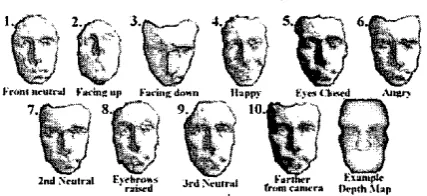
[image:3.613.319.533.62.160.2]dunensioilal face recognition system. Therefore, we introduce a new database of 3D face models, collected at The University of York, as part of an ongoing project to provide a publicly available 3D Face Database of over 5000 models [SI. The
3D
Figure 1. Face models taken from tlie
UOY 3D
face datahasemodels are generated using a 3D camera, which operates on the bmis of stereo disparity o f a high-density projected light patterti. For the purpose of these expenmaits, u'e will Ixusing a subset of tlie 3D face database; acquired during preliminary data acquisitioii sessions. This sct con o f 330 models taken from
100 pkople under the ten conditions shown in figure 1
Doring capture no effolt was made to control lighting conditions. I n order to generate face models at varioiis h a d oricnhtioiis, subjects wcrc iiskd to tiice relkrciice points pitioiied roughly 45" above and below the canera, but no effort was made to enforce a precise aiiglc of orientation.
3D face models iire orientated to face directly f o n w d s using our orientation rioniialisation algoritlmi (not described here) M o r e beiig converted into depth nmps. The &abase is then separated into two disjoint scts: the training sct consisting o f 4 0 depth iiiaps (type I , figure I ) and a tcst set ofthc remaining 2W depth maps. Both sets contain subjects of various race, age aid gender and nobody is present in both the training and test scts.
4. SURFACE REPRESENTATIONS
In
previons work we have shown that the use of image processing techniques can significantly reduce error rates of two-dimensional racc recognition methods [I 1, 121, by removing unwanted effects caused by environmental capture conditions. Much of this aiviroiuncntal influence is not present in the 3D face niodels, but prc-processing may still aid rccognition by nuking distinguishing features more explicit. We test a n u m k of surface representations, which may affect recognition error rates, derived by pre-processing of depth maps, prior to both training and test procedures, as described in table 1.5. DEFINING SURFACE SPACE
We d e f i e surface space by application of PCA to the training set of facial surfaces, t a k i g a similar approach to that described
by Turk and Peiitland [ I ] and U& in previous investigations [ I 1, 121. Consider OUT training set of facial surfaces, stored as orientation normalised 60x105
depth
maps, representedas
vectors of length 6300. We begin by reducing dimensionality to a practical value, while mavimising the spread of facial surfaces within the subspace, by application of PCA to the training set of
M
(40) depth maps{rl,
rr
...rM).
computing the covariance.-e
Where
On
is the difference of the irrh depth map from the averagev.
Eigenvectors and eigenvalues of the covariancematrix are calculatd using standxd linear methods. The resultant eignivectors describe a set of axes withbi Uie depth map space, along which most variance occurs and the corresponding eigeuvalnes represent lhc degree of Uiis variance along each a i s . The M eigmvectors are sorted in order of descaiding cigenvalues and the
M
(40) greatest eigenvectors cbosai to repreent surface space. We term each eigenvector an eigensurtfce, displayed as range iniages in figure 2.6. VERlFICATlON OF FACIAL SURFACES
Oncc surface space has k e n defined, w e prqject any face into suuhce s p ~ e by a simple matrix multiplication, using tlie eigeiivcctors calcuhted from covariance matrix C.
0 , = r r ; ( ~ - y ~ ) f b r k = l ..., & I '
Where lik is thc hT/i eigenvector and wk is the bh weight in tlie v e c t o r C = [ m , , ~ ~ ,
...wkrl.
~ ~ c v c c t o r ~ i s t a k e i i a s t ~ i c ,face- key' representing a person's facial stnslure in surface space and comparcd bv c i t h a euclidean or cosine distmicc nietrics.&
ll".~i~bll
~~*,,<,,<,'..,,>
=llQ<,
-
Qnll
L-
='
-
In addition, we can also divide each face-key by its rcspctivc eigenvalues, prior to distance calculation, renioving any inhcrcnt dimensional bias and introducing hvo supplementmy metrics, Uie Madialanobis distance and weighted cosine distance. An acceptance (facial surfaces match) or rejclion (siutices do not match) is determined by applying
a
Uueshold to the celculated distance. In order to evaluate the effectiveness of the lice recognition methods, we compare each ofthe 290 surfaces in the test set with every other surface (41,905 vcrificatiun operations). False acceptance rates (FAR) and false rejection rates (FRR) are calculated as the prrcnitage of incorrect acceptances and rejections a A a applying a threshold. Vaqing the threshold producesa
series of FAR, FRR pairs, which plotted on a graph prodntics an error rate curve (figure 3), from which the EER (where FAR equals FRR)is
taken as a single comparative value.7.
RESULTS
Results are presented as m r rate curves aid bar charts of EERs (figure 3). The results clemly show that dividing by eigenvalues to normalise vector dimensions
prior
to distance calculations, significantly decreases error rates for both euclidean and cosine distance, with the Mahahobis metric providing the lowest EER forthe
depth map system. The EERs produced show that surface gradient representations provide the most distinguishmg informatlo& with horizontal derivatives giving the lowest EERs of all, using the weighted cosine distance metric.In
fact, the weighted cosine distance retums the lowest EER for the majority of surface representations. escepting a few particular cases. However, the most effective surface representation seems to be dependent on the distance metric used for comparison.8. CONCLUSlON
We have shown
that
a well-known tw+dimensional face recognition method can be adapted for use on three-dimensionalFace models. Tests have been c a n i d out on a large database of three-dimensional facial surhces, caphued under conditiolis that present typical ditliculties whcii performing recognition. The m o r rates produced from the three-dimensional bnseline system
(19.1% EER using euclidean distance) are notably lower that thou: gathered in similar exlxriments using two-dimensional images (25.5% EER) [12]. Although a more direct coinparison is required, using a common 2D/3D test database, in order to draw m y quanlitive conclusions, initial results suggest that tlucedimmsional face recognition has distinct advantages over conv~lltional two-dunnisional approaches.
Exprimenting with a iiumkr of surtice rrpraentatious, we have discovered that facial sluface gradient is more effective Tor recognition than depth and curvature represcntations. In particular, horizontal gradients produce the lowest enor rates, seeming to indicate that horizontal derivatives provide more diszNiiinatory infonilation tlim vertical. Another advantage is Ihat gndicnts are lkely to be more robust to inaccuracies in thc aliginnent procedure, a5 the dmivativa will be invariant to tnuislations along the Z-axis.
Curvature rq~rcsentati~ins do not seem lo coiit.iiii as nmcli discluiiinatory infonuation as other surfgice reprcjaitations. We find Uiis suryrisuig, a s second derivatives sla~uld
be
less tiracks of orieiitatioit a~id translation along the Z-axis. However, this could be a rcllection of inaduliwte 3D model resolution and high noise content.Testuig four distance metrics has showi that the choice of nicthod for fnce-key coiiiparisoiis has a colisiderable alkct on resulting error rates. llie euclidean aid cosine measures seem tailored to specific surface representations. suggesting that some create a surface space ui which between-class deviation is predominaiitly angular, whereas olhm produce more radial deviation. It is also evident that dividing wch face-key by respective eigenvalues, normalising dimensional distribution, usually improves results for both euclidean and cosine distaiices. This indicates that the distribution along one surface space diniension is not necessarily proportional to its discriminating ability and that face-keys become more discriminative when all dimensions are weighted evenly. However, this is not the case for some suIface representations with higher EERs, suggesting that these representations incorporate only a few dominant useful components, which become maslied when .weighted evenly with the majority of less discriminatory components.
Error rates of the optimum 3D eigensurface system (12.7% EER) are substantially lower than the best two-dimensional
systems (20.4% EER and 17.8% EER) teste3 under
similar
circumstances inour previous investigations [ I I, 121. Although we recognise the differences between these experiments (most notably the lack of a common 3DRD test set), the results do show that geometric face slncture is useful for recognition when used independently from colour and texture and capable of achieving high levels of accuracy. Given that the data caphue method produces models invariant to lighling conditions and provides the ability to recognise faces regardless of pose, makes this system particularly attractive for use in security and surveillance applications. However, more testing is required to identify the limitations of the eigensurface method, although one obvious issue is the system's reliance on accurate orientation normalisation. A better approach would ke to genmte a surface representation that was invariant to orientation.~~~~~
.... ~ ... ~
0 0
D I O B m A o ~ D m n a ~ r w F&%xk-RIII..
Figure 3. Error rate ciiwes for the base line depth map system (left) and EEKs of all 3D face recognition systems using a variety of
surface representations and distance metrics (right)
11. REFERENCES
I . M. Turk, A. Pentland, “Face Recognition Using Eigenfaces” Proc. IEEE Conf. on Computer Vision and Pattem Recognition,pp. 586-591 (1991)
2. C. Beunier, M. Acheroy, “Automatic 3D Face Auflientication” Image and Vision Computing, vol. 18, no. 4,
pp.
315-321(2000)
3. G. Gordon, ‘%ace Recognition’Based on Depth and C w a t u r e Features” Proc. IEEE Computer Society Conf. on Computer Vision and Pattem Recognition, pp. 108-1 10 (1992)
4. C. Chua, F. Han, T. Ho, “3D Human Face Recognition Using Point Signature’’ Proc. 4th IEEE Int. Conf on
Automatic Face and Gesture Recognition, pp. 233-238 (2000)
5. W. Zhao, K. Chellappa, “3D Model Enhanced Face Recognition” Proc. Int. Conf on Image Processing (2000) 6. S. Romdhani, V. Blanz, T. Vetter, “Face Identification by Fitting a 3D Morphahle Model using Linear Shape and Texture Error Functions” The European C o d . on Computer
Vision (2002)
7. V. Blanz. S. Romdhani, T. Vetter. “Face Identification
across Differ&
Poses
and Illuminations with a3D
Morphahle Model“ Proc. of the 5” IEEE Conf. on AFGR (2002)8: “The UOY 3D Face Database” \I,ww.cs.vor~.ilc.tIM-lornh 9. P. Phillips, P. Grother, R. Micheals,
D.
Blackhum, E. Tabassi, J. Bone, “FRVT 2002: Overvinv and S m a r y ” h t t d l w w v frvt.ore5~KVl2002ld~~i~n~ls.hlm, (2003)10.
C.
Hesher,A.
Srivastava,G.
Erlehacher, ‘?Principal Coniwnmt Analysis of Range Images for Facial Recognition”F&CISST (2002)
1 I . T. Haeltine,
N.
P e m . J. Austin, ‘Evaluation of image me-_ .
processing techniques for eigenface-bawd face recognition” Proc. 2nd Int. Conf. on Image and Graphics, SPIE vol. 4875 12. T. Heseltine,
N.
Pears, J. Austin, ‘%ace Recognition: A Comparison of Appearance-based Approaches” Proc. 7th Int. Conf. on Digital Image Computing Techniques and Applications, vol. 1 pp 59-69 (2003)pp. 6n-6x5 (2002)