This is a repository copy of
Optimization of double pulse pumping for Ni-like Sm x-ray
lasers
.
White Rose Research Online URL for this paper:
http://eprints.whiterose.ac.uk/1730/
Article:
Lin, J Y, Tallents, G J orcid.org/0000-0002-1409-105X, Smith, R et al. (11 more authors)
(1999) Optimization of double pulse pumping for Ni-like Sm x-ray lasers. Journal of Applied
Physics. pp. 672-675. ISSN 0021-8979
https://doi.org/10.1063/1.369201
[email protected] https://eprints.whiterose.ac.uk/
Reuse
Items deposited in White Rose Research Online are protected by copyright, with all rights reserved unless indicated otherwise. They may be downloaded and/or printed for private study, or other acts as permitted by national copyright laws. The publisher or other rights holders may allow further reproduction and re-use of the full text version. This is indicated by the licence information on the White Rose Research Online record for the item.
Takedown
If you consider content in White Rose Research Online to be in breach of UK law, please notify us by
Optimization of double pulse pumping for Ni-like Sm x-ray lasers
J. Y. Lin, G. J. Tallents,a)and R. Smith
Department of Physics, University of Essex, Colchester, CO4 35Q, United Kingdom
A. G. MacPhee
School of Mathematics and Physics, Queen’s University of Belfast, Belfast BT7 1NN, United Kingdom
E. Wolfrum and J. Zhang
Clarendon Laboratory, Department of Physics, University of Oxford, Oxford, OX1 3PU, United Kingdom
G. Eker
Department of Physics, University of Essex, Colchester, CO4 35Q, United Kingdom
R. Keenan and C. L. S. Lewis
School of Mathematics and Physics, Queen’s University of Belfast, Belfast BT7 1NN, United Kingdom
D. Neely
Central Laser Facility, Rutherford Appleton Laboratory, Chilton, Oxon, OX11 0QX, United Kingdom
R. M. N. O’Rourke
School of Mathematics and Physics, Queen’s University of Belfast, Belfast BT7 1NN, United Kingdom
G. J. Pert
Department of Physics, University of York, York, YO1 5DD, United Kingdom
S. J. Pestehe
Department of Physics, University of Essex, Colchester, CO4 35Q, United Kingdom
J. S. Wark
Clarendon Laboratory, Department of Physics, University of Oxford, Oxford, OX1 3PU, United Kingdom
~Received 3 August 1998; accepted for publication 15 October 1998!
We report a systematic study of double pulse pumping of the Ni-like Sm x-ray laser at 73 Å, currently the shortest wavelength saturated x-ray laser. It is found that the Sm x-ray laser output can change by orders of magnitude when the intensity ratio of the pumping pulses and their relative delay are varied. Optimum pumping conditions are found and interpreted in terms of a simple model. © 1999 American Institute of Physics.@S0021-8979~99!07102-9#
I. INTRODUCTION
Maximizing the efficiency of generating x-ray lasers re-duces the driving energy required to produce shorter wave-length x-ray lasing. Using double drive pulses ~one prepulse and one main pulse!to pump x-ray lasers has been shown to be able to saturate x-ray laser output of Ni-like Ag~14 nm!,1 In ~12.6 nm!,2 Sn ~12 nm!,3 and Sm ~7.3 nm!4 at plasma medium lengths 18–20 mm. With double pulse pumping, the first pulse produces cold plasma from the solid. During the time interval between the prepulse and main pulse, the pre-formed plasma expands and forms a long scale-length elec-tron density profile. The longer scale-length plasma not only increases the energy absorption of the plasma from the driv-ing laser ~main pulse! via inverse Bremsstrahlung absorp-tion, but also produces less refraction of the x-ray laser beam and better propagation within the gain region. Previous studies5–7 suggest that the level of prepulse irradiance and the pulse interval between the prepulse and main pulse de-termine the electron and ion temperatures, the electron
den-sity gradient, the laser gain, and the maximum x-ray laser propagation distance in the plasma and that these parameters control the x-ray laser output.
In this article, we have made a systematic experimental study of double pulse pumping of the Ni-like Sm x-ray laser at 7.3 nm. The Ni-like Sm x-ray laser has been successfully demonstrated as the shortest wavelength saturated x-ray laser achieved in the laboratory.4 To determine the optimum double pulse pumping configuration, double pulses with various pulse ratios ~the ratio of the irradiance of the prepulse to main pulse!and pulse intervals~the time between the prepulse and main pulse! were irradiated on single Sm slab targets. The targets were of 14 mm length which is sufficiently short to avoid the laser operating in the saturation region during the optimization procedures. We expect the gain length product from a single 14 mm target is<13.4
II. EXPERIMENTAL ARRANGEMENTS
The experiment was carried out at the Rutherford Apple-ton Laboratory using the Vulcan Nd-glass laser at 1.05mm. Before entering the preamplifiers of the Nd-glass laser chain, the stretched oscillator pulse with a pulse duration of;75 ps was divided by a beam splitter to produce double pulses with
a!Electronic mail: [email protected]
672
adjustable pulse intervals. While keeping the irradiance of the second pulse ~main pulse! at the same level, the first pulse’s irradiance was controlled by inserting pre-calibrated filters to produce the required pulse ratio ~prepulse/main pulse!. After the amplifier chain, each of the Vulcan laser beams could deliver up to 22 J ~in the main pulse! on the target. Three beams were overlapped onto the target in a 19 mm375mm width line focus by using a combination of three f /2.5 spherical lenses and three f /2.5 off-axis spherical focusing mirrors to produce a peak irradiance of the main pulse on the target of up to;631013 W/cm2.
The ratio of the prepulse to main pulse irradiance was monitored by two fast photodiodes in the laser control area and was double checked by a fast vacuum diode in the target area. For shots with high pulse contrast (.102), one photo-diode with less filtering was arranged deliberately to be satu-rated by the main pulse to provide a measurable prepulse signal level for comparison with the main pulse signal mea-sured by the other photodiode.
The targets were 14 mm long flat slabs consisting of 75
mm width and 1–2mm thickness samarium stripes coated on glass substrates. The primary on-axis diagnostic was a graz-ing angle flat field spectrometer with a 1200 lines/mm ape-riodically ruled grating. The spectrometer recorded emission from 60 to 240 Å wavelength and from 21 to 11 mrad angular deviation in the horizontal direction ~perpendicular to the target surface! on an InstaSpec IV back-thinned soft x-ray charge coupled device~CCD!detector. The collection angle;1 mrad of the spectrometer in the vertical direction is limited by the entrance slit. Thin Ag, Al, and C filters were used to eliminate optical light and attenuate the lasing signal to adequate levels at the CCD detector. The absolute laser output is calculated by integrating ~over wavelength and angle!the lasing signal on the CCD detector and taking into account the filter transmission, the grating reflectivity ~mea-sured using synchrotron radiation>10%!,8and the estimated fraction~;1/6!of laser photons collected in the vertical di-rection. The uniformity and the ionization balance along the line focus was monitored by a space-resolving and time-integrating Bragg crystal spectrometer with a 300 mm con-vex curvature potassium acid phthalate ~KAP! crystal (2d 526.64 Å). An attached CCD detector recorded the reso-nance line emissions from 7 to 11 Å. For some shots, another crystal spectrometer with a 300 mm curvature KAP crystal was coupled to an x-ray streak camera to measure the time-resolved ionization balance from the lasing plasma media. The width of the timing slit of the streak camera was set to be 200mm, which gave a temporal resolution;20 ps.
III. RESULTS
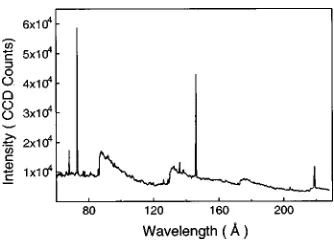
Figure 1 shows a typical on-axis time integrated spec-trum of the lasing signals from a 14 mm long Sm target. The lasing spectrum is dominated by the J50 – 1 transition at 73 Å, seen in three orders, while the other transition line at 68 Å is also visible. To determine the best pump pulse configura-tion for the Ni-like Sm laser, a series of shots using various pulse ratios and pulse intervals were carried out. Keeping the peak irradiance of the main pulse consistently at ;5
31013W/cm2~with less than a 10% energy fluctuation!, the x-ray laser output for each pulse interval is found to peak at various pulse ratios ~Fig. 2!. A lower level of prepulse is optimal as the pulse interval is increased. Pumping with the optimum pulse ratio increases the laser output by orders of magnitude compared with unoptimized pulse ratios and pulse intervals.
The brightest Sm x-ray laser has been observed using a 0.5% prepulse with a pulse interval of 3.5 ns, but the maxi-mum optimized x-ray laser output with pulse intervals of 2.2, 3.5, and 5 ns differ by less than a factor of 2~Fig. 2!. How-ever, a 1 ns pulse interval gives a factor 4–7 less signal than that of the optimized laser output for the other pulse inter-vals.
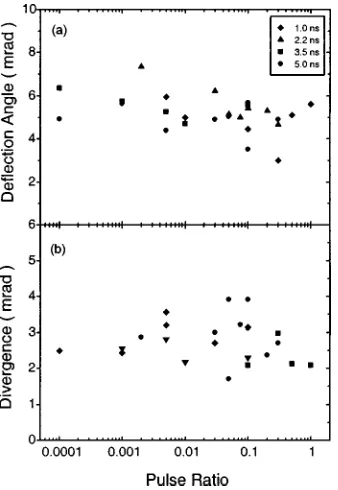
[image:3.612.354.521.49.169.2]The beam quality of the brightest Sm x-ray laser pumped by double pulses with a 1 ns pulse interval was found to be similar to those pumped by double pulses with 2.2, 3.5, and 5 ns pulse intervals. The divergence~full width at half maxi-mum! and deflection angle~beam pointing angle relative to the target surface!of the x-ray laser beam were measured to be 2.561 and 561 mrad, respectively, as shown in Fig. 3. These values are small because of the lack of significant refraction effects in the Ni-like Sm x-ray laser. The short wavelength and flat electron density profiles smoothed by the prepulse mean that refraction is small.
[image:3.612.323.552.558.723.2]FIG. 1. Axial spectrum from a single 14 mm long Sm target irradiated by double 75 ps pulses with a pulse ratio of 5% and a pulse interval of 2.2 ns. The first order of the lasing line at 73 Å is slightly saturated in the CCD detector.
FIG. 2. Variations of x-ray laser outputs at 73 Å as a function of the pulse ratio for various pulse intervals. The peak irradiance of the main pulse is at
;531013W/cm2.
The degree of ionization of the x-ray lasing plasma was monitored by a keV crystal spectrometer. As the temperature rises in the plasma, we expect more Co-like and higher ion-ization stage ions to be generated and consequently stronger band emissions from those ionization stages. A comparison of time-integrated Sm keV spectra pumped by various pulse ratios with a 3.5 ns pulse interval had been made during the experiment. Experimental observations suggest that Ni-like 4 f -3d emissions show no significant variations, when differ-ent pulse ratios are used. However, the Co-like 4 f -3d emis-sions, and Fe-like and Mn-like band emissions are signifi-cantly lower when a small ~0.01%!or large~10%!prepulse is used. The spectra of the Sm x-ray laser medium pumped by an optimum level of prepulse ~0.5%! implies a hotter plasma because of the strong emission from the higher ion-ization stages. Higher temperature in the lasing medium pro-duces a higher excitation rate and thus higher gains.
A typical time-resolved resonance emission of Sm plasma recorded by the streaked keV crystal spectrometer is shown in Fig. 4. The main driving pulse irradiance is shown schematically in Fig. 4 assuming that the start of emission corresponds to the start of the laser pulse. In Fig. 4, 4 f -3d band emissions from the Mn-like and Fe-like ionization stages peak slightly earlier than similar emission from the Co-like and Ni-like stages. There is also a significant differ-ence of the emission duration from various ionization stages. The duration@full width at half maximum ~FWHM!#of the Mn-like and Fe-like resonance emissions is;65 ps, which is comparable with the duration of the pumping pulse. In con-trast, the resonance emissions from Co-like and Ni-like ions last;85 and;100 ps, respectively. The Co-like and Ni-like emissions peak later and last longer probably because of re-combination from higher ionization stages after the main drive pulse has switched off.
IV. DISCUSSION
[image:4.612.325.549.48.219.2]An optimum pulse ratio for x-ray laser output occurs because of a balance between the achieved gain coefficient, the volume of the gain region, and refraction effects. A small prepulse tends to produce a small volume of preplasma. Al-though this produces a high peak temperature and thus high peak gain coefficient when the preplasma is heated by the main pulse, the gain region is small and refraction effects are serious because of the small volume of plasma produced and steep electron density profiles. In contrast, a too large prepulse gives a larger gain region and less refraction in the plasma, but the peak gain is low. It is also found that the optimum pulse ratio decreases with increasing pulse interval ~Fig. 5!. A longer pulse interval implies a longer time for the preformed plasma to expand. Although a large scale-length plasma gives a shallower electron density profile, the peak temperature is lower because the main pulse energy has to heat up a larger volume of low-temperature plasma. Hence, a FIG. 3. ~a!Deflection angle, and~b!divergence of the Sm x-ray laser as a
[image:4.612.92.261.51.296.2]function of the pulse ratio for various pulse intervals.
FIG. 4. The time-resolved 4 f -3d band emissions of Sm from different ionization stages pumped by a double 75 ps pulse with a 0.1 pulse ratio and a 2.2 ns pulse interval. The main laser pulse irradiance is shown schemati-cally as a dotted line.
FIG. 5. The pulse ratios Roptfor optimum x-ray laser output as a function of
the pulse interval T. The error bars show the range of R giving a factor of 2 variation of x-ray laser output. The curves show a variation of Roptscaling
[image:4.612.322.552.546.713.2]lower level of prepulse is preferred to keep the plasma at a high temperature to produce gains when a long pulse interval is used.
Simulations6 suggest that the plasma condition of colli-sional excitation x-ray lasers pumped by double pulses can be quantified by a parameter, the energy density (Te/Vpre), where Vpre is the volume of the preplasma just before the arrival of the main pulse and Teis the peak electron tempera-ture during the main pulse irradiation. A higher energy den-sity than the optimum value implies over ionization or a narrow gain region with steep electron density gradients, while a lower energy density than the optimum gives low gain and thus lower laser output. By assuming the density profile is determined by the prepulse because of the rela-tively long pulse interval compared with the driving pulse duration and the preplasma undergoes a two dimensional ex-pansion, the volume of the preplasma can be represented as
Vpre;n2T2, where n is the ionic sound speed and T is the pulse interval. Since the mass ablation and thus the number of electrons produced by the prepulse are proportional to
n•t, the lasing electron temperature is then proportional to
Te}Imain/n•t, where t is the prepulse duration and Imain is the peak irradiance of the main pulse. If we assume the ionic sound speed is proportional to Iprea , where Ipre is the peak irradiance of the prepulse and a is a constant, the energy density can be represented as Te/Vpre}ImainIpre2
3a
t21T22. Simulations for the Ne-like Ge x-ray laser suggest a51/3, which indicates that the optimum pulse ratio scales as (Ipre/Imain)opt}t21T22. In Fig. 5, the best fit optimum pulse ratio scales as Ropt}T23, but Ropt}T22 produces a reason-able fit to the experimental results, particularly for pulse in-tervals T<2.2 ns.
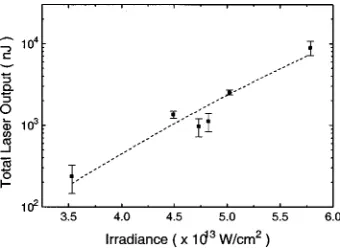
The x-ray laser output increases as the peak irradiance of the main pulse increases ~Fig. 6!. This can be shown to be due to the increase in electron temperature with increasing irradiance. The collisional excitation rate into the upper
quantum state of the x-ray lasing transition is approximately proportional to;exp(2DE/kTe)/(kTe)0.5.9If we assume that the electron temperature is proportional to Imain/Ipre
a as above, the gain coefficient is then proportional to exp(2bImaina21)/Imain(12a)/2, where b is a constant. Since the re-fraction of x-ray lasers is not serious when using a prepulse, the x-ray laser output increases as the exponent of the gain coefficient. After fitting this dependence to the experimental data ~see Fig. 6!, a is determined as 0.3560.05, which is consistent with the value described above. If we assume the prepulse energy is mainly deposited at the critical density, a simple balance of the pressure P3velocityn and laser irra-diance at the critical density gives an ionic acoustic velocity
n}Ipre1/3, which also agrees with the scaling value.
V. CONCLUSIONS
The Ni-like Sm x-ray laser pumped by double drive pulses has proven to be an efficient and bright x-ray source at short wavelength. We have demonstrated the first detailed parameter scan of a double pulse pumped Ni-like x-ray laser using a single Sm target. Using an optimum pulse configu-ration has been shown to increase the x-ray laser outputs by orders of magnitude. The optimum pulse ratio is found to decrease as the pulse interval increases, which agrees with the predictions of a simple model.
ACKNOWLEDGMENTS
The authors gratefully acknowledge the assistance of the laser operation and target fabrication staff of the Rutherford Appleton Laboratory. The work has been supported by sev-eral grants from the United Kingdom Engineering and Physi-cal Sciences Research Council.
1
J. Zhang, A. G. MacPhee, J. Nilsen, J. Lin, T. W. Barbee, Jr., C. Danson, M. H. Key, C. L. S. Lewis, D. Neely, R. M. N. O’Rourke, G. J. Pert, R. Smith, G. J. Tallents, J. S. Wark, and E. Wolfrum, Phys. Rev. Lett. 78, 3856~1997!.
2
J. Y. Lin, G. J. Tallents, J. Zhang, A. G. MacPhee, C. L. S. Lewis, D. Neely, J. Nilsen, G. J. Pert, R. M. N. O’Rourke, R. Smith, and E. Wolfrum
~submitted!.
3J. Zhang, A. G. MacPhee, J. Lin, E. Wolfrum, R. Smith, C. Danson, M. H.
Key, C. L. S. Lewis, D. Neely, J. Nilsen, G. J. Pert, G. J. Tallents, J. S. Wark, and P. J. Warwick, Phys. Lett. A 234, 410~1997!.
4J. Zhang, A. G. MacPhee, J. Lin, E. Wolfrum, R. Smith, C. Danson, M. H.
Key, C. L. S. Lewis, D. Neely, J. Nilsen, G. J. Pert, G. J. Tallents, and J. S. Wark, Science 276, 1097~1997!.
5
G. F. Cairns, C. L. S. Lewis, M. J. Lamb, A. G. MacPhee, D. Neely, P. Norreys, M. H. Key, S. B. Healy, P. B. Holden, G. J. Pert, J. A. Plowes, G. J. Tallents, and A. Demir, Opt. Commun. 123, 777~1996!.
6J. Y. Lin, G. J. Tallents, A. Demir, S. B. Healy, and G. J. Pert, J. Appl.
Phys. 83, 1863~1998!.
7
S. B. Healy, G. F. Cairns, C. L. S. Lewis, G. J. Pert, and J. A. Plowes, IEEE J. Sel. Top. Quantum Electron. 1, 949~1995!.
8D. Neely, D. Chambers, F. Quinn, and M. Roper, RAL Technical Report,
1997.
9
[image:5.612.89.259.51.175.2]R. C. Elton, X-ray Lasers~Academic, London, 1990!, p. 101. FIG. 6. Sm x-ray laser output as a function of the peak irradiance of the
main pulse. The pulse ratio and pulse interval are fixed at 5% and 2.2 ns, respectively. The fitted curve is the expected variation of x-ray laser output taking account of the variation of the collisional excitation rate.