R E S E A R C H A R T I C L E
Open Access
Evaluation of SNP calling using single and
multiple-sample calling algorithms by
validation against array base genotyping
and Mendelian inheritance
Pankaj Kumar
1, Mashael Al-Shafai
1, Wadha Ahmed Al Muftah
1, Nader Chalhoub
1, Mahmoud F Elsaid
2,
Alice Abdel Aleem
1and Karsten Suhre
1,3*Abstract
Background:With diminishing costs of next generation sequencing (NGS), whole genome analysis becomes a standard tool for identifying genetic causes of inherited diseases. Commercial NGS service providers in general not only provide raw genomic reads, but further deliver SNP calls to their clients. However, the question for the user arises whether to use the SNP data as is, or process the raw sequencing data further through more sophisticated SNP calling pipelines with more advanced algorithms.
Results:Here we report a detailed comparison of SNPs called using the popular GATK multiple-sample calling protocol to SNPs delivered as part of a 40x whole genome sequencing project by Illumina Inc of 171 human genomes of Arab descent (108 unrelated Qatari genomes, 19 trios, and 2 families with rare diseases) and compare them to variants provided by the Illumina CASAVA pipeline. GATK multi-sample calling identifies more variants than the CASAVA pipeline. The additional variants from GATK are robust for Mendelian consistencies but weak in terms of statistical parameters such as TsTv ratio. However, these additional variants do not make a difference in detecting the causative variants in the studied phenotype.
Conclusion:Both pipelines, GATK multi-sample calling and Illumina CASAVA single sample calling, have highly similar performance in SNP calling at the level of putatively causative variants.
Keywords:NGS, GATK, CASAVA, WGS pipeline, Mendelian inheritance, Qatari population, Multi-sample calling, Genotype calling, Variant, Trios, Illumina
Background
Numerous NGS pipelines and tools have been developed in recent years that are valuable to users in the field, but also create confusion in selecting the desired tool. Some of the commercial NGS pipelines are CLC genomics workbench, DNASTAR, CASAVA, Genious, Genomatix Solutions, GenoMiner, Partek Genomics Suite and so on. Most of the commercial NGS pipeline tools are tar-geted to biologists as end-users highlighting easy and
user friendly interface. Often, these commercial tools be-come difficult to customize for speed when processing large number of samples. Alternatively, commercial ven-dors provide the facility to process and ship the complete variants sets along with the sequencing of samples. Non-commercial open source NGS pipelines such as GATK [1,2], SAMtools [3], SOAP [4,5], SNPAAMapper [6], WEP [7], Atlas2 [8] are also being used extensively in academia and many organizations. These open source NGS pipe-lines are highly customizable but require expertise to set up optimally. Many studies have been done to evaluate NGS data analysis pipelines and tools. Bao S. et al. [9] have evaluated various mapping and assembly software. * Correspondence:[email protected]
1
Weill Cornell Medical College in Qatar, Education City, Doha, Qatar 3Institute of Bioinformatics and System Biology, Helmholtz Zentrum
Munchen, German Research Center of Environmental Health, Nuherberg, Germany
Full list of author information is available at the end of the article
Pabinger et al. [10] have surveyed around 205 variants of NGS tools at different analytical steps like quality assess-ment, alignassess-ment, variant identification, variant annotation and visualization. Nielsen et al. [11] have evaluated various SNP and genotype calling algorithms. Although these studies have helped tremendously in determining which tools and pipelines to use, they do not answer the concrete question of whether to use data provided from a commer-cial vendor or to put in extra efforts to run additional well-known open source pipelines. Also, in situations where we fail to identify a causative variant in the data set provided by commercial vendors, we may doubt the pipe-line’s ability to find the variants. Thus, it becomes import-ant to compare the variimport-ant sets provided by commercial vendors with variants obtained through one of the well-reputed tools. Several studies have confirmed the GATK pipeline’s excellent performance in detecting variants. The GATK pipeline is being used in large projects, such as the 1000 Genomes Project and The Cancer Genome Atlas [1,12]. However, smaller labs and institutes often rely fully on commercial vendors for complete sequencing and ana-lysis services. Illumina Inc. is a leader in providing NGS services. Illumina uses the CASAVA and ISSAC pipelines for variant detection. Illumina has reported comparison among ISAAC, CASAVA and GATK pipelines; mostly for the speed of completing the pipeline [13]. However, an in-dependent detailed comparison between the Illumina and GATK pipeline using multi-sample calling algorithm in larger cohorts is necessary. Here we compared variant sets supplied by the Illumina CASAVA pipeline and the well-known GATK pipelines in great detail on concrete study cases and discuss the differences from a user’s perspective. In general, genotype calling errors by the variant callers are associated with Mendelian violation when the caller is unaware of family structure [14]. In this study, both GATK and CASAVA are unaware of family pedigree and therefore Mendelian inheritance is examined in familial samples for the genotypes of discordant variants by the pipelines. As an additional independent quality control we use genotyping array data from the Illumina OMNI 2.5 array. We present an evaluation of the CASAVA and the GATK pipelines for three different data sets: 108 unrelated Qatari genomes, 19 trios from studies on obesity and dia-betes, and 2 larger families with suspected rare genetic diseases.
Methods
CASSAVA SNP calling
Illumina SNP calls were based on the CASAVA −1.9.0a1_110909 pipeline. SNPs and the genotype from the CASAVA pipeline were called for each sample indi-vidually. We created a pass quality subset of these variants by keeping the variant for which Filter column in VCF file has value “PASS” and removing all other variants. Thus,
the first set without any quality filter will be called CASAVA ALL and the quality filtered set will be called CASAVA PASS in this paper. In many cases, we have compared the pipelines for a group of samples. In these cases, we merged these SNPs from the CASAVA pipeline using vcftools [15]. Similarly, we created merged VCF for quality filtered (PASS quality) from the CASAVA pipeline by merging all the PASS quality SNPs based on quality column annotation (Genotype quality >20) in all single sample VCF files.
GATK best practice pipeline
Genotyping Omni array
Human genotyping array data is from Illumina Human-Omni2.5-8 platform. This array has about 2.37 million tag SNPs from 1000 genomes pilot project with MAF ≥2.5%. Illumina Inc. supplied genotypes for all the samples from HumanOmni2.5-8 by performing Illumina Infinium LCG assay and thereupon calling the genotypes using their propri-ety software called GenomeStudio. They provide genotype for each of these probes with GenCall scores. Illumina recommends a GenCall score cut-off of 0.15 for their infinium assay based products [20]. This recommended GenCall score cut-off of 0.15 was used to test the con-cordance with the GATK and CASAVA pipelines.
Evaluation data sets
1. 108 unrelated individuals from Qatar
Genotypes from HumanOmni2.5-8 array and Whole Genome Sequencing (WGS) data analysis from CASAVA and GATK pipeline are compared for these 108 unrelated individuals from Qatar. Whole Genome Sequencing was done by Illumina Hiseq 2500 sequencer with the average coverage of 37.99 (see Additional file1). Phenotypes of these
individuals are either diabetic or normal individuals. Illumina CASAVA pipeline called variants using a single sample (genome) at a time while we used GATK multi-sample calling.
2. 19 trios (Father, Mother, Offspring)
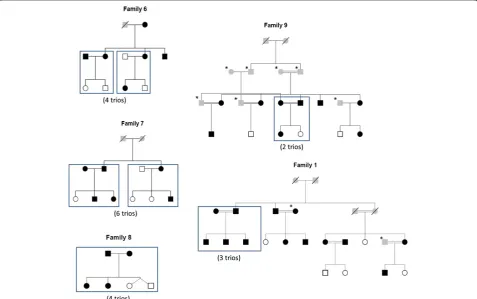
These 19 trios are selected from another cohort of 64 individuals with 11 different families. Whole Genome Sequencing was done by Illumina Hiseq 2500 sequencer with the average coverage of 39.50 (Additional file1). Variants from the GATK pipeline were called for all the 64 individuals together by multi-sample calling using the UnfiedGenoytper and variant sets for trios were filtered using SelectVariants walker. The pedigree structures for families from which trios are selected are shown in Figure1. 3. Two clinical case studies of monogenic disorders
[image:3.595.59.537.392.691.2]In the first family (Figure2A), both affected children are present with hypoplasia of cerebellum as a disease phenotype. The other three members (Father, mother and aunt) are unaffected. The second family (Figure2B) comprises two affected children with abnormal pain sensation and two unaffected children. Whole Genome Sequencing was done by Illumina Hiseq 2500 sequencer with the
average coverage of 43.20 for first family and 42.95 for second family (Additional file1). In the pipeline comparison result for these two families, GATK calls were made by multi-sample calling of all members of the family whereas CASAVA calls were from single sample calling.
For all three evaluation data sets, although Illumina sup-plied annotated VCF files, we annotated both Illumina and GATK VCF files using SnpEff [21] and AnnTools [22] to provide a uniform annotation for comparison between pipelines.
Results
The summarized comparison results between the CASAVA and GATK pipeline are presented in Table 1. Both CASAVA and GATK have very high similarity to OmniAr-ray genotypes. However, while comparing all variants from NGS, GATK identifies a higher number of variants than CASAVA. The robustness of these additional variants are analyzed and discussed below in the results presented for comparison between the pipelines for various data sets.
Comparison of NGS pipelines with genotyping array The Illumina Omni 2.5 platform can detect genotypes at 2.37 million SNP loci in the human genome. In every single individual about 30% of these 2.37 million SNPs were present either in a heterozygous or a homozygous for the non-reference variant state. Illumina only reports genotypes for such variants in the VCF files. Reference allele homozygous calls are not differentiated from non-call. We therefore compare the pipeline only on SNPs that are reported in the VCF files. Both pipelines have very high concordance (~99%) with genotyping array data (Table 1). GATK pipeline has a higher number of non-reference SNPs compared to CASAVA, but CASAVA
has slightly higher genotyping matches (99.67%) compared to GATK (98.33%). For quality passed variants (CASAVA PASS, GATK PASS) both pipelines have approximately the same concordance with Illumina Genotyping OmniAr-ray data (Table 1 and Additional file 2). False positives and false negatives in Table 1 are calculated assuming Illumina OMNI 2.5 genotype data to be correct. GATK has lot more false positive compared to CASAVA before PASS filter and the opposite after PASS filter. To our surprise, TsTv ratios of these false positives are not very far from ideal TsTv ratio of 2.0-2.1. Furthermore, TsTv ratio of false positive by GATK is better, closer to 2, than the TsTv ratio of false positive by CASAVA in both before and PASS filter. More-over, the TsTv ratio of common false positive is near to 2 suggesting these small numbers of common false positive by both pipelines could be false negative in OMNI 2.5 genotype array data.
Pipeline comparison in unrelated individuals
[image:4.595.57.539.90.255.2]Venn diagram in Figure 3 shows the comparison be-tween CASAVA and GATK pipeline for the combined variants of all 108 unrelated individuals. For the unfiltered variants set in Figure 3A, GATK ALL and CASAVA ALL have an approximately equal number of SNPs (24.01 million for GATK and 23.99 million for CASAVA) and an equal number of unique SNPs (2.4 million for GATK and 2.39 million in CASAVA). However, if we look at the individual sample from GATK and CASAVA in Figure 4E, we find GATK has many more SNP calls than CASAVA (4.33 million by GATK and 4.02 million by CASAVA). This discrepancy, similar number of var-iants by pipelines at population level but different at sample level, can be explained by exploring shared and unique variants across the samples (Figure 5). The number of shared variants among 108 individuals iden-tified by GATK is lot more than in CASAVA for both
with and without PASS filter (Figure 5a, Figure 5b). The distribution of number of unique variants among 108 individuals identified by GATK and CASAVA are overlapping in great extant and thus are very similar (Figure 5c and Figure 5d). Also, we can explain the dis-crepancy by pipelines at population and sample level by looking at the pipeline specific calls (GATK ONLY
[image:5.595.57.544.100.423.2]and CASAVA ONLY calls). Theoretically, CASAVA ONLY calls should be very different across the 108 samples and GATK only calls should be similar across 108 samples to justify the observed discrepancy. When we checked the GATK ONLY 2.4 million SNPs of com-bined variants set (Figure 3A), we found that around 56.6% (1.29 million) were present in more than 5 out
[image:5.595.60.539.549.694.2]Figure 3Venn diagrams comparing combined variants of All108 Qatari genomes by GATK and CASAVA pipelines. A)Between GATK ALL and CASAVA ALL variants sets showing intersection and unique variants sets.B)Between GATK PASS and CASAVA PASS variants sets showing intersection and unique variants sets.
Table 1 Summary of GATK and CASAVA comparison
Data sets CASAVA GATK Common
Variant count TsTv ratio Variant count TsTv ratio Variant count TsTv ratio
Omni Array Genotyping Data
108 unrelated (per sample)
All SNP by pipelines 708,089 ± 4,516 3.56 ± 0.003 715,033 ± 4,551 3.53 ± 0.003 706,378 ± 4502 3.57 ± 0.003
GT Matched SNP 705,749 ± 4468 3.58 ± 0.003 703,608 ± 4479 3.59 ± 0.003 698,910 ± 4437 3.60 ± 0.003
Ref or missing by pipeline
1661347 ± 4538 1654613 ± 4573 1649566 ± 4567
False positive 988 ± 20 1.46 ± 0.020 6320 ± 112 1.61 ± 0.039 489 ± 13 1.92 ± 0.031
False negative 23283 ± 90 22076 ± 58 20550 ± 59
PASS SNP by pipelines 707,128 ± 4506 3.57 ± 0.003 696,960 ± 4480 3.60 ± 0.003 695,589 ± 4456 3.60 ± 0.003
GT Matched SNP 705,106 ± 4459 3.58 ± 0.003 693,135 ± 4434 3.63 ± 0.003 689,330 ± 4394 3.63 ± 0.003
Ref or missing by pipeline
1662325 ± 4528 1672894 ± 4501 1657868 ± 4533
False positive 810 ± 17 1.33 ± 0.019 277 ± 20 2.23 ± 0.054 229 ± 10 2.12 ± 0.054
False negative 24067 ± 134 33985 ± 96 22735 ± 65
NGS Data Set
108 unrelated (per sample)
All 4,025,625 ± 44,102 2.02 ± 0.001 4,331,336 ± 45,896 1.86 ± 0.002 3,792,293 ± 43,122 2.07 ± 0.000
PASS 3,894,810 ± 43,388 2.04 ± 0.001 3,438,203 ± 41205 2.13 ± 0.001 3,401,091 ± 40317 2.15 ± 0.001
19 trios ( per trio) ALL 5,235,184 ± 47,790 2.01 ± 0.001 7,003,439 ± 56,488 1.88 ± 0.003 4,945,042 ± 46,650 2.06 ± 0.002
PASS 4,786,871 ± 47,564 2.07 ± 0.002 5,125,002 ± 48,717 2.13 ± 0.001 4,320,414 ± 43,062 2.14 ± 0.001
Family 1 ALL 6,082,624 2.00 6,337,108 1.88 5,635,183 2.04
PASS 5,438,393 2.07 5,004,048 2.12 4,898,126 2.13
Family 2 ALL 5,192,891 1.99 5,459,725 1.84 4,752,193 2.03
PASS 4,526,291 2.07 4,205,995 2.12 4,104,343 2.13
of 108 samples. In contrast, in CASAVA ONLY 2.39 million combined variants (Figure 3A), only 18.8% (0.45 million) were present in more than 5 out of 108 samples. The higher percentage of consensus call across the sample in GATK ONLY SNPs compared to CASAVA ONLY SNPs indicates the effects of multi-sampling calling using the GATK pipe-line. We hypothesize that this effect is desired since the sam-ples are from the same population. In other words, in order to have confidence in the SNPs that are non-agreeing across the pipelines, the variant calls should have agreement across the samples, provided that the samples originate from same population. However, the variants identified by only one pipeline (GATK ONLY SNPs or CASAVA ONLY SNPs) have lower TsTv ratio compared to variants that are com-mon to both pipeline (Figure 4A and Figure 4B). TsTv ratio for GATK ONLY SNPs before pass filter in Figure 4A is very low (1.096 ± 0.003). Similarly, TsTv ratio of CASVA ONL
[image:6.595.59.538.87.454.2]SNPs in Figure 4B is low (1.485 ± 0.001). The lower TsTv ra-tio of pipeline specific variants indicates the presence of false positives. Furthermore, Het/Hom ratio of GATK ONLY sub-set after GATK PASS filter is very high, as shown in Figure 4D, indicates that GATK calls more false posi-tive heterozygous calls than homozygous false posiposi-tive calls. In general, the explanation of lower TsTv for both before and after PASS filter should be similar. The more number of pipeline specific variants has more false posi-tives. In addition to the pipeline specific variant count, the lower quality variants could be reason of of very low Tstv ratio for GATK ONLY in Figure 4A compared to TsTv ra-tio of GATK ONLY subset in Figure 4B. However, before pass filter the number of combined set of variants for GATK ONLY (2.4 million) is similar to CASAVA ONLY (2.39 million) and, therefore, should not have drastically different TsTv in data set. Moreover, GATK ONLY subset
Figure 4Individual genome comparison between GATK and CASAVA pipeline in 108 unrelated Qatari individuals. A,C,andEshow comparison for unfiltered sets (CASAVA ALL, GATK ALL).B,D, andFshow comparison for quality filtered sets (CASAVA PASS, GATK PASS).Aand
has more number of shared variants among 108 samples compared to CASAVA ONLY and intuitively we would be expecting better TsTv for GATK ONLY compared to CASAVA ONLY. The opposite behavior of TsTv can thus be attributed to GATK multi-sample calling which might be placing doubtful SNP in samples at particular locus if it one or more samples have confirmed SNP at that locus. This suggests that multi-sample calling has the advantage of calling more variants but at the cost of more false posi-tives. The other possible explanation of lower TsTv ratio of pipeline specific variants could be non-universal nature of TsTv ratio [23]. However, we tested this by random sampling the 2.4 million variants 10 times and computed TsTv ratio. We found TsTv ratio of these randomly sampled variant to be 2.051 ± 0.001. This excludes non-universal na-ture of TsTv ratio as possible explanation. Thus, lower TsTv for pipeline specific (GATK ONLY and CASAVA ONLY) subset is indication of false positives. The non-agreeing SNPs between the pipelines can also be analyzed in a family structure to see the Mendelian violation, which we did by looking at 19 trios (Father, Mother, and Offspring) and 2 families having homozygous recessive diseases.
Pipeline differences after PASS filter at per sample level (Figure 4F) is apposite to before PASS filter (Figure 4E) i.e. the number of SNPs per sample in GATK call set is lower than in CASAVA. However, at population level GATK called more SNPs in both before and after PASS filter (Figure 3A and Figure 3B). It is important to see how PASS filter changed the allele frequency distribution in GATK and CASAVA. Minor Allele Frequency (MAF) distribution plot shown in Additional file 3 and vari-ants frequency distribution shown in Additional file 4 to see the effect of PASS filter for both GATK and
CASAVA. In Additional file 3, we can see that PASS filter removes low frequency with high MAF and, there-fore, we see higher frequency for low MAF. In Additional file 4, we can see the distributions of GATK before and PASS filtering is far apart while the distribution of CASAVA before and PASS filtering has some overlap. This shows that there are many low quality variants from each of the 108 unrelated samples identified by GATK. This also explains the reason of higher false positives and lower TsTv ratio for of GATK compared to CASAVA before PASS filter.
Pipelines comparison in trios
The CASAVA and GATK pipelines were compared for 19 trios from the Qatari population by taking combined vari-ants sets of each trio separately (Figure 6 and Additional file 5). On average GATK ALL have 7 million variants in any trio compared to 5.25 million variants in CASAVA ALL (Figure 6). The large difference between the GATK ALL and CASAVA ALL variant sets in any trio can be at-tributed to GATK multi-sample calling, but this gives rise to the question about the qualities of these extra variants. Both pipelines have approximately equal percentage of variants having Mendelian violation (3.40% for CASAVA ALL and 3.47% for GATK ALL (Figure 6C). Assuming Mendelian violation as a criterion to judge confidence in variants, CASAVA pipeline missed those extra 1.75 million variants present in GATK ALL, which were comparable in quality. However, the lower TsTv ratio of 1.01 for Mendelian violated GATK ALL variants compared to TsTv ratio of 1.47 for Mendelian violated CASAVA ALL variants (Figure 6A) creates doubt about these extra 1.75 million variants of GATK ALL. The difference between number 0.00e+00
2.50e−06 5.00e−06 7.50e−06 1.00e−05 1.25e−05
0e+00 1e+05 2e+05
Unique Variants
Density
0e+00 2e−06 4e−06
3000000 3500000 4000000 4500000
Shared Variants
CASAVA ALL CASAVA PASS GATK ALL GATK PASS
[image:7.595.59.540.89.290.2]A
B
of variants, Mendelian violation, and TsTv ratio in the GATK and CASAVA pipelines is diminished for quality-filtered sets (CASAVA PASS and GATK PASS). It’s im-portant to estimate false positive rate for the decision of applying the PASS filter or not. Since we do not have genotyping array data for trios, we are confined to assess the pipelines performance based on Mendelian violation and TsTv ratio. We can assume the variant set confirmed by both pipelines to be robust to provide us the rough es-timate of the Fraction of Mendelian violation (FMV) in each trio by the pipeline. Using this fraction we thus com-puted the Expected number of Mendelian violation in var-iants subset (EMV) which didn’t pass the PASS filter (NOT PASS) in the pipelines. We then found the actual number of variants with Mendelian violation (OMV) in all the vari-ants in NOT PASS subset (TNP). We then calculated the false positive fraction in the NOT PASS subset by (OMV– EMV)/TNP. This way we found mean false positive percent of 11.15% for GATK NOT PASS subset and 22.90% for CASAVA NOT PASS subset in 19 trios. The detailed numbers are shown in Additional file 6. The false positive percent in CASAVA NOT PASS is higher than GATK NOT PASS in trios that is in contrast to false positive per-cent by pipelines in 108 unrelated individuals when com-puted using Genotyping OMNI array data. It suggests that GATK multi-sample calling algorithm works better in re-lated individuals compared to unrere-lated individuals. In order to check the real difference at a functional level, we evaluated the pipeline performance in real case of finding
the causative homozygous recessive variant in two dis-eased families.
Pipelines comparison for calling variants in monogenic homozygous recessive diseased families
We analyzed two different families with affected children. In Family 1, affected children were diagnosed with the phenotype of hypoplasia of cerebellum which is mono-genic homozygous recessive disease [24-28]. In Family 2, affected children were diagnosed with abnormal pain sen-sation, which is also monogenic homozygous recessive disease [29-33]. The number of variants between pipelines and between quality filter sets follows the similar pattern of what we saw above in the comparison between the pipelines in trios. However, in these cases, the difference in Mendelian violation between the pipelines is strongly pronounced. The difference is more between CASAVA ALL and GATK ALL variants set and the detail of this shown in Table 2 and Table 3 for Diseased Family 1 and Diseased Family 2 correspondingly. Since, CASAVA PASS and GATK PASS variants sets have lot of similarity; the details of number of variants for various categories are shown in Additional file 7 and Additional file 8 for Dis-eased Family 1 and Disease Family 2 correspondingly.
Diseased family 1
The CASAVA pipeline has 4.78% (290985 out of 6082624) of variants with Mendelian violation in the CASAVA ALL set and 1.23% (66903 out of 5438393) of variants with
CASAVA GATK
CASAVA ALL,GATK ALL CASAVA PASS, GATK PASS
MV Total MV
0.5
1.0
1.5
2.0
2.5
n=19 n=19 n=19 n=19
Total MV Total MV
0.5
1.0
1.5
2.0
2.5
n=19 n=19 n=19 n=19
Total MV Total MV Total MV Total MV
tstv ratio
Total
variant count (in million)
7 6 5 4 3 2 1 0
5
4
3
2
1
0
A
B
[image:8.595.58.539.89.336.2]C
D
Mendelian violation in the CASAVA PASS set. In contrast, GATK has only 2.96% (187920 out of 6337108) of variants with Mendelian violation in the GATK ALL set and 0.14% (7122 out of 5004048) of variants with Mendelian viola-tion in the GATK PASS set (Table 2 and Addiviola-tional file 7). Because both children are affected by the hypoplasia of cerebellum, and the parents and aunt are unaffected, the causative variant should be a homozygous variant [34]. We further investigated the pipeline performance to find the homozygous recessive variants. In this paper, we use the term Homozygous Recessive Condition (HRC) for any particular variant position in a family when all three of the following conditions are met: 1) all affected off-springs are homozygous, 2) all affected off-springs have the same geno-type and their genogeno-type is different than normal individuals in the family, and 3) all affected off-springs follow Mendelian inheritance (e.g. Father GT = A/C, Mother GT = A/C, Affected Child 1 GT = C/C, Affected Child 2 GT = C/C). Both CASAVA and GATK pipelines have approximately a similar number of HRC variants (Table 2). They also have a similar number of region specific or known variants like exonic, CDS, 3’UTR, 5’UTR, intronic, non-synonymous coding, 1000genome and so on. Furthermore, the pipelines
have a similar number of commonly known variants such as those in 1000 genomes, and Q108 (108 unrelated indi-viduals from Qatar). After filtering the known variants, we tried to map these variants to known genes for the phenotype in the literature. We could not map the set of possible causative variants to known genes in this case. Therefore, we tried another real case of homozygous reces-sive disease with a pair of normal and affected siblings.
Diseased family 2
[image:9.595.60.539.99.432.2]This family is different in structure because of the pres-ence of unaffected siblings (Figure 2B), which gives extra power to evaluate the pipeline because of the inherent validation about the variants, e.g. evaluating homozygous recessive variants identified by both the pipelines but mismatched in genotypes according to Mendelian inher-itance in affected and unaffected separately. We have presented a detailed comparison of the pipeline perfor-mances for this family in Table 3. The additional param-eters to judge the pipelines in Table 3, as compared to the previous case in Table 2, are due to the additional two normal siblings in this case. Exclusively determined HRC variants are divided into two sets of variants for Table 2 GATK and CASAVA comparison in diseased Family 1
Pipelines CASAVA all GATK all
HRC HRC
Total Total HRC by CASAVA but
not by GATK Total Total
HRC by GATK but not by CASAVA
Total number of variant 6082624 61497 409 6337108 63774 1349
TsTv Ratio 2.00 2.09 1.88 1.88 2.03 1.07
Mendelian Violation 290985 0 0 187920 0 0
In dbSNP 5562308 60769 268 5609116 62277 643
In interGenic 3682138 35416 257 3790849 36884 846
In CDS 65785 650 2 64452 638 2
In‘3 UTR 77701 849 16 82211 853 11
In‘5 UTR 18552 240 0 20093 246 4
In Intronic 4113210 47220 218 4412928 48805 818
In Non_coding_intronic 214239 1826 26 217104 1839 40
In Exonic 57842 580 1 56762 579 3
In Non_coding_exonic 16356 110 0 15196 106 0
In Putative Promoter Region 12780 135 0 15517 141 1
Non-Synonymous Coding 19080 159 1 18299 161 2
Common Variant 5395888 60389 205 5905677 62830 1335
Common Homozygougs Minor Variant in 1000genome
4777175 56874 104 4792920 57620 194
Common Homozygougs Minor Variant in Q108
4727231 57643 142 4915274 60169 1293
Common Het (>5%) Variant in 1000genome 4479609 56407 99 4494483 57151 189
Common Het(>5) Variant in Q108 4895168 59296 63 5422841 62027 1332
analyzing pipeline performance: 1) HRC variant by Pipeline1 and not by Pipeline2 and having mismatch in genotype calls between the pipelines, and 2) HRC variant by Pipeline1 and none from Pipeline2 for all five individuals.
In the first set of variants (Table 3, Column “GT mis-match by GATK” and “GT mismatch by CASAVA”), in which only one pipeline meets HRC and the pipelines have mismatch in genotype calls, the pipeline not meeting HRC can either have Mendelian inheritance or Mendelian viola-tion. The cases, where both the pipelines have Mendelian inheritance and only one pipeline meets HRC, are difficult
to evaluate in terms of pipeline performance. Example vari-ant position genotypes in this family are as follows:
Pipeline 1 Genotypes (Mendelian Inheritance and HRC):
Father GT = A/C, Mother GT = A/C, Unaffected Child1 GT = A/C, Unaffected Child2 GT = A/C, Affected Child1 GT = C/C, Affected Child1 GT = C/C;
Pipeline2 Genotypes (Mendelian Inheritance but no
HRC):Father GT = A/A, Mother GT = A/C, Unaffected
[image:10.595.58.537.100.572.2]Child1 GT = A/A, Unaffected Child2 GT = A/A, Affected Child1 GT = A/C, Affected Child2 GT = A/C.
Table 3 GATK and CASAVA comparison in diseased Family 2
Pipelines CASAVA all GATK all
HRC HRC
HRC by CASAVA but not by GATK
HRC by GATK but not by CASAVA
Total Total Total GT mismatch by GATK
Absent in GATK
Total Total Total GT mismatch by CASAVA
Absent in CASAVA
Total number of variant 5192891 29522 912 781 131 5459725 30653 2043 1499 544
TsTv Ratio 1.99 2.04 1.30 By CASAVA 1.21 2.05 1.84 2.00 1.29 By CASAVA 1.37 1.09
By GATK 1.23 By GATK 1.37
Mendelian Violation 416915 3 1 By CASAVA 0 1 265402 8 8 By CASAVA 1010 5
By GATK 244 By GATK 3
Mendelian Violation in affected 279336 0 0 By CASAVA 0 0 189043 0 0 By CASAVA 929 0
By GATK 211 By GATK 0
Mendelian Violation in unaffected 267367 3 1 By CASAVA 0 1 182659 8 8 By CASAVA 257 5
By GATK 82 By GATK 3
In dbSNP 4717672 28409 738 656 82 4754687 29129 1458 1243 215
In interGenic 3152905 18780 602 516 86 3266794 19527 1349 999 350
In CDS 54766 339 6 3 3 53607 359 26 11 15
In‘3 UTR 64961 476 4 4 0 69395 483 11 8 3
In‘5 UTR 15087 81 0 0 0 16635 92 11 10 1
In Intronic 3484737 19668 487 427 60 3797577 20562 1381 976 405
In Non_coding_intronic 180421 931 38 29 9 182875 972 79 57 22
In Exonic 48608 284 6 3 3 47577 292 14 7 7
In Non_coding_exonic 13960 82 8 8 0 12525 82 8 7 1
In Putative Promoter Region 10932 56 0 0 0 13801 66 10 10 0
Non-Synonymous Coding 16299 97 4 3 1 15429 100 7 3 4
Common Variant (1000genome + Q108) 4693812 28034 784 728 56 5224846 29186 1936 1418 518
Homozygougs Minor Variant in 1000genome
4089468 26162 396 364 32 4098301 26562 796 726 70
Homozygougs Minor Variant in Q108 4283672 26479 663 628 35 4469485 27677 1861 1357 504
Het (>5%) Variant in 1000genome 3888895 25824 386 354 32 3897416 26225 787 717 70
Het(>5) Variant in Q108 4355312 27616 686 674 12 4900523 28852 1922 1408 514
Non-Synonymous rare Pain related 5 1 0 0 0 5 1 0 0 0
Pain genes mapped to Non-Synonymous rare variants
4 1 0 0 0 4 1 0 0 0
The cases where one pipeline has both HRC and Men-delian inheritance and other pipeline has neither could be a strong indication that the second pipeline calls are wrong in these variants. Example variant position geno-types in this family are as follows:
Pipeline 1 Genotypes (Mendelian Inheritance and HRC):
Father GT = A/C, Mother GT = A/C, Unaffected Child1 GT = A/C, Unaffected Child2 GT = A/C, Affected Child1 GT = C/C, Affected Child1 GT = C/C;
Pipeline2 Genotypes (No HRC due to Mendelian violation in affected off-springs):Father GT = A/A, Mother GT = A/A, Unaffected Child1 GT = A/A, Unaffected Child2 GT = A/A, Affected Child1 GT = C/C, Affected Child1 GT = C/C.
In Table 2, we can see in the CASAVA ALL and GATK ALL sets that out of 1499 exclusively determined HRC variants by GATK, 929(62%) had both Mendelian viola-tions and different genotypes by the CASAVA pipeline. In contrast, out of 781 exclusively determined HRC variants by CASAVA, only 244 (31%) have both Mendelian viola-tions and different genotypes. Therefore, we can say that for exclusively determined HRC where there is mismatch between the genotype calls between the pipelines, the GATK pipeline is more robust than the CASAVA pipeline, if we compare all the variants without any quality filter.
We also examined Mendelian violation in another set of exclusively determined HRC variants by one pipeline where there were no variants in any member of the fam-ily by the second pipeline (Table 3, Column “Absent in GATK” and “Absent in CASAVA”). Both CASAVA and GATK have almost no Mendelian violation in these cases.
Table 3 also shows many categories to compare CASAVA and GATK. CASAVA identifies slightly more number of Non-synonymous variants compared to GATK. However, GATK has higher percentage of Non-synonymous variants as HRC variants compared to CASAVA. About one hun-dred of these Non-Synonymous variants of both the pipe-lines are linked to 60 pain related genes by literature identified using SnpEff [21] and AnnTools [22]. After ex-cluding the common variants (variants present in homozy-gous state in either 1000 genomes or 108 unrelated Qatari individuals, and variant present in heterozygous state with MAF >5%) from these non-synonymous variants, there were 5 variants left by both the pipelines (Non-synonymous pain related rare variant in Table 3). From both pipelines, out of these 5 variants only one was HRC variant and most probably the causative variant.
Discussion
We found excellent performances of both GATK and CASAVA pipelines in matching the genotype calls when
matching with Illumina OmniArray genotype calls. How-ever, we saw differences in the number of variants called by each pipeline in unfiltered variant sets (CASAVA ALL, GATK ALL) and generally GATK identifies more variants because of its multi-sample calling algorithm. Most of these additional variants are of low quality but not bad in terms of Mendelian inheritance. CASAVA pipeline, in most of the cases, have TsTv ratio closer to 2 compared to GATK. Since both CASAVA and GATK pipeline were un-aware of the pedigree structure while calling the geno-types, in conflicting or discordant genotypes by the pipelines, Mendelian inheritance is a good criterion to judge the confidence of variants for familial samples. In general, GATK pipeline called less Mendelian viola-tion for all different sets. Notably, PASS filter in GATK pipeline drastically minimizes Mendelian Violation, from 2.4% in GATK ALL to 0.14% in GATK PASS in disease family 1 and from 4.86% in GATK ALL to 0.19% in GATK PASS in disease family 2. However, in CASAVA pipeline PASS filter does not reduce Mendelian violation signifi-cantly, from 4.78% in CASAVA ALL to 1.23% in CASAVA PASS in disease family 1 and from 8.03% in CASAVA ALL to 1.87% in CASAVA PASS in disease family 2. By assuming Mendelian violation to be inversely correlated to pipeline performance in cases of genotype mismatch and where the other pipeline satisfies HRC, GATK multi-sample calling performs better than CASAVA single sam-ple calling for these cases. However, we didn’t find any significant difference in the ability of these pipelines to identify causative variants in this abnormal pain per-ception family. We also found extremely low Mendel-ian violation in exclusively determined homozygous recessive condition for which variants were not called in any family member by the other pipeline, which sug-gests robustness of both GATK and CASAVA pipelines in finding the functional variants. This broad level agreement between the pipelines suggests that normally we can avoid calling variants again using more sophisticated algorithm except for specific scientific goals. One of such specific scientific goals could be finding de novo mutation in sam-ples where comprehensiveness of variants are desired and can be obtained by taking combining the variant sets from the pipelines with tolerated false positives. Also, if the cohort sample size is large and scientific goal is based on the phase SNPs, it is desirable to use more sophisti-cated SNP calling platform such as GATK multiple-sample calling.
and 2.02% respectively while the difference between GATK and CASAVA presented in this paper using GATK v2.4 are around 4.9% and 7.6% before and PASS filter set respectively. Similarly, the relative standard de-viation of TsTv of different versions of GATK for before and PASS filter sets are and only 0.58% and 0.59% re-spectively while the difference between GATK and CASAVA presented in this paper using GATK v2.4 are around 8.2% and 2.4% before and PASS filter set respectively. Thus, the different version of GATK have very little effect on the num-ber of variants identified and thus doesn’t change the results and conclusion drawn in this paper using GATK v2.4.
We have used 3 different type of data set (108 unre-lated, 19 trios, and 2 diseased families) to cover some of the various possible data sets. We have found difference in results for related and unrelated individuals. In gen-eral, the pipeline comparison results should hold for most of the possible data set with some limitations. We have only tested for sequences coming from Illumina platform that helps in fair comparison of the pipeline but the result might deviate for sequence reads from some other platform. Also, we have not tested for com-plex diseases like cancer where somatic mutation is frequent.
Conclusion
High quality SNP calls delivered by commercial NGS se-quencing projects in general show concordance with array genotypes and Mendelian inheritance. Application of more sophisticated SNP calling platforms, i.e. using GATK multiple-sample calling, may be helpful in valid-ating and expanding the number of possible candidates, especially in related individuals, but may not provide additional candidates for monogenic disorders. In gen-eral, it is futile effort of calling variants again using open source alternative when commercial vendors had already supplied variants sets. However, in cases of related indi-viduals where commercial providers lack the information of relatedness because of confidentially involved, one should try multiple-sample calling to expand variants conforming Mendelian inheritance.
Additional files
Additional file 1:Coverage of samples.
Additional file 2:Comparison of GATK and CASAVA pipeline with OmniArray.
Additional file 3:Effect of PASS filter on Minor Allele Frequency distribution in 108 unrelated Qatari individuals.
Additional file 4:Effect of PASS filter on variant count distribution in 108 unrelated Qatari individuals.
Additional file 5:Het-hom of individual Father, Mother, and Off-spring in 19 trios with GATK and CASVA comparison.
Additional file 6:Pipelines performances in 19 trios using Mendelian violation.
Additional file 7:GATK and CASAVA comparison for quality filtered set in diseased Family 1.
Additional file 8:GATK and CASAVA comparison for quality filtered set in diseased Family 2.
Additional file 9:GATK version sensitivity analysis.
Abbreviations
NGS:Next Generation Sequencing; WGS: Whole Genome Sequencing; SNP: Single Nucleotide Polymorphism; VCF: Variant Call Format; GT: Genotype; TsTv: Transition-transversion; CDS: Coding DNA Sequence; UTR: Un-translated Region; HRC: Homozygous Recessive Condition.
Competing interests
The authors declare that they have no competing interests.
Authors’contributions
PK and KS designed the study and wrote the manuscript. PK performed the data analysis. MA, WM, NC, ME, AA collected patient samples. MA and WM contributed to trios data analysis. NC, ME, AA contributed to monogenic disease cases data analysis. All authors read and approved the final manuscript.
Acknowledgement
This work is supported by the Biomedical Research Program funds at Weill Cornell Medical College in Qatar, a program funded by the Qatar Foundation. The statements made herein are solely the responsibility of the authors.
Author details
1
Weill Cornell Medical College in Qatar, Education City, Doha, Qatar. 2Neuropediatrics Department, Hamad Medical Corporation, Doha, Qatar. 3
Institute of Bioinformatics and System Biology, Helmholtz Zentrum Munchen, German Research Center of Environmental Health, Nuherberg, Germany.
Received: 6 May 2014 Accepted: 3 October 2014 Published: 22 October 2014
References
1. McKenna A, Hanna M, Banks E, Sivachenko A, Cibulskis K, Kernytsky A, Garimella K, Altshuler D, Gabriel S, Daly M, DePristo MA:The genome analysis toolkit: a MapReduce framework for analyzing next-generation DNA sequencing data.Genome Res2010,20(9):1297–1303.
2. DePristo MA, Banks E, Poplin R, Garimella KV, Maguire JR, Hartl C, Philippakis AA, del Angel G, Rivas MA, Hanna M, McKenna A, Fennell TJ, Kernytsky AM, Sivachenko AY, Cibulskis K, Gabriel SB, Altshuler D, Daly MJ:A framework for variation discovery and genotyping using next-generation DNA sequencing data.Nat Genet2011,43(5):491–498.
3. Li H, Handsaker B, Wysoker A, Fennell T, Ruan J, Homer N, Marth G, Abecasis G, Durbin R:Genome project data processing S: the sequence alignment/Map format and SAMtools.Bioinformatics2009,25(16):2078–2079.
4. Li R, Li Y, Fang X, Yang H, Wang J, Kristiansen K, Wang J:SNP detection for massively parallel whole-genome resequencing.Genome Res2009, 19(6):1124–1132.
5. Li S, Li R, Li H, Lu J, Li Y, Bolund L, Schierup MH, Wang J:SOAPindel: efficient identification of indels from short paired reads.Genome Res 2013,23(1):195–200.
6. Bai Y, Cavalcoli J:SNPAAMapper: an efficient genome-wide SNP variant analysis pipeline for next-generation sequencing data.Bioinformation 2013,9(17):870–872.
7. D’Antonio M, D’Onorio De Meo P, Paoletti D, Elmi B, Pallocca M, Sanna N, Picardi E, Pesole G, Castrignano T:WEP: a high-performance analysis pipeline for whole-exome data.BMC Bioinform2013,14(Suppl 7):S11. 8. Evani US, Challis D, Yu J, Jackson AR, Paithankar S, Bainbridge MN,
9. Bao S, Jiang R, Kwan W, Wang B, Ma X, Song YQ:Evaluation of next-generation sequencing software in mapping and assembly.J Hum Genet2011, 56(6):406–414.
10. Pabinger S, Dander A, Fischer M, Snajder R, Sperk M, Efremova M, Krabichler B, Speicher MR, Zschocke J, Trajanoski Z:A survey of tools for variant analysis of next-generation genome sequencing data.Brief Bioinform2013.
11. Nielsen R, Paul JS, Albrechtsen A, Song YS:Genotype and SNP calling from next-generation sequencing data.Nat Rev Genet2011,12(6):443–451. 12. Wu CC, Lin YH, Lu YC, Chen PJ, Yang WS, Hsu CJ, Chen PL:Application of
massively parallel sequencing to genetic diagnosis in multiplex families with idiopathic sensorineural hearing impairment.PLoS One2013,8(2):e57369. 13. Raczy C, Petrovski R, Saunders CT, Chorny I, Kruglyak S, Margulies EH,
Chuang HY, Kallberg M, Kumar SA, Liao A, Little KM, Stromberg MP, Tanner SW:Isaac: ultra-fast whole-genome secondary analysis on Illumina sequencing platforms.Bioinformatics2013,29(16):2041–2043.
14. Chen W, Li B, Zeng Z, Sanna S, Sidore C, Busonero F, Kang HM, Li Y, Abecasis GR:Genotype calling and haplotyping in parent-offspring trios.
Genome Res2013,23(1):142–151.
15. Danecek P, Auton A, Abecasis G, Albers CA, Banks E, DePristo MA, Handsaker RE, Lunter G, Marth GT, Sherry ST, McVean G, Durbin R, Genomes Project Analysis Group:The variant call format and VCFtools.Bioinformatics 2011,27(15):2156–2158.
16. Langmead B, Salzberg SL:Fast gapped-read alignment with Bowtie 2.
Nat Methods2012,9(4):357–359.
17. Picard.http://broadinstitute.github.io/picard/.
18. Clarke L, Zheng-Bradley X, Smith R, Kulesha E, Xiao C, Toneva I, Vaughan B, Preuss D, Leinonen R, Shumway M, Sherry S, Flicek P, Genomes Project Consortium:The 1000 genomes project: data management and community access.Nat Methods2012,9(5):459–462.
19. Sherry ST, Ward MH, Kholodov M, Baker J, Phan L, Smigielski EM, Sirotkin K: dbSNP: the NCBI database of genetic variation.Nucleic Acids Res2001, 29(1):308–311.
20. Ritchie ME, Liu R, Carvalho BS, Australia, New Zealand Multiple Sclerosis Genetics C, Irizarry RA:Comparing genotyping algorithms for Illumina’s Infinium whole-genome SNP BeadChips.BMC bioinformatics2011,12:68. 21. Cingolani P, Platts A, le Wang L, Coon M, Nguyen T, Wang L, Land SJ, Lu X,
Ruden DM:A program for annotating and predicting the effects of single nucleotide polymorphisms, SnpEff: SNPs in the genome of Drosophila melanogaster strain w1118; iso-2; iso-3.Fly2012,6(2):80–92. 22. Makarov V, O’Grady T, Cai G, Lihm J, Buxbaum JD, Yoon S:AnnTools: a
comprehensive and versatile annotation toolkit for genomic variants.
Bioinformatics2012,28(5):724–725.
23. Keller I, Bensasson D, Nichols RA:Transition-transversion bias is not universal: a counter example from grasshopper pseudogenes.PLoS Genet 2007,3(2):e22.
24. Ozcelik T, Akarsu N, Uz E, Caglayan S, Gulsuner S, Onat OE, Tan M, Tan U: Mutations in the very low-density lipoprotein receptor VLDLR cause cerebellar hypoplasia and quadrupedal locomotion in humans.Proc Natl
Acad Sci U S A2008,105(11):4232–4236.
25. Ozcelik T, Akarsu N, Uz E, Caglayan S, Gulsuner S, Onat OE, Tan M, Tan U: Reply to herz et al. And Humphrey et al.: genetic heterogeneity of cerebellar hypoplasia with quadrupedal locomotion.Proc Natl Acad Sci U S A2008,105(23):E32–E33.
26. Glass HC, Boycott KM, Adams C, Barlow K, Scott JN, Chudley AE, Fujiwara TM, Morgan K, Wirrell E, McLeod DR:Autosomal recessive cerebellar hypoplasia in the Hutterite population.Dev Med Child Neurol2005,47(10):691–695. 27. Dilber E, Aynaci FM, Ahmetoglu A:Pontocerebellar hypoplasia in two
siblings with dysmorphic features.J Child Neurol2002,17(1):64–66. 28. Boycott KM, Flavelle S, Bureau A, Glass HC, Fujiwara TM, Wirrell E, Davey K,
Chudley AE, Scott JN, McLeod DR, Parboosingh JS:Homozygous deletion of the very low density lipoprotein receptor gene causes autosomal recessive cerebellar hypoplasia with cerebral gyral simplification.Am J
Hum Genet2005,77(3):477–483.
29. Fanconi G, Ferrazzini F:Congenital analgia (congenital generalized pain indifference).Helvetica paediatrica acta1957,12(1):79–115.
30. Bertoye A, Carron R, Rosenberg D, Cotton JB, Michel M:Apropos of a case of congenital indifference to pain (Universal congenital analgesia). pathogenic hypothesis.Pediatrie1964,19:605–608.
31. Silverman FN, Gilden JJ:Congenital insensitivity to pain: a neurologic syndrome with bizarre skeletal lesions.Radiology1959,72(2):176–190.
32. Thiemann HH:Congenital analgia (congenital universal absence of pain).
Archiv fur Kinderheilkunde1961,164:255–262.
33. Ogden TE, Robert F, Carmichael EA:Some sensory syndromes in children: indifference to pain and sensory neuropathy.J Neurol Neurosurg Psychiatry 1959,22:267–276.
34. Mathews KD, Afifi AK, Hanson JW:Autosomal recessive cerebellar hypoplasia.J Child Neurol1989,4(3):189–194.
doi:10.1186/1756-0500-7-747
Cite this article as:Kumaret al.:Evaluation of SNP calling using single and multiple-sample calling algorithms by validation against array base genotyping and Mendelian inheritance.BMC Research Notes20147:747.
Submit your next manuscript to BioMed Central and take full advantage of:
• Convenient online submission
• Thorough peer review
• No space constraints or color figure charges
• Immediate publication on acceptance
• Inclusion in PubMed, CAS, Scopus and Google Scholar
• Research which is freely available for redistribution